George Manville Fenn (continued 3)
Reading edition
“Drive, drive, and pull up, all the afternoon, with about five or six minutes for my tea, and then up and at it again, hour after hour, till the last journey’s done, and then I’ve got off the box hardly able to stand, I’ve been so cramped; while scarcely ever before eleven, and generally twelve, I’ve got home, worn out, to my bit of supper. Fifteen or sixteen hours, Sunday and weekday, is too much of a good thing, ain’t it? And on such days as I’ve been talking about, when you can’t feel your feet, and your hands won’t hardly hold rein or whip, and the cold goes through and through you, don’t you think as one wants something to comfort one a bit? because if you don’t, I should like them as grumbles to try it on for a month and see.
“Coats, of course, keeps out a deal, but the coat ain’t been made that will keep out all the cold and wet. Oilskins and macintoshes always acts on me rheumatically, and gives me pains all over in the jynts; so I puts on as many reg’lar coats and weskits as I can get on one above another, and wraps up my legs. But in all that long time, it’s no use, the cold creeps in somewhere like the thin edge of a wedge, and lets in ever so much more, and though we mostly gets a shilling or so a day more than the conductors, I don’t know but what I’d rather have their life, on account of the jumping up and down.
“I get very tired of it by the time night comes; but a good sleep and the little bit of home comfort one gets seems to put one right before morning, though, I’m blest if I think a sea captain could know much less of his children than we ’bus drivers do of ours. But there, it can’t last for ever, and I s’pose some day I shall be lifted off my box as Sam was. Couldn’t get down, poor chap, for he stuck to it right to the very last, though his missis wanted him to lay up long before.
“‘Just for a few days, Sam,’ she says, but he shook his head, poor chap, thinking of pay night, and not wanting to go on his club; and so she used to wait at a corner for him, and bring him drops of warm broth and cups of tea, and little things she thought he’d fancy, for the poor fellow was like a horse off his feed; but it was all of no use.
“I used to drive mostly the ’bus that went afore his and used to see her, pale-faced and anxious, waiting at the corner till he came, which was only ten minutes after mine—this being a busy time, you know; and Sam and I having been friends, I used to nod to her, for it’s no use to come the reg’lar s’loot with the whip you know. But, as I said afore, it was all no use; and Sam got worse and worse—reg’lar touched, poor chap—and one night, as he was coming back off his last journey, pulls up sudden like aside the road gives the office with his whip to the conductor, and then drops the reins. Held out to the very last he had, like a Briton, and then as I said they had to lift him down, when the conductor sent him home in a cab, collected the fares, then got up and drove the rest of the journey himself.
“Terrible bad Sam was, poor chap, and first one and then another of us went to sit up with him, for he was delirious best part of the time. My turn came twice over, and I went after I’d had a bit of supper—tripe and onions, and a drop o’ dog’s nose we had that night, and out and out it was, too, for my missus said that them as sat up with sick people ought allus to have something supporting—which I say, you know, just to show that we didn’t have tripe and onions every night; for, you know, the wages wouldn’t run to it.
“So I gets there and finds all made comfortable and him bedded down for the night—for his missus was as good a sort as ever a driver married: snug bit of fire; kettle singing on the hob; easy chair aside the fire, Sam’s medicine on a little table, ready to give him when he woke up; one of his rugs to wrap round me when I got shivery towards morning; and my medicine on the chimney-piece—drop of gin, tumbler, teaspoon, and sugar, with half a lemon on a plate.
“‘I’ll come down about five, and make you a cup of tea,’ says Sam’s wife.
“‘No you won’t,’ I says gruffly. ‘I’ll call you about seven,’ I says, ‘for I must be off then; so you’d better get a good-night’s rest.’
“She didn’t say much, for, poor thing! she’d got into a way then of breaking down and crying at the least word; but she went and straightened Sam’s bed a bit, just as you’ve seen a woman do when the bed don’t want touching; then she leaned over and kissed him, and went off upstairs with the children.
“Plain furnished place theirs was; but, bless you, it was like a little palace, for Sam’s wife had a knack of making things show off to the best advantage, and that, too, without being one of them horrible cleaning women, who seems to think as furniture and carpets was made a purpose to be rubbed up and shook, while floors wasn’t for nothing else but scrubbing.
“Sam seemed fast asleep, and after giving a look at him I made myself as comfortable as I could in the easy chair, with the rug, in front of the fire, and sat there thinking about the onions I had for supper. Not as I wanted to, you know, but onions is things as will make you think about ’em afterwards, and that ain’t the worst of it, for they takes precious good care that every one else shall know you’ve had ’em. About half-past two I had a weak mixing of gin and water, and all that time poor Sam hadn’t stirred; but just as I’d finished my glass, which was about three, for I took time over it and smoked a pipe, sending all the smoke up the chimney—just as I’d done I heard Sam stir and say something; but he was quiet again directly, and my orders were to wait till he asked for his medicine. So all I had to do was to sit still and wait.
“It was hard work keeping awake between four and five, but I managed it; for I took off my boots, and walked up and down the room softly, trying to count up how many streets I passed on the near side from Piccadilly to the Mansion House and how many coming back again; and though I tried at it for an hour, I never got it right, for the streets seemed to dodge from one side to the other, and bothered me; but I kept awake, and sat down at five o’clock, feeling rather shivery, to another taste of gin and water, and all that time poor Sam never moved—only breathed softly when I went to listen.
“Seven o’clock came at last by Sam’s watch, standing in the little sand-castle on the chimney-piece; and then I called his wife gently, and in a few minutes more she was down, and wanted to get me some breakfast; but I said ‘No!’ for I knew it would be ready at home; and I was just going when I heard her give a shriek by the bedside, and down she went upon the floor—fainted dead away.
“He never give more than a sigh, mum, or I must have heerd him; for my eyes never closed that night, and though p’raps last time I looked I ought to have seen it, yet, not thinking of anything, my sight being not so keen as that of his own wife, who, poor woman! I lifted into a chair, and called for help.
“That’s what the bits of crape are for, mum, it’s a way we have with us. What complaint? Well, I only have my ideas, and thinks that if you run a hoss too hard he’s soon wore out, and I fancy as men can be run too hard as well. It seems to me as Natur’ never meant men to keep on day after day all them hours at a stretch; and though it ain’t like hard labour, yet you’re at it all the time; and, besides, what were Sundays made for if not for a rest? Seems to me, mum, that if a day of rest hadn’t been wanted, Sunday would have been left out altogether, and we should have gone right on from Saturday to Monday at once.
“P’raps ’tain’t for me to complain; but I have my own ideas about poor Sam.”
Chapter Thirteen.
Having Patience.
Much living in London and the constant unvarying round of life does tell upon the constitution as in the case of the poor driver, and I was feeling heavy and sad beyond my wont in a way that excited the notice of my friends. The Hendricks were the first to speak about it, and with affectionate solicitude Mr Hendrick begged that I would listen to his advice.
“You know how bad I was,” he said, “and what the country did for me. Go and spend a month or two by the seaside.”
“And what is to become of my London friends and my poor?” I said.
“What is to become of your London friends and your poor,” he said quickly, “if you droop from over work, take to your bed, and die. Come, take my advice. Why, Hetty,” he said, “how would it be if she went and stayed with the Ross’s in Cornwall?”
“Cornwall?” I exclaimed, “so far away?”
“So far away,” he said laughing, “why no part of England’s far away now. You can start from Paddington at mid-day and be there the same night. Besides, John Ross is a medical man and a sensible fellow. He is a dear friend of mine, and I’ll be bound to say he and his wife and the Cornish air will send you back better than ever.”
“Are—are they very grand people,” I faltered.
“Grand? no. They’ve a nice place and garden and are doing well, but they’ve known what it was to struggle, and are simplicity itself. I know them as well almost as I know myself. We went down and stayed with them when we were married and very welcome the sum we paid for board and lodging was to them then. They kept nothing from us and I remember well the poor fellow’s struggles and despair.
“‘Don’t take on about it darling don’t, pray,’ little Mrs Ross would whisper. ‘Have patience and all will be well,’ and she’d leave her untouched breakfast and kneel at her husband’s feet so that she could lay her hands upon his breast and let her blue eyes look up appealingly in his.
“‘How can I be patient?’ he exclaimed angrily, and frowning as he spoke. But his anger was not such but that he could caressingly rest one hand upon the soft wavy hair, and draw the loving head closer to his bosom. ‘But there; go and sit down: it’s eleven now, and we shall never have done breakfast. Give me another cup of tea.’
“‘But you have not drunk that, dear,’ said Mrs Ross gently, as she returned to her seat at the breakfast-table.
“‘Haven’t I?’ said her husband absently. ‘Oh! no, of course not. But, there; I don’t want any breakfast, this constant anxiety frets away appetite.’
“‘But you will have something for that case last night, love? You were there from twelve till five.’
“Mr Ross smiled, as he replied, ‘Yes, I shall have something—thanks, and blessings, and that sort of payment. The people were too poor to go to old Tomkins—too proud to go to the union—so they came to me, and of course I went. That was right, was it not?’
“‘Of course, love,’ replied Mrs Ross. ‘How could you stay away, when you had it in your power to do good to a fellow-creature? But will the man live, do you think?’
“Mr Ross shook his head. ‘I’m afraid not. He may linger on for months; but the foundation has been sapped by excess.’
“‘God help his poor family,’ murmured Mrs Ross, and then she rose and crossed the room to where her husband was irritably walking up and down before the window. The breakfast, with its thin tea and rank butter, lay untasted still, and a child-like little servant-girl appearing at the door, Mrs Ross gave her a nod, and the untouched meal was removed.
“Once more alone, that anxious wife softly stole one little hand beneath her husband’s arm, and creeping closer and closer, walked with him up and down the worn drugget, till he stopped short as if gazing from the window, but really looking inward at his own position, his wife refraining from speaking a word, as she anxiously watched the working of his countenance.
“For the Ross folks, as people in Elmouth called them were in sad straits. Some two years before, with a little money in hand, John Ross had come to settle with his young wife in the pleasant seaside town, having made his calculations that he would get no practice as the new doctor for the first year—at least none to signify—but that he could furnish his house quietly, and live decently for that first year; while what little he did earn would go to his remaining stock of cash, and add to what he gained during the second year, which he hoped would be something, if not considerable, at least enough to enable them to what he called ‘rub along.’
“But John Ross did not know the ignorance and prejudices of small country towns, and he soon found that he was looked down upon with contempt by the old practitioner; not known by those who considered themselves the gentry of the place; and viewed generally with suspicion by the poorer and middle classes. He might have possessed the skill of the Royal College of Surgeons condensed into one man, but the people of Elmouth would still have shaken their heads at him. And knowing all this, Tomkins, the old surgeon, used to chuckle and rub his hands, killing some, curing others, and year by year growing richer, telling himself that the new man would soon grow tired and go, for after all said and done, it was a great piece of impudence to come and set up in Elmouth without his leave. Why, did not Cheeseman, his assistant, set up in opposition after a quarrel, and go to the dogs in three months? At least that was what old Tomkins said, for Cheeseman’s going to the dogs was really going back to London to his friends, till he could obtain another situation as assistant.
“But things had gone very crookedly with the Ross people, and in spite of every exertion, John Ross found himself at the end of two years and some months penniless, and without a chance of bettering his position. It seemed as if the people would have none of him, and again and again he was for trying some other place. But after a long discussion his wife and he always bore in mind the old proverb of a rolling stone gathering no moss, and knowing that it would be like going through their troubles again, without money, they concluded that it would be better to fight on hopefully, keeping their poverty hidden as much as possible, and waiting patiently for better days.
“But though it was easy enough to talk of keeping their poverty hidden, that is no slight matter in a country town; and if John Ross and his wife could have known all, they would have found that the Elmouth people generally knew the extent of their wardrobes; how much to a shilling they owed baker and butcher; how that their landlord fully expected they would give him notice from quarter to quarter, and had promised the first offer of the house to some one else. In short, their affairs were made out to be so bad, that people used to shake their heads, and wonder how folks could be so proud, and keep up appearances as them Ross’s did, when they were almost starving, Lord bless you!
“John Ross would never take any notice of the small tattling of the people, or he might have resented the fact that Tomkins had spoken very disparagingly of his ability. But he was too wise a man. He hoped that times would mend, and gave every spare minute to the study of his profession, working late into every night, and merely taking such exercise as was absolutely necessary for his health.
“But it must not be imagined that no practice fell to his share, for the poor flocked to him in spite of the ill success that attended his efforts in the first year of his coming. In fact, Tomkins made great capital out of the death of a fever patient whom Mr Ross was called in to attend, when the young surgeon had told his wife that he was convinced that no human power could have saved the stricken one. However, people would talk and shake their heads, and say what a pity it was such an inexperienced person had been called in, et cetera; and it was not until the young surgeon had performed several clever cures in advice gratis cases that the poorer people favoured him with their patronage, giving him much trouble, few thanks, and seldom any pay.
“‘Look at that,’ said John Ross one day, as two nurses passed the window in charge of a perambulator fitted with an awning, and containing a fine-looking boy of some twelve months old—‘look at that,’ he said bitterly. ‘Why, I should think what is spent upon that child in nurses and dress would be a comfortable income for us. It is enough to make any man envious to see how unequally money is distributed. There are those people, the Westerns, rolling in wealth, and without labour to gain it, while the more I fight and struggle, the worse off I am. What do they know of trouble? Hetty, my girl,’ he cried passionately, ‘I wish I had never married you, to drag you down to this poverty!’
“‘Hush! oh, hush, darling!’ sobbed Mrs Ross, the tears streaming down her cheeks. ‘Have we not been happy through it all, and have I ever seemed to mind? Be patient, and times will brighten; but please—please—don’t—speak—’
Mrs Ross could say no more, for her sobs choked her utterance. Her husband’s words had seemed to cut her to the heart, for of late he had grown more bitter and less hopeful. Instead of flying to his books for comfort, and studying hard, he had grown moody and peevish in spite of her loving attentions; and many a night while he slept had her pillow been wet with tears as she vainly tried to pierce the cloud of gloom that seemed to close them in on every side.
“His wife’s tears were not without effect, and the next moment John Ross was kissing them away, vowing that he would be hopeful and contented, fighting out the battle till the very last; for, as he said, the tide must turn some time.
“‘What a bear I am, darling,’ he cried, ‘to mope and growl as I do, envying, hating, and maliciously regarding my neighbours because they make money and I don’t. There, never mind! I’ll make old Tomkins want me for partner yet, and—there! if you haven’t sent out the breakfast things again, and I’m as hungry as a hunter.’
“It was of no use, John Ross would not own to its being pretence. He insisted upon the breakfast things being brought back, and ate bread-and-butter, and drank weak tea, insisting at the same time upon his wife partaking of the piece of toast he made for her himself.
“An hour after he was making notes, and eagerly studying up a case reported in the medical journals, now shaking his head and calling his wife’s attention to what he considered fallacies, or great blunders, and pointing out what would have been his course under the circumstances—not dwelling upon it with any show of assumption, but proving all he said step by step from the experience of those learned in the great science of medicine.
“And in spite of her aching heart, and their poverty, Mrs Ross’s eye lighted up, and her nostrils dilated with pride as, letting her needlework fall in her lap, she gazed upon the high, slightly bald forehead, and deep thoughtful eye of her husband, as wrapped in the case before him, his whole being seemed to dilate, and he in fancy performed some great cure.
“‘If he had had opportunity,’ she thought to herself, and then sighing resumed her task, one that betokened a change at hand in their little household, with helplessness and expense attendant, and she sighed again, but only to check herself, and look anxiously to see whether her husband had noticed her despondency.
“But John Ross was too busily intent upon his studies, toiling on eagerly till called to visit some unremunerative patient, from whom he returned weary and worn to renew his work.
“Work was his only resource; and but for his constant application, life would have been almost a burden, from the hope deferred that maketh the heart sick.
“Two months had glided by, and their affairs were at such a low ebb that John Ross would have given way utterly to despair, had he been alone. But he dared not, for now it was his turn to solace and comfort. Complaining for so long of his poverty, he had been unaware that it had pleased heaven to make him rich—a wealth that in his blindness he could not see, until he had thrown himself sobbing upon his knees by his wife’s bedside to pray forgiveness for his murmurings, and that heaven would be merciful and not take away the spirit then flickering, hovering, as it were, between this world and that which is to come.
“For there had been a bitter struggle in that little poorly-furnished chamber, and more than once John Ross had felt that he would be left to fight the battle alone. But the change that came had been for the better, and now, pale and tottering when she tried to cross the room, Hetty Ross was once more down, able no longer to give consolation, but glad to take it herself.
“Her face was very, very pale, but at times it would light up with such a smile of ineffable joy, that her husband would forget his studies, and sit breathlessly watching the young mother’s countenance, as in the pride of first maternity, her gaze lingered where, in its cradle, there was something whose breathing gently raised and let fall the warm coverlid. Then the parents’ eyes would meet, and with the husband at the wife’s feet, all worldly trouble would be forgotten in that happiness given to all that are true of heart.
“Another month glided by, and by some means or other John Ross still struggled on, even hopefully, for his wife had grown almost strong again, and her strength gave energy to him in his efforts.
“They were seated at breakfast once more, when Mrs Ross spoke.
“‘Such sad news, dear.’
“‘What is it?’ said her husband, not raising his eyes from the paper.
“‘You remember saying that the Westerns, with their wealth, did not know care?’
“‘Ah—yes! one says plenty of stupid and bitter things when in trouble,’ said John Ross. ‘But what is it?’
“‘Jane tells me their little boy is dying.’
“‘Never!’ exclaimed Mr Ross, starting. ‘What, that fine little fellow that looked heartiest of the hearty?’
“‘I fear so. Jane heard it from one of the nurses, who says the Westerns are almost heart-broken, and the poor woman sobbed herself as she spoke of it. It seems that they wanted to have more advice, but Mr Tomkins said it was not necessary, and now it seems it is too late.’
“‘Poor little chap!’ exclaimed Mr Ross, dropping his paper, and gazing towards the cradle where his own child lay, by whose side Mrs Ross was now kneeling, to assure herself of its safety. ‘Poor little chap!’ he muttered again, and then aloud, ‘God forgive me, Hetty! What blind fools we are! and I was envious of those people.’
“Father and mother were bending over the cradle, when there came the rattle of wheels, a horse was dragged upon his haunches at the gate, the bell rang furiously, and as Mr Ross hurriedly opened the door, the rich Mr Western seized him by both hands.
“‘For mercy’s sake, Mr Ross, pray come! My poor boy’s dying—half murdered by that man,’ and before he could recover from his surprise the surgeon was hurried hatless into a brougham, thrust in almost by the excited father, the horse was flogged, and John Ross just had time to wave an adieu to his wife at the window before the carriage was turned, and they were going at full gallop through the town towards the Hall.
“On their way Mr Ross learned all the particulars he could respecting the child’s illness; how the family attendant had treated it as of little moment, and the child had gradually sunk, till as he finished his account Mr Western exclaimed, in a voice choked with emotion.
“‘And now I fear we are too late. Oh, that I had come last night!’
“‘Calm yourself,’ said Mr Ross. ‘It may be that I could do no more than your regular attendant.’
“‘Don’t tell me, sir!’ exclaimed the father angrily. ‘My child has been neglected—shamefully neglected. That man came to my house last night from some public dinner, and I feel sure now, though I did not detect it then, that he was ignorant of what he was doing. But quick, sir, follow me!’
“In another minute John Ross was in the chamber before the little sufferer, lying pale and wasted upon its weeping mother’s knees. For a moment the young surgeon was almost unmanned, when, looking to him as her last hope, the weeping woman raised her red eyes, and joined her hands supplicatingly, as if to say, ‘Oh, save—oh, save my child!’
“Wealth was there, glancing from every article of furniture in the handsome room, but the cold grim shade that visits the palace with the same stern justice as the lowly cottage, seemed to be also there waiting for a few brief moments ere he claimed his own.
“For a moment John Ross thought he was too late, and his brow knit with disappointment; but the next instant he drew a long breath, and as if nerving himself to the struggle with the destroyer, he threw off his coat, knelt down, and softly lifted one blue lid, to gaze in the contracted pupil of the child’s eye, and listened to its faint, sighing breath.
“‘Cold water—towels—vinegar,’ he then said, in quick, firm tones. ‘Now brandy. What have you there, arrowroot? Yes; good. Now the brandy—quick!’
“Father and servants flew to execute his commands, and in a few seconds the tightly-closed lips were parted, and with difficulty a little brandy and arrowroot was swallowed. Towels saturated with vinegar and water were wrapped round the little golden head, and extemporising a fan from an open book, the young surgeon placed the father at his child’s head to keep up a sharp agitation of the air, and ran himself to throw open the window.
“Directly after he was back, and watching the child with an earnestness barely equalled by its parents, as at intervals he spoke, after drawing out his watch and referring to it from time to time.
“‘Look,’ he said, in short, peremptory tones: ‘the eyes are unclosing, the pupils dilate already, there is a little more pulsation—that sigh was stronger. Keep up the fanning, sir; now another towel, and colder water.’
Fresh applications were made, and then another anxious interval ensued, during which the dark shadow of death seemed to fade, and in a wondrous manner light—the faintest dawn of life—seemed to return into the child’s face.
“‘Good, so far!’ exclaimed Mr Ross, while father and mother watched him with an aspect almost approaching to the veneration that must have beamed in the face of the Shunammite woman when the ‘Man of God’ raised her child from the dead. And truly this seemed almost a miracle—the miracle of science given by the Great Creator to those who will study and learn His wonders.
“But now Mr Ross was at a table, hurriedly writing out a prescription on a leaf of his pocket book.
“‘Take that,’ he said to Mr Western—‘take it yourself to my wife, and bring back what she prepares.’
“‘To your wife?’ stammered the father.
“‘Yes, to my wife,’ said the young surgeon. ‘There, man, I’d trust my life to her accuracy, so do not be afraid.’
“With the obedience of a servant, Mr Western hurried from the room, and in a few minutes more the sound of hoofs was heard upon the drive, as he galloped off himself to fetch the medicine.
“In less than half an hour Mr Western was back, to find that the poor child had shown further signs of returning animation; the horrible convulsed look had left its countenance; its breathing was more regular, and already, with tears of gratitude, the mother was whispering her thanks. But Mr Ross only shook his head, saying that the danger had been staved off for awhile, but that it was still imminent.
“Then taking the medicine from its bearer, he tasted, nodded his head in token of satisfaction, and with his own hands administered a small portion.
“‘Now, Mr Western,’ he then said, fanning the child’s head furiously the while he spoke, ‘we have done all we can do for the present, the rest must follow, and all depends upon good nursing. With your lady’s consent, then, we will divide that between us; but I feel it to be my duty to tell you that the child is in very, very great danger, and likely to be for some time. What we have to do now, is to try and make up for the waste of nature that has already taken place.’
“Then followed instructions for preparing the juice of meat, arrowroot, and that an ample supply of brandy should be at hand; when, just as Mr Ross was in the act of administering a little in the arrowroot, the door opened, and in walked the great practitioner, expressing great astonishment at seeing his fellow professional there.
“‘You here, sir?’ he exclaimed. ‘This seems to be a most astounding breach of etiquette. Perhaps you will step with me into the next room.’
“‘Mr Tomkins!’ exclaimed the father angrily, ‘I entrusted the life of my sick child in your hands. You neglected that trust—whether from ignorance or carelessness I will not say—’
“‘Oh, indeed!’ blustered the surgeon loudly, ‘I can see through the trick; charlatans and pretenders are always waiting to seize their opportunity; and—good heavens!’ he ejaculated as if in horror—‘a dessert spoonful of strong brandy to a tender child like that.’
“Mr Ross turned upon him fiercely, but recollected himself directly after, and kneeling down by his little patient, he proceeded to pour the diluted spirit, drop by drop, between the parted lips, watching eagerly the effect; every tiny drop that trickled down seeming to brighten the eye, and give new life; even as when the effect passed off, the eye grew dim, and that life seemed slowly sinking away.
“The old surgeon made some further remark, but Mr Western sternly ordered him to leave the room, when Mr Ross rose from his knees.
“‘I could not speak before that man, sir,’ he said, ‘for he has heaped too many insults upon me since I have been in Elmouth; but I think that now, with careful watching and treatment, there may be some hope for the little one; and if you would prefer that your old attendant should take my place, I will directly leave.’
“As Mr Ross spoke, his eye lighted for an instant upon Mrs Western’s face, in which consternation was painted most plainly, but her husband took the young doctor’s hand, and in a broken voice said something respecting gratitude, and thanks, which he could not finish, for, worn out with watching and anxiety, he sank into a chair and wept like a child.
“Anxious hours followed, life appearing to be sustained by the strong spirit administered at intervals of ten or fifteen minutes, when the flame seemed to spring up vigorously, but only to slowly decline, and then begin to flicker and tremble, as if waiting for some stronger blast of air than usual to extinguish it for ever.
“And so on at every quarter-hour the little sufferer seemed to be snatched back, as it were, from the hands of death—all that day, all that night, and again the next day; and during that space the young surgeon never left the child’s side. Next night he lay down upon a sofa in the room for a few hours, but only to be awakened at four o’clock by the anxious father, who dreaded that some change for the worse had taken place.
“But the alarm was needless, though Mr Ross once more took his place at the side of the little cot, working incessantly at his task with the earnestness of a man whose soul was in his profession. No night seemed too long, no watching too tedious, in his efforts to get the better of the great enemy with whom he was contending. If he was away for ten minutes he was restless to return, lest any change should take place in his absence, and truly it seemed that, but for the incessant care and attention, death would have gained the victory.
“But science conquered; and from incessant watching, Mr Ross’s attention was reduced to visits three times, twice, and then only once a day. From the inanimate pale face the dark shadow had been effectually chased, and divers signs of amendment set in, one succeeding the other rapidly, till danger was quite at an end.
“And now the change had taken place; for instead of sitting at home hour after hour, neglected, and longing for a patient, the demands upon Mr Ross’s time grew incessant, till with a pout on her lips, but joy in her heart, Mrs Ross declared that she could never be sure of her husband from one hour to another.
“For the fame of the cure had gone forth, with all the exaggerations common to a country place, and wealthy old Tomkins grew at last fat, as he sat at home gnawing his nails with annoyance at seeing his practice become less year by year, till a call grew to be something unusual; and making a virtue of necessity, he told a crony, one evening in confidence, that with so many new-fangled ideas in medicine the profession was going to the dogs, and he was glad to say he was not called out now one night in a month; while as to meeting that upstart, Ross, in consultation, he would not do it to save his life—and he might have added, anybody else’s.
“But John Ross was not proud in his prosperity, and would at any time have stretched out the hand of good fellowship to the old doctor, could he have been sure that it would have been taken.
“The Ross family found fast friends in the Westerns; and it was at one of the dinner parties at the Hall, that after seriously speaking to his friends of the debt of obligation he was under to Mr Ross, and thanking him again as the instrument, under God’s providence, of giving them back their child to life, that, to give a livelier tone to the conversation, the squire related an anecdote he professed to have heard a few days before, in an encounter which took place between the sexton of the old church, and the old gentleman doing duty at the new.
“‘Ah!’ said the first old man, chuckling with triumph, ‘you don’t have half so many funerals in your yard as I do in mine.’
“‘No,’ said the other, ‘and somehow they seem to be falling off year by year. My place isn’t hardly worth holding now. The town gets a deal too healthy.’
“‘It does so,’ said the first speaker. ‘I’m nearly ruined, and can’t make it out anyhow—can you?’
“‘No,’ said the other, ‘it’s past me’—‘and then the two old fellows went chattering and grumbling off,’ continued Mr Western; ‘and if any one wishes to know the reason of the falling away, he must ask our friend the doctor there; though he will be sure to deny that he has had anything to do with it.’
“‘There’s the bell again, dear,’ said Mrs Ross one day, ‘and if it wasn’t for knowing that you are wanted for some poor suffering creature, I believe I should exclaim against it as being a perfect nuisance. You never now seem to get a meal in peace.’
“‘Oh! yes, I do,’ said Mr Ross smiling. ‘The bell does its share of work, though, certainly. By the way though, my dear, you never feel any dread in having the bell answered now, do you?’
“‘Dread? no; what a question!’ said Mrs Ross. ‘What made you say that?’
“‘I was only thinking of a few years ago, when a ring at the bell sometimes caused one’s heart to beat, lest it should be some hungry creditor.’
“Mrs Ross sighed, and then smiled, saying, ‘and all the rest has come of patience.’
“‘And work,’ said her husband.
“‘But I don’t think,’ she whispered, creeping closer to his side, and drawing one strong arm around her as if for protection—‘I don’t think, dear, you will ever again say that the rich have no trouble.’
“John Ross was silent for awhile, as he recalled the loss he had so nearly sustained, and the scene at the Hall, when the hope of two fond parents lay a-dying, and then he answered softly—
“‘God forbid!’”
Chapter Fourteen.
Pengelly’s Weakness.
These were the people the Hendricks wished me to go and visit, and in due course I went down to Elmouth to pass two of the most delicious months of rest and peace, growing stronger day by day, and finding ample food for thought in what I saw and heard.
I had left London with a feeling that one great interest of my life would be for the time in abeyance, but I soon found upon mixing with the simple-hearted fishing and mining folks, that though the locality was changed, the pleasures and pains of people were just the same, and that care and suffering came to Cornwall hand-in-hand as often as elsewhere.
One of my great friends here was Old Pengelly, the Ross’s gardener, and often in a dreamy pleasant day have I sat in the old rugged garden, made in a niche of the great granite rocks with a view of the restless changing sea.
Old Pengelly always had an idea that I was too weak to walk, and showed me the tenderest solicitude as he moved my chair more into the shade, fetched my sunshade or book; but his great delight was to kneel down and weed some bed close by me, and talk about the past, and no sooner did he find that he had hit upon some subject that seemed to interest me, than he would go steadily on, only rising up and straightening himself now and then, to get rid of a pain in his back.
“Ah-h-h!” he would say, “don’t take no notice of my groaning ma’am, that’s my back that is, and all along of mowing, and digging, and sweating, and lifting about them lumps of granite stone to make the missus’s rockeries; master don’t seem to do it a bit of good.”
“Doesn’t he, Pengelly?” I said, as I could not help smiling as I thought of the fine sturdy old man’s age, for he was seventy-five.
“No, ma’am; you see it’s rheumatiz just in the small, through the rain on it sometimes, and the sun on it sometimes, and the perspiration on it always, along o’ that bit o’ lawn swade. Nice bit o’ green swade, though, as any in the county—spongy, and springy, and clean. Deal o’ worrit though, to get it to rights, what with the worms a-throwing up their casties, and them old starlings pegging it about and tearing it to rags, and then the daisies coming up all over it in all directions. There ain’t nothing like daisies: cut their heads off, and they like it; spud ’em up, and fresh tops come; stop ’em in one place, and they comes up in another. I can’t get riddy of ’em. That bit o’ lawn would be perfect if it wasn’t for the daisies; but they will come up, and like everything else in this life, that there lawn ain’t perfect. They will come, you know: they will live, and you can’t kill ’em. They ain’t like some things in this life that won’t live, do all you can to make ’em.
“There, don’t you take no notice of them; they ain’t tears, they ain’t; that isn’t crying, that’s a sort o’ watery weakness in the eyes through always being a gardener all your life, and out in the wet. Only, you know, when I get talking about some things living do all you can to kill ’em—such as weeds, you know, and daisies; and of some things not living, do all you can to make ’em, like balsams in frosty springs, you know—I think about my boy, as was always such a tender plant, do all I would, and about all the plans I’d made for him, and all cut short by one o’ the sharp frosts as the good Master of all sends sometimes in every garden, whether it’s such a one as this, with good shelter, and a south aspeck, and plenty of warm walls for your trained trees, or the big garden of life, with the different human trees a-growing in it; some fair plants growing to maturity, and sending out fine green leaves, well veined and strong, well-shaped blossoms of good colour and sweet smell, fair to look upon, and doing good in this life; sturdy, well-grown trees of men, and bright-hued, tender, loving plants of women; some with tendrils and clinging ways—the fruitful vines upon your house—and many clustering blossoms of children; and bad weeds, and choking thorns, and poison-berries, and all. Life’s just one big garden, and when I stick my spade in like this here, and rest my foot on it, and my elber on the handle, and my chin on my hand, I get thinking about it all in a very strange way, oftens and oftens.
“Say I get a bit of ground ready, and put seed in. That’s faith, ain’t it? I put those little tiny brown grains in, and I know in all good time, according as the great God has ordained, those tiny grains will come up, and blow, and seed in their turns. Not all though; some gets nipped, and never comes to anything, spite of all your care, some slowly shrivels away, and those that do are generally the best.
“That’s the watery weakness again. Don’t you take no notice of that; only, you know, whatever I get talking about seems, somehow or other, to work round to my poor boy as we’ve laid in the earth over yonder by the old church—a human seed, sowed in corruption, to be raised in incorruption, eh? Those are the words, ain’t they, ma’am? And that’s faith, too, you’ll say.
“We were quite old folks when we married, you see, not being able to afford it early in life, and when that boy was born, being an odd, old-fashioned gardener of a man, I was always looking upon him as a sort of plant sent to me to bring up to as near perfection as we can get things in a garden that isn’t Eden. And there I used to sit at dinner hours or teas having my pipe, as made the little thing sneeze, but kept away blight, you know: and then I used to plot and plan as to how I’d work him; how, every now and then, I should, as he grew, carefully loosen all the earth about his tender young fibres, and give him some of the best, well-mixed, rich soil when I repotted him, shaking it well in amongst his roots, giving him room to grow, every now and then, by putting him in a larger pot, watching carefully for blight, taking away all green moss, giving him proper light and air, and all the time while it was nursery gardening, treating him as his tender nature required.
“Light, rich, loamy soil I meant him to have as soon as he was fit to go on a border, and then I meant to train him; ah, that I did! I’d made up my mind that no one else should touch him, but that I’d train him myself. A weed shouldn’t come near him, nor slug, nor snail neither, if I knew it, but I’d cover him over, and shelter him from all frosts, and then watch him grow and grow in the light and warmth of God’s beautiful sunshine. And let me tell you that you people who live in your big towns don’t know the real pleasure there is in seeing a young plant grow day by day, putting forth its wonderful leaves from out some tiny bud, where they have lain snugly shut up from the winter’s frosts, then the beautifully-painted flowers with their sweet scents. There, when I go to bed every night, in my humble fashion I thank God that I was made a gardener, with the chance through life of watching His wondrous works, and how He has ordained that man, by industry and skill, can change the wild, worthless weed or tree into the healthy, life-supporting vegetable or fruit. And yet I don’t know but what I’m doing you town-dwellers a wrong, for I’ve seen many a pale face in your close, crowded courts watching patiently over some sickly, sun-asking flower in a broken pot, watering it, maybe, with a cracked jug, and then I’ve longed to put that pale face down in such a place as my garden here—I call it mine, you know, though it’s master’s—to watch it brighten, and see, as I’ve often seen before now, the tears of joy come into the eyes of that pale face because things were so beautiful.
“There’s nothing like gardens, ma’am, to make people good and pure-hearted, for there’s something about flowers that leads the thoughts up and up, higher and higher. I pity you folks in London. There’s religion in gardens, and I think if you put beautiful flowers within reach of people, you do them more good than by showing them grand buildings and sights. There’s a something in flowers that makes its way to the heart—not only in the grandest blossoms, but in the simplest; and I ain’t going to set up for a prophetic person, but I mean to say that as long as this world lasts there will always be a tender love in every human heart for the little, gentle, sweet-scented violets. I’ve lived in big towns myself, and seen the girls with their baskets full of fresh-gathered blossoms, nestling amongst green leaves, with the water lying upon them in big, bright beads, and when, being only a poor man, I’ve spent my penny in a bunch of the fragrant little blossoms, and held it to my face, what have I breathed in?—just the scent of a violet? Oh, no! but God’s bright country—far away from the smoke, and bricks, and mortar—and health and strength, and then it would be that a great longing would come on me to be once again where the wind blew free and the sun shone brightly.
“That was, you know, when I went up to London to better myself, and didn’t; thinking, you know, to get to be gardener to some great man, or in one of the societies, but there wasn’t room for me.
“I’ve heard about some poet saying something about a man to whom a primrose by the river’s brim was a yellow primrose, and nothing more. I wonder what sort of a man that was, who could look upon the simplest flower that grows, and not see in it wonder, majesty, grandeur—a handiwork beside which the greatest piece of machinery made by man seems as it were nothing. But there, that’s always the way with violets and primroses, they always have a tendency towards bringing on that watery weakness. They do it with hundreds, bless you, if given at the right times. They’re so mixed up with one’s early life, you see, and with days when everything looked so bright and sunny; and with some people, I suppose, that is the reason why they act so upon them; while with me, you see, there’s something else, for when I think of them, I can always see two little bunches lying upon a little breast, with never a breath to stir them,—bright blossoms, smelling of the coming spring-time, but soon to be shut from the light of heaven, and buried deep, deep with that seed to be raised where chill winds never come, where the flowers are never-fading, and where the light of love shines ever upon those thought worthy to enter into that garden of life everlasting, amen!
“For it was all in vain, it was not to be. I made all my plans, I took all the care I could, I meant to train and prune and cut out all foreright and awkward growths, I meant that boy to be something to be proud of; but it was not to be: he was not to blossom here,—this did not seem to be his climate; and though I wouldn’t see it, there was the plain fact, that there was a canker somewhere out of sight where it could not be got at; and though I tried, and the doctor tried, all we knew, it was of no use, and at last I was obliged to own that my little fellow was slowly withering away. I used to have him in his little chair in a sheltery spot, where there was sunshine, and give him a bunch of flowers to play with; but at last he grew too weak to be taken out, so I used to take him some flowers home, and it was always the same, he would hold them in his hand till they withered away, and then cry to see how they were faded.
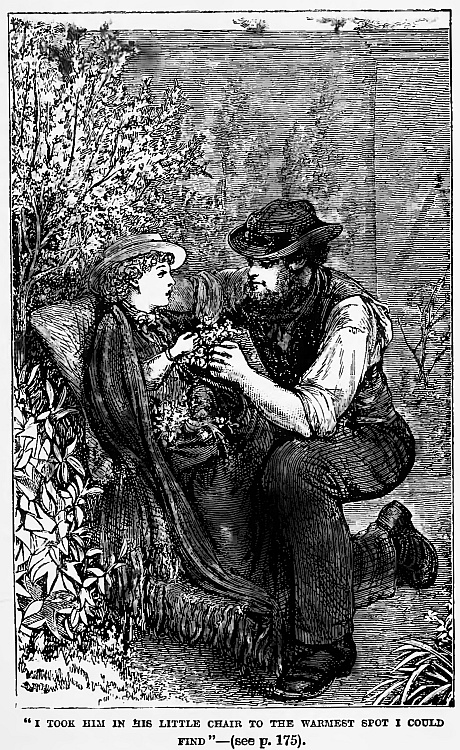
“And at last there came a day when he did not seem any worse than usual. It was one of those soft, bright, warm spring days, that come in all at once, setting the buds bursting, the birds building, and your heart seeming to drink in a kind of joy from the soft breeze. I’d been to dinner, and was going back to the garden, to finish a bit of nailing in over there upon the south wall, that ought to have been done long before. Well, I’d got to the door, when my poor little fellow burst out crying to go with me; and at last, seeing how bright and warm it was, and how sheltered he would be there, under the sunny wall, we wrapped him up, and I took him in his little chair to the warmest spot I could find, gave him some violets and primroses, and a crocus and snowdrop or two, and then I was soon up on my ladder, nailing away, laying in young wood there, moving a branch here, and, being fond of my work, and soon interested, I was sometimes a quarter of an hour together without looking at our little fellow; but I was down four times to pick him a fresh flower or two and the last time I was down I thought he seemed a little drowsy.
“At last I got off to move my ladder, and had my foot on the round to get up again, when I looked at the little chair, and started to see that my boy was lying fast asleep, when, for fear of cold, I caught him up, and carried him towards our cottage; but I had not gone half-way, before a strange shudder seemed to run through me, and I stopped short to look in the little face, saying something that I knew would make him smile if he heard it; and then, hardly knowing what I did, I rushed home with my light burden, whose little hands were tightly holding some of God’s early gifts of spring against the little breast now growing colder and colder.
“No, he didn’t hear me; but there was just the faint dawning of a smile about his little mouth: for God is very kind to some of those he loves, and there was no sign of pain there as he went to sleep. And I can’t think that I’m wrong, in always fancying my boy where never-fading flowers bloom, for he was too young to have ever angered his Maker; and besides, did he not say, ‘Suffer little children to come unto me,’ and ‘Of such is the kingdom of heaven?’
“Don’t you take no notice of me, that’s a watery weakness; but, now, just look there, I went over every bit of that lawn reg’lar, last week, and then there wasn’t a bit of daisy to be seen; while now, here they are coming up in a bunch. But it really is the case with flowers, that those you want to kill and get rid of won’t die, while those you wish to save—There, don’t take no notice of me, it’s only a watery weakness.”
Poor old Pengelly went away, for the weakness seemed disposed to increase, and for long enough he was busy weeding a nook of the garden far away from where I sat. He was very reticent afterwards, for days to come, and when at last he grew more sociable his face was hard, rugged and weather-stained, and he seemed the last man to have been influenced by a tender sympathetical thought.
Chapter Fifteen.
Salt Tears.
That rugged exterior and tenderness of heart of the Cornish people render them marked amongst their fellows. It is questionable whether you would find in any part of England so respectable and religious a body of men as those of Cornwall. Whether fishers or miners it is the same, they are quiet, temperate, and God fearing, and certainly more intelligent than the men of many counties. I have often sat in the Ross’s garden of an evening listening to the singing of the fishermen upon the cliff, not the roaring of some sailors’ chorus, but the sweetly blended parts of some old hymn, or glee—for part singing lingers still amongst these Western folks.
Then as to education, I have been surprised at their amount of knowledge and reading. One fair ruddy sturdy old fellow, the corners of whose lips were not free from the stains of tobacco, used to take me out occasionally in his boat and showed me the various rocks and caves, and he surprised me by his reading. The first time I was out with him I found that his boat was called The Chemorne, and I naturally enough asked why he had given it so quaint a name.
“Oh, it means Birch Canoe,” he said, and when I asked further, he told me that he had found the name in Hiawatha, when he was reading Longfellow’s poems.
One of my greatest intimates though amongst the fishermen, was a quiet stern-faced middle-aged man, who seemed to have some great trouble upon his mind; and one evening when he had rowed me out beyond the headland, and lay upon his oars, he began talking to me about the sorrow of his life, the death of the woman he had loved and who was to have been his wife.
“Yes,” he said, “I behaved bad to her ma’am, and all through blind obstinacy and want of faith.
“I’ve seen that same face of hers scores of times since, and though it makes me shudder, and nips me to the heart, I always go and have a good long earnest look at it, and come away a better man. You may see that face yourself—as much like as if it had been taken from her sad, anxious looks—you may see it at the picture-shop windows, and it’s of a woman tying a handkerchief round a man’s arm, and she looks up at him pitifully, and it’s called ‘The Huguenot.’ That’s like the look, and the face that gazed up into mine after she’d told me what I know now was the truth; and I—yet I’m most ashamed to own it—I flung her away from me, and wouldn’t believe what she said. There was a tear upon each cheek, and the bright drops were brimming in her eyes, and ready to fall; but I was hard and bitter, and whispered to myself that they were false tears, put on to cheat me, and I ran out of her father’s house, swearing that I’d enter it again no more.
“Speaking as a fisherman, and one who was brought up with the sound of the sea always in his ears, I may say we rowed well together in the same boat, Mary and I. I had a long fight of it before I could persuade her that it would be best for her future that she should take me for pilot, and not Harry Penellyn; but I did persuade her at last, and we were to be married down at the little fishermen’s church at the head of the cove. So we worked and waited.
“Two years of as happy a life then fell to my lot as could fall to that of any man in this life, I believe. My ways were rough, and hers were not those of a lady, but they suited our stations in life, and what more would you have? I look back upon that bright bit of life as if it was some dream; and though I can’t settle to go back to the old place, I cling to the fish, and look upon those days when a Lozarne boat comes in, as days worth recollecting; for they bring the blood in one’s cheek, and a bit of light into one’s eye.
“I can see it all now as plain as can be: the little fishing village under the cliff; the stout granite pier running out so as to form a harbour for the fishing-boats; and the blue sea, stretching away far as eye could reach. Down by its edge, too, the weed-fringed rocks, piled high in places, with the sea foaming amongst the crevices, and again forming little rock-pools where the bright sea growths flourished; and as the tide came in, with its fresh cooling waters, you saw the limpets and sea flowers wakening again to life, while many a spider-crab and shell-fish crept out of the nook or crack where it had hidden from the warm sun. I can see it all now at any time, though I am growing grey, and nigh a score of years have passed since; but brighter than all seem to stand out those two mournful eyes, with the same tearful look they gave me as I flung out of the door and saw them for the last time; for when next I looked upon that face the eyes were fast closed, and could I have opened them the lustre would have been gone.
“A west country fisherman’s life is one which takes him a deal from home, for sometimes we go off for perhaps three months at a time to the north coast, or to Ireland when the herring season is on; and, like the rest, I used to be off in my boat, sorry enough to leave home—happy enough to return after a busy season, till one year, when I took it into my head to think it strange that Harry Penellyn, Mary’s old beau, should spin his illness out so long and stop ashore, time after time, when the boats went out, and him seeming to be well and strong as any of us. There had been a heavy gale on the coast some weeks before, and, as we always do at such times, we had run in for the harbour as soon as we saw it coming; but, through bad seamanship, Penellyn’s boat came inside the rocks, when she should have come outside, and then, through their not having water enough, she grounded, lifted again, caught by the stern, and then swung round broadside to the waves, which swept her half deck, while a regular chorus of shrieks rose from the women standing ashore.
“It was a rough time, for even our boats that were in the harbour were groaning and grinding together, while every now and then the sea washed over so as to threaten to fill them, and sweeping the pier from end to end. In an ordinary way we made a custom of laughing at the crew of a boat who, from bungling, got her on the rocks, for born as we were in the bay, with our fathers fishers before us, we knew every stone along the coast, and could almost have steered our boat to them blindfold; but this was no time to jeer, for now the poor fellows were being swept one by one from their hold, and borne struggling through the surf to the rocks, where they were in danger of being dashed to pieces, for ours was no smooth, sandy beach. Some were swimming, some beating the water frantically; and clad as our men are, in their thick cloth trousers, heavy sea boots, and stout Guernsey shirts, they stand a poor chance of keeping long afloat, for the weight of their boots is enough to drag them down.
“There was every one in a state of excitement; some running out as far as they could and throwing ropes—men shouting orders that nobody attended to—women tossing their arms up and crying, while first one and then another of the boat’s crew was dragged ashore, and carried half drowned up to the cottages.
“I was standing looking on, with Mary by my side, for she was out on the cliff when my boat ran into the little harbour, while her hand was the first to clasp mine when I got ashore, thankful for the escape we had had, for the sea had risen wonderfully quick. I had taken no part in trying to save the boat’s crew, for there were plenty of willing hands, and there being but little standing-room down below the cliff, I had thought I should be in the way; but now it seemed to me that one poor fellow would be lost with the efforts they were making to save him, for he was too weak to cling to the ropes thrown out, and as fast as he was swept in by the waves, they sucked him back.
“I had not seen who it was, but just then, as I made a start as if to go down, Mary clutched, my arm, and there was a wild look in her face as she said aloud, ‘Harry Penellyn.’
“The excitement of the moment carried almost everything before it, but I had a strange feeling shoot through my heart, and something seemed to say, ‘Keep back;’ but the next minute I was fighting with the waves, with the noose of a rope round my body, and plenty of stout mates ashore fast hold of the end. Then, after a strangling battle, I got tight hold of Penellyn, and we were drawn ashore, and both of us carried up to Mary’s father’s cottage, though I tried hard to get upon my feet and walk, but I might have known that our fellows would not have let me on any account.
“Well, Harry Penellyn lay there three or four days, and Mary tended him, and all that time I had to fight against a strange, ungenerous, cowardly feeling that would creep over me, and seemed at times to make me mad, till I got myself in a corner and asked myself questions, to all of which I could only answer the same word—nothing. Then Penellyn got better, and went to his mother’s house; and time went on, till I grew bitter, and harsh, and morose, and was always haunted by a suspicion that I would not put into words, while now the question came again and again—‘Why doesn’t Harry Penellyn go to sea?’
“But no answer came to my question; and though he seemed to be well and strong as ever, he always kept at home while we went out; and in my then state of mind this troubled me, and I kept feeling glad that we were only out now on the short trips of a few days in length. I grew angry with myself and with all around. Ay, and I grow angry even now, when I think that a few earnest words of explanation—a few questions that I know would have been answered freely—would have set all right, and perhaps saved the life of as good and loving a woman as ever lived in the light.
“But it was not to be so; and I went on wilfully blinding my eyes to everything—placing a wrong construction upon every look and word, and making those true eyes gaze at me again and again in wonder; whilst Harry Penellyn, who had never before shown me much goodwill, now that I had saved his life, would have been friends, only I met his every advance with a black scowl, when he always turned off and avoided me.
“One evening it had come to the lot of my boat to run into harbour with the fish of several other boats; for the takes had been very light, and somehow or another I felt more bright and happy than I had done for weeks. I got ashore, left my mates tending the mackerel, and ran up to Old Carne’s cottage to find Mary out.
“This did not trouble me at first; but after a few minutes’ fidgeting about, I felt a flush come in my face, and hurrying out, I made an excuse at Mrs Penellyn’s, and got to know that Harry was out too.
“The hot blood rose from my cheeks to my forehead, and seemed to blind me; then a strange singing sensation came in my ears; but the next minute I was tearing along the cove in the dark of the evening, so as to get away where I might be alone with my thoughts, for that vile suspicion that was struggling with me before, had now conquered and beaten me down, so that I was its slave, and for the time a regular madman.
“I had run about half a mile, when I stopped panting, and began to walk slowly along beneath the trees close beside the fern-hung rocky bank, while it was now too dark to see far before me. But the next instant I was standing with my breath held, and one hand resting on my side, for as I crouched close to the bank I heard Penellyn’s voice, talking earnestly as he passed a few yards from me, with his arm tightly clasping a woman’s waist, and just as they had passed they stopped, and there was light enough for me to see him bend over her, and without stopping to think, I leaped from where I was hid, and, as the woman shrieked and fled, I had Penellyn by the throat, and we joined in a fierce struggle.
“If an angel had told me I was deceived, I should not have believed him then in my blind fury; and it was not until, having dashed his head against the ground again and again, and felt my enemy’s hold relax, that I leaped up, kicked him savagely, and then ran back.
“Just as I expected, Mary was at home, looking hot and flushed, but she jumped up with a smile, and hurried to me, saying—
“‘I was down at Mrs Trevere’s, dear; but I heard your boat had come, and—’
“She stopped short, half frightened by my wild looks and disordered clothes, and half by the savage curse I gnashed out at her as I seized her arms; while, as the...” (two pages missing here.)
Chapter Seventeen.
The Empty House.
Some pages are missing here... place, what electro or veneer is to the precious metal or solid wood. There were plate-glass windows, but the frames had warped; handsome balustrades to green shrunken stairs; the floor-boards had shrunk one from another and curled up; the ceilings had cracked; and where the rain had found its way in, through defective spouts at the side, or bad slating and plumbing of the roof, the walls told tales, in the unpleasant-smelling efflorescence of microscopic fungi, that, in place of good honest sand-mixed mortar, the house had been built, by a scamping contractor, with rubbish ground up with a dash of lime stuff, that is good for two or three years, and then crumbles away.
From room to room of the desolate place we went, to find every window closely shut. There was the pleasant prospect, beyond the tiny square of grass-grown earth called a garden, of the blank end wall of the row of houses in the next street. Over the wall, next door, an attempt had been made to brighten the prospect; but the plants looked melancholy, and a Virginia creeper that ought to have been displaying its gorgeous autumnal tints was evidently suffering from a severe bilious attack, due to low spirits, bad drainage, and a clay soil. The very sparrows on the ledges were moulting, and appeared depressed; and on going higher up, there was a blank hideous cistern in one of the attics, that looked so much like a sarcophagus on a humid principle, and suggested such horrors of some day finding a suicidal servant-maid within, that any lingering ideas of recommending the house vanished like dirty snow-crystals before a pelting rain.
“It’s a very convenient house,” said the old gentleman.
“And will let some day at a far higher rent,” piped the old lady.
“You’d better come down to the breakfast-room now,” said the old gentleman.
“And see the kitchen too,” echoed the old lady.
So I went down—to find, as I expected, the breakfast-room showing a cloudy mountainous line of damp on the paper for about two feet above the wainscot; and here again the window was closely shut, and the strange mephitic odour of damp and exhausted air stronger than ever.
This apartment was the one utilised by the old couple for bed and sitting-room combined, and their spare furniture was spread neatly over it, according to the homely old rule of “making the most of things.”
I finished my inspection, with the old folks most eager in their praise of all, and when I pointed to the damp the old gentleman exclaimed—
“Oh! you’ll find that in all the houses about here. It rises up the wall, you see.”
“Yes, from bad building,” I answered.
“But it’s much worse at the house opposite,” said the old lady.
“Where the tenant died?” I said.
“Yes,” she answered innocently enough.
“Why, you seem anxious to let the house,” I said smiling.
“Well, yes,” said the old gentleman, combing his few hairs with one end of his spectacles. “You see, the agents like us to let the houses; and if we’re in one very long—”
“He don’t like it,” said the old lady.
“Then you often have to change?”
“It all depends; sometimes we’ve been in houses where they’ve been let in a week.”
“Not in new neighbourhoods,” said the old lady; “people’s shy of coming to the very new places. You see they’re only just run up, and the roads ain’t made.”
“Ah!” said the old gentleman, “sometimes the roads ain’t made till the houses are all let.”
“And people often won’t take the houses till the roads are made,” said the old lady.
“So sometimes we’re a year or two in a place. People are so particular about damp, you see,” said the old gentleman.
“And many of the houses are damp?” I asked inquiringly.
“Well, ma’am, what can you expect,” he replied confidentially, “seeing how things goes? Here’s, say, a field here to-day, and the surveyor marks it out into roads. Then one speculative builder runs up a lot of carcases on it, and fails. Then another buys the carcases, and finishes ’em in a showy, flashy way; and then they put them at very low rents, to tempt people to take ’em.”
“And raises the rents as soon as one or two tenants have been in them,” said the old lady.
“It tempts people like,” continued the old gentleman; “they see nice showy-looking houses in an open place, and they think they’re healthy.”
“And they’re not?” I said.
The old man shrugged his shoulders.
“Healthy? No!” cried the old lady. “How can they be healthy, with the mortar and bricks all wet, and the rain perhaps been streaming into them for months before they were finished? Why, if you go and look in some of those big half-finished houses, just two streets off, you see the water lying in the kitchens and breakfast-rooms a foot deep. That’s how he got his rheumatics.” Here she nodded at her husband.
“Don’t bother the lady about that, Mary,” said the old man, mildly.
“You’ve lived in some of these very new damp places, then?”
“Well,” said the old gentleman smiling, “beggars mustn’t be choosers, you see. We have to take the house the agent has on hand.”
“You take charge of a house, then, on condition of living rent-free?”
“Yes, ma’am, that’s it,” said the old lady smiling.
“And how long have you lived in this way?”
“Oh! close upon fifteen years, ma’am,” replied the old gentleman; “but things are not so good as they were. More than once I’ve nearly had to take a place—much building as there is going on.”
“Yes, and pay rent,” said the old lady.
“You see it’s the police,” the old gentleman went on.
“The police?”
“Yes, the police,” said the old lady. “The boys do so much mischief.”
“Boys, you see, from the thick parts of London,” said the old gentleman explaining. “Rough lads on Sundays. They get amongst the empty and unfinished houses, troops of them, to play pitch-and-toss, and they throw stones and break windows and slates.”
“And knock down the plaster and bricks,” added the old lady.
“Ah! they most levelled one wall close by,” said the old gentleman.
“They’re so fond of making seesaws of the wood, too,” said the old lady.
“And splashing about in the pools of water,” said the old gentleman.
“And the agents, on account of this, have took to having the police,” said the old lady.
“To keep the boys away?” I asked.
“Yes; you see, it’s the married police and their wives take charge of the houses, and when the boys know that there’s policemen about, why, of course they stay away.”
“But it makes it very bad for such as we,” said the old lady.
“Fifteen years is a long time to live rent-free,” I said smiling.
“Yes, ma’am, it is, and you see we have a deal to do for it. We have lots of people come to look at the houses before one’s let.”
“Specially women,” chimed in the old gentleman. “There’s some come regular, and do it, I s’pose, because they likes it. They look at all the houses in the neighbourhood, same as some other ladies always go to sales. They never buy anything; and they never mean to take a house; but they come and look at ’em, all the same.”
“But we always know them,” said the old lady.
“Yes, they’re easy enough to tell,” chuckled the old man. And then, seeing me look inquiringly at him, he went on, “They finds fault with everything, ma’am. The hall’s too narrow, or else too broad, and the staircase isn’t the right shape. Then they want folding doors to the dining-room; or they don’t want folding doors. Sometimes six bed-rooms is too many; some times eight ain’t enough. And they always finds fault with the kitchen.”
“And they always want a fresh paper in the dining-room,” said the old lady chiming in; “and the drawing-room paper’s too light; and we don’t mind them a bit.”
“No,” chuckled the old gentleman; “we’re used to them. We know, bless you!”
“And I suppose you felt that I did not want a house, eh?”
“No, that we didn’t,” said the old lady; “you see, you came with an order from the agent; while people as don’t want houses never takes the trouble to get that, but drops in promiskus where they see the bills up.”
“One gets to understand people in fifteen years,” said the old gentleman, in a quiet subdued way; “and we don’t mind. We say all we can for a house, as in dooty bound, for the agent; but it goes against one, same time.”
“You could not conscientiously recommend this house, then, for a family?” I asked.
The old gentleman tightened his lips, and looked at his wife; and the old lady tightened hers, and looked at her husband; but neither spoke.
“I see,” I said; then, turning the conversation, “you have been at this for years?”
“Fifteen ma’am,” said the old lady. “You see, when our poor—”
“Don’t trouble the lady about that,” said the old man, with appeal in his voice; but the old lady liked to talk, and went on—
“When our poor Mary died—aged nineteen, ma’am, and as beautiful a girl as ever you saw, and used to help us in the business, keeping the books and writing letters—all seemed to go wrong, and at last we sold out for the best we could make of it, and that just paid our debts—”
“All but Tompkins’ bill,” said the old man correcting.
“Yes, all but Tompkins’ bill,” said the old lady; “but that we paid afterwards. We should have had to go to the parish, only an aunt of mine died and left us a bit of property that brings us in ten shillings a week; which is enough for us so long as we don’t pay rent and taxes.”
“That’s how we came to be here,” said the old gentleman, smiling sadly at his wife, “and we’ve seen some strange changes since; living in houses where people died of fevers; in old houses; in new houses that ought to be knocked down by Act of Parliament, they’re so bad; in houses where the people’s been extravagant, and gone to ruin. But there, it does for us while we’re here.”
He looked at his wife on this, and the old lady placed her thin veiny hand on his arm, telling, by that one action, of trust, love, and faith in her old companion over a very stony path; and I left them together trying very hard to close the front door, the old man’s last words being—
“It sticks so, on account of the wood warping, and that great crack”—the said crack being one from the first to the second-floor.
Chapter Eighteen.
My Friend in Hospital.
I was more successful during the next few days, and had a list of four houses for Mr Ross to see, one of which he selected for his brother.
For my part I was very busy, having many people to see, and being on one occasion in Hammersmith, where the omnibus driver had told me he lived, I made a point of finding his house in a very humble street, and after rather a distant reception from his wife, the poor creature opened her heart to me, and told me that she was in trouble: her husband had had an accident, been kicked by one of his horses, and was in the hospital very ill.
I said what I could by way of comforting the poor thing, and on leaving said that I would go and see him, when the woman’s face flushed with joy.
“You will, ma’am,” she cried.
“To be sure I will,” I said quietly, and I left her seeming the happier for my few words of sympathy and hope.
The next day I was on my way up Gower Street, the long dull, and dreary, where the cabs roll echoing along, and in the silent night the echoes sound like the rumbling in some huge water-pipe. Up Gower Street, where the dismal grinding of the organ sharpens every nerve, and sends the horrors throbbing through every vein and artery—music no longer, but a loud, long wail, sobbing in the windows, and beating for entrance at the doors; up Gower Street, where the dwellers grow hardened to sad sights—where they know the brougham of the great physician or surgeon—the cab conveying the out-patient, or that which bears the in-patient to his couch of suffering; where the face of the pale student who has not yet ceased to shudder at the sufferings of his fellow-man is as familiar as that of the reckless or studious one to whom a groan or heart-wrung agonised cry is part of the profession; where weeping relations—poor, common people, who have left their dear ones in the great hall, or perhaps been to spend an hour by their bedsides—are but everyday sights such as may be seen near each great hospital.
Up Gower Street there’s a crowd, which in London is but another word for a magnet which draws to itself the sharp needles of the streets; ay, the blunt and broken ones, too—everything steely clings to it, while the softer material falls away.
Only a woman crying! Not much that. We may see that every day in our streets, and in most cases turn shuddering away, thinking of the dear ones at home—wife and daughters—sisters or betrothed, and saying to ourselves, “Can this be a woman!” But here we can stand with pitying feelings welling up from our hearts. Only a woman crying! but with such tears gushing from her eyes as Rachel shed when mourning for her children, and refusing to be comforted because they were not. A poor, untutored, unlettered woman, who has not learned the art of controlling her feelings. She has just come out of the great, gaunt, cheerless building; staggered along for some distance, blinded with tears; and at last, oblivious of all but her own bitterness, sunk down upon a doorstep sobbing wildly, for she has been to see the stalwart son who was to have been the prop and stay of her old age, and they have shown her a gaunt, pale, wild-eyed figure that knew her not; and she has come away brokenhearted, and, unlike Joseph of old, too forgetful of self to seek a place where she might weep.
Rocking herself to and fro, and moaning bitterly, till a friendly arm is offered, and she is led away, the crowd parting to let her pass, with many a rough, sympathising word uttered; and then with her burden of sorrow she slowly totters along the gloomy street, followed by a straggling crew of children, ragged boys, girls top-heavy with babies tied up in shawls, and wonderful above all other things for their vitality. To see them day by day, and the risks they run, the only wonder is that their babyhood does not form their shroud, and cover them effectually from further advance towards adolescence.
And now a cab drawn at a foot’s pace towards the great door of the hospital—to so many the jaws of death. A little crowd here even, to see the patient carried in by the two stout porters. A little crowd here, when it might be a case of fever or something else—infectious, contagious. But no; this is no fever case, but one for our skilled surgeons; for the poor lad is bleeding, bound up, and fainting. Injured by machinery. His finger was caught by the cogs of a machine—the hand, the arm drawn in, and crushed right up to above the elbow, so that, what with loss of blood and the shock to the system, it will be a clever surgeon that can save his life.
But he will have the best of skill here, and every appliance that surgery can devise to allay his sufferings—everything but the tender hands of those he loves; while it will take all his hopefulness to fight against the sorrowful thoughts of his maimed and helpless future. He, a poor wounded one of the great army fighting for life—battling day by day with poverty, from childhood to old age; and he early stricken down in the contest.
And now another carriage stops the way; and the porters are not wanted, for the occupant steps out, evidently with his wife, upon whose arm he leans slightly as they go up the steps. To a casual observer there does not seem much the matter, for he smiles as he speaks cheerily to his companion; but somehow his lip seems to be quivering, and he stops at the last step to give one look round, and not at the dull brick and mortary street, but upwards at the bright sky flecked with fleecy clouds, and there is an agony of longing in that look, which tells of the panting of the soul for health, and of a shadow hovering above him which seems to hide the future from his hopeful gaze. As he still looks up, loth to enter, his glance seems to have within it something of that we see upon the emigrant’s face when on shipboard with the anchor a-peak, and the sails shaking out—it seems to say “Farewell.”
But he has returned to the present, and with his lips quivering, he enters the great portal, and the door swings to behind him; while who can say how he will quit the place—alive and hopeful, past the great danger, and with some wondrous operation performed by skilful hands; or merely the lifeless clay, with the spirit returned to its Maker?
An out-door patient creeping up by the aid of a stick—one who cannot summon the fortitude to quit his home, though he would be better in the hospital—better in body perhaps, but worse in spirit; for he would be homesick, and suffering in mind for the homely comforts and the familiar, ministering hands.
And now another pallid, quivering object, leaning upon the arm of friend or relative. He can hardly walk, and must be suffering from some severe internal disease; but he has been by three times, and though his hand grasps the order for admission, he dares not enter, but muttering “Not yet, not yet,” draws his companion away, and totters on until he is fain to rest upon a step. But who can wonder that he should flinch and shrink back when the dread moment arrives? How many who enter the hospital feel that for them there is written above the portal, “Who enter here leave hope behind?” The great gloomy building has by them been considered as a forlorn hope to try when every other means has failed; and with shattered nerves, and mind and body worn by disease, they may well shudder and turn from the building, when the robust in health could hardly enter such an abode of pain and sorrow without a clutching at the heart. And then, too, who is he that seeks a home within the English Maison Dieu but the poor man, perhaps the bread winner of a large family? and he enters, perhaps, with the knowledge that while he is battling with disease those at home are fighting against the wolf poverty, who has lain down at their door.
But the poor fellow has nerved himself at last, and slowly crawls up the steps, takes one glance round as his fellow-sufferer did some quarter of an hour ago, and the portal has closed upon him.
Next comes the rattling of wheels, and a cab turns the corner at as near an approach to a gallop as the shambling horse can manage. Emergency here; and as the cab dashes up, a man springs off the box, and runs up the steps; and then come the porters with their chair to lift out of the vehicle, a groaning mass of charred humanity, wrapped in a blanket, and whose cries on being touched thrill through one’s very marrow, till the door swings to once more.
Again a cab driven up, with this time a policeman on the box, to jump down and fetch out those iron-nerved men whose aid is so frequently sought.
No brand from the burning this time; but another one fallen in the fight with poverty—another wounded—no! hush! they say he is slain, and hesitate before lifting the nerveless, flaccid, collapsing form into the chair.
But he is carried in, and I follow to know the truth and learn it in a few minutes; for the poor fellow, a painter, has fallen from an upper window, with a fearful crash, upon the cruel spikes of the area railings, from which, the newspapers tell us next day, with hideous perspicuity, “he was lifted with great difficulty the spikes having entered his body.”
Guy’s, Saint Thomas’s, Saint Bartholomew’s, Saint George’s, Middlesex, King’s College, University, round all of their doors such dread horrors still abound, and to an extent that almost staggers belief. Sorrow, pain, poverty, despair, all seem to join hands and revel around the suffering wretches; but even to these dismal shadows—these clouds of life—there are silver linings. Hope is there; faith is there; mercy is there; and pity mourns over the suffering poor. It is the collecting together of scenes of misery—the gazing upon so many sufferers at once; and for the moment we forget that suffering is inevitable—that more or less mental or bodily, it must fall to each one’s share; and as we turn shuddering away, we forget that these great institutions are an honour to our country, and glance but at one side of the question. We forget the quiet, gentlemanly men of iron nerve and determination—the heroes who might wear the palms borne by our warriors—the men who engage face to face with disease, and pluck full many a victim from the grim dragon’s jaws. We think not of these calm unassuming men walking quietly into houses plague-stricken, and shunned by all but the mercenary nurse; we forget that such a thing is unknown as a doctor shrinking from facing the worst fever, and leaving the sufferer unaided. Well, there are honours more to be desired than empty titles; and in the love, respect and reverence of their fellow men our doctors must revel, for ours is a strange country. We are not given to showy uniforms, and crosses and ribbons. Perhaps it is as well; for the uniforms and decorations tarnish and fade, while the name once honoured grows brighter with the lapse of years.
The figures seem startling—nay, they are staggering to the belief; but doubtless the statistician had good grounds for declaring that more fall by accidents in the streets of London than suffer upon the whole of the railways in our kingdom. Truly, there is good cause for the boards of much abused directors to smile and rub their hands upon hearing such a statement, for it must be gratifying to their sense of self esteem. But leaving out those who suffer in private, what incredible scenes are witnessed by those who make a tour of a hospital! In addition to the street accidents, what else have we to show of the ills to which mortal flesh is heir? Burnings and scaldings, domestic and from manufactories; falls, including sprains, bruises, dislocations, and simple and compound fractures; cuts, so fearful that one turns away shuddering, and wondering that life has not escaped through the awful gash; limbs crushed, torn or shattered by machinery; wounds from blows, enough to fill any hospital with horrors, without stopping to consider that cruel, insidious enemy disease, mining and burrowing its way through the human system, and battling step by step with the science brought to bear upon it. And in what forms does it present itself? Many common enough, and whose names are sad household words among us, while others are of so complicated a nature that one turns away from the pale, suffering, distorted face with a shudder.
Saddening, most saddening is that aspect of a hospital ward, and the most moving sight is that anxious face of the trembling, suffering patient, before in his extreme horror Nature is merciful to him and draws the veil of insensibility before his starting eyes. “What is it to be?” seems written upon every line of his haggard countenance. Life, to complete some darling scheme—life, to which we all so tenaciously cling; or the cold silent grave? Who will tell him, nurse or doctor? And even then does he not look them through and through doubtingly? If they whisper to him of life, he dares hardly believe it, fancying that ’tis but to rouse his flagging energies; while if they refuse to answer his anxiously reiterated questions does he not feel that they give him up, and set it down to ignorance—for he will not die.
I walk between the rows of beds, some empty, some occupied; and then how the frailty of our hold upon life is forced upon me—how insecure seems the tenure! And then more and more how it comes home to the feelings what a trivial matter is our own poor life to the great world at large; how little we should be missed, and how little the busy frequenters of our street think of the sufferers within these bleak, blank walls.
My companion stops with me at last by the bed where lies my friend of the crape butterfly, and as he lies there, very pale but evidently clean and comfortable, his face lights up with pleasure, and he holds out his hand in welcome to me as I take the chair by his side.
“What?” he said, “you never came o’ purpose to see me, ma’am?”