George Manville Fenn (continued 2)
Reading edition
I lay back, thinking and telling myself I was very savage with him for deceiving me, and that I wouldn’t have him and his mother laying plots together against me, and that I wouldn’t stand by and see him make a fool of himself with the first pretty girl he sets eyes on, when he might marry Maria Turner, the engineer’s daughter, and have a nice bit of money with her, to put into the business, and then be my partner.
“No,” I says; “if you plot together, I’ll plot all alone,” and then I pretended to wake up, took no notice, and had my supper.
I kept rather gruff the next morning, and made myself very busy about the place, and I dare say I spoke more sharply than usual, but the wife and Luke were as quiet as could be; and about twelve I went out, with a little oil-can and two or three tools in my pocket.
It was not far to Bennett’s Place, and on getting to the right house I asked for Mrs Murray, and was directed to the second-floor, where, as I reached the door, I could hear the clicking of my sewing machine, and whoever was there was so busy over it that she did not hear me knock; so I opened the door softly, and looked in upon as sad a scene as I shall ever, I dare say, see.
There in the bare room sat, asleep in her chair, the widow lady who came about the machine, and I could see that in her face which told plainly enough that the pain and suffering she must have been going through for years would soon be over; and, situated as she was, it gave me a kind of turn.
“It’s no business of yours,” I said to myself roughly; and I turned then to look at who it was bending over my machine.
I could see no face, only a slight figure in rusty black; and a pair of busy white hands were trying very hard to govern the thing, and to learn how to use it well.
“So that’s the gal, is it?” I said to myself. “Ah! Luke, my boy, you’ve got to the silly calf age, and I dare say—”
I got no farther, for at that moment the girl started, and turned upon me a timid, wondering face, that made my heart give a queer throb, and I couldn’t take my eyes off her.
“Hush!” she said softly, holding up her hand; and I saw it was as thin and transparent as if she had been ill.
“My name’s Smith,” I said, taking out a screwdriver. “My machine: how does it go? Thought I’d come and see.”
Her face lit up in a moment, and she came forward eagerly.
“I’m so glad you’ve come,” she said, “I can’t quite manage this.”
She pointed to the thread regulator, and the next minute I was showing her that it was too tight, and somehow, in a gentle timid way, the little witch quite got over me, and I stopped there two hours helping her, till her eyes sparkled with delight, as she found out how easily she could now make the needle dart in and out of some hard material.
“Do you think you can do it now?” I said.
“Oh, yes, I think so; I am so glad you came.”
“So am I,” says I gruffly; “it will make it all the easier for you to earn the money, and pay for it.”
“And I will work so hard,” she said earnestly.
“That you will, my dear,” I says in spite of myself, for I felt sure it wasn’t me speaking, but something in me. “She been ill long?” I said, nodding towards her mother.
“Months,” she said, with the tears starting in her pretty eyes; “but,” she added brightly, “I shall have enough with this to get her good medicines and things she can fancy;” and as I looked at her, something in me said—
“God bless you, my dear! I hope you will;” and the next minute I was going downstairs, calling myself an old fool.
They thought I didn’t know at home, but I did. There was the wife going over and over again to Bennett’s Place; and all sorts of little nice things were made and taken there. I often used to see them talking about it, but I took no notice; and that artful scoundrel, my boy Luke, used to pay the half-crown every week out of his own pocket, after pretending to go and fetch it from the widow’s.
And all the time I told myself I didn’t like it, for I could see that Luke was changed, and always thinking of that girl—a girl not half good enough for him. I remembered being poor myself, and I hated poverty, and I used to speak harshly to Luke and the wife, and feel very bitter.
At last came an afternoon when I knew there was something wrong. The wife had gone out directly after dinner, saying she was going to see a sick woman—I knew who it was, bless you!—and Luke was fidgeting about, not himself; and at last he took his hat and went out.
“They might have confided in me,” I said bitterly, but all the time I knew that I wouldn’t let them. “They’ll be spending money—throwing it away. I know they’ve spent pounds on them already.”
At last I got in such a way that I called down our foreman, left him in charge, and took my hat and went after them.
Everything was very quiet in Bennett’s Place, for a couple of dirty dejected-looking women, one of whom was in arrears to me, had sent the children that played in the court right away because of the noise, and were keeping guard so that they should not come back.
I went up the stairs softly, and all was very still, only as I got nearer to the room I could hear a bitter wailing cry, and then I opened the door gently and went in.
Luke was there, standing with his head bent by the sewing machine; the wife sat in a chair, and on her knees, with her face buried in the wife’s lap, was the poor girl, crying as if her little heart would break; while on the bed, with all the look of pain gone out of her face, lay the widow—gone to meet her husband where pain and sorrow are no more.
I couldn’t see very plainly, for there was a mist-like before my eyes; but I know Luke flushed up as he took a step forward, as if to protect the girl, and the wife looked at me in a frightened way.
But there was no need, for something that wasn’t me spoke, and that in a very gentle way, as I stepped forward, raised the girl up, and kissed her pretty face before laying her little helpless head upon my shoulder, and smoothing her soft brown hair.
“Mother,” says that something from within me, “I think there’s room in the nest at home for this poor, forsaken little bird. Luke, my boy, will you go and fetch a cab? Mother will see to what wants doing here.”
My boy gave a sob as he caught my hand in his, and the next moment he did what he had not done for years—kissed me on the cheek—before running out of the room, leaving me with my darling nestling in my breast.
I said “my darling,” for she has been the sunshine of our home ever since—a pale, wintry sunshine while the sorrow was fresh, but spring and summer now.
Why, bless her! look at her. I’ve felt ashamed sometimes to think that she, a lady by birth, should come down to such a life, making me—well, no, it’s us now, for Luke’s partner—no end of money by her clever ways. But she’s happy, thinking her husband that is to be the finest fellow under the sun; and let me tell you there’s many a gentleman not so well off as my boy will be, even if the money has all come out of a queer trade.
Chapter Six.
A Bird in a Cage.
My visits to Burt’s Buildings resulted in others to the neighbourhood where I made the acquaintance of Uncle Bill, as he was generally called by the swarming children about the place; not from any relationship, in fact for no reason at all that I could discover. One woman said it was because he was lame; another thought he was like an uncle, but all the same the little man often met me on my rounds, at first to look at me very dubiously, but ever after to pull his pipe out of his mouth, tap the bowl upon the pavement and thrust it into his pocket, out of compliment to me as a lady who might not like smoke.
“’Taint in a woman’s natur’, mum, to like smoke,” he said, when I hinted that he need not put out his pipe, and no matter when we met I always received from him this bit of politeness.
Rumour reached me one morning, after a short visit to the country, that a dilapidated tenement or two, in this deplorable neighbourhood had fallen down, and on making my way to the place, the first person I encountered was Uncle Bill, pipe in mouth, and with a half-quartern loaf in one hand, and a rasher of bacon in the other.
Before I could say a word the badly wrapped up rasher was thrust into his coat pocket, the pipe extinguished, and thrust in after it, and a smile and nod of recognition were awarded to me.
“Houses falling, mum? Oh! yes, it’s as fact as fact. Come down without a moment’s warning, afore you know’d where you were, I can tell you. I had a narrow escape.”
“What, were you there?”
“To be sure I was. Where should I be if I warn’t at home. It was at my old house. I’m in here, now,” he continued, pointing.
“There was the house up, as may be, lars night, and then, in the morning, it was a tumble-down heap o’ smash, with broken bedsteads, and chairs, and chesties of drawers, and all sorts, tumbled together into a mash, with bricks and mortar, and laths and plaster, and beams. It’s a mussy as no more wasn’t killed; for there was, counting myself, four-and-twenty people as lived in that house, and many had to run out for their lives. People think that houses will stand for ever; and when a house ain’t fit for nothing else but pulling down, some one buys the lease, puts a little whitewash on, and then lets all the rooms out at four or five shillings a week to poor people, while the old house groans and grumbles, and shakes on its pins awful. To-night, perhaps, Braggs, the cobbler in the back room, will have a row with his wife, and they’ll be tearing about till the place shivers again. Night afore, perhaps it was Dennis Murphy and his missus getting a bit excited over a quartern of gin, and then they must get dancing up in their attic till other people’s heads get plastered with hits o’ whitewash as falls off the ceilings—only ’taint whitewash now, because it’s turned t’other colour. Then the old house begins to show its sore places, and you can see an elbow shoving out here, and a crack there; first-floor winder sill’s down on one side, and Mrs Tibbs out of the second-floor back, when she pays her rent, tells the landlord as her door sticks so that she can’t open and shet it; and then, as soon as Mrs Sykes in the second-floor front knows as her neighbour has spoken, she tells the landlord as her window won’t move. Then the first-floors say as there’s a crack across their ceiling, and black dust falls out inter the bread and butter. And then what d’yer think the landlord does—eh? Get it all seen to, and shored up, and so on—eh? You’d think so, now, wouldn’t you? But he don’t; for I’ll tell you what he does—he swears, that’s what he does, and says as soon as ever people will pay up their rent and make all square, he’ll do the house up.
“That’s a thing as he can promise safe enough, for there’s no fear of that coming to pass; for they’re all more or less behind, bless you, and he holds ’em as tight as wax. ‘Tell you what it is,’ he says, one day, ‘them as don’t like the place had better leave it, and if I have any more complaints I’ll raise the rent.’
“That was a quieter directly, you see; for they were all more or less in his power from being behindhand. Houses and lodgings for poor people are dreadful scarce in London, and landlords and tenants knows it; and folks will put up with anything sooner than have to move. And that’s just how it was in this house—people grumbled and bore it; till one morning down it came with a rush, and three or four were killed dead, and ever so many cut up all sorts of ways. But, there, that ain’t nothing new, bless you. We are used to that sort of thing in these courts.
“It was about seven o’clock in the morning, I should say, and fortunately some had got up and gone to work; but working at home on the piece, I wasn’t so particular to half an hour; but I was lying there thinking of rousing out, when all at once I heard a sharp, loud crack, and then another and another, followed by a curious rushing noise, and by a shriek or two. For a moment or two I thought it was thunder, and I lay quite still; then came a rattling down of rubbish, and I saw the end wall of my room seem to bulge gently out, when there was a fierce rumbling crash, and I was hanging to a broken beam sticking out of the wall, clinging to it with bleeding hands, ready to drop each moment on to the jagged pile of ruins underneath me—a good thirty feet, and from which now came slowly up a thick cloud of dust, and from out of it every now and then a shriek or a groan.
“I dare say, you know, at another time I could have hung there some minutes, but now a terrible sort of fear came over me which made me weak; and after looking about as well as I could for help, to see nothing but the dust rising from the heap under me, as I hung over the gap where the house had stood a few minutes before—after looking round once or twice, I seemed to shudder like, and then down I went crash on to the ruins, to be one of the first picked up.
“I lay there, though, for some time, waiting for help; nobody daring to come, till one man crept through the window of the next house on to the heap of rubbish, though he had to dart back once or twice; for now one of the joists left sticking in the wall up above would fall, then a few tiles and some bricks that had been lingering in their places for a few minutes, came down to make matters worse. The end of one joist caught me right on the side of the head, and sent what little sense there was left in flying out; and the next time I opened my eyes it was in the hospital, with some one doing something to my head, and me feeling sick, and dull, and sleepy as could be.
“But it was a terrible sight to see: first one and then another poor bruised and cut creature dragged out of the ruins as fast as they could clear away the rubbish; and there were the poor things half naked, and with the few bits of furniture belonging to them all in one ruinous smash. I did not see it, you know, but plenty of the neighbours did; and I could find you a dozen ready to go over the whole story again and again, up to the finding of Mrs Molloy and her little gal, her as lives now with her father, top of Number 16—pretty little gal she is, and so much like her mother as was killed. They tell me the people on both sides came suddenly out of their houses, as if it was an earthquake; and, you know, really an earthquake would not be much worse so far as one house was concerned. You wouldn’t think it, though, but I saved all my birds as was left hanging against the walls.
“Everybody was very sorry, of course, as soon as it was known; and the papers wrote about it, and people talked of it, and then there were a few pounds put together for the benefit of the sufferers; but you know what a sight of pounds it would take to make it all right for that poor little gal up there as lost her mother. Poor little thing, she don’t feel the loss much; but it’s a sad job for her.
“Hark! don’t you hear? That’s her bird. It’s on’y a finch, but he whistles well, and it pleases her. I give it her, you know; and when her father’s out I goes up and feeds it, and gives it water, because she’s too little to do it. She calls me ‘Uncle Bill,’ and I like to hear her; for, you see, being a cripple, I ain’t like other men, and somehow or other I always was fond of little children.
“Well, then, if you don’t mind, I don’t; so come along, and then p’r’aps we can see her.”
Up flight after flight of groaning stairs, to a landing spun across and across with a string web, upon whose intricacies scraps of white rag took the place of flies; and now came the twittering of many birds, and the restless tap, tap, scraping noise of sharp beaks upon wire and perch. My lame guide opened the attic door, after muttering a warning about my head; and there I stood on the top floor of the house in one of those rooms where fancy brought up visions of stern-faced old Huguenot silk weavers bending over their looms, and sending backwards and forwards the busy shuttle, as bright warp crossed the glistening woof.
But there was no loom here, only the long range of lead casement along one side of the room, filtering the rays of light as they entered dyed of a smoky hue—rays of light, though, so joyous that the dozens of little prisoners ranged about the room grew excited, and fluttered, and sang and twittered loudly.
My guide smiled proudly as I walked from cage to cage, and then, evidently with a thought for the bare shelf in the open cupboard, threw off his coat, unfastened his vest, loosened his collar, and then placed a circlet of greasy old black ribbon round his not too tidy black hair, as he seated himself upon his bench and dived into the mysteries of boot-closing.
“I can talk too, you know,” he said; “that’s the best of my trade. Nice birds some of them, ain’t they? Seems a shame to keep ’em behind wires; but then we all have to work behind wires, more or less, for other folks’s pleasure. They sings—we works; don’t you see?”
But I had finished my inspection of mealy linnets and goldfinches, pegging finches and larks; and had taken in at a glance the one bare room, with its whitewashed walls, decorated here with pictures cut from the Illustrated London News and Punch, and there with glass Florence flasks filled with chintz flowers and salt, potichomanie fashion, as performed by our grandmothers; the rusty, broken-barred grate, with its heaped-up ashes; and the general untidiness of the bachelor place, made worse by the plentiful sprinkling of tobacco débris and the many broken craters in which the weed had been consumed. I had seen all I could in a hasty glance, and was now looking out of the open window at another bird in a cage; for at the casement opposite, her little bright eyes glittering through a tangle of long brown hair, was the child of whom Uncle Bill had spoken. Her red lips were apart, and as I looked she shouted in across the court to the lame boot-closer, in a gleeful, childish treble; while he turned his sallow face to me with a smile of gratified pride upon it that told—oh! how plainly—of the true heart, unspoiled by the misery of a London court.
“That’s her,” he said—and his voice seemed to jar discordantly, sounding of the streets, streety; while the proud look upon his face had in it a tinge of the something greater as planted in all hearts by a great Hand—“that’s her. She stands at that window for hours while I’m at work; and I sing to her, as she claps her hands; and, you know, her father leaves her locked up there like that for long enough while he goes out, and I know the little thing would be hungry if—but she ain’t, you know.” (Nods many here.) “I wish he’d let me have her altogether; for he’s a bad sort, is her father, and it worries me as to what’s to become of the little thing. I’m not much account, you see, myself; but, being such a pretty little thing, I should like to see her taken care of, and one daren’t hardly speak to the child when he’s at home, and he won’t hardly let any of the women in the house go near his room at all.
“No, I say—don’t you go near the window, or you’ll frighten her away.”
I kept back in the room so as to look on unseen, and then started forward; for the bright look of pleasure upon the child’s face turned to one of pain, as a rough hand seized her by the shoulder, drew her back, and then the window was dragged in, and fastened so sharply that one of the little panes was jarred out, and fell tinkling far below into the court.
My next glance was at Uncle Bill, who was bending over his work with set teeth, and the sweat standing in drops upon his grimy forehead.
“There, don’t speak to me,” he said, huskily. “I’m a bit put out now; hook it, and see me agen some other time, please.”
I could hear the birds twittering as I went down from landing to landing, meeting no unkindly looks; but, like Uncle Bill, one could not help feeling “a bit put out” concerning the future of the little bird I saw in its cage.
Chapter Seven.
A Great Trouble.
In my strange, reticent way I had a great objection to making friends unless they were people who needed my aid; then I seemed drawn to them, and an intimacy was sure to follow. There was one family, though, whom I came to know through Ruth Smith and her husband Luke, and from the very first they interested me—more, though, from the troubles through which they had passed than anything else.
Mr Hendrick was a clerk in some great firm, and as our intimacy increased, and he saw the interest I took in his daughters, each of whom was a well educated young girl, just of an impressionable age, he used to speak very plainly of their future.
“I shall not be sorry,” he said, “to see them the wives of good earnest men, I don’t want them to make wealthy matches; but money is useful, of course.”
“They have never been from home?” I said.
“Oh, yes, both of them. But governesses, poor children, have not a happy time. Of course there are houses where there is a good sensible woman at the head, and the governess finds a home; but in too many cases she does not fare any too well.”
“Yours have had some unpleasant experiences, then?”
“Oh, yes,” he said, smiling. “Ah, that was a hard time.” It was just after my long illness, when I was laid by for six months.
“Of course, it was not reasonable to expect different treatment from the great firm with whom I had been for so many years; but it came like a sharp pang when one morning at breakfast, just as I had made up my mind to go up to town and try again, the postman left a letter.
“It was very kindly written, and enclosed a cheque for fifty pounds; but that did not seem to balance the intimation that the heads of the City place had filled up my post by promoting one of their employés; for they said that it was quite evident I should not be in a condition to do active business for some months to come, and they advocated perfect rest and a sojourn at the sea side.
“I could not complain, for twice over I had been back, telling myself I was strong enough to go on, but each time I had broken down, and on the last occasion had to be sent home in a fly.
“The disease, you see, had left me so dreadfully nervous; and directly I had attempted to think and direct, and plunge generally into the regular bustle of business, I had become confused and flurried, ending by sitting down miserably helpless, and obliged to confess myself beaten.
“‘This is the worst cut of all,’ I said with a groan, as I let the envelope and its enclosures fall to the ground; ‘God help us! what is to become of us?’
“‘Oh, come, come!’ exclaimed my wife—bless her for a dear little woman who always thinks a looking-glass has two bright sides!—‘come, come! we shall manage right enough, dear, only wait and grow strong.’
“‘Seven of us, and no income—nothing to look forward to in this weary, weary world,’ I groaned; and I sank back and covered my face with my hands.
“‘And as I did so I felt my little woman rest her forehead on my hands, and in a whisper she repeated those lines of Longfellow’s—’
“‘Be still, sad heart! and cease repining; Behind the clouds is the sun still shining; Thy fate is the common fate of all: Into each life some rain must fall, Some days must be dark and dreary.’
“I knew the truth of the words—very favourite ones of mine, which I had often quoted about other people’s sorrows—but now I could only moan in my weakness, and think of the future as a cloudy, rainy time, which no sunshine could ever pierce.
“What was to become of our two girls, Hetty and Marie, of whom we had been so proud, and whom we had educated and trained with such care that while domestic in every way, they were ladies in the truest sense of the word—girls of eighteen and twenty? What was to become of the little ones?
“For with my large family I had never been able to put much aside, but had trusted to insurance. What little I had saved had been swept away by the expenses of my long illness; and now I had fifty pounds, a few debts, the insurance-money to keep up, my health was shattered, and no prospective income.
“I can scarcely think about it all now without a strange swelling coming in my throat, for events followed one another pretty quickly then. Of course, I know that I had no business to repine; but I was in so weak and helpless a state that I did and said things very different to the thoughts and acts of a man in robust health.
“The next morning my eldest boy, a lad of fourteen then, sat perfectly still after breakfast, and looked preternaturally solemn. I did not see it then, but there was evidently a conspiracy afloat.
“‘Time you had gone to school, my boy,’ I said.
“‘Not going to-day, father,’ was the answer; and then it came out that the schoolmaster’s brother had undertaken to receive the boy into his office, without premium—he was a land agent and surveyor, and the boy was to reside with him.
“I was stunned almost. I knew it was a blessing in disguise—one hearty boy well provided for—but I was too full of repining to see it then.
“Dick went the next day; and this seemed a new trouble.
“Four days later Marie came to tell me that she was going to be nursery governess at the rectory; and though she was only going to be a mile away, that was another bitter pang; and I fear that I did no little towards sending the poor girl to her new home low-spirited and dejected.
“‘Our home’s being broken up now, dear,’ I said to my wife the evening after Marie had gone; and she gave such a sigh, and began to sob so violently, that I knew there was something being kept back, and taxed her with it.
“‘Tell me this instant,’ I said excitedly. ‘What is it?’
“‘Pray, pray don’t be excited,’ she cried tenderly; ‘you know how it depresses you afterwards.’
“‘Then tell me all about what has been done. Oh! it’s cruel, cruel, cruel, while I am prostrate here, to be deceiving me as you all are.’
“‘Harry, darling,’ my poor little wife sobbed, ‘indeed, indeed we have been doing all for the best, and to help you in our difficulties.’
“‘Yes, yes; I know, I know,’ I said, laying my hand upon her head as she knelt there by my bedside; ‘it is I who am so pitifully mean and weak with my illness. Tell me all, dear; I can bear it now.’
“And I did try so hard; though the weak tears would come rolling from beneath my closed eyelids as she told me that Hetty, my darling, the flower of the flock, with her sweet earnest grey eyes, fair face, and golden-brown hair, had nobly determined, too, to obtain a situation as governess; had, unknown even to her mother, advertised; had received an answer, and obtained an appointment in a merchant’s family at a salary of eight pounds per annum.
“‘Yes; and isn’t it lucky, father?’ exclaimed her bright, cheerful, young voice; for she had been standing at the door.
“‘Oh, my darling! I can’t part with you,’ I groaned.
“‘Only for a little while, father dear,’ she said nestling to me. ‘And eight pounds a year; that will be two pounds for me for dress—must dress well, dear—and six for you and mamma. That will nearly half pay one quarter’s rent, you know; and think! there will be three less to keep, and I do eat so heartily.’
“I tried very hard to follow in the same spirit of gaiety; but in those days I was such a wet blanket that I soon led the way, and it ended in our all sobbing together at the thought of the coming separation.
“This may sound very simple to some people; but by those who have lived in the circle of a united family, happy in their own modest way, I dare say it will be understood.
“The day of parting came so quickly, and my wife took my place, going up to town with Hetty, and seeing her safely installed, while I lay tossing feverishly on my bed, bemoaning my inability to act, and looking with envy through the open window at the labourer toiling in the hot sun with his pickaxe, mending the road.
“‘It’s not much I ask!’ I groaned, in an agony of supplication, as I lay there, and stretched out my thin and trembling hands; ‘only that I may have strength—strength to work. I care not how hard, how humble it may be, only give me back my strength.’
“Perhaps it was from exhaustion, but I felt and thought differently after that; for it seemed to me then, as I lay there, that my prayer was heard, and a sweet restful sleep fell upon me, from which I awakened at last to find it was quite sunset, while, on looking round, there sat my wife watching by the bedside.
“‘Back,’ I said, ‘so soon?’
“‘Soon, dear?’ she said; ‘I have been sitting here an hour. It is seven o’clock, and they say you fell asleep before twelve. It was so sweet and sound a sleep that I would not wake you.’
“I lay there quite still for a few minutes, holding her hand in mine, and then I said quite calmly—
“‘Lizzie, I’m going to get strong now.’
“‘Yes, yes; of course, dear,’ she said; and I saw the hopeless tears gathering in her eyes.
“I smiled. She told me afterwards that I had not smiled with such a calm contented look on my countenance for many, many months, and it frightened her; for she thought it might be the precursor of a terrible change.
“‘Yes,’ I said, ‘get strong;’ and I patted the little transparent hand that had grown with anxiety and watching as thin as my own. ‘Yes,’ I repeated again, ‘get strong. I can feel it now. What is to-morrow?’
“‘Friday,’ she said; and her eyes dilated with fear.
“‘Then get a few things ready, and on Saturday we will go down to one of those little villages near Dover for a month. The sea-air will give me the strength I want, and then to work once more. Thank God the worst is past!’
“‘Harry, Harry, dear Harry!’ she sobbed, flinging her arms wildly round me, and drawing my head to her bosom. ‘Oh, speak to me—speak again! You are worse—much worse. No, no; let go, let go,’ she cried frantically, as she struggled to get away, ‘let me ring.’
“‘What for? what for, little woman?’ I said, holding her more tightly to my breast.
“‘To get help—to send for the doctor,’ she cried wildly.
“‘Hush, hush!’ I said. ‘Look at me—look in my eyes—do I seem worse?’
“‘N-no,’ she faltered, gazing at me with her poor face all drawn and haggard; ‘but—but—’
“‘Lay your head on my arm, darling, and listen,’ I said calmly. ‘There, there, I tell you calmly and sanely that I am better. I know I am better. The old weary feeling has gone; and I believe—yes, I believe that my prayer has been heard.’
“Poor little weary heart, that had been so tortured for my sake! It was long enough before I could calm her to the same belief as mine; but at last she sat there with her head resting on the pillow nearest mine, and she answered my questions about her journey to town with Hetty.
“‘A nice house?’ I said.
“‘Yes; a large pretentious place in a new square.’
“‘And the people?’
“‘I only saw the mistress and children.’
“‘Nice?’
“‘Ye-es.’
“‘Wife a little pompous, perhaps?’
“‘Yes; I could not help thinking so,’ she faltered.
“‘And the children rude and disagreeable?’ I said, smiling.
“‘I’m—I’m afraid so,’ she faltered.
“‘Never mind, never mind,’ I said cheerfully. ‘It shan’t be for long, little woman. I shall never rest till I have a comfortable home for our darlings once again; and Hetty, God bless her! she has a way and disposition that must make every one love her. Mistress, children, servants, they will all love and respect her; so we must be patient for a while—only be patient.’
“These words frightened my poor wife again, but my calm quiet smiles reassured her; and that evening I eat up and had tea with those who were left—the two little ones—by the open window of my bedroom, and a sweet sense of calmness and content was over me, such as I had not known for many weary months.
“I was down in the garden the next morning before the sun was hot. I had always loved my bit of garden, and by the help of a hoe walked all round it, feeling a little sad to see how it had gone to ruin, but already making plans for the future.
“‘Ah, Mr Hendrick!’ said a cheery voice, and I recognised a neighbour with whom I had often ridden up to business of a morning; ‘glad to see you so much better.’
“‘Thank you, I am much better,’ I said, catching the extended hand, and feeling a warm glow at my heart in the friendly grasp.
“‘By the way don’t be offended,’ he said, ‘but are you going to leave your house?’
“‘I am thinking of doing so,’ I said sadly.
“‘I don’t mean that,’ he said hastily. ‘I mean for a month or six weeks. An old friend of mine, a country lawyer, wants a furnished residence for self and family for a time, handy to town, where he has a big railway case on. I thought, perhaps if you were going to the sea side for a bit—you know—he’s well off—ask stiff rent, and that sort of thing—eh?—think it over.’
“‘I—I will,’ I said, gasping for breath; for this new piece of good fortune was almost too much for me.
“Suffice it that I promised to send him word, and the result was that, though it delayed my going for a few days, before the next week was over I was down in a pleasant cottage by the sea side, with not only enough for current expenses, but a good surplus coming from the rent of our own house, for my neighbour had secured for me a far higher sum than I should have asked; and there was no occasion to touch the fifty pounds, with which I cleared off all my debts.
“That was a calm and delicious time, when with the sweet sense of returning strength I lay upon the sands, drawing in the iodine-laden sea-breeze, and seeming to feel a change day by day. We had the most cheerful letters from the girls and our boy, telling us of their success, and Hetty’s were above all long and affectionate.
“But I was not satisfied; there seemed to me to be a forced gaiety about Hetty’s letters that troubled me, and I could not think them real, for it seemed to me as if she wrote these notes solely for the sake of making me cheerful, and they had the opposite result. In fact, I would at that time far rather have heard that she was uncomfortable, and longing for the time when she might return home.
“Meanwhile, as the weeks slipped by, I grew so well that I felt almost like my former self; and had anything been wanting to complete my cure, it was a visit from a former partner of the firm I had served. He had left them years before to commence business for himself, and had thriven so that his establishment was as large as that from which he had split.
“We had always been on civil terms, but I never thought he had noticed me. Now, however, on finding out that I was disengaged, he came to me with a most brilliant offer—at least it seemed so to me then.
“‘I always longed to have your clear head to depend on,’ he said, ‘but, of course, honour forbade any negotiations while you were with the old firm. Now you are free, I shall be very glad if you will join me.’
“‘I’m afraid my clear head has gone for ever,’ I said sadly.
“‘Pooh, nonsense, man!’ he said, laughing. ‘You’ve had a nasty attack, but that’s all gone, and you’ll be your own man in another week. Come, say the word, you’ll join me, and I won’t make promises, but come to me and let me feel that I’ve always somebody at the house that I can trust and depend on while I’m away, and perhaps some day we’ll talk about a junior partnership.’
“I could not thank him, but I gave him my hand, and he left me, evidently congratulating himself on having done a good stroke of business; while I—I felt as if I could never atone for my repinings under affliction.
“But my great trouble was to come.
“We were sitting at breakfast the next morning, talking about how it would be quite unnecessary now to give up the house, when a letter came.
“It was a strange hand, from London, and somehow with a sense of impending evil I began slowly turning it over, and telling my wife that it had been down to the old house, and re-directed here, so that it was over a day old.
“At last I opened it, read it, and it dropped from my hands.
“I caught it up again though, the next moment, and read it out to my wife. It was as follows:—
“‘50, Woodmount Square.’
“‘Wednesday.’
“‘Sir,—It is an unpleasant task, but as I have had your daughter living beneath my roof, I feel it to be my duty to inform you that two days ago she left here in a clandestine manner, and has not thought proper to return. It is, of course, a very painful admission to make, especially to her father, but as it is a duty, I do not shrink therefrom. Your daughter’s conduct has given Mrs Saint Ray great cause for anxiety from the first, as it has been flighty, and not at all lady-like. We should very shortly have dismissed her, as we do not approve of gentlemen visiting the instructress of our children. As she has, however, taken this step, I have no more to say, and feeling that I have done my duty,’
“‘I am,’
“‘Your obedient Servant,’
“‘Alexander Saint Ray.’
“‘Mr Hendrick.’
“If I had any remnant of my old weakness hanging about before, it was all cleared away now, as I stood tearing the letter to fragments.
“‘It’s a lie—a wicked, atrocious lie!’ I exclaimed, stamping on the pieces. ‘Our darling has been driven away, or there is something wrong. She would never act like this.’
“‘Never, Harry,’ exclaimed my wife, who stood there flushed and angry one moment, pale as ashes the next. ‘But stop! what are you going to do?’
“‘Going to do?’ I roared, ‘going to seek for our child.’
“‘But you are not strong enough—the agitation—’
“‘Strong! agitation!’ I exclaimed, catching her so tightly by the arm that she winced. ‘Look at me, Lizzy; I never felt stronger in my life.’
“In less than an hour I was being whirled up to town by the train, and on reaching the station, the cab that took me on to Woodmount Square seemed to crawl.
“I thundered so at the knocker, and dragged so fiercely at the visitors’ bell, that the footman in a tawdry livery stared at me aghast as he opened the door, and I strode in.
“‘Tell your master I want to see him,’ I said hastily.
“‘Ain’t at home, sir,’ he said, recovering himself.
“‘Your mistress, then,’ I cried fiercely.
“‘She ain’t—’
“‘Confound you!’ I roared, catching him by the collar, to the disarrangement of his white cravat; ‘tell her—there, there!’ I said, cooling down and slipping a couple of florins in the man’s hand. ‘Here, show me in directly to either of them; I am Miss Hendrick’s father.’
“The man’s frightened, angry face changed on the instant, and he showed me at once into a garish drawing-room, where a coarse, florid woman was lying back on a lounge, fanning herself.
“‘Mrs Saint Ray,’ I said hastily, ‘my name is Hendrick. I have come up in answer to your husband’s letter.’
“‘You must see him, my good man,’ she exclaimed angrily. ‘I told Thomas not to admit any one.’
“‘But this is life or death to me, madam—my child’s honour. Tell me, I beg of you, all you know.’
“‘You people should bring your children up better,’ was the reply. ‘It’s very dreadful—very shocking! and my poor darlings have had a most narrow escape.’
“‘Did it never occur to you, madam, that other people have darlings whom they love?’ I exclaimed, unable to control my anger. ‘But there, tell me, what steps have you taken to find out where she went?’
“‘Steps! I take steps? Absurd! My good man, you must be mad.’
“‘I shall be soon,’ I muttered, then aloud—
“‘But you have done something, madam, surely?’
“‘I desired Mr Saint Ray to write to you, and of course you are the proper person to take steps, as you term it,’ said the lady contemptuously.
“‘Tell me when she left and how. Give me some information, I beg of you,’ I exclaimed.
“‘My good man, I cannot touch the subject at all. It is too painful—too dreadful. See Mr Saint Ray. When I think of having harboured so dreadfully shameless a creature, I feel faint—it turns me sick.’
“I dared not speak—I dared not give utterance to the rage still struggling in my breast, for this was only a woman, and such a woman, that I dashed out of the room, and the door banged heavily behind me.
“As I left the room I nearly fell over the footman, who had evidently been listening, and I caught a glimpse of two female heads disappearing at a doorway as I hurried down the stairs.
“‘Here, my man,’ I said, ‘tell me all you know,’ and I thrust my hand once more into my meagrely filled pocket.
“‘Oh, it’s all right, sir, I don’t want paying,’ said the footman hastily. ‘It’s my belief she drove poor Miss Hendrick away with her temper. She’s a wunner,’ he continued in a whisper, ‘reg’lar tiger-cat, and the young ones is reg’lar tiger-kittens—beasts,’ he added, half savagely.
“‘Tell me when she went.’
“‘Well, sir, it was the night afore the night afore last as she went out, and didn’t come back. I’m going, too, and so’s two of the maids.’
“‘Did she take her box?’
“‘Lor’, no, sir, nothing at all; and when she didn’t come back, we down in the servants’ ’all said as she had been driven away, and gone home.’
“‘But,’ I said, and I felt the blood come into my face as I asked the question about my own child, ‘but did she go alone?’
“‘Oh, yes, I think so, sir.’
“‘And,’—I was choking as I asked the question—‘what gentlemen came to see her?’
“‘Gentlemen—to see her?’
“‘Yes; your master said so in his letter.’
“‘Why, what a whopper!’ exclaimed the man indignantly. ‘Nobody never came to see her once. Stop! yes, they did.’
“My heart seemed to stand still at his words.
“‘Yes, there was an old gentleman called one afternoon—grey-headed old gentleman—a parson, of course—so there was. It was while I was out with the carriage. Hann let him in, and fetched Miss Hendrick down, and she saw him in the dining-room. I remember Hann told me all about it. To be sure; and that little cat, Miss Celia, kicked up a row because Hann wouldn’t let her go into the dining-room while the gentleman was here, and she said she’d tell her mar. Miss Hendrick ain’t been home, then, sir?’
“‘No, my man, no.’
“‘Then I should go bang to the pleece station, sir. They’d find out.’
“I took the man’s advice, and went to the nearest station, where I saw a sergeant, and stated my case, while he made notes in a book.
“‘Lady young?’ he said.
“‘Twenty.’
“I saw the man tighten his lips.
“‘Pretty?’
“‘Very pretty,’ I said, emphatically.
“The man’s lips tightened still more, and I saw a faint smile as he spoke again.
“‘We’ll do our best, sir, but this is a detective case. I should go to Scotland Yard if I was you. Young ladies will do these sort of things. Gets led away, you know.’
“‘What is it, Thomson?’ said an officer whom I saw to be an inspector; and his coming stopped an indignant exclamation on my lips.
“‘Young lady missing,’ said the sergeant.
“‘What description?’ said the inspector, going to the desk.
“I repeated it hastily, and the inspector turned sharply round to his subordinate and spoke to him in a low tone. He then turned to me.
“‘I’m very sorry, sir,’ he said kindly. ‘Just take a seat. Any relative?’
“‘Daughter,’ I panted; and then I read that in the man’s eyes which made the whitewashed office seem to swim round; a deathly sickness overcame me, and all was blank.
“The next thing I remember is feeling cold water splashing my face, and a kindly voice saying—
“‘Come, come! hold up, sir. It’s not so bad as that. There, drink some of this.’
“I drank some of the water the inspector held to my lips, and two constables who had been supporting me drew back.
“‘I’ve been very ill,’ I stammered, ‘and I am weak; but tell me, pray tell me the worst.’
“‘Well, sir, the worst is that the young lady’s getting better, I hope. That was the last report, if it’s the same. She was knocked down by a van on the fifteenth; concussion of the brain; small bone of arm broken; no means of identification; taken to Saint George’s Hospital; last news, still insensible, but doctors hopeful.’
“This principally read to me from a book which the inspector consulted.
“‘A cab, please, quick!’ I faltered.
“‘Cab directly, Thomson,’ said the inspector.—‘There, I’ll go with you.’
“That inspector holds a place in my heart amongst those to whom I owe gratitude, for he was very kind. He took me, trembling and agitated, to the hospital, and there, after a short delay, we were taken to a bedside in a small, beautifully clean, and airy ward, where a doctor was sitting by my darling, who lay there very feeble, but with the light of reason beginning to shine once more from her gentle eyes.
“She recognised me, but her voice was quite a whisper, and I could see that she was confused and puzzled as to her presence there.
“I need not tell you of her rapid strides back to convalescence, nor more of her accident than that all she recollected was a warning cry as she crossed the road, and then seeming to wake in the hospital with me standing at her side.
“Our sojourn by the sea lasted another month for her sake, but by then I was busy once again, and working easily and well.
“Need I say that my darlings were both soon back in their old home, never to leave us again?”
“I could not refrain from smiling.
“‘Why do you laugh?’ he said.
“‘I was only thinking,’ I said, sadly, as I could not help comparing the young happy maidenhood of the two girls with my own. I did not know that I smiled.
“Oh, I see your meaning,” he said, laughing. “Well, yes, perhaps you are right: young birds will make nests elsewhere, and there may be fresh partings; for the son of our old clergyman, who called upon Hetty in Woodmount Square, spends a great deal of his spare time here.”
“Yes,” I said, “and I thought Marie blushed very vividly the other day when I saw her here with that lad Edwards.”
“Ah, yes,” he said, nodding his head thoughtfully. “I knew John Edwards’ father at school. He’s a good young fellow, and as you say, or rather as you think, we may lose our darlings after all.”
“And that was your great trouble?” I said.
“Yes,” he replied, “sunshine and rain. I had both, though I could not see clearly through the storm.”
“Your failing was that of many,” I said sadly; “and it is so, that whatever rain falls into each life, God sends his sunshine to dry those tears.”
Chapter Eight.
As Companion to a Lady.
The governess question was discussed more than once at the Hendricks—the position of governesses and companions, Mrs Hendrick and her daughters agreeing with me that some poor girls suffered a martyrdom at the hands of their employers, especially where there was a family of spoilt children, but at the same time we acknowledged that there was often a want of tact on the part of the young people who undertook the duties of governesses.
On the last occasion it was in the presence of a quiet subdued lady, who seemed to be about four or five-and-thirty, who had formed a friendship for Hetty while she was at Mrs Saint Ray’s, and had continued the acquaintance since. There was something about her that attracted me at the first occasion of our meeting, and by degrees our friendly feeling strengthened, but it was not until after the evening when she spoke that my heart truly warmed to her, for there was a similarity in her career to mine that seemed to act as a bond.
On the evening in question Agnes Laurie had been listening quietly to the conversation, and at last said:—
“I believe, of course, that there is a great deal of ill-treatment of governesses, but my experience has been as companion to a lady, and I have found nothing but kindness. It is many years ago, now over ten, since I came from the country, and I can recall, only too well, the morning when my landlady came into the room upon a very unpleasant errand.
“‘I’m very sorry Miss,’ she exclaimed, ‘and I’m very sorry you’re not well off; but I’m only a poor woman myself, and if you can’t pay the rent of this room, I don’t see as you can afford the rent of the one upstairs.’
“Here my landlady rubbed her nose viciously upon her apron, and stared straight out of the very dirty window.
“As this was evidently a challenge to me to reply, I said, as firmly as I could, a few words which brought out the reason for the woman’s visit that morning.
“‘Am I to understand, then, that you wish me to leave.’
“‘If you please, miss, at the end of the week, for there’s the gent on the first floor would like to have this bedroom.’
“‘Very well, Mrs Ruddock,’ I said, ‘I will find a room elsewhere.’
“‘Thanky, miss,’ she said sharply; and giving her nose another vicious rub, she left me to my thoughts—and my tears.
“For I was weak, faint, and heart-sick, and the coins in my purse had dwindled down, so that if I did not succeed in obtaining an engagement in a very few days, I had no resource but to creep back to the country and avow my failure.
“Just three months since, and we were all so happy in the little country vicarage; and then, in visiting one of his people, my poor father caught a dangerous fever, while in tending him my dear mother was stricken with the same complaint, and ere three weeks had passed Minna and I sat in the little study alone, in deep black; for the struggle had been brief, and those we loved lay together in the green churchyard, and we were only intruders now in the vicarage that had been our home.
“We were nearly penniless, too, but a brother clergyman of my father’s, quite as poor, came forward and offered us a temporary home till, as he said, some opening should occur for us.
“I gladly accepted it for Minna; but, for myself, I was determined to try great London and, unaided, fight my way. In two years John Murray was to come back from Australia to fetch me for his wife, and till then I would be independent. So the day came at last when, with many tears, we two girls had to separate, and with aching heart I left the old Lincolnshire home, and reached the great dreary void of London early one afternoon.
“I was not long in finding a place where I could stay in the shape of a second-floor front room in one of those heart-aching streets near the Foundling—streets that echo from morning to night with mournful cries uttered by vendors whose goods it is impossible to surmise, and with the dismal echoing tones of the various organs. So painful were these last to me, that often of an evening, when I have returned from a weary, disheartening search for an engagement, and sat alone and hungry, fearing to spend my money in anything beyond the tea and bread-and-butter upon which I existed, these doleful strains—cheering, perhaps, to some—have had such an effect upon me that I have sat and sobbed till, utterly worn out, I have fallen asleep, to wake, perhaps hours after, to find it very late, and crawl shivering off to bed.
“As the weeks passed on, and my advertisements and fees paid to the various registry offices had been without effect, I used to crawl back to my room, growing more and more disheartened. I was always a plain sallow-looking girl, and now in my fast-wearing black I began to feel that I was day by day growing more shabby and weary-looking, and that my feeble chances of obtaining a post were growing less and less.
“I used to sit and ask myself whether I had tried hard, and I knew I had; but there was only one result. Whether I advertised for a situation as governess, or went from a registry office to offer myself as companion to a lady, it was always the same; I noticed a look of disappointment as soon as I entered the room, for I was neither pretty nor bright-looking, and my mournful black helped to sadden my aspect. It was, I say, always the same—the lady did not think I should suit her; and in blank despair I had to go away.
“And now it had come to this: that my landlady had grown as tired of me as the people at the registry offices, where I had more than once been rudely told that I was not likely to get a place as governess or companion, but had better look lower in the scale. That afternoon, evidently suspicious of my ability to pay, and perhaps disgusted with my miserable way of living, and afraid that I should be left an invalid upon her hands, she had—rudely, it seemed to me—requested me to leave.
“In my present circumstances I was utterly prostrated by the news, for I dared not take lodgings elsewhere; and I could see no prospect now but to sell a portion of my scanty wardrobe, and go back to beg for assistance from my father’s friend.
“What a change! and how soon had my hopes of independent action been blighted! I was heartsore as I felt how that in that great city there was wealth being squandered and luxury around me while I was literally starving; for my poor living was telling upon me fast. What should I do? What should I do?
“It was with weary iteration I had said those words, and wept till tears came no more, and a dull, stolid feeling of despair had come upon me. I had almost shrunk away in the streets from the bright-faced, happy girls I passed; and at times I found myself asking what was my sin that I should be punished as I had been.
“I lay awake that night for many hours watching the light from the street lamp playing upon my ceiling, and at last, towards morning, the remembrance of words I had often heard came to me with a calm sense of repose, trust, and restfulness, and I believe I fell asleep at last with a smile upon my lips, repeating a portion of that comforting sentence ending, ‘Are ye not much better than they?’
“It was a bright, sunshiny morning when I awoke, to hear some one knocking at my door; and hurrying on a few things, I answered.
“‘Ah! I was just a-going to take ’em down again,’ said my landlady harshly. ‘Some folks can afford to lie in bed all day; I can’t. Here’s two letters for you. And mind this. Miss Laurie: I never bargained to come tramping up to the top of the house with letters and messages for you.’
“‘I’m very much obliged, Mrs Ruddock,’ I said gently, as I took the letters with trembling hands, while, muttering and complaining, their bearer went down stairs. It seemed very hard then, but I believe it was the woman’s habit, and that she was not bad at heart, but warped and cankered by poverty, hard work, and ill-usage from a drunken husband, whom she entirely kept.
“One letter I saw at a glance was from Minna, the other was in a strange crabbed hand; and I longed to read them; but exercising my self-denial, I dressed, lit my fire, and prepared my very frugal breakfast before sitting down and devouring Minna’s news.
“What right had I to murmur as I did last night? I asked myself, when she was evidently so happy and contented; and then I opened, with fluttering hand, the other letter, and was puzzled by it at first; but at last I recalled the fact that three weeks before I had answered an advertisement in the Times where a lady wanted a companion.
“The note was very brief and curt, and ran as follows:—
“If Miss Laurie is not engaged, she can call upon Mrs Langton Porter, 47, Morton Street, Park Village South, at eleven o’clock to-morrow—Thursday.”
“‘At last!’ I said to myself, joyfully; and with beating heart I prepared myself for my journey, for the appointment was for that morning.
“Just as I had pretty well timed myself for my walk, a sudden squall came on, the sky was darkened, snow fell heavily, and in place of a morning in spring we seemed to have gone back into winter, for in a very short time the snow lay thickly, and the branches of the trees were whitened in the squares.
“Weak as I was, this disheartened me, but I fought my way bravely on, and just at eleven rang timidly at the door of an important-looking house, and was superciliously shown, by a stout tall footman in drab livery, into a handsomely-furnished room. Everything in the place I noticed was rich and good: heavy curtains hung by window and door; skins and Eastern rugs lay on the polished wood floor; a tremendous fire blazed in a great brass fire place, and the flames danced and were reflected from the encaustic tiles with which it was surrounded.
“‘I’ll take your note in,’ said the footman, as I handed it. ‘You can sit down.’
“I preferred to stand, and as soon as I was alone I shivered with fear and cold, as I caught a glance of my pale, sallow face in a great mirror. Every moment I expected to see the owner of the place, but I remained standing wearily for an hour, and then I sighed and turned wistfully to look at the door, wondering whether the footman had taken in the note which I had given him as my passport.
“I started, for close behind me, having entered unheard, was a rather plump tall lady in black. She was dressed as if for going out, and well wrapped in furs.
“‘Oh! you are waiting,’ she said harshly; and a shade of displeasure crossed her face, as she looked full at me till my eyes dropped. ‘There, Miss—Miss—Miss!’
“‘Laurie,’ I suggested.
“‘Yes, yes; I know,’ she said sharply; ‘it is in my note. Pray, why in the name of common sense did you not sit down? Take that chair. Now then, have you been companion to a lady before?’
“‘No, ma’am,’ I replied; and then, in answer to her questions, all very sharply given, I told her so much as was necessary of my story.
“‘I don’t think you will suit me,’ she said; ‘I’ve had misery enough, and I want some one cheerful and agreeable, a lady whom I can trust, and who will be a pleasant companion. There, I’m sure there is not such a body in London, for the way I’ve been imposed upon is dreadful! I’ve had six in six months, and the number of applications I have had nearly drove me out of my senses. I’ve had one since you wrote to me—a creature whose sole idea was herself. I want one who will make me her first consideration. I don’t mind what I pay, but I want some one tall and lady-like, and you are not pretty, you know.’
“I shook my head sadly.
“‘Humph! Well,’ she went on, ‘you won’t be so giddy, and be always thinking of getting married. There, you need not blush like that; it’s what all the companions I have had seem to think about. You don’t I suppose?’
“‘I am engaged to be married,’ I said, hanging down my head, ‘in a couple of years.’
“‘Ho! Well, he mustn’t come here, for I’m a very selfish pragmatical old woman; and if I engaged you—which I don’t think I shall do—I should want you all to myself. What is he?’
“‘A surgeon—abroad,’ I faltered.
“‘Ho! That’s better; and perhaps he’ll settle there altogether without you.’
“I looked at her indignantly, and she laughed.
“‘Ah! I know, my good girl. I haven’t lived to eight-and-forty for nothing. How old are you?’
“‘Twenty,’ I said, shivering, for her rough way repelled me, and I longed to bring the interview to an end.
“‘Why, the girl’s cold,’ she said roughly. ‘H’m, twenty! Here, go up to the fire, and have a good warm; it’s dreadful weather. There, pull off your bonnet and jacket. Put them on that chair, and go closer to the fire; I’ve a deal to say to you yet, for I’m not going to engage another young person and have to change directly.’
“I obeyed her, trembling the while, for I was very weak; and she went on asking me questions and making comments.
“‘I don’t like your appearance at all: you look pale and unhealthy. Not a bit like a girl from the country.’
“‘I’m very sorry,’ I said; ‘but indeed, ma’am, I have excellent health.’
“‘Then your face tells stories about you. You play, of course?’
“‘Yes, ma’am.’
“‘You’re warm now. Go and play something. Can you sing?’
“‘Yes, ma’am.’
“‘Then sing too; and look here, Miss—Miss—Miss—’
“I was about to tell her my name, but remembering the last rebuff, I was silent.
“‘Now, look here, my good young lady, how am I to remember your dreadful name? What is it?’
“‘Laurie, ma’am,’ I replied.
“‘Of course it is: I remember it quite well. Now go and play and sing something; and mind, I don’t want my ears deafened with fireworks, and the drums split with parrot-shriek bravuras. Sing something sweet and simple and old-fashioned—if you can,’ she added, ungraciously.
“I crossed the room and sat down to the magnificent piano, and for the next five minutes I seemed to be far away, down in the old home, as I forgot where I was, in singing my poor dead father’s favourite old ballad, ‘Robin Adair;’ while, as I finished, I had hard work to keep back the tears.
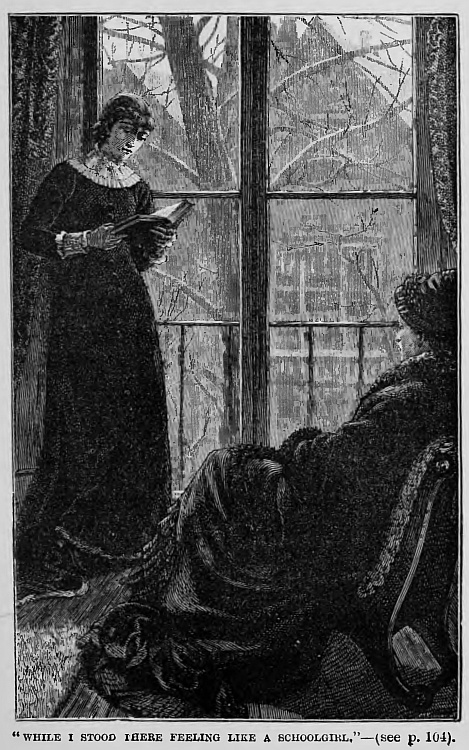
“‘Ro—bin A—dair,’ she sang, as I rose, in a not unpleasing voice. ‘Now let me hear you read. I always make my companion read to me a great deal; and mind this, I hate to hear any one drone like a school-girl. Go over there into the corner of the window, and stand there. Take that book; you’ll find the mark left in where Miss Belleville—bah! I believe her name was Stubbs, and her father a greengrocer—left off. Now then, begin!’
She pushed a lounge-chair close up to the window, and sat down with her hands in her muff, while I stood there, feeling like a school-girl, and ready to drone, as I began to read with faltering voice what happened to be Thackeray’s most beautiful chapter—The Death of poor old Colonel Newcome. I know my voice trembled at times, and a strange sense of choking came upon me as I went on, battling—oh! so hard—to read those piteous heart-stirring lines; but I was weak and suffering, I was faint with hunger and exertion, sick with that despair of hope deferred, and at last the room, with its costly furniture, seemed to swim round before me, a cold perspiration bathed my face, and with a weary sigh I caught feebly at the curtains, and then fell heavily upon the polished floor.
“I have some faint memory of being lifted, and wheeled in a chair whose castors I heard chirrup, to the front of the fire, and then, as my senses began to return, I seemed to feel arms round me, and a pleasant voice saying, half aloud:
“And she just lost her poor father too—to set her to read such a thing as that! I declare I’m about the wickedest, most thoughtless, and unfeeling old woman under the sun.”
“Then there was the refreshing odour of a vinaigrette, and the sick feeling began to pass away.
“‘I—I beg pardon,’ I faltered, trying to rise.
“‘I beg yours, my dear,’ she said, tenderly. ‘Sit still, sit still. Now then, try and drink that.’
“Some sherry was held to my lips, and then I was almost forced to eat a biscuit. They, however, rapidly revived me, and I found Mrs Porter had torn off her bonnet and mantle, and was kneeling by my side.
“That’s better, my dear,” she said, smiling at me, as she passed her arm round my waist, and drew me nearer to her, and kissed me in a gentle, motherly way. This was too much, for I was very weak and hysterical. I could fight against harshness, but her tender words and ways unlocked the flood-gates of my grief, and I laid my head down and sobbed as if my heart would break.
“An hour later, after she had literally forced me to partake of the breakfast that was ordered up, she sat beside me, holding my hand, and more than once I saw the tears steal down her pleasant face as she won from me, bit by bit, the story of my troubles and my bitter struggles here in town.
“At last I rose to go, trembling and expectant. Would she engage me? It was more than I dared to hope.
“‘Sit still, my child,’ she said, tenderly, ‘and stay with me; we shall be the best of friends.’
“I stayed—stayed to know her real worth and to win her motherly love—stayed to find, when John Murray returned, that his love was greater for my sister than for me, and patiently resigned my love to her, and then battled with a long illness when they had gone together to the far-off home. But every day gave me a new lesson on not judging too hastily. That is ten years since; and I am still in my peaceful, happy home, though only as companion to a lady.”
Chapter Nine.
My Old Sergeant.
I have visited the sick a good deal in my time, and have ever found that a serious illness is one of the greatest softeners of a rugged nature. I have noticed it in workhouse and in hospital as well as in the dreary habitations that are occupied by the poor. Perhaps it is more noticeable in men than in women, and in many cases it has seemed to me to bring forth nature’s gentility where it has for years, perhaps, been encrusted with rude, rugged ways.
One of my most genuine gentlemen by nature was a quaint old sergeant of dragoons, living in ill-health upon his little pension, and at the wish of some people in the country near our old home, I sought him out, and found him, after some trouble, in one of the little streets of Walworth, and imparted to him my mission, namely, to inquire if he could tell me the whereabouts of one John Morris and his wife, relatives of the farming people who asked me to inquire.
I found the sergeant, a stern, rugged old fellow, in his lodgings, and he looked surlily at me, being, as I afterwards found, in pain, and he saluted me with a harsh “Well, ma’am, what’s for you? I’m not in the humour for visitors now.”
“I will not keep you long,” I said, and stated my business.
“Oh, that’s it, is it?” he said. “I thought you came to preach at me, and tell me what a wicked old man I am. There, bless your heart, I knowed it well enough, none better. John Morris, eh?”
“Yes, and his wife, do you know where they are?”
“Dead, ma’am, dead, both of them: gone to where there’s rest and peace, and no more sorrow; ‘where the wicked cease from troubling, and the weary—’ You know the rest. Know them! Of course. John Morris was in my troop—B troop, 20th Dragoon Guards; smart, fresh-coloured, honest Lincolnshire lad—a good lad; without any of the general rough ways of a soldier: for there’s good sort of fellows among us, as well as the sweepings of towns and villages; and I loved that lad as if he’d been my own son. Why? Because he was a thorough soldier, every inch of him. He came to me to ’list—I was recruiting sergeant then. ‘Think twice of it, my lad,’ I says; ‘ours is a rough life;’ for from his talk I found he’d been having some tiff at home; so ‘think twice of it, my lad,’ I says: for I did not want to see a fine young fellow throw himself away. And it is that, you know, though it don’t sound loyal of me, as an old troop-sergeant-major, to say so; and feeling this—though I knew I should make a profit of the young fellow—I did not like to see him ’list, when a ‘rough’ would have done just as well. But he would do it; he was set upon it; and told me that if I didn’t take him, he would join the foot-regiment quartered in the town. So seeing how things stood, and sooner than he should do that, I gave him the shilling, and he entered one of the smartest heavy cavalry regiments in the service.
“I always liked him for his frank, honest, open manner, and the way he set to work to learn his duties—riding-school, foot-drill, sword-exercise,—no matter what it was, he worked at it; learned quietly and cheerfully; and in a wonderfully short time made himself a smart soldier. You never heard him snubbed for dirty belts or rusty accoutrements; everything belonging to him shone like silver or gold; while his horse was groomed till its skin was like satin. The men called him ‘Model Jack;’ for whenever some one on parade was having it for want of smartness, without pausing for a moment, the captain, or major, would shout, ‘Rein back, John Morris,’ tell the one in trouble to look at him and his traps, and then order so much punishment-drill.
“But we all liked John Morris; and there was not a man in the troop would have said a word against him, or done him an ill turn; for wasn’t he always ready to help a mate who was sick, or do a turn for a young beginner? But he was only a weak man, and he must do what no soldier who has any respect for a woman should do—he must get in love with a nice pretty little body, who was foolish enough to take a fancy to the fine smart young fellow. Seeing what a superior sort of lass she was, if it had been any other man in the troop, I’d have done what I could to stop it; but knowing the lad’s character—no smoker, no drinker; but one who spent all his spare time in the barrack reading-room—I couldn’t say a word; and so matters went on till we got the route, and were to be shifted from Edinburgh to Hounslow.
“Next time I saw John Morris, I knew there was something the matter; and after stable he comes to me, and in a blunt, straightforward way, he says—
“‘Sergeant, I want to be married. Will you speak to the officers for me?’
“‘No, my lad,’ I says, ‘I won’t.’
“He started, and looked surprised; for I was gruff; while as a rule I was always as friendly to him as I could be to a private—though there wasn’t a man in the troop who speaking honestly would tell you I was ever a bully.
“‘Look here, my lad,’ I says: ‘if you respect that little lass, you’ll just say good-bye to her kindly, and for good; or else tell her to wait till you can buy yourself out, and go into something civilian.’
“‘But—’ he began.
“‘There, hold your tongue, my lad; and just go up to the married men’s quarters, and look at the want of common comforts in the accommodation; look at the misery of their life; and then, if you’re not satisfied, go and look at the poor women who are not on the strength of the regiment—married without leave, you know—and see whether you’d like to see your little maid brought down to that.’
“‘But I’ve always done my duty, sergeant, and the colonel would give me leave to be married, and I’d do more to make her comfortable than—’
“‘Major Ellis wants Sergeant Rollin,’ shouts some one; and, seeing that was me, I jumped up.
“‘But you’ll ask for me, sergeant?’ says John Morris, getting hold of my hand as he looked in my face.
“‘Be off with you, sir, to your duty,’ I roared fiercely; and he went away, and so did I, and, as a matter of course—stupidly, as I told myself—I spoke to the major, and he said he’d speak to the colonel; but it was no use, for there were three more men married than there should have been by rights, and they could not have so many women and children in barracks.
“I told Morris afterwards, and he thanked me, and went about his duties till the day for marching came, and then I found out that John had married without leave, and, of course, punishment must follow as soon as it was known. I would not see it; but it was reported by another sergeant, and, as a matter of course, the poor weak lad was placed in arrest. I say wreak; but, there, I don’t know—the poor things loved one another very dearly; and the official orders, though they’re strong, ain’t so strong as human nature.
“He never grumbled or said anything about his punishment, but bore it all like a man, though he was anxious enough about his little wife, who travelled by parly train as far as their money would go, and walked the rest of the way up to Hounslow. And then there was the regular misery and struggle for the next few years: the poor little lass not being acknowledged by the regiment as one of the soldiers’ wives and having to lodge out of barracks, and live as best she could upon the beggarly pittance her husband could give her, helped out by what she, poor little thing, with her baby, could earn.
“I wasn’t going to jump upon a fallen man, but I know John Morris thought deeply upon my words as he saw the smart pleasant-faced little body sinking day by day into a drudge. I never said a word about it to him, nor he to me; but I did what I could to help him, though that wasn’t much.
“Then came another shift of quarters, and Mary Morris had a hundred and sixty miles to tramp to the next town we were stationed at; but she did it without a murmur, and a few days after we reached our quarters I saw her at the barrack-gate.
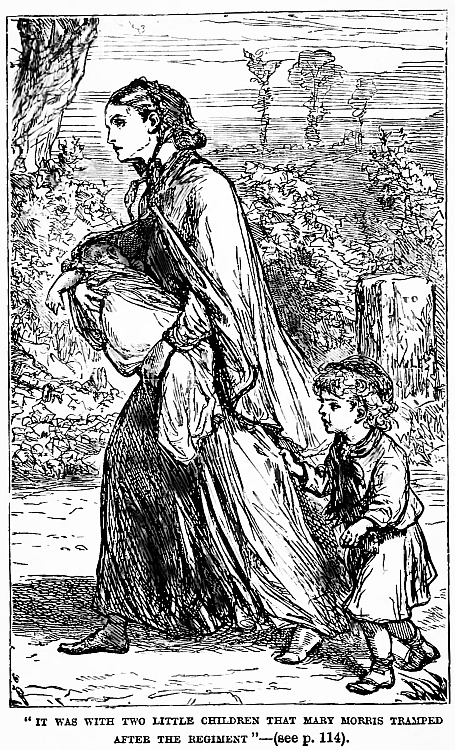
“We were not there very long, but had to make a fresh start, and this time it was with two little children that Mary Morris tramped after the regiment, to reach her husband nearly a fortnight after we had settled down—she looking worn out and haggard with trouble and her long journey. To have seen her now, no one would have known her for the bonnie little lass whom I had seen resting so lovingly upon the lad’s arm in Edinburgh town. But there, it was the usual lot of a soldier’s wife who is not on the strength; and from town to town the poor girl followed us about till the very last; and so long as she could be near her husband I believe the little thing was happy.
“I said till the last; for there came a day when I stood at the barrack-gate with tears in my eyes, that I was quite ashamed of, to see John Morris, the fine stalwart dragoon, in full marching order, leaning down from his horse, his gauntlet glove off, holding his little wife’s hand tightly clasped, as he gazed into her loving eyes—eyes as brimful of tears and affection as were those of the captain’s sister, leaning out of her carriage-window, and waving her handkerchief to her brother.
“Then came the trumpet-calls, and we were off, leaving many a tearful eye behind. But Mary Morris turned up again at the port where we were to embark; for it was only the sea that could stay the faithful little woman from following her husband. But there was the sea now; and we were ordered abroad for ten years, to a country that would be the grave of many of us, as I well knew.
“I’m not sure, but I think that was Mary Morris’s face I saw, all pale and drawn, in one of the boats just pushed off; but it soon faded from sight as the steam-tug drew our great ship down the river; and then, as I turned away, heavy-hearted and dull at leaving the old country, I met the eyes of poor John Morris, when he must have thought of my words before his marriage, for he groaned, and, poor fellow, his head went down upon his arms on the bulwarks, and I could see his great, broad chest heaving as he sobbed and cried like a little child.
“Time went on, and up the country we had our work cut out. I’m no lover of butchery, but I’m a soldier by trade, and always tried to do my duty. More than one battle I had been in, to come out scathless—the last time owing to a swinging sabre-cut given to a Sikh who was about to shoot me down, and it was not my hand that gave that sabre-cut, but the hand of John Morris.
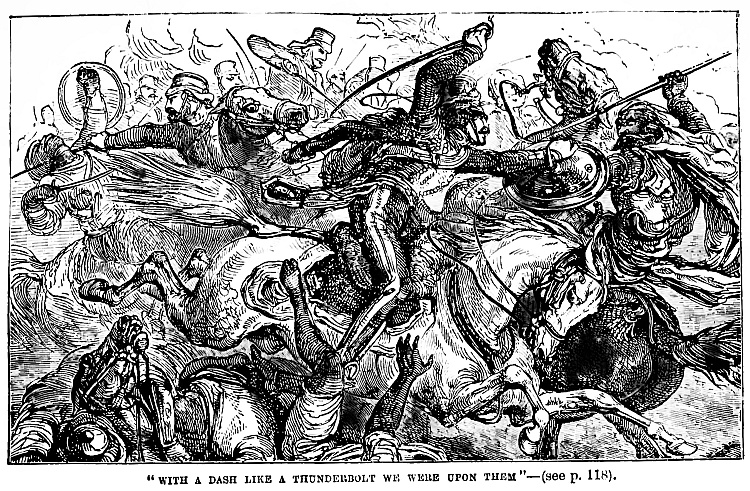
Then came another fierce engagement, when, worn out with heat and thirst, the order came to charge. The moment before, the men were drooping and listless; but as the trumpet rang out, eyes lit up, bronzed faces flushed a deeper hue, and we trotted steadily, knee to knee, over the plain, nearing the enemy at every stride. John Morris was on my left, and I could not help smiling to think what a good man and true I had by my side; when the trumpet call again rang out ‘gallop,’ and on we went until within a hundred yards of the foe, when again came the loud blast; spurs were used, and with a dash like a thunderbolt we were upon them. I recollect the sharp, ringing volley they gave us as we came down, and about the air bearing a strange, shrill cry; after which it was one wild, fierce struggle, till I found myself breathless and faint, trying to free myself from my horse, who was down, pinning me to the ground. A violent drag set me at liberty, just as the poor beast made its last effort to rise, and fell back dead.
“I will not sicken you with the scene around me, one that I tried to leave behind; but I had not limped many paces before a faint voice cried after me, ‘Sergeant!’ and turning, there, raising himself upon his elbow, was poor John Morris, with a look that I shall never forget upon his face. There were plenty of horrors about, but I had eyes only for the poor fellow before me, and kneeling down, I supported his head and tried to stanch his wounds.
“‘No good! no good!’ he whispered. ‘I’m cut to pieces. Done my duty, sergeant, though it was hard work not to desert when I had to leave her. Find her; tell her I was true to the last, and—Cowards!’ he cried.
“At the same moment, almost, I started up, but half-a-dozen horsemen were upon me, and I was cut down and knew no more.
“It was years after when I saw England again, and tried to find out poor Mary—the weak, simple-hearted girl who had been left behind. I tried hard, but for a long time without any result, till one day I met by chance another woman who had been in the same plight.
“‘Can I tell you where she is?’ she said, ‘yes; come with me and I’ll show you.’
“I hung back for a moment, thinking of the sad news I had to tell; but duty’s duty, and I followed the woman from street to street, for quite half an hour, during which time I’d made up the words I meant to say, and was ready with my message, meaning, too, to tell poor Mary where she could draw the pay due to her husband. But I never delivered my message, for turning to the woman I said, ‘is it much farther?’
“‘No,’ she said, ‘close here; and I’d have been with her, but for the hope that my poor boy would some day come back.’
“I hung back again, but she took hold of my arm as she stopped by an iron gate, and pointed to a multitude of green mounds, saying—
“‘They laid her there, somewhere, two years ago now, but I don’t know which was the grave; for poor folks die fast, and people don’t put stones up for soldiers’ wives.’
“‘Do you know what she died of?’ I said, softly, for I was shocked and surprised.
“‘Died of?’ said the woman bitterly; ‘what I should have died of, only I was too hard—died because her husband was dragged away, and her little ones went one after the other: died of a broken heart! a poor, gentle thing, praying that they might meet again.’
“Yes; that mark was left when the Sikh cut me down, as I held poor John Morris’s head; and now if you please, ma’am, we’ll change the subject, for when I get talking about other people’s sorrows that old wound begins to throb.”
Chapter Twelve.
Somebody Dead.
Going about the streets of London on errands of mercy, naturally makes one observant of everything that seems in any way connected with trouble or sorrow. If I see a family moving, with all the discomforts of leaving one home for another, I immediately begin to wonder whether it is a voluntary affair or whether it is the result of misfortune. Again, a funeral always takes my attention and I find myself wondering whether the mourners could be helped or comforted by me, and I note whether the dead is young or old by the funeral trappings, and too often see that it is some tender child, though the grief is as great or greater when it is some dear wife or mother, or may be the father—the stay of some family.
My friends ought to consider me a doleful miserable person but they do not, and they never think it eccentric of me to take so much interest in houses with the window blinds drawn or shutters up, but rather give me their sympathy and help.
Noticing such matters it will be no cause for surprise that I had often marked the black crape band worn upon the arm of their uniform coats by soldiers and volunteers. The first time then that I saw driver after driver of the omnibuses along a busy line of route with a tiny black crape bow fastened on his whip I naturally became eager to know why this was, or rather who might be the important personage to whom the sign of respect was paid.
I felt as if I could give anything for an hour’s chat with one of the drivers, but how was it to be obtained? I knew they were for long hours upon the box, and that during the short time they were at home it would be hard work to get either of them to tell me what I wanted, so I set to and pondered.
I don’t know that I should have felt any compunction in taking a seat outside an omnibus, though now-a-days it would seem a very out of the way place for a lady in London streets. But I thought that if I could find one going out through the suburbs to some pleasant village it would be no more extraordinary than for a lady to take a seat upon a stage coach for a ride through one of the outlying districts beyond the reach of the rail.
The difficulty was solved, for I thought of the Richmond omnibuses, and making my way to the White Horse Cellar, in Piccadilly, I found no difficulty, for a ladder was placed for me, and I was able to climb to the vacant seat beside the driver, who looked at me askant as if suspicious of me. I saw him give a peculiar look at the conductor, and I smiled to myself as I nestled beneath the great tarpaulin apron, and watched the care with which he guided his two stout well-fed horses through the maze of conveyances, the crape bow like a strange black butterfly seeming to flit to and fro before my eyes.
Nothing to him is the task, as through narrow channels he steers his way, pouncing upon a passenger here, another there; rarely using his whip, never in collision, but stopping short now in obedience to a “ting” from the conductor’s bell; started again by the same means; and seeming to have that huge, heavily-laden vehicle, with twenty-eight people in and upon it, as much under control as if he sat a few inches from the ground in a pony-drawn basket carriage, driving in a country road.
But here it was again and again, a crape bow upon whip after whip, and many of those whip handles, and their holders’ elbows, raised in the well-known salute to my driver, though it seems strange that when drivers salute each other they should always do it in that singular elbowish way, their eyes being all the while carefully inspecting their fellow’s horses.
Somebody important must be dead for there to be so general a display of mourning, and I soon found out that I was right. Somebody of consequence had passed away.
No one of the Royal Family, surely? No. Not an eminent statesman, or the papers would have recorded the fact. Man of science, philanthropist, preacher, teacher, author, actor, musician? No, none of these. Somebody of importance? Yes; somebody of importance.
To the world?
Yes, to his own little world.
Who might it be then?
An omnibus driver.
But you said a man of importance!
Yes; a man of importance—the father of a family, the man whose patient toil produced, Saturday night by Saturday night, the sum of money that should keep respectably his wife and six little ones;—the man who had no rest on Sundays; but seven days a week—hail, rain, sunshine, or bitter frost—goes on his monotonous journeys for fourteen, fifteen, sixteen hours per day, with hardly time allowed him to supply the wants of nature—a rough-looking, weather-stained, hoarse-voiced, ignorant man; but a true, faithful husband, a loving father, and a patient toiler—the sole prop, stay, support of the weeping ones at home.
A man of importance called away from this busy, competitive, stirring world—somebody of importance dead, gainsay it who will.
So I found from my driver, who, after being exceedingly gruff and distant for a time, gradually seemed to thaw, and, as I asked question after question, became quite loquacious, as he made the black crape butterfly flit from side to side in the act of caressing his horses with the whip. I did not see him lash them once; and at last he spoke out as if he had known me for years.
“Seems a sort of mark of respect for the poor chap, and we generally do it. Worth nothing, of course, for a kind thought and an honest tear in memory of an old friend’s worth, to my way of thinking, all the crape and black feathers and velvet palls, and hearses and mourning coaches, in the world. Don’t say I’m right, ma’am; and though I talk of tears I don’t say that I drop em. I leave that for the women to do, but I’ve had a few thoughts about poor Sam, who got off his box come Sunday three weeks dead beat, poor chap.”
No, my driver did not seem at all the man given to tears, but in consequence of the cutting wind blowing right into our faces, there was a slight humidity in his eyes, and he sniffed twice very loudly, and then put his whip in the hand that held the reins, took off his hat, and fished out a red cotton handkerchief, with which he blew his nose loudly.
“Strange bad colds we ketches up on the box here sometimes,” he said apologetically. “It’s enough to kill anybody—the hours are so long; but then, it’s no use to grumble—not a bit. If you don’t like it you can go, and there’s hundreds of men who can handle the ribbons ready to pop into your seat. It’s a precious sight easier to get out of collar than it is to get in again, I can tell you; so I don’t grumble, but keep on.
“Look healthy? well, pr’aps I do; but all this red colour in one’s face ain’t fresh air and weather. One’s drops have something to do with it, for some chaps may stand it, I dare say, but I can’t, and I find a drop of beer with some gin in it warms you better than most things. I like temperance as well as any man, but I really can’t do without a drop in the bitter weather, and those who can must be made of different stuff to me.
“Now, take one of our London winter days—which you like—a regular keen frost, or a yaller fog, or a soaking rain, or one of those cold, mizzly, clinging, go-through-your-very-marrow sort of days. Get your breakfast in a hurry, and be off to the yard and get on the box. All’s ready for us, for we don’t clean horses or ’busses; there’s men on purpose to do that. Well, I’m well wrapped up, and I get on my box at eight o’clock in the morning, and begin my City journey. There we are all times; we mustn’t go no faster, nor we mustn’t go no slower; time’s time, and we have to keep it if we can, but sometimes we can’t, and do what we will, we’re late—with extra passengers, or a block, or something wrong with a horse, or one thing or another; and then, if it happens to be near dinner time, we have to start back as usual, and often and often, I haven’t got off the box, but swallowed a mouthful of something where I sat, and been off again.