FRANK FORESTER (continued 3)
Reading edition
"Will it work?" he asked himself as he lurked in his hiding-place a few yards above the track. All depended on whether the drivers examined the attachments before they moved on again. There seemed no reason why they should do so; hitherto the drivers had walked at the head of their teams; but there was a chance that when they came down to lift the blocks of wood one of them might happen to notice that something was wrong.
He waited in feverish impatience. How slowly the men were working! What a bully that German officer was! If the trick succeeded, these patient long-suffering Turks would have had their labour for nothing: the German would make them pay for it. Well, they must pay for allowing themselves to be fooled by the Germans.
At last came the word of command. The drivers hastened to the heads of the mules; two men hurried down to lift the blocks of wood when the gun had started. There were loud shouts and cracking of whips; the mules strained at their collars; the heavy gun lurched forward. And then Frank thrilled with delight. Secured only on one side, the gun skewed round with a jerk. For a brief moment it hung over the edge of the slope. The mules slipped backward; the sudden slackening of the chains released the second ring from its hook; and to the sound of startled yells and frantic invocations of Allah the gun hurtled down the slope and crashed into a ravine two or three hundred feet below.
CHAPTER XVI
TWO MEN IN A LAUNCH
In the confusion ensuing upon the fall of the gun Frank crept unseen up the gully. He chuckled as he heard the infuriate curses of the German officer. The cause of the disaster would never be known. Whether it were ascribed to the carelessness of the men or to the accidental slipping of a ring mattered nothing: the gun was lying at a spot whence it would be almost impossible to remove it; very likely it was damaged beyond repair. Frank's satisfaction was only alloyed by regret that to attempt the same feat with the other guns of the battery was out of the question.
"Now what's to be done?" he thought, when, having put a considerable distance between himself and any risk of danger, he stopped to think over his position. One result of the establishment of the battery on the heights must be his abandonment of the sepulchre. Whatever might be the reason for placing the battery just there, if the guns began to play they would draw upon them the shells of the British fleet, and the sepulchre was near enough to be anything but a safe asylum. The troops pursuing him were not far to the north. With no permanent refuge he could not hope to evade them much longer. Sari Bair was becoming too hot to hold him. He must move on.
But in what direction? No part of the peninsula was any longer safe. To go southwards was mere folly: he would only come to the forts, about which there was no doubt a strong concentration of troops. And that way there was no outlet but the sea. Northwards, where the peninsula was wider, there would be more room to move; but after what had happened he would be watched for at every little farm, on all the roads, and if he were not actually captured, lack of food would ultimately enforce his surrender. "What an ass I was not to make for the harbour at Gallipoli that night," he thought, "and try to smuggle myself on Kopri's vessel!" But repentance had come too late. Here he was, caged; nothing could now alter that; and if he were caught in the end--well, these last few days had given him an amount of joyous excitement which he could never forget. Even the reflection that he had now lost the privileges of a civilian, and would probably be shot at sight, did not much trouble him. "Kismet!" he thought: "I must have breathed in the fatalistic spirit of the country."
"But I'm not done yet," he added to himself. "It's Bulgaria now, I suppose. I'd better get away first to the east, out of the way of those fellows hunting me, and then work round as quickly as I can to the north-west. Lucky I stuffed my pockets pretty full of loaves; but it's quarter rations. I don't know when I'll be able to get more."
The booming of guns to the south reminded him that fellow-countrymen were only a few miles away--a galling remembrance. They could do nothing for him. "Alone, alone, all, all alone!"--where had he read those words, and how little he had understood till now what they meant!--"Oh, chuck it, Frank Forester!" he said to himself. "It's no good grousing. Come on!"
He struck off across the shoulder of the hill, and made his way down the bed of a stream skirting the western side of Kojadere, and flowing almost due south until with a sharp turn to the left it fell into the Dardanelles a mile or so north of Maidos. For the greater part of the distance it was close to a road, and Frank had to keep a careful look-out. But the country was rugged and desolate: there were no villages and to all appearance no houses; only once did he catch sight of anything on the road--a bullock wagon lumbering slowly in the opposite direction.
The ground was for the most part on a low level, and in order to ascertain his distance from the coast he turned off to the left, where there were hills rising nearly two hundred feet. After a long and tiring climb he reached a cliff at the eastern extremity of the Kalkmaz Dagh which, projecting a little into the sea, gave him a direct view downward into Maidos and the strait beyond. A Turkish warship lay just above the Narrows; torpedo boats and vessels which, though he did not know it, were mine-layers, were moored here and there; and crossing the channel from Chanak was the motor launch, with its awning over the fore-deck, which he had noticed once or twice before. "Abdi's on the other side now," he thought.
He watched the launch through his glasses as it threaded its way through the congestion of lighters and small cargo vessels lying off Maidos, to a jetty north of the town. A number of passengers came ashore. The launch was tied up and the crew also landed--all but one man, who sat down in the stern and appeared to be eating his dinner. Frank almost unconsciously took out one of his loaves. "Didn't know I was so hungry," he muttered. He ate half the loaf, which was little larger than a scone, put the remainder back, then took it out again for a final mouthful. The man on the launch was still eating. Frank watched him enviously, and almost hated him when he saw him wrap up a portion of his meal and stow it away. "He has too much and I too little," he thought. "I daresay he'd sell what's left. Wish I could get at him!"
This started a train of thought, or rather a series of questions. Why not go down to the launch? Why not make use of his military uniform? What chance was there that the man on the launch had heard that an English fugitive was masquerading as a Turkish officer of artillery? Indeed, why not bluff it out, get command of the launch, and run down the strait towards the open sea? British warships were there. Was he prepared to face a twofold risk--run the gauntlet of Turkish vessels and batteries, and also draw fire from a British ship?
It was a ticklish problem, that would not wait long for a solution. At any moment the launch might be ordered off. If the attempt was to be made, it must be made at once. "Too risky," he thought. "I might be spotted before I reached it. It's nearly a mile away: might be gone by the time I could get down. It's absurd."
Sunk in this pessimism he sat with his chin on his hand, looking at the launch, on which the man now lay stretched on his back, gazing down the strait towards Kilid Bahr, where the shore bent round to the west, and beyond which there were British vessels. It was only four or five miles to Kilid Bahr; in the clear air the distance seemed shorter. He thought of the alternative--further hide-and-seek in the hills, long wanderings, semi-starvation, cold. "Hanged if I don't have a shot," he said to himself.
Below him ran the road from Boghali through Maidos, at the edge of the strait. There was no other way of reaching the launch unless he made a long detour round the hills. The afternoon was already far advanced. A detour would take much time, and taking it he would lose sight of the launch. On the road, so far as he could see it, there was no traffic. He rose to his feet, made his way down the hillside, gained the road, and set off quickly southward.
In a few minutes, rounding a corner, he overtook a transport wagon drawn by two oxen. It flashed upon him that he would attract less attention if he got a lift on it. Stepping up to the front of the wagon, he hailed the driver.
"Give me a lift," he said. "I've walked from Sari Bair, where we are placing a battery. It's very tiring, walking over the hills."
"That is true, effendim," said the man. "Your excellency may do as he pleases."
Frank got up beside the driver. The wagon lumbered on. As it neared Maidos it passed people here and there; they saluted the supposed officer without suspicion. It passed a house ruined by a shell.
"They said the English were our friends," remarked the wagoner.
"Time will show who are our true friends," answered Frank.
They were now entering the northern outskirts of the town. Frank saw many signs of the havoc wrought by indirect fire from the British fleet. In the distance soldiers were moving about. He thought it time to get down. Tipping the driver, he jumped to the ground, and turned off to the left towards the jetty. The launch was still tied up: he could just see its awning.
When he was still some little distance from it he had a shock. From the opposite direction, and nearer to the jetty than himself, a Turkish officer was approaching it. He was bound to get there first. For a moment Frank thought of turning tail; he had not yet been observed; but it occurred to him that the officer might possibly come back in a few minutes: it was worth while waiting to see.
Near at hand was a deep hole in the ground, the work of a shell. Beside it was a broken transport wagon. He sat on this, took a cigarette from the case which, with an automatic lighter, he had found in the pocket of the great-coat, and began smoking like any idler. A shed at the shore end of the jetty partly hid him from view.
The officer went on board the launch. Frank had a second shock. It was the Kurd Abdi. Apparently he had not been to Chanak after all. Perhaps he had deferred his departure for the sake of making one more attempt to capture the fugitive. It was plain that he was intending to cross the strait now, for the man in charge of the launch was making preparations to start.
Frank was as it were paralysed for a few moments. The game was up. But no: while the man was pouring petrol into the tank, Abdi had gone forward and was making himself comfortable under the awning forward. There was just a chance for boldness. Making up his mind instantly, Frank strolled unconcernedly down the jetty. The launch man was bending over his engine; beyond him Abdi was half concealed by the awning.
Frank halted a few yards from the launch, where his face could not be seen by the Kurd, and hailed the engine man in a low tone. The man looked up, and Frank beckoned him ashore. He hesitated a moment; then the officer's uniform was effective: he jumped on to the jetty and came to Frank's side. With a show of mystery Frank led him a few yards and said:
"His excellency is crossing to Chanak."
"The Governor?" asked the man.
"Yes: you are ordered to wait. Not a word to any one. Go at once to headquarters and ask for Major Ahmed Talik. There will be a valise to carry down. You understand?--Major Ahmed Talik. It is not to be talked about. Make haste!"
"But my passenger, effendim?"
"He must wait. I will explain to him."
"My orders! I am not to leave the launch."
"Do you argue with me?" said Frank sternly. "Go at once."
The man hastened to excuse himself, and set off, somewhat bewildered, towards the town.
"Why keep me waiting, dog of a dog-son?" called Abdi from the launch.
The man turned, but Frank signed to him imperatively to go on, then sauntered back along the jetty, one hand holding the cigarette, the other fingering the revolver in his pocket. Abdi had raised himself from his recumbent posture, and in a crouching attitude was peering out from beneath the low awning. The glow of the sun, setting over the hills behind, struck full upon his eyes: Frank's were shadowed. Frank half turned as if watching the retreating launch man, all the time slowly approaching the vessel, thus gaining ground without revealing his face.
Then he suddenly swung round, and jumped on board. The launch rocked.
"Wallahy! Would you upset me?" cried Abdi.
Frank stood in front of him, pointing his revolver, but in such a posture that the weapon could not be seen by chance observers on shore. Half under the awning Abdi was at a disadvantage. He was so much taken aback by Frank's sudden movement, and so much overcome with amazement when he at last recognised the features of the newcomer, that he was incapable of shouting an alarm, and the sight of the revolver within a few feet of his head disposed him to listen to what Frank was saying.
"Salam," said Frank quietly, "we are going for a little trip together. No, no: keep your hands down. Don't move any further from under the awning. You recognise me, I see. I am the Englishman you have been hunting--and this is my revolver. It is loaded.--Do you hear? Keep still.--You have a revolver too, in that belt to which I see your restless hand groping. Well, I collect revolvers. I have two of yours already; the other will be safer with me. No: keep your hands up; if you hurry me I may shoot too soon. On your life don't make a movement!" he ended fiercely.
With his right hand holding his revolver at the Kurd's head, he stooped, and with a quick movement of his left hand wrested the revolver from the other's belt.
"Now get back under the awning to the comfortable place you have arranged for yourself," he said.
The Kurd hesitated and flashed a downward glance at the knives in his belt.
"I will count three," Frank went on. "If you are not comfortable when I come to three ... one ... two----"
With a snarling curse Abdi crept backward to the cushions at the further end of the awning, and collapsed there.
Transferring the revolver to his left hand, Frank, also moving backward, came to the engine. It was not his first trip in a motor launch, and a rapid examination showed him that the boatman had got everything ready. Nothing remained but to switch on the current, turn the crank and cast off the hawser. These movements he made, his eyes scarcely leaving the discomfited Kurd for a moment. Then he threw the engine into gear and seized the helm, and the little craft sidled from the jetty, and shot away over the dancing wavelets of the Dardanelles.
CHAPTER XVII
THROUGH THE NARROWS
Frank felt himself go pale under the reaction from the strain of the last few minutes. But he had won the advantage in the opening of the game: he must maintain it to the end.
He had so often watched the launch crossing to and fro that he had a pretty good idea of the course. Chanak was a couple of miles down the strait on the opposite shore: it would excite least remark if he steered as for that town. The vessel was too shallow in draught to run much risk from possible mines, and it was so frequently seen that no one on a Turkish ship would pay any attention to it. No doubt an alarm would be raised when the boatman discovered that he had been tricked; but Frank hoped to be several miles on his voyage to safety by that time.
When he drew out from under the lee of the hills he found that the wind was in his favour, blowing directly down the Narrows. This should mean at least a three-knot current. The launch was small, and probably incapable of more than seven or eight knots: his utmost speed, then, might rise to ten or eleven. But it was not wholly a question of speed. If the alarm was given before he reached the narrowest part of the channel at Chanak escape would be unlikely if not impossible. The fast-gathering darkness would be no protection. He would be under searchlights from both sides, and a dozen batteries would have him under fire at ranges ascertained to a yard. His nerves, judgment, quickness of decision, would be taxed to the uttermost in this adventurous voyage of a few miles.
With the fall of night navigation practically ceased on the strait; therefore he was not very likely to be run down by accident. But he must guard against collision with vessels moored under either shore. Further, there was always a chance that he would be challenged from the deck of one of the stationary vessels, and though he did not doubt his ability to give a reassuring answer, he had always the Kurd to reckon with. It would have been prudent to gag him, but the opportunity for that was past. Shaping his course by the faint twilight, he kept one eye on Abdi, ready to take action instantly if the man showed any disposition to be troublesome.
So, in growing darkness, he ran down the strait until he came opposite Chanak, which was distinguishable by a few dim lights and the sounds of bustle on the quays and jetties. The place had suffered considerably by bombardment from the ships of the allied fleet, which had come up to within a few miles of the Narrows; but it was clear that extensive repairs were already in progress. Observing two or three large vessels moored out of the current in the little bay north of the town, Frank as a measure of precaution cut off the engine, and the launch drifted into the neck between Chanak and Kilid Bahr. His ear caught the faint sound of a windlass working in the channel at some unseen point ahead. Clearly a vessel lay out there. He pitched his voice to a low note, and gave Abdi a quiet warning not to speak a word or make any movement of alarm, on pain of receiving the full contents of his revolver. The most dangerous part of his voyage was evidently at hand.
In a few minutes he saw, some little distance ahead on the starboard side, a large dark shape moving towards him. Putting the helm over, he crept in more closely to the Asiatic shore, in the hope that the launch, being small and low and travelling silently, would escape observation. But next moment he was startled by the sudden beam of a searchlight playing over the middle of the channel from some point behind him. The darkness on either side was intensified, so that the light, while it swept mid-channel, favoured him; but if it should bend its rays to the left, the launch would be vividly illuminated, and could not fail to be observed by the men on the approaching vessel, who would certainly follow with their eyes the path of light. He watched the beam lengthening its giant stride. It passed over the slowly approaching torpedo boat and illuminated the water beyond. Hugging the shore as closely as he dared, Frank drifted on, resolved, if the light fell on him, to start the engine and make a dash at full speed down the strait.
The light took a sudden sweep upwards, swung to the right over the hills and disappeared. Then Frank realised that the current had failed him. The launch was scarcely moving. He steered for the open channel, edging out very gradually. No sooner had the launch come again into the current than the light flashed out, just touching a point of land on his port side, and passing beyond it. It occurred to him that if he could round the point during the interval of darkness before the light again appeared, he would no longer be in its direct path. It was worth the risk of starting the engine and making a dash over the short distance between him and safety. Guided only by the dark outline of the low wooded cliffs on his left hand, he put the engine at full speed while the light was still sweeping the channel. To maintain an even distance from the shore he soon found it necessary to keep the helm well over. He must be rounding the point. And when, a minute or two later, the beam once more flashed out, it passed almost directly over him, leaving him in shadow. With a sense of profound relief he stopped the engine and floated down with the current, more than satisfied for the moment, but wondering how long his luck would hold.
The launch was now in pitch darkness. Frank knew that there were shoals along the shore, and he was beset by a double anxiety: he must steer so as to avoid at once the path of the searchlight and the unknown shoals. So fully was his attention occupied that he had almost forgotten the Kurd lying forward. The dark patch which favoured him was favourable also to an expedient which Abdi had been grimly meditating. Suddenly, while Frank was peering into the darkness ahead, he was conscious that a black shape had intervened between him and the scarcely perceptible space of water. He knew instantly what it was, but before he could brace himself for the impending shock the steering-wheel shivered under a sword-cut that missed him by a hairsbreadth, and the Kurd flung himself upon him, at the same time shouting vociferously to attract the attention of any watchers who might be on shore, or on some vessel near by. Taking advantage of Frank's preoccupation and the darkness, Abdi had crawled from under the awning and along the deck under the side of the little craft, springing to his feet within a few inches of Frank's seat.
It was the fact of being seated that proved to be Frank's salvation. Abdi lost the advantage of surprise when his sword-cut missed. He fell forward awkwardly. Frank's right hand was pinned beneath the Kurd's body, but his left, with which he had held the wheel, was free. Instantly he gripped Abdi's sword-arm above the wrist, and for a few moments there was a fierce struggle for position between the two men; Frank striving to free his right hand, and when he had done so, to prevent the Kurd from strangling him with his left arm.
Frank was soon aware that in mere power of muscle he was no match for his assailant. But he had the firmer position, Abdi being inclined forward and swaying unsteadily with the rocking of the launch. Suddenly dropping his clutch on the Kurd's upper right arm, he seized him by the throat, braced himself against the seat, and pulled his left arm towards him, exerting all his strength to twist him over. With his free right hand Abdi clutched at the thwart; but Frank's leverage against the seat gave him the mechanical advantage; moreover, the Kurd was expending much energy in trying to free himself from the pressure on his windpipe. Inch by inch he was pressed back against the side of the launch, every moment struggling more feebly under Frank's choking clutch. At last his shoulders were hanging over the water, and his arms were raised as a drowning man throws up his hands. Then suddenly Frank released the Kurd's throat, caught him beneath the right knee, and, pressing heavily on the seat, tilted him overboard. There was a gurgling gasp as the man struck the water, then a brief silence, broken soon by a long yell. It was a cry for help, but not a cry of despair, and Frank, panting from his recent exertions, was aware that Abdi could swim. His cries must be heard on shore and on any vessels that might lie in the neighbourhood or be patrolling the strait. At first their meaning would not be known, but they would give the alarm and put the enemy on the alert, and as soon as Abdi reached the shore the truth would be flashed from fort to fort.
The launch, left to itself during the struggle, had drifted inshore and was bumping against the rocks. Frank had just switched on the engine and reversed the screw when an agitated movement of the searchlight and shouts from the cliffs above him showed that an alarm of some sort had been given. The white beam was sweeping the whole breadth of the channel except that black band which was shielded by the cliffs and in which the launch was moving. This band widened as the trend of the shore became more south-westerly, and Frank had good hope of running out of danger. His confidence was rudely shaken when a second searchlight began to play from a point slightly ahead of him. For all he knew there might be others at different points down the channel. It was neck or nothing now. He put the engine at full speed ahead, and the launch throbbed and swished through the water.
The coast-line here made a sudden bend inwards. Frank steered accordingly, and was relieved to find that by his change of course he just escaped the searchlight, whose beam flashed almost over his head. The beating of his screw could hardly fail to be heard on shore, no more than a hundred yards away; but the light could evidently not be depressed sufficiently to illuminate this edge of the channel. The launch dashed on; the light was left behind; and steering almost due south Frank once more felt secure.
But next moment he was startled by the sudden flashing of a light from the opposite shore. It swept directly across the channel and moved slowly along, lighting up yard after yard of the white cliffs on his left hand. There was no avoiding it, and he felt a strange tingling as he realised that in a few seconds the light would find him, and he would then become the target for the enemy's guns. So it was. The beam suddenly overtook him, the launch was vividly illuminated from stem to stern, and the light kept pace with it in its rush down the channel. Frank tried by zigzag steering to wriggle out of it, but it followed every movement, and he resigned himself to the inevitable.
There was a roar and flash from the western shore. A shell splashed into the water close astern, but failed to explode. At that moment Frank felt neither dismay nor fear, but only a strange exhilaration. Shells began to fall fast, now ahead, now astern, and on both sides, some exploding with a terrific noise, others merely splashing into the water. "They haven't had practice on moving targets, like our naval gunners," thought Frank.
Since everything now depended on speed, he steered out into the channel, in order to take full advantage of the current. His change of course seemed to baulk the gunners. The light grew dimmer as he drew farther from its source, and the gunners, slow in shortening their range, sent their shells far beyond him. But now a brilliant beam of light struck the launch from the eastern shore. The searchlight which the cliffs had previously intercepted had free play over the part of the channel on which he was now racing. In a few moments shells began to fall more thickly around him. The noise was deafening. Huge waves dashed over the launch, and Frank wondered whether it was to escape a shot only to be swamped and sunk by the water. But he clung firmly to the wheel.
Then there was a stunning explosion. The launch staggered as if smitten by a mighty hammer; an immense volume of silvery spray showered upon it. Frank saw that a big gap had been made in the starboard side, a foot or two from the stem. But the engine still throbbed steadily, and the little craft still thrashed her way at full speed seaward. For a little the shelling ceased. The spray had hidden the launch from the view of the gunners, who probably supposed that they had sunk her. But they soon discovered their mistake, and after a ranging shot they started their continuous bombardment again. The brief respite had enabled Frank to gain ground. The launch was less brilliantly illuminated. A light mist was gathering on the water. The wind had changed and was blowing in from the mouth of the channel. In a few minutes the shells ceased to fall. The batteries had given him up.
But his satisfaction was short-lived. Above the throbbing of his engine he became aware of a new sound--the deeper-toned throbbing of a much more powerful engine. A new light began to grope through the mist. Frank felt a sinking of heart. Beyond doubt a war vessel of some kind was in pursuit of him. Outmatched in speed, what could he look for now but a sudden end?
The light found him. Instantly the torpedo boat astern opened fire: Frank heard the regular rap-rap of a machine gun. The noise of the engines grew louder: the vessel was bearing down upon him relentlessly like a sleuthhound. Bullets whizzed, whistled, splashed, thudded on the woodwork. He felt a burning pang in his right shoulder. Clenching his teeth he held on his course. Despair seized him when another light, this time ahead, mingled its misty beam with that from behind. Between two fires, what could this be but the end? "I'll die game," he muttered, and steered straight for the torpedo boat which was now visible in the lifted light of the vessel behind. In a few seconds his light craft would strike that iron bow, and then----
But the shock against which Frank had thus steeled himself never came. With his hand still upon the steering-wheel he swooned away.
When Frank opened his eyes again, they lighted upon the ruddy clean-shaven face of a man in a peaked cap and navy blue.
"Where am I?" he murmured.
"In a ward of H.M.S.--no, I mustn't tell you the name, bedad: 'tis against the rules, or if it isn't, it might be, so I'll not tell you. But it's a hospital ship, and you've a nice little hole in your shoulder, and here's the bullet that bored it: perhaps you'd like to look at it."
Frank took the bullet and looked at it with an air of detachment. It seemed hardly believable that that cone of lead had been in his flesh and was now out of it.
"But who the deuce are you, in an enemy uniform and all?" the surgeon asked. "No, you haven't it on now, to be sure; but there 'tis, rolled up on the bunk there, and you were in it when they brought you aboard, and you speaking English as well as the rest of us. You can't talk, to be sure; but who are you? Don't try to talk, but tell me that."
Frank smiled at the rubicund Irishman.
"I feel rather groggy," he said faintly.
"Of course, and who wouldn't? But 'tis a clean wound, and you'll be up and skylarking in a day or two, Mr.----"
"Frank Forester."
"Ah now, that's not a Turk's name, to be sure. Well, don't talk. I can talk enough for both. When Lieutenant-Commander W----no, I won't name him--of H.M.S.--won't name her--saw a Turkish gunboat firing on a Turk in a neat little cockleshell of a launch, 'Boys,' said he--though I did not hear him, to be sure--'Boys, drop one in the engine-room.' And sure enough, one of her fore six-pounders planted a shell amidships, and crippled the Turk's engines, and a couple more sent her to the bottom. Then they hunted for you, and found your launch bumping on the rocks below Erenkeui, and you as pale as your shirt (where it wasn't red) hugging your wheel as if you loved it. They took you aboard and handed you over to me, and I'm to send in a report when I've got from you who you are, and who's your father, and the way you come to be playing the fool in a Turk's uniform. But there's no hurry for that. You'll take a little food, and sleep, and by and by I'll come and see you again, and then you can give an account of yourself. Now let me have a peep at your shoulder."
CHAPTER XVIII
THE LANDING AT ANZAC
One bright morning in April, a group of young officers sat smoking on the deck of a British destroyer lying amid a crowd of warships and transport vessels in Mudros harbour, on the southern shore of the Grecian island of Lemnos. They were clad in khaki, with sun helmets, which marked them out as military, not naval officers. Seated in a rough half-circle, some on chairs, some on the spotless deck, they appeared to be specially interested in one of their number, at whom they were throwing questions one after another.
"What's the Turkish for 'Give me some beer,' anyhow?" one had just asked.
"Bana bira ver," replied the young subaltern. "But you won't easily get it, you know. Moslems don't drink it."
"Do they grow grapes?" asked another.
"Oh yes; yuzum 's the word."
"Don't they make 'em into wine, then?"
"They're not supposed to, but I daresay you might get some if you said Bana sharab ver very politely."
"You won't want it, Ted," said a third. "We've plenty of our own stuff. Our Australian wine is as good as any."
"Besides," said the man they were questioning, "you won't get many opportunities of making requisitions of that sort. There aren't any inns in Gallipoli, you know."
"What's the Turkish for inn?"
"Khan."
"Say 'keep up your pecker' in Turkish: that'll stump you."
"Not at all. If you fancy your Turk is downhearted, say to him 'Gheiret ileh.'"
A subaltern, who had furtively taken from his pocket a booklet with a buff-coloured paper cover, turned over the pages, replaced the book, and bending forward said:
"Here's a poser for you. What's the Turkish for 'not to be able to be made to love'?"
There was a gust of laughter.
"Tomlinson's thinking of the girl he left behind him," said one of his comrades. "Gheiret ileh, Tommy."
"Stumped, Forester?"
"I'm sorry for Tomlinson; he'll have a mouthful to say. Sevderilehmemek meets the case, I think."
"By Jove!" gasped the last speaker. "Sounds like a bird twittering."
Tomlinson had taken out his book again.
"Forester's right," he said, examining a page. "What a language! How in the world did you manage to learn it?"
"What have you got there?" some one asked.
"A remarkable production called 'Easy Turkish,'" Tomlinson replied. "If that's easy! ... It's supposed to be a word-book for our chaps in Turkey; but while it gives you the Turkish for 'not to be able to be made to love'--as if any sane person would want to say that!--it doesn't tell you how to say you're hungry or thirsty. Poof!"
He flung the book overboard.
"Bang goes sixpence!" he remarked. "You'd better compile something decent, Forester."
"It's too late now," said Frank, smiling. "Pity; I might have made a few honest pennies if I had started in time."
Frank had been taken in the hospital ship to Malta, where he found his father. As he made a swift recovery from his wound, he grew more and more eager to join the fighting forces, and was on the point of applying for a commission when news came that a military expedition in Gallipoli had been decided on, to retrieve the failure of the naval operations which had been in progress for several months. With his father's approval he hastened to Alexandria and applied for work in connection with the expedition. His knowledge of Turkish and his recent experiences in Gallipoli served him well. Interpreters were much needed. He was attached as interpreter to the Australian contingent with the rank of lieutenant, and accompanied the troops when they sailed for the base in Mudros Bay.
"What sort of a place is this Gallipoli?" asked one of the young Australians, who had heard something of Frank's adventures.
"A very hard nut to crack," Frank replied. "I don't know much about the coast, which is mainly cliffs with very narrow beaches; but the interior is all rocky hills and ravines, covered with scrub and dwarf oaks. You couldn't imagine finer country for defence, and the Turks are best on the defensive. They've had time for preparation, too. A couple of months ago I saw them dragging a battery up the sides of Sari Bair, a hill nearly 1000 feet high, and since then no doubt they've planted guns all over the place."
"We're in for a hot time, then," remarked Tomlinson. "Well, I was fed up with Egypt. That attack on the canal was a futile bit of stupidity, and I was afraid they'd keep us there on the watch for another attack which not even the Turks would be asses enough to make. If we're in for the real thing now--well, I for one am delighted, I assure you."
At two o'clock on Saturday afternoon, April 24, the flagship took up her position at the head of the line, and the warships passed down among the slowly moving transports amid cheers from the men on the crowded decks. Two hours later the troops were lined up with the ships' companies to hear the captains read Admiral de Robeck's final order of the day, and to join in the last solemn service conducted by the chaplains. Then the vessels steamed slowly northward, towards the scene of what was to be the most heroic enterprise in the long annals of our history.
All night the fleet made its slow way. On Frank's destroyer the naval officers entertained the troops with their traditional hospitality, and then the men--such of them as excitement did not keep awake--slept through the remaining hours of darkness.
At one in the morning of Sunday the ships hove to, five miles from the fatal shore. The men were aroused and served with a hot meal. The stillness of night brooded over the decks, and the young soldiers, browned, stalwart, eager, chatted in subdued tones. Twenty minutes later came the signal from the flagship for lowering the boats, which had been swinging all night from the davits. Silently the men moved to their appointed places; the boats dropped gently to the water, and out of the darkness glided the steam pinnaces that were to take them in tow. Frank and his new acquaintances were to remain on the destroyer, which would go close inshore and land them in boats after those towed by the pinnaces had reached the beach.
It was still dark when the boats, each in charge of a young midshipman, moved slowly and silently shoreward. The group of officers on the deck of the destroyer followed them with their eyes until they were swallowed up in the darkness. Their hearts were beating fast with suppressed excitement. What was to be the fate of this great adventure? Could their approach have been heard? Would the enemy be taken by surprise? Had the shore at this spot been fortified in anticipation of attack? Nothing was known. The dawn would show.
Three battleships had taken up position in line abreast to cover the landing. The boats stole past them. Through the gloom the outline of the cliffs was just faintly discernible. Frank gazed breathlessly ahead. He could barely distinguish the foremost boats creeping in towards the shore. All was silent; the brooding hush seemed ominous. Suddenly a searchlight flashed from a point on the cliffs, showing up the boats as it moved slowly over the water. Still not a shot was fired. The destroyer, one of seven, began to move. It had barely got under way when there was a long line of flashes at the level of the beach, followed in a few seconds by a sharp crackle. The Turks had opened rifle fire. Then came the faint sounds of a British cheer. The first boats had reached the beach: dark forms could be seen leaping forwards into a blaze of fire. Frank watched them with a quivering impatience. His general instructions were to go ashore when the landing had been made good and to hold himself in readiness to interpret so soon as the first prisoners were brought in. But in his heart he longed to be among the gallant fellows who were braving the perils of the assault; why should he be passive when they were daring so much?
A light mist crept over the sea, almost blotting out the cliffs. Presently the destroyer moved slowly shorewards; it stopped again, and at the moment when rifle fire burst forth with greater intensity the boats were lowered over the side. Frank sprang into the first, throbbing with exultation as it pulled in. The rosy dawn was just creeping over the hill-tops, the mist was dispersing, and he could now clearly see the khaki figures swarming like cats up the shrub-covered almost perpendicular face of the cliffs.
The boat touched shoal water. Frank leapt overboard with its company, and rushed up the beach, strewn with prostrate forms and discarded packs. Just as he reached the first trench, from which the Turks had been hurled at the point of the bayonet, the man beside him reeled, gasped, and fell against him. Frank laid him gently down; then, losing all sense of his non-combatant capacity, he seized the man's rifle and bandolier and sprinted after the others.
For a few moments he ran forward in a blind confusion of the senses. The yellow sandstone crumbled beneath his feet: in front was what appeared to be a green wall streaked with yellow. Bullets whistled around. Here and there men lay huddled in extraordinary attitudes on the slope; now and then he caught sight of a figure clambering up. On he went, through shrubs that grew higher than his head, conscious only of continuous flashes, until suddenly he came face to face with a dark figure that seemed to have sprung up out of the earth. Instinctively he thrust forward his rifle with a fierce lunge, and the next thing he knew was that the Turk had sunk down before him, and that he was leaping into a trench.
Close to his right he heard the murderous rattle of a machine gun. He stumbled along the trench for a few yards, shouting he knew not what, tripped over a man prone in the bottom of the trench, and before he could pick himself up was kicked and trodden by a number of Australians who had followed him. Struggling to his feet, he hurried on, to find himself in a furious mêlée about the emplacement of the machine gun. Two of the Australians were down, a third was at deadly grips with three big bearded Turks. Frank rushed at the nearest of them, and disposed of him with his bayonet. At the same moment the second fell to the bayonet of the Australian, and the third turned, scrambled out of the trench, and plunging into the scrub disappeared up the hill.
"Got the gun, sir," cried the Australian with a happy grin.
Frank, gasping, trembling, leant against the side of the trench.
"Take it down," he replied.
Another boat's load of men came rushing along the trench. There was no officer among them. Gathering himself together, Frank put himself at their head, and leapt up the hill, in pursuit of the Turks who had been driven from the trench. The ground was broken by ridges, gullies, and sand-pits, and the scrub grew so thickly that they could scarcely see a yard in front of them. To keep a regular alignment was impossible. The men separated, each forcing his own way. None of them had yet so much as charged their magazines. The work had all been done with the cold steel. Here one plunged his bayonet into the back of a fleeing Turk: there another shouted with delight as he discovered that a swaying bush was really a sniper who had tied branches about his body for concealment. As they mounted, friend and foe became hopelessly intermingled. Frank caught sight occasionally of a knot of Turks, then of a group of Australians; next moment nothing was to be seen but scrub and creeper intermingled with bright flowers of varied hue as in a rock garden. Foot by foot he climbed up until presently he found himself at the crest of the hill, and saw the Australians busy with their trenching tools amid a furious rifle fire from the Turks in their main position. His eye marked a steep gully which formed an almost perfect natural trench. Shouting to the men nearest him, he was joined by a score or so, who leapt into the gully beside him. And as the sun rose over the hills on that Sunday morning, Frank, without being aware of it, was within a few hundred yards of his old hiding-place, the sepulchre on Sari Bair.
CHAPTER XIX
A TIGHT CORNER
Meanwhile, on the beach below, the work of disembarking men and guns and stores was proceeding steadily, still under fire, though not so concentrated and so deadly as it was before the first trenches were rushed. Engineers were already cutting paths upward through the scrub on which supplies were being hurried to the top. Ambulance men were carrying wounded on stretchers down the steep face of the cliff. The guns of the fleet were searching for the Turkish positions on the summit, and seaplanes were circling overhead to discover the positions of the batteries which were enfilading the ridges and the beach with shrapnel.
Now that the excitement of the first rush had subsided, Frank felt himself in a difficulty. He was fortuitously in command of nearly a half platoon of men: what was he to do with them? He knew nothing of his position relative to the rest of the force which had established itself on the hill. The din of rifle and machine-gun fire was increasing; it seemed clear that the Turks were rallying for a counter attack. Snipers' bullets incessantly whistled overhead. After a few minutes he felt sure that the head of the gully above was occupied by a strong force of the enemy, and he anxiously considered whether he ought to try to hold on, or to retire down the gully until he came in touch with some one from whom he could take orders. In the meantime he had instructed the men to charge their magazines, to keep their heads down, and to maintain a careful look-out. Never had he felt so glad of the long field-days he had spent as a sergeant in his school corps.
While he was still in doubt, a second lieutenant came up the gully. In the dirty, dishevelled, tattered figure he hardly recognised the Jack Tomlinson who had tried to pose him in Turkish.
"You headstrong jackass!" cried Tomlinson genially. "Do you know that you've got at least five hundred yards ahead of the rest? Looking for Turks not made to be loved, but to be bayoneted, I suppose."
"No cackle! What are we to do?"
"I came to withdraw you, and have had a narrow squeak half a dozen times on the way. The ground between you and our first line, where we've got two or three thousand men strung out anyhow, is frightfully exposed, and the Turks are in strength above. There are no end of snipers concealed in the scrub on each side, and the bottom of the gully is enfiladed; as I tell you, I had the narrowest squeak in getting here."
"We must hold on then?"
"Or risk being heavily cut up. I think we had better stay, though for the life of me I don't see how we can stick it if the Turks locate us. Anyway, I hope it won't be for long. The fellows have chucked away their packs, I see; that means no grub, and there's no water. I'm frightfully dry, but I don't care to take a pull at my water-bottle yet. Every drop may be needed by and by."
"Well, we couldn't have struck a better place for a stand. This gully's a better trench than we could have made in a hurry, bar sandbags. Our handful ought to be able to hold it against anything but artillery. And we can improve it: we'd better start at once before the Turks spot us: I believe they're in pretty strong force above there."
"Righto. Let's have a look round."
The sides of the gully were covered with bushes and small trees. Several of the men had retained their entrenching tools, and Frank set them to lop branches, and others to pull up shrubs by the roots, which the remainder began to weave into a sort of abattis extending across the gully. Before they had been engaged on the task more than a quarter of an hour, the whiz of bullets directly down the gully informed them that the Turks had discovered their position. One or two men were hit, and Frank told off a few to post themselves in the bushes and snipe in return. Their flanks were protected against an attack in force, on one side by a stretch of fairly open ground commanded from the position of the Australians below them, and on the other by the tangled vegetation through which to advance seemed impossible. It gave cover for innumerable snipers, it is true; but it served also as a screen to the occupants of the gully on a much lower level. As an additional defence against attack from up the gully Frank ordered some of the men to throw up a rampart behind the abattis, a task which the soft nature of the rock rendered comparatively easy.
But the traverse was only half finished when there came a warning shout from a man above--
"Here they come!"
Round a bend in the gully some distance higher up a compact mass of swarthy Turks surged down towards them. At a word from Frank the men dropped their tools and posted themselves behind the obstruction, taking all the cover its unfinished state afforded, each man looking steadily over his rifle sight.
"Wait for the word," said Frank at one end of the line.
The Turks rushed down impetuously, filling the whole width of the gully and several ranks deep. They did not fire, their intention evidently being to overwhelm the little party in one headlong rush. Frank waited tensely until the first rank was within about a hundred yards; then he called out:
"Now! Rapid!"
A withering volley flashed from the rifles. Then the men, each for himself, fired into the approaching mass as steadily as if practising at the butts. The first rank went down under the pitiless hail of lead, but the rush was scarcely checked. Carried on by their own impetus, the Turks ran, jumped, reeled down the hundred yards of rough slope that intervened between them and the abattis. They could not stop, even if they would, for the close ranks behind pressed relentlessly upon the foremost. Nor indeed did they show any disposition to shirk the issue. They were Turks, and therefore brave; they were many, and the defenders were few; and though the men at the head of the column fell in their tracks, or survived only to reel forward a few yards and then collapse, those behind sprang over the bodies of their fallen comrades, only to fall themselves a pace or two further on. Their places were taken in turn by others from the throng pressing behind, and the living stream dashed against the abattis like waves upon a breakwater. Shouting the name of Allah, some tried to wrench the branches apart, others dug their feet into the obstacle and began to clamber over. But their courage was of no avail. With a horde of the enemy within five or six feet of them the Australians continued to fire calmly, methodically, relentlessly, plying their bayonets upon those few who came within their reach.
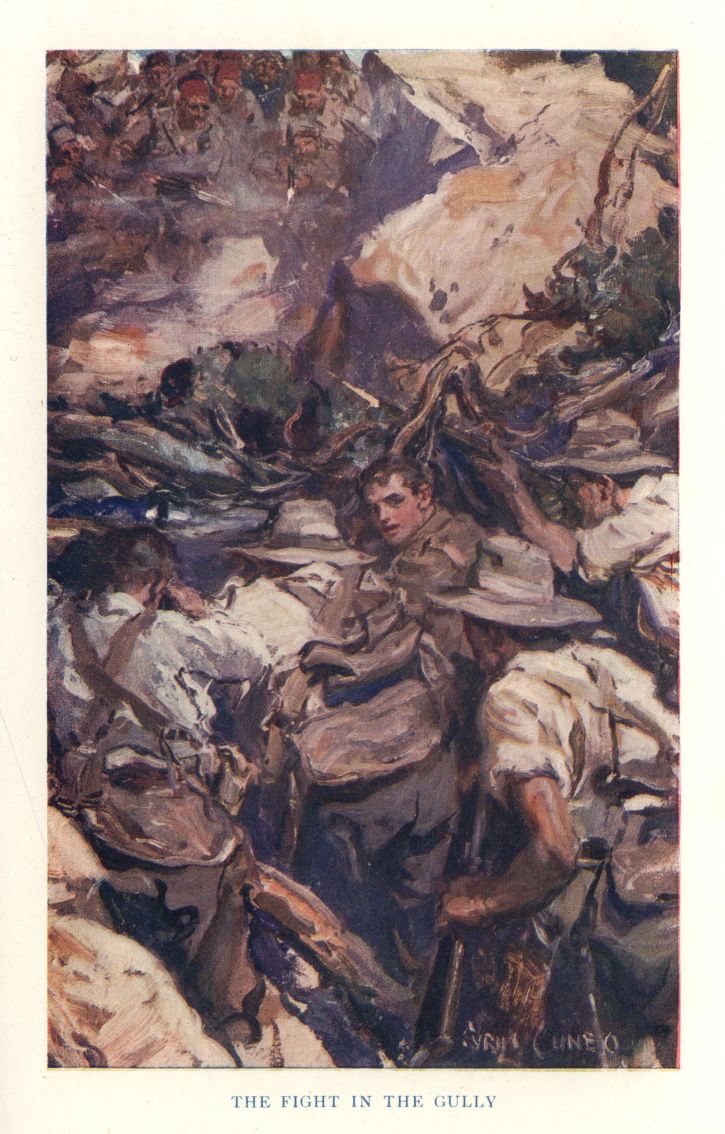
THE FIGHT IN THE GULLY
In two or three minutes from the time when the torrent first broke upon the barrier the oncoming Turks had to meet a new and terrible obstacle in the piled bodies of their comrades. And when finally the survivors, stricken with sudden panic, broke and fled back up the gully, it needed all the authority of the two officers to prevent their men from bursting out and chasing the shattered mob. The Australian in action has only one glorious failing: like a thoroughbred courser, when his blood is up he is hard to hold.
Frank mopped his smoking brow. His hand was shaking. His rifle was hot.
"You three men," he said, indicating those nearest him, "get over and bring in the wounded. The rest keep an eye up the gully."
"I've got some iodine ampoules," said Tomlinson.
"Good! We must do what we can for the poor chaps. I'm glad it's over."
"Is it over? Look there."
At the further end of the gully the Turks had already begun to collect material for a breastwork similar to that against which they had just spent themselves. They kept out of sight, but masses of scrub and branches of trees could be seen falling into the gully from the sides.
"We must snipe them," said Tomlinson--"fire into the bushes."
"Better save our ammunition," suggested Frank. "We shall want it if they attack again, and we can't get any more. They've learnt a lesson, and will be warier now, and therefore more formidable. We've all our work cut out yet."
Thus at the one end the Turks went about their task unmolested, and at the other the Australians were allowed to carry the wounded behind their rampart without interference. Such of the men as had field dressings employed them ungrudgingly on their wounded prisoners. But hardly had the last man who could be moved been brought over when the Turks above commenced a steady fire from behind their barricade.
"Keep low, men," cried Frank. "Poke your rifles through the bushes near the bottom, and loose a shot every now and then."
It soon became clear that the sharpshooting from the barricade was intended to distract the Australians while an attempt was made to outflank them through the scrub on the banks of the gully. Though the Turks moved stealthily, and on the left bank had almost perfect cover, a sudden stirring of the bushes caught Tomlinson's eye, and he guessed what it meant. The party was all too small to meet an attack on three fronts; for presently figures were seen darting across the more open ground on the right in twos and threes, risking observation from the larger force of Australians that was entrenched farther down the hill. Fighting was general all over the position, and even if the plight of the small band in the gully had been known to their comrades below, there was little or no chance of their being reinforced. All that the young officers could do was to tell off as many of their men as could be spared from the barricade to line the banks of the gully, and do their best to daunt the enemy by the accuracy of their fire.
It was a position to test the nerve and resolution of a veteran, much more of soldiers making their first essay in warfare. Nothing in the experience of the Great War has been more remarkable than the extraordinary efficiency shown by the younger officers--men who a few months before were boys at school, with no more expectation of serving their country in arms than of undertaking any other unimagined form of activity. They have shown quickness of perception, promptness in decision, the courage and tenacity which every Briton glories in as his birthright, and a cheerfulness in the most adverse and depressing circumstances, which is not improvised, but grows out of health and disciplined freedom. When the full story of this world-struggle comes to be written, it will be found that a large proportion of the honours which history will award will fall to the boys.
Through the heat of the day, and on till the evening mist crept across the hills, Frank and his Australian comrades maintained the unequal fight. In the struggle at the barricade they had received only a few slight wounds; but as the day wore on the effective strength of the little band ebbed away. Parched with thirst, ruefully regretful of the emergency rations in the packs so lightly discarded on the beach below, they had more than the persistent sniping of the enemy to contend with. They rarely caught sight of the Turks, but every now and then one would fall to a bullet from some unseen rifle in the scrub. Exasperated by this furtive mode of attack, the men asked to be allowed to charge the enemy, and growled in the free-spoken manner of Australians when their entreaty was refused. At one time Tomlinson suggested that they should make an attempt to fall back upon the larger forces below, in spite of its risks: but Frank replied quietly:
"We don't know how important every yard may prove to be. I think we had better hold on, Tommy. Perhaps the fellows below will make another rush upward by and by."
But darkness fell: the din of fighting had not diminished; but none had come to their relief. Tomlinson renewed his proposal; but to the other dangers would be added the risk of losing their way in this unknown wilderness, and he agreed ultimately with Frank that they had better hold their ground.
The men tried to relieve their thirst by sucking the dew from their coats and shirts. The day had been a long torture, but all confessed that the night hours were worse. In the daylight they could see their enemy if they threatened an attack; in the darkness they had to trust to their ears alone. The Turks, knowing how small their numbers were, would probably be tempted to rush them, and the strain of guarding against surprise told very heavily upon their nerves.
About four hours after dark, Frank's suspicion that some such move was intended was aroused, first by the slackening of the sniping fire, then by sounds of movement on all sides. Frank had posted himself at the upper end of his little force, by the barricade: Tomlinson at the lower. From this end Frank suddenly heard murmurs of conversation, in tones which, though low, had a note of excitement. In a few moments a man came to him up the gully.
"I'm Sergeant Jukes, sir," he said--"crept up the gully from below. Some one told the major about you up here, and he sent me to say, hold on as long as you can. They're getting ready to advance down there."
"That's good news! Tell the major we'll stick it to the last."
"I'm to stay with you, sir."
"Good! The major doesn't know who we are, of course."
"No, sir. We heard firing, and he thought perhaps some of our chaps had been cut off and hadn't got an officer with them, so he sent me to take charge in that case, but to stay anyhow."
"We're glad of your help--only wish there were forty of you. Just go down a few paces and keep your ears open. I'm pretty sure the Turks are going to try a rush."
The minutes passed very slowly. It was clear that the enemy, leaving nothing to chance, were making their dispositions with deliberate thoroughness. Officers and men waited in a tenseness that was painful. Would the blow from above fall before the promised movement from below? Frank dared not diminish his force by sending out a listening patrol. He would need every man if the attack came, and it would be so easy to lose one's way in the scrub. But in the darkness every man's hearing seemed preternaturally sharpened, and they fingered their rifles restlessly as they heard more and more sounds of the forces gathering about them.
Suddenly there was a whistle on the right, followed by an answering whistle on the left. Guided by the sounds the defenders opened fire. There was no reply. The enemy were no doubt feeling their way forward, in the hope of getting near enough to sweep the position in one overwhelming rush. From the directions in which the whistles had come, Frank guessed that an attack was to be made simultaneously on two sides. There was another whistle, nearer at hand and unmistakably at the side; the answer came from below. An idea flashed into his mind which he instantly put into execution.
When, a few moments later, the Turks swarmed down both sides of the gully some distance below the barricade, they intended to force the defenders back upon that useless defence, expecting to have them then at their mercy. But when they met, in the darkness and confusion some of them threw themselves upon their own friends before they discovered that the men they had come to attack had disappeared. In that brief interval before the rush, Frank, divining their purpose, had swiftly withdrawn all his men to the barricade, and at the moment when the Turks poured down the sides of the gully, the defenders were all posted above the barricade, facing towards them. As the Turks, yelling and cursing, surged upwards they were met by a withering fire, which swept down the gully into their confused and closely packed ranks. Trapped, bewildered, they hesitated; then they in turn opened fire.
But at this moment there was a ringing cheer from below, repeated in ever-increasing volume as a full company of Australians charged up the gully. They could not be seen; not a rifle flash revealed their position; they meant to do their work with the cold steel. The Turks, swept by the hail of lead from above, ignorant of the number of the enemy pouring upon their rear, began in terror to scramble up the sides of the gully, and broke away into the scrub on either side.
A hoarse shout rose from the parched throats of the men above the barricade. It warned their comrades of their position. And now came the moment that rewarded the little band for all the stress and labour of the day. Exhausted though they were, they sprang up the banks of the gully, and side by side with the new arrivals, deaf to the commands of Frank and Tomlinson, they plunged into the scrub after the fleeing Turks. A series of peremptory blasts from a whistle brought this impetuous movement to a stop. The men returned, disappointed but happy, to the gully, and the newcomers were ordered to line the banks with a protective parapet.
Then an electric torch was seen moving among the men, and a clear authoritative voice was heard.
"Where is the officer who organized this position?"
Thoroughly worn out, Frank was sitting at the foot of the bank, holding his head in his hands, hardly conscious of what was passing around him. He looked up as the light flashed upon him.
"This is he, eh?" a voice said. "Your name, sir."
He saw two keen eyes fixed upon him, and stood up, mechanically saluting.
"My name?" He appeared to consider for a moment. "Yes, I know: Frank Forester."
"Regiment?"
"I don't know; I don't believe I have one. No, sir, of course; I'm attached as interpreter."
"Indeed! You've a queer way of interpreting your duties. How long have you held this gully?"
"Since early morning, sir."
"With what force?"
"We had something over twenty to start with: there aren't so many now."
"Less than a platoon! By George, Mr. Forester, it's an uncommonly fine performance: are you aware of that? I'll send your name up to the General."
"There's Tomlinson, sir."
"I'll look after Tomlinson."
"The men were splendid."
"I haven't a doubt of it.... Why, bless my soul! water there, some one."
Frank had collapsed in his arms.
CHAPTER XX
FISHING
With the morning light the men were set to consolidate the position. Frank's barricade was strengthened; the gully was parapeted and wired; everything possible was done to improve the defensive capacity of the natural trench which marked the summit of the Australian advance, and which its occupants were to hold for a month without being able to push farther.
On the day after the fight, Frank was sent down to the beach by the major to report himself to the colonel, who at once employed him in his proper duties of interpreting for the Turkish prisoners.
"You'd rather be doing something else, I dare say, after that brilliant little defence of yours," said the colonel; "but interpreters are scarce, and you can't be spared."
During the next few days Frank learnt by degrees many details of the wonderful feat accomplished by the allied army. In the first place he discovered that the landing-place of the Australians, a little north of Gaba Tepe, was almost immediately below his old haunt on Sari Bair, and the guns he had heard firing above during that unforgettable day were evidently the battery which he had seen hauled up the hill. He heard too how at Beach Y, to the south, the King's Own Scottish Borderers and part of the Naval Division had gained the top of the cliffs with ease, covered by the guns of three cruisers in the bay; and how, still farther southward, the Royal Fusiliers, landing from the Implacable, had made good their footing without a single casualty. On the broader sands at Beach W the Lancashire Fusiliers had at first failed against the wire entanglements almost at the water's edge, and the innumerable snipers and machine guns concealed in the hollow between the cliffs. At Beach V, the Dublin Fusiliers, almost annihilated as they attempted to force three lines of wire and a labyrinth of trenches, had taken cover under a high sandbank that stretched along the shore, where they were joined by such of the Munster Fusiliers and the Hampshires as survived the terrible fire which burst on them when they rowed in from the collier in whose side a door had been cut for their exit. At Beach S the South Wales Borderers had scaled the cliffs without much difficulty; and the French had successfully effected their diversion on the opposite shore of the channel at Kum Kale.
These were the doings of the memorable Sunday. On Monday the Australians, supported by the guns of the fleet, withstood a violent counter-attack that lasted two hours, and finally drove off the Turks at the point of the bayonet. Elsewhere along the shore, except at Beach Y, which had been abandoned, the invaders held their own, and during the following days the work of consolidation made rapid progress. The sappers threw out piers on which stores and ammunition were unloaded from lighters under incessant shrapnel fire. Engineers cut roads up the cliffs to facilitate the transport and the passage of the ambulance parties that were continually going up and down. The wounded were conveyed to the ships as rapidly as possible. Day and night the work went on, amid the deafening roar of big guns and the unceasing rain of bullets.
During the month of May little further progress was made. The way was blocked by the hill of Achi Baba, crowned by a strong redoubt, and seamed with trenches extending on all sides in terraces one above another. Against these strong fortifications no general advance was possible.
Meanwhile German submarines had commenced their activity in the Dardanelles and the Ægean Sea. They failed to interfere with the supplies for the army, but they torpedoed three large warships, the Goliath, the Triumph, and the Majestic, and put a temporary check on the close co-operation of the fleet. Their successes were in some measure balanced by the feats of British submarines, which ran the blockade of mines, penetrated as far as Constantinople, and sent several Turkish transports to the bottom.
One evening, just after the Majestic had been sunk, Frank was smoking an after-dinner cigarette with his colonel outside the mess-tent. The conversation turning on submarines, Frank mentioned the incident of the broken case on the quay at Panderma, when he had noticed the periscope of a submarine disclosed by the breach. He did not dwell upon it, and the colonel only remarked that the activity of the German submarines had evidently been long premeditated.
Two mornings later, Frank was summoned to the colonel, with whom he found a naval captain.
"Good morning, Forester," said the colonel. "I have been telling my friend Captain Roberts some of your queer experiences before you settled down as a humdrum interpreter. He is rather interested."
"I am indeed," said the captain. "After what you have gone through, interpreting must be dull work--duller than mine, for it's not very exciting to fire at long range without much chance of getting one back."
"It's not very exhilarating, certainly," replied Frank. "The prisoners haven't much to tell. They don't like their German officers, and haven't an idea what they are fighting for. Fighting is their job, and Kismet covers it all.... You haven't been hit from Sari Bair, then?"
"No, though their shells drop pretty close sometimes. Our sea-planes haven't managed to locate that battery. I understand you didn't actually see the guns emplaced."
"No, after I toppled one over I made off. You see, things were getting pretty hot just then."
"Naturally. Well, you seem to have been able to take good care of yourself in very ticklish situations; but perhaps after all your present work is a relief after so much excitement. A man can have his fill of adventures, I suppose."
"I confess things weren't altogether pleasant, sometimes, though they had their bright side."
Frank smiled at his recollections of the major of artillery whose clothes he had commandeered, and of the boastful Abdi gurgling in the sea. At the same time, struck by a peculiar intentness in the captain's manner, he asked himself, "What is he driving at, I wonder?"
"Yes, of course there are two sides to everything," the captain went on. "Sometimes the bright side is eclipsed by the dark--according to the state of one's liver, perhaps. Your liver doesn't trouble you much, I fancy."
Frank looked at the broad, jolly face smiling enigmatically at him.
"Is there anything you wish me to do?" he asked bluntly but respectfully.
The two elder officers exchanged a glance.
"Well, since you put it like that--yes, there is," said the captain. "But it's a matter entirely for yourself. If you feel any hesitation, we shan't think any less of you if you don't entertain the idea. I may as well say at once it's a dangerous job, not at all in the ordinary risk of warfare; but the colonel had told me of your work on the cliff yonder, and for a mere interpreter, you know, you appear rather to relish risks that are not quite ordinary."
"You don't think much of risks when you've got anything going," said Frank. "Anyhow, if I can be of use--what's the nature of the job?"
"It's just as I expected," interposed the colonel, rising. "I'll leave you two to talk it over. Come and tell me what you arrange, Forester. You'll find me somewhere in the neighbourhood."
Next morning Frank's absence evoked enquiries among the junior officers. The colonel was appealed to.
"Forester? Oh, he's off for a few days on special service."
"Interpreting, sir?" asked one.
"He'll have opportunities of airing his Turkish," said the colonel.
His manner discouraged further questioning. The others saw that he meant to say no more. One of them, however, presently asked whether Forester was likely to be away long.
"I can't say." He tugged his moustache reflectively. "Our little job here is not exactly a soft one, but I wouldn't be in Forester's boots just now for a peerage."
CHAPTER XXI
IN A RING FENCE
A Greek fishing vessel was beating up against a gentle easterly wind into the Gulf of Adramyti. Its course suggested that it had sailed from the island of Mitylene. In the distance, beyond the head of the gulf, Mount Ida glowed in the rays of the setting sun, and the shade was deepening on the wooded hills of the Asiatic shore.
It was a peaceful, beautiful scene. But if the eyes of any on board the vessel were turned westward, they fell upon an image of war. Far off on the horizon a long low shape lay darkly silhouetted against the orange sky. With a glass, perhaps without, it might have been recognised as a destroyer.
The crew of the vessel were busy with their nets. Their catches were not very great, yet they showed no disappointment, such as might have been expected in men whose living depended on their takes. Some of them, indeed, showed an almost boyish interest and curiosity in the contents of the nets when they were hauled up. One might have thought that they were out for a night's fishing for the first time in their lives. And the remarks that fell from their lips were not those that one would expect to hear in a Greek vessel, or from native-born fishermen.
"That's a plumper," said one.
"My aunt! don't you know a dogfish when you see it?"
"Is that a dogfish? All I know about 'em is that they make you squeamish. Fact! My cousin told me: a chap always running some craze or other. Once it was science: thought he'd like to be a B.Sc. Biology was in it. He bought a microscope and a swagger set of dissecting instruments: they have to cut up all sorts of strange beasts, you know. First came a frog."
"Ugh! Slimy!" muttered one of his companions.
"Well, he liked it: fact! Said it was a beautiful little creature inside. Then came a mussel: he had no end of a job finding its nervous system or whatever it was. Then was the turn of the dogfish. I don't know whether this fish had been too long away from home, or whether it's naturally offensive, like the skunk: but whatever it was, my cousin told me that when he put in the scalpel--well, he ran out of the room and decided to go in for philosophy instead."
The speakers, though clad in nondescript garments that might have been taken, at a distance, for Greek, were obviously Englishmen. Four of their companions in the boat were of the same nationality, and anyone who had ever spent a few days in a British naval port would have declared, with the first glance at their keen bronzed faces, that they were British seamen in disguise. The remaining five men in the vessel were as obviously genuine Greeks; but a trained ear would have recognised their speech as the Greek of Cyprus rather than Mitylene.
The fishing, or shall we say the pretence of fishing, was kept up until it was almost dark.
"Time to be off, old chap," said the man who had recoiled at the mention of a frog.
"Yes, I suppose so," said the other without much enthusiasm. He took off his outer garments, and replaced them by the loose European costume which is affected by the modern Greek merchant--wide trousers, a jacket that looks as though it were never meant to be buttoned, a shapeless soft hat, and the inevitable touch of colour in a blue cummerbund. Finally he stuck upon his upper lip a long, soft, black moustache.
"By George, you look a regular Levantine--not to say levanter," cried his companion. "In that get-up you could persuade any simple Turk that chalk's cheese. The moustache is a master-stroke: wonderful how it transforms a fellow. I'd like to know the reason why army chaps are encouraged to cultivate 'em, whereas they're strictly forbidden in the King's navy."
He continued talking, apparently with the idea of keeping up his own and his companion's spirits. Meanwhile the vessel, which had put about just before darkness fell, as if to run back to Mitylene, once more beat up the gulf, edging gradually into Turkish waters. In about an hour it had arrived, according to the calculation of the Greek skipper, within about two miles of the coast. Under the starlit sky the hills loomed black in the distance.
The vessel was thrown into the wind. Orders were given in a whisper. A small dinghy towing astern was drawn up alongside. One of the Greeks stepped into it, and tied some bundles of matting to its stern, letting them float on the water at the end of the rope. Then Frank and the naval officer got in, two of the British sailors followed them, and the boat was rowed with well-muffled oars silently shoreward.
When it was within a few cables' length of the shore the rowers ceased pulling, and all the occupants of the boat stretched their ears to catch any sounds that might indicate the presence of persons on the beach. They heard nothing but the slight ripple of the almost tideless Ægean breaking on the sand.
"Pull in," murmured the lieutenant-commander.
A few silent strokes brought the boat to the beach. Trees stretched down almost to the water's brink. All was dark and tranquil. A seaman stepped overboard upon the wet sand and stood with his back towards the boat. Frank rose.
"Good luck, old man," said the naval officer, gripping his hand hard.
Frank mounted the seaman's back, and was carried a few yards to the dry sand. Meanwhile the other seaman had cut the matting loose, and placed it carelessly on the beach just above the waterline, as if it had been cast up there by the sea. Frank waved a farewell, plunged into the forest, and disappeared. After a short interval the boat was pulled out to sea, and its occupants boarded the fishing vessel, anchored where they had left it.
Frank found himself among trees growing thickly together, on ground that sloped steeply from the beach. There was little undergrowth to impede his progress. Consulting a luminous compass, he directed his course almost due northward, expecting in a short time to reach the road that ran parallel with the coast and at a short distance from it, from Alexander Troas to Edremit. The slope soon gave place to more level ground, and the forest belt presently ended abruptly at the edge of cultivated land. Frank crossed the fields, and in about forty minutes after he left the beach he struck into the road.
It was a bright starlit night, without moon. The road was deserted. In accordance with the plan made after close consultation of the map with his friend the lieutenant-commander, he turned to the right, and stole cautiously along the road, stopping at every few yards to listen. Everything was quiet, and there was neither light nor sound from the few farm buildings which he passed at intervals.
After walking about a mile he heard footsteps. At first he thought they were merely echoes of his own, but he took the precaution to step aside into the shadow of a clump of trees, and soon afterwards saw a figure approaching along the road. Before being discovered himself he wished to learn what kind of person he had to do with. The indistinct figure presently resolved itself into the bent form of an old peasant, whom he thought he might safely question. Stepping out into the road, he went on, and was not seen by the peasant, who was apparently very tired and walked with head downbent, until he had almost reached him.
Giving him the usual salutation, Frank stopped.
"Where is the nearest khan?" he asked.
"About an hour's walk along the road," replied the man, looking curiously at him.
"Who is the khanji?"
"Hussan, the son of Ibrahim."
"Is it a good khan? I shall be glad to get there. I have had a long walk. My horse fell lame: I could not get another: they are all taken for the army."
"It is a good khan. Hussan is a good man. You will rest well."
More salutations were exchanged, and each went on his way.
In less than an hour Frank arrived at a building in which lights were burning. He knocked at the door, and called for Hussan the son of Ibrahim. A voice from within asked who he was and what was his business.
"A merchant of Corinth, O khanji, compelled to go on foot by the loss of his horse. I am weary and desire to rest, and it has been told me along the road how excellent is this khan, and how princely the hospitality of the khanji."
"Great is Truth," said the khanji, opening the door. "Here, if you are a respectable man and can pay, you shall find good food and a couch to yourself, since I have but few guests to-night."
The innkeeper, a middle-aged man of Arab type, stood in the doorway to inspect his guest before admitting him.
"Whither are you bound, stranger?" he asked.
"For Edremit, khanji. I have business with the army: what it is I cannot say: you understand that?"
The khanji looked knowing.
"I am deaf and blind if need be," he said. "You will want a horse. I think I can find one for you--if you can pay."
"Surely I will pay well."
"Enter, then, O honoured guest. I will set before you what is left of a prime chicken, and after, cakes and honey, and whatsoever this khan will afford."
Frank went in. The single guest-chamber, a large apartment, was lit by a couple of saucer-lamps. Three men of the carrier type were eating their supper. The host laid rugs on a sleeping board at one end of the room for Frank, and called to his servant to bring the stranger a bowl of stew.
"What news of the war?" he asked.
"There is little fresh," replied Frank. "The Russians get no further, and the English are beating their heads against the rocks in Gallipoli. Your countrymen the Turks----"
"Not so: I am an Arab," interrupted the khanji. "My fathers ruled this country before the Turks were heard of."
"True. Perhaps it will be ruled again by men of your race: who can tell? But the Turks are stronger since the Almans have come among them. There are many Almans in Stamboul. You have not seen any on this side of the water?"
"I have not; but it is said that there are Almans along the coast. What they do here I know not, for they are not fighting men. It is told that they are holy men, who keep themselves very strictly apart. The Almans, it is said, are becoming true sons of the faithful."
"I know something of them," said one of the guests. "I have taken goods to them from Edremit--wheaten flour from Tafid the corn factor. Truly the ways of the Franks are past understanding, and the chief of these Almans is the maddest of all. He is a hermit; yet big and fierce, and not lean and weak like our own holy men. With him there are certain others of less degree, who do what he bids them. His dwelling is on the shore of the gulf, and the ground around it is enclosed by a fence of wire with many sharp spikes. In the fence there is but one gate, and none is allowed to enter except those bringing stores. I myself, when I take the flour, have to leave it at an inner fence far from the house, and there it is received by the holy man's servants. That he is a true son of Islam is sure, for the Governor protects him, and posts soldiers at his gate to defend him from harm."
"Mashallah! These Almans are different from us," said another man. "Our holy men eat pulse, and so little that their bodies are but shadows. But these strangers have large bodies, and surely in appetite they are as elephants, for I have carried to them the flesh of oxen and sheep sufficient for fifty men that have no claim to holiness."
"And now, stranger, give me your name, your business, and the number of your years," said the khanji. "I ask pardon for what seems impertinence, but I am bidden to send every day to the Bey at Chatme a list of my guests. It is a grievous task and costs much time and the loss of my servants' labour, but the command of the Bey must be done."
Frank invented the necessary particulars, which the innkeeper laboriously wrote down in Arabic characters.
"You will send that to Chatme to-morrow, khanji?" he asked.
"Truly: it is too late to-night."
"As I am going that way I will save your servant's time. Let me be your messenger."
The khanji looked surprised at this offer: but he was quite ready to accept it and save himself trouble.
Frank was well satisfied with what he had learnt, and went to sleep with an easy mind.
Very early next morning he accompanied the khanji to his stables, where he found an old broken-kneed horse for which he haggled in the oriental manner, ultimately paying for it a good deal more than it was worth. On a shelf he saw a tool of the nature of a trowel, which he slipped into his pocket when the khanji's back was turned. "It may come in handy," he thought, "and the old rascal is more than paid for it by what he has robbed me of over the horse."
Thanking his host for his hospitality, Frank mounted and pushed along the road as fast as his sorry nag could go. At this early hour he met no travellers, and saw nobody but the labourers trudging to their work in the fields. After riding about nine miles, as nearly as he could guess, he turned off into a side track leading towards the coast. The country all around was densely wooded, and from marks on the track he judged that it was used for dragging timber. Now and then he heard the ring of axes in the woods. At places the track drew near to the edge of the cliff overlooking the sea. Here he struck off inland, making his way as best he could among the trees. Once he caught sight of a man far away on the cliff, looking out to sea. It appeared that the coast was watched.
At last, after what seemed to be hours of slow progress, diversified by stumbles and falls of his miserable steed, he came suddenly to the barbed wire fence of which he had heard at the inn. He saw at a glance that it was not designed to keep people out if they were determined to get in. Like the notice, "Trespassers will be prosecuted," in fields and woods at home, it was intended to scare intruders away. Frank dismounted, led his horse into a thicket out of sight from the fence, hitched the bridle to a tree and gave the animal some food. Then he returned to the fence, took the bearings of the thicket, and prepared to get over. This he achieved by climbing on the successive strands of the wire as on the rungs of a ladder, steadying himself by means of one of the posts to which the wire was attached. One of the barbs tore a rent in his baggy trousers, but this was his only mishap. He was within the enclosure of the mysterious hermitage.
He looked about him. There were many trees, though they were not so crowded as in the woods he had just left. No house was in sight. He had gathered from the carrier's talk that the enclosure was of large extent: exactly how large he did not know, and it was necessary to go warily, to avoid coming too suddenly upon the house. He flitted from tree to tree with the caution of a scout who knows that an enemy is in front of him.
Presently he came to a stream too wide to leap: he crossed it by wading, the water coming halfway up to his knees. The current was swift, and a little to his left he heard a continuous rustle, like the sound of a waterfall. No doubt the stream fell over the cliff into the sea. He went on, and arrived at a rough track parallel with the stream. Carefully scanning the surroundings, he saw, down the track to his right, a second wire fence, with a gate where it crossed the path. He retraced his steps for some little distance, in order to approach the fence at a spot remote from the gate.
When he reached it, he found that it differed from the outer fence. It was constructed, not of barbed wire, but of plain iron wire about as thick as that used for telegraph lines. There would be no difficulty in creeping through. It seemed strange that the inner defences of this hermit's settlement should be so much less formidable even than the paltry obstruction he had recently crossed. He examined it closely, and noticed what appeared to be an insulator on one of the posts. Perhaps the fence was not so harmless as it looked. Wetting a finger, he lightly touched the wire for an instant.
"Lucky I wasn't too impetuous," he thought. "That's a pretty strong charge."
Faced by this unexpected obstacle, he withdrew among the trees to consider what he should do. The trowel which he had brought, with the idea of cutting the wire if necessary, was useless against a wire electrically charged. Possibly, however, search might discover a weak spot. There was no sign of the inhabitants of the settlement. Returning within sight of the fence, but keeping near to the trees so that he might slip under cover in case of alarm, he prowled along, but without reward until he reached the stream he had waded. At this spot it was crossed by the wire, attached to a post on each bank. He saw at once that by scooping away the soft earth at the foot of one of the posts he could make a hole large enough to enable him to wriggle under the bottom strand of wire. The trowel was coming in handy after all.
In a few minutes he was safe on the other side. Following the stream towards the sea, he came presently to a clearing, and what he saw within the clearing assured him in a flash that his journey had not been in vain.
CHAPTER XXII
THE HOLY MEN
As he scanned the scene, Frank smiled at his thought of the wonderment of the khanji and his humble guests could they but see the habitat of the mysterious "holy men." They, no doubt, had imagined a cave in the cliff, or at best a stone grot, with nothing to suggest modern civilization. What he actually saw had no semblance of luxury, indeed; but it was far from the austerities of the anchorites of old.
On the left of the clearing, as he looked towards the sea, was a small wooden bungalow, with a verandah about three sides of it, pleasantly shaded by trees. Beyond it, at the edge of the wood, was a smaller hut, also of wood. To the right were three more huts, one considerably larger than the others; and by the side of this last was a crane, worked by a donkey engine. Two men were moving about the place, hauling packages from the large hut to the crane. Apparently they were to be let down--to what destination below, Frank could not see.
"I am getting warm," he thought.
It was necessary to discover what lay beneath the crane, and Frank glanced round to find some safe and convenient path by which he might secretly approach it. As he did so, he caught sight of a short pole on the roof of the bungalow, from which a single telegraph wire passed over the clearing to the left and disappeared into the wood. Just below him, skirting the clearing on the right, ran the stream with which he was already acquainted. It was possible, he thought, under cover of the shrubs on the further bank, to gain a point where he might satisfy his curiosity. Cautiously making his way along, completely screened, he came to a spot where the stream fell sheer to the level of the beach between high cliffs, through which it cut a channel to the sea. Immediately beneath the cliff on which the bungalow and the huts stood there was a broad pool, bounded by a similar cliff on the opposite side. And on this pool, just beneath the crane, lay a lighter.
Frank at once realised that the pool, like the buildings, was out of sight from the sea. If a ship were to pass the entrance of the channel, those on board, seeing the waterfall, would at once know that the stream was not navigable, and would probably not think it worth while to enter the channel. No one would suspect that within, indented in the cliffs to the right, there was a small natural harbour, in which a vessel might lie perfectly concealed. Its depth Frank had no means of determining. Immediately beneath him the water was churned into foam by the falling stream. But it was clearly deep enough to float a lighter, and it was equally clear that the depth of the channel must be sufficient for its passage in and out.