FRANK FORESTER (continued 2)
Reading edition
And now his difficulties began. Inside, the window had only a narrow ledge; outside, it was flush with the wall: there was no sill. When once he had got through, there was no possibility of returning; but to get through--that was the problem. There was no secure foothold after he left the table; the window was too low for him to stand upright on the ledge, or even to sit on it. He would have to haul himself out by main strength.
He placed his chair on the table, and standing on that, found that his head was now higher than the top of the window. Then he stooped, put his head out, braced himself for the effort, and taking a grip on the rope as high above his head as he could, he lifted his feet and threw his whole weight on it. For a moment it yielded slightly, but then became taut again. Then he got his knees on the ledge, rested a few seconds, grasped the rope a little higher, and managed to drag his legs out so that he swung clear.
At this critical moment his energy was almost paralysed by the fear of falling. The roof was only ten or twelve feet above him, and a few months before he would have made light of swarming up a rope of double that length. It was only now, when he was committed to the enterprise beyond recall, that he realised how his strength had been reduced by privation and want of exercise. But exerting his will to the utmost, he began to haul himself up hand over hand. Bits of earth struck him, and thudded on the ground below. The fear that the sound would bring the soldiers out made him try to climb faster; but finding his strength failing, he twisted his leg round the rope and steadied himself for a further effort. More material fell from above, and struck the ground with a heavier thud. Sounds from the lower floor warned him that the men's attention had been aroused, and he climbed on, ascending by slow and painful inches. In spite of himself he was forced to rest again, but the support his legs gained from the rope was not sufficient to relieve the strain on his arms, and he had almost given himself up for lost when he felt the rope being slowly drawn up. Too weak to climb further, he could only grip the rope and ascend passively, bumping against the wall and scoring his knuckles.
Below him there were voices, of which he was hardly conscious, so intense was the strain. Then there was a flash upward from an electric torch, and a shout. He felt that his grip was loosening; he was at the point of despair when his wrist was grasped from above. The touch braced him for a final effort; his other wrist was gripped, and next moment he was dragged by main force over the low parapet on to the roof, just as a shot rang out.
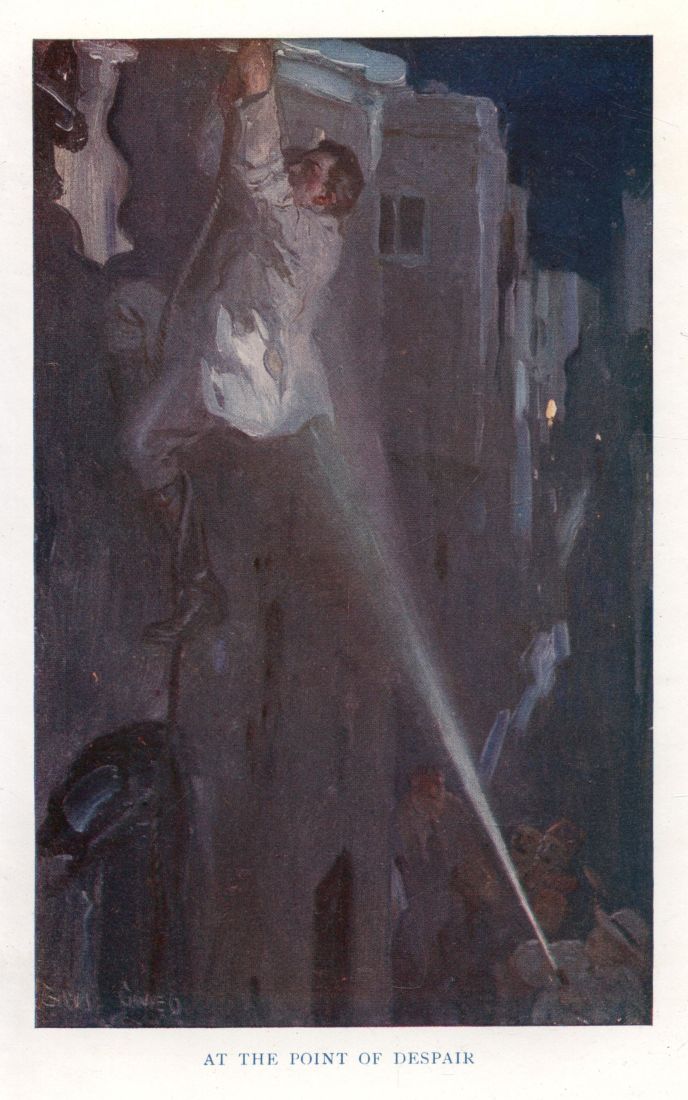
AT THE POINT OF DESPAIR
Half fainting, he was hauled to his feet, and half carried, half dragged across the turf towards the hillside sloping behind. Up this his rescuers stumbled with him until they reached a narrow track beyond Wonckhaus's house. They heard shouts on the roof they had just left, from the ground below, dogs barking, sounds of growing commotion. The darkness concealed them; their flight was favoured by the clamour. On and on they stumbled, the two rescuers finding their way like cats in the darkness. The shouts became fainter. They moderated their pace, and in a few minutes came to an open doorway. Into this they dived. The door closed silently behind them, and Frank sank in the swoon of exhaustion.
CHAPTER IX
A REHEARSAL
It was two days later.
On the slope of the hill, not a stone's throw from the house where Hermann Wonckhaus was nursing his wounded leg and meditating on carpets, was a modest dwelling, huddled among more pretentious buildings, and so inconspicuous that a passer would hardly have thought it worth while to wonder who lived there. At the rear of this house, hollowed out of the hillside, was a small dark chamber with neither door nor window. Any person who might have been brought there in a state of unconsciousness would have supposed, on waking, that he was sealed up within four walls from which he could not escape.
On this particular day three men were in the room, one elderly, the others young. A small oil lamp placed on a wall bracket gave a dim light, and the air was oppressive with staleness and the flavour of smoke. It was not a place where one would have desired to remain long, but its three occupants had chosen it as the scene of a somewhat important rehearsal.
The elderly man was Isaac Kopri, the astute and capable Armenian contractor to the Turkish army in Erzerum. One of the youths was his son Joseph. The second was to all appearance one of those humble Armenians who are employed in driving caravan horses from the Persian frontier to Erzerum and thence to the Black Sea port of Trebizond. He stood at one end of the room, facing his companions at the wall opposite.
Kopri stepped forward, and, speaking in Turkish, asked sharply:
"Who are you?"
"I am your servant, effendim," replied the young man, "Reuben Donessa, the son of Aaron of the Five Wells."
"Where do you come from?"
"From Bashkala, effendim."
"How old are you?"
"Truly I know not, effendim, but my years may be nineteen or twenty."
"Why are you not in the army?"
"Because it is the will of Allah and the noble governor that I should be dispensed from the war service of the Illustrious."
"Where is your paper?"
"Behold it, effendim."
He took from the breast of his shaggy tunic a dirty crumpled paper, which Kopri took and read aloud. It set forth the style and titles of the Sultan, then those of his deputy the governor of Erzerum, and finally declared: "Certifies that the bearer, Reuben Donessa, is employed in the service of Isaac Kopri, contractor to the army of the Commander of the Faithful."
"Isaac Kopri should employ older men, but your paper is in order. You may go."
"Peace be with you, effendim."
"Very good, very good," said Kopri, handing back the paper. "But you must pitch your voice a little higher. Joseph, say 'I am your humble servant, effendim.'"
Joseph repeated the words.
"That is the tone, mark you," said his father. "Now we will go through it again."
The dialogue was repeated, the driver, who seemed somewhat amused at the gravity of the others, imitating Joseph's reedy intonation.
"That is better," said Kopri at its conclusion. "But remember, effendim, tone and accent are not everything. You must bow, and stand humbly, and cast down your eyes, not look forthright into the eyes of your questioner when you answer him. We Armenians have been oppressed for five hundred years. We move meekly on the face of the earth. You Englishmen bear yourselves differently. You walk and stand as if you were the lords of the world. If you would pass for an Armenian you must remember that in the eyes of the Turk you are less than the smallest grain of dust. Keep that in mind, and all will be well."
Frank smiled as he made a humble salam.
"How will that do?" he asked.
"Very good, very good--with a little more crook in the knees. And now I will explain my plan."
Frank had been rescued by Joseph with the help of Ali, the faithful Kurd, and brought to this secret chamber in the obscure house, from which it was entered by a passage beneath the floor. His escape had raised a commotion in the town. Search had been made for him in all directions until Kopri started a rumour that he had bribed Kurds to pass him through Kurdistan into Persia. Wonckhaus was furious, and had promised a high reward to any one who captured the fugitive.
When Joseph was released, in the early days of Frank's imprisonment, his father thought it politic that he should leave the town, and had taken him away on one of his business journeys into the country. Then, fearing that the Armenians were about to suffer in one of the wholesale massacres which break forth in times of disturbance, Kopri had sent all his family to Constantinople, where they would be for a time, at least, safer than in Erzerum, and whence they might in case of need slip across the frontier into Bulgaria or Greece. He himself had the protection of the military authorities, but this might fail him at any moment; indeed, he had already been forced to part with some of his profits in the way of war contributions.
Having thus disposed of his family, Kopri was now intending to join them. The Turkish army in the Caucasus was hard pressed by the Russians, and in great need of supplies. With the ostensible purpose of fetching provisions, Kopri was arranging to take a large number of mules to Trebizond, to await his return from Constantinople. Most of the mules were already on the road. He would follow at the tail end of the caravan, which was in charge of a few specially trusty men, and his plan was that Frank and Joseph should slip out of the city by night, and join him at Ilija, a village at the foot of the hills to the west.
Kopri was well aware of the risks he was running in assisting the Englishman's escape. But Mr. Forester was an old friend of his, and learning in Constantinople that the merchant, on his return there, had been greatly distressed at being unable to communicate with his son, he had willingly yielded to Joseph's entreaty that they should attempt to rescue Frank. He remembered also how Frank had run risks in defending his house from the mob. Mr. Forester had of course left Constantinople with other British residents at the outbreak of war, but he had left word that he should not travel farther than Malta, where he would remain until he had news of Frank.
The arrangements having been thoroughly discussed, Kopri left the house, where his son was to stay with Frank until nightfall. As soon as it was dark, the two slipped out, and crossing roofs, threading alley ways, stealing over gardens, they came at length to the ramparts of the city. The old walls, defended by sixty-two towers, had long been demolished and replaced by mounds of earth with ditches. Guns were mounted at intervals, and the four gates were closely guarded by sentinels; but between them there were many spots where discreet persons might scale the ramparts, and at one of these an Armenian servant of Kopri's was awaiting the fugitives, with a rope by which to let them down on the outer side.
They had taken the precaution to wear white garments, so that dark figures should not show against the snow that covered the ground. Safely over the ramparts, they hurried by a roundabout route across the snow-clad plain, and near midnight arrived at Ilija, where they found Kopri in a small inn with five muleteers. Here they rested for the night. Next morning they started as soon as it was light.
Few would have recognised Frank in the rough garb of a muleteer. Nor was he so pale as might have been expected after months of confinement and privation. Joseph had utilised the two days of hiding to effect a transformation in his master's complexion. He had lightly stained his face, hair, arms, and the upper part of his body. There must be no tell-tale patches to rouse suspicion. And with his dark skin and rough dirty clothes Frank bore little likeness to the well-dressed fair Englishman for whom Wonckhaus's emissaries had sought high and low.
For ten days the caravan marched over plain and hill, on a road on which the snow had been beaten down and hardened by the passage of many travellers. The mules were laden with articles of merchandise for Constantinople, including a number of carpets in rough bundles. Frank was in charge of one of these bundles.
Scarcely anything broke the slow monotony of the journey. Here they would meet a line of bullock-carts, groaning and creaking under loads of uniforms and equipment for the Caucasian army. Then would come a long string of shaggy Bactrian camels, padding noiselessly along with their drivers in sheepskin caps marching at the side. Once they met a family of turbaned Moslems on horseback, sitting astride their overhanging mattresses, from which hung a jangling cluster of cooking-pots. Sturdy Armenian peasants on foot, Kurdish horsemen, a regiment of infantry for whose passage the mules had to leave the beaten road for the soft snow at the sides, formed part of the traffic which the caravan encountered from time to time.
The journey imposed a considerable strain on Frank, weakened by his imprisonment. But he had a good constitution, and it was gradually re-established by the keen air, and the plentiful food which was obtained at the khans en route. And when, on the afternoon of the tenth day after leaving Erzerum, the caravan defiled into the streets of Trebizond, he was conscious of having recovered something of his old vigour, and refreshed by the sight of the sea on whose waters he would soon be borne to Constantinople. But, not having the gift of second sight, he was far from imagining the strange and perilous adventures into which he was shortly to be plunged.
CHAPTER X
A BRITISH SHELL
The caravan jostled its way through the crowded streets of Trebizond towards the landing-place. The port was in a state of exceeding liveliness. Ships were loading and unloading in the harbour; caravans were starting for the interior; and throngs of people of various nationalities made kaleidoscopic patterns as they moved about in dresses of every hue, the Persians conspicuous by their high black caps and long green robes reaching to the ankles.
Kopri's mule train was directed towards a small coasting steamer, lying alongside the quay, in which the contractor was a part owner. She had arrived the previous day with arms and ammunition from Constantinople, and was to leave again that night on her return voyage, which would be interrupted only by a call at Sinope to take in coal. Large crates of her recently unshipped cargo lay on the quay, awaiting transport, and though most of them were covered with tarpaulins, Frank noticed that many bore German marks. Having given orders for the stowment of his cargo, Kopri went to an inn overlooking the bay to pick up what news was bruited. He left Joseph in charge, and recommended that Frank should go on board, ostensibly as shipping clerk, so as to be out of harm's way. The perishable merchandise was quickly stowed away below; the bales of carpets strewed the deck.
When the contractor returned some hours later, he said that Trebizond was greatly excited by a report that British and French warships had begun to bombard the forts at the entrance of the Dardanelles. It was said, too, that Russian torpedo boats had been seen outside the harbour, and the harbour-master had refused to allow the vessel to leave that night. Frank wondered whether he had escaped from the hands of Turkish officers only to fall a victim to a Russian gun. He remained on board all night, looking forward with more interest than uneasiness to what next day might bring forth.
Early in the morning the skipper was about to cast off when a messenger came up from the military authorities ordering the vessel to await the arrival of an important passenger. Kopri was irked by the delay, and had worked himself up into a state of nervous agitation when, after the lapse of nearly two hours, the passenger arrived. And then his nervousness almost betrayed him: the passenger was Hermann Wonckhaus. He had discarded his crutch, but walked stiffly over the gangway, and at once demanded that the captain's cabin should be given him. Frank was standing by the forecastle when the German came on board, and he instantly turned his back on him. He felt that his disguise was not so complete as that Wonckhaus would not recognise him, and wished that he had aged his appearance by the addition of a beard. When the steamer put out to sea, he was careful to keep out of the German's sight, which was the less difficult because they were naturally in different parts of the vessel, and under the brisk north wind the sea was sufficiently choppy to keep Wonckhaus in his cabin, prostrate with sickness. He did not reappear until they had left Sinope with their cargo of coal, and then he urged the skipper to hug the shore as closely as possible and to make all speed for Constantinople: seasickness and the dread of a Russian attack had made him nervous. The breeze had moderated, and Frank from a safe coign of vantage watched Wonckhaus pacing the deck in conversation with Kopri. Presently the German sat down to rest on one of the bales of carpet, and Frank's heart leapt to his mouth: the bale thus unwittingly chosen for a seat was Mirza Aga's rug. Kopri moved away to speak to the skipper, and Wonckhaus, left alone, began by force of commercial habit to peer at the bales by which he was surrounded. He lifted the covering of one at his right hand, and was stooping to examine the one on which he was sitting, when Joseph, hovering near, suddenly gave a shout and pointed excitedly seaward. Wonckhaus sprang up and went to the side, with the skipper, Kopri, and some of the crew.
"A dark speck on the skyline," cried Joseph, with outstretched finger.
The group peered anxiously across the watery expanse; the skipper raised his telescope.
"Where? Where?" cried Wonckhaus, hastily unstrapping his field-glasses.
Joseph only pointed. Nothing could be seen. They continued to gaze for some minutes, and then the skipper declared that Joseph must have been mistaken. The false alarm had effectually diverted Wonckhaus's attention from the carpets. He remained at the side, sweeping the horizon every now and then with his glasses, and he even ordered his meals to be brought him on deck, lest if he went below the dreaded warships should heave in sight. Joseph's quick wit had once more served his master well.
It was a sunny afternoon when the vessel steamed between the well-wooded shores of the entrance to the Bosporus. To Frank the scene was too familiar to hold any fresh charm; but his interest was quickened when he noticed the long low shapes of the Goeben and the Breslau at anchor in the strait. There were signs of repairing work proceeding on the former. Wonckhaus, who had now recovered his courage, talked to Kopri about the vessels with swelling pride, while Joseph superintended the rolling of the carpets to the side in preparation for unloading. Frank was not quite easy in mind until Wonckhaus had crossed the gangway and disappeared among the crowd on the quay.
The cargo was unloaded, Kopri undertaking to convey the precious carpet to a place of security. Frank remained on board until the contractor should return with information that might guide his future course. That information was not reassuring. The British residents who had not been able to get away from Constantinople in November were more or less under arrest. For the present Frank must remain an Armenian. And since Kopri had been ordered, instead of returning to Trebizond, to take on some heavy crates and proceed at once to Panderma and Gallipoli, it seemed better that he should remain on the vessel until she reached the latter place, and then seek an opportunity of getting into Greece or Bulgaria.
The new cargo was brought on board without delay. It consisted of heavy cases, which Kopri surmised to contain ammunition, and quantities of food stuffs for Gallipoli, whither troops were being despatched in all haste both by land and sea. Several German and Turkish officers came aboard when the cargo had been stowed, and Frank was annoyed and somewhat alarmed to see that Wonckhaus was among them. It was irksome to him to be continually on the watch, dodging the German.
The vessel ran down the Sea of Marmora to Panderma, the terminus of the Smyrna railway, where some of the officers disembarked with the heavy cases. Frank was on deck when these were swung out of the hold. As one of them was in mid-air the tackle broke, and the case fell heavily on to the quay, striking its edge. In spite of the iron bands that held it together it broke open, and one of the Turkish officers ordered Frank among others standing by to run over and try to put it together. The break disclosed the top of the periscope of a submarine. Frank had time to notice the label of the case: it was addressed "Adramyti." But he saw no more, for a German captain rushed up in a rage, drove off the crowd that was gathering, peremptorily ordered the crew to return to the ship, and hurled volleys of abuse at the men in charge of the crane.
The vessel cast off the same evening and arrived at Gallipoli soon after dawn. It had hardly come to its moorings when the air vibrated with a heavy boom. A big gun had started work far away. Every half-minute, as it seemed, during the unloading of the vessel, the booming sound was repeated, and Frank thrilled with excitement at the bombardment neither the source nor the effects of which he was able to see.
When the cargo had been removed, he went on shore with Joseph, and wandered about the beach, discussing the past and the future. It was now noon, the sun was bright, and Frank was debating whether to go for a swim in spite of the cold breeze when a slight buzzing in the air caused him to look up. For some minutes he saw nothing in the cloudless sky, though the sound increased; but presently he caught sight of a speck far aloft, moving in a line that would soon bring it straight overhead.
It enlarged, soaring on like some strange bird.
"One of our aeroplanes," said Frank.
"Where shall we run?" asked Joseph, alarmed.
"We had better not run at all. It may be only scouting, not out for dropping bombs: and if it does drop a bomb, it will be on the wharves. We are safer here on the open beach."
"But he might aim at the wharves and hit us," Joseph protested.
"I think better of our men," replied Frank with a smile; "but to please you, we'll get away into that pocket in the cliffs yonder."
They hastened across the beach to the left. At the same moment the aeroplane slightly changed its course and seemed to be following them. Joseph in a panic darted to the right. Frank stood still, watching the droning machine with a curious interest devoid of fear. It passed overhead, at the rate of an express train. Joseph was moving back slowly when a long wail came down the sky. Next moment there was a crash. Joseph flung himself face downward on the sand. Frank had jumped a little, but his gaze had passed downward from the aeroplane to the wharf. A huge column of smoke, dust, splinters of wood had risen just at the end of the landing-place. Men were running about in all directions, horses and mules were galloping, maddened oxen were lumbering away with heavy-laden wagons; and the humming bird soared on serenely.
When the agitation was stilled and order restored, Kopri beckoned up the two young men.
"I have now a little leisure, effendim," he said to Frank. "I propose to take you to the house of a good friend of mine, on the cliff yonder overlooking the plain. He is a man of my race, and with him you may dwell in safety until such time as your future course is made clear."
He led the way up through the pleasant little town. The streets were thronged with Turkish soldiers in ill-fitting uniforms. The town was the base of the army operating farther down the peninsula, and accommodated the headquarters staff. Among the numerous officers Frank noticed several Germans. From the heights he had a good view of the bay, in which lay a dozen transports, while caiques, with cases of ammunition bulging over their high sides, were passing to and fro between the European and the Asiatic shores.
Kopri halted at a little house at almost the highest point of the town. On being admitted, he was met by a patriarchal Armenian named Benidin, a merchant of standing, to whom he introduced Frank under his own name. The old man was greatly perturbed on learning that his visitor was an Englishman.
"My friend," he said to Kopri, "it is not well, that which you have done. The town is not safe, even for me. Already I have sent my family away; at any moment I may have to flee for my life, and if it is discovered that an Englishman lodges with me, my days are numbered. The town swarms with spies. Every man is spying on his neighbour. It will be far better for your friend, and for me also, if he returns in your vessel to Constantinople, and makes his way thence to the Bulgarian frontier."
The old man's distress was so patent that Frank at once assented to his suggestion.
"It is not fair to involve you in my troubles," he said. "I will leave at once."
"It will be two or three days before I can take you back," said Kopri. "I am ordered to go on to Chanak with ammunition for the forts. Benidin will perhaps give you shelter until I return."
"I will do so much for you, Kopri, in the name of our old friendship," said the merchant after some hesitation. "If the English gentleman will remain strictly within doors, he shall be my honoured guest. That must be the firm condition. And I pray that your return be speedy, Kopri, for I know not that I shall be safe even for two days. There came yesterday from Stamboul a large reinforcement of Kurds, who being hillmen will be useful to the army in the heights. You know them, my friend. At any moment the blood passion may burst forth; they may begin to hunt for men of our unhappy race. Then I must flee, and I dare not take the Englishman with me. He will be left to his own devices."
"I go to-night," said Kopri, "and in two days I will return. It is but a little while, and the Germans here will keep the Kurds in order."
"Alas! I have no great confidence in them," said Benidin. "Their emperor has never stayed the massacres of our people, and though his officers are stern with the Turks for their own ends, they will, I fear, show no sympathy for us. Then have I the Englishman's promise?"
Much against the grain, yet unable to contest the wisdom of the old man's condition, Frank gave his word not to leave the house until Joseph returned to take him on board. Kopri and his son remained with Benidin until the evening, then went down to the harbour.
Next day Frank mooned about, finding nothing to occupy him, restive under this new confinement, and uncomfortable because of his host's nervousness. The old man started at every sound, and twisted his hands in panic fright if Frank approached the window. There were sounds of great activity in the bay--the snorting of tugs, the clang of donkey engines, and the rattle of chains, reverberated in a hundred echoes from the hills. Frank longed to see what was going on; but there was nothing for it but to be patient; after all, another day would see his release.
On the following morning, just after the weird notes of a Turkish trumpet had announced the dawn, there came the rumble of distant guns, which continued like a remote prolonged thunderstorm for some hours. In the afternoon, when Frank was sitting with Benidin in an upper room, they were startled by a tremendous boom close at hand.
"A shell from a big gun," cried Frank, springing up.
"Keep away from the window," the Armenian pleaded. "I do not fear your English shells as much as I fear the Turks. I will go out and see what is happening."
Frank was left to himself. He wondered whether an aeroplane had dropped another bomb on the harbour. The fact was that the British fleet had begun to bombard the town by indirect fire from the Gulf of Saros. When Benidin descended into the town, he found the people fleeing in all directions. Many were hurrying to the caves which cut into the cliffs. The largest of these had already been appropriated by the headquarters staff.
A few minutes after Benidin had left the house, a second bang shook the place, shattering the glass. Frank's heart beat fast as he looked out of the window: there was no danger at this moment that any one would notice him. Towards the harbour he saw a geyser of black smoke spreading its top in the air. Then he was conscious of a rushing humming sound coming towards him. He looked up with curiosity. Nothing could be seen. Suddenly there was a tremendous crash on the roof of the house. The place collapsed like a house of cards, and Frank, in the first conscious second of his fall, heard an ear-splitting explosion, accompanied by a blinding flash, and felt sharp blows upon every part of his body. Then he knew no more.
CHAPTER XI
DANGER
The return to consciousness was a painful experience. Frank's head ached violently; his nostrils stung with dust and smoke and foul gas; his ears rang with strange noises; every part of him seemed bruised. For some time he lay simply bewildered, trying to recall how he came to be on the floor, half smothered with dust and fragments of wood and stone. Two splintered beams lay criss-cross just above him: if they had not fallen one upon the other they must certainly have crushed the life out of him.
A loud bang which set the place quivering and the dust dancing about him recalled the explosion he had heard at the moment of falling. He stirred, shook off the litter half burying him, and stretched his limbs. To his joy they were sound. He took out his handkerchief and wiped the dirt from his face. It was streaked with blood.
He looked around him. The house was a mere mass of wreckage. Fragments of furniture were embedded in extraordinary positions among heaps of stone. The roof was gone, the walls had fallen in and out, forming a rampart in which here and there were chinks through which light came. He was on the level of the street.
Shaken, bruised, half-deafened, he lay staring up at the open sky. What was to be done? The bombardment had apparently ceased. He looked at his watch: it had stopped. Where was Benidin? Was the promise to stay in the house any longer binding? But he felt disinclined to move: the shock had left him listless and devoid of energy. It would be no good adventuring until he had recovered something of his strength.
Presently he heard the hum of voices outside. People were apparently moving about now that the havoc-working shells had ceased to fall. He distinguished a question, evidently from a stranger to the town.
"Whose house is this?"
"Benidin's."
"A dog of an Armenian?"
"Even so."
There was a laugh.
"Is he inside?"
"Who knows? If he is buried in the ruins, so much the better."
"A rich man? All these Armenian dogs are rich. Let us see what we can find."
Frank heard scuffling footsteps approaching, and was tempted to call for help. But the recollection that he was dressed as an Armenian checked the impulse. The men outside began to poke at the rubbish; they would discover him; he must try to evade them. At this moment there was another roar and crash close by, and the group of would-be looters scattered with shrill cries. Frank once more wiped from his face the dust which the concussion had showered upon him. A slight movement of one of the cross-beams hinted that his position was still dangerous. They protected him, indeed, from falling rubbish; but another shell, even if it spared the house, might disturb them, and cause them to settle down and crush him.
"I must get out of this," he thought. "It must be getting on towards evening, and Kopri will be back."
Wriggling out of his narrow prison, he climbed up one of the slanting beams, wrenched away some shattered woodwork, and scrambled over the jagged heaps of masonry until he reached a gap in the ruins overlooking the street. Through this he clambered, and stood amid the wreckage outside. The neighbourhood was deserted.
The bombardment had now apparently ceased, though guns could still be heard intermittently from the south. The inhabitants were beginning to reappear. Dusk was falling. Far down the hill Frank saw troops engaged in extinguishing a fire.
He was at a loss what to do. There was no sign of Benidin. His neighbours would soon be returning to their houses, and then Frank must be discovered. Yet discovery was equally certain if he made his way to the harbour, and in spite of the rehearsal in Erzerum, he felt in no condition to parry successfully the questions of some inquisitive officer who would certainly intercept him before he reached the quay. On the whole it seemed better to hang about the ruins until Benidin returned. If he did not return, Kopri would come as soon as his vessel was moored.
Frank went round to the rear of the house, where he was least likely to be seen and questioned by the returning owners of the adjacent dwellings. As he contemplated the ruins, he marvelled at his good fortune in escaping so lightly. No one who knew that a human being was in the house at the time of the explosion would suppose that he had not met his death or at least suffered hideous mutilation.
While he was standing thus, a figure came round the corner of the ruins. Though it was growing dark, Frank recognised the uniform of a Kurdish officer. His first impulse was to slip away and avoid a meeting; but he realised instantly that any sudden movement of departure might seem suspicious. Keeping his back to the newcomer, he continued to examine the wreckage, at the same time edging slowly away.
The Kurd stopped, and appeared to be interested in the scene. He came up to Frank.
"Whose house was this?" he asked.
"The house of one Benidin, a merchant of the town," Frank replied, humbly, in the reedy falsetto learnt from Joseph.
"Was he within when the shell fell?"
"No, effendim."
"You are his servant?"
"Not so, but a humble visitor."
"Then make haste and search that rubbish heap. Before the merchant returns, it may be that you will find for me some few precious things. Make haste, I say, before it grows too dark."
Frank could not refuse compliance. The Kurd was bristling with weapons, which he would not hesitate for a moment to use on a supposed Armenian. But Frank, while he stooped and made a show of turning over the rubbish, was determined not to find anything of value. His object must be to waste time in the hope of darkness putting an end to the search.
The Kurd walked up and down, a few paces in each direction, watching alternately Frank and the vicinity. Every now and then he halted for a few seconds within a few feet of Frank, who pretended to be diligently sorting over the confused heaps in the light of the sunset glow. The prolongation of one of these pauses made Frank uncomfortable. The Kurd, to whom his back had been turned, had moved to a spot where he could see his side face, and Frank was uneasily conscious of being watched with peculiar intentness. He was relieved when the officer moved away again, but next moment was filled with anxiety when he noticed that the Kurd was edging round so as to look at him from the front.
"Ahi! You find nothing? Try in this place," said the Kurd.
Frank went forward, stooping, and keeping his head downbent. He was pulling aside a broken piece of furniture when, with a suddenness that startled him, the officer demanded:
"Who are you?"
"I am Reuben Donessa, son of Aaron Donessa of the Five Wells, effendim," he said.
The sentence came from his lips pat enough, but there was a strange variation of tone between the first words and the last. In the first moment of surprise, Frank had spoken in his natural voice; but instantly remembering Kopri's instruction, he raised its pitch to a passable imitation of Joseph's voice, hoping that the Kurd had not perceived the change.
"Ahi! And what is your town?" the Kurd asked.
"Bashkala, effendim."
"Mashallah! This is a marvel, surely. Are there Five Wells in Bashkala, and does one Aaron Donessa dwell there? Stand upright, dog, so that I may behold you."
Frank realised that the game was up. For the first time he looked straight at the Kurd's face, and recognised with a shock that he was Mirza Aga's nephew, Abdi the Liar, whom he had met on that one occasion in the journey over the hills. It was clear that Abdi had penetrated his disguise. There was a look of malicious glee on the man's face.
"Mashallah! I have found you, dog of an Englishman," cried the Kurd.
His hand was moving towards one of the pistols in his belt. Frank had only the fraction of a second in which to take action. He shot out his right fist, struck the Kurd on the point of the jaw, and hurled him backward into the ruins.
When Abdi regained his senses it was dark, and the so-called Reuben Donessa had disappeared. And a revolver was missing from Abdi's belt.
CHAPTER XII
IN THE HILLS
In the hills of Gallipoli, between Uzundere and Biyuk Anafarta near the Salt Lake, a platoon of Kurdish troops had just joined a half-company of Anatolians. They were taking their midday meal on a level stretch of turf some seven hundred feet above sea-level. It was the only clear space of considerable size in a wilderness of scrub. Below them ran the rough track from Biyuk Anafarta to Boghali. The hill of Sari Bair, nearly three hundred feet above them, blocked the direct view to the nearest part of the sea; but north and south of that eminence the blue waters were clearly visible. The horizon was dotted with dark shapes, no doubt warships and transports of the Allied fleet. To the south, over the lower hills between them and Boghali, they looked down upon the Narrows, with Kilid Bahr on the European shore and Chanak on the Asiatic. To the north-east stretched the Dardanelles above the Narrows, and here too vessels, but Turkish, were passing up and down.
It would have been apparent to the most casual observer that the arrival of the Kurds was not welcome to their Anatolian brethren-in-arms. The Kurd has a habit of assuming a swaggering air of superiority. The Anatolians were in charge of a captain and a lieutenant, the Kurds of a lieutenant only; but this latter officer, seated with the others a little apart from the men, was treating the captain as though he were a subaltern. Ignoring his inferiority in rank, he had questioned and cross-questioned in a bumptious way that raised the captain's gall. As the captain remarked in an undertone to his lieutenant, this barbarous Kurd could not have been more insolent if he had been a German. And as it was with the officers, so with the men. They ate their simple food together, but the Anatolians maintained a sullen silence amid the loud talking of the Kurds. When it was a question of fetching water from the stream that flowed through the rocky bottom below, it was two of the Anatolians who were told off to the job by the Kurdish sergeant, and went sulkily to obey.
The Kurdish lieutenant was holding forth to the other officers.
"Wallahy!" he said. "Here I am, but it is not where I would wish to be. The fight against odds is the breath of his nostrils to a Kurd. If there had been a few squadrons of Kurds in Egypt the other day we should have been in Cairo by now."
"But there were Kurds--many Kurds," the captain ventured to remark. "It was told me by my cousin in a letter."
"Ahi! Are we in Cairo? In truth we are not. I repeat, if there had been Kurds we should have been in Cairo. Therefore there were no Kurds. Mashallah! Did not Liman Pasha whisper in my ear, the day after we set foot in Gallipoli, 'With ten thousand Kurds, noble Abdi, we could conquer the world. Therefore take me now twenty of your excellent men and catch this Englishman. Have we not had for ten days half a company of Anatolian asses on the trail?'"
This was more than even an Anatolian captain could stand.
"You wish to insult me?" he cried.
"Wallahy! What is this? Insult you? I do but repeat the Alman Pasha's words. Mayhap I understood him wrongly; but it seemed to me that he spoke of Anatolian asses. Who am I to correct him? But come now, tell me what you have done and where you have been; what caves you have searched, what woods you have beaten."
Unwillingly, sulkily, the captain gave particulars of his doings during the past few days. He felt that though nominally in command as senior officer, the Kurd was in reality superseding him. And he resented the implication that he had failed in what was at best a thankless task.
Some ten days before, his information had been, an Englishman disguised as an Armenian had been recognised in Gallipoli as a fugitive from Erzerum. How he had contrived to reach Gallipoli was a mystery. Before he could be arrested by the person who had discovered him, he had made a violent attack on that person, and escaped to the hills. When the alarm was given, the Anatolian captain had been sent in pursuit. About sunset a peasant had seen an Armenian who answered to the description of the fugitive crossing the Karaman river near the Bergas road. Darkness prevented his being followed up, but the hunt was resumed at dawn next morning. It had proved fruitless hitherto. The captain complained that not a hundred, but ten thousand men would be required to beat thoroughly those rugged brush-covered hills.
"Think of it!" he said. "Climbing up and down these almost perpendicular hill-faces; through dense scrub; down one side of a valley, across a stream or a swamp and up the other side; beating bushes; exploring hill caves; searching secluded farms--and all the time without proper food. We were sent away in a hurry. 'Hunt till you find him,' was the order. We had two days' rations, and since then have had to depend on what we could pick up at the farms, and they, as you know, are in lonely places far apart. And we have not so much as caught sight of this elusive Englishman, though we have heard of him often enough. Wallahy! a farmer at Taifur Keui told me that a young Armenian had walked uninvited into his house and demanded food, holding a revolver to his head. Stricken with amazement and terror at this boldness on the part of an Armenian dog--but in truth a famished dog is bold as a lion--the farmer gave him bread and honey, and having satisfied himself, he paid for his entertainment and went away composedly and without haste, threatening to shoot any man that followed him. This being told me, I hunted diligently for two days through the Taifur district, and behold, it was then related that the fugitive had appeared at Kum Keui, ten miles away on the high-road, and there he had waylaid a supply wagon, and taken for himself a great quantity of the good things it contained, and forced the driver to unyoke the mules, and when this was done in fear and trembling because of the revolver, this bold brigand caused the wagon to run down a sloping place and over a precipice into the Ak Bashi river."
"Mashallah! These are marvels indeed," said the Kurd, "and there is no truth in them. But say on, captain; let my ears feast on these fairy tales."
"I speak what I have heard; as for the truth, Allah knows. It was told me also that the dog was seen at Kachili and Kuchuk Anafarta, but when I came to those places and was searching every nook and cranny, behold, one brought me word that he had been seen elsewhere. Yesterday, as I live, a major of artillery came wearily into Maidos, sick with shame at the garments he wore, which in very truth were the rags of an Armenian. And he told me that when he was riding without escort on the Gallipoli road near Boghali yonder, a young giant that was Armenian in dress but a very devil in mien and bearing leapt forth suddenly from the bushes of the wayside, and laying a mighty hand upon him, dragged him from his horse, and compelled him there and then to exchange his uniform for those filthy tatters the Armenian wore. Yet did the major confess that his ravisher was not without courtesy, for even as he put on the major's heavy coat he prayed his pardon for the robbery, saying that he would fain have left him the coat, but that he could not, because the nights in these hills are bitter cold. And that this is truth I tell is sure, for that same day--yesterday in the afternoon--an officer of artillery was seen, alone, above Baghche Keui, the hamlet you see below us yonder. And I came last night in haste to Biyuk Anafarta, and rose with the dawn, and for six hours I have been scouring these hills, and not a glimpse of that bold Englishman have I seen."
"Wallahy! Truly it was time I came," said the Kurd. "Know you that it was I, Abdi, that found the Englishman searching for treasure in the ruins of a house in Gallipoli which an English shell had smitten. It was I, Abdi, whom the dog, taking me unawares--who can contend against deceitfulness?--hurled fainting to the ground. To me should have been given the task of hunting the dog; now to me it is given; and by the beard of the Prophet I will catch him and flay him; I, Abdi, say it."
While the others were thus conversing, some of the men, having finished their meal, had got up and begun to stroll about the hillside. Others had gone down to fill their water-bottles at a spring that bubbled out of the rock some two hundred yards from the spot where the officers were sitting. Abdi, lighting a cigarette, watched them with a speculative eye.
"Your Anatolians may stray too far," he said. "That will not my Kurds do. Come now, let us make our plans. We must beat these hills as we beat for bear in Kurdistan. See, here and there below us are clear spaces in the scrub. Into the scrub between them I will send my own men; them I can trust to let nothing pass, not a rabbit nor a stoat nor any small creeping thing; they are not plainsmen, blind and deaf. Your Anatolians shall move six paces apart towards the spot where my mountaineers are posted: even they, surely, cannot let anything through so small a mesh. You will form them up in a crescent line, the horns pointing to where my men lurk in the scrub. So shall we beat a large circle, and if our quarry is not started there, we will go on and do likewise farther afield."
They flung away the ends of their cigarettes, rose to their feet, and blew their whistles. From various directions the men hurried back, the Anatolians lining up on one side of the open space, the Kurds on the other. When the ranks were formed and numbered off, a Kurdish sergeant called out:
"There is a man short. Where is Yusuf?"
The men looked up and down the line, as if seeking their missing comrade; then one of them said:
"I saw him go down to fill his bottle."
The sergeant blew his whistle, and took a few paces in the direction of the stream. A few minutes passed. The absentee did not appear. The sergeant reported his absence to Abdi.
"Take a couple of men and look for him," said the Kurd, twirling his moustache.
The three men went off and disappeared over the brow of the hill. Presently there were shouts from below, and one of the men came back at a run, saluted his officer, and cried excitedly:
"We have found Yusuf, effendim, lying on his back, with his hands and feet tied with his own straps, and his cap thrust between his teeth."
Abdi scowled, and would not meet the Anatolian captain's eye. In another moment the missing man appeared over the crest, led between the sergeant and his comrade.
"What is this, Yusuf?" demanded Abdi roughly, going to meet the man, whose bare head was streaming with water.
"Wallahy! I have been most grievously entreated. I was filling my bottle at the stream there below when there came a step behind me, which I heeded not, thinking one of my comrades had come to fill his bottle likewise. And then, behold, a strong hand seized me, and thrust my head under the water, and held it there until I well-nigh burst for want of breath; and when all the strength was gone out of me I was cast upon the ground, and my wet cap was thrust between my teeth, and my hands and feet were tied, and I was left half dead."
"Who was it did this thing?" asked Abdi.
"Truly I know not, but he had the form of a major of our army, if in the confusion of my senses I could see aright."
"Where is your rifle?"
"It was taken from me, together with my pouch and the hundred cartridges therein."
Abdi spat and cursed, twirling his moustache more fiercely than ever. His fury was increased by a look of amusement on the faces of the Anatolian officers. Aggrieved that a Kurd should have been sent to make good their deficiencies, and enraged by his insolent and overbearing manner, they took no pains to conceal their delight in the discomfiture of the boaster at the hands of the man whose rumoured exploits he had derided and whom he had declared his intention of flaying. His chagrin almost reconciled them to the escape of the fugitive whom they had been vainly hunting for a week.
But the incident spurred them to activity. The fugitive could not be far away. Here was an opportunity of proving whether Kurd or Anatolian was the better man. Abdi's deliberate dispositions were forgotten or ignored. While Abdi led his men at a furious pace in the direction of the stream, the Anatolian captain ordered his party to extend and advance methodically through the scrub. The hunt was up.
Some two hours later a young man in the uniform of a major of Turkish artillery, but carrying a rifle, might have been seen threading his way through the dense scrub on the northern slopes of Sari Bair. Reaching a point where it was possible to obtain a good view to the north-east, he looked cautiously around, halted and listened. There was no sound but the whistling of the wind through the bushes. After a moment's hurried survey of his surroundings, he discovered a spot where he could see without being seen, unslung his field-glasses, and swept the opposite slope of Karsilar. For some little time the glasses moved slowly from left to right, then the watcher held them stationary and took a long and steady gaze. A line of figures was moving like ants across a clear space and disappearing into the scrub beyond. A little later they reappeared in another break in the vegetation, working towards Baghche Keui.
Apparently satisfied, he shut up the glasses, and returned them to their case. The name of the maker caught his eye.
"Good English glasses!" he murmured, as men do who have lived for some time alone. "I am uncommonly obliged to you, my dear major. I needed something to equalise the odds."
CHAPTER XIII
SHARING A SEPULCHRE
Keeping well under cover, Frank worked his way upwards through the scrub round the north-east shoulder of Sari Bair. Every now and then he stopped, as it were to "sniff the air." He smiled to himself, thinking how like his movements must be to those of a fox that knows that the hounds are out. "I can believe now," he thought, "the huntsman's theory that the enjoyment is not all on one side."
From the height to which he had now ascended he had a bird's-eye view of the pretty little village of Biyuk Anafarta, surrounded by tall and stately cypresses, lying below him in a gap in the hills to the north. He paused for a moment to admire the scene. Just above him was the head of a nullah forming a ravine on the northern face of Sari Bair, and joining as a tributary a larger nullah running westward past the village to the sea. A hundred yards up the hill a large cedar jutted out from the side of the nullah, here only a few feet deep, and towered above the prevailing scrub. Six or eight paces from the tree, near the bank of the nullah, there appeared the stone door of an ancient sepulchre, probably dating back before the Christian era. The stones were perfectly cut and squared, and solidly cemented together. The weather of twenty centuries had but lightly touched them.
At this point Frank redoubled his precautions. The vegetation grew closely about the sepulchre; this solitude was apparently never visited by men; but he could not afford to leave anything to chance. He dropped into the nullah some eighty yards below the tree, and carefully worked his way up the bed of the ravine. Arriving at the tree, he took a final look round, pulled himself up by the roots, and climbed up on the western side, having the massive trunk between him and the men who were hunting for him far away to the east.
At the first big fork the tree was hollow. Letting himself down within the hollowed trunk, he stood upon a litter of leaves, brushwood, and soft detritus, which he stooped in the semi-darkness to stir over. After a while he uncovered a hole about two feet across. Through this he wriggled, into a narrow passage not high enough to walk erect in, ending in a small square room a little higher than the passage, but still too low for the upright posture.
The air was full of the sickly odour of decay. A feeble light filtered through a number of tube-like orifices bored in the stone on one wall of the room. At the further end, reaching almost from the floor to the roof, stood two enormous earthen jars. They were filled with human bones. This little room was the interior of the sepulchre.
Frank had discovered the place by accident a day or two before. He had climbed the tree to learn, if he could, the whereabouts of his pursuers, and discovered the hollow trunk. Thinking that this would afford a secure hiding-place in case of need, though the quarters would in truth be rather cramped, he had dropped down and started to clear a space for sleeping. It was then that, in lifting a mass of brushwood, he had discovered the passage and the chamber beyond.
The discovery set his imagination at work. The building was obviously so much older than the tree that this strange connection between them must be an afterthought. Within the sepulchre he found some articles of Greek pottery which suggested an explanation. Back in the middle ages the peninsula of Gallipoli, then a Greek possession, was overrun by the conquering Ottoman Turks. Was it not possible that some Greek fugitive, fleeing before the barbarians, had lighted upon this hollow tree just as he himself had done, and cut a passage through it into the ancient and forgotten tomb? How many centuries had passed before the Byzantine fugitive, if such he was, had intruded upon the solitude of its fleshless inhabitants?
The stories which the Anatolian captain had related to Abdi did not exaggerate the truth. Frank had acted on the impulse of the moment in hurling Abdi into the ruins of Benidin's bomb-shelled house. He had not taken a moment's thought for the future, nor indeed, after his shattering experiences, was he in a condition to think collectedly. All that he was conscious of was a desperate anxiety to get as far from the Kurd as possible. He ran into the gathering dusk, retaining just enough presence of mind to direct his course away from the lower town. Benidin's house was on the outskirts, and in a few minutes he came into open country. He had met no one, but hearing the rumble of an approaching wagon ahead, he left the road and struck off into the rough ground at the side.
It was now dark. He checked his pace, to recover breath and self-possession. What was he to do? Kopri had perhaps returned by this time in the vessel which was to convey him back to Constantinople, but to retrace his steps and seek the harbour was more than he dared. On regaining his senses the Kurd would certainly raise the hue and cry through the town: Gallipoli would be too hot for the fugitive. What then was left? It had been suggested that he should seek safety in Bulgaria, but the frontier was far away, he had no guide, and he had been so shaken by the recent explosion that he felt a nervous dread of the encounters that were inevitable if he attempted to find his way through strange country. A better course, he thought, was to hide among the hills for a few days, until he had recovered his nerve and will-power. With money in his pocket and a command of the Turkish tongue he might purchase food in some hill village or at some outlying farm.
Guiding himself, therefore, by the stars, he struggled on for a while towards the hilly district south-westwards, intending presently to take refuge in some sheltered spot where he might pass the night. As he went he remembered that off the south-west extremity of the peninsula lay the British fleet; but at this moment the fleet seemed as remote from him as the stars themselves. After a time he heard noises below him--the creaking of carts, the voices of men; at short intervals he saw faint lights. Clearly there was a road beneath, and a convoy was on the road. He stood still; listened; watched. The convoy was moving in the opposite direction to his own course, and from the sound of the wagons he inferred that they were empty. Then they must be returning from the forts at the further end of the peninsula. He knew nothing about the geography of the interior of this tongue of land; but he was aware that a road ran close to the shore of the Dardanelles. That must be a shorter route to the forts than this second road, which apparently traversed the centre of the peninsula; and in a moment or two it occurred to him that the Turko-Germans employed the longer road in returning their "empties" in order to avoid congestion on the more direct route.
Frank waited until the convoy had passed, then groped his way down to the road. It was so dark now that he might trudge the highway with little risk of discovery, and with a greater chance of finding a hovel where with good luck he might take shelter. But fatigue overcame him before he had gone more than a few miles, and he climbed up the hillside again, threw himself down under the lee of a rock upon a stretch of moss, and wrapping his sheepskin garment around him, slept until the verge of dawn.
Resuming his way over the hills, within sight of the road, he saw by and by in the distance a village of considerable size. He was hungry, but his heart failed him; he felt that he could not face inquisitive villagers, and endure their cross-questioning. He passed above the village and went on. From the distance came the rumble of guns. Presently he caught sight of a farm in a hollow of the hills, and turned his steps towards it. As he drew nearer to it he became more and more nervous. How was he to account for himself? What story could he invent that would pass muster with people who probably seldom saw a stranger, and would certainly be suspicious? He could not think of anything that seemed plausible; yet he must have food, and at length, with the courage of desperation, he resolved to throw off the mask. He obtained food there at the point of his revolver, and betook himself with it to a thicket on the hill-top beyond, where having assuaged his hunger he slept through the rest of the day and the night.
Next morning he finished his provisions and set off again on his journey--no longer aimless, for during the night the idea had come to him of making his way to the coast and swimming out to one of the British vessels whose guns he had heard. The project had seemed to him, in the hours of darkness, wonderfully easy; but in the cold light of morning it assumed, as such night thoughts often do, a very different complexion. "Silly ass!" he thought. "The ships will be miles out. I'd never get to them." And his mind was soon occupied with more immediate concerns.
Looking back from his elevated position along the road, he perceived a number of soldiers, not marching in orderly ranks on the highway, but dotted here and there on the heights on either side. In a moment it flashed upon him that the troops were on his trail. This conviction acted as a tonic. There was a definite danger to contend with, a problem on which to exercise his wits. To proceed directly on his former course would be fatal. His best chance of ultimate escape was to worry the pursuers in the difficult hill country and tire them out. And so he had commenced that brief career of semi-brigandage which had up to the present supplied his needs and stimulated his mental activity. Now and then, of course, he was sunk deep in depression. He was very much alone, surrounded by enemies, often hungry, still more often very cold; but the necessity for constant exertion helped him to conquer despondency, and prevented him from dwelling over long on the darker side of things.
Now, as he squatted on the couch of leaves which he had made for himself on the floor of the sepulchre, he pondered his situation seriously and with anxiety. It was clear that a determined effort was being made to capture him, and he ruefully acknowledged to himself that the very successes he had had in obtaining food, clothes, and arms would tell against him: they furnished his pursuers with an additional motive. The troops would certainly begin a methodical search of Sari Bair. They could not fail to discover the door of the sepulchre, and though this was sealed, and there was no entrance to the place from the ground, the entrance through the tree might be discovered by one of them in the same accidental way as in his own case. Fortunately, the surrounding rocks were too hard to show tell-tale traces of his footsteps, but if the pursuers should continue to haunt the neighbourhood, he might find himself compelled to remain in hiding, and the idea of being cooped up in these narrow gloomy quarters was far from inspiriting. The tomb was in truth a dismal abode. The sepulchral vases were not cheerful pieces of furniture. On the previous night he had had an attack of nerves, and climbed into the fork of the tree to sleep. But the physical discomfort due to the attentions of innumerable insects was less endurable than the intangible companionship of ghosts, and ashamed of his weakness he had clambered down again, and fallen asleep to the dull boom of British guns bombarding the forts.
"Well, I've got a rifle and ammunition now," he thought, as he settled himself for his second night's sleep in the tomb. "But I dare not go game-shooting with them. To-morrow I shall have to go foraging again. I'm getting tired of this."
CHAPTER XIV
'A CHIEL AMANG THEM'
Next morning he woke late. Climbing into the tree, he saw that the sun was already many degrees up the sky. He looked around, up and down the nullah. No one was in sight. He clambered to the ground and made his way carefully to the hill-top, taking cover of the scrub. From this post he had a view, on the one side, of the upper channel of the Dardanelles, above the Narrows; on the other, of the waters of the Ægean. Vessels were to-day, as on previous days, moving up and down the former. One small craft, apparently a motor launch, which he had noticed before, was again slipping across the channel towards Chanak, the township which he could clearly see on the opposite shore. No doubt it had started from Maidos, which was tucked away under the hills beneath him: he had seen it many times from the deck of a steamer.
"Lucky beggars!" he thought, envying the occupants of the launch as he watched it through his borrowed field-glasses, and recalling trips, among the most enjoyable of his experiences, at home and in the Sea of Marmora.
"Now to forage," he said to himself.
It was unlikely that the pursuers, after the excitement of yesterday, had abandoned the hunt, and in descending the hill he used as much caution as though they were still in sight. His destination was a small farm which he had noticed standing by itself some little distance westward of the village of Biyuk Anafarta: the village itself, of course, he durst not venture into. His progress was slow, for in flitting prudently from one patch of scrub to another, he had to make considerable detours to avoid more or less open spaces. Every now and again, too, he stopped to listen, placing his ear to the ground.
Coming after some hours' difficult wandering to the outskirts of the plantations about the village, he was alarmed to see a herd of cattle in the charge of several herdsmen moving along the rough track that led past the farm, the direction in which he had himself intended to go. It was unsafe to continue his journey at present. He took a drink from a hill stream, and plunged into a thicket, resolving, in spite of his hunger, to wait there until late in the afternoon, when movements along the road were likely to have ceased.
It was about four o'clock when he ventured to leave his hiding-place. There was no sign of movement in the hills. In the distance smoke was rising from the village chimneys. Stealing his way as carefully as before, he struck off in the direction of the farm. The husbandmen, as he had hoped, were still at work in the fields. There would not be many persons at the farm.
Taking advantage of every inequality of the ground he crept to the back of the homestead--a small stone-built place with wooden byres and barns attached. He was well aware that the methods which had formerly served him could not be employed now. Without doubt his description had been circulated throughout Gallipoli. Whether he offered to buy food, or sought to extort it, he would run equal risk. Even if he escaped the hands of the country people, eager to obtain the reward which had probably been offered for his capture, he could not show himself without their putting the troops on his track. With every man's hand against him he could not afford to indulge the scruples that would be natural to him in normal circumstances. He meant to obtain food as quickly and as secretly as possible. But he was not going to steal. He would take what he could find, but leave a fair price.
All was quiet around the farm. Gaining the outbuildings undetected, he slipped along under cover of them until he had nearly reached what was apparently the kitchen: a light smoke rose from the chimney above. More than once during his excursions he had realised how greatly his difficulties would have been increased if the dog were as popular in Turkey as in England. He had not the watchful farmyard dog to fear. The action which had cleared Constantinople of the curs that used to infest its streets seemed to have its counterpart in other parts of the country: at any rate, he had not hitherto been worried by dogs.
But he found now, with as much surprise as consternation, that he had another kind of guardian to reckon with. He had almost reached what he supposed to be the kitchen when a small flock of geese advanced towards him in a mass with much hissing and cackling. There was no alternative but to beat a prompt retreat. He slipped through the open doorway of one of the outbuildings, closed the door behind him, and seeing another door ajar at the further end he hastened towards it, took a cautious peep outside and passed into the open. A glance round the corner of the wall showed him a middle-aged woman--dressed in the rusty black which the male Turk, himself inclined to bright colours, thinks appropriate to his women folk--hurrying from the kitchen to ascertain why the watchful geese were protesting so noisily.
Here was his chance. He darted across the open space between himself and the kitchen, peeped in at the open door, and seeing that the room was empty slipped inside. From the upper floor came the voices of children. There was no time to waste. Frank knew nothing about the room except that it was large, that a pot was on the fire, and that some flat loaves of bread, recently baked, stood in a row upon a slab of stone beside the oven. Without a moment's hesitation he began to cram these into the capacious pockets of his military great-coat, and was on the point of taking out some money to replace them on the slab when he heard the woman returning, grumbling audibly at the geese for the needless interruption of her cooking.
To escape by the door was impossible without being seen. The wooden steps in the corner invited him to the upper floor, but the children's voices repelled. There was no other door. He was caged. He was just making up his mind to brazen it out and trust to his ready wit in explaining his intrusion to the housewife when his eye fell on the long wide board, set against one wall and raised a few inches from the floor, which serves the humble Turk as a sleeping-place. On the impulse of the moment he tiptoed across the room, dropped to the floor, and was just able to wriggle under the board before the woman entered. For a moment he was doubtful whether, quick as he had been, the woman had not caught sight of the skirts of his coat, and he pressed himself against the wall in a fever of anxiety. But she clumped across the floor straight to her cooking pot, the sizzling of which mingled with her exclamations of annoyance. She stirred the pot, made up the fire, called to the children to go to sleep--and noticed that some of the loaves were gone.
"You limbs of Shaitan!" she called up the stairs. "Bring down those loaves. Gluttons you are. Did I not give you a supper fit for princes? Bring down the loaves, I say."
Shrill voices answered her. A boy came half-way down the steps and protested that neither he nor his brothers or sisters had left their room above.
"Wallahy! are there evil djinni abroad?" exclaimed the woman. "Get you to bed. Allah preserve us! What will the man say when he returns?"
She went to the door and looked out for her husband; it was time for him to come for his evening meal. Frank already regretted his hasty action. If only the woman would go out! If only she had not believed her small son, but had gone upstairs to prove him! Apparently he was a truth-teller. Frank felt himself condemned to a long and wearisome detention. The farmer would return; he would eat his supper; then rugs would be spread on the board, and the good people would sleep there. How in the world was he to get away without disturbing them? Meanwhile he could at least eat some of the bread which the woman supposed had been spirited away.
The woman came back to her cooking. Frank's nose was tantalised by the savoury smell of the ragout simmering in the pot. It was growing dusk, and the woman lighted a small oil-lamp, then sat down on the board, muttering incantations against evil spirits. Presently footsteps and voices were heard from outside. The woman rose hastily to her feet and went to the door. A man's voice said a few words, which Frank could not catch. The woman responded with exclamations of surprise and annoyance. Then they came into the room, followed by several pairs of legs. Frank started and shrank more closely against the wall. In the dim light on the floor beyond his hiding-place he saw military boots. There were still loud voices outside. He heard the farmer speaking.
"It is a humble place, effendim, but you are welcome."
"Ahi! That stew has a savoury smell. I have an appetite. Haste you, woman, and set before us what you have in the pot."
Three pairs of legs moved towards the board. Three heavy forms dropped upon it, with clanking of accoutrements. The wood groaned above Frank's head. A chill perspiration broke out upon his skin. He was in the midst of his pursuers.
So narrow was the space between the board and the floor that, lying flat, he could not lift his head more than two or three inches without striking it. To this grovelling posture he saw himself condemned for an indefinite period. He groaned in spirit. What an ass he had been! He breathed dust and smells; the air was stifling; how long could he endure it? Suppose he sneezed!--the very thought made his blood run cold, and he pinched his nose in anticipation.
Meanwhile the three officers above him were conversing until their meal should be ready. Frank's attention was distracted from his woes to the conversation rumbling on above his head.
"Mashallah! It is useless," he heard one say: he thought it was Abdi.
"But the shells do enormous damage when they hit," said the Anatolian captain.
"True, but what do they hit? It is marvellous, I grant you, that they hit anything at all--anything of value--when the guns are miles away and the gunners can see no mark, and without their aeroplanes they would have wrought less havoc even than they have done. But what then? They cease bombarding, and our engineers repair the damage with exceeding swiftness."
"Taught by the Germans," remarked the lieutenant.
"Ahi, the Germans! Your masters!"
"And yours."
"Not so, by the Beard! We Kurds will never own them as masters. They are great men of war, truly, great devisers of machines; no soulless man, such as you Anatolians and the English, can stand against them. But if they think to crush the free spirits of us Kurds in their machinery--wallahy! I hate them."
"Think you the English have no souls?" asked the captain. "That wily fellow we are hunting has, methinks, a spirit free as yours."
"Allah choke him!" growled the Kurd. "It is a knife in my heart that I may not stay to catch him. Yet to spit Armenians is fitter work for a Kurd than to hunt an Englishman, and be sure that few of those dogs who are fleeing to the mountains near Antioch will escape us."
"Did I dream, or did my ears hear from your lips the boast that you yourself would flay this very Englishman?" asked the captain gently: perhaps he could afford to be ironical now that Abdi was recalled for a more congenial task.
"Mashallah! would you taunt me, you pale knock-kneed son of an Anatolian cabbage?" shouted Abdi. "By the Beard, I will carve your carcase into gobbets before----"
"Peace!" said the lieutenant soothingly. "Here is supper. Let us comfort our souls in all peaceableness."
The storm blew over, and for a brief space Frank heard nothing but gobbling above him. Then the Kurd shouted for more bread.
"Peace be with you, effendim," said the woman, "but there is no more."
"No more!" roared the truculent Kurd. "What are these few crumbs that you have set before three illustrious officers, and me the most illustrious, even me, Abdi the Kurd?"
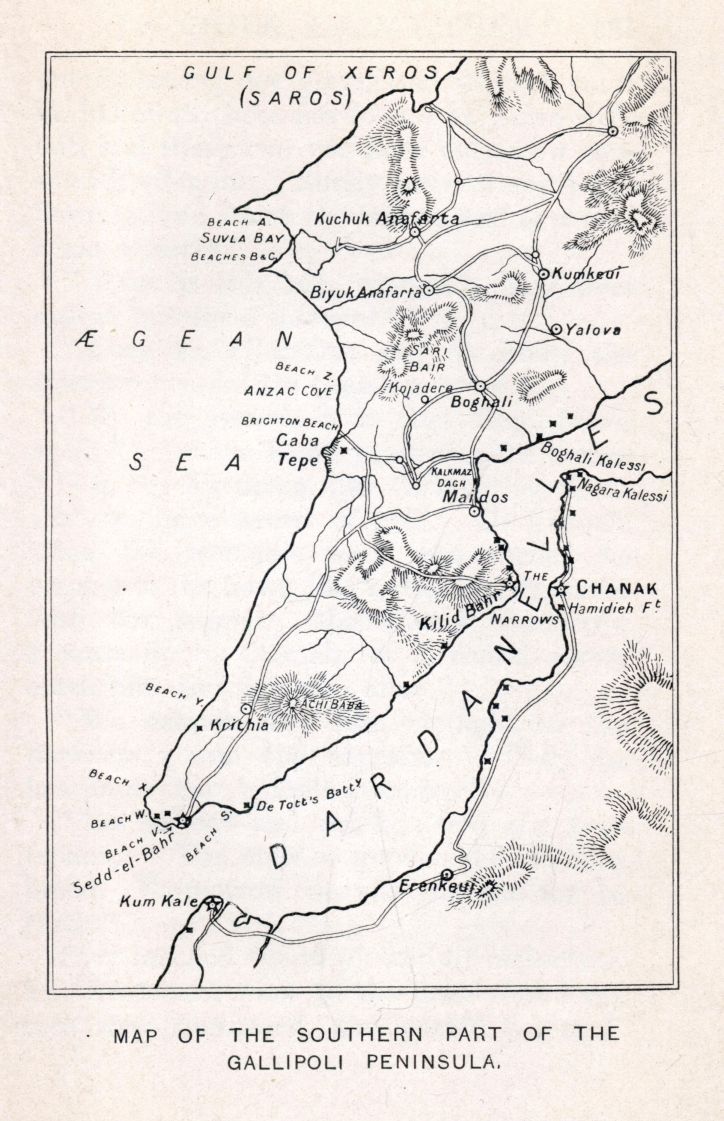
MAP OF THE SOUTHERN PART OF THE GALLIPOLI PENINSULA.
"Wallahy! noble effendim," the woman faltered, "I was but even now telling my man of the ill that befell this pious house this very night. Behold, there was a fair array of loaves fresh from the oven upon yonder stone, and I went from the house but for one moment to learn the meaning of a great outcry among my geese, and when I came in, lo! of all those fair loaves only two were left, and those two you have even now consumed, effendim. Surely an evil spirit has flown in, and stolen the loaves, and departed again secretly."
"What is this tale, woman? You were absent but for a moment?"
"Even so, effendim; and we know the spirits move swifter than the wind."
"By the Beard, it is that Englishman again," cried the Kurd, thumping the board. "Is it not his doing, like those other deeds that we have heard of him? Of a truth when the woman's back was turned he crept into the house like a dog and departed with our supper. Mashallah! to-morrow I must go to Chanak, or I would surely catch him and flay him alive."
"We cannot seek him to-night in the darkness," said the captain. "Truly he has more than a dog's cunning."
"Let us eat and drink," said the lieutenant. "The stew is good, even without bread. To-morrow we will run the fox to earth."
They finished the meal, and lit cigarettes. The lieutenant went to the barn where the men were quartered, and posted a guard. He remarked on his return that it was a useless precaution, since there were no enemies on land.
"Except one--the Englishman," remarked his captain with a rueful laugh.
"He will not return here unless we ourselves bring him in bonds," returned the other.
Piecing together the scraps of conversation he had already heard with those he heard subsequently, Frank came to the conclusion that Abdi had been recalled to take part in a battue of Armenians in Asia Minor, and was to leave next morning by motor launch for Chanak in advance of his men.
By and by the officers stamped about the room while the housewife arranged rugs and cushions on the board for their night's repose. She then followed her husband upstairs to the higher floor, and the officers, after removing their boots and accoutrements, arranged themselves on the simple bed. The lamp was left alight, and, door and window being closed, the room was filled with a heavy, smoky air which soon lulled the three men to sleep.
Frank was by this time suffering painfully from his cramped position and the foul air. At first he had intended to remain in his hiding-place until the officers departed in the morning, and then to seize the first opportunity of slipping away. But as time went on he became convinced that he could not endure his situation through the long night. Before morning he would be asphyxiated, or so racked with pain as to have lost the use of his limbs. If he did not escape during the hours of darkness he would be unable to escape at all. And when the heavy breathing and snores above him showed that slumber had sealed the senses of his enemies, he determined to make an attempt to get away. To be caught gamely at night was better than to be taken helpless in the morning.
It was fortunate that the farmer's primitive bed was a flat board, and not a divan with mattresses bulging below. Otherwise he could hardly have moved without causing some pressure beneath the sleepers that would certainly have disturbed them. He lay for a time trying to visualise the room. The board ran along the whole length of the wall opposite the door. There was not space enough for him to creep out at either the head or the foot: to reach the door he must cross the whole width of the room. Dim though the light was, it was sufficient to reveal his form. But there was no other way.
With infinite precaution he sidled his way from beneath the board, then lay still to listen. The three men were snoring in three different tones. He inferred from the sounds that two of the three had their faces towards the door. To rise at once might cause them to open their eyes; his best chance lay in crawling a little way over the floor. Raising himself on hands and knees, he drew himself along inch by inch; then, gaining courage from the uninterrupted regularity of the snores, he rose to his feet and ventured to glance round. The three men were curled up under their rugs; only the tops of their heads showed.
At the same glance he noticed their accoutrements lying on the stone slab from which he had taken the loaves. Prompted by a dare-devil impulse that had also an element of precaution, he stole on tiptoe to the slab, and with slow careful movements, though his hands were trembling a little, he lifted the flaps of the revolver cases over their buttons and abstracted the revolvers one by one. If the men chanced to wake before he was clear of the door, they should at least have no weapons to fire at him. A slight click as he slipped the last revolver into his pocket caused a momentary pause in the moto continuo of one of the men's recitative, and Frank clutched his own revolver, ready for emergency; but the officer did not stir, and Frank, facing them, crept backward towards the door.
He could not remember whether the door had been locked or bolted, and felt an inward quaking at the thought of having to turn a possibly rusty key or draw a creaking bolt. It was with immense relief that he perceived that the door was fastened only by a wooden catch. Just, however, as he was raising his hand to release it he heard a step outside, approaching the door. With instant presence of mind he took two quick silent paces to the shelf on which the lamp stood and pinched out the flame.
There was a knock on the door. The snoring abruptly ceased, but no answer was given; the sleepers had not been fully awakened. The knock was repeated. A sleepy voice from the bed said "Enter." The door opened, and Frank, being unluckily almost behind it, could not slip out. There was a little diffused light from the moon below the horizon, just sufficient to reveal Frank's form, in its long military great-coat, to the newcomer.
"A runner with a despatch from headquarters, effendim," said the man, taking Frank for one of his own officers.
At one and the same moment Frank silently held out his hand for the despatch and a voice from the other side of the room murmured, "Bring it here. Light the lamp first." Frank was conscious of surprise and hesitancy in the attitude of the visitor. The critical moment had come. Taking the despatch and thrusting it into his pocket, he bent suddenly, sprang at the man's knees, lifted him from his feet and hurled him across the room. A threefold shout followed him as he dashed into the open. The sentry hurried towards him.
"Fire!" cried Frank. "Fetch water!"
"Fire! Fire!" repeated the man, turning about and running towards the well in the yard.
Frank had already rushed in the opposite direction to the dark side of the house. The clamour grew in volume; men were rushing hither and thither with the panic of disturbed sleepers; shrill screams from the startled housewife and her children mingled with the deeper shouts of the soldiers. And Frank dashed away into the darkness. At first heedless of his direction, he stopped when the sounds were faint in the distance, and, panting, tried to take his bearings. Somewhat more than an hour later he clambered down the hollow trunk to his sepulchral refuge, and threw himself exhausted on its earthy floor.
CHAPTER XV
OUT OF ACTION
Frank's first proceeding when he awoke next morning was to start munching one of his loaves; his next, to read the despatch which chance had thrust upon him. It was addressed to the Anatolian captain. A battery of heavy guns was to be emplaced on Sari Bair. The convoy, coming by way of Kumkeni and Boghali, might be expected at Kojadere on the following morning. The captain was to abandon for the time the pursuit of the Englishman and to place himself at the disposition of the officer commanding the battery, to assist in transporting the guns up the hill.
Frank did not know Kojadere by name, but he knew Boghali, and conjectured that Kojadere must be the village at the south-east foot of the hill. It was visible from a spur about half a mile from his hiding-place. A rough path left the main track between Boghali and Kojadere at about the same distance from the latter place, and joined a similar path running direct from Kojadere up the hill. These facts Frank had learnt in the course of his wanderings, and he determined, simply from motives of curiosity, to make his way to a spot where he could see a sight new to him, the placing of a battery of guns. Abdi had gone, no doubt, to Chanak; the others would not for the present concern themselves with their elusive quarry; for he assumed that the contents of the despatch were known to the carrier; so it was with an easy mind that he betook himself to the elevated spot from which he could view the Boghali road.
It was chilly in the morning air. The valleys and the lower ground were blanketed in mist. The heights were clear, and Frank smiled as he saw in his mind's eye the scene of his night's adventure, invisible to his bodily eye, over the brow of the hill.
A light breeze was sweeping up through the hills from the sea, causing the mist to gyrate in swirling eddies, and here and there cutting a path through it. Gradually more and more of the Boghali road was exposed to his view. There was nothing moving upon it. He looked up in the direction of Biyuk Anafarta, towards the quarter in which the Anatolians should presently appear, in pursuance of their instructions. There was no sign of them yet; it was possible that the contents of the despatch were unknown to them after all.
After a time he caught sight of figures beyond Boghali where the road wound round a low hill to the north of that place. Ere long he was able to recognise the artillery train--long teams, whether of horses, oxen, or mules he could not tell even through his field-glasses, dragging heavy guns and ammunition wagons. The escort numbered, at a guess, some three hundred men. The train passed through Boghali, and took the right-hand road towards Sari Bair. A bridge spanned a stream fed by a number of rivulets rising on the eastern slope of the hill. Here the train came to a halt. There was a long delay; probably the bridge was not constructed for heavy traffic. Then one of the guns appeared on the western side; the others slowly followed.
By this time Frank felt pretty sure that the Anatolians were ignorant of the orders given in the despatch, otherwise they should long ago have reached Boghali by the direct road from Biyuk Anafarta. If they had resumed their hunt for him, it behoved him to be cautious. From the troops below he had little to fear. They were not looking for him, and in all likelihood were unaware of his existence. Keeping a careful look-out above, therefore, he stole down under cover of the scrub, which was very dense on this side of the hill, to take a nearer view of the work of the artillerymen.
Several mounted officers had pushed ahead to survey the ground and choose the easiest route for the guns. Some had taken the first track on the right of the road, others were riding quickly forward to Kojadere to examine the track from there. The two parties met at the junction, and from subsequent operations it appeared that the longer but easier gradient from Kojadere had been decided upon. Up this track, then, the officers despatched strong working parties, to clear away obstacles, and cut down the scrub which here and there encroached at the sides. Two officers, mounted on mules, slowly rode up to the summit, to select an emplacement for their battery.
Frank watched all this from a sheltered spot at some distance from the track. These troops were not looking for him, it was true; but in their course they must work round his position, and he was careful not to expose himself.
The way having been prepared, the men in charge of the first gun whipped up their team, which hauled the heavy weapon about a third of the distance up the track. Then there was a check. The slope was very irregular. For some yards its angle was low; then it would suddenly make a sharp rise. It was at one of these abrupt acclivities that the gun had now arrived. The ascent seemed an impossible one, and the track, with on one side the rocky hill and on the other a steep incline, hazardous in the extreme. The team attached to the second gun was unhitched and brought up to assist the first. Urged by vociferous shouts and much cracking of whips, the united teams, straining and hauling, managed to draw the gun up a few feet at a time, large blocks of wood being placed behind the wheels at each stoppage to prevent it from slipping back.
Frank looked on at all this with interest, and a certain sympathy for man and beast, which was increased when one of the officers, a German, rode down the hill and vented his irritation at the delays in foul abuse and violent threats. "They are working jolly hard," was his inward protest. The gun moved on again, and a turn in the track hid it from his view. He looked around to make sure that he was in no danger of being seen from the rear, then crept up through the scrub to reach a spot where he could again follow the operations.
"I wonder what they are going to all this trouble for?" he thought. "Those guns aren't a match for our naval guns, and in any case they are no good here as a defence of the forts."
A little way further up the hill he came upon a gully scarcely three feet wide, much overgrown with bushes. It appeared to lead down towards the track, on which, to judge by the renewed shouts of the men and the cessation of the rumbling of the wheels, the gun had again been brought to a halt. Frank crept down this gully stealthily foot by foot, and presently discovered the cause of this new check. The gully intersected the track and fell down the slope beyond. Though it was now dry, at some time it had evidently been a watercourse, and the water had scored a deep channel across the track, an effectual obstacle to heavy traffic. At this moment the men were toiling with pick and spade to fill up the channel, a task that would clearly occupy some time.
Frank looked on for a few minutes. Then his eyes strayed down the track. The mules were stationary in a long line, quite unattended. The team hauling the second gun lower down was out of sight. "Pity I can't spike the gun," Frank thought, "though to be sure spiking is impossible in these days. But a slip would send it crashing down the track, or over the slope. I wish----" And then an idea flashed into his mind. The gun was hauled, not by leather traces, but by heavy chains. Quickly raising his field-glasses, he levelled them at the attachments of the chains to the gun-carriage. Each one ended in a massive iron ring, which was looped over a long hook. Now that the gun was halted, and the wheels stopped by blocks of wood, the chains were hanging slack.
Replacing his glasses, he crept down under cover of the scrub until he came opposite the gun. All the men were still engaged above. He looked up, down, around. No one was in sight, except the men working with their backs towards him a hundred yards up the hill. Inch by inch he stole nearer to the track; paused a moment to collect himself; then darted rapidly from cover, lifted the ring from the hook on the side nearest him, hitched the chain so that it appeared to be in place, and slipped back breathlessly into the scrub. It had taken him no more than a quarter of a minute.