The Lost Colony of 1587
Reading edition
In the year 1587, Sir Walter Raleigh organized another colonial expedition consisting of 150 persons. Its truer colonizing character was evidenced by the significant facts that, unlike the expedition of 1585, this one included women and children, and the men were called “planters.” Its government was also less military, since the direction of the enterprise in Virginia was to be in the hands of a syndicate of sub-patentees—a governor and 12 assistants whom Raleigh incorporated as the “Governor and Assistants of the Citie of Ralegh in Virginia.”
The new arrangement indicated that colonization was becoming less of a one-man venture and more of a corporate or business enterprise, anticipating in a certain degree the later English companies that were to found successful colonies in Virginia and New England. Exactly what inducements Raleigh offered to the planters are not known. His terms were probably liberal, however, because Hariot, writing in February 1587, paid tribute to Raleigh’s generosity, saying that the least that he had granted had been 500 acres of land to each man willing to go to America. Those contributing money or supplies, as well as their person, probably stood to receive more. From the list of names that has come down to us, it would appear that at least 10 of the planters took their wives with them. Ambrose Viccars and Arnold Archard brought not only their wives but one child each, Ambrose Viccars and Thomas Archard. Altogether there were at least 17 women and 9 children in the group that arrived safely in Virginia.
In still another respect, this second colonial expedition seemed to anticipate the later Jamestown settlement. Raleigh had directed, in writing, that the fort and colony be established in the Chesapeake Bay area where a better port could be had and where conditions for settlement were considered to be more favorable.
19
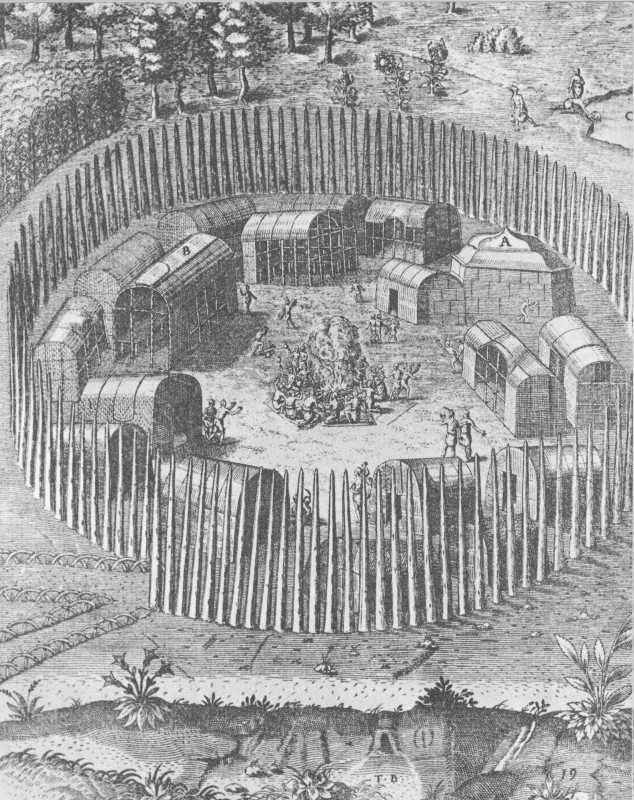
The Indian Village of Pomeiooc, engraved by De Bry from a drawing by John White.
20
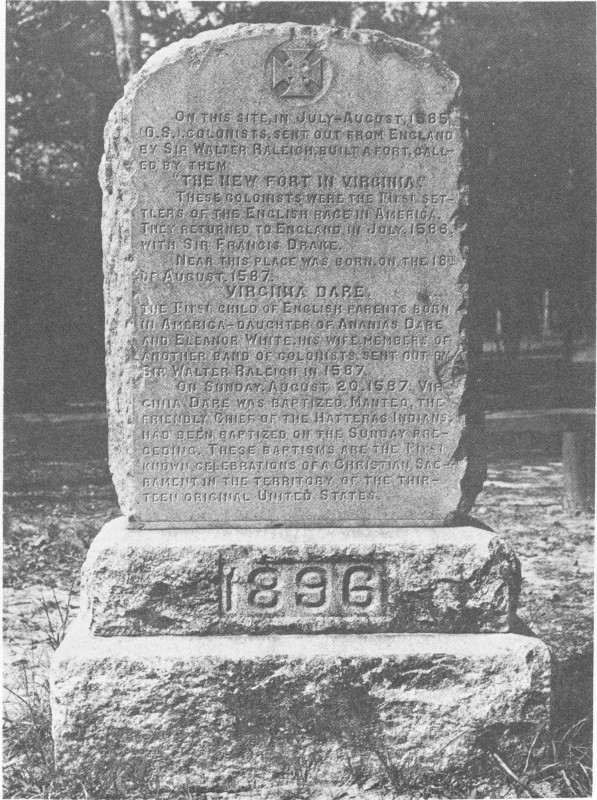
The Virginia Dare marker at Fort Raleigh
The fleet, consisting of three ships, sailed from Plymouth for Virginia on May 8. Continuity with the previous expeditions was afforded in the persons of the Governor, John White, who was to make in all five trips to Virginia, Simon Ferdinando, Captain Stafford, Darby Glande, the Irishman, and perhaps others. The route, as in 1585, lay via “Moskito Bay” in Puerto Rico. Here Darby Glande was left behind, or escaped, and lived to testify regarding the first Roanoke Island colony before the Spanish authorities at St. Augustine some years later. The expedition sailed along the coast of Haiti, even passing by “Isabella” where Grenville had traded with the Spaniards for cattle and other necessities in 1585, but this time there was no trading, possibly because of the precarious relations between England and Spain, now on the eve of open 21 war. Whatever the reason for this failure to take in supplies in Haiti, it constituted a certain handicap for the colony of 1587.
THE SECOND COLONY ESTABLISHED AT ROANOKE.
The two leading ships of the expedition reached Hatoraske on July 22, 1587, and the third ship on July 25. Meanwhile, on the 22d, Governor White and a small group of planters had gone to Roanoke Island with the intention of conferring with the 15 men left there by Grenville the preceding year. On reaching the place where the men had been left, they found only the bones of one of them who had been killed by the Indians. There was no sign of the others.
The next day Governor White and his party “walked to the North end of the island, where Master Ralfe Lane had his forte, with sundry necessary and decent dwelling houses made by his men about it the yeere before.” Here it was hoped some sign of Grenville’s men would be discovered. They found the fort razed “but all the houses standing unhurt, saving that the neather rooms of them, and also of the forte, were overgrown with Melons of divers sortes, and Deere within them, feeding on those Melons.” All hope of finding Grenville’s men then vanished.
For reasons which are obscure, but perhaps because the season was late, it was decided to settle again at Roanoke Island rather than go on to the Chesapeake Bay country. Those houses found Standing were repaired and “newe cottages” were built. The Indians proved to be more hostile than formerly, and George Howe, one of the assistants, was killed by the Indians soon after the landing. Through the intercession of the Indian Manteo, who had relatives on the barrier island of Croatoan, friendly relations with the Croatoan Indians were reestablished, but the others remained aloof. The remnants of the Roanoke Island Indians dwelling at Dasamonquepeuc were accused by the Croatoan Indians of killing Grenville’s men as well as George Howe. Hence, on August 8, Governor White, with Captain Stafford and 24 men, suddenly attacked the town of Dasamonquepeuc with fire and sword. It was a blunder. The Roanoke Indians had already fled. In their place were the friendly Croatoan Indians who had heard of the flight of the other Indians and had come over to take whatever corn and fruit might have been left behind. Thanks to Manteo, the Croatoan Indians forgave the Englishmen, or pretended to do so.
On August 13, complying with Raleigh’s instructions, Manteo was christened and declared Lord of Roanoke and Dasamonquepeuc as a reward for his many services. Five days later, Governor White’s daughter, Eleanor, wife of Ananias Dare, gave birth to a daughter, who was named Virginia because she was the first child of English parentage to be born in the New World. Another child was born to Dyonis and Margery Harvie shortly afterwards. On the 27th, Governor White, at the earnest entreaty of the “planters in Virginia,” sailed homeward with the fleet to obtain supplies for the colony.
22
GOVERNOR WHITE’S RETURN TO ENGLAND.
With Governor White’s departure on the 27th, the history of events in the colony becomes a tragic mystery which one can only seek to explain. There had been talk of moving the colony 50 miles inland, and White had arranged for appropriate indications of their whereabouts if they removed from Roanoke Island before his return. However, White could not return as soon as expected because of the outbreak of war with Spain. The year 1588 was the Armada year. Sir Richard Grenville, who was preparing a new fleet to go to Virginia, was ordered to make his ships available to the English Navy for service against the Armada. Both Raleigh and Grenville were assigned tasks connected with the national defense and could give little thought to Virginian enterprises. At length, the Queen’s Privy Council gave Grenville permission to use on the intended Virginian voyage two small ships not required for service against Spain. White sailed with these on April 28, but they were small, poorly equipped, and poorly provisioned. Partly because of these circumstances and perhaps partly because of their own folly in running after Spanish treasure ships, they were unable to reach Virginia in the war-torn sea. Thus, while Grenville’s large warships contributed to the defeat of the Armada, the Roanoke Island colony was doomed for the lack of them.
Although the Armada was defeated in the summer of 1588, the Anglo-Spanish battle of the Atlantic continued for several years. It was the intention of Spain to carry on the war not only against England by means of the Armada but also to seek out the English colony in the New World and destroy it at about the same time. In the latter part of June 1588, the Spanish Governor at St. Augustine sent a packet boat northward to locate the English colony preparatory to an early attack on it. After reconnoitering Chesapeake Bay, the packet boat, with the pilot Vincente Gonzalez in command and with Juan Menéndez Marqués nephew of the Governor on board, came somewhat by chance to Port Ferdinando. Here they found evidence of a harbor and of English occupation. They departed hurriedly to St. Augustine to report their discovery. They clearly thought the harbor still in use at the time of their visit; but the projected attack, at first postponed and later thought to be unnecessary because of the weakness of the fort and settlement, seems never to have been made. At least that is the conclusion to be drawn from available Spanish documents.
On March 7, 1589, Raleigh deeded his interest in the Virginian enterprise, except a fifth part of all gold and silver ore, to a group of London merchants and adventurers and to Governor White and nine other gentlemen, “Late of London.” At least seven of them were planters whom White had left in Virginia, such as Ananias Dare, his son-in-law and father of Virginia Dare. Others included in the group were Richard Hakluyt and Thomas Smythe, later known as Sir Thomas Smythe.
23
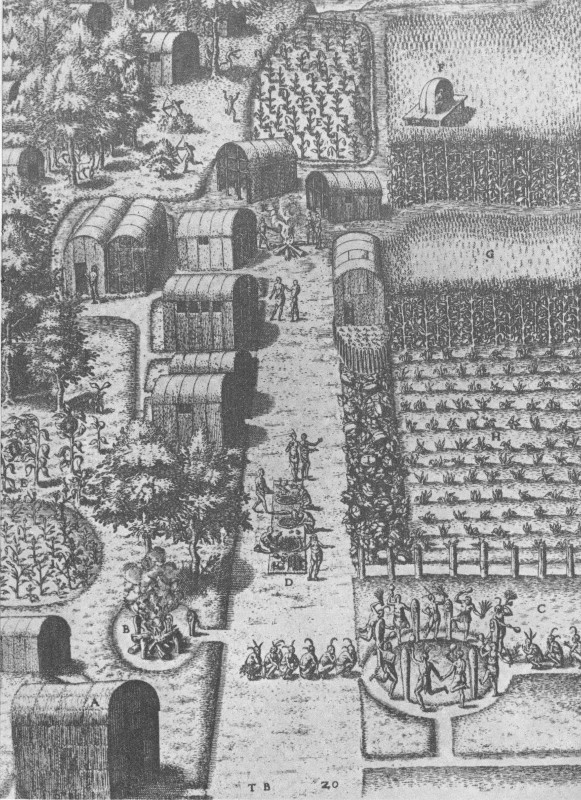
The Indian village of Secotan, engraved by De Bry from John White’s drawing.
24
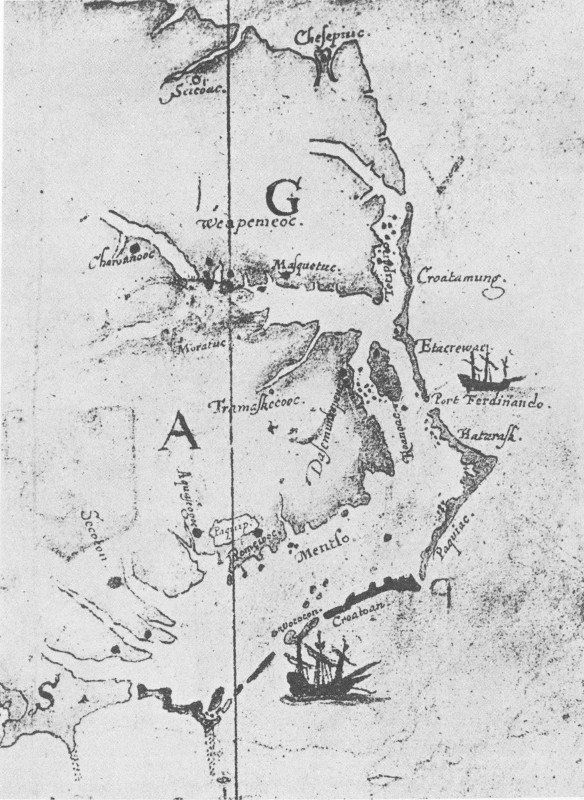
Map made by John White, 1585-86, showing the relationship of Roanoke Island, Dasamonquepeuc, Port Ferdinando, Croatoan, and Hatoraske.
The months slipped by, but Governor White and the London merchants seemed to have been unable to get a fleet organized for the relief and strengthening of the colony. In March 1590, Raleigh endeavored to assist White, through influence at court, when the latter learned that Master John Wattes, of London, was being hampered by a governmental staying order in his effort to clear a fleet of privateers for the West Indies. The scheme appears to have been that Raleigh, acting as middleman, 25 would gain clearance for the ships and, in return, colonists and their furniture would be transported to Virginia. The plan went awry. Governor White sailed on March 20, 1590, for America, but without the accompanying planters and supplies. Indeed, his status was not much better than that of a passenger on one of Wattes’ ships, who had limited court influence at home.
After operating for months in the West Indies, the Wattes expedition anchored on the night of August 12 at the northeast end of the island of Croatoan. If White had only known then the clue to the colonists’ whereabouts that he was to learn 6 days later, he would have asked for a search of that island! But he had no way of knowing the promise that “Croatoan” held. After taking soundings, the fleet weighed anchor on August 13 and arrived at Hatoraske toward the evening of the 15th.
ATTEMPTS TO FIND THE LOST COLONY.
As the ships anchored at Hatoraske, smoke was seen rising on Roanoke Island, giving hope that the colonists were still alive. On the morning of the 16th, Governor White, Captain Cooke, Captain Spicer, and a small company set forth in two boats for Roanoke Island. En route they saw another column of smoke rising southwest of “Kindrikers mountes.” There are no mountains on this coast, except the great sand dunes. Perhaps the smoke was coming from the general area occupied today by the Nags Head dunes. They decided to investigate this latter smoke column first. It was a wearisome task that consumed the whole day and led to nothing, since no human beings were at the scene of the woods fire.
The next day, August 17, they prepared to go to Roanoke Island. Captain Spicer and six other men were drowned in the treacherous inlet when their boat capsized. Despite this unfortunate occurrence, White was able to proceed with the search. They put off again in two boats, but before they could reach the place of settlement it was so dark that they overshot their mark by a quarter of a mile. On the north end of the island they saw a light and rowed toward it. Anchoring opposite it in the darkness, they blew a trumpet and sang familiar English tunes and songs, but received no answer. In the morning they landed on the north end of the island and found only the grass and sundry rotten trees burning. From this point they went through the woods to that part of the island directly opposite Dasamonquepeuc on the mainland, west of the north end of Roanoke Island, and from there they returned by the water’s edge round about the north point of the island until they came to the place where the colony had been left by Governor White. From the description just given of White’s itinerary, this place must have been near the shore on the north end of the island on the east side, i. e., at or near the present Fort Raleigh National Historic Site. In the course of the long walk along the shore, nothing of interest was seen except footprints which two or three natives had made in the sand during the night.
26
As they climbed the sandy bank toward the settlement area, they found CRO carved in Roman letters on a tree at the brow of the hill. Going from there to the site of the dwelling houses, they found all of the houses taken down and the area strongly enclosed with a palisade of tree trunks, with curtains and flankers “very Fort-like.” One of the chief trees, or posts, had the bark peeled off, and carved on it in capital letters was the word CROATOAN, but without the maltese cross or sign of distress that White had asked the settlers to use in such messages in the event of enforced departure from Roanoke Island. On entering the palisade, they found iron and other heavy objects thrown about and almost overgrown with grass, signifying that the place had been abandoned for some time.
From the fort and settlement area, White proceeded again along the shore southward to the “point of the creek” (i. e., the point of Shallow Bag Bay or, as it was called in 1716, “Town Creek”), which had been fortified with “Falkons and small Ordinance” and where the small boats of the colony were habitually kept, but could find no sign of any of these things. Then, on returning to the fort and settlement area, White searched for certain chests and personal effects which he had secretly buried in 1587. The Indians had discovered the hiding place, had rifled the chests, torn the covers off the books, and left the pictures and maps to be spoiled by rain. Considering that Gov. John White was probably John White the artist and illustrator of the expedition of 1585-86, one can imagine his feelings on seeing his maps and pictures irretrievably ruined. However, according to his own words he was cheered at the thought that, as indicated by the word CROATOAN on the palisade post, “a certaine token,” his daughter, granddaughter Virginia Dare, and the colonists would be found at Croatoan Island, where Manteo was born and where the Indians had been friendly to the English.
As stormy weather was brewing, White and his little group returned in haste to the harbor where their ships were at anchor. Next day they agreed to go to Croatoan Island to look for the colonists but the weather would not permit. They planned to go to the West Indies instead, where they would have taken on fresh water and ultimately have returned to Croatoan. However, the elements willed otherwise and they were blown toward the Azores. From Flores in this group, they made their way to England.
Governor White could not finance another expedition to America himself, and Raleigh, although enjoying a large income at times, spent lavishly. Some of the money and energy that might have gone into the Virginian enterprise, Raleigh expended, during 1587-1602, in colonizing estates which he had received in Ireland. The Virginian enterprise would have required a prince’s purse, but Raleigh was not a prince. Walsingham died in 1590, a blow to Raleigh. In July 1592, Raleigh was disgraced and imprisoned for marrying Elizabeth Throckmorton without 27 the Queen’s knowledge or consent. White, therefore, accepted the facts with resignation. His last recorded words, dated February 4, 1593, are: “And wanting my wishes, I leave off from prosecuting that whereunto I would to God my wealth were answerable to my will.”
As late as 1602, Raleigh was still seeking in vain for his lost colony. In that year he sent out an expedition under Samuel Mace, who reached land some “40 leagues to the so-westward of Hatarask,” presumably at or near Croatoan Island. Here they engaged in trading with the Indians along the coast. They probably did not look as diligently as they should have for the lost colonists, because they alleged that the weather made their intended search unsafe. On August 21, 1602, in a letter to Sir Robert Cecil, Raleigh expressed his undying faith in the overseas English Empire which he had attempted to establish, saying, “... I shall yet live to see it an English Nation.” The memory of the Lost Roanoke Colony by that time had become an imperishable English tradition. After the establishment of the Jamestown settlement in Virginia in 1607, the Virginia colonists evidenced an almost constant interest in trying to learn from the Indians the whereabouts of the Roanoke settlers. However, the hearsay data they collected were never sufficiently concrete to be of any real assistance in locating Raleigh’s men, and the answer remains a mystery to this day.