Raleigh’s First Colony, 1585-86
Reading edition
The next Spring, Raleigh sent a colony of 108 persons to Roanoke Island. The expedition, commanded by Raleigh’s cousin, Sir Richard Grenville, sailed from Plymouth, England, on April 9, 1585, in seven ships, the largest of which was of 140 tons’ burthen. Included in the 7 group of ship captains and colonists were Philip Amadas and Simon Ferdinando of the expedition of the previous year; Thomas Cavendish, then on his first great voyage but destined to be the third circumnavigator of the globe; Grenville’s half-brother, John Arundell, and brother-in-law, John Stukeley; and other Raleigh cousins and connections, among them Richard Gilbert, a Courtenay, a Prideaux, Ralph Lane, and Anthony Rowse, a friend of Drake’s. There were an artist, or illustrator, John White; a scientist, named Thomas Hariot; and, among the humbler folk, an Irishman, Darby Glande or Glaven. The two Indians, Wanchese and Manteo, returned to America on this voyage.
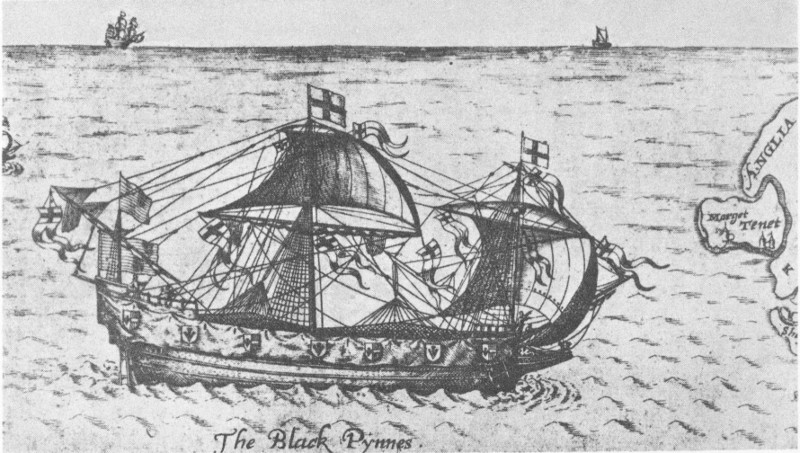
A pinnace used in the funeral of Sir Philip Sidney, 1587. Small boats such as this were used to transport men and supplies from the harbor at Hatoraske through the inland waters to Roanoke Island.
THE VOYAGE.
The route chosen lay via the Canaries and the Spanish West Indies. They anchored at “Moskito Bay” in the Island of “St. Johns” (Puerto Rico), May 12, where they constructed a fort, set up a forge to make nails, and built a pinnace to replace one lost in a storm. They left Puerto Rico toward the end of May after burning the fort and surrounding woods and after seizing two Spanish frigates. Just before departing, Ralph Lane raided “Roxo bay” in one of the captured frigates, built a fort, and seized a supply of salt.
8
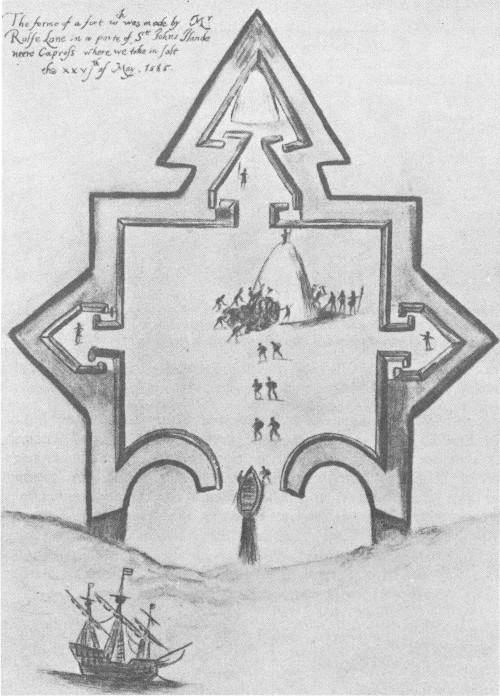
John White’s water-color drawing of the fort which Ralph Lane built in Puerto Rico in May 1585 while the first group of colonists were en route to Roanoke Island.
These bellicose activities of the English in Puerto Rico illustrate the fact that England and Spain were virtually at war at that time. Indeed, the war was to become an actuality within 3 years. In the meantime, the English were engaged in what would be called today a “cold war”—pin-pricking the Spaniard in the West Indies and about to settle on the American mainland at a spot sufficiently close to Spanish Florida to constitute both an economic and a military threat to Spain. Growth of the English colony would circumscribe Spain’s own colonial effort; at the same time, the location chosen for the English colony was close 9 enough to serve as a base of operations against Spanish new world shipping. That both possibilities were uppermost in the minds of Raleigh and Grenville and their supporters at court is obvious. One of the weaknesses of their colonial program was their persistent thought the privateering operations against Spanish shipping should, or could, be made to pay the cost of English colonial effort.
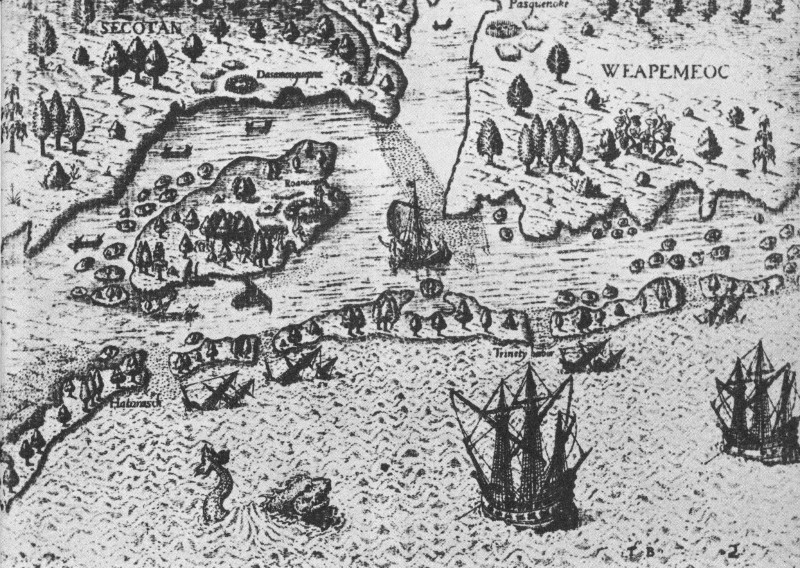
“The Arrival of the Englishmen in Virginia,” engraved by Theodore de Bry from one of John White’s drawings. The view is toward the west, and Dasamonquepeuc is shown on the mainland west of the north end of Roanoke Island.
The first part of June found the English banqueting the uneasy Spanish Governor at Isabella on the Island of Hispaniola (Haiti). To impress the Governor, Grenville treated him to a sumptuous meal served “all in plate” to the “sound of trumpets and consort of musicke.” The Governor entertained in turn and, subsequently, the English traded with the Spaniards for commodities that would be needed in their colonial settlement: “horses, mares, kine, buls, goates, swine, sheepe, bull-hides, sugar, ginger,” etc. From the Spanish accounts of Grenville’s actions in Puerto Rico and Haiti are gained some interesting personal glimpses. The officers and persons of distinction in the expedition were served upon silver plate which was chased and gilt. Wanchese and Manteo had learned to speak English, and the illustrator, John White, was already engaged in drawing pictures of strange plants and objects.
10
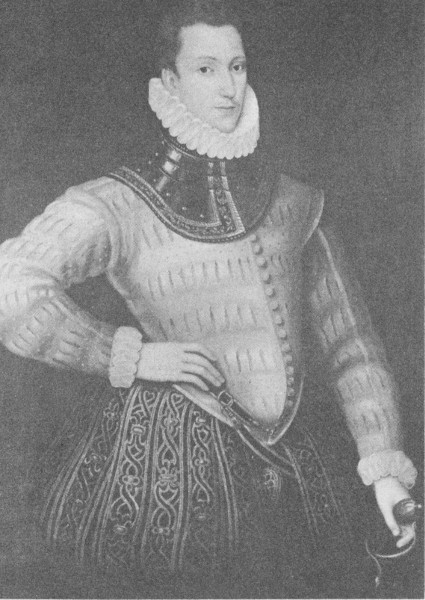
Sir Philip Sidney, from a portrait painted about 1577. Courtesy National Portrait Gallery, London.
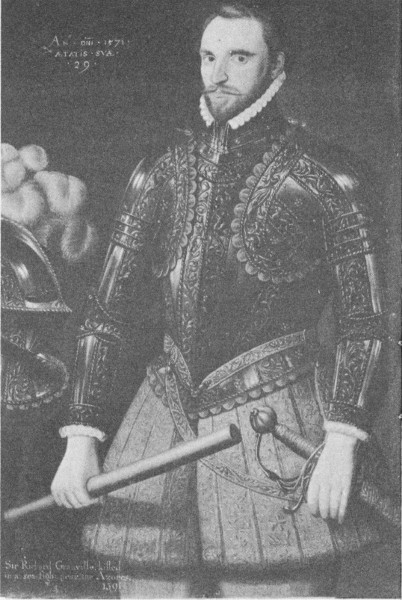
Sir Richard Grenville in 1571. Courtesy National Portrait Gallery, London.
THE ESTABLISHMENT OF THE COLONY.
An island south of Cape Hatteras, now known as Ocracoke, was reached on June 26. The remainder of the month and most of July were spent in exploring the coastal islands and the adjacent mainland. During one of these expeditions, Grenville sought to strike terror into the hearts of the Indians by burning the Indian village of Aquascogok in retaliation for the theft of a silver cup stolen by one of the Indians. Not until July 27 did Grenville anchor at Hatoraske, off the barrier island, a short distance southeast of Roanoke Island. Here at a break in the barrier reef, almost due east of the southern tip of Roanoke Island, Simon Ferdinando discovered a port, named Port Ferdinando in his honor and considered the best port along that stretch of coast.
A colony was established on the “North end” of Roanoke Island, and Ralph Lane was made Governor. From Port Ferdinando, and later from Roanoke Island, letters were written by Lane to Secretary Walsingham informing him of the successful founding of the colony. Still another letter was written to Sir Philip Sidney, son-in-law of Walsingham, who was interested in western discovery. A letter to Richard Hakluyt, geographer and historian, written by Lane from the settlement on Roanoke 11 Island indicated that the Governor of Virginia was impressed by the “huge and unknowen greatnesse” of the American continent. He added that if Virginia only had horses and cows in some reasonable proportion and were inhabited by Englishmen, no realm in Christendom would be comparable to it. The Indians, he said naively, were “courteous, and very desirous to have clothes,” but valued red copper above everything else. Wingina, chief of the Roanoke Island Indians, had received the white men hospitably and had cooperated with them in the initial phases of the founding of the settlement. This is clear from Grenville’s account as well as Lane’s.
Grenville lingered a short while after the founding of the settlement, then returned to England for supplies. On the way home he captured a richly laden Spanish ship, which must have repaid him handsomely for his western trip. On his arrival in England, he too reported to Walsingham, thus acknowledging the interest of the Queen and emphasizing the seminational character of the Virginian enterprise.
Lane built a fort called “The new Fort in Virginia,” where the present Fort Raleigh National Historic Site is situated and where the remains of a fort were still visible as late as 1896. The fort was located near the shore on the east side of Roanoke Island between the “North Point” of the north end of the Island and a “creek.” The mouth of the so-called creek was big enough to serve as the anchorage for small boats (Shallow Bag Bay, known as late as 1716 as “Town Creek”).
Lane’s fort on Roanoke Island resembled in some noteworthy respects the fort which he had built on St. Johns Island, Puerto Rico, in May 1585, when he seized the salt supply. Both forts seem to have been roughly shaped like a star built on a square with the bastions constructed on the sides of the square instead of at the corners, as was common in later fortifications. Copies of the plans of these forts may be seen in the Fort Raleigh museum.
The dwelling houses of the early colonists were near the fort, which was too small to enclose them. They were described by the colonists themselves as “decent dwelling houses” or “cottages” and must have been at least a story and a half or two stories high, because we have a reference to the “neather roomes of them.” The roofs were thatched, as we learn from Ralph Lane’s statement that the Indians by night “would have beset my house, and put fire in the reedes that the same was covered with.” The chimneys and the foundations may have been of brick, because Darby Glande later testified that “as soon as they had disembarked Roanoke they began to make brick and fabric for a fort and houses.” Pieces of brick were reported found at the fort site as late as 1860, and recent archeological work at the fort turned up a few brickbats, possibly of the Elizabethan period.
12
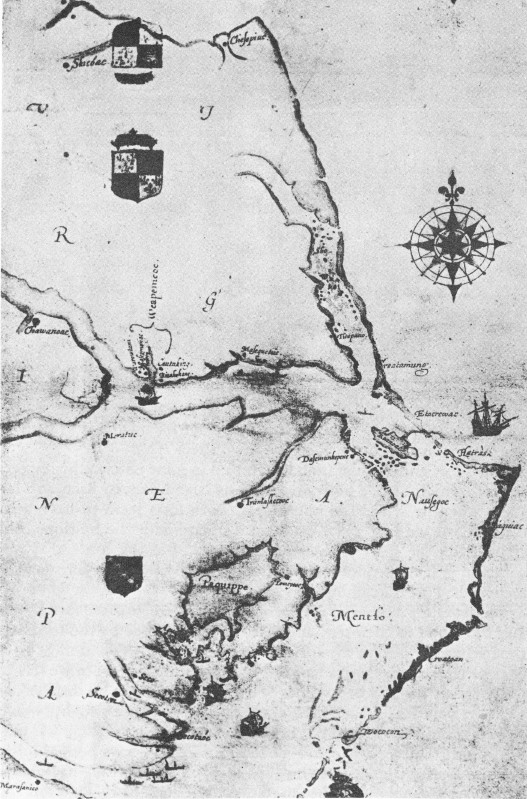
Map made by John White in 1585-86. This map, the original of which is in the British Museum, is of interest as showing opposite the “R” in “Roanoke” a dot that may represent the colonial settlement site. Note Dasamonquepeuc on the mainland west of the north end of Roanoke Island and the barrier island of Croatoan south of Cape Hatteras.
13
Thomas Hariot remarked that though stone was not found on the island, there was good clay for making bricks, and lime could be made from nearby deposits of oyster shells in the same manner that lime was made “in the Isles of Tenet and Shepy, and also in divers other places of England.” However, as no evidence of the extensive use of brick has yet been found, it is perhaps safe to assume that the chief building material was rough boards. It has already been noted that they had a forge which they could set up to make nails. Richard Hakluyt, in his Discourse of Western Planting, written at the request of Sir Walter Raleigh in 1584, about 1 year before the colony sailed, had recommended as “things to be prepared for the voyadge” that any colonial expedition should include “men experte in the arte of fortification,” “makers of spades and shovells,” “shipwrights,” “millwrights, to make milles for spedy and cheape sawing of timber and boardes for trade, and first traficque of suertie,” “millwrights, for corne milles,” “Sawyers for common use,” “Carpinters, for buildinges,” “Brick makers,” “Tile makers,” “Lyme makers,” “Bricklayers,” “Tilers,” “Thatchers with reedes, rushes, broome, or strawe,” “Rough Masons,” “Carpinters,” and “Lathmakers.” The presumption therefore is that typical English thatched cottages and houses, such as were found in rural Elizabethan England, were built at Roanoke. (The log cabin appears to have been introduced into America about 50 years later by the Swedes and Finns on the Delaware.) The Roanoke cottages were presumably well built. The skilled labor of the expedition had been able to construct a seaworthy pinnace at Puerto Rico in less than a month’s time.
LIFE IN THE COLONY.
At first, relations with the Indians continued friendly, though the Englishmen had their detractors in the Council of the Indian Chief. The aborigines planted crops and made fish traps for the Englishmen. With rare foresight, the colonists also induced Chief Wingina (who had changed his name to Pemisapan) to put into simultaneous cultivation his lands both on Roanoke Island and on the mainland at Dasamonquepeuc in order that the Indians might have no excuse for not being able to supply the colony if need arose. The coast was explored by the English as far south as Secotan (about 80 miles) and as far north as the Chesapeake (about 130 miles). Thomas Hariot collected data on plants, animals, and minerals for his New Found Land of Virginia. John White made the inimitable water-color drawings of the Indians, the animal and plant life of Roanoke Island, and the coast, which have been engraved many times. The much rarer facsimile reproductions of these drawings in color may be seen in the Fort Raleigh museum. These paintings are the first artistic productions of Englishmen in America. The colonists also learned to smoke tobacco, using for this purpose Indian pipes or other pipes of their own modeled on the Indian pipes.
14
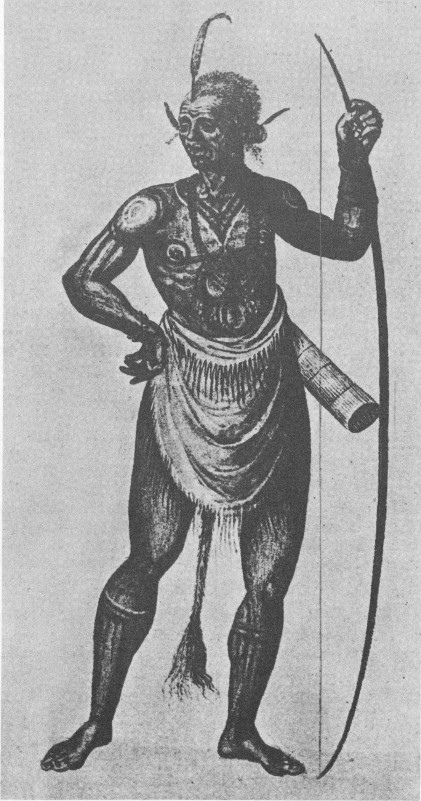
Drawing of an Indian made by John White, 1585-86.
15
How closely the personnel of the first colony conformed to the standard suggested by Hakluyt in 1584 is not known; but historical documents indicate that there were men expert in fortification and that there were brickmakers, carpenters, and thatchers. Also the names of all of the colonists are known, if not their trades. Some were gentlemen, cousins of Raleigh and Grenville, as the names indicate. Hariot says that some were city dwellers “of a nice bringing up” who soon became miserable without their soft beds and dainty food. Others were excellent soldiers, as Lane testified of Captain Stafford; and there were the humbler folk, of whom Darby Glande was perhaps representative, though he was Irish and appears to have been forced to accompany the expedition. On the whole, they gave the appearance more of a military expedition than a colony. They were dependent upon the Indians and upon England for both food and supplies. Many of their basic commodities, such as salt, horses, and cattle, had been obtained in the first instance by trade, or by force, from the Spaniards in the West Indies. There appear to have been no women among them to give permanence to the settlement.
Grenville’s deplorable action in burning the village of Aquascogok was indicative of the fact that the high-spirited Englishmen of that day could not live on even terms with the natives. In the lean period between the planting of crops in the spring and the expected summer harvest, English relations with the Indians grew strained and finally reached the point at which no further supplies could be had from them. Once the colonists and Indians were at odds, the fish traps began to be robbed or destroyed. Food became scarce, and Lane was forced to send groups of settlers to the barrier islands along the coast to live on oysters and other shell fish and to look for passing ships. Master Prideaux and 10 men were sent to Hatoraske Island for this purpose, while Captain Stafford and 20 men went to Croatoan Island, south of Cape Hatteras. (Croatoan Island is a sixteenth-century name, not to be confused with modern Croatan Sound area.) Sixteen or twenty others were sent at intervals to the mainland to live on oysters and native foods.
By June 1, 1586, the colonists were at open war with the Indians, and many of the latter were slain in the struggles that ensued both on Roanoke Island and on the mainland at Dasamonquepeuc. Pemisapan was among those who were killed in the fighting.
ABANDONMENT OF THE COLONY.
Meanwhile, Grenville was delayed in leaving England for the supply of the Roanoke colony. This placed the colonists in a desperate predicament. Such was the state of affairs at Roanoke Island when, on June 9, 1586, Captain Stafford brought news of the fact that Sir Francis Drake was off the coast with a mighty fleet of 23 ships. Richly laden with booty from his attack on the Spanish West Indies and Florida, Drake’s fleet anchored next day partly in the port near Roanoke Island (probably Port Ferdinando) and partly in a “wilde roade” at sea 2 miles from the shore. Second in command to Drake on this expedition was Capt. Christopher Carleill, Secretary Walsingham’s stepson and son-in-law, who had been interested in American exploration since 1574. Lane and some of his company went 16 on board Drake’s flagship, and Drake made them a generous offer. He would give them a ship, one or two pinnaces, a number of smaller boats, and sufficient ship masters, sailors, and supplies to afford another month’s stay at Roanoke and a return voyage to England, or he would give them all immediate return passage to England with his fleet.
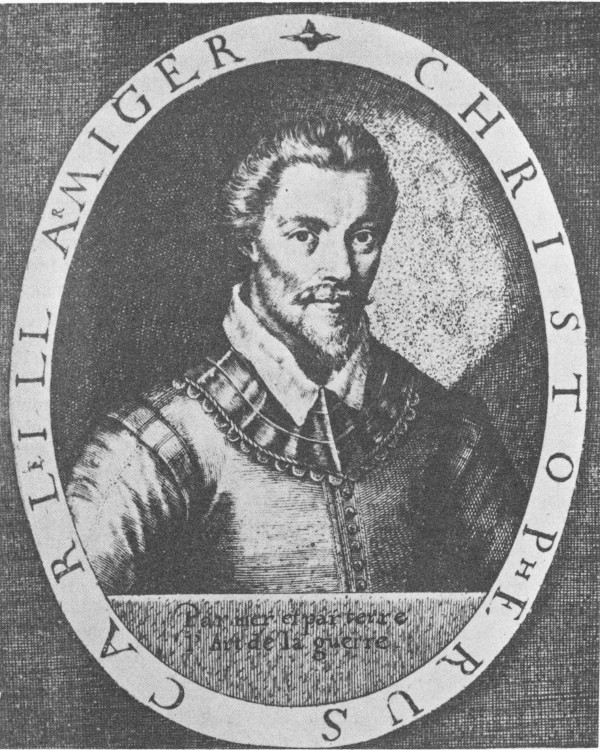
Christopher Carleill.
To Lane’s credit it must be said that he was loath to give up the Roanoke Island project. He accepted the first offer, and the ship was turned over to him; but before the supplies could be made ready, a storm arose and the ship was blown out to sea and did not return. The fleet suffered other losses in this storm, but Drake remained open handed. He offered Lane supplies 17 as before and another ship, but since this vessel was much too large to be kept in Lane’s only harbor, its acceptance, and dependence on it, involved a great risk.
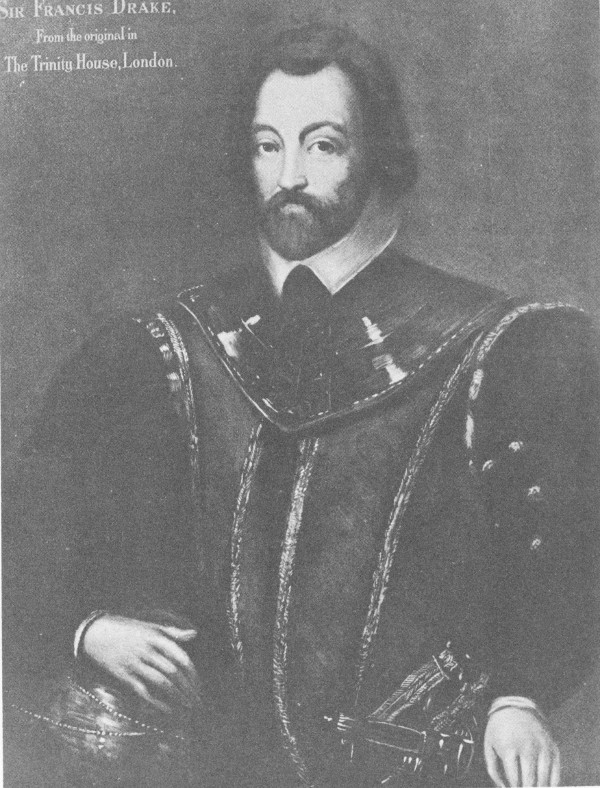
Sir Francis Drake. From the painting in Trinity House, London.
This fact, the troubled state of Europe and America, making war with Spain now practically inevitable, and the unaccountable delay in the arrival of Grenville’s supply fleet caused Lane to ask for passage to England. When Drake sailed, on June 18, he carried the colonists home with him.
18
GRENVILLE’S FIFTEEN MEN.
Shortly after Drake and the colonists had sailed, a supply ship sent out by Sir Walter Raleigh arrived at Hatoraske and after searching in vain for the colonists returned to England. About a fortnight after Raleigh’s ship had left, Grenville arrived with three ships and likewise searched in vain for the colonists. Grenville found the places of colonial settlement desolate, but being “unwilling to loose the possession of the country which Englishmen had so long held,” he left 15 men on Roanoke Island, fully provisioned for 2 years, to hold the country for the Queen while he returned to England.