Gillmore Sets the Stage
Reading edition
From the 21st of February, when ordnance and ordnance stores began to arrive in Tybee Roads, until April 9th, Gillmore gave the men of his command no rest. To put his plan for the siege into effect was a Herculean task. Materials, supplies, ammunition, and guns had to be unloaded through the surf and then transported long distances across sand and marsh. Gun emplacements, magazines, bomb-proof shelters, and roads had to be constructed. And last, but not least, gun crews had to be trained.
Detailed to this back-breaking assignment were the 7th Regiment Connecticut Volunteers, the 46th New York Volunteers, two companies of the Volunteer Engineers, and, for most of the time, two companies of the 3rd Rhode Island Volunteer Artillery.
On the northwest shore of Tybee Island facing Fort Pulaski these troops erected 11 batteries for guns and mortars. Their job was made particularly difficult because the last mile of the shore, on which seven of the major batteries had to be established, was an open marsh in full view of the fort and within effective range of its guns. Here all work was performed at night. The men were not allowed to speak above a whisper and were guided by the notes of a whistle. Before dawn each morning evidence of the night’s work was concealed by camouflage.
When the batteries were ready, the guns were hauled across the marsh on sling carts. These loads were so extraordinarily heavy that it was often necessary to harness 250 men to a cart. Even on the last night before the bombardment the work continued. In the flickering light of lanterns men filled cartridge bags, cut paper fuses, and whittled wooden fuse plugs.
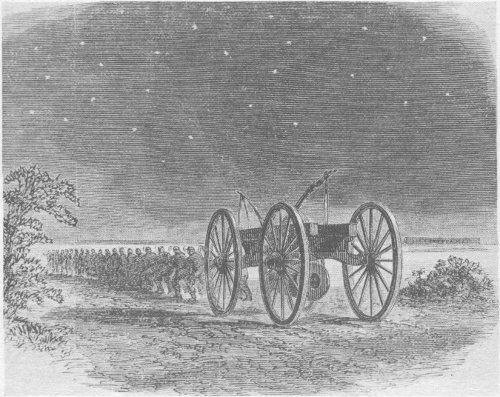
Guns were hauled by manpower. From Harper’s Pictorial History of the War of 1861.
The final armament comprised 36 pieces placed at various distances from the fort as shown in the following table:
1. Battery, Stanton, 3 heavy 13-inch Mortars, at 3,400 yds
2. “ Grant, 3 heavy 13-inch Mortars, “ 3,200 “
3. “ Lyon, 3 heavy 10-inch Columbiads, “ 3,100 “
4. “ Lincoln, 3 heavy 8-inch Columbiads, “ 3,045 “
5. “ Burnside, 1 heavy 13-inch Mortar, “ 2,750 “
6. “ Sherman, 3 heavy 13-inch Mortar, “ 2,650 “
7. “ Halleck, 2 heavy 13-inch Mortar, “ 2,400 “
8. “ Scott, 3 10-in. Columbiads, } “ 1,740 “
Scott, 1 8-in. Columbiads, }
9. “ Sigel, 5 30-pdr. Parrott, } “ 1,670 “
Sigel, 1 48-pdr. James, (old 24 pdr.) }
10. “ McClellan, 2 84-pdr. James, (old 42 pdr.) } “ 1,650 “
McClennan, 2 64-pdr. James, (old 32 pdr.) }
11. “ Totten 2 10-inch Siege Mortars, “ 1,650 “