"For Fortune and Glory" (continued 6)
Reading edition
By this time the men were more at home with their queer steeds, and mounting and dismounting was no longer a painful and even perilous performance. The camels also had become accustomed to the drill, and learned to know what was expected of them. All animals work better and pick up ideas quicker in company. Sometimes, indeed, one would drop suddenly on his knees without rhyme or reason that any one could guess at, and send his rider flying over his head if he were not looking out sharply; but such instances of eccentric conduct were rare, and grew still less frequent as the bipeds and quadrupeds got to know one another better.
A move was now made to Korti, higher up the Nile, a good deal nearer the fourth cataract than the third in fact. But this journey was made on camel back instead of by boat. Now, travelling by boat is not unpleasant when the boat takes you, but when you have to take the boat it is quite a different matter, and riding, even on a camel, is far preferable. And those long days on camel back, near the Nile all the way, and consequently with no stint of water, were about the most pleasant experiences Kavanagh and his companions had.
“Well, Tarrant, I hope you are happy now,” said a trooper one day, as the column was on the march.
“Happy! With tinned meat and no beer, and more flies in the open in the middle of winter than you get over a stable at home in August! I know I wish I was back in Windsor barracks.”
“Never mind, old boy; if you were there you would wish you were here.”
“And a jolly idiot I should be.”
“Don’t fret about that same,” interposed Grady, who was riding near. “It’s your misfortune, not your fault. Faith, we wud all be clever if we could; but sure, I thought ye would be aisy in your mind now that you had got your camel.”
Chapter Nineteen.
Across the Loop.
Korti was the pleasantest place Kavanagh had been to yet. It was healthy, there were plenty of trees to give shade, forage was easily got for the camels, and fresh provisions for the men, for the villages about seemed more prosperous than usual, and the inhabitants more friendly. Here the camel drill was polished up and brought to perfection. They worked in this way. You must know that though the soldiers rode camels on the march, they were not intended to fight on their backs, except perhaps incidentally when they were out scouting.
So their object when in immediate contact with the enemy was to get rid of their camels for the time being, but so that they might find them again and remount at the shortest possible notice. The battalion being in column—that is, suppose a double row of men on camels, forming a front and rear rank, and some way behind them another double row, and then a third, and then a fourth; that forms what is meant by a column—well, then, the battalion, as I say, being in column, the word of command, signifying what formation the men are to take after they have dismounted, is given, followed by the words, “Close order!” Upon this the rear rank of the leading line jambs up to the front rank, which halts at the word. All the rear rows break into a trot and jamb up to the front in turn.
When all are close and compact, the camels are told to lie down; the men dismount, and tie up their animals’ legs, so that they cannot rise, with the head rope. The men who have to run out and mark the places where the others are to form when ready, get their camels knee-lashed for them by the two men whose duty it is to remain with the animals of their company.
By the time the beasts are in a square, helpless mass, the markers are “covered” (or got into their proper places according to the order accurately) by an officer, and the men form on them at once. After a good deal of drill this was done very quickly, as such things are when each man knows exactly what to do and how to do it, since it is confusion and uncertainty which cause delay. When the battalion had to move away and manoeuvre at some little distance from the camels, one company was always to be left to defend them.
The pleasant time at Korti was soon over, and they started across the desert for Shendy. If you will look at the map you will see that from Korti (which you will find in the neighbourhood of Old Dongola, Ambukoi, Merawi, places written large) the Nile stretches to the north for a hundred miles and more as far as Abu Hamed, when it makes a bend completely round, and goes south all the rest of its course. So that by cutting across the desert from Korti to Shendy, or rather Matammeh, which is on the nearer bank of the river, an enormous distance is cut off.
And since time was of the utmost importance, if Khartoum and Gordon were to be rescued, a force under General Stewart was to take the short cut, while the rest followed the tedious windings of the Nile, actually turning their backs for a precious hundred miles on the way they wanted to go. It was provoking, but it could not be helped; water carriage was absolutely necessary for the existence of the expedition.
Those who were to go with General Stewart’s force were in high spirits, and the others envied them exceedingly, for they were going straight at the throat of the enemy, and would probably relieve Khartoum, disperse the Arab hordes, finish the campaign; who knew? They might even bring the Mahdi back in a cage, perhaps, before those following the river would have a chance of distinguishing themselves. They need not have distressed themselves; there would be plenty of hard fighting for all.
You might as well know how our friend Reginald Kavanagh was dressed when he mounted his camel for the desert ride. Picture him then in a loose red flannel tunic, corduroy knee-breeches, serge leggings, white pith helmet with a puggaree round it. Over his shoulder he wore a bandolier belt with sockets for fifty cartridges, and a rifle pocket, in which the butt of the rifle was secured. The bandolier made him look something like a mediaeval musketeer; or might have reminded an admirer of Dumas’ wonderful story—and who is not?—of Artagnan, Athos, Porthos, and Aramis.
The Naval Brigade was also mounted on camels, and it was great fun to see them start. The camel has been called the ship of the desert, but that was by a poet, who thought rightly enough that he said a pretty thing, but who did not mean it literally. Jack did.
“How this craft does roll!” cried one.
“Hard a port, Bill, or you’ll foul me.”
“What d’ye come across my bows for, then?”
“Can’t help it; this here won’t answer the helm. Port, will you!”
“Port it is.”
“Mind, messmate, your camel’s going to founder, I think.”
But the warning came too late; the beast dropped on its knees, and Jack went flying over his hideous head.
Love of adventure and excitement is one thing, patient endurance is another. You want to combine the two to get good soldiers, and Englishmen hitherto have done pretty well. So did these, only after a certain number of hours’ march they were less jocular and more vicious. When they got to the first wells, where they expected to have a rest, being by that time pretty well baked, the supply of water was found to be so scarce that they had to push on at once; but they did it for the most part in silence.
“Well, Tarrant,” said Kavanagh, when they had been plodding on for some two hours in dead silence, “have you not got a growl for us?”
“No, I haven’t,” replied the champion grumbler. “I did get a drink at Hasheen, but this poor brute I am riding didn’t, so I leave the growling to him.”
“Sure it ought to be put in the Gazette” cried Grady, waking up. “First grumbler, Tarrant’s camel, vice Tarrant, contented.”
“I never said I was contented,” replied Tarrant.
“Only it is a consolation to know there’s some one worse off than yourself.”
“Meaning the camels?”
“Aye, and not only them. Don’t you remember that 19th Hussar chap who came up the last halt? There was a go!”
“What do you mean?”
“Didn’t you hear? Why, he belonged to Captain Fanshawe’s troop, who went skirmishing about, and caught a sheikh, called Abu Zoolah. Well, he said that a while ago the Mudir of Dongola had offered a thousand dollars for his head, and now it isn’t worth the price of a pint. Just think what a chance to nearly get, and miss! There’s a lot of beer in a thousand dollars.”
“Sure, yes, that’s hard lines,” observed Grady. “What fun it would be to go out shooting, and get a thousand dollars for every man you bagged.”
“Aye, that would make a man hold straight, if anything would,” said Macintosh. And there were a few spurts of talk like that, but mostly they plodded on in silence.
It took close upon three days to reach Gakdul Wells, and during all that time the camels were not watered, the supply at intermediate wells being barely sufficient for the men. But when they got to Gakdul there was abundance of the life-restoring element for all, beasts and men, thanks to the Royal Engineers and their pumps. For the place was as wild and romantic as you can imagine, the wells being hidden away in deep caverns with precipitous sides, in the midst of frowning and rugged rocks. The sailors, with their contempt of heights, and entire freedom from giddiness, swung themselves down into the most horrible abysses, if only they had a rope made fast at top, without a moment’s hesitation, fixing pipes by which the precious fluid was pumped up and conveyed to the troops.
It was a treat to see the camels drink when at last they got the chance; they sucked the water up with a loud noise, and you could trace it flowing down their necks in waves. Four days is the longest period they can go without a supply. There are people in India and elsewhere who believe that when they die their souls go into the bodies of animals, and Kavanagh’s acquaintance with his camel enabled him to understand this odd notion, for when he looked in its eyes for some time he almost expected it to speak. It was an unsatisfactory beast in some respects, for it would not be petted in any way, and it was impossible to make friends with it. Try to pet it, and it growled; persist, and it tried to bite him. I have known a dog of much the same disposition, but then he made one or two exceptions, and showed as much exaggerated fondness for them as made up for his general want of amiability.
But the camel was consistent, and steadily refused to form the slightest attachment to anything human. You remember the genii in the “Arabian Nights Entertainments” who were forced to serve powerful magicians, but who hated them and longed to tear them in pieces all the time, and did so, too, if the omission of some necessary incantation gave them the power. Well, the camel seemed like one of these subjugated spirits, an excellent servant, but a most unwilling one, and resenting the power to which, forced by inevitable destiny, he yielded implicit obedience. Evidently he was a fatalist, like the people he lived amongst.
When he was being loaded for the journey he moaned and howled as if he were being beaten to death, and whenever a start was made, the outcry of hundreds of the creatures remonstrating at once was something perfectly unparalleled in the way of horrid and dismal noises.
“Sure,” said Grady on the first occasion, “I have often heard spake of a howling wilderness, but I never knew what it meant before at all. But I see now; it’s the camel that does the howling.”
But once started he seemed to make up his mind to the inevitable. While he was uncertain what Fate had in store for him he groaned and lamented, but once he knew the worst he thought it was no use bothering, and proceeded on his way in apparent content.
Indeed, that seemed to be his one aim and object, to be always going straight on to some place a long way off and never arriving, like the Wandering Jew. As for his appearance, you have probably often seen a camel in the Zoological Gardens or a wild beast show, and know his weird, shapeless, uncanny look, with the beard on his upper lip, and the hard natural pads on all parts of him which touch the ground when he subsides for loading or unloading; his chest, knees, and so on. An experienced man has described his motion when he trots in this way:—“Put a horse into a cart without springs, in the cart put a rickety table; on the table place a music-stool screwed up as high as it will go. Now seat yourself on the music-stool and gallop over a ploughed field, and you will have a very correct notion of the sensation of riding a trotting camel.” But with practice the motion is much easier, and with so many hours in the day in the saddle the troops had plenty of practice.
The position at Gakdul was naturally strong, and with the aid of art was made perfectly impregnable, forming a place to fall back upon in case of need. The camels, it has been explained, utterly declined all friendly advances, but the affections of the company Kavanagh belonged to were not on that account destined to grow utterly rusty for want of use, since a dog had attached himself in every sense of the word to it. Where the dog came from and to whom he belonged originally were matters as mysterious as his breed, which seemed to partake of several varieties, amongst which the native sheep dog was the most perceptible.
But his virtues were manifold. He joined on that day of the march when the towing commenced, and posted himself, as no one did it for him, and he was enlisted under the name of Hump, not because of any personal deformity, but after the distinguishing characteristic of the camel. When the battalion took to riding, and, though still following the course of the Nile, often lost sight of it for some hours, either because the track was better or to cut off a corner, Hump carried his own water-bottle, ingeniously constructed for him by a man named Thomas Dobbs, out of an old preserved meat tin covered with a bit of felt, to prevent its becoming too hot; and this was fastened round his neck. When a halt was called, and he wanted a drink, he went up to one of the men, who would take off the cover and pour a little out for him. This was all very well while the river was near, but when they were about to strike across the desert, where water would be scarce, and he would hardly be able to carry enough for his own wants, it was determined to leave him behind, and he was made over to a man who promised to, take charge of him, and who was to remain on the Nile.
But in the bivouac at Gakdul, Dobbs awoke with a start under the impression that a snake was gliding over his face, and sitting up found that it was Hump licking him, the empty water-bottle still round his neck.
It now seemed hopeless to get rid of him, so they let him take his chance; to live if he could manage to supply himself, and to be shot should his sufferings from thirst prove too great. Poor Hump! The most thoughtful feared that he had a poor chance of reaching a good old age. And yet he developed a wonderful talent for finding water in unexpected places, which was useful to himself and others. Sometimes when men would turn away in disappointment from a mud-hole which was indicated by a native guide as a well, but which proved to be dry, Hump would sniff out some place near, and scratch, and six inches or so below the surface water would begin to ooze and trickle.
On January 16th, 1885, at noon, the column on the march was roused from the lethargy induced by monotonous riding hour after hour under a warm sun by distant firing.
“By Jabers!” cried Grady. “There’s an inimy somewheres after all. I began to think Mr Mahdi had packed up his things—it’s a mighty small portmanteau most of them require—and gone out of the country entirely, with all his people.”
“Make your mind quite easy, Grady,” said Sergeant Barton, who was riding near. “The Arabs won’t baulk you, if you want something to remind you of Donnybrook.”
“It isn’t for myself, Mr Sergeant, sir, that I care. I am a peaceable man, and would sooner get what I want quietly. It’s my friend Tarrant here who is spoiling for a fight, and to see him pining away before me very eyes, just for want of a little divarshion with his rifle, makes me feel quite low.”
“Here come the scouts back!” cried Kavanagh, and sure enough the Hussars were seen riding in. For some time all was suspense and conjecture amongst our friends; but after awhile the news circulated from the staff to the regimental officers, from the officers to the sergeants, from the sergeants to the men, that the enemy were in position at the Wells of Abu Klea, twenty-three miles from Matammeh, the place on the Nile they were working for. Where was Abu Klea? Straight to their front was a ridge of fantastically-shaped rocks, and there the enemy was in position.
A little nearer square was formed, and in that formation the force advanced to the foot of the ridge, and was there halted. Then, after awhile, orders were issued to form a zereba for the night, and it was soon made, the materials being plentiful and close at hand, and the camels and stores were placed within it.
“Men for picket!” cried a sergeant, and Kavanagh, who had been warned for the duty, stepped forward and fell in with the others, and presently they were marched off and posted on one of the hills commanding the zereba.
The officer in command took careful note of the position and posted his sentries, taking care to be in communication with the pickets on his right and left, and the zereba in his rear. The sentries were double, that is, there were two men on each post, and were changed every hour.
An hour’s sentry-go may seem to you but a short spell, but if you had a swarm of agile sharp-sighted savages prowling about you all the time, and knew that your own life and those of others who depended on you would be sacrificed if your vigilance flagged, perhaps you would find it long enough.
It was ten o’clock when Kavanagh was roused to go on; Dobbs was his companion, and Corporal Adams posted them.
“You are to challenge any one approximating this post,” he said; “and if they say ‘friend’ or ‘rounds’ you must stop them and make them give the countersign. If they can’t you must run them in, and if they won’t be run in you must run them through with your bayonet; if they won’t be run through you must wait and see if there’s many of them, and if there is you must shoot. But you mustn’t alarm the camp without reason, mind you.”
And with these somewhat conflicting “must’s” and “must not’s” he left them in the gloom. The position was as uncomfortable a one as Kavanagh had ever been in. His imagination peopled the night around him with supple forms ready to leap upon him from behind every time he turned in walking his beat. I won’t say that either he or Thomas Dobbs was frightened, for that would be a slur on a soldier, and one or the other might have me up for it; but they did not half like it. They had been on about twenty minutes when Kavanagh thought he saw something move by a rock a little in front of him, and the next time he met Dobbs, as they both patrolled to the same spot and turned, he whispered his suspicions to him, and he went with him a few paces back along his beat and gazed in the direction, but could distinguish nothing. Kavanagh did not know whether to challenge or not, but thought it best to wait and watch; perhaps he might have been mistaken.
Presently he heard Dobbs cry, “Who goes there?” in a decidedly startled voice, and he brought his own rifle down to the charge. But immediately afterwards Dobbs said—
“What! Is it you, Hump, old boy, come to do a bit of sentry-go? By jingo, you made me jump!”
And no wonder; in such a ticklish situation, to have something jump upon you in the dark, when all your nerves are on the stretch, must be very startling.
Five minutes passed, and there again by the rock Kavanagh was certain he saw a figure move this time, and he, in his turn, called—
“Who goes there?” again bringing down his bayonet.
There was no reply, and he waited, uncertain what to do next, when Hump suddenly dashed forward with a low, angry growl; and presently exclamations were heard in an unknown tongue indeed, but which, from the accent, did not appear to be blessings.
“Good dog, Hump; shake him, boy!” cried Dobbs; but the animal was evidently doing his best in that direction without encouragement.
But the man, who could not have been a dozen yards off, shook himself free somehow, and Hump retired growling, from which Kavanagh felt convinced there were more than one or two Arabs near. Presently he made out three objects against the sky-line, and thought he ought to delay no longer, so he fired at them.
Whether he hit anything he could not, of course, tell; but in reply to his shot there were at least twenty flashes of fire in his front, and the bullets came buzzing about the ears of Kavanagh and Dobbs like a swarm of hornets, though neither was touched.
The picket turned out, and, as the Arabs were some of them quite close to them, the sentries retired upon it. The enemy kept on firing for about five minutes, then ceased; and the sentries were advanced again, but somewhat closer in than before, since, but for the dog, these two would have been cut off.
They were relieved presently; but there were two other alarms in the night, and the troops in the zereba did not get a very sound rest, having thus to stand to their arms three times.
The morning at length dawned, and a sharp fire was maintained for some time from the hills, the pickets being withdrawn into the zereba. Then the enemy advanced in two long lines, with banners flying, five thousand of them, an imposing spectacle, and the English soldiers grasped their weapons, thinking that the struggle had come at last. But not yet was it to be. The enemy declined to push the attack home, but halted at a distance, keeping up a galling fire. So, as men began to drop, and the day was slipping on, General Stewart determined at ten o’clock to take the initiative.
The camels and other encumbrances were left in the zereba with a guard, and the square advanced, working round the left of the enemy’s position. The Arabs retreated, and some of our young soldiers began to anticipate an easy victory. But the enemy showed that they too could manoeuvre; suddenly wheeling to the left, they came down like an avalanche on the rear of the square, bearing back the men composing it, and breaking in at one of the corners.
Why detail the scene? It was very much the same as that which occurred the year before at Tamai, on the Red Sea side, to the Second Brigade, and which was described while we were following the fortunes of Tom Strachan. The hand-to-hand fighting was desperate, the slaughter terrible, and the enemy was finally beaten back. No matter; a step was taken, though deep in blood, towards the great object—the relief of Khartoum, and the rescue of Gordon, and hope beat high in every breast.
Next day, January the nineteenth, General Stewart left his wounded at the wells of Abu Klea, which had been won, and pushed forward for Matammeh at three in the afternoon. No resistance was met with, no sign of the enemy perceived all night, and when the day dawned a thread of silver shone in the south-east, and a hundred voices broke out simultaneously in a chorus of—
“The Nile!”
Yes, there was the river, and as the light grew stronger the town of Matammeh could be distinguished. At the same time the tam-tams were heard beating, and the enemy appeared swarming over the hills which intervened between the British army and the river.
Another zereba was constructed, for the men were exhausted with fatigue and want of food, and it was not thought wise to give battle until they were refreshed, for it is ill fighting on an empty stomach. So breakfast was got ready, the troops of the Mahdi gathering round the while, like the masses of a thunder-cloud.
Presently it burst forth, with rifle flashes for lightning, and a deadly leaden hail. Vainly the men piled up camel furniture, barrels, sacks, sand-bags, for protection; the bullets came amongst them in a storm, and they fell in all directions. And then a rumour ran through all the ranks which spread, not dismay, indeed, nor consternation, but a stern tightening of the heart-strings and bracing of the muscles, with a desire to shoot straight and strike home. The general was hit! Yes, the noble Stewart was down!
Sir Charles Wilson now took command. A redoubt was constructed by the Royal Engineers on the right of the zereba, and manned by fifty-five Life Guardsmen and Scots Greys under Lord Cochrane, and by this means the enemy’s fire was somewhat held in check.
At length the longed-for opportunity for vengeance came; the square left the zereba and advanced upon the foe. Straight it went for the sandy ridge held by the enemy, who came charging down with their accustomed reckless courage.
But this time they did not get up to the square. The ground was too open, the zone of fire too unimpeded, the shooting too steady. Down they went in hecatombs. At one hundred yards their pace was checked, those behind embarrassed by the heaps of dead and dying blocking their path. Still they struggled on to get to close quarters with the English, but at thirty yards the withering volleys were too deadly even for their supernatural bravery, and they broke and fled. Steadily advanced the English troops over the ridge of sand, firing carefully while the fugitives were within range; then down to the Nile at Gubat, near Matammeh, victorious indeed, but having paid a high price for victory.
“If them Arabs takes to shooting straight, and won’t come on any more, it strikes me we shall be in a hole,” said Thomas Dobbs to Grady.
“True for you, me boy,” replied the Irishman.
“Or at any rate we shall not be able to go about in square for them to get all round and blaze away into the brown of us.” And there were some of higher rank who began to entertain the same misgivings.
To resist a rush, the square was excellent, but for a long-continued fire without coming to close quarters it was impossible. Many of the more sanguine, however, hoped that the tremendous losses the Arabs had sustained would dishearten them—that they would awake to the fact that the Mahdi was by no means invincible, and had deceived them.
As for Gordon, had they not had a message from him? “All right; could hold out for years.”
Their chivalrous dash across the desert, and the hard fighting against enormous odds, the loss of valuable men, and the fall of their general, were not fruitless then, since the object of the expedition would be attained.
“Sure we will all get a bar with Khartoum on it under a medal!” said Grady.
“Medals! Bars! Yah!” cried Tarrant.
“I’d sooner have tuppence a day extra for beer.”
“We’ve got naither the medal nor the bar nor Khartoum yet, d’ye ken?” said Macintosh.
Chapter Twenty.
Bir-Hump.
“And when will we be after attacking Matammeh?” asked Grady, as he sat over the bivouac fire.
“Precious soon, I should think; we can’t get on to Khartoum till it’s taken,” said Kavanagh.
“And for why not?” asked Grady again.
“Eh, man!” exclaimed Macintosh, “ye would na go past it and leave all these thousands of heathens in our rear, would ye? With an army at Khartoum in front, and the army here in our rear, we should be between two fires, don’t ye see? Never a mouthful of grub or a cartridge could get to us, and we should be peppered on all sides at once.”
“We might as well risk it and get it over,” said Tarrant.
“We get nothing fit to eat as it is.”
“I call that stupid, talking like that!” cried Dobbs. “I know the rations are a deal better than ever I expected; capital, I call them.”
“So they are,” said Macintosh; “but if Tarrant had sheep’s-head, haggis, and whusky itsel’ for dinner, he would na be contented.”
“Every man to his taste,” growled Tarrant; “and if a chap likes tinned meat he’s welcome. I prefer good beef and mutton, fresh-killed, with plenty of potatoes and white bread.”
“And a little tripe and onions, or a swatebread after it, with pudding and lashings of sherry wine, I’ll be bound,” said Grady.
“Get along wid ye, it’s Lord Mayor of London ye ought to be. Why, man, it’s fighting and not ating ye’ve come out here for.”
“Well, I got plenty of that between Abu Klea and this, anyway,” replied Tarrant. “A bullet went through my water-bottle early on the eighteenth, and I was without a drop for hours. I believe I have worse luck than anybody.”
“Worse luck than anybody, you ungrateful beggar!” cried Smith.
“And how about Richardson, your rear rank man, who got the same bullet which spoilt your bottle into his body, and died in pain that evening? I suppose you would rather his water-bottle had been hit and your inwards!”
Tarrant busied himself in stuffing and lighting his pipe, and made no reply.
“Well, for my part, I hope we shall have a cut in at Matammeh to-morrow,” said Kavanagh, “so as to get on up the river at once.”
“Aye, I hope we may,” echoed half a dozen voices in chorus.
“Gordon and the poor chaps with him must be pretty well sick of waiting to be relieved, hemmed in all the time by those blood-thirsty savages.”
“Eh, but it must have been bad last March, when our people won the victory at Tamai, and they thought at Khartoum that they were coming across to them,” said Macintosh.
“And then to hear they had gone awa again, and left them without a bit of help but themselves.”
“Sure, won’t they be glad when they hear our guns!” cried Grady. “And won’t they come out and tackle the naygurs that have been bothering them on the one side, while we pitch into them on the other! We’ll double them up and destroy them entoirely.”
“I doubt if we go at Matammeh before we get reinforcements,” said Macintosh.
“And what will we want with reinforcements?” asked Grady; “haven’t we bate the inimy into fiddle-strings already?”
“Yes, if they only knew it,” said Kavanagh.
“But they seem to take a lot of persuading before they own themselves beaten.”
“They do, the poor ignorant creatures,” said Grady, reflectively. “And we can’t kill the lot of ’em, which is what they seem to want; they are too many.”
“If there is a big fight in a day or two we shan’t be in it,” said Corporal Adams, who had come up in time to hear the end of the conversation.
“The orders are out, and our company has got to go ten miles off to-morrow.”
“Only our company, corporal?”
“That’s all detailed in orders.”
“And does it say what for?”
“It does not; rikkernottering most like. But you will hear them read presently.”
That was done, and Corporal Adams was quite correct. This particular company was ordered to take a certain amount of ammunition both for mouth and rifle, and march out in a certain specified direction. If they found water they were to make a zereba, or otherwise entrench themselves and remain until further orders; if not, they were to return at once. There was a little disappointment amongst both officers and men of the company.
“We will be out of all the fun entirely,” said Grady. “They will catch the Mahdi, relieve Khartoum, rescue Gordon, and have all their names in the newspapers—and we will have nothing to say to it at all, at all.”
“Don’t you believe it,” said Kavanagh. “The general would not send a rifle away if he were going to attack. He has heard something, or knows something we can’t guess at, and means waiting for more troops to come up, you may depend. And our expedition has something to do, I should not wonder, with covering the flank of the reinforcements. We shall be called in, no fear, before the big battle is fought.”
But even with those who thought differently the matter did not weigh very heavily. They had already fallen into the true campaigning frame of mind which takes things as they come—good quarters and bad; fighting and resting; outpost duty or guarding stores, even wounds and death—very philosophically.
As the company was to start some time before daybreak, the men wisely left off discussing matters, and went to sleep. Then came their rising while it was still night, and the raking together of the embers of the bivouac fire, and breakfasting; then the saddling and lading of camels, amid the dismal lamentations of those grievance-mongering animals; then the start in darkness, and the mind adapting itself to the lethargic monotony of the tramp. Every one was chilly; every one was a trifle sullen at not being in bed; no one was inclined to talk.
The silence was only broken by the swish, swish, swish of the camels’ feet through the sand, the most ghostlike and uncanny of sounds; so slight, so continuous, so wide-spread. To meet a train of camels in the dark would be enough to convert any unbeliever in supernatural phenomena, I mean if he did not know anything about it.
When the sun rose every man seemed to wake up and feel new life in him, and they began to talk, just as the dicky birds tune up for a song on the like occasion. Yet the scene was desolate and dreary enough for Dante or Gustave Dore.
After some hours’ march they passed this barren land and approached the foot of a hill where the mimosa was plentiful again, and other shrubs were seen, with herbage, scant indeed, but good for camels, who will browse upon what would hardly tempt a donkey. Here a halt was called, and while the men dismounted and lay down, the three officers who were with the company explored the spot. There were two mud-holes which supplied water, and had a couple of palms near them, pretty well in the open, and a third spring a hundred yards from the others, larger and deeper, and apparently yielding a better supply than both the others put together, but so near a patch of rocks and thick mimosas which would afford dangerous cover to an enemy, should any be in the neighbourhood, that it would never do to camp close by it.
So when the colour-sergeant was called out presently, he learned that it had been determined to form the zereba so as to include the two smaller water holes and the palm-trees, and the ground was marked out accordingly. Then all set to work to cut down mimosa bushes, and make a hedge of them all round, a gap, just admitting of one camel to pass at a time, being left on the side nearest the outside well, but not at the corner, and this gap was marked by a short hedge inside facing it. It was determined to use this outside well while they had the place to themselves, and reserve those within the zereba in case of an attack.
The space enclosed was as limited as was consistent with convenience to render it more capable of defence, and the hedge was breast high, so that the men could fire over it without their aim being in any way impeded. Shrubs beyond those required to form the zereba were cut down and stored for firewood, so as to remove all cover where Arabs might conceal themselves as far as possible.
Most of this work was done before dinner, and the men had two hours’ rest. After that tapes were brought out and the lines of a trench marked off, six feet from the hedge all round, and when that was done the men began to dig it out, five feet wide, one foot and a foot and a half deep, throwing the soil out on the hedge side, flattening it down and making it as firm as they could, so that if exposed to heavy fire the men might find protection, since the prickly walls, though difficult for men to struggle through, would not stop bullets. And so a good day’s work ended, and the night sentries were posted between the trench and the hedge.
There was no alarm that night. The next morning the camels were taken outside the zereba and watered at the large well, from which also a supply was drawn for the company; and it sufficed for all, evidently a valuable spring. That day the trench was completed, deepened a little, but not much, as it would not do for the defenders to be too low behind the hedge, and a small watch-tower commenced in the centre of the square. Some quaint, distorted trees were found at a little distance, and from one of these enough timber was got for the erection contemplated. There was a flat rock which formed a foundation for it, and a rustic-looking affair, something like a summer-house, was raised some twelve feet from the rock it stood on, which was already six feet from the level plain. From this elevation an extensive view could be obtained.
On the third day a balcony was made round the top of the watch-tower, the sides of which were composed of logs, which it was reckoned would be bulletproof. A few good marksmen might, without being exposed, do considerable execution from this. It also had a roof fixed over it, and the look-out man had thus a protection from the sun. The saddles, with all cases and packages, were arranged to form an inner court of the zereba, within which were the camels, and when they were lying down they were very well protected. Hump, who of course had followed his company, took great interest in all these proceedings, and when the men were at work he stood with his head on one side watching them critically, and from the expression of his face, and the vibration of his tail, it was gathered that on the whole he approved. Captain Reece, who commanded the company, did not, as a matter of fact, much expect an attack, but he thought it only right to be prepared in case one were made, and being a man of an ingenious turn of mind, who, when a boy at Harton, was known as the “Dodger,” he felt a special delight in constructing devices. On being ordered off on his present duty, he had gone to a friend in the Royal Engineers and begged a good bit of gun-cotton, carried for blasting purposes, and with this he proposed to make a mine, an electric battery and a coil of wire forming part of his baggage. There was a group of boulders two hundred yards off, which was certain to be taken advantage of by an enemy, since it formed a perfectly safe redoubt from which to fire on the zereba, or to shelter a group forming the forlorn hope of an attack. This Reece fixed upon as the most favourable spot for his mine, and here the gun-cotton was placed in the position he deemed most adapted for a favourable explosion, and connected by a wire, which there was no great delay or difficulty in concealing in the sandy soil with the zereba, and so with the electric battery.
“It’s a sight of trouble we have taken to resave the inimy, and it will be mighty onpolite of him if he doesn’t come at all,” said Grady.
“I don’t believe there’s any Arabs about these parts,” said Macintosh; “they air all together at Matammeh, or else before Khartoum.”
“You think yourself very clever, no doubt,” said Corporal Adams, indignantly. “But do you suppose that the captain would have taken all this trouble without good information?”
“Nay, but with all due respect to the captain, and the colonel, and the general, and yersel’, too, corporal,” said Macintosh, “the reports they have acted upon are native reports, and they may be good, and they may be bad, they may be honest, and they may want to get detachments sent aboot to weaken the force at Gubat.”
“Well, I think you are very presumpterous,” said the corporal, “very presumpterous indeed, to suppose your superior officers can be took in by a lot of Johnnies that you can see through. They may attack us or they may not, seeing how ready we are for them; but they are somewhere’s, you may take a haveadavy.”
As everybody is generally somewhere, it was difficult to contradict this statement. Besides it is imprudent for a private to contradict a corporal, who has many ways of making himself disagreeable or the reverse. So the prudent Scot acquiesced.
“Well, I am a paceable boy meself, and hate fighting,” said Grady.
“But still it seems a pity to make such iligant fortifications and not to thry them. Is there not sinse in that, now, Kavanagh?”
“I don’t know about sense, but there’s a lot of human nature in it,” replied Kavanagh. “I know I learned to box when I was a lad, and was never happy until I had a turn up to try my skill without the gloves. And a jolly good licking I got for my pains.”
“To be sure!” cried Grady. “And if ye get a new knife ye want to cut something with it, or a new gun ye must be after shooting with it; and so on with anything at all. And now we have got the fortifications one is a thrifle curious to know if the Johnnies could get into them.”
I don’t know whether many of the company wanted to be attacked, or, indeed, if any did, but certainly there was a restlessness about them. They listened all day for firing in the direction of Matammeh, some lying down with their ears to the ground to hear the farther. But all was still as the desert only can be, and the great battle which was expected had certainly not yet begun. But expectation of a fight excites men, and if at a distance they itch to be in it, this feeling even actuating men who fail to show any particular heroism when the pinch comes.
However, wishing or not wishing to be attacked could make no difference; the Arabs were not likely to consult their feelings on the subject. There was no alarm that night, and all but the men on duty slept soundly by the bivouac fires. In the course of the next morning the camels were to be taken to the outside well to be watered, and a few impediments which blocked the gap being removed they began to move out. The leader had gone twenty paces, and three others were following, when Grant, one of the lieutenants who was in the gallery of the look-out with a field-glass, shouted, “Halt! Come back!”
The man with the leading camel looked round to see if the order applied to him, and saw the lieutenant beckoning to him. “Come back at once!” he repeated. The four camels went to the right-about not a bit too soon; for a puff of smoke spurted up from a mimosa bush beyond, and the vicious whiz of a bullet hinted to the leader of the camel nearest to it that it would be better for him not to stop to wind up his watch or pare his nails before he got under shelter.
Pop, pop, pop, pop! A camel is a big mark, and it was clever to miss the lot. One indeed had a lock of hair chipped off him, as if the marksman were an artist who wanted a painting brush; but that was the nearest approach to a casualty.
The other bullets went high over everything, save one or two, which struck the sand and sent little stones flying about in a dangerous manner. But they came in contact with nothing vulnerable, and the four were back in the enclosure presently.
Macintosh, Cleary, and two other men, the crack shots of the company, were ordered up into the balcony to try if they could show the attacking party that they could make a better use of their weapons than they could. Captain Reece was now up there, and the bullets were whizzing about and thudding into the logs in a nerve-shaking manner.
“Crouch down, men, till they are a bit tired of wasting their cartridges,” said the captain, standing erect himself, however; “you could not get a fair shot yet for the smoke.”
When they had done so, he sat on a block of wood himself, and was then protected by the balcony. The two lieutenants and the non-commissioned officers were below cautioning the men, who were now in position all round the zereba, against firing until ordered.
It was a picked corps, and they were perfectly in hand, so that not one single shot was fired during this first storm. And a storm it was; the air seemed perfectly alive with the rush of bullets, all aimed high. Whether it did not occur to the Arabs that the bushes of the enclosure were not impervious, or the watch-tower offered a more tempting mark, or the Remington rifle stocks did not suit their arms and shoulders, and came up high I don’t know, but certainly all the bullets which hit anything struck the wooden erection and the rock it stood upon. Splinters of wood and chips of stone were flying in all directions, but nothing was wounded which minded it, not a man or a camel or Hump, who thought the whole affair got up for his amusement, and barked with delight at the noise.
The leaden shower raged for about five minutes, died down to a sputtering, and ceased. Every man grasped his weapon and peered over the hedge, expecting a rush. But the enemy seemed to want to know whether they had annihilated everything with their fusillade, and kept close in cover. Slowly the smoke lifted, and rolled above their positions.
“Now there is a chance for you, Macintosh,” said the captain; “above that bush, do you see? About three hundred yards.”
Macintosh took a steady aim and pulled.
The man he aimed at staggered, and came down in a sitting position, seizing his right leg, which was broken, with both hands.
“An outer!” cried Captain Reece, who had his field-glass directed on the spot.
“A miss,” he said presently, as another man fired at an Arab darting from a distant to a nearer bit of cover.
“Don’t shoot at them running.”
An Arab was taking careful note of the zereba from the rocks two hundred yards off, his head and shoulders only being exposed. Cleary rested his rifle on the top of the balcony, pulled the stock firmly to his shoulder, got a fine sight on his mark, and pressed the trigger. A flash! A crack!
“A bull for you, Cleary!” exclaimed the captain. “You have nailed him through the head.”
The enemy were now more cautious, and not more than half a dozen shots were got in the next hour, but most of them told. During that time the Arabs indulged in no more continued storms of fire; only Captain Reece drew occasional volleys, mostly from a considerable distance, as he stood fully exposed, reconnoitring the position.
He did not do this recklessly or out of bravado, but simply because it was of the utmost importance to gain some idea of their numbers, which he put at about five or six hundred; not more in the immediate neighbourhood. It was an uncomfortable position, being cramped up there, imprisoned in so small a space, but not a dangerous one. The enemy kept up a dropping fire, which had no effect beyond wasting their cartridges, though after nightfall it was annoying in two ways; the English had to bivouac in the cold, for they could not light fires, and their sleep was disturbed by constant alerts. In the morning there was a lull, not a shot being fired for some hours. The marksmen went up to the balcony, but, seeing no chance of a shot, were withdrawn, and only the look-out man left there. There was some idea that the enemy might have gone away, and no one would have been sorry; for the wells inside the zereba were very inefficient, the water being soon exhausted, and a tedious waiting entailed before the wells filled again. Already the men had to be put on an allowance, and in that country, where the throat is always parched, any stint of water is the greatest possible privation.
But just as it was in contemplation to send out an exploring party, numbers of them were sighted again amongst the more distant bushes, and it did not go out. Dinner time arrived, and the meal was served out. Before the men had quite finished two sentries fired shots, and all sprang to their arms, which were handy; for every man ate, drank, slept with his rifle close to him, as it was impossible to tell at what moment he might require it.
In half a minute every man was at the hedge with a cartridge in his rifle, and that was not too soon, for the Arabs came at a fast run on two sides simultaneously, and even lapped round and threatened a third.
“Steady, now! Don’t shoot till you have your man covered. There’s no hurry. The nearer they are the better!” cried the officers, and sergeants and corporals seconded them well. Yet the commands were not necessary, so cool and steady were the men. It was as if they had been waiting so long for a chance, that they were afraid of wasting it now they had got it. Nothing could be more deliberate than the way they aimed.
“Why did you not fire then, Macintosh?” Sergeant Barton happened to ask; “you had a fair chance,” the Arab being about forty yards off, and the Scotsman “drawing a bead” on him.
“I was trying to get two in a line,” said the economist; and presently he succeeded. Being protected by the hedge naturally made the men cooler, and able to afford to reserve their fire.
If any Arabs were shot so far off as a hundred yards it was as much as it was, and then only because the marksman felt he was “on.” Indeed, with far inferior defenders the position would have been impregnable; held by such men as these, to attack it was suicide. It is hardly an exaggeration to say that every shot told; and if several hit one man, on the other hand some single bolts struck two men, and that helped to bring up the average. For a good ten minutes the plucky fanatics persevered, thirsting like tigers for the blood of their foes; and the carnage was fearful. They had no artillery to shake the defence with before attacking, and the fire was uniform as well as deadly.
“Give it ’em hot, boys!” “That’s your sort!” “Bravo, old Waterproof!” this last cheer being for Macintosh, who shot a chief who was leading on his tribesmen, brandishing a huge two-handed sword.
“Camels for ever!” “Faugh-a-ballah!” “Ha! Ha!” “Hurrah! Hurrah! Hurra–a–ah!” and the cheers were heard for miles across the barren waste, disturbing the beasts and birds of prey on the sites of neighbouring battle-fields from their unholy repast, as the Arabs drew off to their cover in confusion, leaving the whole ground between it and the zereba strewed with their dead and dying. As they pressed back more fell, the soldiers firing at longer distances now the prospect of many more immediate chances was small. The champion marksmen ran for the balcony again, and the last victims dropped to their rifles. And soon was apparent the astonishing vitality of the Arab race. The wounded, who were not mortally stricken, were seen crawling and dragging themselves to cover in all directions. Had they but got the order, how delighted would the soldiers have been to quit the zereba, and dash upon the disordered foe; and that Captain Reece burned to give that order you may be perfectly certain. But that would have been contrary to the tenor of his instructions; and, besides, might, after all, have turned victory into disaster, for the Arabs probably had received reinforcements before the attack, and the little band of Englishmen might find themselves smothered with numbers in the bush.
There was no more sign of the enemy that day; they lay close in cover, watching. During the night they stole out and removed many of their dead, which those in the zereba were glad of, for the numbers threatened presently to poison the air. The next day water began to grow very scarce indeed, and two men with a corporal were permitted to leave the zereba and approach the well, to try if they could get a supply without molestation, so quiet and hidden were the enemy. But they had hardly got half-way before a storm of fire was poured upon them, and they had to run back as hard as they could go, one dropping—the first casualty. The corporal and the other man, who was no other than Grady, stopped, picked him up, and carried him in, the bullets cutting the ground up in puffs of dust all around. But they were not hit, and got their comrade inside amidst cheers from all who were watching them.
Poor Hump seemed likely to come off badly, for however great a pet you may make of an animal, when it comes to a question whether you or he are to go thirsty, the animal is apt to come off second best. And the camels, who reverse the recipe of “little and often,” and require “much and seldom,” must fill the reservoirs, as they call their stomachs, at certain intervals, or die. And if they died the company would probably die too. Poor Hump! Every consideration was against his getting a drink. He whined, and looked very plaintive, with his tongue hanging out. He scratched and scratched, but the water was exhausted, and only trickled into the legitimate holes by driblets. Everybody was very sorry for him, but still more sorry for himself.
So Hump took the matter into his own hands—I was going to say, but he had not got any. I mean that he fell back on his own resources, and he simply ran across to the outside well, drank his fill, and ran back again. It never occurred to the Arabs to take the trouble to shoot at a dog, so he was quite unmolested. After he had made two journeys a bright idea came into the head of Thomas Dobbs. The next time Hump prepared to start on a watering expedition, he took off the lid of his water-bottle, which was suspended round his neck, so when the dog plunged his nose to lap, the tin went into the water and got filled; and though some of it got spilled as he trotted back, enough remained to wet the ingenious Dobbs’s whistle. And he improved upon this; he cut a round piece of wood, filling the can so loosely as to lie at the bottom when it was empty, and floating to the surface when full, but prevented from tumbling out by the edges of the top of the tin being bent in a bit. This prevented most of the spilling, and every excursion Hump made he brought back the best part of a pint. And a pint of water, look you, was worth a good deal more than a pint of champagne in England.
Two more days passed; the Arabs burst out now and then into a spurt of volley firing, but would not attempt another attack. They probably knew the nature of the wells, and trusted to thirst to fight for them.
The little party in the zereba kept a sharp look-out for rescue, you may depend, for their position was growing more and more critical every hour. To the south was the spring, with a few trees, and the thick mimosa bush beyond. On the east were more mimosas and rocky ground in which the enemy could find cover to within five hundred yards at the furthest part; up to two hundred at one point. But on the northern and western sides the country was quite open, and the view was only bounded by sand-hills a good mile off. And it was from one of these directions that they expected help would come.
So when dust was noticed, amidst which an occasional glitter flashed, on the western horizon, eyes began to sparkle and hearts to beat high, as those of shipwrecked men in an open boat when a sail comes in sight. No doubt it was a party sent to relieve them—cavalry, by the pace they came, for the cloud of dust rolled rapidly nearer. In five minutes it was within a thousand yards, and then out of it burst a single horseman, riding straight for the zereba, and the enemy, running from their cover on the southern side, strove to intercept him with their fire as he passed, while presently some twenty Arab horsemen became visible, racing after the fugitive, the foremost about twenty yards from his heels. Bang! bang! bang! From the Arabs, who had run out, and were somewhat too far for the zereba fire. But the hunted man came on untouched.
It is not easy, even for good shots, to hit flying with ball, and the Arabs were not good shots, but the exact reverse. Nearer now, with his horse well in hand, not seeking to increase his distance, glancing back to judge how far off his pursuers were. The footmen of the enemy, provoked at not being able to stop him, ran out in his course too close to the English, and two of them were presently down on the sand. Others not heeding sought to cut him off, and the English could not fire without risk to him also, as they were straight in his direction.
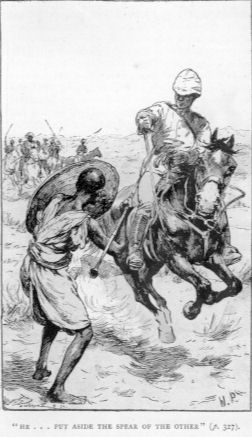
Whipping out his sword, which had hitherto been sheathed, he flourished it in salutation of his friends, and rode straight at a couple of Arabs in his path, loosening his rein, and digging with his spurs as he did so. He knocked one down with his horse’s shoulder, and put aside the spear of the other, as he passed, and without waiting to cut at him, went straight at the zereba hedge. The horse, though covered with foam, had a good bit left in him yet, and rose at it nobly, without an attempt to refuse, and landed safely on the inside. His pursuers came within ten yards. There was a spurt of fire, and four saddles were empty.
The Arab horsemen wheeled round, and the broadsides of the horses presented too fair a mark. Half a dozen of the poor animals were brought down by the bullets, and before they could get away the riders too were slain. Neither did those who in the excitement of the moment had run out from their cover entirely escape; several deliberate shots were aimed at them, and several fresh corpses dotted the plain.
“The curse of Cromwell on them!” cried Grady; “the more you shoot the more there are!”
And it really looked like it. It was a similar phenomenon to that of the wasps in August, when, if you kill one, three come to his funeral. The man who had occasioned this commotion was carried by his horse safely over the zereba hedge, as has been said. Directly he landed he found himself on the edge of the trench, and this, too, the animal cleverly got over.
The rider at once dismounted, and saw Captain Reece before him.
“Rather an unceremonious way of coming into a gentleman’s parlour,” he said; “but I don’t think I have done any damage.”
“Not a bit; and no matter if you had,” said Reece. “We cannot show you much hospitality, I fear, for we are short of everything.”
“By Jove!” exclaimed the new-comer, “I beg your pardon if I am wrong, but is not your name Reece?”
“Yes.”
“You do not remember me?”
“Well, I am sure you will pardon me; I cannot call to mind exactly where I have had the pleasure of meeting you. Was it at the Rag? No, no; surely at Simla, was it not?”
“Not exactly,” said the new arrival.
“Don’t you remember a little idiot who was your fag at Harton, and used to boil your eggs hard and burn your toast, for which you very properly corrected him?”
“What, Strachan!” cried Captain Reece. “Impossible! You can’t be Tom Strachan!”
“As sure as you are Dodger Reece. I should not have dared to call you that to your face then, though.”
“Well, but, you know, I should never have recognised you.”
“I daresay not; I was twelve years old when you left Harton, and I have altered a bit since, no doubt. You were seventeen, and have not changed so much.”
“I am very glad to see you, anyhow,” said Reece, “and we will have a good chat presently. Just now I must not lose my opportunity; the rocks seem pretty crowded. The beggars are blazing away from every crevice about them.”
Strachan wisely asked no questions, but watched and followed. The Arabs had evidently gathered in considerable numbers about the pile of boulders among which the gun-cotton mine was buried. Reece had forbidden any one to molest them from the balcony, not wishing to drive them away. He now went to his battery, attached the wires, brought two ends together, and the ground shook. There was a roar and a rattle; blocks of stone, arms, heads, legs went flying into the air, and a whole posse of Arabs were seen scuttling away into the mimosa bushes.
“What is bred in the bone,” said Strachan to himself.
“He is a Dodger still!”
The men got some more shots at their enemies in the confusion caused by the explosion. It was a useful measure, this, however; for six men with water-cans, and six with rifles, who were waiting close to the gap, rushed out to the well the moment they heard the explosion, and in the confusion into which the enemy were thrown by an event which seemed to them supernatural, in the dust and in the smoke they accomplished their task of filling the cans and retiring without being observed, much less attacked.
It was not until they were safely back in the zereba that the Arabs began firing harmless volleys, in evident anger at having been out-manoeuvred. The water gained was not so much in quantity, but was a great boon nevertheless, for it had been absolutely necessary to water the camels, and that had absorbed every drop of their own springs for the last twelve hours, and was very insufficient for the poor animals then. Strachan loosened his horse’s girths and rubbed him down with a palm-leaf or two, doing what he could for him after his gallant efforts. It was pitiful to hear him whinny as he smelt the water in the distance, and not to be able to get him any. But perhaps a little could be spared from what trickled out by-and-by.
Presently Captain Reece came back to his visitor.
“Well, now I have time to ask, how on earth did you come to choose this desert for a steeple-chase course, and our little zereba for a goal?” he asked.
“I am acting on the staff,” said Strachan; “only galloping, you know. And I was sent out to find you if I could, and tell you to make for Shebacat, and, if you could, to get on to Abu Klea at once. If I found any of the enemy out in this direction, and could not get on, I was to return at once, and a force was to be sent to relieve you; but it was important to avoid this if possible, I was given to understand. However, I had no chance of returning, for the first glimpse I got of the enemy consisted of a small body of mounted Arabs, who cut off my retreat, and chased me all the way here.”
“We are not to make back to Gubat, then?” asked Reece in surprise.
“No,” said Strachan.
“Matammeh has not been carried?”
“Not yet; I suppose it may be soon; everybody seems to expect it. But I don’t see the use now.”
“Why not?”
“Well,” said Strachan, “one hates to be the bearer of bad news, but it must come. The expedition has been too late: Khartoum has fallen.”
The two other officers had come up and heard this, and their faces showed the blank dismay which had fallen upon their hearts, as the words fell upon their ears.
Khartoum fallen! Why, then, what were they fighting for? What was to happen next? All seemed chaos.
“And Gordon?” was the first question which rose to all lips.
“There is no certain news, yet,” said Strachan; “but the rumours of his death are only too probable. He was not the sort of man to be taken alive, I think, was he?”
“No, no!”
“But when did you hear this?” asked Reece.
“Only last night,” replied Strachan. “Gordon’s four steamers arrived while you were at Abu Kru, the camp at Gubat, I think?”
“Yes, and two of them, the Bordein and Telh-howeiya, had started with Sir Charles Wilson up the river. That was on the 24th of January.”
“Exactly. Well, it seems when they got to Khartoum they found it in the hands of the Mahdi, and it was with the greatest difficulty they got away, having to run the gauntlet of several batteries and a tremendous fusillade. Both steamers were wrecked coming down, and Sir Charles Wilson, with the crews and the Royal Sussex men who went with him, is on an island watched by the enemy, who have got guns posted, waiting to be brought off. Stuart Wortley came down in a small boat with the news last night.”
“I could go straight to Shebacat; but for Abu Klea I am not so certain,” said Reece.
“I can guide you as straight as a die,” replied Strachan.
“Indeed, from Shebacat you cannot miss the track.”
Captain Reece then said he had some immediate business to look to, and retired to the watch-tower, partly to have another look round, but principally to get away alone for a bit to think. It was clear to him that he must get away as soon as possible, but yet leaving would cause him to incur responsibility, which he hated. He was a brave man enough where personal danger was concerned, but to have to decide upon a matter where grave interests were at stake threw him into a cold sweat. Let a superior officer be in command, and he was as jolly as possible under any circumstances; supposing he got killed, and all got killed, it had nothing to do with him—that was the commanding officer’s look-out; and he obeyed him cheerfully, reserving the right to criticise him freely afterwards, supposing he were alive to do so.
But here he himself had to take a decided step; he was commanding officer, and Strachan had brought him no definite orders. Suppose they were intercepted, and cut to pieces. The blame would fall on him. Why did he quit the zereba? Suppose he delayed, and a force had to be sent to his rescue, and it were proved afterwards that he could have saved the small main body all that risk and trouble, and very likely loss, if he had shown a little more enterprise. Or suppose that the enemy, now a small body, assembled in force, cut off his retreat, now open, prevented all rescue, and cut them to pieces. In any case he would be blamed. He dreaded the second alternative most, because then he would be alive and ashamed. Still it made his ears burn to think what would be said of him, even after he could not hear or know, if he failed.
The more he thought about it, however, the more he saw that the first risk was the best to incur, and he finally determined to march that night and stand the racket. He examined the enemy’s position once more carefully through his field-glass, and could only make out a few camels and a couple of horses. Indeed, they could not have watered any large number, especially as they had to do so entirely by night, the well being under the fire of the zereba all the daytime. And from men on foot they had nothing to fear, let them get the shortest of starts. There was the cavalry which had hunted Strachan, but they were but a handful. And the route to Shebacat was open desert, so far as the eye could reach from the balcony, with but few mimosas or black rocks.
When he had quite settled his plans he felt easier, and returned to the others. The two juniors had shown Strachan what little hospitality was in their power, including an iron tea-cupful of muddy water for himself and a pint for his horse, who asked for more, poor fellow! With all the earnestness of Oliver Twist in the workhouse.
“Are you Strachan of the Blankshire?” asked Grant.
“Yes,” said Strachan.
“Were you not wounded at Tamai last spring?”
“Yes, I was; but I soon got all right.”
“Is not Edwards in your battalion?”
“Yes, he is; do you know him?”
“Very well; we were at Sandhurst together.”
And this discovery of a common friend made these two feel like comrades at once.
“Well, Strachan,” said Reece, coming up, “are you ready to pilot us to-night?”
“Perfectly ready, sir,” replied Strachan.
“Well, then, we will be off directly after sun-down. Since Khartoum has fallen, the troops before it will be set free, and the country perhaps will be flooded with them. This may be our best chance.”
“Certainly.”
The three officers of camelry had to prepare their men for the start, and see that they got the saddles and other packages, which had been piled together to make an inner defence, separated and placed in proper position for instant adjustment.
Tom Strachan, left alone, wandered off to the watch-tower, to have a look at it and mount to the balcony. On his way across he met a soldier, who advanced his rifle and brought his right-hand smartly across in salute, whom he recognised.
“Kavanagh!” he cried.
“Yes, sir, here I am,” replied Kavanagh. “No, please don’t shake hands now or here,” he added, hurriedly. “I do not want to be recognised at all. My captain has not remembered being with me at Harton, I am glad to say.”
“I have your sword still,” said Strachan.
“Yes, and did good work with it at Tamai,” replied Kavanagh.
“I am glad of that.”
“It is a good one, indeed,” said Strachan; “but I don’t know that I have done anything wonderful with it!”
“Oh, yes, I read about it in the papers. You were mentioned in despatches.”
“They were very kind, because I was wounded. Have you heard anything of the missing will, or Harry Forsyth?”
“Not a word; but I hope for better times still,” he replied.
“So do I, Reginald, with all my heart. You have found life as a private soldier a severe trial, I fear.”
“Not out here, campaigning,” replied Kavanagh. “At home it was certainly trying at first. But the sergeant is waiting for me.”
And he saluted again and passed on, leaving his old chum very serious and meditative, which was not by any means his accustomed state of mind.
Presently Hump came up to make friends, and, when Strachan met Grant again he learned the story of the dog and his excursions to the well, and how Thomas Dobbs had made him fetch water.
“You were saying you did not know the name of this place,” cried Strachan, laughing; “you should call it after him. Bir is the Arabic I believe for a well; you should name it Bir-Hump.”
The suggestion was repeated, adopted, and spread, and the entire company always alluded to the place as Bir-Hump from that hour forward.
The day waned; the camels were saddled and loaded as quietly as might be, Strachan tightened the girths of his horse, and when the sun had set and the after-glow faded into darkness, all mounted, and the camels, led by Strachan, defiled out of the zereba like a string of ghosts.
Every man had his rifle in his hand, ready to sell his life as dearly as he could; but the Arabs did not issue from their cover, and they sped on at a sharp trot unmolested, Strachan keeping a correct course by a compass he had, with an ingenious phosphorescent contrivance, by which he could distinguish the north point. When an hour had elapsed they all began to breathe more freely, for it is uncanny work expecting to be attacked every minute in the dark. But still strict silence was maintained.
During the long night tramp, with no jingling of accoutrements, beat of hoofs, light laugh, or homely talk to break the stillness, nothing but the light brushing sound, more like the whisper of sound than sound itself, caused by the movement of the camels’ feet over the sand, the minds of the most thoughtless could not avoid reflection, and probably there was not one of all that company who did not think of Gordon. And of him there was not a little to think. The long waiting, month after month; never disheartened or beaten; trying every device, every stratagem, to keep the foes which environed him at bay; maintaining well even his reputation; anxious not for himself but for others, ready to sacrifice self indeed at any moment, cheerfully, for the sake of those whom he had undertaken to rescue; struggling on against fanatic courage without, and weakness, frailty, half-heartedness within; seeing the hearts of those in whom he was forced to trust grow fainter and fainter by degrees, in spite of his constant struggles against the effects of hope deferred upon them.
And then, when the reward was just within his reach—not personal honours, for which he cared so little, but what to him was the dearest object, the rescue of those whom he had undertaken to save if possible—to lose all by treachery, the treason of those he had trusted and forgiven.
“Trust makes troth,” says the proverb, and Gordon had proved the truth of it again and again.
But it failed him; the endurance of some who had long wavered was now quite worn-out, and so he was killed, and all his heroic work nullified, all those who had depended on his efforts for safety being destroyed with him. It was a perfectly maddening thought that the ship should founder thus in the entrance of the harbour; that after so many tedious marches, thirst-sufferings, struggles against the forces of nature, desperate battles, and wide-spread misery and wretchedness, they should be just a couple of days too late.
So little would have done it. A week’s earlier start, a little more energy in some clerk, tailor, bootmaker, shipwright—who knows?
The mind seems forced in such a case to try and fix blame upon somebody. There was no redeeming feature for the most persevering maker of the best of things to turn to Experience gained? There was no use in it, for Gordons do not crop up every century.
His example? The lesson of it was spoiled, since his devotion resulted in failure, and he died in the bitterness of feeling that his efforts had not been appreciated, and that he had been but lukewarmly supported.
We do not mean to imply that this was so. History must judge of that. We know only partial facts, and our judgment must also necessarily be affected by our feelings. But it is to be feared that it seemed so to him.
The moon rose, and gloomy thoughts were lightened. There was no enemy in sight, and talk began to circulate amongst the men. Captain Reece, for his part, was inclined to forget everything else in his delight at having given the enemy the slip. To have carried out his orders, and sustained such an attack with the loss of but one man wounded, and he doing well, was a legitimate source of satisfaction. It is true that he was not out of the wood yet; the Arabs who had chased Strachan might belong to a large body that had seized Shebacat.
This proved not to be the case, however, and a halt was called at the wells there. First the men were supplied, and Strachan’s horse had a good satisfactory drink, and then the camels got an instalment of water. Then they mounted again, and pushed on to Abu Klea, where they arrived at sunrise, and Reece reported himself to the officer in command with a feeling of intense relief. He had got well out of it, at any rate, and Tom Strachan also had accomplished his mission satisfactorily; and next day he returned to head-quarters, not, however, without having seized the opportunity of a short unnoticed interview with his old chum Kavanagh before he started.
Chapter Twenty One.
The Convoy.
Kavanagh and his friends had no long rest at Abu Klea; they were soon off again across the Desert, making for the Nile. It was not a cheerful duty they were performing, for they were convoying a body of sick and wounded to Korti, and that was rather too close a connection with the wrong side of the theatre of war. I expect that hospital nurses take quite a different view of a campaign from that entertained by high-spirited subalterns. And this present business was worse than the scenes in a hospital. Do what you will to lighten his sufferings, the transport of a wounded man must always be a painful operation.
These were being conveyed on camels. You have seen the seats in which little children often ride on ponies, one on each side, with a board for the feet to rest on. There were similar affairs on camels’ backs, with two wounded men sitting back to back. Others, whose hurts were more serious, or of a nature which prevented their sitting up, were slung in a species of litter.
But, in despite of depressing influences, the escort were lightening the journey with chat and jest, when they were called to seriousness by the word—
“Attention!”
Silence fell upon the escort, and every man was in his proper place in a second. Arabs had been seen in the mimosa bushes to the right of the convoy, and it was impossible to keep quite clear of them, though, of course, the object of such a party is to avoid collision with the enemy as much as possible.
Half a dozen puffs of smoke spurted out of the cover, and as many bullets came singing overhead. The convoy did not halt, but moved steadily on, some of the escort dismounting, while the others led their camels. When the men on foot got a chance they halted and fired, and then doubled on again, and as they shot a very great deal better than their enemies, they made them chary of exposing themselves, and so held their fire in check. As the convoy came abreast of the position, however, the volleys broke out afresh, and the skirmishers spread, some in front, others in rear of it, to draw the fire on themselves, and away from the sick and wounded men. But not with entire success, for it seemed to be the object of the ambushed Arabs to annoy these with their fire rather than to fight the escort. There was a poor fellow named Binks, whose right-hand had been shattered and amputated, riding sideways on a camel, balanced by another invalid whose head had come in contact with a fragment of a shell, and was bandaged up. Binks had been despondent about himself from the first, not caring very much whether he lived or died, now that he was so mutilated, for how was he to get his living without a right-hand? He asked. It was in vain that Kavanagh assured him that he could do very well in the Corps of Commissionaires; he had not been very steady in the early part of his soldiering career, and his name had several entries against it in the Regimental Defaulters’ Book, which he was convinced would tell fatally against his chances.
Suddenly he flung up his left arm, the right being in a sling, and gave a deep gasp, collapsing in his seat, and falling up against his companion. All his doubts and difficulties about the future were solved, poor fellow! For he was shot through the heart. Presently a camel was wounded, and sank down, groaning pitifully, if pity could have been spared for it, but most of that was absorbed by the soldier, suffering grievously from dysentery, whom he carried, and who was now thrown violently to the ground. A halt was necessary while he was otherwise accommodated, and the covering party pushed close up to the shrubby ground, taking advantage of the mimosas in their turn, and inflicting some loss on the enemy, who seemed now to have quite altered their former tactics, and to prefer distant to close quarters. When the convoy moved on again they closed upon it once more, ready to run up to it at the first signs of a rush upon it. The Soudanese, however, made none; on the contrary, they seemed to find the marksmanship of the escort too accurate for their taste, for they drew off to a distance where the bush was thicker, but so far that the fire they maintained was a mere waste of ammunition.
“Where’s Grady?” cried a man. “Why don’t he come and take his camel?”
“Grady!” called the corporal.
“Grady!” called the sergeant; but even his superior authority evoked no answer.
The officer in command again halted the convoy.
“He may be only wounded; we must not leave him,” he said.
“Who saw him last?”
“I can find the place exactly, sir,” said Kavanagh, “because of a bit of rock among the scrub which marked the place, and he was making towards it.”
“Is it far?”
“No, not five hundred yards; it was just before we ran in.”
“Then double out and look for him. Go with him, another of you, and Corporal Adams.”
But just as this start was being made Grady appeared, shoving before him a man dressed in bernouse and cap, bearing the Mahdi’s colours of blue and white, whom he grasped by the scruff of the neck, and, when he showed unwillingness to advance, expedited his movements with a bump from his knee. What had happened was this. While skirmishing he had caught sight of a pair of human heels protruding from a bush which grew on the side of a rock, and he came to the conclusion that there probably were legs attached to those heels, and a body in continuation. So he made a détour, and crept up very softly from behind till he was within reach of those heels, which he promptly seized—or rather the ankles above them—and drew out a wriggling Arab with a rifle in his hand, which he could not get a chance of using against the person who was drawing him.
Flattering himself that he was entirely concealed, he thought he had got a beautiful place for a pot-shot when the skirmishers had passed, and the convoy came abreast of him. And so indeed he had, and with the barrel of his Remington in the natural rest formed by a fork in the boughs of a tree, he had a first-rate chance of bagging something. But he reckoned without his extremities; had he been a foot shorter, or the scrub a foot deeper, he would have remained unnoticed.
“Come out, you spalpeen, and drop that gun, will ye?” cried Grady, and both directions were obeyed, involuntarily enough; for, as he spoke, the butt of the rifle was brought with such a jerk against the stem of a mimosa, that the owner lost his grip of it, and the same jerk landed him clear of the bush.
“Be quiet, my jewel, till I pick up your shooting-iron,” said Grady, who wanted to take back the rifle as a prize and a trophy, but feared that his nimble captive would escape him while he reached for it.
So he knelt on the Arab’s back, he lying on his face, and taking a piece of twine out of his pocket, he tied his elbows together. Then he reached out and got the rifle, and slung it over his shoulder.
“And will ye plaze to get up?” he said. “You must excuse me if I am a thrifle rough, but it’s owing to the resistance ye make;” and as Grady, a very powerful man, was the stronger, his captive found himself on his feet and emerging into the open, without any volition of his own.
“Sure, and it’s in mighty good luck ye should estame yourself, to fall into the hands of a tender-hearted boy like meself, who lets the dirty life stop in your haythen carcase. By all the laws of your warfare, I am bound to put my bayonet into your stomach instead of making ye a prisoner, just as if ye were a respectable sodger, who gave and took quarter like a Christian. Get along wid ye! Ye are as bad to drive as a pig, and not a hundredth part the value of him, nor such good company either. Get on, I say, or they’ll be thinking you’ve took me, and not that I’ve took you. Ye’ve got to go before the captain, and tell him what he chooses to ask you, so where’s the use of struggling, making us both so uncomfortable this warm day? It’s proud ye should be to have spache with a real gentleman and a British officer, ye poor haythen vagabond!”
It may be observed that the last sentence was uttered in the possible, though not the certain and obvious hearing of the officer alluded to.
“Why, Grady, what have you been up to?” was the question which greeted him.
“Sure and I’ve made an important capture; look at the clothes of him! How do you know that it is not the Mahdi himself?”
Here the officer commanding the detachment rode up.
“Well done, Grady,” he said; “we were wanting a prisoner, and may get some valuable information out of this one. A very neat thing indeed; I shall remember it.”
Grady saluted, and went to his camel.
The prisoner had his arms freed, and was given another camel, as he seemed quiet and philosophical, and had a couple of friendly natives for companions to pump him. And the convoy went on its slow and painful journey.
Assured by the other Arabs that no harm would be done him, the captured man became cheerful and communicative. Of course there are different sorts of Arabs, as there are of English or Frenchmen, and this one was a philosopher who saw no particular merit in struggling against the inevitable, and was inclined to make himself as comfortable as circumstances permitted. Indeed, he and his captor would have found much in common if they had passed a social evening together, and been able to hold converse; though for that it would have been necessary either for Grady to learn Arabic, or for the native to learn English, and neither might have thought it worth the trouble.
He belonged to a tribe which had not been very keen about espousing the Mahdi’s cause. They were old-fashioned in their ideas, and did not like newfangled notions. Besides, this might be an impostor. Mahomet was good enough for them, and they wanted no other prophet. Then they had profitable business relations with the Egyptians, and had no desire to break off communication with them. And they also saw that something was to be made out of the English, especially if they established themselves at Khartoum and opened up a trade with the black tribes towards the Equator. So they were inclined to join us, and throw in their lot with ours. But one day a proclamation was issued which filled them with dismay. The English, to reconcile the inhabitants of the Soudan to their presence, announced that they only desired to rescue General Gordon and his garrison at Khartoum, and then they would retire from the Soudan.
But that meant that this particular tribe, and any others who supported the English, would presently be left alone to stand the brunt of the Mahdi’s power; and the Mahdi’s motto was not “Rescue and retire,” but “Annihilate and stop!” If they had been strong enough to stand alone it would have been different, but without the English alliance they were powerless to resist the False Prophet.
Therefore the only course for them seemed to be to join him, and so escape the vengeance which would otherwise overtake them. And since they had hesitated and therefore incurred suspicion, it was advisable, they thought, to show the greater zeal, and they in many instances adopted the Mahdi’s uniform, as the present prisoner had done. But they did not thoroughly believe in him; they were not at any rate fanatical in his cause, and were not likely to impale themselves on bayonets to encourage the others, as his more earnest adherents thought it a privilege to do. At the same time they were Mohammedans, and to kill an unbeliever must be always a meritorious action in their eyes. So it was a pleasure to them to pepper the Christians a bit, when occasion offered, not to mention that any sort of a fight was attractive to such a warlike race. But still there was no venom in their hostility; we were enemies, of course, but enemies who might any day become friends; and Grady’s prisoner did not think it necessarily behoved him to sulk, refuse food, commit suicide, or, which was much the same thing, attempt to escape. So he was soon chatting freely with the natives, of whom there were a good many, for the camels conveying the invalids were led and tended by them. It stands to reason that all he said about his own tribe and others, and the number of the Mahdi’s followers, and the distribution of his forces, could not be accepted as implicitly correct. For, in the first place, he most likely had no accurate knowledge on many of these and similar points; and in the next place, if he had, he might more than possibly wish to mislead, rather than afford useful information.
But after a certain amount of practice an officer with a head on his shoulders learns how to sift the reports gathered from spies, deserters, prisoners, and peasants, and to get a few grains of valuable fact out of bushels of chaff. So the chief interpreter went to work, and translated much useless and some practical talk.
The most interesting account he had to give could not be called useful, however, because it referred to past events, and these were already fully reported; but the present party had not heard them. It was concerning the death of Colonel Stewart, the only English companion Gordon had for so long, and of which the man professed to have been a witness in the October of 1884. The following was the Arab’s account, transcribed from the note-book of Sergeant Barton, who could take things down in shorthand, when men spoke slowly and deliberately, or with the delay, as in the present instance, of an interpreter:—
“When Gordon Pasha knew that there was no hope, and that Khartoum must fall, because, though he could hold his own against the enemy without, treason in the heart of the place was a thing against which he was powerless, and he knew, though no one else may have done so, that he was betrayed, he sent off Colonel Stewart in a steamer for a pretended purpose which imposed upon him, his real object being to save his friend by getting him out of the way when the attack, which he expected from day to day, came.
“Nothing would have made Colonel Stewart leave Khartoum if he had suspected this, but he did not, and he set out in the firm conviction that his going would really be useful. So say those that should know. What is certain is that he went, and that his steamer struck on a rock in the Wad Gamr country, for I myself have seen it. I was with the Sheikh Omar at Berti at the time. Sheikh Omar had a nephew Sulieman Wad Gamr, a very bitter enemy of the Turk, and of any one who supported the Turk, but a man with a double face, who promised most and smiled the sweetest, when he had the dagger concealed in his sleeve.