"For Fortune and Glory" (continued 5)
Reading edition
“Well, Charley, did you eat them all yesterday?”
“Not quite; we have left a few for you. Eat them, by Jove! They were near eating us.”
“Why, you seemed to go through them grandly.”
“Yes, but it was like going through water, which closes on you as you go. The beggars lay flat, or crouched in holes, and cut at the horses as they passed, to hamstring or maim them; and good-bye to the poor fellow whose horse fell! We ought to have had lances, and it would have been a very different tale. But the troopers’ swords could not reach the beggars, who are as lithe as monkeys. If they had run it would have been easy to get a cut at them; so it would if they had stood up. But they were as cool as cucumbers, and dodged just at the right moment. Of course some were not quite so spry as others, and got cut down; it was a case of the survival of the fittest. What acrobats they would be in time if this game lasted long enough!
“But it was like a nightmare. You know when you have a dream that you are trying to kill something which won’t die; some beast of the eel persuasion. We went through them, cutting all we knew; re-formed; came back, doing ditto; through them a third time; and then there was no satisfaction worth calling such. The fellows were broken up indeed, and a good lot were sabred, but not so many as there ought to have been after undergoing one cutting up, let alone three. And the scattered individuals still showed fight. And we lost awfully; no wonder, for I will tell you what I saw.
“A man rode at an Arab who fired and missed him, and then seized his spear, with the apparent intention of meeting him as an infantry soldier should, according to Cocker. But when the horse was two yards from him he fell flat as a harlequin. The trooper leant over on the off side as low as he could and cut at the beggar, but could not reach him, and the moment he was past, the Arab jumped up and thrust his spear through him from behind. I never saw anything done so quickly in all my life; it was like magic.
“There was a clever old soldier who was not to be done that way; when he saw he could not get at his Arab, he slipped off his horse before you could say ‘knife,’ parried his spear-thrust, ran him through the body, and was up again like a shot. But it was heart-breaking business altogether; you should have seen the horses afterwards, cut about awfully, poor things; and we lost heavily in men too. The Colonel has had the dead Arabs’ spears collected, and armed his regiment with them; and if they get another chance, you will see much more satisfactory business, I expect. But I must be off.”
And off accordingly he went, his horse seeming pleased and proud to carry and obey him. And on went the brigade also towards Tokar.
Oracle number two proved the correct one; the enemy made no stand at the place, but streamed away at their approach, while the inhabitants came out to greet them with every demonstration of joy and gratitude.
Interpreters were few, and apt to be absorbed by senior officers, but it was gathered afterwards that the Tokarites were denouncing the Mahdi as a false prophet and heretic, whose soldiers had despoiled them of their goods, and only spared their lives on condition of their believing in him, and this condition they had thought it best to pretend to comply with, though their consciences rebuked them sorely for the pretended apostacy.
But though our friends of the First Blankshire could not understand all this, whatever officers of other corps may have done, the pantomime of the men, women, and children was unmistakable, and was only intended to express the most enthusiastic delight.
“I shall never make it out,” said Green. “Have we relieved the place after all, then?”
“Cannot say; we shall find out, perhaps in general orders.”
“Catch a newspaper correspondent; he will tell you all about it.”
“At any rate, the gratitude of the poor people is quite touching.”
“Not quite, thank goodness!” cried Fitzgerald; “at any rate so far as I am concerned; though a horrid old woman who cannot have washed for years, and who tainted the air with the rancid fat in her hair for yards round, tried to kiss me. But I dodged round the major’s horse, and left her to him. In my humble opinion, we want the square formation quite as much to meet our native friends as our enemies.”
Major Elmfoot got away from his demonstrative female, and rode up to the group.
“They seem very fond of us, sir,” said Stacy.
“Yes,” responded the major. “I wonder whether they went through the same performance when the Mahdi’s army arrived.”
“But they showed fight, and he took the place by storm, did he not, sir?”
“I really do not know; a spy said so. But the place does not look knocked about at all, and the people seem very jolly. I should not be surprised if the whole thing were a farce, and Tokar had not been besieged or taken at all.”
“Then you do not think they are genuine in their welcome, sir?”
“I do not say that; these people have shops of a sort, I believe, and a customer is a customer all the world over.”
The troops bivouacked outside Tokar, where nothing further occurred of any interest, and shortly afterwards they tramped back to the wells at El Teb, and so to Trinkitat, where they were re-embarked as quickly as might be, and steamed round to Suakim, which now became the base of operations.
And soon Trinkitat was entirely abandoned, and since no natives lived there (how could they when they had no fresh water?) the place ceased to be a place at all in any rational sense of the word.
You may have heard the old explanation of how a cannon is made: “you take a hole, and pour a lot of melted iron round it.” Well, Trinkitat was a hole, and the English store-houses tents, soldiers, horses, camels were poured round it, and when they were withdrawn, nothing but the hole remained. But Suakim was a considerable place, built of coral too, and very interesting in its way to some people. And what was of more consequence, there were many good wells close by, from which water could be obtained all the year round.
Suakim itself, as has been explained before, is built on an island, but the British camp was on the mainland, within the circuit of earthworks which protected the town and harbour. It was on the eighth of March that the First Blankshire were landed at this camp. The look of the houses in the town disappointed some of them now they were closer.
“They don’t look like coral at all,” said Tom Strachan. “If I had not been told I should have thought they were the ordinary sun-dried brick affairs whitewashed.”
“I vote we have a regular inspection of them on the first opportunity,” said Edwards, “and settle the matter once for all.”
“It would be kind to posterity,” replied Tom.
“If you have so much time to spare, which I very much doubt,” said MacBean, “you will employ it better in visiting a very pretty place and a curious. There is just a gap in the earthworks which protects Suakim, a regular breach as one may say, which has to be defended by two strong works, which the sailors have given the names of ships to—Euryalus and Carysfoot they call them. And why is the gap left? And why are the two forts made to defend it instead of filling it up? Just because the rains, which some don’t believe in, make a torrent in the proper season, and this is the watercourse, and everything which barred its passage would be swept into the sea.”
“I recant and apologise,” said Green. “The rain quite convinced me of its existence at Baker’s Fort, I promise you. But you know you sold me so often that I hardly knew what to believe.”
“I never practise upon anybody’s credulity in matters of that sort,” said the doctor. “If a young man likes to believe that the moon is made of green cheese, I may let him; but atmospheric and scientific facts are above being trifled with. Well, if you go through this gap, which is barely a mile off, you will find a very pretty place—the wells, and sycamore trees, and dates. Just the place to spend a happy day. And if you take a bottle or two of champagne, and a pâté de foie gras, I shall not mind if I make one of the party, and show you the objects of interest.”
But such a pic-nic was not destined to come off, nor was there even any opportunity given for testing the coral theory, for there was plenty of work to be done at the moment, and on the eleventh the intending pleasure-seekers started for Baker’s zereba at six o’clock in the evening.
Baker Pasha’s Egyptians, though they had not proved much good at fighting, and had paid the penalty of their cowardice by undergoing a massacre which made the world thrill with horror, were very useful to the avenging force which followed so quickly on their traces. The fort they had constructed near Trinkitat had done much to help the rapid and successful advance upon Tokar; and now the zereba they had made eight miles out from Suakim, and in the direction in which Osman Digna lay with his whole army, made a good first halting-place for the English troops. A zereba, it should be mentioned, is an enclosed space surrounded by thorn-covered bushes cut down and packed round it, with old packing-cases, or anything else which will afford cover to those inside. This one was particularly strong, being further protected by a mound of earth all round it.
When the force, which was the same as before, with the addition of two hundred Marines, and a mule battery of four nine-pounders, had gone some little way, night fell, but not darkness, for a bright moon lent them her rays. Not such a moon as we are accustomed to in these latitudes, but a large brilliant orb, by whose light small print might be easily read.
“You have got the best of it,” said MacBean, who rode up first to one friend amongst the officers and then to another, detailing information which he managed to pick up, he himself best knew how; but it was, as a rule, exceptionally correct. “The Highlanders, who marched out to the zereba yesterday in the heat, suffered awfully. There were five cases of sunstroke, and lots of other men had a narrow squeak of being bowled over too.”
“I can easily imagine it,” replied Major Elmfoot, “for it was hot enough in camp.”
“It is not exactly what you would call bracing to-night, even,” said Fitzgerald.
And, indeed, the air was very close, and the march over the loose sand fatiguing. But the men stepped out merrily, and joke and song lightened the way. There was an improvisatore in the Blankshire, whose comrades considered him a wonderful genius, though, as a matter of fact, his extempore effusions only consisted of taking some well-known song, and altering certain words or lines to suit a particular occasion.
But this was far more successful than original composition would have been, because it was so readily understood and caught up; and the man was really shrewd, and often hit on something appropriate.
He now trolled out in a clear, ringing voice, with every word distinct, a new version of “The Poacher”:—
“When I was bound apprentice in a village of Blanksheer, I served my master truly for close upon a year; But now I serves her Majesty, as you shall quickly hear, For ’tis my delight of a shiny night, in the season of the year.”
And then the chorus broke out far and wide:—
“For ’tis my delight of a shiny night, in the season of the year.”
And the lads laughed at the aptness of the “shiny night,” for that was evident to the dullest capacity. Thus encouraged, he tried a second verse:—
“As the soldiers and the sailors was a marching to his lair, Old Digna he was watching us, for him we didn’t care; For the bayonet beats the spear when he rushes on our square, And ’tis my delight by day or night to beat the Johnnies fair.”
Towards the end of the eight miles march indeed there was less singing and laughing, for throats were dry and legs weary. What, in eight miles and at night-time? Well, the next time you are staying at a sea side place, where there is plenty of sand, you try walking along it, not where it is firm, but higher up from the sea, where you sink over your ankles at every step; if you can borrow a rifle and a hundred rounds of ball cartridge and carry that too, you will be able to form a still more just opinion; but, even without that, I invite you to consider how many more miles of it you want when you have gone four. But if they were tired and thirsty they were full of spirit, and it would only have required the sight of an enemy to make them as lively as crickets again.
It was midnight when they arrived, and they bivouacked outside the zereba in the square formation, every man lying down in the place he would occupy if the force were attacked, so that if the alarm sounded, he had only to snatch up his rifle and rise to his feet, and he was ready for anything.
But they were not disturbed, and rested till noon on the 12th, when dinner was eaten, and after it, at 1 p.m., they started once more to find the foe. As you draw cover after cover to find a fox, so in the desert you try watering-places when you are seeking game of any kind, quadruped or biped. And thus information was obtained that Osman Digna had a camp where all his forces were massed at Tamai, a valley well supplied with the precious fluid, nine miles from the zereba.
Once more was theory knocked over by experience. If there is one thing upon which most people feel quite confident about with regard to Egypt and the surrounding country, it is that the atmosphere is always perfectly clear, so that objects are only hidden from the eye by intervening high ground or the curve of the earth. For, as you probably know, anything on a (so called) level surface like the sea may be visible if the atmosphere allows it for ten miles, to a man on the same plane the shore say; but beyond that distance it gets so far round the globe we inhabit as to be hidden. Of course the taller it is the longer the top of it can be seen, as you will often perceive a ship’s top masts after the hull and lower spars have vanished.
Or, on the other hand, the higher the ground you stand on the further round the earth’s curve you can see; so that a man living on the top of a high mountain has a longer day than one on a flat, since the sun rises earlier and sets later for him.
But it was neither high ground nor the dip of the horizon which bounded the view of those quitting the zereba, but a thick, grey, British haze, which swallowed up everything a thousand yards in front, and out of which the Arab hosts might pour at any moment. The order of advance was different on this occasion, two squares instead of one being formed, the right under General Buller, and the left being commanded by General Davis. The guns were dragged with ropes by men of the Naval Brigade—a tug of war with a vengeance. The haze being so thick would have made it difficult to go straight for the enemy’s position had the information been as uncertain as was sometimes the case, but happily it had been ascertained that if they took a south-west course they could not go far wrong, and the compass came to their aid.
The cavalry marched in rear of the square, with the exception of the scouts, who with the Mounted Infantry explored the ground in front, preventing the possibility of a surprise. Tramp, tramp, mile after mile, hour after hour, plodded the two brigades, with many a halt to enable the man-drawn guns to keep with them. But tedium and fatigue were thought nothing of. The man who would consider a five-mile walk without an object a frightful infliction would think nothing of ten with a gun in his hand, and the chance of game getting up every minute. It is the same with all sports. How far across country could you run alone for the mere sake of exercise? And how far in a paper-chase, with the hare to run down and other hounds to compete with? Think how this stimulating excitement must be intensified when there is an enemy in front of you certain to fight well, and make you do all you know to beat him. After awhile the haze grew thinner, and a range of hills loomed through it in the distance.
As the atmosphere grew clearer these became distinct, and were seen to be low, while a higher range rose above them beyond. On towards the higher ground slowly moved the two brigades, with a total front of from 400 to 500 yards, the scouts spread in a cloud before them, and these were now amongst the spurs of the lower hills.
Presently a couple of them came galloping back with the report that these were clear of the enemy, who were massed further behind, and were watching the English advance. And then a group of mounted infantry were seen returning at a slower pace.
“Look!” cried Strachan, whose eyes were remarkably good; “they have caught some natives.”
And sure enough the troopers could presently be distinguished, coming on in a semi-circle, driving before them a group of men who were unarmed, and declared themselves friendly, or at least no adherents of the Mahdi, Osman Digna, or any votaries of the new Mohammedan heresy. This might be true, but the officer with the scouts thought the general had better decide so knotty a point, and so they were thus brought before him, travelling perhaps a little quicker than they were accustomed to, but otherwise uninjured.
“That’s the way to run fellows in!” cried Tom, enthusiastically. “A fellow, you see, is bound to go straight when he has several rifles pointed at his head in cold blood. There goes the interpreter. I wish the colonel would just go up and hear what it is about, because he would tell the major, and the major would tell the captains loud enough for us poor subs to hear, perhaps.”
“The colonel knows his duty,” said Fitzgerald, “and does not intrude upon the general unless he is sent for.”
“I know he doesn’t, but I wish he did,” replied Tom. “However, we shall get it all out of old MacBean.”
And sure enough, soon after the captured natives had been pumped dry and dismissed, the doctor rode up.
“No fighting for you, my boys,” he said. “The Arabs won’t meet you this time, I expect, and you have had your walk for nothing. I expect that they see that the sun will lick us single-handed, and they need not take the trouble.”
“What makes you say that?”
“Well, at El Teb, you know, they kept their women and boys with them, and these carried hatchets to kill our wounded with after the fight.”
“That’s their notion of surgery,” said Tom, in a very audible aside.
“It goes more directly to its result than ours.”
“Wait till you come under my hands, you young monkey! You will sing a different song then.”
“I have no doubt you will hurt me more than Mrs Arab would, doctor; but then you would cure me, you know, and she wouldn’t.”
“Never mind that cheeky boy, MacBean,” said Fitzgerald. “Why won’t they fight now?”
“Because they have sent all their women and boys away, and that, the friendly natives say, is a sure sign.”
“Curious; it is just the other way on with other savage people, who send their families off when they do mean to fight.”
“But the Arabs are only half savages; and besides they are quite unlike other people. Why, their lucky day is Friday, and their unlucky day Wednesday.”
“Yes,” said Tom Strachan, “and Robinson Crusoe called his savage Friday, and these fellows calls their Prophet Tuesday.”
“Tuesday! What do you mean?” asked Major Elmfoot.
“Mardi is the French for Tuesday, is it not, sir?”
“Strachan, you are really too bad, to make such execrable puns in the middle of the desert.”
“That is it, sir? I thought even my poor flowers of speech might be welcome in such a barren waste!”
Soon after this the colonel was called up to the brigadier, and when he returned he communicated what he had been told to his officers. The low hills being found clear of the enemy, it was intended to occupy them at once, and then if possible to advance upon the camp and the wells, and carry that position before nightfall. But this depended on what daylight they had, for rather than risk being overtaken by darkness in an unfavourable position, it was determined to form a zereba and wait for the advance till next day.
“It is just four o’clock,” said Strachan, looking at his watch as he returned to his company; “and surely there must be a fair chance of carrying the wells before sunset, for I see a lot of the enemy on the hills beyond. Therefore I shall risk a drink,” and he put his water-bottle to his lips accordingly.
“Hurrah! So will I,” said Green.
“I have been fighting down the feeling of thirst for the last two hours. Do you know,” he added, after a refreshing and yet a tantalising irrigation of the mouth and throat, “I have been haunted by a sort of waking dream while plodding on in silence this afternoon. There was an old man who used to bring fruit and ginger-beer to the cricket-field at my school, and he has kept rising up in my memory so vividly that I could see every wrinkle in his face, and the strings which kept down the corks of his brown stone bottles as vividly as if they were before me.”
“I wish they were!” cried Tom. “By Jove, what a trade the man might drive if he could be transported here just now.”
“Oh! And I have often scorned that nectarial fluid,” groaned Edwards, “or only considered it as a tolerable ingredient of shandy—”
“Silence!” cried Strachan.
“Don’t utter that word, or I shall simply go mad. It is quite bad enough of the exasperating Green to allude to the homely pop, though one bore with it in consideration of the tender reminiscences of his childhood; but human endurance has its limits.”
Those who reckoned on carrying the wells that night were over sanguine; when the rising ground was reached the progress of the guns was very slow; indeed, it was wonderful how the sailors managed to drag them on at all.
The atmosphere had now for some time become perfectly clear; and when the infantry had surmounted the first hill they saw the broad valley of Tamai, and on the hills bounding it on the further side, corresponding with the somewhat lower range, where they stood, the enemy’s lines were plainly discernible.
There were multitudes on foot, and others mounted, some on camels, some on horseback. The brigades halted, and the scouts pushed to the front, to unmask the enemy’s position.
“Do you think we shall get on to-night, sir?” asked Major Elmfoot of the colonel.
“Not a chance of it,” replied the chief. “But let the men lie still and have a good rest before they begin making the zereba.”
So they did; even the youngest and most curious had learned by this time to husband their strength and snatch forty winks whenever they got a chance.
“They are at it!” cried Edwards presently, as crack! crack! was heard in front; and then a couple of volleys, followed by more single shots and more volleys again, and then, when the work seemed getting really hot, sudden silence. Some object had been obtained, but what it was exactly regimental officers could not know till they read all about it in the papers afterwards. However, the question of advancing that evening, which had before been answered practically, was now settled officially in the negative, and the order to make the zereba was issued. Mimosa and cactus trees, many of them seven feet high, grew thickly around, so there was no lack of material.
A position was chosen, protected on one side by a sand-hill, which made a natural rampart, and then parties were sent out to cut and bring in the cactus and mimosa bushes, and these were arranged round the space marked out, forming a prickly barrier. And at the same time the ground was cleared of cover where an enemy might lie concealed for from fifty to a hundred yards in every direction, and that was space sufficient to stop any number of Arabs rushing across it with steady rifle-fire. And it soon became evident that this was no mean advantage, for heads were seen popping above the nearest bushes, on the borders of the zone which had been cleared, and it was evident that directly the scouts were withdrawn the Arabs had followed up to the English position, and were now prowling and prying around it.
As the wells could not be taken that night, and the horses could not do without water, the cavalry retraced their steps, and rode back to Baker’s zereba, the point from which they had started in the morning. When they were gone the enemy entirely surrounded the zereba, which was like a ship in the midst of angry waves, hungry for her destruction. While daylight lasted the men inside watched Osman Digna’s seemingly innumerable soldiers dodging about, and when night fell the knowledge that they were there unseen, and might attack on all sides at any moment, was really calculated to try the nerves. For there is nothing more unpleasant than the idea of any one pouncing upon you suddenly in the dark. But the nerves of our friends were getting pretty well seasoned by this time. Only Green, who was very frank, observed to Strachan that it seemed very lonely now the cavalry had gone. Mr Tom, to tell the truth, had the same feeling of isolation, and even his high spirits were rather damped.
“I will tell you what is lonely if you like,” he said plaintively, “and that is my last meal: it wants a companion very much indeed, and I could find plenty of room for it, and for a gallon or two of water besides.”
“Yes, indeed,” replied Green; “if one had a good square meal well moistened, one would feel, I think, that even the enemy were a sort of company.”
But food and water had run very short, and some of the men were faint. The colonel made them a little speech; he was not an orator, but what he said was generally practical.
His remarks on the present occasion were to the following effect—
“We are short of rations, both liquid and solid, men; but you have plenty of cartridges, and the wells are but a mile and a half off, so that we only want daylight to get as much water as we please.”
They got a supply sooner than was expected, however, for at half-past nine there was a bustle, and the sentries challenged; and, after a brief parley, a string of camels was admitted into the zereba, with water and other necessaries on their backs. Major Cholmondeley Turner had brought them over from Baker’s zereba, and got them safely in clear of the Arabs. He belonged to the Egyptian Carrier Corps, and you may imagine how he was cheered.
The men lay down in lines two deep, leaving a space of twelve feet between the front rank and the hedge of the zereba. They wore their great coats and slept with their rifles in their hands, the officers being in rear. In the twelve foot space which was left the sentries patrolled, and there was no need to ingress the necessity of vigilance upon them; the known vicinity of the enemy put them sufficiently on the qui vive.
All, however, was quiet till an hour after midnight, when the sleepers were awakened by a tremendous fusillade, and a storm of bullets came rushing over the zereba. But as the men were lying down, or crouching under the hedge, only a few unfortunate animals were struck by the leaden shower.
To show, however, what absurd things men will do in a panic, an Egyptian camel driver jumped, in his fright, over the prickly hedge, and ran along it outside, exposed to the enemy’s bullets. These failed to strike him, but an English sentry inside naturally took him for an Arab trying to force an entrance, and shot him dead. The firing was still kept up by the enemy, and as some of the shots came lower, being sent through the hedges, the bivouac fires had to be put out, as their light evidently guided the Soudanese in their aim. The night was cold, and this was felt all the more after the heat of the day. And the men lay shivering, unable to sleep, and wishing for day.
As Strachan lay thus, wrapping himself round as closely as he could in his great coat, he heard a thud just in front of him, and the man lying there gave a gasp and straightened his limbs. Strachan rose and went to him, asking—
“Are you hit, my lad?” But there was no answer; he was quite dead.
This, however, was the only fatal effect of some four or five hours’ incessant firing, for the Arabs kept it up for the remainder of the night.
At six o’clock the sun rose, and the enemy no longer had it all their own way. A nine-pounder was run up to the zereba hedge, and pointed in the direction from which the fusillade was hottest, and on another side a Gardner was brought to bear on a bit of cover where the Arabs clustered thickly. Ere the sun was quite above the horizon the loud sharp report of the former cheered the hearts of those who had been so hemmed in and pestered, and a second or so after there was a second bang as the avenging shell burst right among the bushes a thousand yards off. At the same time the ger–r–er of the machine-gun told that its handle was turning, and its deadly missiles tearing through the light cover. The effect was immediate; the enemy cleared off like midges from a puff of tobacco smoke, and retired across the valley to their own lines.
At eight o’clock the troops issued from the zereba and advanced, as before, in two squares in echelon, as it is called, which means that one was in advance of the other, but not directly in front of it. If it were, and the force were attacked, you will easily see that the rear side of the leading square and the front side of the following square could not fire at anything between them without injuring one another. Or if they were on a level, side by side, it would be the same thing, the faces opposite could not use their rifles without firing into each other. But with one square a little in rear this danger is avoided, and each can support the other. Take a pencil and paper and draw two squares upon it if you do not see what I mean. Masses of the enemy could be seen crowning the hills in front and to the right, dark masses on the sides, distinct figures on the sky-line.
The route lay across dry water-courses, which were inconvenient for the square formation, the ranks being necessarily broken in descending and ascending the sides, so causing little delays while the men closed into their places again when clear. But they pressed steadily on, the Second Brigade leading. If the sun rose at six, why did not the troops march before eight? You may ask. Because the cavalry had to return from Baker’s zereba, where they had gone the night before, you may remember, to water their horses. These now came to the front and spread out skirmishing. They were soon engaged with the enemy, and the firing grew very hot, forcing the skirmishers to retire, while the Arab masses pressed on. The leading square now came to the edge of a large nullah or dry river-bed, sixty feet deep and two hundred yards wide, thickly strewn with boulders, and having larger masses of rock rising from its depth.
This nullah was full of Arabs, crowds of whom swarmed up also to the further bank, and from these a heavy fire was poured upon the square, the other sides of which were also assailed. The First Blankshire was in this brigade, but not on the side next the nullah, and the men were firing rather wildly. For the first time since he joined Tom Strachan saw his captain, Fitzgerald, in a rage.
“You confounded idiots!” he yelled to his men, “what’s the use of firing at them a mile off! What are you shooting at, Smith—a balloon? You are no use at all, Strachan; why don’t you make your section reserve their fire? Steady, men, steady!”
All the other officers were making similar efforts, but for a time it was no good. Bodies of Arabs kept sweeping round some seven hundred yards off, watching their chance for a dash, and the men would keep firing at them, and, what was worse, hurriedly, without a cool aim. Indeed a good aim was not to be had, for they were only dimly seen through the smoke. And it was this probably which bothered the men; the ground in front was rough, and might conceal enemies close to them; there were swarms in all directions, and they fired at those they got a glimpse of.
Neither was the distance anything like out of range, only recent experience had shown that it required very severe concentration of fire at the closest quarters to make any impression on these brave Soudanese, and the losses which can be inflicted at seven hundred yards are slight comparatively, especially if the aim is not very cool and deliberate.
“Cease firing!” at last shouted a superior officer, and the word being promptly echoed by all, and enforced by actually grasping the shoulders of the most excited and flurried men, it slackened at length, and there seemed to be a good prospect of the unsteadiness calming down; and after all, this burst of wild firing had only lasted about three minutes. The atmosphere, however, was heavy; there was not a breath of air stirring, and the smoke hung in so thick a pall overhead, that it was impossible to see what was going on.
“Steady!” cried our friend Tom, who really had not deserved his captain’s reproach, for he had been struggling all he knew to restrain his men’s fire, only they got out of hand with him as with everybody else for a minute.
“Wait till the smoke clears, unless they come out of it a yard from your muzzles. Not a shot at present, or ever without a steady aim.”
“That’s right,” shouted Major Elmfoot; “stick to that, Strachan. No more wild shooting, men. Ah!”
There is an infinite variety of expression in the various tones of the human voice, and that simple “All!” conveyed more than I can give you any idea of. There was surprise in it and dismay, but not a suspicion of panic; on the contrary, determination was clearly expressed. The accent of the exclamation indeed was so striking that Strachan turned as sharply as if he had been struck, and at the further corner of the square he saw white teeth, gleaming eyes, tangled black locks, dark naked forms, and glittering spearheads, and—British soldiers recoiling before them!
As the major uttered his cry, he crammed his spurs into his horse’s sides, and with one bound was among them, cutting and pointing like a trooper, and Tom found himself close to him, though whether he moved or the seething, struggling mass came upon him where he stood he did not quite know. One thing he felt sure of, that the situation was just as critical as it possibly could be. Careless, light-hearted lad as he was, he could not lead the life and pass through the scenes of the last few days without becoming familiar with the thought that every hour might very likely prove his last.
But that conviction, which would have been so terrible in cold blood, gave him little concern now; it was the feeling of being beaten which was such mental agony. What was his life, what was the life of any man, of a million of men, compared with defeat? At that moment he would have flung himself into the fire to secure victory for his side. I do not wish to make him out an exceptional hero, and he was not a fellow to brag, but it is certain that at that crisis he felt no fear whatever, no more than when having got hold of the ball in a football match at Harton, he had thought:
“I must have it between the goal posts, if I die for it!”
It has been explained before how he had attained a rare proficiency with his weapons; he had not fired his pistol yet, and he was as clear-headed and firm in nerve as man could be. While the chambers of his revolver were loaded he was in little danger from spearmen in front of him, for he parried the thrust with his sword, and shot the assailant through the head, and even an Arab is knocked out of time by that. But against a thrust in the side or the back no skill or coolness could defend him. And presently he was so jammed up by retreating soldiers that he could not use his arms, and then he was quite powerless for self-help.
It happened, by the best accounts, in this fashion. Covered by the dense smoke, the Arabs swarmed out of the nullah upon the face of the square on the edge of it. The foremost flung themselves on the bayonets; those behind pressing them on to them, the soldiers could not draw their weapons out, and found themselves hampered with dying foes, whose breast-bones were jammed against the muzzles of their rifles. If they drew back to release their weapons, the enemy took instantaneous advantage of the space yielded. When they strove to stand firm they were pushed bodily back by the dense mass surging upon them since the Soudanese in rear could push on with perfect impunity wherever the bayonets were sheathed in the bodies of the front rank. The sailors who manned the machine-guns at one corner were driven back by main force with the rest, but made a desperate effort to keep back the savages, while certain parts without which the guns were useless could be removed. They succeeded, but at the cost of many lives, and then back they had to go, leaving the guns, now happily harmless, in the enemy’s hands.
The confusion was frightful, the front face of the square being driven back upon the rear, and the sides jammed up with them. And then the whole tangled mass was forced slowly back, fighting its hardest. For there was no turning tail; the retreating soldiers kept their faces to the foe, and where they had their arms free delivered thrust for thrust. Marines and Highlanders fought back to back, and fought like bull-dogs. So did the Arabs for that matter; they lay tumbled over in hundreds, but others came on over their bodies. Seventy English were killed in a few minutes. Fighting thus the Second Brigade, now no longer a square, was pushed back nearly half a mile.
But now the charging Arabs came under the fire of the First Brigade, the square on the right, up to which the enemy had not been able to penetrate. This was so well directed and murderous as to check the rear masses of the Arabs, and the Second Brigade having only those in immediate contact to deal with, and relieved from the tremendous pressure, soon got on terms with their enemy again, shook them off, and recovered their lost formation.
The battle was restored; the retreat turned into an advance.
The Arabs, now driven back in turn, retired some distance and opened fire, which was not very effective. Indeed, in spite of it, the re-formed square, when it had recovered some hundred yards of its lost ground, was halted for a quarter of an hour for the purpose of serving out fresh ammunition, the men being exhorted not to waste it as they had done before. Desirous of retrieving their former error in this respect, they were as steady as veterans now, and advancing in line, firing deliberately and with careful aim, they cleared the ground in front, and fought back to the brink of the nullah where the enemy had broken their ranks, and re-captured the guns, the First Brigade moving up at the same time on their right. Savage with the idea that they had been forced to retire and leave their guns, though it was principally the sheer weight of numbers that had done it, and burning with revenge, the men set their teeth and went down into the nullah, clearing all before them. The Arabs defended every bush, every rock, every boulder; but there was no wild firing now, at thirty, twenty, ten paces, and even closer; every bullet had its billet, and the valley was cleared of the living, though every point which afforded cover, and had been tenaciously held by Osman Digna’s soldiers, had its groups of corpses behind it.
Officers were intoxicated with delight at the way their men behaved after their early discouragement.
“That’s the way!”
“Let them have it!”
“Give it ’em hot, boys!”
“Good man, O’Grady; there’s another for you!”
“That’s your sort; never pull trigger till you can blow him to smithereens.”
The advance of the line was not rapid, but it left nothing living behind it. Then the First Brigade under Redvers Buller went into and across the nullah, making for the second ridge held by the enemy some half mile off, still keeping the square formation. It was well that the distance to be traversed was so short, for it was now getting on for ten o’clock, and the power of the sun was intense. The ground, too, was covered with sharp rocks of red granite, and these had become so hot as to burn the feet. But what do brave men feel in the delirium of battle? When close to the foe a volley rang out, and then from every parched throat “Hurrah!” “Hurrah!” “Hurrah!” burst forth, as with levelled bayonets they rushed upon the broken ranks before them, and the ridge was carried.
There was a second beyond it, where the Arabs still lingered, and for that again they went. But the enemy, the fight at last taken out of them, made but a feeble stand, and it was carried at the first onset. But what was that firing in their rear? Had a body of Soudanese lain concealed somewhere? Or had their dead come to life again? Neither.
One of the Gardner guns had been overturned into the limber containing its ammunition, and set fire to. This kept burning, hissing, and firing shots like a gigantic and malevolent cracker for a long time. But the Blue Jackets recovered the gun. When the victorious troops crowned the last ridge, the valley of Tamai lay below them, and there was spread the camp of Osman Digna, the object of their march, the prize for which they had been fighting. The enemy made no further attempt to defend it; they had proved to their cost that the Mahdi’s assurance that the infidel guns would “spit water” was a lie.
They were disheartened, beaten at all points, and hundreds of their best and bravest lay in heaps on the hills and in the valleys to feed the vultures and the jackals. It was no retreat such as they often made, stalking slowly and sullenly from the field where they had been foiled, but a disorderly flight, a rout.
The camp was left to the conquerors, with two standards, all their ammunition, tents, stores, and the spoils of former victories, and before noon the English, without fear of molestation, were slaking their thirst at the wells.
Chapter Seventeen.
A Search.
“May I go back to look for Strachan, sir, if you please?”
“Yes, Green,” replied the colonel, “but take a file of men with you. I think there are none of these fellows left about, but some of the wounded may prove dangerous. Where did you last see him?”
“In the mêlée, sir, when the square was forced to retire. He was all right then.”
“And did no one see him after that?”
“No one that I can hear of, sir.”
“Ah, poor lad! Well, we must hope he will turn up alive. A good officer.”
“Well, has the colonel given you leave to go?” asked Fitzgerald. “I knew he would, but Stacy did not care to take the responsibility, for fear anything should happen to you. You had better take a file of men of my company; they knew him best. I wish I could go, but I have too much to do. Of course, you will take a stretcher from the ambulance; it will be probably useful for some other fellow, if not for poor Tom.”
Directly Green had turned from Fitzgerald, a sergeant brought a man up to him.
“James Gubbins wishes to speak to you, sir,” he said, saluting.
“I beg your pardon, sir,” said Gubbins when called upon to unfold his wishes, “but I heerd say as you was a-going back over them hills to look for Mr Strachan, sir.”
“Yes, Gubbins, what then?” asked Green.
“Well, sir, might I ask to go too? He was very kind to me, and I was in his ker—ker—company, sir;” and the man’s voice faltered.
“Yes, Gubbins,” replied Green, who appreciated perhaps more than others the sentiment which animated the poor fellow, for he himself had been a bit of a butt at first, and had been very grateful for Tom Strachan’s friendship. “I am to take two men of Captain Fitzgerald’s company, and you shall be one of them.”
“Thank you kindly, sir.”
“And pick another to go with him, will you, sergeant? A fellow with his wits about him, you know.”
He did not add “to make up for poor Gubbins’s deficiency in that respect,” but that was what he meant, and so the sergeant understood him.
“Let me see,” he said, on rejoining his company; “his servant would be the best man. Dodd! Has any one seen Dodd?”
“He was killed, sergeant, just when the gun was taken.”
“Ah, yes, so he was. Who to send? No, Sims, my lad; it would not do to have both idiots.”
“I saw Mr Strachan last, from all I can make out,” said another man; “send me, sergeant.”
“Ah, yes, Davis, you will do. Where was it though?”
“It was in the nullah, sergeant. One of the Johnnies got past my bayonet, and tried to wrestle, but I got my rifle at the port, and pushed it forward into his face, damaging the sights a little and knocking him down. And at that moment another of them jumped on my shoulders from a rock above, sending me sprawling on top of the chap I had just floored. I wriggled round and saw t’other with his spear up a couple of feet over my neck, when he tumbled over, and there was Mr Strachan, with his sword well into the Johnny’s stomach. I jumped up, and had no time to thank him, or see where he went. We was too busy.”
“All right, you go at once with Gubbins to Mr Green; he is speaking to the major, yonder. And hark! both of you. If you see an Arab lying like dead, with a weapon of any sort in his hand, run your bayonet through him first, and ask him if he is alive afterwards, for we have lost too many men as it is, and the duties will come heavy. Right-about turn; quick march!”
“Well, good luck go with you,” Major Elmfoot was saying, as Green started. “But I fear that he must be dead, or the ambulance would have found him and brought him in.”
“I wish they would not talk like that,” thought Green, as he went off, followed by his two men. “Everybody speaks of poor Tom in the past tense, from the colonel to Gubbins. I won’t believe that he is dead till I see it; as for the ambulance, they have had plenty of work, and might easily miss him, if he is senseless, and unable to call out.”
He went round to the Field Hospital, where the surgeons were busy at work, and applied for a stretcher. But he was told it was unnecessary to take one, there were several about the fatal spot where the hard fighting had taken place, and two others which had just brought in their blood-stained burdens were going back presently.
So the three went on their way unencumbered.
It was perfectly calm and still; the sun was getting low in the west, but its rays, though not so scorching as at mid-day, were sickening, and productive of extreme lassitude. On the first low range of hills they crossed the bodies were not numerous, and down in the valley at the foot of them they only came upon one group. A knot of Arabs retreating to their last position had evidently been overtaken by a shell bursting in their midst, and their fearfully mangled bodies showed what modern science can effect when applied in earnest to the work of war. On the next ridge the Soudanese dead lay thicker; lying dotted about singly where the Martini-Henry bullets had stopped them, or strewed in rows like the corn sheaves where the reaping machine has passed, as the Gatling guns, sweeping slowly from right to left, and pouring missiles with the regularity and continuous stream of a fire-engine, had mowed their ranks.
“I say, Gubbins,” said Davis, “we fought fairly well to-day I reckon; but do you think we should have stood against such a fire as that?”
“Well, I don’t know,” replied Gubbins. “If there had been any cover near I, for one, should have felt uncommon inclined to make for it. I can’t abide them shells and machine-guns.”
“No, it seems like fighting against lightning and thunderbolts, don’t it?” said Davis.
But as this was an idea which required some cogitation and digesting before it could become assimilated in the Gubbins’ mind, it remained without reply.
As they approached the edge of the nullah the harvest of Soudanese lay thicker and thicker, and when they got down into the dry bed of the watercourse, they had to pick their way in places to avoid treading on the corpses.
And here, for the first time, English dead lay intermingled with the Arab. There was peace between them now.
“Look carefully here,” said Green, turning over a kharkee-clad body which lay on its face as he spoke: it was not his friend.
“Ah, would yer!” cried Davis, presently; and there was a gasp and a cry, which might be rage or pain, as he thrust his bayonet into an Arab who, though his legs were shattered, made a cut at him with his sword as he passed. And Davis was as tender-hearted a man as ever stepped; liked playing with children; petted dogs, cats, and birds; and would risk his own life to save that of another, though a perfect stranger. He had proved it, and had the right to wear the medal of the Royal Humane Society on his right breast. But circumstances are too strong for all of us.
The search was long and ineffective.
“You are certain it was in the nullah that Mr Strachan killed the Arab who was on the top of you?” Green asked Davis.
“Certain, sir; and that rock I showed you was the one the Johnny jumped off, I am pretty sure; though there’s such a many of them, and they are so like, I wouldn’t swear.”
“And you had not leisure to look very particularly. But still, though you saw him here, he may have gone back for some of his men, for in dodging the enemy round stones and bushes they got scattered a bit. We had better go over the ground where we were so hard at it.”
So they clambered up the further bank of the nullah, and stood again on the ground over which they had advanced, been driven back, and advanced again in the morning. Here the Soudanese lay in hundreds, piled up in places in heaps, three or even four deep, one on the top of another. And here too the English dead were terribly thick. But the ambulance had been at work for some hours, and all who had life in them were removed, while many of the dead had been withdrawn from the mingled heaps, and laid decently side by side, and apart.
Green saw that this acre of the Aceldama had been, or was being, thoroughly explored, and he returned to the nullah, where the three continued their search, examining now the outlying crevices and bushes, where individual men, stricken to death, had crawled away; or the pursuing English, observing skulking foes, had spread to clear them out, and prevent being fired upon from the rear after they had passed; and searching in this manner they got separated.
Where could poor Tom Strachan have got to? The sun was sinking fast, there would not be much more daylight, and if he were not found soon he might be left without help all night. For Green would not think of him as dead, and no more for that matter did Gubbins, though Davis had given up all hope long ago. But he did not say so.
Walking up the nullah a bit to the right, Green came to the foot of a huge mass of black rock about twelve feet high, and he thought that from the top of that he might get a more extended view of the bed of the nullah, and perhaps discern some hollow which had not yet been explored. The climbing was not difficult, and he soon sprang up. There were smaller boulders on the little plateau, and a mimosa bush, and an English officer lying on his back, with his arms extended, and his sword attached to his right wrist.
Green ran to his side; it was the object of his search—Tom Strachan.
“Dead!” he cried. “Poor old Tom; dead after all!”
He knelt down and took his left arm up in order to get nearer to his body, to feel if there was warmth in it.
The arm was limp, not stiff; the fingers had been cut by some sharp weapon, and when stirred, blood dropped from them. These signs gave Green fresh hope, and loosening the kharkee, he thrust his hand into his breast. Certainly there was warmth!
He raised the body a little, propping the shoulders against a stone, and taking out a flask he had brought for the purpose, he poured a little brandy into the mouth. It was swallowed. He gave him more, and presently he moved his lips and eyelids.
His first fear over, Green examined him more closely, and found that his clothes were saturated with blood from a broad wound, no doubt a spear-thrust, in the right side. Surgeons were not far, and immediate assistance might be everything, so he rose and went to the edge of the rock to call Davis or Gubbins, who must be within reach of his voice.
Shouting their names, he passed close to the mimosa bush, from the cover of which a man, with tangled locks and glaring eyes, and naked, but for a waist-cloth, sprang out upon him like a wild cat.
He had lost or broken his weapons, but he clasped the young officer in his arms, and bore him to the ground, and then, searching for his throat with his hands, sought to throttle him, while Green, keeping his chin down to his chest, and dragging at his hands, strove to prevent his design.
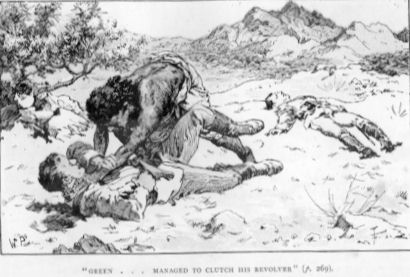
The movement was so sudden that he never suspected the Arab’s presence till he was on him. The savage wrenched his left arm free; Green upon this got his right-hand down, and managed to clutch his revolver; and just as his enemy’s fingers forced their way under his chin to his throat, he put the muzzle to his head and pulled the trigger.
His helmet having fallen off in the struggle, his own hair was singed by the explosion, but he was free; the Arab rolled away from him, his head shattered—a gruesome spectacle.
Just as Green got to his feet again, his two men appeared on the rock. They had heard him call, and the voice had guided them in that direction; and while they were hesitating the pistol-shot told them exactly where their officer was.
“He is up here, and alive,” said Green. “Run, one of you—you, Davis—to the place where we saw the doctors and stretchers, and tell them. Take good note of this spot, that you may not miss it. But I don’t think they are a thousand yards off.”
“I shall know it, sir,” said Davis, and he disappeared over the side of the rock.
Green was now once more by Strachan’s side, and with Gubbins’ help got him into a more comfortable position. The spear-head which had wounded him, with a couple of feet of the shaft, lay close by, as if he had pulled it out before losing consciousness. The rest of the shaft also lay near, half cut through, half broken, close to the edge of the rock, and underneath that spot, at the foot of the crag, was the body of an Arab—head amongst the large stones, feet and legs uppermost—resting on the steep side.
Probably it was the man who had speared Strachan, his weapon, previously hacked nearly through, breaking with the thrust. And one of the soldiers storming the rock had shot him as he was making off. As for the disarmed man who had attacked Green, he had probably taken refuge up there after the tide of battle had swept past, intending to escape at nightfall, but the sight of a foe so close was too tempting for his prudence.
All this, however, is only conjecture; the certain fact was that poor Tom Strachan had a wide wound in the side, and that Green dared not move him much, because it made the life-stream well out afresh. There was nothing for it but to wait till medical aid arrived.
It is surprising what trivial ideas and memories, such as tags of old songs, or anecdotes more or less appropriate to the occasion, will run in our heads when we are anxious about anything, and are forced to remain in inactivity. All the time certain lines of Sir Walter Scott would worry Green, as he knelt there by his friend:
“That spear wound has our master sped; And see the deep cut on his head. Good-night to Marmion.”
Over and over and over again rang the lines, till Strachan himself dissipated them by moving his hand and murmuring. It was evident that what he wanted was water, and so Green put his gourd to his mouth, and after a refreshing draught, consciousness returned to the wounded man’s eyes.
Then Green gently disengaged the sword-knot from his wrist, and, unbuckling his belt, returned the weapon to its scabbard, not without having to wipe it first.
Strachan made a movement of his hand again towards it, evidently knowing that something was taken from him. But Green showed him the sword, and said, “It is all right, I am only wiping it for you;” and the other was placid again immediately, and closed his eyes.
It was not long before the surgeon came, and they got Strachan’s kharkee jacket off, and bandaged him up.
“He has lost a lot of blood,” said the surgeon, “and that is why he fainted, probably.”
“Will it kill him?”
“Not necessarily at all. It is a nice clean wound, and all depends upon how far it has penetrated. Of course, a man cannot have a sharp instrument thrust into his body without some danger to the vital organs. The pressing matter, however, is how to lower him from this. I have got a stretcher at the bottom all right, but the sides of this rock are pretty steep for a badly wounded man to get down.”
“Yes,” said Green.
“But I have examined carefully all round it, and this is the best place.”
And he indicated a corner where there were ledges which formed steps; and here they carried Tom Strachan, and lowered him as gently and carefully as might be.
They could not avoid a jolt or two, which elicited a moan; but it was not far to the bottom, and there was the stretcher. Just as they had managed to get him settled the sun sank, and it was amidst the usual display of orange, crimson, and purple fireworks that they picked their way amongst the corpses which strewed the nullah. It was another job to carry their burden up the steep sides of this, but they managed it before darkness settled down on the battle-field.
At the other side, however, they were soon forced to halt, and wait for the rising of the moon. She was up, but had not appeared over the hills yet, and the ground where they were was in such deep shadow that the bearers could not go a dozen yards without stumbling either over a dead body or the inequalities of the surface. It was a weird thing to wait there in the gloom in the midst of those who had been so full of life and vigour in the morning, and were now as motionless, senseless, as the boulders amongst which they were scattered.
While waiting thus, they fancied they saw several dark figures gliding by them, and Green held his revolver ready, thinking that live Arabs were still prowling around, or taking advantage of the darkness to escape from the nooks where they had lain concealed. Presently, however, the moon topped the higher ground, and he saw one of these moving forms more distinctly, and perceived that it was a four-footed animal, not a biped. Probably they were beasts of prey stealing to the scene of carnage. It takes a good deal of the gilt off glory that the foulest beasts and birds should fake heroes for carrion. And yet, after all, this is a superficial way of looking at it, for it is the qualities of the mind—courage, endurance, patriotism, loyalty, fidelity to comrades—which make the hero, and the soul is beyond the reach of vulture or jackal. As for the mere body without it, it is of no more value than an empty champagne bottle. When there was light enough they went on again, and in due time reached the ambulance. And Green, having seen his friend made as comfortable as was possible under the circumstances, returned to the bivouac of the regiment, where everybody was glad to hear that Tom Strachan was found alive, and that there was a good chance for him, for his good humour and high spirits had made him a general favourite.
“Do you know, Green, you have done a very fine thing?” said the colonel. “If you had not found Strachan this evening he would have been dead in all probability before morning. And you found him very cleverly.”
And Green felt as good all over at this praise as if he had been mentioned in despatches.
The battle of Tamai was the end of the campaign. Some folk said the troops should have taken advantage of the rout and dispersion of Osman Digna’s tribes to march across to Berber on the Nile, and then Khartoum would have been relieved without any further fuss. Other people, who had equally good means of judging, scorned this idea, and were certain that had such a thing been attempted every man of the expedition would have perished.
If the latter people were right, the authorities acted wisely; if the former had reason on their side, they acted foolishly. But as to which is which, it would be very rash for any one who does not know all the ins and outs, and has not the evidence which influenced those who had to decide, before him, to give an opinion. Anyhow, the expedition returned to Suakim, and the majority of the troops sailed away for different places. And Osman Digna had time to gather fresh fanatics together, and the Soudanese recovered from the shock to their superstition and conviction of invincibility which the hecatombs of slaughter had given them, and were soon ready to fight again.
And Tom Strachan was not so very badly hurt, but was soon able to be taken home to England to be nursed, and rejoined his regiment in six months.
Chapter Eighteen.
Against the Stream.
A swift broad river, with the water broken into foaming wavelets by rocks which were everywhere showing their vicious heads above the surface; a string of nuggars, or half-decked boats, fifteen feet broad, forty-five feet long, flat-bottomed, each with a thick rope attached to the bows, and a string of men on the bank towing it under a hot sun.
Perhaps you have yourself towed a skiff on the Thames, when the current was so strong that the progress made with the oars was unsatisfactory. Well, if you have, you don’t know one bit what this was like. In the first place, the Thames, even by Monkey Island, is still water compared to the Nile between Surras and Dal, a sixty-mile stretch. Then your skiff did not carry six tons of beef, bacon, biscuit, and other stores. It may also be safely asserted that the towing-path you walked on was not composed of sharp pointed rocks.
Those were the conditions under which certain picked British soldiers, one of whom was an old friend of ours, lost sight of for a considerable time, were dragging their nuggar up a series of cataracts. Towing always looks to me an absurd business, much as if a man were to carry a horse about, and call it going for a ride.
“Are you growling or singing, Tarrant?” asked Kavanagh of the man behind him on the string.
“Not singing, you may take your davy,” growled the man addressed.
“I fancied not, though there is a certain likeness in your way of doing both which made me ask. I suppose you are growling then—what about?”
“What about, indeed!” grunted Tarrant. “D’ye suppose I ’listed as a soldier or a barge horse?”
“Don’t know; never saw your attestation papers.”
“Why, it was as a soldier then. I should have thought twice if I had known I was to be put to this sort of work.”
“Really! Why, when we were rowing, you did not like that, and said you would sooner be doing any work on your legs.”
“But I didn’t mean this; why, I have cut two pairs of boots to pieces against these here sharp rocks since we began it.”
“Ay,” said Kavanagh, “but you had already worn-out some of your garments at the other game, so it was only considerate to give the feet a chance.”
“Well, it’s a pity them that likes it should not have the doing of it,” said the judicious Tarrant.
“Well, you know, you could not pull an oar, and you can pull a rope,” said Grady, “so you are a trifle more useful now than you were before; and begorra you had need.”
“I could pull a rope if it were over the bough of a tree, and the other end round your neck,” snarled Tarrant.
“Oh, the murdering villain!” cried Grady. “And would ye be after hanging a poor boy who never harmed ye in all his life?”
“Well, keep a civil tongue in your head.”
“Sure, and it’s myself that has kissed the Blarney stone, and can do that same. And if you had such a thing as a bottle of whisky or a pound of tobacco about you, I would make you believe you were a pleasant companion, and pretty to look at besides. But what’s the use of telling lies when there’s nothing to be got by it?”
“Suppose you were to pull a bit harder and talk a bit less,” said Corporal Adams.
“And I will, corporal dear,” replied Grady. “But sure I thought we was marching at ease.”
It may be well to explain that when troops get the word March at ease!—which is generally given directly they step off, when they are not drilling or manoeuvring, but simply on the route—they are allowed to carry their arms as they please, open the ranks, though without losing their places or straggling, smoke their pipes, and chat or sing if they like.
At the word of command—Attention! They close up, slope their arms properly, put away their pipes, and tramp on in perfect silence.
But marching at ease was such a singularly inappropriate expression for men who were dragging a heavy nuggar up a cataract under a blazing sun that there was a general laugh, and even Tarrant relaxed into a grin. A general laugh, I say, not a universal one, for Macintosh, who was plodding along behind Grady, preserved his gravity.
“I don’t say that silence is incumberous,” explained Corporal Adams, who, since he had got his stripes, had taken to using rather fine language, “but too much talking don’t go with hauling.”
“Ho, ho, ho!” chuckled Macintosh, and the corporal began to think he had said something funny. But no; Macintosh had trodden on an unusually sharp flint, and that presented Grady’s idea of what marching at ease was in a ridiculous form to his mind. So when the pang was over he was tickled.
“Eh, but Grady’s a poor daft creature to call this marching at ease; ho, ho!”
A particularly stiff bit came just now. The rope strained as if it would snap; the bows of the nuggar were buried in foam, and the men hauling were forced to take the corporal’s hint, and keep their breath for other purposes than conversation.
When they had got over the worst, however, the boat got jammed on a rock, and the work of getting her off devolved on the crew on board of her, unless she were so fast as to require the aid of the others, who for the present got a much-required rest.
“A set of duffers, those chaps,” said the sergeant in charge of the party, a young fellow named Barton, of good parentage, and Kavanagh’s particular friend off duty. “A regular Nile reis, with his crew of four natives, would never have stuck the nuggar there.”
“I wish we had them Canadian vogajaws, sergeant,” said Corporal Adams.
“Ay, they are first-rate,” replied the sergeant.
“A good many boats have them, haven’t they?”
“Oh, yes! Most I suppose, or we should not get on at all. But we have not had the luck to get them for our craft. There are only a few of these who know how to work a boat up rapids at all, and I fancy they are only apprentices at it. As for the others, one of them owned to me that he had never been on any river before the Nile but the Thames at Putney, and his idea of a rapid was the tide rushing under the bridge.”
“But sure, sergeant, he can sing ‘Row, brothers, row,’ iligantly, he can,” said Grady.
“Ay, but he can’t do it,” replied the sergeant. “He ought to be in the water now. There’s Captain Reece overboard and shoving; I must try and get to him. Stand by the rope, men, and haul away like blazes when she shifts.”
What with poling, and shoving, and pulling at the rope, the nuggar was floated once more at last, and on they went again, and by-and-by the river widened, and the current was not so strong, and so long as they kept the rope pretty taut the boat came along without any very great exertion.
“Have a pipe out of my baccy-box, just to show there’s no malice?” said Grady to Tarrant.
“Thankee, I will,” replied Tarrant, “for mine is so wet it won’t burn. I went up to my neck in shoving off the first time we stuck, before we took to towing.”
“Eh, but that was a chance for the crocodiles!” cried Macintosh. “I saw ye go souse under, Tarrant, and thought one of them had got ye by the leg. Ye might have grumbled a bit then, and folks would have said you had reason.”
“It is all very fine,” said Tarrant, “and if you chaps are pleased, you are welcome; but I don’t call this riding on a camel. I had as soon have stopped with my own regiment, amongst sensible and pleasant lads, and taken my chance, as have volunteered to join this corps, if I had known I was to march all the same, and lug a beast of a boat after me too. I expected to have a camel to ride on.”
“Thank you for putting me in mind that I’m mounted,” said Grady; “I had almost forgotten it.”
“Make your minds easy,” said Sergeant Barton. “You will have plenty of camel riding in a day or two, quite as much as you like perhaps.”
“And I hope it will be before I have worn-out my third pair of boots,” said Macintosh. “Eh, but this is a grievous waste of shoe-leather.”
“I had sooner wear that out than my own skin,” said Kavanagh.
“I’m not that sure,” replied Macintosh. “The skin grows again, and the shoe-leather doesn’t.”
The sergeant laughed.
“Well, I think I may promise you that you will have no more of this work after to-morrow,” he said. “You will get your camels at Wady Haifa.” Barton had been specially instructed in camel drill, and selected for his proficiency to assist in training the corps to which Kavanagh belonged.
His story was a very simple one; he was not one of the plucked, who, failing to get their commissions, join the ranks rather than not serve at all, for it was most likely that he would have succeeded in any competitive examination, being a clever and industrious youth, who was doing well at Oxford when his father lost all his money, having shares in a bank which suddenly failed, and left him responsible to the extent of every penny he possessed. The undergraduate had been accustomed to a handsome allowance, and owed bills which he was now unable to pay. This he could not help, but being an honourable man he would not incur a farthing more, but took his name off the boards at once, divided his caution money, and what was obtained by the sale of his horse, the furniture of his rooms, and whatever else he possessed, amongst his creditors, and enlisted. Having once chosen his profession, he went at it with prodigious zeal, and lost no opportunity of attending any school of instruction which was open to him. When he had once acquired his drill, he was soon made corporal, then sergeant. He distinguished himself at Hythe; he learnt signalling both with flags and flashes. And when useful men were wanted for the formation of Camel Corps, and the battalions in Egypt searched for them, he was one of the first pitched upon to learn and then to instruct. For, when people talk of the super-human intelligence of German officers and soldiers, and speak of ours as a set of dunder-headed idiots, you need not quite take all they say for absolute fact. I think if you took the adjutants, sergeant-majors, and musketry instructors of the British army, you would find it hard to pick out an equal number of men in any country, even Germany itself, to beat them for intelligence, common sense, and promptitude.
“There will be a new drill to learn!” growled Tarrant.
“Oh, that won’t be much,” said Kavanagh. “Lots of old words of command would do over again, I should say. For instance, ‘Shouldare—oop!’ only it would be the camel’s shoulder which has to be mounted.”
“Now, that’s mighty clever,” said Grady. “Will you tell me something, Kavanagh, you that’s a real scholar now—can a man be two things at the same time?”
“Of course he can; he can be an Irishman and a barge horse, you see.”
“Ah, then a Mounted Infantry man can be a trooper and a foot soldier all at once. And a camel rider, would you call him a horse soldier, now?”
“No, Pat, I could not afford it. I’m an Irishman as well as yourself, and dull people would think it was a blunder.”
“That’s a true word,” said Grady. “And have you not noticed now, when folks laugh at an Irishman, he is mostly quite right if they had the understanding? Now you have observed, and heard, what a bad country Egypt is for the eyes. Sure they give us green goggles, or we should get the—what do you call it, Mr Corporal, sir, if you plaze?”
“The hop-fallimy,” replied Corporal Adams, proud of being appealed to.
“Thank you; the hop-family, what with the sun, and the sand, and the flies. And if you get the hop-family you are likely to go blind, and that is a bad thing. Is it not curious that the great river of a country that is so bad for the eyes should have cataracts itself in it? Now that would sound foolish to many people, but you, who are an Irishman, see the bearings of it, don’t you now?”
“But,” observed Macintosh, “a cataract in the eye is a skin, or something growing over it, and a cataract in the river is a kind of waterfall. They are not the same sort of thing at all.”
“And is that so? To be sure, now, what a stupid mistake then I made. And did you ever undergo the operation, now, Macintosh?”
“Well, beyond vaccination and the lugging out of a broken tooth, I don’t call to mind that I have been in the surgeon’s hands; and if ye want to know the truth, I don’t care if I never am. Eh, but that tooth now, it took a tug!”
“I thought you had never had it done,” said Grady. “It’s a pity, sure. And what do you say makes a cataract in the Nile?”
“Surely you have seen enough of them for yersel’. It’s a rapid where the water comes down a steep part with great vehemence. But what operation are ye talking of? I expect ye mean some sauce or other.”
“Sure, no; it’s only that which they say a Scotchman must have done before a joke can be got into his head. But I don’t belave it at all; folks are such liars!” said Grady.
“I would have ye to know,” said Macintosh, when the others had stopped laughing, “that a Scotchman is not deficient in wut, but he can’t see it in mere nonsense.”
All this talk was not spoken right off the reel, as it reads, but at intervals, during pauses in the harder part of the work, and rests. And it was lucky they could keep their spirits up; there is health and vigour in that:
“The merry heart goes all the day; The heavy tires in a mile—a!”
Shakespeare is always right.
But the sergeant was better than his word, and that was their last afternoon of rowing or towing, for they reached the place where the camels were collected that evening before sun-down. On the very next day the new drill commenced, for there was not an hour to be lost.
The last days of 1884 had arrived, and Khartoum still held out. The chances of reaching that place and rescuing Gordon were always present to every mind; that was the one goal to which all efforts were tending. But there was no good in for ever talking about it; on the contrary, it was more healthy to divert the thoughts, if possible, in other directions. A fall from a horse is unpleasant, and risky to the bones, but a tumble off a camel is worse, because it is more dangerous to fall ten feet than five. The first step was a difficulty—to mount the creature at all, that is. It looks easy enough, for it lies down for you. Apparently all you have to do is to throw one leg over and settle yourself in the saddle. But the camel has a habit of springing up like a Jack-in-the-box just as your ankle is on a level with his back, and away you go flying. Experienced travellers, who have camel drivers and attendants, make one of them stand on the creature’s fore legs to keep them down while they settle themselves; but troopers had no such luxuries provided for them, and had to look after their animals themselves, and it took several trials and severe rolls on the sand before some of them managed to mount at all. There the camel lay, quiet and tame and lazy, to all appearance as a cat dozing before the fire. But the moment the foot was over his back he resembled the same cat when she sees a mouse, and away you went. Taught by experience, you spring into the saddle with a vault. Up goes the camel on the first two joints of his forelegs with a jerk which sends the small of your back against the hinder pommel so violently that you think the spine broken. Before you have time to decide this important question in your mind, the hind legs go up with an equally spasmodic movement, and you hit the front pommel hard with your stomach.
Surely now you are settled; not a bit of it. The beast jumps from his knees to his feet with a third spring, and your back gets another severe blow from the hind pommel. After these three pommellings you are mounted. But when you want to get off, and your camel lies down for you, you get it all over again; only your stomach gets the hits one and three, and your back the middle one. Opinions differ as to which is the most pleasant, but after several repetitions of it you feel as if you had been down in the middle of a scrimmage at football, and both sides had taken you for the object to be kicked at. The ordinary traveller, when once on his camel, would stop there some hours; and again, when he got off, would remain off till it was time to renew his journey, and so he would not get so much of it. But a soldier learning camel drill must go on till he is perfect.
After mounting, dismounting, and re-mounting a certain number of times, the troopers learned to anticipate the camel jerks, and avoid the high pommels which rose in front and rear of the saddles, or rather to use them as aids instead of encumbrances. But it took a good deal of practice, and some were longer about falling into it than others. But they were not always at drill, though they had so much of it.
Some went in for fishing, and hooks and lines had been provided by the authorities for that purpose. But the sport was very poor, little being caught, and after trying it once or twice Kavanagh preferred to sit under the tree or in an arbour and smoke his pipe either alone or with a companion—Sergeant Barton for choice, but he was not always available. When that was the case the honest Grady would sometimes join him, and though he would rather have been left to his own thoughts, it was not in his nature to show a want of cordiality towards a good fellow who made advances to him. From the day of his enlistment Reginald Kavanagh had frankly accepted the situation, and had been careful above all things to avoid giving himself any airs of superiority.
“This is a mighty pretty spot you have fixed on, any way,” said Grady, stretching himself under the grateful shade of a palm-tree, “and reminds me of Oireland entirely!”
“It is rather like Merrion Square,” said Kavanagh, gravely; “or that perhaps combined with the Phoenix Park, with a touch of the Lakes of Killarney.”
“Sure, now, you are making fun of a poor boy! Look at that bird now! Isn’t he an illigant bird that? There’s a many of them about, and they are the best looking I have seen at all in Egypt.”
“Do they remind you of Ireland, too?” asked Kavanagh.
“Well, now, you are too hard on me.”
“Not a bit of it, it is only natural that they should, for they are called Paddy birds.”
“And is that a fact now?”
“Certainly it is. Sergeant Barton told me, and he has been some time in Egypt, and knows most of the birds and animals,” replied Kavanagh.
“Well, now, it is only natural that the loveliest bird in the country should be called Paddy. Are not the finest men and the prettiest girls at all Irishmen? They call us every bad name there is, but they can’t do without us. Why, the general is an Irishman, and the Goughs and Napiers are Irishmen, and the Duke of Wellington was an Irishman.”
“And Grady and Kavanagh, the best men that ever rode on camels—or who will be when they can sit them—are Irishmen,” cried Kavanagh, laughing, and Grady chuckled too.
“But, now, there’s a thing I want to ask you, since you are larned about animals. You may not have thought it, for I am no scholar, but when I was a gossoon I went to school,” said Grady presently, “and they had pictures of bastes hung about the walls, and the queerest baste of all to my fancy, barring the elephant, was the camel. I remember purty well what they told me from the mouth, though I was bad at the reading and the sums and that; and the master he said that a camel with one hump was meant for carrying things, water and potatoes and other necessities, and that was why he had only one, to make more room, and have something to tie them on by. And he said there was another camel with two humps, and he was created for riding, and was called a dromedary, and when ye rode him, ye sat at your ease between the two humps, which made a soft saddle, just like an arm-chair ye straddled on, only without arms. And ye could go fast and easy for a week, with provisions all round ye, and the dromedary he only wanted to eat and drink once a week. Now, have the dromedaries died out, do ye think? Or are they more expensive, and is the War Office that mane it won’t afford them, but trates Christians like baggage?”
“They were out of it altogether at your school, Grady,” said Kavanagh. “A dromedary is only a better bred camel; it is like a hack or hunter, and a cart-horse, you know; the dromedary answering to the former. But both are camels, just the same as both the others are horses, and one hump unluckily is all either of them possess.”
“But I saw the pictures of them,” said Grady, with a puzzled look.
“I wish that the pictures had been painted from real animals, and not from the artist’s fancy,” repeated Kavanagh. “It was a general idea, I know—I had it myself—that there were two-humped camels, mighty pleasant to ride. But I believe it is all a mistake.”
“The one-humped beggar is not easy to ride, any how!” said Grady.
“No, that I vow he isn’t!” cried Kavanagh. “Some of the camels trained to trot, and called hygeens, are a bit easier, I believe. The Arabs say that they can drink a cup of coffee on their backs without spilling it while they are going at speed.”
“We have not got any of them in our troop,” said Grady. “Well, we will get a bit of a holiday, plaze the pigs, the day after to-morrow, and not before I want it, for one. For what with them saddle peaks, and the rolls on the sand I have got, I don’t know whether my inwards or my outwards are the sorest. But the show is beginning; and, faith, it’s worth coming all the way to Egypt to see the sun set.”
This was one of the things which made Kavanagh like Grady’s company; he had a real innate love of the beauties of Nature, which you would rarely find in an Englishman of the same class. Together they watched the glories of the transformation scene shifting before them. Low on the horizon the deepest crimson changing and blending as it rose into violet; higher up the blue of the sapphire and the green of the emerald; and when these colours were the most intense, the two rose, and turned back to camp slowly and reluctantly, still gazing in silence. For now the after-glow succeeded; first the sky was a most brilliant orange, such a tint as would cause the painter who could at all approach it to be accused of the most absurd exaggeration by those who had not seen the real colour, while those who had would esteem it far too faint. This changed to an equally brilliant rose colour; and then, in a few seconds, suddenly, as if “Lights out” had been sounded in the zenith, darkness!
“It is like going to church,” said Grady.
“Yes,” replied Kavanagh; “that makes one feel God great and man little, doesn’t it?”
“Aye!”
They were barely a quarter of an hour from camp, and the fires guided them; for hot as it was in the daytime the nights were chilly, and a bonfire in the open acceptable. They found their mates gathered round the largest in great excitement.
“Here, you chaps,” was the cry which assailed them when they made their appearance, “can either of you make a plum-pudding?”
“Of course,” replied Kavanagh. “There’s nothing easier if you only have the materials.”
“Well, the materials have just come; how do you work them up?”
“Why, make them into a pudding and boil it, of course.”
“Any idiot knows that; but how do you make them into a pudding? If we spoil one, you know, we shan’t have any opportunity of trying a second time, so none of your experiments.”
“That’s serious!”
“I should think it was!”
“Well, you take the flour and put it in a basin, and moisten it with water; and you put in your plums and raisins and citron, and beat up half a dozen eggs and put them in too, and three glasses of brandy, and anything else that’s good you have got, and you knead it all up for a good bit, and put it in a cloth, and tie it up tight with a piece of string, and boil it as long as you can; all to-night and to-morrow and to-morrow night, and so right up to dinnertime.”
“It sounds pretty right,” said the first speaker, doubtfully; “but how do you know? Did you ever make one?”
“Why, I cannot say that exactly, but I have seen many made, and helped to stir them.”
“Lately?”
“Not so very, when I was a boy.”
“It would be a sinful waste to put sperrits into a pudding,” observed Macintosh. “It would all boil away, and no one be a bit the better.”
“No fear! Good liquor’s too scarce for that,” cried another.
“Brandy is a great improvement, when you have it, for all that,” maintained Kavanagh.
But though this part of his recipe sounded to all like the dissolving of Cleopatra’s pearls in her drink for wilful waste, the other items of it confirmed the previous opinion of the chief cook of the troop, and the precious ingredients were entrusted to his care. When they were well mixed, an unforeseen difficulty arose about a bag to boil it in; but that was met by the sacrifice of a haversack, and at last it was consigned to the gipsy kettle which was to bring it to perfection. If it were literally true that a watched pot never boils, this would have had a poor chance, for when off drill or duty next day every man ran to have a look at it; but the proverb happily fell through, and it bubbled away famously. Christmas-day dawned, and would have been hot in England for July.
It is a curious experience the first Christmas spent away from home in a warm climate, such a contrast to all early associations. There were decorations of palm-branches, and instead of holly cactus, which represented it well for prickliness. And there was church parade; and afterwards came dinner of tinned roast beef, fish which some of the persevering had caught in the Nile, and an ostrich egg, which a friendly native had brought in, and which proved fresh. And the pudding!
It was an anxious moment when the string was cut, and the remains of the ancient haversack were opened, and every one was relieved when the object of interest did not fall to crumbs as some feared, but remained firm and intact till cut. Was it good? Well, the proof of the pudding is in the eating, and there was not a crumb or a plum left when the party rose. Then a delightful afternoon of idleness and complete rest, which took the ache out of many a poor fellow’s bones, and talk of friends in England, and reminiscences of home. And some lucky ones got letters which succeeded in reaching them the right day, and got away alone to read them; while others kept the link by writing. Rather melancholy, but pleasant all the same, for the element of hope kept all sweet. And at night a huge bonfire was lit; it was cold of nights, and officers and men gathered round it for a sing-song. And there was a platform of barrels and planks on which various performances, fiddling, a hornpipe, recitations, nigger melodies, took place, the highest in command enjoying themselves as heartily as the humblest. And there was a tot of rum, not enough to hurt the weakest head indeed, but still a taste, for every one to drink to absent friends, and a rousing chorus or two, and sound sleep closing a day of thorough enjoyment. For to taste a holiday you must have a long spell of real hard work.