Chapter IV · (continued 2)
Reading edition
Secondly, we have the important fact, which Mr. Lang has duly noted, though he does not apparently see its significance in the argument as to origins, that the class system "arose in a given centre and was propagated by emigrants and was borrowed by distant tribes."[385] Messrs. Spencer and Gillen distinctly affirm that the "division into eight has been adopted (or rather the names for the four new divisions have been) in recent times by the Arunta tribe from the Ilpirra tribe which adjoins the former on the north, and the use of them is at the present time spreading southwards."[386] This view is supported by the widespread organisation of eaglehawk and crow, and by the general homogeneity of Australian social forms. It is clear, therefore, that room is made for the external organisation of the class system and the consequent production of the dual characteristics of the Arunta—the joint product of the fossilisation of mother-right society at the end of the migration movement, and the superimposing upon this fossilisation, with its tendency towards the class system, of the fully organised class system. The two systems are not now fully welded in the Arunta group. Whatever view is taken of these, whether they be considered advanced or primal, the undoubted dualism has to be accounted for, and the best way of accounting for this dualism is, I submit, that of differential evolution. Further study of Messrs. Spencer and Gillen's work, together with the criticisms of various scholars, Mr. Lang, Mr. Hartland, Mr. Frazer, Mr. Thomas, and others, convinces me that the extreme artificiality of the class system is due partly to a want of understanding of the entire facts, and partly to the ad hoc adoption by the natives themselves of new plans to meet difficulties which must arise out of a too close adhesion to their rules. Mr. Lang has allowed me to see a manuscript note of his, in which he points out that the inevitable result of the one totem to the one totem rule of marital relationship,—that is, totem A always intermarrying with totem B, males and females from both totems, and with no others,—is the consanguineous relationship of all the members of the two totems. The rule for non-consanguineous marriage has therefore broken down, and when it breaks down the Australian introduces a new rule which satisfies immediate necessities. When this in turn breaks down a further new rule is made, and this is the way I think the differing rules resulted. They represent, therefore, not varying degrees of culture progress, but only varying degrees of artificial social changes, and they spring from the oldest conditions of all where there is no class system at all.[387] Arunta society is not a "sport" under this view, but a product—a product to be accounted for and explained by anthropological rules, derived not only from Australian society but from the general facts of human society which have remained for observation by the science of to-day. The parallel between Semang and Arunta, therefore, helps us in two ways. It enables us to go back to Semang totemism as an example of primitive kinless society, and forward to Arunta totemism as an example of early development therefrom. We have, in point of fact, discovered the datum line of totemism. Upon this may be constructed the various examples according to their degrees of development, and we may thus see in detail the commencing elements of totemism as well as the means by which we may proceed from the commencing elements to the more advanced elements, and finally to the last stages of totemic society where blood kinship is fully recognised and used, where, in fact, totemic tribes as distinct from totemic peoples take their place in the world's history.
IV
I do not propose in this chapter to proceed further with this inquiry. It will not advance my object, nor is it absolutely necessary. Totemism in the full has been described adequately by Mr. Frazer in his valuable abstract of the evidence supplied from all parts of the world, and there is not much in dispute among the authorities when once the stage of origin is passed. There is danger, however, at the other extreme, namely, the attempt to discover totemism in impossible places in civilisation. Mr. Morgan has shown us totemic society in its highest form of development, untouched by other influences of sufficient consequence to divert its natural evolution. This, I think, is the merit of Mr. Morgan's great work, and not his attempt, his futile attempt as I think, to apply the principles of totemic society to the elucidation of societies that have long passed the stage of totemism. In particular, the great European civilisations are not totemic, nor are they to be seen passing from totemism. It is true that Mr. Lang, Mr. Grant Allen, and others have attempted to trace in certain features of Greek ritual and belief, and in certain tribal formations discoverable in Anglo-Saxon Britain, the relics of a living totemism in the civilised races of Europe;[388] but I do not believe either of these scholars would have endorsed his early conclusions in later studies. Mr. Grant Allen did not, so far as I know, repeat this theory after its first publication, and Mr. Lang has given many signs of being willing to withdraw it. The fact is, there is no necessity to think of Greek or English totem society because in Greece and England there are traces of totem beliefs. We may disengage them from their national position and put them back to the position they occupied before the coming of Greek or Englishman into the countries they have made their own.
In that position there may well have been totemic peoples in Britain of the type we have been considering from Australia. I have already indicated that totemic survivals in folklore have been the subject of a special study of my own which still in the main stands good, and for which I have collected very many additional illustrations and proofs. I discovered that folklore contained some remarkably perfect examples of totemic belief and custom, and also a considerable array of scattered belief and custom connected with animals and plants which, unclassified, seemed to lead to no definite stage of culture history, yet when classified, undoubtedly led to totemism. The result was somewhat remarkable. At many points there are direct parallels to savage totemism, and the whole associated group of customs received adequate explanation only on the theory that it represented the detritus of a once existing totemic system of belief.
The present study enables me to take the parallel to primitive totemism much closer. One of the perfect examples was of a local character. This was found in Ossory. Giraldus Cambrensis tells an extraordinary legend to the following effect: "A priest benighted in a wood on the borders of Meath was confronted by a wolf, who after some preliminary explanations gave this account of himself: There are two of us, a man and a woman, natives of Ossory, who through the curse of one Natalis, saint and abbot, are compelled every seven years to put off the human form and depart from the dwellings of men. Quitting entirely the human form, we assume that of wolves. At the end of the seven years, if they chance to survive, two others being substituted in their places, they return to their country and their former shape."[389] Here is a saintly legend introduced to explain the current tradition of the men of Ossory, that they periodically turned into wolves. Fynes Moryson, in 1603, ridiculed the beliefs of "some Irish who will be believed as men of credit," that men in Ossory were "yearly turned into wolves."[390] But an ancient Irish MS. puts the matter much more clearly in the statement that the "descendants of the wolf are in Ossory,"[391] while the evidence of Spenser and Camden explains the popular beliefs upon even more exact lines. Spenser says "that some of the Irish doe use to make the wolf their gossip;"[392] and Camden adds that they term them "Chari Christi, praying for them and wishing them well, and having contracted this intimacy, professed to have no fear from their four-footed allies." Fynes Moryson expressly mentions the popular dislike to killing wolves, and they were not extirpated until the eighteenth century.[393] Aubrey adds that "in Ireland they value the fang-tooth of an wolfe, which they set in silver and gold as we doe ye Coralls;"[394] and Camden notes the similar use of a bit of wolf's skin.[395]
In the local superstitions of Ossory, therefore, we have several of the cardinal features of savage totemism, the descent from the totem-animal, the ascription to the totem of a sacred character, the belief in its protection, and a taboo against killing it. I will venture to suggest, however, that to these important features there is to be added a parallel in survival to the Semang and Arunta features where the local circumstances of birth are the determining forces which supply the totem name, for the relationship of "gossip," "god-sib," is clearly of the same character as that of the soul-tree of the Semang and the alcheringa of the Australian.[396] The condition of survival has altered the detail of the parallel, but the parallel is on the same plane.
The wolf as gossip to the men of Ossory leads us on to inquire whether any other animal had such close connections with human beings. In Erris, a part of Connaught, "the people consider that foxes perfectly understand human language, that they can be propitiated by kindness, and even moved by flattery. They not only make mittens for Reynard's feet to keep him warm in winter, and deposit these articles carefully near their holes, but they make them sponsors for their children, supposing that under the close and long-established relationship of Gossipred they will be induced to befriend them."[397] Thus it appears that the selfsame conception which the men of Ossory had in the thirteenth century for the wolf, the men of Erris had for the fox in the nineteenth century. No explanation from the dry details of the natural history of these animals is sufficient to account for this curious parallel, and we must turn to ancient beliefs for the explanation.
The general attitude of the men of Erris towards the fox is confirmed as an attribute of totemism when we come to examine a special local form of it. This we can do by turning to Galway. The Claddagh fishermen in Galway would not go out to fish if they saw a fox: their rivals of a neighbouring village, not believing in the fox, do all they can to introduce a fox into the Claddagh village.[398] These people are peculiar in many respects, and are distinctively clannish. They retain their old clan-dress—blue cloaks and red petticoats—which distinguishes them from the rest of the county of Galway, and it may be conjectured that the present-day custom of naming from the names of fish—thus, Jack the hake, Bill the cod, Joe the eel, Pat the trout, Mat the turbot, etc.[399]—may be a remnant of the mental attitude of the folk towards that belief in kinship between men and animals which is at the basis of totemism. But, returning to the fox, we have in the belief that meeting this animal would prevent them from going out to fish, a parallel to the prohibition against looking at the totem which is to be found among savage people, and we have in the neighbours' disbelief in the fox and a corresponding belief in the hare,[400] that local distribution of different totems which is also found in savagery. But all these particulars about the relationship of the fox to the Claddagh fishermen receive unexpected light when we inquire into the biography of their local saint, named MacDara. This saint is the patron saint of the fishermen who, when passing MacDara's island, always dip their sails thrice to avoid being shipwrecked. But then, in the folk-belief, we have this remarkable fact, that MacDara's real name was Sinach, a fox[401]—an instance, it would seem, of a totem cult being transferred to a Christian saint. Thus, then, in the superstitions of these Claddagh fisherfolk we can trace the elements of totemism, the root of which is contained, first, in the nominal worship of a Christian saint, and second, in the actual worship of an animal, the fox.
These examples of local totemism may be followed by a remarkable example of tribal or kinship totemism. It was noted by Mr. G. H. Kinahan in his researches for Irish folklore, and is mentioned quite incidentally among other items, the collector himself not fully perceiving the importance of his "find." This really enhances the value of the evidence, because it destroys any possibility of an objection to its validity—a really important matter, considering the remarkable character of this survival of totem-stocks in Western Europe. The exact words of Mr. Kinahan are as follows:—
"In very ancient times some of the clan Coneely, one of the early septs of the county, were changed by 'art magick' into seals; since then no Coneely can kill a seal without afterwards having bad luck. Seals are called Coneelys, and on this account many of the name changed it to Connolly."[402] The same local tradition is mentioned by Hardiman in one of his notes to O'Flaherty's Description of West or H-iar Connaught,[403] but the note is equally significant of genuineness from the fact that the tradition is styled "a ridiculous story." It strengthens Mr. Kinahan's note in the following passage: "In some places the story has its believers, who would no more kill a seal, or eat of a slaughtered one, than they would of a human Coneely."
The clan Coneely is mentioned both by Mr. Kinahan and by Mr. Hardiman as one of the oldest Irish septs; and that it is widely spread, and not congregated into one locality, is to be inferred from the description of the tradition as prevalent in Connaught, especially from Mr. Hardiman's words, describing that "in some places" the story has its believers now; and hence we may conclude that wherever the clan Coneely are situated there would exist this totem belief.
The full significance of these facts may best be tested by reference to the conditions laid down by Dr. Robertson Smith for the discovery of the survivals of totemism among the Semitic races. These conditions are as follows:—
"'(1) The existence of stocks named after plants and animals'—such stocks, it is necessary to add, being scattered through many local tribes; (2) the prevalence of the conception that the members of the stock are of the blood of the eponym animal, or are sprung from a plant of the species chosen as totem; (3) the ascription to the totem of a sacred character which may result in its being regarded as the god of the stock, but at any rate makes it be regarded with veneration, so that, for example, a totem animal is not used as ordinary food. If we can find all these things together in the same tribe, the proof of totemism is complete; but even when this cannot be done, the proof may be morally complete if all the three marks of totemism are found well developed within the same race. In many cases, however, we can hardly expect to find all the marks of totemism in its primitive form; the totem, for example, may have become first an animal god, and then an anthropomorphic god, with animal attributes or associations merely."[404]
Now in the Irish case all three of these conditions are found together in the same tribe, the clan Coneely, and it is impossible to overlook the importance of such a discovery. It proves from survivals in folklore that totemistic people once lived in ancient Ireland, just as the corresponding evidence proved that the ancient Semitic stock possessed the totemic organisation.
We have now examined the most archaic forms of the survival of totemism in Britain. If we pass on to inquire whether we can detect the more scattered and decayed remnants of totem beliefs and customs, we turn to Mr. Frazer as our guide. From Mr. Frazer's review of the beliefs and customs incidental to the totemistic organisation of savage people, it is possible to extract a formula for ascertaining the classification of savage beliefs and practices incidental to totemism. This formula appears to me to properly fall into the following groups:—
(a) Descent from the totem.
(b) Restrictions against injuring the totem.
(c) Restrictions against using the totem for food.
(d) The petting and preservation of totems.
(e) The mourning for and burying of totems.
(f) Penalties for non-respect of totem.
(g) Assistance by the totem to his kin.
(h) Assumption of totem marks.
(i) Assumption of totem dress.
(j) Assumption of totem names.
My suggestion is that if a reasonable proportion of the superstitions and customs attaching to animals and plants, preserved to us as folklore, can be classified under these heads this is exactly what might be expected if the origin of such superstitions and customs is to be sought for in a primitive system of totemism which prevailed amongst the people once occupying these islands. The clan Coneely and the Ossory wolves are proofs that such a system existed, and if such perfect survivals have been able to descend to modern times, in spite of the influences of civilisation, there is no primâ facie reason why the beliefs and customs incidental to such a system should not have survived, even though they are no longer to be identified with special clans. When once a primitive belief or custom becomes separated from its original surroundings, it would be liable to change. Thus, when the wolf totem of Ossory passes into a local cultus, we meet with the belief that human beings may be transformed into animal forms, as the derivative from the totem belief in descent from the wolf. Fortunately, the process by which this change took place is discernible in the Ossory example; but it will not be so in other examples, and we may therefore assume that the Ossory example represents the transitional form and apply it as a key to the origin of similar beliefs elsewhere.
Again, if we endeavour to discover how the associated totem-beliefs of the clan Coneely would appear in folklore supposing they had been scattered by the influences of civilisation, we can see that at the various places where members of the clan had resided for some time there would be preserved fragments of the once perfect totem-belief. Thus, one place would retain traditions about a fabulous animal who could change into human form; another place would preserve beliefs about its being unlucky to kill a seal (or some other animal specially connected with the locality); another place would preserve a superstitious regard for the seal (or some other local animal) as an augury; and thus the process of transference of beliefs into folklore, from one form into other related forms, from one particular object connected with the clan to several objects connected with the localities, would go on from time to time, until the difficulty of tracing the original of the scattered beliefs and customs would be well-nigh insurmountable without some key. But having once proved the existence of such examples as the clan Coneely and the Ossory wolves, this difficulty, though still great, is very much lessened. Our method would be as follows. We first of all postulate that totem peoples did actually exist in ancient Britain, or whence such extraordinary survivals? We next examine and classify the beliefs and customs which are incidental to totemism in savage society, and having set these forth by the aid of Mr. Frazer's admirable study on the subject, we ascertain what parallels to these beliefs and customs may be found in the folklore of Britain. And then our position seems to be very clearly defined. We prove that in folklore certain customs and superstitions are identical, or nearly so, with the beliefs and customs of totemism among savage tribes, and we conclude that this identity in form proves an identity in origin, and therefore that this section of folklore originated from the totemistic people of early Britain.
I shall not take up all these points on the present occasion, especially as they have in all essentials appeared in the study to which I have referred; but as an example of the scattering of totem beliefs I will refer to the well-known passage in Cæsar (lib. v. cap. xii.), from which we learn that certain people in Britain were forbidden to eat the hare, the cock, or the goose, and see whether this does not receive its only explanation by reference to the totemic restriction against using the totem for food. Mr. Elton, with this passage in his mind, notices that "there were certain restrictions among the Britons and ancient Irish, by which particular nations or tribes were forbidden to kill or eat certain kinds of animals;" and he goes on to suggest that "it seems reasonable to connect the rule of abstaining from certain kinds of food with the superstitious belief that the tribes were descended from the animals from which their names and crests or badges were derived."[405]
Let us see whether this reasonable conjecture holds good. The most famous example is that of Cuchulainn, the celebrated Irish chieftain, whose name means the hound of Culain. It is said that he might not eat of the flesh of the dog, and he came by his death after transgressing this totemistic taboo. The words of the manuscript known as the Book of Leinster are singularly significant in their illustration of this view. "And one of the things that Cúchulainn was bound not to do was going to a cooking hearth and consuming the food [i.e. the dog]; and another of the things that he must not do was eating his namesake's flesh."[406] Diarmaid, whose name seems to be continued in the current popular Irish name for pig (Darby), was intimately associated with that animal, and his life depended on the life of the boar.[407] These examples are so much to the point that we may examine the cases mentioned by Cæsar from the same standard.
Mr. Frazer points out that even among existing totem-tribes the respect for the totem has lessened or disappeared, and among the results of this he notes instances where, if any one kills his totem, he apologises to the animal. Under such an interpretation as this, we may surely classify a "memorandum" made by Bishop White-Kennett about the hare, the first of the British totems mentioned by Cæsar: "When one keepes a hare alive and feedeth him till he have occasion to eat him, if he telles before he kills him that he will doe so, the hare will thereupon be found dead, having killed himself."[408] But respect for the hare, in accordance with totem ideas, was carried further than this at Biddenham, where, on the 22nd September, a little procession of villagers carried a white rabbit [a substitute for hare] decorated with scarlet ribbons through the village, singing a hymn in honour of St. Agatha. All the young unmarried women who chanced to meet the procession extended the first two fingers of the left hand pointing towards the rabbit, at the same time repeating the following doggerel:—
Gustin, Gustin, lacks a bier, Maidens, maidens, bury him here.[409]
This points to a very ancient custom, not yet fully explained, but which clearly had for its object the reverential burying of a rabbit or hare. It is characteristic of the totem animal that it serves as an omen to its clansmen, and we find that the hare is an omen in Britain. Boudicca is said to have drawn an augury from a hare, taken from her bosom, and which when released pursued a course that was deemed fortunate for her attack upon the Roman army;[410] and in modern south Northamptonshire the running of a hare along the street or mainway of a village portends fire to some house in the immediate vicinity.[411] In 1648 Sir Thomas Browne tells us that in his time there were few above three-score years that were not perplexed when a hare crossed their path.[412] In Wilts and in Scotland it was unlucky to meet a hare, but the evil influence did not extend after the next meal had been taken.[413] Then, too, the prohibition against naming the totem object is found in north-east Scotland attached to the hare, whose name may not be pronounced at sea, and Mr. Gregor adds the significant fact that some animal names and certain family names were never pronounced by the inhabitants of some of the villages, each village having an aversion to one or more of the words.[414] A classification of the beliefs and customs connected with the hare takes us, indeed, to almost every phase of totemistic belief, and it is impossible to reject such a mass of cumulative evidence.
Of the second of the British food taboos mentioned by Cæsar we have the most perfect illustration in the instance of the Irish chieftain, Conaire, who, descended from a fowl, was interdicted from eating its flesh.[415]
Turning next to the goose, we find that at Great Crosby, in Lancashire, there is held an annual festival which is called the "Goose Fair," and although it is accompanied by great feasting, the singular fact remains that the goose itself, in whose honour the feast seems to have been held, is considered too sacred to eat, and is never touched by the villagers.[416] In Scotland also the goose was never eaten, being too sacred for food.[417]
Thus the hare, the fowl, and the goose have retained their sacred character in a special manner in various parts of the country, and I may add a further note of more general significance. In Scotland there exists a prejudice against eating hares and cocks and hens.[418] In the south-western parts of England the peasant would not eat hares, rabbits, wild-fowl, or poultry, and when asked whence this dislike proceeds, he asserts that it was derived from his father[419]—the traditional sanction which is so essential to folklore.[420]
The ideas surrounding these three special animals might be easily extended to others, but I will only observe that Mr. Elton, noting both the classical and modern accounts of certain districts in Scotland and Ireland where fish, though abundant, is tabooed as food, quotes with approval a modern suggestion that this abstinence was a religious observance.[421] That fish are carved on numerous stones is a curious commentary on this assertion, while another point to be noted is that the inhabitants of the various islands have each their peculiar notions as to what fish are good for food. Some will eat skate, some dog-fish, some eat limpets and razor-fish, and as a matter of course, says Miss Gordon Cumming, those who do not, despise those who do.[422] A prejudice also existed against white cows in Scotland, and Dalyell ventures upon the acute supposition that this was on account of the unlawfulness of consuming the product of a consecrated animal.[423] These are not stray notes of inexperienced observers, and with two centuries between them it must be that they contain the essence of the people's conception—a conception which leads us back to totemism for its explanation.
I do not think we could get closer to totemic beliefs and ideas than this, nor could we have a better example of the necessity of examining early historical data by anthropological tests and by folklore parallels. Cæsar's words are unimportant by themselves. They convey nothing of any significance to the modern reader—a mere dietetic peculiarity which means nothing and counts for nothing. And yet it might be considered certain that Cæsar knew that the details he recorded were of importance in the historical sense. He did not indicate what the importance was, probably because he was not aware of it; but because he was conscious that among the influences which counted with these people were the food taboos, he rightly recorded the facts. They have remained unconsidered trifles until now, when anthropology has brought them within the range of scientific observation, and they are now to be reckoned with as part of the material which tells of the culture conditions of a section of the early British peoples.
I must here interpose a remark with reference to this grouping of the evidence. Apart from the significance of the superstitions as they are recorded in their bare condition among the peasantry, there is the additional fact to note that the superstition against eating or killing certain animals or birds, or against looking at them or naming them, etc., is not universal. It obtains in one place and not in another. If the injunction not to kill, injure, or eat a certain animal were simply the reflection of a universal practice, such a practice might originate in some attribute of the animal itself which characteristically would produce or tend to produce superstition. But the spread of this class of superstition in certain districts, and not in others, is indicative of an ancient origin, and it is exactly what might be expected to have been produced from totem-peoples. Unfortunately, neither the negative evidence of superstitious beliefs nor the local distribution of superstitious beliefs has ever been considered worthy of attention. But some little evidence is incidentally forthcoming, and I would submit that this may be taken as indicative of what might be obtained more fully by further research into this neglected aspect of folklore. I drew Miss Burne's attention to this subject, and she has noted some particulars in her valuable Shropshire Folklore.[424] But for the most part this portion of our evidence wants picking out by a long and tedious process from the mass of badly recorded facts about popular superstitions. I do not believe in the generally stated opinion that certain superstitions are universally believed or practised. It is difficult to prove a negative, and such evidence is not absolutely scientific, but when it comes in direct antithesis to positive, there does not seem any harm in accepting it. Every class of superstition wants tracing out geographically, and local variants want careful noting. I cannot doubt if this were properly done that many so-called universal superstitions would be found to be distinctly local. In the meantime, it is not with universal superstitions that we have to deal. It is primarily with those local variants which show us side by side the differences of belief. It is thus that we can afford evidence of that intermixture of totem-objects which is to be expected from the known facts of totem-beliefs and customs. Indeed, Mr. McLennan has laid it down that "we might expect that while here and there perhaps a tribe might appear with a single animal god, as a general rule tribes and nations should have as many animal and vegetable gods as there were distinct stocks in the population ... we should not expect to find the same animal dominant in all quarters, or worshipped even everywhere within the same nation."[425]
It is important that we should thoroughly understand what these survivals of totemism in the British isles really mean. On the extreme west coast of Ireland, farthest away from the centres of civilisation, there are found these unique examples of a savage institution. The argument that they might have been transplanted thither by travellers from the far west, where totemism has developed to its highest form, cannot seriously be advanced. The argument that they might be the accidental form into which some merely superstitious fancies of ignorant peasants happened to have ultimately shaped themselves, is met by the mathematical demonstration that the ratio of chance against such a development would be well-nigh incalculable. The remaining argument is that they indicate the last outpost, or perhaps one of the last outposts, of a primitive savage organisation which once existed throughout these lands. This is the view that appears to me to be the only possible one to meet all the conditions of the case; one proof in support of this view being the discovery of evidence in other parts of the country which shows that totemism has left its stamp in more or less perfect form upon the traditional beliefs and practices of the nation. Though we are not able to identify further complete examples of the same type as the seal clan of Western Ireland, or the wolf people of Ossory, we should be able, if the explanation I have advanced of their origin be the correct one, to produce examples of the varying forms which such an institution as totemism must have assumed when it had been broken up by the advance of civilising influences. If the seal clan, or the wolf clan, is in truth the last outpost of a savage organisation, there will be in the lands less remote from the centres of civilisation some evidences of the break-up of savagery as it has been driven westward. Somewhere in tradition, somewhere in local observances of beliefs or superstition, there must still be echoes, more or less faint, but still echoes, from totemism. Having discovered these undoubted examples of totemism, the argument shifts its ground. We can no longer say that the theory of totemism may possibly explain some of the customs and traditions of the people. We are, by the logic of the position, compelled to say that custom and tradition must have preserved many relics of totemism, and that so far from seeking to explain custom and tradition by the theory of totemism, we must seek to explain the survival of totemism by custom and tradition. I lay stress on this view of the case because it is hard to combat the views of those who look upon "mere superstition" as no explanation of primitive originals. To us of the present day the beliefs of the peasantry are no doubt properly definable as "mere superstition." But when we examine it as folklore we are seeking for its origin, not for its modern aspect; we are asking how "mere superstition" first arose, and in what forms, not how it exists; we are pushing back the inquiry from to-day when it exists side by side with a philosophical and moral religion to the time when it existed as the sole substitute for philosophy and morals. Even if it is "mere superstition" it has a dateless history. It is not conceivable that it suddenly arose at a particular period before which "mere superstition" did not exist, and all, both peasant and chief, were philosophical and moral. It is not conceivable that the mere superstition of to-day has replaced bodily the mere superstition of other ages. Every succeeding age of progress has influenced it, no doubt, but not eradicated it, and hence the mere superstition of to-day has just such an unbroken continuity of history as language or institutions. That we are able to pick out from among its items undoubted forms of totemism, and that we may add to these complete examples a classified grouping of customs and beliefs in survival parallel to the customs and beliefs of savage totemism, affords proof that at least we may carry back that history to the era of totemism, at whatever point that era may cross the line of, or come into contact with, political history.
This is the definite conclusion to be drawn from the anthropological interpretation of the presence of totemic beliefs among the survivals of folklore. The study of the anthropological conditions has occupied a wide range of thought and inquiry, but it leads us back to a safe basis for research, for it brings definitely within touch of that realm of man which lies outside the civilisation wherein folklore is embedded, the peoples who have made, and the peoples who are dominated by, that civilisation. The savage of Britain cannot with this evidence before us be considered as the mere product of the literature of Greece and Rome. He is part and parcel of the savagery of the human race. Anthropology has shown us that savagery reached the land we now call Britain as part of the general movement of people which has caused the whole earth to become a dwelling-place for man, and now that we know this we must appeal to anthropology whenever we find that the problems of folklore take us out of the culture period of a civilisation known to history.[426]
APPENDIX
I append a synopsis of the culture-structure of the Semangs of the Malay Peninsula (references are to Skeat and Blagden's Pagan Races of the Malay Peninsula where not otherwise specified), in order that the position claimed for the one section of totemic belief may be tested by the remaining characteristics of Semang culture. I claim that there is nothing that remains which is inconsistent with the interpretation given of the totemic items.
Physical:—
(a). Live exclusively in the forest surrounded by hostile fauna (i. 13).
(b). Food consists of such wild vegetable food as may happen to fall from time to time in season (i. 109, 341, 525), together with small mammals and birds (i. 112), fish (i. 113).
(c). As soon as they have exhausted the sources of food in one neighbourhood they move on to the next (i. 109).
(d). Fire obtained by friction (i. 111, 113), but meat is eaten raw (i. 112).
(e). Nudity is alleged (Journ. Indian Archipelago, i. 252; ii. 258); no satisfactory proof (i. 137); do not use skins of animals nor feathers of birds (i. 138); a girdle of fungus string (i. 138, 142, 380); fringe of leaves suspended from a string (i. 139, 142); necklaces and ligatures of jungle fibre (i. 144, 145); women wear a comb made of bamboo as a charm against diseases (i. 149).
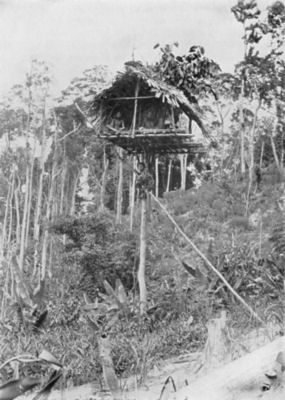
(f). Habitations are rock shelters (i. 173), tree shelters afforded by branches of trees improved by construction of a weather screen (i. 174); ground screen of palm leaves (i. 175).
(g). Hunt successfully the largest animals, escaping easily up the trees (i. 202-204).
(h). Knives made of bamboo, flakes and chips of stone, knives of bone (i. 249, 269); bow and arrow (i. 251, 255); not sufficiently advanced to have produced neolithic implements (i. 268); wooden spear (i. 270).
(i). Ignorant of pottery, vessels made from big stems of bamboo (i. 383).
Social:—
(j). Chief of the group is the principal medicine man, but is on an equal footing with his men, no caste and property is in common (i. 497, 499).
(k). Marriage rights are secured by the presentation of a jungle knife to the bride's parents and a girdle to the bride, and the bride never lets the girdle part from her for fear of its being used to her prejudice in some magic ceremony; adultery is punishable by death (ii. 58, 59) [but this information was not obtained from the most primitive of the Semang people].
(l). Semang women are common to all men (Newbold, Political and Stat. Acc. of Settlements in Straits of Malacca, ii. 379). Great ante-nuptial freedom (ii. 56, 218); "Of the Semang I have not had an opportunity of personally judging" (ii. 377, Newbold).
TREE HUT, ULU BATU, ABOUT 12 MILES FROM KUALA LUMPUR, SELANGOR
(m). Eat dead kindred except head (Newbold, ii. 379); burial takes place in the ground, and the older practice was exposure in trees; the Semang have no dread of ghosts of the deceased (ii. 89, 91).
(n). No sacred shrines or places (ii. 197).
(o). Avoidance of mother-in-law (ii. 204).
(p). Myth of the ringdove informing the children of the first woman that they had married within prohibited degrees of consanguinity, and advising them to separate and marry "other people" (ii. 218).
(q). Myth as to ignorance of cause of birth being dispelled by the cocoanut monkey informing the first man and woman (ii. 218).
(r). The Semang are almost ineradicably nomadic, have no fixed habitation, and rove about like the beasts of the forest (i. 172; ii. 470).
(s). Women and girls are not allowed to eat until the men and boys have finished their repast (i. 116); the men do most of the hunting and trapping, and the women take a large share in the collecting of roots and fruits; all the cooking is performed by the women and girls (i. 375).
(t). They are split up into a large number of dialects, each of which is confined to a relatively small area, and it often happens that a little [clan] or even a single family uses a form of speech which is differentiated from other dialects to be practically unintelligible to all except the members of the little community itself (ii. 379).
(u). Natural segregation of the [tribes] into small [clans] to some extent cut off from one another and surrounded by settled Malay communities (ii. 379).
(v). The most thoroughly wild and uncivilised members of our race, regarded by the Malays as little better than brute beasts, with no recorded history (ii. 384).
(w). Nomadic life of the Semang leads them over a considerable tract of country (ii. 388).
Psychical:—
(x). Decorative patterns on quivers representing natural objects, and possessing magical virtue to bring down various species of monkeys and apes and other small mammals (i. 417), and as charms for the men (i. 423).
(y). Decorative pattern on magic comb worn by women to serve as a charm against venomous reptiles and insects, similar design for similar reason sometimes painted on the breast (i. 41, 420-436).
(z). Child's name is taken from some tree which stands near the prospective birthplace of the child. As soon as the child is born this name is shouted aloud by the sage femme, who then hands over the child to another woman, who buries the afterbirth underneath the birth-tree or name-tree of the child. As soon as this is done the father cuts a series of notches in the tree, starting from the ground and terminating at the height of the breast. The cutting of these notches is intended to signalise the arrival on earth of a new human being, since it thus shows that Kari registers the souls that he has sent forth by notching the tree against which he leans. Trees thus "blazed" are never felled. The child must not in later life injure any tree which belongs to the species of his tree; for him all such trees are taboo, and he must not even eat their fruit, the only exception being when an expectant mother revisits her birth-tree. Every tree of its species is regarded as identical with the birth-tree (ii. 3, 4). When an East Semang dies his birth-tree dies too (ii. 5).
(aa). The child's soul is conveyed in a bird, which always inhabits a tree of the species to which the birth-tree belongs. It flies from one tree of the species to another, following the as yet unborn body. The souls of first-born children are always young birds newly hatched, the offspring of the bird which contained the soul of the mother. If the mother does not eat the soul-bird during her accouchement the child will be stillborn or will die shortly after birth (ii. 4, 192, 194, 216). She keeps the soul-bird within the birth-bamboo, and does not eat it all at once, but piecemeal (ii. 6). All human souls grow upon a soul-tree in the other world, whence they are fetched by a bird which was killed and eaten by the expectant mother (ii. 194).
(bb). Semang religion, in spite of its recognition of a thunder-god (Kari) and certain minor deities (so called), has very little indeed in the way of ceremonial, and appears to consist mainly of mythology and legend. It shows remarkably few traces of demon worship, very little fear of ghosts of the deceased, and still less of any sort of animistic beliefs (ii. 174). [As the Kari is the deity common to the Semang and the people higher in culture than the Semang, it is difficult to trace out the primitive idea. The myths also show a common impress, "which is probably mainly due to the same savage Malay element" (ii. 183).]
(cc). During a storm of thunder and lightning the Semang draw a few drops of blood from the region of the shin bone, mix it with a little water in a bamboo receptacle, and throw it up to the angry skies (ii. 204).
(dd). Pretend entire ignorance of a supreme being, but on pressure confessed to a very powerful yet benevolent being, the maker of the world (ii. 209).