Chapter I · (continued 2)
Reading edition
Here we see that the relationship between father and daughter was in no way considered in ancient society of the type to which Australians and Ahts belonged, and it is now one of the accepted facts of anthropology that at certain stages of savage life fatherhood was not recognised. That this non-relationship of the father very often resulted in the further stage of the father marrying his daughter, is exemplified by many examples. The story of Lot and his daughters, for instance, will at once occur to the reader, and upon this Mr. Fenton has some observations, to which I may refer the student who wishes to pursue this curious subject further,[75] while Mr. Frazer, in his recent study of Adonis, has discussed the practice with his usual extent of knowledge.[76] Again, it should be remembered that in our own chronicle histories Vortigern is said to have married his own daughter, though the legend and the supposed consequences of the marriage have been twisted from their original primitive surroundings by the monkish chroniclers, through whom we obtain the story.[77] Turning next to the daughter-in-law, supposing that the difference between "daughter" and "daughter-in-law" (query stepdaughter) in the story variants is a vital difference, and not an accidental difference, there is curious and important evidence from India. The following custom prevails among certain classes of Sudras, particularly the Vella-lahs in Koimbator: "A father marries a grown-up girl eighteen or twenty years old to his son, a boy of seven or eight, after which he publicly lives with his daughter-in-law, until the youth attains his majority, when his wife is made over to him, generally with half a dozen children. These children are taught to address him as their father. In several cases this woman becomes the common wife of the father and son. She pays every respect due to her wedded husband, and takes great care of him from the time of her marriage. The son, in his turn, hastens to celebrate the marriage of his acquired son, with the usual pomps, ceremonies, and tumasha, and keeps the bride for himself as his father had done."[78] But even further than this, ancient Hindu law allowed the father, who had no prospect of having legitimate sons, to "appoint" or nominate a daughter who should bear a son to himself, and not to her own husband.[79] Sir Henry Maine gives the formula for this remarkable appointment, and then goes on to say that some customs akin to the Hindu usage of appointing a daughter appear to have been very widely diffused over the ancient world, and traces of them are found far down in history.[80]
What we have before us, therefore, to guide us in the view we take of the story incident of a father marrying his own daughter, may be summarised as follows:—
1. The father is not related to his daughter, and hence examples occur of fathers marrying daughters.
2. The custom of marrying a daughter-in-law.
3. The custom of nominating a daughter to bear a son.
From any one of these facts of primitive life we arrive at the central incident in the story of Catskin: the father could marry his daughter without specially shocking the society of the primitive world, simply because, according to primitive ideas, father and daughter, as we call her, were not related.
We now arrive at the second incident—the running away of Catskin. This again is a very early form of marriage custom. Women of primitive times often objected to the forced marriages, and they expressed their objection very often by running away. In the instance of Catskin the running away was successful, as we all know; but in most instances the unwilling bride was captured and forced to surrender. Mr. Farrer, in his Primitive Manners and Customs, quite clears the ground for the refutation of an argument that might be applied if we did not know the customs of primitive society. It might be asked, why did Catskin run away if the custom was a usual one? For the same reason, we answer, that the women of savage society often do run away—objection to the marriage.[81]
Thus we have to note that the two principal features of our ordinary Catskin story are explainable by a reference to primitive manners and customs; and it seems to me much easier and much more reasonable to thus explain the origin of the Catskin story, than first of all to create a "lovely myth," as the mythologists would undoubtedly have a right to call it, of the Sun pursuing the Dawn, and then to say that the Catskin story is simply a relation of this myth.
The opening incident of the Catskin story, as thus interpreted, is not an isolated case of the survival of primitive marriage customs in popular stories. If it were so, there would be considerable difficulty in the way of supporting this interpretation. But it is only saying of Catskin what can be said of other stories. "There are traces," says Mr. Campbell, speaking of his Highland stories, "of foreign or forgotten laws and customs. A man buys a wife as he would a cow, and acquires a right to shoot her, which is acknowledged as good law."[82] Yes, this is good savage law and custom there is no doubt, and Lord Avebury and Mr. McLennan have illustrated it by examples. But in the Highland story of the "Battle of the Birds" the wife is sought to be purchased for a hundred pounds (Campbell, i. 36), and in the Irish story of the "Lazy Beauty and her Aunts" we find something like bride-capture and purchase as well.[83] So, again, if we turn to India the same kind of evidence is forthcoming of another part of the primitive ceremony. "Do not think," retorted the Malee in a story collected by Miss Frere, "that I'll make a fool of myself because I'm only a Malee, and believe what you've got to say because you're a great Rajah. If you mean what you say, if you care for my daughter and wish to be married to her, come and be married; but I'll have none of your new-fangled forms and court ceremonies hard to be understood; let the girl be married by her father's hearth, and under her father's roof."[84] And in another story of the "Chundun Rajah" we have "the scattering rice and flowers upon their heads;"[85] the significance of both of which customs are fully known.
These illustrations of the contact, the necessary contact, of tradition and history show that contact to be equally true of the folk-tale as it is of the local or personal legend. They all point to the substratum of fact underlying tradition, to the absorption by tradition of many features of the life by which it is surrounded, or to the absorption by some great historic person or event of the living tradition of his time or place. This contact is a fact equally important to history and to folklore. It cannot be neglected by either. It stands for something in the analysis which every student must give of the material with which he is working, and that something has a value, sometimes great and sometimes small, which must influence the estimate of the material which both history and folklore supply in the unravelling of man's past.
I will now finally give a more complicated example of the folk-tale as illustrative of the connection between history and tradition. Mr. J. F. Campbell printed a tale in the second volume of the Transactions of the Ethnological Society (p. 336), which had been sent to him in Gaelic by John Davan, in December, 1862—that is, after the publication of the fourth volume of his Highland Tales. The tale is only in outline, but in quite sufficient fulness for my present purpose, as follows:—
There was a man at some time or other who was well off, and had many children. When the family grew up the man gave a well-stocked farm to each of his children. When the man was old his wife died, and he divided all that he had amongst his children, and lived with them, turn about, in their houses. The sons and daughters got tired of him and ungrateful, and tried to get rid of him when he came to stay with them. At last an old friend found him sitting tearful by the wayside, and learning the cause of his distress, took him home; there he gave him a bowl of gold and a lesson which the old man learned and acted. When all the ungrateful sons and daughters had gone to a preaching, the old man went to a green knoll where his grandchildren were at play, and pretending to hide, he turned up a flat hearthstone in an old stance,[86] and went out of sight. He spread out his gold on a big stone in the sunlight, and he muttered, "Ye are mouldy, ye are hoary, ye will be better for the sun." The grandchildren came sneaking over the knoll, and when they had seen and heard all that they were intended to see and hear, they came running up with, "Grandfather, what have you got there?" "That which concerns you not; touch it not," said the grandfather; and he swept his gold into a bag and took it home to his old friend. The grandchildren told what they had seen, and henceforth the children strove who should be kindest to the old grandfather. Still acting on the counsel of his sagacious old chum, he got a stout little black chest made, and carried it always with him. When any one questioned him as to its contents, his answer was, "That will be known when the chest is opened." When he died he was buried with great honour and ceremony, and then the chest was opened by the expectant heirs. In it were found broken potsherds and bits of slate, and a long-handled, white wooden mallet with this legend on its head:—
"So am favioche fiorum, Thabhavit gnoc annsa cheann, Do n'fhear nach gleidh maoin da' fein, Ach bheir a chuid go leir d'a chlann." "Here is the fair mall To give a knock on the skull To the man who keeps no gear for himself, But gives all to his bairns."
Wright, in his collection of Latin stories, published by the Percy Society in 1842 (pp. 28-29), gives a variant of this tale under the title of "De divite qui dedit omnia filio suo," and, so far as can be judged by the abstract, the parallel between the two narratives, separated by at least five centuries of time, is remarkably close. The latter part is apparently different, for the Latin version tells how the man pretended that the chest contained a sum of money, part of which was to be applied for the good of his soul, and the rest to dispose of as he pleased. But at the point of death his children opened the chest. "Antequam totaliter expiraret, ad cistam currentes nihil invenerunt nisi malleum, in quo Anglicè scriptum est:—
"'Wyht suylc a betel be he smyten, That al the werld hyt mote wyten, That gyfht his sone al his thing, And goht hym self a beggyn.'"
Here, then, is a case whereby to test the problem of the position of folk-tales as historical material. Did the people adopt this tale from literature into tradition and keep it alive for five centuries; or did some early and unconscious folklorist adapt it into literature? The literary version has the flavour of its priestly influence, which does not appear in the traditional version; and I make the preliminary observation that if literature could have so stamped itself upon the memory of the folk as to have preserved all the essentials of such a story as this, it must have been due to some academic influence (of which, however, there is no evidence), and this influence would have preserved a nearer likeness to literary forms than the peasant's tale presents to us. But the objection to this theory is best shown by an analysis of the tale, and by some research into the possible sources of its origin.
The story presents us with the following essential incidents:—
1. The gift of a well-stocked farm by a father to each of his children.
2. The surrender of all property during the owner's lifetime.
3. The living of the old father with each of his children.
4. The attempted killing of the old man.
5. The mallet bearing the inscription.
6. The rhyming formula of the inscription.
Mr. Campbell notes the first and third of these incidents in his original abstract of the story,[87] but of the remaining second, fourth, fifth, and sixth no note has hitherto been taken.
Of the first incident, the gift of a well-stocked farm by a father to each of his children, Mr. Campbell says: "This subdivision of land by tenants is the dress and declaration put on by a class who now tell this tale." But it also represents an ancient system of swarming off from the parent household when society was in a tribal stage. The incident of the tale is exactly reproduced in local custom. In the island of Skye the possessor of a few acres of land cut them up only a few years ago into shreds and patches to afford a separate dwelling for each son and daughter who married.[88] In Kinross, in 1797, the same practice prevailed. "Among the feuars the parents are in many instances disposed to relinquish and give up to their children their landed possessions or the principal part of them, retaining only for themselves some paltry pendicle or patch of ground."[89] In Ireland and in Cornwall much the same evidence is forthcoming, and elsewhere I have taken some pains to show that these local customs are the isolated survivals in late times of early tribal practices.[90]
We next turn to the second essential incident of the tale—the surrender of the estate during the owner's lifetime. This is a well-marked feature of early custom, and Du Chaillu has preserved something like the survival of the ritual observances connected with it in his account of the Scandinavian practice. On a visit to Husum he witnessed the ceremonial which attended the immemorial custom of the farm coming into possession of the eldest son, the father still being alive. The following is Mr. Du Chaillu's description, and the details are important: "The dinner being ready, all the members of the family came in and seated themselves around the board, the father taking, as is customary, the head of the table. All at once, Roar, who was not seated, came to his father and said, 'Father, you are getting old; let me take your place.' 'Oh, no, my son,' was the answer, 'I am not too old to work; it is not yet time: wait awhile.' Then, with an entreating look, Roar said, 'Oh, father, all your children and myself are often sorry to see you look so tired when the day's labour is over: the work of the farm is too much for you; it is time for you to rest and do nothing. Rest in your old age. Oh, let me take your place at the head of the table.' All the faces were now extremely sober, and tears were seen in many eyes. 'Not yet, my son.' 'Oh, yes, father.' Then said the whole family, 'Now it is time for you to rest.' He rose, and Roar took his place, and was then the master. His father, henceforth, would have nothing to do, was to live in a comfortable house, and to receive yearly a stipulated amount of grain or flour, potatoes, milk, cheese, butter, meat, etc."[91] Without stopping to analyse this singular ceremony in detail, it is important to note that old age is the assigned cause of resignation by the father of his estate; that the ceremony is evidently based upon traditional forms, the meaning of which is not distinctly comprehended by the present performers; that the father is supported by his successor. As a proof that we have here a survival of very ancient practice, it may be noticed that in Spiti, a part of the Punjab, an exact parallel occurs. There the father retires from the headship of the family when his eldest son is of full age, and has taken unto himself a wife; on each estate there is a kind of dower-house with a plot of land attached, to which the father in these cases retires.[92] In Bavaria and in Würtemberg the same custom obtains,[93] and the sagas of the North also confirm it as an ancient custom.[94]
Of the third incident in the tale, the living of the father with his children, Mr. Campbell says this points to the old Highland cluster of houses and to the farm worked by several families in common,[95] and I think we have here the explanation why the father in Scotland did not have his "dower-house," as he did in Scandinavia and in Spiti.
We next come to the fourth incident, the attempted killing of the old father. Now, from some of the earliest accounts of travels in Britain, we know that the death of the aged by violence was a signal element of the native customs. "They die only when they have lived long enough; for when the aged men have made good cheere and anoynted their bodies with sweet ointments they leape off a certain rocke into the sea." That we have in this episode of the story, remains of customs which once existed in the North, Mr. Elton affords proof, both from saga-history and from the practice of later times, when "the Swedes and Pomeranians killed their old people in the way which was indicated by the passage quoted above."[96] It is the custom of many savage tribes, and the observances made use of are sometimes suggestive of the facts of the tale we are now analysing. Thus, among the Todas of the Nilgiri Hills, they place the old people in large earthen jars with some food, and leave them to perish;[97] while among the Hottentots, Kolben says, "when persons become unable to perform the least office for themselves they are then placed in a solitary hut at a considerable distance, with a small stock of provisions within their reach, where they are left to die of hunger, or be devoured by the wild beasts."[98]
The important bearing of these incidents of barbarous and savage life upon our subject will be seen when we pass on to our fifth incident, namely, the significant use of the mallet. Some curious explanations have been given of this. Mr. Thorns once thought it might be identified with Malleus, the name of the Devil.[99] Nork has attempted with more reason to identify it with the hammer of Thor.[100] But the real identification is closer than this. Thus, it is connected with the Valhalla practices, already noted, by the fact that if an old Norseman becomes too frail to travel to the cliff, in order to throw himself over, his kinsman would save him the disgrace of dying "like a cow in the straw," and would beat him to death with the family club.[101] Mr. Elton, who quotes this passage, adds in a note that one of the family clubs is still preserved at a farm in East Gothland.[102] Aubrey has preserved an old English "countrie story" of "the holy mawle, which (they fancy) hung behind the church dore, which, when the father was seaventie, the sonne might fetch to knock his father in the head, as effœte, & of no more use."[103] That Aubrey preserved a true tradition is proved by what we learn of similar practices elsewhere. Thus, in fifteenth-century MSS. of prose romances found in English and also in Welsh, Sir Perceval, in his adventures in quest of the Holy Grail, being at one time ill at ease, congratulates himself that he is not like those men of Wales, where sons pull their fathers out of bed and kill them to save the disgrace of their dying in bed.[104] Keysler cites several instances of this savage custom in Prussia, and a Count Schulenberg rescued an old man who was being beaten to death by his sons at a place called Jammerholz, or "Woful Wood;" while a Countess of Nansfield, in the fourteenth century, is said to have saved the life of an old man on the Lüneberg Heath under similar circumstances.
Our investigation of barbarous and savage customs, which connect themselves with the essential incidents of this Highland tale, has at this point taken us outside the framework of the story. The old father in the tale was not killed by the mallet, but he is said to have used it as a warning to others to stop the practice of giving up their property during lifetime. We have already seen that this practice was an actual custom in early times, appearing in local survivals both in England and Scotland. Therefore the story must have arisen at a time when this practice was undergoing a change. We must note, too, that the whole story leads up to the finding of a mallet with the rhyming inscription written thereon, connecting it with the instrument of death to the aged, but only on certain conditions. If, then, we can find that the rhyming inscription on the mallet has an existence quite apart from the story, and if we can find that mallets bearing such an inscription do actually exist, we may fairly conclude that the story, which, in Scotland, is the vehicle of transmission of the rhyme, is of later origin than the rhyme itself.
First of all, it is to be noted under this head that Wright, in a note to the Latin story we have already quoted, gives from John of Bromyard's Summa Predicantium another English version of the verse—
"Wit this betel the smieth And alle the worle thit wite That thevt the ungunde alle thing, And goht him selve a beggyng,"
which shows, I think, the popularity of the verse in the vernacular. Clearly, then, the Latin version is a translation of this, and not vice versâ. It must have been a rhyming formula in the vernacular, which had a life of its own quite outside its adoption into literature.
This inferential proof of the actual life of the English rhyming formula is confirmed by actual facts in the case of the corresponding German formula. Nork, in the volume I have already quoted, collects evidence from Grimm, Haupt, and others, which proves that sometimes in front of a house, as at Osnabrück, and sometimes at the city gate, as in several of the cities of Silesia and Saxony, there hangs a mallet with this inscription:—
"Wer den kindern gibt das Brod Und selber dabei leidet Noth Den schlagt mit dieser keule todt"—
which Mr. Thoms has Englished thus:—
"Who to his children gives his bread And thereby himself suffers need, With this mallet strike him dead."[105]
These rhymes are the same as those in the Scottish tale and its Latin analogue, and that they are preserved on the selfsame instrument which is mentioned in the story as bearing the inscription is proof enough, I think, that the mallets and their rhyming formulæ are far older than the story. They are not mythical, the story is; their history is contained in the facts we have above detailed; the life of the folk-tale commences when the use or formula of the mallet ceases to be part of the social institutions.
To the rhyming formulæ, then, I would trace the rise of the mythic tale told by the Highland peasant in 1862 to Mr. J. F. Campbell. The old customs which we have detailed as the true origin of the mallet, and its hideous use in killing the aged and infirm, had died out, but the symbol of them remained. To explain the symbol a myth was created, which kept sufficiently near to the original idea as to retain evidence of its close connection with the descent of property; and thus was launched the dateless, impersonal, unlocalised story which Mr. Campbell has given as a specimen of vagrant traditions, which "must have been invented after agriculture and fixed habitations, after laws of property and inheritance; but it may be as old as the lake-dwellings of Switzerland, or Egyptian civilisation, or Adam, whose sons tilled the earth."[106] I would venture to rewrite the last clause of this dictum of the great master of folk-tales, and I would suggest that the story, whatever its age as a story, tells us of facts in the life of its earliest narrators which do not belong to Teutonic or Celtic history. The Teuton and the Celt, with their traditional reverence for parental authority, at once patriarchal and priestly, would retain, with singular clearness, the memory of traditions, or it may be observations, of an altogether different set of ideas which belonged to the race with which they first came into contact. But whether the story is a mythic interpretation by Celts of pre-Celtic practices, or a pre-Celtic tradition, varied as soon as it became the property of the Celt to suit Celtic ideas, it clearly takes us back to practices very remote, to use Mr. Elton's forcible words, from the reverence for the parents' authority which might have perhaps been expected from descendants of "the Aryan household."[107] These practices lead us back to a period of savagery, of which we have to speak in terms of race distinction if we would get at its root.[108] The importance of such a conclusion cannot be overrated, for it leads directly to the issue which must be raised whenever an investigation of tradition leaves us with materials, which are promptly rejected as fragments of Celtic history because they are too savage, but which need not therefore be rejected as history, because they may be referred further back than Celtic history.
If we proceed by more drastic methods, by the methods of statistics, we shall arrive at much the same conclusion.[109] Taking the first twelve stories in Grimm's great collection, we find that seven of them yield elements which we are entitled to call savage, because they are so far removed from the European culture amidst which the folk-tales have lived, and because these elements belong not to the accidentals of the stories but to the essentials. Thus, if we divide the folk-tale into its components, we shall find that it consists of three features:—
1. The story radicals, or essential plot;
2. The story accidentals, or illustrative points;
3. Modern gloss upon the events in the story—
and if we go on to allocate the various incidents of the stories to these three heads, we get the following common results with regard to seven out of the twelve first stories of Grimm's great collection:—
I.—Frog Prince
Story radicals Story accidentals Added features Modern gloss
1. Savage elements Youngest daughter Fountain or well the locality of leading incident Frog prince—totem Frog prince stays at the house of his future wife Exogamous marriage, the prince coming from a foreign country — — —
2. Fantastic element — — Faithful servant whose heart is bound by iron bands —
3. Rank and splendour — — — Kingly state and its trappings—the princess wears a crown on ordinary occasions, and yet opens the door to a visitor while at dinner
III.—Our Lady's Child
Story radicals Story accidentals Added features Modern gloss
1. Savage elements — Naked forest woman captured for wife Suspicion that she is a cannibal — —
3. Rank and splendour — — — Virgin Mary and heaven the central features of the heroine's adventures
4. Moral characteristics Punishment for curiosity — — —
IV.—The Youth who Wants to Learn to Shudder
Story radicals Story accidentals Added features Modern gloss
1. Savage elements Winning of wife by service Succession to kingship through wife—female kinship Treasure guarded by spirits — — —
2. Fantastic element — The adventures in the haunted castle — —
3. Rank and splendour — — — Kingly state
4. Moral characteristics Bravery — — —
V.—The Wolf and Seven Little Kids
Story radicals Story accidentals Added features Modern gloss
1. Savage elements Talking animals Cutting open of the animal to free the swallowed kids, and refilling the stomach with stones Criticism upon men as compared with animals, 'truly men are like that' — —
VI.—Faithful John
Story radicals Story accidentals Added features Modern gloss
1. Savage elements Capture of bride Talking of animals Three taboos— Horse Garment Sucking of breasts Sacrifice of children and sprinkling of their blood on a stone Human origin of stone pillar — — —
3. Rank and splendour — — — Kingly state and great wealth in gold and riches
4. Moral characteristics — Punishment for curiosity — —
IX.—The Twelve Brothers
Story radicals Story accidentals Added features Modern gloss
1. Savage elements Going [causing to go] away of sons, so that the inheritance should fall to the daughter Change of brothers into ravens Life dependent on an outside object Forest life — —
3. Rank and splendour — — — Kingly state
4. Moral characteristics — — — —
XI.—Brother and Sister
Story radicals Story accidentals Added features Modern gloss
1. Savage elements Transformation of hero into roebuck after drinking at stream — — —
There are thus savage elements in seven out of twelve stories, and the question becomes an important one as to how this is. They are the stories of the nursery, told by mothers to children, stories kept alive by tradition, and the only possible answer to our question is that they contain fragments of the early culture-history of the ancestors, or at all events the predecessors, of those who have preserved them for our use. An occasional savage incident might have been considered a freak of the original narrator, or a borrowing by one of the countless late narrators of these stories brought home from savage countries; but statistics disprove both of these suppositions. It is not accidental but persistent savagery we meet with in the folk-tale. It is also the savagery to be found amongst modern peoples still in the savage stage of culture.
This is proved in a very complete manner by Mr. MacCulloch, whose study provides the material for a statistical survey of story incidents founded on primitive custom and belief.[110] They are the most ancient history to which we have access. That this history is contained in the folk-tales of modern peasantry shows it to have come from that far-off period which saw the earliest condition of these people. It is still history, if it tells us of a life which preceded the written record. It is history of the most valuable description, for it is to be found nowhere else as relating to the remotest period of European civilisation. The modern savage is better off in this respect. He has an outside historian in the traveller and the anthropologist of modern days. The savage who was ancestor to our own people had no such means of becoming known to history, or had but very limited means, and it is only in the deathless tradition that we can trace him out.
These conclusions have been drawn from that great class of tradition preserved by historic peoples in historic times, and yet unmistakably pointing to prehistoric culture. We have been able to show the methods to be adopted for, and the results of, disengaging the myth which has gravitated to the historic person or place from the historic facts which have become part of the legend, and to trace out in the folk-tale facts which belong to a culture far removed from civilised life. There are thus revealed two distinct centres of influence, the traditional centre and the historic centre, and it is obvious that the question must be asked—which is the more important? It seems to me equally obvious that the answer must be given in favour of the historic. History is indebted to tradition for preserving some of the most remote facts of racial or national life, which but for tradition would have been lost, and if we are content to use this tradition as a storehouse from which we may provide ourselves with ancient historical documents, we can trace out therefrom points in the history of any given country wherever the traditions have been preserved.
The folk-tale, in point of fact, equally with the personal and local legend, comes into close contact with history. The periods of history in the folk-tales are different from those in the legends, but together these periods reach from prehistoric culture to historic event. We cannot, however, call this extent of time a continuous period, and we cannot point to definite stages within the detached periods. Much more research must be accomplished before it will be possible to claim such results as these. I have indicated some points of difficulty, some methods of treatment which appear to me to be wrong, and to which I shall have again to refer later on; but in the meantime, from the necessarily incomplete evidence which I have been able to produce, it is, I think, abundantly clear that folklore has to be studied from its historical surroundings if we would draw from it all that it is capable of telling.
III
In the meantime it is well to bear in mind that there is one important department of history which has always been frankly and unhesitatingly accepted as history and yet which has no stronger foundation than tradition, and tradition of the most formal kind. I allude to the early laws of most of the peoples who have become possessed of an historic civilisation. These laws have all been preserved by tradition, are in rhyme or rhythm in order to assist the memory, have become the sacred repository of a school or class of priests, and have finally been reduced to writing by a great lawgiver, who by the act of giving the people written laws has had attributed to him supernatural origin and powers. That history should have accepted from tradition such an important section of its material is worth consideration by itself, apart from its bearing on the present study, and I shall proceed, therefore, to set out some of the chief facts in this connection.
There can be no doubt that in the tribal society of Indo-European peoples the laws and rules which governed the various members of the tribe were deemed to be sacred and were preserved by tradition. The opening clauses of the celebrated Laws of Manu illustrate this position. "The great sages approached Manu, who was seated with a collected mind, and having worshipped him spoke as follows: Deign, divine one, to declare to us precisely and in due order the sacred laws of each of the four chief castes and of the intermediate ones. For thou, O Lord, alone knowest the purport, the rites, and the knowledge of the soul taught in this whole ordinance of the self-existent which is unknowable and unfathomable."[111] They were not only sacred in origin but they dealt with sacred things, and Sir Henry Maine has drawn the broad conclusion that "there is no system of recorded law, literally from China to Peru, which, when it first emerges into notice, is not seen to be entangled with religious ritual and observance."[112] In Greece the lawgivers were supposed to be divinely inspired, Minôs from Jupiter, Lykurgos from the Delphic god, Zaleukos from Pallas.[113] The earliest notions of law are connected with Themis the Goddess of Justice.[114] In Rome it is to Romulus himself that is attributed the first positive law, and it is by a college of priests that the laws were preserved.[115] In Scandinavia the laws were in the custody and charge of the temple priests, and the accumulated evidence for the sacred origin and connection of the laws is to be found in the sagas.[116] Among the Celtic peoples it is well known that the laws were preserved and administered by the Brehons, who are compared with the Hindu Brahmins by Sir Henry Maine, "with many of their characteristics altered, and indeed, their whole sacerdotal authority abstracted by the influence of Christianity."[117] In the Isle of Man the laws were deemed sacred and known only to the Deemsters.[118]
In all cases laws were preserved by tradition and not by writing and evidence, and the superior value attached to the traditional record appears everywhere. The oldest record of Hindu law agrees with the best authority that it was not founded on writing but "upon immemorial customs which existed prior to and independent of Brahminism."[119] In Greece the very nature of the themistes shows that they were judgments dependent upon traditional custom. In Rome it is the subject of definite research that the "greater part of Roman law was founded on the mores majorum."[120] In Scandinavia the law speaker was obliged to recite the whole law within the period to which the tenure of his office was limited.[121] The Celtic laws are based upon customs handed down from remote antiquity,[122] and late down in English law it was admitted as a principle that if oral declarations came into conflict with written instruments the former had the more binding authority.[123]
One of the means by which this sacred tradition was preserved was through the medium of rhythm and verse. Thus, as Sir Henry Maine explains,
"The law book of Manu is in verse, and verse is one of the expedients for lessening the burden which the memory has to bear when writing is unknown or very little used. But there is another expedient which serves the same object. This is Aphorism or Proverb. Even now in our own country much of popular wisdom is preserved either in old rhymes or in old proverbs, and it is well ascertained that during the middle ages much of law, and not a little of medicine, was preserved among professions, not necessarily clerkly, by these two agencies."[124]
In Greece the same word, νόμος, was used for custom and law as for song. The ῥήτρα (declared law) of Sparta and Taras was in verse; the laws of Charondas were sung as σκόλια at Athens,[125] and Strabo refers to the Mazacenes of Cappadocia as using the laws of Charondas and appointing some person to be their law-singer (νομωδός), who is among them the declarer of the laws.[126]
Sir Francis Palgrave, noticing the same characteristic of Teutonic law, says:—
"It cannot be ascertained that any of the Teutonic nations reduced their customs into writing, until the influence of increasing civilisation rendered it expedient to depart from their primeval usages; but an aid to the recollection was often afforded as amongst the Britons, by poetry or by the condensation of the maxim or principle in proverbial or antithetical sentences like the Cymric triads. The marked alliteration of the Anglo-Saxon laws is to be referred to the same cause, and in the Frisic laws several passages are evidently written in verse. From hence, also, may originate those quaint and pithy rhymes in which the doctrines of the law of the old time are not unfrequently recorded."[127]
Again, the editors of the Brehon Law Tracts point out that early laws are handed down "in a rhythmical form; always in language condensed and antiquated they assume the character of abrupt and sententious proverbs. Collections of such sayings are found scattered throughout the Brehon Law Tracts."[128] The sagas contain many verses which partake of the character of legal formulæ, and in Beowulf there seems to be a definite example. It occurs in the passage describing Beowulf engaged in his fatal combat with the fiery dragon, when his "companions," stricken with terror, deserted him, on which Wiglaf pronounced the following malediction:—
"Now shall the service of treasure, and the gifts of swords, all joy of paternal inheritance, all support of all your kin depart; every one of your family must go about deprived of his rights of citizenship; when far and wide the nobles shall learn your flight, your dishonourable deed. Death is better to every warrior than disgraced life."
Mr. Kemble remarks on this passage, that it is not improbable that the whole denunciation is a judicial formula, such as we know early existed, and in regular rhythmical measure.[129]
These early examples may be followed up by others preserved to modern times. The most significant of these occurs in the Church ceremony of marriage, which preserves in the vernacular the ancient rhythmical formula of the marriage laws, and the antiquity of the Church ritual is proved from the fact that it is accompanied and enforced by the old rhythmical verse, which is indicative of early legal or ceremonious usage.
"With this rynge I the wed And this gold and silver I the geve, and with my body I the worshipe, and with all my worldely cathel I the endowe."[130]
Sir Francis Palgrave has noticed the subject, and points out that the wife is taken
"to have and to hold[131] from this day forward for better, for worse, for richer, for poorer,[132] in sickness and in health, to love and to cherish, till death us do part and thereto I plight thee my troth."
These words are inserted in our service according to the ancient canon of England, and even when the Latin mass was sung by the tonsured priest, the promises which accompany the delivery of the symbolical pledge of union were repeated by the blushing bride in a more intelligible tongue.[133] This is a curious and significant fact, and as we trace out these rhythmical lines farther back in their original vernacular, the more clearly distinct is their archaic nature. According to the usage of Salisbury the bride answered:—
"I take thee, John, to be my wedded husband, to have and to hold fro' this day forward for better, for worse, for richer, for poorer, in sycknesse, in hele, to be bonere and buxom [obedient] in bedde and at borde till death do us part and thereto I plight thee my trothe."[134]
The Welsh manual in the library of the Dean and Chapter of Hereford has a slight variation in the form, and an older spelling:—
"Ich N. take thee N. to my weddid wyf, for fayroure for foulore, for ricchere for porer, for betere for wers, in sicknesse and in helthe, forte deth us departe, and only to the holde and tharto ich plygtte my treuthe."[135]
To this may be added the many local examples of the preservation of laws or legal formulæ by means of their form in verse. The most interesting of these, perhaps, is that by which the Kentishman redeemed his land from the lord by repeating, as it was said, in the language of his ancestors:—
"Nighon sithe yeld And nighon sithe geld, And vif pund for the were, Ere he become healdere."
The first verse,
"Dog draw Stable stand Back berend And bloody hand"
justified the verderer in his punishment of the offender. In King Athelstane's grant to the good men of Beverley, and inscribed beneath his effigy in the Minster,
"Als fre Mak I the As heart may think Or eigh may see,"
we have perhaps the ancient form of manumission or enfranchisement,[136] just as we have the surrender by a freeman who gave up his liberty by putting himself under the protection of a master, and becoming his man, still preserved among children, when one of them takes hold of the foretop of another and says:—
"Tappie, tappie, tousie, will ye be my man?"[137]
All over the country we meet with these rhyming or rhythmical formulæ which have legal significance. In the north the chief of the Macdonalds gave grants in the following form:—
"I, Donald, chief of the Macdonalds, give here, in my castle, a right to Mackay, to Kilmahumag, from this day till to-morrow and so on for ever."
"Mise Donull nau Donull, Am shuidh air Dun Donuill, Toirt còir do Mhac-aigh air Kilmahumaig, O'n diugh gus a màireach 'S gu la bhràth mar sin."[138]
At Scarborough there is an old proverbial saying as to "Scarborough Warning," which has had various accounts given of its origin,[139] but the true explanation of which is that it is the fragment of an ancient legal formula of the kind we are investigating. Abraham De la Pryme describes it in his seventeenth-century diary as follows:—
"Scarburg Warning is a proverb in many places of the north, signifying any sudden warning given upon any account. Some think it arose from the sudden comeing of an enemy against the castle there, and haveing dischargd a broad side, then commands them to surrender. Others think that the proverb had it's original from other things, but all varys. However, this is the true origin thereof.
"The town is a corporation town, and tho' it is very poor now to what it was formerly, yet it has a ... who is commonly some poor man, they haveing no rich ones amongst them. About two days before Michilmass day the sayd ... being arrayed in his gown of state he mounts upon horseback, and has his attendants with him, and the macebear[er] carrying the mace before him, with two fidlers and a base viol. Thus marching in state (as bigg as the lord mare of London) all along the shore side, they make many halts, and the cryer crys thus with a strange sort of a singing voyce, high and low:—
"'Whay! Whay! Whay! Pay your gavelage, ha! Between this and Michaelmas Day, Or you'll be fined I, say!'
"Then the fiddlers begins to dance, and caper and plays, fit to make one burst with laughter that sees and hears them. Then they go on again and crys as before, with the greatest majesty and gravity immaginable, none of this comical crew being seen so much as to smile all the time, when as spectators are almost bursten with laughing. This is the true origin of the proverb, for this custome of gavelage is a certain tribute that every house pays to the ... when he is pleased to call for it, and he gives not above one day warning, and may call for it when he pleases."[140]
Rhyming tenures have been frequently noted but never understood. They occur in many parts of the country. The tithingman of Combe Keynes, in Dorsetshire, is obliged to do suit at Winforth Court, and after repeating the following incoherent lines, pays threepence and goes away without saying another word:—
"With my white rod And I am a fourth post That three pence makes three God bless the King, and the lord of the franchise Our weights and our measures are lawful and true Good morrow Mr. Steward I have no more to say to you."[141]
It is hardly necessary to quote more examples. They are not unknown to the historian, but because they are in rhyme they have been hastily assumed to be spurious or even burlesque.[142] But the evidence of a rhyming formula is the opposite to this. It is evidence of their genuineness, and if some of the words appear to be nonsensical it is due to the fact that the sense of the old formula has been misunderstood, and has then become gradually altered.
All these rhyming tenures, indeed, find their place among the traditional examples of legal formulæ. They are the local offshoots preserved because of their legal significance, preserved by those interested from their legal side. Because they are not preserved in the formal codes they need not be neglected, and they must not be misunderstood. They are not to be put on one side by the historian as freaks of local landowners. They are real descendants by traditional lines from the times when laws were not written, but kept alive in the memory by means of such assistance as rhyme could supply, and from the tribesmen who thus treasured the law they obeyed.[143]
That this branch of recorded law is not only early but tribal is undoubted, but perhaps it will be well to refer to tribal rhyming formulæ of an independent kind in order to show by parallel evidence the tribal characteristics. In 1884 Mr. Posnett drew attention to this important subject, and noted that
"Dr. Brown, in an attempt to sketch the origin of poetry—an attempt which attracted the attention of Bishop Percy in his remarks introductory to the Reliques—proposed more than one hundred years ago to discover the source of the combined dance, song, melody, and mimetic action of primitive compositions in the common festivals of clan life. The student of comparative literature will probably regard Dr. Brown's theory as a curious anticipation of the historical method in a study which, in spite of M. Taine's efforts, has made so little progress as yet. The clan ethic of inherited guilt and vicarious punishment has attracted considerable attention. But the clan poetry of the ancient Arabs and of the bard-clans, surviving in the Hebrew sons of Asaph or the Greek Homeridæ, has not received that light from comparative inquiry which the closely connected problems of primitive music and metre would alone amply deserve."[144]
Not much has been done since this was penned. Max Müller had previously, in 1847, declared that the Rig Veda consisted of the clan songs of the Hindu people,[145] but the importance of such a conclusion has been entirely neglected. In the meantime evidence is accumulating that in Britain there are still preserved many examples of clan songs. Thus Lord Archibald Campbell has published, in the first volume of his Waifs and Strays of Celtic Tradition, some sixteen or seventeen sagas. Some of these are clan-traditions; and the editor notes as evidence of their antiquity the fact that none of them makes any mention of firearms. These clan-traditions all relate to feuds and vendettas; and in one case it is expressly recorded that the descendants of one of the foes of the clan, in their account of the incident narrated, "altered this tradition and reversed the main facts." This has been followed by a volume definitely devoted to "clan-traditions,"[146] while in the Carmina Gadelica and many of the Highland incantations there are preserved specimens of ancient clan songs.
The most interesting of the tribal songs is that preserved at the Hawick Common riding. The burgh officers form the van of a pageant which insensibly carries us back to ancient times, and in some verses sung on the occasion there is a refrain which has been known for ages as the slogan of Hawick. It is "Teribus ye teri Odin," which is probably a corruption of the Anglo-Saxon, "Tyr habbe us, ye Tyr ye Odin"—May Tyr uphold us, both Tyr and Odin.
Fortunately Dr. Murray has investigated this formula, and I will quote what he says:—
"A relic of North Anglian heathendom seems to be preserved in a phrase which forms the local slogan of the town of Hawick, and which, as the name of a peculiar local air, and the refrain, or 'owerword' of associated ballads, has been connected with the history of the town back to 'fable-shaded eras.' Different words have been sung to the tune from time to time, and none of those now extant can lay claim to any antiquity; but associated with all, and yet identified with none, the refrain 'Tyr-ibus ye Tyr ye Odin,' Tyr hæb us, ye Tyr ye Odin! Tyr keep us, both Tyr and Odin! (by which name the tune also is known) appears to have come down, scarcely mutilated, from the time when it was the burthen of the song of the gleó-mann or scald, or the invocation of a heathen Angle warrior, before the northern Hercules and the blood-red lord of battles had yielded to the 'pale god' of the Christians."
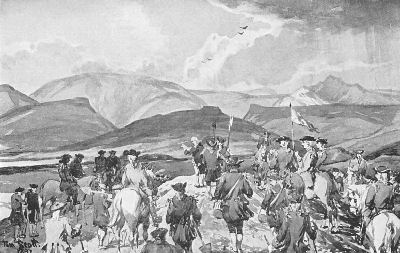
THE AULD CA-KNOWE: CALLING THE BURGESS ROLL
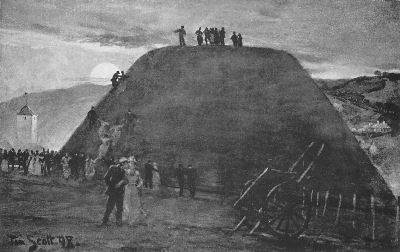
HAWICK MOAT AT SUNRISE
And in a note Dr. Murray adds:—
"The ballad now connected with the air of 'Tyribus' commemorates the laurels gained by the Hawick youth at and after the disastrous battle, when, in the words of the writer,
"'Our sires roused by "Tyr ye Odin," Marched and joined their king at Flodden.'
Annually since that event the 'Common-Riding' has been held, on which occasion a flag or 'colour' captured from a party of the English has been with great ceremony borne by mounted riders round the bounds of the common land, granted after Flodden to the burgh; part of the ceremony consisting in a mock capture of the 'colour' and hot pursuit by a large party of horsemen accoutred for the occasion. At the conclusion 'Tyribus' is sung, with all the honours, by the actors in the ceremony, from the roof of the oldest house in the burgh, the general population filling the street below, and joining in the song with immense enthusiasm. The influence of modern ideas is gradually doing away with much of the parade and renown of the Common-Riding. But 'Tyr-ibus ye Tyr ye Odin' retains all its local power to fire the lieges, and the accredited method of arousing the burghers to any political or civil struggle is still to send round the drums and fifes, 'to play Tyribus' through the town, a summons analogous to that of the Fiery Cross in olden times. Apart from the words of the slogan, the air itself bears in its wild fire all the tokens of a remote origin."[147]
We could not get better evidence than this of the survival of tribal custom, custom that is distinctly connected with tribes rather than with places or individuals, with groups of people who, now bound together by local considerations and influences, have only recently passed away from the far more ancient influences of the tribe. Alike in the forms of historical codes and in traditional local remains, we have found evidence of the use of rhyme for the preservation of unwritten rules and forms; and this use restores to tradition an important branch of its material.
We have thus ascertained that there is direct and acknowledged indebtedness of history to tradition. Its extent covers a wide area of culture progress, and of unbroken continuity from tribal to historic times. The legal codes of the barbaric tribes of Western Europe are the direct successors of the traditional originals; and because these legal codes, equally with their unwritten predecessors, cannot be dispensed with by the historian, they find their place unquestioned among genuine historical material. They are no more, and no less, historical than other traditional material. They are part of the life of the people rescued from prehistoric days, and they tell us of these days by the same sanction and the same methods as the rest of the traditional material which has been so strangely and so persistently neglected by the historian. The whole of tradition, and not selected parts of it, must be brought into use if we would follow scientific method, and I claim this for the study of folklore on the strength of the results which have now been brought together.
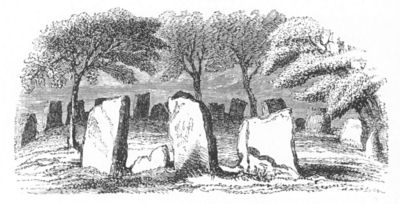
ONE OF FIVE STONE CIRCLES IN THE FIELDS OPPOSITE THE GLEBE OF NYMPHSFIELD
CARN-AN-CHLUITHE TO COMMEMORATE THE DEFEAT AND DEATH OF THE YOUTHS OF THE DANANNS
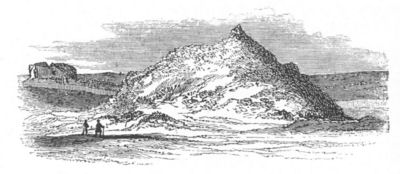
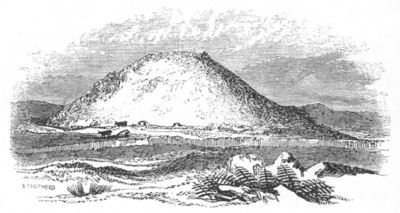
THE CAIRN OF BALLYMAGIBBON NEAR THE ROAD PASSING FROM CONG TO CROSS
IV
Here, however, we are close up to an important point of controversy. The mythologists claim tradition as theirs. It does not, they assert, give us the history but the mythology of our race. It tells us not of the men but of the gods. In explaining how this comes about, however, they have fallen into errors which it is not only necessary to correct but which are fundamental in their effects. We shall be better able later on to discuss the extremely important question of the position of the prehistoric tradition amidst historic life and surroundings, if we try to understand what the mythologists have done and not done in their attempts to claim exclusive property in the folk-tale. They have entirely denied or ignored all history contained in the folk-tale, and they have proceeded upon the assumption, the bald assumption not accompanied by any kind of proof, that the folk-tale contains nothing but the remnants of a once prevalent system of mythology. They ignore all the proofs brought forward by folklorists to the contrary, such proofs, for instance, as Mr. Knowles, Sir Richard Temple and others have produced concerning the Hindu folk-tale. What is not true of the Hindu folk-tale cannot be true of its Celtic or Teutonic or Scandinavian parallel, and yet in the most recent study of Celtic tradition, Mr. Squire takes its mythic origin for granted, and works through his ingenious statement without let or hindrance from other points of view. But even his thorough-going methods compel him to stop short at certain points, and to admit that he has come across historic fact. Thus he agrees that the Fir-Bolgs "were not really gods but the pre-Aryan race which the Gaels, when they landed in Ireland, found already in occupation,"[148] and yet when he treats of the fight of the Fir-Bolgs with the Tuatha dé Danann, and is confronted with Sir William Wilde's proofs that the monuments on the plain of Moytura are in agreement with the traditions concerning them, and point to the account of the battle being historical,[149] all that Mr. Squire can admit is that "certainly the coincidences are curious." He disposes of them on the ground that the "people of the goddess Danu are too obviously mythical to make it worth while to seek any standing ground for them in the world of reality." That standing ground might be found connected with the Tuatha dé Danann in many places, but Mr. Squire will have it that it is impossible, because "it was about this period that the mythology of Ireland was being rewoven into spurious history."[150] It is not, however, upon the mistakes of other inquirers[151] that the mythologists may rest a good claim for their own view. The Historia Britonum of Geoffrey of Monmouth disposes of neither the myths nor the history of the Celts. It shows myth in its secondary position, in the handling of those who would make it all history, just as now there are scholars who would make it all myth. In front of the legends attaching to persons and places is the history of these persons and places. Behind these legends lies the domain of the unattached and primitive folk-tale, Mr. Campbell's Highland Tales, Kennedy's Fireside Stories of Ireland, and those English tales which have been rescued by Mr. Clodd and others. This makes it impossible to see in the hero-legends naught else than the intangible realm of Celtic gods and goddesses.
Equally impossible is it to create for them a home in a system of "state religion," and yet a state religion is a necessary part of the evidence for mythological origins.[152] There was no Celtic state. Emphatically this was so. Everything we know about the Celts of Britain, both before and after the Roman conquest, both in Britain, where the Roman power was upheld for four centuries, and in Ireland, where the Roman power never penetrated, the Celts were possessed of a tribal, not a state polity; lived in tribal strongholds, not in Celtic cities; occupied tribal territories, not countries formed into states; elected tribal chiefs in primitive fashion, and not kings with state ceremonial; and when they come under the dominion of an incipient state policy after the conquest of the English and the Northmen, their laws are promulgated and codified, and show that both Welsh and Irish codes are tribal, not state law.
Not only do I fail to discover a state religion of the Celts, but I do not find it among the Teutons. There is greater evidence of discrepancies than of agreement in all the European religions, but these have not been dwelt upon by scholars. Professor York Powell, in one of his illuminating studies on Teutonic heathendom, is the only authority I know of who argues against the idea of a systematised religion. "It is important that we should at once throw aside the idea that there was any system, any organized pantheon in the religion of these peoples. Their tribes were small and isolated, and each had its own peculiar gods and observances, although the mould of each faith was somewhat similar. Hence there were varieties of religious customs among the Goths, Swedes, Saxons, and Angles."[153]
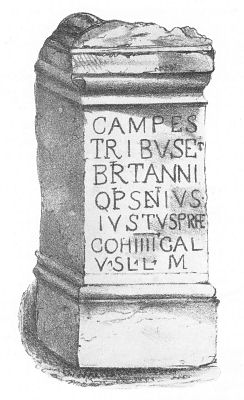
ALTAR DEDICATED TO THE FIELD DEITIES OF BRITAIN FOUND AT CASTLE HILL ON THE WALL OF ANTONINUS PIUS
Now if there was no state there could be no state religion. What existed of worship and religion was tribal. These are the historical facts, which have been neglected by students of myth and saga. I shall have to point out in greater detail presently what these tribal conditions mean to studies in folklore, but the word of warning and protest must come here, for it is unconsciously the conception of a Celtic state religion which gives even the semblance of possibility for Celtic mythology to be found in every hero-legend. It is, in short, the neglect of this among other historical facts which has led the folklorist into error of a somewhat magnificent kind. He attempts to create out of the myths of a people a mythology which provides gods to be worshipped, faiths to be organised, and beliefs to be the standards of life and conduct. Thus, as I have pointed out elsewhere,[154] Sir John Rhys has, in his acute identification of the worship of the water-god Lud on the Thames and of Nod on the Severn,[155] introduced the idea of a great Celtic worship established on these two great rivers as parts of a definite system of Celtic religion, whereas examination proves that the parallel faiths of two perfectly distinct Celtic tribes, the Silures on the Severn and the Trinovantes on the Thames, were welded into a common worship of the god of the waters by the masters of Celtic Britain, the Romans. There was no Celtic organisation which commanded both Severn and Thames until the Romans occupied the country, and occupying the country they adopted into their own religion the native gods and, fortunately for us, recorded their adoption in the pavements of their houses or their temples.[156]
Mr. A. B. Cook goes much further than Sir John Rhys. He attempts to dig out the European sky-god from all sorts of queer places, all sorts of forgotten records, thereby producing a wealth of folklore parallels for which every student must be profoundly thankful. But he does not make it anywhere clear that this universal god was gloriously apparent to his worshippers. There is no established connection between the sky-god and those who worshipped the sky-god, and we seek in vain amidst all the brilliant researches, which have been held to produce evidence of the sky-god, for evidence that he was worshipped by the Aryan-speaking Celt and Teuton. In point of fact, we never get at the worshippers at all. There is the assumption of a state mythology without any evidence for the existence of the state.
In place of this obvious necessity we get an immense abstraction, worked out with all the subtle ingenuity and learning of the Cambridge professor. Mr. Cook has, in fact, used the materials he has collected with such amazing care to project therefrom just those mythological conceptions which Celt and Teuton would have worked out for themselves if they, like the Hindu and the Greek, had developed the state while they were still free to develop their own native beliefs. This they never did, and so their fire worship did not advance beyond its early stages. It was separated from nature worship to become the servant of the European tribes. It helped them to develop tribal and family institutions. It produced for them a tribal and family worship. It did not get beyond this, because Roman institutions and Christianity stood in the way and prevented tribal fire worship from becoming anthropomorphised into a mythology. This need not cause us to doubt that the analogies claimed by these scholars are true analogies. There were among the Celtic peoples, as among other branches of the race to which Celt, Greek, Teuton, Scandinavian, and Hindu belonged, the incipient elements which would go to make up a national or state mythology, when the nation or the state emerged, as it did emerge in the case of Greece and of Rome, from its tribal originals. But the Celtic state did not emerge from tribalism in Britain; the Celtic heroes were always tribal heroes. They were, as Hereward and Arthur were, real human flesh and blood, fighting and raiding and loving and feasting in their tribal fashion as the later heroes did in their national fashion; because of their success as tribal heroes they had attached to them the tribal myths; because they died as nobly as Cuchulain died they left imperishable records among those for whom they died. They were more than gods to the Celtic tribesman—they were kinsmen.
The false conception of a state religion before there was a state, appears in other studies not primarily based upon folklore research, and not having in view anthropological results. It is the basis of the remarkable researches of Sir Norman Lockyer as to the astrological and solar origin of Stonehenge and other circles, and in his chapter which deals with the question, "Where did the British worship originate?" he finds himself bound to the theory of a borrowed civilisation which established the solar system.[157] This borrowed civilisation is Egyptian, but it is too much to ask mythology to supply not only a complete system of belief but a civilisation which belongs to it. What is needed is independent evidence of the civilisation. Without such independent evidence it is impossible to accept the deduction drawn only from one sphere of information.
The error of transferring to the domain of mythology events and occurrences which belong to history, is followed by an error of another sort, namely, the transferring to some general department of human belief the particular beliefs of a people, or of tribes of people. It is wrong to continue to label particular cults as nature myths, when they have already been transferred from that position to a more definite position among the beliefs of a people. Thus even so good a scholar as Mr. A. B. Cook, rightly interpreting Greek evidence of the hill-top fires and of the house fire, yet denies to the exactly corresponding Irish evidence the same interpretation, and argues that "the ritual of Samain, at which all the hearths in Ireland were supplied with fresh fire from a common centre at Tlachtga [is] almost certainly solar," and that "we shall not be far wrong if we suppose that the solar fires of Beltaine were the ritual of the sky god connected with the Ash of Uisnech."[158] Mr. Frazer, too, has interpreted these bonfires as mainly sun charms, and he sees in the Balder myth, and in the peasant customs all over Europe, which he asserts illustrate this myth, an ancient ritual which originally marked the beginning of the new year, when the tree spirit, or spirit of vegetation, was burned, the special reasons why the deity of vegetation should die by fire being that as "light and heat are necessary to vegetable growth, on the principle of sympathetic magic, by subjecting the personal representative of vegetation to their influence you secure a supply of these necessaries for trees and crops."[159] Mr. Frazer goes far afield for evidence. He does not see that the fire ceremonies which he collects from all Europe have a specialised significance, even in their last stages of existence as survivals, which is not found among the Incas, the African tribes, the hill tribes of India, and the Chinese, whom he cites as providing the required parallels. Parallel practices are not necessarily evidence of parallels in culture, and it is the failure to locate properly the several examples in relationship to each other which produces a loose and inadequate conception of the relics of fire worship in European countries, and the refusal to recognise its special place as the cult of a tribal people.[160] Another example of this fundamental error takes us in the very opposite direction to that of Dr. Frazer. Thus Dr. Gummere, in a recent study dealing with Germanic origins,[161] sees nothing in the fire cult of the Indo-European people but a branch, and apparently an undeveloped branch, of general nature worship, not specially Germanic or Indo-European, not specialised by the tribes and clans of these people into a cult far more closely connected with their doings and their life than mere participation in the general primitive nature worship could have afforded.
The danger of searching for a general system of belief and worship from the beliefs and rites of peoples not ethnically, geographically, or politically connected is very great, and I venture to think that even Mr. Frazer's remarkable researches into the agricultural rites of European peoples do not take count of one important consideration. I think his constructive hypothesis is too complex in process and too systematic in form to have been the actual living faith of the varied paganism of the European peoples. It would have meant as organised an institution as the Christian Church itself, and of this there is no evidence whatever. It would have meant an exclusive agricultural ceremony, and of this there is strong evidence to the contrary. It would have meant a deep system of philosophy, penetrating from the highest to the lowest of the people, and of this there is no evidence. The plain fact is that the historical conditions have been altogether left out of consideration in these matters, and we consequently do not get a complete study. We get the advocate's position. The case for the mythological interpretation of folklore has been put with full strength, but it is not the entire case.
V
This short survey of the relationship of tradition to history would not answer its purpose if we did not consider the complementary position which history bears to tradition. This may best be done by reference to the period before that occupied by contemporary native record. The history here alluded to is, properly speaking, only derived from one source, namely, the works of foreign or outside authorities. It is written by observers from a civilised country, travelling among the more primitive peoples of another land, and the Greek and Latin authors who relate particulars of early Britain were of this class. Their narratives have to be compared with the traditions written down as history by professed historians, who lived long after the events happened to which the traditions are said to relate, but who recorded the traditions of the people preserved in the monasteries by devotees who were of the people, or by the songs and rhymes which, as Henry of Huntingdon states explicitly, were used for the purpose.
Both the observations of the foreign historians and travellers and the recorded traditions from native sources have been treated with scant courtesy whenever they cannot be explained according to the views of each particular inquirer into the period to which they refer. They have been alternatively the subject of dispute or neglect by students for a long series of years. They consist of items which do not fit in with Celtic or Teutonic institutions as we know them from other and more detailed sources. They offend against the national pride because they tell of a condition of savagery. They do not appeal to the historian, because the historian knows little and cares nothing at all about the condition of savagery. If, therefore, they are not rejected as true history, they are purposely neglected. They are in any event never taken into consideration by the right method, and they stand over for examination by any one who will take the trouble to deal with them by the light and test of modern research.
It is not my purpose to deal with these matters now, but it is advisable that we should try to understand two things—first, how they have been dealt with by the historian; secondly, their true place in history.
The Greek and Latin authors who have stated of peoples living in Britain many characteristics which do not belong to civilisation or even to the borders of civilisation, range from Pytheas the Greek in the middle of the fourth century before our era down to the Latin poets of the early fifth century anno Domini. They all refer to the British savage. He is cannibalistic, incestuous, naked, possesses his wives in common, lives on wild fruits and not cultivated cereals, indulges in head-hunting, has no settled living-place which can be called a house, and generally betrays the characteristics of pure savagery.[162] Altogether there is a fairly substantial range of material for the formation of a reasonable conception of the condition of savagery in Britain.
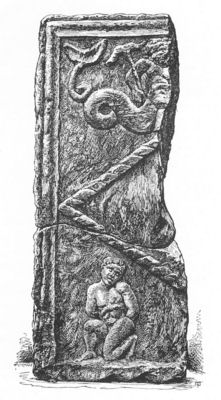
ROMAN SCULPTURED STONE FOUND AT ARNIEBOG, CUMBERNAULD, DUMBARTONSHIRE, SHOWING A NAKED BRITON AS A CAPTIVE
We need not dwell long upon the earlier of our historians who have neglected or contested the statements of the authorities they use. They hardly possessed the material for scientific treatment, and personal predilections were the governing factors of any opinion which is expressed. John Milton, in his brave attempt to tell the story of early England, does not so much as allude to these disagreeable points. Hume disdainfully passes by the whole subject and practically begins with the Norman conquest. Lappenberg says of the group marriage of the Britons that it "is probably a mere Roman fable."[163] Innes accepts the views of the classical authorities and argues from them in his own peculiar way,[164] but Sullivan will have it that the materials afforded from classical sources are worthless: "they consist of mere hearsay reports without any sure foundation, and in many cases not in harmony with the results of modern linguistic and archæological investigations."[165] Neither Turner nor Palgrave has any doubt as to the authority of these early accounts,[166] and Dr. Giles accepts the accounts which he so usefully collected from the original authorities.[167]
The modern historian cannot, however, be so incidentally treated. He lives in the age of the comparative sciences and of anthropological research. He sometimes uses, though in a half-hearted and incomplete fashion, the results of inquirers in these fields of research, but he nowhere deals with the problem fully. His sins are not general, but special. He agrees with one statement of his original authority and disagrees with another, and we are left with a chaos of opinion founded upon no accepted principle. If the earlier historians accepted or rejected historical records without much reason for either course, the later historians have no right to follow them. The terms "savage" and "barbarian," indulged in by the Greek and Roman writers, cannot be rejected by modern authorities simply because they are too harsh. They cannot be considered merely in the nature of accusations against the standing and position of our ancestors, made by advocates anxious to blacken the national character. Even scholars like Mr. Skene, Mr. Elton, and Sir John Rhys, though inclined to weigh these passages by the light of ethnographic research, throw something like doubt upon the exact extent to which they may be taken as evidence. Mr. Elton, though admitting that the early "romances of travel" afford some evidence as to the habits of our barbarian ancestors, cannot quite get as far in his belief as to think that the account of "the Irish tribes who thought it right to devour their parents" is much more than a traveller's tale.[168] Sir John Rhys is not quite sure that the account by Cæsar of the communal marriages of the British is "not a passage from some Greek book of imaginary travels among imaginary barbarians which Cæsar had in his mind,"[169] though he notes elsewhere that "the vocabulary of the Celts will be searched in vain for a word for son or daughter as distinguished from boy or girl" as a fact of no little negative importance in relation to Cæsar's "ugly account;"[170] and he has similar doubts to express, noteworthy among them being the passage from Pliny which illustrates the Godiva story.[171] Mr. Skene lays stress upon the fact that Tacitus "neither alludes to the practice of their staining their bodies with woad nor to the supposed community of women among them;" and he offers some kind of excuse for the Roman evidence as to the tattooing with representations of animals,[172] evidence which Sir John Rhys, too, is chary of accepting in its full sense. Mr. Pearson reluctantly accepts Cæsar's account of the group marriage and the human sacrifice of the Druids, but he ignores all else, including the attested cannibalism of the Atticotti, though he mentions that tribe in another connection.[173] Sir James Ramsay agrees that the Britons tattooed their bodies with woad, recognises the fact that their matrimonial customs were polyandric, and that brother-and-sister marriage obtained, and generally accepts the prevalent ideas as to Celtic Druidism with its sacrificial rites and the system of "state worship." He rests his views for much of this upon the anthropological evidence in support of it.[174] Mr. Lang on behalf of Scotland, and Dr. Joyce on behalf of Ireland, have their say on the evidence. Mr. Lang seems to accept Cæsar's evidence "if correctly reported," throws doubts upon the ethnological value of such customs, and declares roundly that to found theories upon such evidence as archæology provides "is the province of another science, not of history."[175] Dr. Joyce says that in early Greek and Roman writers there is not much reliable information about Ireland, though he believes them when they talk of students from Britain residing in Ireland and of books existing in Ireland in the fourth century.[176]
This meagre result from the historians seems to me to be most unfortunate. Even when the testimony of early writers is accepted, it is accepted without the necessary filling in which such an acceptance warrants. Bare acceptance does not tell us much. Each recorded fact has a relationship to surrounding facts, should lead us to associated facts which, escaping observation by early writers, can nevertheless be restored. In history they are isolated and unconnected, because of the faults of the historian who records them. Anthropologically they belong to a wider grouping, reveal a connection with each other which is otherwise unsuspected, and prepare themselves for treatment on a larger platform. The historian has used them for the unprofitable controversy ranging round the question of early Celtic civilisation, whereas they clearly belong to the history of early man, and even the folklorist does not disdain to cast them on one side when they do not suit his purpose.[177]
It is still more unfortunate that Sir Henry Maine should have sought to enhance the value of his Indian evidence by contrasting it with what he calls "the slippery testimony concerning savages which is gathered from travellers' tales,"[178] and that Mr. Herbert Spencer should have replied to this in an angry note, declaring that he was aware "that in the eyes of most, antiquity gives sacredness to testimony, and that so what were travellers' tales when they were written in Roman days have come in our days to be regarded as of higher authority than like tales written by recent or living travellers."[179] The scorn passed upon "travellers' tales," the application of the term "romance" to the early descriptions of voyages, have done the same amount of mischief to these early chapters of history as the constant disbelief in the value of tradition has done to the testimony of folklore.
Now I do not recall these controversies, or lay stress upon what appear to me to be the shortcomings of the historian and folklorist in their relationship to each other, for the purpose of reawakening old antagonisms. I have merely selected a few illustrations of the present position of the subject in order that it may be seen how essential it is to proceed on other lines. All the items which have formed the subject of dispute, together with others which have escaped attention—items which have found their way into history by accident, which are by nature fragmentary and isolated, which do not connect up with anything that is distinctively Celtic or Teutonic, and which do not apparently fit in with any standard common to themselves—must command attention if only because they alone cannot be cut out of history when items standing side by side with them are allowed to remain, and in the end it can, I think, be shown that they command attention because of their inherent value.
The method of investigation as to the importance and significance of these earliest historical records must be anthropological. They are in point of fact so much anthropological data relating to Britain. It is no use calling them history, and then defining that history as bad history simply because as history the recorded facts do not appear to be credible. As a matter of fact they belong to the prehistory period of Britain, and to test their value scientific methods are required.
In the first place, anthropology shows that there is no primâ facie necessity for calling them Celtic, thus identifying them with that portion of our ancestry which is Celtic in race; for there is evidence of a non-Celtic race existing in prehistoric times, and existing down to within historic times, if not to modern times. Mr. Willis Bund has recently summarised the evidence from archæology, philology, and tradition as it appears in a particularly valuable local study of ancient Cardiganshire, stating it "to be agreed that there was more than one race of early inhabitants, and two of the sources say that there was an original race and at least two distinct races of invaders," and further, "that whoever the original inhabitants were they were not Celts."[180] These original inhabitants, who were not Celts, have left their remains in the barrows and megalithic monuments which still exist in various parts of the country, and anthropologists show that they have not entirely disappeared from among the race distinctions observable among the people of these islands. If it is possible to proceed from this to another stage, and to show from the British evidence what Mr. Risley has so well illustrated from the Indian evidence, namely, that gradations of race types as shown by anthropometrical indices correspond with gradations of social precedence and social organisation,[181] it may yet be possible to prove that the people who were not Celts were the people with whom originated those recorded customs and beliefs which are rejected as too savage for the Celt. Unfortunately, we know nothing about them, except the isolated scraps which are to be picked up from the early historians. This compels us to turn to other sources of information, and when we do this we find that British folklore preserves in traditional custom, rite, belief, and folk-tale, parallels to each and every item of savagery mentioned by the early historians of Britain; and further, that anthropology shows clearly enough that among the customs and beliefs of primitive races there are to be found parallels to every item of custom and belief recorded of early Britain. This gets rid of one of our greatest difficulties, and disposes of Dr. Sullivan's unwarranted assertion to the contrary (ante, p. 113). The recorded customs and beliefs of early Britain are proved by this means not to be impossible or improbable factors in the elements of the British prehistoric race. It will not be possible to term them inventions of romance or of false testimony, simply on the ground that they are not found elsewhere. On the contrary it will, I think, be difficult to resist the conclusion that inventions such as these, covering a wide and ascertained area of sociological and early religious development, could hardly have been made by historians having the limited range of knowledge possessed by the native and classical writers who are responsible for the facts. It is an easy, but not a satisfactory method of criticism to declare what is not to one's liking to be invention and romance, and it has until late years been difficult to combat such an argument. The battle has raged round wordy disputes, the merits of which are governed by the abilities of the respective disputants; that this is no longer possible is due to the fact that there have entered into the fray the methods and results of folklore which prevent the terms invention and romance from being applied, except where there is good independent reason for their use.
I have now dealt with all the points which appear to be necessary in order to show the inherent relationship of folklore to history, and I have shown causes for resisting the claims of mythology to appropriate what it chooses of folklore, and then to reject all the rest from consideration. I have dealt (1) with examples of local traditions and hero-traditions, in their relation to history and historical conditions; (2) with the folk-tale in its retention of details of early historic conditions, and of the picture of early tribal organisation, and in that its structure is based upon the events of savage social conceptions; (3) with the early laws and rules of tribal society preserved by tradition and accepted in historical times; (4) with the claims of mythology to interpret the meaning of folk-tales, and the reasons for rejecting this claim; and (5) with the treatment by historians of statements by classical writers as to the condition of the peoples inhabiting Britain before the dawn of civilisation. I think it will be admitted that, without pretending in any way to have exhausted the evidence, or even to have thoroughly comprehended and satisfactorily stated it under each of these heads, a very considerable claim has been made out for the historical value of folklore. If so much has been gained it will rest with folklorists to pursue investigations on these lines, and it will remain with the historian to consider the results wherever his research leads him into domains where the evidence of folklore is obtainable.
It will be seen that the problems which the two sciences, history and folklore, have to solve in conjunction are not a few and that they are extremely complex. They cannot be solved if history and folklore are separated; they may be solved if the professors in each work together, both recognising what there is of value in the other. History in its earliest stages is either entirely dependent upon foreign authorities, or it has to follow the practice of the earlier and unscientific historian and to deny that there is any history, or at all events any history worth recording, before the advent, perhaps the accidental advent, of an historian on native ground. History in its later stages is dependent upon the personal tastes or ability of each historian for the record of events and facts. Folklore in its earliest stages has brought down from the most ancient times memories of ancient polity, faith, custom, rite, and thought. In its later stages it has preserved custom, rite, and belief amid the attacks of the progressive civilisation which has been developed, and it has clothed heroes of later times with the well-worn trappings of those of old. Combined history and folklore can restore much of the picture of early times, and can work through the fulness of later times with some degree of success. There is needed for this work, however, a clear conception of the position properly held by both sciences, together with established rules of research. This is more particularly needed in the department of folklore. I do not pretend to be able to formulate these rules. In the subjects dealt with in this chapter I have indicated a few of the points which must be raised, and my object will be in the remaining chapters to set forth some of the conditions which it appears to me necessary to consider in connection with the problems with which folklore is concerned as one of the historical sciences.