STORIES ABOUT ALL SORTS OF THINGS (continued 2)
Reading edition
You would not have known it if you could have seen it, and, what is more, you would not have wanted to see it; you would have been afraid to come near enough.
You could not have found Lake Michigan on it nor even the Atlantic Ocean nor the Rocky Mountains, and the reason you could not have found them is, they were not there. There was no Lake Michigan and no Atlantic Ocean and no Rocky Mountains.
You see, they had not been made yet. All the water and minerals were bubbling and seething and whirling around in the most awful storms. You would have wanted to get as far from the earth in those days as you possibly could; not even the North Pole was cool enough to rest upon with any comfort.
193This went on for a few millions of years probably, but the earth was all the time getting a little cooler, until it got so cool that things began to harden and the dry land to appear. But mother earth was in a state of terrific excitement even then, and every once in a while would heave such a sigh that an earthquake or volcanic eruption would break forth. But as old earth, or young earth I suppose it was then, grew older and calmer, it settled more and more into its present form. It got so cold and old after awhile that it became wrinkled, like the skin of an apple in the late fall. You know how that is. Only mother earth was a very large apple and her wrinkles were very deep, and in fact they made the great mountain ranges.
You need not believe all this unless you want to, but it is true,—that is, the wise people, who know more than you and I ever will, say so.
But what has all this to do with leaves?
It has as much to do with leaves as the fire in the stove has to do with the boiling of the tea kettle.
Of course, while the earth was in this overheated state, nothing could grow on it. But it kept getting cooler and cooler, until at last life began to appear. Just exactly what this first life looked like I do not know. Nobody does, because, you see, nobody was 194living then to tell about it and write it down. But very likely queer mushy plants were the first to come along, and they were about all leaf. So far we may be pretty sure.
After awhile plants with stems and leaves grew up and flourished.
They were queer enough, no doubt, for there are pictures of some of them which the rocks took and kept for us, and people often break open a rock nowadays and find these old plant pictures.
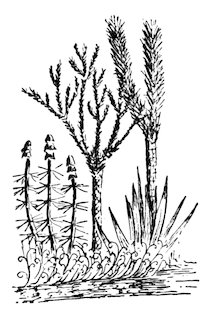
They are what we call fossils, and now I have no doubt you know all about it; if you do not you will some day,—that is, if you care to.
From what the rocks tell us, and for other reasons, we feel pretty sure that the earlier plants had only leaf and stem, but no flowers. And the very first leaves were not like the leaves we see in the woods and gardens about us, for they were probably large and mushy and had no veins to speak of. If you had picked one up it would have been flabby and squashy, and you would have been glad to put it down again. But nobody ever did pick one up, because nobody was there.
The earth was not ready for us yet. It was all soft and swampy or hard and cheerless, and we had 195to wait until these queer pioneer plants gradually changed into other plants and made the earth fit to live on.
But these flabby old friends of ours went to work with a will to get things in shape for us to come. Their green leaves and stems, where they had any, ate the gases in the air and stored them up as plant material. Then they died. They did us as much good by dying as by living, for only part of their substance went back as gases into the air; the rest went into the ground and began to make soil for other plants to grow in.
So Mr. Flabby Leaf was a very good life starter.

One thing we are quite sure of, and that is, these earlier plants did not have any seeds. When new plants came from the old ones, they merely sprouted out from the leaves or the roots, as a certain fern that grows in Fayal and other places does to-day. It is fun to raise this fern in a window box and watch the young ferns sprout out of the edge of the leaves of the old fern. After they get two or three tiny green leaves and the cunningest little curled-up frond, just like a big fern, off they tumble down to the ground, where they strike root and grow as calmly as though they had come the regular plant way and sprouted from a seed.
196They do come the regular way the very early plants did, instead of coming the way modern plants do, for in some such way the earlier plants, no doubt, reproduced themselves.
They had no flowers and no seeds. Leaf and stem did it all. You see, these first plants were simple people, not complicated at all, and so each part of the plant was able to do all its own work. But after awhile the plant world became more complex; the earth grew drier, for one thing. The first plants lived in the water, no doubt, and so everything was much easier for them; at least they could always get plenty of water, which is a matter of great importance with plants.
No water, no plant. Then, too, the earth cooled more and more, and from being uniformly warm and moist, which was just the best conditions for plants to live without taking any trouble about it, the air was sometimes colder and contained less moisture.
So the plants that grew on the land had to invent ways of getting and keeping an extra amount of water, and even those that lived in the water had to look around and find a way of protecting themselves against changes of temperature.
197
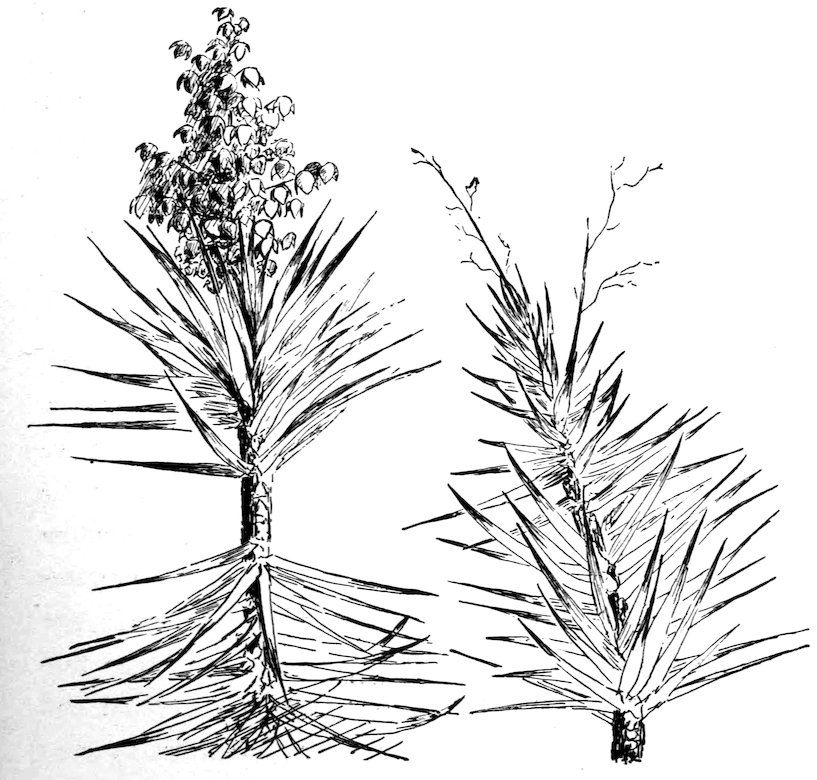
As the earth grew cooler and drier, and the changes from hot to cold at the different seasons became more marked, the plants that grew on the prairies and mountain sides, where it was very hot and damp at one season and very dry or very cold at another, had to find ways to protect themselves against these changes. So the leaves and stems began to be a little more particular about their work. The leaves may have said, “We will do one kind of work in one part of us and another kind of work in another part. We will have stiff veins and ribs to protect us from being 198blown to pieces, and we will have our sap flow through veins, instead of soaking all through us everywhere. And we will have a thick skin to breathe through and to protect us from the sun when it is too hot.”
So some lived on the hot plains with small, thick, hard leaves, and others lived in the damp shady woods with large, thin, tender leaves.
Thus, you see, there came about a division of labor. Not all at once,—oh, no! but so gradually, so very gradually that, had you been watching these plants grow from year to year, you could no more have seen any change than you can see a blade of grass grow to-day, although you know it does grow. Perhaps the plants on the edge of a swamp were the first to change.
Perhaps the water receded and so gradually left them higher and drier. As they got less water, they would have to do one of two things,—change to suit the new state of affairs or give up trying and die. Very likely a good many died; the water may have receded too rapidly, or they could not see just how to change. But others did see, and they stiffened their flabby leaves with ribs and veins and made for themselves a thicker skin, and so lived on. They survived because they were the fittest to survive. 199And now you know the meaning of that very celebrated saying, “the survival of the fittest”; whatever plant or animal can adapt itself the best to the place it lives in is the fittest, of course, for that place, and so it survives or lives on.
No doubt, in those early days, new plants grew out of the old ones just anywhere as the baby plants grow out of the leaf of the Fayal fern I told you about.
But as life grew more and more difficult, as the plants had to contend with too much heat at one time and too great cold at another, with now a season of moisture and now one of great dryness, their leaves, as you know, began to change and divide up the work. A part of the leaf breathed for the plant; another part ate for it; another part protected it. Nor was this all. Some leaves did one kind of work and some another, as time went on.
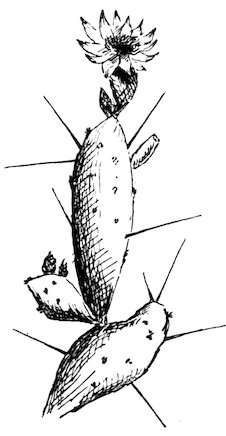
When animals came upon the earth they ate the plants, and so the plants had to partly protect themselves to keep from being entirely destroyed. Thus some plants changed part of their stems or leaves into sharp thorns, as we see to-day in the hawthorns and cactuses. Some, like the mullein, covered their leaves with a disagreeable wooly substance that stuck to animals’ mouths and made them avoid the 200plants. These wooly coverings served two purposes,—regulated evaporation and protected from the attacks of animals. Some, like the aconite, manufactured a poisonous, disagreeable juice, while others, like the nettle, clothed the stems with stinging hairs.
There are many, many ways by which plants have changed their leaves and stems in order to protect themselves from being eaten, and all this came about very, very gradually.
While these things were happening, other things were happening too. Wherever there is life there is change. Living things keep changing all the time.
The little fern that drops from the leaf of its parent is, in a general way, like the parent, but it is not exactly like its parent; it is itself and has some peculiarities of its own. You see, it changes a little from the parent form or, as we say, varies. Every living thing has this power to vary within limits. No doubt, the power of variation was much greater in early times, and animals and plants were able to change much more then than now.
As time went on, things sort of settled down, as it were, and stopped changing so rapidly.
201But way back in the early ages the plants changed a good deal. And all they had to work with, you will remember, was just stem and leaves,—not another thing. But that was enough. They could change stem and leaves into thorns, as we know, and they could do something else. They could change leaves into pistils.
When the leaves divided their work, some plants devoted certain of their leaves to the task of making new plants. Ferns show this up to this very day.
Look at a clump of ferns in the woods any time in the middle of the summer or later, and you will see that some of the fern leaves have little dark spots on their backs. Sometimes these dots are on their margins, sometimes on the ribs, and sometimes scattered everywhere over the back of the leaf.
These dots are little cups filled with a fine dust, which falls on the ground and finally gives rise to more ferns. It is sometimes called fern seed, but the bits of dust are not exactly seeds. In the end they answer the same purpose, however. Well, suppose one of these fern leaves with the dots growing on it should curl over backwards until its edges met, and suppose the little grains should become true seeds, then we would have a very good ovary with the ovules inside.
202Fern leaves do not act in this way; they are too old-fashioned. But some of the leaves in flowering plants do. They just roll up into a pistil, with young plants, in the form of seeds, growing inside.
And to this day that is all a pistil is,—a leaf, or a whorl or circle of leaves, rolled together, with seeds growing along the inner part. Of course, in time, these pistil leaves changed very much, and to-day we find all sorts of pistils, and by just looking at them, we would never suspect they were leaves or ever had been. And they are not leaves any more, and they themselves never have been leaves; but long ago the pistils of their ancestors were leaves or parts of leaves, and they have inherited and improved upon these pistil leaves, as a boy improves upon a willow twig and makes it into a beautiful carved whistle that does not look at all like a willow twig, and yet that is just what it is at heart. So you see, one of the most important parts of the flower is, after all, “nothing but leaves.”
After seeing how the pistil, with its seed-children, is modified leaves, you will not be surprised to learn that stamens, too, are merely modified leaves. Anyway, whether you are surprised or not, that is just what they are. Tender little leaves folded a part of 203themselves together into little rooms or cells, and on the inside of these cells the pollen grains grew.
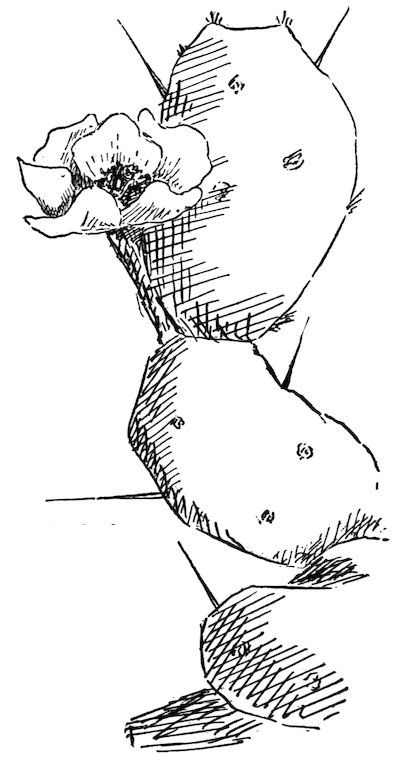
Now the plant was all fitted out. It had flowers, not very beautiful ones, to be sure, as they had nothing but pistils and stamens. Still they were flowers, and flowers are flowers whether they are bright or not.
Pistils and stamens were enough at first. But times change. Each plant tried every possible means to make strong seeds, so it could live in the crowded world. It did not wish to be crowded out, you see. So when it discovered the value of cross-fertilization, it began, so to speak, to invent ways to bring this about.
The insects with wings came to it and brought it pollen, so it learned to coax the insects to come oftener. It made quantities of pollen, so the insect could eat what it would and still leave enough for the plant.
It, no doubt, had several rows of stamens, as a wild rose or a cactus flower has to-day. But it soon found out a good use to put some of these stamens to.
204It wanted the bees to see and come, so it changed some of its stamens into petals.
The anthers ceased to grow, and they and the filaments spread out broad and bright. So, you see, petals, too, are nothing but leaves,—very much changed leaves, true, as they were first leaves, then stamens, and then petals, but that does not prevent their having come from leaves after all.
If you want to see how it is done, look at a water lily next time you get a chance.
Unless it is a very unaccommodating lily indeed, you will be sure to see stamens changing into petals.
Some of the inside petals are small with an anther at the tip.
Of course flowers do not go through all these changes every time they bloom now. They used to way, way back, when things were in a general state of change, but after awhile they found out just how to do it, and so out of the tiny buds at once made pistils and stamens and petals and sepals.
For sepals, too, came from stamens. The plants made all these new forms out of the materials of their leaf buds and wrapped them all together into a flower bud; so when this opened, there were the parts all ready to go to work without any more shifting around.
205The calyx was ready to protect, the corolla to call the bees and butterflies, the stamens to make pollen, the pistils to make ovules.
Sometimes flowers forget and go back to the old ways of doing things; and if we are lucky enough to find such a flower, we can see just how it happened.
Sometimes roses behave in this peculiar way, and the flower goes back to leaves.
I used to know a bush whose roses did that. The pistils were leafy and also the stamens, and sometimes a branch grew right out of the middle of a rose as it does out of a leaf bud. Of course it was a very ugly-looking thing, neither flower nor leaf, but it was very instructive.
What do you suppose double flowers are?
Very often they are only flowers whose stamens have changed into petals.
A double rose has fewer stamens than a single rose, and sometimes all the stamens are changed, and the rose has not a grain of pollen to help itself with. What becomes of its seeds? It does not have any, as a rule. Where flowers become very double, the vitality goes to make petals instead of essential organs, as stamens and pistils are called, and such flowers often set no seeds.
206Then how do they continue the life of the race?
Sometimes simply because somebody takes care of them. Almost always double flowers are cultivated ones. People take them and tend them, give them rich soil to grow in, water them, and, if necessary, keep them warm. Such plants seem to grow lazy and helpless, as rich people who pamper themselves a great deal always do. They have all they want without any effort of their own, and so they cease to be self-supporting; they cannot even raise their own children, but live and die seedless. Such plants, if left to themselves, would quickly die, as they would be crowded out by sturdier growths, or else they would change their habits at once and become good seed-setting, industrious plants once more, with a tendency to stop having double flowers.
There are one or two things about corollas that I am sure you would like to know. One is, how did the flowers manage to change stamens into corollas? Another is, how did they manage to give them such bright colors?
About corolla-making,—if you are determined to know that, you will have to take yourself off to that far-away time when there were no flowers. Then, in course of time, while changing about and trying to get fitted to their surroundings, the plants, as 207you know, rolled some of their leaves into pistils and stamens. But still they had no petals.
The pistils and stamens were flowers, however,—as much flowers as they would ever be, no matter how much corolla they might develop.
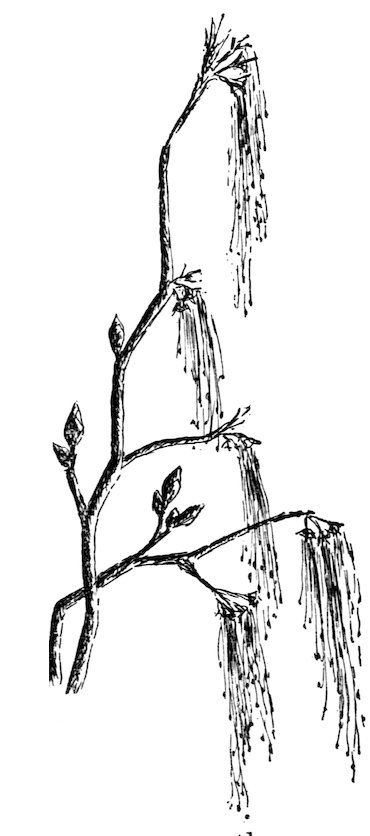
A corolla does not make a flower; by this time you know the important part of a flower is the pistil and stamens, and so, even to-day, some flowers, as the elms and some maples, have no petals at all. When such maples are in bloom, you will see gay fringes decorating the trees. This fringe is made of the long pedicels with the stamens at the end. The stamens swing in the breeze, and the pollen is blown to the stigmas which are often in flowers on different trees.
Now, as plants grew and adapted themselves to their surroundings, they produced more seeds than could by any chance find room in the earth to grow. So every little seed that fell had to fight its way with a host of other seeds and plants. A defective seed or a weak one would 208stand no chance at all. The others would crowd it out. We know how that is in a garden. The delicate flowers have to be helped or the strong weeds would kill them. We pull up the weeds and let the flowers have the whole garden to themselves. But in the woods and fields each plant has to take care of itself and struggle up as best it can.
This fight of the plants for a place to grow in is called the struggle for existence. Now, whatever would help a plant in the struggle for existence would, of course, be of great benefit to that plant. As we know, cross-fertilization is a very great help; it makes stronger and better seeds, and the plants whose seeds were regularly cross-fertilized would be the ones to survive.
Where pistils and stamens are forming, there is a great deal of nourishment brought to that part of the plant, and substances are being changed there. Very often sweet juices are present. Long ago when insects, in flying about, smelled these sweets they doubtless would go and eat them, and they would also eat the pollen. As they went from flower to flower looking for food, they would carry pollen sticking to their legs or bodies, and so would sometimes fertilize the flowers.
The seeds from such flowers would be strong and 209would have the best chance to survive. The plants that grew from these seeds would also inherit the tendency to secrete sweet juices near the flower.
In probing for sweets, the insect would irritate the parts it touched, and this would cause an extra flow of sap there and very likely the manufacture of more sweet juice; so the nectary came to be developed.
You can understand how this might be by recalling how the skin of your hand changes when you first try to do some new and hard work, like rowing a boat.
After you have rowed a little while your hand is blistered. The constant rubbing of the oar in one place has irritated it, just as you can imagine the tongues of the insects rubbing against the delicate flower tissue would irritate it. Wherever a place on the skin is irritated, the blood flows to that spot; and so in the plant, where it is irritated, there will likely be a collection of sap. After the blood has flowed to the place on your hand which was rubbed by the oar, the spot becomes red and inflamed and pains you, and finally the skin separates in the form of a blister and a new skin forms underneath; and if you keep on rowing, your hand does not keep on blistering, but actually makes a new kind of skin to protect the rubbed places, and what we call a “callous” or hard spot is formed. The skin is many 210times thicker here than elsewhere, and was formed on purpose to protect the place. So we can understand how irritation might change a plant organ and in time form a nectary.
But how about petals, you are asking. Well, imagine yourself in those old times when plants made their first flowers out of pistils and stamens only.
These primitive flowers were probably not very showy. Primitive flowers means first flowers,—flowers that lived way back in the beginning of plant life.
They had no petals, but they secreted juices which the insects liked. Those early insects were queer fellows, too, not very much like our insects, except that they were fond of sweets and liked to eat the tender parts of the flowers, just as our insects do to-day. They ate nectar when they could find it and did not disdain pollen, which, it is to be feared, they sometimes ate, anther and all; and, what is worse, they in all probability frequently dined on pistil, which was very bad for the plant.
Now imagine one strong plant secreting a good deal of nectar. The insects would be likely to eat this and let the pollen and pistil alone, only in getting to the nectar, they would be apt to dust the 211pistil with pollen from another plant which they had been visiting and would also brush off some pollen against their bodies.
Thus the strong plant with the abundant nectar would be cross-fertilized and would keep its pistil unharmed. It would be very likely to develop good strong seeds that would grow and again bear strong flowers with plenty of nectar. Now, remember the essential organs—that is, stamens and pistil—seem to find it a little easier to change than other parts of the plant; so it would not be surprising if in time some of the stamens were to become different. You see, the insects in visiting the flowers would irritate them more or less walking over them and clinging to them, and they would be likely to undergo change for this reason; and if it happened that in some flower a row of stamens got too full of sap to know what to do with themselves and so spread out a little broader and more leaf-like and kept their yellow stamen color or bleached-out white, that flower would be seen far and near and the insects would go straight to it, for insects have the sharpest kind of eyes for seeing bright colors a long way off. You see what would happen; all the flowers whose stamens had done so would be abundantly cross-fertilized,—that is, all their seeds would get fresh 212pollen from another strong plant, and the plants growing from these seeds would inherit the tendency of their parents to form petal-like parts from some of the stamens. The flower could well afford to lose part of its stamens for this purpose. Of course as time went on, these stamens, which were half petals, might develop more and more in the direction of signals,—that is, might become more and more perfect petals, finally losing all trace of their old life as stamens.
Of course no one can say that is just the way it came about, but it is likely that in some such way it happened, for there are proofs of it which you may like to read when you grow older.
So, you see, flowers are nothing but leaves after all,—very much changed leaves, to be sure, but yet just leaves.
Sometimes when plants and animals have changed into a new form, they change back again. We know some plants which once had petals but which have again lost their petals and gone back to a form which has no petals. Such backward changes we call retrogression, and it is sometimes difficult to find out whether a flower with no petals is a primitive form which for some reason has not changed or whether it is one which has changed and gone back 213again. Usually, though, we can find traces of petals and sepals in flowers which have retrogressed.
You see, a flower depends upon its surroundings for its shape. If its surroundings (and of course this includes its insect visitors) are such as to favor its growth in the line of petals, it does so. But if for some reason it becomes easier for it to grow and be fertilized in some other way, perhaps by making abundance of light pollen which is blown by the wind, as in the maple trees, then it may gradually lose its petals, as it depends less and less on insects and more and more on the wind for cross-fertilization. Nothing in life stands still; it is always moving,—going on or going back. And this, we know, is just the same in human life.
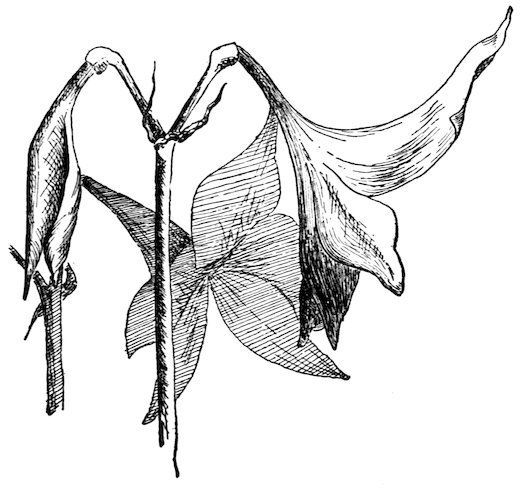
We cannot stand still; we must keep growing wiser and stronger and better, or else we must do the opposite.
214
SIGNS OF OTHER TIMES.
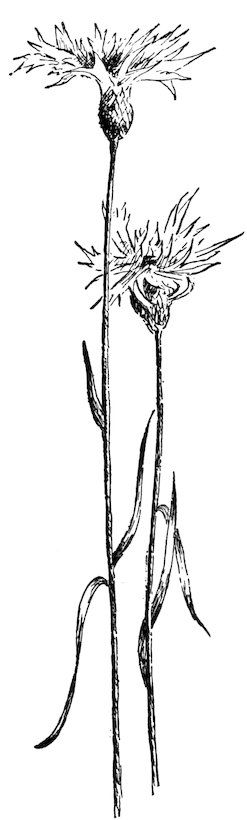
In the beginning flowers seem to have had their petals all separate from each other. Some do still, and these we call polypetalous, because “poly-” means many, and they have many petals. But other flowers, like our morning-glory, have no separate petals; all are grown together into a tube with a bright border.
But this tube and border tell us a little story if we are able to hear it.
They tell us of the time when the morning-glory had several petals. More than this, they tell us just how many it had. If we were to guess we should probably say five, because it seems so fond of the number five, with its five nectaries, five nectar guides, five stamens, and five sepals.
If we guessed five we should guess just right. There is no doubt but that once upon a time the 215plants from which our morning-glories are descended had five separate petals. The morning-glories themselves manage it differently now, but it took them a long time to do it. They were working away, long before the great pyramids of Egypt were built, to get their five petals united into one piece. But it is done, and they have learned how to twist the flower up tightly in the bud and then unroll it in all its glory.
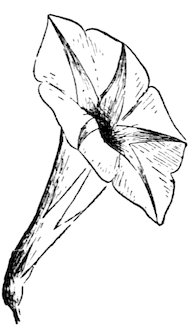
They never have five petals now, but they still bear traces of it.
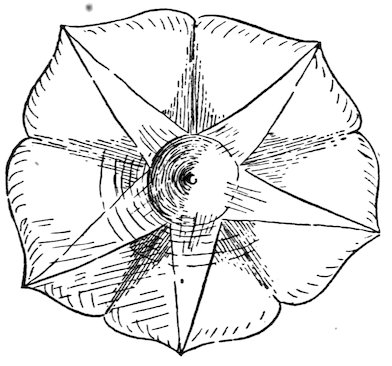
Look at the little notch on the border, halfway between two nectar guides. Does that tell us anything?
Count the notches. Five, you see.
Look at the line that runs from the notch down to the bottom of the flower.
The corolla looks as though it had been folded along those lines. You can easily see five long creases ending in a notch. The flower is folded along these lines in the bud, but we think the lines have yet another meaning.
Carefully tear the corolla down the lines; you see, a very little pressure does it. Now we have the corolla in five parts, like five petals, only it is so weak it can no longer hold itself up. Once upon a 216time we think it grew this way, with five separate petals, only the petals stood up then, for they must have been stiffer and perhaps were not so long. It was long, long ago, oh, very long ago, that it had its five petals. Then the edges of the petals began to grow together, and they kept on doing this until, in course of time, the whole length of each petal had grown fast to the next one, all except that little tiny spot where the notch is.
We are glad our morning-glory kept this little notch and the line where the sides of the petals grew together, for that is what tells us the story of long, long ago when all the petals were separate.
When finally they were grown together, the corolla did not need to be so stiff, for its shape helped to make it firm, and then it no longer used good material to make stiffening for the petals, for that would have been a waste of plant sap, and plants do not like to waste materials. When they find they can get along without something they have been used to having, they stop making it. Life is too short and too precious to waste a bit of it. Our flower only kept the stiffening in the corolla along the paths where it wished the bees to go to its honey cups and where, when folded, it could best protect the bud.
217The morning-glory, you see, is as wise as it is beautiful.
218
WHY ARE THE FLOWERS SO LARGE AND BRIGHT?
Why are the flowers so large and bright?
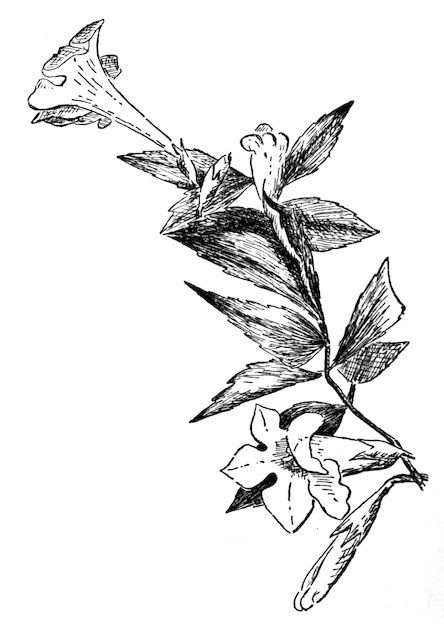
We cannot say that they were always so. It is probable they were not. But good Mother Nature has watched over them as they came upon the earth, and she has lovingly made them so large and bright.
How could she do this? Let us see. Here is a tangle of plants. They all bear flowers and all set seeds. Some are stronger and more beautiful than others. The seeds fall to the ground. Those from strong and beautiful plants are larger and stronger than the others. After a while the seeds sprout. Not all do this, however. The very weakest do not sprout. Dear Mother Nature has other work for them. “You are not suited to struggle in the earth with the strong seeds, dears,” she whispers 219and lays them to rest. They do not wake up; the materials in them change. These materials let go of each other; they depart from the seed; some as gases float off in the air; others as minerals sink in the earth. The gases and the minerals are not lost. They join some other plant and help to make it strong.
“It is better to help another than to try to grow yourselves,” Mother Nature whispers to these little seeds that could not sprout. And they are happy. They are glad to change into gases and minerals and help another plant to grow.
Many of the seeds sprout, but not all grow up and blossom. There is not room in the earth for all the seeds to grow; there is not food enough in the air to feed so many. Mother Nature with her kind eye looks over the growing plants.
She smiles and shakes her head at those trying to grow in shady places.
“No, dears,” she whispers, “there is other work for you to do.” Then the shaded seedlings do not try any more to grow into plants. They give up the materials they have collected to the little brothers and sisters who have started in the good ground and the sunlight.
They fade away, but they are happy, for they, too, 220are doing their work. The materials in them let go of each other. They change into gases and float off in the air, or to minerals and other substances and sink to the ground. These gases and solid substances pass into other plants and help make them strong.
“It is better to help another than to do poor work alone, dears,” Mother Nature whispers, as she lays them to rest.
Then she visits all the weak plants, and all those in poor soil or in too much light or too much shade, and lays them to rest. Their materials go to nourish the strong plants, who are doing good work in the world and growing in beauty. Not all the plants that live to blossom are good alike. Some are better than others, but Mother Nature lets them grow if they are strong enough and can find food. At last the blooming comes. The flowers do their best. The strong ones make large, bright flowers full of color and full of sweetness. Mother Nature smiles at them and is pleased. The weaker flowers do their best; they are not so bright nor so large. Mother Nature smiles at them, for she loves them, too, and she will tell them what to do. The bees come and fly to the brighter flowers; they have rich, abundant pollen and rich nectar. The bees know this; they do not care so much for the duller, smaller flowers.
221When the bees do not come, Mother Nature whispers to the little flowers, “Never mind, dears, there is work for you to do.” So they are happy, though their ovules get no pollen and they set no seeds. They are happy to do the work dear Mother Nature has for them to do.
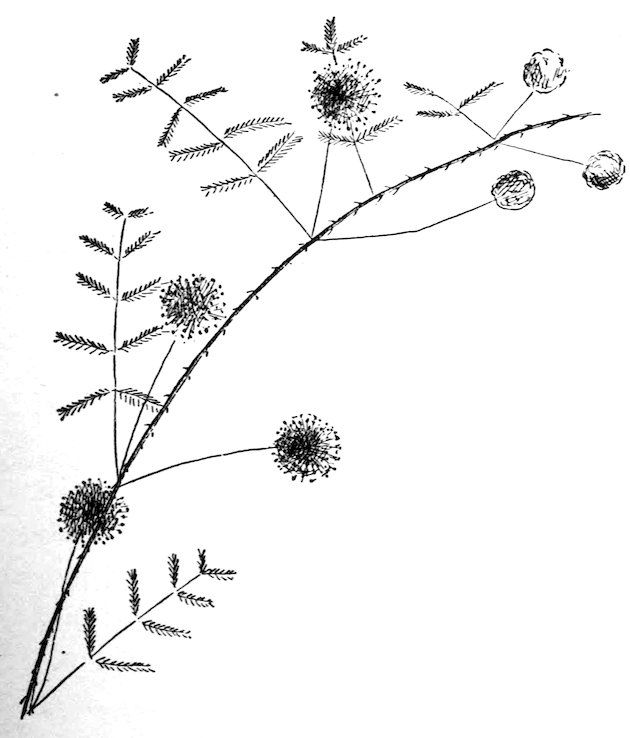
The strong flowers set their seeds; they are strong, and they have been well fertilized. The weak flowers set few seeds; they are not strong to make many seeds, and they have not been well fertilized. So year by year and century by century Mother Nature watches her plants and encourages the strong to grow and helps the weak to find other work.
And this is why the flowers are so bright.
222Mother Nature selects those that are to grow and blossom and sends the rest to help them. This is what we call natural selection, and this is what makes the earth so beautiful. Only the best continue to grow; the others are glad to help them.
223
HOW MOTHER NATURE MAKES NEW FLOWERS.
Once upon a time there lived a little plant in a marshy place. We will call it Primus, not because that was the very first form of the plant, for it was not, but because that was its form when we first saw it.
It had five small yellow petals, five small stamens, and an ovary.
When its seeds were ripe, along came a great wind and blew them away from the marsh upon the dry land at the edge.
Poor little seeds, they were out of their familiar wet marsh and they could not grow. But they did their best. Some of them managed to sprout, but soon they found the earth too dry and the sun too hot; so they said, “We will turn to other work; we will help the other plants and not try to grow ourselves.”
So they changed into gases and minerals and other substances. But a few of the seeds continued to grow.
224They blossomed and bore seeds, but they were not just like the plants in the marsh. Mother Nature had helped them get a tougher skin and taught them how to shut tightly their pores in dry weather, so that the water within them could not escape.
You see, they were already different from their parents, though you might not have noticed it if you had seen them, the difference was so slight. The seeds of these new plants sprouted the next season. They did not have a hard time to grow. They knew just what to do, and the best and strongest of them grew a few hairs to help cover up the pores, so the water would not go out too fast.
It happened to be a very hot, dry season, and all the plants but these hairy ones stopped growing. They changed into gases and minerals and other substances to help the other plants. The hairy people got through the dry season very well. They set a good many seeds, and these seeds sprouted. The new plants remembered about the hairs and had plenty of them. Some were covered all over with a soft down.
And it was well they were, for it was a very hot, dry season, and all but the downy ones stopped growing and changed into minerals and gases and other substances to help the others. The seeds of 225the downy plants blew far over the dry land, far away from the marsh; but they had learned to live in the dry soil, and if you had found these downy people, you would hardly have known they were descended from the smooth, juicy, large-leaved marsh plants. Their stems were hard and tough and their leaves stiff and small. We can no longer call them Primus, they are so changed.
Let us call them Secundus. Secundus had small yellow flowers, like the marsh plants it was descended from. But one day some of the seeds of Secundus blew into the edge of a wood where the soil was rich and the air damp. This just suited the Secundus seeds, and they grew into very thrifty plants indeed. They had so much sap and grew so luxuriantly that their petals were twice as large as was usual with Secundus petals. These fine showy flowers also possessed a great deal of nectar, they had so much sap. Of course the bees came to them, and they were well fertilized. They set many seeds. The next year these strong seeds were able to grow even when their neighbors were not, and the plants that came from these seeds also had large showy flowers.
These stronger plants held their own, you may be sure, and at last there was more of them than of the small-flowered plants. It was well for them this 226was so, for there came several bad seasons when nothing was just right for these plants. It was cold and stormy, and only the very strongest lived through it. But they managed to survive, and their flowers were large and showy.
All the weaker plants with smaller flowers were killed out, and only these large-flowered ones remained. They were very different from their ancestors the marsh plants, and we shall have to call them Tertius.
One day some of the seeds of Tertius were blown into a new kind of soil; they sucked up the juices of this new soil, and lo! some of their flowers opened white instead of yellow. It so happened that the white-flowered plants were stronger than the others. The bees liked them, too; for, being so strong and full of sap, they made plenty of honey. So these white-flowered ones increased in numbers very greatly. At last only the white ones could be found; the yellow ones had gradually given way before them until no yellow ones were left.
So we will call the white-flowered people Quartus.
Quartus lived a long time, each year bearing seeds, the strongest and best of which grew up and bore flowers.
One day some of Quartus’ seeds were blown into 227a hot, sandy place; this almost killed them, but some of them managed to grow.
Their leaves were smaller and stiffer than ever before, but they had a great many of them, and their flowers were large and white. They grew to like the sandy soil, and what they got from it changed their sap in some way so their petals were delicately tinged with pink. The bees liked these pink flowers; perhaps their honey was a little richer; perhaps they could see them better. However that may be, the bees almost deserted the white-blossomed plants and visited the pink ones. So the white flowers set few seeds and the pink flowers many. When the seeds sprouted, the pink ones were the strongest, because in their change of color there was somehow added a change in strength; they were stronger than the white flowers. They grew fast and took the materials from the earth and the air; and when the white flowers saw this, they said, “It is their turn now,” so they changed into gases and minerals and other things and helped the pink flowers to grow.
Soon there were no more white flowers to be seen; they had stopped growing, and only the pink ones kept on, so we shall have to call these pink flowers Quintus.
228But a great danger threatened Quintus. Cows and goats and sheep bit off their leaves. They ate so much of them that many plants were killed outright. Only the stiffest and hardest were left to blossom and set seed. The seeds of these plants with the stiff leaves and stems grew into other stiff-stemmed and stiff-leaved plants. The cattle browsed the tenderest of these and again left the stiffest. This went on for many years, the plants growing stiffer and harder each year. Some of them got so stiff and hard that they threw out prickles all over their stems.
These prickly ones were not eaten, and in time you would have found them grown into woody bushes with prickly stems.
We shall have to call these Sextus.
Sextus spread all over the sandy plains. Hardly any other plant was to be seen. The strong Sextus seeds sprouted and took the materials in the earth and the air, and the other seeds that happened to be blown among them did not grow; they changed into gases and minerals and other substances and helped the Sextus plants to grow.
One day some Sextus seeds blew upon good, rich, damp soil, and there they sprouted and grew. They had plenty of water, and there were no cattle to disturb 229them; so those with the fewest prickles were the best off, because they could use the food material to make larger flowers instead of prickles. So the plants with fewer prickles had larger flowers and better seeds, and these seeds sprouted and grew, and the others gave way before them. In the course of time these plants growing on the rich soil lost their prickles, and their flowers were large and very deep pink; in fact, some of them were a bright red.
These bright red flowers attracted the bees, and so they lived on and set seed. These we must call Septimus.
For some reason some of the seeds of the Septimus flowers developed unusually thrifty plants.
These plants had flowers with petals so full of sap they overlapped, and finally, just because they were so full of the growing spirit, the edges of the petals grew together.
Finally, the flowers with the edges grown together were the most successful. The tube their flowers made kept the nectar for the bees, and the bees liked to go into these red bells. You see what had happened: the flowers were no longer polypetalous. Their petals had grown together; they were gamopetalous. Their corollas formed snug tubes, something like a morning-glory corolla, for the bees.
230We shall have to call these people Octamus.
And we will not follow them any farther, only be sure they kept on changing ever and ever. Whenever the seeds fell in a new soil, they had to change or die. The reason they could change so is because no two things are ever just alike, and out of a great many plants some might be fitted to survive in the new surroundings. These would live, and their descendants would be like them, but they would be different from their ancestors.
In some such way, no doubt, the many different kinds of flowers have come into existence.
If you ask me for the exact name of our plant that has changed so many times, I cannot tell you, for I do not know.
But that, we believe, is Mother Nature’s way of making new flowers.
231
TONGUES AND TUBES.
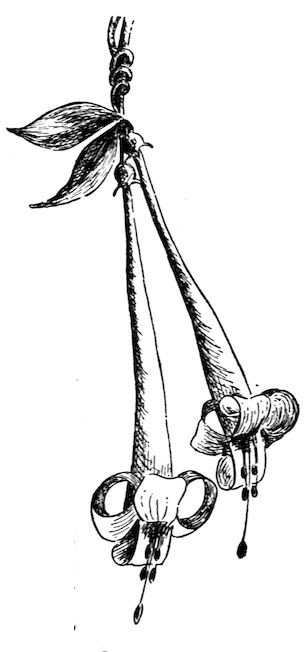
A flower tube is a most convenient and safe place to keep stamens and nectar. If it is protected by scales or hairs or a sticky juice, as is often the case, the ants and other small insects are given a gentle but convincing hint to keep out. They might readily infer their presence is not wanted, and though it may hurt their feelings a little, they have nothing to do but obey.
Some flowers like ants and little crawling insects, but they have open, spreading corollas with the nectars easily reached; but you may be sure a flower with a tube is no friend to them.
Its tube says “keep out” as plainly as though it had put out a printed sign, and then a tube is a sign anybody in the insect world can read, no matter what language he may speak or whether he knows his letters.
232But tubes are not intended to keep all visitors away,—far from it.
They are as much an invitation to one kind of insect as they are a request to “keep off these premises” to another. If you happen to be a large insect with a long tongue, you will be sure to find a welcome in many a flower with a tube. And no doubt, if you are fond of honey and are industrious about collecting it, you will find that the flower whose nectar you like the very best and which you visit the oftenest has a tube just the same shape and size as your tongue; and what is more, it will be in the most convenient position for you to reach it.
It seems to be your flower, and no doubt it is, for flowers have a way of making their tubes to fit the tongues of those who love them best. Not that they do all the fitting, for no doubt the tongues also grow to fit the flowers.
Of course other insects with similar tongues can get the honey too, and a good many, whose tongues are quite different, can reach more or less of it; but the bulk of the honey is for the favorite visitor. He can reach clear to the bottom of the nectary, and in some cases, where the favorite insect has a very long and very slender tongue, the spur, or tube, will be so 233long and slender that none but that particular kind of insect can get the honey at all.
Everybody who lives in New England, and a good many who do not, knows the white azalea, often called swamp honeysuckle.
Swamp honeysuckle and the large night-flying moths are great friends. The azalea has provided honey for the fellows, and protects it, too, against other visitors, all but the bees and humming birds. The humming birds are welcome, and the bees have a way of coming whether they are welcome or not.
If you go just at dark to where the azaleas are blooming, you will not see the moths, but you will hear them. The chief sounds in the woods are the rustling of twigs and leaves in the breeze, the calling of frogs from the ponds, the noises of the insects, and the voices of the night-flying birds. Then all at once there comes another sound,—a steady buzz-z-z that draws nearer and nearer until it seems to be close to your ear. This is the moth come to visit the honeysuckle. And, no doubt, the honeysuckle is glad to feel the breeze of these fanning wings and feel the long tongue enter the tube, for the moth’s body touches the out-reaching stigma and leaves there pollen from some other flower whose honey it has enjoyed. From the stamens it detaches pollen 234grains to carry to another flower; and this, too, no doubt, gives happiness to the azalea, for it makes its pollen, not for its own use, but for the sake of its azalea friends.
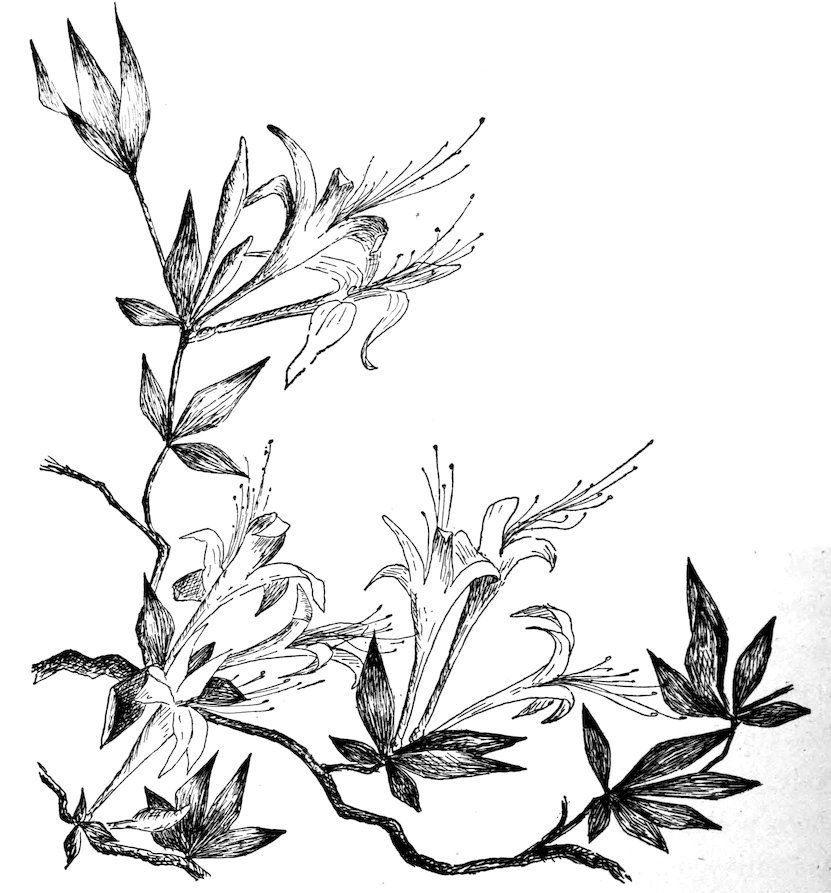
You see, the azalea has long, upturned filaments that reach far out of the tube, and the style is yet longer, so that only a large insect or a humming bird, collecting honey while on the wing, can really give pollen to the stigma.
Bees alight back of the anthers and take the honey. If they want pollen they collect it from the stamens without 235touching the stigma, except once in a while by accident, as it were. So however much the majority of flowers may love and respect the bee, our azalea has no liking for her. Besides, the bee has a bad habit of biting a hole in the flower tube and getting the honey that way. This would be a thoroughly disreputable performance on the part of any insect, and if bees are not ashamed of it they ought to be.
The azalea does several things for the moth it loves. It may be its beautiful white color is for his sake; anyway, if the flower were not white the moth would not be likely to find it, since he flies abroad after the birds have gone to rest,—that is, in the evening, when it is dark in the damp thickets where the honeysuckle loves to grow. Azalea has a sweet white corolla with a long, slender tube containing nectar that moth or humming bird can reach, but which bees cannot reach. Watch a bee try some time. If the flower is between you and the light, you can see the bee’s brown tongue through the flower tube; she appears to be standing on her toes and reaching in as far as she can; she darts out her tongue to its full length, and you can see it wriggling and straining to get to the abundant honey low down in the flower tube. But there is no use trying; the 236tongue is too short and the tube too long. The honeysuckle tube was not made to fit the bee’s tongue, and the bee can get only the outer rim of the honey. Perhaps this is why the bee so often breaks in the back way.
Besides being white, the azalea flowers grow in clusters, which makes them yet more visible in the dusk. They exhale a delicious and far-reaching perfume too, and this is a note of invitation to the moths.
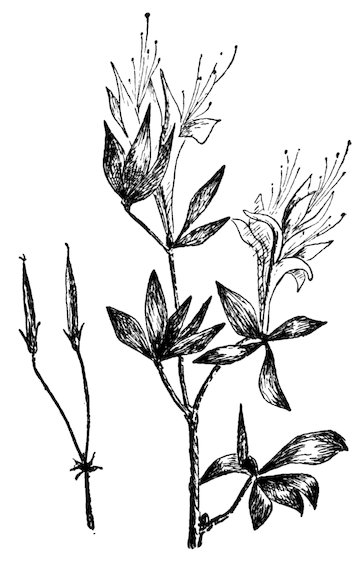
Instead of writing a note on a sheet of perfumed paper, the honeysuckle simply sends the perfume without the paper, and the moth understands the message and knows the white azalea “requests the pleasure” of his company that evening, and he puts on his best manners, since he cannot change his clothes, and goes.
The white azalea is so very sweet and so pretty, it would not be strange if other uninvited guests than bees were to visit it. No doubt, the ants and bugs and gnats and flies would be glad to, but the azalea has a very inhospitable 237way of receiving such would-be guests. All over the outside of the lower part of the white tube and running in a line to the very tips of the petals are tiny white hairs with black tips.
These are azalea’s body guard. Each tip exudes a drop of sticky liquid.
Fine, sticky hairs cover the stems and the leaves too; so the unfortunate insect that tries to crawl up to the flower is sure to get wings and legs hopelessly entangled and stuck together.
Only large fellows, like bees, who are strong enough to pull themselves free and clean off their legs, are able to defy this body guard. You will sometimes meet our sweet azalea covered on the outside with little marauders who wanted to steal her honey but could not, because the body guard caught them and stuck them fast.
Not all flowers with tubes have succeeded as well as azalea in keeping their honey for the visitors who can do them the most good. Yet many have tried.
Look at the morning-glory, for instance; it has hairs at the entrance to the nectaries which the ants cannot readily pass, but which the bees can push aside. The openings to the nectary are large enough readily to admit the tongue of a bee, and the distance into the nectar is about the length of a bee’s 238tongue; but there are no sticky guards to preserve the honey, for the bees and small beetles and other tiny insects often crawl into the tube and eat the honey and even devour the flower itself.
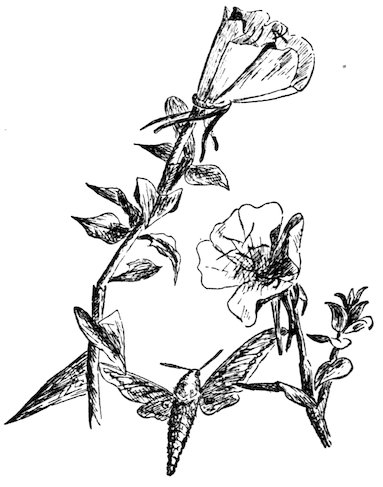
Evening Primrose.
Tropæolum has a fine large tube full of rich honey for bees and humming birds. This tube no doubt corresponds to some tongue or bird-bill in her own South America. But in our country the bees answer very well. The bumblebee is fond of Tropæolum honey and fertilizes the flower, while an occasional ruby throat may be seen taking a sip.
Jewelweed’s horn is a humming bird tube and a bee tube, too. The flowers are so delicately balanced 239on tiny stalks that wingless insects would not find an easy entrance.
Pelargonium, too, has a tube suited to some long and slim-tongued visitor. In her own native land in far-away Africa she probably loves the butterflies that live there, who also love her, and so they have grown tongue and tube to fit each other. For the flower is not the only one to change: the insect changes to suit the flower at the same time that the flower changes to suit the insect. They grow to fit each other.
Wherever you see a flower tube you may be sure there is somewhere a tongue to fit it.
241