PART FIFTH (continued 2)
Reading edition
"At once."
He reached for his coat and turned off the lights. The two went out arm and arm into the March night. The wind was still rising.
"It's only half-past nine, and Mrs. Googe will be up; she is a busy woman."
"Tell me—" he drew his breath short—"what has my mother done all these years—how has she lived?"
"As every true woman lives—doing her full duty day by day, living in hope of this joy."
"But I mean what has she done to live—to provide for herself; she has kept the house?"
"To be sure, and by her own exertions. She has never been willing to accept pecuniary aid from any friend, not even from Mr. Buzzby, or the Colonel. I am in a position to know that Mr. Van Ostend did his best to persuade her to accept something just as a loan."
"But what has she been doing?"
"She has been taking the quarrymen for meals the last six years, Champney—at times she has had their families to board with her, as many as the house could accommodate."
The arm which his own held was withdrawn with a jerk. Champney Googe faced him: they were on the new iron bridge over the Rothel.
"You mean to say my mother—my mother, Aurora Googe, has been keeping a quarrymen's boarding-house all these years?"
"Yes; it is legitimate work."
"My mother—my mother—" he kept repeating as he stood motionless on the bridge. He seemed unable to grasp the fact for a moment; then he laid his hand heavily on Father Honoré's shoulder as if for support; he spoke low to himself, but the priest caught a few words:
"I thank Thee—thank—for life—work—"
He seemed to come gradually to himself, to recognize his whereabouts. He began to walk on, but very slowly.
"Father Honoré," he said, and his tone was deeply earnest but at the same time almost joyful, "I'm not going home to my mother empty-handed, I never intended to—I have work. I can work for her, free her from care, lift from her shoulders the burden of toil for my sake."
"What do you mean, Champney?"
"I made application to the manager of the Company this afternoon; I saw they were all strangers to me, and they took me on in the sheds—Shed Number Two. I went to work this afternoon. You see I know my trade; I learned it during the last six years. I can support her now—Oh—"
He stopped short just as they were leaving the bridge; raised his head to the black skies above him, reached upwards with both hands palm outwards—
"—I thank my Maker for these hands; I thank Him that I can labor with these hands; I thank Him for the strength of manhood that will enable me to toil with these hands; I thank Him for my knowledge of good and evil; I thank Him that I have 'won sight out of blindness—'" his eyes strained to the skies above The Gore.
The moon, struggling with the heavy drifting cloud-masses, broke through a confined ragged circle and, for a moment, its splendor shone upon the heights of The Gore; its effulgence paled the arc-lights in the quarries; a silver shaft glanced on the Rothel in its downward course, and afar touched the ruffled waters of Lake Mesantic....
"I'll stay here on the lawn," he said five minutes afterwards upon reaching the house. A light was burning in his mother's bedroom; another shone from her sitting-room on the first floor.
The priest entered without knocking; this house was open the year round to the frequent comers and goers among the workmen. He rapped at the sitting-room door. Mrs. Googe opened it.
"Why, Father Honoré, I didn't expect you to-night—didn't you have the—What is it?—oh, what is it!" she cried, for the priest's face betrayed him.
"Joyful news, Mrs. Googe,"—he let her read his face—"your son is a free man to-night."
There was no outcry on the mother's part; but her hands clasped each other till the nails showed white.
"Where is he now?"
"Here, in Flamsted—"
"Let me go—let me go to him—"
"He has come to you—he is just outside—"
She was past him with a rush—at the door—on the porch—
"Champney!—My son!—where are you?" she cried out into the night.
Her answer came on swift feet. He sprang up the steps two at a time, they were in each other's arms—then he had to be strong for both.
He led her in, half carrying her; placed her in a chair; knelt before her, chafing her hands....
Father Honoré made his escape; they were unconscious of his presence or his departure. He closed the front door softly behind him, and on feet shod with light-heartedness covered the road to his own house in a few minutes. He flung aside his coat, took his violin, and played and played till late into the night.
Two of the sisters of The Mystic Rose, who had been over to Quarry End Park nursing a sick quarryman's wife throughout the day, paused to listen as they passed the house. One of them was Sister Ste. Croix.
The violin exulted, rejoiced, sang of love heavenly, of love earthly, of all loves of life and nature; it sang of repentance, of expiation, of salvation—
"I can bear no more," whispered Sister Ste. Croix to her companion, and the hand she laid on the one that was raised to hush her, was not only cold, it was damp with the sweat of the agony of remembrance.
The strains of the violin's song accompanied them to their own door.
VII
The Saturday-night frequenters of The Greenbush have changed with the passing years like all else in Flamsted. The Greenbush itself is no longer a hostelry, but a cosy club-house purveyed for, to the satisfaction of every member, by its old landlord, Augustus Buzzby. The Club's membership, of both young and old men, is large and increasing with the growth of the town; but the old frequenters of The Greenbush bar-room head the list—Colonel Caukins and Octavius Buzzby paying the annual dues of their first charter member, old Joel Quimber, now in his eighty-seventh year.
The former office is a grill room, and made one with the back parlor, now the club restaurant. On this Saturday night in March, the white-capped chef—Augustus prided himself in keeping abreast the times—was busy in the grill room, and Augustus himself was superintending the laying of a round table for ten. The Colonel was to celebrate his sixty-fifth birthday by giving a little supper.
"Nothing elaborate, Buzzby," he said a week before the event, "a fine saddle of mutton—Southdown—some salmon trout, a stiff bouillon for Quimber, you know his masticatory apparatus is no longer equal to this whole occasion, and a chive salad. The cake Mrs. Caukins elects to provide herself, and I need not assure you, who know her culinary powers, that it will be a ne plus ultra of a cake, both in material and execution; fruits, coffee and cheese—Roquefort. Your accomplished chef can fill in the interstices. Here are the cards—Quimber at my right, if you please."
Augustus looked at the cards and smiled.
"All the old ones included, I see, Colonel," he ran over the names, "Quimber, Tave, Elmer Wiggins, Emlie, Poggi and Caukins"—he laughed outright; "that's a good firm, Colonel," he said slyly, and the Colonel smiled his appreciation of the gentle insinuation—"the manager at the sheds, and the new boss of the Upper Quarry?" He looked inquiringly at the Colonel on reading the last name.
"That's all right, Buzzby; he's due here next Saturday, the festal day; and I want to give some substantial expression to him, as a stranger and neighbor, of Flamsted's hospitality."
Augustus nodded approval, and continued: "And me! Thank you kindly, Colonel, but you'll have to excuse me this time. I want everything to go right on this special occasion. I'll join you with a pipe afterwards."
"As you please, Buzzby, only make it a cigar; and consider yourself included in the spirit if not in the flesh. Nine sharp."
At a quarter of nine, just as Augustus finished putting the last touch to an already perfect table, the Colonel made his appearance at The Greenbush, a pasteboard box containing a dozen boutonnières under his arm. He laid one on the table cloth by each plate, and stood back to enjoy the effect. He rubbed his hands softly in appreciation of the "color scheme" as he termed it—a phrase that puzzled Augustus. He saw no "scheme" and very little "color" in the dark-wainscoted room, except the cheerful fire on the hearth and some heavy red half-curtains at the windows to shut out the cold and dark of this March night. The walls were white; the grill of dark wood, and the floor painted dark brown. But the red carnations on the snow-white damask did somehow "touch the whole thing up," as he confided later to his brother.
The Colonel's welcome to his companions was none the less cordial because he repressed his usual flow of eloquence till "the cloth should be removed." He purposed then to spring a surprise, oratorical and otherwise, on those assembled.
After the various toasts,—all given and drunk in sweet cider made for the occasion from Northern Spies, the Colonel being prohibitive for example's sake,—the good wishes for many prospective birthdays and prosperous years, the Colonel filled his glass to the brim and, holding it in his left hand, literally rose to the occasion.
"Gentlemen," he began in full chest tones, "some fourteen years ago, five of us now present were wont to discuss in the old office of this hospitable hostelry, now the famous grill room of the Club, the Invasion of the New—the opening of the great Flamsted Quarries—the migrations of the nations hitherwards and the consequent prospective industrial development of our native village."
He paused and looked about him impressively; finally his eye settled sternly on Elmer Wiggins who, satisfied inwardly with the choice and bounteous supper provided by the Colonel, had made up his mind to "stand fire", as he said afterwards to Augustus.
The Colonel resumed his speech, his voice acquiring as he proceeded a volume and depth that carried it far beyond the grill room's walls to the ears of edified passers on the street:
"There were those among us who maintained—in the face of extreme opposition, I am sorry to say—that this town of Flamsted would soon make itself a factor in the vast industrial life of our marvellous country. In retrospect, I reflect that those who had this faith, this trust in the resources of their native town, were looked upon with scorn; were subjected to personal derision; were termed, to put it mildly, 'mere dreamers'—if I am not mistaken, the original expression was 'darned boomers.' Mr. Wiggins, here, our esteemed wholesale and retail pharmacist, will correct me if I am wrong on this point—"
He paused again as if expecting an answer; nothing was forthcoming but a decidedly embarrassed "Hem," from the afore-named pharmacist. The Colonel was satisfied.
"Now, gentlemen, in refutation of that term—I will not repeat myself—and what it implied, after fourteen years, comparable to those seven fat kine of Pharaoh's dream, our town can point throughout the length and breadth of our land to its monumental works of art and utility that may well put to blush the renowned record of the Greeks and Romans."
Prolonged applause and a ringing cheer.
"All over our fair land the granite monoliths of Flamsted, beacon or battle, point heavenwards. The transcontinental roads, that track and nerve our country, cross and re-cross the raging torrents of western rivers on granite abutments from the Flamsted quarries! The laws, alike for the just and unjust,"—the Colonel did not perceive his slip, but Elmer Wiggins smiled to himself,—"are promulgated within the stately granite halls of the capitals of our statehood—Flamsted again! The gospel of praise and prayer will shortly resound beneath the arches of the choir and nave of the great granite cathedral—the product of the quarries in The Gore!"
Deafening applause, clinking of glasses, and cries of "Good! True—Hear—Hear!"
The Colonel beamed and gathered himself together with a visible effort for his peroration. He laid his hand on his heart.
"A man of feeling, gentlemen, has a heart. He is not oblivious either of the needs of his neighbor, his community, or the world in general. Although he is vulnerable to wounds in the house of his friends,"—a severe look falls upon Wiggins,—"he is not impervious to appeal for sympathy from without. I trust I have defined a man of feeling, gentlemen, a man of heart, as regards the world in general. And now, to make an abrupt descent from the abstract to the concrete, from the general to the particular, I will permit myself to say that those aspersions cast upon me fourteen years ago as a mere promoter, irrespective of my manhood, hurt me as a man of feeling—a man of heart.
"Sir—" he turned again to Elmer Wiggins who was apparently the lightning conductor for the Colonel's fourteen years of pent-up injury—"a father has his feelings. You are not a father—I draw no conclusions; but if you had been a father fourteen years ago in this very room, I would have trusted to your magnanimity not to give expression to your decided views on the subject of the native Americans' intermarriage with those of a race foreign to us. I assure you, sir, such a view not only narrows the mind, but constricts humanity, and ossifies the heart—that special organ by which the world, despite present-day detractors, lives and moves and has its being." (Murmuring assent.)
"But, sir, I believe you have come to see otherwise, else as my guest on this happy occasion, I should not permit myself to apply to you so personal a remark. And, gentlemen," the Colonel swelled visibly, but those nearest him caught the shimmer of a suspicious moisture in his eyes, "I am in a position to-night—this night whereon you have added to my happiness by your presence at this board—to repeat now what I said fourteen years ago in this very room: I consider myself honored in that a member of my immediate family, one very, very dear to me," his voice shook in spite of his effort to strengthen it, "is contemplating entering into the solemn estate of matrimony at no distant date with—a foreigner, gentlemen, but a naturalized citizen of our great and glorious United States. Gentlemen," he filled his glass again and held it high above his head,—"I give you with all my heart Mr. Luigi Poggi, an honored and prosperous citizen of Flamsted—my future son-in-law—the prospective husband of my youngest daughter, Dulcibella Caukins."
The company rose to a man, young Caukins assisting Quimber to his feet.
With loud and hearty acclaim they welcomed the new member of the Caukins family; they crowded about the Colonel, and no hand that grasped his and Luigi's in congratulation was firmer and more cordial than Elmer Wiggins'. The Colonel's smile expanded; he was satisfied—the old score was wiped out.
Afterwards with cigars and pipes they discussed for an hour the affairs of Flamsted. The influx of foreigners with their families was causing a shortage of houses and housing. Emlie proposed the establishment of a Loan and Mortgage Company to help out the newcomers. Poggi laid before them his plan for an Italian House to receive the unmarried men on their arrival.
"By the way," he said, turning to the new head of the Upper Quarry, "you brought up a crowd with you this afternoon, didn't you?—mostly my countrymen?"
"No, a mixed lot—about thirty. A few Scotch and English came up on the same train. Have they applied to you?" He addressed the manager of the Company's sheds.
"No. I think they'll be along Monday. I've noticed that those two nationalities generally have relations who house and look out for them when they come. But I had an application from an American just after the train came in; I don't often have that now."
"Did you take him on?" the Colonel asked between two puffs of his Havana.
"Yes; and he went to work in Shed Number Two. I confess he puzzles me."
"What was he like?" asked the head of the Upper Quarry.
"Tall, blue eyes, gray hair, but only thirty-four as the register showed—misfit clothes—"
"That's the one—he came up in the train with me. I noticed him in the car. I don't believe he moved a muscle all the way up. I couldn't make him out, could you?"
"Well, no, I couldn't. By the way, Colonel, I noticed the name he entered was a familiar one in this part of Maine—Googe—"
"Googe!" The Colonel looked at the speaker in amazement; "did he give his first name?"
"Yes, Louis—Louis C. Googe—"
"My God!"
Whether the ejaculation proceeded from one mouth or five, the manager and foreman could not distinguish; but the effect on the Flamsted men was varied and remarkable. The Colonel's cigar dropped from his shaking hand; his face was ashen. Emlie and Wiggins stared at each other as if they had taken leave of their senses. Joel Quimber leaned forward, his hands folded on the head of his cane, and spoke to Octavius who sat rigid on his chair:
"What'd he say, Tave?—Champ to home?"
But Octavius Buzzby was beyond the power of speech. Augustus spoke for him:
"He said a man applied for work in the sheds this afternoon, Uncle Jo, who wrote his name Louis C. Googe."
"Thet's him—thet's Champ—Champ's to home. You help me inter my coat, Tave, I 'm goin' to see ef's true—" He rose with difficulty. Then Octavius spoke; his voice shook:
"No, Uncle Jo, you sit still a while; if it's Champney, we can't none of us see him to-night." He pushed him gently into his chair.
The Colonel was rousing himself. He stepped to the telephone and called up Father Honoré.
"Father Honoré—
"This is Colonel Caukins. Can you tell me if there is any truth in the report that Champney Googe has returned to-day?
"Thank God."
He put up the receiver, but still remained standing.
"Gentlemen," he said to the manager and the Upper Quarry guest, his voice was thick with emotion and the tears of thankfulness were coursing down his cheeks, "perhaps no greater gift could be bestowed on my sixty-fifth birthday than Champney Googe's return to his home—his mother—his friends—we are all his friends. Perhaps the years are beginning to tell on me, but I feel that I must excuse myself to you and go home—I want to tell my wife. I will explain all to you, as strangers among us, some other time; for the present I must beg your indulgence—joy never kills, but I am experiencing the fact that it can weaken."
"That's all right, Colonel," said the manager; "we understand it perfectly and it's late now."
"I'll go, too, Colonel," said Octavius; "I'm going to take Uncle Jo home in the trap."
Luigi Poggi helped the Colonel into his great coat. When he left the room with his prospective father-in-law, his handsome face had not regained the color it lost upon the first mention of Champney's name.
Emlie and Wiggins remained a few minutes to explain as best they could the situation to the stranger guests, and the cause of the excitement.
"I remember now hearing about this affair; I read it in the newspapers—it must have been seven or eight years ago."
"Six years and four months." Mr. Wiggins corrected him.
"I guess it'll be just as well not to spread the matter much among the men—they might kick; besides he isn't, of course, a union man."
"There's one thing in his favor," it was Emlie who spoke, "the management and the men have changed since it occurred, and there are very few except our home folks that would be apt to mention it—and they can be trusted where Champney Googe is concerned."
The four went out together.
The grill room of The Greenbush was empty save for Augustus Buzzby who sat smoking before the dying fire. Old visions were before his eyes—one of the office on a June night many years ago; the five friends discussing Champney Googe's prospects; the arrival of Father Honoré and little Aileen Armagh—so Luigi had at last given up hope in that direction for good and all.
The town clock struck twelve. He sighed heavily; it was for the old times, the old days, the old life.
VIII
It was several months before Aileen saw him. Her close attendance on Mrs. Champney and her avoidance of the precincts of The Gore—Maggie complained loudly to Mrs. Googe that Aileen no longer ran in as she used to do, and Mrs. Caukins confided to her that she thought Aileen might feel sensitive about Luigi's engagement, for she had been there but twice in five months—precluded the possibility of her meeting him. She excused herself to Mrs. Googe and the Sisters on the ground of her numerous duties at Champ-au-Haut; Ann and Hannah were both well on in years and Mrs. Champney was failing daily.
It was perhaps five months after his return that she was sitting one afternoon in Mrs. Champney's room, in attendance on her while the regular nurse was out for two hours. There had been no conversation between them for nearly the full time, when Mrs. Champney spoke abruptly from the bed:
"I heard last month that Champney Googe is back again—has been back for five months; why didn't you tell me before?"
The voice was very weak, but querulous and sharp. Aileen was sewing at the window. She did not look up.
"Because I didn't suppose you liked him well enough to care about his coming home; besides, it was Octavius' place to tell you."
"Well, I don't care about his coming, or his going either, for that matter, but I do care about knowing things that happen under my very nose within a reasonable time of their happening. I'm not in my dotage yet, I'll have you to understand."
Aileen was silent.
"Come, say something, can't you?" she snapped.
"What do you want me to say, Mrs. Champney?" She spoke wearily, but not impatiently. The daily, almost hourly demands of this sick old woman had, in a way, exhausted her.
"Tell me what he's doing."
"He's at work."
"Where?"
"In the sheds—Shed Number Two."
"What!" Paralysis prevented any movement of her hands, but her head jerked on the pillow to one side, towards Aileen.
"I said he was at work in the sheds."
"What's Champney Googe doing in the sheds?"
"Earning his living, I suppose, like other men."
Almeda Champney was silent for a while. Aileen could but wonder what the thoughts might be that were filling the shrivelled box of the brain—what were the feelings in the ossifying heart of the woman who had denied help to one of her own blood in time of need. Had she any feeling indeed, except that for self?
"Have you seen him?"
"No."
"I should think he would want to hide his head for shame."
"I don't see why." She spoke defiantly.
"Why? Because I don't see how after such a career a man can hold up his head among his own."
Aileen bit her under lip to keep back the sharp retort. She chose another and safer way.
"Oh," she said brightly, looking over to Mrs. Champney with a frank smile, "but he has really just begun his career, you know—"
"What do you mean by that?"
"I mean he has just begun honest work among honest men, and that's the best career for him or any other man to my thinking."
"Umph!—little you know about it."
Aileen laughed outright. "Oh, I know more than you think I do, Mrs. Champney. I haven't lived twenty-six years for nothing, and what I've seen, I've seen—and I've no near-sighted eyes to trouble me either; and what I've heard, I've heard, for my ears are good—regular long-distance telephones sometimes."
She was not prepared for the next move on Mrs. Champney's part.
"I believe you would marry him now—after all, if he asked you." She spoke with a sneer.
"Do you really believe it?" She folded her work and prepared to leave the room, for she heard the nurse's step in the hall below. "Well, if you do, I'll tell you something, Mrs. Champney, but I'd like it to be between us." She crossed the room and paused beside the bed.
"What?"
She bent slightly towards her. "I would rather marry a man who earns his three dollars a day at honest work of quarrying or cutting stones,—or breaking them, for that matter,"—she added under her breath, "but I'm not saying he would be any relation of yours—than a man who doesn't know what a day's toil is except to cudgel his brains tired, with contriving the quickest means of making his millions double themselves at other people's expense in twenty-four hours."
The nurse opened the door. Mrs. Champney spoke bitterly:
"You little fool—you think you know, but—" aware of the nurse, she ended fretfully, "you wear me out, talking so much. Tell Hannah to make me some fresh tamarind water—and bring it up quick."
By the time Aileen had brought up the refreshment, she had half repented of her words. Mrs. Champney had been failing perceptibly the last few weeks, and all excitement was forbidden her. For this reason she had been kept so long in ignorance of Champney's return. As Aileen held the drinking tube to her lips, she noticed that the faded sunken eyes, fixed upon her intently, were not inimical—and she was thankful. She desired to live in peace, if possible, with this pitiable old age so long as it should last—a few weeks at the longest. The lesson of the piece of granite was not lost upon her. She kept the specimen on a little shelf over her bed.
She went down stairs into the library to answer a telephone call; it was from Maggie McCann who begged her to come up that afternoon to see her; the matter was important and could not wait. Aileen knew by the pleading tone of the voice, which sounded unnatural, that she was needed for something. She replied she would go up at once. She put on her hat, and while waiting for the tram at The Bow, bought a small bag of gumdrops for Billy.
Maggie received her with open arms and a gush of tears; thereupon Billy, now tottering on his unsteady feet, flopped suddenly on the floor and howled with true Irish good will.
"Why, Maggie, what is the matter!" she exclaimed.
"Och, Aileen, darlin', me heart's in smithereens, and I'm that deep in trouble that me head's like to rend—an' Jim's all broke up—"
"What is it; do tell me, Maggie—can I help?" she urged, catching up Billy and endeavoring to smother his howls with kisses.
Mrs. McCann wiped her reddened eyes, took off her apron and sat down in a low chair by Aileen who was filling Billy's small mouth, conveniently open for another howl upon perceiving his mother wipe her eyes, with a sizable gumdrop.
"The little gells be over to the kindergarten with the Sisters, an' I thought I'd clane go out of me mind if I couldn't have a word wid you before Jim gets home—Och, Aileen, dearie, me home I'm so proud of—" She choked, and Billy immediately repudiated his gumdrop upon Aileen's clean linen skirt; his eyes were reading the signs of the times in his mother's face.
"Now, Maggie, dear, tell me all about it. Begin at the beginning, and then I'll know where you're at."
Maggie smiled faintly. "Sure, I wouldn't blame you for not knowin' where I'm at." Mrs. McCann sniffed several times prefatorily.
"You know I told you Jim had a temper, Aileen—"
Aileen nodded in assent; she was busy coaxing the rejected ball into Billy's puckered mouth.
"—And that there's times whin he querrels wid the men—"
"Yes."
"Well, you know Mr. Googe bein' in the same shed an' section wid Jim, I says innercent-like to Jim:—'I'm glad he's in your section, Jim, belike you can make it a bit aisier for him.'
"'Aisy is it?' says Jim.
"'Yes, aisy,' says I.
"'An' wot wud I be after makin' a job aisier for the likes of him?' he says, grouchy-like.
"'An' why not?' says I.
"'For a jail-bird?' says he.
"'Deed,' says I, 'if yer own b'y had been breakin' stones wid a gang of toughs for sivin long years gone, wouldn't ye be after likin' a man to spake wan daycint word wid him?' says I.
"Wid that Jim turned on quick-like an' says:—
"'I'll thank ye, Mrs. McCann, to kape yer advice to yerself. It's not Jim McCann's b'y that'll be doin' the dirthy job that yer Mr. Champney Googe was after doin' six years gone, nor be after takin' the bread an' butter out of an honest man's mout' that has a wife an' three childer to feed. He's a convic',' says Jim.
"'What if he is?' says I.
"'I don't hold wid no convic's,' says Jim; 'I hold wid honest men; an' if it's convic's be comin' to take the best piece-work out of our hands, it's time we struck—to a man,' says Jim.
"Niver, niver but wanct has Jim called me 'Mrs. McCann,'" Maggie said brokenly, but stifled a sob for Billy's sake; "an' niver wanct has he gone to work widout kissin' me an' the childer, sometimes twice round—but he went out yisterday an' niver turned for wan look at wife an' childer; an' me heart was that heavy in my bosom that me b'y refused the breast an' cried like to kill himself for wan mortal hour, an' the little gells cried too, an' me bread burnin' to a crisp, an' I couldn't do wan thing but just sit down wid me hands full of cryin' childer—an' me heart cryin' like a child wid 'em."
Aileen tried to comfort.
"But, Maggie, such things will happen in the happiest married lives, and with the best of husbands. Jim will get over it—I suppose he has by this time; you say it isn't like to him to hold anger long—"
"But he hasn't!" Maggie broke forth afresh, and between mother and son, who immediately followed suit, a deluge threatened. "Wan of the stone-cutters' wives, Mrs. MacLoughanchan, he works in the same section as Jim, told me about it—"
"About what?" Aileen asked, hoping to get some continuity into Maggie's relation of her marital woes.
"The fight at the sheds."
"What fight?" Aileen put the question with a sickening fear at her heart.
"The fight betwixt Jim an' Mr. Googe—"
"What do you mean, Maggie?"
"I mane wot I say," Maggie replied with some show of spirit, for Aileen's tone of voice was peremptory; "Jim McCann, me husband, an' Mr. Googe had words in the shed—"
"What words?"
"Just lave me time an' I'll tell you, Aileen. You be after catchin' me short up betwixt ivery word, an' more be token as if't was your own man, instid of mine, ye was worrittin' about. I said they had words, but by rights I should say it was Jim as had them. Jim was mad because the boss in Shed Number Two give Mr. Googe a piece of work he had been savin' an' promisin' him; an' Jim made a fuss about it, an' the boss said he'd give Jim another, but Jim wanted that wan piece; an' Jim threatened to get up a strike, an' if there's a strike Jim'll lave the place an' I'll lose me home—ochone—"
"Go on, Maggie." Aileen was trying to anticipate Maggie's tale, and in anticipation of the worst happening to Champney Googe, she lost her patience. She could not bear the suspense.
"But Jim didn't sass the boss—he sassed Mr. Googe. 'T was this way, so Mrs. MacLoughanchan says—Jim said niver a word about the fight to me, but he said he would lave the place if they didn't strike—Mr. Googe says, 'McCann, the foreman says you're to begin on the two keystones at wanct—at wanct,' says he, repating it because Jim said niver a word. An' Jim fires up an' says under his breath:
"'I don't take no orders from convic's,' says he.
"'What did you say, McCann?' says Mr. Googe, steppin' up to him wid a glint in his eye that Jim didn't mind he was so mad; an' instid of repatin' it quiet-like, Jim says, steppin' outside the shed when he see the boss an' Mr. Googe followin' him, loud enough for the whole shed to hear:
'"I don't take orders from no convic's—' an' then—" Maggie laid her hand suddenly over her heart as if in pain, '"Take that back, McCann,' says Mr. Googe—'I'll give you the wan chanct.'—An' then Jim swore an' said he'd see him an' himself in hell first, an' then, before Jim knew wot happened, Mr. Googe lit out wid his fist—an' Jim layin' out on the grass, for Mrs. MacLoughanchan says her man said Mr. Googe picked a soft place to drop him in; an' Mr. Googe helps Jim to his feet, an' holds out his hand an' says:
"'Shake hands, McCann, an' we'll start afresh—'
"But, oh, Aileen! Jim wouldn't, an' Mr. Googe turned away sad-like, an' then Jim comes home, an' widout a word to his wife, says if they don't strike, because there's a convic' an' a no union man a-workin' 'longside of him in his section, he'll lave an' give up his job here—an' it's two hundred he's paid down out of his wages, an' me a-savin' from morn till night on me home—an' 't was to be me very own because Jim says no man alive can tell when he'll be dead in the quarries an' the sheds."
She wept afresh and Billy was left unconsoled, for Maggie, wiping her eyes to look at Aileen and wonder at her silence, saw that she, too, was weeping; but the tears rolled silently one after another down her flushed cheeks.
"Och, Aileen, darlin'! Don't ye cry wid me—me burden's heavy enough widout the weight of wan of your tears—say something to comfort me heart about Jim."
"I can't, Maggie, I think it's wicked for Jim to say such things to Mr. Googe—everybody knows what he has been through. And it would serve Jim McCann but right," she added hotly, "if the time should come when his Billy should have the same cruel words said to him—"
"Don't—don't—for the love of the Mother of God, don't say such things, Aileen!" She caught up the sorely perplexed and troubled Billy, and buried her face in his red curls. "Don't for the sake of the mother I am, an' only a mother can know how the Mother of God himself felt wid her crucified Son an' the bitter words he had to hear—ye're not a mother, Aileen, an' so I won't lay it up too much against ye—"
Aileen interrupted her with exceeding bitterness;
"No, I'm not a mother, Maggie, and I never shall be."
Maggie looked at her in absolute incomprehension. "I thought you was cryin' for me, an' Jim, an' all our prisent troubles, but I belave yer cryin' for—"
Mrs. McCann stopped short; she was still staring at Aileen who suddenly lifted her brimming eyes to hers.—What Mrs. McCann read therein she never accurately defined, even to Jim; but, whatever it was, it caused a revulsion of feeling in Maggie's sorely bruised heart. She set Billy down on the floor without any ceremony, much to that little man's surprise, and throwing her arms around Aileen drew her close with a truly maternal caress.
"Och, darlin'—darlin'—" she said in the voice with which she soothed Billy to sleep, "darlin' Aileen, an' has your puir heart been bearin' this all alone, an' me talkin' an' pratin' about me Jim to ye, an' how beautiful it is to be married!—'Deed an' it is, darlin', an' if Jim wasn't a man he'd be an angel sure; but it's not Maggie McCann that's wantin' her husband to be an angel yet, an' you must just forgive him, Aileen, an' you'll find yerself that no man's parfection, an' a woman has to be after takin' thim as they be—lovin' an' gentle be times, an' cross as Cain whin yer expectin' thim to be swateheartin' wid ye; an' wake when ye think they're after bein' rale giants; an' strong whin ye're least lookin' for it; an ginerous by spells an' spendthrifts wid their 'baccy, an' skinflints wid their own, an'—an'—just common, downright aggravatin', lovable men, darlin'—There now! Yer smilin' again like me old Aileen, an' bad cess to the wan that draws another tear from your swate Irish eyes." She kissed her heartily.
In trying to make amends Mrs. McCann forgot her own woes; taking Billy in her arms, she went to the stove and set on the kettle.
"It's four past, an' Jim'll be comin' in tired and worritted, so I'll put on an extra potater or two an' a good bit of bacon an' some pase. Stay wid us, Aileen."
"No, Maggie, I can't; besides you and Jim will want the house to yourself till you get straightened out—and, Maggie, it will straighten out, don't you worry."
"'Deed, an' I'll not waste me breath another time tellin' me troubles to a heart that's sorer than me own—good-bye, darlin', an' me best thanks for comin' up so prompt to me in me trouble. It's good to have a friend, Aileen, an' we've been friendly that long that it seems as if me own burden must be yours."
Aileen smiled, leaning to kiss Billy as he clung to his mother's neck.
"I'll come up whenever you want me and I can get away, Maggie, an' next time I'll bring you more comfort, I hope. Good-bye."
"Och, darlin'!—T'row a kiss, Billy. Look, Aileen, at the kisses me b'y's t'rowin' yer!" she exclaimed delightedly; and Billy, in the exuberance of his joy that tears were things of the past, continued to throw kisses after the lady till she disappeared down the street.
IX
Oh, but her heart was hot with indignation as she walked along the road, her eyes were stung with scalding tears, her thoughts turbulent and rebellious! Why must he suffer such indignities from a man like Jim McCann! How dared a man, that was a man, taunt another like that! The hand holding her sun umbrella gripped the handle tightly, and through set teeth she said to herself: "I hate them all—hate them!"
The declining July sun was hot upon her; the road-bed, gleaming white with granite dust, blinded her. She looked about for some shelter where she could wait for the down car; there was none in sight, except the pines over by Father Honoré's and the sisterhood house an eighth of a mile beyond. She continued to stand there in the glare and the heat—miserable, dejected, rebellious, until the tram halted for her. The car was an open one; there was no other occupant. As it sped down the curving road to the lake shore, the breeze, created by its movement, was more than grateful to her. She took off her shade-hat to enjoy the full benefit of it.
At the switch, half way down, the tram waited for the up car. She could hear it coming from afar; the overhead wires vibrated to the extra power needed on the steep grade. It came in sight, crowded with workmen on their way home to Quarry End; the rear platform was black with them. It passed over the switch slowly, passed within two feet of her seat. She turned to look at it, wondering at its capacity for so many—and looked, instead, directly into the face of Champney Googe who stood on the lower step, his dinner-pail on his arm, the arm thrust through the guard.
At sight of her, so near him that the breath of each might have been felt on the cheek of the other, he raised his workman's cap—
She saw the gray head, the sudden pallor on brow and cheek, the deep, slightly sunken eyes fixed upon her as if on her next move hung the owner's hope of eternal life—the eyes moved with the slowly moving car to focus her....
To Aileen Armagh that face, changed as it was, was a glimpse of heaven on earth, and that heaven was reflected in the smile with which she greeted it. She did more:—unheeding the many faces that were turned towards her, she leaned from the car, her eyes following him, the love-light still radiating from her every feature, till he was carried beyond sight around the curving base of the Flamsted Hills.
She heard nothing more externally, saw nothing more, until she found herself at The Corners instead of The Bow. The tumult within her rendered her deaf to the clanging of the electric gong, blind to the people who had entered along Main Street. Love, and love alone, was ringing its joy-bells in her soul till external sounds grew muffled, indistinct; until she became unaware of her surroundings. Love was knocking so loudly at her heart that the bounding blood pulsed rhythmic in her ears. Love was claiming her wholly, possessing her soul and body—but no longer that idealizing love of her young girlhood and womanhood. Rather it was that love which is akin to the divine rapture of maternity—the love that gives all, that sacrifices all, which demands nothing of the loved one save to love, to shield, to comfort—the love that makes of a true woman's breast not only a rest whereon a man, as well as his babe, may pillow a weary head, but a round tower of strength within which there beats a heart of high courage for him who goes forth to the daily battlefield of Life.
She rode back to The Bow. Hannah called to her from the kitchen door when she saw her coming up the driveway:
"Come round here a minute, Aileen."
"What is it, Hannah?" Her voice trembled in spite of her effort to speak naturally. She prayed Hannah might not notice.
"Here's a little broth I've made for Uncle Jo Quimber. I heard he wasn't very well, and I wish you'd take this down to him before supper. Tell him it won't hurt him and it's real strengthenin'."
"I will go now, and—Hannah, don't mind if I don't come home to supper to-night; I'm not hungry; it's too hot to eat. If I want anything, I'll get a glass of milk in the pantry afterwards. If Mrs. Champney should want me, tell Octavius he'll find me down by the boat house."
"Mis' Champney ain't so well, to-night, the nurse says. I guess it's this heat is telling on her."
"I should think it would—even I feel it." She was off again down the driveway, glad to be moving, for a strange restlessness was upon her.
She found Joel Quimber sitting in his arm chair on the back porch of the little house belonging to his grand-niece. The old man looked feeble, exhausted and white; but his eyes brightened on seeing Aileen come round the corner of the porch.
"What you got there, Aileen?"
"Something good for you, Uncle Jo. Hannah made it for you on purpose." She showed him the broth.
"Hannah's a good soul, I thank her kindly. Set down, Aileen, set down."
"I'm afraid you're too tired to have company to-night, Uncle Jo."
"Lord, no—you ain't comp'ny, Aileen, an' I ain't never too tired to have your comp'ny either."
She smiled and took her seat on the lower step, at his feet.
"Jest thinkin' of you, Aileen—"
"Me, Uncle Jo? What put me into your head?"
"You're in a good part of the time ef you did but know it."
"Oh, Uncle Jo, did they teach you how to flatter like that in the little old schoolhouse you showed me years ago at The Corners?"
Old Joel Quimber chuckled weakly.
"No—not thar. A man, ef he's any kind of a man, don't have to learn his a-b-c before he can tell a good-lookin' gal she's in his head, or his heart—jest which you're a min' ter—most of the time. Yes, I was thinkin' of you, Aileen—you an' Champney."
The color died out entirely from Aileen's cheeks, and then surged into them again till she put her hands to her face to cool their throbbing. She was wondering if Love had entered into some conspiracy with Fate to-day to keep this beloved name ever in her ears.
"What about me and Mr. Googe?" She spoke in a low tone, her face was turned away from the old man to the meadows and the sheds in the distance.
"I was a-thinkin' of this time fourteen year ago this very month. Champ an' me was walkin' up an' down the street, an' he was tellin' me 'bout that serenade, an' how you'd give him a rosebud with pepper in it—Lord, Aileen, you was a case, an' no mistake! An' I was thinkin', too, what Champ said to me thet very night. He was tellin' 'bout thet great hell-gate of New York, an' he said, 'You've got to swim with the rest or you'd go under, Uncle Jo,'—'go under,' them's his very words. An' I said, 'Like enough you would, Champ—I ain't ben thar—'"
He paused a moment, shuffled out his handkerchief and wiped his eyes. Then he spoke again, but in so low a tone that Aileen could barely catch the words:
"An' he went under, Champ did—went under—"
Aileen felt, without seeing, for her face was still turned to the meadows and the sheds, that the old man was leaning to her. Then she heard his voice in her ear:
"Hev you seen him?"
"Once, Uncle Jo."
"You're his friend, ain't you, Aileen?"
"Yes." Her voice trembled.
"Guess we're all his friends in Flamsted—I heered they fit in the shed, Champ an' Jim McCann—it hadn't ought 'a'-ben, Aileen—hadn't ought 'a'-ben; but't warn't Champ's fault, you may bet your life on thet. Champ went under, but he didn't stay under—you remember thet, Aileen. An' I can't nowise blame him, now he's got his head above water agin, for not stan'in' it to have a man like McCann heave a stone at him jest ez he's makin' for shore. 'T ain't right, an' the old Judge use ter say, 'What ain't right hadn't ought ter be.'"
He waited a while to regain his scant breath; the long speech had exhausted it. At last he chuckled weakly to himself, "Champ's a devil of a feller—" he caught up his words as if he were saying too much; laid his hand on Aileen's head; turned her face half round to his and, leaning, whispered again in her ear:
"Don't you go back on Champ, promise me thet, Aileen."
She sprang to her feet and laid her hand in his.
"I promise, Uncle Jo."
"Thet's a good girl." He laid his other hand over hers. "You stick by Champ an' stick up for him too; he's good blood, an' ef he did go under for a spell, he ain't no worse 'n the rest, nor half ez bad; for Champ went in of his own accord—of his own accord," he repeated significantly, "an' don't you forget thet, Aileen! Thet takes grit; mebbe you wouldn't think so, but it does. Champ makes me think of them divers, I've read an' heerd about, thet dives for pearls. Some on 'em comes up all right, but some of 'em go under for good an' all. Champ dove mighty deep—he was diving for money, which he figured was his pearl, Aileen—an' he most went under for good an' all without gettin' what he wanted, an' now he's come to the surface agin, it's all ben wuth it—he's got the pearl, Aileen, but t'ain't the one he expected to get—he told me so t' other night. We set here him an' me, an' understan' one 'nother even when we don't talk—jest set an' smoke an' puff—"
"What pearl is it, Uncle Jo?" She whispered her question, half fearing, but wholly longing to hear the old man's answer.
"Guess he'll tell you himself sometime, Aileen."
He leaned back in his chair; he was tired. Aileen stooped and kissed him on the forehead.
"Goodnight, Uncle Jo," she said softly, "an' don't forget Hannah's broth or there'll be trouble at Champo."
He roused himself again.
"I heered from Tave to-day thet Mis' Champney is pretty low."
"Yes, she feels this heat in her condition."
"Like enough—like enough; guess we all do a little." Then he seemed to speak to himself:—"She was rough on Champ," he murmured.
Aileen left him with that name on his lips.
On her return to Champ-au-Haut, she went down to the boat house to sit a while in its shade. The surface of the lake was motionless, but the reflection of the surrounding heights and shores was slightly veiled, owing to the heat-haze that quivered above it.
Aileen was reliving the experience of the last seven years, the consummation of which was the knowledge that Champney Googe loved her. She was sure of this now. She had felt it intuitively during the twilight horror of that October day in The Gore. But how, when, where would he speak the releasing word—the supreme word of love that alone could atone, that alone could set her free? Would he ever speak it?—could he, after that avowal of the unreasoning passion for her which had taken possession of him seven years ago? And, moreover, what had not that avowal and its expression done to her?
Her cheek paled at the thought:—he had kissed love into her for all time; and during all his years of imprisonment she had been held in thrall, as it were, to him and to his memory. All her rebellion at such thraldom, all her disgust at her weakness, as she termed it, all her hatred, engendered by the unpalatable method he had used to enthrall her, all her struggle to forget, to live again her life free of any entanglement with Champney Googe, all her endeavors to care for other men, had availed her naught. Love she must—and Champney Googe remained the object of that love. Father Honoré's words gave her courage to live on—loving.
"Champney—Champney," she said low to herself. She covered her face with her hands. The mere taking of his name on her lips eased the exaltation of her mood. She rejoiced that she had been able that afternoon to show him how it stood with her after these many years; for the look in his eyes, when he recognized her, told her that she alone could hold to his lips the cup that should quench his thirst. Oh, she would be to him what no other woman could ever have been, ever could be—no other! She knew this. He knew it. When, oh, when would the word be spoken?
She withdrew her hands from her face, and looked up the lake to the sheds. The sun was nearing the horizon, and against its clear red light the gray buildings loomed large and dark.—And there was his place!
She sprang to her feet, ready to act upon a sudden thought. If she were not needed at the house, she would go up to the sheds; perhaps she could walk off the restlessness that kept urging her to action. At any rate, she could find comfort in thinking of his presence there during the day; she would be for a time, at least, in his environment. She knew Jim McCann's section; she and Maggie had been there more than once to watch the progress of some great work.
On the way up to the house she met Octavius.
"Where you going, Aileen?"
"Up to the house to see if I'm needed. If they don't want me, I'm going up to the sheds for a walk. They say they look like cathedrals this week, so many of the arches and pillars are ready to be shipped."
"There's no need of your going up to the house. Mis' Champney ain't so well, and the nurse says she give orders for no one to come nigh her—for she's sent for Father Honoré."
"Father Honoré! What can she want of him?" she asked in genuine surprise. "He hasn't been here for over a year."
"Well, anyway, I've got my orders to fetch Father Honoré, and I was just asking Hannah where you were. I thought you might like to ride up with me; I've harnessed up in the surrey."
"I won't drive way up, Tave; but I'd like you to put me down at the sheds. Maggie says it's really beautiful now in Shed Number Two. While I'm waiting for you, I can nose round all I want to and you can pick me up there on your way back. Just wait till I run up to the house to see the nurse myself, will you?" Octavius nodded.
She ran up the steps of the terrace, and on her return found Octavius with the surrey at the front door.
Aileen was silent during the first part of the drive. This was unusual when the two were together, and, after waiting a while, Octavius spoke:
"I'm wondering what she wants to see Father Honoré for."
"I'd like to know myself."
"It's got into my head, and somehow I can't get it out, that it's something to do with Champney—"
"Champney!—" the name slipped unawares through the red barrier of her lips; she bit them in vexation at their betrayal of her thought—"you mean Champney Googe?" She tried to speak indifferently.
"Who else should I mean?" Octavius answered shortly. Aileen's ways at times, especially during these last few years when Champney Googe's name happened to be mentioned in her presence, were irritating in the extreme to the faithful factotum at Champ-au-Haut.
"I wish, Aileen, you'd get over your grudge against him—"
"What grudge?"
"You can tell that best yourself—there's no use your playing off—I don't pretend to know anything about it, but I can put my finger on the very year and the very month you turned against Champney Googe who never had anything but a pleasant word for you ever since you was so high—" he indicated a few feet on his whipstock—"and first come to Champo. 'T ain't generous, Aileen; 't ain't like a true woman; 't ain't like you to go back on a man just because he has sinned. He stands in need of us all now, although they say at the sheds he can hold his own with the best of 'em—I heard the manager telling Emlie he'd be foreman of Shed Number Two if he kept on, for he's the only one can get on with all of the foreigners; guess Jim McCann knows—"
"What do you mean by the year and the month?"
"I mean what I say. 'T was in August seven years ago—but p'r'aps you don't remember," he said. His sarcasm was intentional.
She made no reply, but smiled to herself—a smile so exasperating to Octavius that he sulked a few minutes in silence. After another eighth of a mile, she spoke with apparent interest:
"What makes you think Mrs. Champney wants to see Father Honoré about her nephew?"
"Because it looks that way. This afternoon, when you was out, she got me to move Mr. Louis' picture from the library to her room, and I had to hang it on the wall opposite her bed—" Octavius paused—"I believe she don't think she'll last long, and she don't look as if she could either. Last week she had Emlie up putting a codicil to her will. The nurse told me she was one of the witnesses, she and Emlie and the doctor—catch her letting me see any of her papers!" He reined into the road that led to the sheds.
"I hope to God she'll do him justice this time," he spoke aloud, but evidently to himself.
"How do you mean, Tave?"
"I mean by giving him what's his by rights; that's what I mean." He spoke emphatically.
"He wouldn't be the man I think he is if he ever took a cent from her—not after what she did!" she exclaimed hotly.
Octavius turned and looked at her in amazement.
"That's the first time I ever heard you speak up for Champney Googe, an' I've known you since before you knew him. Well, it's better late than never." He spoke with a degree of satisfaction in his tone that did not escape Aileen. "Which door shall I leave you at?"
"Round at the west—there are some people coming out now—here we are. You'll find me here when you come back."
"I shall be back within a half an hour; I telephoned Father Honoré I was coming up—you're sure you don't mind waiting here alone? I'll get back before dusk."
"What should I be afraid of? I won't let the stones fall on me!"
She sprang to the ground. Octavius turned the horse and drove off.
On entering the shed she caught her breath in admiration. The level rays of the July sun shone into the gray interior illumining the farthest corners. Their glowing crimson flushed the granite to a scarcely perceptible rose. Portions of the noble arches, parts of the architrave, sculptured cornice and keystone, drums, pediments and capitals, stone mullions, here and there a huge monolith, caught the ethereal flush and transformed Shed Number Two into a temple of beauty.
She sought the section near the doors, where Jim McCann worked, and sat down on one of the granite blocks—perhaps the very one on which he was at work. The fancy was a pleasing one. Now and then she laid her hand caressingly on the cool stone and smiled to herself. Some men and women were looking at the huge Macdonald machine over in the farthermost corner; one by one they passed out at the east door—at last she was alone with her loving thoughts in this cool sanctuary of industry.
She noticed a chisel lying behind the stone on which she sat; she turned and picked it up. She looked about for a hammer; she wanted to try her puny strength on what Champney Googe manipulated with muscles hardened by years of breaking stones—that thought was no longer a nightmare to her—but she saw none. The sun sank below the horizon; the afterglow promised to be both long and beautiful. After a time she looked out across the meadows—a man was crossing them; evidently he had just left the tram, for she heard the buzzing of the wires in the still air. He was coming towards the sheds. His form showed black against the western sky. Another moment—and Aileen knew him to be Champney Googe.
She sat there motionless, the chisel in her hand, her face turned to the west and the man rapidly approaching Shed Number Two—a moment more, he was within the doors, and, evidently in haste, sought his section; then he saw her for the first time. He stopped short. There was a cry:
"Aileen—Aileen—"
She rose to her feet. With one stride he stood before her, leaning to look long into her eyes which never wavered while he read in them her woman's fealty to her love for him.
He held out his hands, and she placed hers within them. He spoke, and the voice was a prayer:
"My wife, Aileen—"
"My husband—" she answered, and the words were a Te Deum.
X
Octavius drew up near the shed and handed the reins to Father Honoré.
"If you'll just hold the mare a minute, I'll step inside and look for Aileen."
He disappeared in the darkening entrance, but was back again almost immediately. Father Honoré saw at once from his face that something unusual had taken place. He feared an accident.
"Is Aileen all right?" he asked anxiously.
Octavius nodded. He got into the surrey; the hands that took the reins shook visibly. He drove on in silence for a few minutes. He was struggling for control of his emotion; for the truth is Octavius wanted to cry; and when a man wants to cry and must not, the result is inarticulateness and a painful contortion of every feature. Father Honoré, recognizing this fact, waited. Octavius swallowed hard and many times before he could speak; even then his speech was broken:
"She's in there—all right—but Champney Googe is with her—"
"Thank God!"
Father Honoré's voice rang out with no uncertain sound. It was a heartening thing to hear, and helped powerfully to restore to Octavius his usual poise. He turned to look at his companion and saw every feature alive with a great joy. Suddenly the scales fell from this man of Maine's eyes.
"You don't mean it!" he exclaimed in amazement.
"Oh, but I do," replied Father Honoré joyfully and emphatically....
"Father Honoré," he said after a time in which both men were busy with their thoughts, "I ain't much on expressing what I feel, but I want to tell you—for you'll understand—that when I come out of that shed I'd had a vision,"—he paused,—"a revelation;" the tears were beginning to roll down his cheeks; his lips were trembling; "we don't have to go back two thousand years to get one, either—I saw what this world's got to be saved by if it's saved at all—"
"What was it, Mr. Buzzby?" Father Honoré spoke in a low voice.
"I saw a vision of human love that was forgiving, and loving, and saving by nothing but love, like the divine love of the Christ you preach about—Father Honoré, I saw Aileen Armagh sitting on a block of granite and Champney Googe kneeling before her, his head in the very dust at her feet—and she raising it with her two arms—and her face was like an angel's—"
The two men drove on in silence to Champ-au-Haut.
The priest was shown at once to Mrs. Champney's room. He had not seen her for over a year and was prepared for a great change; but the actual impression of her condition, as she lay motionless on the bed, was a shock. His practised eye told him that the Inevitable was already on the threshold, demanding entrance. He turned to the nurse with a look of inquiry.
"The doctor will be here in a few minutes; I have telephoned for him," she said low in answer. She bent over the bed.
"Mrs. Champney, Father Honoré is here; you wished to see him."
The eyes opened; there was still mental clarity in their outlook. Father Honoré stepped to the bed.
"Is there anything I can do for you, Mrs. Champney?" he asked gently.
"Yes."
Her articulation was indistinct but intelligible.
"In what way?"
She looked at him unwaveringly.
"Is—she going—to marry—him?"
Father Honoré read her thought and wondered how best to answer. He was of the opinion that she would remember Aileen in her will. The girl had been for years so faithful and, in a way, Mrs. Champney cared for her. Humanly speaking, he dreaded, by his answer, to endanger the prospect of the assurance to Aileen of a sum that would place her beyond want and the need to work for any one's support but her own in the future. But as he could not know what answer might or might not affect Aileen's future, he decided to speak the whole truth—let come what might.
"I sincerely hope so," he replied.
"Do—you know?" with a slight emphasis on the "know."
"I know they love each other—have loved each other for many years."
"If she does—she—won't get anything from me—you tell her—so."
"That will make no difference to Aileen, Mrs. Champney. Love outweighs all else with her."
She continued to look at him unwaveringly.
"Love—fools—" she murmured.
But Father Honoré caught the words, and the priest's manhood asserted itself in the face of dissolution and this blasphemy.
"No—rather it is wisdom for them to love; it is ordained of God that human beings should love; I wish them joy. May I not tell them that you, too, wish them joy, Mrs. Champney? Aileen has been faithful to you, and your nephew never wronged you personally. Will you not be reconciled to him?" he pleaded.
"No."
"But why?" He spoke very gently, almost in appeal.
"Why?" she repeated tonelessly, her eyes still fixed on his face, "because he is—hers—Aurora Googe's—"
She paused for another effort. Her eyes turned at last to the portrait of Louis Champney on the wall at the foot of her bed.
"She took all his love—all—all his love—and he was my husband—I loved my husband—But you don't know—"
"What, Mrs. Champney? Let me help you, if I can."
"No help—I loved my husband—he used to lie here—by my side—on this bed—and cry out—in his sleep for her—lie here—by my side in—the night—and stretch out his arms—for her—not me—not for me—"
Her eyes were still fixed on Louis Champney's face. Suddenly the lids drooped; she grew drowsy, but continued to murmur, incoherently at first, then inarticulately.
The nurse stepped to his side. Father Honoré's eyes dwelt pityingly for a moment on this deathbed; then he turned and left the room, marvelling at the differentiated expression in this life of that which we name Love.
Octavius was waiting for him in the lower hall.
"Did you see her?" he asked eagerly.
"Yes; but to no purpose; her life has been lived, Mr. Buzzby; nothing can affect it now."
"You don't mean she's gone?" Octavius started at the sound of his own voice; it seemed to echo through the house.
"No; but it is, I believe, only a question of an hour at most."
"I'd better drive up then for Aileen; she ought to know—ought to be here."
"Believe me, it would be useless, Mr. Buzzby. Those two belong to life, not to death—leave them alone together; and leave her there above, to her Maker and the infinite mercy of His Son."
"Amen," said Octavius Buzzby solemnly; but his thought was with those whom he had seen leave Champ-au-Haut through the same outward-opening portal that was now set wide for its mistress: the old Judge, and his son, Louis—the last Champney.
He accompanied Father Honoré to the door.
"No farther, Mr. Buzzby," he said, when Octavius insisted on driving him home. "Your place is here. I shall take the tram as usual at The Bow."
They shook hands without further speech. In the deepening twilight Octavius watched him down the driveway. Despite his sixty years he walked with the elastic step of young manhood.
XI
"Unworthy—unworthy!" was Champney Googe's cry, as he knelt before Aileen in an access of shame and contrition in the presence of such a revelation of woman's love.
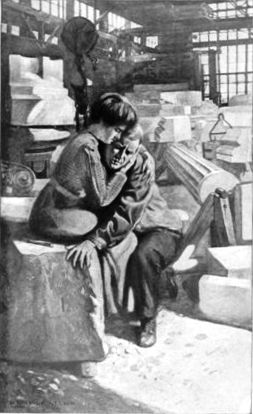
"'Unworthy—unworthy!' was Champney Googe's cry, as he knelt before Aileen"
Aileen lifted his head, laid her arms around his neck, drew him by her young strength and her gentle compelling words to a seat beside her on the granite block. She kept her arms about him.
"No, Champney, not unworthy; but worthy, worthy of it all—all that life can give you in compensation for those seven years. We'll put it all behind us; we'll live in the present and in hope of a blessed future. Take heart, my husband—"
The bowed shoulders heaved beneath her arms.
"So little to offer—so little—"
"'So little'!" she exclaimed; "and is it 'little' you call your love for me? Is it 'little' that I'm to have a home—at last—of my own? Is it 'little' that the husband I love is going out of it and coming home to it in his daily work, and my heart going out to him both ways at once? And is it 'little' you call the gift of a mother to her who is motherless—" her voice faltered.
Champney caught her in his arms; his tears fell upon the dark head.
"I'm a coward, Aileen, and you are just like our Father Honoré; but I will put all behind me. I will not regret. I will work out my own salvation here in my native place, among my own and among strangers. I vow here I will, God helping me, if only in thankfulness for the two hearts that are mine...."
The afterglow faded from the western heavens. The twilight came on apace. The two still sat there in the darkening shed, at times unburdening their over-charged hearts; at others each rested heart and body and soul in the presence of the other, and both were aware of the calming influence of the dim and silent shed.
"How did you happen to come down here just to-night, and after work hours too, Champney?" she asked, curious to know the how and the why of this meeting.
"I came down for my second chisel. I remembered when I got home that it needed sharpening and I could not do without it to-morrow morning. Of course the machine shop was closed, so I thought I'd try my hand at it on the grindstone up home this evening."
"Then is this it?" she exclaimed, picking up the chisel from the block.
"Yes, that's mine." He held out his hand for it.
"Indeed, you're not going to have it—not this one! I'll buy you another, but this is mine. Wasn't I holding it in my hand and thinking of you when I saw you coming over the meadows?"
"Keep it—and I'll keep something I have of yours."
"Of mine? Where did you get anything of mine? Surely it isn't the peppered rosebud?"
"Oh, no. I've had it nearly seven years."
"Seven years!" She exclaimed in genuine surprise. "And whatever have you had of mine I'd like to know that has kept seven years? It's neither silver nor gold—for I've little of either; not that silver or gold can make a man happy," she added quickly, fearing he might be sensitive to her speech.
"No; I've learned that, Aileen, thank God!"
"What is it then?—tell me quick."
He thrust his hand into the workman's blouse and drew forth a small package, wrapped in oiled silk and sewed to a cord that was round his neck. He opened it.
Aileen bent to examine it, her eyes straining in the increasing dusk.
"Why, it's never—it's not my handkerchief!—Champney!"
"Yes, yours, Aileen—that night in all the horror and despair, I heard something in your voice that told me you—didn't hate me—"
"Oh, Champney!"
"Yes. I've kept it ever since—I asked permission to take it in with me?—I mean into my cell. They granted it. It was with me night and day—my head lay on it at night; I got my first sleep so—and it went with me to work during the day. It's been kissed clean thin till it's mere gossamer; it helped, that and the work, to save my brain—"
She caught handkerchief and hand in both hers and pressed her lips to them again and again.
"And now I'm going to keep it, after you're mine in the sight of man, as you are now before God; put it away and keep it for—" He stopped short.
"For whom?" she whispered.
He drew her close to him—closer and more near.
"Aileen, my beloved," his voice was earnestly joyful, "I am hoping for the blessing of children—are you?—"
"Except for you, my arms will feel empty for them till they come—"
"Oh, my wife—my true wife!—now I can tell you all!" he said, and the earnest note was lost in purest joy. He whispered:
"You know, dear, I'm but half a man, and must remain such. I am no citizen, have no citizen's rights, can never vote—have no voice in all that appeals to manhood—my country—"
"I know—I know—" she murmured pityingly.
"And so I used to think there in my cell at night when I kissed the little handkerchief—Please God, if Aileen still loves me when I get out, if she in her loving mercy will forgive to the extent that she will be my wife, then it may be that she will bestow on me the blessing of a child—a boy who will one day stand among men as his father never can again, who will possess the full rights of citizenship; in him I may live again as a man—but only so."
"Please God it may be so."
They walked slowly homewards to The Bow in the clear warm dark of the midsummer-night. They had much to say to each other, and often they lingered on the way. They lingered again when they came to the gate by the paddock in the lane.
Aileen looked towards the house. A light was burning in Mrs. Champney's room.
"I'm afraid Mrs. Champney must be much worse. Tave never would have forgotten me if he hadn't received some telephone message while he was at Father Honoré's. But the nurse said there was nothing I could do when I left with Tave—but oh, I'm so glad he didn't stop! I must go in now, Champney," she said decidedly. But he still held her two hands.
"Tell me, Champney, have you ever thought your aunt might remember you—for the wrong she did you?"
"No; and if she should, I never would take a cent of it."
"Oh, I'm so glad—so glad!" She squeezed both his hands right hard.
He read her thought and smiled to himself; he was glad that in this he had not disappointed her.
"But there's one thing I wish she would do—poor—poor Aunt Meda—" he glanced up at the light in the window.
"Yes, 'poor,' Champney—I know." She was nodding emphatically.
"I wish she would leave enough to Mr. Van Ostend to repay with interest what he repaid for me to the Company; it would be only just, for, work as I may, I can never hope to do that—and I long so to do it—no workman could do it—"
She interrupted gayly: "Oh, but you've a working-woman by your side!" She snatched away her small hands—for she belonged to the small people of the earth. "See, Champney, the two hands! I can work, and I'm not afraid of it. I can earn a lot to help with—and I shall. There's my cooking, and singing, and embroidery—"
He smiled again in the dark at her enthusiasm—it was so like her!
"And I'll lift the care from our mother too,—and you're not to fret your dear soul about the Van Ostend money—if one can't do it, surely two can with God's blessing. Now I must go in—and you may give me another kiss for I've been on starvation diet these last seven years—only one—oh, Champney!"...
The dim light continued to burn in the upper chamber at Champ-au-Haut until the morning; for before Champney and Aileen left the shed, the Inevitable had already crossed the threshold of that chamber—and the dim light burned on to keep him company....
A month later, when Almeda Champney's will was admitted to probate and its contents made public, it was found that there were but six bequests—one of which was contained in the codicil—namely:
To Octavius Buzzby the oil portrait of Louis Champney.
To Ann and Hannah one thousand dollars each in recognition of faithful service for thirty-seven years.
To Aileen Armagh (so read the codicil) a like sum provided she did not marry Champney Googe.
One half of the remainder of the estate, real and personal, was bequeathed to Henry Van Ostend; the other half, in trust, to his daughter, Alice Maud Mary Van Ostend.
The instrument bore the date of Champney Googe's commitment.