PART THIRD
Reading edition
In the Stream
I
Mrs. Milton Caukins had her trials, but they were of a kind some people would call "blessed torments." The middle-aged mother of eight children, six boys, of whom Romanzo was the eldest, and twin girls, Elvira Caukins might with justice lay claim to a superabundance of a certain kind of trial. Every Sunday morning proved the crux of her experience, and Mrs. Caukins' nerves were correspondingly shaken. To use her own words, she "was all of a tremble" by the time she was dressed for church.
On such occasions she was apt to speak her mind, preferably to the Colonel; but lacking his presence, to her family severally and collectively, to 'Lias, the hired man, or aloud to herself when busy about her work. She had been known, on occasion, to acquaint even the collie with her state of mind, and had assured the head of the family afterwards that there was more sense of understanding of a woman's trials in one wag of a dog's tail than in most men's head-pieces.
"Mr. Caukins!" she called up the stairway. She never addressed her husband in the publicity of domestic life without this prefix; to her children she spoke of him as "your pa"; to all others as "the Colonel."
"Yes, Elvira."
The Colonel's voice was leisurely, but muffled owing to the extra heavy lather he was laying about his mouth for the Sunday morning shave. His wife's voice shrilled again up the staircase:
"It's going on nine o'clock and the boys are nowheres near ready; I haven't dressed the twins yet, and the boys are trying to shampoo each other—they've got your bottle of bay rum, and not a single shoe have they greased. I wish you'd hurry up and come down; for if there's one thing you know I hate it's to go into church after the beginning of the first lesson with those boys squeaking and scrunching up the aisle behind me. It makes me nervous and upsets me so I can't find the place in my prayer book half the time."
"I'll be down shortly." The tone was intended to be conciliatory, but it irritated Mrs. Caukins beyond measure.
"I know all about your 'shortlies,' Mr. Caukins; they're as long as the rector's sermon this very Whit-sunday—the one day in the whole year when the children can't keep still any more than cows in fly time. Did you get their peppermints last night?"
"'Gad, my dear, I forgot them! But really—", his voice was degenerating into a mumble owing to the pressure of circumstances, "—matters of such—er—supreme importance—came—er—to my knowledge last evening that—that—"
"That what?"
"—That—that—mm—mm—" there followed the peculiar noise attendant upon a general clearing up of much lathered cuticle, "—I forgot them."
"What matters were they? You didn't say anything about 'supreme importance' last night, Mr. Caukins."
"I'll tell you later, Elvira; just at present I—"
"Was it anything about the quarries?"
"Mm—"
"What was it?"
"I heard young Googe was expected next week."
"Well, I declare! I could have told you that much myself if you'd been at home in any decent season. It seems pretty poor planning to have to run down three miles to The Greenbush every Saturday evening to find out what you could know by just stepping across the bridge to Aurora's. She told me yesterday. Was that all?"
"N—no—"
"For mercy's sake, Mr. Caukins, don't keep me waiting here any longer! It's almost church time."
"I wasn't aware that I was detaining you, Elvira." The Colonel's protest was mild but dignified. There were sounds above of renewed activity.
"Dulcie," said Mrs. Caukins, turning to a little girl who was standing beside her, listening with erected ears to her mother's questions and father's answers, "go up stairs into mother's room and see if Doosie's getting ready, there's a good girl."
"Doosie is with me, Elvira; I would let well enough alone for the present, if I were you," said the Colonel admonishingly. His wife wisely took the hint. "Come up, Dulcie," he called, "father's ready." Dulcie hopped up stairs.
"You haven't said what matters of importance kept you last night." Mrs. Caukins returned to her muttons with redoubled energy.
"Champney came home unexpectedly last evening, and the syndicate has offered him a position, a big one, in New York—treasurer of the Flamsted Quarries Company; and our Romanzo's got a chance too—"
"You don't say! What is it?" Mrs. Caukins started up stairs whence came sounds of an obstreperous bootjack.
"Paymaster, here in town; I'll explain in more propitious circumstances. Has 'Lias harnessed yet, Elvira?"
Without deigning to answer, Mrs. Caukins freed her mind.
"Well, Mr. Caukins, I must say you grow more and more like that old ram of 'Lias's that has learned to butt backwards just for the sake of going contrary to nature. I believe you'd rather tell a piece of news backwards than forwards any day! Why didn't you begin by telling me about Romanzo? If your own child that's your flesh and blood and bone isn't of most interest to you, I'd like to know what is!"
The Colonel's reply was partly inaudible owing to a sudden outbreak of altercation among the boys in the room below. Mrs. Caukins, who had just reached the landing, turned in her tracks and hurried to the rescue.
The Colonel smiled at the rosy, freshly-shaved face reflected in the mirror of the old-fashioned dressing-case, and, at the same time, caught the reflection of another image—that of his hired man, 'Lias, who was crossing the yard. He went to the window and leaned out, stemming his hands on the sill.
"There seems to be the usual Sunday morning row going on below, 'Lias. I fear the boys are shampooing each other's heads with the backs of their brushes from the sounds."
'Lias smiled, and nodded understandingly.
"Just look in and lend a hand in case Mrs. Caukins should be outnumbered, will you? I'm engaged at present." And deeply engaged he was to the twins' unspeakable delight. Whistling softly an air from "Il Trovatore," he rubbed some orange-flower water on his chin and cheeks; then taking a fresh handkerchief, dabbed several drops on the two little noses that waited upon him weekly in expectation of this fragrant boon. He was rewarded by a few satisfactory kisses.
"Now run away and help mother—coach leaves at nine forty-five pre-cisely. I forgot the peppermints, but—" he slapped his trousers' pockets significantly.
The twins shouted with delight and rushed away to impart the news to the boys.
"I wish you would tell me the secret of your boys' conduct in church, Colonel Caukins; it's exemplary. I don't understand it, for boys will be boys," said the rector one Sunday several years before when all the boys were young. He had taken note of their want of restlessness throughout the sermon.
The Colonel's mouth twitched; he answered promptly, but avoided his wife's eyes.
"All in the method, I assure you. We Americans have spent a generation in experimenting with the inductive, the subjective method in education, and the result is, to all intents and purposes, a dismal failure. The future will prove the value of the objective, the deductive—which is mine," he added with a sententious emphasis that left the puzzled rector no wiser than before.
"Whatever the method, Colonel, you have a fine family; there is no mistake about that," he said heartily.
The Colonel beamed and responded at once:
"'Blessed is the man that hath his quiver full'—"
At this point Mrs. Caukins surreptitiously poked the admonitory end of her sunshade between the Colonel's shoulder blades, and the Colonel, comprehending, desisted from further quotation of scripture. It was not his strong point. Once he had been known to quote, not only unblushingly but triumphantly, during a touch-and-go discussion of the labor question in the town hall:—"The ass, gentlemen, is worthy of his hire"; and in so doing had covered Mrs. Caukins with confusion and made a transient enemy of every wage-earner in the audience.
But his boys behaved—that was the point. What boys wouldn't when their heart's desire was conveyed to them at the beginning of the sermon by a secret-service-under-the-pew process wholly delightful to the young human male? Who wouldn't be quiet for the sake of the peppermints, a keen three-bladed knife, or a few gelatine fishes that squirmed on his warm moist palm in as lively a manner as if just landed on the lake shore? Their father had been a boy, and at fifty had a boy's heart within him—this was the secret of his success.
Mrs. Caukins appeared at last, radiant in the consciousness of a new chip hat and silk blouse. Dulcie and Doosie in white lawn did their pains-taking mother credit in every respect. The Colonel gallantly presented his wife with a small bunch of early roses—an attention which called up a fine bit of color into her still pretty face. 'Lias helped her into the three-seated wagon, then lifted in the twins; the boys piled in afterwards; the Colonel took the reins. Mrs. Caukins waved her sunshade vigorously at 'Lias and gave a long sigh of relief and satisfaction.
"Well, we're off at last! I declare I miss Maggie every hour in the day. I don't know what I should have done all these years without that girl!"
The mention of "Maggie" emphasizes one of the many changes in Flamsted during the six years of Champney Googe's absence. Mrs. Caukins, urged by her favorite, Aileen, and advised by Mrs. Googe and Father Honoré, had imported Margaret O'Dowd, the "Freckles" of the asylum, as mother's helper six months after Aileen's arrival in Flamsted. For nearly six years Maggie loyally seconded Mrs. Caukins in the care of her children and her household. Slow, but sure and dependable, strong and willing, she made herself invaluable in the stone house among the sheep pastures; her stunted affections revived and flourished apace in that household of well-cared-for children to whom both parents were devoted. It cost her a heartache to leave them; but six months ago burly Jim McCann, one of the best workmen in the sheds—although of unruly spirit and a source of perennial trouble among the men—began to make such determined love to the mother's helper that the Caukinses found themselves facing inevitable loss. Maggie had been married three months; and already McCann had quarrelled with the foreman, and, in a huff, despite his wife's tears and prayers, sought of his own accord work in another and far distant quarry.
"Maggie told me she'd never leave off teasing Jim to bring her back," said the fifth eldest Caukins.—"Oh, look!" he cried as they rumbled over the bridge; "there's Mrs. Googe and Champney on the porch waving to us!"
The Colonel took off his hat with a flourish; the boys swung theirs; Mrs. Caukins waved her sunshade to mother and son.
"I declare, I'd like to stop just a minute," she said regretfully, for the Colonel continued to drive straight on. "I'm so glad for Aurora's sake that he's come home; I only hope our Romanzo will do as well."
"It would be an intrusion at such a time, Elvira. The effusions of even the best-intentioned friends are injudicious at the inopportune moment of domestic reunion."
Mrs. Caukins subsided on that point. She was always depressed by the Colonel's grandiloquence, which he usually reserved for The Greenbush and the town-meeting, without being able to account for it.
"He'll see a good many changes here; it's another Flamsted we're living in," she remarked later on when they passed the first stone-cutters' shed on the opposite shore of the lake; and the family proceeded to comment all the way to church on the various changes along the route.
It was in truth another Flamsted, the industrial Flamsted which the Colonel predicted six years before on that memorable evening in the office of The Greenbush.
To watch the transformation of a quiet back-country New England village into the life-centre of a great and far-reaching industry, is in itself a liberal education, not only in economics, but in inherited characteristics of the human race. Those first drops of "the deluge," the French priest and the Irish orphan, were followed by an influx of foreigners of many nationalities: Scotch, Irish, Italians, Poles, Swedes, Canadian French; and with these were associated a few American-born.
Their life-problem, the earning of wages for the sustenance of themselves and their families, was one they had in common. Its solution was centred for one and all in their work among the granite quarries of The Gore and in the stone-cutters' sheds on the north shore of Lake Mesantic. These two things the hundreds belonging to a half-dozen nationalities possessed in common—these, and their common humanity together with the laws to which it is subject. But aside from this, their speech, habits, customs, religions, food, and pastimes were polyglot; on this account the lines of racial demarkation were apt, at times, to be drawn all too sharply. Yet this very fact of differentiation provided hundreds of others—farmers, shopkeepers, jobbers, machinists, mechanics, blacksmiths, small restaurant-keepers, pool and billiard room owners—with ample sources of livelihood.
This internal change in the community of Flamsted corresponded to the external. During those six years the very face of nature underwent transformation. The hills in the apex of The Gore were shaved clean of the thin layer of turf, and acres of granite laid bare to the drill. Monster derricks, flat stone-cars, dummy engines, electric motors, were everywhere in evidence. Two glittering steel tracks wound downwards through old watercourses to the level of the lake, and to the huge stone-cutting sheds that stretched their gray length along the northern shore. Here the quarried stones, tons in weight, were unloaded by the great electric travelling crane which picks up one after the other with automatic perfection of silence and accuracy, and deposits them wherever needed by the workmen.
A colony of substantial three-room houses, two large boarding-houses, a power house and, farther up beyond the pines, a stone house and a long low building, partly of wood, partly of granite waste cemented, circled the edges of the quarry.
The usual tale of workmen in the fat years was five hundred quarrymen and three hundred stone-cutters. This population of working-men, swelled to three thousand by the addition of their families, increased or diminished according as the years and seasons proved fat or lean. A ticker on Wall Street was sufficient to give to the great industry abnormal life and activity, and draw to the town a surplus working population. A feeling of unrest and depression, long-continued in metropolitan financial circles, was responded to with sensitive pulse on these far-away hills of Maine and resulted in migratory flights, by tens and twenties, of Irish and Poles, of Swedes, Italians, French Canucks, and American-born to more favorable conditions. "Here one day and gone the next"; even the union did not make for stability of tenure.
In this ceaseless tidal ebb and flow of industrials, the original population of Flamsted managed at times to come to the surface to breathe; to look about them; to speculate as to "what next?" for the changes were rapid and curiosity was fed almost to satiety. A fruitful source of speculation was Champney Googe's long absence from home, already six years, and his prospects when he should have returned. Speculation was also rife when Aurora Googe crossed the ocean to spend a summer with her son; at one time rumors were afloat that Champney's prospective marriage with a relation of the Van Ostends was near at hand, and this was said to be the cause of his mother's rather sudden departure. But on her return, Mrs. Googe set all speculation in this direction at rest by denying the rumor most emphatically, and adding the information for every one's benefit that she had gone over to be with Champney because he did not wish to come home at the time his contract with Mr. Van Ostend permitted.
Once during the past year, the village wise heads foregathered in the office of The Greenbush to discuss the very latest:—the coming to Flamsted of seven Sisters, Daughters of the Mystic Rose, who, foreseeing the suppression of their home institution in France, had come to prepare a refuge for their order on the shores of America and found another home and school among the quarrymen in this distant hill-country of the new Maine—an echo of the old France of their ancestors. This was looked upon as an undreamed-of innovation exceeding all others that had come to their knowledge; it remained for old Joel Quimber to enter the lists as champion of the newcomers, their cause, and their school which, with Father Honoré's aid, they at once established among the barren hills of The Gore.
"Hounded out er France, poor souls, just like my own great-great-great-granther's father!" he said, referring to the subject again on that last Saturday evening when the frequenters of The Greenbush were to be stirred shortly by the news they considered best of all: Champney Googe's unexpected arrival. "I was up thar yisterd'y an' it beats all how snug they're fixed! The schoolroom's ez neat as a pin, an' pitchers on the walls wuth a day's journey to see. They're havin' a room built onto the farther end—a kind of er relief hospital, so Father Honoré told me—ter help out when the quarrymen git a jammed foot er finger, so's they needn't be took home to muss up their little cabins an' worrit their wives an' little 'uns. I heerd Aileen hed ben goin' up thar purty reg'lar lately for French an' sich; guess Mis' Champney's done 'bout the right thing by her, eh, Tave?"
Octavius nodded. "And Aileen's done the right thing by Mrs. Champney. 'T isn't every young girl that would stick to it as Aileen's done the last six years—not in the circumstances."
"You're right, Tave. I heerd not long ago thet she was a-goin' on the stage when she'd worked out her freedom, and by A. J. she's got the voice for it! But I'd hate ter see her thar. She's made a lot er sunshine in this place, and I guess from all I hear there's them thet would stan' out purty stiff agin it; they say Luigi Poggi an' Romanzo Caukins purty near fit over her t' other night."
"You needn't believe all you hear, Joel, but you can believe me when I tell you there'll be no going on the stage for Aileen—not if I know it, or Father Honoré either."
He spoke so emphatically that his brother Augustus looked at him in surprise.
"What's up, Tave?" he inquired.
"I mean Aileen's got a level head and isn't going to leave just as things are beginning to get interesting. She's stood it six year and she can stand it six more if she makes up her mind to it, and I'd ought to know, seeing as I've lived with her ever since she come to Flamsted."
"To be sure, Tave, to be sure; nobody knows better'n you, 'bout Aileen, an' I guess she's come to look on you, from all I hear, as her special piece of property." His brother spoke appeasingly.
Octavius smiled. "Well, I don't deny but she lays claim to me most of the time; it's 'Octavius' here and 'Octavius' there all day long. Sometimes Mrs. Champney ruffs up about it, but Aileen has a way of smoothing her down, generally laughs her out of it. Is that the Colonel?" He listened to a step on the veranda. "Don't let on 'bout anything 'twixt Romanzo and Aileen before the Colonel, Joel."
"You don't hev ter say thet to me," said old Quimber resentfully; "anybody can see through a barn door when thar's a hole in it. All on us know Mis' Champney's a-breakin'; they do say she's hed a shock, leastwise I heerd so, an' Aileen'll look out for A No. 1. I ain't lived to be most eighty in Flamsted for nothin', an' I've seen an' heerd more'n I've ever told, Tave; more'n even you know 'bout some things. You don't remember the time old Square Googe took Aurory inter his home to bring up an' Judge Champney said he was sorry he'd got ahead of him for he wanted to adopt her for a daughter himself; them's his words; I heerd him. An' I can tell more'n—"
"Shut up, Quimber," said Octavius shortly; and Joel Quimber "shut up," but, winking knowingly at Augustus Buzzby, continued to chuckle to himself till the Colonel entered who, beginning to expatiate upon the subject of Champney Googe's prospects when he should have returned to the home-welcome awaiting him, was happily interrupted by the announcement of that young man's unexpected arrival on the evening train.
II
Champney Googe was beginning to realize, as he stood on the porch with his mother and waved to his old neighbors, the Caukinses, the changed conditions he was about to face. He was also realizing that he must change to meet these conditions. On his way up from the train Saturday evening, he noted the power house at The Corners and the substantial line of comfortable cottages that extended for a mile along the highroad to the entrance of the village. He found Main Street brilliant with electric lights and lined nearly its entire length with shops, large and small, which were thronged with week-end purchasers. An Italian fruit store near The Greenbush bore the proprietor's name, Luigi Poggi; as he drove past he saw an old Italian woman bargaining with smiles and lively gestures over the open counter. Farther on, from an improvised wooden booth, the raucous voice of the phonograph was jarring the night air and entertaining a motley group gathered in front of it. Across the street a flaunting poster announced "Moving Picture Show for a Nickel." Vehicles of all descriptions, from a Maine "jigger" to a "top buggy," were stationary along the village thoroughfare, their various steeds hitched to every available stone post. In front of the rectory some Italian children were dancing to the jingle of a tambourine.
On nearing The Bow the confusion ceased; the polyglot sounds were distinguishable only as a murmur. In passing Champ-au-Haut, he looked up at the house; here and there a light shone behind drawn shades. Six years had passed since he was last there; six years—and time had not dulled the sensation of that white pepper in his nostrils! He smiled to himself. He must see Aileen before he left, for from time to time he had heard good reports of her from his mother with whom she had become a favorite. He thought she must be mighty plucky to stand Aunt Meda all this time! He gathered from various sources that Mrs. Champney was growing peculiar as she approached three score and ten. Her rare letters to him, however, were kind enough. But he was sure Aileen's anomalous place in the household at Champ-au-Haut—neither servant nor child of the house, never adopted, but only maintained—could have been no sinecure. Anyway, he knew she had kept the devotion of her two admirers, Romanzo Caukins and Octavius Buzzby. From a hint in his aunt's last letter, he drew the conclusion that Aileen and Romanzo would make a match of it before long, when Romanzo should be established. At any rate, Aileen had wit enough, he was sure, to know on which side her bread was buttered, and from all he heard by the way of letters, Romanzo Caukins was not to be sneezed at as a prospective husband—a steady-going, solid sort of a chap who, he was told, had a chance now like himself in the quarry business. He must credit Aunt Meda with this one bit of generosity, at least; Mr. Van Ostend told him she had applied to him for some working position for Romanzo in the Flamsted office, and not in vain; he was about to be put in as pay-master.
As he drove slowly up the highroad towards The Gore, he saw the stone-cutters' sheds stretching dim and gray in the moonlight along the farther shore. A standing train of loaded flat-cars gleamed in the electric light like a long high-piled drift of new-fallen snow. Here and there, on approaching The Gore, an arc-light darkened the hills round about and sent its blinding glare into the traveller's eyes. At last, his home was in sight—his home!—he wondered that he did not experience a greater thrill of home-coming—and behind and above it the many electric lights in and around the quarries produced hazy white reflections concentrated in luminous spots on the clear sky.
His mother met him on the porch. Her greeting was such that it caused him to feel, and for the first time, that where she was, there, henceforth, his true home must ever be.
"It will be hard work adjusting myself at first, mother," he said, turning to her after watching the wagonload of Caukinses out of sight, "harder than I had any idea of. A foreign business training may broaden a man in some ways, but it leaves his muscles flabby for real home work here in America. You make your fight over there with gloves, and here only bare knuckles are of any use; but I'm ready for it!" He smiled and squared his shoulders as to an imaginary load.
"You don't regret it, do you, Champney?"
"Yes and no, mother. I don't regret it because I have gained a certain knowledge of men and things available only to one who has lived over there; but I do regret that, because of the time so spent, I am, at twenty-seven, still hugging the shore—just as I was when I left college. After all these years I'm not 'in it' yet; but I shall be soon," he added; the hard determined ring of steadfast purpose was in his voice. He sat down on the lower step: his mother brought forward her chair.
"Champney," she spoke half hesitatingly; she did not find it easy to question the man before her as she used to question the youth of twenty-one, "would you mind telling me if there ever was any truth in the rumor that somehow got afloat over here three years ago that you were going to marry Ruth Van Ostend? Of course, I denied it when I got home, for I knew you would have told me if there had been anything to it."
Champney clasped his hands about his knee and nursed it, smiling to himself, before he answered:
"I suppose I may as well make a clean breast of the whole affair, which is little enough, mother, even if I didn't cover myself with glory and come out with colors flying. You see I was young and, for all my four years in college, pretty green when it came to the real life of those people—"
"You mean the Van Ostends?"
"Yes, their kind. It's one thing to accept their favors, and it's quite another to make them think you are doing them one. So I sailed in to make Ruth Van Ostend interested in me as far as possible, circumstances permitting—and you'll admit that a yachting trip is about as favorable as they make it. You know she's three years older than I, and I think it flattered and amused her to accept my devotion for a while, but then—"
"But, Champney, did you love her?"
"Well, to be honest, mother, I hadn't got that far myself—don't know that I ever should have; any way, I wanted to get her to the point before I went through any self-catechism on that score."
"But, Champney!" She spoke with whole-hearted protest.
He nodded up at her understandingly. "I know the 'but', mother; but that's how it stood with me. You know they were in Paris the next spring and, of course, I saw a good deal of them—and of many others who were dancing attendance on the heiress to the same tune that I was. But I caught on soon, and saw all the innings were with one special man; and, well—I didn't make a fool of myself, that's all. As you know, she was married the autumn after your return, three years ago."
"You're sure you really didn't mind, Champney?"
He laughed out at that. "Mind! Well, rather! You see it knocked one of my little plans higher than a kite—a plan I made the very day I decided to accept Mr. Van Ostend's offer. Of course I minded."
"What plan?"
"Wonder if I'd better tell you, mother? I'd like to stand well in your good graces—"
"Oh, Champney!"
"Fact, I would. Well, here goes then: I decided—I was lying up under the pines, you know that day I didn't want to accept his offer?"—she nodded confirmatorily—"that if I couldn't have an opportunity to get rich quick in one way, I would in another; and, in accepting the offer, I made up my mind to try for the sister and her millions; if successful, I intended to take by that means a short cut to matrimony and fortune."
"Oh, Champney!"
"Young and fresh and—hardened, wasn't it, mother?"
"You were so young, so ignorant, so unused to that sort of living; you had no realization of the difficulties of life—of love—."
She began speaking as if in apology for his weakness, but ended with the murmured words "life—love", in a voice so tense with pain that it sounded as if the major dominant of youth and ignorance suddenly suffered transcription into a haunting minor.
Her son looked up at her in surprise.
"Why, mother, don't take it so hard; I assure you I didn't. It brought me down to bed rock, for I was making a conceited ass of myself that's all, in thinking I could have roses for fodder instead of thistles—and just for the asking! It did me no end of good. I shall never rush in again where even angels fear to tread except softly—I mean the male wingless kind—worth a couple of millions; she has seven in her own right.—But we're the best of friends."
He spoke without bitterness. His mother felt, however, at the moment, that she would have preferred to hear a note of keen disappointment in his explanation rather than this tone of lightest persiflage.
"I don't see how—" she began, but checked herself. A slight flush mounted in her cheeks.
"See how what, mother? Please don't leave me dangling; I'm willing to take all you can give. I deserve it."
"I wasn't going to blame you, Champney. I'm the last one to do that—Life teaches each in her own way. I was only thinking I didn't see how any girl could resist loving you, dear."
"Oh, ho! Don't you, mother mine! Well, commend me to a doting—"
"I'm not doting, Champney," she protested, laughing; "I know your faults better than you know them yourself."
"A doting mother, I say, to brace up a man fallen through his pride. Do you mean to say"—, he sprang to his feet, faced her, his hands thrust deep in his pockets, his face alive with the fun of the moment,—"do you mean to say that if you were a girl I should prove irresistible to you? Come now, mother, tell me, honor bright."
She raised her eyes to his. The flush faded suddenly in her cheeks, leaving them unnaturally white; her eyes filled with tears.
"I should worship you," she said under her breath, and dropped her head into her hands. He sprang up the steps to her side.
"Why, mother, mother, don't speak so. I'm not worthy of it—it shames me. Here, look up," he took her bowed head tenderly between his hands and raised it, "look into my face; read it well—interpret, and you will cease to idealize, mother."
She wiped her eyes, half-smiling through her tears. "I'm not idealizing, Champney, and I didn't know I could be so weak; I think—I think the telegram and your coming so unexpectedly—"
"I know, mother," he spoke soothingly, "it was too much; you've been too long alone. I'm glad I'm at home at last and can run up here almost any time." He patted her shoulder softly, and whistled for Rag. "Come, put on your shade hat and we'll go up to the quarries. I want to see them; do you realize they are the largest in the country? It's wonderful what a change they've made here! After all, it takes America to forge ahead, for we've got the opportunities and the money to back them—and what more is needed to make us great?" He spoke lightly, expecting no answer.
She brought her hat and the two went up the side road under the elms to the quarry.
Ay, what more is needed to make us great? That is the question. There comes a time when a man, whose ears are not wholly deafened by the roar of a trafficking commercialism, asks this question of himself in the hope that some answer may be vouchsafed to him. If it come at all, it comes like the "still small voice" after the whirlwind; and the man who asks that question in the expectation of a response, must first have suffered, repented, struggled, fought, at times succumbed to fateful overwhelming circumstance, before his soul can be attuned so finely that the "still small voice" becomes audible. Youth and that question are not synchronous.
"I've not been so much alone as you imagine, Champney," said his mother. They were picking their way over the granite slopes and around to Father Honoré's house. "Aileen and Father Honoré and all the Caukinses and, during this last year, those sweet women of the sisterhood have brought so much life into my life up here among these old sheep pastures that I've not had the chance to feel the loneliness I otherwise should. And then there is that never-to-be-forgotten summer with you over the ocean—I feed constantly on the remembrance of all that delight."
"I'm glad you had it, mother."
"Besides, this great industry is so many-sided that it keeps me interested in every new development in spite of myself."
"By the way, mother, you wrote me that you had invested most of that twenty thousand from the quarry lands in bank stock, didn't you?"
"Yes; Mr. Emlie is president now; he is considered safe. The deposits have quadrupled these last two years, and the dividends have been satisfactory."
"Yes, I know Emlie's safe enough, but you don't want to tie up your money so that you can't convert it at once into cash if advisable. You know I shall be on the inside track now and in a position to use a little of it at a time judiciously in order to increase it for you. I'd like to double it for you as Aunt Meda has doubled her inheritance from grandfather—Who's that?"
He stopped short and, shading his eyes with his hat, nodded in the direction of the sisterhood house that stood perhaps an eighth of a mile beyond the pines. His mother, following his look, saw the figure of a girl dodge around the corner of the house. Before she could answer, Rag, the Irish terrier, who had been nosing disconsolately about on the barren rock, suddenly lost his head. With one short suppressed yelp, he laid his heels low to the slippery granite shelves and scuttled, scurried, scrambled, tore across the intervening quarry hollow like a bundle of brown tow driven before a hurricane.
Mrs. Googe laughed. "No need to ask 'who' when you see Rag go mad like that! It's Aileen; Rag has been devoted to her ever since you've been gone. I wonder why she isn't at church?"
The girl disappeared in the house. Again and again Champney whistled for his dog but Rag failed to put in an appearance.
"He'll need to be re-trained. It isn't well, even for a dog, to be under such petticoat government as that; it spoils him. Only I'm afraid I sha'n't be at home long enough to make him hear to reason."
"Aileen has him in good training. She knows the dog adores her and makes the most of it. Oh, I forgot to tell you I sent word to Father Honoré this morning to come over to tea to-night. I knew you would like to see him, and he has been anticipating your return."
"Has he? What for I wonder. By the way, where did he take his meals after he left you?"
"Over in the boarding-house with the men. He stayed with me only three months, until his house was built. He has an old French Canadian for housekeeper now."
"He's greatly beloved, I hear."
"The Gore wouldn't be The Gore without him," Mrs. Googe spoke earnestly. "The Colonel"—she laughed as she always did when about to quote her rhetorical neighbor—"speaks of him to everyone as 'the heart of the quarry that responds to the throb of the universal human,' and so far as I know no one has ever taken exception to it, for it's true."
"I remember—he was an all round fine man. I shall be glad to see him again. He must find some pretty tough customers up here to deal with, and the Colonel's office is no longer the soft snap it was for fifteen years, I'll bet."
"No, that's true; but, on the whole, there is less trouble than you would expect among so many nationalities. Isn't it queer?—Father Honoré says that most of the serious trouble comes from disputes between the Hungarians and Poles about religious questions. They are apt to settle it with fists or something worse. But he and the Colonel have managed well between them; they have settled matters with very few arrests."
"I can't imagine the Colonel in that rôle." Champney laughed. "What does he do with all his rhetorical trumpery at such times? I've never seen him under fire—in fact, he never had been when I left."
"I know he doesn't like it. He told me he shouldn't fill the office after another year. You know he was obliged to do it to make both ends meet; but since the opening of the quarries he has really prospered and has a market right here in town for all the mutton he can raise. I'm so glad Romanzo's got a chance."
They rambled on, crossing the apex of The Gore and getting a good view of the great extent of the opened quarries. Their talk drifted from one thing to another, Champney questioning about this one and that, until, as they turned homewards, he declared he had picked up the many dropped stitches so fast, that he should feel no longer a stranger in his native place when he should make his first appearance in the town the next day. He wanted to renew acquaintance with all the people at Champ-au-Haut and the old habitués of The Greenbush.
III
He walked down to Champ-au-Haut the next afternoon. Here and there on the mountain side and along the highroad he noticed the massed pink and white clusters of the sheep laurel. Every singing bird was in full voice; thrush and vireo, robin, meadow lark, song-sparrow and catbird were singing as birds sing but once in the whole year; when the mating season is at its height and the long migratory flight northwards is forgotten in the supreme instinctive joy of the ever-new miracle of procreation.
When he came to The Bow he went directly to the paddock gate. He was hoping to find Octavius somewhere about. He wanted to interview him before seeing any one else, in regard to Rag who had not returned. The recalcitrant terrier must be punished in a way he could not forget; but Champney was not minded to administer this well-deserved chastisement in the presence of the dog's protectress. He feared to make a poor first impression.
He stopped a moment at the gate to look down the lane—what a beautiful estate it was! He wondered if his aunt intended leaving anything of it to the girl she had kept with her all these years. Somehow he had received the impression, whether from Mr. Van Ostend or his sister he could not recall, that she once said she did not mean to adopt her. His mother never mentioned the matter to him; indeed, she shunned all mention, when possible, of Champ-au-Haut and its owner.
In his mind's eye he could still see this child as he saw her on the stage at the Vaudeville, clad first in rags, then in white; as he saw her again dressed in the coarse blue cotton gown of orphan asylum order, sitting in the shade of the boat house on that hot afternoon in July, and rubbing her greasy hands in glee; as he saw her for the third time leaning from the bedroom window and listening to his improvised serenade. Well, he had a bone to pick with her about his dog; that would make things lively for a while and serve for an introduction. He reached over to unlatch the gate. At that moment he heard Octavius' voice in violent protest. It came from behind a group of apple trees down the lane in the direction of the milking shed.
"Now don't go for to trying any such experiment as that, Aileen; you'll fret the cow besides mussing your clean dress."
"I don't care; it'll wash. Now, please, do let me, Tave, just this once."
"I tell you the cow won't give down her milk if you take hold of her. She'll get all in a fever having a girl fooling round her." There followed the rattle of pails and a stool.
"Now, look here, Octavius Buzzby, who knows best about a cow, you or I?"
"Well, seeing as I've made it my business to look after cows ever since I was fifteen year old, you can't expect me to give in to you and say you do."
Her merry laugh rang out. Champney longed to echo it, but thought best to lie low for a while and enjoy the fun so unexpectedly provided.
"Tavy, dear, that only goes to prove you are a mere man; a dear one to be sure—but then! Don't you flatter yourself for one moment that you, or any other man, really know any creature of the feminine gender from a woman to a cow. You simply can't, Tavy, because you aren't feminine. Can you comprehend that? Can you say on your honor as a man that you have ever been able to tell for certain what Mrs. Champney, or Hannah, or I, for instance, or this cow, or the cat, or Bellona, when she hasn't been ridden enough, or the old white hen you've been trying to force to sit the last two weeks, is going to do next? Now, honor bright, have you?"
Octavius was grumbling some reply inaudible to Champney.
"No, of course you haven't; and what's more you never will. Not that it's your fault, Tavy, dear, it's only your misfortune." Exasperating patronage was audible in her voice. Champney noted that a trace of the rich Irish brogue was left. "Here, give me that pail."
"I tell you, Aileen, you can't do it; you've never learned to milk."
"Oh, haven't I? Look here, Tave, now no more nonsense; Romanzo taught me how two years ago—but we both took care you shouldn't know anything about it. Give me that pail." This demand was peremptory.
Evidently Octavius was weakening, for Champney heard again the rattle of the pails and the stool; then a swish of starched petticoat and a cooing "There, there, Bess."
He opened the gate noiselessly and closing it behind him walked down the lane. The golden light of the June sunset was barred, where it lay upon the brilliant green of the young grass, with the long shadows of the apple-tree trunks. He looked between the thick foliage of the low-hanging branches to the milking shed. The two were there. Octavius was looking on dubiously; Aileen was coaxing the giant Holstein mother to stand aside at a more convenient angle for milking.
"Hold her tail, Tave," was the next command.
She seated herself on the stool and laid her cheek against the warm, shining black flank; her hands manipulated the rosy teats; then she began to sing:
"O what are you seeking my pretty colleen, So sadly, tell me now!"— "O'er mountain and plain I'm searching in vain Kind sir, for my Kerry cow."
The milk, now drumming steadily into the pail, served for a running accompaniment to the next verses.
"Is she black as the night with a star of white Above her bonny brow? And as clever to clear The dykes as a deer?"— "That's just my own Kerry cow." "Then cast your eye into that field of wheat She's there as large as life."— "My bitter disgrace! Howe'er shall I face The farmer and his wife?"
What a voice! And what a picture she made leaning caressingly against the charmed and patient Bess! She was so slight, yet round and supple—strong, too, with the strength of perfect health! The thick fluffed black hair was rolled away from her face and gathered into a low knot in the nape of her neck. Her dress cut low at the throat enhanced the white purity of her face and the slim round grace of her neck which showed to advantage against the ebony flank of the mother of many milky ways. Her lips were red and full; the nose was a saucy stub; the eyes he could not see; they were downcast, intent upon her filling pail and the rising creamy foam; but he knew them to be an Irish blue-gray.
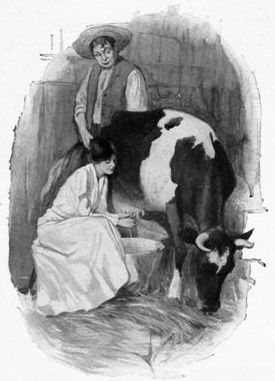
"What a picture she made leaning caressingly against the charmed and patient Bess"
"Since the farmer's unwed you've no cause to dread From his wife, you must allow. And for kisses three— 'Tis myself is he— The farmer will free your cow."
The song ceased; the singer was giving her undivided attention to her self-imposed task. Octavius took a stool and began work with another cow. Champney, nothing loath to prolong the pleasure of looking at the improvised milkmaid, waited before making his presence known until she should have finished.
And watching her, he could but wonder at the ways of Chance that had cast this little piece of foreign flotsam upon the shores of America, only to sweep it inland to this village in Maine. He could not help comparing her with Alice Van Ostend—what a contrast! What an abyss between the circumstances of the two lives! Yet this one was decidedly charming, more so than the other; for he was at once aware that Aileen was already in possession of her womanhood's dower of command over all poor mortals of the opposite sex—her manner with Octavius showed him that; and Alice when he saw her last, now nearly six months ago, would have given any one the impression of something still unfledged—a tall, slim, overgrown girl of sixteen, and somewhat spoiled. This was indeed only natural, for her immediate world of father, aunt, and relations had circled ever since her birth in the orbit of her charming wilfulness. Champney acknowledged to himself that he had done her bidding a little too frequently ever since the first yachting trip, when as a little girl she attached herself to him, or rather him to her as a part of her special goods and chattels. At that time their common ground for conversation was Aileen; the child was never tired of his rehearsing for her delight the serenade scene. But in another year she lost this interest, for many others took its place; nor was it ever renewed.
The Van Ostends, together with Ruth and her husband, had been living the last three winters in Paris, Mr. Van Ostend crossing and recrossing as his business interests demanded or permitted. Champney was much with them, for their home was always open to him who proved an ever welcome guest. He acknowledged to himself, while participating in the intimacy of their home life, that if the child's partiality to his companionship, so undisguisedly expressed on every occasion, should, in the transition periods of girlhood and young womanhood, deepen into a real attachment, he would cultivate it with a view to asking her in marriage of her father when the time should show itself ripe. In his first youthful arrogance of self-assertion he had miscalculated with Ruth Van Ostend. He would make provision that this "undeveloped affair"—so he termed it—with her niece should not miscarry for want of caution. He intended while waiting for Alice to grow up—a feat which her aunt was always deploring as an impossibility except in a physical sense—to make himself necessary in this young life. Thus far he had been successful; her weekly girlish letters conclusively proved it.
While waiting for the milk to cease its vigorous flow, he was conscious of reviewing his attitude towards the "undeveloped affair" in some such train of thought, and finding in it nothing to condemn, rather to commend, in fact; for not for the fractional part of a second did he allow a thought of it to divert his mind from the constant end in view: the making for himself a recognized place of power in the financial world of affairs. He knew that Mr. Van Ostend was aware of this steadfast pursuit of a purpose. He knew, moreover, that the fact that the great financier was taking him into his New York office as treasurer of the Flamsted Quarries, was a tacit recognition not only of his six years' apprenticeship in some of the largest banking houses in Europe, but of his ability to acquire that special power which was his goal. In the near future he would handle and practically control millions both in receipt and disbursement. Many of the contracts, already signed, were to be filled within the next three years—the sound of the milking suddenly ceased.
"My, how my wrists ache! See, Tave, the pail is almost full; there must be twelve or fourteen quarts in all."
She began to rub her wrists vigorously. Octavius muttered: "I told you so. You might have known you couldn't milk steady like that without getting all tuckered out."
Champney stepped forward quickly. "Right you are, Tave, every time. How are you, dear old chap?" He held out his hand.
"Champ—Champney—why—" he stammered rather than spoke.
"It's I, Tave; the same old sixpence. Have I changed so much?"
"Changed? I should say so! I thought—I thought—" he was wringing Champney's hand; some strange emotion worked in his features—"I thought for a second it was Mr. Louis come to life." He turned to Aileen who had sprung from her stool. "Aileen, this is Mr. Champney Googe; you've forgotten him, I dare say, in all these years."
The rich red mantled her cheeks; the gray eyes smiled up frankly into his; she held out her hand. "Oh, no, I've not forgotten Mr. Champney Googe; how could I?"
"Indeed, I think it is the other way round; if I remember rightly you gave me the opportunity of never forgetting you." He held her hand just a trifle longer than was necessary. The girl smiled and withdrew it.
"Milky hands are not so sticky as spruce gum ones, Mr. Googe, but they are apt to be quite as unpleasant."
Champney was annoyed without in the least knowing why. He was wondering if he should address her as "Aileen" or "Miss Armagh," when Octavius spoke:
"Aileen, just go on ahead up to the house and tell Mrs. Champney Mr. Googe is here." Aileen went at once, and Octavius explained.
"You see, Champney—Mr. Googe—"
"Have I changed so much, Tave, that you can't use the old name?"
"You've changed a sight; it don't come easy to call you Champ, any more than it did to call Mr. Louis by his Christian name. You look a Champney every inch of you, and you act like one." He spoke emphatically; his small keen eyes dwelt admiringly on the face and figure of the tall man before him. "I thought 't was better to send Aileen on ahead, for Mrs. Champney's broken a good deal since you saw her; she can't stand much excitement—and you're the living image." He called for the boy who had taken Romanzo's place. "I'll go up as far as the house with you. How long are you going to stay?"
"It depends upon how long it takes me to investigate these quarries, learn the ropes. A week or two possibly. I am to be treasurer of the Company with my office in New York."
"So I heard, so I heard. I'm glad it's come at last—no thanks to her," he added, nodding in the direction of the house.
"Do you still hold a grudge, Tave?"
"Yes, and always shall. Right's right and wrong's wrong, and there ain't a carpenter in this world that can dovetail the two. You and your mother have been cheated out of your rights in what should be yours, and it's ten to one if you ever get a penny of it."
Champney smiled at the little man's indignation. "All the more reason to congratulate me on my job, Tave."
"Well, I do; only it don't set well, this other business. She ain't helped you any to it?" He asked half hesitatingly.
"Not a red cent, Tave. I don't owe her anything. Possibly she will leave some of it to this same Miss Aileen Armagh. Stranger things have happened." Octavius shook his head.
"Don't you believe it, Champney. She likes Aileen and well she may, but she don't like her well enough to give her a slice off of this estate; and what's more she don't like any living soul well enough to part with a dollar of it on their account."
"Is there any one Aunt Meda ever did love, Tave? From all I remember to have heard, when I was a boy, she was always bound up pretty thoroughly in herself."
"Did she ever love any one? Well she did; that was her husband, Louis Champney, who loved you as his own son. And it's my belief that's the reason you don't get your rights. She was jealous as the devil of every word he spoke to you."
"You're telling me news—and late in the day."
"Late is better than never, and I'd always meant to tell you when you come to man's estate—but you've been away so long, I've thought sometimes you was never coming home; but I hoped you would for your mother's sake, and for all our sakes."
"I'm going to do what I can, but you mustn't depend too much on me, Tave. I'm glad I'm at home for mother's sake although I always felt she had a good right hand in you, Tave; you've always been a good friend to her, she tells me."
Octavius Buzzby swallowed hard once, twice; but he gave him no reply. Champney wondered to see his face work again with some emotion he failed to explain satisfactorily to himself.
"There's Mrs. Champney on the terrace; I won't go any farther. Come in when you can, won't you?"
"I shall be pretty apt to run in for a chat almost anytime on my way to the village." He waved his hand in greeting to his aunt and sprang up the steps leading to the terrace.
He bent to kiss her and was shocked by the change in her that was only too apparent: the delicate features were sharpened; the temples sunken; her abundant light brown hair was streaked heavily with white; the hands had grown old, shrunken, the veins prominent.
"Kiss me again, Champney," she said in a low voice, closing her eyes when he bent again to fulfil her request. When she opened them he noticed that the lids were trembling and the corners of her mouth twitched. But she rallied in a moment and said sharply:
"Now, don't say you're sorry—I know all about how I look; but I'm better and expect to outlive a good many well ones yet."
She told Aileen to bring another chair. Champney hastened to forestall her; his aunt shook her finger at him.
"Don't begin by spoiling her," she said. Then she bade her make ready the little round tea-table on the terrace and serve tea.
"What do you think of her?" she asked him after Aileen had entered the house. She spoke with a directness of speech that warned Champney the question was a cloak to some other thought on her part.
"That she does you credit, Aunt Meda. I don't know that I can pay you or her a greater compliment."
"Very well said. You've learned all that over there—and a good deal more besides. There have been no folderols in her education. I've made her practical. Come, draw up your chair nearer and tell me something of the Van Ostends and that little Alice who was the means of Aileen's coming to me. I hear she is growing to be a beauty."
"Beauty—well, I shouldn't say she was that, not yet; but 'little.' She is fully five feet six inches with the prospect of an additional inch."
"I didn't realize it. When are they coming home?"
"Early in the autumn. Alice says she is going to come out next winter, not leak out as the other girls in her set have done; and what Alice wants she generally manages to have."
"Let me see—she must be sixteen; why that's too young!"
"Seventeen next month. She's very good fun though."
"Like her?" She looked towards the house where Aileen was visible with a tea-tray.
"Well, no; at least, not along her lines I should say. She seems to have Tave pretty well under her thumb."
Mrs. Champney smiled. "Octavius thought he couldn't get used to it at first, but he's reconciled now; he had to be.—Call her Aileen, Champney; you mustn't let her get the upper hand of you by making her think she's a woman grown," she added in a low tone, for the girl was approaching them, slowly on account of the loaded tray she was carrying.
Champney left his seat and taking the tea-things from her placed them on the table. Aileen busied herself with setting all in order and twirling the tea-ball in each cup of boiling water, as if she had been used to this ultra method of making tea all her life.
"By the way, Aileen—"
He checked himself, for such a look of amazement was in the quickly lifted gray eyes, such a surprised arch was visible in the dark brows, that he realized his mistake in hearing to his aunt's request. He felt he must make himself whole, and if possible without further delay.
"Oh, I see that it must still be Miss Aileen Armagh-and-don't-you-forget-it!" he exclaimed, laughing to cover his confusion.
She laughed in turn; she could not help it at the memories this title called to mind. "Well, it's best to be particular with strangers, isn't it?" Down went the eyes to search in the bottom of a teacup.
"I fancied we were not wholly that; I told Aunt Meda about our escapade six years ago; surely, that affair ought to establish a common ground for our continued acquaintance. But, if that's not sufficient, I can find another nearer at hand—where's my dog?"
This brought her to terms.
"Oh, I can't do anything with Rag, Mr. Googe; I'm so sorry. He's over in the coach house this very minute, and Tave was going to take him home to-night. Just think! That seven-year-old dog has to be carried home, old as he is!"
"If it's come to that, I'll take him home under my arm to-night—that is, if he won't follow; I'll try that first."
"But you're not going to punish him!—and simply because he likes me. That wouldn't be fair!"
She made her protest indignantly. Champney looked at his aunt with an amused smile. She nodded understandingly.
"Oh, no; not simply because he likes you, but because he is untrue to me, his master."
"But that isn't fair!" she exclaimed again, her cheeks flushing rose red; "you've been away so long that the dog has forgotten."
"Oh, no, he hasn't; or if he has I must jog his memory. He's Irish, and the supreme characteristic of that breed is fidelity."
"Well, so am I Irish," she retorted pouting; she began to make him a second cup of tea by twirling the silver tea-ball in the shallow cup until the hot water flew over the edge; "but I shouldn't consider it necessary to be faithful to any one who had forgotten and left me for six years."
"You wouldn't?" Champney's eyes challenged hers, but either she did not understand their message or she was too much in earnest to heed it.
"No I wouldn't; what for? I like Rag and he likes me, and we have been faithful to each other; it would be downright hypocrisy on his part to like you after all these years."
"How about you?" Champney grew bold because he knew his aunt was enjoying the girl's entanglement as much as he was. She was amused at his daring and Aileen's earnestness. "Didn't you tell me in Tave's presence only just now that you couldn't forget me? How is that for fidelity? And why excuse Rag on account of a six years' absence?"
"Well, of course, he's your dog," she said loftily, so evading the question and ignoring the laugh at her expense.
"Yes, he's my dog if he is a backslider, and that settles it." He turned to his aunt. "I'll run in again to-morrow, Aunt Meda, I mustn't wear my welcome out in the first two days of my return."
"Yes, do come in when you can. I suppose you will be here a month or two?"
"No; only a week or two at most; but I shall run up often; the business will require it." He looked at Aileen. "Will you be so kind as to come over with me to the coach house, Miss Armagh, and hand my property over to me? Good-bye, Aunt Meda."
Aileen rose. "I'll be back in a few minutes, Mrs. Champney, or will you go in now?"
"There's no dew, and the air is so fresh I'll sit here till you come."
The two went down the terrace steps side by side. Mrs. Champney watched them out of sight; there was a kindling light in her faded eyes.
"Now, we'll see," said Champney, as they neared the coach house and saw in the window the bundle of brown tow with black nose flattened on the pane and eyes filled with longing under the tangled topknot. The stub of a tail was marking time to the canine heartbeats. Champney opened the door; the dog scurried out and sprang yelping for joy upon Aileen.
"Rag, come here!" The dog's day of judgment was in that masculine command. The little terrier nosed Aileen's hand, hesitated, then pressed more closely to her side. The girl laughed out in merry triumph. Champney noted that she showed both sets of her strong white teeth when she laughed.
"Rag, dear old boy!" She parted with caressing fingers the skein of tow on the frowsled head.
"Come on, Rag." Champney whistled and started up the driveway. The terrier fawned on Aileen, slavered, snorted, sniffed, then crept almost on his belly, tail stiff, along the ground after Champney who turned and laid his hand on him. The dog crouched in the road. He gently pulled the stumps of ears—"Now come!"
He went whistling up the road, and the terrier, recognizing his master, trotted in a lively manner after him.
Champney turned at the gate and lifted his hat. "How about fidelity now, Miss Armagh?" He wanted to tease in payment for that amazed look she gave him for taking a liberty with her Christian name.
"Well, of course, he's your dog," she called merrily after him, "but I wouldn't have done it if I'd been Rag!"
Champney found himself wondering on the homeward way if she really meant what she said.
IV
It was a careless question, carelessly put, and yet—Aileen Armagh, before she returned to the house, was also asking herself if she meant what she said, asking it with an unwonted timidity of feeling she could not explain. On coming in sight of the terrace, she saw that Mrs. Champney was still there. She hesitated a moment, then crossed the lawn to the boat house. She wanted to sit there a while in the shade, to think things out with herself if possible. What did this mean—this strange feeling of timidity?
The course of her life was not wholly smooth. It was inevitable that two natures like hers and Mrs. Champney's should clash at times, and the impact was apt to be none of the softest. Twice, Aileen, making a confidant of Octavius, threatened to run away, for the check rein was held too tightly, and the young life became restive under it. When the child first came to Champ-au-Haut, its mistress recognized at once that in her mischief, her wilfulness, her emphatic assertion of her right of way, there was nothing vicious, and to Octavius Buzzby's amazement, she dealt with her, on the whole, leniently.
"She amuses me," she would say when closing an eye to some of Aileen's escapades that gave a genuine shock to Octavius in the region of his local prejudices.
There had been, indeed, no "folderols" in her education. Sewing, cooking, housework she was taught root and branch in the time not spent at school, both grammar and high. During the last year Mrs. Champney permitted her to learn French and embroidery in a systematic manner at the school established by the gentle Frenchwomen in The Gore; but she steadily refused to permit the girl to cultivate her voice through the medium of proper instruction. This denial of the girl's strongest desire was always a common subject of dissension and irritation; however, after Aileen was seventeen a battle royal of words between the two was a rare occurrence.
At the same time she never objected to Aileen's exercising her talent in her own way. Father Honoré encouraged her to sing to the accompaniment of his violin, knowing well that the instrument would do its share in correcting faults. She sang, too, with Luigi Poggi, her "knothole boy" of the asylum days; and, as seven years before, Nonna Lisa often accompanied with her guitar. The old Italian, who had managed to keep in touch with her one-time protégée, and her grandson Luigi, made their appearance in the village one summer after Aileen had been two years in Flamsted. Luigi, now that his vaudeville days were over, was in search of work at the quarries; his grandmother was to keep house for him till he should be able to establish himself in trade—the goal of so many of his thrifty countrymen.
These two Italians were typical of thousands of their nationality who come to our shores; whom our national life, through naturalization and community of interests, is able in a marvellously short time to assimilate—and for the public good. Intelligent, business-like, keen at a bargain, but honest and graciously gentle and friendly in manner, Luigi Poggi soon established himself in the affections of Flamsted—in no one's more solidly than in Elmer Wiggins', strange to say, who capitulated to the "foreigner's" progressive business methods—and after three years of hard and satisfactory work at the quarries and in the sheds, by living frugally and saving thriftily he was able to open the first Italian fruit stall in the quarry town. The business was flourishing and already threatened to overrun its quarters. Luigi was in a fair way to become fruit capitalist; his first presidential vote had been cast, and he felt prepared to enjoy to the full his new Americanhood.
But with his young manhood and the fulfilment of its young aspirations, came other desires, other incentives for making his business a success and himself a respected and honored citizen of these United States. Luigi Poggi was ready to give into Aileen's keeping—whenever she might choose to indicate by a word or look that she was willing to accept the gift—his warm Italian heart that knew no subterfuge in love, but gave generously, joyfully, in the knowledge that there would be ever more and more to bestow. He had not as yet spoken, save with his dark eyes, his loving earnestness of voice, and the readiness with which, ever since his appearance in Flamsted he ran and fetched and carried for her.
Aileen enjoyed this devotion. The legitimate pleasure of knowing she is loved—even when no response can be given—is a girl's normal emotional nourishment. Through it the narrows in her nature widen and the shallows deepen to the dimensions that enable the woman's heart to give, at last, even as she has received,—ay, even more than she can ever hope to receive. This novitiate was now Aileen's.
As a foil, against which Luigi's silent devotion showed to the best advantage, Romanzo Caukins' dogged persistence in telling her on an average of once in two months that he loved her and was waiting for a satisfactory answer, served its end. For six years, while Romanzo remained at Champ-au-Haut, the girl teased, cajoled, tormented, amused, and worried the Colonel's eldest. Of late, since his twenty-first birthday, he had turned the tables on her, and was teasing and worrying her with his love-blind persistence. That she had given him a decided answer more than once made no impression on his determined spirit. In her despair Aileen went to Octavius; but he gave her cold comfort.
"What'd I tell you two years ago, Aileen? Didn't I say you couldn't play with even a slow-match like Roman, if you didn't want a fire later on? And you wouldn't hear a word to me."
"But I didn't know, Tave! How could I think that just because a boy tags round after you from morning till night for the sake of being amused, that when he gets to be twenty-one he is going to keep on tagging round after you for the rest of his days? I never saw such a leech! He simply won't accept the fact once for all that I won't have him; but he's got to—so now!"
Octavius smiled at the sudden little flurry; he was used to them.
"I take it Roman doesn't think you know your own mind."
"He doesn't! Well, he'll find out I do, then. Oh, dear, why couldn't he just go on being Romanzo Caukins with no nonsense about him, and not make such a goose of himself! Anyway, I'm thankful he's gone; it got so I couldn't so much as tell him to harness up for Mrs. Champney, that he didn't consider it a sign of 'yielding' on my part!" She laughed out. "Oh, Tavy dear, what should I do without you!—Now if I could make an impression on you, it might be worth while," she added mischievously.
Octavius would have failed to be the man he was had he not felt flattered; he smiled on her indulgently. "Well, I shouldn't tag round after you much if I was thirty year younger; 't ain't my way. But there's one thing, Aileen, I want to say to you, and if you've got any common sense you'll heed me this time: I want you to be mighty careful how you manage with Luigi. You've got no slow-match to play with this time, let me tell you; you've got a regular sleeping volcano like some of them he was born near; and it won't do, I warn you. He ain't Romanzo Caukins—Roman's home made; but t'other is a foreigner; they're different."
"Oh, don't preach, Octavius." She always called him by his unabbreviated name when she was irritated. "I like well enough to sing with Luigi, and go rowing with him, and play tennis, and have the good times, but it's nonsense for you to think he means anything serious. Why, he never spoke a word of love to me in his life!"
"Humph!—that silent kind's the worst; you don't give him a chance."
"And I don't mean to—does that satisfy you?" she demanded. "If it doesn't, I'll tell you something—but it's a secret; you won't tell?"
"Not if you don't want me to; I ain't that kind."
"I know you're not, Tave; that's why I'm going to tell you. Here, let me whisper—"; she bent to his ear; he was seated on a stool in the coach house mending a strap; "—I've waited all this time for that prince to come, and do you suppose for one moment I'd look at any one else?"
"Now that ain't fair to fool me like that, Aileen!"
Octavius was really vexed, but he spoke the last words to empty air, for the girl caught up her skirt and ran like a deer up the lane. He could hear her laughing at his discomfiture; the sound grew fainter and fainter; when it ceased he resumed his work, from time to time shaking his head ominously and talking to himself as a vent for his outraged feelings.
But Aileen spoke the truth. Her vivid imagination, a factor in the true Celtic temperament, provided her with another life, apart from the busy practical one which Mrs. Champney laid out for her. All her childish delights of day-dreaming and joyous romancing, fostered by that first novel which Luigi Poggi thrust through the knothole in the orphan asylum fence, was at once transferred to Alice Van Ostend and her surroundings so soon as the two children established their across-street acquaintance. Upon her arrival in Flamsted, the child's adaptability to changed circumstances and new environment was furthered by the play of this imagination that fed itself on what others, who lack it, might call the commonplace of life: the house at Champ-au-Haut became her lordly palace; the estate a park; she herself a princess guarded only too well by an aged duenna; Octavius Buzzby and Romanzo Caukins she looked upon as life-servitors.
Now and then the evidence of this unreal life, which she was leading, was made apparent to Octavius and Romanzo by some stilted mode of speech. At such times they humored her; it provided amusement of the richest sort. She also continued to invent "novels" for Romanzo's benefit, and many a half-hour the two spent in the carriage house—Aileen aglow with the enthusiasm of narration, and Romanzo intent upon listening, charmed both with the tale and the narrator. In these invented novels, there was always a faithful prince returning after long years of wandering to the faithful princess. This was her one theme with variations.
Sometimes she danced a minuet on the floor of the stable, with this prince as imaginary partner, and Romanzo grew jealous of the bewitching smiles and coquetries she bestowed upon the vacant air. At others she would induce the youth to enter a box stall, telling him to make believe he was at the theatre, and then, forgetting her rôle of princess, she was again the Aileen Armagh of old—the child on the vaudeville stage, dancing the coon dance with such vigor and abandonment that once, when Aileen was nearly sixteen, Octavius, being witness to this flaunting performance, took her severely to task for such untoward actions now that she was grown up. He told her frankly that if Romanzo Caukins was led astray in the future it would be through her carryings-on; at which Aileen looked so dumbfoundered that Octavius at once perceived his mistake, and retreated weakly from his position by telling her if she wanted to dance like that, she'd better dance before him who understood her and her intentions.
At this second speech Aileen stared harder than ever; then going up to him and throwing an arm around his neck, she whispered:
"Tave, dear, are you mad with me? What have I done?—Is it really anything so awful?"
Her distress was so unfeigned that Octavius, not being a woman, comforted her by telling her he was a great botcher. Inwardly he cursed himself for an A No. 1 fool. Aileen never danced the "coon" again, but thereafter gave herself such grown-up and stand-off airs in Romanzo's presence, that the youth proceeded in all earnest to lose both head and heart to the girl's gracious blossoming womanhood. Octavius, observing this, groaned in spirit, and henceforth held his tongue when he heard the girl carolling her Irish love songs in the presence of the ingenuous Caukins.
After this, the girl's exuberance of spirits and the sustaining inner life of the imagination helped her wonderfully during the three following years of patient waiting on a confirmed invalid. Of late, Mrs. Champney had come to depend more and more on the girl's strong youth; to demand more and more from her abundant vitality and lively spirits; and Aileen, although recognizing the anomalous position she held in the Champ-au-Haut household—neither servant nor child, neither companion nor friend—gave of herself; gave as her Irish inheritance prompted her to give: ungrudgingly, faithfully, without reward save the knowledge of a duty performed towards the woman who, in taking her into her household and maintaining her there, had placed her in a position to make friends—such friends!
When the soil is turned over carefully, enriched and prepared perfectly for the seed; when rain is abundant, sunshine plenteous and mother-earth's spring quickening is instinctive, is it to be wondered at that the rootlet delves, the plantlet lifts itself, the bud forms quickly, and unexpectedly spreads its petal-star to the sunlight which enhances its beauty and fructifies its work of reproduction? The natural laws, in this case, work to their prescribed end along lines of favoring circumstance—and Love is but the working out of the greatest of all Nature's laws. When conditions are adverse, there is only too often struggle, strife, wretchedness. The result is a dwarfing of the product, a lowering of the vital power, a recession from the type. But, on the contrary, when all conditions combine to further the working of this law, we have the rapid and perfect flowering, followed by the beneficent maturity of fruit and seed. Thus Life, the ever-new, becomes immortal.
Small wonder that Aileen Armagh, trying to explain that queer feeling of timidity, should suddenly press her hand hard over her heart! It was throbbing almost to the point of suffocating her, so possessed was it by the joy of a sudden and wonderful presence of love.
The knowledge brought with it a sense of bewildering unreality. She knew now that her day dreams had a substantial basis. She knew now that she had not meant what she said.
For years, ever since the night of the serenade, her vivid imagination had been dwelling on Champney Googe's home-coming; for years he was the central figure in her day dreams, and every dream was made half a reality to her by means of the praises in his behalf which she heard sounded by each man, woman, and child in the ever-increasing circle of her friends. It was always with old Joel Quimber: "When Champ gits back, we'll hev what ye might call the head of a fam'ly agin." Octavius Buzzby spent hours in telling her of the boy's comings and goings and doings at Champ-au-Haut, and the love Louis Champney bore him. Romanzo Caukins set him on the pedestal of his boyish enthusiasm. The Colonel himself was not less enthusiastic than his first born; he never failed to assure Aileen when she was a guest in his house—an event that became a weekly matter as she grew older—that her lot had fallen in pleasant places; that to his friend, Mrs. Googe, and her son, Champney, she was indebted for the new industrial life which brought with it such advantages to one and all in Flamsted.
To Aurora Googe, the mother of her imaginative ideal, Aileen, attracted from the first by her beauty and motherly kindness towards an orphan waif, gave a child's demonstrative love, afterwards a girl's adoration. In all this devotion she was abetted by Elvira Caukins to whom Aurora Googe had always been an ideal of womanhood. Moreover, Aileen came to know during these years of Champney Googe's absence that his mother worshipped in reality where she herself worshipped in imagination.
Thus the ground was made ready for the seed. Small wonder that the flowering of love in this warm Irish heart was immediate, when Champney Googe, on the second day after his home-coming, questioned her with that careless challenge in his eyes:
"You wouldn't?"
The sun set before she left the boat house. She ran up the steps to the terrace and, not finding Mrs. Champney there, sought her in the house. She found her in the library, seated in her easy chair which she had turned to face the portrait of her husband, over the fireplace.
"Why didn't you call me to help you in, Mrs. Champney? I blame myself for not coming sooner."
"I really feel stronger and thought I might as well try it; there is always a first time—and you were with Champney, weren't you?"
"I? Why no—what made you think that?" Mrs. Champney noticed the slight hesitation before the question was put so indifferently, and the quick red that mounted in the girl's cheeks. "Mr. Googe went off half an hour ago with Rag tagging on behind."
"Then he conquered as usual."
"I don't know whether I should call it 'conquering' or not; Rag didn't want to go, that was plain enough to see."
"What made him go then?"
Aileen laughed out. "That's just what I'd like to know myself."
"What do you think of him?"
"Who?—Rag or Mr. Googe?"
She was always herself with Mrs. Champney, and her daring spirit of mischief rarely gave offence to the mistress of Champ-au-Haut. But by the tone of voice in which she answered, Aileen knew that, without intention, she had irritated her.
"You know perfectly well whom I mean—my nephew, Mr. Googe."
Aileen was silent for a moment. Her young secret was her own to guard from all eyes, and especially from all unfriendly ones. She was standing on the hearth, in front of Mrs. Champney. Turning her head slightly she looked up at the portrait of the man above her—looked upon almost the very lineaments of him whom at that very moment her young heart was adoring: the fine features, the blue eyes, the level brows, the firm curving lips, the abundant brown hair. It was as if Champney Googe himself were smiling down upon her. As she continued to look, the lovely light in the girl's face—a light reflected from no sunset fires over the Flamsted Hills, but from the sunrise of girlhood's first love—betrayed her to the faded watchful eyes beside her.
"He looks just like your husband;" she spoke slowly; her voice seemed to linger on the last word; "when Tave saw him he said he thought it was Mr. Champney come to life, and I think—"
Mrs. Champney interrupted her. "Octavius Buzzby is a fool." Sudden anger hardened her voice; a slight flush came into her wasted cheeks. "Tell Hannah I want my supper now, let Ann bring it in here to me. I don't need you; I'm tired."
Aileen turned without another word—she knew too well that tone of voice and what it portended; she was thankful to hear it rarely now—and left the room to do as she was bidden.
"Little fool!" Almeda Champney muttered between set teeth when the door closed upon the girl. She placed both hands on the arms of her chair to raise herself; walked feebly to the hearth where a moment before Aileen had stood, and raising her eyes to the smiling ones looking down into hers, confessed her woman's weakness in bitter words that mingled with a half-sob:
"And I, too, was a fool—all women are with such as you."
V
Although Mrs. Champney remained the only one who read Aileen Armagh's secret, yet even she asked herself as the summer sped if she read aright.
During the three weeks in which her nephew was making himself familiar with all the inner and outer workings of the business at The Gore and in the sheds, she came to anticipate his daily coming to Champ-au-Haut, for he brought with him the ozone of success. His laugh was so unaffectedly hearty; his interest in the future of Flamsted and of himself as a factor in its prosperity so unfeigned; his enjoyment of his own importance so infectious, his account of the people and things he had seen during his absence from home so entertaining that, in his presence, his aunt breathed a new atmosphere, the life-giving qualities of which were felt as beneficial to every member of the household at The Bow.
Mrs. Champney took note that he never asked for Aileen. If the girl were there when he ran in for afternoon tea on the terrace or an hour's chat in the evening,—sometimes it happened that the day saw him three times at Champ-au-Haut—her presence to all appearance afforded him only an opportunity to tease her goodnaturedly; he delighted in her repartee. Mrs. Champney, keenly observant, failed to detect in the girl's frank joyousness the least self-consciousness; she was just her own merry self with him, and the "give and take" between them afforded Mrs. Champney a fund of amusement.
On the evening of his departure for New York, she was witness to their merry leave-taking. Afterwards she summoned Octavius to the library.
"You may bring all the mail for the house hereafter to me, Octavius; now that I am feeling so much stronger, I shall gradually resume my customary duties in the household. You need not give any of the mail to Aileen to distribute—I'll do it after to-night."
"What the devil is she up to now!" Octavius said to himself as he left the room.
But no letter from New York came for Aileen. Mrs. Champney tried another tack: the next time her nephew came to Flamsted, later on in the autumn, she asked him to write her in detail concerning his intimacy with her cousins, the Van Ostends, and of their courtesies to him. Champney, nothing loath—always keeping in mind the fact that it was well to keep on the right side of Aunt Meda—wrote her all she desired to know. What he wrote was retailed faithfully to Aileen; but the frequent dinners at the Van Ostends', and the prospective coming-out reception and ball to be given for Alice and scheduled for the late winter, called forth from the eagerly listening girl only ejaculations of delight and pleasant reminiscence of the first time she had seen the little girl dressed for a party. If, inwardly she asked herself the question why Alice Van Ostend had dropped all her childish interest in her whom she had been the means of sending to Flamsted, why she no longer inquired for her, her common sense was apt to answer the question satisfactorily. Aileen Armagh was keen-eyed and quick-witted, possessing, without actual experience in the so-called other world of society, a wonderful intuition as to the relative value of people and circumstances in this ordinary world which already, during her short life, had presented various interesting phases for her inspection; consequently she recognized the abyss of circumstance between her and the heiress of Henry Van Ostend. But, with an intensity proportioned to her open-minded recognition of the first material differences, her innate womanliness and pride refused to acknowledge any abyss as to their respective personalities. Hence she kept silence in regard to certain things; laughed and made merry over the letters filled with the Van Ostends' doings—and held on her own way, sure of her own status with herself.
Aileen kept her secret, and all the more closely because she was realizing that Champney Googe was far from indifferent to her. At first, the knowledge of the miracle of love, that was wrought so suddenly as she thought, sufficed to fill her heart with continual joy. But, shortly, that was modified by the awakening longing that Champney should return her love. She felt she charmed him; she knew that he timed his coming and going that he might encounter her in the house or about the grounds, whenever and wherever he could—sometimes alone in her boat on the long arm of the lake, that makes up to the west and is known as "lily-pad reach"; and afterwards, during the autumn, in the quarry woods above The Gore where with her satellites, Dulcie and Doosie Caukins, she went to pick checkerberries.
Mrs. Champney was baffled; she determined to await developments, taking refuge from her defeat in the old saying "Love and a cough can't be hidden." Still, she could but wonder when four months of the late spring and early summer passed, and Champney made no further appearance in Flamsted. This hiatus was noticeable, and she would have found it inexplicable, had not Mr. Van Ostend written her a letter which satisfied her in regard to many things of which she had previously been in doubt; it decided her once for all to speak to Aileen and warn her against any passing infatuation for her nephew. For this she determined to bide her time, especially as Champney's unusual length of absence from Flamsted seemed to have no effect on the girl's joyous spirits. In July, however, she had again an opportunity to see the two together at Champ-au-Haut. Champney was in Flamsted on business for two days only, and so far as she knew there was no opportunity for Aileen to see her nephew more than once and in her presence. She managed matters in such a way that Aileen's services were in continual demand during Champney's two days' stay in his native town.
But after that visit in July, the singing voice was heard ringing joyfully at all times of the day in the house and about the grounds of The Bow. Sometimes the breeze brought it to Octavius from across the lake waters—Luigi's was no longer with it—and he pitied the girl sincerely because the desire of her heart, the cultivation of such a voice, was denied her. Mrs. Champney, also, heard the clear voice, which, in this the girl's twentieth year, was increasing in volume and sweetness, carolling the many songs in Irish, English, French and Italian. She marvelled at the light-heartedness and, at the same time, wondered if, now that Romanzo Caukins could no longer hope, Aileen would show enough common sense to accept Luigi Poggi in due time, and through him make for herself an established place in Flamsted. Not that she was yet ready to part with her—far from it. She was too useful a member of the Champ-au-Haut household. Still, if it were to be Poggi in the end, she felt she could control matters to the benefit of all concerned, herself primarily. She was pleasing herself with the idea of such prospective control of Aileen's matrimonial interests one afternoon, just after Champney's flying visit in July, when she rose from her chair beneath the awning and, to try her strength, made her way slowly along the terrace to the library windows; they were French casements and one of them had swung outwards noiselessly in the breeze. She was about to step through, when she saw Aileen standing on the hearth before the portrait of Louis Champney. She was gazing up at it, her face illumined by the same lovely light that, a year before, had betrayed her secret to the faded but observant eyes of Louis Champney's widow.
This was enough; the mistress of Champ-au-Haut was again on her guard—and well she might be, for Aileen Armagh was in possession of the knowledge that Champney Googe loved her. In joyful anticipation she was waiting for the word which, spoken by him when he should be again in Flamsted, was to make her future both fair and blest.
VI
In entering on his business life in New York, Champney Googe, like many another man, failed to take into account the "minus quantities" in his personal equation. These he possessed in common with other men because he, too, was human: passions in common, ambitions in common, weaknesses in common, and last, but not least, the pursuance of a common end—the accumulation of riches.
The sum of these minus quantities added to the total of temperamental characteristics and inherited traits left, unfortunately, in balancing the personal equation a minus quantity. Not that he had any realization of such a result—what man has? On the contrary, he firmly believed that his inherited obstinate perseverance, his buoyant temperament, his fortunate business connection with the great financier, his position as the meeting-point of the hitherto divided family interests in Flamsted, his intimacy with the Van Ostends—the distant tie of blood confirming this at all points—plus his college education and cosmopolitan business training in the financial capitals of Europe, were potent factors in finding the value of x—this representing to him an, as yet, unknown quantity of accumulated wealth.
He had not yet asked himself how large a sum he wished to amass, but he said to himself almost daily, "I have shown my power along certain lines to-day," these lines converging in his consciousness always to monetary increment.
He worked with a will. His energy was tireless. He learned constantly and much from other men powerful in the world of affairs—of their methods of speculation, some legitimate, others quite the contrary; of their manipulation of stocks, weak and strong; of their strengthening the market when the strengthening was necessary to fill a threatened deficit in their treasury and of their weakening a line of investment to prevent over-loading and consequent depletion of the same. He was thoroughly interested in all he heard and saw of the development of mines and industries for the benefit of certain banking cliques and land syndicates. If now and then a mine proved to have no bottom and the small investor's insignificant sums dropped out of sight in this bottomless pit, that did not concern him—it was all in the game, and the game was an enticing one to be played to the end. The two facts that nothing is certain at all times, and that everything is uncertain at some time, added the excitement of chance to his business interest.
At times, for instance when walking up the Avenue on a bracing October day, he felt as if he owned all in sight—a condition of mind which those who know from experience the powerful electro-magnetic current generated by the rushing life of the New York metropolis can well understand. He struck out into the stream with the rest, and with overweening confidence in himself—in himself as master of circumstances which he intended to control in his own interests, in himself as the pivotal point of Flamsted affairs. The rapidity of the current acted as a continual stimulus to exertion. Like all bold swimmers, he knew in a general way that the channel might prove tortuous, the current threaten at times to overpower him; but, carried rapidly out into mid-stream with that gigantic propulsive force that is the resultant of the diverse onward-pressure of the metropolitan millions, he suddenly found himself one day in that mid-stream without its ever having occurred to him that he might not be able to breast it. Even had he thought enough about the matter to admit that certain untoward conditions might have to be met, he would have failed to realize that the shore towards which he was struggling might prove in the end a quicksand.