III MARINES AT BLANC MONT
Reading edition
The battalion groped its way through the wet darkness to a wood of scrubby pines, and lay down in the slow autumn rain. North and east the guns made a wall of sound; flashes from hidden batteries and flares sent up from nervous front-line trenches lighted the low clouds; occasional shells from the Boche heavies whined overhead, searching the transport lines to the rear. It lacked an hour yet until dawn, and the companies disposed themselves in the mud and slept. They had learned to get all the sleep they could before battle.
A few days before, this battalion, the first of the 5th Regiment of Marines, a unit of the 2d Division, had pulled out of a pleasant town below Toul, in the area where the division rested after the Saint-Mihiel drive, and had come north a day and a night by train, to Chalons-sur-Marne. Thence, by night marches, the division had gathered in certain bleak and warworn areas behind the Champagne front, and here general orders announced that the 2d was detached from the American forces and lent by the Generalissimo as a special reserve to Gouraud’s 4th French Army.
Forthwith arose gossip about General Gouraud, the one-armed and able defender of Rheims, who had broken the German offensive 132in July. “A big bird with a beak of a nose and one of these here square beards on ’im—holds hisself straighter than the run of Frog generals,” confided a motorcycle driver from division headquarters. “Seen him in Challawns. They say he fights.”
“Yeh, ole Foch has picked the right babies this time,” observed the files complacently. “Special reserve—that’s us all over, Mable! Hope they keep us in reserve—but we know they won’t! The Frogs have got something nasty they want us to get outa the way for them. An’ we see Chasser d’Alpinos and Colonials around here. Somethin’ distressin’ is just bound to happen.”
“Roll your packs, you birds! The lootenant passed the word we’re goin’ up in camions to-night!”
The battalion got aboard in its turn, just as dusk deepened into dark, rode until the camion train stopped, and marched through the rain to its appointed place.
I
The dawn came very reluctantly through the clouds, bringing no sun with it, although the drizzle stopped. The battalion rose from its soggy blankets, kneading stiffened muscles to restore circulation, and gathered in disconsolate shivering groups around the galleys. These had come up in the night, and from them, standing under the dripping pines, came a promising smell of hot coffee. Something hot was the main consideration in life just now. But the fires were feeble, and something hot was long in coming. The cooks swore because dry wood couldn’t be found, and wet wood couldn’t be risked, because it would draw shell-fire. 133The men swore at the weather and the slowness of the kitchen force, and the war in general, and they all growled together.
“Quite right—entirely fitting and proper!” said the second-in-command of the 49th Company, coming up to where his captain gloomed beside the galley. “We wouldn’t know what to do with Marines who didn’t growl. But, El Capitan, if you’ll go over to that ditch yonder, you’ll find some Frog artillerymen with a lovely cooking-fire. They gave me hot coffee with much rum in it. A great people, the Frogs—” But the captain was already gone, and the second-in-command, who was a lean first lieutenant in a mouse-colored raincoat, had to run to catch up with him.
They returned in time to see their company and the other companies of the battalion lining up for chow. This matter being disposed of, the men cast incurious eyes about them.
The French artillerymen called the place “the Wood of the Seven Pigeons.” There were no pigeons here now. Only hidden batteries of 105s, with their blue-clad attendants huddled in shelters around them. The wood was a sparse growth of scrubby pines that persisted somehow on the long slope of one of the low hills of Suippes, in the sinister Champagne country. Many of the pines were blackened and torn by shell-fire, and the chalky soil was pockmarked with shell craters from Boche counter-battery work, searching for the French guns camouflaged there. Trenches zigzagged through the pines, old and new, with belts of rusty wire. There were graves.
North from the edge of the pines the battalion looked out on desolation where the once grassy, rolling slopes of the Champagne 134stretched away like a great white sea that had been dead and accursed through all time. Near at hand was Souain, a town of the dead, a shattered skeleton of a place, with shells breaking over it. Beyond and northward was Somme-Py, nearly blotted out by four years of war. From there to the horizon, east and west and north and south, was all a stricken land. The rich topsoil that formerly made the Champagne one of the fat provinces of France was gone, blown away and buried under by four years of incessant shell-fire. Areas that had been forested showed only blackened, branchless stumps, upthrust through the churned earth. What was left was naked, leprous chalk. It was a wilderness of craters, large and small, wherein no yard of earth lay untouched. Interminable mazes of trench work threaded this waste, discernible from a distance by the belts of rusty wire entanglements that stood before them. Of the great national highway that had once marched across the Champagne between rows of stately poplars, no vestige remained.
The second-in-command, peering from the pines with other officers of the battalion, could see nothing that moved in all the desolation. Men were there, thousands of them, but they were burrowed like animals in the earth. North of Somme-Py, even then, Gouraud’s hard-fighting Frenchmen were blasting their way through the lines that led up to the last strongholds of the Boche toward Blanc Mont Ridge, and over this mangled terrain could be seen the smoke and fury of bursting shrapnel shell and high explosive. The sustained roar of artillery and the infernal clattering of machine-guns and musketry beat upon the ears of the watchers. Through glasses one could make out bits of blue 135and bits of green-gray, flung casually about between the trenches. These, the only touches of color in the waste, were the unburied bodies of French and German dead.
“So this, Slover, is the Champagne,” said the second-in-command to one of his non-coms who stood beside him. The sergeant spat. “It looks like hell, sir!” he said.
The lieutenant strolled over to where a French staff captain stood with a knot of officers in the edge of the pines, pointing out features of this extended field, made memorable by bitter fighting.
“Since 1914 we have fought hard here,” he was saying. “Oh, the French know this Champagne well, and the Boche knows it too. Yonder”—he pointed to the southwest—“is the Butte de Souain, where our Foreign Legion met in the first year that Guard Division that the Prussians call the ‘Cockchafers.’ They took the Butte, but most of the Legion are lying there now. And yonder”—the Frenchman extended his arm with a gesture that had something of the salute in it—“stands the Mountain of Rheims. If you look—the air is clearing a little—you can perhaps see the towers of Rheims itself.”
A long grayish hill lay against the gray sky at the horizon, and over it a good glass showed, very far and faint, the spires of the great cathedral, with a cloud of shell-fire hanging over them.
“All this terrain, as far as Rheims, is dominated by Blanc Mont Ridge yonder to the north. As long as the Boche holds Blanc Mont, he can throw his shells into Rheims; he can dominate the whole Champagne Sector, as far as the Marne. Indeed, they say that the Kaiser watched from Blanc Mont the battle that he launched here in July. And the Boche means to hang on 136there. So far, we have failed to dislodge him. I expect”—he broke off and smiled gravely on the circle of officers—“you will see some very hard fighting in the next few days, gentlemen!”
It was the last day of September, and as the forenoon went by an intermittent drizzle sent the battalion to such miserable shelters as the men could improvise. Company commanders and seconds-in-command went up toward ruined Somme-Py for reconnoissance, and returned to profane the prospect to their platoon leaders.
“I do not like this place,” declared the captain of the 49th Company to his juniors. “It looks like it was just built for calamities to happen in.”
“Yep, and all the division is around here for calamities to happen to.... A sight more of us will go in than will ever come out of it!”
Meantime it was wet and cold in the dripping shelters. Winter clothing had not been issued, and the battalion shivered and was not cheerful.
“Wish to God we could go up an’ get this fight over with!”
“Yes, an’ then go back somewhere for the winter. Let some of these here noble National Army outfits we’ve been hearin’ about do some of the fightin’! There’s us, and there’s the 1st Division, and the 32d—Hell! we ain’t hogs! Let some of them other fellows have the glory——”
“Gawd help the Boche when we meets him this time! Somebody’s got to pay for keepin’ us out in this wet an’ cold.”
137
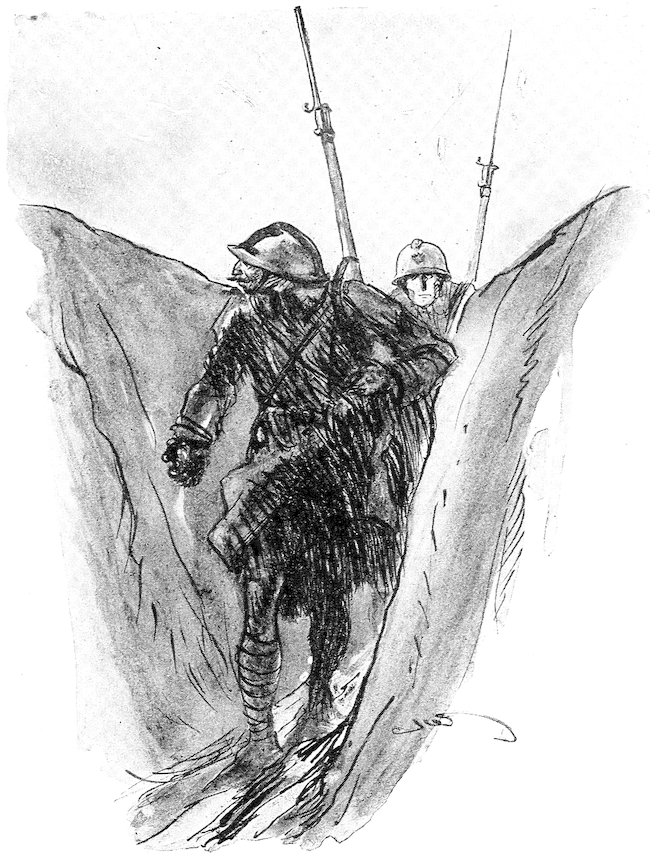
French grenadier—Blanc Mont.
139“Hear your young men talk, El Capitan? They’re goin’ to take it out on the Boche—they will, too. Don’t you take any more of this than your rank entitles you to! I’m gettin’ wet.”
The second-in-command and the captain were huddled under a small sheet of corrugated iron, stolen by an enterprising orderly from the French gunners. The captain was very large, and the other very lean, and they were both about the same length. They fitted under the sheet by a sort of dovetailing process that made it complicated for either to move. A second-in-command is sort of an understudy to the company commander. In some of the outfits the captain does everything, and his understudy can only mope around and wait for his senior to become a casualty. In others, it is the junior who gets things done, and the captain is just a figurehead. In the 49th, however, the relation was at its happiest. The big captain and his lieutenant functioned together as smoothly as parts of a sweet-running engine, and there was between them the undemonstrative affection of men who have faced much peril together.
“As for me,” rejoined the captain, drawing up one soaked knee and putting the other out in the wet, “I want to get wounded in this fight. A bon blighty, in the arm or the leg, I think. Something that will keep me in a nice dry hospital until spring. I don’t like cold weather. Now who is pushin’? It’s nothin’ to me, John, if your side leaks—keep off o’ mine!”
So the last day of September, 1918, passed, with the racket up forward unabated. So much of war is just lying around waiting in more or less discomfort. And herein lies the excellence of veterans. They swear and growl horribly under discomfort and exposure—far more than green troops; but privations do not 140sap their spirit or undermine that intangible thing called morale. Rather do sufferings nourish in the men a cold, mounting anger, that swells to sullen ardor when at last the infantry comes to grips with the enemy, and then it goes hard indeed with him who stands in the way.
On the front, a few kilometres from where the battalion lay and listened to the guns, Gouraud’s attack was coming to a head around the heights north of Somme-Py and the strong trench systems that guarded the way to Blanc Mont Ridge. Three magnificent French divisions, one of Chasseurs, a colonial division, and a line division with a Verdun history, shattered themselves in fruitless attacks on the Essen Trench and the Essen Hook, a switch line of that system. Beyond the Essen line the Blanc Mont position loomed impregnable. Late on the 1st of October, a gray, bleak day, the battalion got its battle orders, and took over a mangled front line from certain weary Frenchmen.
Gathering the platoon leaders and non-coms around them, the captain and the second-in-command of the 49th Company spread a large map on the ground, weighting its corners with their pistols.
“You give the dope, John,” ordered the captain, who was not a man of words, and his junior spoke somewhat in this manner:
“Here, you birds, look at this map. The Frogs have driven the Boche a kilometre and a half north of Somme-Py. You see it here—the town you watched them shell this morning. They have gotten into the Prussian trench—this blue line with the wire in front of it. It’s just a fire trench, mostly shell-holes 141linked up. Behind it, quite close, is the Essen trench, which is evidently a hum-dinger! Concrete pill-boxes and deep dugouts and all that sort of thing—regular fort. The Frogs say it can’t be taken from the front—they’ve tried. We’re goin’ to take it. On the other side of that is the Elbe trench, and a little to the left the Essen Hook, and in the centre the Bois de Vipre—same kind o’ stuff, they say. We’re to take them. You see them all on the map.... Next, away up in this corner of the map, is the Blanc Mont place. Whoever is left when we get that far will take that, too.... Questions?... Yes, Tom, we ought to get to use those sawed-off shotguns they gave us at St. Mihiel—though when we get past the Essen system, we’ll be in the open, mostly.... The old Deuxième Division is goin’ in to-night—it’s goin’ to be some party!”
“Gunnery sergeants send details from each platoon for bandoleers—ammunition-dump is around Battalion Headquarters somewhere,” added the captain. “We get a few rifle-grenades, and some shotgun-shells. And make the men hang on to their reserve rations, for Christ’s sake! Probably won’t eat again until after this is over. Move out of here as soon as it’s dark. That’s all.”
“Two hundred and thirty-four men, sir, and seven officers, not counting the galley force and the office force that we’re leaving behind,” reported the second-in-command, falling in beside the captain as the company moved off with the rest of the battalion in the gathering darkness. They went in double file, dim shapes in the gloom, down the muddy, tortuous road.
“The company’s in better shape than it ever has been,” replied 142the captain thoughtfully. “St. Mihiel was a walk-over, but it was fine training for them, and even our greenest replacements had a chance to get over being gun-shy. And the non-coms are fine, too ... hope we don’t lose too many of them. You and I have come all the way from Belleau Wood together, John—I’m no calamity-howler—but there’s something about this dam’ Champagne country that gets you——”
“Too many men died here, I reckon,” said the lieutenant. “You feel ’em somehow, in the dark.... Something creepy about those flares, isn’t there?”
The road here was screened on the side toward the enemy by coarse mats of camouflage material erected on tall poles. Through this screen the German flares, ceaselessly ascending, shone with cold, greenish whiteness, so that men saw their comrades’ faces weirdly drawn and pale under their helmets. The files talked as they went——
“I’ve seen the time I’d have called those things pretty—but now—reckon hell’s lit with the same kind of glims!” ... “Remember the flare that went up in our faces the night we made the relief in Bellew Woods? Seemed to me like everybody in the world was lookin’ at me.” “Bois de Belleau! mighty few in the battalion now that remember them days, sonny....” “Listen to that dam’ Heine machine-gun over yonder ... like a typewriter, ain’t it?” “Useter run a typewriter myself, back befo’ Texas declared war on Germany—in a nice dry office it was, an’ this time o’ night I’d be down on the drug-store corner lookin’ ’em over.—” “Somebody shoot that bum, talkin’ about lookin’ ’em over!” “Hey! Th’ angels’ll be lookin’ him over, this time to-morrow night, they will!” “Yes, they will! I’ll live to spit on the grave of the man that said that!”—“My word! Don’t these 1917 model gyrines talk rough, Mac!” marvelled one old non-com to another.
143
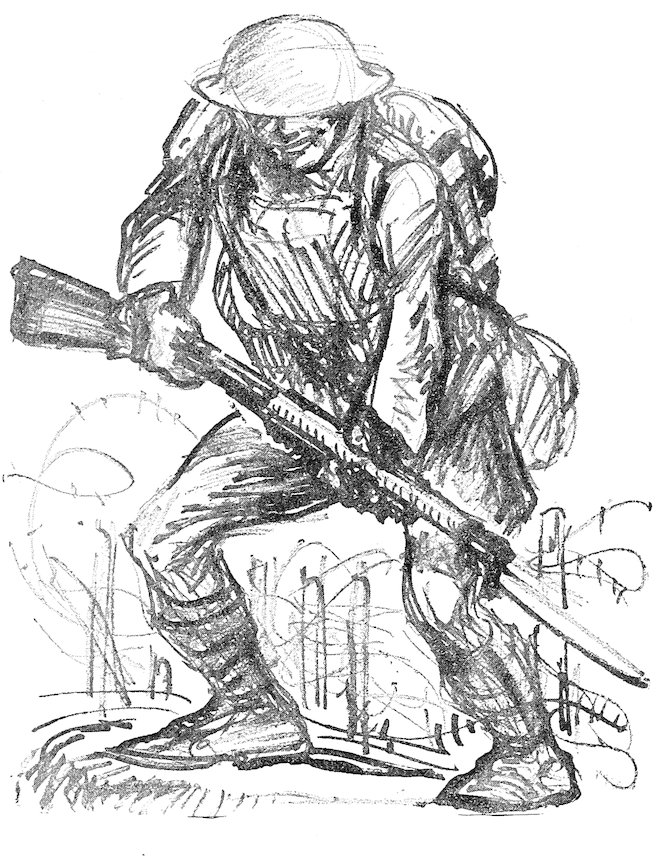
Those sawed-off shotguns they gave us at St. Mihiel.
145The road passed into the desolation and wound north, kilometre after kilometre. Presently the camouflage ended and the battalion felt exceedingly naked without its shelter. Then a slope to the left screened the way, the crest of it sharply outlined as the flares ascended. Beyond that crest the machine-guns sounded very near; now and again the air was filled with the whispering rush of their bullets, passing high toward some chance target in the rear. The upper air was populous with shells passing, and the sky flickered with gun-flashes, but the road along which the battalion went enjoyed for the time an uneasy immunity. The rests were all too short; the sweating files swore at their heavy packs; the going was very hard. Presently the road ceased to be a road—merely a broken way across an interminable waste of shell-holes, made passable after a fashion by the hasty work of French engineers, toiling behind the assault of the infantry.
The battalion skirted stupendous craters of exploded mines—“Good Gawd! you could lose my daddy’s house, an’ his barn, too, in that there hole! ’Taint no small barn, either!” The stars had come out, and shone very far off and strangely calm. The dark was foul with all the reek of an old battle-field. “After midnight,” conjectured the files. “Are we ever goin’ to get across this accursed place?”
The files plodded on each side of the tumbled track, and as they neared Somme-Py a pitiful stream of traffic grew and passed 146between them, the tide of French wounded ebbing to the rear. They were the débris of the attacks that had spent themselves through the day—walking wounded, drifting back like shadows in stained blue uniforms, men who staggered and leaned against each other and spoke in low, racked voices to the passing files; and broken men who were borne in stretchers, moaning—“Ah, Jesu!...” “Doucement, doucement!!...” Farther back the ambulances would be waiting for them.... The battalion went on in close-mouthed silence. Very little talking now, no laughing at all.... “El Capitan, regardez—we be sober-minded men approaching—what we approach—” said the second-in-command, hitching the sling of his musette bag well out of the way of his gas-mask. “I have always,” replied that stolid veteran, “held that war was a serious business.” ... “This is Somme-Py. Can’t those bums ahead set a better pace?”
The column went quickly through the town, into which shells were falling, stumbling over the débris of ruined walls and houses. There was a very busy French dressing-station there, under the relic of a church. It was too dark to see, but each man caught the sound and the smell of it. They cleared the town and went on to a crossroads. French guides were to have met the battalion there, for the line was just ahead, but the guides were late. There was a nerve-racking halt. The next battalion in column closed up; a machine-gun outfit, with its solemn, blasé mules, jammed into the rifle companies.
The 49th was the leading company, just behind the Battalion Headquarters group, and the second-in-command went up to where the major and his satellites were halted.
147“Crossroads are always a dam’ bad business, Coxy,” the major was observing to his adjutant. “Just askin’ for it here—no tellin’ how late our Frog friends will be—get the men moved into that ditch off the road yonder—Ah! thought so!”
A high, swift whine that grew to a shrieking roar, and a five-inch shell crashed down some fifty yards to the right of the crowded road. Everybody except the mules were flat on the ground before it landed, but wicked splinters of steel sung across the road, and a machine-gunner, squatting by his cart, collapsed and rolled toward the edge of the road, swearing and clutching at his thigh. The men moved swiftly and without disorder to the ditch, which was a deep communication-trench paralleling the road. Another shell came as they moved, falling to the left, and then another, closer, this time between the road and the trench. A mule or two reared and plunged, stricken; a Marine whose head had been unduly high slumped silently down the side of the trench with most of his head gone. “Damn! Jimmie stopped somethin’ the size of a stove-lid!” “Fool oughta kept his head down!” “Some very hard men you have in your company, El Capitan,” commented the second-in-command, a few feet away, crouching by the side of the captain. “Now, I may stop one, but nobody’s goin’ to get to say that about me, I’ll bet!” “Nor me, John!”... “Face it when it comes, but no use lookin’ for it!”
More shells came, landing along the road, between the road and the trench, and one or two of them in the trench itself. Cries and groans came from the head of the column; stretcher-bearers hurried in that direction; the battalion lay close and waited. 148Then the shelling stopped. Up forward the major drew a long breath. “Just harassin’ fire on these crossroads. I was afraid we were spotted. Now, those guides—” A little group of Frenchmen arrived panting at the head of the column and the men were quickly on the move again. “If Brother Boche had kept flingin’ them seabags around here, he’d a-hurt somebody. Where do we go from here?”
Said the major, coming to the head of the 49th with a French guide—“Francis, we’re takin’ the regimental front—division’s putting four battalions in the line. The 6th will be on our left; infantry brigade on the right. Let me know how your sector looks—my P. C. will be—I’d better send a runner with you. Here’s your guide.”
That company moved off, and the other companies, going into position in the battered Prussian trench, facing the formidable Essen work. The French riflemen they found there were hanging on in the very teeth of the enemy. Their position had been hastily constructed a few days before by the hard-pressed Boche and was a mere selection from the abundant shell craters, connected by shallow digging. The Marines stumbled and slipped through its windings. It was cluttered up with dead men, for it had been strongly held and dearly won. The 49th took over the part allotted to it from some ten platoons of Frenchmen, eight or ten men to a platoon, in command of a first lieutenant. It was what was left of a full battalion.
Courteous and suave, although he swayed on his feet from weariness and his eyelids drooped from loss of sleep, the Frenchman summed up the situation for the Marine captain. “We 149hold this fire trench. In your sector are four communication trenches running to the Essen work, which is about a hundred metres distant. We hold most of the boyau on the extreme right; the others we have barricaded. You cannot take this Essen trench by frontal assault!”—“Why can’t we?” growled the American.
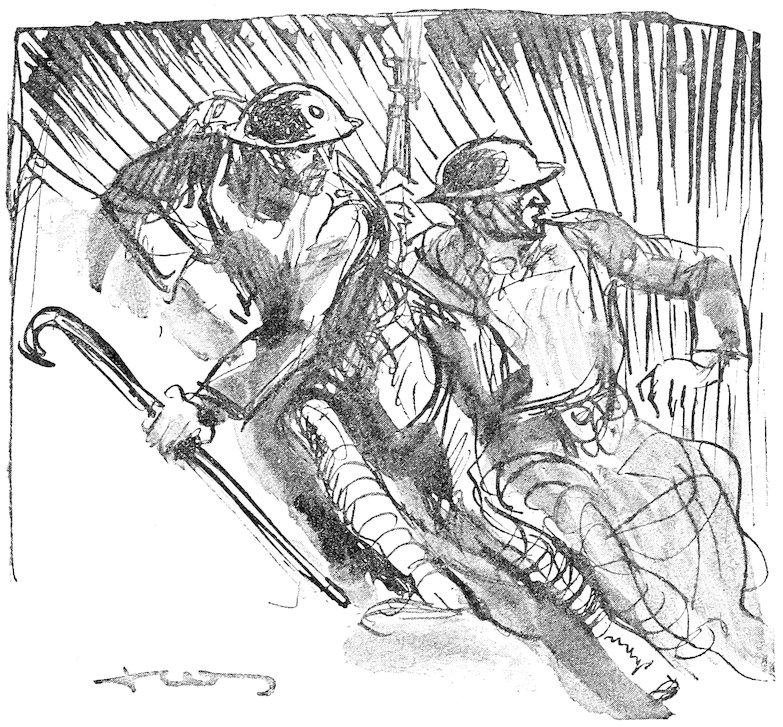
The shells began to drop into the trench.
“When it is light you will see, M. le Capitaine! You can only 150get forward by bombing your way in the boyaux. They are too strong in machine-guns, the Boche. Now I take my men and go. Seven days and nights we have been on our feet ... those of us who are left are very tired.... It is well that you be watchful in this place, but do not stir up the Boche yonder. They shoot with minenwerfers when you frighten them. Such a one finished my pauvre capitaine and six men with him. Bon chance, mon capitaine! Bon jour!”
“Cheerful bird, wasn’t he?” remarked the captain. “Wonder if that thing I stepped on just outside his hole was his captain? John, before it gets good daylight, don’t you want to take a look-see at this Essen Trench? Take whoever you want and see how the land lies.”
The Essen Trench had been very active when the companies were being posted; staccato bursts of machine-gun fire had ripped across the intervening dark, and Springfields had answered. There had been some bombing around traverses in the boyaux. But when, in the creeping grayness of the dawn, the lieutenant from the 49th ventured across to it with his orderly and a sergeant, he found the Boche retiring. Filing quickly through the communication trenches, the battalion occupied it without difficulty, and, looking around them, were very glad they hadn’t had to take it by storm.
151
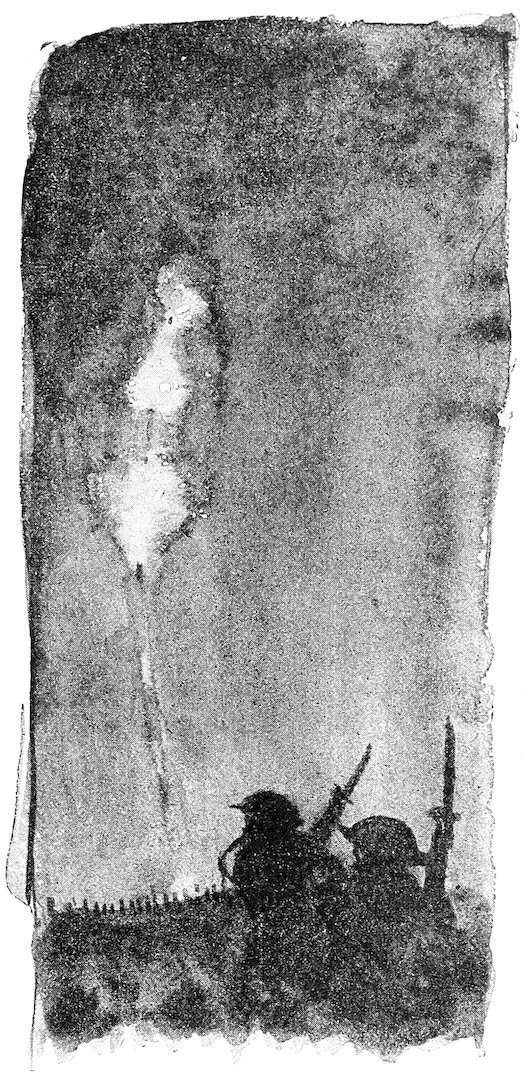
A flare during shelling in the front-line trenches.
153And the captain understood why the French lieutenant had said it couldn’t be stormed. The French had tried the evening before to cross the scant distance and get into it. Most of those who had charged lay as the Boche Maxims had cut them down. In one place, between two boyaux that formed with the opposed lines a rough square of perhaps one hundred yards, he counted eighty-three dead Frenchmen. Lying very thick near the lip of their own trench, the bodies formed a sort of wedge, thinning toward the point as they had been decimated, and that point was one great bearded Frenchman, his body all a mass of bloody rags, who lay with his eyes fiercely open to the enemy and his outthrust bayonet almost in the emplacement where the Boche guns had been.
The company, which had learned its own bitter lesson in frontal attacks on machine-guns, gave passing tribute. “Them Frogs, they eat machine-guns up. Fightin’ sons o’ guns, they are. Wonder if any chow is comin’ up to-day?” They made themselves comfortable among the dead and waited the next move with equanimity.
“Two hundred and thirty-one men, sir,” reported the second-in-command, sliding into the shallow dugout where the captain was holed up. “Mighty lucky so far. I’m goin’ to sleep. There’s some shellin’, especially toward the left, but most of the outfit is pretty well under cover.”
II
Gouraud’s battle roared on to the left with swelling tumult. The Americans, in their sector, passed the day in ominous quiet. They wondered what the delay was, speculated on the strategy of attack—which is a matter always sealed from the men who deliver the attack—and wore through to the evening of October 2. At dark, food came up in marmite cans—beef and potatoes and a little coffee. “Put ours on that mess-tin there,” directed 154the second-in-command, as his orderly slid in with his and the captain’s rations. The captain sat up in his corner a little later. “What th’ hell, John?”—sniff—sniff! “Has that dead Boche on the other side of you begun to announce hisself? Phew!” The second-in-command rose from the letter he was writing by the stub of a candle and sniffed busily—sniff—snnnn—“Damnation! Captain, it’s our supper!” With averted face he presented the grayish chunks of beef that reposed on the mess-tin. “Urggg—throw it out!” He disappeared up the crumbled steps to the entrance of the hole.
A few minutes later he slid down again, followed in a shower of dust and clods by a battalion runner. “All the beef was bad, El Capitan! What the young men are saying about the battalion supply would make your hair curl!—And here’s our attack orders.”
There was a brief pencilled order from the major, and maps. The two officers bent over them eagerly. “Runner!—Platoon commanders report right away—” ... “What do you make of it, John? Looks like General Lejeune was goin’ to split his division and reunite it on the field.... Hmmm! Ain’t that the stunt you claim only Robert E. Lee and Napoleon could get away with?... All here? Get around—the map’s about oriented——”
“Here we are, in the Essen Trench—seems that the Marines move down to the left to here—and the 9th and 23rd move to the right—to here. These pencil lines show the direction of attack—then we jump off, angling a little to the right, compass bearing—and the infantry outfits point about as much to the left. That brings us together up here about three kilometres, and we go on straight, a little west of north from there, to Blanc Mont——
155
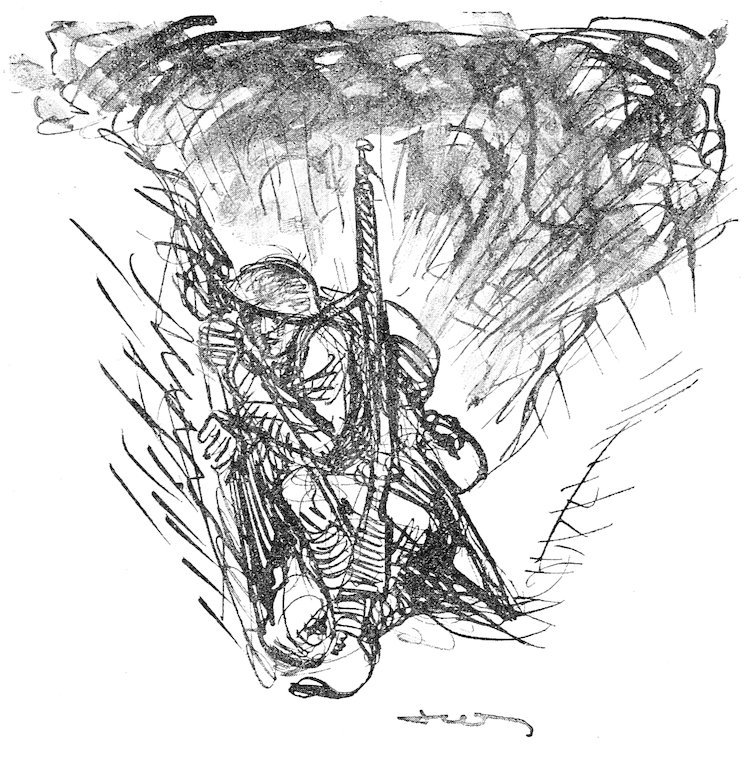
In the Essen trench—a runner.
157“Essen Hook and Bois de Vipre are the first objectives—Blanc Mont final objective.... That means we pass to the flank of the Hook and join up behind the Viper Woods—we’ll get some flanking fire, but we will cut both positions off from the rear, and we won’t get near as many men shot up as we would in frontal attack. Might be worse——”
“That’s all we know about the division orders— For the battalion, the major says the 5th Regiment will follow the 6th in support at the jump-off, and the zero hour will be communicated later—some time in the morning, I reckon. That’s all.”
The morning of October 3 [1918] came gray and misty. From midnight until dawn the front had been quiet at that point—comparatively. Then all the French and American guns opened with one world-shaking crash. From the Essen Trench the ground fell away gently, then rose in a long slope, along which could be made out the zigzags of the German trenches. The Bois de Vipre was a bluish mangled wood, two kilometres north. Peering from their shelters, the battalion saw all this ground swept by a hurricane of shell-fire. Red and green flames broke in orderly rows where the 75s showered down on the Boche lines; great black clouds leaped up where the larger shells fell roaring. The hillside and the wood were all veiled in low-hanging smoke, and the flashes came redly through the cloud. Far off, Blanc Mont way, a lucky shell found and exploded a great ammunition-dump—the 158battalion felt the long tremor from the shock of it come to them through the earth and watched, minutes after the high crimson flare of the explosion, a broad column of smoke that shot straight up from it, hundreds of feet, and hung in air, spreading out at the top like some unearthly tree.
The men crowed and chortled in the trench. “Boy, ain’t Heinie gettin’ it now!” “Hear that shell gurglin’ as she goes?—That’s gas.” “Listen to them 75s. You know, I never see one of them little guns that I don’t want to go up and kiss it. Remember that counter-attack they smeared in front of us at Soissons?”
The heavens seemed roofed over with long, keening noises—sounds like the sharp ripping of silk, magnified, running in swift arcs from horizon to horizon. These were the quickfiring 75s, the clear-cut bark of the discharges merging into a crashing roar. Other sounds came with them, deeper in key, the whine growing to a rumble—these were the heavier shells—105s, 155s, 210s. Almost, one expected to look up and see them, like swift, deadly birds, some small, some enormous, all terrible. Gas-shells could be distinguished from the high explosive by the throaty gurgle of the liquid in them. “Move down the trench to the left,” came the order.
The battalion moved, filing around the traverses with judicious intervals between men, so that the Boche shells might not include too many in their radius of death. For Heinie was beginning to shoot back. He had the range of his vacated trench perfectly, and, holding the high ground, he could see what he was shooting at. Shells began to crash down among the companies, whole squads were blotted out, and men choked and coughed as the reek of the high explosive caught at their windpipes.
159
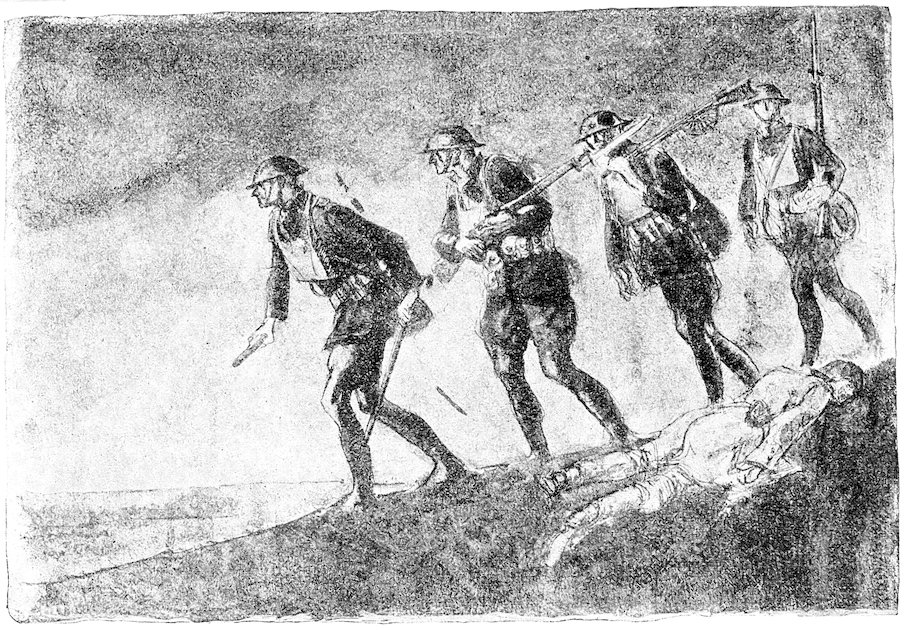
The morning of October 3d came gray and misty—a patrol.
161“Lordy, ain’t we ever goin’ to get outa this dam’ place an’ get at ’em—?” A shell with a driving-band loose came with a banshee scream, and men and pieces of men were blown into the air. “That was in the first platoon,” said the second-in-command, shaking the dirt off his gas-mask. “Something ought to be done about that gunner, El Capitan!” Another landed in the opposite lip of the trench where the two officers crouched, half-burying them both. “My God, cap’n! You killed?” “Hell, no! Are you?”
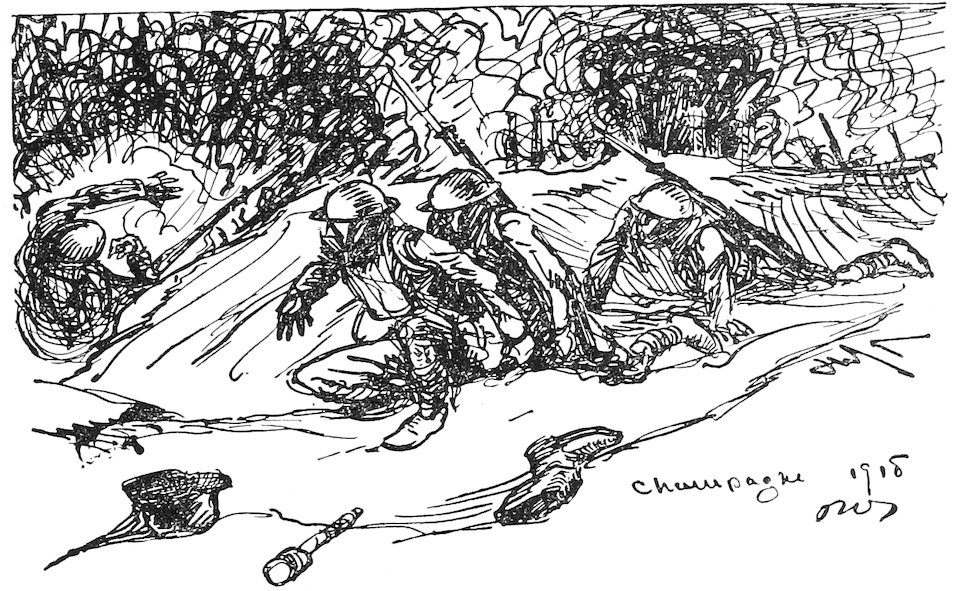
“Lordy, ain’t we ever goin’ to get outa this dam’ place an’ get at ’em—?”
“Far enough to the left,” the major sent word. “We will wait here. The 6th leads—we’re the last battalion in support to-day.”
162Coming from the maze of trenches in the rear, the assault regiment began to pass through the 5th, battalion following battalion at 500-yard distances. A number of French “baby” tanks started with the assaulting waves, but it was an evil place for tanks. Tank traps, trenches so wide that the little fellows went nose-down into them and stuck, and direct fire from Boche artillery stopped the most of them. Wave after wave, the 6th went forward. For a moment the sun shone through the murk, near the horizon—a smouldering red sun, banded like Saturn, and all the bayonets gleamed like blood. Then the cloud closed again.
When an attack is well launched it is the strategy of the defenders to concentrate their artillery fire on the support waves that follow the assault troops, leaving the latter to be dealt with by machine-gun and rifle fire. So the battalion, following on in its turn, was not happy.
“Wish to Gawd we wuz up forward,” growled the files. “’Nothin’ up there but machine-guns. This here shellin’ gets a man’s goat. Them bums in the 6th allus did have all the luck!...” “Lootenant, ain’t we ever gonna get a chance at them Boches? This bein’ killed without a chance to kill back is hell—that’s what it is!”
The battalion was out of the trench now, and going forward, regulating its pace on the battalion ahead. All at once there was a snapping and crackling in the air—a corporal spun round and collapsed limply, while his blouse turned red under his gas-mask—the man beside him stumbled and went down, swearing through grayish lips at a shattered knee—the men flattened and all faces turned toward the flank.
163“Machine-guns on the left!”—“Hell! It’s that Essen Hook we’ve got to pass—thank God, it’s long range! Come on, you birds.” And the battalion went on, enduring grimly. Finally, when well past its front, which ran diagonally to the line of advance, the 17th Company, that had the left, turned savagely on the Essen Hook and got a foothold in its rear. A one-pounder from the regimental headquarters company was rushed up to assist them, and the men yelled with delight as the vicious little cannon got in direct hits on the Boche emplacements. Hopelessly cut off, the large body of Germans in this formidable work surrendered after a few sharp and bloody minutes, and the 17th, sending back its prisoners, rejoined the battalion.
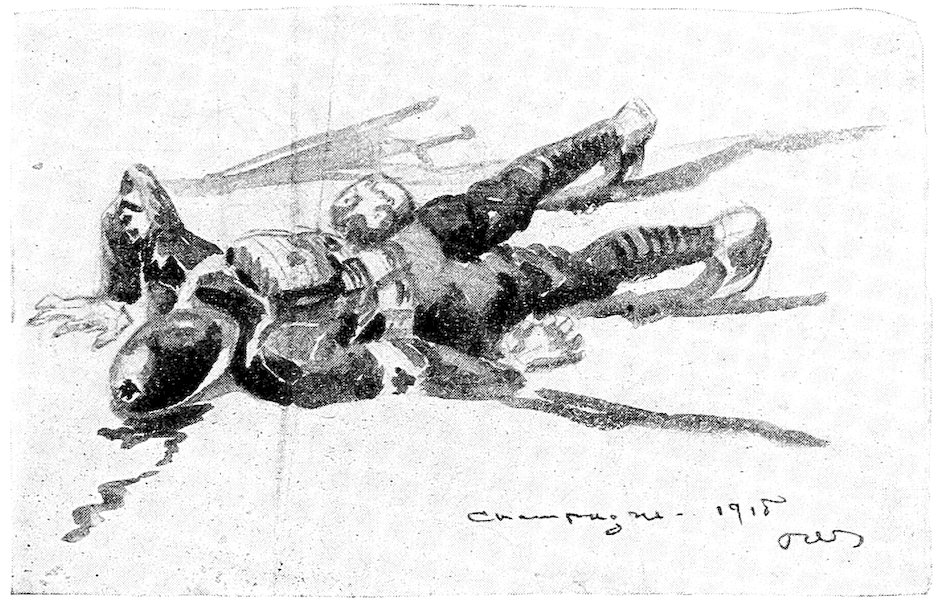
Others lay on the ground over which the battalion passed.
Prisoners began to stream back from the front of the attack, 164telling of the success of the 6th. Wounded came with them, some walking, some carried on improvised stretchers by the Boche “kamarads.” Most of them were grinning. “Goin’ fine up there, boys, goin’ fine!” “Lookit, fellers! Got a bon blighty—We’ll give ’em your regards in Paris!”
Others of the 6th lay on the ground over which the battalion passed. Some lay quietly, like men who rested after labor. Others were mangled and twisted into attitudes grotesque and horrible as the fury of the exploding shells had flung them. There were dead Germans, too. Up forward rifle-fire and machine-guns gave tongue, and all the Boche guns raged together. “Reckon the 6th is gettin’ to Blanc Mont now.” The second-in-command looked at his watch. Inconceivably, it was noon.
For a while now the battalion halted, keeping its distance from the unit ahead. The men lay on their rifles and expressed unreasonable yearnings for food. “Eat? Eat? Hell! Shock troops ain’t supposed to eat!” Officers cast anxious glances toward the utterly exposed left. The French attack had failed to keep abreast of the American.
The left company, the 17th, was in a cover of scrubby trees. The other companies were likewise concealed. Only the 49th lay perforce in the open, on a bleak, shell-pocked slope. A high-flying Boche plane spotted its platoon columns, asprawl eighty or a hundred yards apart on the chalky ground. “No good,” said the second-in-command, cocking his head gander-wise in his flat helmet, “is goin’ to come of that dam’ thing—guess all our noble aviators have gone home to lunch.” The plane, high and small and shining in the sky, circled slowly above them. Far back of the Boche lines there was a railroad gun that took a wireless from the wheeling vulture. “Listen,” said the captain, “listen to th——”
165
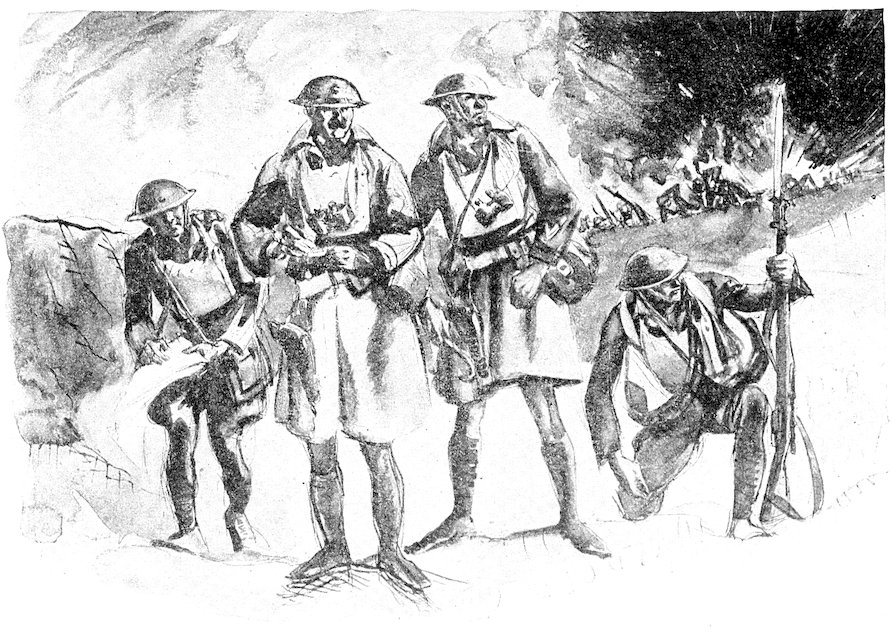
“Oh, Lordy! They’ve got us bracketed!”
167There were lots of shells passing over—the long, tearing whine of the 75s, the coarser voices of the Boche 77s replying, and heavy stuff, but most of it was breaking behind or in front of the battalion. Into this roof of sound came a deeper note—a far-off rumble that mounted to an enormous shattering roar, like a freight train on a down-grade. The company flattened against the ground like partridges, and the world shook and reeled under them as a nine-inch shell crashed into the earth fifty yards ahead, exploding with a cataclysmic detonation that rocked their senses. An appalling geyser of black smoke and torn earth leaped skyward, jagged splinters of steel whined away, and stones and clods showered down. Before the smoke had lifted from the monstrous crater the devastating rumble came again, and the second shell roared down fifty yards to the rear.
“Oh, Lordy! They’ve got us bracketed!”
“I saw that one! I saw it—look right where the next one’s gonna hit, an’—” “Look where it’s gonna hit! Lawd, if I jest knew it wasn’t gonna hit me—ahh——!”
The third shell came, and men who risked an eye could see it—a dark, tremendous streak, shooting straight down to the quivering earth. A yawning hole opened with thunder fairly between two platoon columns, and the earth vomited.... It was wonderful shooting. All the shells that followed dropped between the columns of prone men—but not a man was hit! The heavy projectiles sank far into the chalky soil, and the explosions sent 168the deadly fragments outward and over the company. More than a dozen shells were fired in all, the high sinister plane wheeling overhead the while. Then the company went forward with the battalion, very glad to move.
“Any one of those nine-inch babies would have blotted out twenty of us,” marvelled a lieutenant, leading his platoon around a thirty-foot crater that still smoked. “Or ripped the heart out of any concrete-and-steel fortification ever built—the good Lawd was certainly with us!”
To the company commanders, gathered at dark in a much disfigured Boche shelter in the Wood of Somme-Py, the major gave information. “The 6th took Blanc Mont, and they are holding it against heavy counter-attacks. Prisoners say they were ordered to hold here at any costs—they’re fighting damned well, too! The infantry regiments piped down the Bois de Vipre, just as we did the Essen Hook. The division is grouping around the Ridge, but we’re pretty well isolated from the French. To-night we are going on up and take the front line, and attack toward St.-Etienne-à-Arnes—town north of the Ridge and a little west. Get on up to Blanc Mont with your companies—P. C. will be there, along the road that runs across the Ridge.”
III
Not greatly troubled by the Boche shelling, that died to spasmodic bursts as the night went on, the battalion mounted through the dark to its appointed place. Here, beside a blasted road that ran along Blanc Mont, just behind the thin line of the 6th, the weary men lay down, and, no orders being immediately forthcoming, slept like the dead that were lying thickly there. Let the officers worry over the fact that the French had fallen behind on each flank, that the division was, to all purposes, isolated far out in Boche territory—let any fool worry over the chances of stopping one to-morrow—to-morrow would come soon enough. “The lootenant says to get all the rest you can—don’t—nobody need to—tell—me—tha——”
169
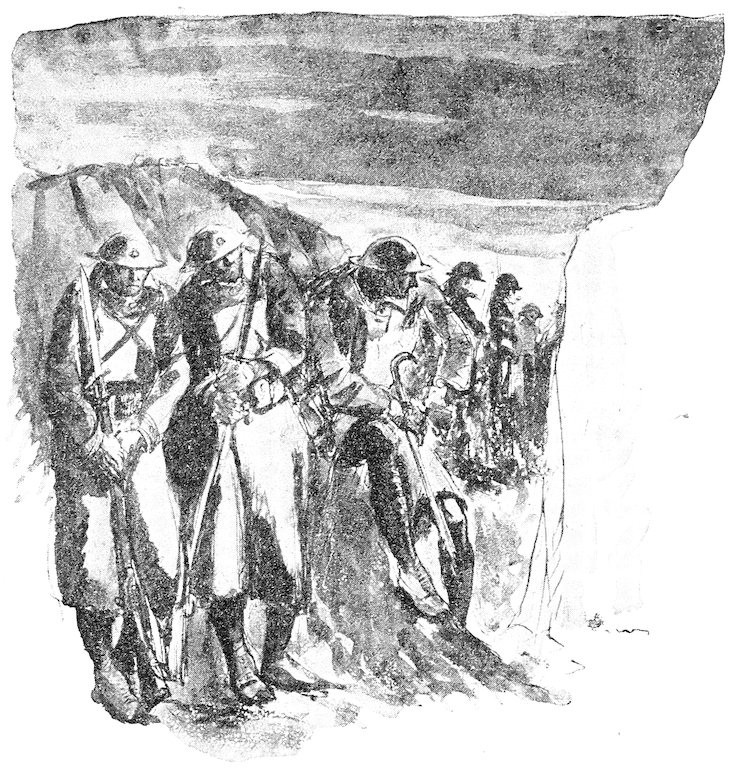
Before zero hour.
171In the deep dugouts behind the road the battalion commanders prodded at field-maps and swore wearily over the ominous gaps behind the flanks—three kilometres on one flank, five on the other, where the French divisions had not kept pace. Into these holes the Boche had all day been savagely striving to thrust himself, and his success would mean disaster. Already the 6th had a force thrown back to cover the left rear, disposed at right angles to the line of advance.... And orders were to carry the attack forward at dawn. On top of that, after midnight a Boche deserter crawled into the line with the cheering news that the Germans were planning an attack in force on the American flanks at dawn; a division of fresh troops—Prussians—had just been brought up for that purpose. It looked bad—it looked worse than that. “Well,” said Major George Hamilton of the 1st Battalion of the 5th, “orders are to attack, and, by God, we’ll attack”—a yawn spoiled the dramatic effect of his pronouncement—“and now I’m going to get some sleep. Coxy, wake me at 5.30—that will be an hour.”
And at dawn, while the Ridge shook and thundered under the barrage that went before the Boche flank attack, and the 6th 172held with their rifles the branch behind the left, the 5th Marines went forward to carry the battle to St.-Etienne.
They went in column of battalions, four companies abreast. For the 1st Battalion, still in support, the fourth day of October began as a weary repetition of the day before. Shells whooped down into the platoon columns as they waited for the 2d and 3d Battalions to get clear; machine-guns on the left took toll as they rose up to follow. Noon found them well forward of the Ridge, lying in an open flat, while the leading battalions disappeared in pine woods on a long slope ahead. It had fallen strangely quiet where they lay.
“Now what’s comin’, I wonder?” “Anything at all, ’cept chow.” “Boy, ain’t it quiet here? What do you reckon—” “Don’t like this,” said one old non-com to another. “Minds me of once when I was on a battle-wagon in the China Sea. Got still like this, and then all at once all the wind God ever let loose come down on us!” “Shouldn’t wonder—Hey! She’s opening up again! That there 2d Battalion has sure stuck its foot in somethin’!”
Up forward all hell broke loose. Artillery, machine-guns, rifles, even the coughing detonations of grenades, mounted to an inconceivable fury of sound. “Here comes a battalion runner—there’s the skipper, over there—what’s up, anyway?”
The second-in-command came through his company with a light in his eyes, and he sent his voice before him. “Deploy the first platoon, Mr. Langford. Three-pace interval, be sure. Where’s Mr. Connor? Oh, Chuck, you’ll form the second wave behind Tom. About fifty yards. Other two platoons in column behind the company flanks. On yo’ feet, chillun! We’re goin’ up against ’em!”
173
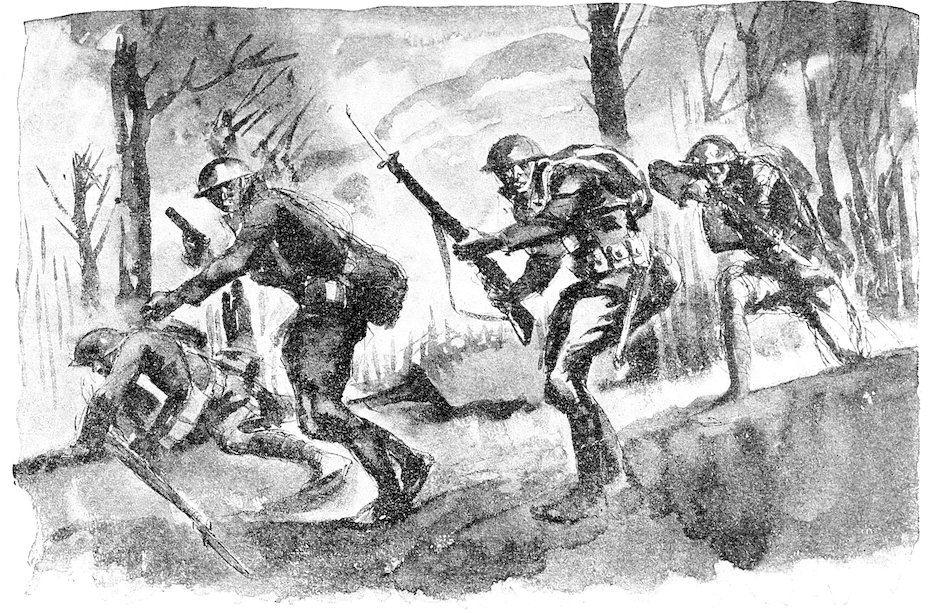
Flanking fire. “Hey! She’s opening up again.”
175
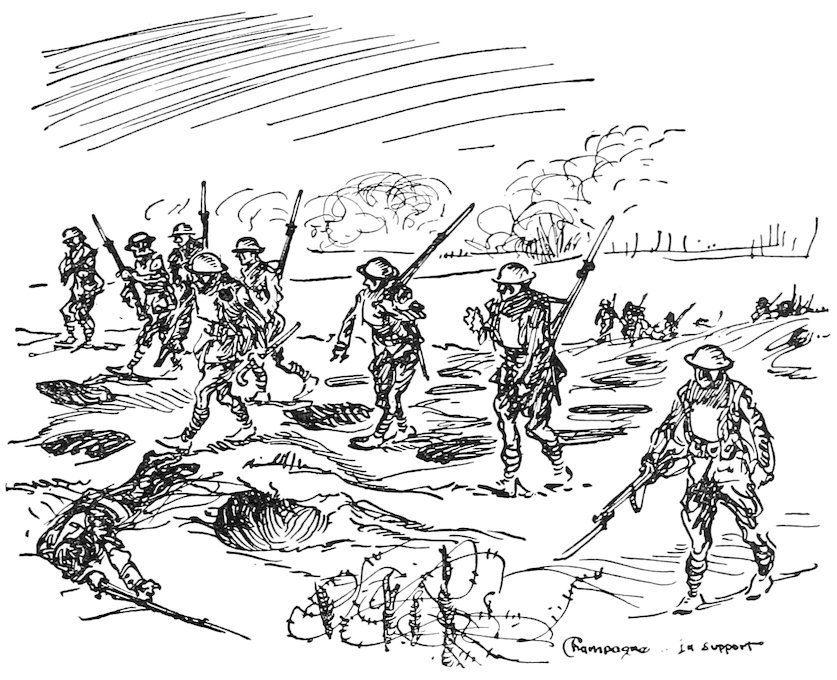
The hush still hung around them as they moved out of the flat and began to ascend the long gray slope ahead.
And so, all four companies in line, the 1st Battalion, a thousand men, went up against the Boche. “Capitan,” said the second-in-command, as they started, “we’re swingin’ half-left. This tack will take us right to St.-Etienne, won’t it? We were pointin’ a little one side of it before—major give you any dope?” “The Boche have come out of St.-Etienne—two full infantry regiments, anyhow, and a bunch of Maxim guns—and hit the second and third in the flank. Must be pretty bad. We’re goin’ up to hit them in the flank ourselves. ’Bout a kilometre, I’d say. 176Wait until their artillery spots this little promenade. None of ours in support, you know.”
The hush still hung around them as they moved out of the flat and began to ascend the long gray slope ahead, the crest of which was covered with a growth of pines. There was no cover on the slope—a few shell-holes, a few stunted bushes and sparse tufts of grass. Across a valley to the left, 800 to 1,000 yards away, rose another ridge, thickly clothed with underbrush, that ran back toward Blanc Mont. Forward and to the right was the heavy pine timber into which the other battalions had gone, and from which still came tumult and clangor. Tumult and clangor, also, back toward Blanc Mont, and further back, where the French attacks were pushing forward, and drumming thunder on the right, where the Saxons were breaking against the 9th and 23d Infantry—but here, quiet. Voices of non-coms, rasping out admonitions to the files, sounded little and thin along the line. Every man knew, without words, that the case was desperate, but to this end was all their strength and skill in war, all their cunning gained in other battles, and their hearts lifted up to meet what might come. “More interval—more interval there on the left! Don’t bunch up, you——”
“That ridge over yonder, capitan—” said the second-in-command softly. “It’s lousy with the old Boche! And forward—and behind the flank, too! This is goin’ to be—Ahhh—shrapnel!”
177
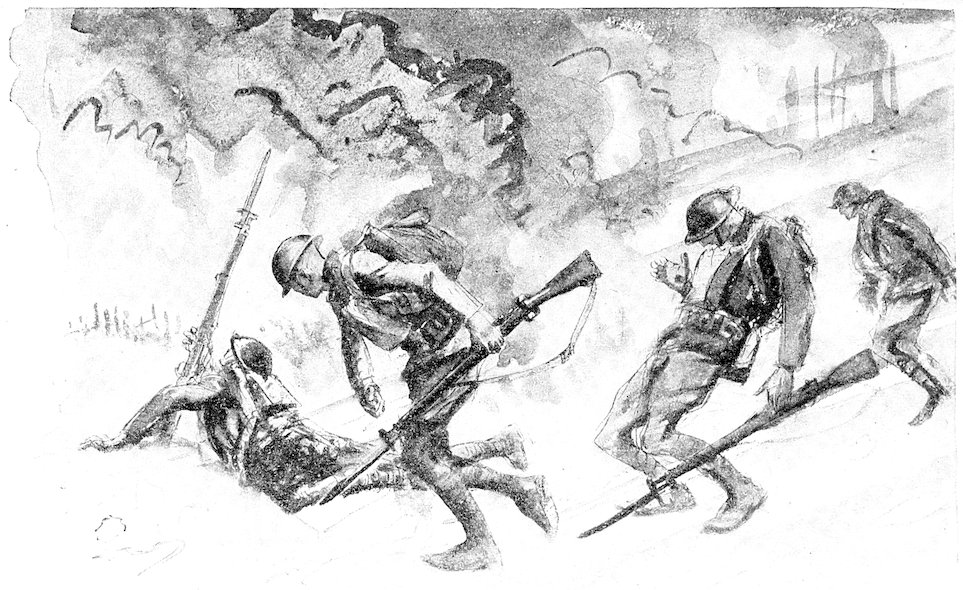
The first shell came screaming down the line from the right.
179The first shell came screaming down the line from the right, and broke with the hollow cough and poisonous yellow puff of smoke which marks the particular abomination of the foot-soldier. It broke fairly over the centre of the 49th, and every head ducked in unison. Three men there were who seemed to throw themselves prone; they did not get up again. And then the fight closed upon the battalion with the complete and horrid unreality of nightmare. All along the extended line the saffron shrapnel flowered, flinging death and mutilation down. Singing balls and jagged bits of steel spattered on the hard ground like sheets of hail; the line writhed and staggered, steadied and went on, closing toward the centre as the shells bit into it. High-explosive shells came with the shrapnel, and where they fell geysers of torn earth and black smoke roared up to mingle with the devilish yellow in the air. A foul murky cloud of dust and smoke formed and went with the thinning companies, a cloud lit with red flashes and full of howling death.
The silent ridge to the left awoke with machine-guns and rifles, and sibilant rushing flights of nickel-coated missiles from Maxim and Mauser struck down where the shells spared. An increasing trail of crumpled brown figures lay behind the battalion as it went. The raw smell of blood was in men’s nostrils.
Going forward with his men, a little dazed perhaps with shock and sound such as never were on earth before, the second-in-command was conscious of a strangely mounting sense of the unreality of the whole thing. Automatically functioning, as a company officer must, in the things he is trained to do, there was still a corner of his brain that watched detached and aloof as the scene unrolled. There was an officer rapped across the toe of his boot by a spent bullet—the leather wasn’t even scratched—who 180sat down and asserted that his foot was shot off. There was Lieutenant Connor, who took a shrapnel dud in his loins, and was opened horribly....
There was a sergeant, a hard old non-com of many battles, who went forward beside him. His face was very red, and his eyes were very bright, and his lean jaw bulged with a great chew of tobacco. His big shoulders were hunched forward, and his bayonet glinted at a thirsty angle, and his sturdy putteed legs swung in an irresistible stride. Then there was, oddly audible through the din, the unmistakable sound that a bullet makes when it strikes human flesh—and a long, crumpled, formless thing on the ground turned to the sky blind eyes in a crawling mask of red. There were five men with a machine-gun, barrel and mount and ammunition-boxes, and a girlish, pink-cheeked lieutenant went before them swinging a pair of field-glasses in his hand. Over and a little short of them a red sun flashed in a whorl of yellow smoke, and they were flattened into a mess of bloody rags, from which an arm thrust upward, dangling a pair of new, clean glasses by a thong, and remained so.... The woods on the crest were as far away as ever through the murk—their strides got them nowhere—their legs were clogged as in an evil dream—they were falling so fast, these men he had worked with and helped to train in war. There was a monstrous anger in his heart ... a five-inch shell swooped over his head, so near that the rush of air made his ear-drums pop and burst. He was picked up and whirled away like a leaf, breath and senses struck from him by the world-shattering concussion.
181
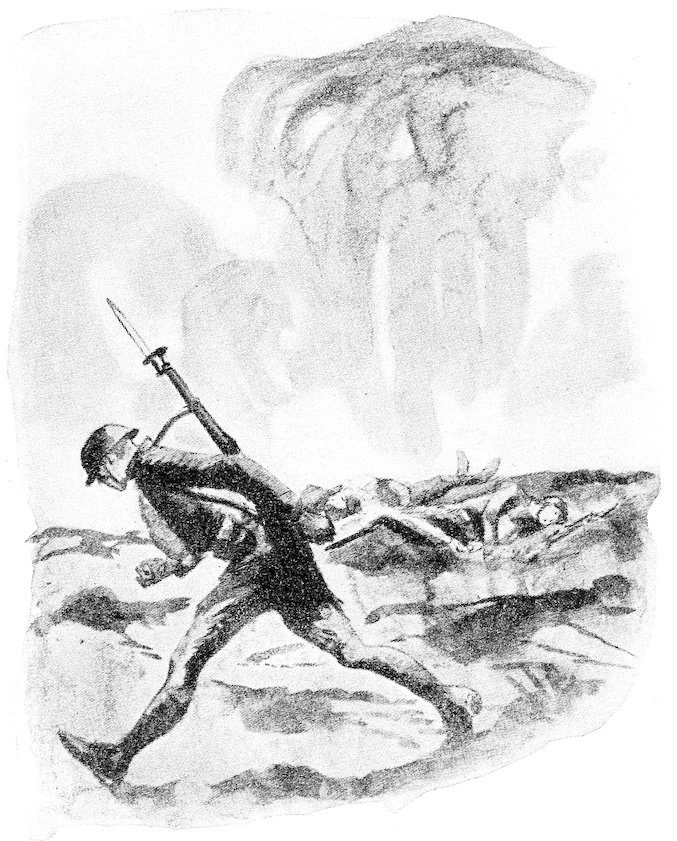
“Here comes a battalion runner—what’s up, anyway?”
183The second-in-command was pulled to his feet by Gunner Nice, who had taken the second platoon. His head lolled stupidly a moment, then he heard words—“an’ that shell got all the captain’s group, sir—all of ’em! An’ my platoon’s all casualties—” He pulled himself together as he went forward. His raincoat was split up the back, under his belt. His map-case was gone—the strap that had secured it hung loosely from his shoulder. There was blood on his hands, and the salt taste of it in his mouth, but it didn’t seem to be his. And the front of the battalion was very narrow, now. The support platoons were all in the line. Strangest of all, the gray slope was behind them—the trees on the crest were only a few yards away.
Behind and to the left the machine-guns still raved, but the artillery fell away. A greenish rocket flared from the pines ahead, and right in the faces of the panting Marines machine-guns and rifles blazed. In the shadow of the pines were men in cumbersome green-gray uniforms, with faces that looked hardly human under deep round helmets. With eyes narrowed, bodies slanting forward like men in heavy rain, the remnant of the battalion went to them.
It was the flank of the Boche column which had come out of St.-Etienne and struck the leading battalions of the 5th. It had watched first with keen delight, then with incredulity, the tortured advance of the battalion. It had waited too long to open its own fire. And now, already shaken by the sight of these men who would not die, it shrank from the long American bayonets and the pitiless, furious faces behind the steel. A few Brandenburger zealots elected to die on their spitting Maxim guns, working them until bayonets or clubbed rifles made an end. A few 184iron-souled Prussians—the Boche had such men—stood up to meet bayonet with bayonet, and died that way. The second-in-command saw such a one, a big feldwebel, spring against one of his sergeants with the long Prussian lunge that throws the bayonet like a spear to the full reach of the arm. It is a spectacular thrust, and will spit like a rabbit what stands in its way. But the sergeant, Bob Slover, a little fiery man with a penchant for killing Germans, ran under it and thrust from the ground for the Boche’s throat. And as his point touched, he pulled the trigger. The feldwebel’s helmet flew straight into the air, and the top of his head went with it.
A great many more flung away their arms and bleated “Kamaraden” to men who in that red minute knew no mercy. Some hid in holes, or feigned death, to be hunted out as the press thinned. And the rest scuttled through the fringe of trees and back down toward St.-Etienne, while the Marines, lying prone or taking rest for their Springfields, killed them as they ran. This same rifle-fire, directed against the flank and rear of the column which had pushed to the right against the other battalions of the 5th, broke that force and dispersed it. There was a battery of field-guns down the slope, 500 yards or so. The gunners—those who were lucky—took to cover after the first burst of fire. “Thank Gawd fer a shot at them dam’ artillerymen! Battle-sight, an’ aim low, you birds—don’t let any of them bastards get away!”... “Sergeant, reckon the lootenant would let us go down an’ take them 77s?”—“Shut up an’ work yo’ bolt, you dam’ fool!—Whatinell you think you are—a army core?”—“Besides, Mr. Connor’s dead....” On the hill beyond St.-Etienne new trenches scarred the slope; there were many Germans milling there, some 1,500 yards away. “Save your ammunition and lay low,” the word was passed. “We’re on our own out here.” And the battalion, a very small battalion now, little more than a hundred men, lay along the crest they had stormed, with their dead and wounded and the Boche dead and wounded around them.
185
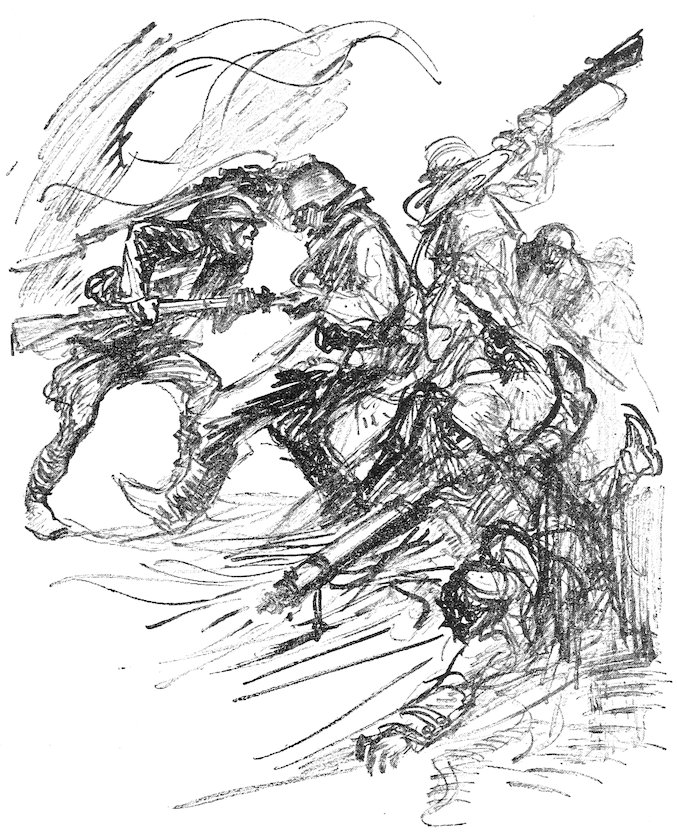
A few iron-souled Prussians—the Boche had such men—stood up to meet bayonet with bayonet, and died that way.
187
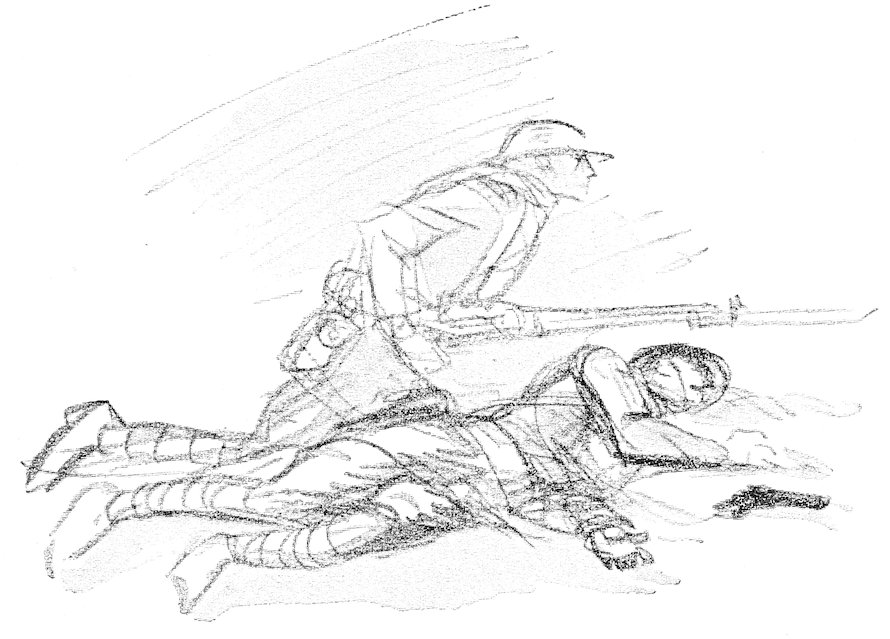
The last few men are always the most difficult to kill.
Almost immediately the Boche began to react. He opened on them a storm of fire, high explosive and shrapnel, and his machine-guns dinned fiercely. A counter-attack began to form toward St.-Etienne. Sweating gunners struggled into position 188with the two machine-guns that were left in the battalion, and these, with their crews, were knocked out by shell-fire before either had been in action long enough to fire a clip. But the rifles gave tongue and continued to speak—the last few men are always the most difficult to kill—and the Boche had little taste for rifle-fire that begins to kill at 700 yards. That counter-attack shortly returned whence it came, and the one that followed it went back also.
The rifles fell silent, for the Boche infantry was in cover, or too far away to waste scant ammunition on. “O Lord, for one battery of 75s or a machine-gun outfit! All the Boches in the world, an’ nothin’ to reach ’em with!” lamented the captain of the 49th. “We’re clean away from our guns, and those devils seem to know it—look at ’em, yonder! Heard a shell from ours to-day, John? I haven’t.”—“Plenty from the other side, though—damn few of us left, capitan. Eastin’s got it, Tom Langford’s got it—Chuck Connor, and Matthews. Don’t know where Geer is. Guess I’m the only officer you have left—here’s Captain Whitehead.”
Whitehead, of the 67th Company, plumped down beside them. Small, very quick and wiry, with his helmet cocked on the side of his head, he gave the impression of a fierce and warlike little hawk. “Hunt’s comin’ over, Francis,” he said. “Bad place; worst I ever saw. Got about thirty men left. Hell that our machine-guns got knocked out so quick, wasn’t it?—must be two regiments of Fritzies on our front yonder!”
Captain Hunt, senior in the field, a big, imperturbable Californian, came, and Lieutenant Kelly, promoted by casualties in 189the last hour to command of the 66th Company. “How does it look to you, gentlemen?” said Hunt. “Damn bad” was the consensus of opinion, with profane embellishments. Followed some technical discussion. “Well,” concluded the senior captain, “we’ve accomplished our mission—broke up their attack—better hook up with the rest of the regiment. We’ll find them through the woods to the right. Move off your companies—Kelly, you go first.”
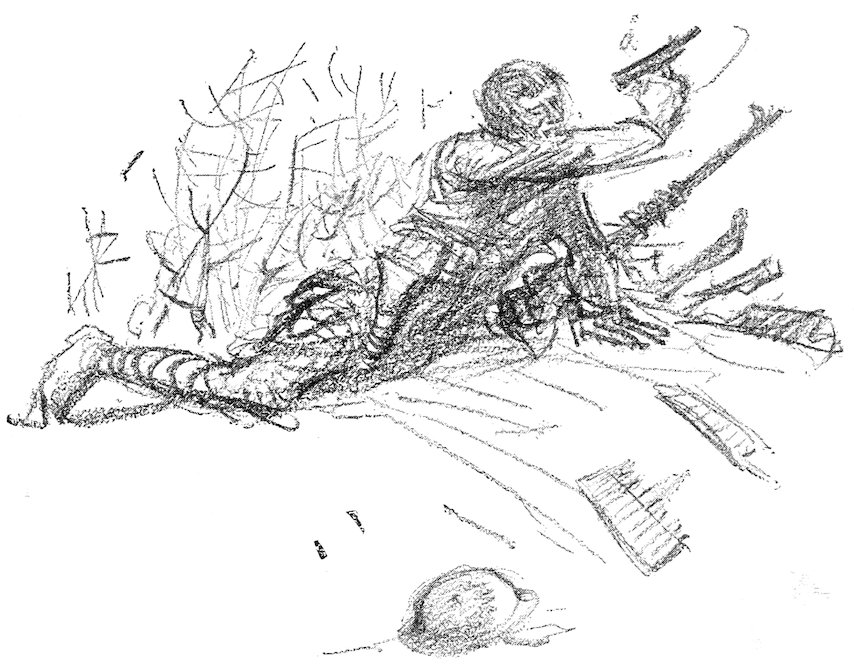
A machine-gunner, Champagne. A sketch made on the field.
Nobody remembers very clearly that swing to the right, 190through a hail of machine-gun fire and an inferno of shelling. They found the companies of the 2d Battalion digging in astride a blasted road, and went into position beside them.
“I’ve organized the company sector with twenty men—all we’ve got left—you and I make twenty-two,” reported the second-in-command, dropping wearily into the shell-hole where the captain had established himself. “Lord, I’m tired ... and what I can’t see,” he added in some wonder, fingering the rents in his raincoat, “is why we weren’t killed too....”
That night, lying in its shallow, hastily dug holes, the remnant of the battalion descended through further hells of shelling. The next night tins of beef and bread came up. There was some grim laughter when it came. “Captain,” reported the one remaining sergeant, after distributing rations in the dark, “they sent us chow according to the last strength report—three days ago—230-odd rations. The men are building breastworks out of the corned-willy cans, sir!—twenty of ’em——”
Some runners got through, and Division H. Q., well forward in a pleasantly exposed spot on the Souain road, built up a picture of a situation sufficiently interesting. Four infantry regiments were thrust saw-wise northwest to northeast of Blanc Mont; all were isolated from each other and from the French, who had lagged behind the flanks. Four little islands in a turbulent Boche sea, and the old Boche doing his damnedest. The Marine major-general commanding, Lejeune, it is related, went serenely to sleep. And they relate further that a staff colonel who, like Martha, was careful and troubled about many things, 191came to rouse him with a tale of disaster: “General, general, I have word from the front that a regiment of Marines is entirely surrounded by the Germans!”
“Yes, colonel? Well, sir,” said the general, sadly and sleepily, “I am sorry for those Germans!”—and returned to his slumbers.
More days and nights, slipping, characterless, into each other. Being less than a company in strength, the 1st Battalion of the 5th was not called on to attack again. They lay in their holes and endured. “Until the division has accomplished its mission,” said the second-in-command, rubbing his dirt-encrusted and unshaven chin. “That means, until the rest of the outfit is killed down as close as we are. Then we’ll be relieved, an’ get a week’s rest and a gang of bloodthirsty replacements, an’ then we can do it all over again.” “Yes,” replied the captain, turning uneasily in the cramped, coffin-shaped hole in which they lay. He scratched himself. “I have cooties, I think. In plural quantities.” “Well, you would have that orderly strip the overcoats off a covey of dead Boches to furnish this château of ours. The Boche is such an uncleanly beast.... I have cooties, too, my capitan. Hell ... ain’t war wonderful!”
And after certain days the division was relieved. The battalion marched out at night. The drumming thunder of the guns fell behind them and no man turned his face to look again on the baleful lights of the front. On the road they passed a regiment of the relieving division—full, strong companies of National Guardsmen. They went up one side of the road; and in ragged 192column of twos, unsightly even in the dim and fitful light, the Marines plodded down the other side. They were utterly weary, with shuffling feet and hanging heads. The division had just done something that those old masters in the art of war, the French, and the world after them, including Ludendorff, were to acknowledge remarkable. They had hurled the Boche from Blanc Mont and freed the sacred city of Rheims. They had paid a price hideous even for this war. And they were spent. If there was any idea in those hanging heads it was food and rest.
The Guard companies gibed at the shrunken battalion as they passed. Singing and joking they went. High words of courage were on their lips and nervous laughter. Save for a weary random curse here and there, the battalion did not answer.... “Hell, them birds don’t know no better....” “Yeh, we went up singin’ too, once—good Lord, how long ago!... They won’t sing when they come out ... or any time after ... in this war.”... “Damn you, can’t you march on your own side the road? How much room you need?”
193
SONGS THREE “MADEMOISELLE FROM ARMENTIÈRES”
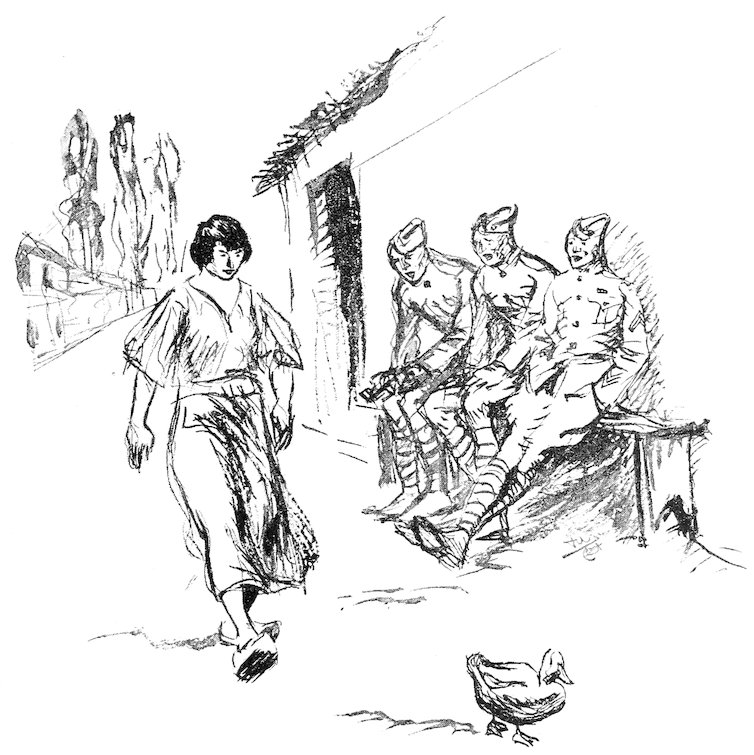
194It was nice, back in billets, resting between battles, to sit on a bench in the sun and watch the world go by. Odette, the strapping and genteel daughter of the baker of Croutte-sur-Marne, here herds the duck Anatole into the courtyard of her mother’s bakery. (M. Boulanger was last heard from on the Chemin des Dames; Mme. Boulangère keeps the establishment going.) The duck Anatole has been ordered for dinner by two lieutenants of the 1st Battalion, the consideration being 37 francs 80 centimes. Two privates of the 49th Company are choiring softly “Mademoiselle from Armentières” as she passes. It is just as well that neither Odette nor Anatole comprend l’anglais.
195
197
IV
198At various times and places in 1918 the 2d Marine Division was subsisted on the French ration, a component part of which was preserved Argentine beef with carrots in it. This was called monkey-meat by the Marines of the 4th Brigade. Men ate it when they were very hungry.
199