I BATTLE-SIGHT THE FIGHTING AROUND THE BOIS DE BELLEAU
Reading edition
I ATTACK
In the fields near Marigny Marines of the 1st Battalion of the 5th found an amiable cow. There had been nothing in the way of rations that day; there were no prospects. All hands took thought and designated a robust Polish corporal as executioner. He claimed to have been a butcher in a former existence. He was leading the cow decently away from the road when a long gray car boomed up, halted with the touch of swank that Headquarters chauffeurs always affect, and disgorged a very angry colonel. The colonel’s eye was cold upon the interested group around the cow. They stood now to attention, the cow alone remaining tranquil, with a poppy dangling from her languid mouth.
“Lieutenant, what are you doing there——?”
“Sir, you see, the men haven’t had anything to eat, and I thought, sir—we found this cow wanderin’ around—we couldn’t find any owner—we’d like to chip in and buy her—we were goin’ to——”
“I see, sir, I see! You were going to kill this cow, the property of some worthy French family. You will bear in mind, lieutenant, 2that we are in France to protect the lives and property of our allies from the Germans—Release that animal at once! Your rations will be distributed as soon as possible—carry on—” The colonel departed, and four or five 77s crashed into a little wood two hundred yards up the road. There were more shells in the same place. “Hi! Brother Boche must think there’s a battery over there!”—“Well, there ain’t—” The Marines sat down in the wheat and observed the cow.
“Property of our gallant allies—yeh!—” “Old man’s in an awful humor—wonder what—” The lieutenant sucked a straw reflectively. His sergeant solaced himself with tobacco. The cow ruminated, quite content. She had nourished herself at will for three delightful days, since her people, in a farm over toward Torcy—where, at the minute, the Boche was killing off a battalion of French territorials—had incomprehensibly turned her out and vanished. Full-fed, she eyed the strangers without emotion.
“I was a quartermaster sergeant once, sir,” said the platoon sergeant dreamily. “I remember just what the cuts of beef are. There’d be fine sirloin on that cow-critter, now.... Mr. Ashby (another flight of 77s burst in the wood), if we was to take that cow over an’ tie her in that brush—she oughten to be out here in the open, anyway—might draw fire ... shell’s liable to hit anything, you know, sir——”
“Sergeant, you heard what the colonel said. But if you think she’d be safer—I’d suggest volunteers. And by the way, sergeant, I want a piece of tenderloin—the T-bone part——”
3
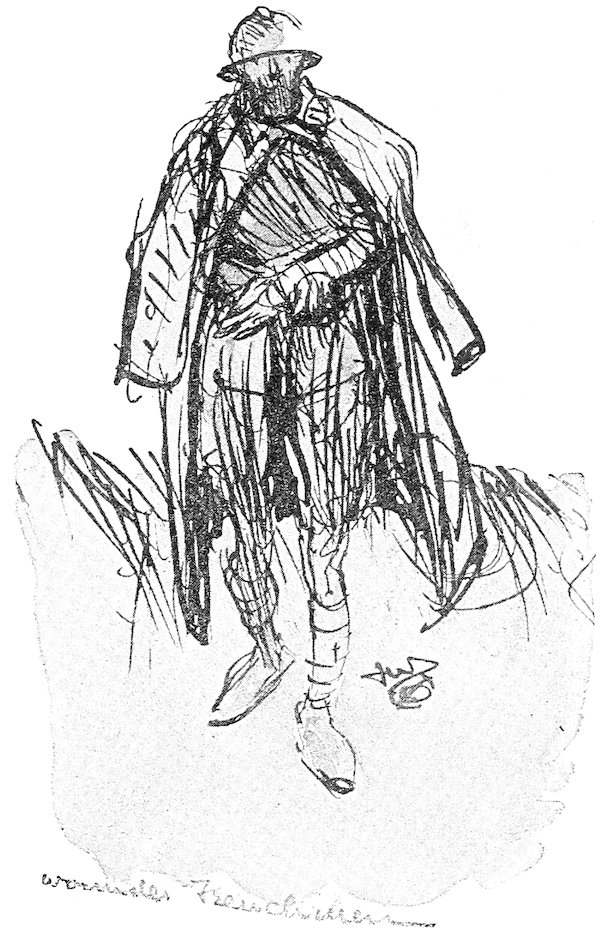
Occasional wounded Frenchmen drifted back.
The cow was duly secured in the wood, men risking their lives thereby. The Boche shelled methodically for two hours, and the Marines were reduced to a fearful state of nerves—“Is that dam’ heifer gonna live forever?—” Two or three kilometres away fighting was going on. The lieutenant, with his glass, picked up far, running figures on the slope of a hill. You caught a flicker, points of light on the gray-green fields—bayonets. Occasional 4wounded Frenchmen wandered back, weary, bearded men, very dirty. They looked with dull eyes at the Americans—“Très mauvais, là-bas! Beaucoup Boche, là—” The Marines were not especially interested. Their regiment had been a year in France, training. Now they, too, were dirty and tired and very hungry. The war would get along ... it always had.
A week ago, Memorial Day, there had been no drills. The 2d Division, up from a tour in the quiet Verdun trenches, rested pleasantly around Bourmont. Rumors of an attack by the 1st Division, at Cantigny, filtered in. Cantigny was a town up toward Montdidier. Notions of geography were the vaguest—but it was in the north, where all the heavy fighting was. It appeared that the 2d was going up to relieve the 1st.... “Sure! we’ll relieve ’em. But if they wanted a fight, why didn’t they let us know in the first place?—We’d a-showed ’em what shock troops can do!”
The division set out in camions; in the neighborhood of Meaux they were turned around and sent out the Paris-Metz road, along which the civilian population from the country between the Chemin des Dames and the Marne, together with the débris of a French army, was coming back. No man who saw that road those first days of June ever forgot it. A stream of old men and children and old and young women turned out of their homes between two sunrises, with what they could carry in their hands. You saw an ancient in a linen smock and sabots, trundling a wheelbarrow, whereon rode a woman as old as himself, with a feather-bed and a selection of copper pots and a string of garlic. There were families in amazing horse-drawn vehicles, 5models of the Third Empire, and horses about as old, clutching unreasonable selections of household effects—onyx clocks and bird-cages and rabbits—what you like. Women carrying babies. Children—solemn little boys in black pinafores, and curly-headed, high-nosed little girls, trudging hand-in-hand. People of elegance and refinement on inadequate shoes. Broad-faced peasants. Inhabitants of a thousand peaceful little villages and farms, untouched by the war since 1914. Now the Boche was out again, and those quiet places, that had drowsed in obscurity while generations lived and worked and died, were presently to be known to all the world—names like Bouresches, and Belleau, and Fismes, and Vierzy, and Fismettes. They walked with their faces much on their shoulders, these people, and there was horror in their eyes. The Marines took notice of another side of war.... “Hard on poor folks, war is.” “You said it!”—“Say—think about my folks, an’ your folks, out on the road like that!...” “Yeh. I’m thinkin’ about it. An’ when we meet that Boche, I’m gonna do something about it—Look—right nice-lookin’ girl, yonder!”
There were French soldiers in the rout, too. Nearly all were wounded, or in the last stages of exhaustion. They did not appear to be first-line troops; they were old, bearded fellows of forty and forty-five, territorials; or mean, unpleasant-looking Algerians, such troops as are put in to hold a quiet sector. Seven or eight divisions of them had been in the line between Soissons and Rheims, which was, until 27 May, a quiet sector. On that day forty-odd divisions, a tidal wave of fighting Germans, with the greatest artillery concentration the Boche ever effected, was 6flung upon them, and they were swept away, as a levee goes before a flood. They had fought; they had come back, fighting, thirty-five miles in three days; and the Boche, though slowed up, was still advancing. They were holding him along the Marne, and at Château-Thierry a machine-gun battalion of the American 3d Division was piling up his dead in heaps around the bridgeheads, but to the northwest he was still coming. And to the northwest the 2d Division was gathering. During the 2d, the 3d, and the 4th of June it grouped itself, first the 4th Brigade of Marines, with some guns, and then the regular infantrymen of the 9th and 23d. Already, around Hautevesnes, there had been a brush with advancing Germans, and the Germans were given a new experience: rifle-fire that begins to kill at 800 yards; they found it very interesting. This was 5 June; the battalion near Marigny, on the left of the Marine Brigade, had a feeling that they were going in to-morrow.... The men thought lazily on events, and lounged in the wheat, and watched that clump of trees—and at last an agonized bellow came on the echo of a bursting shell—“Well—she’s stopped one! Thought she musta dug in—Le’s go get it——”
Presently there was lots of steak, and later a bitter lesson was repeated—mustn’t build cooking-fires with green wood, where the Boche can see the smoke. But everybody lay down on full bellies. Before dark the last French were falling back. Some time during the night Brigade sent battle orders to the 1st Battalion of the 5th Marines, and at dawn they were in a wood near Champillon. Nearly every man had steaks in his mess-pan, and there was hope for cooking them for breakfast. Instead....
7
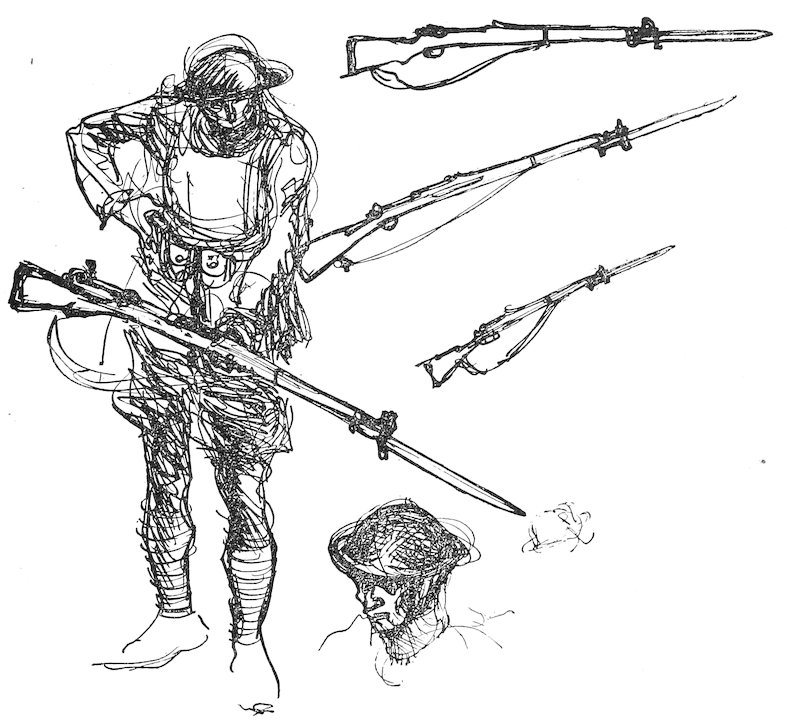
Sketches from Captain Thomason’s note-book.
9Those were before the days of lavish maps, to which the Americans afterwards attained. There was one map to each company, exclusive property of the captain. Platoon commanders had a look at it—“You’re here. The objective is a square patch of woods a kilometre and a half northeast, about. See?—this. Form your platoons in four waves—the guide will be right. Third Battalion is advancing their flank to conform. French on the left....” Platoons were formed in four waves, the attack formation taught by the French, a formation proved in trench warfare, where there was a short way to go, and you calculated on losing the first three waves and getting the fourth one to the objective. The Marines never used it again. It was a formation unadapted for open warfare, and incredibly vulnerable. It didn’t take long to learn better, but there was a price to pay for the learning.
The platoons came out of the woods as dawn was getting gray. The light was strong when they advanced into the open wheat, now all starred with dewy poppies, red as blood. To the east the sun appeared, immensely red and round, a handbreadth above the horizon; a German shell burst black across the face of it, just to the left of the line. Men turned their heads to see, and many there looked no more upon the sun forever. “Boys, it’s a fine, clear mornin’! Guess we get chow after we get done molestin’ these here Heinies, hey?”—One old non-com—was it Jerry Finnegan of the 49th?—had out a can of salmon, hoarded somehow against hard times. He haggled it open with his bayonet, and went forward so, eating chunks of goldfish from the point of that wicked knife. “Finnegan”—his platoon commander, 10a young gentleman inclined to peevishness before he’d had his morning coffee, was annoyed—“when you are quite through with your refreshments, you can—damn well fix that bayonet and get on with the war!” “Aye, aye, sir!” Finnegan was an old Haitian soldier, and had a breezy manner with very young lieutenants—“Th’ lootenant want some?”—Two hours later Sergeant Jerry Finnegan lay dead across a Maxim gun with his bayonet in the body of the gunner....
It was a beautiful deployment, lines all dressed and guiding true. Such matters were of deep concern to this outfit. The day was without a cloud, promising heat later, but now it was pleasant in the wheat, and the woods around looked blue and cool. Pretty country, those rolling wheat-lands northwest of Château-Thierry, with copses of trees and little tidy forests where French sportsmen maintained hunting-lodges and game-preserves. Since the first Marne there had been no war here. The files found it very different from the mangled red terrain around Verdun, and much nicer to look at. “Those poppies, now. Right pretty, ain’t they?”—a tall corporal picked one and stuck it in his helmet buckle, where it blazed against his leathery cheek. There was some shelling—not much, for few of the German guns had caught up, the French had lost all theirs, and the American artillery was still arriving.
11
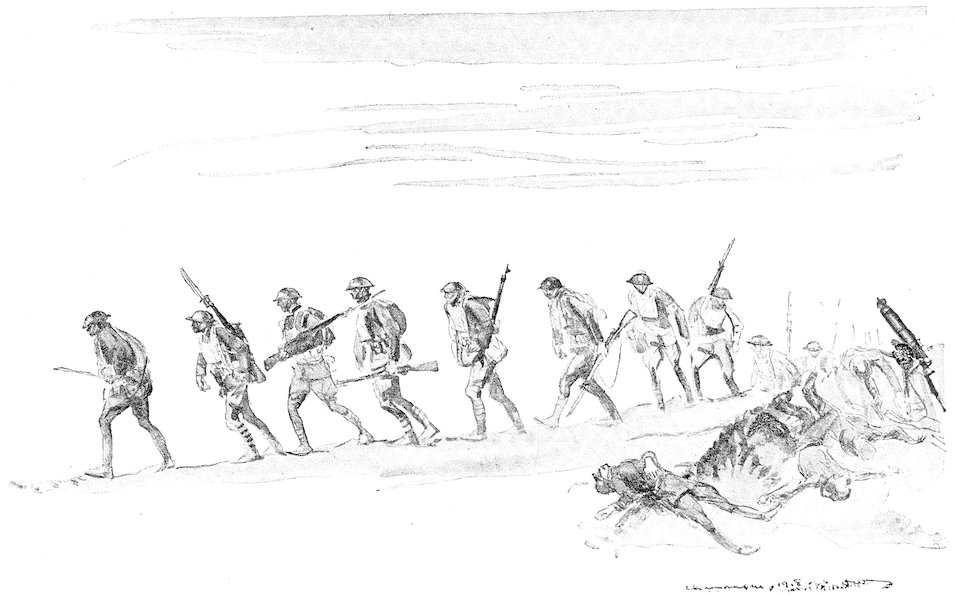
Platoon column in support, Champagne, 1918. Drawn by Captain Thomason from notes made in front of Blanc Mont.
13Across this wheat-field there were more woods, and in the edge of these woods the old Boche, lots of him, infantry and machine-guns. Surely he had seen the platoons forming a few hundred yards away—it is possible that he did not believe his eyes. He let them come close before he opened fire. The American fighting man has his failings. He is prone to many regrettable errors. But the sagacious enemy will never let him get close enough to see whom he is attacking. When he has seen the enemy, the American regular will come on in. To stop him you must kill him. And when he is properly trained and has somebody to say “Come on!” to him, he will stand as much killing as anybody on earth.
The platoons, assailed now by a fury of small-arms fire, narrowed their eyes and inclined their bodies forward, like men in heavy rain, and went on. Second waves reinforced the first, fourth waves the third, as prescribed. Officers yelled “Battle-sight! fire at will”—and the leaders, making out green-gray, clumsy uniforms and round pot-helmets in the gloom of the woods, took it up with Springfields, aimed shots. Automatic riflemen brought their chaut-chauts into action from the hip—a chaut-chaut is as accurate from the hip as it ever is—and wrangled furiously with their ammunition-carriers—“Come on, kid—bag o’ clips!—” “Aw—I lent it to Ed to carry, last night—didn’t think—” “Yeh, and Ed lent it to a fence-post when he got tired—get me some off a casualty, before I—” A very respectable volume of fire came from the advancing platoons. There was yelling and swearing in the wheat, and the lines, much thinned, got into the woods. Some grenades went off; there was screaming and a tumult, and the “taka-taka-taka-taka” of the Maxim guns died down. “Hi! Sergeant!—hold on! Major said he wanted some prisoners—” “Well, sir, they looked like they was gonna start somethin’—” “All right! All right! but you catch some alive the next place, you hear?—” 14“Quickly, now—get some kind of a line—” “Can’t make four waves—” “Well, make two—an’ put the chaut-chauts in the second—no use gettin’’em bumped off before we can use ’em—” The attack went on, platoons much smaller, sergeants and corporals commanding many of them.
A spray of fugitive Boche went before the attack, holding where the ground offered cover, working his light machine-guns with devilish skill, retiring, on the whole, commendably. He had not expected to fight a defensive battle here, and was not heavily intrenched, but the place was stiff with his troops, and he was in good quality, as Marine casualty lists were presently to show. There was more wheat, and more woods, and obscure savage fighting among individuals in a brushy ravine. The attack, especially the inboard platoons of the 49th and 67th Companies, burst from the trees upon a gentle slope of wheat that mounted to a crest of orderly pines, black against the sky. A three-cornered coppice this side of the pines commanded the slope; now it blazed with machine-guns and rifles; the air was populous with wicked keening noises. Most of the front waves went down; all hands, very sensibly, flung themselves prone. “Can’t walk up to these babies—” “No—won’t be enough of us left to get on with the war—” “Pass the word: crawl forward, keepin’ touch with the man on your right! Fire where you can—” That officer, a big man, who had picked up a German light machine-gun somewhere, with a vague idea of using it in a pinch, or, in any case, keeping it for a souvenir, received the attention of a heavy Maxim and went down with a dozen bullets through his chest.
15
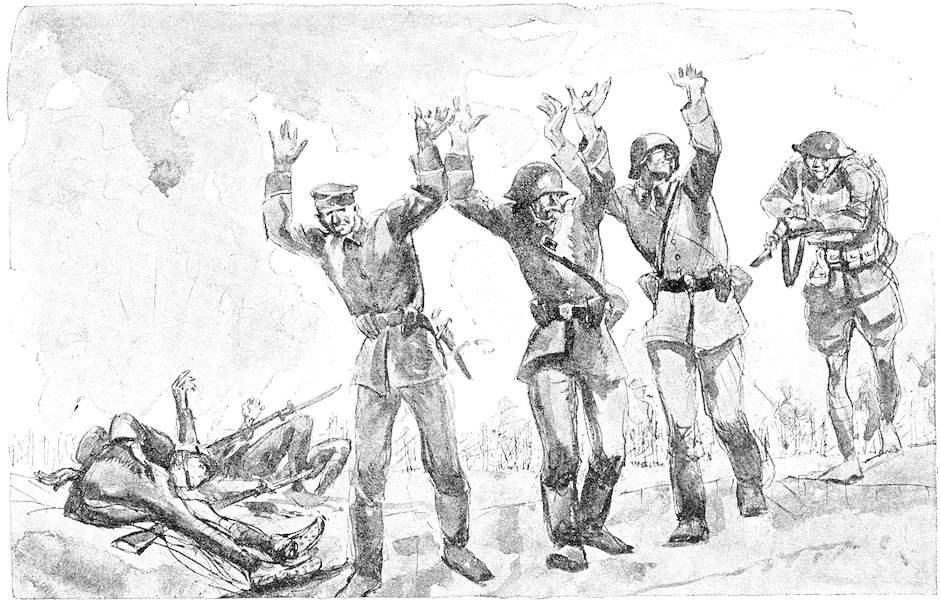
“Catch some alive——”
17Men crawled forward; the wheat was agitated, and the Boche, directing his fire by observers in tree-tops, browned the slope industriously. Men were wounded, wounded again as the lines of fire swept back and forth, and finally killed. It helped some to bag the feldwebels in the trees; there were men in that line who could hit at 750 yards, three times out of five. Sweating, hot, and angry with a bleak, cold anger, the Marines worked forward. They were there, and the Germans, and there was nothing else in the clanging world. An officer, risking his head above the wheat, observed progress, and detached a corporal with his squad to get forward by the flank. “Get far enough past that flank gun, now, close as you can, and rush it—we’ll keep it busy.”... Nothing sounds as mad as rifle-fire, staccato, furious—The corporal judged that he was far enough, and raised with a yell, his squad leaping with him. He was not past the flank; two guns swung that way, and cut the squad down like a grass-hook levels a clump of weeds.... They lay there for days, eight Marines in a dozen yards, face down on their rifles. But they had done their job. The men in the wheat were close enough to use the split-second interval in the firing. They got in, cursing and stabbing. Meanwhile, to the left a little group of men lay in the wheat under the very muzzle of a gun that clipped the stalks around their ears and riddled their combat packs—firing high by a matter of inches and the mercy of God. A man can stand just so much of that. Life presently ceases to be desirable; the only desirable thing is to kill that gunner, kill him with your hands! One of them, a corporal named Geer, said: “By God, let’s get him!” And they got him. One fellow seized the spitting muzzle 18and up-ended it on the gunner; he lost a hand in the matter. Bayonets flashed in, and a rifle-butt rose and fell. The battle tore through the coppice. The machine-gunners were brave men, and many of the Prussian infantry were brave men, and they died. A few streamed back through the brush, and hunters and hunted burst in a frantic medley on the open at the crest of the hill. Impartial machine-guns, down the hill to the left, took toll of both. Presently the remnants of the assault companies were panting in the trees on the edge of the hill. It was the objective of the attack, but distance had ceased to have any meaning, time was not, and the country was full of square patches of woods. In the valley below were more Germans, and on the next hill. Most of the officers were down, and all hands went on.
They went down the brushy slope, across a little run, across a road where two heavy Maxims were caught sitting, and mopped up and up the next long, smooth slope. Some Marines branched off down that road and went into the town of Torcy. There was fighting in Torcy, and a French avion reported Americans in it, but they never came out again ... a handful of impudent fellows against a battalion of Sturm-truppen.... Then the men who mounted the slope found themselves in a cleared area, full of orderly French wood-piles, and apparently there was a machine-gun to every wood-pile. Jerry Finnegan died here, sprawled across one of them. Lieutenant Somers died here. One lieutenant found himself behind a wood-pile, with a big auto-rifleman. Just across from them, very near, a machine-gun behind another wood-pile was searching for them. The lieutenant, all his world narrowed to that little place, peered vainly for a loophole; the 19sticks were jumping and shaking as the Maxim flailed them; bullets rang under his helmet. “Here, Morgan,” he said, “I’ll poke my tin hat around this side, and you watch and see if you can get the chaut-chaut on them—” He stuck the helmet on his bayonet, and thrust it out. Something struck it violently from the point, and the rifle made his fingers tingle. The chaut-chaut went off, once. In the same breath there was an odd noise above him ... the machine-gun ... he looked up. Morgan’s body was slumping down to its knees; it leaned forward against the wood, the chaut-chaut, still grasped in a clenched hand, coming to the ground butt first. The man’s head was gone from the eyes up; his helmet slid stickily back over his combat pack and lay on the ground.... “My mother,” reflected the lieutenant, “will never find my grave in this place!” He picked up the chaut-chaut, and examined it professionally, noting a spatter of little thick red drops on the breech, and the fact that the clip showed one round expended. The charging handle was back. He got to his feet with deliberation, laid the gun across the wood-pile, and sighted ... three Boche with very red faces; their eyes looked pale under their deep helmets.... He gave them the whole clip, and they appeared to wilt. Then he came away from there. Later he was in the little run at the foot of the hill with three men, all wounded. He never knew how he got there. It just happened.
Later in the day the lieutenant was back on the pine-crested hill, now identified as Hill 142. Captain Hamilton was there, one or two other officers, and a handful of the 49th and 67th Companies; a semblance of a line was organized. “Nothing on 20the right or left; all right, we’ll just stay here—” Some people from the 8th Company had a Hotchkiss gun, and some Boche Maxims were put in position. It was said that Blake, of the 17th, had been up, and was bringing the company in. The Boche indulged himself in violent shelling and raked the hill savagely with all the machine-guns in the world. From the direction of Torcy a counter-attack developed; the Boche was filtering cleverly forward and forming somewhere on the Torcy road, in cover. The Marines were prone, slings adjusted, killing him. “It’s a quarter-point right windage—” “Naw! not a breath of air! Use zero—” A file of sweating soldiers, burdened with picks and shovels in addition to bandoleers and combat gear, came trotting from the right. A second lieutenant, a reddish, rough-looking youngster, clumped up and saluted. “You in charge here?” he said to the Marine officer. “I’m Lieutenant Wythe of the 2d Engineers, with a detachment. I’m to report to you for orders.” “Well—captain’s right up yonder—how many men you got?” “Twenty-two, sir—” “Fine! That makes thirty-six of us, includin’ me—just flop right here, and we’ll hold this line. Orders are to dig in here—but that can wait—see yonder——?”
Those Engineers, their packs went one way and their tools another, and they cast themselves down happily. “What range, buddy?—usin’ any windage—?” A hairy non-com got into his sling and laid out a little pile of clips.... There was always good feeling between the Marines of the 2d Division and the Regular Army units that formed it, but the Marines and the 2d Engineers—“Say, if I ever got a drink, a 2d Engineer can have half of it!—Boy, they dig trenches and mend roads all night, and they fight all day! An’ when us guys get all killed off, they just come up an’ take over the war! They’s no better folks anywhere than the Engineers....”
21
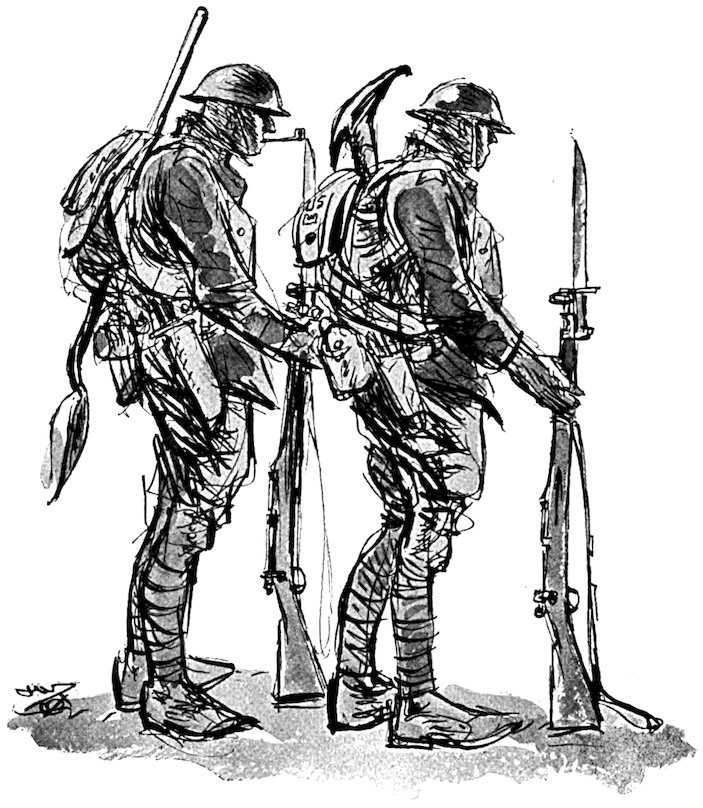
The 2d Engineers.
23The Boche wanted Hill 142; he came, and the rifles broke him, and he came again. All his batteries were in action, and always his machine-guns scourged the place, but he could not make head against the rifles. Guns he could understand; he knew all about bombs and auto-rifles and machine-guns and trench-mortars, but aimed, sustained rifle-fire, that comes from nowhere in particular and picks off men—it brought the war home to the individual and demoralized him.
And trained Americans fight best with rifles. Men get tired of carrying grenades and chaut-chaut clips; the guns cannot, even under most favorable conditions, keep pace with the advancing infantry. Machine-gun crews have a way of getting killed at the start; trench-mortars and one-pounders are not always possible. But the rifle and bayonet goes anywhere a man can go, and the rifle and the bayonet win battles. Toward midday, this 6th of June, 1918, the condition around Hill 142 stabilized. A small action, fought by battalions over a limited area of no special importance, it gave the Boche something new to think about, and it may be that people who write histories will date an era from it.
Between attacks the stretcher-bearers and the Red Cross men on both sides did their utmost for the wounded who were scattered through the wheat around the hill, and who now, under the torture of stiffening wounds and the hot sun, began to 24cry out. As the afternoon advanced, you heard pitiful voices! little and thin across the fields: “Ach, Himmel, hilf, hilf! Brandighe!... Liebe Gott, brandighe!”... “First-aid—this way, First-aid, for the love of God!”... From most wounds men do not appear to suffer greatly at first. There is the hot impulse of the attack, and perhaps a certain shock from the missile, so that the nerves are numb. One has gone forward with the tide at the highest; life is a light thing to lay down, death a light thing to venture; yonder is the enemy; one has come a long way to meet him, and now the affair can be taken up personally. Then something hits—the wheat cuts off all the world. An infernal racket goes on somewhere—Springfields and Mausers, Maxim guns and Hotchkiss—sometimes closer, sometimes receding. Bullets zip and drone around. There may be shells, shrapnel, and H. E., searching the ground, one can hear them coming. “Is it gonna hit me—is it gonna hit me, O Lawd—Christ! that was close!” Presently pain, in recurring waves. Pride may lock a man’s lips awhile ... left long enough, most men break, and no blame to them. A hundred brave dead, lying where the guns cut them down, are not so pitiful as one poor wailing fellow in a dressing-station....
25
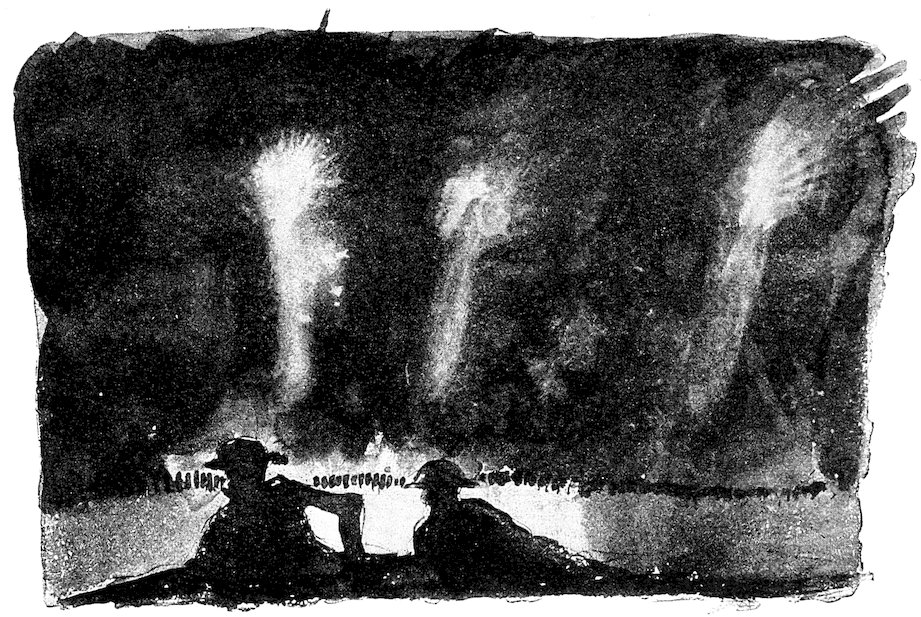
A tortured area ... lit by flares and gun-flashes.
27Forward of the hill, German stretcher-bearers moved openly, unmolested, at first. The Marines watched them curiously. The enemy, his works are always interesting. A sergeant said: “Hi! Look at those Fritzies yonder, right off the road, there—” A lieutenant got his glass on them; two big men, one with a yellow beard, wearing Red Cross brassards. They carried a loaded stretcher; it looked like a man lying with his knees drawn up, under a blanket. “Humph! Got him well covered—officer, probably.” One stumbled, or the wind blew, and an end of the blanket flapped back, disclosing unmistakably the blunt snout of a heavy Maxim.—“So that’s it, eh? Slover—Jennings—Heald—got a rifle, Cannon? Range 350—let ’em have it—we can play that game, too—” Thereafter it was hard on Red Cross men and wounded; hard, in fact, on everybody. Like reasonable people, the Americans were willing to learn from the Boche, from anybody who could teach them; and if the Boche played the game that way—they could meet him at it. “Schrechlichkeit—if he wants frightfulness, we can give it to him—” Later there was a letter, taken from a dead feldwebel in the Bois de Belleau—“The Americans are savages. They kill everything that moves....”
Late in the afternoon a great uproar arose to the right. There was more artillery up now, more machine-guns, more of everything. The 3d Battalion of the 6th Marines and the 3d Battalion of the 5th attacked the town called Bouresches and the wood known as Bois de Belleau. They attacked across the open, losing hideously. Platoons were shot down entire. The colonel commanding the 6th Regiment, farther forward than regimental commanders have any business being, was shot and evacuated. Lieutenant Robertson got into Bouresches, with twenty men out of some hundred who started, threw the Boche out, and held it. They gained a footing in the rocky ledges at the edge of the Bois de Belleau, suffering much from what was believed to be a machine-gun nest at this point. They tried to leave it and go 28on, with a containing force to watch it; they found that the whole wood was a machine-gun nest.
Night descended over a tortured area of wheat and woodland, lit by flares and gun-flashes, flailed by machine-guns, and in too many places pitiful with crying of wounded who had lain all the day untended in a merciless sun. Stretcher-bearers and combat patrols roamed over it in the dark. Water parties and ration parties groped back from forward positions over unknown trails. There were dog-fights all over the place, wild alarms, and hysterical outbreaks of rifle-fire. It was the same with the Boche; he knew the ground better, and he was determined to repossess it. His people filtered back through the American strong points, for the Marines did not hold a continuous line; isolated positions were connected by patrols and machine-guns laid for interlocking fire.
At the southern angle of Hill 142 the 49th Company put out a listening-post—one man down the slope a little way, to watch for visitors. In the night there was a trampling, a grunt, and one scream—“Boche!”—At once the hill blazed into action—weary men overspent, they fired into the dark until their pieces were hot. And after they found the listening-post fellow, bayoneted. And down the hill a little huddle of new dead. Not all the rifle-fire had gone astray.
Back in Brigade, officers bent over maps and framed orders for a stronger attack on the Bois de Belleau at dawn.... Brigade was writing also to Division: “... casualties severe ... figures on which to base call for replacements will be submitted as soon as possible....”
29
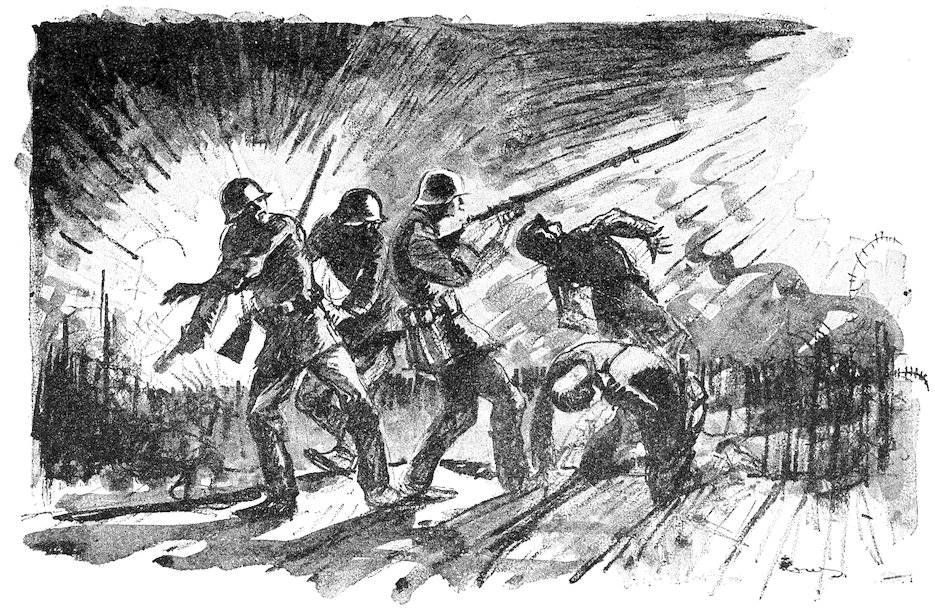
The hill blazed into action—not all the rifle-fire had gone astray.
31
II REPLACEMENTS
At the crossroads beyond La Voie du Chatelle they met the War.
Behind them, crammed somehow into weeks, were Quantico, the transport, Brest, a French troop-train. Then there was the golden country around St. Aignan, the “Saint Onion” of Americans, a country full of growing wheat and fields of red-topped clover, picture-book houses, and neat little forests. A country stripped of men, where the women were competent and kindly. Almost any place you could get noble omelets and white wine that tasted better than chlorinated water—good kick in it, too. “I tell you, Boots, an’ you remember it, this here France is a fine place to have a war in. Now, Haiti, an’ in Nicaragua, an’ in China, it’s nowhere near as good. I hope Germany will be as good, when—” So Sergeant McGee, with his double rows of ribbons and his hash marks, over a canteen full of eau de vie—old-timer he was.
The war was represented by demoniac non-coms, instructors in this and that. Bayonet drills—“Come on, now; lemme hear you—‘What do we wash our bay’nets in?—German blood!’—Aw—sing out like you meant it, you dam’ replacements! I’ll swear, it’s a shame to feed animals like you to the Germans—” Gas-mask drill—“Take more than five seconds, an’ your Maw 32gets a Gold Star—Now!—the gas-alert position—O, for Gawd’s sake, you guy, you wit’ the two left feet—” “But, sergeant, I find that I have a certain difficulty—” Sergeants also swear terribly.... There was every kind of drill, eight hours a day of it, and police work.
Rumors of great battles in the north. Glum and sad civilians—they were glum and sad everywhere in France, that spring of 1918—talking in anxious groups after the town crier with his drum passed. Another troop-train—maybe the same train that was carelessly left alongside a train containing the wine ration for some French division, the papers in which case are probably still accumulating. Camions after that. The replacements debussed late of a June afternoon and went up a great white road between exactly spaced poplars. They marched first in column of squads, then in column of files, platoons on opposite sides of the empty road. At the crest of a slope the column stopped. You could see, hanging above the sky-line to the north and east, curious shapes—“Look like a elephant’s head, bows on, wit’ his ears out, don’t they, sergeant?” The tall non-com who was guiding the column—a silent man—observed to the replacement officer in charge: “We’ll stop here, sir. Boche sausages yonder—observation balloons—see the whole country. We’ll wait till dark.”
33
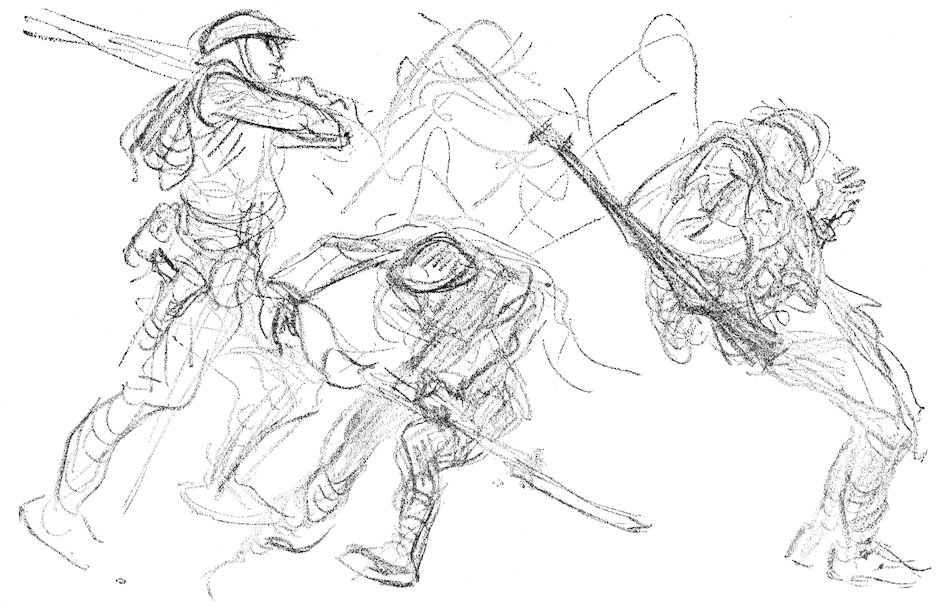
Pencil sketches made on scraps of paper, in Belleau Wood.
35The detachment was glad to fall out, off the road. It sat in little groups, silent for the most part, and listened to a mutter and a rumble in the direction of the blimps. A dark, high plane came into view from the east; its motor filled the ear with a deep, vibrant droning, oddly ominous. All at once the air around it was stippled with little puff-balls, white against the blue. You could hear the drumming of artillery, and the faint cough of bursting shrapnel, very far off. The plane went away. “—Yes, sir. Anti-aircraft stuff. Pretty, but it seldom hits anything—though it does run ’em off. Theirs is black....” The sergeant only spoke when spoken to; there was a look about his eyes—he was the survivor of a platoon that was sixty strong two days before. The sun set, and the day drowsed into the long twilight. Presently the sergeant said: “We can move now, sir.” The replacements moved, making no conversation.
A little country road led them off the highway. They passed a shattered farmhouse where a few soldiers lounged in the dusk. “Regimental, sir. Gets shelled a lot. No, sir, they don’t expect you to report. Somebody on the road to meet you....” A little group of officers rose out of the ditch, yawning. They looked slack and tired. “Replacement column? You in charge? Yes—assignments made back in Brigade. You’ll go to—Henry: your battalion gets a hundred and seventy, with five officers. Take ’em off the head of the column—tell Major Turrill——”
The detachment followed the officer called Henry, who set what they considered an immoderate pace. He passed the word: “Don’t bunch up; if a plane comes over low, don’t look up at it—he can see your faces; no smokin’, an’ don’t talk—” Sergeant McGee thought audibly: “Where have I seen that bird? Was it in Managua, that time they broke me for ... was it in Cuba?—where the devil—he was somebody’s sergeant-major—” They turned off the lane and went through a wheat-field. 36The sky was sword-blade blue, with a handful of stars. There was a loom of woods ahead, the tops of them outlined by greenish flares ceaselessly ascending somewhere beyond. They heard a machine-gun. “Sounds like one of these here steam-riveters, now, don’t it?...” A vagrant puff of wind blew a smell across the column, a smell terrible and searing to the nose. “Phew! dead hawses—” The officer named Henry spoke crisply. “Those are not,” he said, “dead horses.” The replacements sweated and felt cold, and thirsty too. They went on, very silent.
They went through a gap in a hedge and were at another crossroads. “Fall out here, an’ form combat packs. Leave your stuff under the hedge. Take one blanket. Come on—quickly, now!—an’ don’t bunch up!—” The replacements formed combat packs expertly, remembering Parris Island and Quantico. “Smartly, now! Come by here, fill your pockets—each man take two boxes hard bread—Where’ll you carry them? How in hell do I know—There!”
Two goods-boxes sat close together, and the men filed between them. One box had dried prunes in it, the other bread. “Don’t stop! don’t stop! Right down that road, an’ keep movin’!”
37
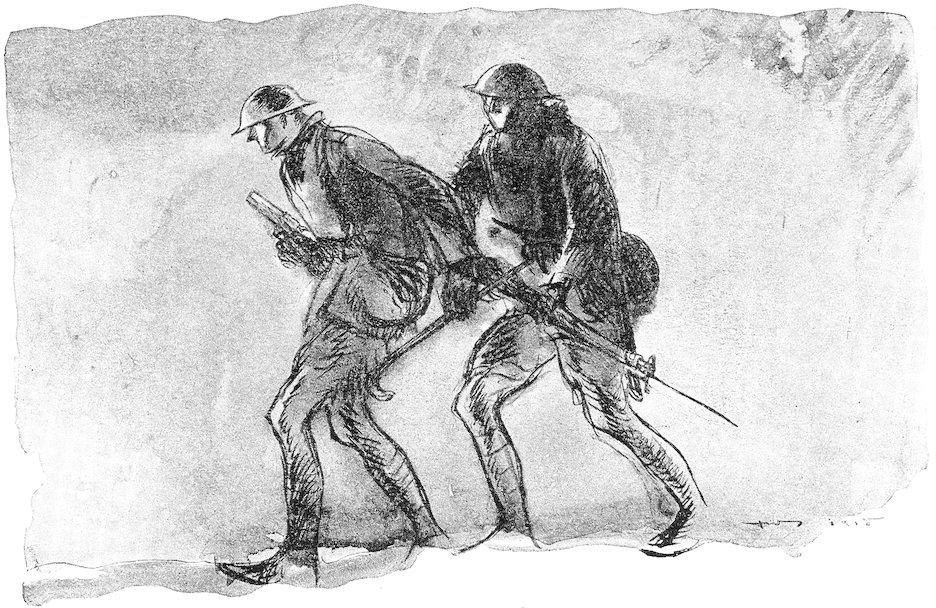
Combat patrol.
39Out over the woods a sound started, a new sound. It was a rumbling whine, it grew to a roar, and a 77 crashed down just beyond the crossroads. A cloud blacker than the night leaped up, shot with red fire—“Lie down, all hands!” Another landed at once; the air was full of singing particles. The men, flat on their faces, in the dark, waited numbly for the next order. There were a dozen or so shells all around the place. The last one hit between the two goods-boxes, where a man was lying. The boxes and the man vanished in a ruddy cloud—better than if he’d gotten it in the belly and rolled around screaming.... There were no more shells—“Say, you know, I saw a arm an’ a rifle goin’ up wit’ that burst—I—who was he, anyway?—” “Keep quiet, there! All right! on your feet—right down that road—” the officer ordered, and added to himself—“Dam’ it! Should have remembered they shell La Voie du Chatelle every night this time—but they acted fine....” A voice spoke up, excited, amused: “Say! Sergeant McGee—anything like that in Vera Cruz?” “Pipe down, you Boot.”
They went down a wood-road, black as a pocket, the files pressing close to keep the man ahead in sight. They went lightly, a weight off each man’s mind. They had been shelled, and nobody had run away, and only one man hurt! Most men are afraid when they go up to the front; and what they fear most is the fear of seeming afraid.... They were ordered to fix bayonets. The road began to have inequalities in it. There were noises, explosions, around in the dark. The machine-guns sounded nearer; the flares showed more starkly on the sky. A man fell into a hole, and there was an acrid smell that caught at your windpipe. Just ahead, down the road, came a bright flash and a roar, and fragments ripped through the woods, and they heard a lamentable crying, getting weaker: “First-aid! first-aid—” The column came to a dead mule and the wreck of a cart lying athwart the road, and a smoking hole, and a smell of high explosive, and the sharp reek of blood. There was a struggling group, somebody 40working swiftly in the dark, a whiteness of bandages, and the white blur of a man’s torso. “Lie still, damn you!”—“O, Jesus! Jesus Christ! Jesus Christ!—Ahhhhh! Go easy, you—” “Hell, I know it hurts, guy, but I got to get this bandage on, haven’t I? Come on—quit kickin’—” Passing around the mule, a man stepped on something neither hard nor soft—nothing else on earth feels that way—and he floundered to one side, cursing hysterically.—“Quiet, back there—pass the word, no talking!” The files obediently passed the word. The column groped on in the dark.
It came out of the woods into a pale stone town—Champillon. There were no lights in the houses; the place had an air of death about it. There was a well by Champillon, where the water-parties came back from the lines in the night for water.... One canteenful was a man’s allowance for each twenty-four hours. Men, after a time, made a shift to wash and shave and live not too thirsty out of one canteen a day. The replacements met two spectres who bore between them, on a long stick, twenty-odd canteens—the canteens of a platoon. “Hey! Guy!—” this in a hoarse whisper—“you comin’ up to relieve us?” “Hell, no!” a guide answered. “These is 1st Battalion replacements.” “I’ll be goddam’. Gonna leave us in forever—Ain’t we ever gonna be relieved?—” “Close up, there, and silence——”
41
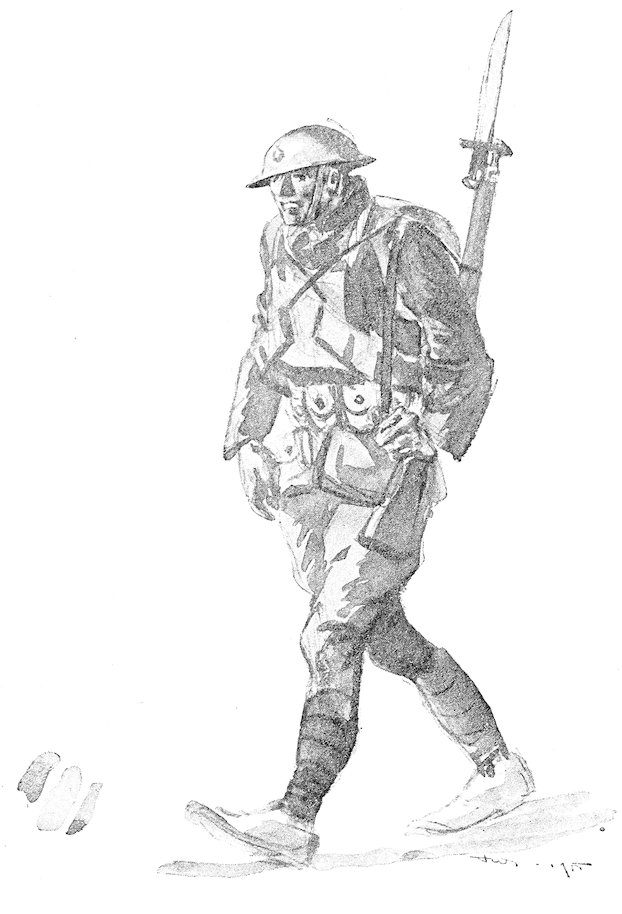
A sprinkling of old-time Marines.
43There was a Ph.D. from Harvard in that sweating file, a big, pale, unhandy private, hounded habitually by sergeants, and troubled with indigestion and patriotism. For all his training, a pack was not at home on his shoulders or a rifle easy in his hands. He was aware of his panoply of war—the full belt dragging at his loins, the straps that cut into his shoulders, the bulge of prunes in his blouse-pockets, and his Springfield, increasingly heavy. He reflected, feeling for the road with clumsy hobnails—for he was blind in the dark—“Now, those men are undoubtedly of the professional-soldier type. It is all a business with them. They are tired and they want to rest, and they say so frankly. No matter how tired I was, I’d never have the courage to say I wanted a relief. I’d want to awfully, but——”
He thought of the pleasant study back Cambridge way, of the gold-and-blue sergeant under the “First to Fight!” recruiting poster—“Your job, too, fella! Come on an’ help lick the Hun! You don’t wanta wait to be drafted, a big guy like you! We can use you in the Marines—” A hearty, red-necked ruffian—extremely competent in his vocation, no doubt. Good enough chaps. Yes ... but ... tea by a sea-coal fire in the New England twilight, and clever talk of art and philosophic anarchism—one wrote fastidious essays on such things for the more discriminating reviews ... scholarly abstractions.... Of all the stupid, ignorant, uncivilized things, a war! Who coined that phrase, civilized warfare? There was no such thing!... Here, in the most civilized country on earth.... The neighborhood of Château-Thierry ... Montaigne’s town, wasn’t it? The kings of France had a château near it, once. And yet it was always a cockpit ... since Ætius rolled back Attila in the battle of the nations, at Châlons—Napoleon fought Champ-Aubert and Montmirail around here—always war——
The column was through Champillon, dipping into a black hollow. More shell-holes in the road here.... All at once 44there was a new shell-hole, and the doctor of philosophy, sometime private of Marines, lay beside it, very neatly beheaded, with the rifle, that had been such a bore to keep clean, across his knees, and dried prunes spilling out of the pockets that he never had learned to button. The column went on. At dawn a naval medico attached to the Marine Brigade, with a staff officer, passed that way.
“Odd, the wounds you see,” observed the naval man, professionally interested. He looked curiously. “I couldn’t have done a neater decapitation than that myself. Wonder who—took his identification tags with it. I see. Replacement, by his uniform—” (For the 5th and 6th Regiments had long since worn out their forester-green Marine uniforms, and were wearing army khaki, while the replacements came in new green clothing.) The staff officer picked up the rifle, snapped back the bolt, and squinted expertly down the bore. “Disgustin’,” he said. “Sure he was a replacement. You never catch an old-timer with a bore like that—filthy! Bet there hasn’t been a rag through it in a week. You know, surgeon, I was looking at some of the rifles of that bunch of machine-gunners lying in the brush just across from Battalion; they were beautiful. Never saw better kept pieces. Fine soldiers in a lot of ways, these Boche!...”
Meantime the column had passed into heavier woods, and halted where the rifles ahead sounded very near. They saw dugouts, betrayed by the thread of candle-light around the edges of the blankets that cloaked their entrances. One was a dressing-station, by the sound and the smell of it. The officer named Henry ducked into the other. There a stocky major sat up on 45the floor and rolled a cigarette, which he lighted at a guttering candle. “Replacements in? Well, what do they look like?—”
“Same men I saw in the training area last month, sir. A sprinkling of old-time Marines—Sergeant McGee, that we broke for something or other in Panama, is with ’em—and the rest of them are young college lads and boys off the farm—fine material, sir. Not much drill, but they probably know how to shoot, they take orders, and they don’t scare worth a cent! Shelled coming in, at Voie du Chatelle, and some more this side of Champillon—several casualties. No confusion—nothing like a panic—laid down and waited for orders—did exactly as they were told—fine men, sir!”
“All right! All right! Rush ’em right up to the companies. Guides are waiting around outside—company commanders have their orders about distribution. Start with the 49th and drop ’em off as you go along. They’ll do—they’ll have to!...”
46
III THE BOIS DE BELLEAU
They tried new tactics to get the bayonets into the Bois de Belleau. Platoons—very lean platoons now—formed in small combat groups, deployed in the wheat, and set out toward the gloomy wood. Fifty batteries were working on it, all the field pieces of the 2d Division, and what the French would lend. The shells ripped overhead, and the wood was full of leaping flame, and the smoke of H. E. and shrapnel. The fire from its edge died down. It was late in the afternoon; the sun was low enough to shine under the edge of your helmet. The men went forward at a walk, their shoulders hunched over, their bodies inclined, their eyes on the edge of the wood, where shrapnel was raising a hell of a dust. Some of them had been this way before; their faces were set bleakly. Others were replacements, a month or so from Quantico; they were terribly anxious to do the right thing, and they watched zealously the sergeants and the corporals and the lieutenants who led the way with canes.
47
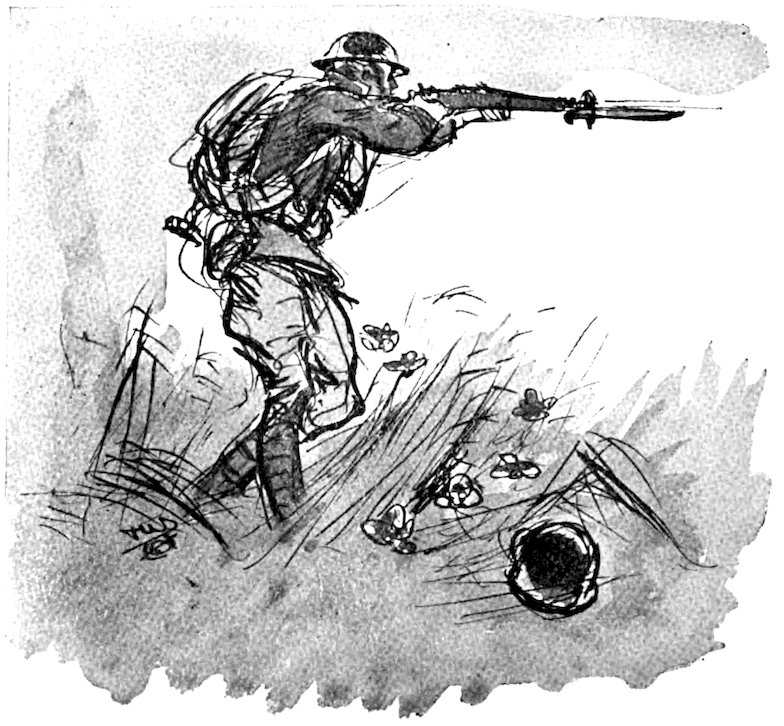
Some of them had been this way before.
One such group, over to the left, followed a big young officer, a replacement, too, but a man who had spent a week in Bouresches and was to be considered a veteran, as such things went in those days, when so many chaps were not with the brigade very long. He had not liked Bouresches, which he entered at night, and where he lived obscenely in cellars with the dead, and saw men die in the orange flash of minenwerfer shells, terribly and without the consolation of glory. Here, at last, was attack.... He thought, absently watching his flank to see that it guided true—guide centre was the word—of the old men who had brought him up to tales of Lee’s Army of Northern Virginia, in the War of the Southern Confederacy. Great battles, glamorous attacks, full of the color and the high-hearted élan of chivalry. Jackson 48at Chancellorsville; Pickett at Gettysburg—that was a charge for you—the red Southern battle-flags, leading like fierce bright-winged birds the locked ranks of fifteen gray brigades, and the screeching Rebel yell, and the field-music, fife and drum, rattling out “The Girl I Left Behind Me”:
“Oh, if ever I get through this war,
And the Lincoln boys don’t find me,
I’m goin’ to go right back again
To the girl I left behind me——”
No music here, no flags, no bright swords, no lines of battle charging with a yell. Combat groups of weary men, in drab and dirty uniforms, dressed approximately on a line, spaced “so that one shrapnel-burst cannot include more than one group,” laden like mules with gas-masks, bandoleers, grenades, chaut-chaut clips, trudging forward without haste and without excitement, they moved on an untidy wood where shells were breaking, a wood that did not answer back, or show an enemy. In its silence and anonymity it was far more sinister than any flag-crowned rampart, or stone walls topped with crashing volleys from honest old black-powder muskets—he considered these things and noted that the wood was very near, and that the German shells were passing high and breaking in the rear, where the support companies were waiting. His own artillery appeared to have lifted its range; you heard the shells farther in, in the depths of the wood.
49
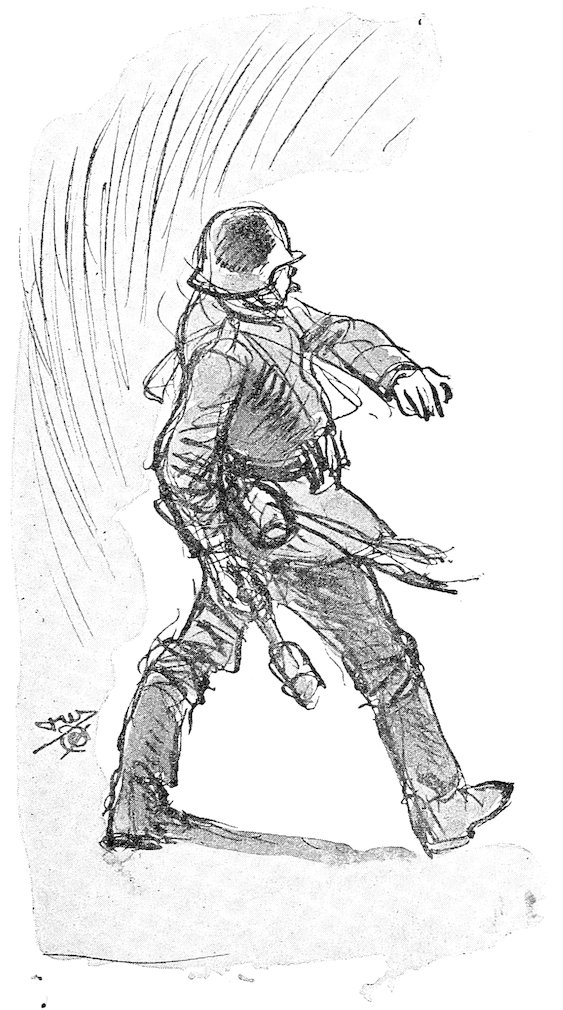
Boche grenadier.
51
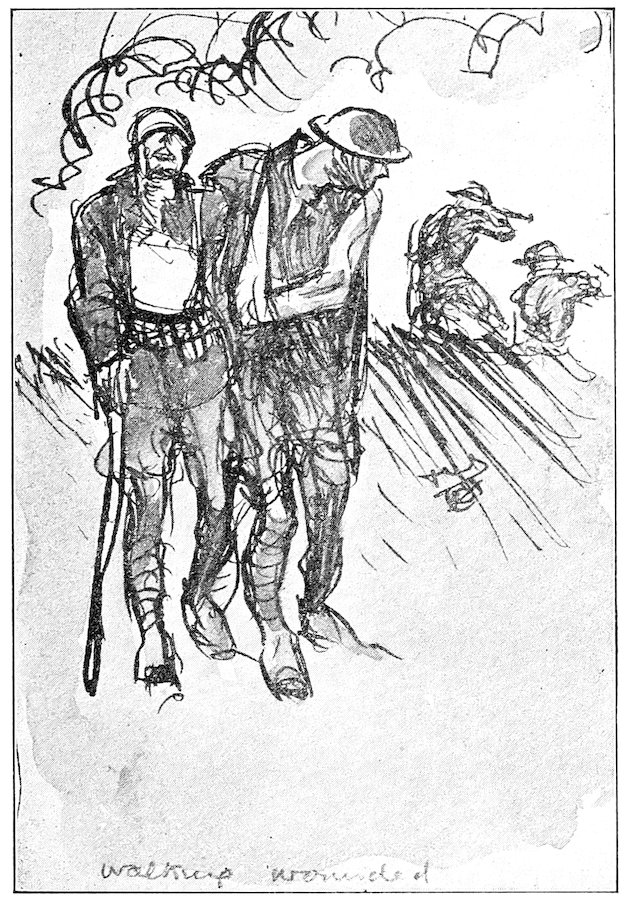
So many chaps were not with the brigade very long.
The air snapped and crackled all around. The sergeant beside the lieutenant stopped, looked at him with a frozen, foolish smile, and crumpled into a heap of old clothes. Something took the kneecap off the lieutenant’s right knee and his leg buckled under him. He noticed, as he fell sideways, that all his men were tumbling over like duck-pins; there was one fellow that spun around twice, and went over backward with his arms up. Then the wheat shut him in, and he heard cries and a moaning. He observed 52curiously that he was making some of the noise himself. How could anything hurt so? He sat up to look at his knee—it was bleeding like the deuce!—and as he felt for his first-aid packet, a bullet seared his shoulder, knocking him on his back again. For a while he lay quiet and listened to odd, thrashing noises around him, and off to the left a man began to call, very pitifully. At once he heard more machine-gun fire—he hadn’t seemed to hear it before—and now the bullets were striking the ground and ricocheting with peculiar whines in every direction. One ripped into the dirt by his cheek and filled his eyes and his mouth with dust. The lamentable crying stopped; most of the crawling, thrashing noises stopped. He himself was hit again and again, up and down his legs, and he lay very still.
Where he lay he could just see a tree-top—he was that near the wood. A few leaves clung to it; he tried to calculate, from the light on them, how low the sun was, and how long it would be until dark. Stretcher-bearers would be along at dark, surely. He heard voices, so close that he could distinguish words:
“Caput?”
“Nein—nicht alles—”
53
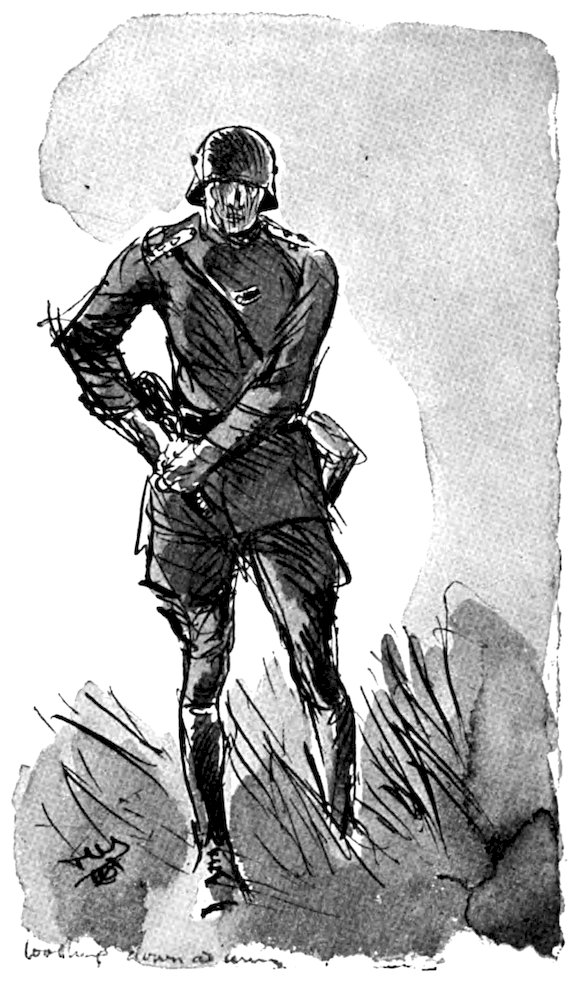
The Boche had out his pistol.
55Later, forgetting those voices, he tried to wriggle backward into a shell-hole that he remembered passing. He was hit again, but somehow he got into a little shell-hole, or got his body into it, head first. He reflected that he had bled so much that a head-downward position wouldn’t matter, and he didn’t want to be hit again. Men all dead, he supposed. He couldn’t hear any of them. He seemed to pass out, and then to have dreamy periods of consciousness. In one of these periods he saw the sky over him was dark, metallic blue; it would be nearly night. He heard somebody coming on heavy feet, and cunningly shut his eyes to a slit ... playing dead.... A German officer, a stiff, immaculate fellow, stood over him, looking at him. He lay very still, trying not to breathe. The Boche had out his pistol, a short-barrelled Luger, rested it on his left forearm, and fired deliberately. He felt the bullet range upward through the sole of his foot, and something excruciating happened in his ankle. Then one called, and the German passed from his field of vision, returning his pistol as he went....
Later, trying to piece things together, he was in an ambulance, being jolted most infernally. And later he asked a nurse by his bed: “I say, nurse, tell me—did we get the Bois de Belleau?”—“Why, last June!” she said. “It’s time you were coming out of it! This is August....”
56
IV COMING OUT
The battalion lay in unclean holes on the far face of Bois de Belleau, which was “now U. S. Marine Corps entirely.” The sun was low over Torcy, and all the battalion, except certain designated individuals, slept. The artillery, Boche and American, was engaged in counter-battery work, and the persecuted infantry enjoyed repose. The senior lieutenant of the 49th Company, bedded down under a big rock with his orderly, came up from infinite depths of slumber with his pistol out, all in one swift motion. You awoke like that in the Bois de Belleau.... Jennings, company runner, showed two buck-teeth at him and said: “Sir, the cap’n wants to see you——”
They crawled delicately away from the edge of the wood, to a trail that took you back under cover, and found the captain frying potatoes in bacon grease. “Going out to-night, by platoons. Start as soon as it’s dark, with the 17th. We are next. 6th Regiment outfit makin’ the relief—96th Company for us. They’ve been here before, so you needn’t leave anybody to show them the ground. Soon as they get to you, beat it. Got a sketch of the map? Have your platoon at Bois Gros-Jean—you know, beyond Brigade, on the big road—at daylight. Battalion has chow there.—Got it?—Good——”
The lieutenant went happily back to his men. The word had already gotten around, by the grape-vine route, and grinning heads stuck out of every hole. “Well, sergeant, pass the word 57to get set—goin’ out to-night—” “Yes, sir! Ready right now! Is the division bein’ relieved?”—“No, 6th Regiment comin’ in—” “Well, sir, I hope to God they ain’t late. Did you hear, sir, anything about us goin’ back to St. Denis, and gettin’ liberty in Paris, an’ a month’s rest—” That unaccountable delusion persisted in the Marine Brigade through all of June and into July. It never happened. “No, I didn’t hear any such thing. But it’s enough to get out of here. This place is like the wrath of God!”
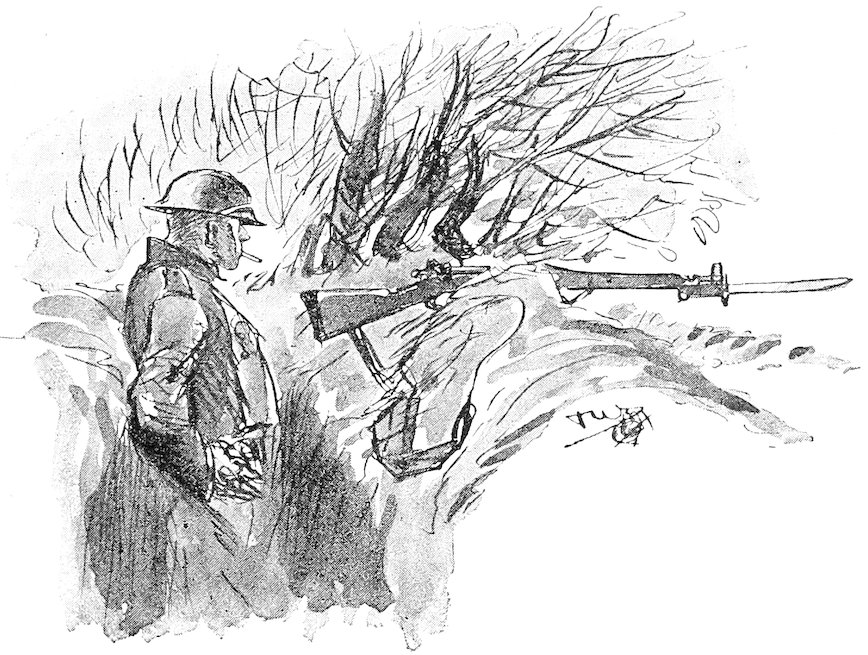
Certain designated individuals watched.
It was. To begin with, it had been a tangled, rocky wood of a few kilometres, the shooting-preserve of a French family in 58happier days. Even now you could see where a sort of hunting-lodge had been; they said some Marines had crawled in and bombed a Boche headquarters out of it. The first of June it was rather a pretty place, with great trees and flowery underbrush, all green and new in the full tide of spring. It was a place of no particular military importance other than local. But the chance of war made it a symbol. The German rolled down to it like a flood, driving before him forlorn fragments of wrecked French divisions, all the way from the Chemin des Dames. It was the spearhead of his last great thrust on Paris. The Americans of the 2d Division were new troops, untried in this war, regarded with uneasy hopefulness by the Allies. Their successes came when the Allies very greatly needed a success; for not since 1914 had the Boche appeared so terrible as in this, the spring of 1918. For a space the world watched the Bois de Belleau uneasily, and then with pride and an awakened hope. Men saw in it, foreshadowed, Soissons, and the 8th of August, that Ludendorf was to call “the black day of the war,” and an event in a car on a railroad siding, in the misty November forest of Senlis.
But the men who fought here saw none of these things. Good German troops, with every device of engineering skill, and all their cunning gained in war, poured into the wood. Battalions of Marines threw themselves against it. Day and night for nearly a month men fought in its corpse-choked thickets, killing with bayonet and bomb and machine-gun. It was gassed and shelled and shot into the semblance of nothing earthly. The great trees were all down; the leaves were blasted off, or hung sere and blackened. It was pockmarked with shell craters and 59shallow dugouts and hasty trenches. It was strewn with all the débris of war, Mauser rifles and Springfields, helmets, German and American, unexploded grenades, letters, knapsacks, packs, blankets, boots; a year later, it is said, they were still finding unburied dead in the depths of it. Finally it was taken, by inches.
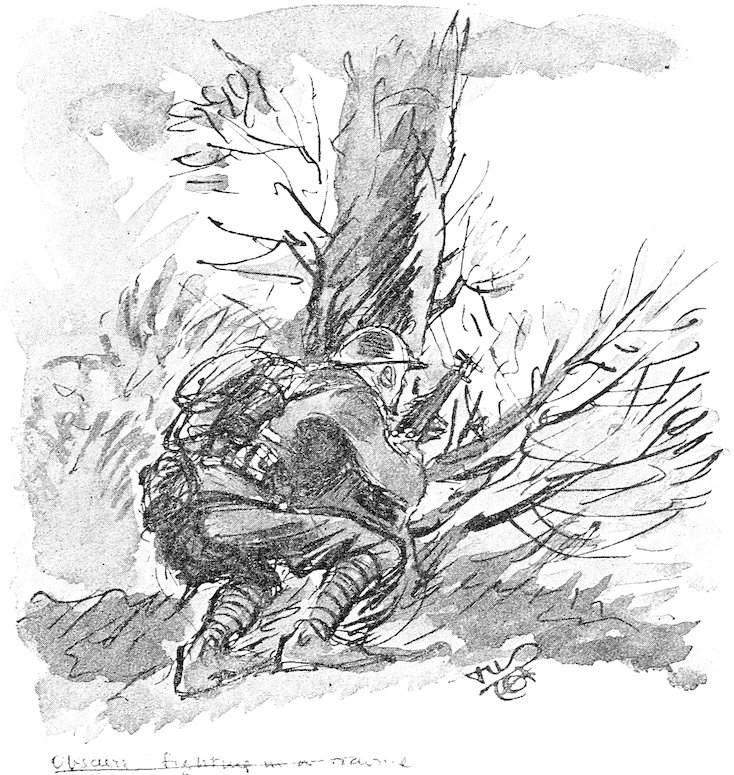
Men fought in its corpse-choked thickets....
60Now the battalion turned its backs to the tangle and watched with languid interest the shrapnel that one of the batteries of our 15th Field was showering on the ruined airdrome in front of Torcy. The white puff-balls were tinged pink by the setting sun, and jets of reddish dust went up from the ground under the bursts. A Boche battery was replying, and heavy shells rumbled far above, searching transport lines. Those nights, up in northern France, came late and went early. A man could sit on the edge of his hole, prairie-dog fashion, and write a letter at 10.30; it was not safe to move in the open until after 11.00; it was nearly midnight when the relieving troops came in. The lieutenant’s opposite number reported, chap he hadn’t seen since Quantico, back in another lifetime.—“Well, here we are! Out you go—” “I say, is it you, Bob? Heard you were killed—” “Oh, not at all—heard the same thing about you—not strange; lot of serious accidents have happened around here—” “Well, good luck—” “Sure—bon chance, eh?—so-long——”
61
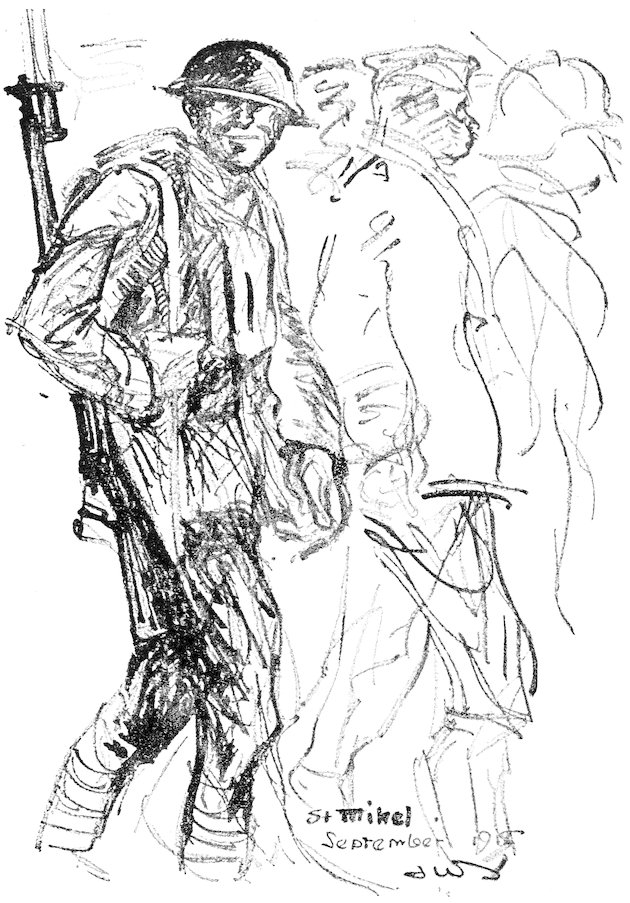
Bringing in German prisoners at St. Mihiel. Drawn on the field by Captain Thomason.
63
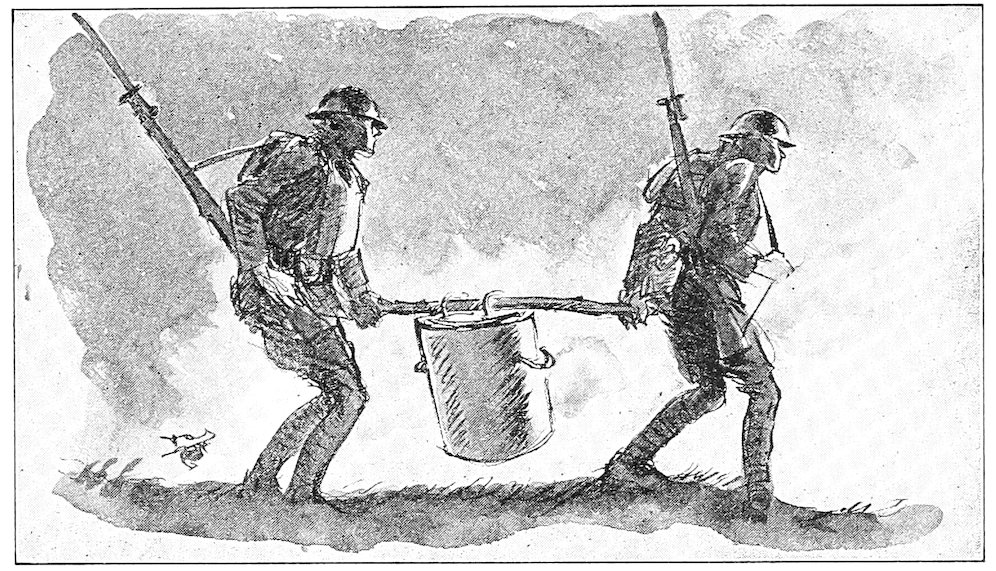
Ration parties ... always sweated mightily and anticipated exciting incidents....
The platoon left the wood and angled down to the Torcy road. A string of shells howled overhead, 88s by the sound of them, and broke on the road. The lieutenant halted and watched: “Dam’ unusual, shellin’ here this time of night—must know it’s a relief—” It was the conviction of all that the Boche knew everything, down to the movements of the lowest corporal.—“I think we’ll cut a corner, and take a chance of gettin’ through the line over yonder—” He led away from the road, through the trampled wheat to his right, away from the shelling. This was really No Man’s Land, for the line curved back from the wood, and thrust out again along the line of another crest, also wooded. Such intervals were watched by day and patrolled by night, and ration parties, carrying details, and other wretches who had to traverse them always sweated mightily and anticipated exciting incidents. It was full of smells and mysterious horrors in the starlight, that wheat. Once the platoon came upon a pig, feeding unspeakably.... The woods ahead grew plain; the men walked gingerly, straining their eyes at the shadows.... “Eighth machine-gun in there—take it easy, you—risky business, this—wish to God I’d—” The platoon stopped, frozen, as they heard the charging handle of a Hotchkiss snick back. A small, sharp voice barked: “Halt—who’ there?”—“Platoon of the 49th—can we get through here?” “My God, I dam’ near gave you a clip! What the hell, comin’ up here—don’t you know you ain’t supposed to come bustin’ around a machine-gun position 64you—” “All right—all right!—shellin’ the road down there”—and the platoon scuttled past the Hotchkiss gun, while its crew reviled them. Machine-gunners are a touchy lot, prone to shoot first and inquire afterward; the platoon gave thanks for a man who didn’t scare.
They turned left now, and went swiftly through the woods northwest of Lucy. They passed a place where the midnight harassing fire had caught a ration party; a shell had hit a pushcart loaded with loaves of the round French war bread which was the main item of the ration on this front; bread was scattered over an acre or so, and a frenzied sergeant was routing his ration party out of several holes and trying to collect it again. Otherwise, an outfit up in the Bois de Belleau wouldn’t eat for another twenty-four hours. The platoon was amused. They took the road to La Voie du Chatelle, stepping out. They’d be well behind the usual shelling, if the Boche was on schedule. Far enough back to talk now, and relax their hunched shoulders.
Down the road they heard a trampling, and the wind brought a smell of unwashed men. “Hi! Relief of Frogs comin’ in—!” “Yeh—Frogs. They smell like camels. We smell like goats.” “Hope this relief carries a bath wit’ it! Me, I’ve got blue mould all up my back.” “Well, next time we come in, we’ll put showers in that goddam place. Been there long enough to, already—” “How long we been there?—Le’s see—this is the 5th of July, ain’t it?—” “Je’s, I don’t keep count of no days! I can’t remember when we was anywhere else—” This was in a tone so mournful that the file’s neighbors laughed. “What you doin’ in this war, anyway? Dam’ replacement, jus’ joined up after Hill 65142—” “Man,” said the file very earnestly, “I’ll tell you. So help me Gawd, I wuz dodgin’ the draft!”
The French column came up and passed. Its horizon-blue uniform was invisible in the dark, but the stars glinted a little on its helmets and bayonets. “V’la! Yanquis! B’soir, Americains!” “Dam’ right, Frenchie! Bon chance, huh?” They went on without lagging, well closed up. A man’s feet dragged going in; there are no such things on a battle-field as fresh troops, for you always approach by forced marches, infinitely weary—“but comin’ out—boy, we make knots!—” They reached La Voie du Chatelle, where Regimental was, and there the old Boche always shelled. It was a little farm, pretty well knocked to pieces now, but Regimental was reported to prefer it to a change; they had the Boche’s system down so that they could count on him. His shelling always fell into method when he had long enough, and the superior man could, by watching him a few days, avoid unpleasantness. La Voie du Chatelle, as the world knew, received his attention from 11.45 to 12.10 every night. Then he laid off until 3, when his day-shift came on. You could set your watch by it. The platoon went cheerfully past.
A full kilometre farther they hiked, at a furious pace. Then the lieutenant considered that they might catch a rest; they had come a long way and were in a safe spot. Ten minutes’ rest out of every hour was the rule when possible. He passed the word: “Fall out to the right of the road,” and sat down himself, a little way off, feeling for his chewing-tobacco. You didn’t smoke on the front at night—lights were not safe. And chewin’ was next best. Then he observed that the platoon was not falling out. 66They stood in groups on the road, and an angry mutter reached him. “What th’ell?—Goin’ out, an’ then he wants to rest!” “Yeh, ‘fall out on the right of the road,’ he says, the goddam fool—” The lieutenant knew his men, as you know men you live in hell with. He got up, chuckling.—“Well, if that’s the way you feel about it—come on, you birds!” and he set them a killing step, at which no man complained.
The dawn was coming when they rendezvoused with the battalion in Bois Gros-Jean—beans for breakfast, and hot coffee, and tins of jam! That afternoon they had off their clothes for the first time in three weeks or so, and swam in the Marne at a place called Croutte. And at formation they heard this order published:
VI Armée
État-Major
6930/2
Au QGA le 30 Juin, 1918.
In view of the brilliant conduct of the 4th Brigade of the 2nd U. S. Division, which in a spirited fight took Bouresches and the important strong point of Bois de Belleau, stubbornly defended by a large enemy force, the General commanding the VIth Army orders that, henceforth, in all official papers, the Bois de Belleau shall be named “Bois de la Brigade de Marine.”
The General of Division Degoutte
Commanding VIth Army
(Signed) Degoutte.
“Yeh,” said the battalion. “Now, about this liberty in Paris—” But they didn’t go to Paris. They took a road that led through Soissons, and St. Mihiel, and Blanc Mont, and the Argonne-Meuse, to Nieuwied, on the far side of the Rhine.
67
SONGS ONE “BANG AWAY, LULU”
68The Marines have a very noble song: the Marine Corps Hymn. It is taught, along with close order drill and things like that, to recruits at Parris Island and on the West Coast. It begins:
“From the Halls of Montezuma
To the shores of Tripoli,
We have fought our country’s battles
On the land and on the sea....”
and it closes, gloriously:
“If the Army and the Navy
Ever look on heaven’s scenes,
They will find the streets are guarded
By United States Marines....”
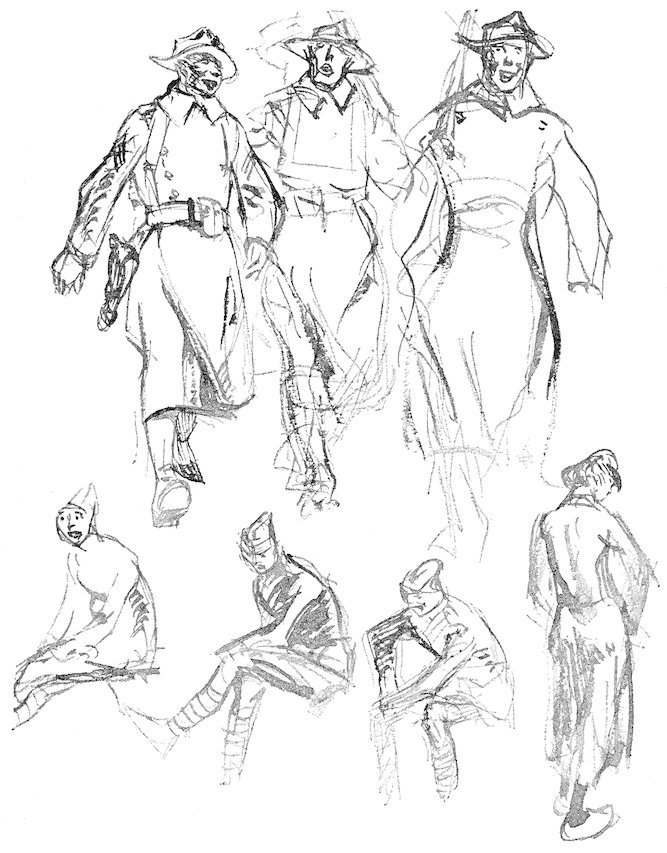
This platoon, however, led by a brazen-throated gunnery sergeant, is roaring out:
“Bang away, Lulu....”
69
71
II
72In the town of Villers-Nancy, where the battalion billeted, they published this order to the troops:
No. 862’3
Ordre Général No. 318
Xe Armée
État-Major
3e Bureau
AuQGA 30 July 18
Officers, Non-Commissioned Officers and Soldiers of the Third United States Army Corps:
Shoulder to shoulder with your French comrades you were thrown into the counter-offensive battle which commenced on the 18th of July. You rushed to the attack as to a festival. Your magnificent courage completely routed a surprised enemy and your indomitable tenacity checked the counter-attacks of his fresh divisions. You have shown yourselves worthy sons of your great country, and you were admired by your comrades-in-arms.
Ninety-one guns, 7,200 prisoners, immense booty, 10 kilomètres of country liberated; this is your portion of the spoil of this victory. Furthermore, you have demonstrated your superiority over the barbarian enemy of all mankind. To attack him is to vanquish him.
American comrades! I am grateful to you for the blood so generously spilled on the soil of my country. I am proud to have commanded you during such days, and to have fought with you for the deliverance of the world.
(Signed) Mangin.
73