Chapter IV · (continued 2)
Reading edition
A similar ring, with the hands joined, and inscribed Jesus Nazarenus, is represented in the ‘Gentleman’s Magazine’ (vol. liv. p. 734, and vol. lv. p. 333).

Inscription on a supposed religious ring, found at Carlisle.
The annexed engraving represents a ring found, about 1790, in Stretly Park, near Nottingham. The figure is that of St. Edith, and the ring probably belonged to the abbess of some religious house in the neighbourhood.
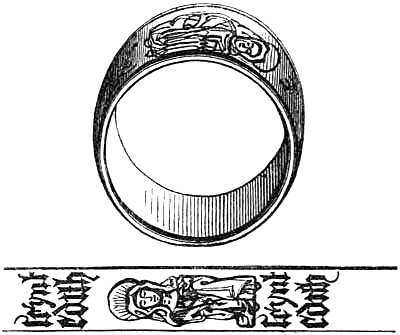
Religious ring.
The following illustration represents a ring discovered, in 1812, while harrowing near Froxfield, Hants; weight 4 dwt. 7 grs. It is supposed to have been worn by a warrior in the Crusades. The bezel part exhibits on the dexter side a knight with a shield, charged with a cross, thrusting a lance down the throat of a dragon—probably meant for St. George. The figure on the corresponding side varies in having a cross on the right side of his mantle, and appears to be in a boat, or wading through water; and it may be conjectured to be intended for St. Christopher.
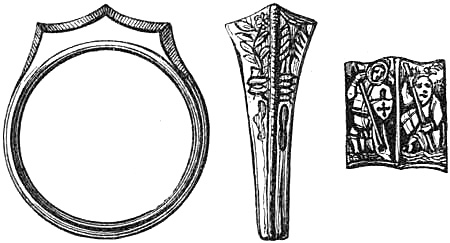
Religious ring.
Representation of a ring with a crowned I over a pillar, supposed to be the initial of our Saviour’s name as King of the Jews:
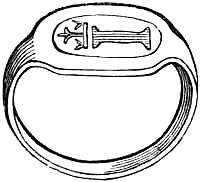
Religious ring.
Mr. Davis, of Hempton, Oxfordshire, possesses a brass ring found there, in the form of a strap and buckle, or of a garter, so contrived as to admit of being contracted or enlarged, to suit the wearer’s finger; the end of the strap being formed with little knobs, upon which the buckle catches, and keeps the ring adjusted to the proper size. The hoop is inscribed in relief, MATER DEI MEMENTO.
In the Waterton Collection is an ecclesiastical ring, silver-gilt, with circular bezel set with a cabochon crystal, the shoulders ornamented with cherubs’ heads in full relief, supported by brackets; on the reverse of the bezel is engraved the figure of Christ on the Cross; sixteenth century; diameter two and a half inches.
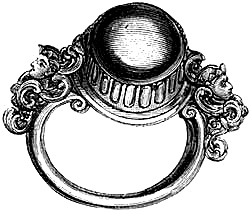
Ecclesiastical ring.
A singular silver ring, of which a representation is given in the ‘Archæological Journal’ (vol. iii. p. 78) was exhibited at a meeting of the Institute in 1846 by Mr. Talbot. The interlaced plated work resembles some ornaments of the Saxon period, but is remarkable for having the impress of two feet, which may, probably, be regarded as one of the emblems of the Passion, or as a memorial of the pilgrimage to the Mount of Olives, where the print of the feet of the Saviour which miraculously marked the scene of His Ascension, was visited by the pilgrims with the greatest veneration.

Pilgrim ring.
In the collection of Mr. Octavius Morgan, F.R.S., F.S.A., is a gold ring, probably one of those obtained at Jerusalem, as tokens of pilgrimage to the Holy City. On the head, which is circular, is engraved the Jerusalem Cross, and around the hoop the first words of Numbers vi. 24: ‘The Lord bless thee and keep thee,’ in Hebrew characters.
At a meeting of the Archæological Institute (Feb. 1855), Mr. Gough Nichols exhibited impressions from two signet-rings, also bearing as a device the ‘Jerusalem Cross,’ or cross potent between four crosslets, the insignia of the Kingdom of Jerusalem, worn likewise on the mantles of the Knights of the Holy Sepulchre. This device is regarded as emblematic of the five wounds of our Lord. On one of these rings, of gold, purchased at Brighton, the cross appears between two olive-branches, with the word ‘Jerusalem’ in Hebrew characters beneath; on the other the branches alone are introduced. The ring last mentioned, which is of silver, is in the possession of Mr. Thompson, of Leicester. These are supposed to be memorial rings brought as tokens of pilgrimage to the Holy City.
A gold ring of most beautiful workmanship was exhibited at the Lincoln meeting of the Archæological Institute, by the Rev. S. Blois Turner, bearing the device of the bear and bâton ragulé, with the motto inscribed above, ‘Soulement une’ (only one). Around the hoop are the words, ‘be goddis fayre foot’. This very singular legend has been supposed to have reference to the miraculous impress of the Saviour’s feet on the Mount of Olives, which was regarded by pilgrims with extreme reverence, and, like the five wounds, was probably used as a symbol of talismanic virtue. This ring, formerly in the possession of George IV., now belongs to General Johnson. Weight 230 grains.
In the Braybrooke Collection is a brass ring strongly gilt, with a long, oval, flat signet, engraved with Hebrew characters, ‘Pray for the peace of Jerusalem,’ from Psalm cxxii., supposed to be one of the rings given to tourists to the holy city, as a certificate of their visit, and called in the East ‘hadji’ or pilgrims’ rings.
In the same collection is a slight silver ring, with narrow and flat band to hoop, surmounted by a circular signet; on the hoop is this inscription, in relief, between lines raised along each edge, headed and ended by small flowers, ‘M S D MONSERRATA.’ On the signet, also in relief, appears a double-handled stone-mason’s saw (serra), the Latin for which furnished the key to this monkish riddle; it reads thus, ‘Mater Sancta de Monserrata,’ or Holy Mother of Monserrat, in Spain, where there was a chapel dedicated to the Virgin, and this is, probably, the ring of a pilgrim to that shrine.
At the meeting of the Archæological Institute at Norwich in 1847 some curious examples of religious rings (of silver) were exhibited, connected, most probably, with charms and superstitions. A ring dating about the period of Henry VI. is engraved with the figure of a female saint, and the symbols of the five wounds. Another, of the same age, found at Fransham, has the hoop swaged or twisted; on the angular facets had been engraved figures of saints. The engraving on another ring was ‘+Maria+Anna+Ih’us.’
Amongst the rich collection of rings lent by Mr. R. H. Soden Smith to the Loan Exhibition of Ancient and Modern Jewellery at the South Kensington Museum in 1872, were six rings, gold and silver, of the iconographic type, having for the most part figures of saints engraved on the bezel, one inscribed within, in Gothic letters, ‘yspartir+canc+dec+’ (partir sans désir).
In the ‘Journal of the Royal Institution of Cornwall’ (Sept. 1875) is a note on an ancient signet-ring found at Penryn by Mr. W. H. Tregelles: ‘This ring was found a few years since in a field near Budock church, by a watchmaker of the neighbourhood, of whom I bought it for Mr. Octavius Morgan, F.S.A., late M.P. for Monmouthshire. It has been the subject of much interesting discussion, the result of which, with a description of the ring, and three impressions in hard wax, I have deposited in the Museum of the Royal Institution of Cornwall, at Truro.
‘It is an oriental ring of silver, set with an oblong sard, engraved; it appears at one time to have been gilt, and the loop and back of the bezel were ornamented with a small pattern in niello, now almost obliterated by long wear.
‘In the middle of the device is a cartouche, or escutcheon, terminating at the top in a Greek cross potent. In the lower part of the escutcheon is engraved a paschal lamb, and in the upper part are some oriental characters, which have not been deciphered with certainty. On either side of the escutcheon is some ornamental scroll-work, having in the middle the Jerusalem cross potent.
‘It was submitted to Mr. Albert Way and Mr. C. W. King; and the latter gentleman, who took much pains to make out the inscription, considered that the characters were Servian, and that they represent the name of some ecclesiastic of the Greek Church to whom it once belonged.
‘It was evidently an ecclesiastical ring, and M. Castellane stated that he has seen several Armenian priests at Rome wearing similar rings. It may, perhaps, date from the early part of the last century.
‘The most probable conjecture as to the reason of such an object being found in Cornwall is that it may have been brought over by some traveller, and, having been lost by him or the person to whom he gave it, was mislaid among rubbish, and carted out with manure.’
In the first chapter of this work I have alluded to rings of the early Christians, a subject of great interest, to which I again refer in these notices of ‘religious’ rings, with additional illustrations from the ‘Archæological Journal.’
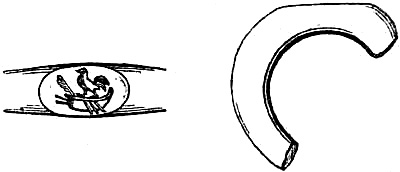
The following cut represents a portion of a ring of dark-green jasper, from Rome, dating, probably, from the second or third century. On the oval bezel a symbol is engraved in intaglio, viz. a boat, on which is a cock, carrying a branch of palm.
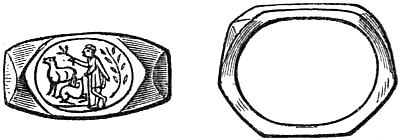
A bronze ring, probably Christian, of the third or fourth century, of an oval octagonal form, set with red jasper, engraved in intaglio with the subject of a shepherd. From Rome.
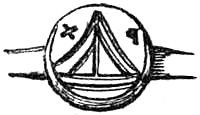
The ring here represented is of bronze, engraved with a ship, the emblem of the Church, between the letters chi and rho. This ring was obtained at Rome.
The accompanying illustrations are of small gold rings, in workmanship and form dating from the third or fourth century.
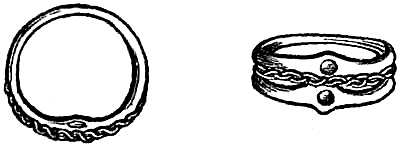
Annexed (probable date about 440) is a signet-ring, the subject incised upon the gold apparently a matrimonial or love-ring.
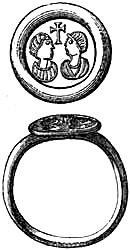
To the same period may be ascribed a bronze ring, of coarse workmanship, taken from the Roman catacombs. A circular hoop is surmounted by a flat circular bezel, on which is engraved an ear of corn between two fishes, emblem of the bread of life, and those who live in faith of it.
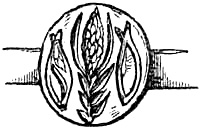
Another bronze ring is engraved with the sacred symbol, the united chi and rho between the alpha and omega above, and two sheep below. Probable date, the middle of the fourth century. Found at Rome.
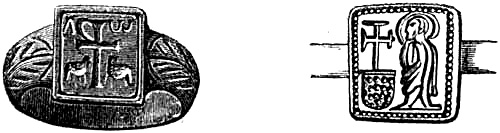
To the same class of rings belongs the last of the above engravings. It is of bronze, having a simple convex hoop; the device, a draped male figure with nimbus, and standing before a cross appearing to spring from a bunch of grapes. It was brought from Athens, and is probably Byzantine, of the sixth or seventh century.
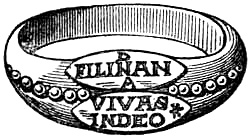
The following engraving represents a ring of duplex form, of solid gold, weighing 5½ dwts. It has engraved
D FILINAN A
and
Vivas in Deo*.
The ring probably dates from the latter part of the third, or beginning of the fourth, century. It was discovered in the neighbourhood of Masignano, a small township of Fermo.
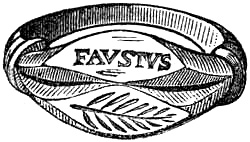
Early Christian rings of silver are unusual; that now represented is of duplex form. On one oval is engraved the name FAVSTVS, and on the other is a palm-branch. The date is, probably, of the latter half of the fourth century.
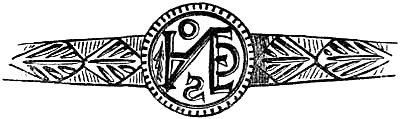
A bronze ring, intended for a signet. On the bezel is a monogram deeply cut in reverse, which has been rendered by Rossi, Deus dona vivas in Deo. From Rome, and of the fourth century.
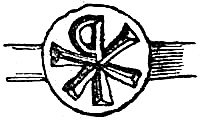
A bronze ring with circular hoop, the bezel engraved with the sacred monogram. This ring is said to have been found in the neighbourhood of the house of Pudens.
A bronze ring of coarse workmanship and angular form. The device, two doves and a fish.
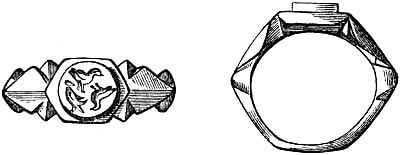
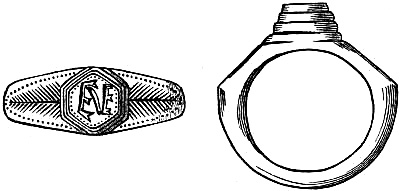
The shoulders of the following bronze ring are engraved as palm branches. The bezel is raised by four steps or tables, and engraved with a monogram. From Rome.
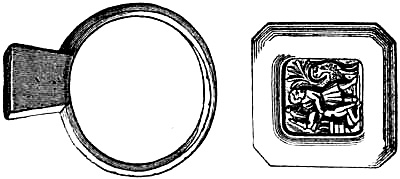
A bronze ring with high, projecting bezel. On the square face the subject of Abraham’s sacrifice is deeply engraved. The execution may be attributed, perhaps, to the latter end of the third century, but, more probably, to the fourth. Brought from Viterbo.
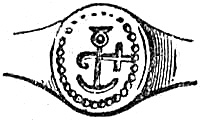
Bronze ring, formed as a circle of half-round metal, engraved with a double-fluked anchor, crossed by one of a single fluke, and surrounded by a pearl border. From the catacombs at Rome.
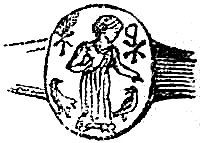
Bronze ring, with plain rounded hoop. Device, a draped female standing between two birds. On either side is the Christian monogram. Found, it is believed, in the catacombs of St. Calixtus; date, fourth century of our era.
An iron ring of octagonal form, the bezel engraved with two human figures and the sacred monogram. A human figure is represented on each face of the octagon. This is a remarkable ring of its class.
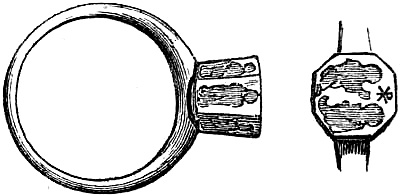
Bronze ring, with bezel shaped as the sole of a shoe, and incised with the legend IN DEO, in the collection of C. D. E. Fortnum, Esq., F.S.A.:
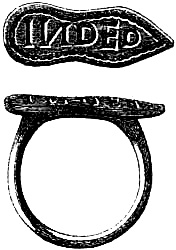
In Montfaucon’s ‘L’Antiquité Expliquée’ are several illustrations of Roman rings with the bezels representing a human foot. One seems to have been a Christian seal, the inscription on which, DEDONAO, is there, perhaps, put for DEI DONA. Montfaucon mentions one in his own cabinet, inscribed, between two crosses, DEI DONA.
A bronze stamp, formed as the sole of a shoe, is preserved in the Christian Museum of the Vatican. Inscription reversed, SPES IN DEO.

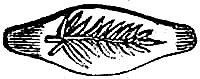
A child’s ring of gold. A simple hoop, flattened out on the bezel, which is engraved with the palm-branch. This ring was found in a child’s tomb in the neighbourhood of Rome.
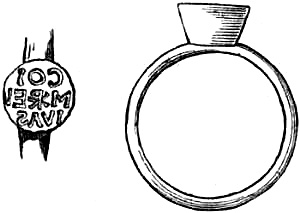
Bronze ring, the bezel engraved with the sacred monogram, round which is placed the inscription, COSME VIVAS. This was discovered in one of the catacombs on the Via Appia.
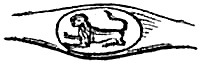
A small iron ring, on which is engraved the lion of St. Mark, dating, probably, from the sixth century. Found in a Coptic grave near the temple of ‘Medinet Aboo,’ at Thebes.
Mr. Hodder M. Westropp, in his ‘Handbook of Archæology,’ remarks that Christian inscriptions ‘are all funeral, and are, for the most part, found in the Catacombs, or subterranean cemeteries of the early Christians in Rome. They are characterised by symbols and formulæ, peculiar to the Christian creed; the idea of another life—a life beyond the grave—usually prevails in them. The symbols found in connection with the funeral inscriptions are of three kinds; the larger proportion of these refer to the profession of Christianity, its doctrines and its graces. A second class, of a partly secular description, only indicate the trades of the deceased, and the remainder represent proper names; thus a lion must be named as a proper name, Leo; Onager, an ass; a dragon, Dracontius. Of the first kind the most usually met with is the monogram of Christ. The other symbols generally in use are the ship, the emblem of the church; the fish, the emblem of Christ; the palm, the symbol of martyrdom; the anchor, representing hope in immortality; the dove, peace; the stag, reminding the faithful of the pious aspiration of the Psalmist; the horse was the emblem of strength in the faith; the hunted hare, of persecution; the peacock and the phœnix stood for signs of the resurrection; Christ, as the good pastor, and the Α-Ω of the Apocalypse, was also introduced in the epitaphs. Even personages of the pagan mythology were introduced, which the Christians employed in a concealed sense, as Orpheus, enchanting the wild beasts with the music of his lyre was the secret symbol of Christ, as the civilizer of men, leading all nations to the faith. Ulysses, fastened to the mast of his ship, was supposed to present some faint resemblance to the Crucifixion.’