Chapter II · (continued 2)
Reading edition
A curious passage occurs in a letter addressed by Lord Chancellor Hatton to Sir Thomas Smith, preserved among the Harleian MSS., relating to an epidemic then prevailing: ‘I am likewise bold to commend my humble duty to our dear mistress (Queen Elizabeth) by this letter and ring, which hath the virtue to expel infectious airs, and is (as it letteth me) to be worn between the sweet duggs, the chaste nest of pure constancy (!). I trust, sir, when the virtue is known it shall not be refused for the value.’
‘Medijcinable’ rings for the cure of the falling sickness and the cramp are mentioned in the Household Books of Henry IV. and Edward IV.; the metal they were composed of was what formed the King’s offering to the Cross on Good Friday, that day being appointed for the blessing of the rings.
The following entry occurs in the account of the seventh and eighth years of Henry IV. (1406). ‘In oblacionibus domini regis factis adorando crucem in capella infra manerium suum de Eltham, die parasceves, in precio trium nobilium auri, et v. solidorum sterlyng, xxv. s.’
‘In denariis solutis pro eisdem oblacionibus reassumptis, pro annulis medicinalibus inde faciendis, xxv. s.’
A ring considered to possess some healing or talismanic virtues was also termed, in mediæval Latin, vertuosus. Thus Thomas de Hoton, rector of Kyrkebymisperton, 1351, bequeathed to his chaplain ‘j. zonam de serico, j. bonam bursam, j. firmaculum, et j. anulum vertuosum. Item, domino Thome de Bouthum, j. par de bedes de corall, j. annulum vertuosum.’
Andrew Boorde, who lived in the reign of Henry VIII., alluding to the cramp-rings, says, in his ‘Introduction to Knowledge,’ the ‘Kynges of England doth halow every yere crampe rynges, ye whych rynges worn on one’s finger doth helpe them whych have the crampe.’ And, again, in his ‘Breviary of Health’ (1557), he writes: ‘The kynge’s majesty hath a great helpe in this matter in halowynge crampe rings, and so given without money or petition, ye which rynges worne on one’s finger doth helpe them,’ &c. This ceremonial was practised by previous sovereigns. Hospinian gives an account of the proceedings, and states that they took place on Good Friday, and originated from the famous ‘pilgrim’ ring of King Edward the Confessor. According to tradition the sapphire in the British crown came from this ring, the possession of which gave English sovereigns the power of procuring an efficacious blessing to the cramp-rings. Gardiner, in 1529, received a number of cramp-rings to distribute among the English embassage to the Pope, ‘the royal fingers pouring such virtue into the metal that no disorder could resist it.’[42]
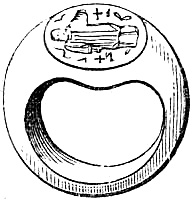
Silver Cramp-ring.
The superstitious belief in the efficacy of cramp-rings was by no means, as we have seen, confined to the ignorant and uneducated classes; even Lord Berners, ambassador to the Emperor Charles V., writing to ‘my Lord Chancellor’s Grace’ from Saragossa (June 30, 1518), says, ‘If your Grace remember me with some crampe-ryngs, ye shall doe a thing muche looked for, and I trust to bestowe theym well, with Goddes grace, who evermore preserve and increase your most reverent estate.’
The late Cardinal Wiseman (‘Notes and Queries,’ vol. vii., 1st series, p. 89) had in his possession a manuscript containing both the ceremony for the blessing of the cramp-rings, and that for the touching for the King’s evil. At the commencement of the manuscript are emblazoned the arms of Philip and Mary. The first ceremony is headed ‘Certain Prayers to be used by the Quene’s Heignes in the Consecration of the Crampe-rynges.’ Accompanying it is an illumination, representing the queen kneeling, with a dish containing the rings to be blessed on each side of her. The second Ceremony is entitled ‘The ceremonye for ye Heling of them that be diseased with the Kynge’s Evill.’ This manuscript was exhibited at a meeting of the Archæological Institute, June 6, 1851.
In Burnet (vol. ii. p. 266 of ‘Records’) there is the whole Latin formula of the consecration of the cramp-rings. It commences with the psalm ‘Deus misereatur nostri.’ Then follows a prayer invoking the aid of the Holy Spirit: the rings then lying in one basin or more, a prayer was said over them, from which we learn that the rings were made of metal, and were to expel all living venom of serpents. The rings were then blessed with an invocation to the God of Abraham, Isaac, and Jacob, and signed frequently with the cross. In the last benediction the prayer is made ‘that the rings may restore contracted nerves.’ A psalm of benediction follows, and a prayer against the frauds of devils. ‘The Queen’s Highness then rubbeth the rings between her hands, saying the prayer implying that as her hands rub the rings, the virtue of the holy oil wherewith she was anointed might be infused into their metal, and, by the grace of God, might be efficacious.’ The remainder of the curious ceremony concluded with holy water being poured into the basin with further prayers. This ceremonial was practised by previous sovereigns, and discontinued by Edward VI. Queen Mary intended to revive it, and, in all probability, did so, from the manuscript to which I have alluded as having belonged to the late Cardinal Wiseman.[43]
The annexed cut represents a cramp-ring of lead, simply cast in a mould, and sold cheap for the use of the commonalty. It belongs to the fourteenth century.
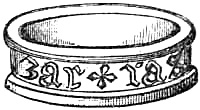
Lead Cramp-ring.
A curious remnant or corruption of the use of cramp-rings at the present time is noticed by Mr. Rokewode, who says that in Suffolk the use of cramp-rings as a preventive against fits is not entirely abandoned: ‘Instances occur where young men of a parish each subscribe a crooked sixpence to be moulded into a ring for a young woman afflicted with that malady.’
The use of galvanic rings for the cure of rheumatism belongs to our own time, and is by no means extinct; however, we have no right to class this practice among our superstitions. After all, faith works wonders!
Particular rings were worn on certain days from superstitious motives; thus in the inventory of Charles V., in 1379, a ring with a cameo representing a Christian subject is thus described:—‘annel des vendredis, lequel est néellé et y est la croix double noire de chacun costé, où il y a ung crucifix d’un camayeux, Saint Jean et Notre-Dame, et deux angeloz sur les bras de la croix, et le porte le roy continuellement les vendredis.’
Evil portents with regard to rings prevailed in the reign of Elizabeth. The queen’s coronation-ring, which she had worn constantly since her inauguration, having grown into her finger, necessitated the ring being filed off, and this was regarded as an unfavourable augury by many, who, doubtless, attributed any untoward event that occurred at this period to an omen. Few were more credulous in such matters than the strong-minded (in most respects) queen herself, who was a firm believer in the still popular superstition of ‘good luck.’
Long after this period, however, there were not wanting believers in the supernatural efficacy of charmed rings; there was even a charge against the Puritans of having contributed to foster the popular delusion. In the ‘Scourge,’ a series of weekly papers which appeared between 1717 and 1718, alluding to May 29, the writer says of the Roundheads: ‘Yet these priests of Baal had so poisoned the minds of the populace with such delusive enchantments that from rings, bodkins, and thimbles, like the Israelitish calf of gold, would start up a troop of horse to reinforce the saints.’
Even to a comparatively late period the belief in the Gnostic amulets was current in our own country. Immediately after the battle of Culloden the baggage of Prince Charles Edward fell into the hands of the Duke of Cumberland’s army, and many private and curious articles came into the possession of General Belford—amongst others a stone set in silver attached to a ring, which probably the superstitious Prince may have obtained on the Continent as a charm, and carried it as a protection in the hazardous enterprise in which he was engaged. It was a ruby blood-stone, having on one face the figure of Mars, with the inscription beside it, I A w. On the other face was a female naked figure, probably Isis, with the inscription, A T I T A.
The ancient superstition of securing the favour of the great by wearing certain precious stones appears in the East by the aid of a talismanic ring—simply, however, of silver, without the assistance of a jewel. In Herbelot’s ‘Customs of the Mussulmans of India’ a formula is given for the making of these rings: ‘Should anyone desire to make princes and grandees subject and obedient to his will he must have a silver ring made, with a small square tablet fixed on it, upon which is to be engraved the number that the letters composing the ism represent, which in this case is 2.613. This number by itself, or added to that of its two demons, 286 and 112, and its genius, 1,811—amounting in all to 4,822—must be formed into a magic square of the solacee or robace kind, and engraved. When the ring is thus finished, he is, for a week, to place it before him, and daily, in the morning and in the evening, to repeat the ism five thousand times, and blow on it. When the whole is concluded he is to wear the ring on the little finger of the right hand.’
The losing of a ring given as a pledge of affection was considered in former times, as it is not unfrequently now, to be an omen of mishap. The widow of Viscount Dundee, the famous Claverhouse, was met and wooed at Colzium House, in Stirlingshire, by William Livingstone (afterwards Viscount Kilsyth). As a pledge of his love he presented her with a ring, which she lost, next day, in the garden; and this giving rise to sad presentiments, a large reward was offered for its finding and restoration. Strange it may seem, but Lady Kilsyth was killed in Holland with her infant, by the fall of a house, and their bodies were brought to Scotland and interred at Kilsyth. In 1796 the tenant of the garden in which the ring was lost discovered it, when digging for potatoes, in a clod of earth. At first he regarded it as a bauble, but the moment the inscription became apparent the tradition came fresh to his recollection, and he found it was the identical ring of Lady Kilsyth. It was of gold and about the value of ten shillings; nearly the breadth of a straw, and without any stone. The external surface is ornamented with a wreath of myrtle, and on the internal surface is the legend: ‘Zovrs onlly & euver.’ This ring came into the possession of the Edmonstone family.
In Sir John Bramstone’s autobiography (1631) it is related that his stepmother dropped her wedding-ring off her finger into the sea, near the shore, when she pulled off her glove. She would not go home without the ring, ‘it being the most unfortunate that could befall anyone to lose the wedding ring.’ Happily for her comfort, the ring was found.
Rings bursting on the fingers, as an ill-omen, is thus alluded to in the Scotch ballad of ‘Lammilsin’:
···· The Lord sat in England A drinking the wine. I wish a may be weel Wi’ my lady at hame; For the rings of my fingers They’re now burst in twain.
In the ‘State Trials’ (vol. xiv., Case of Mary Norkott and John Okeman) is a curious instance of superstition connected with the marriage-ring. It was a case of murder, and the victim, at the touch of the person accused of the crime, ‘thrust out the ring or marriage-finger three times, and pulled it in again, and the finger dropped blood upon the grass.’ Sir Nicholas Hyde said to the witness: ‘Who saw this beside you?’ The answer was: ‘I cannot swear what others saw; but, my Lord, I do believe the whole company saw it, and if it had been thought a doubt, proof would have been made of it, and many would have attested with me.’
The breaking of a ring was of ominous import. Atkinson, in his ‘Memoirs of the Queen of Prussia,’ says: ‘The betrothal of the young couple (Frederic and Sophia Charlotte, first King and Queen of Prussia) speedily followed. I believe it was during the festivities attendant upon this occasion that a ring worn by Frederic, in memory of his deceased wife, with the device of clasped hands, and the motto “à jamais,” suddenly broke, which was looked upon as an omen that this union, likewise, was to be of short duration.’
The breaking of a wedding-ring is still regarded in some parts of England as an import that its wearer will soon be a widow. A correspondent of ‘Notes and Queries’ found this superstition current in Essex a few years ago. A man had been murdered in that county, and his widow said: ‘I thought I should soon lose him, for I broke my wedding-ring the other day, and my sister lost her husband after breaking her ring. It is a sure sign’!
It was an olden superstition that the bending of the leaves to the right or to the left of the orpine plants, or Mid-summer men, as they were called (Telephium), would never fail to tell whether a lover was true or false. In an old poem, the ‘Cottage Girl,’ we find:—
Oft on the shrub she casts her eye, That spoke her true love’s secret sigh; Or else, alas, too plainly told Her true love’s faithless heart was cold.
In 1801 a small gold ring was exhibited at the Society of Antiquaries (found in a ploughed field near Cawood, in Yorkshire) which had for a device two orpine plants joined by a true-love knot, with a motto above: ‘ma fiance velt,’ my sweetheart wills, or is desirous. The stalks of the plants were bent to each other, in token that the parties represented by them were to come together in marriage. The motto under the ring was: ‘Joye l’amour feu.’ From the form of the letters it appeared to have been a ring of the fifteenth century.
The ring conferring divination powers on the wedding-cake is thus alluded to in the ‘St. James’s Chronicle’ (1799):—
Enlivening source of Hymeneal mirth, All hail the blest receipt that gave thee birth! Though Flora culls the fairest of her bowers, And strews the path of Hymen with her flowers, Nor half the raptures give her scatter’d sweets, The Cake far kinder gratulation meets. The bridesmaid’s eyes with sparkling glances beam, She views the cake, and greets the promised dream; For, when endowed with necromantic spell, She knows what wondrous things the cake will tell. When from the altar comes the pensive bride, With downcast looks, her partner at her side, Soon from the ground these thoughtful looks arise To meet the cake that gayer thoughts supplies. With her own hands she charms each destined slice, And through the ring repeats the trebled thrice. The hallow’d ring, infusing magic power, Bids Hymen’s visions wait the midnight hour; The mystic treasure placed beneath her head Will tell the fair if haply she will wed. These mysteries portentous lie conceal’d Till Morpheus calls and bids them stand reveal’d; The future husband that night’s dream will bring, Whether a parson, soldier, beggar, king, As partner of her life the fair must take, Irrevocable doom of Bridal-cake.
Rowe, in his ‘Happy Village’ (1796), says ‘the wedding-cake now through the ring was led.’
The connection between the bride-cake and wedding-ring is strongly marked in the following custom, still retained in Yorkshire, where the former is cut into little square pieces, thrown over the bridegroom and bride’s head, and then put through the ring.
In the North slices of the bride-cake are put through the wedding-ring, and they are afterwards laid under the pillows at night to cause young persons to dream of their lovers. Douce’s manuscript notes say: ‘This is not peculiar to the north of England, but seems to prevail generally; the pieces of cake must be drawn nine times through the wedding-ring.’
In Brand’s ‘Popular Antiquities’ we read: ‘Many married women are so rigid, not to say superstitious, in their notions concerning their wedding-rings, that neither when they wash their hands, nor at any other time, will they take the ring off the finger; extending, it should seem, the expression of “till death do us part” even to this golden circlet, the token and pledge of matrimony.’ There is an old proverb on the subject of wedding-rings, which has, no doubt, been many a time quoted for the purpose of encouraging and hastening the consent of a diffident or timorous mistress:—
As your wedding-ring wears, Your cares will wear away.
A charm-divination on October 6, St. Faith’s day, is still in use in the north of England. A cake of flour, spring water, salt, and sugar, is made by three girls, each having an equal hand in the composition. It is then baked in a Dutch oven, silence being strictly preserved, and turned thrice by each person. When it is well baked it must be divided into three equal parts, and each girl must cut her share into nine pieces, drawing every piece through a wedding-ring which has been borrowed from a woman who has been married seven years. Each girl must eat her pieces of cake while she is undressing, and repeat the following verses:—
O good St. Faith, be kind to-night, And bring to me my heart’s delight; Let me my future husband view, And be my visions chaste and true.
All three must then get into one bed, with the ring suspended by a string to the head of the couch. They will then dream of their future husbands.
A very singular divination practised at the period of the harvest-moon is thus described in an old chap-book: ‘When you go to bed place under your pillow a Prayer-book open at the part of the Matrimonial Service, “With this ring I thee wed;” place on it a key, a ring, a flower, and a sprig of willow, a small heart-cake, a crust of bread, and the following cards: the ten of clubs, nine of hearts, ace of spades, and the ace of diamonds. Wrap all these in a thin handkerchief of gauze or muslin, and on getting into bed cross your hands and say:—
Luna, every woman’s friend, To me thy goodness condescend; Let me this night in visions see Emblems of my destiny.
If you dream of storms, trouble will betide you; if the storm ends in a fine calm, so will your fate; if of a ring, or the ace of diamonds, marriage; bread, an industrious life; cake, a prosperous life; flowers, joy; willow, treachery in love; spades, death; diamonds, money; clubs, a foreign land; hearts, base children; keys, that you will rise to great trust and power, and never know want; birds, that you will have many children; and geese, that you will marry more than once.’
There is an old superstition on the colours of stones in ‘keepsake’ rings:—
Oh, green is forsaken And yellow’s forsworn, But blue is the prettiest colour that’s worn.
A correspondent of ‘Notes and Queries’ observes that in the district about Burnley it is common to put the wedding-ring into the posset, and, after serving it out, the unmarried person whose cup contains the ring will be the first of the company to be married.
In Ireland it is a popular belief that finding the ring in a piece of Michaelmas pie would ensure the maiden possessor an early marriage.
The following notice of an advertisement is extracted from an Oxford paper of 1860, and republished in ‘Notes and Queries’ (3rd series, vol. x. p. 19): ‘Important Notice!—The largest cake ever made in Oxford, weighing upward of 1,000 pounds, and containing 30 gold wedding and other rings, in value from 7s. 6d. to Two Guineas each! To be seen for sale at No. 1 Queen Street, Oxford, from Thursday, December 27th, until Saturday, January 5th, 1861, when it will be cut out at the low price of 1s. 2d. per pound (this quality frequently sold for wedding-cake). Persons at a distance desirous of purchasing may rely upon prompt attention being given to their favours.
‘N.B.—J. Boffin will feel obliged if persons obtaining the gold rings will favour him with their names.’
A wide-spread superstition or fancy prevails with regard to the use of a gold ring at weddings. Mr. Wood, in his ‘Wedding Day in all Ages and Countries,’ observes ‘that the Irish peasantry have a general impression that a marriage without the use of a gold ring is not legal. At a town in the south-east of Ireland, a person kept a few gold wedding-rings for hire, and when parties who were too poor to purchase a ring of the necessary precious metal were about to be married, they obtained the loan of one, and paid a small fee for the same, the ring being returned to the owner immediately after the ceremony. In some places it is common for the same ring to be used for many marriages, which ring remains in the custody of the priest.’
Mr. Jeaffreson says: ‘I have known labourers of the eastern counties of England express their faith in the mystic efficacy of the golden arrabo in language that in the seventeenth century would have stirred Puritan auditors to denounce the Satanic bauble and its worshippers with godly fervour.’
Pegge, in his ‘Curialia,’ alludes to the superstition that a wedding-ring of gold rubbed on a stye upon the eyelid was a sovereign remedy, but it required to be rubbed nine times.
Mr. W. R. S. Ralston, in his ‘Songs of the Russians,’ mentions some curious superstitions in connexion with rings in that country.
A custom exists in Russia of catching rain that falls during a thunderstorm in a basin, at the bottom of which rain has been placed. In the Riazan Government, water that has been dropped through a wedding-ring is supposed to have certain merits as a lotion; and at a Little-Russian marriage the bride is bound to give the bridegroom to drink from a cup of wine in which a ring has been put. From the mention of a ring made in the ‘Dodola Songs,’ and in others referring to storm and rain, it is supposed that a golden ring, in mythical language, is to be taken as a representation of the lightning’s heavenly gold.
In the olden time the celestial divinities were supposed to be protectors and favourers of marriage, and the first nuptial crown was attributed to that heavenly framer of all manner of implements who forged the first plough for man. And so, in some of the songs, a prayer is offered up to a mysterious smith, beseeching him to construct a golden nuptial crown, and out of the fragments of it to make a wedding-ring, and a pin with which to fasten the bridal veil.
There comes a Smith from the Forge, Glory! The Smith carries three hammers, Glory! Smith, Smith, forge me a crown, Glory! Forge me a crown both golden and new, Glory! Forge from the remnants a golden ring, Glory! And from the chips a pin, Glory! In that crown will I be wedded, Glory! With that ring will I be betrothed, Glory! With that pin will I fasten the nuptial kerchief, Glory!
When a lover leaves his mistress for a time, he gives her a golden ring (pérsten’, a signet-ring, or one set with gems—from perst, a finger) and receives from her a gold ring in exchange (Kol’ tsë, a plain circlet like our own wedding-ring, from Kolo, a circle).
It is not a falcon flying across the sky, It is not a falcon scattering blue feathers, But a brave youth galloping along the road, Forth from his bright eyes pouring bitter tears. He has parted from his own, The Lower River track, through which, In all her beauty, Mother Volga flows. He has parted from the maiden fair, And with her as a token left A costly diamond ring; And from her has he taken in exchange A plighting ring of gold. And while exchanging gifts thus has he spoken: ‘Forget me not, my dear one, Forget me not, my loved companion. Often, often gaze upon my ring; Often, often will I kiss thy circlet, Pressing it to my beating heart, Remembering thee, my own. If ever I think of another love, The golden circlet will unclasp; Shouldst thou to another suitor yield, From the ring the diamond will fall.’