Front matter (continued 3)
Reading edition
"Well, it seemed all right. Wasn't a bad road for a bit, and I put on speed to make up for lost time. Then, just as I was going through an avenue of trees, and what with the mist and the shade couldn't see more than a few yards ahead, the road took a sharp dip, and I throttled down and screwed on the brakes; but the road made a sudden bend, and before I knew where I was, I was chucked in the ditch by the roadside. I was dazed for a bit, and when I come to, there was the lorry in the field. I crawled to it; it was stuck fast, and even it if hadn't been I couldn't have driven it in the mashed state I was in. A pretty fix to be in, in a strange country, with no garage handy. I didn't know what to do. When I'd recovered a bit, I crawled back to see if I could find that parson. It was all his fault, not warning me, and he ought to get me out of the mess. But I couldn't find him, so all I could do was to crawl to the main road, on the chance of seeing some of our chaps. It was hours before any one came along; just my luck; another time the road would very likely have been crowded. But presently that cyclist came up at forty miles an hour. He would have gone past if I hadn't bellowed like a bull. He wouldn't get off his machine to take a look at the lorry, but he said he'd send help if he could. And all I want is to get hold of that parson; I'd know him again in a minute by his size and the wart on his nose. Why, a German couldn't have served me a dirtier trick; and he said he knew the road.... There's the lorry; I doubt whether you'll get it up; and the Wessexes howling for their grub, I expect."
The lorry was tilted over to one side, with the near front wheel embedded nearly up to the axle in the soft earth of the field.
"Got a jack?" asked Ginger.
"You'll find it under the seat."
Ginger fetched it, and with his companions tried to jack the wheel up; but the tool sank into the earth.
"Let's unload and then see," suggested Kenneth.
It took them half an hour to unload the car, working so hard that they were all bathed in perspiration. Again they plied the jack, but in vain.
"The only chance is to get something solid to put under it," said Ginger. "There's nothing handy hereabouts. Any houses about here?" he asked the driver.
"Hanged if I know. It was too misty to see when I came along. The parson lives somewhere, I suppose."
"I'll run up the hill and take a look round," said Harry.
"Take your rifle, man," Kenneth called, as Harry was starting without it.
"All right; but we're miles away from the German front. You might have a look at the engine while I'm gone."
All this time there had been sounds of firing in the distance eastward, with reports of British guns at intervals nearer at hand. But they were now so familiar with such sounds that they scarcely heeded them. Guns and gunners were alike out of sight. There were few signs of war immediately around them; but for the absence of human activity on the fields the country might have been at peace.
Harry went up the hill and for some distance along the road before he discovered anything that promised assistance. A slight breeze was dispersing the mist; but the sun was already far down in the western sky; in an hour or two it would be dark. At length, on his right he noticed a rough cart track leading to a small farm building half hidden in a hollow about half a mile away. He hurried towards it across the fields, soon regretting that he had not gone by the beaten track, for the soil was soft and heavy.
Approaching the building at an angle, he saw a man pottering about in the yard. While he was still at some distance the man happened to glance towards him, then went into the house. Harry quickened his pace, and entering the yard, was met at the house door by a burly individual who gave a somewhat surly response to his salutation. In his best French Harry explained the circumstances, and asked for the loan of a stout board.
"You'll find one in the shed yonder," said the man. "You'll bring it back?"
"Oh yes," Harry replied, thinking that the farmer might at least have offered to help. "By the way, could you lend us a horse to pull the lorry on to the roadway when we get it up?"
"I haven't got one; all my horses are requisitioned."
"That's hard luck. I hope we'll soon clear the country, and there'll be better times. Many thanks: I'll return the board presently."
Reflecting on the hardships war inflicted on honest country people, Harry trudged back with the plank, this time taking the cart track.
"Good man!" said Kenneth. "Where did you get it?"
"At a small farm. The farmer's rather a bear, but I suppose the war has pretty well ruined him. Now, Ginger, let's see what we can do."
Placing the plank by the embedded wheel, they set the jack on it and screwed up the axle until they finally succeeded in releasing the wheel.
"The lorry isn't damaged, luckily," said Kenneth. "We'll get the wheel on to the plank, then I'll start the engine and we'll back on to the road. You fellows shove."
In a few more minutes the lorry stood on the road, facing towards its original destination.
"Now for loading up," said Harry. "This is back-aching work; I shouldn't care to be a docker."
The three men started to carry the boxes and baskets from the field to the lorry, the driver sitting on the grass by the roadside. They were about halfway through the work when they heard the hum of an aeroplane. Like the reports of artillery it was so common a sound that they paid little attention to it. But Kenneth, glancing up as the sound grew louder, exclaimed:
"It's a Taube, about 5000 feet up. I fancy. There'll be a pretty chase presently. By Jove! it's dropping. Something must have gone wrong with the engine. I'll try a pot shot at it if you fellows will go on loading."
Seizing his rifle, he stood watching the aeroplane as it circled above them, gradually coming lower.
"Look out!" he cried suddenly.
Almost as soon as he had spoken there was a terrific crash on the road about thirty yards away, and a shower of earth and stones bespattered the lorry and the men. Kenneth fired as the Taube made another sweep round, still lower.
"Here's another!" he called. "Down with you."
They all threw themselves flat on their faces. The second bomb exploded farther away than the first, doing no damage. They sprang to their feet, and all three fired at the aeroplane, which was now making a vol plané, and would come to earth apparently about half a mile away.
"We'll nab them," cried Ginger. "Come on."
They ran up the hill. The aeroplane was descending on the far side of the farm, near a clump of trees. They rushed across the fields, and were just in time to see a man leap from the aeroplane and dive into the copse. The farmer joined them as they ran past. They came to the aeroplane. The pilot was in extremis. After the shot had struck him he had managed to control the machine until it reached earth; he would never fly again.
"We must catch the other fellow," said Kenneth.
All three ran into the copse, the farmer following them. Separating, they scoured the plantation in all directions without finding the fugitive. After about half an hour Kenneth called the others together.
"He seems to have got away," he said. "We must give it up. It'll soon be dark, and we've got to get the lorry home. Ginger, will you mount guard over the aeroplane? Our fellows are sure to have seen it, and will no doubt be coming up shortly. We'll motor back if we can borrow a car."
"Right you are," said Ginger. "I'll wait for you, in any case."
The others left him, returned to the lorry, and lifting the driver on to it, drove off rapidly towards its destination. There they told their story, and the colonel at once sent off a motor omnibus with a number of men to secure the aeroplane. When they approached the spot where they had left it the machine was gone.
"Somebody must have fetched it already," said Kenneth. "It's a pity you fellows are too late."
They drew up at the rear of the farm. Kenneth and Harry sprang out, surprised that Ginger was not awaiting them.
"He's inside, perhaps," said Harry. "He makes friends of most people; perhaps he has got over the farmer's surliness."
They went through the yard to the house door. The farmer met them on the threshold.
"Ah, messieurs," he said, "this is lamentable."
"What do you mean?" asked Harry.
"Your comrade, messieurs, he is gone. I fear he is a prisoner. He made signs that he was thirsty, and I left him there at the aeroplane while I returned here to fetch him some little refreshment. Ma foi! I was just uncorking the bottle when I heard a whirr. I rushed out with the bottle in one hand and the corkscrew in the other, and voila! there was the aeroplane already in the air."
"But how?--what..."
"I do not know," said the farmer, with a shrug. "I only guess. The man who ran away must have hidden until your backs were turned, then come back and overpowered your comrade and flown away with him."
"That's very rummy," said Kenneth to Harry. "Ginger isn't a man to be caught napping easily. What do you make of it, sir?" he asked the lieutenant in charge of the omnibus party, who had followed them.
Kenneth repeated the farmer's story.
"Very curious," said the officer quietly. "The man wasn't himself a flier, I suppose?"
"No."
"Well, I think we'll run your farmer back to headquarters. It looks rather fishy: there are spies all over the place. You speak French? I don't, more's the pity. Just tell this fellow he's to come with me."
The farmer protested volubly, but the officer was inexorable. The omnibus party returned with their prisoner, and Kenneth and Harry tramped back in the twilight to their village.
CHAPTER XII
DOGGED
There was great indignation among the men of No. 3 Company when Ginger's capture was reported. Latterly the German airmen had rarely appeared behind the British lines; their experiences had usually been unfortunate. "Like their cheek!" grumbled one of the men. "And to carry off Ginger, too, after a lucky shot had brought 'em down. That farmer chap must have been a spy, and I hope they'll give him what he deserves over yonder."
The loss of the most popular man in the battalion was a blow to the Rutlands. And to be a prisoner they counted the worst of luck. Death they were ready for; to be wounded was all in the day's work; there was not a man of them but preferred death or wounds to captivity, to be the mock and sport of a misguided populace, and the victim of brutal and barbarous guards.
"And we can't do nothing," growled a sergeant. "Lor bless you, when I think of the stories I read as a nipper in the boys' papers, daring rescues, hairbreadth escapes and all that--what a peck of rubbish I used to swallow! And believe it all too, mind you. It all looked so easy. There was the prison, and the jailer's pretty daughter, perhaps a file to cut away the bars, or a knife to dig a tunnel underground, or a note carried to a wonderful clever pal outside, or the prisoner dressing up in the gal's clothes: gummy, how excited I used to get. Them chaps that write the blood-curdlers don't know nothing about the real thing, that's certain."
Kenneth laughed.
"The real thing tops anything ever invented, after all," he said. "You've heard of how Latude escaped from the Bastille; and how Lord Nithsdale escaped from the Tower; and how an English prisoner--I forget his name--a hundred years ago made a most wonderful escape from the French fortress of St. Malo; and only the other day, a German prisoner in Dorchester had himself screwed into a box and nearly got away."
"Nearly ain't quite, though. But I never heard of those other Johnnies; you might tell us about them--if they're true, that is; I don't want no fairy tales."
And Kenneth beguiled an evening or two by relating all the historical escapes he could remember.
Ginger's case, they agreed, was hopeless. The papers, it was true, had recorded the escape of Major Vandeleur from Crefeld, without giving any of the particulars which the men were hungry for. That a British lance-corporal could ever escape from a German concentration camp was beyond the bounds of possibility, and they had to resign themselves to the hope of one day, when the war was over, seeing Ginger again, perhaps half-starved, ill, wretched, a speaking monument of German "culture."
The Rutlands were sent into the trenches again, where they again endured the tedium of watchful inactivity.
One evening, Captain Adams sent Kenneth to the village with a message. The telephone between the village and the trenches had suddenly failed. Kenneth found the place busier than he had ever known it. A new regiment had arrived. Officers of all ranks were present; despatch riders were coming in. He was asked to wait for a return message to the firing line. While waiting he became aware of a considerable movement some distance in the rear of the British lines. There were sounds of heavy vehicles in motion in several directions. Something was clearly in the air.
It was about three hours before he was sent for and received a written message from a staff-officer.
"What's your name?" he was asked.
"Amory, sir."
"Oh! You had a hand in destroying that German gun the other day?"
"Yes, sir," replied Kenneth, rather taken aback to find that his name had become known.
"A capital bit of work! Get on with this despatch as quickly as you can. It's important. And if you have heard anything out there"--he pointed to the rear--"you needn't say anything about it. There are spies everywhere. The telephone wire has been repaired, by the way; it was cut near the village; but we've a reason for not using it just at present. Tell Colonel Appleton that, will you?"
The night was very dark, but by this time Kenneth knew every inch of the road to the trenches. There was desultory firing, both artillery and rifle, for a considerable distance along the lines ahead. As he left the village the sounds from the rear grew fainter, drowned by the firing and by a moderate wind blowing from the direction of the enemy's lines.
The road was quite deserted. All coming and going between the trenches and the billets had ceased for the night. But when he had walked for about a quarter of a mile he was conscious of that strange, often unaccountable feeling that sometimes steals upon a solitary pedestrian on a lonely road at night--the feeling that he was not alone. He had heard neither footfall nor whisper; the wind sighed through the still almost bare branches of the trees. His feeling, he thought, was probably due to mere nervousness caused by the knowledge that he was carrying an important despatch. But it became so strong that he sat down by the roadside and slipped off his boots, slinging them round his neck, and walked on heedfully in his stockings, keeping a look-out for holes in the road, and stretching his ears for the slightest unusual sound.
In a moment or two he came to the end of the avenue of poplars; those which had formerly lined the rest of the road had been felled, partly to provide wood for the trenches, partly for the sake of the gunners. On the left, a few yards from the road, was a small plantation. It had been sadly damaged by German shells, but many trees still remained. Just as he came opposite to the plantation his ears caught a sound which, though indistinguishable in the wind, was different from the rustling of branches or foliage. It appeared to come from behind him. He slipped from the road towards the clump of trees; then, as it suddenly occurred to him that some other person might be making for the same place, he reached for a branch just above his head, and swung himself up with the "upstart" of the gymnasium. It was a frail support, but he sat astride the branch near the trunk, and there, among the burgeoning twigs, he waited.
His senses had not deceived him. Three vague shapes moved out of the blackness, and passed almost beneath him. His ears scarcely caught the sound of their movements; yet sound there was, a dull muffled tread as though their feet were blanketed. Who were these nocturnal prowlers? What were they about? Kenneth wished there were no despatch buttoned up in his pocket, so that he were free to follow these stealthy figures. He had not been able to determine whether they wore uniforms. If they were villagers, they had no right to be hereabouts at night.
Peering through the foliage, he was just able to discern that the three men had halted at the edge of the plantation. For a moment or two there was complete silence. He guessed they had stopped to listen. Then they spoke in whispers. A few words were carried on the wind to Kenneth's attentive ears: "Soeben gehört ... ganz nahe ... ja."
"They're after me!" thought Kenneth. He had no doubt that it was he whom they had referred to as "just heard ... quite near." Spies were everywhere, as the staff-officer had said. These men must have learnt in the village that he was carrying a despatch. He wished that he could stalk the stalkers, but he dared do nothing that would endanger his errand. One man he might have tackled; with three the odds were too heavy against him. And while he was still debating the matter with himself the three dark shapes had disappeared as silently as they had come.
He waited a minute or two. They had apparently gone along the road which he himself was to follow. They might suspect that they had outstripped him, and ambush him before he reached the trenches. He must dodge them by making a detour. Dropping lightly to the ground he skirted the northern side of the plantation and struck across the ploughed land at what seemed a safe distance from the road. The soil was sticky; his progress was slow; and he stopped every now and again to listen. For some time he heard nothing but the wind and the crack of distant rifles or the boom of guns. Presently, as he drew nearer to the trenches, there fell faintly on his ear the customary sounds of conversation, laughter, singing. At one moment he believed he heard the tootle of Stoneway's flute. As these sounds increased in loudness, he despaired of recognising the stealthy movements of the spies. He unslung his rifle, resolving, if he caught sight of them, to fire. The shot, even if it failed to dispose of any of them, would probably bring men from the trenches in sufficient numbers to deal with them.
He had to guess his course across the fields, pushing here through a hedge, there descending into a slimy ditch and crawling up the further side. At last he caught sight of a landmark: a ruined shed which stood about two hundred yards in rear of the trenches. To reach the trench in which Colonel Appleton had his quarters he must strike across to the right, and pass between the shed and the road.
There was no sign of the three spies. The fields were quite bare; the shed was the only thing that afforded cover. Instinctively he gave it a wide berth, and was leaving it some paces on his left when he heard a sudden guttural exclamation, and two figures rushed from the shed towards him. There was no time to fire. Uttering a shout he thrust his bayonet towards the assailants. The stock of his rifle was seized from behind. And now, at this critical moment, the years of training on the football field, in the gymnasium, on Mr. Kishimaru's practice lawn, bore fruit in instantaneous decision and rapid action. Releasing his rifle suddenly, the man behind him fell backward to the ground. At the same moment Kenneth stooped, tackled the nearest of the other men, and brought him down. The second man toppled over them. Freeing himself instantly, Kenneth sprang up and sprinted towards the road, hearing in a moment the thud of heavy footsteps behind him.
But there were sounds also in front. His shout had been heard in the trenches, and some of the Rutlands were running to meet him. A word from him sent them at a rush towards the shed. Leaving them to hunt for the spies, he hurried on and delivered his despatch to the colonel, to whom he related his adventure.
It was some time before the men returned.
"They got away," said one of them. "It was no good hunting any longer in the dark. But we've brought these."
He handed over Kenneth's rifle and a cap bearing the badge of a Territorial regiment. It was clear that the spies had disguised themselves in British uniforms. The colonel telephoned particulars to the village, asking that a thorough search should be made; but other matters were then engaging attention.
CHAPTER XIII
THE FIGHT FOR THE VILLAGE
In the darkest hours before the dawn the trenches were buzzing with excitement. Word had been passed along that next morning the Rutlands were to attack. The long, trying period of inaction was over. Sir John French had ordered the capture of the village within the German lines. The hill on which it stood commanded a wide stretch of open country, and its possession was an essential preliminary to the general advance which would take place when the weather improved and the reserves of ammunition were completed.
During these last hours of the night sleepy men trudged along the road and across the sodden fields towards the firing line. Fresh troops, some of whom had never been under continuous fire, crowded into the trenches. Some of the men tried to prepare breakfast in the constricted space; the most of them were too much excited to feel any inclination to eat. The bustle which Kenneth had noticed in the village was explained. Batteries of heavy artillery had been brought up and placed all along the rear of the British lines. The men listened eagerly for the boom that would announce the great doings of the day, and they gazed up into the inky sky, longing for the dawn.
Sitting, sprawling, packed tight in the trenches, they waited. Would morning never come? The darkness thinned; the blackness gradually was transformed into ashen grey, streaked here and there with silvery light. A gun boomed miles in the rear. The men stifled a cheer. Rifle fire burst from the German trenches. Bullets pinged across the breastworks, and some of the newcomers involuntarily ducked. Captain Adams passed along the simple orders of the day. "The battalion will advance in line of platoons at 7 o'clock." Another hour to wait!
The men took off their equipment and stowed their coats in their packs. Some munched sticks of chocolate, others lighted cigarettes but forgot to smoke them. Boom, boom! The British guns were in full play. The German guns were answering. Shells screamed across the trenches in both directions. The din increased moment by moment. The air quivered with the thunderous crashes, and sang with the perpetual phwit, phwit of bullets. Not a man dared to lift his head. Clouds of earth rose into the air before and behind, showering pellets upon the waiting soldiers.
Boom and roar and crash! Presently the stream of shells from the Germans diminished. It almost ceased.
"Platoons, get ready!"
"Fix bayonets!"
The men began to swarm up the parapet. There was no enemy to be seen. The wire stretched across their front had been battered down in many places.
All at once there was a great stillness. The artillery had finished its work.
"Now, men!" shouted Kennedy, commander of the leading platoon.
With a cheer the men rushed forward, Kenneth on the right, Harry on the left. On either side other regiments had already deployed and were advancing. They came to the first of the German trenches--empty, except for prone and huddled forms in grey, and a litter of rifles, helmets, water-bottles, mess-tins, equipment of all kinds. Kenneth sprang into the communication trench beside the pond, and splashed through the water at the bottom, the rest of the platoon after him. Where were the Germans?
They came to the second line of trenches, floundered through what seemed an endless series of mysterious zigzag passages, waded through two or three feet of greenish water, scrambled up the embankment beyond, and raced across the open field, as fast as men could race with packs on their backs, full haversacks, and rifle and bayonet, over ground pitted with holes, heaped with earth and stones, scattered with the bodies of men, strands of barbed wire, fragments of shells and all the dreadful apparatus of warfare. Still there were no Germans to be seen, but bullets spat and sang among the advancing men; here a man fell with a groan, there one tumbled upon his face without even a murmur, scarcely noticed by his comrades pressing on and on with shouts and cheers.
Kennedy's platoon reached the ruined church which Kenneth and Harry had passed on their memorable night expedition. With shaking limbs and panting lungs they flung themselves down behind the wall of the churchyard for a brief rest. The next rush towards the village would be across two hundred and fifty yards of open ground, bare of cover until they came to the gardens at the back of the cottages.
The modern battle makes greater demands on individual effort and resource than the old-time battles on less extensive fields, where all the operations were conducted under the eye of the commander-in-chief. Kennedy's men knew nothing of what was going on on their left and right. They heard the insistent crackle of rifles, the rapid clack-clack of machine guns, the whistling of shrapnel. They saw the white and yellow puffs, with now and then a burst of inky blackness, in the sky. Boom and crash, rattle and crack; pale flashes of fire; the ground trembling as with an earthquake; all the work of deadly destructive machines, operated by some unseen agency. And in a momentary lull there came raining down from somewhere in the blue the liquid notes of a lark's song.
"Now, men," cried Kennedy, "the last rush. No good stopping or lying down. On to the village. Stick it, Rutlands!"
The men sprang through the gaps in the wall, rushed across the churchyard and into the open fields. From the houses a little above them on the hillside broke a withering fire. They pressed on doggedly, stumbling in holes and shell pits, scrambling up and moving on again, bullets spattering and whistling among them, their ears deafened by the merciless scream and boom. On, ever on, the gaps in their extended order widening as the fatal missiles found their mark. There was no faltering. A mist seemed to hide the houses from view, but they were drawing nearer moment by moment. Suddenly there was a tremendous detonation in their front; a vast column of smoke, earth and brick dust rose in the air, and where cottages had been there were now only heaps of ruins. "I hope our own gunners won't shell us," thought Kenneth on the extreme right, as he dashed towards the side street in which the explosion had taken place.
And now at last the enemy were seen, some on the ground, some fleeing helter skelter from the ravaged spot. The Rutlands yelled. From the further end of the village came answering British cheers. Working round the shoulder of the hill another company had forced the defences, and the village was won.
With scarcely a moment's delay the men set to work to prepare for the inevitable counter-attack. Lieutenant Kennedy was not to be seen. Sergeant Colpus took command of his platoon, diminished by nearly a half. Kenneth and Harry, bearing no marks of the fight except dirt, had time for only a word of mutual congratulation before they rushed off to place machine guns at the salient angles of the village. Others threw up new entrenchments and barricades, utilising the debris of houses and furniture. And meanwhile, on the shell-scarred field behind, the ambulances and Red Cross men were busy.
The village consisted of one principal street, with a few streets springing from it on either side; crooked and irregular, following the contour of the hill. For a couple of hours the men toiled to strengthen the position they had carried; then warning of the impending attack was given by a shell from a German battery miles away to the east. It burst some fifty yards in front of the village. A minute or two later four shells plunged among the houses almost at the same instant. The warning had given the Rutlands just time enough to evacuate the houses and take what shelter was possible. An aeroplane soared high over the position towards the German lines. Shrapnel burst around it, but it sailed on unperturbed for several minutes, then swept round and returned. No visible signal had been observed, but almost immediately shells began to scream over the village: the British artillery had been given the range and had opened fire. For half an hour the German bombardment continued, gradually slackening as gun after gun was put out of action by the British shells from far away. Finally the German batteries were silenced, but the enemy had not relinquished his design of a counter-attack. In the distance, over a wide front, column after column of grey-clad infantry was seen advancing in the dense formation that had cost countless lives in the early months of the war, but which had succeeded many times in crushing the defence, even though temporarily, by sheer weight of numbers.
The Rutlands manned the houses, the ruins, the garden fences, the breastworks hastily thrown up. Other battalions occupied the German reserve trenches running close beside the church in the rear. The advancing Germans were met with rapid fire from rifles and machine guns. Great gaps were cut in their ranks, but they were instantly filled up. Time after time they were brought to a halt and showed signs of wavering; but in a few minutes their lines were steadied and they came on again with indomitable courage. It was soon apparent that the German commander was hurling immense masses forward with the intention of recapturing the village at all costs. As they approached they spread out to right and left, attacking the village on three sides. The Rutlands and the one company from another regiment which held it could look for no support, for the men in the trenches also were hard beset and unable to leave their positions because of the enfilading fire of the numerous German machine guns.
Kenneth and Harry, with the other survivors of their platoon, occupied two or three small houses on the southern slope of the hill. A dozen men held a detached cottage some forty yards beyond. It was on this cottage that the huge German wave first broke. Two or three times it was swept back; then Captain Adams, recognising the hopelessness of attempting to retain this isolated outpost, ran into one of the nearest houses and called for a volunteer to carry the order for its evacuation. Harry sprang forward among the group that instantly responded.
"Good, Randall!" said the captain. "Bring them back at once. Look out for cover."
Harry left the house, ran along for a few yards sheltered by a brick wall, then with lowered head sprinted along the open road towards the cottage. He entered it from the back. Of the dozen men who held it, only four or five were now in action. Two were dead; the rest, among whom was Stoneway, were wounded. On receiving the captain's order, the men who were unhurt carried out those of their comrades who were incapable of movement, and began to withdraw. The moment they left their loopholes the Germans they had held at bay swarmed up the slope. Laden as they were, they could hardly escape without assistance.
"Come on, boys!" shouted Kenneth.
Followed by several of his companions he dashed out of the house. At the wall they stopped to fire one volley, then with a ringing cheer charged with the bayonet. At the sight of cold steel the Germans recoiled, and their pause, short as it was, gave Harry time to bring the retiring men under cover of the wall. Then the Germans came on again in such numbers that Kenneth and his party had to fall back, firing as they went, and rejoin the men in the house.
For ten minutes more they held their position, hurling the grey mass back by the rapidity of their fire. Their rifles were hot to the touch. Still the Germans pressed forward, some of them flinging hand grenades, which set fire to the houses. To remain longer was to court certain destruction. Dashing out at the back, the men rushed from garden to garden towards the main street, only to find that the enemy had already forced their way into that, and were pressing hard upon the remnants of two platoons that were falling back, disputing every yard.
Kenneth glanced round among the men who had accompanied him from the houses. Neither Sergeant Colpus nor any other non-commissioned officer was with them.
"We'll give them a charge, boys," he cried.
Several files of Germans had already passed the end of the lane that ran along the rear of the gardens into the main street. Forming his little party in fours, Kenneth led them along the lane. They swept upon the flank of the enemy, their sudden onset cutting the column in two. The eastern portion recoiled: the western, caught between these new assailants and the Rutlands stubbornly retreating up the street, were cut to pieces.
"Well done!" cried Captain Adams, rushing up at the head of the men upon whom the pressure had been relieved, "Dash down those walls there."
He pointed to a house that was already tottering through the effects of the bombardment. Taking advantage of the enemy's confusion, the Rutlands completed the demolition of the walls, hurling bricks, plaster, rafters, furniture across the street, and hastily raising a barricade. When the Germans returned to the charge, they found themselves faced by a formidable breastwork, from behind which the Rutlands met their rush with rifles and machine guns. They were thrown back again and again, and during every interval the defenders ripped up the pave and worked energetically at sinking a trench across the whole breadth of the street.
"They are checked for the moment," said the captain. "But they'll bring up field guns, and splinter the barricade. We'll hold the houses on each side. I've already sent word to the colonel; if we can manage to hold our ground for the rest of the day we shall get support to-morrow."
It was clear that the attack had been checked all along the line. The Germans immediately in front of the village established themselves at the foot of the hill facing the street, no doubt with the intention of renewing the attack after another bombardment. During the day the Rutlands were not further molested. Early next morning the village was heavily shelled by the German batteries, but British artillery had been moved up in anticipation of this onslaught, and after a hot duel that lasted for nearly an hour the Germans were again silenced. Their infantry was observed to be entrenching themselves in the fields half a mile away, and a certain amount of spasmodic rifle fire and sniping went on between the two forces.
The Rutlands were worn out with fatigue and hunger. It had been impossible to bring up supplies, and they had only their emergency rations and what food they could find in the village. But in the evening two fresh battalions came up to relieve them, and they were ordered back to their original billets. There the brigadier himself complimented them on their success, and promised them a well-earned rest.
When the roll was called, it was found that the success had been won at a heavy cost. Half the officers and thirty per cent. of the men were killed or wounded. Colonel Appleton was slightly injured by a splinter, Lieutenant Kennedy had narrowly escaped death: a bullet had shattered the wire-nippers in his breast pocket, causing lacerations of the flesh. Stoneway's wound turned out to be very slight; and some of the men who had been with him in the cottage were rather aggrieved that he had withdrawn from the firing line though not incapacitated. Captain Adams, Kenneth and Harry were among those who had come through unscathed.
CHAPTER XIV
THE HIKIOTOSHI
The village appeared to be full of wounded. Some were being attended to by doctors on the spot, others were sent to the rear in motor ambulances as fast as these could be brought up. The Rutlands learnt that their attack on the village had been only one incident in operations that had extended for several miles along the front, and which had resulted in a certain gain of ground. The German trenches had been stormed, and the enemy thrown back for a considerable distance.
During the morning a motor despatch rider came in with a message from the general of division. An immediate answer was required, which Colonel Appleton at once proceeded to write, while Captain Adams questioned the cyclist on what he had seen in the course of his ride. The divisional headquarters was at a village some fifteen miles to the north-east as the crow flies, but the route taken by the cyclist, well behind the British lines, was almost twice that distance. He had been instructed to return the same way. It occurred to Captain Adams, however, that much time would be saved if a more direct route were followed, and he suggested that the colonel should take advantage of the change in position resulting from the forward movement and the confusion in the German lines, to send his message along a road that ran from the captured village in the rear of what had been the enemy's trenches.
"That's all very well," said the colonel, "but in the first place this man is ordered to go back the same way, and in the next we have no other cycles or cyclists."
"We have a couple of cycles," said the captain. "Don't you remember, sir, we sent a requisition to the base for a couple of new machine guns and by some blunder or other they sent us two motor cycles instead?"
"And we still have them?"
"Oh yes! We shall have to keep them until someone discovers that they are missing and ultimately finds out their whereabouts. And I've no doubt we've several men who can ride."
"There's a further consideration. The road you mention is now between our firing line and the enemy's. It will be decidedly unhealthy."
"A little risky, no doubt; but by all accounts the Germans have been thrown back some distance, and they'll be too busy consolidating their new position to be very dangerous to-day. I daresay there'll be snipers here and there, but they're not very successful at running targets. I'd suggest that you triplicate your despatch: send one copy by this man the long way, and two at short intervals by the direct road. You'd make sure of it thus."
"Well, I'll 'phone to the front and discover how the land lies. In the meantime see if you can find riders. If it appears reasonably safe I'll adopt your suggestion: it will save half an hour or more."
The captain at once hurried to the Bonnards' cottage. "Amory's a likely man," he thought.
The upshot was that when the official despatch rider was returning to headquarters by the long way round, Kenneth and Harry were speeding along the road north-eastward. Harry was the first to start; Kenneth followed at a minute's interval, just keeping his friend in sight. Their orders were to let nothing interfere with or delay the delivery of the despatch. If any accident happened, if either of them was hit by a sniper's bullet, there must be no question of helping the other.
Before starting they had attentively studied a large-scale map of the district. The colonel's information had shown the impossibility of attempting to reach headquarters without leaving the direct road. This lay, for about half the distance, between the new fronts of the opposing forces, but it then crossed the new position which the Germans were believed to be entrenching, and ran for several miles behind it. There was, however, a by-road forking to the left just before the halfway point was reached, and this opened into a bridle track leading in the right direction. By making this slight detour they would lose a mile or two, but they might hope to incur no more danger than they were bound to risk in the early part of the journey.
"Barring accidents, we shall save a good deal more time than the colonel thinks," said Kenneth, as he folded the map. "The way the other fellow has gone is sure to be congested with traffic: this will be clear."
"I hope so," replied Harry, "but don't forget there's been an action. The road is probably half pits. Well, I go first then; if I come a cropper, take warning and scoot."
At the outset the road was not so bad as he had expected, and he was able to run the machine at a pace of nearly forty miles an hour without much risk. There were few marks of gun fire, no doubt because the road followed the bottom of an indentation over which the shells had passed. But after a time it rose, and the ground fell away on each side, and Harry was warned of the necessity of reducing speed by a sudden jolt that made him bite his tongue. From that moment he had to watch every yard of the road. Sometimes on the left, sometimes in the centre, sometimes on the right, yawned a shell pit deep enough to bury a wagon. Presently he had to pick his way through a litter of broken rifles, helmets, haversacks, all sorts of articles of equipment, evidently dropped or thrown aside by the Germans in their disordered flight the day before. Time was so important that, even now, he rode at a speed that would have seemed lunacy to a motorist with a proper respect for springs and bearings, avoiding only dangerous holes, and riding over most of the obstacles. His progress was a succession of jolts and jerks that threatened to dislocate the machine, and he afterwards wondered that it had not broken down under the strain.
He came into the by-road. This, being at a lower level than the road he had left, had not suffered so much from shells; on the other hand, it was scored with ruts and soft with mud, into which the wheels now and then sank several inches. He was beset now by a constant fear of skidding, and annoyed by splashes of mud on his face.
"It might be worse," he thought. "Lucky they are not bullets."
So far, it was clear, he had not been seen by the snipers whom Captain Adams had mentioned as the greatest risk of the journey. The ground on either side rolled away in gentle undulations. There was neither house nor living creature in sight. Guns were booming in the far distance, but though he knew that there were thousands of invisible soldiers on each side of him, nothing on the face of the country indicated a state of war.
Topping a rise, he came to a ruined hamlet in which not a single cottage was whole. Beyond this branched the bridle track that led to his destination. It was a lane no more than four feet wide, between hedges, and thick with slimy mud. It wound and twisted in an erratic and seemingly purposeless manner, and but for the evidence of the map he had conned Harry would have had no confidence in its general direction.
Suddenly he heard the characteristic scream of a shell not far ahead. Immediately afterwards the deep boom of a heavy gun came from his right. The German gunners had started work. In a few seconds there was rolling thunder on each side of him; it was evident that a violent artillery duel was in progress. The hedges prevented him from seeing anything; but reflecting that the gunners were aiming at each other's positions he was not disturbed about his own safety.
He had just turned an awkward corner, narrowly avoiding a sideslip, and was congratulating himself on a few yards of straight track and a widening that gave hope of reaching an open road, when, amid the sound of guns, he caught another sound, which at first he mistook for the whirr of an aeroplane. In a moment, however, he recognised his error. It was the purring of a motor bicycle, and in front, approaching him. Almost as soon as he knew this, the machine came in sight at the far corner, perhaps a hundred yards away, running at no great speed. At the first glance he saw that the rider was a German; at the second that the German was not unprepared to meet him. He realised afterwards that, the wind being with him, the noise of his own swiftly running engine must have been heard first.
Each had only a few moments to decide what to do. The German, the instant he recognised the approaching rider as a British soldier, screwed on his brakes, turned the bicycle across the lane, sprang off and drew a revolver, no doubt expecting that the Englishman would swerve at the obstacle, be forced into the hedge, and present an easy target. His reasoning, if such it was, would have been sound enough had it not proceeded from a faulty estimate of the English mind--an error into which the Germans have been betrayed many times since the Kaiser made his initial blunder in the same kind. The German is a master of the obvious, and imagines that what he would do is the best thing to be done, and that an Englishman will do it badly.
Harry, however, was not committed by training or habit to either of the obvious courses: to allow himself to be forced into the hedge, or to stop dead and fight the German on foot. It seemed to him, in those few seconds that he had for deciding, better to clear the way for Kenneth, who, no doubt, was not far behind. A spill would at any rate not hurt his feelings, as it might a German's. Accordingly, instead of applying the brakes, he opened the throttle, and bracing himself for the shock, drove his machine at ever-increasing speed straight for the enemy.
This, of course, from the German point of view, was English madness. Still, it was unexpected, and when the German fired, at the distance of twenty paces, his aim was flurried by his natural surprise, and by the sudden realisation that his machine would certainly be smashed. Dropping his revolver, and shouting something that was far from complimentary, he tried to pull his bicycle clear; but his action was not only too late; like so many well-meant efforts to prevent mischief, it furthered it. His movement of a few inches caused Harry's bicycle to strike the hub of the driving wheel instead of the middle of the machine, for which he was steering. Harry was flung over the handle-bars into the hedge, a few feet in advance of the bicycles, which lay mangled together, and not quite so far from the German, who had very luckily escaped being crushed beneath them.
The two men staggered to their feet almost at the same moment, bruised and shaken, but equally unconscious of their hurts. The German, with his cultivated instinct, fumbled for his revolver, remembered it was on the ground out of reach, and was drawing his sword-bayonet when Harry, in the British way, flung himself upon him. And when Kenneth, half a minute later, drawn up at speed by the sound of the crash, came upon the scene, he beheld with mingled amazement and concern two military figures, begrimed with mud, struggling on the ground. The figure in grey was undermost.
"Go on!" shouted Harry. "I've got the Hikiotoshi on him."
Kenneth had slowed down, but remembering the captain's injunction, and seeing that his friend was well able to take care of himself, he opened out and in a few seconds was pushing along at as high a speed as the greasy lane permitted. He could not help smiling at the recollection of his own bewilderment and naïve indignation when, in one of his early lessons in jujutsu from Mr. Kishimaru, he had found both legs suddenly swept from under him, and heard the Japanese, beaming down upon him, gently remark:
"That, my dear sir, is the Hikiotoshi."
Kenneth's experiences along the road had been identical with Harry's. But a few seconds after he had left the scene of the collision he had reason to wonder, for the first time, whether he would ever reach his destination. The bridle track opened into a road that intersected a stretch of plain. It had suffered hardly at all from shells; being on a higher level than the bridle track it was fairly dry and gave a better surface for riding; but it was fully exposed on either hand, without protection of hedge or dyke; and anyone passing along it must be in full view for a considerable distance left and right. And Kenneth found that he had run into the very centre of the artillery duel the sounds of which he had heard for some minutes. Shells whizzed over his head in both directions. Bang to the left of him, boom to the right of him, and above him shriek and moan in various tones. And in the midst of the broken sounds came the continuous hum of an aeroplane somewhere in the neighbourhood.
Neither the German nor the British batteries were visible. Kenneth indeed did not look round for their flashes or the smoke from the bursting shells. Bending forward over the handle-bars he raced on, congratulating himself that, his course being probably midway between the distant batteries, the gunners on each side were too intent on searching the hostile position to concern themselves about a solitary cyclist careering across their front at a shorter range. But he knew that between him and the guns infantry were watching in their trenches, perhaps awaiting the order to advance, and at any moment he might find himself caught between two fires.
He was not long left in doubt whether he had been seen. From the right a bullet sang across the road. It was a single shot, from the rifle of some sniper concealed somewhere in advance of the German lines. At a speed of fifty miles an hour he must be a difficult target even for the most expert of marksmen, and he hoped that speed would save him. Another shot whistled by his ear; that was a narrow escape, he thought; but there had been no volley from the German trenches: apparently he had not been seen except by the sniper, and it was only a stream of shot from rifles or machine guns that he had to fear.
Presently, however, he was startled by a loud explosion near at hand on his left; glancing round, he saw a column of earth and smoke rise from the ground. "That's a shell from a field-gun," he thought. "The Germans have spotted me, and are trying their hand." Another shell burst on his right, close enough to bespatter him with earth. A few seconds afterwards there was a shattering explosion on the same side, of such force that the concussion of the air alone was sufficient to hurl his machine sideways. Uncontrollably it mounted a low bank on the left, jumped a ditch, tore a furrow through the heavy soil, then stopped slowly and turned over.
Kenneth picked himself up, covered with dirt but unharmed. He looked at the fallen machine. Both wheels were buckled; from one the tyre had been ripped off; the bicycle was damaged beyond repair. A shell bursting within a hundred yards sent him scrambling into a ditch, where he rested for a few moments to collect himself. The German gunners were apparently satisfied; the firing ceased.
"Scuppered, and with only a few miles to go," he thought. "Both of us! The long way will prove to be the shortest after all."
After a little consideration he came to the conclusion that there was still a chance of arriving first at headquarters by making his way along the ditch parallel with the road. In any case he must attempt it, for the third rider might have met with an accident: his clear duty was to go on and deliver the despatch. He was farther from his destination than he supposed, and it would probably have taken him an hour to reach it on foot. But he set off along the bottom of the ditch, sinking sometimes over his ankles in slime and water.
Some twenty minutes afterwards he was surprised to hear another series of explosions on the road behind him. A little later the wind carried towards him the purr of a motor bicycle. It was rapidly approaching; the crash of bursting shells came nearer and nearer. Was the rider a friend or an enemy? It could not be either Harry or the German he had met, for he had seen at a glance as he passed by that their machines were crippled. He was bound to be discovered; the ditch, while deep enough to conceal him from the gunners in the distance, would not hide him from anyone passing along the road, even if he lay flat in the filthy ooze. He drew the revolver which Captain Adams had lent him, resolving to get his shot in first.
Only a few seconds elapsed between his hearing the sound and the appearance of the bicycle round a curve in the road behind. The rider was in khaki; he was flat over the handle-bars; the machine seemed to leap along the road. It flashed by, and Kenneth, crouching over the ditch, was amazed to see that the rider was Harry. Whether his friend had recognised him he could not tell. Quite oblivious of the shells that were still bursting on and near the road, he watched the bicycle's breakneck career until it passed under a bank that protected it from the German guns, turned a corner, and disappeared. Next moment there was a crash behind him; he was conscious for the fraction of a second of sharp blows on every part of his body; then he knew no more.
CHAPTER XV
THE OBSERVATION POST
Harry reached the divisional headquarters without further mishap, and delivered his despatch. The rider who had come by the long way had not arrived. It was more than half an hour later when he at last rode in, and explained that he had been delayed at several points by congestion of traffic.
Meanwhile Harry had obtained leave to ride back and bring in his companion, whom he expected to meet within a mile or two. Evening was coming on; heavy clouds were heaping themselves in the western sky, hastening the dark. Harry had only the vaguest idea of the locality of the spot where he had caught a momentary glimpse of Kenneth, and after riding for some distance, untroubled by attentions from the German gunners, without meeting him, he began to feel uneasy. The sight of the abandoned motor bicycle increased his misgiving. Turning at the bridle path he rode back very slowly, closely scanning both sides of the road. At length he descried, in the failing light, a body lying half in, half out of the ditch. He jumped off his machine and hastened to the prostrate form, dreading to find that his friend was killed. But a moment's examination sufficed to reassure him. The heart was still beating. A few drops from his flask revived Kenneth, who sat up, a deplorable object, caked with mud from head to foot.
"How do you feel, old man?" asked Harry anxiously.
"Ugh!" grunted Kenneth. "Is my collar-bone broken?"
"Not a bit of it, or you couldn't move your neck like that. Can you get up?"
"Give me a hand."
He rose slowly to his feet.
"Is my skull cracked?" he asked. "Where's my cap?"
Harry picked it up, and put it on his head after feeling all over the skull.
"Just pinch me up and down the legs, will you?" said Kenneth.
"I don't think there's anything wrong," said Harry after pressing all the joints and muscles.
"Then I've cost the Germans a good few pounds for nothing. I'm horribly dizzy; feel as if a whole rugger team had been over me. You got through to headquarters?"
"Yes. But look here, I'll tell you about it presently. D'you think you could stick on the carrier? The sooner we get out of this the better."
"Let me walk a little first. I'm rather top-heavy at present. You got there first?"
"Yes."
"Good man! 'Fraid we'd both muff it.... Is my face as dirty as my hands?"
"My dear child, your face is all right. If you talk like that I shall be certain you are cracked."
"All right, old man; only I was thinking of your face, you know. I don't mind so long as we are both pretty much alike."
"Well now, hop on, and I'll go fairly slowly. If you feel inclined to tumble off, sing out and I'll catch you before you fall."
Kenneth, however, managed to maintain his seat on the carrier, and the two rode into headquarters just before absolute dark. They were given a billet for the night, and told to return to their regiment as best they could next day. Luckily able to get a bath, they were then provided with supper, and Harry had an opportunity of telling at his ease how he had managed to save the situation.
"You see, after I had put him down with the Hikiotoshi----"
"I nearly rolled off with laughing when you sang that out," Kenneth interrupted. "How delighted old Kishimaru would be! I must write and tell him about it. Go on."
"Well, I had to lay him out, which wasn't very difficult, and for safety's sake I tied him up in his own straps. Then I had a look at my machine. The front wheel was hopelessly buckled. What about the German's, I thought. I found that the engine was mere scrap iron; it had got the full force of the collision. But the back wheel wasn't hurt a bit. By good luck it was exactly the same size as mine, and as the tool bag was there all complete, I set about exchanging the wheels--and also more or less pleasant remarks with the German, who showed a wonderful command of English bargee idiom when he recovered his senses. I had pulled my old Rover to pieces so often at home that I had no trouble, though it took me a long time. When I had finished, I wondered whether I could bring in the German as a prisoner, but I couldn't very well fix him on the carrier without help. And besides, the front forks had been so strained and twisted that I was afraid the whole concern might come to grief. So I went over and bade him a polite good-bye, eased his lashings so that he could wriggle free with a little exertion, and then set off at full speed. By the way, I had taken the liberty of examining his pockets, left him a photograph and a few trifles, and took a letter and a despatch which I handed to the general. On the whole I think we've done a good day's work."
"I rather think we have. Pity you didn't leave the German tied up: we might have got him to-morrow on our way back."
"No thank you! Once running the gauntlet of German shells is enough for me. We'll go back the long way. And as we shall have only the one machine between us I'll take it to the repairing shop and have it looked over. There's not much wrong with it, and we'll take turn and turn about on the carrier."
They set off in a fine spring dawn, taking their midday meal with them. It was slow going on this outer circle. The road, lying well behind the British lines, was encumbered with military traffic. The pave was for long stretches occupied by motor omnibuses and lorries, carrying men, provisions, and ammunition. Here was a lorry loaded with bacon, there one packed with loaves of bread from the baking ovens, there another heaped with parcels sent out from home, another with new uniforms, boots and equipment. Time after time the cyclists had to hop off, leave the pave for the muddy unpaved border of the road, and stand ankle deep in mud until the heavy vehicles had passed, exchanging pleasantries with the cheerful drivers.
"I say, this is a nuisance," said Harry, at one of these stoppages. "If I'm not mistaken, the map showed a cross-road about halfway, leading into the road we travelled yesterday. It comes out by that hamlet we passed. I vote we take that and chance it. There's no firing at present, and the road is less exposed at that end. Of course there's no hurry, but this constant hopping off and on is too monotonous for anything."
"We'll have a look at the cross-road when we come to it. It may be too bad for riding."
On reaching the cross-road, they found that there was no traffic on it, though there were marks of the recent passage of heavy vehicles. It looked fairly easy, so they struck into it, and bowled along for a mile or two without interruption. In spite of bruises due to their spills on the previous day they felt very fit, and the rapid movement through the fresh morning air had its usual exhilarating effect.
"This is better than the trenches--heaps better than hanging about in billets," said Kenneth. "I'd rather like despatch riding."
"So would I," replied Harry. "But I don't regret anything. All I'm sorry for is that poor old Ginger is collared. I'm afraid he's having a rotten time of it."
The road was winding and hilly, running through country for the most part bare, but dotted with clumps of woodland. Presently they passed a train of artillery transport. Shortly afterwards they came in sight of a low hill from the further side of which they expected to see the ruined hamlet. As they rode up the hill they suddenly noticed, just below the crown on their left, a battery of British field-guns getting into position. The gunners were masking it from aerial observation by means of branches of trees and shrubs on which the foliage was well advanced. Then a bend of the road brought them in sight of a battalion of infantry, evidently in support of the guns.
"Halt there!" cried a man, coming towards them.
They slipped off, left the bicycle by the side of the road, and accompanied the man to the colonel.
"Where are you going?" he asked.
Kenneth mentioned the name of their village.
"You can't go this way," said the colonel. "The enemy isn't far on the other side of the road this leads to, and I don't want anything to attract his attention to this quarter. Ride back, and go along the main road."
"We can't get along very well for the traffic, sir," said Kenneth. "We rode the other way yesterday, and know it quite well. It's much shorter, and a good deal of it is in a hollow, so that we are not very likely to be seen. Besides, sir, we might possibly do a little scouting on the way."
"You're not in a signal company?"
"Not officially, sir, though we carried an emergency despatch yesterday."
"Well, I'll let you through on condition that you come back at once if you see anything worth reporting. You're a public school man, aren't you?"
"Yes, sir. Haileybury."
"O.T.C.?"
"Yes, sir."
"Couldn't wait for a commission, I suppose? Well, remember your work on field days. I can trust you to use your intelligence."
"Thank you, sir."
"By the way, I must tell you that a field telephone has gone ahead. Look alive; the gunners are in a hurry."
They remounted and rode on, passing a screen of scouts lying over a wide front below the crest of the hill. As they were nearing the foot of the farther slope they saw the telephone wagon coming towards them. On meeting it they stopped and asked the driver what was going on.
"Nothing yet. We've laid the wire to a cottage you'll see in the distance when you get beyond those trees. There's a lieutenant and four men in charge. You'd better hurry up."
"What, are there any Germans in sight?" asked Harry.
"No; but there's been a bit of sniping. I don't think they could have seen us going into the cottage, but they must have caught sight of us on the road. I heard the smack of a bullet on the back of the wagon, and was thankful when I got under the trees."
They went on. Beyond the trees the road ran straight up a long gradual incline. To the left, on the crest, stood a small cottage, enclosed, with its garden, within a brick wall. They had ridden only a few yards up the ascent when they heard the crackle of rifle fire ahead.
"The Germans must have seen or guessed that the men went to the cottage," said Kenneth. "We had better leave the machine and go up across the field. The cottage and garden wall will give us cover. It will be just as well to learn what's going on."
They left the road and ran up the grassy hill towards the cottage. On nearing the crest they became aware that the firing they had heard was being directed from the front of the cottage. There was no answering fire, but it was clear that the little party in the cottage was expecting an attack. Being an observation party, to whose success secrecy was essential, it was equally clear that they would not have fired except from urgent necessity.
"Ride back and tell the colonel," said Kenneth. "I'll go on and lend a hand."
At another moment it would have been Harry's way to dispute his friend's right to the dangerous part, and to settle the matter by the spin of a coin. It might have occurred to him, too, that the call for support would reach the colonel by telephone more quickly than he could convey it on the bicycle. But guessing that the position was critical, he turned his back at once, ran down the hill, mounted the machine, and rode back at his utmost speed. Kenneth meanwhile had vaulted the garden wall, and dashed into the cottage through the open door at the back.
During the next ten or fifteen minutes events crowded one upon another more rapidly than can be related, and we must pause for a little to make the position clear. The cottage stood on a spur projecting slightly eastward from the general line of the ridge. Below it the ground sloped gently down to the road which Kenneth and Harry had travelled on the previous day. Beyond that the country undulated for several miles. About a mile away was a young plantation. The road ran right and left, with considerable windings, and a mile and a half away, on the right, was the ruined hamlet through which the motor riders had passed. A little below the cottage a stone wall of no great height stretched across the ground, ultimately meeting the road. On the eastern side of it--that is, in the direction of the German lines--was a ditch, shallow and empty. During the night a full regiment of Germans, reorganised after their recent repulse, had occupied the wood and the hamlet, the advance guard of a large body whose purpose was to carry their line forward just as the British on their side were doing. The British engineer party had not completed the installation of the telephone in the cottage when the lieutenant saw the Germans debouching from the wood towards the hamlet, and considerable movement in the hamlet itself. Ordering his men to cut loopholes in the wall of the front room on the upper storey, and to fire if the enemy appeared to be advancing on the cottage, he worked at the telephone, and had almost finished when the German scouts were seen creeping up the hill about half a mile away. Below them was a company in extended order; below them again a second company in support. They were coming straight towards the cottage, and the men, in obedience to their officer's orders, had fired.
Kenneth dashed into the cottage. The lower floor was empty. He rushed up the stairs into the only room above. Four men were posted at the loopholes; the lieutenant was screwing on the receiver of the telephone. He looked up as Kenneth entered.
"Are they coming on already?" he asked.
"No; but a pal of mine has ridden back to tell the colonel."
"That's good. It will be a minute or two before this wretched thing is in working order."
Just then there was a burst of rifle fire from the enemy. The windows were shattered. One of the men dropped his rifle and shouted.
"Get out and back to our lines," called the officer, seeing that he was hors de combat. "Take his rifle, will you?" he added to Kenneth. "For goodness' sake don't go near the window."
Kenneth picked up the rifle and hurried to a loophole. From the volume of the enemy's fire it was clear that the assailants were a very numerous body, and it struck him as madness for five men to attempt to hold the place. He ventured to say so.
"Done at last!" said the lieutenant. "What was that you said? ... All right" (he spoke through the telephone). "Infantry advancing. No sign of battery.... Hold it! Of course we must. If they get here they can see our battery from the roof. Besides, if we can hold them off until the battalion comes up we couldn't have a better defensive position than the wall and ditch in front.... Gad! that's bad."
A shell had burst on the slope between the cottage and the road, clear of the infantry advancing farther to the right.
"Take my glasses," continued the lieutenant, "go well to the left, and see if you can spot the direction when the next shell comes." In low distinct tones he spoke into the bell of the receiver: "Enemy firing line about 700 yards below crest, range say 5200."
Another shell burst about a hundred yards to the left of the cottage.
"See the flash?" asked the officer, with the receiver at his ear.
"No."
"They're firing at long range.... Yes: all right.... They've had to change their position--our battery, I mean. Want another five minutes." He looked at his wrist watch. "By that time the Germans will be upon us, even if a lucky shot from one of their big guns don't tumble the place about our ears. However!"
Kenneth admired the young officer's coolness as, laying down the receiver, he took up a rifle and posted himself at a loophole. The Germans had stopped firing: bending low they were creeping up yard by yard towards the wall.
"Are you a good shot?" asked the officer.
"Fair," replied Kenneth.
"Then pick off the men on the flank. If they get across that dyke they'll work round to our rear and have cover until they are close upon us."
Kenneth, sighting for 500 yards, took aim at the man highest up on the enemy's extreme left flank. The man dropped. Then he fired at the next man, and missed. A second shot found its mark. Meanwhile the officer and his three men methodically fired, each through his own loophole. And for four crowded minutes they poured their bullets into the line of scouts, which thinned away until not one was visible on the hillside.
But the company behind was pushing steadily on, and now opened fire. A hail of bullets struck the walls of the cottage and whistled through the broken windows. The officer, creeping across the floor to the telephone receiver, was smothered with splinters of wood. One of the men uttered an oath and drew his hand across his cheek.
"A free shave, Tom," said the next man with a grin. "Whiskers won't grow there no more."
Meanwhile, every twenty or thirty seconds a shell burst in the neighbourhood of the cottage, every time nearer. The noise was terrific.
"Long time getting the range," said the lieutenant, holding the receiver to his ear. "Our boys are just going to start.... Yes; still coming on; range 5000: 400 less will smash me, so be careful." ...
Almost immediately afterwards a British shell burst in front of the cottage.
"Where did it fall?" asked the officer.
"Behind their supports, sir," replied one of the men.
"Make it 4800," said the lieutenant through the telephone.
The words had scarcely left his lips when there was a terrific crash. For a few seconds Kenneth was so dazed as almost to be unconscious. When he regained his wits he found himself lying in darkness on the floor. An acrid smell teased his nostrils. Wondering where he was, and why he was alive, he tried to rise, and knocking his head, discovered that he was under a bed. He crawled out, over a heap of rubbish, and wriggled to a gap in the back wall, and into the garden. And there, emerging from the framework of what had been a window, was the lieutenant, his face streaming with blood. But he still held the telephone receiver, which, by one of the freaks of such explosions, had remained undamaged.
"Cottage bashed to bits," he reported coolly through the telephone.... "No answer. The line's broken somewhere. Wonder whether it was a German shell or one of ours. Hunt about for a rifle. By their howls they're coming on. We'll creep round into the ditch. I've got my revolver: come after me if you can find a rifle."
But Kenneth was diverted from his search for a rifle by groans from beneath a heap of debris. Removing it as quickly as possible, he released one of the privates, whose face was cut and bruised and his arm broken. He was wondering whether to look for the other men or for a rifle when he saw a khaki figure running along by the garden wall towards the ditch. Another followed, then another, then groups, all hastening quietly in the direction of the firing. The battalion had come up at last. Kenneth continued his search for the men. One was dead; the third badly wounded.
Meanwhile the British soldiers, puffing hard with the run up the hill, were filing into the ditch, opening fire on the Germans the moment they arrived. The enemy's artillery was silent, no doubt for fear of hitting their own men. But British shells were falling almost incessantly on the German columns down the hill. Still the enemy advanced, losing more and more heavily as the ditch filled up. And presently, unable to endure the terrible fire from the British vantage position above them, they recoiled and were soon in full retreat, with still heavier losses, for by the time they reached the road the whole of the British battalion was extended along the firing line.
The British at once set to work to deepen the ditch for a regular trench. Before long the German artillery again began to play, the fire becoming more and more accurate as the gunners found the range. The Red Cross men were kept busy in tending the wounded under cover of the ruined cottage. In a short time the British position on the ridge was consolidated, and preparations were made for a line of trenches, somewhat farther back and less exposed, which would become the permanent trenches if the Germans were in sufficient force to return to the attack.
By force of circumstances Kenneth had taken no part in the fight after the collapse of the cottage. But the engineer lieutenant, who had retired from the firing line as soon as the ditch was manned, and imperturbably rummaged among the ruins for the broken wire, thanked him for his help.
Kenneth wondered why Harry had not returned. As soon as he had an opportunity he enquired about him, and learnt that the colonel had sent him to the village with a message. The road by which Kenneth had intended to return being closed, he could only regain his billet by tramping back until he reached the main road. But Harry on the bicycle met him halfway, and they reached their quarters in time for dinner. And there they learnt that a portion of the village which they had captured two days before had been won back by the Germans.
CHAPTER XVI
EXCHANGE NO ROBBERY
In a small room in one of the houses at the foot of the hill village, bending over a table spread with papers, sat Lieutenant Axel von Schwank, an officer of a crack Prussian regiment, and a scion of an ancient and exalted family.
He had had an excellent dinner, without sparing the wine: what need was there to do so when so many cases had been obtained gratis in Champagne? He would have liked to remain with his brother officers, convivially employed in the room on the other side of the passage; but his colonel had given him some work to do. That was the penalty of being a musician.
For Lieutenant Axel von Schwank was accomplished in music. His rendering of the Waldstein sonata was wonderful for an amateur and a Prussian; he sang "The Two Grenadiers" with éclat, as his friends used to say before the authorities ordered the French language to be abolished; and he was renowned for his ability to read the most difficult score at sight. With all that he was full of martial spirit: his cheeks were seamed with no fewer than three scars, proud memorials of his student days.
But it was for his musical skill that the colonel had selected him for the piece of work on which he was now engaged. It was very elementary work for a man who could play the Waldstein sonata and read a score by Strauss; any school girl could have done it; but even the greatest philosopher has at times to perform the simple operation of washing his face, and the lieutenant need not have felt that he was demeaning himself by a task so much below his powers. For what Lieutenant Axel von Schwank was doing was simply to transcribe into musical notation, on a sheet of ruled music paper, the two lines of German with which the colonel had supplied him.
Surely that is difficult, you say? He has only seven letters, A to G, to employ, representing the seven notes of the scale, and the German alphabet has twenty-six. What about the v's, and w's, and z's in which the German language is so much superior to the French? But in the first place, remember that the German musician calls H the note which the less accomplished Englishman calls B, and in the second place that the range of most instruments, including the German flute, extends beyond a single octave.
So that if the lieutenant writes this

[musical note]
for A, there is nothing to prevent him writing

[musical note]
for I, and by means of the sharps and flats he can even arrive at Z, without exceeding the compass of that dulcet instrument.
He was busy with his transcription when he heard a scuffling of feet and the clank of swords in the opposite room. His fellow officers were hurrying to the street door. The colonel put his head in.
"We are called to the trenches," he said. "Go on with that, and follow us when you have done."
The lieutenant had sprung up, turned round and saluted. When his superior was gone, he sat down and set to work again. After all, he probably reflected, music has charms: it would preserve him for a few minutes more from the bullets of those hateful pigs the English.
The house was in silence.
A little while after the officers had departed, a strange, unshaven, unkempt face peered round the edge of the door, which the colonel had left open. It was a lined and somewhat careworn face; the eyes were bright and wild; the hair, very rough and tangled, was red. The face moved slowly forward; inch by inch a dirty, tattered khaki uniform showed itself; and the rays of the lamp on the table glinted on the blade of a long carving knife, held in the man's right hand. He wore no boots, and his stockings made no sound as he tiptoed across the room.
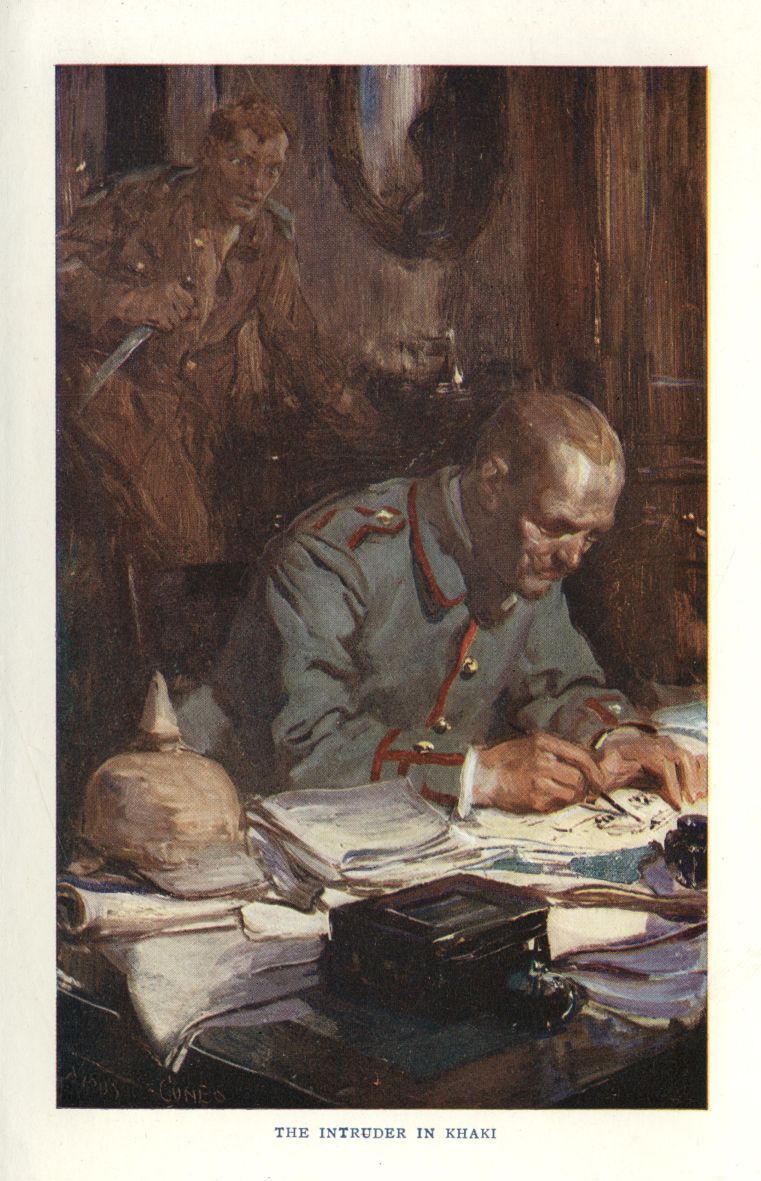
THE INTRUDER IN KHAKI
Lieutenant Axel, bending over the table with his back to the door, was absorbed in his occupation. But just as the intruder reached his chair he seemed to become aware that he was not alone. He turned suddenly, his right hand holding the fountain pen, his left, by some instinct, crushing the papers into his pocket, and found a determined face glaring at him, and a carving knife pointed at his breast. Before he could collect himself a sinewy hand clutched him by the throat, and a voice said in a hoarse whisper:
"Make a sound and you're a dead 'un."
Whether a knowledge of English was one of Lieutenant Axel's accomplishments or not, there was no mistaking the hand, the knife, the purport of the words. He turned pale; his eyes searched the room for a chance of escape; he was discreetly silent; and at a significant movement of the offensive blade he raised his hands above his head. A drop of ink fell on his nose.
The captor, in whose expression there was eagerness, anxiety, an air of listening, loosed his grip on the officer's throat.
"Take off your uniform and 'coutrements," he said, with a jerk of the knife.
Lieutenant Axel hesitated for a moment only. The Englishman's face was not pleasant. Hurriedly he stripped off tunic, trousers, belt and boots.
"That'll do," said Ginger, in whose eyes the look which the German had mistaken for fury really indicated that he was at his wits' end to know how to effect the change of clothes without putting down the knife and giving his captive an opportunity to dash for the door.
An idea flashed upon him. Still pointing the knife at the officer, he took up the lamp with his left hand, placed it on the chimney piece close by, and stripped the cloth from the table.
"Put it over your head," he whispered fiercely.
Again a movement of the knife abridged the lieutenant's hesitation. The shrouding table-cloth eclipsed the concentrated fury of his eyes. Ginger wasted not a second. He shoved the officer into a corner of the room, pulled a sofa across to bar him in, cut a bell-pull with the knife, and drawing the cord over his head, began to tighten it. The German began to struggle; for the first time he spoke.
"You shtrangle me!" came the muffled words.
"Shut up!" growled Ginger, with a premonitory dig of the knife. "I won't graze your skin if you don't make a fuss. But----"
Lieutenant Axel may have wondered: this hateful pig was certainly not expert in frightfulness; he was very soft, like all the English. But the struggles ceased; the officer was quiet while Ginger knotted the cord about his neck. And he stood there in the corner, a statue in table-cloth and pants, as Ginger, with a quickness learnt on raw mornings in the barracks at home, endued himself with the well-tailored habiliments of a Prussian officer. The boots were a trifle large for him.
He listened. All was quiet. He threw a dubious look at the rigid officer.
"Not safe," he muttered.
Hastening to the German, he loosed the cord, pulled off the table-cloth, and looking into the hot face said:
"You've got to be tied up. Make a row and you know what. Join your hands behind you."
While Ginger was tying his hands, and his feet to a leg of the sofa, Lieutenant Axel von Schwank cursed him in undertones in both English and German. Ginger made no reply. But as soon as this part of his work was finished, he caught up some papers from the mantelpiece--they were copies of the Hymn of Hate--twisted them together, and with a sudden movement thrust them into the German's mouth.
"There! Bite them," he muttered. "Such shocking language!"
He once more threw the table-cloth over the helpless man's head, put the pickel-haube on his own, and quietly left the room. Passing the open door opposite he hesitated for the fraction of a second, then went in, gulped a glass of wine, caught up the frame of a chicken from the table, and digging his teeth into it ravenously, hurried back, along the passage, down a dark flight of steps, and out through the back door into the garden. He drew quick breaths as he leant against the wall, gnawing the carcase. From somewhere on his right came low sounds he had learnt to recognise as signs of Germans in their trenches. On the left there was silence. In the distance guns boomed. After a few minutes he threw the chicken bones upon a neglected garden plot, sighed, drew his hand across his lips, and murmured:
"Blowed if I know!"
The village was a mile or more from his old trench; he knew that. It was, he supposed, wholly in possession of the Germans. He would have to go through it up the hill, or round it, and pass the enemy's trenches before he could reach his regiment. And at any moment the German officer might be discovered!
"I must skip," he said to himself.
The assuagement of his terrible hunger had seemed a necessity beyond all others. Now he realised his peril. Choosing the direction that was silent, he stole from garden to garden, scaling the fences, and presently found himself in a lane. It was uphill to the right: that was his way. The lane ended in a street. There he turned to the left, but had taken only a few steps when the tread of feet and the sound of guttural voices coming towards him sent him back hastily in the opposite direction. To his dismay, in a few seconds he heard other men approaching. There was no escape. On one side he was blocked by a high wall, on the other a house dimly lighted. The night was dark; he wore a German uniform; unless accosted by a real officer he might pass safely. With shrinking heart but an assured gait he walked boldly on, close to the wall.
Dark though it was, the soldiers returning from the trenches recognised the officer's uniform and went by stiffly at the salute. Ginger was bringing his hand up smartly when he remembered that he was an officer, eased the movement, and dropped his hand again, quaking lest some terrible blunder in the mode of his return salute should have betrayed him. But in the darkness it passed muster. No doubt the men were tired. They went on. Ginger, perspiring and limp, leant against the wall for a moment or two.
"Oh crumbs!" he murmured as he braced himself and set off again.
A few steps brought him to a lane that broke the line of houses on his left. It was quiet. He turned into it. The ground rose somewhat steeply.
"Must be going right," he thought.
Soon the houses were left behind. The lane became a track across even ground, with a few trees at the borders. Suddenly the silence was broken by the sharp crackle of rifle fire from the upper part of the hill. Ginger threw himself down and crouched behind a stout trunk. There was no reply from the German trenches, which must be somewhere below him, he thought. He waited patiently until the firing died away, then rose and crept forward.
His heart sank into his boots when he came unawares upon a trench and heard the murmur of guttural voices. Before he had time to retreat, a sentinel addressed him in German.
"Sssh!" Ginger hissed, sliding into the trench a few feet from the dark figure. Further down the trench there were dim lights. It was neck or nothing now. Stepping on to the banquette he began to clamber up to the parapet. The sentry, no doubt believing that the officer was engaged on some special scouting duty, came towards him, whispering, "Erlauben Sie, Herr Leutnant," and gave him a leg-up.
Ginger scrambled over, fell on hands and knees, and crawled over the ground. How far ahead were the British trenches he knew not; the night was too dark for him to be seen, but at the least noise he would certainly be taken for a German and become the invisible target for a dozen rifles.
While he was slowly wriggling forward he heard a commotion far in his rear--shouts, the sound of many men on the move. Probably the muffled lieutenant had been discovered; the men in the trenches would be advised of the outrage, and the no man's land between the hostile forces might be swept by a fusillade. Crushing himself flat he dragged himself on.
Now there were sounds in front of him. He stopped, panting, listening. Yes, they were British voices; were they those of his own comrades? What should he do? If he called, he might be riddled with shot. So many Germans could speak English. The Rutlands would know his voice, but what if the men in the trenches were not the Rutlands?
For a few moments he lay inert with hopelessness. Then an idea occurred to him. On again, inch by inch, feeling out for barbed wire. There was none; the position must have been hurriedly occupied. The voices were more distinct; his straining cars caught individual words.
"English, I surrender!" he called in a low tone.
The voices were hushed.
"Who goes there?" said a voice.
"Murgatroyd, of the Rutlands," he replied.
"Keep still."
There was a momentary flash of light.
"Don't fire!" called Ginger, instantly realising that his uniform must have been seen. "I surrender."
"Hands up and come on."
Ginger was just rising when bullets sang over his head from behind. He dropped down again; his last chance was gone; they would believe he was tricking them. But he heard an officer give an order. There was no answering fire from the trench in front, no repetition of the volley from the rear. He crawled on, dimly seeing the parapet a few yards away.
"I surrender," he repeated, and crawled on, over the sandbags, was seized by rough hands, hauled headlong into the trench, and held firmly by the neck.
"Got him, sir," said a voice.
CHAPTER XVII
STRATEGY
"Don't throttle me," Ginger murmured, scarcely able to speak from physical exhaustion and the reaction from mental strain. "Are you the Rutlands?"
"No, we ain't. Got a special fancy for the Rutlands, 'eemingly."
"I'm Murgatroyd, No. 939, 17th battalion, 3rd company, 1st platoon," said Ginger feebly.
"Oh, we know all about that. You German blighters all speak English, but you don't come it over us."
"Silence, Barnet; bring him along," said the officer.
"Yes, sir. Says he's a Rutland, sir."
Ginger was taken along the dark trench to a dug-out lit by a candle-lamp. The lieutenant looked at him. The uniform was German, from helmet to boots: the Iron Cross was on his breast; but the dirty, lined, unshaven face was not that of a German officer.
"Who do you say you are?" said the lieutenant, puzzled.
"Murgatroyd, lance-corporal in the 17th Rutlands, sir: called Ginger, sir: look at my hair."
He removed the helmet. The lieutenant laughed.
"The name suits you," he said. "But what have you been up to?"
"Taking French leave and German toggery, sir," said Ginger. "Beg pardon; could you give me a drink? My mouth's that parched. I'm all of a shake."
Refreshed by a cup of tea, Ginger told his story.
"A regular romance," said the lieutenant. "You're as plucky as you are lucky. By George! I should like to have seen the German taking off his uniform. He must have been very mad."
"He had a very swanky shirt, sir, but I couldn't stop to take that. Can I get back to my billet, sir?"
"Certainly. I'll send a man with you out of the trenches. You go round by the church, you know."
"I'll find my way, sir, never fear. If you'd give me a cigarette or two...."
"But you'll never get through in that uniform. I can't give you a change. Stay, I'll write you a note; don't wear the helmet."
"No, sir: I'll send it home to the kids, along with the Iron Cross."
"You've deserved that, at any rate. Well, good luck to you. I wish you were one of my men."
"Thank you, sir."
Somewhere about midnight, Ginger, after certain amusing adventures with the sentries, knocked at the door of Bonnard's cottage. There was some delay: then Bonnard opened the door, lifting a lighted candle.