Front matter (continued 2)
Reading edition
It was long in coming. To move before knowing the direction would be useless and might be dangerous, so, curbing their impatience, they lay on the slope of the embankment.
At last they heard the whirr of an aeroplane. Having learnt to expect a shot from the sniper when it was masked by some other sound, they sprang up. The humming drew nearer; then came the single sharp rifle crack.
"Behind us!" whispered Kenneth.
With great caution the two men moved along the track, stepping over sleepers and rails torn up, and skirting deep holes made by shells. Every now and again they stopped to listen. Presently they were brought to a sudden halt by the sound of a rifle-shot apparently almost beneath them. Dropping to the ground, they peeped over the embankment. At this spot there had been a landslip, evidently caused by a heavy shell. At the foot of the embankment lay a pool of water, extending for some twenty yards. Except for these nothing was to be seen.
They felt rather uncomfortable. On this bare embankment, rising from an equally bare plain, there seemed to be no cover of any kind. Yet it was certain that a sniper was within a few yards of them, perhaps within a few feet. They lay perfectly still, watching, waiting for another shot. It did not come. Kenneth began to wonder whether the sniper had seen or heard them, and stolen away. Or perhaps he was stalking them. At this thought Kenneth gripped his revolver.
What was to be done? To prowl about in the darkness on the chance of discovering the marksman would be mere foolhardiness. He hoped on for another shot, not daring even to whisper to Ginger. The minutes lengthened into hours; the two men were cramped with cold; but as if by mutual consent they lay where they were. Neither was willing to go back and report failure. Now and again they caught slight sounds which they were unable to identify or locate. They nibbled some biscuits they had brought with them, determined at least to await the dawn. Conscious of discomfort, they had no sense of fatigue or sleepiness. And when at length the darkness began to yield, they fancied they saw shadowy enemies on the misty plain.
When it was light enough to see clearly, they looked to right and left, to the front and the rear, and discovered no sign of life within a mile of them. The air began to fill with the roll of artillery and the rattle of rifle-shots. Here and there in the distance they saw columns of black smoke. Two aeroplanes passed overhead towards the German lines, and shrapnel shells strewed white puffs around and below them. But on the embankment all was quiet.
"He must have got away in the darkness," Kenneth ventured to whisper at last.
"Can't make it out," murmured Ginger in return.
How the sniper could have escaped unseen was a mystery. Daylight revealed the bareness of the plain. Only a few low hedges divided the fields. One such, bordered by a narrow ditch, ran northward from the railway within a few yards of them. But this could be of no use to a sniper, for it was on the wrong side of the embankment, towards the north.
After a murmured consultation they rose to examine the embankment more closely, in the hope of finding tracks of the sniper. As they did so, a number of bullets whistled around them; their figures had been seen on the skyline by the Germans. Dropping instantly to the ground, they crawled along, skirting the hole made by the shell, and taking care not to slide down in the loose earth that had been displaced. They covered thus a hundred yards or so in each direction, up and down the line, without discovering anything.
"We must give it up," said Kenneth at last. "I don't like to, but I see nothing else for it."
"Our chaps are in billets to-day," said Ginger. "I'm game to stay till to-night if you are."
"All right. We've got our emergency rations. We may as well lie up in the farm, and take turns to sleep."
They crawled across the track to the British side of the embankment, slid down the slope, and being now safe from German shots began to walk erect along the bottom, following a slight curve in the direction of the farm. The less of open field they had to cross, the better.
They had taken only a few steps along the base of the embankment when Ginger, a little in advance of Kenneth, stopped suddenly, and stooped. Then he turned his head quickly, putting his finger to his lips. Kenneth hurried up. Ginger pointed to a slight track in the grass, leading round the low hedge before mentioned. Without hesitation they began to follow it up, moving with infinite precaution, and bending under cover of the hedge.
Running straight for some distance, the track at last made a sharp bend to the right, then skirting another hedge parallel with the embankment. The two men were on the point of turning with it when Kenneth, in the rear, happening to look behind him over the hedge, caught sight of a man about half a mile away, coming apparently from the direction of the village where the Rutlands were billeted. Ginger came back at a low call from his companion, and they stood together at the hedge, watching the stranger, careful to keep out of sight themselves.
The man drew nearer. He was old and shabbily dressed. A small basket was slung on his back. Every now and again he looked behind as if fearful of being followed. They watched him eagerly, surprised, full of curiosity and suspicion. His path ran along the hedge parallel with the railway, and he was screened by it from the British lines.
He came on until he had almost reached the hedge behind which the two Englishmen were posted. At this point there was a wide gap in the hedge that covered him, and he turned off sharply at right angles towards the railway. Kenneth instantly guessed that he had done this to avoid observation through the gap, that he would pass round the end of the hedge near the embankment, and follow the track by which Ginger and he had recently come.
As the man turned, Ginger caught Kenneth by the sleeve. His eyes were bright with excitement. He seemed about to speak, but Kenneth hastily clapped a hand over his mouth. Watching the man until he was on the point of turning the corner, Kenneth drew Ginger through a small gap in the hedge parallel with the railway, and they waited there until the stranger came up to it on the track they had just left, and began to walk towards another hedge at right angles to it, which led back to the embankment almost at the spot where they had watched through the night.
They followed him quietly. He was on the inner side of the hedge, they on the outer. They saw that he was wading along the ditch towards the railway. At the end of the hedge they stooped and peeped through a gap, to see what was going on within a few feet of them. They heard a low whistle, and were just in time to catch sight of the man disappearing into a culvert that carried the ditch under the embankment.
Allowing him time to get through, they crawled through the hedge, up the embankment, over the line, and approaching the culvert from above, established themselves on top of the brickwork at the entrance. They heard voices from below, within the culvert. Kenneth held his revolver ready, Ginger gripped his bayonet. And there they waited for one or other of the men inside to come out.
They had not long to wait. The mumble of voices came nearer. Kenneth listened intently, but could not distinguish the words until, just beneath him, he heard "Auf Wiedersehen!" Immediately afterwards the man they had followed waded out through the shallow water at the bottom of the culvert, bending almost double to avoid the arch. His basket was gone. Just as he was about to straighten himself, Kenneth called sternly, "Hands up!" The man swung round, saw a revolver pointed at his head, and instantly threw up his hands, at the same time glancing right and left as if seeking some way of escape.
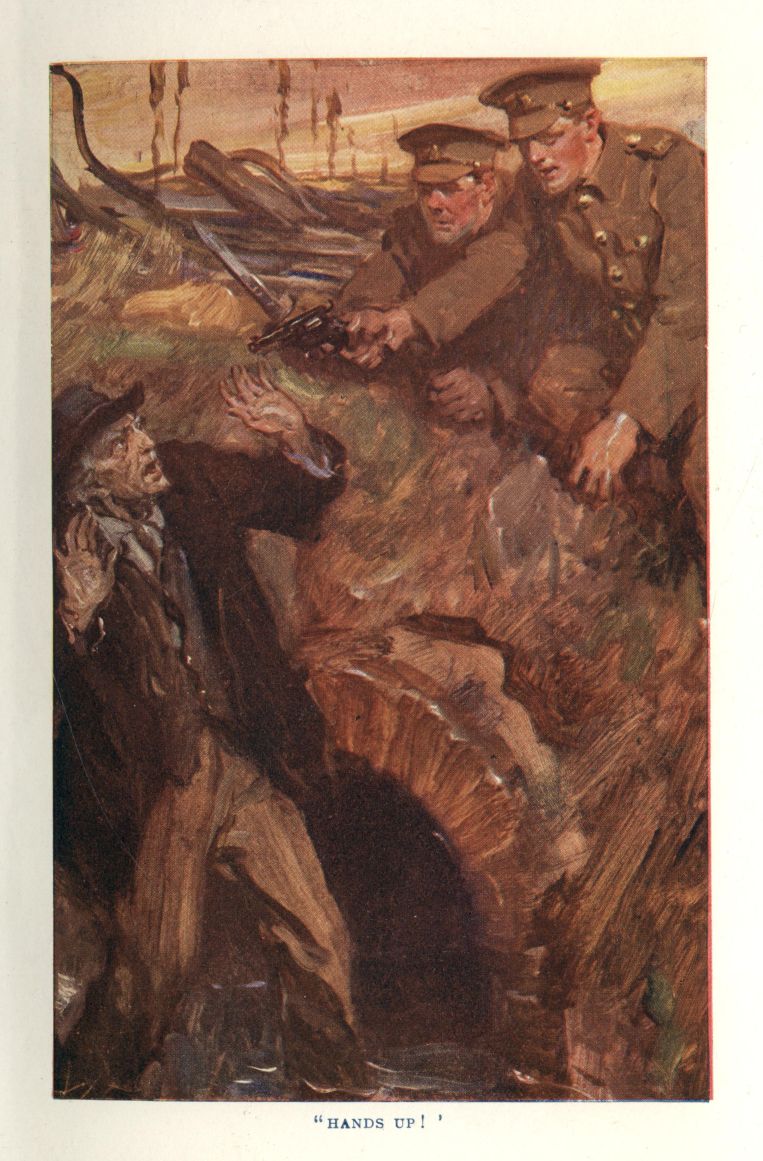
"HANDS UP!"
What were they to do with him? Within a few feet of them, in the culvert, was the sniper, a man of courage and daring, or he would not have elected or been chosen for this particular means of serving his country. Luckily Kenneth was a man of quick decision.
"Collar that fellow while I keep an eye below," he said. "Take care you don't show against the opening."
Ginger sprang down the embankment, and approached the captive, whom Kenneth covered with his revolver, at the same time keeping an eye on the arch below. In a few seconds Ginger had made the man pull off his coat and waistcoat, and unfasten his braces, and with these he tied him hand and foot.
"You'll be safe there for a bit," he said, laying the man at the foot of the embankment. Then he rejoined his companion.
Meanwhile Kenneth had been considering how to get the sniper out. There had been no sound from the culvert, but the German must be well aware of what had happened. That he had not attempted to escape by the other end was probably explained by his ignorance of the number of men he had to do with. Armed with his rifle, he might have thought himself pretty safe in the narrow culvert, where he could take heavy toll of any assailants who should attempt a direct attack.
"We'll have to smoke him out," whispered Kenneth, as Ginger joined him. "There's some straw in the farmhouse; cut back quickly and bring as much as you can carry."
In ten minutes Ginger returned with two large bundles which he had himself trussed. He kindled one of the trusses, and placed it at the rear end of the culvert, the quarter from which a slight breeze was blowing. Kenneth meanwhile kept watch above the brick arch at the other end.
The straw was somewhat damp, and made as much smoke as they could have wished. Carried by the breeze through the culvert, it floated out beneath Kenneth, tickling his throat and causing his eyes to smart. Every moment he expected the sniper to make a rush from his unendurable position. When a minute or two had passed without any sign of the man he was surprised: was insensibility to smoke one of the German superiorities?
"Any more straw, Ginger?" he asked.
"Another bundle," Ginger replied, and returned to the farther end to light it.
He had only just disappeared over the edge of the embankment when Kenneth, who had been straining his ears for sounds of movements below, heard a slight displacement of ballast on the line above him. Glancing up, he found himself looking straight at the barrel of a rifle, behind which was a head surmounted by a German helmet.
For half a second he was paralysed with astonishment. Then a click galvanised him into activity. Realising that the rifle had missed fire, forgetting--like an idiot, as he afterwards confessed--that he had a revolver, he made a spring and with his left hand seized the muzzle a few feet above him. The German held fast; there was a momentary tug of war; then the German lost his footing on the slippery earth, fell suddenly to a sitting posture, and slid down the embankment helplessly, driving Kenneth under him into the shallow pool of water at the foot.
Kenneth was a thought quicker than the German in recovering his wits. Wriggling sideways, he flung his arm over the man, spluttering out a mouthful of muddy water, and grappled him. For a few seconds they heaved and writhed like grampuses. Then Ginger, drawn by the splash, came running across the line, saw the struggling figures, sprang down the embankment, and dashed his fist in the German's face. In another moment he had dragged the man out of the water and a foot or two up the embankment, and held him down until Kenneth had shaken himself and come to his side.
"This beats cockfighting," he said. "Where did the beggar come from?"
"Don't know," said Kenneth. "We'll see presently. I'm nearly choked with mud. We'll have to use his braces too."
When they had tied the man securely, they got up to investigate. What they discovered was a proof of the ingenuity which the Germans exhibit in all their undertakings. The landslide, a little to the right of the culvert, formed a sort of boss on the embankment. At the farther extremity of this, out of sight from the spot where Kenneth had stood, the German had forced his way up from a small chamber excavated in the base of the embankment, where he had a folding chair, a rug, a tin plate and mug, a supply of ammunition, and the basket which the visitor had carried. It was full of food. There were two or three inconspicuous openings for the admission of air, and, towards the British trenches, a small tube, and an arrangement by which the rifle could be clamped. Evidently the sniper took his sights in the daytime, and set the rifle in such a position in the tube that he could fire directly on the trenches with the certainty of having the correct aim.
"Up to snuff, ain't they, not half," said Ginger, with unwilling admiration. "But how did you come to be wallowing in that there puddle?"
Kenneth explained.
"My word! a lucky missfire," said Ginger.
"Lucky indeed!" replied Kenneth. "And we can't discover the cause of it; the rifle's in the mud."
"Never mind about the cause of it. We've bagged our first prisoners; that's one to us and the Rutlands."
But Kenneth was never satisfied to leave a problem unsolved. Thinking over the matter constantly during the next few days, unwilling to ascribe to luck something that must have a sufficient cause, he came to the conclusion that the breech of the rifle had become clogged with earth as the sniper forced his way up through the landslide.
They marched their prisoners back to headquarters in the village, keeping the embankment between them and the enemy as long as possible.
"I've often seen this old rascal about the village," said Ginger, referring to the civilian. "He's a spy, that's what he is. They'll shoot him, won't they?"
"The colonel will hold an enquiry, no doubt. By George! I shall be glad to get back and dry my things and have a good feed."
They received an enthusiastic welcome from their comrades, and Colonel Appleton commended them for their successful work. The sniper was sent to the rear as a prisoner of war. An investigation was held. It came out that the civilian who supplied him with food was a supposed refugee, and one of the pensioners of Monsieur Obernai. That gentleman was summoned to the court of inquiry, and was overcome with horror on learning that one of the men whom he had assisted was a spy.
"It is heart-breaking," he said. "It is enough to make one hard. Besides, it might throw suspicion on me. Still, it would not be just to abandon my humble efforts to alleviate distress because one man has deceived me. But in future I shall make the most careful inquiries before I assist a stranger."
The spy was shot, and thereafter there was no more trouble from night snipers at that part of the lines.
CHAPTER VII
IN THE ENEMY'S LINES
It was during their next spell in the trenches that the Rutlands had their first taste of artillery fire. They were not systematically bombarded: there was no indication of infantry attack; but at irregular intervals shells from field guns burst over or behind the trenches, doing very little damage, but making the men nervous and irritable. When the ominous tearing sound was heard as a shell flew through the air, the men winced and cowered, and at the explosion they looked fearfully around, sometimes through a shower of earth, wondering to find themselves still alive.
"You'll get used to it by and by," said Captain Adams to the men of his company. "The bark is worse than the bite at present. It's really very kind of the Bosches to let you get accustomed to them gradually."
After a day or two the bombardment became heavier and more persistent. Two or three batteries were located, either by officers in observation posts or by British airmen, and the British gunners replied to them, not without success. But presently the trenches were shelled at night by heavier guns which it seemed impossible to place. The position of the guns appeared to vary. Sometimes the reports came from the south-east, sometimes from the east, sometimes from the north-east; and in general they were louder than those of the guns which had been definitely located, though this fact, in the opinion of some of the men, was due to the stillness of the night air. They began to suspect that the Germans were bringing up more guns to various parts of their line, with the idea of discouraging any attempt to break through at this point.
All this made the Rutlands eager to come to grips with the enemy, and the prolonged inaction tried them sorely. To amuse them during the long weary evenings in the trenches the colonel sent for a number of mouth organs, and some of the officers read to them in the dug-outs by candle light. One evening the men of Kennedy's platoon pricked up their ears when they heard the plaintive notes of a flute from a short distance on their left.
"Who's playing?" they asked.
Word was passed along the trench that it was Stoneway, who had bought a flute in the village.
"There's a chap for you!" said Ginger. "All the months we were training the beggar never did a thing, playing or singing. Seems to me he can play, too. But he didn't ought to play 'Home, sweet Home.' Gives you a lump in your throat. Pass the word along for 'Dolly Grey,' will you, mates?"
Stoneway's unsuspected musical accomplishments raised him in the estimation of his comrades. Every night there were calls for him. He knew a great number of their favourite tunes, and was always ready to play them. He would usually begin by running up and down the scale, and practising tuneless exercises; and sometimes, when these preliminary flourishes were rather prolonged, the men called to him to "cut it" and come to the real thing.
As time went on, the shelling became more frequent. It soon became clear that the Germans were working from definite knowledge of what was going on behind the British lines. The bombardment often took place when parties were relieving one another in the trenches, though this was always done in darkness. And one day, when the general commanding the division came to the village to inspect the battalion, a particularly brisk shelling caused a stampede of the people, who had come to regard themselves as safe. Several cottages were damaged, several civilians as well as soldiers were killed or wounded, and a heavy shell excavated a deep hole in the garden of Monsieur Obernai's house.
One morning the trenches were subjected for the first time to the fire of a heavy howitzer. A peculiar low drone, rapidly increasing in loudness, was heard.
"'Ware Jack Johnson!" cried Captain Adams, and the men crouched in the trenches, holding their breath.
The first shell fell some distance behind the lines. They heard a terrific crash, and saw a column of thick smoke. The second shell, about a minute after the first, fell far too short, plunging into the ground just in front of the German trenches, and bespattering them with earth. The third exploded in the pond between the lines, and sent a wave into the German trench at the side. During the next half hour the ground in front of the pond between the opposing forces was pitted with holes made by the heavy shells.
"There's something wrong with the range-finding or the charges," remarked Harry.
"Lucky for us," said Kenneth, brushing from his coat some dust cast up by one of the shells. "The smell is bad enough."
After half an hour the shelling ceased, and the men wondered what purpose the Germans could have had in such an apparently motiveless bombardment. Captain Adams suspected that something was going on in the German lines, and remembering the success of Kenneth and Ginger in discovering the sniper, he decided to send them out that night as a listening patrol. Harry begged to be allowed to go with them.
"Very well," said the captain. "If you're successful we'll try a whole section another time. It's a ticklish job, you understand. You'll crawl over to the German trenches, and listen. You know German, Amory, I believe. You'll do the listening, then; you others keep on the watch. Don't lose your way. I'll take care that the men here don't fire on you as you come back; but if you stray too far to right or left you may find yourselves in hot water."
"You've no special instructions, sir?" asked Kenneth.
"No: you must work out the details yourselves. You're not puppets on the end of a string."
"Nor yet monkeys on a stick," Ginger murmured when the captain had gone. "What did Capting mean by that?"
"He meant that we're not machine made, as the Germans are, by all accounts," replied Harry. "I say, I'm jolly glad he let me go too: I'm getting quite fat with doing nothing."
They talked over their plans together. Obviously the safest direction in which to approach the enemy was towards the large pond. This was an irregular oval in shape, and the Germans had not closely followed its curve in cutting their trenches, for, if they had done so, it would have exposed them to enfilading fire from the British. They had carried their advanced trench close up to the border of the pond on each side, then run communicating trenches at right angles from front to rear, and there dug a straight trench along the breadth of the pond, about a hundred yards in the rear of their first alignment. The wire entanglements in front of the pond, facing the British, were not so elaborate as on the rest of their line, from which the inference was that the water was too deep to be waded.
Just before midnight the three men crept stealthily out of their trench, armed only with their bayonets, crawled under the barbed wire, and wriggled forward towards the pond. It was slow and tiring work, for the ground was much cut up by shell fire, and littered with fragments of shells, empty tins, and other rubbish. There was a certain advantage in the unevenness, in that it gave cover; but it also contained an element of danger, because there was a risk of their displacing something as they proceeded, and they knew that the slightest noise would provoke a fusillade from the enemy.
The moon was not up, but the sky was spangled with stars, by whose feeble light they were able to distinguish objects on the ground within ten or a dozen paces. They heard the Germans talking and laughing in their trenches, and here and there a slight radiance marked the places where they had candles or lamps. Foot by foot they crawled on, Kenneth leading the way towards the angle of the trenches on the left.
At last he came to a stop within a few feet of the parapet. The three men lay flat on the ground. For some moments Kenneth was not able to distinguish anything from the general murmur, but presently he realised that one man was reading aloud to the rest from a German newspaper. "The blockade of England. Great German success in the North Sea. An English merchantman of 245 tons laden with bricks was torpedoed in the North Sea yesterday, and seriously damaged. The starvation of England proceeds satisfactorily."
"What, do the English eat bricks?" asked one simple soul.
There was a laugh.
"They have good teeth! Look at this picture," said another.
"If the English bricks are harder than our war bread I pity them," said a third. "We needn't cry 'God punish England' any more."
"Is there any news of sinking a grain ship?" asked a voice.
"No," replied the reader. "Grain comes in big vessels; I expect the Americans won't let their ships sail. We shall have America on our side soon."
"Anything to shorten the war," said a man. "I'm tired of it. I want to get home to Anna and the children. The General said it would be all over by Christmas."
"So it will, by next Christmas. I want to get back to the Savoy: I made £10 there the Christmas before last."
"You won't make it again. The English won't have any money after this."
Signing to the others to remain where they were, Kenneth crept still farther forward until he came below the parapet. From the direction of the voices he guessed that the trench was unoccupied at the angle; the men who should be there were gathered around the man who had the paper. Cautiously raising himself, he peeped first through a loophole, then over the crown of the parapet. Here he was able to look along both the main trench and the communicating trench at right angles to it. In the former, about a dozen yards away, he saw a group of men at the entrance of a dug-out, from which a glow shone forth. It was here, evidently, that the man was reading. He discovered the reason why, apart from the attraction of the newspaper, this part of the trench was empty. The stars were reflected in water that lay along the bottom. There was evidently a considerable leakage from the pond. On the right hand the communication trench was quite dark. Apparently it was not manned at all.
Kenneth dropped down again, and remained for a short time listening. The conversation had changed: instead of discussing the war, the Germans were talking of domestic matters; the ex-waiter of the Savoy Hotel described his little house and garden at Peckham, and told how he had happened to meet in London a girl from his own village in Wurtemburg, who was now his wife. Luckily he had saved enough money to keep her and his children for a year or two.
Finding that he was not likely to gain any important information, Kenneth crawled back to his companions, and they made their wriggling way to their trench without being discovered. Captain Adams was a little disappointed at the meagre result of their reconnaissance. The only valuable piece of news was that the communication trench was empty and the angle flooded.
Shortly after their return the mysterious gun again opened fire. Several men were wounded by splinters of shells, one so seriously that, in spite of the risk, he had to be carried at once to the rear.
Next day Kenneth said to Harry:
"Look here, last night's business has whetted my appetite. Why shouldn't we get behind the German lines and see if we can locate that gun? Every day we lose a man or two without being able to retaliate, and it's quite time to put a stop to it."
"Will the captain let us?"
"Adams wouldn't object, I think; but I'm afraid we should have to get the colonel's leave for this. I'll take the first opportunity of speaking to the captain. It would be a pity not to make some use of the little information we were able to pick up."
Captain Adams, when the proposal was put to him, at once said, as Kenneth had expected, that he must ask the colonel's permission.
"It's a good deal more dangerous than last night's affair, you see. You'll be shot out of hand if you're caught."
"But it's worth trying, sir, if we can find that gun. Apart from our losses, it's making the men jumpy."
"That's all very well, but I don't want to lose two useful men. Still, I'll see what the colonel says."
Later in the day he sent for them.
"I've seen the colonel," he said. "He was at first dead against it, but I did my best for you. He agrees, provided you come back at once if you find things too unhealthy: that is to say, you are not to go on if you come up against any considerable body of the enemy. And keep the matter to yourselves. You'll be supposed to be going out again as a listening patrol. I shall tell only Mr. Kennedy and your sergeant. No one else is to know what has become of you, and they will be on the look-out for your return."
He gave them a large-scale map of the district behind the German lines, and recommended them to study it carefully during the day. The railway seemed likely to be their best landmark. It ran almost due north-east. About four miles away it passed over a canal running north and south. With these two fixed lines and a pocket luminous compass they should not wander far afield in ignorance of their general position. Much nearer to the British trenches, and almost directly in their front, was a ruined church, the spire of which, used by the Germans as an observation post, had been shot away some time before the Rutlands arrived at the front.
Their diligence in conning the map aroused the curiosity of their comrades, but they laughed off enquiries, and gave the map back to the captain.
They decided to start, carrying revolvers, soon after dark, at the time when the Germans might be supposed to be taking their evening meal. With some difficulty they managed to slip away unnoticed by the other men. Moving with even more caution than on the previous night, they crawled over the ground until they reached the angle of the trenches abutting on the pond. It was quite dark; the moon, in its third quarter, was, as they had learnt from the almanac, not due to rise for some hours.
Peering down into the firing trench, they neither saw nor heard any sign of occupants in the space immediately below them; but they heard voices from a traverse a few yards away. Then Harry caught sight of three or four men coming down the communication trench, and from their gait concluded that they were bringing food. The two dropped down below the parapet and lay motionless: it was clear that they had started a little too early.
They waited until they heard the men pass back along the communication trench; then, after a short interval, rose to carry out the plan previously agreed upon for descending into the trench. The principal danger was a fall of loose earth from the parapet or a splash in the water at the bottom. Kenneth cautiously clambered up the earthwork, lay flat on top of the parapet, then backed until his legs hung over inside. To avoid slipping he held Harry's hands, and so lowered himself until he stood on the banquette, which was an inch or two under water. Pressing himself close against the earthen wall, he steadied Harry in his descent: both stood in the trench. They were panting with excitement.
From their left came the sounds of conversation; the speakers were invisible. They were just about to start down the communication trench when they heard footsteps approaching from the farther end. Flattening themselves into the angle they waited breathlessly. The corner was so dark that they hoped to escape detection; but their hearts leapt to their mouths when they saw the flash of an electric torch some distance away in the communication trench. Escape was impossible. If the light was shown as the men approached the corner discovery was certain.
"Don't waste the light," Kenneth heard one of the men say. "We are running short of batteries. You can see the turn by looking up. Watch the stars."
The light was switched off. Holding their breath the Englishmen waited. Two Germans drew nearer, splashed through the water, and turned into the firing trench. As soon as they had disappeared, Kenneth and Harry started to go down the communication trench, stepping very slowly through the water, and halting every now and again to listen. Presently they were startled by hearing voices behind them. The Germans apparently were returning. To retreat now was impossible. Whatever danger might lie ahead, they must go on.
By this time they had quitted the water. Seemingly they had passed beyond the pond. But the bottom of the trench was sticky with mud; walking was difficult. And the men behind were gaining on them. Suddenly they came to a trench at right angles--no doubt the trench at the rear of the pond. Scarcely daring to look along it, they went straight on.
"Anything doing?" asked a voice close by.
"All's quiet," replied Kenneth in German.
Another hundred yards brought them to a third trench. It appeared to be unoccupied. After listening intently for a few moments they decided to trust their luck down this trench rather than continue along the communication trench, in which they could still hear the footsteps and voices of the men following them. Others might be coming towards them. Striking to the left, they went along the trench for a few yards; then, coming upon another communication trench at right angles, they stopped to consult in murmurs. They decided that the trenches were more dangerous than the open ground. Retracing their steps for some little distance, they waited a moment or two. All was silent. Cautiously they clambered up and lay, breathing hard, upon the grass.
A little ahead of them was the ruined church standing black and gaunt in the starlight.
"We go past that," whispered Kenneth, "then strike off to the north-east. We'll try that direction first, at any rate. Most of the shots appear to come from there."
"About how far away?"
"Two or three miles, I think."
"I say----"
"Well?"
"Oh nothing!--only I feel sort of empty inside."
CHAPTER VIII
SKY HIGH
Harry's feeling of emptiness simply meant that he was only now beginning to realise the difficulty of the task undertaken so lightheartedly by himself and his friend. They had come only about a fourth of the distance they expected to cover, and it was the easiest portion, for after all there was much less chance of meeting enemies in the quiet communication trenches than behind the lines, where movement was unconstrained, and a German might lurk behind every tree.
They lay for a few minutes, peering into the darkness, listening, thinking out their course. Somewhere to the left they heard the rumble of carts, the clatter of motor cars, the voices of men. Similar sounds, but fainter, came from the right. On either hand there was a road to avoid. No doubt there was a path running from the church to one or other of these roads. Their best plan seemed to be to creep along by the churchyard wall and strike across the fields, taking what cover the hedges, ditches, and isolated trees afforded. There was no definite clue to their direction. The gun they had come to seek had not yet begun its nightly work.
Assuring themselves that there were no sounds in their immediate neighbourhood, they got up and stole towards the tree-lined wall of the churchyard. The wall was broken in many places; trees had been split and felled and tombstones shattered by gunfire. They moved very cautiously along the wall towards the open fields. Suddenly they both halted and crouched. High up in the ruined tower a light had flashed for a moment. From the same place came faint sounds which they soon recognised as the murmur of voices. The light again shone forth, and again disappeared. It came and went at intervals, now long, now short, and in a few minutes they realised that the men in the tower were signalling.
The light showed in the direction of the trenches. They had never noticed it in their night watches there; presumably the signallers were at work for the first time, or perhaps the direct rays were masked, and the light was visible only at a higher elevation. Beyond doubt the signallers were Germans; no British soldiers, or natives in collusion with them, would have chosen a spot within the German lines, and so near the trenches--a spot where the glow of the lamp could be so clearly distinguished.
But it was puzzling. Why should the Germans signal towards their own trenches? Was it possible that they were communicating with somebody behind the British lines?
The two Englishmen crouched below the wall.
"Shall we take a look-in at the tower?" asked Harry in a whisper.
"It's not our present job," returned Kenneth. "We're out to find the gun. Perhaps afterwards--at any rate we'll report it. The men up there have got a good view over the fields; we shall be lucky to get away without being discovered."
Bent double, they hurried along the wall, and when it came to an end, crept on under cover of a hedge across a field. Descending into a shallow hollow, they sprang across a brook, and made for a small clump of trees on rising ground in front of them. The ground was rough and stubbly; walking was difficult and fatiguing. They passed through the skirt of the wood, crossed more fields, taking to the ditches where the ground rose, and quickening their pace through the depressions. Kenneth frequently consulted his compass and watch, the dials of which were faintly luminous.
At length he announced that they must have come about three miles from the trenches.
"It's no good going farther at present," he said. "All we can do is to wait until we hear the discharge of the gun, perhaps see its flash. And it will be just our luck if they don't fire it to-night."
"How long shall we wait?"
"That's the problem! If we wait too long we shan't get back to-night, and that means hiding up all to-morrow. We can't possibly return in daylight. But it's no good talking. Let's make ourselves as comfortable as we can in the shade of this hedge. And for goodness' sake don't let me fall asleep."
"Not much chance of that if you feel like me. I couldn't sleep a wink, though I'm tired enough."
They sat down, took some chocolate from their tins, and prepared for their vigil. All was silent around them. There were no longer sounds of traffic; the roads had apparently diverged. The whole countryside lay peaceful under the silent stars.
Time went on. The air was cold. Now and then they got up and tramped to and fro to stir their chilled blood. Ten o'clock: eleven: no sound. Kenneth looked at his watch at ever shorter intervals. He was becoming restless. Had they adventured on a vain quest? The moon crept above the horizon, dimly illuminating the landscape, showing here a dark rounded mass that must be a wooded hill, there the white walls of a solitary farmhouse.
"There's no getting back to-night," thought Kenneth, as the light increased.
It was just past midnight. They were sitting side by side, silent, disappointed, depressed.
"Hark!" said Harry suddenly.
There was a low continuous rumble in the distance. It grew louder. They rose to their feet, and looked across the fields eastward. The ground stretched away in undulations, alternate dark and light bands in the moonshine. They could see nothing to explain the sound. It came from their right, increasing in volume as it approached, then diminishing as it passed away to the left, finally ceasing.
"Sounded like a railway truck," said Harry.
"There's no line there," replied Kenneth. "The only line shown on the map is the one running through the village almost due east; it turns to the north-east after cutting the German lines. It must be a good three or four miles from here. That sound went right across our front, from south to north, and couldn't have been more than half a mile away."
"Well, it's stopped now. We needn't bother about it. Quite certainly it wasn't made by the guns, and that's the only riddle we're called on to solve. I'm fed up with this, Ken."
"So am I. The idea of a whole day here is sickening. Still, it can't be helped."
They sat down again, each thinking his own thoughts.
Suddenly there was a momentary flash, instantly followed by a terrific roar.
"The gun!" exclaimed Kenneth, springing up.
"And jolly close, too," said Harry, looking across the fields. "Which side of us?"
"I don't know. We must wait for the next. This is getting exciting."
Within a minute or two they saw the flash again, lighting up the sky behind a low ridge on their left front. The noise of the discharge reverberated and died away.
"Come on!" whispered Kenneth.
They crept along the hedge in the direction of the ridge. A third report rent the air; then, after a minute's silence, they were surprised to hear a renewed rumbling, which passed across their front nearer than they had heard it before, and receded towards the south.
"'Pon my word, it seems to have some connection with the gun after all," murmured Kenneth.
They went on, as fast as they could with caution. Crawling up the ridge, they peered over. Nothing was to be seen in either direction. They crawled down the other slope, and came to what appeared to be a sunken grass road. It was shadowed by the ridge. Looking to right and left, and discovering nothing, they got up and began to walk across the road. Suddenly Harry stumbled, and uttered a low exclamation.
"A whack on the toe," he murmured.
"By George!" whispered Kenneth behind him. He had stooped to look at the obstruction.
Harry turned. The obstacle was a rail. There was no glint from it; apparently it was rusty. But it was sticky to the touch. Kenneth held his fingers to his nose. They smelt of tar.
Beside the rail there was a layer of loose grass, twigs, rubbish of all sorts, and beyond this, five feet away, a parallel rail.
"We have come on a single-track railway," said Kenneth. "It's not marked on the map; must have been recently laid. Let us go on a little, and examine it."
In a few minutes their discovery was confirmed. The seeming grass road was a roughly laid track. But the rails had been painted over with tar, and the sleepers and permanent way were hidden under low heaps of litter.
"They're clever beasts," said Kenneth. "D'you see the trick? No airman would ever guess this to be a railway. The rails are quite dark."
"But what's it for?"
At this moment came the report of the gun, some distance to the south.
"That's what we are going to find out," said Kenneth.
They made their way stealthily along the track between the rails in the direction of the sound. Presently, at a gentle curve, they came to a white post with a small square platform in front of it, abutting on the railway. Wondering what it was for, they went on, and in a few moments heard the rumble of an approaching train. They scrambled up the ridge on their right, threw themselves flat on the ground and watched.
In a few minutes an engine and two trucks glided into view, making extraordinarily little noise. They passed slowly below the watchers. There was no smoke from the engine; perhaps it was electric. The first truck carried a heavy gun; the other, containing men, was like an ordinary railway wagon, but apparently better sprung, for it moved with only the low rumble which the watchers had already heard. The effect of the train gliding past, dark, almost without sound, was mysteriously strange.
When the train had passed, they hastened after it, walking just below the crest of the ridge. They had scarcely started when they heard a low screeching of brakes. Stealing on a few steps, and peering over, they saw that the train had stopped opposite the small platform. The men had got out of their truck, and were moving noiselessly but quickly about the truck containing the gun. Orders were given in a low voice. There was a slight grating of machinery and creaking of timber. The recoil cradle of the gun, which still remained on the truck, was being placed on the platform; the gun itself was being loaded. Its muzzle pointed over the railway line towards the trenches.
Stuffing up their ears, Kenneth and Harry waited. The gun was fired. They heard the heavy projectile whizz over their heads. Three times the gun spoke; then it was swung round on the truck, and the train moved on to the north-east.
Dazed and deafened by the tremendous noise, the watchers followed it along the line. Here was a discovery indeed. It was no wonder that the gun had never been located. But what they had already learnt made them eager to learn more. Where was the gun kept when not in use? Where was the headquarters of the men? If they could find out this, they would have information of real value to carry back with them.
They went cautiously along the line, on the look-out for sentries. But the line was not guarded. Its existence was probably known only to the German staff, and it was evidently used only for the gun train.
About half a mile beyond the platform, the train came to rest at another. Again the gun was fired: then the train rumbled back. The two men hid until it had passed, then continued along the line in the opposite direction. During its absence they would seize the opportunity to survey this part of the line.
Some ten minutes after the train had passed they caught sight of low buildings ahead on the east side of the track, and a dim light. In case there might be Germans on the spot, they left the rails, walked across a field under cover of the hedge, and approached the buildings from the east. These, they found, were three low wooden sheds, near the opening of a large quarry, which Kenneth remembered having seen marked on the map. The sheds were in ill repair: there were many chinks and gaps in their boarded walls. Apparently the quarry and its appurtenances had been for some time disused. The light which they had seen from the railway line proceeded from one of the sheds, from the interior of which they now heard guttural voices. Peeping through a chink in its wall, they saw four Germans smoking, drinking, and playing cards by the light of oil lamps. There were narrow beds ranged along the opposite wall, some of which were occupied. Helmets and tunics hung from pegs. In one corner rifles were piled. In another stood a cooking stove, its iron chimney passing out through the roof. It was evident that the shed was continuously occupied. At the end nearest the line the door was open, and a sentry paced to and fro.
While the Englishmen were taking stock of all this, they heard the drone of an aeroplane approaching. The four men at the table sprang up, turned down the lamps, seized their rifles and ran to the door. Kenneth stole a few yards along the wall until he came within earshot of them. He was on the shaded side of the shed; there was nothing but miscellaneous litter on the ground, so that it seemed unlikely that the Germans would come in this direction.
"Is it one of ours?" asked one of the men, as the drone grew louder.
"I can't see," replied another. "It sounds like an English machine."
"Well, they won't spot us. They haven't done it by daylight, so they won't now."
"They're flying rather low. We could easily hit them."
"But that would be to give ourselves away. They have gone past. It's all right."
The aeroplane disappeared. But the men had no sooner re-entered the shed than its drone was heard again. They hastened out.
"It's coming round in a circle," said a voice. "The cursed Englishmen seem suspicious."
"They're hunting for the gun, of course. But it has been quiet lately. The captain heard the sound in time. And there's nothing bright about the gun. The English are dished."
"They're no good, the stupid English. They've no chance against German brains."
The aeroplane finally vanished, and the men returned to their cards, turning up the lamps again. Some ten minutes later the report of the gun was heard. It was fired at intervals for an hour, at varying distances; then the low rumble of the train approached. The watchers heard the door of the second shed creak. In a few minutes the train glided up, and entered the shed, into which, it being the middle one of the three, the Englishmen could not see from their present position. After a while the door was closed, and the gun crew joined their comrades. They were not accompanied by their officer, who had no doubt gone to more select and comfortable quarters elsewhere. After exchanging a few words with the cardplayers, the newcomers threw off their clothes and got into bed.
"I should like to have a look into the other sheds," whispered Harry. "But the moon lights up the other side; and the----"
"Don't talk here," said Kenneth. "Come round to the back."
Taking care not to displace loose stones, they crept along the wall and some distance into the quarry.
"They can't hear us here," said Kenneth, still, however, speaking in whispers. "I think we've found out enough. The place is marked on the map. Our gunners can shell it by map measurement."
"Yes, but let's have a look at the other sheds before we go. It won't be safe to go into the moonlight, perhaps; but couldn't we take a peep from the rear?"
"The sheds are built right against the quarry wall. But we'll go and see."
They stole across the litter until they came to the back of the sheds. There they found that there was some chance of achieving their purpose. The wall of the quarry was very uneven, just as it had been hewn out. Consequently the back walls of the sheds did not fit flush against it; there was a space of varying width, but at its narrowest part wide enough to admit a man. Into this they crept.
They discovered that this end of the sheds was in worse repair than the side they had already seen. Protected from the weather by the wall of the quarry, the timber had not been renewed. There were many gaps, and when they touched the wood, its crumbling gave signs of dry rot. But the interiors of the second and third sheds were quite dark: it was impossible to distinguish anything within.
Harry broke off several fragments of the dry wood without making any sound.
"We can get in," he whispered.
Kenneth hesitated. They had learnt enough for their purpose; it would be a pity to risk the failure of the whole enterprise. But youth is adventurous and confident. The voices of the men in the first shed would smother any slight sounds they might make; the sentry was at least a hundred and fifty feet away.
"All right," he murmured.
With their clasp knives they cautiously attacked the boards in the wall of the third shed, stopping every now and again to listen. After a while they were able to remove two of the boards, leaving an opening large enough to admit them. Very carefully they climbed in. Dark as the interior had appeared from the outside, they found when they were inside that there was just light enough, filtering through cracks in the wall, to reveal the contents of the shed. The whole interior, except for narrow gangways, was packed with shells and cases of high explosives. Near the door there were shells for field guns and howitzers, and a certain quantity of small arms ammunition. It was clear that the shed was an ammunition depot.
Creeping carefully back, they replaced the boards, and went to the middle shed, which they managed to enter in the same way, after the exercise of greater patience, owing to the more constricted space between the shed and the wall of the quarry. Here they found the gun train, and a number of petrol tins: evidently the engine was petrol driven. While Kenneth examined the engine as well as he could in the still dimmer light, wishing he dared to use his electric torch, Harry stole to the front of the shed, and watched the sentry through a crack in the badly fitting folding doors. Kenneth followed him.
"Let me know when the sentry's back is turned," he whispered. "I'll use my torch then."
Harry gave the sign by a scarcely audible hiss. Kenneth made the best use of the few seconds afforded him at intervals. His experience of motor engines had taught him exactly what to look for. And he was prompted, not by mere curiosity, but by a sudden idea which had occurred to him, but which he had not yet mentioned to his companion. The engine was still warm. He knew that it ran very smoothly; it was provided with a very efficient silencer, or he would not have mistaken it for an electric engine. With their customary thoroughness, the Germans had ensured that the movements of their gun train should lack nothing in secrecy.
The mechanism was simple, similar to that of an ordinary touring car, except that there were only two speeds and reverse.
"Well," he thought, "why not run off with the train, gun and all?"
The train had backed into the shed trucks first. They were still coupled to the engine. The load was very heavy; the question was whether he could get up speed in time to escape. Some of the Germans were awake: the sentry was at the door; the feat seemed impossible, and Kenneth dismissed the idea, feeling glad that he had not suggested it to Harry. But before leaving the engine he looked into the tank, and saw that it was half full of petrol.
A hiss called him to the door. The sentry was being changed. The new man was grumbling at having had to leave his bed. The voices in the further shed had ceased.
"All gone to bed?" asked the sentry who was being relieved.
"Yes," replied the other, yawning.
"Schneider won five marks of me this afternoon. He said he'd give me my revenge. Well, I'll beat him to-morrow."
He went into the shed: there was a rustling for a few moments: then all was silent, except for the heavy tramp of the sentry as he paced slowly up and down.
The two Englishmen went back to the quarry wall, and were replacing the boards.
"I say!" whispered Harry.
"What is it?"
"It's mad, perhaps; but I wondered if we couldn't run off with the train."
"Absurd!" replied Kenneth.
"But----"
"Hush! we'll talk presently."
They returned to their former position across the quarry.
"I daresay you are right," said Harry, "but I wish we could collar that gun."
"It's impossible," said Kenneth, arguing against his own inclination. "We couldn't open the door without being seen."
"But it's so ramshackle that it would burst at a touch."
"Then we'd make a row starting the engine, and before we had any speed on they'd be at us."
"I don't know. They've got to wake up, and dress----"
"Why waste time dressing?"
"Well, is a German a soldier without his uniform? Anyhow, they would be too sleepy for a few seconds to understand what was going on. It might just give us time to get off."
"I don't mind telling you that the idea occurred to me, but I gave it up."
"Oh, do let us try it. It's a sporting chance. They feel perfectly secure; that's so much in our favour. They'll be struck all of a heap, and you know what confusion there is when fellows are taken by surprise."
"You've the tongue of the old Serpent, Harry. With a little luck--ah! while we're about it, oughtn't we to blow up the ammunition?"
"That means blowing up the men too."
"Well? We can't take 'em prisoners. And when you remember that every shell in the shed may kill or maim a lot more Englishmen or Frenchmen than there are Germans in the shed, you'll see that it's our duty. War's war, more's the pity. There are some fuses near the door."
"Come on, then."
They stole back. Kenneth crept into the ammunition shed, and started a time fuse while Harry removed the boards from the wall of the engine shed. Just as Kenneth, returning, had almost reached the opening, in his haste he displaced a shell that was standing insecurely. It toppled over with a heavy thud. He sprang through the gap.
"Touch and go now!" he panted. "We haven't a second to lose."
There was no time to replace the boards. They slipped into the engine shed, hearing the sentry call to his comrades and run towards the ammunition shed. In a few moments he would discover the gap in the wall, and the Germans would be scouring the place.
The Englishmen ran to the engine.
"Jump in!" gasped Kenneth.
He stooped down to find the starting handle, in the agitation of the moment forgetting that, when examining the engine, he had noticed the push that indicated a self-starter. There was no crank, but only the shaft on which it should fit. For the moment his brain ceased to work; he was conscious only of the noise of shouts and hurrying footsteps dinning in his ears. Then recollection came in a flash. He raised himself, sprang into the cab of the engine, and simultaneously released the brake and pressed the button of the starting mechanism. Beneath his feet there was a welcome whirr; he threw the engine into gear, and the heavy machine, with the heavier trucks behind, lurched forward.
The folding door was only eight or nine feet away--little enough space to allow for momentum. It was neck or nothing. At the first movement Kenneth threw out the clutch, racing the engine; then he let it in, and the train jerked itself forward in a way that alarmed him for the couplings. The manoeuvre succeeded. The engine crashed into the crazy door; it was shattered and partly wrenched off the hinges; and the train glided out, rounded the curve, and ran with increasing speed into the straight towards the south.
All this had occupied only a few moments. Meanwhile, what of the Germans? At the thud of the falling shell the sentry was at the farther end of his beat. He hastened towards the ammunition shed, calling to his comrades as he passed their door. Some sprang up, others only turned in their beds. The former, as Harry had foretold, began to throw on their uniforms. There was no sound from outside to alarm them. But a second cry from the sentry caused them to seize their rifles and rush out as they were. They followed him into the ammunition shed, where he showed them, by the light of an electric torch, the hole in the wall. They poked their heads through, and seeing nothing, were beginning to ask each other what they had better do when they heard through the shed wall the whirr of the starting engine. Shouting, they hurried back, overturning shells and bruising their toes, heard the crash of the door, and reached the entrance in time to see the train lumbering round the curve to their left.
One or two rifle shots rang out. Kenneth and Harry heard for a minute or two, above the purring of the engine, shouts as if the Germans were pursuing them on foot. And then there was a terrific roar; the sky was lit up by a flash that blinded the pale moon, and fragments of metal fell in a thick shower upon the train, inflicting sharp blows upon the Englishmen, of which their hands and faces bore signs for several days.
"What double asses we were!" gasped Kenneth. "The row will bring the Bosches swarming about us."
"They'll make for the sheds. By George! what a blaze! Lucky we're running in a hollow. Where does the line lead to?"
"Don't know. Be ready to jump. We're going nearly thirty miles an hour now; I'll slow down in a minute or two. We must get away from the line and hide up."
In a few minutes he slackened speed to about five miles.
"Drop off!" he said.
Harry leapt out. Kenneth opened the throttle to the utmost, put the engine into top, and jumped clear as it gathered way. By the time he had picked himself up the train had disappeared. Clambering up the western bank, the two men, bending low, raced as fast as they could towards a small clump of trees that stood up dark in the moonlight. They were but halfway across the field when there was a tremendous crash somewhere to their left rear, a sound of tearing and rending, then silence.
"It's run off the line or something," Kenneth panted. "Hope the old gun is smashed."
It was weeks before they knew what had happened. Then, passing over the ground in the course of a general advance of the British forces, they saw the debris of the train, engine, gun, and trucks, lying amid shattered masonry in and beside a shallow brook. The engine had failed to take a sharp curve and dashed into and through the parapet of the bridge.
CHAPTER IX
D.C.M.
The two men had almost reached the clump of trees when they heard the thud of horses' hoofs approaching them from the front. They instantly dropped flat into one of the furrows of the stubble field. Two horsemen galloped round the corner of the clump, and rode down towards the railway, passing within twenty yards of the fugitives.
Waiting breathlessly until the horsemen had gone out of hearing, the two got up, and, still bending low, hurried over the few yards between them and the clump and plunged among the trees.
"We shall have to get back to-night, by hook or crook," whispered Kenneth. "They'll track us down as soon as it is light.... Listen!"
From beyond the clump came the steady tramp of a considerable body of men. Was it possible that the Germans were on their track already? For a few moments they were unable to decide in what direction the men were going. The sounds became gradually fainter, receding towards the railway. Apparently a detachment had been dispatched towards the scene of the conflagration.
They stole towards the western side of the clump, and, standing within the shadow of the trees, looked out across the country. The moon was still up, obscured at moments by drifting clouds. Far ahead, a little to their left, they could just distinguish the tower of the ruined church. Still farther to the left the moonbeams revealed the roofs of the small village which the church served, and in which, no doubt, German soldiers were billeted. Lying on the eastern slope of a low hill, it was invisible from the British lines, but Kenneth remembered having seen its position marked on the map.
"It's past two o'clock," said Kenneth, glancing at his watch. "The moon won't go down for hours, and it will be light by six. We simply must get back before sunrise. All we can do is to creep along the shady side of the hedges and take our chance."
After a good look round, they left the trees and hurried to the shelter of the nearest hedge. Being now on lower ground, they could no longer see the church: but they judged their general direction by the compass, and made their best speed. Once they found themselves in a field completely surrounded by a hedge. Forcing their way through at the cost of many scratches, they fell some five feet into a ditch that the hedge concealed, and sank over their ankles in slimy mud. They scrambled up the other side, the brambles tearing their skin and clothes, and tramped on again.
It was nearly an hour before they came once more in sight of the church, farther to the left than they had expected. Their best course seemed to be to try to find the communication trench by which they had come. Keeping always on the shady side of the hedges, they paused only to glance towards the tower, to see if the light was still showing, then turned their backs on it and hurried on.
They came to a stretch of open ground on which there was no cover of any kind, and knew that they were now near the trenches. The most nerve-racking portion of their journey was before them. They dared not go erect, in the moonlight. If they should stumble unawares upon an occupied trench it was all up with them. Throwing themselves on the ground, they crawled forward by painful inches, stopping every few seconds to listen. Once the scurry of some wild creature across their front tightened their hearts and sent a cold thrill along their spines. Presently they heard the murmur of voices on their right, and instantly edged to the left, only to be brought to a check after a few minutes by voices in that direction also. Had the rearmost trenches been manned during their absence?
Aching in every limb, they crawled still more slowly over the ground. At last they encountered a ridge of broken earth, and stopped, holding their breath. There was no sound near them; faint murmurs came from a distance. Harry cautiously raised his head, crept forward a few inches, and whispered--
"A trench!"
They peered over. The trench was empty. Sliding into it, they ran along to the left, and presently struck a trench at right angles. This too was empty. They halted at the corner to listen, then hurried along until they had almost reached the second trench. A man, by his figure an officer, turned from it into the communication trench, and walked rapidly towards the firing line. They pressed themselves against the wall.
"Making his rounds," whispered Kenneth. "Our best chance is to follow him."
"We've come right," said Harry. "There's the water."
A bank of cloud veiled the moon. They hoped it would not pass for the few minutes during which darkness would be so precious a boon. They heard the officer splashing through the water at the further end of the trench, and crept after him as rapidly as they dared. He turned into the firing trench. Voices were heard. There was great risk in crossing the trench, and it occurred to Harry that it would be less dangerous to clamber over the embankment on their left and wade through a few yards of the pond, which could not be very deep thereabout. If the moon remained in cloud, they would not be seen from the trench behind the pond. Accordingly, two or three yards from the angle of the trenches, they swarmed up the bank, and began to let themselves down on the other side, clinging to the earth so that they should not drop heavily.
Then fortune deserted them. The earth crumbled in Kenneth's grasp, and he fell into the water with a great splash. Harry at once flung himself face downwards, and the two crawled through several inches of water towards the dry land. The light was increasing as the thinner end of the cloud moved slowly across the moon. Crushing their inclination to jump to their feet and sprint over the ground towards their trench, they scampered along on all fours. And then the unveiled moon flooded the scene with light.
Shouts came from behind them. Shots rang out, and pattered around them. A bullet carried off the heel of Harry's boot. Still they wriggled on. They were conscious of sounds in front. The trench was alive. A hand grenade fell just behind them, bespattering them with earth. Yard by yard they dragged themselves over the ground; here was the wire entanglement. As they drew themselves under it, a bullet struck one of the tin cans suspended from the top. There were only a few yards now. From right and left a hail of bullets flew from the British trench. They reached the parapet.
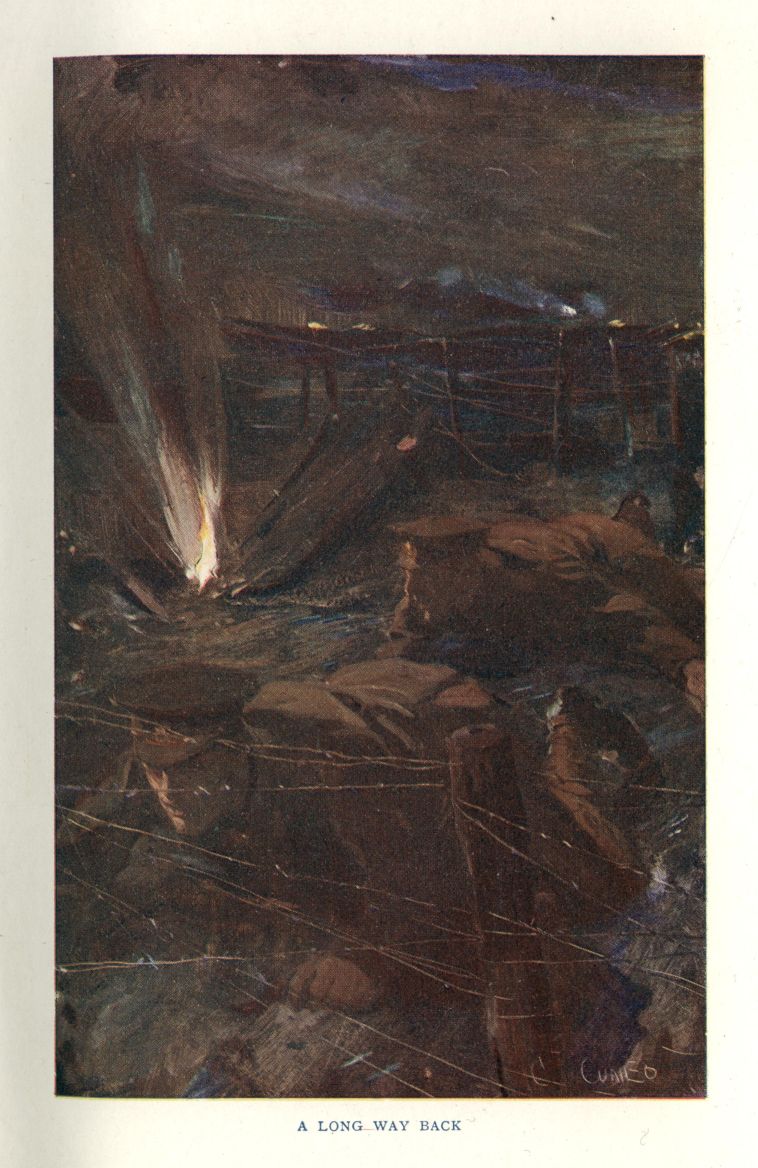
A LONG WAY BACK
"Steady!" whispered Kennedy. "Keep flat for a moment."
But the caution was vain. After coming a hundred yards under fire they thought of nothing but the safety of the trench. They crawled on, over into friendly arms. Bullets sang around them.
"Pipped!" exclaimed Kenneth, as something stung his shoulder.
But next moment they were safe, dropping exhausted on to the banquette. And then the air was rent by a storm of cheers hurled defiantly at the Germans.
"Good men!" said Kennedy, as he helped Kenneth to pull off his coat. "You're a lucky fellow, by George! It's little more than a graze. I didn't expect to see you back. Ah! here's the captain."
Captain Adams came up.
"Amory hurt? A mere scratch, I see. It was a tight moment. You seemed an age crawling up. But come now, have you anything to report?"
"Ammunition depot blown up, sir."
"That was the row we heard, then," the captain interrupted. "We thought it must have been an accident, as no firing was going on at the time."
"And to the best of our knowledge and belief, the gun is done for."
"You don't say so! Talk, man; a round unvarnished tale deliver. Oh, but this is good!"
The captain was evidently excited. Kenneth and Harry between them related the whole sequence of their adventures, to an audience of the captain, two lieutenants, and as many men of the platoon as could come within earshot. When the story was finished, another roar of cheers burst forth, which was taken up along the trench far on both sides, though the most of the shouting men could not have known as yet what they were cheering for.
"A dashed fine piece of work," said the captain, warmly. "It's a feather in the cap of No. 3 Company, and certain promotion for you two men. You'll have to see the colonel to-morrow, when we get back to billets. Go into the Savoy and sleep; you deserve a day's rest, and you shall have it."
When they reappeared among their comrades next day a broad grin welcomed them.
"You do look uncommon pretty," said Ginger. "I never see anyone like you except once, and that was when a chap I knew got drunk at the fair, had a fight with another chap, tumbled into a blackberry bush on the way home, and was found by a copper in the ditch after it had been raining all night. Your best gals would fair scream at the sight of you. 'Oh George, dear, where did you get them scratches? You've been a-fighting, you horrid creature, you!' 'No, Sally, I've had a little bit of misfortune.' 'Rats! You won't get over me. I'd be ashamed to be seen along of you, with a face like that. I'll walk out with Bill next Sunday, so there!' And off she goes, and on Monday morning you get hold of Bill and spoil his beauty for him, and then there's a pair of you."
Everybody laughed, and the two dirty and disfigured objects concerned understood that that was Ginger's way of paying a compliment.
On returning to the village at the close of the day, they had only just washed and got rid of some of the mud from their clothes when the colonel sent for them. They had to repeat their story.
"I don't happen to have any Iron Crosses," said the colonel, "but I'm going to recommend you for commissions. Officers are badly wanted still, and you've got over that nonsense of a few months back?"
"Not at all, sir," said Kenneth. "We're bound by our promise."
"Ridiculous! I don't mean that you are ridiculous to keep your word, but to give such a promise was a piece of confounded stupidity. Why, goodness alive! after what you've done the men would follow you anywhere."
"It's very good of you, sir," Kenneth replied, "but really we must stick to what we said."
"Not that I want to lose you from my regiment. Well, I shall have to get Captain Adams to give you your stripes. You won't object to that?"
"I'm afraid we must, sir. You see, anything that gave us a lift over the other men would be a breach of the understanding."
"Well, you're a couple of young jackasses. I hope I'm a man of my word, but---- Oh well, have it your own way! Virtue shall be its own reward. You've relieved the whole battalion of a great worry and danger, and I'm uncommonly obliged to you."
It was not until some weeks later that the two friends learnt that their names had appeared in the Gazette among a list of men recommended for the distinguished conduct medal. Their refusal of promotion had become known to their comrades, and it was observed that Ginger and some of his friends often had their heads together, and appeared to be conducting delicate negotiations with the men of the other platoons.
CHAPTER X
HOT WORK
Kenneth had not omitted to report the signalling from the church tower. The light had not been seen from the trenches of his own battalion, and it was guessed that the receiver of the messages was at some other point behind the long British front. But on the first night of their return to billets it occurred to Harry that the light might possibly be visible from some post of equal height with the tower in which it shone, and he suggested to Kenneth that they should go up into the belfry of the church in their village. In order to give no excuse for a German bombardment the colonel had refrained from making use of this as an observation post, which some of his officers regarded as an excess of scrupulousness. It would be necessary to get permission now before Harry's suggestion could be acted upon.
Harry put the question to Captain Adams. He saw the colonel, who in view of the fact that the Germans were certainly using a church tower a few miles away gave his consent. Finding, therefore, the sacristan, Harry and Kenneth got him to take them up the belfry at about the same hour as they had seen the Germans' lamp.
Furnished with Captain Adams' field-glasses, they scanned the country in turns. For a long time they had no reward, and they were indeed on the point of quitting the spot when Kenneth caught sight of a twinkle far away to the south-east. It vanished and reappeared at irregular intervals, just as the light from the tower had done.
"We are not getting the full rays here," said Kenneth, after Harry had taken a look. "But it is clear that they are signalling to someone in this direction, more or less."
"Let us go half way down the tower, and see if the light is visible there," suggested Harry.
But they found that only at the foot of the belfry itself could they catch sight of the twinkling light.
"It's very cleverly arranged," Harry remarked. "They are not signalling to this village, that's clear. There's certainly no observer but ourselves here, and no other place is high enough to catch the rays."
"Except Obernai's house," said Kenneth, looking round over the village. Most of the roofs were considerably lower than the spot on which they stood. Only the attics of the Alsatian philanthropist's house rose above that level. That large building in its extensive grounds was about sixty yards to their left. There was a light in one of the lower rooms, where Captain Adams and several other officers were billeted: the rest was dark.
"It's not very likely, after that spy business, that any of Obernai's servants is in German pay," Kenneth continued. "Still I'll tell the captain what we have seen."
He made his report to Captain Adams next morning. Later in the day the captain said to him:
"There's nothing in that matter, Amory. I asked Monsieur Obernai whether his servants were trustworthy, and he assured me that he had had them for years, and could answer for them all. I didn't tell him why I had made the enquiry; it's best to keep these things as quiet as possible; we don't want to make people uneasy. I've no doubt the signals are directed to some place farther away on our left, and the colonel is sending word along the front, asking them to keep a look-out."
Nothing more was heard of the signalling for a long time.
When they returned to the trenches, their position was somewhat altered. The Rutlands were moved a little to the right, and Kennedy's platoon occupied a portion of the trench which had formerly been held by another platoon.
Kenneth was making himself comfortable in a dug-out with Harry and Ginger when he picked up, among the various articles left by its former occupants, a piece of ruled music paper dotted with notes.
"A relic of your friend Stoneway, Ginger," he said with a laugh. "He's the only musician in the company."
"Is he, by George!" cried Harry. "You forget I was in the school choir, old chap."
"So you were! I remember how the mothers used to admire your pretty little cherub face when you let off your songs on the platform. 'Isn't he sweet, mother?' I heard a girl say once. You remember how we rotted you."
"Yes, confound it! I was jolly glad when my voice broke, and I got out of all that. I haven't sung a note since; if I try, my voice is like a nutmeg grater."
"You've lost your cherubic mug too, old man. But look here; whistle over this tune; let's hear what it is."
Harry took the paper, scanned it for a moment or two, then said:
"It's no tune at all. The notes go up and down all anyhow."
He whistled a few notes.
"Oh, for any sake stop it!" implored Ginger. "It's Stoneway's exercises, by the sound of it. Call that music! It's enough to make a cat ill."
"I'll give it back to Stoneway next time I see him," said Harry.
"Tear it up," said Ginger. "If he hasn't got it, perhaps he can't----"
A shout interrupted him.
"Stand to! Here they come!"
They seized their rifles and rushed out into the trench, Harry stuffing the paper into his pocket. The men were posting themselves a yard apart on the banquette, looking excitedly through the loopholes. Across the open ground in front the Germans were advancing in a serried mass. It was a surprise attack, not heralded, in the customary way, by a bombardment. The testing moment had come for the Rutlands at last.
They stood at their posts, tense, quiet with excitement. Ginger's features twitched; Harry's lips were parted. With their fingers at the triggers they awaited breathlessly the order to fire. On came the dense grey lines. The Germans did not fire; with fixed bayonets they swarmed forward rapidly. They came to the wire entanglement; with clock-work precision every man in the first rank plied his nippers, and then, in the trench, Kennedy cried in a hoarse whisper:
"Three rounds, rapid!"
All along the line sounded the crackle of rifles. On the right a machine-gun rattled; on the left another. Three times the rifles spoke. Men were shouting, they knew not what. Other sounds mingled with the din: yells, groans, guttural orders from the German officers; and at the wire entanglement lay a long swathe of fallen men.
But behind them another multitude was dashing on. They leapt over their stricken comrades, only to drop in their turn before the withering volley from their unseen enemy in the trench. Through the gaps poured an unending torrent; the grey-clad men were drawing nearer to the trench. The rifle-fire was now continuous, but it was of no avail to repel this close-packed horde. There was no longer question of taking cover. The Rutlands leapt up to meet the charge. They fired as fast as they could, until their rifles were hot. In spite of their losses the Germans pressed on until sheer weight of numbers carried them to the edge of the trench.
It is not for us to describe the scene of carnage there--the hideous work of the bayonets, the cries of the wounded, the hoarse shouts of defenders and assailants. The Germans fell back. Kennedy's clear voice shouted the order for volley-firing. And now came a fierce reply from the German ranks. Then they fell on their knees and crawled forward again. Again they were driven back. They began to retreat. And then Kennedy leapt on the parapet and gave the command to charge. The men responded with alacrity. Up they scrambled, over the fallen men, and dashed forward with exultant shouts. There was a whizz and boom overhead. The British artillery behind was coming into play. From the front came deafening crashes; columns of earth and smoke rose into the air. The Rutlands lay on the ground until the guns had ceased fire; then dashed on. They plunged into the reek about the German trench; they sprang over the parapet and drove the Germans out; and a storm of cheers acclaimed their victory.
They were preparing to hold the ground they had won when word was brought that strong reinforcements were hurrying up to the Germans from the east. They had no reserve strong enough to hold the new line in face of a superior force. The colonel ordered them to evacuate the trench, after doing as much damage as was possible in the short time available.
The men set to work with their own trenching tools and with those abandoned by the Germans to hack down the walls of the trench. Kenneth caught up a pick, and remembering the pond at the right of the communicating trench, he began to cut a hole through the three or four feet of intervening earth. Ginger joined him. In a few minutes the water burst through in spate, flooding the trenches, and driving the Englishmen out pell-mell.
Laughing, singing, throwing jokes one to another, they returned to their own trenches. They picked up swords, rifles, helmets, and other articles of equipment that were scattered over the ground, threaded their way among the fallen men, stopping here and there to assist wounded comrades. Meanwhile the British artillery was pounding the German lines to discourage a renewed attack, and the Red Cross men moved swiftly and silently over the field.
Kenneth had not seen Harry for some time, and was anxious about him. But the friends met at the edge of their trench. Each ran his eyes rapidly over the other; their set faces cleared when they recognised that neither was hurt.
Settled down once more in their dug-out, the three men talked over their experiences.
"I felt my blood run cold," said Harry, "but I hadn't time to be afraid. I feel worse now. Look at my hand shaking."
Ginger, very pale, was mechanically cleaning his rifle. He flung it down with a curse.
"What have they done to me?" he cried. "What have they done to me? I killed an officer, a nice young chap as might have been your brother. What for? What about his mother? And all those poor chaps yonder: why can't them as make wars let us alone? Men ain't made to kill each other. What's the good of it all? When the war's over, millions dead, millions crippled, millions miserable. It didn't ought to be."
"We're serving our country, Ginger," said Kenneth. "It's not a question of just the present moment. We've got to think of the future. What would life be worth to our people at home if the Germans had their way? You can get nothing good without paying the price, and it will be good if we can teach the Germans and the world that force isn't everything, that people have a right to live their own lives without being bullied. For every man that dies, whether English or German, perhaps thousands may have a better time in days to come. That's worth fighting for, and dying for, if need be. We've all got our little part to play. It's not a thing you can argue about: you feel it. Look at what Sir Edward Grey said: he'd rather cut the old country altogether than be obliged to give up our good English ways and to put up with German tyranny. Don't you feel like that too? Well, that's why we are fighting; we're fighting to call our souls our own, and, please God, we'll win."
CHAPTER XI
THE DISAPPEARANCE OF GINGER
It was when the battalion next returned to billets that the meaning of Ginger's confabulations with the men of other platoons came out.
One evening after supper Kenneth and Harry were smoking in the Bonnards' kitchen. They were alone. Ginger and the other members of their billet had left them some little while before, and the men's faces had worn the sly, conscious look of those who are meditating a secret design.
"If I didn't know Ginger, I should think they were up to some mischief," Harry had said.
Presently the door opened, and Ginger reappeared, at the head of eight or ten men from other platoons of No. 3 Company. They all looked a little sheepish and uncomfortable as they filed into the room. Some hung back and were pushed forward by their mates. Ginger moved to the rear, and was instantly seized by several hands and expostulated with in fierce whispers.
"Keep your wool on; I'm only going to shut the door," said Ginger.
"What's in the wind, you fellows?" said Kenneth. "Why are you hanging about the door? Come round the fire and light up: we'll have a smoking concert or something."
There were mutterings among the group. Some words reached the ears of the two men at the fire-place.
"It's your job: you're a sergeant."
"No fear; you don't catch me..."
"Ginger's the man..."
"Spouts like a M.P...."
At last Ginger was pushed through to the front. He grinned, half turned to protest, was swung round again; then he drew his hand across his mouth.
"Mr. Harry, and Mr. Amory," he began.
"Oh, come now, no misters here," Harry broke in.
"Not in the ordinary way, of course," said Ginger, "but this ain't an ordinary occasion. The fact is, we're a deputation, that's what we are; a deputation from No. 3 Company, and the other chaps have made me foreman of the jury. Not as I want to push myself; not me. I consider it's a job for a three-stripe man; but Sergeant Colpus here is a very bashful and retiring man, though you'd never think it to look at him."
"Dry up!" growled the sergeant, turning fiery red as the other men sniggered.
"Well, you would put it on to me," Ginger went on, "and I must do it my own way, always respecting my superior officer, of course. Being foreman of the jury, I speak for 'em all, got to give the verdict, as you may say. The fact of it is, we men of No. 3 Company, what you may call the Randall Company, ain't easy in our minds at the idea of being dogs in the manger like. We know as the colonel wants to make you officers, and we think it ain't fair to you or the army to keep you in the ranks 'cause of us. A promise is all right, and we take it very kind that you've stuck to your guns, in a manner of putting it, all these months. Speaking for myself, I didn't expect nothing else. But we think it 'ud be a dirty shame if we held you to your promise now, specially when every man of us knows you ought to be officers, and there's not a man of us but would be proud to follow your lead anywhere. And so we've come to say that the promise is off, and we don't stand in the way of your getting your rights."
There was a chorus of approval as Ginger wiped his mouth again and stepped back among his comrades.
"It's very good of you, Ginger," said Harry, "but I'm sure neither Amory nor myself want to leave the ranks."
"Not at all," said Kenneth: "thanks all the same."
"But it ain't right," said Ginger, coming forward again. "We've learnt a thing or two since we started being soldiers, and we've lost a lot of the bally nonsense that used to fill our heads, about all men being equal and such like. Mind you, I'm a Socialist, as strong as ever I was. I say now, as I've said afore, that there's no call for a man to stick himself up and think himself mighty superior 'cos he's got a quid for every penny I've got. And I don't say but what, if we'd had your eddication and chances and all that, we wouldn't be as good as you. But that ain't the point. We've got to look at things as they are, and be honest about it, and what I say is that you've had the training that makes officers and we haven't; and besides, you were born one way and we were born another, and it's no good trying to make out that chalk's as good as cheese. And there's another thing. When we've got a tough job afore us like licking the Germans we're bound to consider what's best for the company and the regiment, and if a man is cut out for an officer it's simply silly to keep him a private: he ain't in his right place, doing his right job. So we think it's only right for us and the army that you should do what the colonel wants, and that's the size of it."
"Is that what you all think?" asked Kenneth.
"Well, I can't say that; all but one or two, and they're a disgrace to the company. There's----"
"I don't want to know who they are," said Kenneth, interrupting. "We're both immensely obliged to you for your good-will, but we enlisted on certain terms, and I feel for my part that we can't break our contract without the unanimous consent of the company."
"I agree," said Harry. "The men enlisted on the faith of our promise, and it wouldn't be fair to break it without the consent of all. So we'll drop it, Ginger, and go on as before."
"It's for you to say, sir," said Ginger. "There! 'Sir,' says I. A slip of the tongue, mates; you can't get out of bad habits all of a sudden. Well, I'll say for No. 3 Company that we'd be sorry to lose such good pals, and as there's no chance that St---- that the pigheaded members of the jury will come round to the opinion of the sensible ones, we may reckon it as certain that the defendants will be condemned to serve as Tommies for three years or the duration of the war."
"And now we'll discharge the jury," said Kenneth, "and have a sing-song until 'lights out.' Come on, Ginger; start off with 'Dolly Grey.'"
Next afternoon Kenneth was summoned to the captain.
"I've a little job for you, Amory. You know how to drive a motor; do you know anything about the mechanism?"
"Not much; but Ginger--that is, Murgatroyd, sir--is a bit of a mechanic. Of course I'll have a shot at whatever is required."
"Add Randall, and we have the Three Musketeers complete. You didn't know that's our name for you, I suppose? Well, it's this. A motor cyclist came in just now with a despatch for the colonel, and reported that on the way he had passed a man who'd had an accident of some sort with a motor lorry, and wanted help. Just go and see what you can do, the three of you. I don't know whether the load is for us; if it is, so much the better. Take my map; the breakdown is thereabouts"--he pointed to a spot some three miles away--"and be as quick as you can."
The three men set out, Ginger carrying a bag of tools he had borrowed from the village smith. The place where the accident had happened was apparently on a by-road about halfway between the village and the headquarters of the next regiment on the left of the Rutlands. They followed footpaths across the fields, some of which had been sown by the inhabitants. The air was very misty, and but for the map they could hardly have found their way. But presently they caught sight of a man in khaki sitting on the grass at the corner of the main road and by-road. The man bore the badge of the Army Service Corps on his sleeve.
"What's wrong?" asked Kenneth, going up to him.
"Are you the Wessex?" said the man.
"No, the Rutlands. You've had a spill by the look of you."
"You're right," said the driver with an oath. "And I owe that there parson one. It's his fault. Did that cyclist send you along?"
"No, but the capting did," said Ginger. "Where's your lorry? We'll have a go at it."
"Well, if you two chaps 'll be a pair of crutches I'll take you to it. I'm bruised all over, and my ankle's got a twist so that I can't hardly walk. It's about a mile away."
Supported by Kenneth on one side and Harry on the other, the man led them slowly along the by-road.
"I only came out a week ago, a Carter Paterson man I am," he said. "I was driving up a load of grub for the Wessexes, and somehow took the wrong turning away back there. I'd drive over London blindfold, but I'm new to this job, see. It came over misty, and I got a sort of notion I was on the wrong road, and there was nobody about to ask the way of, even supposing I could have made 'em understand me. However, at last I happened to catch sight of a fat parson in a long cloak just ahead of me. I pulled up, and pointed to the name of the village on my map, for twist my tongue to it I couldn't. 'All right, my man,' says he, speaking English like a countryman. 'You take the first turning on the right': that's this road we're on now. That seemed about the right direction. 'Good road?' says I: 'not too soft for a heavy load?' 'Capital road,' says he. 'Go as fast as you like, straight through to the road you've left.'