APPENDIX. (continued 3)
Reading edition
Conjecture as to the future of the lumbering industry, and consequently as to the character of the men engaged in it, would be idle. Who can tell what a day or another fifty years may bring forth? The pine woods will not last always; already the camps are being pushed further and further to the north and west, and whereever the denuded pine lands are arable the farmer is making his home. The lumbering industry is also passing into the hands of corporations, and with their extensive means and the armies of men employed by them the forests are disappearing more rapidly than ever. It is possible that the present generation of lumbermen may be the last in the valley of the St. Croix, and that before another fifty years have passed the last of the number may have shouldered his axe or peavy and passed "over the divide."
THE LOG JAMS OF THE ST. CROIX.
The St. Croix river in its passage through the Dalles is compressed into a comparatively narrow channel, by which means the logs driven down the stream are crowded closely together, so closely as to sometimes become firmly wedged or jammed together. The jam generally occurs at a point known as Angle Rock, a huge promontory of massive trap rock extending into the middle of the channel from the Minnesota side, and opposite to the St. Croix landing. The river makes a bend around this rock nearly at a right angle with the channel above. At this point jams are, under certain conditions, almost inevitable. Sometimes they are of small dimensions and are easily broken. Sometimes the logs gather in such quantity and become so tightly wedged that it is a labor of weeks to break them.
The first jam worthy of note occurred in 1865, during the prevalence of high water. It is, in fact, only during high water that jams can occur, the current being at such time swift and strong, and the logs apt to accumulate in greater number than in the regular drives, from the fact that logs that have been stranded in former seasons or at low water are floated off, and the river is thus filled with logs from bank to bank. These are crowded into the narrow channel of the Dalles faster than they can be discharged, and a jam results. An obstruction once formed, the logs continuing to come in from above fill the channel. The tide of logs arrested, crowd downward until they rest upon the bottom of the river, and are heaped upward sometimes to a height of twenty or thirty feet above the surface. The river thus checked in its course rises, wedging the logs more closely and heaping them higher.
In the jam of 1865 the river channel was filled nearly to the St. Croix dam, a distance of a mile and a quarter above Angle Rock. This being the first of the great jams excited unusual attention. Excursionists came up daily in the boats to look upon it. It was indeed a wonderful sight. The logs were heaped together in the wildest confusion, and wedged in at all angles. Men and horses were employed to break the jam, which at that time, owing to the inexperience of the workers, was no light task. The modus operandi of jam breaking is to remove logs from the lower part of the jam till some log which serves as a key to the jam is reached. This being removed the logs above commence moving, and, if the haul be a long one, in a short time the movement is extended to the head of the jam. Perhaps the logs are so heaped above that no water is visible. It matters not; the tremendous current beneath sweeps downward, carrying the logs along, and the spectator beholds a wonderful scene, a river of logs, the current swiftest in the centre of the stream, the logs rolling, tumbling, crashing, grinding, sometimes snapped in sunder like pipestems. The jam breakers are in the wildest excitement, cheering and hurrahing, and some may be seen out in the current of logs, jumping from one to another, or making their escape to the shore. Others on the lower part of the jam at the moment of breaking are carried down the river. Though apparently a scene of great danger, comparatively few accidents occur. The workers are cool, experienced men with steady nerves and stalwart arms, a race of men not surpassed for muscular development.
In 1877 another jam took place nearly as large as that of 1865. This jam came near destroying the beautiful bridge that spanned the river at the head of the Dalles. Many of the logs carried high in air by the pressure of the logs below struck the bridge, and at times its destruction seemed inevitable. This bridge has since been replaced by an iron structure, much higher than the first, but even this occasionally received a blow from some log carried along by the current at a "present arms."
In 1883 another jam of considerable dimensions occurred, but it was removed with less labor and expense than its predecessors, and steamboats anchored below were used to aid in breaking it. It cost from $5,000 to $10,000 to break these jams.
By far the greatest of the jams occurred in June, 1886. The water was high, the current strong and the river above so full of logs that a log driver might have crossed upon them. This abundance was owing to other causes than those mentioned in the account of the jam of 1865. The dams at Snake, Kettle and other rivers had been simultaneously opened, and the logs in these streams all set free at once in the current of the St. Croix. On they came in long procession with but little obstruction till they reached Angle Rock, where they were suddenly arrested, and, owing to the force of the current, wedged more tightly and heaped higher than on any previous occasion, and the river channel was filled with logs to a point two miles above the St. Croix falls formerly known as the dam. To break this jam, two steamers, two engines, several teams of horses and over two hundred men were employed, and during the six weeks that occurred before it was broken, thousands of visitors came by rail and steamboat to look upon it. This jam was estimated to hold during its continuance 150,000,000 feet of logs.
POPULATION OF WISCONSIN.
The first census of the Northwest Territory, taken in 1790, does not show the population of the region now known as Wisconsin. The census of 1800 gave the following figures: Ohio, 45,363; Indiana Territory, 5,641; Green Bay, 50; Prairie du Chien, 65. According to the census of 1880, the original Northwest Territory contained a population of 12,989,571, or more than one-quarter of the population of the United States. The population of Crawford county in 1820 was 492; in 1830, 692; in 1834, 810; in 1836, 1,220; in 1838, 850; in 1841, 1,503; in 1847, 1,409.
In 1836, when Wisconsin Territory was organized, the population of the Territory was, 11,883. The whole number of votes cast at the election in 1836 was 2,462. The population, according to the census taken at the close of every five years, was as follows: In 1840, 30,945; in 1845, 155,275; in 1850, 305,301; in 1855, 552,109; in 1860, 775,881; in 1865, 868,325; in 1870, 1,054,670; in 1875, 1,236,729; in 1880, 1,315,480; in 1885, 1,563,423.
The official compilation of the census of Wisconsin gives the following details: Total population, 1,563,423; white, males, 806,342; females, 748,810; negroes, in full, 5,576; Indians, 2,695. The nativities are divided as follows: United States, 1,064,943; Germany, 265,756; Scandinavia, 90,057; Ireland, 36,371; Great Britain, 32,731; British America, 21,887; Bohemia, 15,838; Holland, 7,357; France, 3,963; all other countries, 20,030; subject to military duty, 286,289; soldiers of the late war, 29,686.
POPULATION OF ST. CROIX, PIERCE, POLK, BURNETT, AND SAWYER COUNTIES.
1840.1845.1850. 1855. 1860. 1865. 1870. 1875. 1880. 1885.
St. Croix 618 809624 2,040 5,3926,25511,03914,95718,83822,389
Pierce 1,720 4,6726,82410,00415,10117,68519,760
Polk 547 1,4001,677 3,422 6,73610,09512,884
Burnett 12 238 705 1,436 2,980 4,607
Sawyer 2,481
POPULATION OF MINNESOTA.
In 1849 the Territory had a population of 4,680. The census taken at periods of every five years shows the following population: In 1850, 6,077; in 1855, ——; in 1860, 172,073; in 1865, 250,099; in 1870, 439,706; in 1875, 597,403; in 1880, 780,773; in 1885, 1,117,798.
The following table gives the population of the counties on the St. Croix waters.
1850. 1855. 1860. 1865. 1870. 1875. 1880. 1885.
Washington 1,066 —— 6,123 6,780 11,809 9,994 19,562 29,763
Chisago —— —— 1,743 2,175 4,378 6,046 7,982 9,765
Pine —— —— 92 64 648 795 1,365 2,177
Kanabec —— —— 30 31 93 311 605 1,119
Isanti —— —— 281 453 2,035 3,901 5,063 7,032
Carlton —— —— 51 28 286 495 1,230 3,189
MINNESOTA STATE CAPITOL.
By the organic act of Minnesota Territory, $20,000 were appropriated for a capitol building. At the time the Territory was organized, however (June 1, 1849), the permanent seat of government had not been determined on, and the money was therefore not available. The Central House in St. Paul, a log tavern weather-boarded, situated at the corner of Bench and Minnesota streets, where the rear of the Mannheimer block now is, was rented for the public offices and legislative assembly. It was for some months known as "The Capitol." On the lower floor was the secretary of state's office, and the house of representatives chamber. On the second floor was the council chamber and the territorial library. Neither of these legislative halls was over sixteen or eighteen feet square. The rest of the building was used as an inn. The Union colors, floating from a flag staff on the bank in front of the building, was the only mark of its rank. During his entire term of office, Gov. Ramsey kept the executive office in his private residence, and the supreme court met in rented chambers here and there.
On Sept. 3, 1849, the first session of the legislature assembled at the above temporary capitol. Gov. Ramsey delivered his message to the two houses in joint convention assembled, in the hotel dining room. The whole fitting of the assembly rooms was of the plainest description.
Considerable discussion ensued during the session on this subject, as to whether the Territory had a right to expend the $20,000 appropriated in the organic act, for a capitol building. The question having been submitted to Hon. Wm. Meredith, secretary of the treasury, he replied that the "Department can not doubt that the public buildings in question can only be erected at the permanent seat of government, located as described."
The second session assembled Jan. 2, 1851, in a brick building, since burned, which occupied the site of the Third street front of the Metropolitan Hotel. At this session the seat of government was fixed at St. Paul, as above noted. D. F. Brawley, Jonathan McKusick, Louis Robert and E. A. C. Hatch were elected building commissioners. Charles Bazille, a pioneer resident and large property owner of St. Paul, donated to the government the block of ground since known as "Capitol Square," and plans drawn by N. C. Prentiss were adopted. The contract was let to Joseph Daniels for $33,000, but the building finally cost over $40,000. It was commenced at once, but not completed until the summer of 1853. The third and fourth sessions of the legislature were compelled, therefore, to meet in rented buildings. That of 1852 assembled in Goodrich's block on Third street below Jackson, and that of 1853 in a two story brick row on Third street, where the front of the Mannheimer block now is.
BURNING OF THE CAPITOL.
At nine o'clock on the evening of March 1, 1881, while both houses of the legislature were in session, and all the halls and departments were crowded with visitors, the dome of the building was found to be on fire. The flames spread with too great rapidity to be checked, and all that could be done was to save the contents of the building. The most valuable records and papers of the various offices, and of the legislature, with some of the furniture, were carried out, but the greater part of the contents of the building, including the valuable law library, the supply of state laws, documents and reports, and all the stationery in the secretary of state's store rooms, etc., were a total loss. The Historical Society's library was mostly saved. The entire loss to the State was fully $200,000.
Fortunately the city of St. Paul had just completed a fine and spacious market house, which was still unoccupied, and its use was at once tendered the State by the city authorities, and while the flames were still burning the furniture and effects saved from the old capitol were removed thither. At nine o'clock next morning the state departments and both houses of the legislature were again at work in their new quarters. But two days of the session yet remained. Gov. Pillsbury immediately secured estimates for rebuilding the burned edifice, using the old walls, and an act appropriating $75,000 for that purpose was passed. Work was commenced at once. It was then found that the old walls were too unsafe to use, and at the extra session in September, 1881, the further sum of $100,000 was appropriated for the completion of the building. Its total cost was about $275,000. The dome of the building is two hundred feet above the ground, giving a noble view to the visitor who ascends it. The exterior of the edifice is neat and tasty, and it is altogether creditable to the State, considering its comparatively small cost.
SELKIRK VISITORS.
In the early days a somewhat primitive people inhabited the Northwest, making their homes on the banks of the Red River of the North and on the shores of Winnipeg, in what was known as the Selkirk settlement, now included in the province of Manitoba. They were a mixed race of Scotch, French and Indian stock, born and raised under the government of the Northwest British Fur Company. They were a peaceable, partly pastoral and partly nomadic, trading people. They cultivated the ground quite successfully considering the high latitude of their home and the absence of machinery for farm work, raising wheat, vegetables, cattle and horses. They engaged in hunting and trapping and yearly visited St. Paul with the surplus products of their labor to be disposed of for money or goods. They came usually in caravans consisting of files of carts drawn by cows, oxen and ponies, and commanded by a captain elected to the position who exercised over them a rigid military rule. Their carts were rude, creaking affairs, made entirely without iron, all the fastenings being sinews and leathern thongs. This harness was made of raw hides, Indian tanned, and sewed with animal sinews. Their costume was a happy cross between the civilized and savage. Their caravans included from 100 to 600 carts, which were laden with furs, buffalo robes, buffalo tongues, dried pemmican, etc. As they came a distance of 450 miles, the journey required many days, but was made in good military order. The raising of a flag was the signal for starting, the lowering, for stopping. At night the carts were ranged in a circle about the encampment, and sentinels posted. Their encampment within the suburbs of St. Paul attracted great crowds of the curious. In 1857 their train consisted of 500 carts, and in 1858 of 600, but later, as railroads were built northward and steamers were placed upon the Red River of the North, their number gradually diminished and finally their visits ceased altogether.
CYCLONES.
Recorded and unrecorded, Minnesota and Wisconsin have had their full share of those atmospheric disturbances that have wrought so much destruction in the Western States. In the early days, when the country was sparsely settled and villages and towns were few and far between, they came and went unnoted, or attracting but little attention. They left no traces on the plain, and in the forests only a belt of fallen timber, known as a "windfall." These belts are sufficiently numerous to establish the fact that these storms were probably as frequent in early, even in prehistoric, times as at the present. Their movements are more destructive in later times because of the improvements of civilization, the increased number of human habitations and the growth of towns and cities. The tornado has more to destroy, and as a destroying agent, its movements are better known and more widely published.
Scientists are not agreed as to the cause of these destructive phenomena, but enough is known to overthrow the theory so persistently advanced that it is in consequence of the cutting away of the forests and the substitution of farms. In fact much of the country was already prairie land and abundant evidences of tornadoes are found in the midst of old forests in which have since grown up trees of considerable size, and this at a period long before the lumberman commenced his destructive work.
We append a few sketches of cyclones that have occurred in comparatively recent times.
THE ISANTI COUNTY CYCLONE.
This storm occurred in September, 1865, and spent its fury chiefly in Isanti county, but extended beyond and was felt even in Wisconsin. The tornado gathered its wrath in the southwestern region of Isanti county, in what is called the "Lake Typo settlement," some forty miles north of St. Paul. It was first discovered in the shape of "two clouds," as the people there residing expressed it, "approaching each other from different directions." Suddenly the mingling of these counter currents of strong winds appeared to form the blackened heavens into a funnel-shaped mass. The direction of the whirlwind was from southwest to northeast, and after crossing the St. Croix river passed through an unsettled portion of timber lands known as "pine barrens," a growth of scattering pines interspersed with black oaks of medium size.
On Wood river, Burnett county, Wisconsin, the trunks of pine trees, three feet in diameter and eighty feet high, were twisted into "broom splints" and carried high in air. The intervening oaks were also served the same way; and the whole track of the tornado, from thirty rods to three-fourths of a mile in width, had left no tree standing. Pines and oaks were all prostrate, and promiscuously heaped up in winrows over the ground, their branches and trunks interlocked, and in some places piled to the height of thirty feet.
The author of this work lost about 10,000,000 feet of pine logs in Wood river in this cyclone. On Clam river, Wisconsin, for four miles in length and about half a mile in width, the forest was laid in winrows, and parties who came through soon after the tempest had to cut their way.
The tornado, traveling with the velocity of lightning to the northeast, overtook Dr. Comfort, of Wyoming, as he was crossing Sunrise prairie with a mule team, accompanied by a hired man. The doctor and man saved themselves by clinging to some shrubs near by, but when the fury of the whirlwind had passed, all they could find of their outfit was the poor mules, half frightened to death, and the fore wheels and tongue of the wagon. The hind wheels, box, and the rest of the outfit, together with the doctor's medicine kit, which he had along, when last seen, were bound zenithward.
Wm. A. Hobbs, late quartermaster sergeant of the Third Minnesota Battery, Light Artillery, and Orville Grant and brother—sons of R. Grant, Esq., a farmer living in Isanti county—were out hunting, and happened to be caught where the storm passed through the heaviest timber. They saw it approaching, and at first attempted to take shelter in an old school house near by, but soon saw that was no place for them and made for an old pine log which they got behind; soon that commenced to move. Hobbs seized hold of an oak, some ten inches in diameter, which immediately commenced to be loosened at the roots and to spin around like a top. The tree was prostrated and he with it—he receiving very severe injuries. The Grant boys, were also injured, but none near so badly as Hobbs. The log school house shared the fate of the surrounding forest. A resident near by states that he saw one-half the roof sailing upward at least four hundred feet above the tops of the tallest trees.
THE COTTAGE GROVE CYCLONE.
On June 15, 1877, a terrific cyclone visited the town of Cottage Grove, Washington county, Minnesota. We append the correct and vivid description taken from the "History of Washington County:"
"At 9 o'clock p. m. there arose in the southwest a dark and heavy cloud, attended with loud thunder, vivid lightning and a strong wind. The cloud moved forward rapidly; soon the rain began to fall in torrents, when suddenly the wind came dashing with great violence, sweeping everything before it. There seemed to be two currents of wind, one coming from the west and the other from the southwest. These two currents came together in section 22. The stronger current being from the southwest, the storm took a northwestern direction, and did some damage in section 27, taking away a portion of the roof of Ethan Viall's house, and a trunk out of the chamber, no trace of which could be found. A corn cultivator was taken up, some portions of which were never found, while other parts were found two miles from the place of its taking. In section 22, when the currents met, the destruction of property beggars description. The timber in its track was prostrated; fences were torn up and scattered in every direction; E. Welch's house came in the line of desolation; Mr. and Mrs. Welch had stepped out to look after some chickens in which Mrs. Welch was specially interested, and, startled by the roar of the wind, were in the act of returning to the house. When near the door the wind took up the house, bearing it away, and a stick of timber struck both Mr. and Mrs. Welch, knocking them down. When Mr. Welch recovered he had hold of his wife, but she was dead. The stick of timber struck her on the head and caused instant death. The next object in the path of destruction was C. D. Tuttle's two story dwelling, located in the northwest corner of section 26. The main part of the house was torn to pieces and scattered in every direction, while the wing was left unmoved. The family, consisting of six persons, fled to the cellar and were miraculously preserved. The large barn a few rods further on was completely destroyed. Next in its course was Mr. J. C. Tucker's barn, the roof of which suddenly passed along on the breeze. At this point the storm turned, taking a northeasterly direction, and struck the house of Robert Williams, damaging the house and entirely destroying the barn. A horse tied to a girder in the barn was found, uninjured, sixty feet outside of the limits of the building, with the girder lying across him, and the strap still tied to it. Next in line was a small lake in the southwest corner of section 23. It was almost robbed of its treasure. The water and mud was carried a long distance up the bluffs, fifty feet above the level of the lake. Next came the fine house of John Morey, giving a portion of its roof to the excited wind; then passed into the town of Denmark, continuing its destructive course, killing a horse for W. G. Wagner, near the town line. A man known as Michael Schull, a farm hand, was taken up by the wind and dashed against a pile of wood, injuring his brain, causing him to become dangerous. He is now at St. Peter in the insane asylum. The destruction of property was great. No accurate account of the amount of damage done has been compiled. Mr. Tuttle, living in section 26, suffered the most. He estimated his loss at $7,000. His house was situated in a valley surrounded by oak trees, and we would suppose was protected by the strong bulwarks of Nature, and yet house, barn, farming utensils, and machinery were scattered over the country. The next morning sheets of tin two feet square, found in Mr. Tuttle's yard, were supposed to have come from a church in Dakota county. Portions of Mr. Tuttle's house were found miles away."
The same cyclone visited Lake Elmo and did great damage, blowing down the depot buildings, Lake Elmo Hotel and other structures. The buildings and trees of the agricultural fair grounds were destroyed. Some parts of the buildings were carried miles away by the storm.
THE CYCLONE AT WHITE BEAR AND MARINE, MINNESOTA, AND CLEAR LAKE, WISCONSIN.
Sept. 9, 1884, a storm arose in Hennepin county and did some damage; continuing to White Bear lake, Oneka and Grant, in Washington county, it gathered force and proved very destructive to life and property. As it passed through Oneka and Grant its path was about ten miles in width. Churches, school houses, dwellings, barns, grain stacks, and fences in its way were either partially or wholly destroyed, and the wrecked property was distributed for miles around. The cyclone passed on over Marine, Big Lake and Scandia, crossed the St. Croix, passed over the town of Somerset, Star Prairie, New Richmond, in St. Croix county, and over Black Brook, Clear Lake, Pineville and Clayton in Polk county and Turtle Lake in Barron, pursuing the usual northeasterly direction common to these cyclones, and disappearing in terrific thunderstorms, in the timbered lands of Barron and Chippewa counties. An eye witness, Mr. Ivory Hatch, of Oneka, thus describes the approach of the storm:
"I was standing near a shed in the barnyard, when suddenly the sky became black and threatening. In about five minutes I saw two funnel-shaped clouds descend and approach each other. I started for the house to warn my family, when, as quick as a flash, I was enveloped in the cloud, and while clinging to a post for safety my grain stacks and buildings disappeared. The storm did not continue over a minute and a half. I escaped almost miraculously without a bruise." The testimony of others in the neighborhood is substantially the same. In the town of Oneka the destruction was worse than in any other locality.
In the track of the storm through Washington county not less than fifty houses were demolished. The loss on each averaged $600, making a total of $30,000. Losses on barns, machinery and stock raised this sum to $50,000. The loss at Marine was computed roughly at $75,000, which made a total of $135,000, not including hay and grain. The entire loss to Clear Lake was estimated at $200,000. Three persons lost their lives, Mrs. P. Burdick, Willie Kavanagh and John Saunders. The Methodist, Congregational and Swedish churches were leveled with the ground. The timber losses were close to $1,000,000; private property in villages, loss near $500,000, and all other losses, such as farm property and the like, in the hundred thousands. The total loss in Wisconsin has been placed at six lives and $4,000,000 in property.
THE ST. CLOUD AND SAUK RAPIDS CYCLONE OF 1886.
The most destructive storm yet recorded occurred on the afternoon of April 14, 1886. The clouds were first seen from St. Cloud to gather a short distance over the basin of the Masour cemetery about three o'clock, Sunday afternoon, in dark, overhanging masses. Then sharp tongues of lightning darted down with terrific force, and the storm with all its fury burst upon the doomed cities. The south end, or beginning of the cyclone track, was located two or three miles south and a little west of St. Cloud and its total length was twenty-four miles. The property destroyed amounted to over a quarter of a million of dollars, and the loss of life at St. Cloud and Sauk Rapids was seventy-five. If we include those who died later of injuries from wounds, exposure and fright, we may safely say a hundred.
The first victim of the cyclone was Nicholas Junneman. The cyclone rising, as we have said, over or near Calvary cemetery, for a space of about three hundred yards in diameter the trees were uprooted or twisted off, gravestones were thrown flat, and fences demolished. Crossing over Calvary Hill, in a path about one hundred feet wide, it wrecked the small Catholic chapel and badly injured the crucifix located there. Next in its course was the farm house of Nicholas Junneman which was left a pile of ruins, and Mr. Junneman was killed, while his wife was dangerously injured. The first house struck within the city limits was J. W. Tenvoorde's. Just across the street J. Schwartz's two story brick house was almost wrecked. Here the path of the tornado was about two hundred feet wide, and increased until by the time it reached the Manitoba depot the width was six hundred feet, taking in in its fearful embrace during the length of its course half a hundred or more buildings, which were totally wrecked, moved from their foundations, or more or less damaged. In many instances there was nothing left to show where a house had stood, and the prairie was covered far and wide with the debris of the demolished buildings. Over fifty houses in St. Cloud were totally destroyed and as many more badly damaged. Before striking the river it swerved slightly northward, and thus the costly building blocks and crowded streets in the heart of the city were spared. Had the cyclone veered in its course more to the south, the loss of property and life in St. Cloud would have been incalculable.
Striking the river the cyclone appeared to be almost motionless for a few moments, or moved so slowly as to seem to hang over the face of the water, its huge black column rising toward the zenith. Then leaving the river, this monster of the air struck Sauk Rapids at Stanton's large flouring mill, which was left a heap of ruins. It then took Demeules' store and the Northern Pacific depot, and passed on through the main business part of the place, leaving but one important business house standing, Wood's store, which was badly damaged. Court house, church, school building, post office, newspaper offices, hotels, dwelling houses, all went down under the relentless power of the storm. Streets were blockaded with the wreck so as to be practically impassable. The list of dead out of a village of about 1,000 population included some of the leading county officials and prominent citizens. Amongst them were John Renard, county auditor, and Gregg Lindley, register of deeds; also Edgar Hull, president of the German-American National Bank; E. G. Halbert, of the New York Insurance Company, with whom Mr. Hull had just filed an application for a $5,000 policy, was so badly injured that he died in a few days. The destruction of property in Sauk Rapids was far greater than in St. Cloud, as the business portion of the city was almost entirely swept away. The loss of life was also proportionately greater.
After leaving Sauk Rapids the cyclone struck Rice's, a station on the Northern Pacific road, about fourteen miles from the former village. Some four miles southeast of the station, at the house of a farmer named Schultz, a happy wedding party was gathered, a daughter of the farmer having been married to Henry Friday, chairman of the board of supervisors of Langola. Almost before they realized it the terrible power of the storm encircled them, and in the twinkling of an eye nine of the goodly company were mangled corpses, among the number being the groom, while the bride was dangerously if not fatally injured. The victims also included the Rev. G. J. Schmidt, pastor of the German Evangelical church of Sauk Rapids. The Rev. Mr. Seeder, pastor of the Two Rivers district, was found out on the prairie with both legs broken.
At Buckman, Morrison county, several persons were killed, and six or seven farm houses destroyed. The suffering caused by this most terrible of cyclones evoked the liveliest sympathy, and large contributions of money, food and clothing were forwarded by the citizens of St. Paul, Minneapolis and other cities throughout the State.
G. W. Benedict, of Sauk Rapids, relates his experience in the storm as follows: "I was in the yard at my residence half a mile north of the depot, when I heard a terrible deafening roar, and on looking up I saw what first appeared to be a very heavy black volume of smoke from a railroad engine, but in a moment I realized what it was. The volume of black cloud soon increased to double its size, and had a funnel shape, gyrating in a peculiar zigzag form. Untold amounts of debris of houses, fences and everything above the surface were shooting and flying with terrific velocity from the cloud, which took a northerly direction. The horrible writhing demon of destruction, with its deafening roar, increased in volume and force, and hurled to utter destruction everything in its path, a great portion of which was carried miles in the air out of sight as though but trifles of lightest chaff."
Thos. Van Etten was walking on the street, going home, when the cyclone struck the town, and he was bodily lifted into the air, carried four hundred feet up a steep hill and landed in a street, literally plastered over with mud. A young man fishing near the end of the bridge, on the opposite side from Sauk Rapids, says that many of the houses were lifted high in the air, and did not seem to be injured until they were dashed to the ground, when they collapsed, and the pieces were scattered in all directions. None of the very large number of persons who went into a cellar for protection from the storm were badly injured. The Fink family, the mother and four children of which were almost instantly killed, were in a house which had an excellent cellar, but the family forgot to utilize it. Near the ruins of the Carpenter house is a tree about ten inches in diameter, through which a pine board was driven so that it protruded at both sides of the tree. The property loss in Benton county was estimated at $300,000, and in St. Cloud at $56,000.
STRUCK BY LIGHTNING.
Some time in the '50s Messrs. Oaks, Rand, Witham, Carson, and twelve other men were in a tent on the banks of Lake St. Croix, just below the mouth of Willow river, during a severe thunder storm. It was about 9 o'clock P. M. when lightning struck the tent and passing down killed Witham and Carson, and severely stunned Oaks and Rand. The other men were not injured, but, being badly frightened, ran away, and did not return till the following morning, when they found two of the men supposed killed still alive, but dazed and motionless. The two killed were lying close together, while Mr. Oaks lay upon one side and Mr. Rand upon the other. The lightning had struck the men who were killed upon the head, and traversing the body had passed out below the ankles. The current of electricity had passed up the arm of Mr. Oaks and down his body, burning spots the size of a pea, and plowing lines under the skin, the scars of which, after recovery, were raised in welts nearly as large as a whipcord. Mr. Oaks was nearly a year recovering. He says that during the time he lay motionless and apparently stunned he was in full possession of his faculties. Mr. Rand had one side of his body burned to a blister. Prior to this he had been affected with weak eyes, but the electrical treatment there received effected a complete cure.
ASIATIC CHOLERA.
Minnesota was early visited by this scourge of the eastern world. It was brought up the river on the crowded steamers and created the utmost consternation, and even panic. No one on board the Royal Arch, May, 1853, can forget the dreadful scenes upon this boat. The first case occurred at Galena, that of a child, and the next at La Crosse, that of a woman, who was put ashore in a dying condition twenty miles above. From thence to St. Paul the boat was a floating hospital, and thirteen corpses lay under a canvas on the lower deck.
Notwithstanding the ghastly freight carried by the steamer, and its sick and dying passengers in the cabin above, kind hearts sympathized and kind hands were extended to help; and the dead were buried and every thing possible was done for the sick and suffering survivors, many of whom died after being carried ashore at St. Paul. What these good Samaritans did was at the risk of their own lives, and more than one, among them Henry P. Pratt, editor of the St. Paul Minnesotian, sickened and died from infection caught by ministering to the stricken ones.
DECREE OF CITIZENSHIP.
The first naturalization papers on record in Minnesota are somewhat unique, and for that reason worthy of preservation, and are herewith presented et literatim:
DECREE OF CITIZENSHIP. Territory of Wisconsin, St. Croix County.
I, William Willim, an alien by birth, aged twenty-six years, do hereby, upon my oath, make known that I was born in the county of Hereford, in the kingdom of Great Britain and Ireland, on the twenty-sixth day of June, A. D. 1821; that I emigrated from the kingdom aforesaid, and landed in New York, in the state of New York, on the first day of October, 1838; that I was at that time a minor aged seventeen years, and that I have since that time resided in the United States of America; that it is my bona fide intention to become a citizen of the United States, to renounce forever all allegiance and fidelity which I, in anywise, owe to any foreign power, potentate, state or sovereignty whatever, and more particularly all allegiance and fidelity which I, in anywise, owe to Victoria, queen of Great Britain, of whom I have heretofore been a subject, and, further that I do not possess any hereditary title, or belong to any of the order of nobility in the kingdom from whence I came; so help me God.
William Willim.
Sworn and subscribed to before me on this eighteenth day of June, 1847, in open court.
Joseph R. Brown, Clerk of District Court of St. Croix County, Wisconsin Territory.
Another oath, such as is now administered, to support the constitution of the United States, was signed and attested in like manner.
BURNING OF THE INTERNATIONAL HOTEL.
On a clear, cold night in February, 1869, the International Hotel, located at the corner of Seventh and Jackson streets, took fire and was speedily consumed. The alarm was sounded at two o'clock in the morning. The hotel was crowded with boarders, among whom were many members of the legislature, then in session, and their families. The writer occupied a room on the second floor and was among the first aroused. Hastily seizing my trunk I hurried down stairs and returned to assist others, but was stopped by the smoke at the entrance. The guests of the house were pouring from every outlet. A group of ladies had escaped to the sidewalk, partly clad, some with bare feet. Ladders were placed to the windows to save those who had failed to escape in the hallway. Senators C. A. Gilman and Seagrave Smith, with their wives, were rescued in this manner. Many diverting circumstances occurred illustrative of nonchalance, coolness and daring, as well as of bewilderment and panic.
Senator Armstrong tried in vain to throw his trunk from a window in which it was wedged fast and was obliged to leave it to the flames. Judge Meeker came out of the house carrying his clothing upon his arm, having a shawl wrapped round his head, and bewailing the loss of the maps and charts of Meeker's dam. Seagrave Smith tarried too long searching for a senate bill, and narrowly escaped sharing the fate of the bill. Many of the guests escaped in their night clothing, and carrying their clothing with them completed their toilet standing in the snow in the light of the burning building. Considering the rapidity of the fire, and the hour at which it occurred it seemed marvelous that no lives were lost.
GRASSHOPPERS.
Minnesota has been visited at intervals by that scourge of some of the Western States, grasshoppers. The first visitation was from the Selkirk (now Manitoba) settlement, about 1838-9. The pests are said to have accompanied some of the early immigrants from Selkirk who came down to the reservation about Fort Snelling. They made yearly visitations and threatened to become a serious obstacle to the settlement of the country. Some seasons they proved quite destructive. In 1874-5-6-7 the state legislature made appropriations to relieve those suffering from their ravages in the western and southwestern parts of the State. There were also large private contributions to the relief fund. One of the acts passed at the session of 1877 appropriated $100,000 for bounties to pay for the destruction of grasshoppers and their eggs. Townships and villages were also authorized to levy taxes for the destruction of the common enemy, and $75,000 was appropriated to furnish seed grain for those who had lost their crops, and $5,000 was voted for a common relief fund. Special prayers were offered for an abatement of the scourge. In 1877, when the grasshopper appeared in myriads again, the governor appointed a day of fasting and prayer for riddance from the calamity. From some unknown cause the grasshoppers disappeared, and have not since returned in such numbers as to prove a plague. These grasshoppers were a species known as the Rocky Mountain locusts.
ANCIENT MOUNDS.
The valley of the Mississippi and the valleys of its tributary streams abound with mounds of various sizes and fashions, circular, oval or oblong, serpentine and sometimes irregular in outline, and all works of intelligence and design, wrought by some ancient people for purposes now not fully known. It is probable, however, that some were used as places of defense, others were built for sacrificial or religious purposes, others for sepulture, and others still may be the remains of dwellings. Most of them contain relics, coins or implements made of shells, of flints and in some instances of baked earthenware, and lastly human remains. These relics are not necessarily of cotemporaneous date, and many of them are comparatively modern. Such mounds were used for burial places long after their original builders had passed away.
That they are very ancient is unquestionable. They outdate the traditions of the Indians who inhabited this country at the date of its discovery, while the most ancient remains taken from them indicate as their builders a people widely different from the present aborigines, and possessed of arts unknown to them. Conjecture points to a race from the South, probably the Aztecs, as the mound builders. This race was exterminated in some way, or driven away by some stronger tribes, who may in turn have given place to our present race of Indians. A full description of these ancient works would require volumes; we can therefore allude only to a few that may be considered typical specimens of their class.
At Prairie Village, now Waukesha, Wisconsin, in 1836, the writer saw a mound six feet high, representing a tortoise, the head, feet and tail being still distinctly traceable. Many mounds exist at Prairie du Chien, some quite large, and of varying shape, some representing inclosures or fortifications, with gateways or openings. These are located on the high bluffs east of the Prairie. Many of these, very distinct in the early days, are now almost obliterated by the plowshare of the farmer and the spade of the relic hunter.
The builders of the ancient mounds certainly exercised great taste in their location, as they are generally found in pleasant localities, on grassy plateaus or elevated lands, and by the shores of lakes and streams. Some, originally built on plains, have since been overgrown with trees. In some cases trees of immense size have been found growing even on the summit of the mounds. The most notable mounds of the St. Croix valley are at Vasa village, in Marine township, Washington county, Minnesota, and in the neighborhood of Osceola Mills, Polk county, Wisconsin. We append notes of a survey of the latter, made in 1870. They are sixteen in number and we mention only the most remarkable.
No. 1 is of circular form, 20 feet in height and 60 in diameter. Trees 2 feet in diameter are found on this mound. Mound No. 2 has a diameter of 90 feet, and was originally 30 feet high; at present but 20. This mound is also of circular formation. Mound No. 3 is circular in form, 36 feet in diameter and 2 feet high. Mound No. 4 is circular, 40 feet in diameter and 5 feet high. Mound No. 5 is oblong and 40×60 feet in dimensions, and 4 feet high. The largest and finest of these mounds have been nearly destroyed by the encroachments of the road makers. These mounds are located two miles north of Osceola, on Close creek. Alanson Thompson made a homestead of the land on which they are situated, and built his home immediately in the rear of the two larger mounds. His garden included many of the mounds.
Mr. T. H. Lewis, of St. Paul, made a later survey of these ancient mounds. In the group north of the creek and near the school house, which he classifies as the upper group, he finds ninety-six well developed mounds, and some of them of peculiar shape and great interest. In the group south of the creek, which he calls the lower group, he finds forty-nine mounds, a total of one hundred and forty-five in the two groups; at least five times as many as has been supposed to be there.
But one of the mounds is an effigy mound, and this is not clearly defined, plowing in the field having disturbed the outline of the effigy. The most of them contain bones, as has long been known, and Mr. Lewis finds in them shell relics, which are rarely found in any mounds; also pottery, and beads made from shells.
Another peculiar mound not included in this description may be found on the bluff overlooking the St. Croix, not far from the Close creek series of mounds. It is over one hundred feet in length and serpentine in form, one end being enlarged to represent the head. There are also fine specimens of ancient mounds on Chisago lake, near Centre City and Chisago City.
The subject is a fascinating one to the archaeologist, but it behooves him to make haste with his investigations, as these marvelous works are rapidly disappearing, being dug over by the irresponsible and unscientific relic hunter, or worn down by the plow, or carted away for loose earth to mend a roadway or fill a sinkhole.
LAKE ITASCA.
The Mississippi appropriately takes its name at the outlet of Lake Itasca, its reputed source. This lake, although known to the fur company adventurers of the eighteenth, and the early part of the nineteenth centuries, received the name Itasca in 1832 from Schoolcraft and Boutwell. A complete account of the naming of the lake will be found in the biography of Rev. W. T. Boutwell, attached to the history of Pine county in this work. Itasca lies in range 36, townships 133 and 134, and is about three miles in length by one and one-half in width. Its title to the distinction of being the true source of the Mississippi has been frequently called in question. There are tributary lakes of smaller size lying near it, connected with it by small streams, barely navigable for birch canoes. Elk lake, a body of water three-fourths of a mile in length, lying south, is connected with it by a stream 25 links wide and 30 rods in length. Elk lake has an influent stream 2 miles in length, which drains a swamp lying south.
Another stream from the south, two miles in length, flows into Itasca, and has its source in a lake one-fourth of a mile long. As this lake has not been named in any original or later township map, United States Surveyor Chandler, Chief Clerk B. C. Baldwin and the writer, in January, 1887, agreed to give it the name of Boutwell, in honor of the devoted missionary who visited Itasca in company with Schoolcraft in 1832. This lake is really the source of the Mississippi, though from its small size is not likely to receive general recognition as such. Lakes Itasca, Elk and Boutwell lie in range 36, township 143, west of the 5th principal meridian, United States survey, latitude 47.10, and longitude 95.30 west from Greenwich United States survey. The lands bordering on and adjacent to these lakes were surveyed in October, 1875, by Edwin Hall, and lie in Beltrami county, which was named after an Italian traveler who visited this section in 1823.
Hon. B. C. Baldwin, a member of the Minnesota constitutional convention of 1857, told the writer that when surveying government lands in 1874, he discovered in range 37, township 143, six miles west of Itasca, a lake two and a half miles in length, without inlet or outlet, the waters apparently rising, as trees were standing in the water near the shore and submerged at least eight feet. Small lakes of similar character were also discovered. Twelve miles west of Itasca the tributaries of the Red River of the North have their source.
The latest claim made as to the discovery of the source of the Missispippi is that of Capt. Willard Glazier, who, in 1881, claimed to have discovered Elk lake as the source of the Mississippi. The Minnesota State Historical Society promptly repudiated his assumptions, and protested against affixing to Elk lake the name Glazier, as the captain was in no sense a discoverer, either of the lake or its connections with Itasca, the adjacent lands having been surveyed in 1875, and partially covered with claims in 1881. With far more justice we might claim for Lake Boutwell, a more remote lake, the distinguished honor of being the true source of the Mississippi.
COPPER MINING ON THE ST. CROIX.
As early as 1842, a company, composed of the Harris brothers and others, of Galena, Illinois, prospected in the Upper St. Croix valley for copper. Their superintendent, Mr. Crosby, located a mineral permit at Pine island, one mile above St. Croix Falls, where he found rich specimens. Citizens and operatives at St. Croix Mills gave liberally to aid the enterprise, but Mr. Crosby's health having failed he left expecting to spend the winter in Cuba, but sickened and died at New Orleans, and the mining enterprise of the Galena company was never resumed.
In 1847, a Boston company, composed of Caleb Cushing, Robert Rantoul, Dexter and Harrington, and others, of Boston, and some other capitalists, located a mineral permit one mile square at St. Croix Falls, and another of the same dimensions on the St. Croix and Kettle River rapids. This proved to be a speculative scheme of Boston and Washington capitalists and politicians.
In 1848, David Dale Owen, a prominent geologist, made an exploration of the territory now included in Minnesota and Wisconsin and published a report. His work being done at the order of the government, he was accompanied by a corps of scientific men, and had time and means to make thorough investigations. He reported that the trap rock ranges of the St. Croix, a continuation of the copper ranges of Superior, are rich in specimens of copper. These ranges crop out every few miles in a southwesterly direction from Superior. The most southerly are those known as the Dalles of the St. Croix, including as a part the Franconia ledge three miles below. The Kanabec river range crops out near Chengwatana. The Kettle river range crosses the St. Croix further north.
In 1865 the Minnesota legislature placed the sum of $1,000 in the hands of N. C. D. Taylor for the purpose of examining and reporting the different mineral prospects on the St. Croix and its tributaries. He reported the Kettle river veins as being very promising. Mr. Taylor sunk a shaft in a locality in Taylor's Falls to a depth of forty feet and found excellent indications of copper, and some good specimens. He reports most of the rock in the St. Croix valley above Taylor's Falls to be of the different kinds of trap rock, with belts of conglomerate running through them in a direction from northeast to southwest, the conglomerate being most abundant on the Kettle river. There are limited patches of sandstone which in places contain marine shells, but no rock in place. Prof. Hall says of the Taylor's Falls vein that it is a very distinct vein and shows quite equal to the early showing of many of the best paying mines of Superior. He regards the Kettle river vein as one of the most promising yet found in the country.
Other veins have been discovered in the vicinity of the St. Croix Dalles. Considerable money has been spent in prospecting and development, but more capital is needed than miners have yet been able to obtain.
Taylor's Falls Copper Mining Company was organized Dec. 15, 1874, W. H. C. Folsom, president; Geo. W. Seymour, secretary; Levi W. Folsom, treasurer; David A. Caneday, mining agent. They sunk a shaft one hundred and thirty feet deep and found good indications. This mine was worked in 1875-76, at an expenditure of over $5,000. Excellent specimens were found but not in paying quantities. The rock increased in richness as the shaft sunk in depth. The work was suspended for want, of material aid. There is but little doubt that as the valley becomes known and populated, that as wealth increases, the mineral resources of the country are better known, mining will become a prominent and profitable industry.
REMINISCENCES OF REV. JULIUS S. WEBBER.[K]
We reached Stillwater, June 3, 1850, and moved into the Elfelt house on North Hill. The village contained at that time about thirty dwellings, two hotels, three stores, and a number of saloons. Three religious denominations held services each Sabbath, the missionaries in charge alternating through the successive Sabbaths, and supporting in addition a union prayer meeting and Sabbath-school, of which Capt. Wm. Holcomb was the first superintendent. The meetings were held in a school house on Third street.
My appointments outside of Stillwater were at Willow River, Kinnikinic and Prescott, Wisconsin, and at Cottage Grove and Point Douglas in Minnesota. In 1852 Rev. S. T. Catlin was appointed to that part of my field lying east of the St. Croix river, and I formed appointments at Arcola, Marine, Taylor's and St. Croix Falls. We organized a Baptist society at Stillwater, Oct. 26, 1850, consisting of eight members; Rev. J. P. Parsons and wife, Dean A. H. Cavender and wife of St. Paul, J. S. Webber and wife, constituting a council of recognition. Rev. J. P. Parsons preached the sermon of recognition, and J. S. Webber extended the right hand of fellowship. The first baptism by immersion in the county was administered in a large spring just below Nelson's store, Jan. 30, 1853, the waters of the spring being free from ice. The candidate was Margaret Towner, of Pembina. In 1853 I made a tour of the Minnesota valley to Mankato. On the first day, September 23d, I traveled from Fort Snelling to Shakopee and saw not a human habitation nor a human being on the trail. At Shakopee I found a home with Judge Dowling. On the next day I traveled to Le Sueur. On Sabbath morning I preached at Traverse des Sioux, and in the afternoon I went to Mankato, and stopped at the house of Mr. Hannah, where I preached in the evening, to a congregation that had come together hastily from the neighborhood, the first sermon preached in Mankato. On the twenty-sixth I preached the first sermon at Le Seuer, and the first sermon at Shakopee on my return.
In 1854 I opened on the South Hill, known later as Nelson's addition to Stillwater, a school known as Washington Seminary, which received liberal patronage from the citizens of Stillwater and surrounding country. In May, 1855, I sold the school to Mr. Kent, and it passed into the hands of an Episcopal clergyman. I returned to New York where I have since lived, pursuing my calling, which has suffered thus far no interruption from sickness or infirmities.
The remembrance of my association with the people of the St. Croix valley is pleasant. Amongst the most pleasant of my recollections are those of the lumbermen of St. Croix, who often made up a large portion of my congregation. They were kind and courteous, attentive hearers and valued as friends and associates.
AN AMUSING INCIDENT.
An amusing incident occurred in Carver county, in Judge E. O. Hamlin's district (an account of which was published in "The Drawer" of Harper's Monthly, some years after it occurred). Judge Hamlin, going to Chaska to hold his first term of court in Carver county, found the sheriff absent, and his deputy, a foreigner who could speak English very imperfectly, ignorant alike of his duties and of the language in which they were to be performed, confessed his entire ignorance of "how to open court," but said he could read writing. Therefore Judge Hamlin wrote out the form for opening court, and instructed him when the order was given for "the sheriff to open court," to stand up and read distinctly the form prepared for him. This was in the usual terms, beginning "Hear ye, hear ye, all manner of persons having any business," etc., etc., and ending with "come forward and give your attendance, and you shall be heard." At the hour fixed the court room was reasonably well filled. Parties, witnesses and jurors, together with the district attorney (who at that time went with the judge over the whole district) were in attendance. The judge was on the bench, and the deputy sheriff, fully conscious of the dignity of his office, awaited the order of the judge. Upon being told to "make proclamation for the opening of court," this officer arose, and holding the written form before his eyes, roared out in stentorian tones: "Here we are! Here we are!" and running through the remainder of the form closed with "come forward and give your attendance, and you will be sure to be here!" The air of importance with which it was said, together with his self complacency in the discharge of his new duties, was scarcely less amusing than the mistake he had made. Its effect may be better imagined than described.
THE OLD SETTLERS ASSOCIATION.
By an act of the legislature approved May 33, 1857, the "Old Settlers Association" was incorporated with the following charter members: H. H. Sibley, Socrates Nelson, Franklin Steele, A. L. Larpenteur, Wm. Holcombe, Wm. H. Randall, Wm. Hartshorn, Cornelius Lyman, Lorenzo A. Babcock, J. D. Ludden, David Olmsted, H. M. Rice, Alex. Ramsey, Wm. R. Marshall, Jos. R. Brown, Chas. W. Borup, Henry Jackson, Martin McLeod, Norman W. Kittson, Vetal Guerin, J. W. Selby, Aaron Goodrich, and Philander Prescott. These members, with those whom they might associate with them, were duly empowered to buy, sell, hold property, to sue or be sued, to receive donations, to keep a common seal, and to enjoy all the franchises incident to a corporate body.
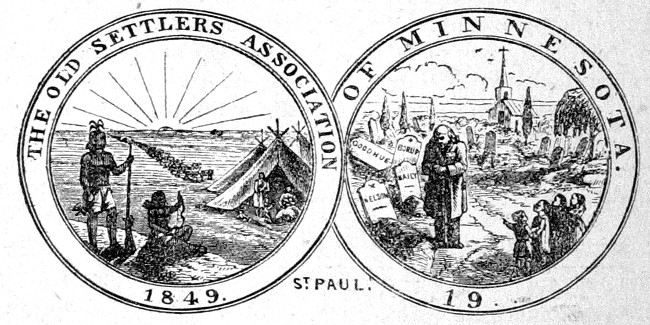
It was provided that no person should be eligible to a membership who had not been a resident of the Territory prior to Jan. 1, 1850. The seal of the association was devised by Aaron Goodrich. On the two sides of the seal were represented the past and the future. In the background of the side representing the past is delineated a plain; in the distance are seen the last rays of the declining sun; nearer are seen Indian hunters, their lodges, women and children, and a herd of buffalo.
Prominent in the foreground of the side representing the future stands an aged man with silvered hair; he leans upon his staff; he is in the midst of a cemetery; the spire of a church is seen in the distance; as he turns from a survey of the various monuments which mark the resting place of departed old settlers, his eye rests upon a new made grave. It is that of his last associate; he is the last survivor; his companions have fallen asleep. A group of children in the foreground represents the rising generation of Minnesota which shall reap the fruits of the pioneer's toil.
SEAL OF THE ASSOCIATION.
ORGANIZATION.
The first meeting of the Old Settlers Association was held, in pursuance of public notice, at the hall of the Historical Society of Minnesota, in the capitol, in St. Paul, on Saturday, Feb. 27, 1858.
On motion of Judge Goodrich, his excellency Henry H. Sibley was unanimously elected president. Hon. Aaron Goodrich and Hon. L. A. Babcock were unanimously elected vice presidents, A. L. Larpenteur, Esq., secretary, and J. W. Bass, Esq. treasurer. After which Gov. Sibley addressed the meeting in a manner able, pertinent and feeling. Several other members spoke.
On motion a committee of three was appointed by the chair to report by-laws for the government of the association. Also a committee of three to report such measures as shall be deemed best calculated to effectuate the objects of the charter.
The president appointed H. L. Moss, L. A. Babcock and T. R. Potts committee on by-laws, and Aaron Goodrich, B. W. Lott and Chas. S. Cave committee on charter.
Judge Goodrich said this occasion was one of deep and abiding interest to the pioneers of Minnesota; that there were epochs in our history that should be commemorated. He desired that the first day of June be fixed upon as the day for the future meetings of the association; he named this day for the reason that on the first day of June, 1849, the local organization of this Territory took place.
The following resolution was adopted:
Resolved, That the annual meeting of this association be held on the first day of June, providing that when said month shall commence on the Sabbath, said meeting shall be held on the following Monday.
On motion of Judge Goodrich the following preamble and resolution were adopted:
Whereas, The object of this association and the individuals composing the same are closely allied to and identified with that of the Historical Society of Minnesota, therefore
Resolved, That up to the period in which this association shall possess a hall in which to meet, its place of meeting shall be the hall of said Historical Society.
As a matter of history we record the names of the members originally and subsequently enrolled.
Ames, Michael E.* Ayer, Frederick.* Abbott, G. S.+ Altenberg, William.* Armstrong, William.+ Atkinson, John W. Anderson, John.+ Arpin, A.* Babcock, Lorenzo A.* Bailly, Alexis.* Bass, Jacob W. Beatty, James. Banfill, John.* Barton, Thomas.* Bazille, Charles.* Becker, George L. Berard, Antoine.+ Bevans, Henry L.* Black, Mahlon. Bautien. V.+ Beaulieu, Clement H. Beau, James.+ Bishop. Thornton. Beaupre, Philip. Blackburn, John T. Burns, Hugh. Berriwick, J.* Blair, O. H.* Boutwell, W. T. Blakeley, Russell. Bolles, Lemuel.* Borup, Chas. W. W.* Bostwiek, Lardner.* Bradley, J.* Brady, Patrick.* Brawley, Daniel J.* Brisette, Edmond.* Bromley, C. B. Brown, Joseph R.* Brown, Wm. R.* Brunson, Benj. W Bryant, Alden.+ Buffit, C.+ Burkelo, Samuel.* Bottineau, Pierre. Bettington, John C.+ Beauchier, Francis.+ Besour, A. C.* Bailly John.+ Boal, James Mc C.* Campbell, George W.* Cavalier, Charles. Cave, Chas. S. Cavender, A. H. Chute, Rirchard. Clewitt, James R.* Colter, William.* Conway, Chas. R. Cooper, David.* Cormack, John.* Cave, William. Culver, George.* Culver, J. B.* Connell, William.+ Cummings, R. W. Curtis, Harley.* Chapman, John J.+ Cloutier, A.+ Colby, Wm. F. Colter, Charles. Carlie, C.* Chase, A. M. Comer, Elias H. Church, Cal.+ Dana, Napoleon, J. T. Day, David. Day, James.* Dayton, Lyman.* Desmarais, Louis. Desnoyers, Stephen.* Dewey, John J. Dibble, William B.* Doe, William E.* Day, Henry T. Day, Leonard P.* Dorr, Caleb D. Dobney, John. Durant, E. W. Day, William P.+ Dudley, John. Davis, Patten W. Dresser, Horace.+ Elfelt, Charles D. Ely, Edmund F.* Ellison, Smith. Eddy, Frank S.* Eldridge, Ariel. Eaton, Alonzo.+ Elfelt, L. C.* Faribault, J. B.* Faribault, Alex.* Farrington, G. W.+ Fisher, Jacob. Forbes, W. H.* Ford, J. A.+ Finch, T. M.+ Findley, S. J.* Foster, A. D.* Foster, Thomas.* Freeborn, William.* French, A. R.* Folsom, S. P. Furber, J. W.* Furber, P. P.* Fuller, A. G.+ Folsom, W. H. C. Fox, Patrick. Fairbanks, John H. Foster, Henry.+ Furber, Theodore. Fisk, Frank. Folsom, Edgar. Folsom, Ward W. Farnham, S. W. Fillmore, R. G. Fisher, John. Finn, William. Farnham, Rufus, Jr. Gammel, Irenus.* Gibbs, H.R. Gilman, David.* Godfrey, Ard. Goodrich, Aaron.* Greely, Elam.* Guerin, Vetal.* Gautier, Napoleon. Guernsey, W.H. Glenn, Samuel.* Getchel, W. W. Gervais, Benjamin. Gardner, Charles R. Gardner, John C.* Gray, Isaac. Guion, Joseph. Hartshorn, W.* Hartshorn, W. E. Hobart, Chancey. Holcombe, William.* Holmes, Thomas.* Hoyt, B. F.* Hoyt, Lorenzo. Hopkins, Daniel.* Hopkins, Peter. Humphrey, J. K. Harris, George. Holton, John.* Houghton, George. Houghton, James. Haskell, Joseph. Hone, David.* Henkly, J. S.+ Hoffman, James.+ Haskill, Hiram.+ Hetherington, Thomas,* Holcombe, W. W. Hill, Lewis. Irvine, J. R.* Irvine, B. F. Jackson, Henry.* Jarvis, W. H.* Johnson, P. K. Johnson, R. W. Jackins, John.* Jackman, H. A. Kellogg, M. N. Kennedy, Robert. Kittson, N. W.* Keogh, James. Knox, M. C. Kent, William. Kattenberg, Henry. Lambert, H. A.* Larpenteur, E. N.* Larpenteur, A. L. Lennon, J. G.* Lennon, J. E. Leavitt, Martin. Lull, C. P. V. Lyman, Cornelius S.* Lott, B. W.* Ludden, J. D. Leonard, C. E. Loomis, D. B. Lowry, S. B.* Lyman, Stoers B. Lyman, David P. McKenny, J. H.* McKenzie, J. G. Masterson, H. F. McKusick, John. McKusick, J. E. Mitchell, J. B. H. Marshall, W. R. McLeod, Martin.* McCleod, Alexander.* McLean, N.* Murphy, Edward.* Meeker, Bradley B.* Murphy, Alfred C.+ McKusick, William. McHattie, Alexander. Manaege, Peter. Mackey, Andrew. McDonald, R.+ Masier, Josiah.* Marks, Isaac.* Moreau, Charles.* Mahoney, Wm.* Mahoney, Jeremiah. Morgan, John.* Moffett, Lot.* Morrison, W. C. Morrison, Allen.* Morton, T. F.* Moss, H. L. Murray, M. P. Murphy, J. W. Myrick, Nathan. McComb, J. D. McKean, Elias. McMullen, James.+ McLean, Henry.+ Masterman, Joseph. Mause, John. Mower, Wm.* Mower, Martin. Mower, John E.* Mosher, Jacob. McHale, M.+ McHattie, John. McLery, Charles.+ Moulton, E. (Jr.)+ McCarty, A.+ Manse, Charles.+ Neill, E. D. Nichols, G. C.* Nelson, Socrates.* Nobles, W. H.* Norris, J. S.* North, J. W. Northrup, Anson. Newbury, H. H. Oakes, C. H.* Oakes, David.* Odel, T. S.* Olmsted, David.* Owens, J. P.* Parker, Rodney.* Perin, Moses. Potts, T. R.* Prescott, Philander.* Presley, Bartley.* Pomeroy, J. H. Proctor, J. S. Pond, G. H. Powers, Simon.* Potter, Colver.+ Perro, Joseph. Parker, L. N. Parsons, Oliver. Quinn, W. B. Quinn, Peter.+ Randall, B. H. Randolph, S. R.* Ramsey, Alexander. Ramsey, J. C.* Ravoux, Auguste. Reed, C. M.* Rice, H. M. Rice, Edmund. Robertson, Andrew.* Rice, C. R.* Robert, Louis.* Robert, Joseph.* Richardson, R. M. Rollins, John.* Rose, Isaac.* Russell, R. P. Russell, Jeremiah.* Riggs, S. R.* Robert, Alexis.+ Roy, Peter.* Russell, William. Rohrer, Daniel. Robert, Nelson. Rogers, John. Ramsden, Thomas. Rutherford, Wm.* Rogers, Richard.+ Rutherford, James.* Selby, J. W.* Simons, Orlando. Simpson, J. W.* Simpson, Robert. Shaffer, C. E. Shearer, A. L.* Sherman, M. Spencer, J. B. Spicer, Nathan.+ Shelley, E. Y. Steele, Franklin.* Spencer, John H.+ Sawyer, Seth M.* Spates, Samuel.+ Somerville, John.+ Stevens, J. H. Stone, Lewis.* Sturgis, W.* Sweet, G. W. Setzer, H. N. Stanchfield, Sam.* Sibley, H. H. Stinson, C. F.+ Santel, A.+ Staples, Josiah.+ Shamley, John+ Sanford, H. S.+ Shearer, James. Stratton, L. W.* Scott, C. P.+ Short, A. J. Shoasby, John.* Stiles, W. L.+ Taylor, J. L. Taylor, Jesse W.* Taylor, N. C. D.* Terry, J. C. Tinker, W. H. Thompson, James (colored).* Trask, Sylvanus. Trower, John.+ Thompson, G. W.* Terry, Robert.* Van Voorhes A.* Villaume, Thomas.* Von Tassel, William.* Walker, Orange.* Whitaker, E. H. Whitney, J. C. Wilkinson, M. S. Wilkin, Alex.* Wells, James.* Wilson, Harvey.* Woodbury, Warren.* Willoughby, A.* Wright, Thomas.+ Williamson, T. S.* Willim, William. Wilmarth, Alvin M. Wallis, John.+ Worthingham, Wm.+ White, Asa.* Westing, Henry.* Welshance, M.* Williams, D. D.* Whalen, Patrick.* Yorks, J. C.
[Note: * Deceased.]
[Note: + Unknown.]
OBJECTS AND ORGANIZATION.
The society was organized in 1849 by a few of the pioneers of the Territory, and incorporated by an act of the first territorial legislature, approved Oct. 20, 1849, this being the first literary institution organized in the Territory; and its "library," then only a few volumes, was the first ever established in Minnesota. The original charter of the society stated its objects to be: "The collection and preservation of a library, mineralogical and geological specimens, Indian curiosities, and other matters and things connected with, and calculated to illustrate and perpetuate the history and settlement of said Territory." The amended charter of 1856 enacted: "The objects of said society, with the enlarged powers and duties herein provided, shall be in addition to the collection and preservation of publications, manuscripts, antiquities, curiosities, and other things pertaining to the social, political and natural history of Minnesota, to cultivate among the citizens thereof a knowledge of the useful and liberal arts, science and literature."
The work of this society may therefore be formulated thus:
I. (1) The collection, (2) the preservation, (3) the publication of materials for the history of Minnesota and its people.
II. The collection and management of a library containing useful works of reference on the most valuable departments of knowledge.
III. The diffusion among citizens of the State of useful knowledge.
ITS PROGRESS.
In the early days of the Territory, owing to its want of means, the sparse population and its poverty, and the infancy of the commonwealth generally, the society accomplished but little beyond collecting some information regarding the early history of this region, and printing the same in several pamphlet volumes. In 1864 it had only eight hundred and forty volumes in its library. It was then reorganized, and with the aid of a small annual appropriation from the State, since enlarged, has been able to make very gratifying progress.
ITS PRESENT CONDITION.
It has now comfortable apartments in the state capitol, a building believed to be fireproof; a sufficient income to pay its current expenses, granted partly by the State and partly contributed by its members; one of the largest and most valuable libraries in the State, containing 22,000 volumes of choice works, together with a cabinet or museum of historical and archælogical curiosities, and a number of historical pictures, engravings, manuscripts, etc. An endowment fund of several thousand dollars, accumulated by gifts and membership fees; two lots, eligibly situated, on which at no distant day, will be erected a fireproof building.
PROPOSED BUILDING FOR THE SOCIETY.
Reference was made before to the building lots of the society. These were purchased by a subscription of the members in 1855, for the sum of $1,500, in hopes that the society would be enabled to erect thereon a fireproof building for its use, but up to this time it has not been able to do so. The lots are now valued at $20,000 or more. Several months ago an effort was made by the president of the society to raise enough by subscription to insure the commencement of a building to cost, completed, $50,000; of this amount $14,500 was subscribed, and it is believed that there are liberal and public spirited citizens of our State who will contribute the balance when called on, or provide, by will, for bequests in its aid. Such an edifice would be a perpetual monument to their generosity and public spirit, and would be an inestimable boon to succeeding generations, who will frequent our library in pursuit of knowledge.
PRESIDENTS OF THE OLD SETTLERS ASSOCIATION.
1858. Henry H. Sibley. 1859. Socrates Nelson. 1860. J. E. McKusick. 1861. Wm. H. Nobles. 1862. Dr. T. R. Potts. 1863. Frank Steele. 1864. R. M. Richardson. 1865. John D. Ludden. 1866. Socrates Nelson. 1867. Abram Van Voorhes. 1868. Henry H. Sibley. 1869. Nathaniel McLean. 1870. Bartlett Presley. 1871. John H. Stevens. 1872. George L. Becker. 1873. David B. Loomis. 1874. Henry M. Rice. 1875. Alex. Ramsey. 1876. Norman W. Kittson. 1877. Charles H. Oakes. 1878. Mahlon Black. 1879. Charles E. Leonard. 1880. Benj. H. Randall. 1881. S. P. Folsom. 1882. Jacob W. Bass. 1883. Benj. W. Brunson. 1884. Clement H. Beaulieu. 1885. Henry L. Moss. 1886. R. W. Johnson. 1887. Anson Northrup. 1888. David Day.
Judge Goodrich was secretary of the Old Settlers Association from 1859 until his death, in 1887.
THE ST. CROIX VALLEY OLD SETTLERS ASSOCIATION.
This association was organized Nov. 5, 1875, at the office of Durant & Wheeler, in the city of Stillwater. Charles E. Leonard was elected president, and David B. Loomis, secretary. The latter has been re-elected and served continuously to the present time. It is a requisite that members shall have been residents in the Northwest prior to 1850.
The following have been presidents of the association, the term of service being limited to one year:
1875. D. B. Loomis. 1876. Christopher Carli. 1877. W. T. Boutwell. 1878. John D. Ludden. 1879. Henry L. Moss. 1880. Wm. R. Marshall. 1881. Daniel Mears. 1882. Henry A. Jackman. 1883. W. H. C. Folsom. 1884. Edward W. Durant. 1885. Albert Stimson. 1886. Henry N. Setzer. 1887. Morton S. Wilkinson.
The annual meetings are held on or about the middle of September, at Stillwater.
NEWSPAPER HISTORY IN RAMSEY COUNTY.
The St. Paul Weekly Pioneer, established by James M. Goodhue as the Minnesota Pioneer, issued its first number April 28, 1849, one day later than the St. Paul Register, but, unlike that paper, it was printed in the place of publication. In March, 1854, Earl S. Goodrich purchased the Pioneer, and on May 1st issued the first number of the Daily Pioneer. On Oct. 31, 1855, the Democrat was merged in the Pioneer, which became the Pioneer and Democrat, which name it continued to bear for six years, when it resumed its former name, the Pioneer. Nov. 8, 1865, the Pioneer was sold to H. P. Hall and John X. Davidson. July 29, 1866, the Pioneer was sold to Capt. H. L. Carver, C. W. Nash and others. April 22, 1874, the Pioneer became the property of David Blakely. April 11, 1875, the Pioneer and Press consolidated, and the name was changed to St. Paul Pioneer Press, under the management of the Pioneer Press Company, with J. A. Wheelock editor-in-chief. The Pioneer Press now embodies, by consolidation, twenty-five distinct newspapers. Its daily issue is about 18,000 copies. The stock company is now officered by J. A. Wheelock, president; F. Driscoll, Sr., vice president and treasurer; F. Driscoll, Jr., secretary. The management is in the hands of J. A. Wheelock, editor-in-chief; F. A. Carle, managing editor; F. Driscoll, business manager; A. W. Dunn, city editor.
The St. Paul Globe was established Jan. 15, 1878, by H. P. Hall, and conducted as an individual enterprise until July 1, 1881, when it was made into a stock company with a capital of $150,000. Its first officers were: President, H. H. Sibley; vice president, P. H. Kelly; treasurer, Albert Scheffer; secretary, Ansel Oppenheim; general manager, H. P. Hall. This company, which was called the St. Paul Globe Printing Company, was sold to a new company, styled the St. Paul Globe Publishing Company, Feb. 1, 1885. The first officers of that company were: President, N. W. Kittson; vice president, P. H. Kelly; treasurer, Albert Scheffer; secretary and general manager, Lewis Baker. All the officers of each company were resident in St. Paul. The Globe publishes daily and weekly editions.
The St. Paul Dispatch was founded by H. P. Hall and David Ramaley, Feb. 29, 1868. It has passed through many ownerships. The company publish a weekly and evening daily paper.
The St. Paul Daily Times was established in 1854, by T. M. Newson, M. J. Clum and J. B. H. Mitchell. In 1869 it was merged into the St. Paul Press.
The Register, Chronicle and Democrat were published in territorial days, and have been discontinued.
Die Volkszeitung, the first German paper of St. Paul, was established in 1857. Another German paper was subsequently established, and the two were consolidated, Sept. 6, 1877, as Die Volkszeitung. It issues daily and weekly editions. Chas. H. Lineau is general manager, A. Wolff, editor-in-chief; C. Newhausen, city editor, and Louis Hern, literary editor.
The Northwest Magazine is a monthly journal, devoted to the interests of the Northwest. It was established in 1883. E. V. Smalley is the editor.
OTHER ST. PAUL PUBLICATIONS.
A. O. U. W. Guide, weekly Guide Publishing Company, established 1883.
Pythian Advocate, monthly, Pythian Company, established 1884.
Northwestern Chronicle, weekly (Catholic), Northwestern Publishing Company, established 1866.
Herald, weekly, Chantler & Nichols, established 1883.
Der Wanderer (German), weekly, Wanderer Publishing Company, established 1867.
Familien Zeitung (German), weekly, Engel-Dreis Company, established 1885.
Le Canadien (French), weekly, E. R. Dufresne, L. N. Dixon, established 1877.
Nordvesten (Scandinavian), weekly, C. H. Brandt, established 1880.
Skaffaren (Swedish Lutheran), weekly, J. E. Osborn, established 1877.
Northwestern Lancet, semi-monthly, C. B. Witherle, established 1882.
Northwest Reporter (legal), weekly, West Publishing Company, established 1881.
Saturday Evening News, weekly, Lewis & Bole, established 1883.
Western Appeal, weekly, F. D. Parker, established 1885.
Home Gazette, monthly, S. Sherin, established 1883.
St. Paul Daily Evening News, established 1888.
St. Paul Labor Echo, Eric Olson, established 1884.
White Bear Lake Breeze, A. H. S. Perkins, established 1879.
HENNEPIN COUNTY.
The first paper established in Hennepin county as now bounded was the St. Anthony Express, E. Tyler, publisher, Isaac Atwater, editor. The first number was issued May 31, 1857. The Minneapolis Democrat was established in 1854. Neither of these papers is to be found in the directory.
PAPERS OF MINNEAPOLIS.
Evening Journal, daily, D. B. Blakely, established 1887.
Evening Mercury, daily, E. Ferwald, established 1885.
Minneapolis Gazette, daily, W. Bickley, established 1870.
Minneapolis Tribune, daily, Will E. Haskell, Tribune Publishing Company, established 1867.
Commercial Bulletin, weekly, Commercial Publishing Company, established 1883.
Minneapolis Life, weekly, W. E. Atkins, established in 1885.
Saturday Evening Spectator, weekly, C. H. Dubois, established 1879.
Temperance Review, weekly, L. Bixby, established 1865.
Budstikken (Norwegian), Johann E. Gidde, established 1873.
Folkebladt (Norwegian), weekly, Folkebladt Publishing Company, established 1878.
Svenska Posten (Swedish), weekly, Svenska-American Publishing Company, established 1885.
Svenska Tidning (Swedish), weekly, Svenska Publishing Company, established 1883.
Svenska Kistna Herolden, weekly, Svenska Herolden Publishing Company, established 1885.
Herold (German), weekly, German Press Association, established 1884.
Freie Presse (German), weekly, F. Doerr, established 1869.
Le Progres (French), weekly, J. B. A. Paradis, established 1884.
Echo De L'Ouest (French), weekly, A. F. Carrier, established 1883.
Free Baptist, weekly, A. A. Smith, established 1882.
Northwestern Standard, weekly, Ed. O'Brien, established 1885.
Northwestern Presbyterian, weekly, Edgar A. Gay, established 1884.
Our Church (Unitarian), semi-monthly, Rev. L. D. Boynton, established 1885.
Farm, Stock and Home Journal, monthly, Farm, Stock and Home Company, established 1884.
Mississippi Valley Lumberman, weekly, Platt B. Walker, established 1876.
Northwestern Miller, weekly, C. M. Palmer, established 1873.
Northwestern Trade, bi-weekly, E. E. Haynes, established 1883.
Homestead, monthly, Homestead Publishing Company, established 1885.
Housekeeper, monthly, Buckeye Publishing Company, established 1878.
Medical Mirror, monthly, N. M. Cook, M.D., established 1881.
Northwestern Architect, monthly, Bruce & Brundage, established 1884.
Pilgrim (Congregational), monthly, Pilgrim Publishing Company, established 1881.
Poultry and Farm Journal, monthly, I. I. Bachellor, established 1877.
Real Estate Review, monthly, C. H. Dubois & Co., established 1883.
Temperance Educator, monthly, L. Bigby, established 1882.
To-Day (Evangelical), Geo. F. Wells, A. S. Edwards, established 1880.
Wood and Iron, monthly, Wood and Iron Publishing Company, established 1880.
Methodist Herald, weekly, R. H. Young, established 1887.
EXCELSIOR.
Minnetonka Mirror, weekly, W. H. Mitchell, established 1885.
Northwestern Tourist, weekly, A. S. Dimond & Son, established 1876.
WASHINGTON COUNTY.
The first newspaper published in Washington county was the St. Croix Union, established Oct. 8, 1854, in Stillwater. It was continued under the management of Cable & Easton one year, when F. S. Cable sold out to Milton H. Abbott. Soon after Mr. Abbott bought out the interest of M. S. Easton. The paper went down in the crash of 1857.
The Stillwater Messenger made its appearance under the management of A. T. Van Voorhes, Sept. 11, 1856. It changed ownership several times, and in 1871 Seward & Taylor, the present owners, came into possession.
The Stillwater Democrat succeeded the defunct Union in 1858. L. F. Spaulding and C. P. Lane became the editors and proprietors. It was discontinued in 1861.
A. B. Easton and J. N. Castle established the Stillwater Gazette, the first number appearing Aug. 6, 1870. This paper was successful from the first, and with but few changes in proprietorship is published at the present day as a daily and weekly by Clewell & Easton.
The Stillwater Lumberman was established April 9, 1875, by Ed. H. Folsom. It afterward passed into the hands of a stock company, and was discontinued in 1884.
The Stillwater Post, a German paper, was established by W. P. Shilling & Co. Aug. 26, 1876. Two years later it passed into the hands of Wm. Schermuly, and in 1880 it was taken charge of by Julius Duel, who is succeeded by F. C. Neumeier.
CHISAGO COUNTY.
Taylor's Falls Reporter, F. H. Pratt, established February, 1860; in 1862 the name was changed to Taylor's Falls Monitor; in 1883 the name was again changed to Taylor's Falls Journal; present editor, Ed. H. Folsom.
Rush City Pos., Hial P. Robie, established in 1875.
Chisago County Times, Taylor's Falls, Rowe & Walker, established April 19, 1888.
PINE COUNTY—PINE CITY.
Pine County Pioneer, weekly, Ed. C. Gottry, established 1885.
CARLTON COUNTY—CLOQUET.
Pine Knot, weekly, Dr. H. B. Allen, established 1884.
Industrial Vidette, established 1887.
ST. LOUIS COUNTY—DULUTH.
Tribune, weekly and daily, R. C. Mitchell, established 1881.
Lake Superior News, weekly, Wm. S. Woodbridge, established 1878.
Duluth Daily News, established 1885.
Duluth Skandinav, Wesenbergad Hurst, established 1887.
Paragrapher, established 1887.
Volksfreund, Dworsehak & Son, established 1886.
Evening Journal, established 1887.
TOWER.
Tower Press, C. T. Bingham, established 1885.
TWO HARBORS.
Iron Post, A. De Lacy Wood, established 1887.
AITKIN COUNTY—AITKIN.
Aitkin Age, weekly, E. F. Barrett, established 1883.
CROW WING COUNTY—BRAINERD.
Brainerd Dispatch, weekly, Ingersoll & Willard, established 1881.
Brainerd Journal, weekly, H. C. Stivers, established 1882.
Northwestern Tribune, weekly, Halsted & Pennell, 1872.
The News, daily, established 1887.
KANABEC COUNTY—MORA.
Mora Times, weekly, R. W. Safford, established 1882.
MILLE LACS COUNTY—PRINCETON.
Princeton Union, weekly, R. C. Dunn, established 1876.
MORRISON COUNTY—LITTLE FALLS.
Little Falls Sun, weekly, Little Falls Publishing Company, Cyrus D. Auyer, editor, established 1882.
Little Falls Transcript, weekly, W. M. Fuller, established 1877.
Morrison County Democrat, weekly, Cyrus D. Auyer, established 1886.
ROYALTON.
Royalton Record, weekly, changed name to Royalton Banner, A. W. Swanson, editor, established 1884.
The first newspaper in Morrison county was the Northern Herald, established in Little Falls, 1856, suspended in 1858. The Little Falls Courier was established later, but discontinued and the Transcript took its place.
STEARNS COUNTY—MELROSE AND SAUK CENTRE.
Herald and Record, weekly, C. F. Hendryx, established 1867.
SAUK CENTRE.
Democrat, weekly, Barnum and Henshaw, established 1885.
Tribune, weekly, W. C. Brower, established 1873.
ST. CLOUD.
Der Nordstern (German), weekly, Rosenberger & Remer, established 1874.
Journal-Press, weekly; W. Mitchell, established 1857.
Times, weekly, C. F. MeDonald, established 1861.
The first paper in St. Cloud, and in Stearns county, was styled the Minnesota Advertiser. The first number appeared Jan. 1, 1857, H. Cowles, editor, and James Mowatt, publisher. Mrs. Jane G. Swisshelm succeeded to the proprietorship in December, 1857, and changed the name to the St. Cloud Visitor, and edited it till the destruction of her press and material by a mob, March 24, 1858. The paper reappeared under new auspices and with the name changed to the Democrat. In 1866 W. B. Mitchell changed the name to the Journal. In 1876 he purchased the Press and consolidated it under the name of Journal-Press.
The St. Cloud Union was established in 1861, by C. C. Andrews, afterward a general in the Union Army and minister to Sweden and Norway. In 1862 Mr. Wood purchased the paper, but sold it in 1863 to Spafford & Simonton, who sold it in 1864 to R. C. Moore, who published it as the St. Cloud Times. In 1875 it was purchased by the present owner, C. F. McDonald.
The Nordstern was originally established by Peter E. Kaiser and Peter Brieke and has now a circulation of 25,000 copies.
SHERBURNE COUNTY—ELK RIVER.
Sherburne County Star News, weekly, A. N. Dare, established 1875.
A. J. Clark started the Sherburne Weekly in 1867, and published it one year, when John W. Thompson started the Elk River News. The Sherburne County Star was established in 1875, and consolidated with the News in 1861.
ISANTI COUNTY—CAMBRIDGE.
Isanti County Press, weekly, C. W. Van Wormer, established 1874.
BENTON COUNTY.
Watab Reveille, weekly, J. W. Chasanack, editor, established 1850.
Free Press, weekly, A. De Lacy Wood, established 1885.
In 1854 Jeremiah Russell and George W. Benedict started the Sauk Rapids Frontiersman, and continued the publication three years, when the New Era made its appearance, published by W. H. Wood assisted by G. W. Benedict. The Era was afterward merged in the St. Cloud Times. In 1868 G. W. Benedict established the Sauk River Sentinel which, with a few changes, has continued to the present time.
ANOKA COUNTY—ANOKA.
Anoka County Union, weekly, Granville S. Pease, established 1865.
Anoka County Herald, weekly, Alvah Eastman, established. 1865.
DAKOTA COUNTY—FARMINGTON.
Dakota County Tribune, weekly, C. P. Carpenter, established 1884.
Hastings News, daily, D. F. Chamberlain, established 1881.
Hastings Banner, weekly, E. D. Barker, established 1865.
Hastings Gazette, weekly, Irving Todd, established 1857.
Hastings Bugle Call, monthly, Chamberlain & Smith, established 1886.
GOODHUE COUNTY—CANNON RIVER FALLS.
Beacon, weekly, S. S. Lewis, established 1876.
KENYON.
Leader, weekly, U. Curtis, established 1885.
PINE ISLAND.
Journal, weekly, Holmes & Ingalls, established 1882.
RED WING.
Red Wing Republican, daily, Red Wing Publishing Company, established 1885.
Red Wing Advance Sun, weekly, Red Wing Publishing Company, established 1884.
Red Wing Argus, weekly, C. L. Davis, established 1864.
ZUMBROTA.
Independent, weekly, E. A. Mitchell, established 1875.
News, weekly, Thompson & Bradford, established 1877.
WABASHA COUNTY—MAZEPPA.
Tribune, weekly, M. Schrane, established 1877.
PLAINVIEW.
News, weekly, Ed. A. Paradis, established 1874.
Wabasha County Herald, weekly, O. F. Collier &.Co., established 1857.
Wabasha County Post, weekly, John P. W. Weller, established 1885.
WINONA COUNTY—ST. CHARLES.
St. Charles Union, weekly, J. S. Whitten, established 1877.
Winona Republican, daily and weekly, Sinclair Publishing Company, established 1855.
Adler, weekly, Adler Publishing Company, established 1873.
Herald, weekly, Boynton & Metcalf, established 1869.
Westlicher Herald, weekly, Joseph Leicht, established 1881.
Wiarus (Polish), weekly, Wiarus Publishing Company, established 1885.
NEWSPAPERS IN WISCONSIN.
PIERCE COUNTY—ELLSWORTH.
Pierce County Herald, weekly, Case & Doolittle, established 1868.
Ariel, weekly, John M. Pryse, established 1884.
Pierce County Plaindealer, weekly, E. H. Ives, established 1874.
RIVER FALLS.
Journal, weekly, S. B. Merrick. W. S. Fowler, established 1874.
The first paper named in Prescott was the Paraclete, published by C. E. Young, Feb. 14, 1854. The name was changed in 1855 to the Transcript. In 1857 the Northwestern Democrat was issued by Lusk, Wise & Bailey. In 1861 Lute A. Taylor moved the River Falls Journal to Prescott, changing the name to Prescott Journal. In 1868 Flint & Webber purchased the Journal. In 1872, after the fire, the River Falls Journal was revived at River Falls by A. Morse; the office and material were burned. In 1873 M. B. Kimball issued the Prescott Clarion and changed the name to Pierce County Plaindealer. In 1876 E. H. Ives became editor and proprietor.
ST. CROIX COUNTY—BALDWIN.
Bulletin, weekly, Ferd. Peachman, established 1879.
HAMMOND.
Hammond Review, weekly, —— Frost, established 1886.
HUDSON.
Star and Times, weekly, Taylor & Price, established 1855.
True Republican, weekly, Cline & Cogswell, established 1871.
NEW RICHMOND.
St. Croix Republican, weekly, Abe C. Van Meter, established 1869.
The Voice, weekly, E. P. Huntington, established 1886.
The St. Croix Banner, the first paper in the St. Croix valley, was issued Jan. 20, 1850, by Col. and Mrs. James Hughes. It was printed in the Pioneer office, St. Paul. Saxton & Johnson in the same year commenced publishing the St. Croix Enquirer. These papers were short-lived. In 1853 U. B. Shaver started the Hudson Journal, afterward edited by Col. Hughes as the Hudson Republican. The office was destroyed by fire and the paper discontinued in 1854. The Star was established by Dr. Otis Hoyt in 1855, and in the same year U. B. Shaver established the Chronicle. In 1860 these two papers were purchased by Horace A. Taylor, and consolidated as the Star and Times.
In 1856 Col. Hughes issued the Shield and Banner, which was succeeded by a campaign paper called the Pathfinder. The Hudson Democrat was established in 1864 by E. O. Jones and discontinued in 1875. The True Republican was established by M. A. Fulton in 1875, and sold to the present owners in 1886.
POLK COUNTY—CLEAR LAKE.
Clear Lake Herald, weekly, A. T. Churchill, established 1884.
North Wisconsin News, weekly, Johnson E. Russell.
OSCEOLA MILLS.
Polk County Press, weekly, Charles E. Mears, established 1860.
ST. CROIX FALLS.
St. Croix Valley Standard, weekly, George F. Ely, established 1885.
The St. Croixian was first established at St. Croix in 1860 by John D. Reymert and Junius Bartlett. S. S. Fifield bought the paper in 1861, and removed it to Osceola, changing the name to Polk County Press. In 1872 C. F. Meara succeeded to the ownership. In 1874 C. C. Jordan established the New Era at Osceola, but soon discontinued it. The Dalles of the St. Croix was established at St. Croix Falls in 1881 by D. A. Caneday, and discontinued in 1884. The Polk County News was established at St. Croix Falls in 1885 by George H. Ely, who was succeeded by L. A. Ingersoll, who changed the name to St. Croix Valley Standard.
BARRON COUNTY—BARRON.
Barron County Shield, weekly, Charles S. Taylor, established 1876.
CHETEK.
Alert, weekly, Walter Speed, established 1882.
CUMBERLAND.
Advocate, weekly, Cumberland Publishing Company, established 1885.
RICE LAKE.
Barron County Chronotype, weekly, P. H. Swift, editor, established 1874.
Times, weekly, Times Publishing Company, established 1883.
SAWYER COUNTY—HAYWOOD.
North Wisconsin News, weekly, E. O. Johnson, established 1878.
BURNETT COUNTY—GRANTSBURG.
Burnett County Sentinel, weekly, W. A. Talboy, established 1875.
ASHLAND COUNTY—ASHLAND.
Ashland Press, weekly and daily, Sam S. Fifield, established 1872.
Ashland News, weekly, John S. Saul, established 1885.
GLIDDEN.
Glidden Pioneer, weekly, R. M. Williams, F. A. Healy, established 1884.
HURLEY.
Montreal River Miner, weekly, Gowdey & Goodale, established 1885.
BAYFIELD COUNTY—BAYFIELD.
Bayfield Press, weekly, Currie G. Bell, established 1868.
WASHBURN.
Washburn Bee, weekly, Allan T. Williams, established 1885.
Itemizer, weekly, Bareger Brothers, established 1884.
DOUGLAS COUNTY—SUPERIOR.
Superior Chronicle, John C. Wise, established 185-.
Superior Times, Bardon Brothers, established 1870.
Inter Ocean, weekly and daily, Street & Co., established 1881.
Superior Sentinel, M. B. Kimball, established 1888.
Sunday Morning Call, established 1887.
WASHBURN COUNTY.
Shell Lake Watchman, William Irle, established 1882.