Chapter IX · THE 4.7” RIFLE, MODEL 1906.
Reading edition
GUN.
Weights and Dimensions.
Weight 2,688 lb.
Caliber 4.7 in.
Total length 134.92 in.
Length of bore 129.42 in.
Length of rifling 111.9 in.
Number of grooves 42
Twist Right hand.
Weight of proj. based fuse 60 lb.
Weight of proj. point fuse 45 lb.
Weight of powder charge 95 oz.
Muzzle velocity, 60 lb. proj. 1,700 ft. per second
Muzzle velocity, 45 lb. proj. 2,050 ft. per second
Maximum range 11,000 meters
THE CARRIAGE.
Weight of carriage complete 5,320 pounds
Weight of carriage and gun complete 8,068 pounds
Maximum elevation 15 degrees
Maximum depression 5 degrees
Maximum traverse 140 mils.
The gun is built up and consists of a tube, jacket, locking hoop and clip. The jacket covers the rear half of the tube and projects beyond the tube at the rear to form the breech recess. The jacket also has a recoil lug on the under side for connecting the recoil cylinder. The clip is a short hoop near the muzzle and has guides formed on it to guide the gun in the cradle on recoil. The jacket also has guides formed on it. The length of the gun is approximately 11 feet.
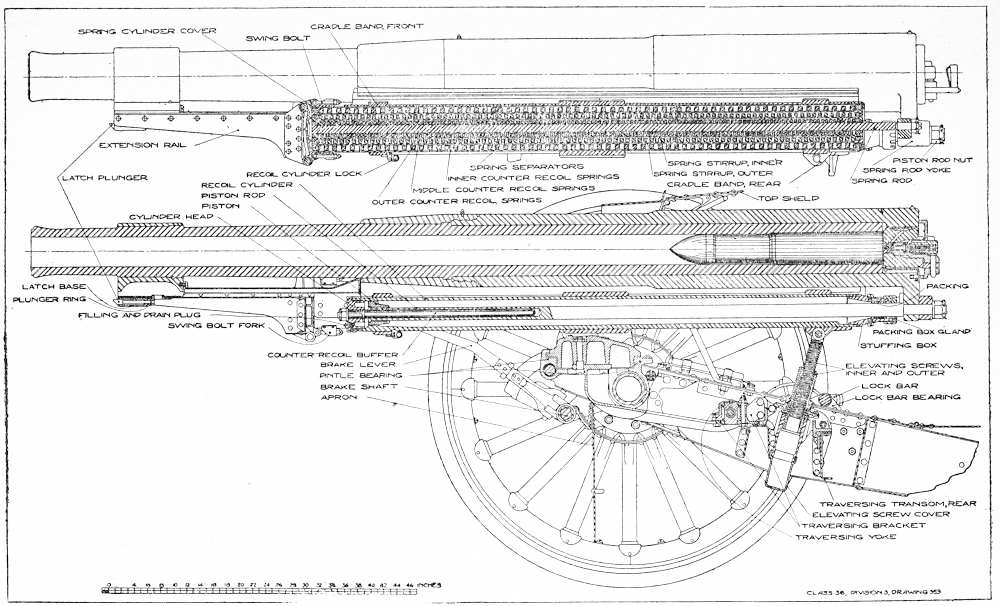
4.7” Rifle
The breechblock is of the interrupted screw type having four threaded and four plain sectors. It is operated by a handle which swings from left to right turning and withdrawing the breech with one motion. An extractor is fitted for throwing out the shell case when the breech is opened after firing.
The firing mechanism is of the type known as a continuous pull mechanism, that is, the mechanism is cocked and fired by the pull on the lanyard or by downward pressure on the firing handle located at the right side of the breech.
The recoil system is of the hydro-spring type.
The two parallel steel tubes (the spring cylinders) are fitted into a frame surmounted by heavy steel rails which form the gun slides thus forming the cradle. The recoil cylinder is fitted between these two.
The recoil and counter-recoil piston rods are attached to the gun lug and recoil with the gun, while the spring cylinders and recoil cylinder remain stationary.
The recoil is constant, being 70 inches for all elevations. The recoil cylinder uses hydroline oil as the buffer medium. Throttling is obtained by three throttling bars running lengthwise of the cylinder which are of varying height to give a throttling effect with corresponding slots in the recoil piston. A counter-recoil buffer is fitted in the piston rod to take up the shock when the springs return the gun into battery.
The trunnions on the cradle are mounted in bearings formed by a yoke which swivels in a pintle bearing provided at the front of the trail.
Traverse is obtained by means of a handwheel and screw mounted on the left side of the trail which swings the yoke in traverse carrying the gun with it. A traverse of 70 mils on each side of center is possible.
The piece is elevated by a double screw type of mechanism. The upper end is attached to the cradle and so raises and lowers it. The screw is operated thru gearing by two handwheels one on each side of the trail from 5° elevation dep. to 15° elevation.
The trail is of the solid type made up of flasks of channel section. It has housings for the axle and carries the pintle bearing in which the top carriage or yoke swings. A tool box is provided in the trail. A seat is provided on each side of the trail for the cannoneers. The lunette transom is fitted about 27 inches from the rear of the trail and carries a bearing that fits the limber pintle.
A trail prop is provided for supporting the trail when limbering.
The spade can be released and folded up on the trail when traveling.
A traveling lock is provided on the trail for locking the gun when traveling. The piston rod and spring rods must be disconnected before the gun can be drawn back far enough to lock.
The wheels are 61 × 6 inch with rubber tires and band brakes. Some older vehicles have steel tires and are fitted with tire brakes.
An armor plate shield is fitted to the carriage for the protection of the personnel.
The instruments for sighting and laying the piece included a line sight, a rear sight, a front sight, a panoramic sight and a range quadrant.
The line sight consists of a conical point as a front sight and a V notch as a rear sight. These are located on the Jacket of the gun, and are useful for giving a general direction to the gun.
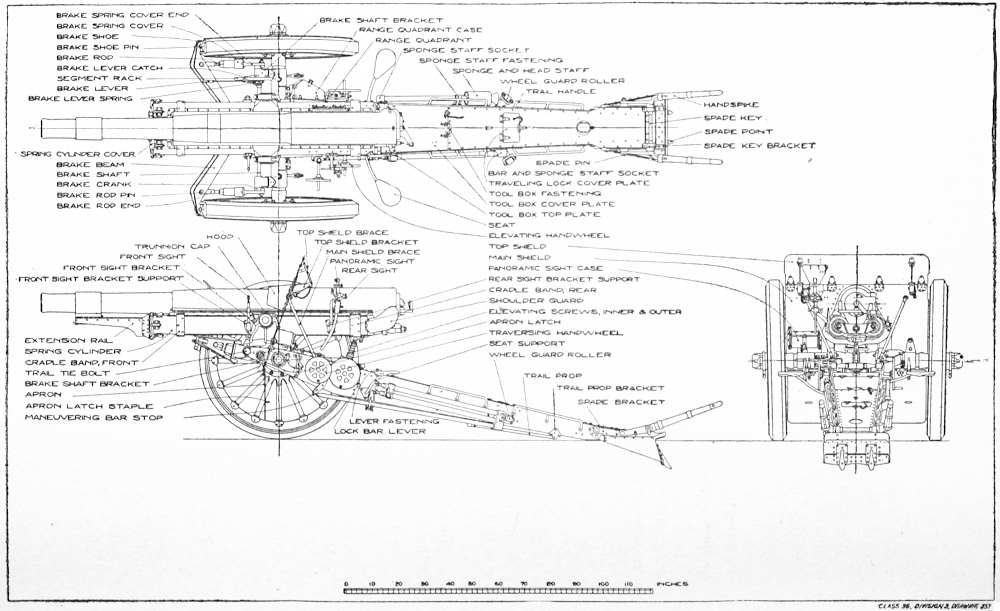
4.7” Rifle
The sighting is similar to the 3”, 1902.
The rear sight and front sight are used for direct aiming. The rear sight is a peep sight mounted on a range scale quadrant by a bracket on right side of the cradle. The front sight is a pair of cross wires mounted in a ring attached by a bracket on the cradle about 3 ft. ahead of the rear sight.
The range scale quadrant has a socket in which the Standard U. S. Panoramic sight may be mounted.
For indirect fire the gunner on the left of the carriage lays for direction only.
On the right side of the cradle is mounted the Range Quadrant which has in combination with it the Angle of Site Mechanism. For indirect fire the gunner on the right of the piece lays for range with this instrument.
Fixed ammunition is used with this gun. Shrapnel and high explosive shell are used. The base fuzed steel shell and the shrapnel weigh 60 lbs. The point fuzed steel shell weighs 45 lbs. Gas shell are also issued identical with the 45 lb. steel shell.