Other Chimerical Creatures and Heraldic Beasts (continued 2)
Reading edition
Azure, a salamander or, in flames proper, is the charge on the shield of the Italian family of Cennio.
The “lizards” which form the crest of the Ironmongers’ Company, were probably intended for salamanders on the old seal of the company in 1483, but are now blazoned as lizards.
The heraldic signification of the salamander was that of a brave and generous courage that the fire of affliction cannot destroy or consume.
In the animal symbolism of the ancients the salamander may be said to represent the element of Fire; the eagle, Air; the lion, Earth; the dolphin, Water.
Heraldic Antelope
This fictitious animal, when depicted in heraldry, has a body like that of a stag, the tail of a unicorn, a head like the heraldic tiger, with two serrated horns, and a tusk growing from the tip of his nose, a row of tufts down the back of his neck, and the like on his tail, chest and thighs. Thus represented it is termed an heraldic antelope to distinguish it from the real or natural antelope, which is also borne in modern coats of arms.
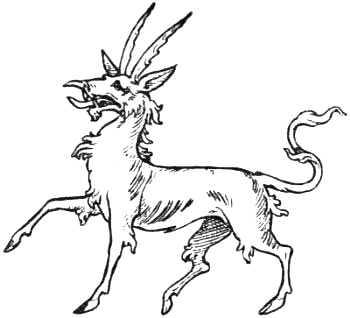
Heraldic Antelope.
The old heralds, with their scant knowledge of the rarer kinds of foreign animals, represented the antelope as a fierce beast of prey, and totally unlike in appearance and in disposition to the beautiful small-limbed gentle creature with which we are acquainted. That such was the prevailing opinion in the time of Spenser is evident. In the “Faerie Queen” he makes the stout Sir Satyrane—
“In life and manners wild, Amongst wild beasts and woods from laws of man exiled.”
—more than a match for the most ferocious brutes, all of whom he subdues:
“Wild beasts in iron yokes he would compel; The spotted panther, and the tuskèd boar; The pardale swift, and the tiger cruel, The antelope and wolf, both fierce and fell; And them constrain in equal team to draw.”
Some authorities give the heraldic antelope with two straight horns, but as the ancient badge of the House of Lancaster it was represented with two serrated horns curving backward.
In blazon, the term “heraldic antelope” should always be used unless the natural antelope is intended.
The Heraldic Ibex
is an imaginary beast resembling the heraldic antelope in appearance, with the exception of the horns projecting from his forehead, which are serrated like a saw. Perhaps it would not be erroneous to consider it identical with the heraldic antelope.
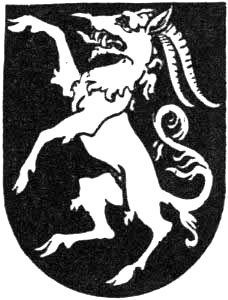
The Heraldic Ibex.
The real or natural ibex is a native of the Alps, the Pyrenees and the Grecian mountains, where they abound in defiance of the hunters. It resembles a goat, but the horns are much larger, bent backwards, and full of knots, one of which is added every year.
Bagwyn
A fabulous beast like the heraldic antelope, but having the tail of a horse, and long horns of a goat curved backwards. The dexter supporter of the arms of Carey, Lord Hundson, in Westminster Abbey, is a Bagwyn.
The Camelopard, Camel-leopard
The Giraffe figures a few times in blazon under these names. It is described by old heralds as half camel and half leopard. A curious word-combination was made by the Romans when wishing to find a name for the giraffe. “It is,” says Archbishop Trench, “a creature combining, though with infinitely more grace, yet some of the height and even the proportions of a camel, with the spotted skin of the pard.” They called it “camelopardus,” the camel-panther.
There are two heraldic creatures based upon the above which are referred to in heraldic works, viz., the Allocamelus or ass-camel, having the body of the camel conjoined to the head of an ass; and the Camelopardel, which is like the camelopard, but with two long horns curved backwards.
Musimon, Tityrus
A fictitious animal mentioned by Guillim and others. It nearly resembles a goat, with the head and horns of a ram, but has besides the horns of that beast, a pair of goat’s horns. It is also mentioned in Guillim’s “Display,” where it is said to be a bigenerous beast, of unkindly procreation, engendered between a goat and a ram, like the Tityrus, the offspring of a sheep and goat, as noted by Upton.
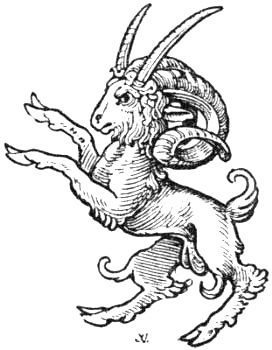
Musimon, Tityrus.
The Enfield
An imaginary hybrid animal with the head of a fox, chest of a greyhound, talons of an eagle, and body of a lion; the hind legs and tail of a wolf. It occurs as the crest of some Irish families of the name of Kelly.
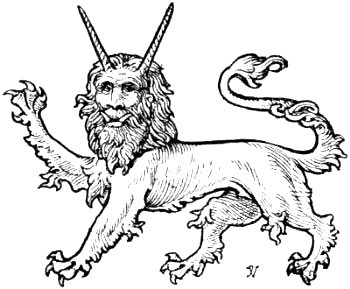
Mantygre—Satyral.
Mantiger, Montegre or Manticora Satyral
A chimerical creature of mediæval invention, having the body of an heraldic tiger with mane, and the head of an old man with long spiral horns. Some heraldic authorities make the horns more like those of an ox, and the feet like a dragon’s.
The Satyral is apparently identical with the man-tiger.
The belief that certain persons have the power of assuming the shape of the tiger is common in India, and the Khonds say that a man-killing tiger is either an incarnation of the Earth’s goddess or a transfigured man. It is thus with the Lavas of Birma, supposed to be the broken-down remains of a cultured race and dreaded as man-tigers.[27]
Two satyrals supported the arms of the Lords Stawell.
The supporters of the arms of the Earl of Huntingdon are mantigers, but are represented without horns.
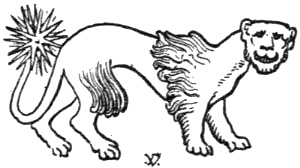
Manticora. From ancient Bestiaria.
From a mediæval “Bestiaria” we have a description and illustration of a gruesome creature of this name (manticora), evolved no doubt from some traveller’s marvellous tale. We are told that it is “bred among the Indians,” has a triple row of teeth, in bigness and roughness like a lion’s, face and ears like a man’s, a tail like a scorpion’s “with a sting and sharp-pointed quills,” and that “his voice is like a small trumpet,” and that he is “very wild,” and that after having his tail bruised, he can be tamed without danger.
There are several other fictitious creatures, which, if we may believe certain old writers, excited the minds of our credulous wonder-loving forefathers. Of these little need be said, as they rarely, if ever, appear in modern works on heraldry, and may therefore be classed as extinct monsters.
Lamia or Emipusa
A curious creature of the imagination is the lamia, of which we are told many fictitious stories. It is said to be “the swiftest of all four-footed creatures, that it is very treacherous and cruel to men. It is stated to be bred in Lybia, and sometimes devours its own young.” It is represented in an ancient “Bestiaria” as having the head and breasts of a woman, and the body of a four-footed animal with flowing tail, the hind feet having divided hoofs. It is “thought to be the creature mentioned in Isaiah xxxiv., called in Hebrew Lilith, as also the same which is mentioned in Lamentations iv.”
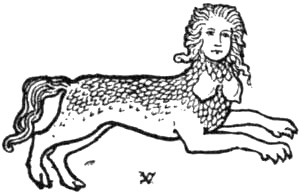
Lamia. From old Bestiary.
In Dr. Brewer’s “Dictionary of Phrase and Fable,” Lamia is “a female phantom whose name was used by the Greeks and Romans as a bugbear to children, from the classic fable of a Lybian Queen beloved by Jupiter, but robbed of her children by Juno; and in consequence she vowed vengeance against all children, whom she delighted to entice and murder.” They are again described as spectres of Africa, who attracted strangers and then devoured them. In the story of “Machatës and Philemon,” a young man is represented as marrying an Empusa, who sucks his blood at night. Goethe borrowed his ballad of the “Bride of Corinth” from this tale.
Beyond casual mention this mythical creature does not appear in heraldry.
Baphomet
A fictitious creature having two heads, male and female, the rest of the body female; said to be used as an idol or symbol by the Templars in their mysterious rites. The word is a corruption of Mahomet. Though mentioned in old works it does not now appear in British heraldry.
Apres
A fictitious animal resembling a bull, with a short tail like that of a bear. It is the sinister supporter of the arms of the Company of Muscovy Merchants.
Stelliones
The supporters of the Ironmongers’ Company of London are two lizards. Bossewell describes beasts of similar shape—“Stelliones” as he terms them, evidently in allusion to steel. He says, “Stellio is a beaste like a lysard, having on his back spotts like starres.”[28]
Stellione-serpent, a serpent with the head of a weasel, borne by the name of Baume.