Chimerical Creatures of the Dragon and Serpent kind
Reading edition
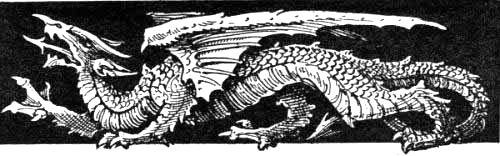
The Dragon
“The scaly monster of a dragon, coiled Full in the central field—unspeakable, With eyes oblique retorted, that askant Shot gleaming fire.” Hesiod.—“The Shield of Hercules.”
he dragon is the most interesting and most frequently seen of all chimerical figures, and it is a remarkable fact that such a creature appears at an early period of the world’s history to have been known in the East and in countries widely separated. Long anterior to the dawn of civilisation in the West of Europe, even in far-off China and Japan in the extreme East of Asia we find the dragon delineated in very much the same form in which it appears in our national heraldry.
The ancients conceived it as the embodiment of malignant and destructive power, and with attributes of the most terrible kind. Classic story makes us acquainted with many dreadful monsters of the dragon kind, to which reference will afterwards be more particularly made.
It is often argued that the monsters of tradition are but the personification of solar influences, storms, the desert wind, the great deeps, rivers inundating their banks, or other violent phenomena of nature, and so, no doubt, they are, and have been; but the strange fact remains that the same draconic form with slight modifications constantly appears as the type of the thing most dreaded, and instead of melting into an abstraction and dying out of view, it has remained from age to age, in form, distinctly a ferocious flying reptile, until in the opinion of many the tradition has been justified by prosaic science. It is surprising to find that the popular conception of the dragon—founded on tradition, passed on through hundreds of generations—not only retains its identity, but bears a startling resemblance to the original antediluvian saurians, whose fossil remains now come to light through geological research, almost proving the marvellous power of tradition and the veracity of those who passed it on.
Mr. Moncure Conway (“Demonology, or Devil Lore”) says: “The opinion has steadily gained that the conventional dragon is the traditional form of some huge saurian. It has been suggested that some of those extinct saurians may have been contemporaneous with the earliest men, and that traditions of conflicts with them, transmitted orally and pictorially, have resulted in preserving their forms in fable proximately.”
“Among the geological specimens in the British Museum,” says Hugh Miller, “the visitor sees shapes that more than rival in strangeness the great dragons and griffins of mediæval legends; enormous jaws, bristling with pointed teeth, gape horrid, in stone, under staring eye-sockets a foot in diameter; and necks that half equal in length the entire body of a boa-constrictor. And here we see a winged dragon that, armed with sharp teeth and strong claws, has careered through the air on leathern wings like those of a bat.” We are also told in the sacred Scriptures by Moses of “fiery serpents,” and by Isaiah of “a fiery flying serpent.” Other monsters—dragons, cockatrices, and some of whose form we have no conception—are also mentioned. Euripides describes a dragon or snake breathing forth fire and slaughter, and rowing its way with its wings. It is evident that such a creature may at one time have existed. Looking at the widespread belief in dragons, there seems little doubt that the semi-myth of to-day is the traditional successor of a really once-existent animal, whose huge size, snake-like appearance, and possibly dangerous powers of offence made him so terrible that the earlier races of mankind adopted him unanimously as the most fearful embodiment of animal ferocity to be found.
One of the latest acquisitions in the Natural History Museum, South Kensington, is the skeleton of that enormous creature the long-limbed dinosaur (Diplodicus Carnegii), recently discovered in America, eighty-nine feet in length from the head to the tip of the tail, the huge bulky framework of the monster measuring eleven feet in height at the shoulder. The enormous length of its neck and tail, with relatively small head, would indicate it to be an amphibious inhabitant of the waters, feeding on the vegetation growing in its depths.
Mr. Moncure Conway, in his remarkable work, “Demonology, or Devil Lore,” describes all intermediate stages between demon and devil under the head of dragon. This he believes to be the only fabulous form which accurately describes all the transitions. Throughout all the representations of the dragon one feature is common, and that is the idealised serpent. The dragon possesses all the properties of the demon along with that of harmfulness, but differs from the devil in not having the desire of doing evil. The dragon in mythology is the combination of every bad feature in nature, all of which is combined into one horrible whole. “The modern conventional dragon,” says Mr. Conway, “is a terrible monster. His body is partially green, with memories of the sea and of slime, and partly brown or dark, with lingering shadows of storm-clouds. The lightning flames still in his red eyes, and flashes from his fire-breathing mouth. The thunderbolt of Jove, the spear of Woden, are in the barbed point of his tail. His huge wings—bat-like and spiked—sum up all the mysteries of extinct harpies and vampires. Spine of crocodile is on his neck, tail of the serpent and all the jagged ridges of rocks and sharp thorns of jungles bristle round him, while the ice of glaciers and brassy glitter of sunstrokes are in his scales. He is ideal of all that is hard, destructive, perilous, loathsome, horrible in nature; every detail of him has been seen through and vanquished by man, here or there; but in selection and combination they rise again as principles, and conspire to form one great generalisation of the forms of pain, the sum of every creature’s worst.”
“The external forms of Dragons are greatly dependent on the nature of the country in which they originate. In the far north, where exist the legends of the swan and pigeon, maidens and vampires, exists the swan-shaped dragon. As demons of excessive heat principally existed in the south, so in the north the great enemy of man was excessive cold. In the northern countries is found also the serpent element, but as serpents are there frequently harmless, this feature does not enter much into their composition. The Cuttlefish is supposed to have helped in the formation of the Hydra, which in its turn assisted in forming the dragon of the Apocalypse. Assyrian ideas also seem to have assisted in the pictorial impersonations of the hydra. This many-headed monster is a representation of a torrent, which being cut off in one direction breaks out in another. The conflicts of Hercules with the hydra are repeated in those of the Assyrian Bel with Trinant (the deep), and also in the contentions of St. Michael with the dragon. The old dragon myths left in Europe were frequently utilised by the Christians. Other saints besides St. Michael were invested with the feats of Hercules; St. Margaret, St. Andrew, and many others are pictured as trampling dragons under their feet. The Egyptian dragon is based on the crocodile, and this form being received into Christian symbolism did greatly away with other pagan monsters. The hideousness of the crocodile and the alligator could easily be exaggerated so as to suit the most horrible contortions of the human imagination. Amongst the most terrible dragons is Typhon, the impersonation of all the terrors of nature. Son of Tartarus, father of the harpies and of the winds, he lives in the African deserts; from thence fled in fear, to escape his terrible breath, all the gods and goddesses. He is coiled in the whirlwind, and his many heads are symbolical of the tempest, the scrive, the hurricane, and the tornado.”
Under the head of The Colonial Dragon Mr. Conway has embodied all the horrors and difficulties with which the early colonists would be beset. Amongst these he places the Gorgon and the Chimera. The most widely spread of all is the last named, and from it is supposed that all Christian and British dragons are descended. The Christian myth of St. George and the Dragon is but a variation of Bellerophon and the Chimera, in which the last has given place to the dragon and the pagan hero to St. George.
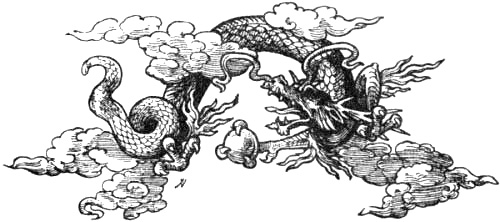
Japanese Dragon.
“In ancient families there are usually traditions of some far-distant ancestor having slain a desperate monster. It is always the colonial dragon that has been borrowed by poets and romancers. The Dragon killed by Guy of Warwick is but another variation of the chimera. There is again the Sockburn Worm, slain by Sir John Conyers for the devouring of the people of the neighbourhood; the well-known tradition of the Lambton Worm is in reality a modification of the Aryan Dragon of the Stormcloud; smaller than a man’s hand he swells out to prodigious dimensions.”
A favourite subject for Chinese and Japanese painting and sculpture is a dragon very much of the same type, and a monstrous representation of a dragon in the form of a huge Saurian still forms the central object at Japanese festivals.
Among the Chinese the dragon is the representation of sovereignty, and is the imperial emblem borne upon banners, and otherwise displayed as the national ensign. To the people of that vast country it represents everything powerful and imposing; and it plays an important part in many religious ceremonies and observances. Dr. S. Wells Williams, the eminent sinalogue, describes the fabulous monster of Chinese imagination in the following passage: “There are three dragons—the lung in the sky, the li in the sea, and the kiau in the marshes. The first is the only authentic species according to the Chinese; it has the head of a camel, the horns of a deer, eyes of a rabbit, ears of a cow, neck of a snake, belly of a frog, scales of a carp, claws of a hawk, and palm of a tiger. On each side of the mouth are whiskers, and its beard contains a bright pearl; the breath is sometimes changed into water and sometimes into fire, and its voice is like the jingling of copper pans. The dragon of the sea occasionally ascends to heaven in waterspouts, and is the ruler of all oceanic phenomena.” The fishermen and sailors before venturing away from land or returning to port, burn joss-sticks and beat gongs to ward off the evil influences of the dragon, and it is worshipped in a variety of ways. According to a fable current in China, the Celestial Emperor Hoang-ti was carried up to heaven, along with seventy other persons, by a great dragon; those who were only able to catch at his moustaches were shaken off and thrown on the ground. It is still the custom when an emperor dies to say that the dragon has ascended to heaven. An eclipse the simple Celestials believe to be caused by a great dragon that seeks to devour the sun or moon. A great noise is made by firing guns, beating drums, and the rattling and jangling of pairs of discordant instruments to frighten the monster away. A frequent subject of their artists is the dreadful dragon sprawling through masses of curling clouds in the act of grasping at or swallowing the great luminary, a subject which no doubt bears a deeper meaning than we see, and one intimately connected with their mythology.
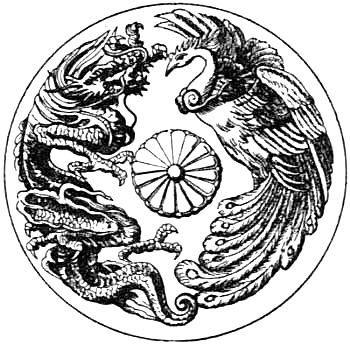
Japanese Imperial Device. The Dragon, the Ho-Ho, or Phœnix, and the Chrysanthemum.
In some of their splendid festivals the worship of the dragon is celebrated with great excitement and furore. On the Canton river a boat of immense length formed like a dragon in many wondrous folds, rowed by fifty or more natives, with wild music and dancing, and accompanied by a crowd of junks; the unfurling of sails and the streaming of flags from the masts, the beating of drums, the noise and smoke from the firing of guns, all exhibit the fondness of a people for the pleasures of a national holiday.
Dragon’s Teeth.—Cadmus slew the dragon that guarded the well of Ares, and sowed some of the teeth, from which sprang up the armed men who all killed each other except five, who were the ancestors of the Thebans. Those teeth which Cadmus did not sow, came to the possession of Ætes, King of Colchis; and one of the tasks he enjoined on Jason was to sow these teeth and slay the armed warriors that rose therefrom. The frequent allusion to the classic term dragon’s teeth refers to subjects of civil strife; whatever rouses citizens to rise in arms.
The mythical dragon has left the lasting impress of his name in various ways in our language and literature, as in the art of nearly every country.
Ω Dragon’s Head and ℧ Dragon’s Tail.—In astronomy Nodes are the opposite points in which the orbit of a planet, or of a moon, crosses the ecliptic. The ascending node marked by the character (Ω), termed the Dragon’s head, is where the planet or moon ascends from the south to the north side of the ecliptic, and the descending node indicated by the character (℧) the Dragon’s tail is where it passes from the north to the south side.
Draco, a constellation in the northern hemisphere, representing the monster that watched the golden apples in the garden of the Hesperides, slain by Hercules, and set as a constellation in the heavens.
Draco volens, a meteor sometimes visible in marshy countries—Ignus fatuus, or will-o’-the-wisp.
Draco volens, or flying dragon, a curious class of saurian reptiles peculiar to the East Indies, having membranous attachments to their limbs, which give them the appearance of flying as they leap from tree to tree.
Dragon’s blood, a vegetable balsam of a dark red colour brought from India, Africa, and South America. So called from its resemblance to dried and hardened masses of blood.
The Dragon in Christian Art
(The symbol of the Supreme Spirit of Evil, or the Evil One)
It was believed that in the gloomy land of the Cimmerians and the confines of Hades strange monsters were to be met; and not only there, but in any part of the universe which was conceived to be beyond the pale of human habitation these weird creatures might be encountered. The same idea is recognised in the Semitic belief, that uncanny beings lurked in the outer deserts, where men did not penetrate at all, or did so only at great danger. The “place of dragons” is associated with “the shadow of death” (Ps. xliv. 19). Dragons are also associated with the waters of the deep (Ps. lxxiv. 13) and are called upon to praise Jehovah (Ps. cxlviii. 7); and Isaiah (xxxiv.), describing in vivid and picturesque language the destruction and utter desolation which shall come on Zion’s enemies, prophesies that her palaces and fortresses “shall be a habitation for dragons.”
The term dragon is applied by the translators of the Scriptures to some monsters of which we have no knowledge. The word is used by ecclesiastics of the Middle Ages as the symbol of sin in general and paganism in particular, though ofttimes heresy is denoted. The metaphor is derived from Rev. xii. 9, where Satan is termed the Great Dragon; in Psalm xci. 13, it is said “the saints shall trample the dragon under their feet.”
In the book of Job we recognise in Leviathan a creature more like the extinct saurians of the old world than any crocodile recorded in historic times; and this leviathan is treated as still existing in the days of David. In Psalm lxxiv. 13, 14, Jehovah is spoken of as having broken the heads of the dragons in the waters; in Isaiah li. 9, as having wounded the dragon; and pæans are sung on the punishment of “Leviathan, that crooked serpent,” and the slaying of “the dragon that is in the sea” (Is. xxvii. 1). Finally, in the Apocalyptic vision, “there appeared another wonder in heaven; and behold a great red dragon, having seven heads, and ten horns, and seven crowns upon his heads, and his tail drew the third part of the stars of heaven, and did cast them to earth” (Rev. xii. 3, 4); “I saw an angel come down from heaven, having the key of the bottomless pit and a great chain in his hand, and he laid hold on the dragon, that old serpent, which is the Devil and Satan, and bound him” (Rev. xx. 1, 2).
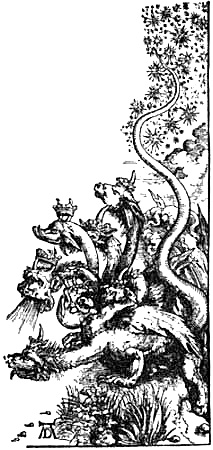
The Dragon of the Apocalypse. By Albert Dürer.
As a Christian emblem the dragon may be taken to symbolise the supreme spirit of evil, a veritable devil whom it was the special mission of militant saints to slay, as it had been the glory of the heroes of the pagan mythology to conquer. “In pictures of sacred and legendary subjects,” says a late writer, “the dragon usually formed an important feature. The evil thing was invariably depicted writhing under the foot of the saint, or transfixed with his triumphant spear. In like manner the virtues trampled tranquilly each on her complementary vice, embodied in the form of some impossible creature; and if the rigid virtues were sometimes insipid, it must be allowed that the demons were usually grotesquely characteristic, and often delightful in colour.”
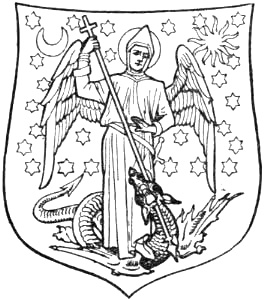
St. Michael and the Old Dragon. Arms of the Royal Burgh of Dumfries.
The prostrate attitude usually signifies the triumph of Christianity over Paganism, as in pictures of St. George and St. Sylvester; or over heresy and schism, as when it was adopted as the emblem of the Knights of the Order of the Dragon, in Hungary, which was instituted for the purpose of contending against the adherents of John Huss and Jerome of Prague.
The dragon in Christian Art is often very variously represented, sometimes as a serpent, at other times as a dragon or wyvern, or again in the symbolic figure partly human, under which form we find the “old serpent” (the Devil) often represented, as in the conflict of St. Michael the Archangel. The numerous legends of saints who have fought and overcome dragons prove the symbolic light in which the impersonation of evil was generally viewed.
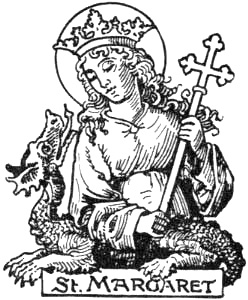
From ancient carving.
St. Margaret is the patron saint of the borough of Lynn Regis, and on the old corporation seal she is represented standing on a dragon and wounding it with a cross. The Latin inscription on the seal is “Sub Margaret teritur draco stat cruce læta.” The modern shield of the town is now blazoned: azure three conger’s (or dragon’s) heads erased and erect, the jaws of each pierced with a cross crosslet fitchée or. In paintings St. Margaret is represented as a young woman of great beauty bearing the martyr’s palm and olive crown, or with the dragon chained and helpless at her feet as an attribute. Sometimes she is depicted coming from the dragon’s mouth, for the legend says the monster swallowed her, but on her making the sign of the cross he was compelled to free her again. A legend states that Olybus, Governor of Antioch, captivated by the beauty of Margaret, wished to marry her; as she rejected him with scorn he threw her into a dungeon, where the devil appeared to her in the form of a horrible dragon and endeavoured to frighten her from her path. Margaret held up the cross and the dragon fled. Other legends say he burst asunder.
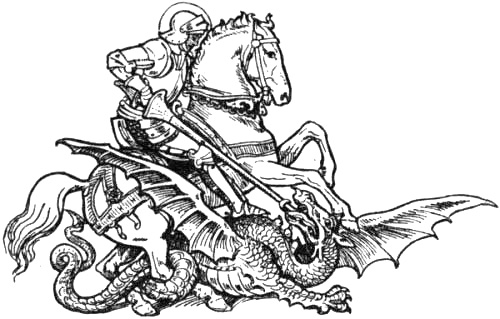
St. George and the Dragon.
“In many a church his form is seen, With sword, and shield, and helmet sheen: Ye know him by his steed of pride, And by the dragon at his side.” Chr. Schmid.
St. George, the patron saint of England, in his legendary combat with the monster, is a subject which occurs frequently in English sculpture and painting, and enters largely into the language and literature of the nation. St. George appears to have been selected as the patron saint of England not long after the Norman conquest. We find the anniversary of his martyrdom (April 23) was ordered to be observed as a festival by the National Synod of Oxford in 1222 A.D.
The “Golden Legend,” printed by Pynson in 1507 (fol. cxix.), thus refers to “Saynt George”: “This blyssed and holy martyr Saynt George is patrone of this realme of Englōd: and ye crye of mē of warre; and in ye worsyp of whome is founded ye noble order of a garter: and also ye noble college in ye castell of Wyndsore, by Kynges of Englond. In whyche college is ye herte of Saynt George: whyche Sygysmond ye Emperour of Alamayn brought: and gaf it for a grete and precyous relyque to kynge Harry the fifte. And also the said Sygysmond was broder of the sayd garter. And also there is a piece of his head; which college is nobly endowed to thonour and worshippe almighty God and his blyssed Martyr Saynt George. Then late us praye vnto hym that he be specyel protectour and defendour of this royaume.”
The emblems commonly given to St. George, martyr, and patron saint of England are: a dragon, a shield bearing a red cross on a white field, and a spear. He is usually represented on horseback in the act of spearing the monster which is vomiting fire; or as standing with the slain dragon at his feet.
That St. George is a veritable character is beyond all reasonable doubt, and there seems no reason to deny that he was born in Armorica, and was beheaded in Diocletian’s persecution by order of Datianus, April 23, 303. St. Jerome (331-420) mentions him in one of his martyrologies; in the next century there were many churches erected to his honour. St. Gregory (540-604) has in his sacramentary a “Preface for St. George’s Day”; and the Venerable Bede (672-735) in his martyrology, says: “At last St. George truly finished his martyrdom by decapitation, although the gests of his passion are numbered among the apocryphal writings.”
According to the old ballad given in Bishop Percy’s “Reliques of Ancient Poetry,” St. George was the son of Lord Albert of Coventry. His mother died in giving him birth, and the new-born babe was stolen away by the weird lady of the woods, who brought him up to deeds of arms. His body had three marks: a dragon on the breast, a garter round one of the legs, and a blood-red cross on the arm. When he grew to manhood he first fought against the Saracens, and then went to Sylene, a city of Libya, where was a stagnant lake infested by a huge dragon, whose poisonous breath “had many a city slain,” and whose hide “no spear nor sword could pierce.” Every day a virgin was sacrificed to it, and at length it came to the lot of Sabra, the king’s daughter, to become its victim. Decked out in bridal array she went out to meet the dragon; she was tied to the stake, and left to be devoured, when St. George appeared in full panoply and mounted on his charger. He vowed to take her cause in hand, and when the dragon came on the scene it was encountered by the hero, who wounded it, and binding it to the lady’s girdle it was led like a “meek beast” into the city. St. George there attacked it, thrusting his lance into its mouth, killed it on the spot, and a church dedicated to Our Lady and St. George was built to commemorate the event. After many adventures he carried off Sabra to England, where they were wedded, and at Coventry lived happily till their death.
In his history of the Order of the Garter Mr. Antis warmly censures those who would doubt the traditionary history of that saint, and says “he who would credit St. Ambrose will not detract from the honour of our George, the soldier and martyr of Christ, concerning the dragon and the deliverance of the beautiful royal virgin, which is related in so many pictures,” adding that “he shall not contradict those who make an allegory of it, so that they do not deny the certainty of this history.... Suppose every one George, who being clothed with the virtue of baptism and armour of faith, keeps his earthly body in subjection by the due exercise of religion and piety, and by the armour of the Spirit overcomes, and by the true spiritual art crushes and confounds the serpent’s poison, the snares of the old Dragon, and his diabolical arts and stratagems.”
The dragon slain by St. George is simply a common allegory to express the triumph of the Christian hero over evil, which St. John the Evangelist beheld under the figure of a dragon. Similarly St. Michael, St. Margaret, St. Sylvester and St. Martha are all depicted as slaying dragons; the Saviour and the Virgin as treading them under foot; and St. John the Evangelist as charming a winged dragon from a poisoned chalice given him to drink. Even John Bunyan avails himself of the same figure, when he makes Christian encounter Apollyon and prevail against him.
A learned Frenchman, M. Clermont Ganneau, in a treatise lately published, traces the legend of St. George and the dragon to a very remote antiquity. In the Louvre at Paris he found an Egyptian bas-relief, which he identified as the combat of Horus against Set, or Typhon, in the well-known Egyptian legend. It represents a man on horseback in Roman armour slaying a crocodile with a spear; but for the fact that the rider has a hawk’s head, the group might easily be mistaken for the traditional combat of St. George and the dragon. Extending his investigations, M. Ganneau has brought to light some most startling proofs of the connection between the eastern and western mythologies. We have therefore, he considers, evidence as clear and convincing as evidence from deduction can be, that the Egyptian “Horus and Typhon”; the Greek “Perseus and Andromeda”; the “Bel and Dragon” of the Apocrypha; the Archangel Michael of Christian legend who also slays the old dragon, are all one and the same story with that of our own St. George. We pass over the intermediate steps by which he reconciles the divergent names and qualities of the personages identified, and also the ingenious arguments as to the real meaning of the symbolism in the worship of Dagon the Fish-god.
In all the old romances dealing with feats of chivalry and knight-errantry the dragon plays an essential if not a leading part; and a romance without some dragon or monster was as rare as one without a valiant knight or a beautiful lady. But of all the malignant creatures dreaded of gods and men, the most hateful and wicked is that prime dragon personified by Spenser under the type of the “blatant beast,” and which confronts his hero, the Red Cross Knight, at every turn: “a dreadful fiend, of gods and men ydrad,” who has a thousand tongues, speaks things most shameful, most unrighteous, most untrue, and with his sting steeps them in poison.
As an example of the inception and development of a dragon legend from slender materials, the following is related in Figuer’s “World before the Deluge”:
In the city of Klagenfurth, in Carinthia, is a fountain on which is sculptured a monstrous dragon with six feet, and a head armed with a stout horn. According to popular tradition this dragon lived in a cave, whence it issued from time to time to ravage the country. A bold and venturous knight at last kills the monster, paying with his life the forfeit of his rashness. The head of the pretended dragon is preserved in the Hotel de Ville, and this head has furnished the sculptor for a model of the dragon on the fountain. A learned professor of Vienna on a visit to the city recognised it at a glance as the cranium of the fossil rhinoceros. Its discovery in some cave had probably originated the fable of the knight and the dragon—and all similar legends are capable of some such explanation when we trace them back to their sources and reason the circumstances on which they are founded. The famous bird, the roc, which played so important a part in the myths of the people of Asia, is also believed to have originated in the discovery of some gigantic bones.
Chief among Dragon-slayers of Christian legend we find the following:
St. Philip the Apostle is said to have destroyed a huge dragon at Hierapolis, in Phrygia.
St. Michael, St. George, St. Margaret, Pope Sylvester, St. Samson, Archbishop of Dol; Donatus (fourth century), St. Clement of Metz, all killed dragons—if we may trust old legends.
St. Keyne of Cornwall slew a dragon.
St. Florent killed a terrible dragon who haunted the Loire.
St. Cado, St. Maudet and St. Paull did similar feats in Brittany.
The town of Worms (famous as the place at which the Diet of Worms was held before which the reformer Luther was summoned) owes its name to the “Lind-wurm” or dragon there conquered by the hero Siegfried as related in the “Nibelungen Lied.” (See p. 100.)
Drachenfels, on the Rhine (Dragon Rocks), is so called from the same monster; and at Arles and Rouen legends are preserved of victories gained by saints over the Tarasque and Gargouille, both local names for the dragon. St. Martha conquered the fabulous Tarasque of the city of Languedoc, which bears the name of “Tarascon.” Gargouille (waterspout) was the great dragon that lived in the Seine, ravaged Rouen, and was slain by St. Romanus, Bishop of Rouen, in the seventh century. The latter name has come down to us in the term “gargoyle,” applied to the monstrous heads which often decorate the waterspouts of old churches.
A strange relic of the ancient faith is perpetuated in the remains of early Celtic art in the curiously wrought interlaced monsters which form the chief ornament of ancient Irish crosses, and particularly in the borders and initials of illuminated manuscripts, whose spirals and interminable interlacements of the most complex character, often allied with equally strange colouring, form a style perfectly unique in itself, and unlike any other; the elaborate knots terminating in draconic heads, and with wings and animal extremities in wonderfully ingenious patterns that seem almost beyond the limits of human ingenuity. In the kindred art of Scandinavia we find similar decoration founded on serpentine forms.
Another survival of the dragon myth exists in the name given to some of our fighting men on the introduction of firearms. A kind of blunderbus gave to the troops who used it the name of “dragoniers,” whence is derived the well-known term dragoons. They used to be armed with dragons—i.e., short muskets—which spouted fire, like the fabulous beast so named. The head of a dragon was wrought on the muzzles of these muskets. We have all heard of the Dragonades, a series of persecutions by Louis XIV., which drove many thousands of Protestants out of France—and out of the world. Their object was to root out “heresy.” A bishop, with certain ecclesiastics, was sent to see if the heretics would recant; if not they were left to the tender mercies of the Dragonniers, who followed these “ministers of peace and good will to men.” The same game of conversion was practised by the Reformed Church upon the Presbyterians of Scotland, with its accompaniment of “dragons let loose”—in which Claverhouse took a leading part.
“In mediæval alchemy the dragon seems to have been the emblem of Mercury; hence the dragon became one of the ‘properties’ of the chemist and apothecary, was painted upon his drug pots, hung up as his sign, and some dusty stuffed crocodile hanging from the ceiling in the laboratory had to do service for the monster, and inspire the vulgar with a profound awe of the mighty man who had conquered the vicious reptile.”[6]
When apothecaries’ signs were not derived from heraldry, they were used to typify certain chemical actions. In an old German work on alchemy one of the plates represents a dragon eating his own tail; underneath are the words which, translated, signify: “This is a great wonder and very strange; the dragon contains the greatest medicament,” and much more of similar import.
The Dragon in the Royal Heraldry of Britain
“Advance our standards, set upon our foes, Our ancient word of courage fair Saint George Inspire us with the spleen of fiery dragons.” “Richard III.,” Act v. sc. 3. “Come not between the dragon and his wrath.” “King Lear,” Act i. sc. 2.
The dragon does not seem to have been a native emblem with the Romans, and when they adopted it it was only as a sort of subordinate emblem—the eagle still holding the first place. It seems to have been in consequence of their intercourse with other nations either of Pelasgic or Teutonic race. Amongst all the new races which overran Europe at the termination of the classical period the dragon seems to have occupied nearly the same place that it held in the earlier stages of Greek life. Among the Teutonic tribes which settled in England the dragon was from the first a principal emblem, and the custom of carrying the dragon in procession with great jollity on May eve to Burford is referred to by old historians. The custom is said by Brand also to have prevailed in Germany, and was probably common in other parts of England.
Nor was the dragon peculiar to the Teutonic races. Amongst the Celts it was the symbol of sovereignty, and as such was borne on the sovereign’s crest. Mr. Tennyson’s “Idylls” have made us familiar with “the dragon of the great Pendragonship” blazing on Arthur’s helmet as he rode forth to his last battle, and “making all the night a stream of fire.” The fiery dragon or drake and the flying dragon of the air were national phenomena of which we have frequent accounts in old books.
The Irish drag means “fire,” and the Welsh dreigiaw (silent flashes of lightning) “fiery meteors”; hence Shakespeare says:
“Swift, swift, ye dragons of the night!—that dawning May bare the raven’s eye.” Cymbeline, ii. 2.
A principal source of the Dragon legends in these countries is the Celtic use of the word “dragon” for “a chief.” Hence Pen-dragon (sumus rex), a sort of dictator in times of danger. Those knights who slew a chief in battle slew a dragon, and the military title soon got confounded with the fabulous monster. The name or title Pendragon (dragon’s head) was among British kings and princes what Bretwalda was among the Saxons; and his authority or supremacy over the confederation was greater or less according to his valour, ability, and good fortune. Arthur succeeded his father Uther, and was raised to the pendragonship in the first quarter of the sixth century.
The dragon was a symbol among the heathen. One of the sons of Odin was thus invoked: “Child of the Dragon, Son of Conquest, arise! grasp thy silver spear; thy snowy steed prepare and haste thee to the strife of the shield! Uprise thou Dragon of Onslaught!” And again:
“Wave high the dragon’s flaming sign, Roll wide the shout of glee; Ho! conquest ope thy crimson gates This day I give to thee.”
“The Dragon of the Shield struck his sounding war-board with his ponderous spada. The fierce-browed children of Hilda gathered round at the signal.”
Maglocue, a British king who was a great warrior and of a remarkable stature, whose exploits had rendered him terrible to his foes, as a surname was called “The Dragon of the Isle,” perhaps from his seat in Anglesey.
Dragon Standard. From the Bayeux Tapestry.
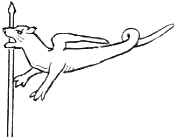
Cuthred, King of Wessex, bore a dragon on his banner. A dragon was also the device of the British King Uther Pendragon, or Dragon’s-head, father of that King Arthur of chivalric memory, who so bravely withstood the incursions of the Saxons. Two dragons addorsed—that is, back to back—are ascribed to Arthur, as well as several other devices.
Dragon’s Hill, Berkshire, is where the legend says St. George killed the dragon. A bare place is shown on the hill where nothing will grow, and there the blood ran out. In Saxon annals we are told that Cedric, founder of the West Saxon kingdom, slew there Naud, the pendragon, with 5000 men. This Naud is called Natan-leod, a corruption of Naud-an-ludh; Naud, the people’s refuge.[7]
“It has sometimes been thought,” says Miss Millington, “that the royal Saxon banner bore a dragon; certain it is, that on the Bayeux tapestry a dragon raised upon a pole is constantly represented near a figure, whilst the words ‘Hic Harold’ prove to be intended for Harold; yet Matthew of Westminster, in describing a battle fought in the time of Edward I., says that the place of the king was ‘between the dragon and the standard,’ which seems to imply that the standard or banner had some other device. The dragon was perhaps a kind of standard borne to indicate the presence of the king. Henry III. carried one at the Battle of Lewes, fought against Simon de Montfort in 1264:
“‘Symoun com to the feld, And put up his banere; The king schewed forth his scheld, His dragon full austere.’
It was not, however, at that time restricted to the King, for Simon himself in the same battle
“‘Displaied his banere, lift up his dragoun.’
The English at the Battle of Crecy carried a ‘burning dragon, made of red silk adorned and beaten with very broad and fair lilies of gold, and broidered about with gold and vermilion.’ This banner,” adds Miss Millington, “perhaps resembled that used by the Parthians and Dacians, which is described by Ammianus Marcellinus as ‘a dragon, formed of purple stuff, resplendent with gold and precious stones fixed on a long pike, and so contrived that when held in a certain manner, with its mouth to the wind, the entire body became inflated, and stretched its sinuous length upon the air.’”
“The dragon,” says Mr. Planché, “was the customary standard of the kings of England from the time of the Conquest. It was borne in the battle between Canute and Edmund Ironside; it is figured in the Bayeux tapestry, and there are directions for making one in the reign of Henry III., but it never formed a portion of their armorial bearings, i.e., as a charge upon the shield of arms.”
Henry VII., first of the Tudor line, assumed as one of his badges the red dragon of Cadwallader—“Red dragon dreadful.” Henry claimed an uninterrupted descent from the aboriginal princes of Britain, Arthur and Uther, Caradoc, Halstan, Pendragon, &c. His grandfather, Owen Tudor, bore a dragon as his device in proof of his descent from Cadwallader, the last British prince and first King of Wales (678 A.D.), the dragon being the ensign of that monarch. At the Battle of Bosworth Field Henry bore the dragon standard. After the battle of Bosworth Field Henry went in state to St. Paul’s, where he offered three standards. On one was the image of St. George, on the other a “red fierce dragon beaten upon green and white sarsenet” (the livery colours of the House of Tudor); on the third was painted a dun cow upon yellow tartan,—the dun cow, in token of his descent from Guy Earl of Warwick, who had slain
“A monstrous wyld and cruelle beaste Called ye dun cow of Dunsmore Heath.”
The dun cow is still one of the badges of the Guards. This monarch founded the office of Rouge dragon pursuivant on the day before his coronation (October 29, 1485). Henry VII., Henry VIII., Edward V., Mary and Elizabeth all carried the dragon as a supporter to the royal arms, but varied in position, and at times superseded by a greyhound. (A greyhound argent, collared or, the collar charged with a rose gules, was a Lancastrian badge.) Henry VIII. used for supporters the red dragon and white greyhound of his family; a red dragon and a lion gardant gold, sometimes crowned; at other times a silver greyhound and a golden lion, an antelope, a white bull, a cock, &c. On the union of Scotland and England under King James, the Scottish unicorn was substituted for the sinister supporter, while the lion gardant, first adopted by Henry VIII., appears to have permanently superseded the red dragon of Wales, the white greyhound, &c., as the other supporter of the royal arms, the dragon being relegated to be the special badge of the principality of Wales, which position it still retains. The present royal badges, as settled at the union, 1801, are:
A white rose within a red England.
A thistle Scotland.
A harp or, stringed argent, and a trefoil or shamrock vert Ireland.
Upon a mount vert, a dragon passant, wings expanded and endorsed, gules Wales.
Richard III. as a badge had a black dragon. “The bages that he beryth by the Earldom of Wolstr (Ulster) ys a blacke dragon,” derived through his mother from the De Burghs, Earls of Ulster.
Mallet, in his “Northern Antiquities,” states “that the thick misshapen walls winding round a rude fortress at the summit of a rock were called by a name signifying dragon, and as women of distinction were, during the ages of chivalry, commonly placed in such castles for security, thence arose the romances of princesses of great beauty being guarded by dragons, and afterwards delivered by young heroes who could not achieve their rescue until they had overcome their terrible guardians.” The common heraldic signification of a dragon is one who has successfully overcome such a fortress, or it denotes the protection afforded to the helpless by him to whom it was granted, and the terror inspired in his foes by his doughty or warlike bearing. It was a title of supreme power among the early British.
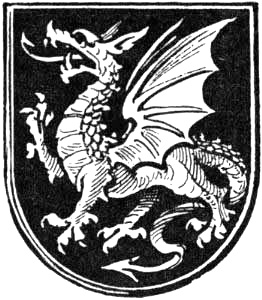
A Dragon passant.
The dragon has always been an honourable bearing in British armoury, in some instances to commemorate a triumph over a mighty foe, or merely for the purpose of inspiring the enemy with terror. This seems to have been especially the case with the dragon standard—the “red dragon dreadful” of Wales (y Ddraig Coch) described as:
“A dragon grete and grimme Full of fyre and eke venymme.”
The Crocodile as the Prototype of the Dragon
In the existing representatives of the antediluvian saurians, the crocodile and alligator, we see the prototypes of the dragons and hydras of poetic fancy. The crocodile is a well-known huge amphibious reptile, in general contour resembling a great lizard covered with large horny scales that cannot be easily pierced, except underneath, and reaching twenty-five to thirty feet in length. The crocodile was held sacred by the ancient Egyptians, the Nile was and is its best-known habitat; it is also found in the rivers of the Indian seas. Though an awkward creature upon land, it darts with rapidity through the water after fish, which is its appropriate food, but it is dangerous also to dogs and other creatures, as well as to human beings entering the water or lingering incautiously on the bank.
It is the Lacerta crocodilus of Linnæus, from Greek κροκοδειλος (krokodeilos) a word of uncertain origin. The Alligator, the American crocodile, takes its name from the Spanish El Legarto, the lizard. The Latin form is Lacertus or Lacerta.
Miss Millington, in her “Heraldry in History, Poetry and Romance,” says that both dragon and crocodile seem anciently to have been confounded under one name, and that Philip de Thaun, in his “Bestiarus,” says that “crocodille signifie diable en ceste vie.” Guillim, an old heraldic writer, says: “The dragons are naturally so hot that they cannot be cooled by drinking of waters, but still gape for the air to refresh them, as appeareth in Jeremiah xiv. 6.”
Young, author of “Night Thoughts,” in a footnote appended to the magnificent description of the leviathan (crocodile), in his paraphrase of part of the book of Job says: “The crocodile, say the naturalists, lying under water, and being there forced to hold its breath, when it emerges, the breath long repressed is hot, and bursts out so violently that it resembles fire and smoke. The horse suppresses not his breath by any means so long, neither is he so fierce and animated,” yet the most correct of poets ventures to use the same metaphor regarding him:
“Collectumque premens volvit sub naribus ignem.”
The Heraldic Dragon
The mythical dragon is represented in heraldic art with the huge body of the reptile saurian type covered with impenetrable mail of plates and scales, a row of formidable spines extending from his head to his tail, which ends in a great and deadly sting; his enormous jaws, gaping and bristling with hideous fangs, belch forth sparks and flame; his round luminous eyes seem to shoot gleaming fire; from his nose issues a dreadful spike. He is furnished with sharp-pointed ears and a forked tongue, four sturdy legs terminating in eagle’s feet strongly webbed, clawing and clutching at his prey. Great leathern bat-like wings armed with sharp hook’s points, complete his equipment. The wings are always “endorsed,” that is, elevated and back to back.
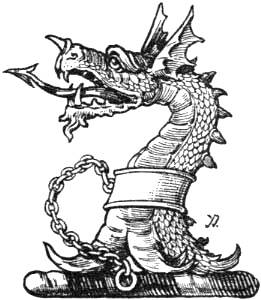
Crest, a Dragon’s Head erased collared and chained.
The dragon of our modern books of heraldry is a miserable impostor, a degenerate representative of those “dragons of the prime, that tore each other in their slime.” It is curious to note in this the gradual degradation from the magnificent saurian type of the best period of heraldic art to a form not far removed from that given to an ordinary four-legged creature covered with plates and scales. His legs are longer and weaker, his mighty caudal appendage, shrunk to insignificant and useless proportion, and most unlike his ancient prototype the crocodile. This error of our modern heraldic artists displays remarkable lack of proper knowledge of this mythical creature and his attributes. Such a splendid creation of the fancy should not be represented in such a weak and meaningless form by the hands of twentieth-century artists. The ancient form is infinitely to be preferred as a work of symbolic art.
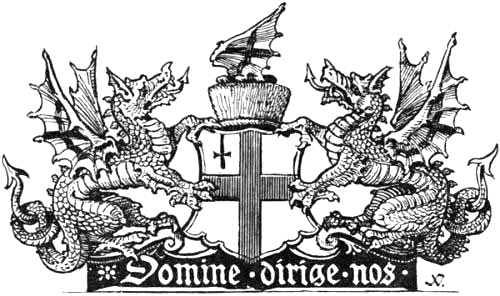
Arms of the City of London.—Two dragons are the supporters of the arms of the City of London, the crest a dragon’s sinister wing. They are thus blazoned: Argent a cross gules, in the first quarter, a sword in pale point upwards of the last. Supporters, on either side a dragon with wings elevated and addorsed, argent, and charged on the wing with a cross gules.
The crest is a dragon’s sinister wing charged with a similar cross.
The County of Chester has for its supporters two dragons, each holding an ostrich feather.
Basingstoke, Linlithgow and Dumfries on the town seals have St. Michael overthrowing the dragon (see p. 72).
The dragon appears in various forms in the arms of many towns, and also in those of some peers.
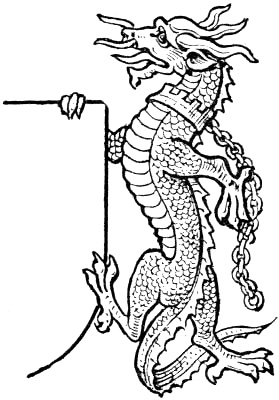
Sinister supporter of the arms of Viscount Gough.
One of the most extraordinary and elaborate coats of arms of modern times is that of Viscount Gough. The sinister supporter of the shield is a dragon (intended to represent the device upon a Chinese flag). A dragon or, gorged with a mural crown sable, inscribed with the word “China,” and chained gold.
Examples vary considerably in the form of the dragon, some early examples represent it to have four legs, others with only two, when it is properly a wyvern. The pendent “George” in the Order of the Garter represents it with a body similar to a crocodile, winged and covered with plates and scales.
A similar device to that of the George noble of Henry VIII. was the St. George slaying the dragon by Pistrucci, a foreigner employed at the mint. This handsome reverse, says Mr. Noel Humphrey, “Coin Collector’s Manual,” is nearly a copy from a figure in a battle-piece on an antique gem in the Orleans collection, but several Greek coins might equally well have furnished the model. Old George III. sovereigns and five-shilling pieces have this most finely conceived and executed device on the reverse of the coins. It also appears upon some sovereigns of Queen Victoria. Prominence is naturally given to the figure of St. George, the dragon in consequence being diminished in its relative size.
The Hydra
“Seven great heads out of his body grew, An iron breast, and back of scaly brass; And all imbrued in blood his eyes did shine as glass, His tail was stretched out in wondrous length.” Spenser, “Faerie Queen,” Book i. c. vii.
The hydra is represented in heraldry as a dragon with seven heads; it is not of frequent occurrence as a bearing in armory.
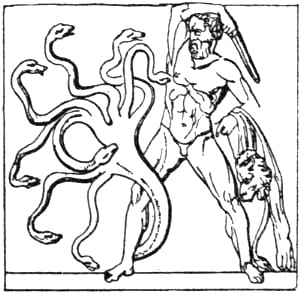
Hercules and the Lernean Hydra. From Greek vase.
The terrible dragon, with one hundred heads, that guarded the golden apples of the Hesperides, slain by Hercules, was celebrated in classic mythology; so was the Lernean hydra, a monster of the marshes that ravaged the country of Lerna in Argolis, destroying both men and beasts. The number of its heads varies with the poets, though ancient gems usually represent it with seven or nine. Hercules was sent to kill it as one of his twelve labours. After driving the monster from its lair with arrows he attacked it with his sword, and in place of each head he struck off two sprang up. Setting fire to a neighbouring wood with the firebrands he seared the throat of the Hydra until he at length succeeded in slaying it. The fable is usually referred to in illustration of a difficulty which goes on increasing as it is combated. (See page 63.)
“Whereon this Hydra son of war is born Whose dangerous eyes may well be charmed asleep.” Henry IV. part ii. sc. 2.
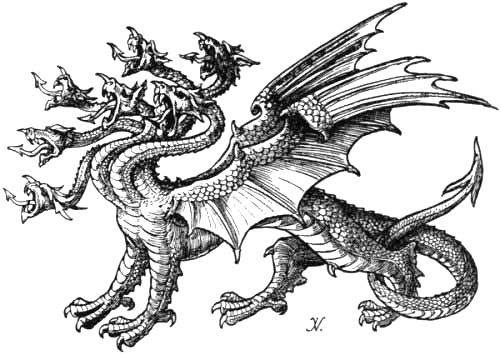
The Hydra.
The Lernean hydra, the watchful dragon of the garden of the Hesperides, the many-headed Naga or snake of the Hindu religion, are, say learned writers, only some of the many forms under which the relics of the ancient serpent-worship exhibited itself.
A hydra, wings endorsed vert, scaled or, is the crest of Barret of Avely, Essex. It is also borne by the names Crespine and Downes.
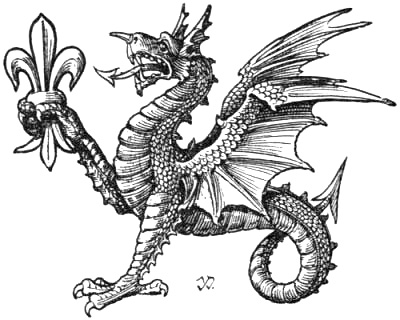
A Wyvern holding a fleur-de-lis.
The Wyvern
(Saxon, Wivere, a serpent) said to represent a flying serpent, an imaginary creature resembling the dragon, but having only two legs, which are like an eagle’s, and a serpent-like tail, barbed, sometimes represented nowed after the manner of serpents. It is figured on one of the standards in the Bayeux tapestry (see Dragon, p. 86). It is erroneously termed a dragon by some writers, though perhaps they may both be classed together. Old heralds say of these imaginary monsters that they are emblems of pestilence, and are represented as strong and fierce animals covered with invulnerable mail, and fitly typify viciousness and envy. In armory they are properly applied to tyranny or the overthrow of a vicious enemy.
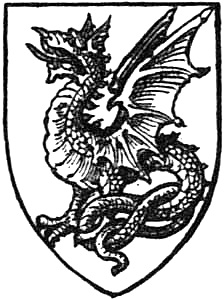
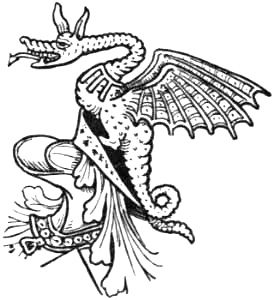
A Wyrvern, wings endorsed, tail nowed. Wyvern from the Garter plate of Sir John Gray, 1436 A.D.
Occasionally a wyvern is borne with the tail nowed and without wings.
Lindworm.—It is not usual to say a wyvern “without wings” or “without legs,” but sans wings or sans legs, as the case may be. A dragon or wyvern sans wings is termed a lindworm. (See page 80.)
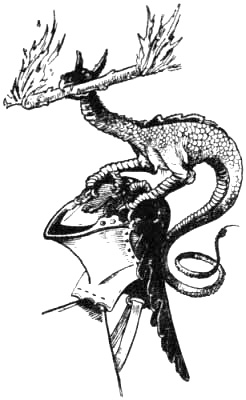
Wyvern, or Lindworm. (German version.)
Argent, a wyvern, wings endorsed gules, are the arms of Drake, of Ashe, Devon (Bart.), 1600.
The town of Leicester has for crest a wyvern, wings expanded, sans legs, strewed with wounds, gules.
Argent on a bend sable, between two lions rampant of the last, a wyvern volant in bend of the field, langued gules, Ruddings.
Two wyverns, wings endorsed and emitting flames, are the supporters of Viscount Arbuthnot.
The arms of the King of Portugal are supported by two wyverns erect on their tails or, each holding a banner, the crest is a demi-wyvern out of a ducal coronet.
Guivre.—The wyvern or serpent in the arms of the Visconti, Lords of Milan, argent a guivre d’azure couronnée d’or, issante de gules (Guivre is represented as a serpent or wingless dragon sans feet, with a child’s body issuing from its mouth), is said to commemorate the victory of a lord of that house over a fiery dragon or guivre which inhabited a cavern under the church of St. Denis in that place. “It is hardly possible,” says Miss Millington, “not to think that the story of the dragon as well as its adoption in the coat-of-arms bears allusion rather to the dragon of paganism, expelled from the city, as it might seem, by the church built upon the site of the cave, in which too, by the rite of Holy Baptism, children especially were delivered from the power of Satan. Indeed, the innumerable legends of saints who have fought and overcome dragons sufficiently prove the symbolic light in which that creature was anciently viewed.” (See also Serpent Biscia, p. 117.)
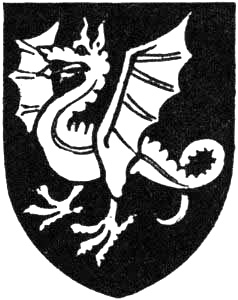
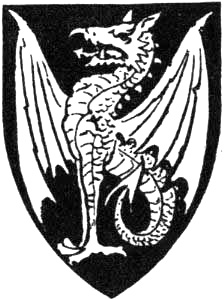
Wyvern, wings displayed. (Early example.) Wyvern, wings depressed.
The Chimera
Chimera, from a Greek coin.
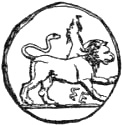
An imaginary fire-breathing monster of great swiftness and strength, invented by the ancient Greek poets. Though mentioned by heraldic authorities, it is not met with in British coat armour; it is described as having the head, mane and legs of a lion, the body of a goat, and the tail of a dragon. From this creature the term “chimerical” is applied to all such figures as have no other existence but in the imagination. It is represented upon the coins of Sycion during the Achæan League.
The origin of the story of the chimera is ascribed to a mountain in Lycia which had a volcano on its top and nourished lions; the middle part afforded pasture for goats, and the bottom was infested with serpents; according to Hesiod it had three heads, that of a lion, a goat, and a dragon. Bellerophon destroyed the monster by raising himself in the air on his winged steed Pegasus, and shooting it with his arrows.
“Amid the troops, and like the leading god, High o’er the rest in arms the graceful Turnus rode; A triple pile of plumes his crest adorned, On which with belching flames chimera burned: The more the kindled combat rises higher, The more with fury burns the blazing fire.” Virgil, Æneid, Book vii.
Phillip II. of Spain, after his marriage with Queen Mary of England, assumed as a device, Bellerophon fighting with the chimera, and the motto, “Hinc vigilo,” the monster being intended by him for a type of England’s heresies which he waited his time to destroy.
The family of Fada of Verona have for arms: Gules a winged chimera argent, the head and breasts carnation (or proper), and the wings and feet of an eagle. The illustration, however, has the head and breasts of a woman, and eagle’s wings and feet, and makes it a different creature entirely, and should more properly be blazoned harpy.
The Lion-Dragon
is compounded of the forepart of a lion conjoined to the hinder part of a dragon.
Or, a lion-dragon gules armed, langued and crowned of the first, is the Bretigni family.
Party per chevron gules and or, three lion-dragons ducally crowned and countercharged.—Easton.
The Gorgon
Reference has already been made to the gorgon in a quotation from Milton. The name now denotes anything unusually hideous. In classic story there were three gorgons, with serpents on their heads instead of hair. Medusa was the chief of the three, and the only one that was mortal. So hideous was her face that whoever set eyes on it was instantly turned to stone. She was slain by Perseus, and her head placed upon the shield of Minerva (termed the Ægis of Minerva). Homer, in the “Odyssey,” Book xi. thus alludes to the dread creature:
“Lest Gorgon rising from the infernal lakes With horrors armed, and curls of hissing snakes, Should fix me stiffened at the monstrous sight, A stony image in eternal night.”
And Shakespeare, in Macbeth, Act ii. sc. 3, uses the name to picture, in a word, the horrible discovery of the murdered Duncan:
“Approach the chamber, and destroy your sight With a new gorgon.”
The Cockatrice
This chimerical creature was said to be produced from a cock’s egg hatched by a serpent; hence its name. It differs from the wyvern of heraldry only in having a head like that of a dunghill cock. “This monster is of that nature,” says an old writer, “that its look or breath is said to be deadly poison”; and this, in addition to the ordinary weapons of offence, would constitute it rather a difficult creature to be interfered with.
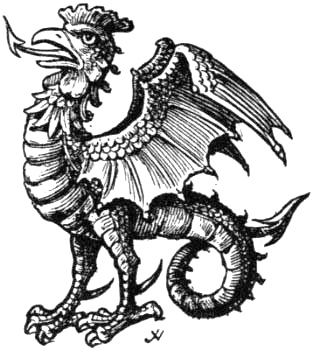
Cockatrice.
The cockatrice is frequently referred to in the Scriptures as the type of something evil. “The weaned child shall put his hand on the cockatrice’s den” (Isaiah xi. 8), meaning that the most noxious animal shall not hurt the most feeble of God’s creatures.
And Jeremiah viii. 17: “For behold, I will send serpents, cockatrices, among you which will not be charmed, and they shall bite you, saith the Lord.”
The cockatrice is a frequent emblem in heraldry, borne as a charge upon the shield and also as a supporter. To the mailed draconic form of the wyvern it had the hideous crested head with livid dangling wattles similar to the dunghill cock, its round glittering eyes dealing death; its barbed tongue and serpentine tail, with deadly sting, would no doubt render it a fearful object to behold, and terrific to its enemies. It is always borne in profile, the wings endorsed, or back to back, unless directed otherwise. The tail is frequently nowed, i.e., knotted.
Sable, a cockatrice or, combed and wattled gules.—Bothe.
Sable, a cockatrice, displayed argent, crested, membered and jelloped gules.—Baggine.
Jelloped, jowlopped, terms used to describe the comb or crest, and gills or wattles, when of a different tincture from the body. Beaked and membered, in similar manner, have reference to the beak and legs.
Basilisk, or Amphysian Cockatrice
The amphysian cockatrice or basilisk in heraldry exactly resembles the cockatrice, but having an additional head (like that of a dragon) at the end of its tail instead of a barb or sting.
“With complicated monsters’ head and tail Scorpion and Asp and Amphisbœna dire.” Milton.
Amphisbœna, or Amphista, is a creature sometimes referred to by old writers as having the dragon’s body and wings, the head of a serpent, and the tail ending in a like head. Bossewelle, in “Armorie of Honour,” folio 63, enlarging upon this idea, describes “a prodigious serpente called Amphybene, for that he hath a double head, as though one mouth were too little to custe his venyme.”
Earl Howe has for supporters two cockatrices (amphysian), wings elevated, the tails nowed, and ending in a serpent’s head or, combed, wattled and legged gules.
Argent, a basilisk, wings endorsed, tail nowed, sable.—Langley, Rathorpe Hall, Yorks.
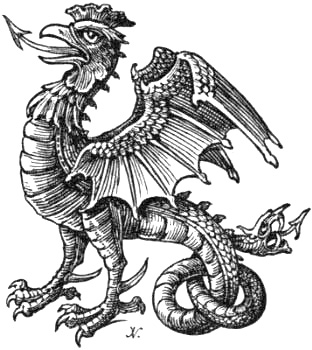
Basilisk or Amphysian Cockatrice, tail nowed.
Basilisk, the king of serpents (Greek, Basileus, a king), so called from having on his head a mitre-shaped crest. Old writers give wonderful accounts of the death-dealing power of this strange creature. Pliny says, “all other serpents do flee from and are afraid of it,” and tells of the deadly effect of his breath and glittering eye. The Duke of Alva, the scourge of the Netherlands (1566-1575), where he left the eternal memory of his cruelties, had for a device a basilisk drawing out serpents, with the motto: “Tu nomine tantum” (“Thou dost so much by thy name alone”), a fitting emblem for so great a monster!
In allusion to its power of “looking any one dead on whom it fixed its eyes,” Dryden makes Clytus say to Alexander, “Nay, frown not so; you cannot look me dead,”
“like a boar Plunging his tusk in mastiff’s gore, Or basilisk, when roused, whose breath, Teeth, sting and eyeballs all are death.” King, Art of Love.
King Henry, when he hears of the death of his uncle Humphry, the good Duke of Gloucester, says to Suffolk:
“come basilisk And kill the innocent gazer with thy sight.” 2 King Henry VI. Act iii. 2.
Beaumont and Fletcher also speak of “the basilisk’s death-dealing eye” in “The Woman Hater.”
Its appearance was so dreadful, it was said, that if a mirror was placed so that it could see itself, it would instantly burst asunder with horror and fear.
In Christian Art it is the emblem of deadly sin and the spirit of evil. St. Basil the Great uses it as the type of a depraved woman.
The Mythical Serpent
“The most remarkable remembrance,” says Dean, “of the power of the paradisaical serpent is displayed in the position which he retains in Tartarus. A cuno-draconictic cerberus guards the gates; serpents are coiled upon the chariot wheels of Proserpine; serpents pave the abyss of torment; and even serpents constitute the caduceus of Mercury, the talisman which he holds in his hand when he conveys the soul to Tartarus. The image of the serpent is stamped upon every mythological fable connected with the realms of Pluto. Is it not probable that in the universal symbol of heathen idolatry we recognise the universal object of primitive worship, the serpent of paradise?”
“Speaking of the names of the snake tribe in the great languages,” Ruskin says, “in Greek, Ophis meant the seeing creature, especially one that sees all round it; and Drakon, one that looks well into a thing or person. In Latin, Anguis, was the strangler; Serpens, the winding creature; Coluber, the coiling animal. In our own Saxon the Snake meant the crawling creature; and Adder denoted the groveller.”
The true serpents comprise the genera without a sternum or breastbone, in which there is no vestige of shoulder, but where the ribs surround a great part of the circumference of the trunk. To the venomous kind belong the rattlesnake, cobra de capello, spectacled or hooded snake, viper, &c. So the non-venomous, the boa constrictor, anaconda, python, black snake, common snake.
The minute viper, V. Brashyura, is celebrated for the intensity of its poison, and is truly one of the most terrible of its genus. The asp of Egypt, or Cleopatra’s asp (Coluber naja, Lin.), was held in great veneration by the Egyptians; and it is this snake which the jugglers, by pressing on the nape of the neck with the finger, throw into a kind of catalepsy, which renders it stiff, or, as they term it, turns it into a rod.
All snakes, says the celebrated naturalist Waterton, take a motion from left to right or vice versa—but never up and down—the whole extent of the body being in contact with the ground, saving the head, which is somewhat elevated. This is equally observable both on land and in water. Thus, when we see a snake represented in an up-and-down attitude, we know at once that the artist is to blame.
Another misconception exploded by Waterton is the common and accepted notion that a snake can fascinate to their destruction and render powerless by a dead set of its eye the creatures it makes its prey. Snakes have no such power. The eyes, which are very beautiful, do not move, and they have no eyelids; they have been placed by nature under a scale similar in composition to the scales of the body, and when the snake casts it slough, this scale comes away with it, and is replaced by a new one on a new skin.
Noli me tangere—do not touch me with intent to harm me—is, continues Waterton, a most suitable motto for a snake, which towards man never acts on the offensive (except perhaps only the larger species which may be in waiting for a meal, when any creature, from a bull to a mouse, may be acceptable). But when roused into action by the fear of sudden danger, ’tis then that, in self-defence a snake will punish the intruder by a prick (not a laceration) from the poison-fang, fatal or not, according to its size and virulence.
A writer in the Daily Telegraph of July 23, 1883, giving an account of the new reptile house in the Zoological Gardens, Regent’s Park, dwells upon the surpassing beauty of a python that had just cast its skin, “a very miracle of reptilian loveliness. Watch it breathing; it is as gentle as a child, and the beautiful lamia head rests like a crowning jewel upon the softly heaving coils. Let danger threaten, however, and lightning is hardly quicker than the dart of those vengeful convolutions. The gleaming length rustles proudly into menace, and instead of the voluptuous lazy thing of a moment ago, the python, with all its terrors complete, erects itself defiantly, thrilling, so it seems, with eager passion in every scale, and measuring in the air, with threatening head, the circle within which is death. Once let those recurved fangs strike home, and there is no poison in them, all hope is gone to the victim. Coil after coil is rapidly thrown round the struggling object, and then with slow but relentless pressure life is throttled out of every limb. No wonder that the world has always held the serpent in awe, and that nations should have worshipped, and still worship, this emblem of destruction and death. It is fate itself, swift as disaster, deliberate as retribution, incomprehensible as destiny.” It would be tedious to recapitulate the multitude of myths through which the “dire worm” has come to our times, dignified and made awful by the honours and fears of the past. A volume could hardly exhaust the snake-lore scattered up and down in the pages of history and fable.
“The python in the Zoological Gardens, however,” adds the same writer, “though it may stand as the modern reality of the old-world fable of a gigantic snake that challenged the strength of the gods to overcome it, presents to us only one side of snake nature. It possesses a surprising beauty and prodigious strength; but it is not venomous. Probably the more subtle and fearful apprehensions of men originated really from the smaller and deadlier kinds, and were then by superstition, poetry and heraldry extended to the larger. The little basilisk, crowned king of the vipers; the horned ‘cerastes dire,’ a few inches in length; the tiny aspic, fatal as lightning and as swift; and the fabled cockatrice, that a man might hold in his hand, first made the serpent legend terrible; their venom was afterwards transferred, and not unnaturally, to the larger species. It was the small minute worms, that carried in their fangs such rapid and ruthless death, which first struck fear into the minds of the ancients, and invested the snake with the mysterious and horrid attributes whereunto antiquity from China to Egypt hastened to pay honours.”
Cadmus and his wife Harmonia were by Zeus converted into serpents and removed to Elysium. Æsculapius, son of Apollo, god of medicine, assumed the form of a serpent when he appeared at Rome during a pestilence; therefore he is always represented with his staff entwined with a serpent, symbol of healing. Similarly represented was Hippocrates, a famous physician of Cos; who delivered Athens from a dreadful pestilence, in the beginning of the Peloponnesian War, and was publicly rewarded with a golden crown, and the privileges of a citizen. Therefore it is that the goddess of health bears in her hand a serpent.
The caduceus of Mercury was a rod adorned with wings, having a male and female serpent twisted about it, each kissing the other. With this in his hands, it was said, the herald of the Gods could give sleep to whomsoever he chose; wherefore Milton, in “Paradise Lost,” styles it “his opiate rod.”
“With his caduceus Hermes led From the dark regions of the imprisoned dead; Or drove in silent shoals the lingering train To night’s dull shore and Pluto’s dreary reign.” Darwin, Loves of the Plants, ii. 291.
Jupiter Ammon appeared to Olympias in the form of a serpent, and became the father of Alexander the Great:
“When glides a silver serpent, treacherous guest! And fair Olympia folds him to her breast.” Darwin, Economy of Vegetation, i. 2.
Jupiter Capitolinus in a similar form became the father of Scipio Africanus.
In the temple of Athena at Athens, a serpent was kept in a cage and called “The Guardian Spirit of the Temple.” This serpent was supposed to be animated by the soul of Ericthonius. It was thus employed by the Greeks and Romans to symbolise a guardian spirit, and not unfrequently the figure of a serpent was depicted on their altars.
Upon the shields of Greek warriors, on ancient vases, &c., the serpent is often to be seen blazoned.
Greek Shield, from painted vase in the British Museum.
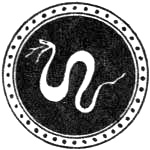
The serpent monster Python, produced from the mud left on the earth after the deluge of Deucalion, lived in the caves of Mount Parnassus, but was slain by Apollo, who founded the Pythian games in commemoration of his victory. This and many similar solar myths are merely classic panegyrics on the conquering power exercised by the genial warmth of spring over the dark gloom of winter.
The serpent in Christian Art figures in Paradise as the tempter of Eve under that form, and is generally placed under the feet of the Virgin, in allusion to the promise made to Eve after the Fall: “The seed of the woman shall bruise the serpent’s head.” The heart of the serpent being close to the head, renders a severe “bruise” there fatal. The serpent bruised the “heel” of man—i.e., being a cause of stumbling, it hurt the foot which tripped against it (Gen. iii. 15).
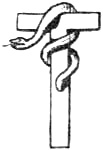
The brazen serpent erected by Moses in the wilderness, which gave newness of life to those plague-stricken Israelites who were bitten by the fiery dragons and raised their eyes to this symbol (Numb. xxi. 8), as an emblem of healing, is represented in Christian art as coiled up on a tau cross, a symbol of which our Saviour did not disdain in some degree to admit the propriety when he compared himself to the healing serpent in the wilderness.
The serpent is placed under the feet of St. Cecilia, St. Euphemia, and many other saints, either because they trampled on Satan, or because they miraculously cleared some country of such reptiles. St. Patrick, the patron saint of Ireland, is always represented habited as a bishop, his foot upon a viper, the head transfixed with the lower extremity of his pastoral staff, from his having banished snakes and all venomous reptiles from the soil of Ireland. As the symbol of the evil principle, a diminutive specimen of the dragon, guivre, or winged snake was more frequently used, wriggling under foot.
The serpent is emblematical of The Fall; Satan is called the great serpent (Rev. xii. 9); of Wisdom: “Be ye therefore wise as serpents, and harmless as doves” (Matt. x. 16); of Subtlety: “Now the serpent was more subtil than any beast of the field” (Gen. iii. 1); of Eternity: a serpent in a circle with its tail in its mouth is the well understood symbol of unending time.
“The serpent figures largely in Byzantine Art as the instrument of the Fall, and one type of the Redemption. The cross planted on the serpent is found sculptured on Mount Athos; and the cross surrounded by the so-called runic knot is only a Scandinavian version of the original Byzantine image—the crushed snake curling round the stem of the avenging cross. The cross, with two scrolls at the foot of it typifying the snake, is another of its modifications, and a very common Byzantine ornament. The ordinary northern crosses, so conspicuous for their interlaced ornaments and grotesque monsters, appear to be purely modifications of this idea.”[8]
Boniface, the Anglo-Saxon missionary, in his letter to the Archbishop of Canterbury, inveighs against the luxuries of dress, and declares against those garments that are adorned with very broad studs and images of worms, announcing the coming of Antichrist.
In the wonderfully intricate interlacing of snake-like and draconic forms of celtic art which appear in the marvellously illuminated manuscripts executed in Ireland of the sixth and seventh centuries, the great sculptured crosses, as well as in gold and metal work, are seen unmistakable traces of the traditional ideas relating to the early serpent-worship.
“The serpent,” says Mr. Planché, “the most terrible of all reptiles, is of rare occurrence in English heraldry. Under its Italian name of Bisse it occurs in the Roll of Edward III.’s time, ‘Monsire William Malbis d’argent, a une chevron de gules, a trois testes de bys rases gules’ (Anglicé, argent, a chevron between three serpents’ heads erased gules).”
The well-known historic device, the Biscia or serpent devouring a child, of the dukedom of Milan is of much interest. There are many stories as to the origin of this singular bearing. Some writers assign it to Otho Visconti, who led a body of Milanese in the train of Peter the Hermit, and at the crusades fought and killed in single combat the Saracen giant Volux, upon whose helmet was this device, which Otho afterwards assumed as his own. Such is the version adopted by Tasso, who enumerates Otho among the Christian warriors:
“Otho fierce, whose valour won the shield That bears a child and serpent on the field.” Gerusalemme Liberata, cant. i. st. 55. (Hoole’s translation.)
From another legend we learn that when Count Boniface, Lord of Milan, went to the crusades, his child, born during his absence, was devoured in its cradle by a huge serpent which ravaged the country. On his return, Count Boniface went in search of the monster, and found it with a child in its mouth. He attacked and slew the creature, but at the cost of his own life. Hence it is said his posterity bore the serpent and child as their ensign. A third legend is referred to under Wyvern (which see).
Menestrier says that the first Lords of Milan were called after their castle in Angleria, in Latin anguis, and that these are only the armes parlantes of their name.[9] Be this as it may, “Lo Squamoso Biscion” (the scaly snake) was adopted by all the Visconti lords, and by their successors of the House of Sforza.
“Sforza e Viscontei colubri.” Orlando Furioso, cant. xiii. 63.
And again in the same poem (cant. iii. 26. Hoole’s translation):
“Hugo appears with him, his valiant son Who plants his conquering snakes in Milan’s town.”
Dante also refers in “Purgatorio” to this celebrated device.
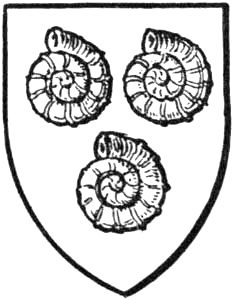
Arms of Whitby Abbey.
The “three coiled snakes,” which appear in the arms of Whitby Abbey, Yorkshire, really represent fossil ammonites, which are very plentiful in the rocky promontories of that part of the English coast, and on that account were no doubt adopted in the arms of the Abbey, and afterwards of the town of Whitby.
The arms are: Azure three snakes coiled or encircled two and one, or.
Popular legend, however, ascribes their origin to the transformation of a multitude of snakes into stone by St. Hilda, an ancient Saxon princess. The legend is referred to by Sir Walter Scott in “Marmion”:
“How of a thousand snakes each one Was changed into a coil of stone While Holy Hilda prayed.”
It is, however, more than likely that the arms suggested the legend of the miracle.
The ancient myth of the deaf adder seems to have been a favourite illustration of the futility of unwelcome counsel.
“What, art thou, like the adder, waxen deaf? Be poisonous too.” 2 King Henry VI. Act ii. sc. 2. “Pleasure and revenge have ears more deaf than adders To the voice of any true decision.” Troilus and Cressida, Act ii. sc. 2. “He flies me now—nor more attends my pain Than the deaf adder heeds the charmer’s strain.” Orlando Furioso, cant. xxxii. 19. (Hoole’s translation.)
A serpent or adder stopping his ears, by some writers termed “an adder obturant his ear” from the Latin obturo, to shut or stop, is a very ancient idea. It is said that the asp or adder, to prevent his hearing unwelcome truths, puts one ear to the ground and stops the other with his tail, a device suggested by Psalm lviii. 4,5: “They are like the deaf adder that stoppeth her ear; which will not hearken to the voice of charmers, charming never so wisely.”
Alessandro d’Alessandri (+ 1523), a lawyer of Naples, of extensive learning, and a member of the Neapolitan Academy, took for device a serpent stopping its ears, and the motto, “Ut prudentia vivam” (“That I may live wisely”), implying that as the serpent by this means refuses to hear the voice of the charmer, so the wise man imitates the prudence of the reptile and refuses to listen to the words of malice and slander.
It is said that the cerastes hides in sand that it may bite the horse’s foot and get the rider thrown. In allusion to this belief, Jacob says, “Dan shall be ... an adder in the path, that his rider shall fall backward” (Gen. xlix. 17).
Asp.—According to Sir Gardiner Wilkinson, the ancient Egyptian kings wore the asp, the emblem of royalty, as an ornament on the forehead. It appears on the front of the double crown of Upper and Lower Egypt.
Many terms have been invented by the heralds to express the positions serpents may assume in arms. Berry’s “Encyclopædia of Heraldry” illustrates over thirty positions, the terms of blazon of which it is impossible to comprehend, and hardly worth the inquiry. Few of these terms are, however, met with in English heraldry.
Two serpents erect in pale, their tails “nowed” (twisted or knotted) together, are figured in the arms of Caius College, Cambridge. In the words of the old grant, they are blazoned “gold, semied with flowers gentil, a sengreen (or houseleek) in chief, over the heads of two whole serpents in pale, their tails knit together (all in proper colour), resting upon a square marble stone vert, between a book sable, garnish’t gul, buckled, or.”
Fruiterers’ Company of London.—On a mount in base vert, the tree of Paradise environed with the serpent between Adam and Eve, all proper. Motto: Arbor vitæ Christus, fructus perfidem gustamus.
Nowed signifies tied or knotted, and is said of a serpent, wyvern, or other creature whose body or tail is twisted like a knot.
Annodated, another term for nowed; bent in the form of the letter S, the serpents round the caduceus of Mercury may be said to be annodated.
Torqued, torgant, or targant (from the Latin torqueo, to wreathe), the bending and rebending, either in serpents, adders or fish, like the letter S.
A Serpent, nowed, proper. Crest of Cavendish.
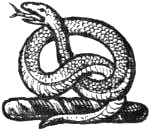
Voluted, involved or encircled, gliding, and several terms used in blazon explain themselves, as erect, erect wavy, &c.
In blazoning, the terms snake, serpent, adder, appear to be used indiscriminately.
A serpent nowed, proper, is the crest of Cavendish, Duke of Devonshire.
Gules, three snakes nowed in triangle argent (Ednowain Ap Bradwen, Merionethshire).
Or, three serpents erect wavy sable (Codlen, or Cudlen).
Remora is an old term in heraldry for a serpent entwining.
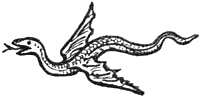
Amphiptère, or flying serpent.
Serpents are also borne entwined round pillars and rods, &c., and around the necks of children, as in the arms of Vaughan or Vahan Wales: Azure, three boys’ heads affronté, couped at the shoulders proper, crined or, each enveloped or enwrapped about the neck with a snake vert. Entwisted and entwined are sometimes used in the same sense.
The amphiptère is a winged serpent. Azure, an amphiptère or, rising between two mountains argent, are the arms of Camoens, the Portuguese poet.
As a symbol in heraldry the serpent does not usually have reference to the mythical creature, as in Early Christian Art, its natural qualities being more generally considered.
The Scorpion
The reptile of this name, carrying a virulent and deadly sting in its tail, is generally borne erect. When it is borne with the head downwards, it is described as reversed. One branch of the family of Cole bears: argent, a fesse between three scorpions erect sable; and another branch of the same family, argent a chevron gules between three scorpions reversed, sable.
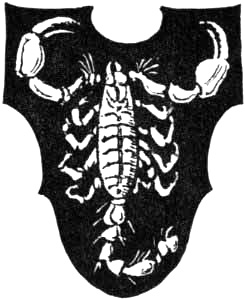
Scorpion.
Scorpion.—Luigi di Gonzaga, styled Rodomonte for his great intrepidity and strength, was a favourite general of Emperor Charles V. in his army with Bourbon at the sack of Rome. When Charles made his public entry into Mantua, Rodomonte wore a blue surcoat made in squares. Upon one was embroidered a scorpion; upon the other his motto, “Qui vivens lædit morte meditur” (“Who living wounds, in death is healed”). It being the property of the scorpion when killed and laid over the wound to cure the poison, so Rodomonte, if any one presumed to offend him, would clear himself of the injury by the death of his enemy.
“If a man be stung with a scorpion, and drink the powder of them in wine, it is thought to be present remedie.”[10]