JACK THE GIANT-KILLER (continued 3)
Reading edition
Snow-white and Rose-red kept their mother’s cottage so clean that it was a pleasure to look into it. In the summer Rose-red managed the house, and every morning she gathered a nosegay in which was a rose off each tree, and set it by her mother’s bed before she awoke. In winter Snow-white lighted the fire, and hung the kettle on the hook; and though it was only copper it shone like gold, it was rubbed so clean. In the evening, when the snow fell, the mother said, “Go, Snow-white, and bolt the door;” and then they seated themselves on the hearth, and the mother took her spectacles, and read aloud out of a great book, and the two girls listened, and sat and span. Near them lay a lamb on the floor, and behind them, on a perch, sat a white dove, with its head under its wing.
One evening, as they were thus happy together, some one knocked to be let in. The mother said, “Quick, Rose-red, open the door; perhaps it is a traveller who seeks shelter.” Rose-red went and pushed the bolt back, and thought it was a poor man; but a bear stretched his thick black head into the door. Rose-red screamed and sprang back, the little lamb bleated, the little dove fluttered about, and Snow-white hid herself behind her mother’s bed. However, the bear began to speak, and said, “Do not be frightened, I will do you no harm; I am half frozen, and only want to warm myself a little.”
“You poor bear,” said the mother, “lay yourself down before the fire, only take care your fur does not burn.” Then she called out: “Snow-white and Rose-red, come out; the bear will not hurt you—he means honestly by us.” Then they both came out, and, by degrees, the lamb and the dove also approached, and ceased to be afraid. The bear said, “Children, knock the snow a little out of my fur;” and they fetched a broom, and swept the bear’s skin clean; and he stretched himself before the fire and growled softly, like a bear that was quite happy and comfortable. In a short time they all became quite friendly together, and the children played tricks with the awkward guest. They pulled his hair, set their feet on his back, and rolled him here and there; or took a hazel rod and beat him, and when he growled they laughed. The bear was very much pleased with this frolic, only, when they became too mischievous, he called out: “Children, leave me alone.
“Little Snow-white and Rose-red, You will strike your lover dead.”
When bedtime came, and the others went to sleep, the mother said to the bear: “You can lie there on the hearth, and then you will be sheltered from the cold and the bad weather.” At daybreak the two children let him out, and he trotted over the snow into the wood. Henceforward the bear came every evening at the same hour, laid himself on the hearth, and allowed the children to play with him as much as they liked; and they became so used to him that the door was never bolted until their black companion had arrived. When spring came, and everything was green out-of-doors, the bear said one morning to Snow-white: “Now I must go away, and may not come again the whole summer.”
“Where are you going, dear Bear?” asked Snow-white.
“I must go into the wood, and guard my treasures from the bad dwarfs; in winter, when the ground is frozen hard, they have to stay underneath, and cannot work their way through, but now that the sun has thawed and warmed the earth, they break through, come up, seek, and steal; what is once in their hands, and lies in their caverns, does not come so easily into daylight again.” Snow-white was quite sorrowful at parting, and as she unbolted the door for him, and the bear ran out, the hook of the door caught him, and a piece of his skin tore off; it seemed to Snow-white as if she had seen gold shining through, but she was not sure. But the bear ran quickly away, and soon disappeared behind the trees.
After some time, their mother sent the children into the wood to collect fagots. They found there a large tree, which had been cut down and lay on the ground, and by the trunk something was jumping up and down, but they could not tell what it was. As they came nearer they saw that it was a dwarf with an old withered face, and a snow-white beard a yard long. The end of the beard was stuck fast in a cleft in the tree, and the little fellow jumped about like a dog on a rope, and did not know how to help himself. He stared at the girls with his fiery red eyes, and screamed out: “Why do you stand there? Can’t you come and render me some assistance?”
“What is the matter with you, little man?” asked Rose-red.
“Stupid little goose!” answered the dwarf; “I wanted to chop the tree, so as to have some small pieces of wood for the kitchen; we only want little bits; with thick logs the small quantity of food that we cook for ourselves—we are not, like you, great greedy people—burns directly. I had driven the wedge well in, and it was all going on right, but the detestable wood was too smooth, and sprang out unexpectedly; and the tree closed up so quickly that I could not pull my beautiful white beard out; now it is sticking there, and I can’t get away. There, you foolish, soft, milk-faces, you are laughing and crying out: ‘How ugly you are! how ugly you are!’”
The children took a great deal of trouble, but they could not pull the beard out; it stuck too fast.
“I will run and fetch somebody,” said Rose-red.
“You great ninny!” snarled the dwarf, “to want to call more people; you are too many for me now. Can’t you think of anything better?”
“Only don’t be impatient,” said Snow-white. “I have thought of something;” and she took her little scissors out of her pocket, and cut the end of the beard off.
As soon as the dwarf felt himself free he seized a sack filled with gold that was sticking between the roots of the tree; pulling it out, he growled to himself: “You rude people, to cut off a piece of my beautiful beard! May evil reward you!” Then he threw his sack over his shoulders, and walked away without once looking at the children.
Some time afterwards Snow-white and Rose-red wished to catch some fish for dinner. As they came near to the stream they saw that something like a grasshopper was jumping towards the water, as if it were going to spring in. They ran on and recognized the dwarf.
“Where are you going?” asked Rose-red. “You don’t want to go into the water?”
“I am not such a fool as that,” cried the dwarf. “Don’t you see the detestable fish wants to pull me in?”
The little fellow had been sitting there fishing, and, unluckily, the wind had entangled his beard with the line. When directly afterwards a great fish bit at his hook the weak creature could not pull him out, so the fish was pulling the dwarf into the water. It is true he caught hold of all the reeds and rushes, but that did not help him much; he had to follow all the movements of the fish, and was in imminent danger of being drowned. The girls, coming at the right time, held him fast and tried to get the beard loose from the line, but in vain—beard and line were entangled fast together. There was nothing to do but to pull out the scissors and to cut off the beard, in doing which a little piece of it was lost. When the dwarf saw that, he cried out: “Is that manners, you goose! to disfigure one’s face so? Is it not enough that you once cut my beard shorter? But now you have cut the best part of it off, I dare not be seen by my people. I wish you had had to run, and had lost the soles of your shoes!” Then he fetched a sack of pearls that lay among the rushes, and, without saying a word more, he dragged it away and disappeared behind a stone.
Soon after the mother sent the two girls to the town to buy cotton, needles, cord, and tape. The road led them by a heath, scattered over which lay great masses of rock. There they saw a large bird hovering in the air; it flew round and round just above them, always sinking lower and lower, and at last it settled down by a rock not far distant. Directly after they heard a piercing, wailing cry. They ran up, and saw with horror that the eagle had seized their old acquaintance, the dwarf, and was going to carry him off. The compassionate children instantly seized hold of the little man, held him fast, and struggled so long that the eagle let his prey go.
When the dwarf had recovered from his first fright, he called out, in his shrill voice: “Could not you deal rather more gently with me? You have torn my thin coat all in tatters, awkward, clumsy creatures that you are!” Then he took a sack of precious stones, and slipped behind the rock again into his den. The girls, who were used to his ingratitude, went on their way, and completed their business in the town. As they were coming home again over the heath they surprised the dwarf, who had emptied his sack of precious stones on a little clean place, and had not thought that any one would come by there so late. The evening sun shone on the glittering stones, which looked so beautiful in all their colors that the children could not help standing still to gaze.
“Why do you stand there gaping?” cried the dwarf, his ash-colored face turning vermilion with anger.
With these cross words he was going away when he heard a loud roaring, and a black bear trotted out of the woods towards them. The dwarf sprang up terrified, but he could not get to his lurking-hole again—the bear was already close upon him. Then he called out in anguish:
“Dear Mr. Bear, spare me, and you shall have all my treasures; look at the beautiful precious stones that lie there. Give me my life; for what do you want with a poor thin little fellow like me? You would scarcely feel me between your teeth. Rather seize those two wicked girls; they will be tender morsels for you, as fat as young quails; pray, eat them at once.”
The bear, without troubling himself to answer, gave the malicious creature one single stroke with his paw, and he did not move again. The girls had run away, but the bear called after them: “Snow-white and Rose-red, do not be frightened; wait, I will go with you.” Recognizing the voice of their old friend, they stood still, and when the bear came up to them his skin suddenly fell off; and behold he was not a bear, but a handsome young man dressed all in gold.
“I am a king’s son,” said he; “I was changed by the wicked dwarf, who had stolen all my treasures, into a wild bear, and obliged to run about in the wood until I should be freed by his death. Now he has received his well-deserved punishment.”
So they all went home together to the widow’s cottage, and Snow-white was married to the prince and Rose-red to his brother. They divided between them the great treasures which the dwarf had amassed. The old mother lived many quiet and happy years with her children; but when she left her cottage for the palace she took the two rose-trees with her, and they stood before her window and bore every year the most beautiful roses—one white and the other red.
THE WILD SWANS
FAR away, where the swallows take refuge in winter, lived a king who had eleven sons and one daughter, Elise. The eleven brothers—they were all princes—used to go to school with stars on their breasts and swords at their sides. They wrote upon golden slates with diamond pencils, and could read just as well without a book as with one, so there was no mistake about their being real princes. Their sister Elise sat upon a little footstool of looking-glass, and she had a picture-book which had cost the half of a kingdom. Oh, these children were very happy; but it was not to last thus forever.
Their father, who was king over all the land, married a wicked queen who was not at all kind to the poor children; they found that out on the first day. All was festive at the castle, but when the children wanted to play at having company, instead of having as many cakes and baked apples as ever they wanted, she would only let them have some sand in a tea-cup, and said they must make-believe.
In the following week she sent little Elise into the country to board with some peasants, and it did not take her long to make the king believe so many bad things about the boys that he cared no more about them.
“Fly out into the world and look after yourselves,” said the wicked queen; “you shall fly about like birds without voices.”
But she could not make things as bad for them as she would have liked; they turned into eleven beautiful wild swans. They flew out of the palace window with a weird scream, right across the park and the woods.
It was very early in the morning when they came to the place where their sister Elise was sleeping in the peasant’s house. They hovered over the roof of the house, turning and twisting their long necks, and flapping their wings; but no one either heard or saw them. They had to fly away again, and they soared up towards the clouds, far out into the wide world, and they settled in a big, dark wood, which stretched right down to the shore.
Poor little Elise stood in the peasant’s room, playing with a green leaf, for she had no other toys. She made a little hole in it, which she looked through at the sun, and it seemed to her as if she saw her brothers’ bright eyes. Every time the warm sunbeams shone upon her cheek it reminded her of their kisses. One day passed just like another. When the wind whistled through the rose-hedges outside the house, it whispered to the roses: “Who can be prettier than you are?” But the roses shook their heads and answered: “Elise!” And when the old woman sat in the doorway reading her Psalms the wind turned over the leaves and said to the book: “Who can be more pious than you?” “Elise!” answered the book. Both the roses and the book of Psalms only spoke the truth.
She was to go home when she was fifteen, but when the queen saw how pretty she was she got very angry, and her heart was filled with hatred. She would willingly have turned her into a wild swan too, like her brothers, but she did not dare to do it at once, for the king wanted to see his daughter. The queen always went to the bath in the early morning. It was built of marble, and adorned with soft cushions and beautiful carpets.
She took three toads, kissed them, and said to the first: “Sit upon Elise’s head when she comes to the bath, so that she may become sluggish like yourself.” “Sit upon her forehead,” she said to the second, “that she may become ugly like you, and then her father won’t know her! Rest upon her heart,” she whispered to the third. “Let an evil spirit come over her, which may be a burden to her.” Then she put the toads into the clean water, and a green tinge immediately came over it. She called Elise, undressed her, and made her go into the bath; when she ducked under the water, one of the toads got among her hair, the other got onto her forehead, and the third onto her bosom. But when she stood up three scarlet poppies floated on the water; had not the creatures been poisonous, and kissed by the sorceress, they would have been changed into crimson roses, but yet they became flowers from merely having rested a moment on her head and her heart. She was far too good and innocent for the sorcery to have any power over her. When the wicked queen saw this she rubbed her over with walnut juice, and smeared her face with some evil-smelling salve. She also matted up her beautiful hair; it would have been impossible to recognize pretty Elise. When her father saw her, he was quite horrified, and said that she could not be his daughter. Nobody would have anything to say to her, except the yard dog and the swallows, and they were only poor dumb animals whose opinion went for nothing.
Poor Elise wept, and thought of her eleven brothers who were all lost. She crept sadly out of the palace and wandered about all day, over meadows and marshes, and into a big forest. She did not know in the least where she wanted to go, but she felt very sad, and longed for her brothers, who, no doubt, like herself had been driven out of the palace. She made up her mind to go and look for them, but she had only been in the wood for a short time when night fell. She had quite lost her way, so she lay down upon the soft moss, said her evening prayer, and rested her head on a little hillock. It was very still and the air was mild; hundreds of glow-worms shone around her on the grass and in the marsh like green fire. When she gently moved one of the branches over her head the little shining insects fell over her like a shower of stars. She dreamed about her brothers all night long. Again they were children playing together: they wrote upon the golden slates with their diamond pencils, and she looked at the picture-book which had cost half a kingdom. But they no longer wrote strokes and noughts upon their slates as they used to do; no, they wrote down all their boldest exploits, and everything that they had seen and experienced. Everything in the picture-book was alive, the birds sang, and the people walked out of the book, and spoke to Elise and her brothers. When she turned over a page they skipped back into their places again, so that there should be no confusion among the pictures.
When she woke the sun was already high; it is true she could not see it very well through the thick branches of the lofty forest trees, but the sunbeams cast a golden shimmer around beyond the forest. There was a fresh, delicious scent of grass and herbs in the air, and the birds were almost ready to perch upon her shoulders. She could hear the splashing of water, for there were many springs around, which all flowed into a pond with a lovely sandy bottom. It was surrounded with thick bushes, but there was one place which the stags had trampled down, and Elise passed through the opening to the water side. It was so transparent that had not the branches been moved by the breeze she must have thought that they were painted on the bottom, so plainly was every leaf reflected, both those on which the sun played, and those which were in shade.
When she saw her own face she was quite frightened, it was so brown and ugly; but when she wet her little hand and rubbed her eyes and forehead her white skin shone through again. Then she took off all her clothes and went into the fresh water. A more beautiful royal child than she could not be found in all the world.
When she had put on her clothes again and plaited her long hair she went to a sparkling spring, and drank some of the water out of the hollow of her hand. Then she wandered farther into the wood, though where she was going she had not the least idea. She thought of her brothers, and she thought of a merciful God who would not forsake her. He let the wild crab-apples grow to feed the hungry. He showed her a tree, the branches of which were bending beneath their weight of fruit. Here she made her midday meal, and, having put props under the branches, she walked on into the thickest part of the forest. It was so quiet that she heard her own footsteps; she heard every little withered leaf which bent under her feet. Not a bird was to be seen, not a ray of sunlight pierced the leafy branches, and the tall trunks were so close together that when she looked before her it seemed as if a thick fence of heavy beams hemmed her in on every side. The solitude was such as she had never known before.
It was a very dark night, not a single glow-worm sparkled in the marsh; sadly she lay down to sleep, and it seemed to her as if the branches above her parted asunder, and the Saviour looked down upon her with His loving eyes, and little angels’ heads peeped out above His head and under His arms.
When she woke in the morning she was not sure if she had dreamed this, or whether it was really true.
She walked a little farther, when she met an old woman with a basket full of berries, of which she gave her some. Elise asked if she had seen eleven princes ride through the wood. “No,” said the old woman, “but yesterday I saw eleven swans, with golden crowns upon their heads, swimming in the stream close by here.”
She led Elise a little farther to a slope, at the foot of which the stream meandered. The trees on either bank stretched out their rich, leafy branches towards each other, and where, from their natural growth, they could not reach each other, they had torn their roots out of the ground, and leaned over the water so as to interlace their branches.
Elise said good-bye to the old woman and walked along by the river till it flowed out into the great open sea.
The beautiful open sea lay before the maiden, but not a sail was to be seen on it—not a single boat. How was she ever to get any farther? She looked at the numberless little pebbles on the beach; they were all worn quite round by the water. Glass, iron, stone, whatever was washed up, had taken their shapes from the water, which yet was much softer than her little hand. “With all its rolling, it is untiring, and everything hard is smoothed down. I will be just as untiring! Thank you for your lesson, you clear rolling waves! Some time, so my poor heart tells me, you will bear me to my beloved brothers!”
Eleven white swans’ feathers were lying on the sea-weed; she picked them up and made a bunch of them. There were still drops of water on them. Whether these were dew or tears no one could tell. It was very lonely there by the shore, but she did not feel it, for the sea was ever changing. There were more changes on it in the course of a few hours than could be seen on an inland fresh-water lake in a year. If a big black cloud arose it was just as if the sea wanted to say, “I can look black too,” and then the wind blew up and the waves showed their white crests. But if the clouds were red and the wind dropped, the sea looked like a rose-leaf, now white, now green. But, however still it was, there was always a little gentle motion just by the shore; the water rose and fell softly, like the bosom of a sleeping child.
When the sun was just about to go down, Elise saw eleven wild swans with golden crowns upon their heads flying towards the shore. They flew in a swaying line, one behind the other, like a white ribbon streamer. Elise climbed up onto the bank and hid behind a bush; the swans settled close by her and flapped their great white wings.
As soon as the sun had sunk beneath the water the swans shed their feathers and became eleven handsome princes; they were Elise’s brothers. Although they had altered a good deal, she knew them at once; she felt that they must be her brothers, and she sprang into their arms, calling them by name. They were delighted when they recognized their little sister who had grown so big and beautiful. They laughed and cried, and told each other how wickedly their stepmother had treated them all.
“We brothers,” said the eldest, “have to fly about in the guise of swans, as long as the sun is above the horizon. When it goes down we regain our human shapes. So we always have to look out for a resting-place near sunset, for should we happen to be flying up among the clouds when the sun goes down we should be hurled to the depths below. We do not live here; there is another land, just as beautiful as this, beyond the sea; but the way to it is very long, and we have to cross the mighty ocean to get to it. There is not a single island on the way where we can spend the night; only one solitary little rock juts up above the water midway. It is only just big enough for us to stand upon close together, and if there is a heavy sea the water splashes over us, yet we thank our God for it. We stay there over night in our human forms, and without it we could never revisit our beloved Fatherland, for our flight takes two of the longest days in the year. We are only permitted to visit the home of our fathers once a year, and we dare only stay for eleven days. We hover over this big forest from whence we catch a glimpse of the palace where we were born, and where our father lives; beyond it we can see the high church towers where our mother is buried. We fancy that the trees and bushes here are related to us; and the wild horses gallop over the moors, as we used to see them in our childhood. The charcoal burners still sing the old songs we used to dance to when we were children. This is our Fatherland, we are drawn towards it, and here we have found you again, dear little sister! We may stay here two days longer, and then we must fly away again across the ocean to a lovely country indeed, but it is not our own dear Fatherland. How shall we ever take you with us! We have neither ship nor boat!”
“How can I deliver you!” said their sister, and they went on talking to each other nearly all night; they only dozed for a few hours.
Elise was awakened in the morning by the rustling of the swans’ wings above her; her brothers were again transformed, and were wheeling round in great circles till she lost sight of them in the distance. One of them, the youngest, stayed behind. He laid his head against her bosom, and she caressed it with her fingers. They remained together all day. Towards evening the others came back, and as soon as the sun went down they took their natural forms.
“To-morrow we must fly away, and we dare not come back for a whole year, but we can’t leave you like this! Have you courage to go with us? My arm is strong enough to carry you over the forest, so surely our united strength ought to be sufficient to bear you across the ocean.”
“Oh yes; take me with you,” said Elise.
They spent the whole night in weaving a kind of net of the elastic bark of the willow bound together with tough rushes; they made it both large and strong. Elise lay down upon it, and when the sun rose and the brothers became swans again they took up the net in their bills and flew high up among the clouds with their precious sister, who was fast asleep. The sunbeams fell straight onto her face, so one of the swans flew over her head so that its broad wings should shade her.
They were far from land when Elise woke; she thought she must still be dreaming, it seemed so strange to be carried through the air so high up above the sea. By her side lay a branch of beautiful ripe berries and a bundle of savory roots which her youngest brother had collected for her, and for which she gave him a grateful smile. She knew it was he who flew above her head shading her from the sun. They were so high up that the first ship they saw looked like a gull floating on the water. A great cloud came up behind them like a mountain, and Elise saw the shadow of herself on it, and those of the eleven swans looking like giants. It was a more beautiful picture than any she had ever seen before, but as the sun rose higher, the cloud fell behind, and the shadow picture disappeared.
They flew on and on all day like an arrow whizzing through the air, but they went slower than usual, for now they had their sister to carry. A storm came up, and night was drawing on; Elise saw the sun sinking with terror in her heart, for the solitary rock was nowhere to be seen. The swans seemed to be taking stronger strokes than ever; alas! she was the cause of their not being able to get on faster; as soon as the sun went down they would become men, and they would all be hurled into the sea and drowned. She prayed to God from the bottom of her heart, but still no rock was to be seen! Black clouds gathered, and strong gusts of wind announced a storm; the clouds looked like a great threatening leaden wave, and the flashes of lightning followed each other rapidly.
The sun was now at the edge of the sea. Elise’s heart quaked, when suddenly the swans shot downward so suddenly that she thought they were falling then they hovered again. Half of the sun was below the horizon, and there for the first time she saw the little rock below, which did not look bigger than the head of a seal above the water. The sun sank very quickly, it was no bigger than a star, but her foot touched solid earth. The sun went out like the last sparks of a bit of burning paper; she saw her brothers stand arm in arm around her, but there was only just room enough for them. The waves beat upon the rock and washed over them like drenching rain. The heavens shone with continuous fire, and the thunder rolled, peal upon peal. But the sister and brothers held one another’s hands and sang a psalm which gave them comfort and courage.
The air was pure and still at dawn. As soon as the sun rose the swans flew off with Elise, away from the islet. The sea still ran high; it looked from where they were as if the white foam on the dark green water were millions of swans floating on the waves.
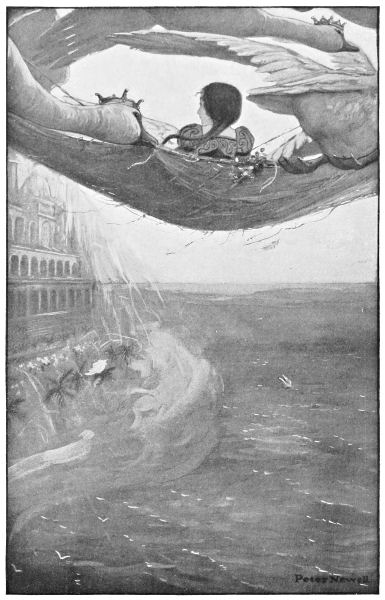
Elise saw an ice palace, with one bold colonnade built above another
When the sun rose higher Elise saw before her, half floating in the air, great masses of ice, with shining glaciers on the heights. A palace was perched midway a mile in length, with one bold colonnade built above another. Beneath them swayed palm-trees and gorgeous blossoms as big as mill wheels. She asked if this was the land to which she was going, but the swans shook their heads, because what she saw was a mirage—the beautiful and ever-changing palace of Fata Morgana. No mortal dared enter it. Elise gazed at it; but as she gazed the palace, gardens, and mountains melted away, and in their place stood twenty proud churches with their high towers and pointed windows. She seemed to hear the notes of the organ, but it was the sea she heard. When she got close to the seeming churches they changed to a great navy sailing beneath her; but it was only a sea mist passing before her eyes, and now she saw the real land she was bound to. Beautiful blue mountains rose before her with their cedar woods and palaces. Long before the sun went down she sat among the hills in front of a big cave covered with delicate green creepers. It looked like a piece of embroidery.
“Now we shall see what you will dream here to-night,” said the youngest brother, as he showed her where she was to sleep.
“If only I might dream how I could deliver you,” she said, and this thought filled her mind entirely. She prayed earnestly to God for His help, and even in her sleep she continued her prayer. It seemed to her that she was flying up to Fata Morgana in her castle in the air. The fairy came towards her; she was charming and brilliant, and yet she was very like the old woman who gave her the berries in the wood and told her about the swans with the golden crowns.
“Your brothers can be delivered,” she said; “but have you courage and endurance enough for it? The sea is indeed softer than your hands, and it molds the hardest stones; but it does not feel the pain your fingers will feel. It has no heart, and does not suffer the pain and anguish you must feel. Do you see this stinging nettle I hold in my hand? Many of this kind grow round the cave where you sleep; only these and the ones which grow in the church-yards may be used. Mark that! Those you may pluck, although they will burn and blister your hands. Crush the nettles with your feet and you will have flax, and of this you must weave eleven coats of mail with long sleeves. Throw these over the eleven wild swans and the charm is broken! But remember that from the moment you begin this work till it is finished, even if it takes years, you must not utter a word! The first word you say will fall like a murderer’s dagger into the hearts of your brothers. Their lives hang on your tongue. Mark this well!”
She touched her hand at the same moment—it was like burning fire—and woke Elise. It was bright daylight, and close to where she slept lay a nettle like those in her dream. She fell upon her knees with thanks to God, and left the cave to begin her work.
She seized the horrid nettles with her delicate hands, and they burnt like fire; great blisters rose on her hands and arms, but she suffered it willingly if only it would deliver her beloved brothers. She crushed every nettle with her bare feet, and twisted it into green flax.
When the sun went down and the brothers came back they were alarmed at finding her mute; they thought it was some new witchcraft exercised by their wicked stepmother. But when they saw her hands they understood that it was for their sakes; the youngest brother wept, and wherever his tears fell she felt no more pain and the blisters disappeared.
She spent the whole night at her work, for she could not rest till she had delivered her dear brothers. All the following day while her brothers were away she sat solitary, but never had the time flown so fast. One coat of mail was finished, and she began the next. Then a hunting-horn sounded among the mountains; she was much frightened; the sound came nearer, and she heard dogs barking. In terror she rushed into the cave, and tied the nettles she had collected and woven into a bundle, upon which she sat.
At this moment a big dog bounded forward from the thicket, and another and another; they barked loudly, and ran backward and forward. In a few minutes all the huntsmen were standing outside the cave, and the handsomest of them was the king of the country. He stepped up to Elise; never had he seen so lovely a girl.
“How came you here, beautiful child?” he said.
Elise shook her head; she dared not speak; the salvation and the lives of her brothers depended upon her silence. She hid her hands under her apron, so that the king should not see what she suffered.
“Come with me,” he said; “you cannot stay here. If you are as good as you are beautiful I will dress you in silks and velvets, put a golden crown upon your head, and you shall live with me and have your home in my richest palace!” Then he lifted her upon his horse: she wept and wrung her hands, but the king said: “I only think of your happiness; you will thank me one day for what I am doing!” Then he darted off across the mountains, holding her before him on his horse, and the huntsmen followed.
When the sun went down the royal city with churches and cupolas lay before them, and the king led her into the palace, where great fountains played in the marble halls, and where walls and ceilings were adorned with paintings; but she had no eyes for them, she only wept and sorrowed. Passively she allowed the women to dress her in royal robes, to twist pearls into her hair, and to draw gloves onto her blistered hands.
She was dazzlingly lovely as she stood there in all her magnificence; the courtiers bent low before her, and the king wooed her as his bride, although the archbishop shook his head, and whispered that he feared the beautiful wood maiden was a witch who had dazzled their eyes and infatuated the king.
The king refused to listen to him; he ordered the music to play, the richest food to be brought, and the loveliest girls to dance before her. She was led through scented gardens into gorgeous apartments, but nothing brought a smile to her lips or into her eyes; sorrow sat there like a heritage and a possession for all time. Last of all, the king opened the door of a little chamber close by the room where she was to sleep. It was adorned with costly green carpets, and made to exactly resemble the cave where he found her. On the floor lay the bundle of flax she had spun from the nettles, and from the ceiling hung the shirt of mail which was already finished. One of the huntsmen had brought all these things away as curiosities.
“Here you may dream that you are back in your former home!” said the king. “Here is the work upon which you were engaged; in the midst of your splendor, it may amuse you to think of those times.”
When Elise saw all those things so dear to her heart, a smile for the first time played about her lips, and the blood rushed back to her cheeks. She thought of the deliverance of her brothers, and she kissed the king’s hand; he pressed her to his heart, and ordered all the church bells to ring marriage peals. The lovely dumb girl from the woods was to be queen of the country.
The archbishop whispered evil words into the ear of the king, but they did not reach his heart. The wedding was to take place, and the archbishop himself had to put the crown upon her head. In his anger he pressed the golden circlet so tightly upon her head as to give her pain. But a heavier circlet pressed upon her heart—her grief for her brothers; so she thought nothing of the bodily pain. Her lips were sealed, a single word from her mouth would cost her brothers their lives, but her eyes were full of love for the good and handsome king, who did everything he could to please her. Every day she grew more and more attached to him, and longed to confide in him, tell him her sufferings; but dumb she must remain, and in silence must bring her labor to completion. Therefore at night she stole away from his side into her secret chamber, which was decorated like a cave, and here she knitted one shirt after another. When she came to the seventh all her flax was worked up; she knew that these nettles which she was to use grew in the church-yard, but she had to pluck them herself. How was she to get there? “Oh, what is the pain of my fingers compared with the anguish of my heart?” she thought. “I must venture out; the good God will not desert me!” With as much terror in her heart as if she were doing some evil deed she stole down one night into the moonlit garden, and through the long alleys out into the silent streets to the church-yard. There she saw, sitting on a gravestone, a group of hideous ghouls, who took off their tattered garments, as if they were about to bathe, and then they dug down into the freshly made graves with their skinny fingers, and tore the flesh from the bodies and devoured it. Elise had to pass close by them, and they fixed their evil eyes upon her; but she said a prayer as she passed, picked the stinging nettles, and hurried back to the palace with them.
Only one person saw her, but that was the archbishop, who watched while others slept. Surely now all his bad opinions of the queen were justified; all was not as it should be with her; she must be a witch, and therefore she had bewitched the king and all the people.
He told the king in the confessional what he had seen and what he feared. When those bad words passed his lips the pictures of the saints shook their heads as if to say: It is not so; Elise is innocent. The archbishop, however, took it differently, and thought that they were bearing witness against her, and shaking their heads at her sin. Two big tears rolled down the king’s cheeks, and he went home with doubt in his heart. He pretended to sleep at night, but no quiet sleep came to his eyes. He perceived how Elise got up and went to her private closet. Day by day his face grew darker; Elise saw it, but could not imagine what was the cause of it. It alarmed her, and what was she not already suffering in her heart because of her brothers? Her salt tears ran down upon the royal purple velvet, they lay upon it like sparkling diamonds, and all who saw their splendor wished to be queen.
She had, however, almost reached the end of her labors, only one shirt of mail was wanting; but again she had no more flax, and not a single nettle was left. Once more, for the last time, she must go to the church-yard to pluck a few handfuls. She thought with dread of the solitary walk and the horrible ghouls, but her will was as strong as her trust in God.
Elise went, but the king and the archbishop followed her; they saw her disappear within the grated gateway of the church-yard. When they followed they saw the ghouls sitting on the gravestone as Elise had see them before; and the king turned away his head because he thought she was among them—she, whose head this very evening had rested on his breast.
“The people must judge her,” he groaned, and the people judged. “Let her be consumed in the glowing flames!”
She was led away from her beautiful royal apartments to a dark, damp dungeon, where the wind whistled through the grated window. Instead of velvet and silk, they gave her the bundle of nettles she had gathered to lay her head upon. The hard, burning shirts of mail were to be her covering, but they could have given her nothing more precious.
She set to work again, with many prayers to God. Outside her prison the street boys sang derisive songs about her, and not a soul comforted her with a kind word.
Towards evening she heard the rustle of swans’ wings close to her window; it was her youngest brother; at last he had found her. He sobbed aloud with joy, although he knew that the coming night might be her last; but then her work was almost done, and her brothers were there.
The archbishop came to spend his last hours with her, as he had promised the king. She shook her head at him, and by looks and gestures begged him to leave her. She had only this night in which to finish her work, or else all would be wasted, all—her pain, tears, and sleepless nights. The archbishop went away with bitter words against her, but poor Elise knew that she was innocent, and she went on with her work.
The little mice ran about the floor bringing nettles to her feet, so as to give what help they could, and a thrush sat on the grating of the window where he sang all night as merrily as he could to keep up her courage.
It was still only dawn and the sun would not rise for an hour when the eleven brothers stood at the gate of the palace, begging to be taken to the king. This could not be done was the answer, for it was still night; the king was asleep, and no one dared wake him. All their entreaties and threats were useless; the watch turned out, and even the king himself came to see what was the matter; but just then the sun rose, and no more brothers were to be seen—only eleven wild swans hovering over the palace.
The whole populace streamed out of the town gates; they were all anxious to see the witch burned. A miserable horse drew the cart in which Elise was seated. They had put upon her a smock of green sacking, and all her beautiful long hair hung loose from the lovely head. Her cheeks were deathly pale, and her lips moved softly, while her fingers unceasingly twisted the green yarn. Even on the way to her death she could not abandon her unfinished work. Ten shirts lay completed at her feet; she labored away at the eleventh amid the scoffing insults of the populace.
“Look at the witch; how she mutters! She has never a book of psalms in her hands; no, there she sits with her loathsome sorcery. Tear it away from her into a thousand bits!”
The crowd pressed around her to destroy her work, but just then eleven white swans flew down and perched upon the cart flapping their wings. The crowd gave way before them in terror.
“It is a sign from Heaven! She is innocent!” they whispered, but they dared not say it aloud.
The executioner seized her by the hand. But she hastily threw the eleven shirts over the swans, who were immediately transformed to eleven handsome princes; but the youngest had a swan’s wing in place of an arm, for one sleeve was wanting to his shirt of mail; she had not been able to finish it.
“Now I may speak! I am innocent.”
The populace who saw what had happened bowed down before her as if she had been a saint, but she sank lifeless in her brother’s arms, so great had been the strain, the terror, and the suffering she had endured.
“Yes, innocent she is indeed,” said the eldest brother, and he told them all that had happened.
While he spoke a wonderful fragrance spread around as of millions of roses. Every fagot in the pile had taken root and shot out branches, and a great high hedge of red roses had arisen. At the very top was one pure white blossom; it shone like a star, and the king broke it off and laid it on Elise’s bosom, and she woke with joy and peace in her heart.
All the church bells began to ring of their own accord, and the singing birds flocked around them. Surely such a bridal procession went back to the palace as no king had ever seen before!
ALADDIN AND THE WONDERFUL LAMP
THERE once lived a poor tailor who had a son called Aladdin, a careless, idle boy who would do nothing but play all day long in the streets with little idle boys like himself. This so grieved the father that he died; yet, in spite of his mother’s tears and prayers, Aladdin did not mend his ways. One day, when he was playing in the streets as usual, a stranger asked him his age, and if he was not the son of Mustapha the tailor. “I am, sir,” replied Aladdin; “but he died a long while ago.” On this the stranger, who was a famous African magician, fell on his neck and kissed him, saying: “I am your uncle, and knew you from your likeness to my brother. Go to your mother and tell her I am coming.” Aladdin ran home and told his mother of his newly found uncle. “Indeed, child,” she said, “your father had a brother, but I always thought he was dead.” However, she prepared supper, and bade Aladdin seek his uncle, who came laden with wine and fruit. He presently fell down and kissed the place where Mustapha used to sit, bidding Aladdin’s mother not to be surprised at not having seen him before, as he had been forty years out of the country. He then turned to Aladdin, and asked him his trade, at which the boy hung his head, while his mother burst into tears. On learning that Aladdin was idle and would learn no trade, he offered to take a shop for him and stock it with merchandise. Next day he bought Aladdin a fine suit of clothes and took him all over the city, showing him the sights, and brought him home at nightfall to his mother, who was overjoyed to see her son so fine.
Next day the magician led Aladdin into some beautiful gardens a long way outside the city gates. They sat down by a fountain, and the magician pulled a cake from his girdle which he divided between them. They then journeyed onward till they almost reached the mountains. Aladdin was so tired that he begged to go back, but the magician beguiled him with pleasant stories, and led him on in spite of himself. At last they came to two mountains divided by a narrow valley. “We will go no farther,” said the false uncle. “I will show you something wonderful; only do you gather up sticks while I kindle a fire.” When it was lit the magician threw on it a powder he had about him, at the same time saying some magical words. The earth trembled a little and opened in front of them, disclosing a square flat stone with a brass ring in the middle to raise it by. Aladdin tried to run away, but the magician caught him and gave him a blow that knocked him down. “What have I done, uncle?” he said, piteously; whereupon the magician said more kindly: “Fear nothing, but obey me. Beneath this stone lies a treasure which is to be yours, and no one else may touch it, so you must do exactly as I tell you.” At the word “treasure” Aladdin forgot his fears, and grasped the ring as he was told, saying the names of his father and grandfather. The stone came up quite easily, and some steps appeared. “Go down,” said the magician; “at the foot of those steps you will find an open door leading into three large halls. Tuck up your gown and go through them without touching anything, or you will die instantly. These halls lead into a garden of fine fruit trees. Walk on till you come to a niche in a terrace where stands a lighted lamp. Pour out the oil it contains, and bring it me.” He drew a ring from his finger and gave it to Aladdin, bidding him prosper.
Aladdin found everything as the magician had said, gathered some fruit off the trees, and, having got the lamp, arrived at the mouth of the cave. The magician cried out in a great hurry: “Make haste and give me the lamp.” This Aladdin refused to do until he was out of the cave. The magician flew into a terrible passion, and throwing some more powder onto the fire, he said something, and the stone rolled back into its place.
The magician left Persia forever, which plainly showed that he was no uncle of Aladdin’s, but a cunning magician, who had read in his magic books of a wonderful lamp, which would make him the most powerful man in the world. Though he alone knew where to find it, he could only receive it from the hand of another. He had picked out the foolish Aladdin for this purpose, intending to get the lamp and kill him afterwards.
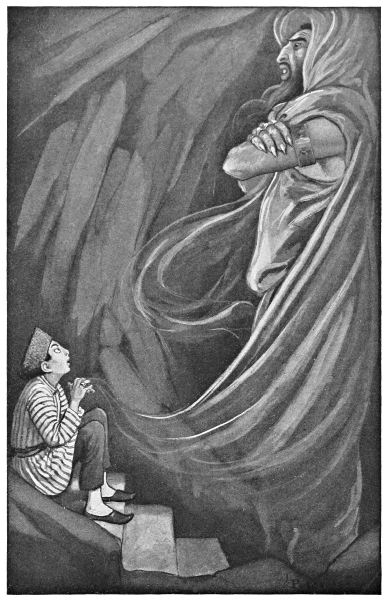
“I am the Slave of the Ring, and will obey thee in all things”
For two days Aladdin remained in the dark, crying and lamenting. At last he clasped his hands in prayer, and in so doing rubbed the ring, which the magician had forgotten to take from him. Immediately an enormous and frightful genie rose out of the earth, saying: “What wouldst thou with me? I am the Slave of the Ring, and will obey thee in all things.” Aladdin fearlessly replied: “Deliver me from this place!” whereupon the earth opened, and he found himself outside. As soon as his eyes could bear the light he went home, but fainted on the threshold. When he came to himself he told his mother what had passed, and showed her the lamp and the fruits he had gathered in the garden, which were in reality precious stones. He then asked for some food. “Alas! child,” she said, “I have nothing in the house, but I have spun a little cotton and will go and sell it.” Aladdin bade her keep her cotton, for he would sell the lamp instead. As it was very dirty she began to rub it, that it might fetch a higher price. Instantly a hideous genie appeared, and asked what she would have. She fainted away, but Aladdin, snatching the lamp, said boldly: “Fetch me something to eat!” The genie returned with a silver bowl, twelve silver plates containing rich meats, two silver cups, and two bottles of wine. Aladdin’s mother, when she came to herself, said: “Whence comes this splendid feast?” “Ask not, but eat,” replied Aladdin. So they sat at breakfast till it was dinner-time, and Aladdin told his mother about the lamp. She begged him to sell it, and have nothing to do with devils. “No,” said Aladdin, “since chance hath made us aware of its virtues, we will use it, and the ring likewise, which I shall always wear on my finger.” When they had eaten all the genie had brought Aladdin sold one of the silver plates, and so on until none were left. He then had recourse to the genie, who gave him another set of plates, and thus they lived for many years.
One day Aladdin heard an order from the Sultan proclaimed that every one was to stay at home and close his shutters while the Princess, his daughter, went to and from the bath. Aladdin was seized by a desire to see her face, which was very difficult, as she always went veiled. He hid himself behind the door of the bath and peeped through a chink. The Princess lifted her veil as she went in, and looked so beautiful that Aladdin fell in love with her at first sight. He went home so changed that his mother was frightened. He told her he loved the Princess so deeply that he could not live without her, and meant to ask her in marriage of her father. His mother, on hearing this, burst out laughing, but Aladdin at last prevailed upon her to go before the Sultan and carry his request. She fetched a napkin and laid in it the magic fruits from the enchanted garden, which sparkled and shone like the most beautiful jewels. She took these with her to please the Sultan, and set out, trusting in the lamp. The Grand Vizier and the lords of council had just gone in as she entered the hall and placed herself in front of the Sultan. He, however, took no notice of her. She went every day for a week, and stood in the same place. When the council broke up on the sixth day the Sultan said to his Vizier: “I see a certain woman in the audience-chamber every day carrying something in a napkin. Call her next time, that I may find out what she wants.” Next day, at a sign from the Vizier, she went up to the foot of the throne and remained kneeling till the Sultan said to her: “Rise, good woman, and tell me what you want.” She hesitated, so the Sultan sent away all but the Vizier, and bade her speak freely, promising to forgive her beforehand for anything she might say. She then told him of her son’s violent love for the Princess. “I prayed him to forget her,” she said, “but in vain; he threatened to do some desperate deed if I refused to go and ask your Majesty for the hand of the Princess. Now I pray you to forgive not me alone, but my son Aladdin.” The Sultan asked her kindly what she had in the napkin, whereupon she unfolded the jewels and presented them. He was thunderstruck, and turning to the Vizier said: “What sayest thou? Ought I not to bestow the Princess on one who values her at such a price?” The Vizier, who wanted her for his own son, begged the Sultan to withhold her for three months, in the course of which he hoped his son would contrive to make him a richer present. The Sultan granted this, and told Aladdin’s mother that, though he consented to the marriage, she must not appear before him again for three months.
Aladdin waited patiently for nearly three months, but after two had elapsed his mother, going into the city to buy oil, found every one rejoicing, and asked what was going on. “Do you not know,” was the answer, “that the son of the Grand Vizier is to marry the Sultan’s daughter to-night?” Breathless, she ran and told Aladdin, who was overwhelmed at first, but presently bethought him of the lamp. He rubbed it, and the genie appeared, saying: “What is thy will?” Aladdin replied: “The Sultan, as thou knowest, has broken his promise to me, and the Vizier’s son is to have the Princess. My command is that to-night you bring hither the bride and bridegroom.” “Master, I obey,” said the genie. Aladdin then went to his chamber, where, sure enough, at midnight the genie transported the bed containing the Vizier’s son and the Princess. “Take this new-married man,” he said, “and put him outside in the cold, and return at daybreak.” Whereupon the genie took the Vizier’s son out of bed, leaving Aladdin with the Princess. “Fear nothing,” Aladdin said to her; “you are my wife, promised to me by your unjust father, and no harm shall come to you.” The Princess was too frightened to speak, and passed the most miserable night of her life, while Aladdin lay down beside her and slept soundly. At the appointed hour the genie fetched in the shivering bridegroom, laid him in his place, and transported the bed back to the palace.
Presently the Sultan came to wish his daughter good-morning. The unhappy Vizier’s son jumped up and hid himself, while the Princess would not say a word, and was very sorrowful. The Sultan sent her mother to her, who said: “How comes it, child, that you will not speak to your father? What has happened?” The Princess sighed deeply, and at last told her mother how, during the night, the bed had been carried into some strange house, and what had passed there. Her mother did not believe her in the least, but bade her rise and consider it an idle dream.
The following night exactly the same thing happened, and next morning, on the Princess’s refusing to speak, the Sultan threatened to cut off her head. She then confessed all, bidding him ask the Vizier’s son if it were not so. The Sultan told the Vizier to ask his son, who owned the truth, adding that, dearly as he loved the Princess, he had rather die than go through another such fearful night, and wished to be separated from her. His wish was granted, and there was an end of feasting and rejoicing.
When the three months were over, Aladdin sent his mother to remind the Sultan of his promise. She stood in the same place as before, and the Sultan, who had forgotten Aladdin, at once remembered him, and sent for her. On seeing her poverty the Sultan felt less inclined than ever to keep his word, and asked his Vizier’s advice, who counselled him to set so high a value on the Princess that no man living could come up to it. The Sultan then turned to Aladdin’s mother, saying: “Good woman, a sultan must remember his promises, and I will remember mine, but your son must first send me forty basins of gold brimful of jewels, carried by forty black slaves, led by as many white ones, splendidly dressed. Tell him that I await his answer.” The mother of Aladdin bowed low and went home, thinking all was lost. She gave Aladdin the message, adding: “He may wait long enough for your answer!” “Not so long, mother, as you think,” her son replied. “I would do a great deal more than that for the Princess.” He summoned the genie, and in a few moments the eighty slaves arrived, and filled up the small house and garden. Aladdin made them set out to the palace two and two, followed by his mother. They were so richly dressed, with such splendid jewels in their girdles, that every one crowded to see them and the basins of gold they carried on their heads. They entered the palace, and, after kneeling before the Sultan, stood in a half-circle round the throne with their arms crossed, while Aladdin’s mother presented them to the Sultan. He hesitated no longer, but said: “Good woman, return and tell your son that I wait for him with open arms.” She lost no time in telling Aladdin, bidding him make haste. But Aladdin first called the genie. “I want a scented bath,” he said, “a richly embroidered habit, a horse surpassing the Sultan’s, and twenty slaves to attend me. Besides this, six slaves, beautifully dressed, to wait on my mother; and lastly, ten thousand pieces of gold in ten purses.” No sooner said than done, Aladdin mounted his horse and passed through the streets, the slaves strewing gold as they went. Those who had played with him in his childhood knew him not, he had grown so handsome. When the Sultan saw him he came down from his throne, embraced him, and led him into a hall where a feast was spread, intending to marry him to the Princess that very day. But Aladdin refused, saying: “I must build a palace fit for her,” and took his leave. Once home, he said to the genie: “Build me a palace of the finest marble, set with jasper, agate, and other precious stones. In the middle you shall build me a large hall with a dome, its four walls of massy gold and silver, each side having six windows, whose lattices, all except one which is to be unfinished, must be set with diamonds and rubies. There must be stables and horses and grooms and slaves; go and see about it!”
The palace was finished by next day, and the genie carried him there and showed him all his orders faithfully carried out, even to the laying of a velvet carpet from Aladdin’s palace to the Sultan’s. Aladdin’s mother then dressed herself carefully, and walked to the palace with her slaves, while he followed her on horseback. The Sultan sent musicians with trumpets and cymbals to meet them, so that the air resounded with music and cheers. She was taken to the Princess, who saluted her and treated her with great honor. At night the Princess said good-bye to her father, and set out on the carpet for Aladdin’s palace, with his mother at her side, and followed by the hundred slaves. She was charmed at the sight of Aladdin, who ran to receive her. “Princess,” he said, “blame your beauty for my boldness if I have displeased you.” She told him that, having seen him, she willingly obeyed her father in this matter. After the wedding had taken place Aladdin led her into the hall, where a feast was spread, and she supped with him, after which they danced till midnight.
Next day Aladdin invited the Sultan to see the palace. On entering the hall with the four-and-twenty windows, with their rubies, diamonds, and emeralds, he cried: “It’s a world’s wonder! There is only one thing that surprises me. Was it by accident that one window was left unfinished?” “No, sir, by design,” returned Aladdin. “I wished your Majesty to have the glory of finishing this palace.” The Sultan was pleased, and sent for the best jewellers in the city. He showed them the unfinished window, and bade them fit it up like the others. “Sir,” replied their spokesman, “we cannot find jewels enough.” The Sultan had his own fetched, which they soon used, but to no purpose, for in a month’s time the work was not half done. Aladdin, knowing that their task was vain, bade them undo their work and carry the jewels back, and the genie finished the window at his command. The Sultan was surprised to receive his jewels again, and visited Aladdin, who showed him the window finished. The Sultan embraced him, the envious Vizier meanwhile hinting that it was the work of enchantment.
Aladdin had won the hearts of the people by his gentle bearing. He was made captain of the Sultan’s armies, and won several battles for him, but remained modest and courteous as before, and lived thus in peace and content for several years.
But far away in Africa the magician remembered Aladdin, and by his magic arts discovered that Aladdin, instead of perishing miserably in the cave, had escaped, and had married a princess, with whom he was living in great honor and wealth. He knew that the poor tailor’s son could only have accomplished this by means of the lamp, and travelled night and day till he reached the capital of China, bent on Aladdin’s ruin. As he passed through the town he heard people talking everywhere about a marvellous palace. “Forgive my ignorance,” he asked, “what is this palace you speak of?” “Have you not heard of Prince Aladdin’s palace,” was the reply, “the greatest wonder of the world? I will direct you if you have a mind to see it.” The magician thanked him who spoke, and having seen the palace knew that it had been raised by the Genie of the Lamp, and became half mad with rage. He determined to get hold of the lamp, and again plunge Aladdin into the deepest poverty.
Unluckily, Aladdin had gone a-hunting for eight days, which gave the magician plenty of time. He bought a dozen copper lamps, put them into a basket, and went to the palace, crying: “New lamps for old!” followed by a jeering crowd. The Princess, sitting in the hall of four-and-twenty windows, sent a slave to find out what the noise was about, who came back laughing, so that the Princess scolded her. “Madam,” replied the slave, “who can help laughing to see an old fool offering to exchange fine new lamps for old ones?” Another slave, hearing this, said, “There is an old one on the cornice there which he can have.” Now this was the magic lamp, which Aladdin had left there, as he could not take it out hunting with him. The Princess, not knowing its value, laughingly bade the slave take it and make the exchange. She went and said to the magician: “Give me a new lamp for this.” He snatched it and bade the slave take her choice, amid the jeers of the crowd. Little he cared, but left off crying his lamps, and went out of the city gates to a lonely place, where he remained till nightfall, when he pulled out the lamp and rubbed it. The genie appeared, and at the magician’s command carried him, together with the palace and the Princess in it, to a lonely place in Africa.
Next morning the Sultan looked out of the window towards Aladdin’s palace and rubbed his eyes, for it was gone. He sent for the Vizier and asked what had become of the palace. The Vizier looked out, too, and was lost in astonishment. He again put it down to enchantment, and this time the Sultan believed him, and sent thirty men on horseback to fetch Aladdin in chains. They met him riding home, bound him, and forced him to go with them on foot. The people, however, who loved him, followed, armed, to see that he came to no harm. He was carried before the Sultan, who ordered the executioner to cut off his head. The executioner made Aladdin kneel down, bandaged his eyes, and raised his scimitar to strike. At that instant the Vizier, who saw that the crowd had forced their way into the court-yard and were scaling the walls to rescue Aladdin, called to the executioner to stay his hand. The people, indeed, looked so threatening that the Sultan gave way and ordered Aladdin to be unbound, and pardoned him in the sight of the crowd. Aladdin now begged to know what he had done. “False wretch!” said the Sultan, “come hither,” and showed him from the window the place where his palace had stood. Aladdin was so amazed that he could not say a word. “Where is my palace and my daughter?” demanded the Sultan. “For the first I am not so deeply concerned, but my daughter I must have, and you must find her or lose your head.” Aladdin begged for forty days in which to find her, promising if he failed to return and suffer death at the Sultan’s pleasure. His prayer was granted, and he went forth sadly from the Sultan’s presence. For three days he wandered about like a madman, asking every one what had become of his palace, but they only laughed and pitied him. He came to the banks of a river, and knelt down to say his prayers before throwing himself in. In so doing he rubbed the magic ring he still wore. The genie he had seen in the cave appeared, and asked his will. “Save my life, genie,” said Aladdin, “and bring my palace back.” “That is not in my power,” said the genie; “I am only the Slave of the Ring; you must ask him of the lamp.” “Even so,” said Aladdin, “but thou canst take me to the palace, and set me down under my dear wife’s window.” He at once found himself in Africa, under the window of the Princess, and fell asleep out of sheer weariness.
He was awakened by the singing of the birds, and his heart was lighter. He saw plainly that all his misfortunes were owing to the loss of the lamp, and vainly wondered who had robbed him of it.
That morning the Princess rose earlier than she had done since she had been carried into Africa by the magician, whose company she was forced to endure once a day. She, however, treated him so harshly that he dared not live there altogether. As she was dressing, one of her women looked out and saw Aladdin. The Princess ran and opened the window, and at the noise she made Aladdin looked up. She called to him to come to her, and great was the joy of these lovers at seeing each other again. After he had kissed her, Aladdin said: “I beg of you, Princess, in God’s name, before we speak of anything else, for your own sake and mine, tell me what has become of an old lamp I left on the cornice in the hall of four-and-twenty windows, when I went a-hunting.” “Alas!” she said, “I am the innocent cause of our sorrows,” and told him of the exchange of the lamp. “Now I know,” cried Aladdin, “that we have to thank the African magician for this! Where is the lamp?” “He carries it about with him,” said the Princess. “I know, for he pulled it out of his breast to show me. He wishes me to break my faith with you and marry him, saying that you were beheaded by my father’s command. He is forever speaking ill of you, but I only reply by my tears. If I persist, I doubt not but he will use violence.” Aladdin comforted her, and left her for a while. He changed clothes with the first person he met in the town, and having bought a certain powder returned to the Princess, who let him in by a little side door. “Put on your most beautiful dress,” he said to her, “and receive the magician with smiles, leading him to believe that you have forgotten me. Invite him to sup with you, and say you wish to taste the wine of his country. He will go for some and while he is gone I will tell you what to do.” She listened carefully to Aladdin, and when he left her arrayed herself gayly for the first time since she left China. She put on a girdle and head-dress of diamonds, and seeing in a glass that she was more beautiful than ever, received the magician, saying, to his great amazement: “I have made up my mind that Aladdin is dead, and that all my tears will not bring him back to me, so I am resolved to mourn no more, and have therefore invited you to sup with me; but I am tired of the wines of China, and would fain taste those of Africa.” The magician flew to his cellar, and the Princess put the powder Aladdin had given her in her cup. When he returned she asked him to drink her health in the wine of Africa, handing him her cup in exchange for his, as a sign she was reconciled to him. Before drinking the magician made her a speech in praise of her beauty, but the Princess cut him short, saying: “Let us drink first, and you shall say what you will afterwards.” She set her cup to her lips and kept it there, while the magician drained his to the dregs and fell back lifeless. The Princess then opened the door to Aladdin, and flung her arms round his neck; but Aladdin put her away, bidding her leave him, as he had more to do. He then went to the dead magician, took the lamp out of his vest, and bade the genie carry the palace and all in it back to China. This was done, and the Princess in her chamber only felt two little shocks, and little thought she was at home again.
The Sultan, who was sitting in his closet, mourning for his lost daughter, happened to look up, and rubbed his eyes, for there stood the palace as before. He hastened thither, and Aladdin received him in the hall of the four-and-twenty windows, with the Princess at his side. Aladdin told him what had happened, and showed him the dead body of the magician, that he might believe. A ten days’ feast was proclaimed, and it seemed as if Aladdin might now live the rest of his life in peace; but it was not to be.
The African magician had a younger brother, who was, if possible, more wicked and more cunning than himself. He travelled to China to avenge his brother’s death, and went to visit a pious woman called Fatima, thinking she might be of use to him. He entered her cell and clapped a dagger to her breast, telling her to rise and do his bidding on pain of death. He changed clothes with her, colored his face like hers, put on her veil, and murdered her, that she might tell no tales. Then he went towards the palace of Aladdin, and all the people, thinking he was the holy woman, gathered round him, kissing his hands and begging his blessing. When he got to the palace there was such a noise going on round him that the Princess bade her slave look out of the window and ask what was the matter. The slave said it was the holy woman, curing people by her touch of their ailments, whereupon the Princess, who had long desired to see Fatima, sent for her. On coming to the Princess the magician offered up a prayer for her health and prosperity. When he had done the Princess made him sit by her, and begged him to stay with her always. The false Fatima, who wished for nothing better, consented, but kept his veil down for fear of discovery. The Princess showed him the hall, and asked him what he thought of it. “It is truly beautiful,” said the false Fatima. “In my mind it wants but one thing.” “And what is that?” said the Princess. “If only a roc’s egg,” replied he, “were hung up from the middle of this dome, it would be the wonder of the world.”
After this the Princess could think of nothing but the roc’s egg, and when Aladdin returned from hunting he found her in a very ill humor. He begged to know what was amiss, and she told him that all her pleasure in the hall was spoiled for the want of a roc’s egg hanging from the dome. “If that is all,” replied Aladdin, “you shall soon be happy.” He left her and rubbed the lamp, and when the genie appeared commanded him to bring a roc’s egg. The genie gave such a loud and terrible shriek that the hall shook. “Wretch!” he cried, “is it not enough that I have done everything for you but you must command me to bring my master and hang him up in the midst of this dome? You and your wife and your palace deserve to be burnt to ashes but that this request does not come from you, but from the brother of the African magician whom you destroyed. He is now in your palace disguised as the holy woman—whom he murdered. He it was who put that wish into your wife’s head. Take care of yourself, for he means to kill you.” So saying, the genie disappeared.
Aladdin went back to the Princess, saying his head ached, and requesting that the holy Fatima should be fetched to lay her hands on it. But when the magician came near, Aladdin, seizing his dagger, pierced him to the heart. “What have you done?” cried the Princess. “You have killed the holy woman!” “Not so,” replied Aladdin, “but a wicked magician,” and told her of how she had been deceived.
After this Aladdin and his wife lived in peace. He succeeded the Sultan when he died, and reigned for many years, leaving behind him a long line of kings.
From “The Blue Fairy Book,” edited by Andrew Lang, by permission of Messrs. Longmans, Green & Co.
ALI BABA AND THE FORTY THIEVES
IN a town in Persia there dwelt two brothers, one named Cassim, the other Ali Baba. Cassim was married to a rich wife and lived in plenty, while Ali Baba had to maintain his wife and children by cutting wood in a neighboring forest and selling it in the town. One day, when Ali Baba was in the forest, he saw a troop of men on horseback coming towards him in a cloud of dust. He was afraid they were robbers, and climbed into a tree for safety. When they came up to him and dismounted, he counted forty of them. They unbridled their horses and tied them to trees. The finest man among them, whom Ali Baba took to be their captain, went a little way among some bushes, and said: “Open, Sesame!”[1] so plainly that Ali Baba heard him. A door opened in the rocks, and having made the troop go in, he followed them, and the door shut again of itself. They stayed some time inside, and Ali Baba, fearing they might come out and catch him, was forced to sit patiently in the tree. At last the door opened again, and the Forty Thieves came out. As the Captain went in last he came out first, and made them all pass by him; he then closed the door, saying: “Shut, Sesame!” Every man bridled his horse and mounted, the Captain put himself at their head, and they returned as they came.
Then Ali Baba climbed down and went to the door concealed among the bushes, and said: “Open, Sesame!” and it flew open. Ali Baba, who expected a dull, dismal place, was greatly surprised to find it large and well lighted, and hollowed by the hand of man in the form of a vault, which received the light from an opening in the ceiling. He saw rich bales of merchandise—silk, stuff-brocades, all piled together, and gold and silver in heaps, and money in leather purses. He went in and the door shut behind him. He did not look at the silver, but brought out as many bags of gold as he thought his asses, which were browsing outside, could carry, loaded them with the bags, and hid it all with fagots. Using the words: “Shut, Sesame!” he closed the door and went home.
Then he drove his asses into the yard, shut the gates, carried the money-bags to his wife, and emptied them out before her. He bade her keep the secret, and he would go and bury the gold. “Let me first measure it,” said his wife. “I will go borrow a measure of some one while you dig the hole.” So she ran to the wife of Cassim and borrowed a measure. Knowing Ali Baba’s poverty, the sister was curious to find out what sort of grain his wife wished to measure, and artfully put some suet at the bottom of the measure. Ali Baba’s wife went home and set the measure on the heap of gold, and filled it and emptied it often, to her great content. She then carried it back to her sister, without noticing that a piece of gold was sticking to it, which Cassim’s wife perceived directly her back was turned. She grew very curious, and said to Cassim when he came home: “Cassim, your brother is richer than you. He does not count his money, he measures it.” He begged her to explain this riddle, which she did by showing him the piece of money and telling him where she found it. Then Cassim grew so envious that he could not sleep, and went to his brother in the morning before sunrise. “Ali Baba,” he said, showing him the gold piece, “you pretend to be poor and yet you measure gold.” By this Ali Baba perceived that through his wife’s folly Cassim and his wife knew their secret, so he confessed all and offered Cassim a share. “That I expect,” said Cassim; “but I must know where to find the treasure, otherwise I will discover all, and you will lose all.” Ali Baba, more out of kindness than fear, told him of the cave, and the very words to use. Cassim left Ali Baba, meaning to be beforehand with him and get the treasure himself. He rose early next morning, and set out with ten mules loaded with great chests. He soon found the place, and the door in the rock. He said: “Open, Sesame!” and the door opened and shut behind him. He could have feasted his eyes all day on the treasures, but he now hastened to gather together as much of it as possible; but when he was ready to go he could not remember what to say for thinking of his great riches. Instead of “Sesame,” he said: “Open, Barley!” and the door remained fast. He named several different sorts of grain, all but the right one, and the door still stuck fast. He was so frightened at the danger he was in that he had as much forgotten the word as if he had never heard it.
About noon the robbers returned to their cave, and saw Cassim’s mules roving about with great chests on their backs. This gave them the alarm; they drew their sabres, and went to the door, which opened on their Captain’s saying: “Open, Sesame!” Cassim, who had heard the trampling of their horses’ feet, resolved to sell his life dearly, so when the door opened he leaped out and threw the Captain down. In vain, however, for the robbers with their sabres soon killed him. On entering the cave they saw all the bags laid ready, and could not imagine how any one had got in without knowing their secret. They cut Cassim’s body into four quarters, and nailed them up inside the cave, in order to frighten any one who should venture in, and went away in search of more treasure.
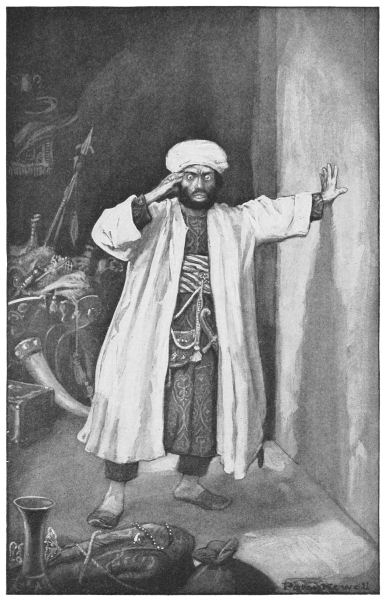
Cassim forgets the magic word
As night drew on Cassim’s wife grew very uneasy, and ran to her brother-in-law, and told him where her husband had gone. Ali Baba did his best to comfort her, and set out to the forest in search of Cassim. The first thing he saw on entering the cave was his dead brother. Full of horror, he put the body on one of his asses, and bags of gold on the other two, and, covering all with some fagots, returned home. He drove the two asses laden with gold into his own yard, and led the other to Cassim’s house. The door was opened by the slave Morgiana, whom he knew to be both brave and cunning. Unloading the ass, he said to her: “This is the body of your master, who has been murdered, but whom we must bury as though he had died in his bed. I will speak with you again, but now tell your mistress I am come.” The wife of Cassim, on learning the fate of her husband, broke out into cries and tears, but Ali Baba offered to take her to live with him and his wife if she would promise to keep his counsel and leave everything to Morgiana; whereupon she agreed, and dried her eyes.
Morgiana, meanwhile, sought an apothecary and asked him for some lozenges. “My poor master,” she said, “can neither eat nor sleep, and no one knows what his distemper is.” She carried home the lozenges and returned next day weeping, and asked for an essence only given to those just about to die. Thus, in the evening, no one was surprised to hear the wretched shrieks and cries of Cassim’s wife and Morgiana telling every one that Cassim was dead. The day after, Morgiana went to an old cobbler near the gates of the town who opened his stall early, put a piece of gold in his hand, and bade him follow with his needle and thread. Having bound his eyes with a handkerchief, she took him to the room where the body lay, pulled off the bandage, and bade him sew the quarters together, after which she covered his eyes again and led him home. Then they buried Cassim, and Morgiana his slave followed him to the grave, weeping and tearing her hair, while Cassim’s wife stayed at home uttering lamentable cries. Next day she went to live with Ali Baba, who gave Cassim’s shop to his eldest son.
The Forty Thieves, on their return to the cave, were much astonished to find Cassim’s body gone and some of their money-bags. “We are certainly discovered,” said the Captain, “and shall be undone if we cannot find out who it is that knows our secret. Two men must have known it; we have killed one, we must now find the other. To this end one of you who is bold and artful must go into the city dressed as a traveller, and discover whom we have killed, and whether men talk of the strange manner of his death. If the messenger fails he must lose his life, lest we be betrayed.” One of the thieves started up and offered to do this, and after the rest had highly commended him for his bravery he disguised himself, and happened to enter the town at daybreak, just by Baba Mustapha’s stall. The thief bade him good-day, saying: “Honest man, how can you possibly see to stitch at your age?” “Old as I am,” replied the cobbler, “I have very good eyes, and you will believe me when I tell you that I sewed a dead body together in a place where I had less light than I have now.” The robber was overjoyed at his good-fortune, and, giving him a piece of gold, desired to be shown the house where he stitched up the dead body. At first Mustapha refused, saying that he was blindfolded; but when the robber gave him another piece of gold he began to think he might remember the turnings if blindfolded as before. This means succeeded; the robber partly led him, and was partly guided by him, right in front of Cassim’s house, the door of which the robber marked with a piece of chalk. Then, well pleased, he bade farewell to Baba Mustapha and returned to the forest. By and by Morgiana, going out, saw the mark the robber had made, quickly guessed that some mischief was brewing, and, fetching a piece of chalk, marked two or three doors on each side, without saying anything to her master or mistress.
The thief, meantime, told his comrades of his discovery. The Captain thanked him, and bade him show him the house he had marked. But when they came to it they saw that five or six of the houses were chalked in the same manner. The guide was so confounded that he knew not what answer to make, and when they returned he was at once beheaded for having failed. Another robber was despatched, and, having won over Baba Mustapha, marked the house in red chalk; but Morgiana being again too clever for them, the second messenger was put to death also. The Captain now resolved to go himself, but, wiser than the others, he did not mark the house, but looked at it so closely that he could not fail to remember it. He returned, and ordered his men to go into the neighboring villages and buy nineteen mules, and thirty-eight leather jars, all empty, except one which was full of oil. The Captain put one of his men, fully armed, into each, rubbing the outside of the jars with oil from the full vessel. Then the nineteen mules were loaded with thirty-seven robbers in jars, and the jar of oil, and reached the town by dusk. The Captain stopped his mules in front of Ali Baba’s house, and said to Ali Baba, who was sitting outside for coolness: “I have brought some oil from a distance to sell at to-morrow’s market, but it is now so late that I know not where to pass the night, unless you will do me the favor to take me in.” Though Ali Baba had seen the Captain of the robbers in the forest, he did not recognize him in the disguise of an oil merchant. He bade him welcome, opened his gates for the mules to enter, and went to Morgiana to bid her prepare a bed and supper for his guest. He brought the stranger into his hall, and after they had supped went again to speak to Morgiana in the kitchen, while the Captain went into the yard under pretence of seeing after his mules, but really to tell his men what to do. Beginning at the first jar and ending at the last, he said to each man: “As soon as I throw some stones from the window of the chamber where I lie, cut the jars open with your knives and come out, and I will be with you in a trice.” He returned to the house, and Morgiana led him to his chamber. She then told Abdallah, her fellow-slave, to set on the pot to make some broth for her master, who had gone to bed. Meanwhile her lamp went out, and she had no more oil in the house. “Do not be uneasy,” said Abdallah; “go into the yard and take some out of one of those jars.” Morgiana thanked him for his advice, took the oil-pot, and went into the yard. When she came to the first jar the robber inside said softly: “Is it time?”
Any other slave but Morgiana, on finding a man in the jar instead of the oil she wanted, would have screamed, and made a noise; but she, knowing the danger her master was in, bethought herself of a plan, and answered quietly: “Not yet, but presently.” She went to all the jars, giving the same answer, till she came to the jar of oil. She now saw that her master, thinking to entertain an oil merchant, had let thirty-eight robbers into his house. She filled her oil-pot, went back to the kitchen, and, having lit her lamp, went again to the oil-jar and filled a large kettle full of oil. When it boiled she went and poured enough oil into every jar to stifle and kill the robber inside. When this brave deed was done she went back to the kitchen, put out the fire and the lamp, and waited to see what would happen.