JACK THE GIANT-KILLER (continued 2)
Reading edition
The water-dogs wandered about in the swamp—splash! splash! The rushes and reeds bent beneath their tread on all sides. It was terribly alarming to the poor duckling. He twisted his head round to get it under his wing, and just at that moment a frightful big dog appeared close beside him; his tongue hung right out of his mouth and his eyes glared wickedly. He opened his great chasm of a mouth close to the duckling, showed his sharp teeth, and—splash!—went on without touching him.
“Oh, thank Heaven!” sighed the duckling, “I am so ugly that even the dog won’t bite me!”
Then he lay quite still while the shot whistled among the bushes, and bang after bang rent the air. It only became quiet late in the day, but even then the poor duckling did not dare to get up; he waited several hours more before he looked about, and then he hurried away from the marsh as fast as he could. He ran across fields and meadows, and there was such a wind that he had hard work to make his way.
Towards night he reached a poor little cottage; it was such a miserable hovel that it could not make up its mind which way to fall even, and so it remained standing. The wind whistled so fiercely round the duckling that he had to sit on his tail to resist it, and it blew harder and harder; then he saw that the door had fallen off one hinge and hung so crookedly that he could creep into the house through the crack, and by this means he made his way into the room. An old woman lived there with her cat and her hen. The cat, which she called “Sonnie,” could arch his back, purr, and give off electric sparks—that is to say, if you stroked his fur the wrong way. The hen had quite tiny short legs, and so she was called “Chuckie-low-legs.” She laid good eggs, and the old woman was as fond of her as if she had been her own child.
In the morning the strange duckling was discovered immediately, and the cat began to purr and the hen to cluck.
“What on earth is that!” said the old woman, looking round; but her sight was not good, and she thought the duckling was a fat duck which had escaped. “This is a capital find,” said she; “now I shall have duck’s eggs if only it is not a drake. We must find out about that!”
So she took the duckling on trial for three weeks, but no eggs made their appearance. The cat was the master of the house and the hen the mistress, and they always spoke of “we and the world,” for they thought that they represented the half of the world, and that quite the better half.
The duckling thought there might be two opinions on the subject, but the cat would not hear of it.
“Can you lay eggs?” she asked.
“No!”
“Will you have the goodness to hold your tongue, then!”
And the cat said, “Can you arch your back, purr, or give off sparks?”
“No.”
“Then you had better keep your opinions to yourself when people of sense are speaking!”
The duckling sat in the corner nursing his ill-humor; then he began to think of the fresh air and the sunshine, an uncontrollable longing seized him to float on the water, and at last he could not help telling the hen about it.
“What on earth possesses you?” she asked. “You have nothing to do; that is why you get these freaks into your head. Lay some eggs or take to purring, and you will get over it.”
“But it is so delicious to float, on the water,” said the duckling; “so delicious to feel it rushing over your head when you dive to the bottom.”
“That would be a fine amusement,” said the hen. “I think you have gone mad. Ask the cat about it, he is the wisest creature I know; ask him if he is fond of floating on the water or diving under it. I say nothing about myself. Ask our mistress yourself, the old woman; there is no one in the world cleverer than she is. Do you suppose she has any desire to float on the water or to duck underneath it?”
“You do not understand me,” said the duckling.
“Well, if we don’t understand you, who should? I suppose you don’t consider yourself cleverer than the cat or the old woman, not to mention me. Don’t make a fool of yourself, child, and thank your stars for all the good we have done you! Have you not lived in this warm room, and in such society that you might have learned something? But you are an idiot, and there is no pleasure in associating with you. You may believe me I mean you well, I tell you home truths, and there is no surer way than that of knowing who are one’s friends. You just see about laying some eggs, or learn to purr, or to emit sparks.”
“I think I will go out into the wide world,” said the duckling.
“Oh, do so by all means!” said the hen.
So away went the duckling; he floated on the water and ducked underneath it, but he was looked askance at by every living creature for his ugliness. Now the autumn came on, the leaves in the woods turned yellow and brown; the wind took hold of them, and they danced about. The sky looked very cold, and the clouds hung heavy with snow and hail. A raven stood on the fence and croaked Caw! Caw! from sheer cold; it made one shiver only to think of it. The poor duckling certainly was in a bad case.
One evening the sun was just setting in wintry splendor when a flock of beautiful large birds appeared out of the bushes. The duckling had never seen anything so beautiful. They were dazzlingly white with long waving necks; they were swans; and, uttering a peculiar cry, they spread out their magnificent broad wings, and flew away from the cold regions to warmer lands and open seas. They mounted so high, so very high, and the ugly little duckling became strangely uneasy; he circled round and round in the water like a wheel, craning his neck up into the air after them. Then he uttered a shriek so piercing and so strange that he was quite frightened by it himself. Oh, he could not forget those beautiful birds, those happy birds! And as soon as they were out of sight he ducked right down to the bottom, and when he came up again he was quite beside himself. He did not know what the birds were or whither they flew, but all the same he was more drawn towards them than he had ever been by any creatures before. He did not even envy them in the least. How could it occur to him even to wish to be such a marvel of beauty; he would have been thankful if only the ducks would have tolerated him among them—the poor ugly creature!
The winter was so bitterly cold that the duckling was obliged to swim about in the water to keep it from freezing, but every night the hole in which he swam got smaller and smaller. Then it froze so hard that the surface ice cracked, and the duckling had to use his legs all the time, so that the ice should not close in round him; at last he was so weary that he could move no more, and he was frozen fast into the ice.
Early in the morning a peasant came along and saw him; he went out onto the ice and hammered a hole in it with his heavy wooden shoe, and carried the duckling home to his wife. There it soon revived. The children wanted to play with it, but the duckling thought they were going to ill-use him, and rushed in his fright into the milk pan, and the milk spurted out all over the room. The woman shrieked and threw up her hands; then it flew into the butter cask, and down into the meal tub and out again. Just imagine what it looked like by this time! The woman screamed and tried to hit it with the tongs, and the children tumbled over one another in trying to catch it, and they screamed with laughter. By good luck the door stood open, and the duckling flew out among the bushes and the new fallen snow, and it lay there thoroughly exhausted.
But it would be too sad to mention all the privation and misery it had to go through during that hard winter. When the sun began to shine warmly again the duckling was in the marsh, lying among the rushes; the larks were singing, and the beautiful spring had come.
Then all at once it raised its wings, and they flapped with much greater strength than before and bore him off vigorously. Before he knew where he was he found himself in a large garden where the apple-trees were in a full blossom, and the air was scented with lilacs, the long branches of which overhung the indented shores of the lake. Oh! the spring freshness was so delicious!
Just in front of him he saw three beautiful white swans advancing towards him from a thicket; with rustling feathers they swam lightly over the water. The duckling recognized the majestic birds, and he was overcome by a strange melancholy.
“I will fly to them, the royal birds, and they will hack me to pieces, because I, who am so ugly, venture to approach them! But it won’t matter; better be killed by them than be snapped at by the ducks, pecked by the hens, or spurned by the henwife, or suffer so much misery in the winter.”
So he flew into the water, and swam towards the stately swans; they saw him, and darted towards him with ruffled feathers.
“Kill me, oh, kill me!” said the poor creature, and bowing his head towards the water he awaited his death. But what did he see reflected in the transparent water?
He saw below him his own image; but he was no longer a clumsy, dark, gray bird, ugly and ungainly. He was himself a swan! It does not matter in the least having been born in a duckyard if only you come out of a swan’s egg!
He felt quite glad of all the misery and tribulation he had gone through; he was the better able to appreciate his good-fortune now, and all the beauty which greeted him. The big swans swam round and round him, and stroked him with their bills.
Some little children came into the garden with corn and pieces of bread, which they threw into the water; and the smallest one cried out: “There is a new one!” The other children shouted with joy: “Yes, a new one has come!” And they clapped their hands and danced about, running after their father and mother. They threw the bread into the water, and one and all said that “the new one was the prettiest; he was so young and handsome.” And the old swans bent their heads and did homage before him.
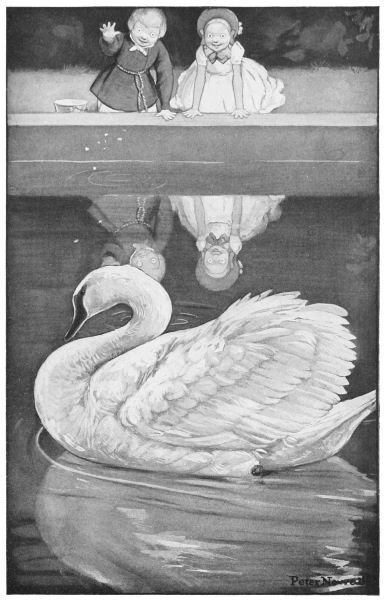
Some little children threw pieces of bread into the water
He felt quite shy, and hid his head under his wing; he did not know what to think; he was so very happy, but not at all proud; a good heart never becomes proud. He thought of how he had been pursued and scorned, and now he heard them all say that he was the most beautiful of all beautiful birds. The lilacs bent their boughs right down into the water before him, and the bright sun was warm and cheering, and he rustled his feathers and raised his slender neck aloft, saying, with exultation in his heart: “I never dreamed of so much happiness when I was the Ugly Duckling!”
HOP-O’-MY-THUMB
THERE once lived in a village a fagot-maker and his wife who had seven children—all boys; the eldest was no more than ten years old, and the youngest was only seven. It was odd enough, to be sure, that they should have so many children in such a short time; but the truth is, the wife always brought him two and once three at a time. This made him very poor, for not one of these boys was old enough to get a living; and what was still worse, the youngest was a puny little fellow who hardly ever spoke a word. Now this, indeed, was a mark of his good sense, but it made his father and mother suppose him to be silly, and they thought that at last he would turn out quite a fool. This boy was the least size ever seen; for when he was born he was no bigger than a man’s thumb, which made him be christened by the name of Hop-o’-my-Thumb. The poor child was the drudge of the whole house, and always bore the blame of everything that was done wrong. For all this, Hop-o’-my-Thumb was far more clever than any of his brothers; and though he spoke but little he heard and knew more than people thought. It happened just at this time that for want of rain the fields had grown but half as much corn and potatoes as they used to grow; so that the fagot-maker and his wife could not give the boys the food they had before, which was always either bread or potatoes.
After the father and mother had grieved some time, they thought that as they could contrive no other way to live they must somehow get rid of their children. One night when the boys were gone to bed, and the fagot-maker and his wife were sitting over a few lighted sticks, to warm themselves, the husband sighed deeply, and said: “You see, my dear, we cannot maintain our children any longer, and to see them die of hunger before my eyes is what I could never bear. I will, therefore, to-morrow morning take them to the forest, and leave them in the thickest part of it, so that they will not be able to find their way back: this will be very easy; for while they amuse themselves with tying up the fagots, we need only slip away when they are looking some other way.”
“Ah, husband!” cried the poor wife, “you cannot, no, you never can consent to be the death of your own children.”
The husband in vain told her to think how very poor they were.
The wife replied “that this was true, to be sure; but if she was poor, she was still their mother”; and then she cried as if her heart would break. At last she thought how shocking it would be to see them starved to death before their eyes, so she agreed to what her husband had said, and then went sobbing to bed.
Hop-o’-my-Thumb had been awake all the time; and when he heard his father talk very seriously, he slipped away from his brothers’ side, and crept under his father’s bed, to hear all that was said without being seen.
When his father and mother had left off talking, he got back to his own place, and passed the night in thinking what he should do the next morning.
He rose early, and ran to the river’s side, where he filled his pockets with small white pebbles, and then went back home. In the morning they all set out, as their father and mother had agreed on; and Hop-o’-my-Thumb did not say a word to any of his brothers about what he had heard. They came to a forest that was so very thick that they could not see each other a few yards off. The fagot-maker set to work cutting down wood; and the children began to gather the twigs, to make fagots of them.
When the father and mother saw that the young ones were all very busy, they slipped away without being seen. The children soon found themselves alone, and began to cry as loud as they could. Hop-o’-my-Thumb let them cry on, for he knew well enough how to lead them safe home, as he had taken care to drop the white pebbles he had in his pocket along all the way he had come. He only said to them, “Never mind it, my lads; father and mother have left us here by ourselves, but only take care to follow me, and I will lead you back again.”
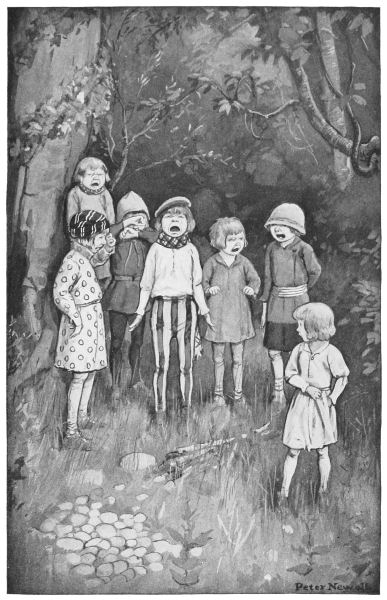
The children began to cry as loud as they could
When they heard this they left off crying, and followed Hop-o’-my-Thumb, who soon brought them to their father’s house by the very same path which they had come along. At first they had not the courage to go in, but stood at the door to hear what their parents were talking about. Just as the fagot-maker and his wife had come home without their children a great gentleman of the village sent to pay them two guineas for work they had done for him, which he had owed them so long that they never thought of getting a farthing of it. This money made them quite happy; for the poor creatures were very hungry, and had no other way of getting anything to eat.
The fagot-maker sent his wife out immediately to buy some meat; and as it was a long time since she had made a hearty meal, she bought as much meat as would have been enough for six or eight persons. The truth was, when she was thinking what would be enough for dinner, she forgot that her children were not at home; but as soon as she and her husband had done eating, she cried out: “Alas! where are our poor children? How they would feast on what we have left! It was all your fault, husband! I told you we should repent leaving them to starve in the forest! Oh, mercy! perhaps they have already been eaten by the hungry wolves!” The poor woman shed plenty of tears. “Alas! alas!” said she, over and over again, “what is become of my dear children?”
The children, who were all at the door, cried out together, “Here we are, mother, here we are!”
She flew like lightning to let them in, and kissed every one of them.
The fagot-maker and his wife were charmed at having their children once more with them, and their joy for this lasted till their money was all spent; but then they found themselves quite as ill off as before. So by degrees they again thought of leaving them in the forest: and that the young ones might not come back a second time, they said they would take them a great deal farther than they did at first. They could not talk about this matter so slyly but that Hop-o’-my-Thumb found means to hear all that passed between them; but he cared very little about it, for he thought it would be easy for him to do just the same as he had done before. But although he got up very early the next morning to go to the river’s side to get the pebbles, a thing which he had not thought of hindered him; for he found that the house door was double locked. Hop-o’-my-Thumb was now quite at a loss what to do; but soon after this his mother gave each of the children a piece of bread for breakfast and then it came into his head that he could make his share do as well as the pebbles by dropping crumbs of it all the way as he went. So he did not eat his piece, but put it into his pocket.
It was not long before they all set out, and their parents took care to lead them into the very thickest and darkest part of the forest. They then slipped away by a by-path as before, and left the children by themselves again. All this did not give Hop-o’-my-Thumb any concern, for he thought himself quite sure of getting back by means of the crumbs that he had dropped by the way; but when he came to look for them he found that not a crumb was left, for the birds had eaten them all up.
The poor children were now sadly off, for the farther they went the harder it was for them to get out of the forest. At last night came on, and the noise of the wind among the trees seemed to them like the howling of wolves, so that every moment they thought they should be eaten up. They hardly dared to speak a word, or to move a limb, for fear. Soon after there came a heavy rain which wetted them to the very skin, and made the ground so slippery that they fell down at almost every step and got dirty all over.
Before it was quite dark Hop-o’-my-Thumb climbed up to the top of a tree, and looked round on all sides to see if he could find any way of getting help. He saw a small light, like that of a candle, but it was a very great way off, and beyond the forest. He then came down from the tree, to try to find the way to it; but he could not see it when he was on the ground, and he was in the utmost trouble what to do next. They walked on towards the place where he had seen the light, and at last reached the end of the forest, and got sight of it again. They now walked faster; and after being much tired and vexed (for every time they got into lower ground they lost sight of the light), came to the house it was in. They knocked at the door, which was opened by a very poor-natured-looking lady, who asked what brought them there. Hop-o’-my-Thumb told her that they were poor children who had lost their way in the forest, and begged that she would give them a bed till morning. When the lady saw that they had such pretty faces she began to shed tears, and said: “Ah, my poor children, you do not know what place you are come to. This is the house of an Ogre, who eats up little boys and girls.”
“Alas! madam,” replied Hop-o’-my-Thumb, who trembled from head to foot, “what shall we do? If we go back to the forest we are sure of being torn to pieces by the wolves; we would rather, therefore, be eaten by the gentleman. Besides, when he sees us, perhaps he may take pity on us and spare our lives.”
The Ogre’s wife thought she could contrive to hide them from her husband till morning; so she let them go in and warm themselves by a good fire, before which there was a whole sheep roasting for the Ogre’s supper. When they had stood a short time by the fire there came a loud knocking at the door: this was the Ogre come home. His wife hurried the children under the bed and told them to lie still, and she then let her husband in.
The Ogre asked if supper were ready, and if the wine were fetched from the cellar; and then he sat down at the table. The sheep was not quite done, but he liked it much better half raw. In a minute or two the Ogre began to snuff to his right and left, and said he smelt child’s flesh.
“It must be this calf, which has just been killed,” said his wife.
“I smell child’s flesh, I tell thee once more!” cried the Ogre, looking all about the room—“I smell child’s flesh; there is something going on that I do not know of.”
As soon as he had spoken these words he rose from his chair and went towards the bed.
“Ah! madam,” said he, “you thought to cheat me, did you? Wretch! thou art old and tough thyself, or else I would eat thee up too! But come, come, this is lucky enough; for the brats will make a nice dish for three Ogres, who are my particular friends, and who are to dine with me to-morrow.”
He then drew them out one by one from under the bed. The poor children fell on their knees and begged his pardon as humbly as they could; but this Ogre was the most cruel of all Ogres, and instead of feeling any pity, he only began to think how sweet and tender their flesh would be; so he told his wife they would be nice morsels if she served them up with plenty of sauce. He then fetched a large knife, and began to sharpen it on a long whetstone that he held in his left hand; and all the while he came nearer and nearer to the bed. The Ogre took up one of the children, and was going to set about cutting him to pieces; but his wife said to him: “What in the world makes you take the trouble of killing them to-night? Will it not be time enough to-morrow morning?”
“Hold your prating,” replied the Ogre; “they will grow tender by being kept a little while after they are killed.”
“But,” said this wife, “you have got so much meat in the house already; here is a calf, two sheep, and half a pig.”
“True,” said the Ogre, “so give them all a good supper, that they may not get lean, and then send them to bed.”
The good creature was quite glad at this. She gave them plenty for their supper, but the poor children were so terrified that they could not eat a bit.
The Ogre sat down to his wine, very much pleased with the thought of giving his friends such a dainty dish: this made him drink rather more than common, and he was soon obliged to go to bed himself. Now the Ogre had seven daughters, who were all very young like Hop-o’-my-Thumb and his brothers. These young Ogresses had fair skins, because they fed on raw meat like their father; but they had small gray eyes, quite round, and sunk in their heads, hooked noses, wide mouths, and very long, sharp teeth, standing a great way off each other. They were too young as yet to do much mischief; but they showed that if they lived to be as old as their father they would grow quite as cruel as he was, for they took pleasure already in biting young children and sucking their blood. The Ogresses had been put to bed very early that night; they were all in one bed, which was very large, and every one of them had a crown of gold on her head. There was another bed of the same size in the room, and in this the Ogre’s wife put the seven little boys, and then went to bed herself along with her husband.
Now Hop-o’-my-Thumb was afraid that the Ogre would wake in the night, and kill him and his brothers while they were asleep. So he got out of bed in the middle of the night as softly as he could, took off all his brothers’ nightcaps and his own, and crept with them to the bed that the Ogre’s daughters were in; he then took off their crowns, and put the nightcaps on their heads instead; next he put the crowns on his brothers’ heads and his own, and got into bed again; expecting, after this, that, if the Ogre should come, he would take him and his brothers for his own children. Everything turned out as he wished. The Ogre waked soon after midnight, and began to be very sorry that he had put off killing the boys till the morning; so he jumped out of bed, and took hold of his large knife. “Let us see,” said he, “what the young rogues are about, and do the business at once!” He then walked softly to the room where they all slept, and went up to the bed the boys were in, who were all asleep except Hop-o’-my-Thumb. He touched their heads one at a time, and feeling the crowns of gold, said to himself: “Oh, oh! I had like to have made such a mistake! I must have drunk too much wine last night.”
He went next to the bed that his own little Ogresses were in, and when he felt the nightcaps, he said, “Ah! here you are, my lads”; and so in a moment he cut the throats of all his daughters.
He was very much pleased when he had done this, and then went back to his own bed. As soon as Hop-o’-my-Thumb heard him snore he awoke his brothers, and told them to put on their clothes quickly, and follow him. They stole down softly into the garden, and then jumped from the wall into the road; they ran as fast as their legs could carry them, but were so much afraid all the while that they hardly knew which way to take. When the Ogre waked in the morning he said to his wife, grinning: “My dear, go and dress the young rogues I saw last night.”
The wife was quite surprised at hearing her husband speak so kindly, and did not dream of the real meaning of his words. She supposed he wanted her to help them to put on their clothes; so she went up-stairs, and the first thing she saw was her seven daughters with their throats cut and all over blood. This threw her into a fainting fit. The Ogre was afraid his wife might be too long in doing what he had set her about, so he went himself to help her; but he was as much shocked as she had been at the dreadful sight of his bleeding children. “Ah! what have I done?” he cried. “But the little rascals shall pay for it, I warrant them.”
He first threw some water on his wife’s face; and, as soon as she came to herself, he said to her: “Bring me quickly my seven-league boots, that I may go and catch the little vipers.”
The Ogre then put on these boots, and set out with all speed. He strided over many parts of the country, and at last turned into the very road in which the poor children were. For they had set off towards the fagot-maker’s cottage, which they had almost reached. They watched the Ogre stepping from mountain to mountain at one step, and crossing rivers as if they had been tiny brooks. At this Hop-o’-my-Thumb thought a little what was to be done; and spying a hollow place under a large rock, he made his brothers get into it. He then crept in himself, but kept his eye fixed on the Ogre, to see what he would do next.
The Ogre found himself quite weary with the journey he had gone, for seven-league boots are very tiresome to the person who wears them; so he now began to think of resting, and happened to sit down on the very rock where the poor children were hid. As he was so tired, and it was a hot day, he fell fast asleep, and soon began to snore so loud that the little fellows were terrified.
When Hop-o’-my-Thumb saw this he said to his brothers, “Courage, my lads! never fear! you have nothing to do but to steal away and get home while the Ogre is fast asleep, and leave me to shift for myself.”
The brothers now were very glad to do whatever he told them, and so they soon came to their father’s house. In the mean time Hop-o’-my-Thumb went up to the Ogre softly, pulled off his seven-league boots very gently, and put them on his own legs; for though the boots were very large, yet being fairy-boots, they could make themselves small enough to fit any leg they pleased.
As soon as ever Hop-o’-my-Thumb had made sure of the Ogre’s seven-league boots, he went at once to the palace, and offered his services to carry orders from the King to his army, which was a great way off, and to bring back the quickest accounts of the battle they were just at that time fighting with the enemy. In short, he thought he could be of more use to the King than all his mail-coaches, and so should make his fortune in this manner. He succeeded so well that in a short time he made money enough to keep himself, his father, mother, and six brothers, without the trouble of working, for the rest of their lives. Having done this, he went back to his father’s cottage, where all the family were delighted to see him again. As the great fame of his boots had been talked of at court in this time the King sent for him, and indeed employed him very often in the greatest affairs of the state, so that he became one of the richest men in the kingdom.
And now let us see what became of the wicked Ogre. He slept so soundly that he never discovered the loss of his boots; but having an evil conscience and bad dreams, he fell in his sleep from the corner of the rock where Hop-o’-my-Thumb and his brothers had left him, and bruised himself so much from head to foot that he could not stir; so he was forced to stretch himself out at full length, and wait for some one to come and help him.
Now a good many fagot-makers passed near the place where the Ogre lay, and when they heard him groan they went up to ask him what was the matter. But the Ogre had eaten such a great number of children in his lifetime that he had grown so very big and fat that these men could not even have carried one of his legs, so they were forced to leave him there. At last night came on, and then a large serpent came out of a wood just by and stung him, so that he died in great pain.
By and by, Hop-o’-my-Thumb, who had become the King’s first favorite, heard of the Ogre’s death; and the first thing he did was to tell his Majesty all that the good-natured Ogress had done to save the lives of himself and brothers. The King was so much pleased at what he heard that he asked Hop-o’-my-Thumb if there was any favor he could bestow upon her. Hop-o’-my-Thumb thanked the King, and desired that the Ogress might have the noble title of Duchess of Draggletail given to her, which was no sooner asked than granted. The Ogress then came to court, and lived very happily for many years, enjoying the vast fortune she had found in the Ogre’s chests. As for Hop-o’-my-Thumb, he every day grew more witty and brave; till at last the King made him the greatest lord in the kingdom, and set him over all his affairs.
BEAUTY AND THE BEAST
THERE was once a very rich merchant who had six children—three boys and three girls. As he was himself a man of great sense, he spared no expense for their education. The three daughters were all handsome, but particularly the youngest; indeed, she was so very beautiful that in her childhood every one called her the Little Beauty; and being equally lovely when she was grown up, nobody called her by any other name, which made her sisters very jealous of her. This youngest daughter was not only more handsome than her sisters, but also was better tempered. The two eldest were vain of their wealth and position. They gave themselves a thousand airs, and refused to visit other merchants’ daughters; nor would they condescend to be seen except with persons of quality. They went every day to balls, plays, and public walks, and always made game of their youngest sister for spending her time in reading or other useful employments. As it was well known that these young ladies would have large fortunes, many great merchants wished to get them for wives; but the two eldest always answered that, for their parts, they had no thoughts of marrying any one below a duke or an earl at least. Beauty had quite as many offers as her sisters, but she always answered, with the greatest civility, that though she was much obliged to her lovers, she would rather live some years longer with her father, as she thought herself too young to marry.
It happened that, by some unlucky accident, the merchant suddenly lost all his fortune, and had nothing left but a small cottage in the country. Upon this he said to his daughters, while the tears ran down his cheeks, “My children, we must now go and dwell in the cottage, and try to get a living by labor, for we have no other means of support.” The two eldest replied that they did not know how to work, and would not leave town; for they had lovers enough who would be glad to marry them, though they had no longer any fortune. But in this they were mistaken; for when the lovers heard what had happened, they said, “The girls were so proud and ill-tempered that all we wanted was their fortune; we are not sorry at all to see their pride brought down; let them show off their airs to their cows and sheep.” But everybody pitied poor Beauty, because she was so sweet-tempered and kind to all, and several gentlemen offered to marry her, though she had not a penny; but Beauty still refused, and said she could not think of leaving her poor father in his trouble. At first Beauty could not help sometimes crying in secret for the hardships she was now obliged to suffer; but in a very short time she said to herself, “All the crying in the world will do me no good, so I will try to be happy without a fortune.”
When they had removed to their cottage the merchant and his three sons employed themselves in ploughing and sowing the fields, and working in the garden. Beauty also did her part, for she rose by four o’clock every morning, lighted the fires, cleaned the house, and got ready the breakfast for the whole family. At first she found all this very hard; but she soon grew quite used to it, and thought it no hardship; indeed, the work greatly benefited her health. When she had done she used to amuse herself with reading, playing her music, or singing while she spun. But her two sisters were at a loss what to do to pass the time away: they had their breakfast in bed, and did not rise till ten o’clock. Then they commonly walked out, but always found themselves very soon tired, when they would often sit down under a shady tree, and grieve for the loss of their carriage and fine clothes, and say to each other, “What a mean-spirited, poor, stupid creature our young sister is, to be so content with this low way of life!” But their father thought differently, and loved and admired his youngest child more than ever.
After they had lived in this manner about a year the merchant received a letter, which informed him that one of his richest ships, which he thought was lost, had just come into port. This news made the two eldest sisters almost mad with joy, for they thought they should now leave the cottage, and have all their finery again. When they found that their father must take a journey to the ship, the two eldest begged he would not fail to bring them back some new gowns, caps, rings, and all sorts of trinkets. But Beauty asked for nothing; for she thought in herself that all the ship was worth would hardly buy everything her sisters wished for. “Beauty,” said the merchant, “how comes it that you ask for nothing? What can I bring you, my child?”
“Since you are so kind as to think of me, dear father,” she answered, “I should be glad if you would bring me a rose, for we have none in our garden.” Now Beauty did not indeed wish for a rose, nor anything else, but she only said this that she might not affront her sisters; otherwise they would have said she wanted her father to praise her for desiring nothing. The merchant took his leave of them, and set out on his journey; but when he got to the ship some persons went to law with him about the cargo, and after a deal of trouble he came back to his cottage as poor as he had left it. When he was within thirty miles of his home, and thinking of the joy of again meeting his children, he lost his way in the midst of a dense forest. It rained and snowed very hard, and, besides, the wind was so high as to throw him twice from his horse. Night came on, and he feared he should die of cold and hunger, or be torn to pieces by the wolves that he heard howling round him. All at once he cast his eyes towards a long avenue, and saw at the end a light, but it seemed a great way off. He made the best of his way towards it, and found that it came from a splendid palace, the windows of which were all blazing with light. It had great bronze gates, standing wide open, and fine court-yards, through which the merchant passed; but not a living soul was to be seen. There were stables too, which his poor, starved horse, less scrupulous than himself, entered at once, and took a good meal of oats and hay. His master then tied him up, and walked towards the entrance-hall, but still without seeing a single creature. He went on to a large dining-parlor, where he found a good fire, and a table covered with some very nice dishes, but only one plate with a knife and fork. As the snow and rain had wetted him to the skin, he went up to the fire to dry himself. “I hope,” said he, “the master of the house or his servants will excuse me, for it surely will not be long now before I see them.” He waited some time, but still nobody came; at last the clock struck eleven, and the merchant, being quite faint for the want of food, helped himself to a chicken, and to a few glasses of wine, yet all the time trembling with fear. He sat till the clock struck twelve, and then, taking courage, began to think he might as well look about him; so he opened a door at the end of the hall, and went through it into a very grand room, in which there was a fine bed; and as he was feeling very weary, he shut the door, took off his clothes, and got into it.
It was ten o’clock in the morning before he awoke, when he was amazed to see a handsome new suit of clothes laid ready for him, instead of his own, which were all torn and spoiled. “To be sure,” said he to himself, “this place belongs to some good fairy, who has taken pity on my ill luck.” He looked out of the window, and instead of the snow-covered wood, where he had lost himself the previous night, he saw the most charming arbors covered with all kinds of flowers. Returning to the hall where he had supped, he found a breakfast-table, ready prepared. “Indeed, my good fairy,” said the merchant aloud, “I am vastly obliged to you for your kind care of me.” He then made a hearty breakfast, took his hat, and was going to the stable to pay his horse a visit; but as he passed under one of the arbors, which was loaded with roses, he thought of what Beauty had asked him to bring back to her, and so he took a bunch of roses to carry home. At the same moment he heard a loud noise, and saw coming towards him a beast, so frightful to look at that he was ready to faint with fear. “Ungrateful man!” said the beast, in a terrible voice, “I have saved your life by admitting you into my palace, and in return you steal my roses, which I value more than anything I possess. But you shall atone for your fault: you shall die in a quarter of an hour.”
The merchant fell on his knees, and, clasping his hands, said, “Sir, I humbly beg your pardon. I did not think it would offend you to gather a rose for one of my daughters, who had entreated me to bring her one home. Do not kill me, my lord!”
“I am not a lord, but a beast,” replied the monster; “I hate false compliments, so do not fancy that you can coax me by any such ways. You tell me that you have daughters; now I will suffer you to escape if one of them will come and die in your stead. If not, promise that you will yourself return in three months, to be dealt with as I may choose.”
The tender-hearted merchant had no thoughts of letting any one of his daughters die for his sake; but he knew that if he seemed to accept the beast’s terms, he should at least have the pleasure of seeing them once again. So he gave his promise, and was told he might set off as soon as he liked. “But,” said the beast, “I do not wish you to go back empty-handed. Go to the room you slept in, and you will find a chest there; fill it with whatsoever you like best, and I will have it taken to your own house for you.”
When the beast had said this he went away. The good merchant, left to himself, began to consider that as he must die—for he had no thought of breaking a promise, made even to a beast—he might as well have the comfort of leaving his children provided for. He returned to the room he had slept in, and found there heaps of gold pieces lying about. He filled the chest with them to the very brim, locked it, and, mounting his horse, left the palace as sorrowful as he had been glad when he first beheld it. The horse took a path across the forest of his own accord, and in a few hours they reached the merchant’s house. His children came running round him, but, instead of kissing them with joy, he could not help weeping as he looked at them. He held in his hand the bunch of roses, which he gave to Beauty, saying, “Take these roses, Beauty; but little do you think how dear they have cost your poor father.” And then he gave them an account of all that he had seen or heard in the palace of the beast.
The two eldest sisters now began to shed tears, and to lay the blame upon Beauty, who, they said, would be the cause of her father’s death. “See,” said they, “what happens from the pride of the little wretch; why did not she ask for such things as we did? But, to be sure, miss must not be like other people; and though she will be the cause of her father’s death, yet she does not shed a tear.”
“It would be useless,” replied Beauty; “for father shall not die. As the beast will accept of one of his daughters, I will give myself up, and be only too happy to prove my love for the best of fathers.”
“No, sister,” said the three brothers, with one voice, “that cannot be; we will go in search of this monster, and either he or we will perish.”
“Do not hope to kill him,” said the merchant; “his power is far too great. But Beauty’s young life shall not be sacrificed; I am old, and cannot expect to live much longer; so I shall but give up a few years of my life, and shall only grieve for the sake of my children.”
“Never, father!” cried Beauty; “if you go back to the palace, you cannot hinder my going after you; though young, I am not over-fond of life; and I would much rather be eaten up by the monster than die of grief for your loss.”
The merchant in vain tried to reason with Beauty, who still obstinately kept to her purpose; which, in truth, made her two sisters glad, for they were jealous of her, because everybody loved her.
The merchant was so grieved at the thoughts of losing his child that he never once thought of the chest filled with gold, but at night, to his great surprise, he found it standing by his bedside. He said nothing about his riches to his eldest daughters, for he knew very well it would at once make them want to return to town; but he told Beauty his secret, and she then said that while he was away two gentlemen had been on a visit at their cottage who had fallen in love with her two sisters. She entreated her father to marry them without delay, for she was so sweet-natured she only wished them to be happy.
Three months went by only too fast, and then the merchant and Beauty got ready to set out for the palace of the beast. Upon this the two sisters rubbed their eyes with an onion to make believe they were crying; both the merchant and his sons cried in earnest. Only Beauty shed no tears. They reached the palace in a very few hours, and the horse, without bidding, went into the same stable as before. The merchant and Beauty walked towards the large hall, where they found a table covered with every dainty, and two plates laid ready. The merchant had very little appetite; but Beauty, that she might the better hide her grief, placed herself at the table, and helped her father; she then began to eat herself, and thought all the time that, to be sure, the beast had a mind to fatten her before he ate her up, since he had provided such good cheer for her. When they had done their supper they heard a great noise, and the good old man began to bid his poor child farewell, for he knew it was the beast coming to them. When Beauty first saw that frightful form she was very much terrified, but tried to hide her fear. The creature walked up to her and eyed her all over; then asked her, in a dreadful voice, if she had come quite of her own accord.
“Yes,” said Beauty.
“Then you are a good girl, and I am very much obliged to you.”
This was such an astonishingly civil answer that Beauty’s courage rose; but it sank again when the beast, addressing the merchant, desired him to leave the palace next morning, and never return to it again. “And so good-night, merchant. And good-night, Beauty.”
“Good-night, beast,” she answered, as the monster shuffled out of the room.
“Ah! my dear child,” said the merchant, kissing his daughter, “I am half dead already, at the thought of leaving you with this dreadful beast; you shall go back and let me stay in your place.”
“No,” said Beauty, boldly, “I will never agree to that; you must go home to-morrow morning.”
Then they wished each other good-night and went to bed, both of them thinking they should not be able to close their eyes; but as soon as ever they had lain down they fell into a deep sleep, and did not awake till morning. Beauty dreamed that a lady came up to her, who said: “I am very much pleased, Beauty, with the goodness you have shown, in being willing to give your life to save that of your father. Do not be afraid of anything; you shall not go without a reward.”
As soon as Beauty awoke she told her father this dream; but though it gave him some comfort, he was a long time before he could be persuaded to leave the palace. At last Beauty succeeded in getting him safely away.
When her father was out of sight poor Beauty began to weep sorely; still, having naturally a courageous spirit, she soon resolved not to make her sad case still worse by sorrow, which she knew was vain, but to wait and be patient. She walked about to take a view of all the palace, and the elegance of every part of it much charmed her.
But what was her surprise when she came to a door on which was written Beauty’s Room! She opened it in haste, and her eyes were dazzled by the splendor and taste of the apartment. What made her wonder more than all the rest was a large library filled with books, a harpsichord, and many pieces of music. “The beast surely does not mean to eat me up immediately,” said she, “since he takes care I shall not be at a loss how to amuse myself.” She opened the library, and saw these verses written in letters of gold on the back of one of the books:
“Beauteous lady, dry your tears, Here’s no cause for sighs or fears. Command as freely as you may, For you command and I obey.”
“Alas!” said she, sighing, “I wish I could only command a sight of my poor father, and to know what he is doing at this moment.” Just then, by chance, she cast her eyes on a looking-glass that stood near her, and in it she saw a picture of her old home, and her father riding mournfully up to the door. Her sisters came out to meet him, and although they tried to look sorry, it was easy to see that in their hearts they were very glad. In a short time all this picture disappeared, but it caused Beauty to think that the beast, besides being very powerful, was also very kind. About the middle of the day she found a table laid ready for her, and a sweet concert of music played all the time she was dining, without her seeing anybody. But at supper, when she was going to seat herself at table, she heard the noise of the beast, and could not help trembling with fear.
“Beauty,” said he, “will you give me leave to see you sup?”
“That is as you please,” answered she, very much afraid.
“Not in the least,” said the beast; “you alone command in this place. If you should not like my company you need only say so, and I will leave you that moment. But tell me, Beauty, do you not think me very ugly?”
“Why, yes,” said she, “for I cannot tell a falsehood; but then I think you are very good.”
“Am I?” sadly replied the beast; “yet, besides being ugly, I am also very stupid: I know well enough that I am but a beast.”
“Very stupid people,” said Beauty, “are never aware of it themselves.”
At which kindly speech the beast looked pleased, and replied, not without an awkward sort of politeness, “Pray do not let me detain you from supper, and be sure that you are well served. All you see is your own, and I should be deeply grieved if you wanted for anything.”
“You are very kind—so kind that I almost forgot you are so ugly,” said Beauty, earnestly.
“Ah! yes,” answered the beast, with a great sigh; “I hope I am good-tempered, but still I am only a monster.”
“There is many a monster who wears the form of a man; it is better of the two to have the heart of a man and the form of a monster.”
“I would thank you, Beauty, for this speech, but I am too senseless to say anything that would please you,” returned the beast, in a melancholy voice; and altogether he seemed so gentle and so unhappy that Beauty, who had the tenderest heart in the world, felt her fear of him gradually vanish.
She ate her supper with a good appetite, and conversed in her own sensible and charming way, till at last, when the beast rose to depart, he terrified her more than ever by saying, abruptly, in his gruff voice, “Beauty, will you marry me?”
Now Beauty, frightened as she was, would speak only the exact truth; besides, her father had told her that the beast liked only to have the truth spoken to him. So she answered, in a very firm tone, “No, beast.”
He did not go into a passion, or do anything but sigh deeply, and depart.
When Beauty found herself alone she began to feel pity for the poor beast. “Oh!” said she, “what a sad thing it is that he should be so very frightful, since he is so good-tempered!”
Beauty lived three months in this palace very well pleased. The beast came to see her every night, and talked with her while she supped; and though what he said was not very clever, yet, as she saw in him every day some new goodness, instead of dreading the time of his coming, she soon began continually looking at her watch, to see if it were nine o’clock; for that was the hour when he never failed to visit her. One thing only vexed her, which was that every night before he went away he always made it a rule to ask her if she would be his wife, and seemed very much grieved at her steadfastly replying “No.” At last, one night, she said to him, “You wound me greatly, beast, by forcing me to refuse you so often; I wish I could take such a liking to you as to agree to marry you, but I must tell you plainly that I do not think it will ever happen. I shall always be your friend, so try to let that content you.”
“I must,” sighed the beast, “for I know well enough how frightful I am; but I love you better than myself. Yet I think I am very lucky in your being pleased to stay with me; now promise me, Beauty, that you will never leave me.”
Beauty would almost have agreed to this, so sorry was she for him, but she had that day seen in her magic glass, which she looked at constantly, that her father was dying of grief for her sake.
“Alas!” she said, “I long so much to see my father that if you do not give me leave to visit him I shall break my heart.”
“I would rather break mine, Beauty,” answered the beast; “I will send you to your father’s cottage, you shall stay there, and your poor beast shall die of sorrow.”
“No,” said Beauty, crying, “I love you too well to be the cause of your death; I promise to return in a week. You have shown me that my sisters are married, and my brothers are gone for soldiers, so that my father is left all alone. Let me stay a week with him.”
“You shall find yourself with him to-morrow morning,” replied the beast; “but mind, do not forget your promise. When you wish to return you have nothing to do but to put your ring on a table when you go to bed. Good-bye, Beauty!” The beast sighed as he said these words, and Beauty went to bed very sorry to see him so much grieved. When she awoke in the morning she found herself in her father’s cottage. She rang a bell that was at her bedside, and a servant entered; but as soon as she saw Beauty the woman gave a loud shriek; upon which the merchant ran up-stairs, and when he beheld his daughter he ran to her and kissed her a hundred times. At last Beauty began to remember that she had brought no clothes with her to put on; but the servant told her she had just found in the next room a large chest full of dresses, trimmed all over with gold, and adorned with pearls and diamonds.
Beauty, in her own mind, thanked the beast for his kindness, and put on the plainest gown she could find among them all. She then desired the servant to lay the rest aside, for she intended to give them to her sisters; but, as soon as she had spoken these words, the chest was gone out of sight in a moment. Her father then suggested perhaps the beast chose for her to keep them all for herself; and as soon as he had said this, they saw the chest standing again in the same place. While Beauty was dressing herself a servant brought word to her that her sisters were come with their husbands to pay her a visit. They both lived unhappily with the gentlemen they had married. The husband of the eldest was very handsome, but was so proud of this that he thought of nothing else from morning till night, and did not care a pin for the beauty of his wife. The second had married a man of great learning; but he made no use of it, except to torment and affront all his friends, and his wife more than any of them. The two sisters were ready to burst with spite when they saw Beauty dressed like a princess, and looking so very charming. All the kindness that she showed them was of no use; for they were vexed more than ever when she told them how happy she lived at the palace of the beast. The spiteful creatures went by themselves into the garden, where they cried to think of her good-fortune.
“Why should the little wretch be better off than we?” said they. “We are much handsomer than she is.”
“Sister,” said the eldest, “a thought has just come into my head: Let us try to keep her here longer than the week for which the beast gave her leave, and then he will be so angry that perhaps when she goes back to him he will eat her up in a moment.”
“That is well thought of,” answered the other, “but to do this we must pretend to be very kind.”
They then went to join her in the cottage, where they showed her so much false love that Beauty could not help crying for joy.
When the week was ended the two sisters began to pretend such grief at the thought of her leaving them that she agreed to stay a week more; but all that time Beauty could not help fretting for the sorrow that she knew her absence would give her poor beast; for she tenderly loved him, and much wished for his company again. Among all the grand and clever people she saw she found nobody who was half so sensible, so affectionate, so thoughtful, or so kind. The tenth night of her being at the cottage she dreamed she was in the garden of the palace, that the beast lay dying on a grass-plot, and with his last breath put her in mind of her promise, and laid his death to her forsaking him. Beauty awoke in a great fright, and burst into tears. “Am not I wicked,” said she, “to behave so ill to a beast who has shown me so much kindness? Why will not I marry him? I am sure I should be more happy with him than my sisters are with their husbands. He shall not be wretched any longer on my account; for I should do nothing but blame myself all the rest of my life.”
She then rose, put her ring on the table, got into bed again, and soon fell asleep. In the morning she with joy found herself in the palace of the beast. She dressed herself very carefully, that she might please him the better, and thought she had never known a day pass away so slowly. At last the clock struck nine, but the beast did not come. Beauty, dreading lest she might truly have caused his death, ran from room to room, calling out, “Beast, dear beast!” but there was no answer. At last she remembered her dream, rushed to the grass-plot, and there saw him lying apparently dead beside the fountain. Forgetting all his ugliness, she threw herself upon his body, and, finding his heart still beat, she fetched some water and sprinkled it over him, weeping and sobbing the while.
The beast opened his eyes. “You forgot your promise, Beauty, and so I determined to die; for I could not live without you. I have starved myself to death, but I shall die content since I have seen your face once more.”
“No, dear beast,” cried Beauty, passionately, “you shall not die; you shall live to be my husband! I thought it was only friendship I felt for you, but now I know it was love.”
The moment Beauty had spoken these words the palace was suddenly lighted up, and all kinds of rejoicings were heard around them, none of which she noticed, but hung over her dear beast with the utmost tenderness. At last, unable to restrain herself, she dropped her head over her hands, covered her eyes, and cried for joy; and, when she looked up again, the beast was gone. In his stead she saw at her feet a handsome, graceful young prince, who thanked her with the tenderest expressions for having freed him from enchantment.
“But where is my poor beast? I only want him and nobody else,” sobbed Beauty.
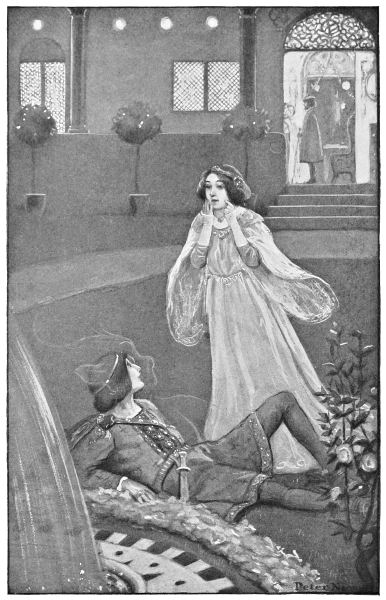
She saw at her feet a handsome, graceful young prince
“I am he,” replied the prince. “A wicked fairy condemned me to this form, and forbade me to show that I had any wit or sense till a beautiful lady should consent to marry me. You alone, dearest Beauty, judged me neither by my looks nor by my talents, but by my heart alone. Take it, then, and all that I have besides, for all is yours.”
Beauty, full of surprise, but very happy, suffered the prince to lead her to his palace, where she found her father and sisters, who had been brought there by the fairy-lady whom she had seen in a dream the first night she came.
“Beauty,” said the fairy, “you have chosen well, and you have your reward, for a true heart is better than either good looks or clever brains. As for you, ladies,” and she turned to the two elder sisters, “I know all your ill deeds, but I have no worse punishment for you than to see your sister happy. You shall stand as statues at the door of her palace, and when you repent of and have amended your faults, you shall become women again. But, to tell you the truth, I very much fear you will remain statues forever.”
LITTLE SNOWDROP
ONCE upon a time, in the middle of winter, when the flakes of snow fell like feathers from the sky, a queen sat at a window set in an ebony frame, and sewed. While she was sewing and watching the snow fall, she pricked her finger with her needle, and three drops of blood dropped on the snow. And because the crimson looked so beautiful on the white snow, she thought: “Oh that I had a child as white as snow, as red as blood, and as black as the wood of this ebony frame!”
Soon afterwards she had a little daughter, who was as white as snow, as red as blood, and had hair as black as ebony. And when the child was born the queen died.
After a year had gone by the king took another wife. She was a handsome lady, but proud and haughty, and could not endure that any one should surpass her in beauty. She had a wonderful mirror, and whenever she walked up to it, and looked at herself in it, she said:
“Little glass upon the wall, Who is fairest among us all?”
Then the mirror replied:
“Lady queen, so grand and tall, Thou art the fairest of them all.”
And she was satisfied, for she knew the mirror always told the truth. But Snowdrop grew ever taller and fairer, and at seven years old was beautiful as the day, and more beautiful than the queen herself. So once, when the queen asked of her mirror:
“Little glass upon the wall, Who is fairest among us all?”
it answered:
“Lady queen, you are grand and tall, But Snowdrop is fairest of you all.”
Then the queen was startled, and turned yellow and green with envy. From that hour she so hated Snowdrop, that she burned with secret wrath whenever she saw the maiden. Pride and envy grew apace like weeds in her heart, till she had no rest day or night. So she called a huntsman and said: “Take the child out in the forest, for I will endure her no longer in my sight. Kill her, and bring me her lungs and liver as tokens that you have done it.”
The huntsman obeyed, and led the child away; but when he had drawn his hunting-knife, and was about to pierce Snowdrop’s innocent heart, she began to weep, and said: “Ah! dear huntsman, spare my life, and I will run deep into the wild forest, and never more come home.”
The huntsman took pity on her, because she looked so lovely, and said, “Run away then, poor child!” (“The wild beasts will soon make an end of thee,” he thought.) But it seemed as if a stone had been rolled from his heart because he had avoided taking her life; and as a little bear came by just then, he killed it, took out its liver and lungs, and carried them as tokens to the queen. She made the cook dress them with salt, and then the wicked woman ate them, and thought she had eaten Snowdrop’s lungs and liver. The poor child was now all alone in the great forest, and she felt frightened as she looked at all the leafy trees, and knew not what to do. So she began to run, and ran over the sharp stones, and through the thorns; and the wild beasts passed close to her, but did her no harm. She ran as long as her feet could carry her, and when evening closed in, she saw a little house, and went into it to rest herself. Everything in the house was very small, but I cannot tell you how pretty and clean it was.
There stood a little table, covered with a white tablecloth, on which were seven little plates (each little plate with its own little spoon)—also seven little knives and forks, and seven little cups. Round the walls stood seven little beds close together, with sheets as white as snow. Snowdrop being so hungry and thirsty, ate a little of the vegetables and bread on each plate, and drank a drop of wine from every cup, for she did not like to empty one entirely.
Then, being very tired, she laid herself down in one of the beds, but could not make herself comfortable, for one was too long, and another too short. The seventh, luckily, was just right; so there she stayed, said her prayers, and fell asleep.
When it was grown quite dark, home came the masters of the house, seven dwarfs, who delved and mined for iron among the mountains. They lighted their seven candles, and as soon as there was a light in the kitchen, they saw that some one had been there, for it was not quite so orderly as they had left it.
The first said, “Who has been sitting on my stool?”
The second, “Who has eaten off my plate?”
The third, “Who has taken part of my loaf?”
The fourth, “Who has touched my vegetables?”
The fifth, “Who has used my fork?”
The sixth, “Who has cut with my knife?”
The seventh, “Who has drunk out of my little cup?”
Then the first dwarf looked about, and saw that there was a slight hollow in his bed, so he asked, “Who has been lying in my little bed?”
The others came running, and each called out, “Some one has also been lying in my bed.”
But the seventh, when he looked in his bed, saw Snowdrop there, fast asleep. He called the others, who flocked round with cries of surprise, fetched their seven candles, and cast the light on Snowdrop.
“Oh, Heaven,” they cried, “what a lovely child!” and were so pleased that they would not wake her, but let her sleep on in the little bed. The seventh dwarf slept with all his companions in turn, an hour with each, and so they spent the night. When it was morning Snowdrop woke up, and was frightened when she saw the seven dwarfs. They were very friendly, however, and inquired her name.
“Snowdrop,” answered she.
“How have you found your way to our house?” further asked the dwarfs.
So she told them how her stepmother had tried to kill her, how the huntsman had spared her life, and how she had run the whole day through, till at last she had found their little house.
Then the dwarfs said, “If thou wilt keep our house, cook, make the beds, wash, sew and knit, and make all neat and clean, thou canst stay with us and shalt want for nothing.”
“I will, right willingly,” said Snowdrop. So she dwelt with them, and kept their house in order. Every morning they went out among the mountains, to seek iron and gold, and came home ready for supper in the evening.
The maiden being left alone all day long, the good dwarfs warned her, saying, “Beware of thy wicked stepmother, who will soon find out that thou art here; take care that thou lettest nobody in.”
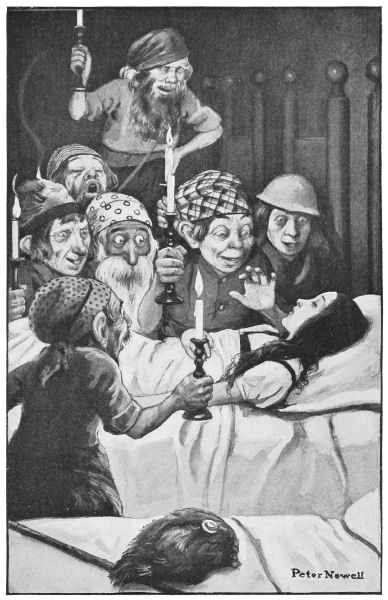
“Oh, Heaven,” they cried, “what a lovely child!”
The queen, however, after having, as she thought, eaten Snowdrop’s lungs and liver, had no doubt that she was again the first and fairest woman in the world; so she walked up to her mirror, and said:
“Little glass upon the wall, Who is fairest among us all?”
The mirror replied:
“Lady queen, so grand and tall, Here you are fairest of them all; But over the hills, with the seven dwarfs old, Lives Snowdrop, fairer a hundredfold.”
She trembled, knowing that the mirror never told a falsehood; she felt sure that the huntsman had deceived her, and that Snowdrop was still alive. She pondered once more, late and early, early and late, how best to kill Snowdrop; for envy gave her no rest, day or night, while she herself was not the fairest lady in the land. When she had planned what to do she painted her face, dressed herself like an old pedler-woman, and altered her appearance so much that no one could have known her. In this disguise she went over the seven hills to where the seven dwarfs dwelt, knocked at the door, and cried, “Good wares, cheap!—very cheap!”
Snowdrop looked out of the window and cried, “Good-morning, good woman. What have you to sell?”
“Good wares, smart wares,” answered the queen—“bodice laces of all colors;” and drew out one which was woven of colored silk.
“I may surely let this honest dame in!” thought Snowdrop; so she unfastened the door, and bought for herself the pretty lace.
“Child,” said the old woman, “what a figure thou art! Let me lace thee for once properly.” Snowdrop feared no harm, so stepped in front of her, and allowed her bodice to be fastened up with the new lace.
But the old woman laced so quick and laced so tight that Snowdrop’s breath was stopped, and she fell down as if dead. “Now I am fairest at last,” said the old woman to herself, and sped away.
The seven dwarfs came home soon after, at eventide, but how alarmed were they to find their poor Snowdrop lifeless on the ground! They lifted her up, and, seeing that she was laced too tightly, cut the lace of her bodice; she began to breathe faintly, and slowly returned to life. When the dwarfs heard what had happened, they said, “The old pedler-woman was none other than the wicked queen. Be careful of thyself, and open the door to no one if we are not at home.”
The cruel stepmother walked up to her mirror when she reached home, and said:
“Little glass upon the wall, Who is fairest among us all?”
To which it answered, as usual:
“Lady queen, so grand and tall, Here you are fairest of them all; But over the hills, with the seven dwarfs old, Lives Snowdrop, fairer a hundredfold.”
When she heard this she was so alarmed that all the blood rushed to her heart, for she saw plainly that Snowdrop was still alive.
“This time,” said she, “I will think of some means that shall destroy her utterly;” and with the help of witchcraft, in which she was skilful, she made a poisoned comb. Then she changed her dress and took the shape of another old woman.
Again she crossed the seven hills to the home of the seven dwarfs, knocked at the door, and cried, “Good wares, very cheap!”
Snowdrop looked out and said, “Go away—I dare let no one in.”
“You may surely be allowed to look!” answered the old woman, and she drew out the poisoned comb and held it up. The girl was so pleased with it that she let herself be cajoled, and opened the door.
When the bargain was struck the dame said, “Now let me dress your hair properly for once.” Poor Snowdrop took no heed, and let the old woman begin; but the comb had scarcely touched her hair before the poison worked, and she fell down senseless.
“Paragon of beauty!” said the wicked woman, “all is over with thee now,” and went away.
Luckily it was near evening, and the seven dwarfs soon came home. When they found Snowdrop lifeless on the ground they at once distrusted her stepmother. They searched, and found the poisoned comb; and as soon as they had drawn it out, Snowdrop came to herself, and told them what had happened. Again they warned her to be careful, and open the door to no one.
The queen placed herself before the mirror at home and said:
“Little glass upon the wall, Who is fairest among us all?”
But it again answered:
“Lady queen, so grand and tall, Here, you are fairest of them all; But over the hills, with the seven dwarfs old, Lives Snowdrop, fairer a thousandfold.”
When she heard the mirror speak thus she quivered with rage. “Snowdrop shall die,” she cried, “if it costs my own life!”
Then she went to a secret and lonely chamber, where no one ever disturbed her, and compounded an apple of deadly poison. Ripe and rosy cheeked, it was so beautiful to look upon that all who saw it longed for it; but it brought death to any who should eat it. When the apple was ready she painted her face, disguised herself as a peasant-woman, and journeyed over the seven hills to where the seven dwarfs dwelt. At the sound of the knock Snowdrop put her head out of the window, and said, “I cannot open the door to anybody, for the seven dwarfs have forbidden me to do so.”
“Very well,” replied the peasant-woman; “I only want to be rid of my apples. Here, I will give you one of them!”
“No,” said Snowdrop, “I dare not take it.”
“Art thou afraid of being poisoned?” asked the old woman. “Look here; I will cut the apple in two, and you shall eat the rosy side, and I the white.”
Now the fruit was so cunningly made that only the rosy side was poisoned. Snowdrop longed for the pretty apple; and when she saw the peasant-woman eating it she could resist no longer, but stretched out her hand and took the poisoned half. She had scarcely tasted it when she fell lifeless to the ground.
The queen, laughing loudly, watched her with a barbarous look, and cried: “Oh, thou who art white as snow, red as blood, and black as ebony, the seven dwarfs cannot awaken thee this time!”
And when she asked the mirror at home,
“Little glass upon the wall, Who is fairest among us all?”
the mirror at last replied,
“Lady queen, so grand and tall. You are the fairest of them all.”
So her envious heart had as much repose as an envious heart can ever know.
When the dwarfs came home in the evening they found Snowdrop lying breathless and motionless on the ground. They lifted her up, searched whether she had anything poisonous about her, unlaced her, combed her hair, washed her with water and with wine; but all was useless, for they could not bring the darling back to life. They laid her on a bier, and all the seven placed themselves round it, and mourned for her three long days. Then they would have buried her, but that she still looked so fresh and lifelike, and had such lovely rosy cheeks. “We cannot lower her into the dark earth,” said they; and caused a transparent coffin of glass to be made, so that she could be seen on all sides, and laid her in it, writing her name outside in letters of gold, which told that she was the daughter of a king. Then they placed the coffin on the mountain above, and one of them always stayed by it and guarded it. But there was little need to guard it, for even the wild animals came and mourned for Snowdrop: the birds likewise—first an owl, and then a raven, and afterwards a dove.
Long, long years did Snowdrop lay in her coffin unchanged, looking as though asleep, for she was still white as snow, red as blood, and her hair was as black as ebony. At last the son of a king chanced to wander into the forest, and came to the dwarf’s house for a night’s shelter. He saw the coffin on the mountain with the beautiful Snowdrop in it, and read what was written there in letters of gold. Then he said to the dwarfs, “Let me have the coffin! I will give you whatever you like to ask for it.”
But the dwarfs answered, “We would not part with it for all the gold in the world.”
He said again, “Yet give it me; for I cannot live without seeing Snowdrop, and though she is dead, I will prize and honor her as my beloved.”
Then the good dwarfs took pity on him, and gave him the coffin. The prince had it borne away by his servants. They happened to stumble over a bush, and the shock forced the bit of poisoned apple which Snowdrop had tasted out of her throat. Immediately she opened her eyes, raised the coffin-lid, and sat up alive once more. “Oh, heaven!” cried she, “where am I?”
The prince answered, joyfully. “Thou art with me,” and told her what had happened, saying, “I love thee more dearly than anything else in the world. Come with me to my father’s castle, and be my wife.”
Snowdrop, well pleased, went with him, and they were married with much state and grandeur.
The wicked stepmother was invited to the feast. Richly dressed, she stood before the mirror, and asked of it:
“Little glass upon the wall, Who is fairest among us all?”
The mirror answered:
“Lady queen, so grand and tall, Here, you are fairest among them all; But the young queen over the mountains old Is fairer than you a thousandfold.”
The evil-hearted woman uttered a curse, and could scarcely endure her anguish. She first resolved not to attend the wedding, but curiosity would not allow her to rest. She determined to travel, and see who that young queen could be, who was the most beautiful in all the world. When she came, and found that it was Snowdrop alive again, she stood petrified with terror and despair. Then two iron shoes, heated burning hot, were drawn out of the fire with a pair of tongs, and laid before her feet. She was forced to put them on, and to go and dance at Snowdrop’s wedding—dancing, dancing on these red hot shoes till she fell down dead.
THE STORY OF THE THREE BEARS
ONCE upon a time there were Three Bears, who lived together in a house of their own in a wood. One of them was a Little, Small, Wee Bear; and one was a Middle-sized Bear, and the other was a Great, Huge Bear. They had each a pot for their porridge, a little pot for the Little, Small, Wee Bear; and a middle-sized pot for the Middle Bear; and a great pot for the Great, Huge Bear. And they had each a chair to sit in; a little chair for the Little, Small, Wee Bear; and a middle-sized chair for the Middle Bear; and a great chair for the Great, Huge Bear. And they had each a bed to sleep in; a little bed for the Little, Small, Wee Bear; and a middle-sized bed for the Middle Bear; and a great bed for the Great, Huge Bear.
One day, after they had made the porridge for their breakfast, and poured it into their porridge-pots, they walked out into the wood while the porridge was cooling, that they might not burn their mouths by beginning too soon to eat it. And while they were walking a little old woman came to the house. She could not have been a good, honest old woman; for, first, she looked in at the window, and then she peeped in at the key-hole; and, seeing nobody in the house, she lifted the latch. The door was not fastened, because the bears were good bears, who did nobody any harm, and never suspected that anybody would harm them. So the little old woman opened the door and went in, and well pleased she was when she saw the porridge on the table. If she had been a good little old woman she would have waited till the bears came home, and then, perhaps, they would have asked her to breakfast; for they were good bears—a little rough or so, as the manner of bears is, but for all that very good-natured and hospitable. But she was an impudent, bad old woman, and set about helping herself.
So first she tasted the porridge of the Great, Huge Bear, and that was too hot for her; and she said a bad word about that. And then she tasted the porridge of the Middle Bear, and that was too cold for her; and she said a bad word about that, too. And then she went to the porridge of the Little, Small, Wee Bear, and tasted that, and that was neither too hot nor too cold, but just right, and she liked it so well that she ate it all up; but the naughty old woman said a bad word about the little porridge-pot, because it did not hold enough for her.
Then the little old woman sate down in the chair of the Great, Huge Bear, and that was too hard for her. And then she sate down in the chair of the Middle Bear, and that was too soft for her. And then she sate down in the chair of the Little, Small, Wee Bear, and that was neither too hard nor too soft, but just right. So she seated herself in it, and there she sate till the bottom of the chair came out, and down came she, plump upon the ground. And the naughty old woman said a wicked word about that, too.
Then the little old woman went up-stairs into the bedchamber in which the three bears slept. And first she lay down upon the bed of the Great, Huge Bear; but that was too high at the head for her. And next she lay down upon the bed of the Middle Bear; and that was too high at the foot for her. And then she lay down upon the bed of the Little, Small, Wee Bear; and that was neither too high at the head nor at the foot, but just right. So she covered herself up comfortably, and lay there till she fell fast asleep.
By this time the three bears thought their porridge would be cool enough, so they came home to breakfast. Now the little old woman had left the spoon of the Great, Huge Bear standing in his porridge.
“SOMEBODY HAS BEEN AT MY PORRIDGE!”
said the Great, Huge Bear, in his great, rough, gruff voice. And when the Middle Bear looked at his, he saw that the spoon was standing in it, too. They were wooden spoons; if they had been silver ones the naughty old woman would have put them in her pocket.
“Somebody Has Been At My Porridge!”
said the Middle Bear, in his middle voice.
Then the Little, Small, Wee Bear looked at his, and there was the spoon in the porridge-pot, but the porridge was all gone.
“Somebody has been at my porridge, and has eaten it all up!”
said the Little, Small, Wee Bear, in his little, small, wee voice.
Upon this the three bears, seeing that some one had entered their house, and eaten up the Little, Small, Wee Bear’s breakfast, began to look about them. Now the little old woman had not put the hard cushion straight when she rose from the chair of the Great, Huge Bear.
“SOMEBODY HAS BEEN SITTING IN MY CHAIR!”
said the Great, Huge Bear, in his great, rough, gruff voice.
And the little old woman had squatted down the soft cushion of the Middle Bear.
“Somebody Has Been Sitting In My Chair!”
said the Middle Bear, in his middle voice.
And you know what the little old woman had done to the third chair.
“Somebody has been sitting in my chair, and has sate the bottom of it out!”
said the Little, Small, Wee Bear, in his little, small, wee voice.
Then the three bears thought it necessary that they should make further search, so they went up-stairs into their bedchamber. Now the little old woman had pulled the pillow of the Great, Huge Bear out of its place.
“SOMEBODY HAS BEEN LYING IN MY BED!”
said the Great, Huge Bear, in his great, rough, gruff voice.
And the little old woman had pulled the bolster of the Middle Bear out of its place.
“Somebody Has Been Lying in My Bed!”
said the Middle Bear, in his middle voice.
And when the Little, Small, Wee Bear came to look at his bed, there was the bolster in its place, and the pillow in its place upon the bolster, and upon the pillow was the little old woman’s ugly, dirty head—which was not in its place, for she had no business there.
“Somebody has been lying in my bed—and here she is!”
said the Little, Small, Wee Bear, in his little, small, wee voice.
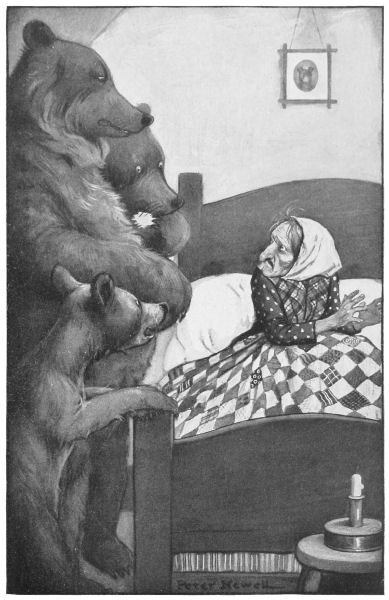
The voice of the little, small, wee bear awakened her at once
The little old woman had heard in her sleep the great, rough, gruff voice of the Great, Huge Bear; but she was so fast asleep that it was no more to her than the roaring of wind or the rumbling of thunder. And she had heard the middle voice of the Middle Bear, but it was only as if she had heard some one speaking in a dream. But when she heard the little, small, wee voice of the Little, Small, Wee Bear, it was so sharp and so shrill that it awakened her at once. Up she started; and when she saw the Three Bears on one side of the bed she tumbled herself out at the other and ran to the window. Now the window was open, because the bears, like good, tidy bears as they were, always opened their bedchamber window when they got up in the morning. Out the little old woman jumped; and whether she broke her neck in the fall, or ran into the wood and was lost there, or found her way out of the wood and was taken up by the constable and sent to the House of Correction for a vagrant as she was, I cannot tell. But the Three Bears never saw anything more of her.
From “The Green Fairy Book,” edited by Andrew Lang, by the courtesy of Longmans, Green & Co.
SNOW-WHITE AND ROSE-RED
A POOR widow lived alone in a little cottage, in front of which was a garden, where stood two little rose-trees: one bore white roses, the other red. The widow had two children who resembled the two rose-trees: one was called Snow-white, and the other Rose-red. They were two of the best children that ever lived; but Snow-white was quieter and more gentle than Rose-red. Rose-red liked best to jump about in the meadows, to look for flowers and catch butterflies; but Snow-white sat at home with her mother, helped her in the house, or read to her when there was nothing else to do. The two children loved one another so much that they always walked hand in hand; and when Snow-white said, “We will not forsake one another,” Rose-red answered, “Never, as long as we live;” and the mother added, “Yes, my children, whatever one has, let her divide with the other.” They often ran about in solitary places, and gathered red berries; and the wild creatures of the wood never hurt them, but came confidingly up to them. The little hare ate cabbage-leaves out of their hands, the doe grazed at their side, the stag sprang merrily past them, and the birds remained sitting on the boughs, and never ceased their songs. They met with no accident if they loitered in the wood and night came on; they lay down together on the moss, and slept till morning; and the mother knew this, and was in no anxiety about them. Once, when they had spent the night in the wood, and the red morning awoke them, they saw a beautiful child, in a shining white dress, sitting by the place where they had slept, who, arising, and looking at them kindly, said nothing, but went into the wood. And when they looked round they found out that they had been sleeping close to a precipice, and would certainly have fallen down it if they had gone a few steps farther in the dark. Their mother told them it must have been the angel that takes care of good children who had sat by them all night long.