Volume 2 — Chapter VII Land at Last (continued 2)
Reading edition
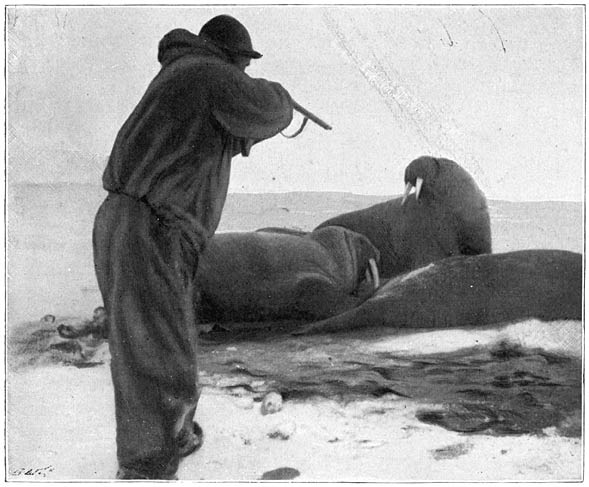
“I Photographed Him and the Walrus”
The walruses still kept near us for some time. Every now and then we would hear some violent blows on the ice from beneath, two or three in succession, and then a great head would burst up with a crash through the ice. It would remain there for a time panting and puffing so that it would be heard a long way off, and then vanish again. On September 25th, while we were pulling our roof hides out of the water at a hole near the shore, we heard the same crashing in the ice a little farther out, and a walrus came up and then dived again. “Look there! It won’t be long before we have him in this hole.” The words were scarcely spoken, when our hide in the water was pushed aside and a huge head, with bristles and two long tusks, popped up in front of us. It gazed fixedly and wickedly at us standing there, then there was a tremendous splash and it was gone.
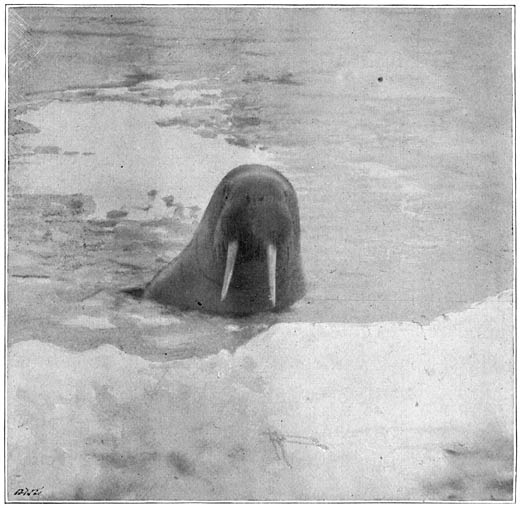
“It Gazed Wickedly at Us”
Our hides were now so far softened in the sea that we could stretch them over the roof. They were so long that they reached from one side of the hut right over the ridge-piece down to the other side, and we stretched them by hanging large stones at both ends, attached by strips of hide, thus weighing them down over the edges of the wall, and we then piled stones upon them. By the aid of stones, moss, strips of hide, and snow to cover everything, we made the edges of the walls to some extent close-fitting. To make the hut habitable we still had to construct benches of stone to lie upon inside it, and also a door. This consisted of an opening in one corner of the wall, which led into a short passage dug out in the ground and subsequently roofed over with blocks of ice, on very much the same principle as the passage to an Eskimo’s house. We had not dug this passage so long as we wished before the ground was frozen too hard for our implements. It was so low that we had to creep through it in a squatting posture to get into the hut. The inner opening was covered with a bearskin curtain, sewed firmly to the walrus hide of the roof; the outer end was covered with a loose bearskin laid over the opening. It began to grow cold now, as low as -20° C. (4° below zero, Fahr.); and living in our low den, where we had not room to move, became more and more intolerable. The smoke, too, from the oil-lamp, when we did any cooking, always affected our eyes. We grew daily more impatient to move into our new house, which now appeared to us the acme of comfort. Our ever-recurring remark while we were building was, how nice and snug it would be when we got in, and we depicted to each other the many pleasant hours we should spend there. We were, of course, anxious to discover all the bright points that we could in our existence. The hut was certainly not large; it was 10 feet long and 6 feet wide, and when you lay across it you kicked the wall on one side and butted it on the other. You could move in it a little, however, and even I could almost stand upright under the roof. This was a thought which especially appealed to us. Fancy having a place sheltered from the wind where you could stretch your limbs a little! We had not had that since last March, on board the Fram. It was long, however, before everything was in order, and we would not move in until it was quite finished.
The day we had skinned our last walruses I had taken several tendons from their backs, thinking they might be very useful when we made ourselves clothes for the winter, for we were entirely without thread for that purpose. Not until a few days afterwards (September 26th) did I recollect that these tendons had been left on the ice beside the carcasses. I went out there to look for them, but found, to my sorrow, that gulls and foxes had long since made away with them. It was some comfort, however, to find traces of a bear, which must have been at the carcasses during the night, and as I looked about I caught sight of Johansen running after me, making signs and pointing out towards the sea. I turned that way, and there was a large bear, walking to and fro and looking at us. We had soon fetched our guns, and while Johansen remained near the land to receive the bear if it came that way, I made a wide circuit round it on the ice to drive it landward, if it should prove to be frightened. In the meantime, it had lain down out there beside some holes, I suppose to watch for seals. I stole up to it; it saw me and at first came nearer, but then thought better of it, and moved away again, slowly and majestically, out over the new ice. I had no great desire to follow it in that direction, and though the range was long I thought I must try it. First one shot; it passed over. Then one more; that hit. The bear started, made several leaps, and then in anger struck the ice until it broke, and the bear fell through. There it lay, splashing and splashing and breaking the thin ice with its weight as it tried to get out again. I was soon beside it, but did not want to sacrifice another cartridge; I had faint hopes, too, that it would manage to get out of the water by itself, and thus save us the trouble of dragging such a heavy animal out. I called to Johansen to come with a rope, sledges, and knives, and in the meantime I walked up and down waiting and watching. The bear labored hard, and made the opening in the ice larger and larger. It was wounded in one of its fore-legs, so that it could use only the other, and the two hind-legs. It kept on taking hold and pulling itself up. But no sooner had it got half up than the ice gave way, and it sank down again. By degrees its movements became more and more feeble, till at last it only lay still and panted. Then came a few spasms, its legs stiffened, its head sank down into the water, and all was still. While I was walking up and down I several times heard walruses round about, as they butted holes in the ice and put their heads through; and I was thinking to myself that I should soon have them here too. At that moment the bear received a violent blow from beneath, pushing it to one side, and up came a huge head with great tusks; it snorted, looked contemptuously at the bear, then gazed for a while wonderingly at me as I stood on the ice, and finally disappeared again. This had the effect of making me think the old solid ice a little farther in a pleasanter place of sojourn than the new ice. My suspicion that the walrus entertains no fear for the bear was more than ever strengthened. At last Johansen came with a rope. We slipped a running noose round the bear’s neck and tried to haul it out, but soon discovered that this was beyond our power; all we did was to break the ice under the animal, wherever we tried. It seemed hard to have to give it up; it was a big bear and seemed to be unusually fat; but to continue in this way until we had towed up to the edge of the thick ice would be a lengthy proceeding. By cutting quite a narrow crack in the new ice, only wide enough to draw the rope through, up to the edge of a large piece of ice which was quite near, we got pretty well out of the difficulty. It was now an easy matter to draw the bear thither under the ice, and after breaking a sufficiently large hole we drew it out there. At last we had got it skinned and cut up, and, heavily laden with our booty, we turned our steps homeward late in the evening to our den. As we approached the beach where our kayaks were lying upon one of our heaps of walrus blubber and meat, Johansen suddenly whispered to me, “I say, look there!” I looked up, and there stood three bears on the heaps, tearing at the blubber. They were a she-bear and two young ones. “Oh dear!” said I; “shall we have to set to at bears again?” I was tired, and, to tell the truth, had far more desire for our sleeping-bag and a good potful of meat. In a trice we had got our guns out, and were approaching cautiously; but they had caught sight of us, and set off over the ice. It was with an undeniable feeling of gratitude that we watched their retreating forms. A little later, while I was standing cutting up the meat and Johansen had gone to fetch water, I heard him whistle. I looked up, and he pointed out over the ice. There in the dusk were the three bears coming back—our blubber-heap had been too tempting for them. I crept with my gun behind some stones close to the heap. The bears came straight on, looking neither to right nor left, and as they passed me I took as good an aim at the she-bear as the darkness would allow, and fired. She roared, bit her side, and all three set off out over the ice. There the mother fell, and the young ones stood astonished and troubled beside her until we approached, when they fled, and it was impossible to get within range of them. They kept at a respectful distance, and watched us while we dragged the dead bear to land and skinned it. When we went out next morning, they were standing sniffing at the skin and meat; but before we could get within range they saw us, and were off again. We now saw that they had been there all night, and had eaten up their own mother’s stomach, which had contained some pieces of blubber. In the afternoon they returned once more; and again we attempted, but in vain, to get a shot at them. Next morning (Saturday, September 28th), when we crawled out, we caught sight of a large bear lying asleep on our blubber-heap. Johansen crept up close to it under cover of some stones. The bear heard something moving, raised its head, and looked round. At the same instant Johansen fired, and the bullet went right through the bear’s throat, just below the cranium. It got slowly up, looked contemptuously at Johansen, considered a little, and then walked quietly away with long, measured steps, as if nothing had happened. It soon had a couple of bullets from each of us in its body, and fell out on the thin ice. It was so full of food that, as it lay there, blubber and oil and water ran out of its mouth on to the ice, which began gradually to sink under its weight, until it lay in a large pool, and we hastily dragged it in to the shore, before the ice gave way beneath it. It was one of the largest bears I have ever seen, but also one of the leanest; for there was not a trace of fat upon it, neither underneath the skin nor among the entrails. It must have been fasting for a long time and been uncommonly hungry; for it had consumed an incredible quantity of our blubber. And how it had pulled it about! First it had thrown one kayak off, then it had scattered the blubber about in all directions, scraping off the best of the fat upon almost every single piece; then it had gathered the blubber together again in another place, and then, happy with the happiness of satiety, had lain down to sleep upon it, perhaps so as to have it handy when it woke up again. Previous to attacking the blubber-heap it had accomplished another piece of work, which we only discovered later on. It had killed both the young bears that had been visiting us; we found them not far off, with broken skulls and frozen stiff. We could see by the footprints how it had run after them out over the new ice, first one and then the other, and had dragged them on land, and laid them down without touching them again. What pleasure it can have in doing this I do not understand, but it must have regarded them as competitors in the struggle for food. Or was it, perhaps, a cross old gentleman who did not like young people? “It is so nice and quiet here now,” said the ogre, when he had cleared the country.
Our winter store now began quite to inspire confidence.
At length, on the evening of that day, we moved into our new hut; but our first night there was a cold one. Hitherto we had slept in one bag all the time, and even the one we had made by sewing together our two blankets had been fairly adequate. But now we thought it would not be necessary to sleep in one bag any longer, as we should make the hut so warm by burning train-oil lamps in it that we could very well lie each in our own berth with a blanket over us, and so we had unpicked the bag. Lamps were made by turning up the corners of some sheets of German silver, filling them with crushed blubber, and laying in this, by way of a wick, some pieces of stuff from the bandages in the medicine-bag. They burned capitally, and gave such a good light, too, that we thought it looked very snug; but it neither was nor ever would be sufficient to warm our still rather permeable hut, and we lay and shivered with cold all night. We almost thought it was the coldest night we had had. Breakfast next morning tasted excellent, and the quantity of bear-broth we consumed in order to put a little warmth into our bodies is incredible. We at once decided to alter this by making along the back wall of the hut a sleeping-shelf broad enough for us to lie beside one another. The blankets were sewed together again, we spread bearskins under us, and were as comfortable as we could be under the circumstances; and we made no further attempt to part company at night. It was impossible to make the substratum at all even, with the rough, angular stones which, now that everything was frozen, were all we had at our disposal, and therefore we lay tossing and twisting the whole winter to find something like a comfortable place among all the knobs. But it was hard, and remained so; and we always had some tender spots on our body, and even sores on our hips, with lying. But, for all that, we slept. In one corner of the hut we made a little hearth to boil and roast upon. In the roof above we cut a round hole in the walrus hide, and made a smoke-board up to it of bearskin. We had not used this hearth long before we saw the necessity of building a chimney to prevent the wind from beating down, and so filling the hut with smoke as to make it sometimes intolerable. The only materials we had for building this were ice and snow; but with these we erected a grand chimney on the roof, which served its purpose, and made a good draught. It was not quite permanent, however; the hole in it constantly widened with use, and it was not altogether guiltless of sometimes dripping down on to the hearth; but there was abundance of this building material, and it was not difficult to renew the chimney when it was in need of repair. This had to be done two or three times during the course of the winter. On more exposed spots we employed walrus flesh, bone, and such-like materials to strengthen it.
Our cookery was as simple as possible. It consisted in boiling bear’s flesh and soup (bouillon) in the morning and frying steak in the evening. We consumed large quantities at every meal, and, strange to say, we never grew tired of this food, but always ate it with a ravenous appetite. We sometimes either ate blubber with it or dipped the pieces of meat in a little oil. A long time might often pass when we ate almost nothing but meat, and scarcely tasted fat; but when one of us felt inclined for it again he would, perhaps, fish up some pieces of burnt blubber out of the lamps, or eat what was left of the blubber from which we had melted the lamp-oil. We called these cakes, and thought them uncommonly nice, and we were always talking of how delicious they would have been if we could have had a little sugar on them.
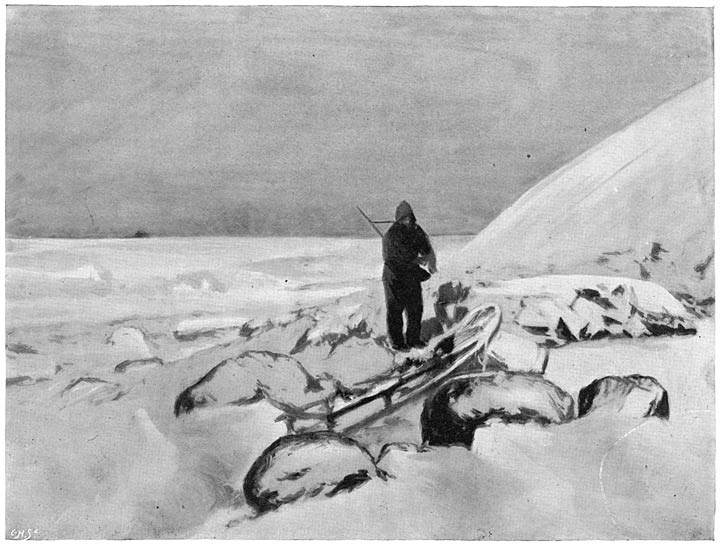
At Our Winter Quarters
Meanwhile time passed. The sun sank lower and lower, until on October 15th we saw it for the last time above the ridge to the south; the days grew rapidly darker, and then began our third polar night.
We shot two more bears in the autumn, one on the 8th and one on the 21st of October; but from that time we saw no more until the following spring. When I awoke on the morning of October 8th I heard the crunching of heavy steps in the snow outside, and then began a rummaging about among our meat and blubber up on the roof. I could hear it was a bear, and crept out with my gun; but when I came out of the passage I could see nothing in the moonlight. The animal had noticed me, and had already disappeared. We did not altogether regret this, as we had no great desire to set to at the cold task of skinning now, in a wind, and with 39° (70.2° Fahr.) of frost.
There was not much variety in our life. It consisted in cooking and eating breakfast in the morning. Then, perhaps, came another nap, after which we would go out to get a little exercise. Of this, however, we took no more than was necessary, as our clothes, saturated as they were with fat, and worn and torn in many places, were not exactly adapted for remaining in the open air in winter. Our wind clothes, which we should have had outside as a protection against the wind, were so worn and torn that we could not use them; and we had so little thread to patch them with that I did not think we ought to use any of it until the spring, when we had to prepare for our start. I had counted on being able to make ourselves clothes of bearskins, but it took time to cleanse them from all blubber and fat, and it was even a slower business getting them dried. The only way to do this was to spread them out under the roof of the hut; but there was room for only one at a time. When at last one was ready we had, first of all, to use it on our bed, for we were lying on raw, greasy skins, which were gradually rotting. When our bed had been put in order with dried skins we had to think about making a sleeping-bag, as, after a time, the blanket-bag that we had got rather cold to sleep in. About Christmas-time, accordingly, we at last managed to make ourselves a bearskin bag. In this way all the skins we could prepare were used up, and we continued to wear the clothes we had throughout the winter.
These walks, too, were a doubtful pleasure, because there is always a wind there, and it blew hard under the steep cliff. We felt it a wonderful relief when it occasionally happened to be almost calm. As a rule, the wind howled above us and lashed the snow along, so that everything was wrapped in mist. Many days would sometimes pass almost without our putting our heads out of the passage, and it was only bare necessity that drove us out to fetch ice for drinking-water, or a leg or carcass of a bear for food, or some blubber for fuel. As a rule, we also brought in some sea-water ice, or, if there were an opening or a crack to be found, a little sea-water for our soup.
When we came in, and had mustered up appetite for another meal, we had to prepare supper, eat till we were satisfied, and then get into our bag and sleep as long as possible to pass the time. On the whole, we had quite a comfortable time in our hut. By means of our train-oil lamps we could keep the temperature in the middle of the room at about freezing-point. Near the wall, however, it was considerably colder, and there the damp deposited itself in the shape of beautiful hoar-frost crystals, so that the stones were quite white; and in happy moments we could dream that we dwelt in marble halls. This splendor, however, had its disadvantages, for when the outside temperature rose, or when we heated up the hut a little, rivulets ran down the wall into our sleeping-bag. We took turns at being cook, and Tuesday, when one ended his cooking-week and the other began, afforded on that account the one variation in our lives, and formed a boundary-mark by which we divided out our time. We always reckoned up how many cooking-weeks we had before we should break up our camp in the spring. I had hoped to get so much done this winter—work up my observations and notes, and write some of the account of our journey; but very little was done. It was not only the poor, flickering light of the oil-lamp which hindered me, nor yet the uncomfortable position—either lying on one’s back, or sitting up and fidgeting about on the hard stones, while the part of the body thus exposed to pressure ached; but altogether these surroundings did not predispose one to work. The brain worked dully, and I never felt inclined to write anything. Perhaps, too, this was owing to the impossibility of keeping what you wrote upon clean; if you only took hold of a piece of paper your fingers left a dark-brown, greasy mark, and if a corner of your clothes brushed across it, a dark streak appeared. Our journals of this period look dreadful. They are “black books” in the literal sense of the term. Ah! how we longed for the time when we should once more be able to write on clean white paper and with black ink! I often had difficulty in reading the pencil notes I had written the day before, and now, in writing this book, it is all I can do to find out what was once written on these dirty, dark-brown pages. I expose them to all possible lights, I examine them with a magnifying-glass; but, notwithstanding, I often have to give it up.
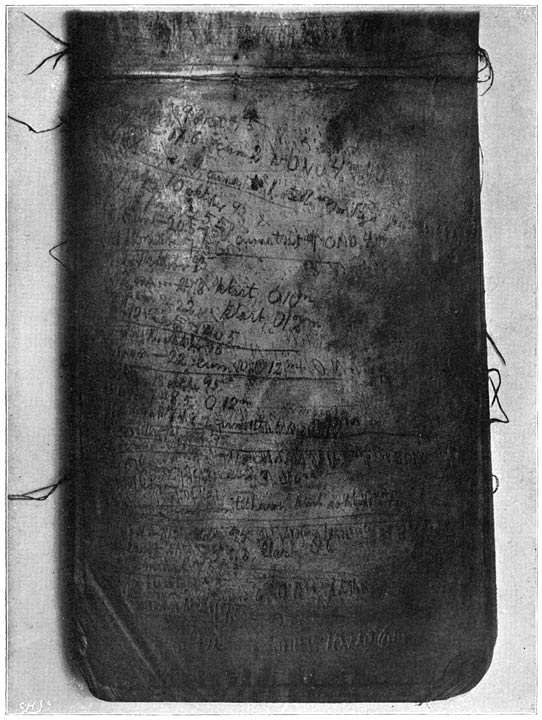
An Illegible Page from Diary
The entries in my journal for this time are exceedingly meagre; there are sometimes weeks when there is nothing but the most necessary meteorological observations with remarks. The chief reason for this is that our life was so monotonous that there was nothing to write about. The same thoughts came and went day after day; there was no more variety in them than in our conversation. The very emptiness of the journal really gives the best representation of our life during the nine months we lived there.
“Wednesday, November 27th. -23° C. (9.4° below zero, Fahr.). It is windy weather, the snow whirling about your ears, directly you put your head out of the passage. Everything is gray; the black stones can be made out in the snow a little way up the beach, and above you can just divine the presence of the dark cliff; but wherever else the gaze is turned, out to sea or up the fjord, there is the same leaden darkness; one is shut out from the wide world, shut into one’s self. The wind comes in sharp gusts, driving the snow before it; but up under the crest of the mountain it whistles and roars in the crevices and holes of the basaltic walls—the same never-ending song that it has sung through the thousands of years that are past, and will go on singing through thousands of years to come. And the snow whirls along in its age-old dance; it spreads itself in all the crevices and hollows, but it does not succeed in covering up the stones on the beach; black as ever, they project into the night. On the open space in front of the hut two figures are running up and down like shadows in the winter darkness to keep themselves warm, and so they will run up and down on the path they have trampled out, day after day, till the spring comes.
“Sunday, December 1st. Wonderfully beautiful weather for the last few days; one can never weary of going up and down outside, while the moon transforms the whole of this ice-world into a fairy-land. The hut is still in shadow under the mountain which hangs above it, dark and lowering; but the moonlight floats over ice and fjord, and is cast back glittering from every snowy ridge and hill. A weird beauty, without feeling, as though of a dead planet, built of shining white marble. Just so must the mountains stand there, frozen and icy cold; just so must the lakes lie congealed beneath their snowy covering; and now as ever the moon sails silently and slowly on her endless course through the lifeless space. And everything so still, so awfully still, with the silence that shall one day reign when the earth again becomes desolate and empty, when the fox will no more haunt these moraines, when the bear will no longer wander about on the ice out there, when even the wind will not rage—infinite silence! In the flaming aurora borealis the spirit of space hovers over the frozen waters. The soul bows down before the majesty of night and death.
“Monday, December 2d. Morning. To-day I can hear it blowing again outside, and we shall have an unpleasant walk. It is bitterly cold now in our worn, greasy clothes. It is not so bad when there is no wind; but even if there is only a little it goes right through one. But what does it matter? Will not the spring one day come here too? Yes; and over us arches the same heaven now as always, high and calm as ever; and as we walk up and down here shivering we gaze into the boundless starry space, and all our privations and sorrows shrink into nothingness. Starlit night, thou art sublimely beautiful! But dost thou not lend our spirit too mighty wings, greater than we can control? Couldst thou but solve the riddle of existence! We feel ourselves the centre of the universe, and struggle for life, for immortality—one seeking it here, another hereafter—while thy silent splendor proclaims: At the command of the Eternal, you came into existence on a paltry planet, as diminutive links in the endless chain of transformations; at another command, you will be wiped out again. Who then, through an eternity of eternities, will remember that there once was an ephemeral being who could bind sound and light in chains, and who was purblind enough to spend years of his brief existence in drifting through frozen seas? Is, then, the whole thing but the meteor of a moment? Will the whole history of the world evaporate like a dark, gold-edged cloud in the glow of evening—achieving nothing, leaving no trace, passing like a caprice?
“Evening. That fox is playing us a great many tricks; whatever he can move he goes off with. He has once gnawed off the band with which the door-skin is fastened, and every now and then we hear him at it again, and have to go out and knock on the roof of the passage. To-day he went off with one of our sails, in which our salt-water ice was lying. We were not a little alarmed when we went to fetch ice and found sail and all gone. We had no doubt as to who had been there, but we could not under any circumstances afford to lose our precious sail, on which we depended for our voyage to Spitzbergen in the spring, and we tramped about in the dark, up the beach, over the level, and down towards the sea. We looked everywhere, but nothing was to be seen of it. At last we had almost given it up when Johansen, in going on to the ice to get more salt-water ice, found it at the edge of the shore. Our joy was great; but it was wonderful that the fox had been able to drag that great sail, full of ice too, so far. Down there, however, it had come unfolded, and then he could do nothing with it. But what does he want with things like this? Is it to lie upon in his winter den? One would almost think so. I only wish I could come upon that den, and find the thermometer again, and the ball of twine, and the harpoon-line, and all the other precious things he has taken, the brute!
“Thursday, December 5th. It seems as if it would never end. But patience a little longer, and spring will come, the fairest spring that earth can give us. There is furious weather outside, and snow, and it is pleasant to lie here in our warm hut, eating steak, and listening to the wind raging over us.
“Last night it all at once grew wonderfully calm, and the air was surprisingly mild. It was delightful to be out, and it is long since we have had such a long walk on our beat. It does one good to stretch one’s legs now and then, otherwise I suppose we should become quite stiff here in our winter lair. Fancy, only 12° (21½° Fahr.) of frost in the middle of December! We might almost imagine ourselves at home—forget that we were in a land of snow to the north of the eighty-first parallel.
“Thursday, December 12th. Between six and nine this morning there were a number of shooting-stars, most of them in Serpentarius. Some came right from the Great Bear; afterwards they chiefly came from the Bull, or Aldebaran, or the Pleiades. Several of them were very bright, and some drew a streak of shining dust after them. Lovely weather. But night and day are now equally dark. We walk up and down, up and down, on the level, in the darkness. Heaven only knows how many steps we shall take on that level before the winter ends. Through the gloom we could see faintly only the black cliffs, and the rocky ridges, and the great stones on the beach, which the wind always sweeps clean. Above us the sky, clear and brilliant with stars, sheds its peace over the earth; far in the west falls shower after shower of stars, some faint, scarcely visible, others bright like Roman candles, all with a message from distant worlds. Low in the south lies a bank of clouds, now and again outlined by the gleam of the northern lights; but out over the sea the sky is dark; there is open water there. It is quite pleasant to look at it; one does not feel so shut in; it is like a connecting link with life, that dark sea, the mighty artery of the world, which carries tidings from land to land, from people to people, on which civilization is borne victorious through the earth; next summer it will carry us home.
“Thursday, December 19th. -28.5°(19.3° below zero, Fahr.). It has turned cold again, and is bitter weather to be out in. But what does it signify? We are comfortable and warm in here, and do not need to go out more than we like. All the out-of-door work we have is to bring in fresh and salt water ice two or three times a week, meat and blubber now and again, and very occasionally a skin to dry under the roof. And Christmas, the season of rejoicing, is drawing near. At home, every one is busy now, scarcely knowing how to get time for everything; but here there is no bustle; all we want is to make the time pass. Ah, to sleep, sleep! The pot is simmering pleasantly over the hearth; I am sitting waiting for breakfast, and gazing into the flickering flames, while my thoughts travel far away. What is the strange power in fire and light that all created beings seek them, from the primary lump of protoplasm in the sea to the roving child of man, who stops in his wanderings, makes up a fire in the wood, and sits down to dismiss all care and revel in the crackling warmth. Involuntarily do these snake-like, fiery tongues arrest the eye; you gaze down into them as if you could read your fate there, and memories glide past in motley train. What, then, is privation? What the present? Forget it, forget yourself; you have the power to recall all that is beautiful, and then wait for the summer.... By the light of the lamp she sits sewing in the winter evening. Beside her stands a little maiden with blue eyes and golden hair, playing with a doll. She looks tenderly at the child and strokes her hair; but her eyes fill, and the big tears fall upon her work.
“Johansen is lying beside me asleep; he smiles in his sleep. Poor fellow! he must be dreaming he is at home at Christmas-time with those he loves. But sleep on—sleep and dream, while the winter passes; for then comes spring—the spring of life!
“Sunday, December 22d. Walked about outside for a long time yesterday evening, while Johansen was having a thorough clearing in the hut in preparation for Christmas. This consisted chiefly in scraping the ashes out of the hearth, gathering up the refuse of bone and meat, and throwing it away, and then breaking up the ice which has frozen together with all kinds of rubbish and refuse into a thick layer upon the floor, making the hut rather low in the roof.
“The northern lights were wonderful. However often we see this weird play of light, we never tire of gazing at it; it seems to cast a spell over both sight and sense till it is impossible to tear one’s self away. It begins to dawn with a pale, yellow, spectral light behind the mountain in the east, like the reflection of a fire far away. It broadens, and soon the whole of the eastern sky is one glowing mass of fire. Now it fades again, and gathers in a brightly luminous belt of mist stretching towards the southwest, with only a few patches of luminous haze visible here and there. After a while scattered rays suddenly shoot up from the fiery mist, almost reaching to the zenith; then more; they play over the belt in a wild chase from east to west. They seem to be always darting nearer from a long, long way off. But suddenly a perfect veil of rays showers from the zenith out over the northern sky; they are so fine and bright, like the finest of glittering silver threads. Is it the fire-giant Surt himself, striking his mighty silver harp, so that the strings tremble and sparkle in the glow of the flames of Muspellsheim? Yes, it is harp music, wildly storming in the darkness; it is the riotous war-dance of Surt’s sons. And again at times it is like softly playing, gently rocking, silvery waves, on which dreams travel into unknown worlds.
“The winter solstice has come, and the sun is at its lowest; but still at midday we can just see a faint glimmer of it over the ridges in the south. Now it is again beginning to mount northward; day by day it will grow lighter and lighter, and the time will pass rapidly. Oh, how well I can now understand our forefathers’ old custom of holding an uproarious sacrificial banquet in the middle of winter, when the power of the winter darkness was broken. We would hold an uproarious feast here if we had anything to feast with; but we have nothing. What need is there, either? We shall hold our silent festival in the spirit, and think of the spring.
“In my walk I look at Jupiter over there above the crest of the mountain—Jupiter, the planet of the home; it seems to smile at us, and I recognize my good attendant spirit. Am I superstitious? This life and this scenery might well make one so; and, in fact, is not every one superstitious, each in his own way? Have not I a firm belief in my star, and that we shall meet again? It has scarcely forsaken me for a day. Death, I believe, can never approach before one’s mission is accomplished—never comes without one feeling its proximity; and yet a cold fate may one day cut the thread without warning.
“Tuesday, December 24th. At 2 P.M. to-day -24° C. (11.2° below zero, Fahr.). And this is Christmas-eve—cold and windy out-of-doors, and cold and draughty indoors. How desolate it is! Never before have we had such a Christmas-eve.
“At home the bells are now ringing Christmas in. I can hear their sound as it swings through the air from the church tower. How beautiful it is!
“Wednesday, December 25th. We have got lovely Christmas weather, hardly any wind, and such bright, beautiful moonlight. It gives one quite a solemn feeling. It is the peace of thousands of years. In the afternoon the northern lights were exceptionally beautiful. When I came out at 6 o’clock there was a bright, pale-yellow bow in the southern sky. It remained for a long time almost unchanged, and then began to grow much brighter at the upper margin of the bow behind the mountain crests in the east. It smouldered for some time, and then all at once light darted out westward along the bow; streamers shot up all along it towards the zenith, and in an instant the whole of the southern sky from the arc to the zenith was aflame. It flickered and blazed, it whirled round like a whirlwind (moving with the sun), rays darted backward and forward, now red and reddish-violet, now yellow, green, and dazzling white; now the rays were red at the bottom and yellow and green farther up, and then again this order was inverted. Higher and higher it rose; now it came on the north side of the zenith too; for a moment there was a splendid corona, and then it all became one whirling mass of fire up there; it was like a whirlpool of fire in red, yellow, and green, and the eye was dazzled with looking at it. It then drew across to the northern sky, where it remained a long time, but not in such brilliancy. The arc from which it had sprung in the south was still visible, but soon disappeared. The movement of the rays was chiefly from west to east, but sometimes the reverse. It afterwards flared up brightly several times in the northern sky; I counted as many as six parallel bands at one time, but they did not attain to the brightness of the former ones.
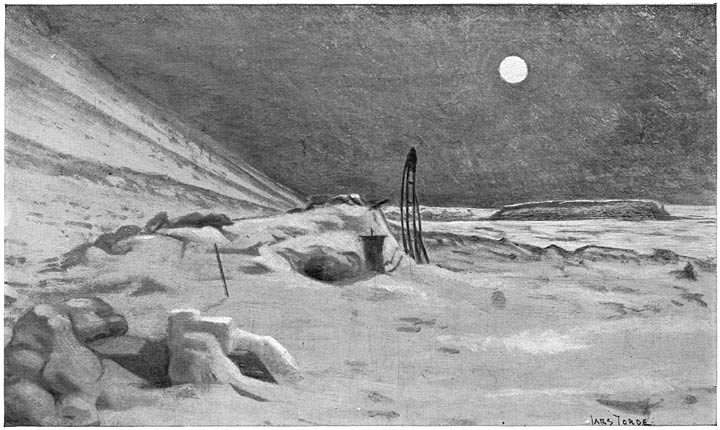
Our Winter Hut. December 31, 1895
(By Lars Jorde, from a photograph)
“And this is Christmas-day! There are family dinners going on at home. I can see the dignified old father standing smiling and happy in the doorway to welcome children and grandchildren. Out-of-doors the snow is falling softly and silently in big flakes; the young folk come rushing in fresh and rosy, stamp the snow off their feet in the passage, shake their things and hang them up, and then enter the drawing-room, where the fire is crackling comfortably and cozily in the stove, and they can see the snowflakes falling outside and covering the Christmas corn-sheaf. A delicious smell of roasting comes from the kitchen, and in the dining-room the long table is laid for a good, old-fashioned dinner with good old wine. How nice and comfortable everything is! One might fall ill with longing to be home. But wait, wait; when summer comes....
“Oh, the road to the stars is both long and difficult!
“Tuesday, December 31st. And this year too is vanishing. It has been strange, but, after all, it has perhaps not been so bad.
“They are ringing out the old year now at home. Our church-bell is the icy wind howling over glacier and snow-field, howling fiercely as it whirls the drifting snow on high in cloud after cloud, and sweeps it down upon us from the crest of the mountain up yonder. Far in up the fjord you can see the clouds of snow chasing one another over the ice in front of the gusts of wind, and the snow-dust glittering in the moonlight. And the full moon sails silent and still out of one year into another. She shines alike upon the good and the evil, nor does she notice the wants and yearnings of the new year. Solitary, forsaken, hundreds of miles from all that one holds dear; but the thoughts flit restlessly to and fro on their silent paths. Once more a leaf is turned in the book of eternity, a new blank page is opened, and no one knows what will be written on it.”