Front matter
Reading edition
E-text prepared by deaurider, Graeme Mackreth, and the Online Distributed Proofreading Team (http://www.pgdp.net) from page images digitized by the Google Books Library Project (https://books.google.com) and generously made available by HathiTrust Digital Library (https://www.hathitrust.org/)
Note: Images of the original pages are available through HathiTrust Digital Library. See https://babel.hathitrust.org/cgi/pt?id=hvd.hnx5cg;view=1up;seq=11
FAMOUS FIGHTERS OF THE FLEET
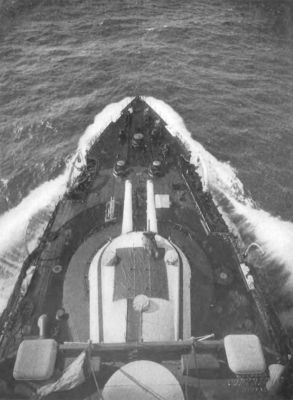
THE ENEMY IN SIGHT—'FULL SPEED AHEAD!' Looking down, on board a battleship, from the forward fighting-top.
FAMOUS FIGHTERS OF THE FLEET
GLIMPSES THROUGH THE CANNON SMOKE IN THE DAYS OF THE OLD NAVY
BY
EDWARD FRASER
They left us a kingdom none can take, The realm of the circling sea, To be ruled by the rightful sons of Blake And the Rodneys yet to be.
Henry Newbolt.
As it was in the days of long ago, And as it still shall be.
Rudyard Kipling.
WITH ILLUSTRATIONS
London
MACMILLAN AND CO., Limited
NEW YORK: THE MACMILLAN COMPANY
1904
All rights reserved
DEDICATION
The lasses and the little ones, Jack Tars, they look to you; The despots over yonder, let 'em do whate'er they please, God bless the little isle where a man may still be true, God bless the noble isle that is Mistress of the Seas. Tennyson.
PREFACE
This book, as far as its subject is concerned, is something of an experiment, something of a new departure. It is an attempt to interest people by recalling some of the associations of the brave days of old that cluster round and attach to certain historic man-of-war names. As far as that goes, indeed, having for its subject, as it has, the doings in battle of famous hearts of oak of the fighting times—
Those oaken giants of the ancient race That ruled all seas,
the book ought not to require an elaborate introduction, any special pleading on its behalf, among those whose pride it is to count themselves the
Sons and sires of seamen Whose realm is all the sea.
Further, it may possibly be, that in a degree, this book may serve as a reminder, even to some of those who to-day man His Majesty's Fleet, of what an inheritance is theirs, and how tremendous an obligation. The heroism of the Old Navy lives evermore in the man-of-war names of the modern navy, and should lead our sailors more even than they do, to 'glory,' in Kinglake's stirring language, in their ships' 'ancient names, connecting each with its great traditions, and founding upon the cherished syllables that consciousness of power which is a condition of ascendancy in war.'
The names of the men-of-war, the stories of which are told here, stand in the forefront among the famous names of the Sea Service for their associations with great and dashing exploits. They are possibly not the most widely known of all, not so familiar to everybody as are certain other names similarly associated with other famous feats of arms of the fighting days,—but that, after all, is perhaps all the more reason that their stories should be told now. 'We are few, but of the right sort,' said Nelson on one of the memorable occasions of his life, and it is hoped that the half-dozen stories within these covers may with justice say the same for themselves. The story of Lord Charles Beresford's little Condor, if not an Old Navy event, has much in keeping with the old order, and is included on its merits as being as gallant a piece of fighting-work in its way as has been done in the British Navy in our time.
My aim throughout has been to interest my readers. That a man-of-war's life-record is not necessarily a dull subject, a mere collection of dry facts, nor its incidents all matters of common knowledge, the following pages, it is hoped, will show. In the main, as far as possible, the accounts and impressions of eye-witnesses of the various events related, as written down while the events were in progress or were still fresh in recollection, old logs and letters, diaries and journals, and the newspapers of the time, have been relied on. Strangely appealing and mutely eloquent at times are some of our old ship logs, with their pages faded and yellow and blurred, often with the stain on them of what was once, more than a century ago, a fleck of fresh sea spray that rested there just as it was whisked in through an open port; now and then indeed with on them a dull rusty brown smear or spot, grimly suggestive of something else. And, too, a terse, blunt note, scrawled painfully down after a day under fire by the hard fist of some rough Old Navy skipper, gone long since to his last reckoning, says more—a good deal more—often, than pages could do of smoother prose, by people who were not on the spot.
Practically all the literature of the subject in book form has been laid under contribution. Among modern writers I am particularly indebted to Captain Mahan and Professor J.K. Laughton, R.N., of King's College, London, and to Mr. David Hannay, to whose brilliant monograph on Rodney I am in a special degree under obligation.
For myself, I am well aware of the pitfalls that beset the path of the landsman who presumes to write of nautical matters. So, indeed, it has ever been since Agur the son of Jakeh, in the days of King Solomon, placed it on record that "the way of a ship in the midst of the sea" was "too wonderful." For any shortcomings of mine in this regard I ask the kindly indulgence of my naval readers.
Throughout the stories, I trust, the amplest justice has been done, and the fullest credit given, to those who were our gallant foes on the several occasions.
In conclusion, I am greatly indebted to Lord Selborne, First Lord of the Admiralty, for allowing me to use information which has proved invaluable for my purposes; to Mr. A.B. Tucker of the Graphic for assistance with my proofs and maps, and suggestions as to certain footnotes; and to Commander C.N. Robinson, R.N., for placing at my disposal his fine collection of old naval prints and drawings.
E.F.
CONTENTS
1. The Monmouths in War 1
How Arthur Gardiner fought the Foudroyant.
2. Rodney's Ship on Rodney's Day 43
The Formidable that broke the line.
3. Won at the Cannon's Mouth 172
His Majesty's Ship Undaunted.
4. 'Billy Blue': A Ballad of the Fleet 199
One of the Royal Sovereign's days.
5. The 'Fighting' Téméraire. 213
Where, how, and when she made her name.
6. 'Well Done, Condor!' 287
Alexandria, 1882.
ILLUSTRATIONS
The Enemy in Sight—'Full Speed Ahead!' 'Ready, Aye Ready!' Our Cruiser Monmouth of to-day In Action at Midnight The Monmouth fighting the Foudroyant at close quarters 'Success to the Formidable!' Nov. 17, 1898 'Ut Veniant Omnes!' The Big 50-Ton Guns of the Formidable Rodney's Formidable on the day before her Launch Rodney's Sword Admiral Lord Rodney, K.B. (after Gainsborough's portrait) The Pitons of St. Lucia The Count De Grasse Clock-face from the Ville de Paris Bell of the Ville de Paris Chart showing Rodney's pursuit of De Grasse Monument of the three Captains—Blair, Bayne, and Lord Robert Manners—in Westminster Abbey Fighting the Guns on the Main Deck The Critical Moment of Rodney's Battle—how the French Line was broken The Formidable breaking the Line. April 12, 1782 One of the 'Fighting Lanterns' of the Ville de Paris De Grasse's Flag comes down. Rodney watching the Surrender of the Ville de Paris 'Count De Grasse resigning his Sword to Admiral Rodney' The 'Rodney Temple,' Spanish Town, Jamaica Admiral De Grasse as a Prisoner of War Captain Robert Faulknor Captain Faulknor storming Fort Louis The Death of Captain Faulknor 'Billy Blue'—Admiral the Hon. Sir William Cornwallis, G.C.B. 'Cornwallis's Retreat' The 'Fighting' Téméraire tugged to her last Berth to be broken up Where Turner met the Téméraire Camp of the Grand Army at Boulogne, 1804 Captain Lucas—the French hero of Trafalgar The Battle of Trafalgar. Oct. 21, 1805—2.15 P.M. Admiral Villeneuve's Sword Admiral Villeneuve's Signature The Téméraire entering Portsmouth Harbour on her return from Trafalgar. Dec. 20, 1805 Relics of the 'Fighting' Téméraire Alexandria—July 11, 1882. The Condor attacking Fort Marabout Bombardment of Alexandria. July 11, 1882—9 A.M. Vice-Admiral Lord Charles Beresford, K.C.B.
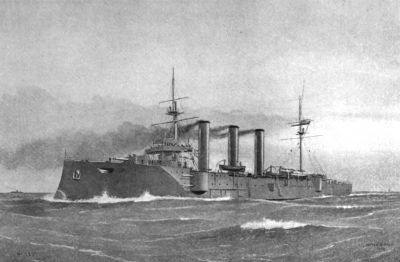
'READY, AYE READY!' OUR CRUISER MONMOUTH OF TO-DAY
I
THE MONMOUTHS IN WAR
HOW ARTHUR GARDINER FOUGHT THE FOUDROYANT
Aye stout were her timbers and stoutly commanded, In the annals of glory unchalleng'd her name; Aye ready for battle when duty demanded, Aye ready to conquer—or die in her fame! Old Song.
The Monmouth of to-day is one of our 'County Cruisers'—and among them one of the smartest and best. Her special rôle in war-time will be to help in safeguarding the commerce of the British Empire on the high seas, to see that the corn-ships and the cattle-ships from across the Atlantic, on which the people of these islands depend for their existence from day to day, reach port without molestation by the 'corsair cruisers' of the enemy. It will be her duty to patrol on the trade routes far and wide, and chase off hostile ships at sight, or run them down and fight them. All that, with other duties at times thrown in:—
For this is our office, to spy and make room. As hiding, yet guiding the foe to their doom; Surrounding, confounding, to bait and betray And tempt them to battle the seas' width away.
For her work, whatever it may be, the Monmouth is well equipped. She carries quick-firing guns and Krupp steel armour on her sides, and can steam at high speed—23 knots, or, on occasion, a trifle more.
A glance round on board this brand new twentieth-century cruiser of ours may be of interest at the outset.
An ugly customer to tackle looks the Monmouth in her 'war-paint' of sombre Navy grey, devoid, as are our modern men-of-war, of all that has to do with prettiness and the merely decorative.
Mis arreos son las armas, Mi descanso el pelear, My ornaments are arms, My pastime is in war,
is the motto of the Royal Navy of our day.
A big ship is the Monmouth, a first-class cruiser of not far short of 10,000 tons displacement,—9800 tons, to be exact,—a floating weight heavier than all the mass of iron and steel in the Eiffel Tower. She measures over all, from end to end, from ram to rudder, 463½ feet. To give an idea, in another way, of the ship's size. If she were stood on end inside St. Paul's Cathedral, her bows would project 60 feet above the cross over the dome. Set up on end beside the Clock Tower at Westminster, the ship's length would overtop the tower by half as high again. The Monument piled on the top of the Nelson Column would need an extra 50 feet to equal the Monmouth from stem to stern. Propped up against Beachy Head, the Monmouth would overtop the turf at the edge of the cliff summit fully 90 feet. Laid lengthways inside St. Paul's, the Monmouth would fill the whole length of the nave and chancel from the western door to the reredos. Placed along the front of Buckingham Palace, the Monmouth's hull would overlap the façade for 50 feet on either side. In width the ship is 66 feet broad amidships,—22 yards, just the length of a cricket-pitch, or one foot wider than London Bridge after its recent enlargement. It takes 5 tons weight of paint to coat the hull above water, and 6 tons to coat it below; and costs, the single item of paint by itself, every time it is laid on—£800.
Her three funnels each stand up 75 feet into the air—very nearly the height of the Round Tower of Windsor Castle above the mound at its foot. Each funnel weighs 20 tons, and costs £400 to make—a year's pay of a colonel of hussars. In diameter each is the exact size, to an inch, of the 'Two-penny Tube.' If they were laid flat, a life-guardsman in King's Birthday regimentals could trot through them. Each lower mast is a steel tube, 80 feet from end to end and weighing 20 tons. The rudder weighs 18 tons; and the ram, a steel casting, 19 tons. The propellers each weigh 12 tons, and are each 16 feet across from tip to tip. The stern-post weighs 20 tons.
The armour on the conning-tower is 10 inches thick, and weighs 65 tons, the weight of a Great Western express engine. It cost £7500—a sum equal to the lumped salaries for one year of all the Sea Lords of the Admiralty. The 10 inches of nickel steel of which it is made can stand a harder blow than the 17 inches of iron armour on the turrets of the old Inflexible. The conning-tower is the main 'fighting station' of the ship, the nerve-centre of the mighty organisation. Thence in action, from behind a ring-fence of solid metal, are controlled the huge engines, far down below, impelled by
The strength of twice ten thousand horse That serve the one command,
—if one may vary Mr. Kipling,—engines of the power of twenty-two thousand horses, the strength of an army corps of cavalry; also the steering of the ship and the firing of the guns. By means of a simple arrangement in the three primary colours—red, blue, and yellow—painted in bands round the walls of the conning-tower inside, the captain can tell at a glance, at any moment, which of his guns, and how many of them, can train on an enemy at any given point.
The Monmouth's 'fighting-weight' is another matter. Fourteen 6-inch guns, Vickers-Maxims of the latest pattern, contribute something to that. This is the sort of weapon the 6-inch gun is. Imagine one set up in Trafalgar Square to fire with extreme elevation. Its 100-pound shells would drop on Kingston Bridge in one direction; beyond Harrow, ten miles off, in another. Other shells would burst over Barnet; sweep the woodland rides of Epping Forest; startle the tennis-players on the trim lawns of Chislehurst in Kent. And not many seconds would elapse between the flash of the discharge and the shell doing its work. Ten miles, of course, is the farthest that the gun could shoot, its 'estimated extreme range.' In war-time that sort of firing would not be worth while, as it would be impossible to mark the shots. Seven miles, roughly, or 12,000 yards, is the limit the gun is sighted for. Then again, imagine our gun firing at a mark. At 2000 yards, the minimum engaging distance in naval war because of torpedoes, aiming from Trafalgar Square at a target set up, say, in Ludgate Circus or at Hyde Park Corner, the shot would smash through a slab of wrought iron 14 inches thick as easily as a stone goes through a pane of glass. Firing at 6000 yards, the maximum distance for opening action in ordinary circumstances, at a target set up at Hammersmith, for example, the shot would cut a hole clean through 6½ inches of wrought iron—armour 2 inches thicker than our first ironclad, the Warrior, had on her sides. Fired with a full charge of 25 lbs. of cordite, the shot leaves the gun at a speed of 2775 feet (or half a mile and forty-five yards) a second—a pace capable of carrying it in a minute as far as Reading; with energy sufficient to toss Cleopatra's Needle 30 feet into the air as lightly as a schoolboy flings up a wicket, or heave the biggest railway express engine 100 feet high, to hurl an elephant over the Eiffel Tower, or a cart-horse out of sight to three times the height of Snowdon.
Every round from one of the Monmouth's 6-inch guns costs the country £12. The gun itself costs £1700. As a fact, each gun takes five months of work, night and day, to make; and weighs 7½ tons, like all modern naval guns of any size, it is a 'wire gun,' constructed of steel tape wound round an inner tube or 'barrel,' in the same way that the string is laid round the handle of a cricket-bat, and jacketed over by an outer steel tube. Upwards of 18,200 yards of steel 'wire' are used for each 6-inch gun, 10½ miles of it—a length that, pulled out straight, would stretch for half the distance between Dover and Calais. The set of sights for each gun, as an item by itself, costs £80.
The Monmouth's 6-inch guns are each capable of firing from five to eight shots a minute, and there are on board, besides, ten 12-pounders, three 3-pounders, and some Maxims. The 12-pounders cost £300 each, and take four months to make.
In action, the Monmouth, fighting both broadsides at once, would let fly at the enemy at each discharge two-thirds of a ton of projectiles; within the first minute 3½ tons weight of metal; every five minutes, 18 tons—all bursting shells. That is the Monmouth's 'fighting-weight.'
To supply her guns the Monmouth carries, stowed away in the different magazines far down in the recesses of the hold, 200 tons weight of ammunition—30 to 40 tons of it in cordite cartridges; the rest in shot and loaded shell, with each projectile painted its differentiating colour—white-banded 'armour-piercers,' red-tipped shrapnel, yellow lyddite, and so on.
Electricity works the great hooded turrets on the forecastle and quarter-deck, each of 4-inch nickel steel and carrying a pair of 6-inch guns, mounted side by side in double-barrelled sporting-gun fashion on a twin mounting, training the eighty odd tons of dead-weight to right and left, or from one side of the ship to the other, through three-quarters of a circle, as easily as one wheels one's arm-chair in front of the fire after dinner. Electricity also 'feeds' the guns, both in the turrets and in the casemates, as fast as they can be fired, bringing up the ammunition to the guns directly from the magazines.
The 4-inch Krupp steel armour on the Monmouth's sides at the water-line, from the ram for three-quarters of the ship's length aft, cost to manufacture, in round figures, £60,000—equal to the total yearly income of four Archbishops of Canterbury or six Lord Chancellors. Two 'turtle-back' decks of thin steel armour further help to keep out shot. Altogether, in dead-weight, the armour all over the ship—on the sides, decks, bulkheads, conning-tower, casemates, barbettes, ammunition-supply tubes—amounts to 1800 tons, a fifth of the ship's entire displacement weight in sea-going trim.
Then another detail, and the most important of all. Speed, for a cruiser, is, of course, the prime essential. It means the power of picking out a foe, of running down a foe, the command of the weather-gage, the choice of the range, the power of bringing on or refusing battle. Twenty-three knots an hour, or 26½ statute miles, is the Monmouth's best pace. Twenty-three knots an hour means the covering of a land mile in 2 minutes 36 seconds; or 100 yards in 7-4/5 seconds. In modern athletics 9-3/5 seconds is the record for 100 yards. The record for the Oxford and Cambridge boat race works out at under 11 knots an hour—considerably less than the Monmouth's everyday cruising speed in time of peace.
How it is done is, of course, an engine-room affair. Two main engines drive the ship: one engine to each of the immense 16-feet-wide twin-screws. At full speed they work up to an aggregate power of twenty-two thousand horses: eleven thousand horses each engine. Thirty-one boilers, of the much-maligned Belleville type, supply the steam. What that means the staff below have good reason to know. The thirty-one boilers, with their 'economisers,' provide seven thousand tubes to be looked after and kept clean. Collectively, the boiler-tubes offer to the fires in the stoke-hold a total heating-surface of 50,300 square feet: an area, that is, of an acre and a sixth, a space about equal to Trafalgar Square within the roadway, or the floor-space of the Albert Hall. Each boiler has two furnaces to heat it, making sixty-two in all. When all are alight they burn 40 tons of coal at once, on a grate-area of 1610 square feet; practically giving off a square space of flame 170 yards each way.
The main engines, however, are by no means all. There are on board sixty-five separate 'auxiliary engines' besides. The weight of the machinery alone on board the Monmouth, amounts to 1750 tons—a fourth of the total weight of the ship.
Six hundred and eighty officers and men form the complement of the Monmouth, and their pay costs the nation £32,000 a year. To feed them, 'bare navy,' costs two-thirds of that sum a year. The ship herself, as she floats, represents to the country a value not very far short of three-quarters of a million sterling, or, put in concrete form, 8 tons of sovereigns—a railway truck packed tight. Our first ironclad, the Warrior, cost less than half the amount expended on the Monmouth. The Collingwood, a first-class battleship of eighteen years ago, cost to complete £20,000 less than the price paid for the Monmouth cruiser of to-day. Ten Victorys or Royal Georges could have been built and fitted for sea at the cost of this one cruiser of ours.
Such, in brief, are some of the 'points' of our modern Monmouth. The reputation that she has to live up to, the ancestry of her famous name, in particular the magnificent feat of arms that one of our Monmouths, the most famous of all, once achieved—these have now to be told.
The Monmouth, as a fact, bears a name that ranks second to none for brilliant associations and memories of heroism. Hardly another man-of-war has so many 'battle honours' to its credit. No ship of the Old Navy perhaps ever won such distinction in battle for sheer hard fighting as did the six Monmouths, one after the other, from which our cruiser Monmouth of to-day takes her name. Were it possible for His Majesty's ships-of-war to have ship flags for display at reviews or on other ceremonial occasions, just as the regiments of the army use regimental colours, the Monmouth's flag would show a record of upwards of thirty fights, and even then the list would not be complete. No flag, probably, could display the detailed record of the occasions on which Monmouths of old did their duty before the enemy at sea.
The navy owes the name to Charles the Second, who introduced it on the roll of the fleet as a mark of special favour and a paternal compliment to Lucy Walters' ill-starred son, the vanquished of Sedgemoor, whose headless body now lies beneath the altar of the Chapel of St. Peter ad Vincula in the Tower.
That was in the year of the Dutch attack on Chatham, and the same year saw our first Monmouth's first fight. Mr. Pepys's 'complaints' notwithstanding, the Monmouth made a good show on the occasion.[1] Her allotted duty was to bar the approach to the iron chain stretched across the Medway below Upnor Castle, and Captain Clarke, the Monmouth's captain, kept his ship at her post until the position was no longer tenable. The Monmouth later on was in the thick of the fight in the tremendous battle off Solebay, where James, Duke of York, defeated the Dutch fleet under Admiral Ruyter after nearly sixteen hours at close quarters; in Prince Rupert's three battles with the Dutch in 1673; and at La Hogue.
Our second Monmouth was with Rooke when he made his swoop on the Vigo galleons—which dashing affair is commemorated to this day in the name of Vigo Street, off Regent Street;—took a distinguished part in the capture of Gibraltar; fought the French off Malaga; and helped Byng—Sir George Byng, Viscount Torrington, the father of the other Byng known to English history, the Byng who beat the enemy and was not shot—to settle the Spanish fleet off Cape Passaro in the year 1718.
The next Monmouth had a hand in defeating two French fleets within six months—first with Anson and then with Hawke, in May and October 1747. This was the Monmouth whose brilliant capture of the great French flagship the Foudroyant in a desperate ship-to-ship duel at night forms our main story here.
The fourth Monmouth, at the close of a hot and bloody day, after a drawn battle with the French in the West Indies, in July 1779, received the unique compliment of being toasted that same night at dinner by the officers of the enemy's flagship—'To the brave little black English ship!' Nor is it easy to match another story of how this same Monmouth, in battle in the East Indies in 1782, resisted the fiercest onsets of the mighty De Suffren and his best captains, holding her own at bay, and stubbornly standing up to five French seventy-fours at once. Her main and mizen masts were shot down; the wheel was cleared of the men at it three times; the colours were shot away twice. Still, though, the Monmouth fought on—until help came. Only three men were left alive on the Monmouth's quarter-deck when the fight was over; one being her captain, James Alms, a sturdy son of Sussex, who stood at his post dauntlessly to the end, though twice wounded by splinters, with his coat ripped half off by a shot, with two bullet-holes through his hat, and his wig set on fire.
Yet another Monmouth proved herself the bravest of the brave at Camperdown.
The brief summary of the Monmouths' deeds of valour here given is, of course, not nearly all. It would take a big book to do adequate justice to the Monmouths' war record—and there need not be a dull page in the volume.
So we pass on to what is by common consent accounted the brightest gem in the Monmouth's coronet of fame, her fight with the Foudroyant, a French ship powerful enough to have sent the Monmouth to the bottom at the first broadside, a set-to that lasted half through a February night, and ended the right way.
Now clear the ring, for hand to hand The manly wrestlers take their stand.
It was in February 1758, in the middle of the Seven Years' War. The British Mediterranean fleet in that month was blockading a French squadron that had sought shelter in the Spanish naval harbour of Carthagena. The squadron, numbering seven ships of the line and two frigates, had set sail from Toulon in January to reinforce the French fleet on the coast of Canada, and assist in the defence of Louisbourg, Cape Breton, which, as was known at Versailles, was to be attacked in force in the following summer. They counted on being able to evade the British Mediterranean fleet and give it the slip by running through the Straits of Gibraltar under cover of a dark winter's night. But ils se faisaient un tableau, that fault against which Napoleon in later days was always cautioning his generals. It all depended on the chance of their getting past Gibraltar unseen.
Unfortunately for the French plans, the British Admiralty were well aware of what was to be attempted. The fitting-out of the squadron at Toulon had been carried on with the greatest secrecy, but not so secretly that the British admiral at the head of the Mediterranean fleet had not learnt all about it. Admiral Osborn had also been warned from home of the probable destination of the French ships. The result was that when the French came they found him cruising with twelve line-of-battle ships a little to eastward of the Rock, and with a chain of look-out frigates stretching right across from Ceuta to Cape de Gata. M. de la Clue, the French admiral, found his way out of the Mediterranean barred, and having only seven ships of the line with him to the British commander's twelve, he turned aside and ran into the 'neutral' harbour of Carthagena.[2] He only got inside the port in the nick of time. Just as M. de la Clue's ships let go anchor within the Spanish batteries. Admiral Osborn's ships, duly warned by signals from their look-out frigates of every movement of the French squadron, came hastening up.
De la Clue sent off an urgent appeal for reinforcements, and in response five fresh ships of the line and a frigate were despatched from Toulon, in charge of the Marquis du Quesne, Chef d'Escadre, or, as we call the rank, Commodore. With these additional ships De la Clue would have the same numbers exactly as his adversary, and should, the French considered, be able to fight his way out. The Toulon ships sailed for Carthagena on the 25th of February with the idea of running the gauntlet of the blockading fleet and joining M. de la Clue at night. Again, however, Admiral Osborn was forewarned of the enemy's approach, and his look-out frigates did their work. Two of the French ships, pushing ahead of the others, managed, during the night of the 27th of February, to get past the British scouting frigates off Cape Palos and turn into Carthagena unseen, but the main French force, three ships of the line and the frigate, were caught in the act.
Soon after daybreak on the 28th of February—a bright, clear morning—the British frigate Gibraltar, cruising some twenty leagues north-east of Cape Palos, spied four strange sail away on the horizon to the north-east of her. The Gibraltar's signals were repeated by the St. George and the Culloden and then Admiral Osborn ordered part of his fleet off Carthagena to head towards the strangers and chase. He had at the same time, of course, to keep his grip on M. de la Clue inside Carthagena and prevent him from making use of the opportunity to break out.
The strangers showed no colours and were too far off to be identified, but it was certain they could only be French ships. Indeed, too, as the English turned towards them, they began to edge away. A little later they divided and went off on different courses. One ship, a two-decker, stood in directly for the land. The smallest, the frigate, stood seaward, to the south-west. To cut off the two-decker and stop her from getting into Spanish waters the Monarch and Montague were detached and went off chasing to the north-west. The frigate was already practically out of reach. A little later the remaining two French ships, both two-deckers, were seen to draw apart. One of them headed as if to work round into Carthagena. The other, the biggest ship of the whole squadron, held on down the coast, as though to draw the British after her. In pursuit of the first of these two two-deckers went the Revenge and the Berwick. The Monmouth and the Swiftsure, with the Hampton Court following them, went after the big ship. Of what force the French ships were, or their identity, nobody of course could tell as yet. They were too far off for the ports on their broadsides to be counted.
It is with the Monmouth and her chase that we are particularly concerned.
From off the Monmouth's deck all that at first could be seen of the chase was that she 'loomed large,' as the old sea phrase went—looked likely to be a tough customer. That, though, was so much the better. Going ahead before the wind with every reef shaken out, on her best point of sailing, the Monmouth soon outstripped the Swiftsure and the Hampton Court. By early in the afternoon she had left them both some leagues astern—mere dots on the far horizon. At the same time she was overhauling the big Frenchman fast. The Monmouth had the reputation of being the fastest line-of-battle ship in the Royal Navy. 'She never gave chase to any ship that she did not come up with,' said the newspapers of her, when, in 1767, the Monmouth, unfit for further service and worn out after twenty-five years on the effective list of the fleet, was brought in to be broken up. To-day the ship displayed a speed in keeping with her reputation. Hand over hand the Monmouth drew up nearer and nearer to her prospective foe, which loomed ever larger and larger. From the stranger's vast bulk and what gun-ports of her double tier could be counted end-on, from nearly dead astern, the chase was either an eighty-gun ship or an eighty-four.
If that was really so, it made all the difference in the world. French eighty-fours were at that day the most powerfully armed ships afloat. A French eighty-four carried 42-pounders as her main armament, and threw a broadside of 1136 lbs. at every discharge. That, in point of fact, was heavier metal than the Royal George herself, the biggest first-rate in the British fleet, could throw. The Monmouth was a small third-rate, one of the very smallest ships of the line in the Royal Navy, a sixty-four. Her heaviest guns were 24-pounders. Her total broadside amounted only to some 540 lbs. There would also be on board the eighty-four from 800 to 900 men, as against 470 in the Monmouth.
Who and what was the stranger? One man on board the Monmouth knew, and apparently one man only.
The captain of the Monmouth knew. He had already identified the ship ahead of him as the great Foudroyant of 84 guns, until recently the flagship of the French Mediterranean fleet. Arthur Gardiner had good reason to know the Foudroyant.
Gardiner had been Byng's flag-captain, and the Foudroyant had been the flagship of the French fleet off Minorca. The evidence at Byng's trial had absolutely exonerated Captain Gardiner.[3] It showed that Admiral Byng himself had practically taken the charge of the flagship out of his captain's hands, and had rejected his advice to go straight for the enemy without waiting for ships that were out of station, but in spite of that Gardiner had refused to be satisfied. He felt his connection with the affair bitterly, as a personal disgrace, he said. Indeed, as he told one of his friends, he only lived to find an opportunity of wiping out what was a slur on his good name, a stain on his honour. Apparently the idea became fixed in Captain Gardiner's mind that he was a marked man, that people said things of him; especially, that it was thought he had been 'shy' about laying his ship alongside the French flagship. That was intolerable, and out of it grew a feeling of peculiar antipathy towards this particular ship, the Foudroyant, that had become a sort of monomania with Captain Gardiner. It must, in these circumstances, have seemed to Captain Gardiner like the hand of Providence, when, some four months after the Byng court-martial, he was appointed to the Monmouth and ordered out to the Mediterranean. And now his day had actually come. There was the very Foudroyant right ahead of him, by herself, and with his own ship overtaking her fast.
At a quarter-past one in the afternoon the Foudroyant ran a red flag up to the foretopgallant mast-head.[4] Apparently it was meant as a signal to her nearest consort, the ship that the Revenge and Berwick were in pursuit of, L'Orphée, to hoist her colours and commence firing. As the Monmouth as yet was out of gunshot, three or four miles distant, the Foudroyant had no need for the moment to hoist her own colours—nor did she show any until towards four o'clock, when the Monmouth had at length begun to come within range. Then, exactly at six minutes to the hour, as an eye-witness notes, the French flag was displayed on the Foudroyant's ensign staff, and a commodore's broad pennant at the main.
The Monmouth's men had not long to wait.
On the stroke of four o'clock a spurt of flame leapt from one of the stern-chase ports of the Foudroyant, and as the smoke blew away to leeward the boom of a heavy gun came over the waters towards the Monmouth. It was the first shot. The ball splashed in the water not far off, and then the Foudroyant fired a second shot—followed quickly by a third. The enemy had got the range. That, too, was enough for Captain Gardiner. His heavier guns could at least carry as far as the Foudroyant's guns, and without waiting longer the Monmouth's bow-chasers took up the game. 'Soon after being in gunshot of our chase,' says Lieutenant Carkett, the first lieutenant of the Monmouth, in his journal, 'she, having up French colours, began to fire her stern-chase at us, which we soon after returned with our bow-chase, and continued for about an hour, then ceased firing as she did, except a single gun now and then.'[5]
By this time, about five o'clock, the wind had fallen very light, but the Monmouth still continued to gain steadily on her opponent. She was single-handed. The Swiftsure and the Hampton Court were hull down on the horizon, though they were still following with all sail set. The rest of the fleet was quite out of sight.
Just before the Foudroyant began firing, Captain Gardiner, as we are told, called all hands aft. His address to them was brief, but what he said was to the point. 'That ship has to be taken, my lads, above our match though she looks. I shall fight her until the Monmouth sinks.' Then they piped down and returned to quarters.
A little before this, while pacing up and down the quarter-deck with Lieutenant Campbell, a young army officer from Gibraltar who was on board in charge of a small detachment of soldiers (600 men from the Gibraltar garrison had been lent to Admiral Osborn to assist on deck in ships that were short-handed), he had said to the young officer, pointing to the Foudroyant ahead of them: 'Whatever happens to you and me, that ship must go into Gibraltar.'
In that spirit Captain Gardiner took the Monmouth into action as the evening began to close in—
Her ports all up, her battle-lanterns lit, And her leashed thunders gathering for their leap.
Captain Gardiner had a worthy antagonist. The Marquis du Quesne-Menneville, whose broad pennant flew at the Foudroyant's mast-head that day, had the reputation of being as able an officer as any in the French service. No braver man ever wore the bleu du Roi. And he commanded a man-of-war that was, by common consent, considered the finest ship in all King Louis's navy. Only a short time before this a French officer, a prisoner of war, in conversation with one of his captors, had said of the Foudroyant: 'No single ship in the world can take her, not even your new Royal George! She can fight all to-day, and to-morrow, and the next day, and still go on fighting!' The Foudroyant's weight of metal, indeed, was heavy enough to have sent the Monmouth to the bottom at a single discharge. M. du Quesne, however, did not think fit to let the Monmouth come up alongside. He would not venture to bring-to and accept the Monmouth's challenge because of the Swiftsure and the Hampton Court. They were a long way off, several hours distant, but they were to him, as far as the Foudroyant was concerned, an enemy 'in being,' and he kept on before the wind.
'At half-past seven,' says Lieutenant Carkett, 'we came very nigh her, gave our ship a yaw, and discharged what guns we could bring to bear on her.' This meant checking the ship's way and hauling up at an angle to her course, turning off as it were to let fly a broadside right ahead. Apparently the Monmouth lost ground in so doing. According to the first lieutenant's log, Captain Gardiner did not repeat the man[oe]uvre, and it took the Monmouth nearly an hour to regain the distance that she dropped back.
'At half-past eight,' says Lieutenant Carkett, 'we came to a close engagement.'
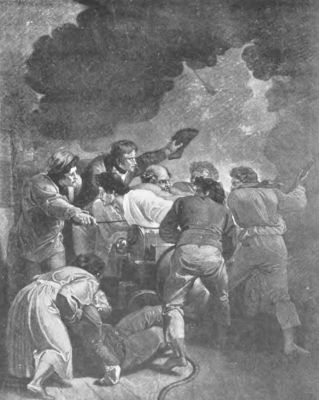
IN ACTION AT MIDNIGHT
The Monmouth now ranged up on the Foudroyant's larboard quarter and hurled into her a crashing broadside of round-shot and grape, at half musket range. It was the first heavy blow, and it got home. Then fastening with a bulldog's grip on her big opponent, the Monmouth set to and blazed away fiercely into the French ship as fast as the guns could be loaded and run out.
Nothing could be more masterly than the way the British captain handled his ship. Captain Gardiner knew his business. He meant to settle his personal score with the Foudroyant once for all; but he had no idea of sacrificing needlessly the life of a single man. There was to be no reckless clapping of the little Monmouth side by side with the Foudroyant. Gardiner was well aware of the weight of his opponent's metal. He laid the Monmouth on the Foudroyant's quarter and kept her there, skilfully placing her in a way that allowed every gun on the Monmouth's broadside to train on the enemy, while, at the same time, the French were unable to bring a number of their guns in the fore-part of the ship to bear.
It was of course quite dark when the battle at close quarters began—half-past eight on a February evening. The moon, within two days of the last quarter, would not rise till between eleven and midnight. Each ship, however, had her distinguishing lights hoisted, and the gleam of the battle-lanterns through the Foudroyant's ports gave the Monmouth's men sufficient mark to lay their guns by. More they did not want.
The Swiftsure at this time was about nine miles off, as her log notes, steering for the spot by the flash of the guns.
The Hampton Court was a couple of miles or so astern of the Swiftsure.
The enemy, for their part, with their heavier guns, smote the Monmouth hard and answered back her fire with equal spirit. Even now though, the French commodore would not risk bringing-to for a space and making an effort to get the Monmouth fairly under his broadside, where his crushing superiority in gun-power might well have been decisive. He held on instead, drifting slowly before the light wind, fighting as he went. So far there was little to disquiet M. du Quesne in the way that things were going. As a fact, during the first hour, the terrific punishment that the Foudroyant's 42-pounders were able to inflict told heavily on the Monmouth, and it looked as though the Foudroyant could well hold her own to the end. Captain Gardiner, however, stuck to his task unflinchingly. All the time an incessant fire of musketry was kept up from the Foudroyant's tops, and from her towering bulwarks, which were lined with soldiers all along the length of the ship.
They did considerable execution among the men at the upper-deck guns, and, among their other victims, wounded Captain Gardiner himself with a musket bullet through the arm. It was an ugly wound, but the gallant captain of the Monmouth refused to quit the deck, and had the wound bound up as he stood. This was about a quarter to nine.
Fate, however, unhappily had more in store for Arthur Gardiner that night. At half-past nine, the captain received a second and a mortal wound. 'Captain Gardiner received a mortal wound which obliged him to be conveyed off the deck,' Lieutenant Carkett briefly records. A grape-shot struck Gardiner on the forehead, according to the journal of Lieutenant Baron,[6] the third lieutenant, and he was carried below insensible, to linger in the cockpit until four next morning, when he died, 'having been speechless since he received his wound.'
Neither account exactly tallies with the story of Gardiner's fall that reached England. According to that, poor Gardiner was conscious for some moments after he was struck down, and was able to recognise Carkett, as the first lieutenant bent over him. He bade Carkett, it was said, as his last orders, 'to fight the Foudroyant to the last, and sink alongside rather than quit her.' In reply, the account proceeds, Carkett swore to the captain to fight the battle out to the very last, and sent on the spot for the carpenter and had the Monmouth's ensign nailed to the staff, after which he declared with an oath that he would shoot dead on the spot any man who should even whisper a thought of lowering it. So, indeed, it well may have been. Robert Carkett could be trusted to die hard. He was just the man to make such a threat and to keep it. Lieutenant Carkett was a rough sea-dog.
As senior officer after Captain Gardiner's fall, Carkett took charge on the quarter-deck, and the battle went on with even more desperate fury than before:—
Spars were splinter'd, decks were shatter'd, Bullets fell like rain; Over mast and deck were scatter'd Blood and brains of men.
Hour after hour, from half-past nine to twelve o'clock, the Monmouth hung doggedly on the quarter of the great Foudroyant and refused to be shaken off. She kept pace with the Frenchman steadily, not losing a foot, and not drawing nearer; mercilessly pounding away into the Foudroyant's hull at a short seventy-yards range, as fast as the shot could be brought to the guns. Nor did the Foudroyant's fire in reply slacken appreciably until midnight was past. Then, at length, the enemy seemed to tire, and the Foudroyant's fire began to grow irregular and gradually to weaken.
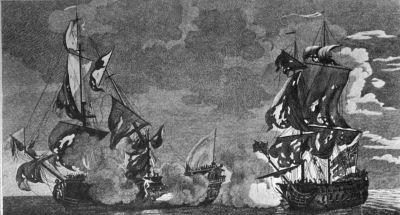
THE MONMOUTH FIGHTING THE FOUDROYANT AT CLOSE QUARTERS. THE FINAL ROUND—1.30 A.M. 'At half past [one] her main-mast was shot away. She then ceased firing' (Log of Lieutenant Carkett of the Monmouth).
It was the beginning of the end. Aided by the clear moonlight,—by half-an-hour after midnight the moon was well up,—the Monmouth's gunners made better practice than before. They redoubled their efforts, as gun after gun in the Foudroyant's ports stopped firing, until, a few minutes after one o'clock, the big vessel ceased resisting altogether, and not a shot came from her. The Foudroyant lay helpless, like a log on the water, dismasted, hammered to a standstill, a silenced and beaten ship.
Lieutenant Carkett in his log thus summarises what passed in the last hour. 'Half-past 12: Our mizen was shot away. At 1 A.M. the enemy's was shot away. Also at half-past her main-mast was shot away. She then ceased firing, having slackened her fire for some time before.'
Still, though, the Foudroyant made no sign of giving in. Lassata, nondum satiata—all was not quite over yet. So the Monmouth continued her cannonade. Until the enemy made the customary sign of surrender, Lieutenant Carkett had no option but to go on firing. Commodore du Quesne was holding out pour l'honneur du pavillon: and also for his own personal credit. He had not long to wait. Within a few minutes of the Foudroyant's fire giving over the Swiftsure arrived on the scene. Ranging up under the Monmouth's stern, she hailed across requesting her to stop her fire.
The Monmouth held her hand. She had done her work, and there was no need to do more now. As the Monmouth's gunner, reporting on the night's expenditure, stated, the ship had fired away no fewer than 80 barrels of gunpowder (about four tons weight of powder), with 1546 round-shot, 540 grape-shot, and 156 double-headed shot.
Then the Swiftsure rounded in to pass between the Monmouth and the Foudroyant. All her batteries were lighted up, showing the men standing ready by the guns. Captain Stanhope as he came abreast hailed the Foudroyant, asking if she had surrendered. Her ensign was down. It had been shot away about the same time that the mizen-mast went. The reply came instantly—two shotted guns in rapid succession, and a sharp crackle of musketry. M. le Marquis's honour was not satisfied yet. What followed was inevitable. The Swiftsure had now to administer the coup de grâce according to the rules of naval war. As the sound of the Foudroyant's defiance died away, the Swiftsure's double tier burst into flame, and the British seventy-four's broadside crashed into the French ship, sweeping her decks from stem to stern. It was enough. The next instant down came the Foudroyant's lights and she called for quarter. The battle was over.
The Marquis du Quesne had refused to surrender to the Monmouth single-handed. It was a point of honour. In the presence of a second British ship and a fresh ship, a seventy-four, his honour was fully satisfied. All the same, when the Swiftsure's officer came on board to receive his sword, he insisted on being taken on board the Monmouth and surrendering it to the commanding officer of that ship, to Lieutenant Carkett, giving it up, we are told, 'with great politeness.' A story was told afterwards that the French commodore expressed himself in bitter terms, and shed tears next morning when in full daylight, at close quarters, he saw the small size of the Monmouth as compared with his own splendid ship. But that is as it may be.
The Hampton Court came up some ten minutes after the Swiftsure had arrived.
It remained now only to count the cost and overhaul damages.
How things stood on board the Monmouth they knew before the night was out. Captain Gardiner was the only officer who had fallen. The four lieutenants of the ship had escaped without a scratch, as had the Monmouth's two marine officers and Lieutenant Campbell. It was otherwise, unfortunately, among the men. The casualties between decks amounted to upwards of 24 per cent of the entire ship's company. The figures as officially returned were—29 killed and 81 wounded—110 altogether. Not a boat was left that could swim; the mizen-mast had been shot right away, smashed through close above the deck; the main-mast, riddled with holes, was tottering; every one of the sails had to be stripped from its yard and new sails bent; most of the rigging was lying in tangled heaps about the decks.
In the Foudroyant, the prize-crew that was placed in charge had their work cut out for them in looking after prisoners below and stopping leaks and dangerous shot-holes. The deadly shooting of the Monmouth had in parts almost rent the Foudroyant open. More than seventy shot-holes through the hull were counted, low down, at or near the water-line. All over the hull, more than a hundred shot-holes were to be seen, gaping holes with jagged and splintered edges; and more shots than one had gone through some of the holes. Some of the Monmouth's shots had even gone right through from side to side, leaving enormous rents in the Foudroyant on the unengaged side of the ship where they had smashed their way out. To give an idea of the terrible hammering that the Foudroyant underwent, it may be stated that the repairs to the hull at Portsmouth took eight months to execute, at an expense of £7000, just half the total sum at which the Admiralty Prize Court valued the whole ship for purchase from her captors. As far as could be made out, the Foudroyant's casualties amounted to 190 officers and men killed and wounded; but the French practice of throwing the dead overboard in action as they fell, made it impossible to arrive at the exact figures.
As well as could be managed on the spot, the two ships were cleared of wreckage and put in sea-going trim, and at noon next day, the 1st of March, they set out to rejoin Admiral Osborn, the Swiftsure towing the Foudroyant, and the Monmouth under her own canvas, under jury-rig, with the Hampton Court close by in case of need.
They found the admiral with the rest of the fleet off Carthagena. With them was the French Orphée, which the Revenge and Berwick had run down and taken within two miles of Carthagena mole. M. de la Clue had missed his chance entirely. He had not stirred, although with the two men-of-war that had got in the night before he had had nine ships of the line, and the British admiral, with five of his ships detached in chase of Du Quesne's squadron, only seven. All that the French admiral had done the livelong day on the 28th had been to man and arm his boats and send them down to paddle about aimlessly at the mouth of the harbour.
The Monmouth and Revenge were ordered to Gibraltar to repair, accompanied by their two prizes. On the way the dead of the Monmouth and the remains of Captain Gardiner were committed to the deep, off Cape de Gata, at half-past three on Saturday afternoon, the 4th of March. All four ships hove-to and half-masted their ensigns during the funeral service, and the bodies were passed overboard to the booming of the Monmouth's minute-guns—his ship's last tribute to her dead captain. No tablet exists to Arthur Gardiner's memory in Westminster Abbey or elsewhere; but that, after all, matters little.
There is in the lone, lone sea A spot unmark'd but holy, For there the gallant and the free In his ocean bed lies lowly. Down, down beneath the deep, That oft in triumph bore him, He sleeps a sound and peaceful sleep, With the salt waves dashing o'er him. He sleeps serene and safe From tempest and from billow, Where storms that high above him chafe Scarce rock his peaceful pillow. The sea and him in death They did not dare to sever; It was his home when he had breath, 'Tis now his home for ever. Sleep on, thou mighty dead, A glorious tomb they've found thee, The broad blue sky above thee spread, The boundless ocean round thee. No vulgar foot treads here, No hand profane shall move thee, But gallant hearts shall proudly steer And warriors shout above thee. And though no stone may tell thy name, thy worth, thy glory, They rest in hearts that love thee well, they grace Britannia's story.[7]
At Gibraltar the Foudroyant was measured and found to be 12 feet longer than the Royal George. She was berthed alongside the mole with the Monmouth lying next her, and an officer present graphically describes the disparity of size between them in these terms: 'It was like the Monument overlooking a ninepin!'
The French prisoners were still on board the Foudroyant. They went to England in the ship, most of them to be shut up in Porchester Castle, the great war-prison of the South of England in those times. The visitor to the ruins of Porchester Castle to-day, if he explores in a certain part of the keep, will find at one spot, rudely cut in the wall, a string of French names, under a sort of scroll similarly carved roughly in the stonework, with the legend 'Vive le vaisseau le Foudroyant—1758,' the handiwork, it can hardly be doubted, of some of these very men. The Marquis du Quesne and his first and second captains came to England by themselves, in the Gibraltar frigate, and were interned on parole at Northampton. The other surviving officers of the ship were paroled at Maidstone.
All England rang with Arthur Gardiner's name when, in the first week in April, the Gibraltar arrived at Spithead with Admiral Osborn's despatches, and the London Gazette told the story of how Gardiner had died 'as he was encouraging his people and inquiring what damage they had sustained between decks.' Everywhere, we are told, the news of the taking of the 'mighty Foudroyant' and how it was done excited the liveliest enthusiasm. Inn signboards were repainted with pictures of the fight, a favourite way with our eighteenth-century forefathers of commemorating great events; and a ballad was composed about it which was set to a popular tune of the day and sung all over the country. One of the signboards so painted was in existence a very few years ago,—and may be so still,—at Lostwithiel in Cornwall, bearing a representation of two old-fashioned men-of-war in desperate combat, with the legend 'The memorable battle of the Monmouth and Foudroyant.'[8] Of the ballad and its music no trace is to be found, although some lines on the fight, apparently contemporary, are in print. One can, though, hardly fancy them being set to any sort of tune, still less anybody trying to sing them. Their shortcomings as verse too are obvious, but one must remember that it was the period when the Poet Laureate was Colley Cibber. There was no market in the days of George the Second for what our present Poet Laureate calls 'the higher kind of poetry.'
STANZAS
On the capture of the Foudroyant, of 84 guns, by the Monmouth, of 64, Anno 1758.
As Louis sat in regal state, The monarch, insolently great, Accosts his crouching slaves, 'Yon stubborn isle at last must bend, For now my Foudroyant I send, The terror of the waves. 'When once he bursts in dreadful roar, And vomits death from shore to shore, My glory to maintain; Repenting Britons then will see Their folly to dispute with me The empire of the main.' He spake, th' obedient sails were spread, And Neptune reared his awful head, To view the glorious sight; The Tritons and the Nereids came, And floated round the high-built frame, With wonder and delight. Then Neptune thus the Gods address'd: 'The sight is noble, 'tis confess'd, The structure we admire; But yet this monst'rous pile shall meet With one small ship from Britain's fleet, And strike to Britons' fire.' As from his lips the sentence flew, Behold his fav'rite sails in view, And signal made to chase; Swift as Camilla o'er the plain, The Monmouth skimm'd along the main, Unrivall'd in the race. Close to her mighty foe she came, Resolv'd to sink or gain a name Which Envy might admire; Devouring guns tumultous sound, Destructive slaughter flam'd around, And seas appear'd on fire. When lo! th' heroic Gardiner fell, Whose worth the Muse attempts to tell, But finds her efforts vain; Some other bard must sing his praise, And bold as fancy's thoughts must raise The sadly mournful strain. Carkett, who well his place supply'd, The mangling bolts of death defy'd, Which furious round him rag'd; While Hammick[9] points his guns with care, Nor sends one faithless shot in air, But skilfully engag'd. Baron and Winzar's[10] conduct show'd Their hearts with untam'd courage glow'd, And manly rage display'd; Whilst every seaman firmly stood, 'Midst heaps of limbs and streams of blood Undaunted, undismay'd. Austin[11] and Campbell next the Muse Thro' fiery deluges pursues, Serenely calm and great; With their's the youthful Preston's[12] name Must shine, enrolled in list of fame, Above the reach of fate. Hark! how Destruction's tempests blow, And drive to deep despair the foe, Who trembling fly asunder; The Foudroyant her horror ceas'd, And whilst the Monmouth's fire increas'd, Lost all her pow'r to thunder. Now, haughty Louis, cease to boast, The mighty Foudroyant is lost, And must be thine no more; No gasconade will now avail, Behold he trims the new-dress'd sail, To deck Britannia's shore. If e'er again his voice be heard, With British thunder-bolts prepar'd, And on thy coast appears; His dreadful tongue such sounds will send, As all the neighb'ring rocks shall rend, And shake all France with fears.
What is more interesting is that one of the Foudroyant's officers, while a prisoner of war on board and on the way to England, wrote a set of verses in honour of the captain of the Monmouth. They appeared in the Gentleman's Magazine for July 1758 in this form:—
Chatham, July 23.
Mr. Urban—By inserting the following Elegy, which was written by a French officer, taken prisoner on board the Foudroyant, you will oblige many of your readers, and particularly your humble servant,
P. Cochet.
ÉLÉGIE SUR LA MORT DU CAPT. GARDINER
Ce héros respectable a fini ses beaux jours, Il a trop peu vécu, ce sage capitaine, Le Monmouth pleure encore l'objet de son amour Et moi la cause de ma gêne. Aux combats il étoit un terrible ennemi, Son exemple animoit le c[oe]ur le plus timide, Au milieu des hazards le foible est affermi, Ayant un tel chef pour son guide. O Monmouth! quelle nuit, lorsque le Foudroyant, Par ses bouches d'arain menaçoit votre ruine, Vous tenez contre lui, vous êtes triomphant, La victoire pour vous s'incline, Conduit par ce héros, vos canons vomissoient La foudre à gros bouillons, et la mort tout ensemble, Il inspiroit sa force à ceux qui combattoient, Ha! l'ennemi le sent et tremble. O! quel funeste coup, ce héros n'est donc plus? Le brave Gardiner tombe et finit sa vie, Mais il vit dans nos c[oe]urs, il vit par ses vertus, Est-ce le ciel qui nous l'envie? Quelle aimable douceur envers ses prisonniers, Sa tendresse pour eux égaloit son courage, Il ne ressembloit point aux inhumains guerriers, Qui ne respirent que carnage.
Whatever may be the quality or literary merit of these verses, there could, surely, be no higher tribute to the memory of a British officer, the tribute of an enemy in the bitter hour of defeat; and the incident in all its circumstances is unique. With it we may close the story.
The 'little black ship' Monmouth (Captain Fanshawe's ship), to which the officers of the French flagship Languedoc drank at dinner on the night of the 6th of July 1779, was the next successor to Gardiner's Monmouth, and it was this Monmouth on board which, in the East Indies, Captain Alms, on the 12th of April 1782 (actually the same day on which Rodney was fighting his battle in the West Indies) made so heroic a stand. The Camperdown Monmouth came next, and after her a Monmouth that was never commissioned at all. Finally we come to our modern Monmouth cruiser of the present hour.
The quondam French Foudroyant, as a man-of-war of the Royal Navy, fought for England and did well. Her successor of the same name in the navy had strangely varied fortunes. She began her life as one of Nelson's flagships; and when she was worn out was sold to a German shipbreaker, by whom she was re-sold at an immense profit to Mr. G. Wheatly Cobb, of Caldicot Castle, Chepstow, in Monmouthshire curiously, who interested himself in the fate of the Foudroyant, and 'for Nelson's sake,' as he himself put it, spent £25,000 out of his own pocket in re-purchasing her and re-building and fitting her out to make the old veteran of the sea look, as far as possible, as she appeared in Nelson's time. A cruel fate, however, cut short the nobly conceived project. Our second Foudroyant ended her days off Blackpool, of all places in the world, where, in the summer of 1897, in the hundredth year of her existence, she was wrecked in a gale.
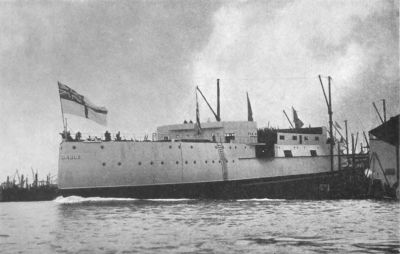
'SUCCESS TO THE FORMIDABLE!' November 17, 1898
FOOTNOTES:
II
RODNEY'S SHIP ON RODNEY'S DAY
THE FORMIDABLE THAT BROKE THE LINE
Brave Rodney made the French to rue The Twelfth of April 'Eighty two. Old Song.
The West Indies is the Station for honour. Nelson.
'Who can feel any pride in a mere blustering adjective? We do seriously believe that the Admiralty would add something to the popularisation of the navy by a reform of the naming system. It is proper enough to christen new ships after famous old vessels of the past, and the 'Admirals' also are very proper and pleasant, but why this mania for adjectives and such futilities?'
So a London newspaper commented on the selection of the name Formidable for the great first-class battleship that to-day bears that name proudly lettered at her stern. Well, we shall see what we shall see. When all is said and done, it may appear, perhaps, that some of us are not so unreasonable after all in taking pride in seeing this 'blustering adjective' inscribed as a man-of-war name on the roll of our modern British fleet. Handsome is, every nursery knows, that handsome does. It is more than highly probable that should the day for 'the real thing,' as Mr. Kipling calls it, come in our present Formidable's time, those to whose lot it may fall to face the Formidable from the enemy's side will think that, in regard to this particular ship at least, there is something in a name.
This is the sort of vessel that our twentieth-century battleship the Formidable is, glancing at some of her points—the details on which she relies to make good the intention of her name. Hard hitting is the Formidable's business in life, so to speak, her raison d'être; her forte, the dealing of knock-down blows. To that end she carries the most powerful guns in existence: 50-ton breech-loaders, a foot in diameter in the bore; capable of hurling gigantic shells each between three and four feet long and weighing 850 lbs., or 7½ cwts., with a bursting charge of three-quarters of a hundredweight of powder or lyddite, through three feet of iron at a mile and a half off, or all the way across from Shakespeare's Cliff at Dover on to the sand dunes round Calais. Each firing charge of cordite weighs by itself nearly 2 cwts.—the weight of a sack of coal as delivered at a house-holder's door from a tradesman's cart,—and each gun by itself takes a year to construct. The Formidable's guns could silence the old 'Woolwich Infants' and the mighty 80-ton guns that the famous Inflexible carried, from a range miles beyond the farthest that the older guns could reach. Yet these less than twenty years ago were reckoned a wonder of the world.
A finger's pressure, nothing more, The ponderous cannon's thund'ring roar, A passing cloud of smoke, and lo! The waves engulf the haughty foe!
wrote a versifier once about what the guns of the Inflexible could do. With less than half the weight, they are considerably more powerful weapons than the 110-ton monsters of the Benbow and Sans Pareil and the ill-fated Victoria, one of which was tested at Shoeburyness against a specially-built-up target of enormous proportions, and sent its shot, as easily as one can push one's finger into a lump of putty, clean through 20 inches of steel-faced compound armour, 8 inches of cast iron, 20 feet of oak, 5 feet of granite, 11 feet of concrete, and lastly 6 feet of brick—to a depth of 44 feet 4 inches altogether. As to the actual size of the guns, of the ship's heavier pieces: each is 41 feet long—13 yards and 2 feet from muzzle to breech. Pace this out on a gravel garden-walk, and imagine the length covered by a gigantic steel tube, three-quarters of a yard across at one end and swelling gradually to over 5 feet thick at the other—that may give some idea of the bulk of a Formidable gun. Such a piece of ordnance would have suited the mood of old Marshal Soult when he refused to fight a duel on the score of his dignity. 'A marshal of France,' growled the old gentleman at his challenger's seconds on their calling to offer him the choice of weapons, 'a marshal of France only fights with cannon!'
Four of these weapons form the Formidable's 'main armament.' They are mounted, two on the quarter-deck and two on the forecastle, each pair in a circular barbette 37½ feet in diameter, walled round with 12-inch thick Harveyed steel of immense resisting capacity, and weighing upwards of 315 tons. They can load at any angle of elevation or of training, and the ammunition-supply mechanism ensures the guns being loaded as fast as they can fire. Bis dat qui cito dat, 'who gives quickly gives twice,' is the maxim of the modern navy gunner. As far as her 12-inch guns are concerned, the Formidable could let the enemy have two 850-lb. lyddite shells from each gun every eighty seconds. The ship's magazines and shell-rooms stow eighty rounds for each gun. Fired at the same time, the four guns exert a combined force enough to lift the whole ship up bodily ten feet.
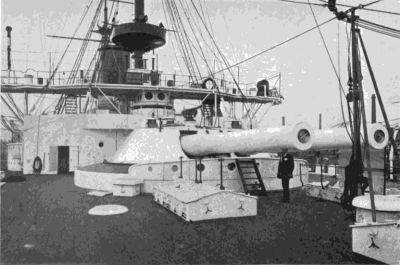
'UT VENIANT OMNES!'—THE BIG 50-TON GUNS OF THE FORMIDABLE
To support the 'main armament' and provide for all comers, down to hostile torpedo boats, there are on board the Formidable, as 'secondary armament,' twelve 6-inch Vickers guns of the latest pattern (mounted six a side), sixteen 12-pounders and six 3-pounders (mounted in the fighting-tops—three in each top), with Maxims and light boat and field guns. In battle, fighting an enemy end-on, this embodiment of a 'blustering adjective' would, within the first five minutes, have sent at the enemy upwards of 7 tons of bursting shells; fighting broadside-on, over 16 tons.
The Formidable is no less efficiently fitted for standing up to the enemy and taking her share of hard knocks. On her sides amidships, shielding from injury the engines and boilers, the 'vitals' of the ship as they are called, a wide belt of Harveyed steel armour extends. It is 9 inches thick, and 217 feet long by 15 feet deep, and is built up of some seventy odd plates or slabs of solid steel fitted together, each one of just the surface area of a billiard-table with an extra yard added to its length, and weighing each upwards of 12 tons. Each plate separately takes from a fortnight to three weeks to make. Where the 9-inch armour leaves off, towards the ends of the ship, a thinner steel belt, 3 inches thick, with an armoured deck, also of 3-inch steel, carries forward the protection. At the bows it joins on to the ship's enormous ram—a ponderous forging of 35 tons of steel.
Such, roughly indicated, are some of the main features in regard to offence and defence of this Titanic 'bruiser of the sea,' His Majesty's battleship the Formidable. Below, the ship has twenty Belleville boilers, capable of raising steam at a pressure of 300 lbs. to the square inch; engines of 15,000 horse-power, capable of driving the ship's immense hull, a length of 430 feet over all from stem to rudder, through the water, full speed ahead, at 18 knots an hour (nearly twenty land miles), each of the great 17-foot twin-screws thrashing round at the rate of 108 revolutions a minute. She can stow coal enough to carry her without re-coaling, at an average cruising speed of 10 knots, from Spithead to Buenos Ayres or through the Suez Canal as far as the Bay of Bengal.
A million sterling of the nation's money, with a trifle of forty odd thousand pounds added, is what the Formidable represents—£1,040,000 literally cast on the waters. Of that sum the guns by themselves cost £74,500—more, in fact, than it cost to build and rig and fit the Victory for sea. And her upkeep in commission—interest on first cost, wear and tear, crew, victualling, coal, stores, and ordnance stores—costs £163,000 a year. In action every shot from the Formidable's big guns would cost £80—a sum equivalent to the annual pay of two midshipmen plus a naval cadet.
These features of the Formidable are enough to show that in the case of this particular modern battleship, at any rate, the name is not misapplied, not unsuitable, nor without justification: that it is something more than a 'futility,' something more than a 'merely blustering adjective.' We may trust the honour of the flag to the Formidable's keeping, assured that should the hour of trial come in her time she has the means of taking her own part with power and advantage. Grant her, when that time comes, 'good sea-room and a willing enemy,' as the war toast of the Old Navy used to go, and the British Empire may rest assured that, as far as this particular ship is concerned,
... in the battle's dance of death, She'll dance the strongest down.
There is, though, another justification, and of the amplest kind, for the presence on the roll of the British fleet of the name Formidable. This 'merely blustering adjective' has a meaning there that is all its own—a raison d'être not only for the Royal Navy but for all the world in that connection that is sui generis. The British fleet does not owe the name to any whim or fancy of a modern Admiralty First Lord. Vixere fortes ante Agamemnon—there have been famous Formidables before the present ship. Formidable, indeed, is one of our best 'trophy names'—a name that came into the British service as spoil of war, won from the enemy in very exceptional circumstances. It stands in a special sense as a memento of one of the most brilliant exploits in our annals—of that tremendous November afternoon battle of 1759, fought in a wild Atlantic storm amid the reefs of Quiberon Bay, on that historic occasion, so happily described in Mr. Henry Newbolt's stirring verse,[13] 'when Hawke came swooping from the west.'
'Twas long past noon of a wild November day When Hawke came swooping from the west; He heard the breakers thundering in Quiberon Bay, But he flew the flag for battle, line abreast. Down upon the quicksands roaring out of sight Fiercely beat the storm-wind, darkly fell the night, But they took the foe for pilot and the cannon's glare for light When Hawke came swooping from the west.
One result of Hawke's swoop was, of course, the stopping of all French invasion schemes for the rest of the Seven Years' War. Henceforward there was no need to watch the southward beacons night after night; no need of more shore batteries at Brighton and elsewhere along the Sussex coast; no further need to cover the South of England with standing camps for Pitt's new militiamen to learn their drill in; no more need to shock the good ladies of Hampshire with the sight of bare-legged Highlanders marching to and fro.
The guns that should have conquered us, they rusted on the shore, The men that would have mastered us, they drummed and marched no more; For England was England, and a mighty brood she bore When Hawke came swooping from the west.
The other result of Hawke's swoop was the Formidable—the French flagship Formidable—the sole trophy that the stormy weather allowed Hawke to bring off from the fight. The Royal Navy took over the fine prize, a magnificent two-decker of eighty guns, enrolled her name as it stood on the list of the British fleet, and in due course handed the name on from one successor to another, until we come in the end to our own fine steel-clad battleship, the Formidable that to-day graces
The proud Armado of King Edward's ships,
in the words of poor Kit Marlowe's 'mighty'—and prophetic—line.[14]
Then we have another justification, the most notable of all. The Formidable's name has acquired a new significance since the days of Hawke. To-day it has to the Royal Navy a more recent meaning. It stands on the roll of the fleet as the special memorial of another achievement, as a memento of another admiral's 'stricken field,' in special honour of Rodney's most famous feat of arms, of the great victory that has given Rodney his place in the history of the British Empire. On that day a Formidable was Rodney's flagship; the second ship of the name, the immediate successor of Hawke's great prize, our first British-built man-of-war Formidable.[15] 'If ever,' wrote Froude, 'the naval exploits of this country are done into an epic poem—and since the Iliad there has been no subject better fitted for such treatment or better deserving it—the West Indies will be the scene of the most brilliant cantos.' In at least one of those cantos Rodney's Formidable would be a central figure.
We now come directly to the place, time, and circumstances of the event, taking up the tale a little before the fighting actually opens.
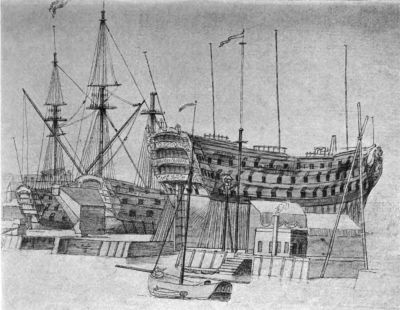
RODNEY'S FORMIDABLE ON THE DAY BEFORE HER LAUNCH
[Note, to the right of the ship, the canvas 'booths' or stands for the Commissioner of Chatham Dockyard and officers and guests of distinction. The launching flagstaffs on board were usually set up on the day before a launch, to fly the Jack at the bows, the Admiralty flag, Royal Standard, and Union flag where the three masts would be; and the 'St. George's ensign' (White Ensign) on the ensign staff.]
It begins, first of all, in Gros Islet Bay, St. Lucia, a locality that one wants a fairly large map to find. The name is hardly a familiar one, yet it has a place of its own, of special interest in our naval annals. Gros Islet Bay was Rodney's headquarters in the West Indies during March 1782 and the first week of April, at the time that the Formidable was Rodney's flagship. Rodney was in Gros Islet Bay with his fleet of 36 sail of the line, and the French admiral De Grasse, at the head of 34 of the line, was facing him in Fort Royal Bay, Martinique, distant some thirty miles—about as far off as Boulogne is from Folkestone. So the lists were set.

RODNEY'S SWORD
Rodney had come out from England specially to save the British West Indies from De Grasse. And even more than the fate of the 'sugar islands' depended on his efforts. 'The fate of this Empire,' were the last words of the First Lord of the Admiralty (Lord Sandwich) to Rodney before he sailed, 'the fate of this Empire is in your hands!' He forced his way across the ocean in mid-winter, battling through a series of fierce storms that day after day threatened to tear the masts out of his ship. 'Ushant,' wrote Rodney to his wife, 'we have weathered in a storm but two leagues, the sea mountains high, which made a fair breach over the Formidable and the Namur, but it was necessary for the public service that every risk should be run. Persist and conquer is a maxim that I hold good in war, even against the elements, and it has answered.' It did answer. Rodney arrived to find that there were still four islands left to Great Britain. All our West Indian possessions had fallen except Jamaica, Barbados, Antigua, and St. Lucia. St. Kitts, Nevis, Montserrat, and Demerara had been taken, actually, while Rodney was on his way out. De Grasse when Rodney arrived was refitting for a yet more audacious project at Fort Royal, Martinique, the Portsmouth of the French navy in the West Indies; and to be on the spot to intercept him and bring him to decisive battle at the first chance, Rodney anchored his fleet in the nearest available harbour, within touch and almost within sight of the French fleet, in the roadstead of Gros Islet Bay, St. Lucia.
Both fleets during March and the first week of April were hard at work refitting. Twelve of Rodney's ships had come out from England with him and wanted little; the others of the thirty-six, however, belonged to the fleet originally on the station, and after the trying time of it they had had during the past six months, including two sharp fights with the French, were badly in need of a refit. De Grasse's fleet was in like case. The arrival of convoys from home, however, with war stores and supplies of all kinds for both fleets, towards the end of March, made it all but certain that the month of April would not go by without a battle in the open sea.
Those days in Gros Islet Bay proved to Rodney of vital importance. Secret intelligence came to hand which disclosed to him the enemy's entire plan of campaign. A gigantic and startling project was on foot. An elaborate and wide-reaching combination had been designed in which a Franco-Spanish army and a Franco-Spanish fleet were both to take part, the operations being projected on a scale far beyond anything hitherto attempted in the war on either side. It aimed at nothing less than the sweeping of the British flag out of the West Indies by one tremendous and overmastering coup.
De Grasse's fleet was to be the chief factor in the situation, the mainspring of the movement. The preliminary dispositions had already been made. Thirteen Spanish ships of the line were at that moment waiting off Cape Haitien in San Domingo, accompanied by transports with 24,000 troops on board. They were expecting to be joined by a force of 10,000 French soldiers from Brest, escorted by five or six men-of-war which were already overdue. According to the grand plan, De Grasse with his fleet, thirty-four of the line, with store-ships and the convoy that had arrived in March, was to move out from Fort Royal, with some five or six thousand more troops on board the men-of-war, and cross over and join hands with the assemblage off San Domingo. The united armada, making up some sixty ships of the line, against which Rodney's thirty-six and the handful of ships at Port Royal could not hope to stand, were then to swoop down on Jamaica and capture it out of hand. There were only 3500 British regulars in Jamaica, and the planter militia and armed negroes were of little account. Jamaica taken, said the enemy, Barbados would fall at the first summons, and Antigua and St. Lucia would follow, making an end of the British West Indies. So confident were the enemy of success that, as it was reported, Don Bernardo Galvez, the Spanish Commander-in-Chief, had already been publicly addressed at Havana as 'Governor of Jamaica,' which island, according to the secret arrangement between the allies (already drafted), was to be Spain's share of the spoil.
Rodney's fleet—the Formidable and her thirty-five consorts off St. Lucia—were all that stood between the scheme and its fulfilment. Realising to the utmost what depended on him, Rodney pressed on his preparations for sea with intensified vigour, so as to be ready to fall on De Grasse immediately he left Fort Royal.
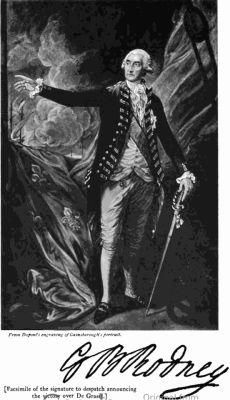
[Facsimile of the signature to despatch announcing the victory over De Grasse.]
During March and the early part of April—except for ten days lost in a futile attempt to cut off De Grasse's convoy from France on its way to Fort Royal—Rodney was busy refitting: a task that taxed all his energies owing to the state to which some of the ships had been reduced, short of powder, shot, sea stores of all kinds, bread, even anchors. All the fleet, too, had to be watered, which proved a slow and difficult business owing to the bad weather. 'I think,' wrote Rodney in March, 'the winter season has followed us: nothing but violent hard gales, and such a sea that half the boats of the fleet have been stove in watering, which has delayed us much in refitting.'
Incidentally the admiral had other matters to attend to. One—it will be interesting to make a small point of it here—was to correspond personally with his opponent. The subject was the interchange of prisoners taken at St. Kitts and earlier in the campaign. The British sloop-of-war Alert was the intermediary, going and coming under a flag of truce. Nothing could exceed the courteous tone of Rodney's correspondence with the French admiral; and, on the other hand, De Grasse was civility itself. He treated Captain Vashon of the Alert, while that officer was at Fort Royal, with every consideration, made him his guest for the time, and expressed in conversation with the British captain the highest esteem and consideration for 'le Chevalier Rodney.'
Rodney wrote to De Grasse, for instance, in one letter, after dealing in the pleasantest way with the business in hand:—
It will make me happy if at any time this island produces anything worthy your acceptance, or that may be the least useful to your table. As the merchant ships which have lately arrived from Europe may have brought different species of necessaries that may be agreeable to your Excellency, it will make me happy, Sir, to obey your commands.
The bearing of the two admirals to one another in their personal dealings affords a pleasing instance of the high-bred, chivalrous courtesy that was so characteristic of the old-time fighting days. It was the way with the men of the ancien régime on both sides the Channel when they met in war never to forget that, first and foremost, they were gentlemen. In this spirit, almost at that very moment, indeed, De Crillon at Gibraltar was exchanging similar compliments with the 'old Cock of the Rock,' General Eliott—'Eliott the Brave': the same spirit that at Fontenoy, as all the world knows, moved one side to challenge the other to fire first. It was the same chivalrous spirit that prompted the captains of the British fleet in the East Indies to pay their unique compliment to the great De Suffren at the close of this war. Hostilities were over, peace had been proclaimed, and the rival fleets, so lately enemies, met, both on their way home, in Table Bay. They had fought five fierce battles within sixteen months—each one a drawn action, with honours divided. On finding the Bailli de Suffren and his fleet in Table Bay when they arrived, the British captains, brave old Commodore King, the senior officer, at their head, proceeded in a body to call on the gallant leader of their quondam foes, and pay the homage of brave men to the brilliant tactician they had more than once been hard put to it to keep at bay. Their generous tribute delighted the warm-hearted Provençal immensely, as he described, by the spontaneity and peculiar graciousness of the act. The intercourse between Rodney and De Grasse was in essentials of the same kind: the outcome of two warriors' sense of noblesse oblige the one to the other; the obligation, as a point of honour, on both sides—
To set the cause above renown, To love the game beyond the prize, To honour while you strike him down The foe that comes with fearless eyes. To count the life of battle good, And dear the land that gave you birth, And dearer yet the brotherhood That binds the brave of all the earth.[16]
It was, as it were, the swordsmen's obligatory recognition of each other in 'the Salute' when they first come face to face, ere the sword-blades cross and clash in fight; one of the courtesies of war between destined opponents, wishing one another well until the striking of the appointed hour—
Health and high fortune till we meet, And then—what pleases Heaven!
'Always be polite,' said Bismarck once to Moritz Busch; 'be polite to the foot of the scaffold, but hang your man nevertheless!' Nothing could be nicer than Rodney's attentions, but he was in deadly earnest all the same—he meant, at the proper time, 'to hang his man nevertheless!'
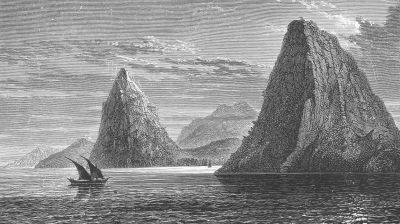
THE PITONS OF ST. LUCIA
Another incidental detail. It was while Rodney's fleet off Gros Islet Bay was getting ready for sea that, according to local tradition, the grim little real-life tragedy of the Pitons took place. The Pitons or 'Sugar Loaves,' as, from their general shape, they are to this day commonly called by seafaring men, are two gigantic cones of rock, of volcanic origin, that thrust themselves up out of the sea off the south-westernmost end of St. Lucia, rising abruptly, almost sheer from the water's edge. The larger of the two, the Grand Piton, towers up to a height of some 2720 feet, or nearly seven times the height of St. Paul's Cathedral; the smaller has an elevation some 300 feet less. A number of sailors, the story goes, either stragglers from a watering-party or, possibly, men from the Russell, a seventy-four, then undergoing repairs in the carénage, managed to get on to the Grand Piton, clambering up on to its lower slopes 'by means of lianes and scrub.' Their intention was to try and scale the huge mass and plant a Jack flag they had brought with them on the boulders at the summit. The Grand Piton is covered almost to the top with dense bush, but there are bare patches and open areas of rock surface and ledges here and there. How many landed or started to climb is not stated, but, according to the story told at St. Lucia to this day, lookers-on with telescopes made out four men, including one man with the flag, more than half-way up. Immediately afterwards one of the party was seen to stagger and fall, and then roll down a little way and disappear. The others went on until some two or three hundred feet higher up, when a second man dropped. The two survivors went on steadily higher still, and then suddenly one of the two was seen to go down. His companion apparently took no notice. He pressed on with his flag, intent only on getting to the top. He nearly succeeded. The last man seemed to have almost reached the summit when he, like his messmates, was seen to stop, stagger, throw up his arms, and drop. So the local people tell visitors to St. Lucia to this day. What was it? What made the men fall dead so suddenly? How they met their death no man ever knew. Few human feet besides theirs, if indeed any, have ever tried to scale the Pitons, and the bones of Rodney's sailors lie up there on the windy height as they fell—what the weather and a hundred and twenty years' exposure in the open has left of them. Was it sunstroke? Local opinion attributes their fate to another cause. The Pitons, like the whole island of St. Lucia itself, are known to swarm with venomous serpents, the deadly fer de lance—'perhaps the deadliest snake in the world' it has been called—an ugly monster, in average length from 3 to 5 feet, as thick as a boy's wrist, of a dull red or reddish-yellow colour, fiercely aggressive in its ways, ever ready to strike at sight, and its bite practically instant death. Craspedocephalus—the name in itself is almost enough to kill—would account for everything. Whatever the cause really was, at any rate the Grand Piton has ever since kept its secret to itself.
At Fort Royal, meanwhile, everybody, from the great French Admiral De Grasse himself down to the smallest mousse, was in the highest spirits and assured of victory. To one and all the hour was at hand for the development of the grand scheme that was to lay all the West Indies at the feet of France. Hardly a finer fleet, perhaps, had ever assembled under a French admiral than that lying there at that moment in attendance on the orders of De Grasse. There were thirty-four ships of the line, the finest men-of-war in the French navy among them, and their captains were some of the smartest and most dashing and most highly trained officers that ever trod a French quarter-deck. A specially interesting set they were, as it happened, in many ways.
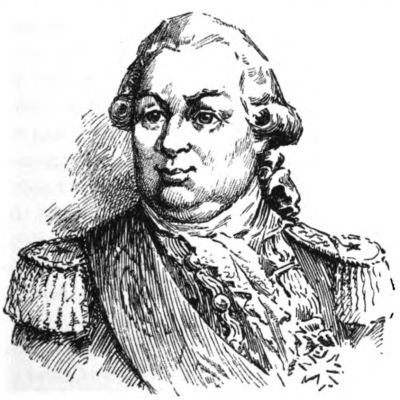
THE COUNT DE GRASSE
De Grasse himself was a man of reputation, a talented and highly trained officer, able to map out the strategy of a campaign in advance with any man of his time, as his admirably planned and executed Chesapeake campaign had just proved to all the world. He was just fifty-nine—five years younger than Rodney. Both men had followed the sea for half-a-century, the young De Grasse taking service under the Order of Malta, in which seven-and-twenty of his ancestors had been enrolled before him, just about the time that the schoolboy Rodney was leaving Harrow to enter the Royal Navy as the last of the 'King's Letter Boys.' Since then De Grasse, as an officer of the French navy in the regular line, had served all over the world, and done well for his country and himself. He had fought against England in three wars and been taken prisoner once. In the present war, indeed, he had already taken part in six fleet actions, and in three of them as chef d'escadre and third in command had had opportunity of learning something of Rodney's methods on the day of battle. Such was Joseph Paul de Grasse-Briançon, Knight of Malta, Grand Cross of the Order of St. Louis, Chevalier of the Order of Cincinnatus, Count de Grasse and Marquis de Grasse-Tilly, thirty-fifth of his line, of the noblesse of Provence, overlord of forty fiefs, the man in whose hands rested the fate of the campaign now about to open. 'Fresh from the victorious thunder of the American cannon' as he was, not a man under his orders doubted his ability to achieve success in the grand project that had been committed to his hands.
The Marquis de Vaudreuil was De Grasse's second in command. There was no better gentleman, from all accounts—never a nobler specimen of a French naval officer of the old school than Louis Philippe de Rigaud, Marquis de Vaudreuil. He looks it in his portrait at Versailles—a beau sabreur of the sea, rusé, ready-witted in emergency, a 'first-class fighting man' in all respects. The son of a sailor, the grandson of a sailor, the great-grandson of a sailor, he belonged to a family that had sent its sons to serve 'on the ships of the King' ever since France had had a navy. 'Il a de l'eau de mer autour du c[oe]ur' is an old Breton saying that applied in the case of the scions of the Norman house of De Vaudreuil. He was a year younger than De Grasse, and like his chief had once had to go through the bitter experience of having to raise his hat on the quarter-deck of a foeman's ship as he gave up his sword to a foreigner in token of surrender.[17] Like De Grasse also, De Vaudreuil had taken part in six fleet battles since the war began. He was there by his own choice. There was not a man in the fleet who had not heard how, only a little time before, De Vaudreuil had refused the King's personal offer of a lucrative colonial governorship—De Vaudreuil was a poor man—rather than be absent from what to him was the post of duty. 'I am a sailor, your Majesty,' was the fine reply, 'and in war-time a sailor's place is on the sea.'[18] No officer in the whole French navy was more personally popular than was this courtly son of old-time France—'noble de sang, d'armes, et de nom.'
The circumnavigator Bougainville, chef d'escadre, was third in command, and about to add another experience to the many he had gone through in his crowded life. Professor of mathematics, barrister, author, major of militia, diplomatist, colonel of light dragoons, A.D.C. at Quebec and on the Rhine, circumnavigator, flag-captain—there were few things within his reach that Louis Antoine de Bougainville, the clever son of a country lawyer, had not tried his hand at in his time.[19]
Of the other officers, a third almost of the Annuaire de la Noblesse, the Debrett of Versailles, was represented at Fort Royal. Among the senior officers alone there were four Marquises, two Viscounts, five Counts, six Chevaliers, two Barons, nineteen 'de's,' only two plain Messieurs. There was a second De Vaudreuil, the Vicomte's younger brother, the Comte de Vaudreuil, a man of another kind—a smart, hard-fighting officer, but better known for his feats of gallantry than for his feats of arms, in particular as the favoured first lover of that haughty young beauty Gabrielle Yolande de Polignac, daintiest of Court ladies of the hour, 'avec le visage d'un ange et'—perhaps it will be kinder to say no more. The Comte de Vaugiraud was Captain of the Fleet. Baron d'Escars, of the house of Fitz-James, notorious for his fanatical hatred of Great Britain, was captain of the Glorieux. The Sieur de la Clochetterie, an impetuous and brilliant officer—whose name as captain of the Belle Poule in her duel with the 'Saucy' Arethusa at the outset of the war, the French navy still remembers—commanded the Hercule. Comte d'Albert de Rions, by reputation the ablest tactician in the French navy, after De Suffren, was the senior captain. A De la Charette commanded the black Bourgogne;[20] a De Castellan, the Auguste; De la Vicomté, the Hector; and so on. There is, indeed, as one runs down the list of the French captains at Fort Royal, quite a ring of mediæval chivalry, of old-time romance, about their names. De Mortemart, De Monteclerc, De Saint Césaire, De Champmartin, De Castellane-Majastre, Le Gardeur de Tilly, to take half-a-dozen other names at random—one might almost be checking off one of Bayard's compagnies d'élite, or calling over a muster-roll of the Lances of Du Guesclin. In the junior ranks were a De Tourville, the Vicomte de Betisy, two scions of the historic house of St. Simon, a Grimaldi, a Lascaris, a De Lauzun, a De Sevigné, a MacMahon, a Talleyrand, a De Ségur, a De Rochefoucauld, a Montesquieu. Brueys d'Aigalliers, of a noble family of Languedoc, who later on took service under the Revolution, and perished fighting Nelson at the Nile, was one of the lieutenants. La Pérouse, the explorer, was a capitaine de frégate. Bruix and Denis Decrès, Napoleon's Ministers of Marine in later days, were two of the midshipmen. Magon, who fell a rear-admiral at Trafalgar, was an enseigne de vaisseau. L'Hermitte, Troude, Willaumez, Emeriau, Bourayne, others of Napoleon's admirals, were among the boy volontiers d'honneur (naval cadets) in various ships of the Fort Royal fleet. De Grasse's personal staff comprised the Vicomte de Grasse, the admiral's nephew, the Comte de Cibon, and the Marquis de Beaulieu.