Front matter (continued 3)
Reading edition
Elsewhere at this time, towards four o'clock, there was a good deal of 'partial and desultory' firing, to use Dr. Blane's term, going on here and there, principally in the direction of De Grasse's squadron. The French admiral's attempt to rally and re-form line had failed. Bougainville's ships kept away in a body, apparently too much occupied in repairing their own damages to pay attention to their commander-in-chief. Many of De Vaudreuil's seemed equally shy, although De Vaudreuil himself, with two or three of his command, gallantly beat to windward and joined the Ville de Paris, making up a forlorn-hope band round De Grasse that comprised the rearmost formed group of the French fleet. They moved away at the best speed they were capable of, but owing to the state of the Ville de Paris's masts and spars, the rate of sailing was dangerously slow.
De Grasse's group, numbering, with De Vaudreuil's accession and others, nine ships in all, formed, as it were, a lodestone to the British captains. It drew towards it all who could possibly make for the spot. The great French flagship in the centre, with the commander-in-chief's flag at the mast-head, was for all eyes the supreme attraction. Each followed as well as the wind, which was variable and at times very light, and the state of his own masts and spars, would let him.
The French Hector was their first victim, between five and six o'clock in the evening,—the third Frenchman to surrender. She had been badly hammered by Hood's squadron when it broke the line, losing so many men that to supply the main and upper deck batteries the quarter-deck and forecastle guns had to be abandoned, but had been able to keep up with the Ville de Paris for most of the afternoon. For the last two and a half hours, according to a letter from one of the Hector's officers, they had been firing their stern chasers to try and keep the advancing British back, but in vain. Then, towards the end of the time, two British seventy-fours drew out and ranged alongside the Hector. They were the Canada and the Alcide. The two pushed up abreast and came to close quarters. Their attack was met by the Hector in a spirit worthy of her heroic name. She struck out right and left like a wounded tigress at bay. She looked, in the words of an eye-witness, 'like a blazing furnace vomiting fire and iron.' The display was brilliant, but it could not last. De la Vicomté, the gallant captain of the Hector, was struck down, mortally wounded, and with his fall the spirit of the defence flickered out. 'Some men on the main deck having run from their quarters,' says the letter just referred to, 'the captain was putting his foot on the ladder to go below to kill with his own hand the dastards, when a cannon-ball smashed his thigh.' He was carried to the cockpit, and a few minutes later De Beaumanoir, the first lieutenant, 'seeing the ship being knocked to pieces and powder running short,' after a hasty consultation with the other surviving officers, hauled the ensign down and hailed the Alcide that they had surrendered.
A fourth ship, the Ardent, was taken about the same time. She was one of Bougainville's squadron, and the only ship of all the French van that, on seeing how things were likely to fare with the commander-in-chief, had turned back to lend him a hand. In so doing she met her fate. The Ardent was intercepted and cut off by the British Belliqueux and the Prince William, who brought her to close action, and after a sharp set-to of a quarter of an hour, made her lower her colours. Some English prisoners, taken a few weeks before out of a merchantman prize, happened to be on board, and their red ensign was hoisted in token of surrender. The taking of the Ardent was peculiarly gratifying to the British fleet. In point of fact it was a recapture. The Ardent was a British-built man-of-war which had fallen into the hands of the enemy in very discreditable circumstances earlier in the war. It was this same ship that the Franco-Spanish combined fleet had snapped up, practically without her firing a shot, off Plymouth Sound three years before, when they were parading the English Channel in triumph at the time they compelled the Channel Fleet to retreat before them to Spithead. It was a satisfactory stroke of retaliation, although if it had taken place six weeks earlier it would have been still more satisfactory. Then the Vicomte de Marigny—Charles Réné Louis, of an old Norman family, elder brother to Comte Bernard, the captain of the César—the officer who had been the original captor of the Ardent, would have been on board. In honour of his capture of a British man-of-war, 'si vaillamment,' Charles de Marigny had been posted to the prize by the King of France's special command, his commission being accompanied by a picture in oils representing his feat, painted at the instance of His Most Christian Majesty, and sent by the King's order to be hung in the cabin of the Ardent, with the legend over it: 'Donné par le Roi au brave Vicomte de Marigny.'[41] The Vicomte, unfortunately for the dramatic completeness of the situation, had been sent home with De Grasse's despatch after the capture of St. Kitts, and he had taken the oil-painting with him. Still, though, even without De Marigny, it was a good thing to have the Ardent back under her old flag once more.
We now come to the closing fight of the day, to the story of the fate of the noblest victim of all. It was next the turn of the Ville de Paris herself. Between half-past five and six o'clock the course of the pursuit had brought the headmost of Rodney's ships well up with the rearmost group of the enemy, close astern of De Grasse himself and the little group of ships that kept company with the Ville de Paris. There were ships both of Rodney's own squadron and of Hood's squadron among the British at that point, although most of them were Hood's, hustled forward in chase by their chief's incessant signals during the afternoon. The Barfleur herself, with every inch of canvas set and stu'ns'ls out aloft and alow, was following among the foremost and eagerly pressing on. The Formidable and great part of Rodney's squadron were in rear, a little way off. As they neared the enemy the headmost ships came streaming on and firing briskly, steering to overlap the French on either side.
The French, for their part, were in a straggling line, with irregular gaps between the ships. They comprised the Ville de Paris, originally in the centre but now fallen back to be almost last ship; the Triomphante, De Vaudreuil's flagship; De la Charette's Bourgogne, Macarty Macteigne's Magnifique, De Rions' Pluton, and the Marseillais, commanded by De Castellane-Majastre. All these belonged to De Vaudreuil's squadron, and had rallied with their chief to try and help the admiral. Three of De Grasse's own ships were with them—all that had stood by the chief,—the Languedoc and the Couronne (the Ville de Paris's two 'seconds' in the original line of battle) and the younger De Vaudreuil's Sceptre. Like his brother, that officer was at the post of greatest danger, in accordance with the traditions of his House. The last three had dropped back to join De Grasse about four o'clock. None of Bougainville's ships were near De Grasse; the only one that had tried to reach him had been the Ardent, now, as the result, in Rodney's hands. Round this devoted band of nine ships the British attack concentrated, and for a second time the battle blazed up fiercely. The encounter was, however, too one-sided to endure. Stout-heartedly as they defended themselves, and most of them were fighting both broadsides at once, the French last-hope band were thrown into disorder and broken up.
The British Canada, Cornwallis's hard-hitting seventy-four, fresh from her victorious bout with the French Hector, came on in the forefront of the pursuing British and fastened at once on the Ville de Paris. The French flagship by now had fallen quite to the rear. The Couronne had failed her admiral at the last moment. De Grasse, as he himself reported to Versailles, had personally hailed her just before, and ordered her to keep station close in the flagship's wake. They had answered back, 'Oui, Général!' but as the Canada came up the Couronne shifted out of the way and edged off past the flagship, letting Cornwallis in.[42] Cornwallis knew what he had to do, and pointed his guns high. Stationing the Canada on the quarter of the Ville de Paris, out of direct reach of De Grasse's broadside, he hung on there fixedly, pounding his hardest meanwhile into the French flagship with every gun the Canada could bring to bear, cutting away spars and rigging and holding the great vessel back until other British ships were at hand to take up the task. The Canada then moved off after the other French ships farther on, passing over the work of holding the Ville de Paris to Saumarez of the Russell, the only captain of Admiral Drake's squadron who was 'in at the death'—thanks to his own intelligent anticipation of probable events earlier in the day. The Russell during the afternoon had had a series of long-range encounters with four of the French fleet elsewhere, but she was fresh enough for the business before her. Saumarez pushed in boldly, hauled up under the stern of the Ville de Paris, and gave her a raking broadside that swept the giant three-decker from end to end. After that the Russell placed herself on the lee quarter of the Ville de Paris, to prevent her from edging off after the other French ships of her group, which were now giving way everywhere as the attack on them was being driven home. There she remained until Hood himself with the Barfleur came on the scene.
De Grasse by this had been practically abandoned to his fate. Even De Vaudreuil's devotion could help him no further now. The Languedoc made one despairing attempt to come to her flagship's rescue, but could not get through. Beaten back by the Duke and another ship, she turned away and fled, hoisting all sail. On board the Ville de Paris every spar had been shot down, stripped from the masts, which had themselves been riddled and were tottering. The rudder had been smashed away, and the ship could not be steered; many guns were disabled; one gun had burst, killing sixteen men and injuring thirty. There was hardly a yard of space along her sides that had not a shot-hole through it. From three to four hundred of her crew—the exact numbers were never returned—were dead or in the cockpit. Those who were still at quarters were dead-beat and nearly dropping from exhaustion, having been without food since daybreak. All the cartridges in the magazines were exhausted, and they had to supply the guns by ladling loose powder into them from open barrels brought up on deck. The 'fighting lanterns' between decks were mostly extinguished, the candles burned out; all was dark below, and they waded ankle-deep and stumbled amid the horrible débris of what that morning had been living human beings. Even then De Grasse would not give in; not at least to any British captain. He stoutly resisted until, a little after six o'clock, he caught sight of Hood's flag at the Barfleur's mast-head, showing above the smoke a little way off. He would wait until Hood came up and then surrender. It was a point of honour: his flagship should lower her colours only to a flagship.
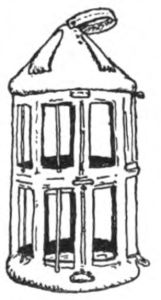
ONE OF THE 'FIGHTING LANTERNS' OF THE VILLE DE PARIS
Now in the Museum of the Royal United Service Institution, Whitehall.
As the Barfleur got nearer, De Grasse fired a challenging gun. It was to attract the approaching flagship's attention. Hood marked the gun and understood it. He at once headed the Barfleur directly for the Ville de Paris. 'I concluded,' said Hood, 'the Count de Grasse had a mind to be my prisoner, as an old acquaintance, and therefore met his wishes by looking towards him.' As the Barfleur began to close with the French flagship, De Grasse made a show of opening fire on her, 'which I,' continued Hood, 'totally disregarded till I had proved, by firing a single gun from the quarter-deck, that I was within point blank.'[43] That was the Barfleur's distance. Ranging up to the Ville de Paris Hood greeted the French admiral with one tremendous salvo of round-shot and grape at close quarters that crashed through the sides of De Grasse's doomed flagship as though they were cardboard. That one broadside struck down sixty men. All was over for the French admiral now. In less than ten minutes the end had come. De Grasse stepped to the taffrail, and with his own hand pulled the Ville de Paris's ensign down. The battle of the 'Glorious Twelfth of April' had been fought and won. As the Ville de Paris's ensign dropped the sun's rim touched the sea-line.
There were but three unwounded men on the Ville de Paris's quarter-deck when the admiral hauled down the flag. De Grasse himself was one. More than a third of the flagship's immense company, officers and men, had gone down, while he himself, at the most exposed point of all from the first shot to the last and seeming to court death throughout, had come through the day unscathed, except for a contusion across the loins from a splinter which did not break the skin.
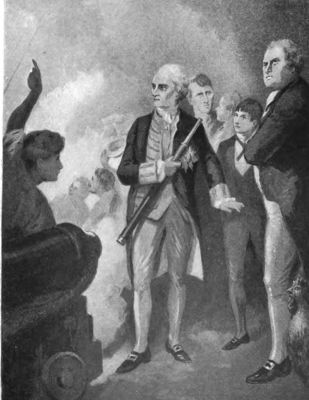
DE GRASSE'S FLAG COMES DOWN. RODNEY WATCHING THE SURRENDER OF THE VILLE DE PARIS
[Immediately behind Rodney's left shoulder is seen the head of Lord Cranstoun. Midshipman Dashwood is readily recognisable, and the tall, bulky man on the extreme right of the picture is Sir Charles Douglas with the little bantam cock near his feet. The picture was shown at the Royal Academy Exhibition of 1784.]
The grand finale was witnessed from the Formidable, now close at hand and drawing up, but just too late to share in the honour of the event. Dr. Blane saw the French flag drop. 'The Formidable was right astern, and having come within shot, was yawing in order to give the enemy a raking broadside, when, Sir Charles Douglas and I standing together on the quarter-deck, the position of our ship opened a view of the enemy's stern between the foresail and the jib boom, between which we saw the French flag hauled down!'[44]
Some one else saw it too—De Vaudreuil. He was about a quarter of a mile off at the moment, and still fighting. It made him senior officer, commander-in-chief. There was now no De Grasse to keep pace with for the honour of the flag. He could consider his own safety. De Vaudreuil at once clapped on every sail that his masts could bear and made off, hoisting as he did so the signal to rally to the north-west. The Bourgogne was the nearest ship to him. Across to her De Vaudreuil shouted orders to make all sail and follow, and as he passed the other ships ahead of him he hailed each to the same effect in turn.
Captain Knight of the Barfleur—son of Dr. Johnson's old friend, Admiral Sir Joseph Knight, with whom the Doctor once stayed for a week on board the Ramillies at Chatham, and afterwards expressed the opinion that 'No man will be a sailor who has contrivance enough to get himself into gaol'—received De Grasse's surrender. A party of seamen and marines from the Barfleur under the first-lieutenant at the same time took possession of the prize. They put off within five minutes of the surrender, and arrived not a moment too soon. With the hauling down of the flag all discipline on board vanished. 'The moment the Ville de Paris struck,' wrote Captain Douglas, 'her worthless, disorderly crew broke open the chests and trunks of all their officers, and with lighted candles in their hands, stove in the doors of the store-rooms in quest of wine and other liquors, to the great danger of all on board from fire.'[45]
Lord Cranstoun in a boat from the Formidable reached the Ville de Paris a few minutes after Captain Knight. He described De Grasse as 'a tall, robust, and martial figure, presenting in that moment an object of respect, no less than of concern and sympathy.' He looked pale and apparently dazed at the tremendous catastrophe that had befallen him. According to Lord Cranstoun the French admiral 'could not recover from the astonishment into which he was plunged, the expressions of which he often iterated, at seeing in the course of so short a time, his vessel taken, his fleet defeated, and himself a prisoner.' Lord Cranstoun brought De Grasse a courteous message from Rodney, to the effect that if he wished he might remain for the night 'at his ease' on board the Ville de Paris, 'with every testimony of attention and regard manifested towards him on the part of the British commander.'[46]
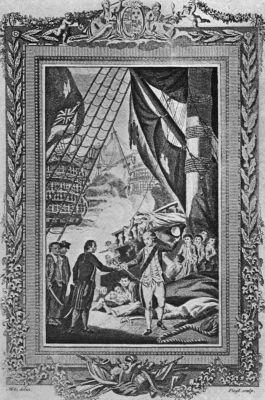
'Count de Grasse, the French Admiral, resigning his Sword to Admiral Rodney after being defeated by that gallant Commander in the West Indies. April 12, 1782.'
The state of things on board was appalling, 'altogether terrible,' said Lord Cranstoun. The quarter-deck was 'covered with dead and wounded.... Between the foremast and main-mast, at every step he took,' Lord Cranstoun told Sir Nathaniel Wraxall, 'he was over his buckles in blood.'[47] Below, where the cattle (to provide the troops on board with meat) had been stalled between the guns, things were even more horrible, for 'they had suffered not less than the crew and troops from the effects of the cannon.' De Grasse himself, incidentally, gives an idea of the state to which the Ville de Paris had been reduced at the end. In his official report to Versailles on the battle he said, 'I was reduced to such a state that the enemy on the morning of the 13th, to strike the ship's pennant, were obliged to cut away the masts for fear, in sending a man to get at the pennant, all would go overboard or come down in a crash on deck.'
Immediately after the surrender of the Ville de Paris Rodney made the signal for the fleet to cease firing and bring-to. There was to be no pursuit. It was a decision for which Rodney has been bitterly criticised. He had, however, his reasons, and he put them in writing; but it was, all said and done, a very grave error of judgment on the part of the British leader. 'Come, come,' he is said to have exclaimed in reply to a suggestion that was made to him by Hood, that part of the fleet at any rate might follow up the enemy, 'we have done very handsomely!' It was not the old Rodney of the Eagle who said that, one must remember. Rodney in April 1782 was a man broken in health, racked with gout, a man grown prematurely old,—ten years, at least, older than his real age,—and utterly worn out after twelve anxious hours on deck under a burning sun. Before that, also, as Rodney himself said, he had had no proper rest for four nights. Most unfortunately, as it proved, Rodney underestimated the force of the smashing blow that he had dealt the enemy, and formed an entirely erroneous estimate of the condition of the ships that had escaped. He allowed himself to form a picture of their condition that was totally at variance with the facts, and did not think it wise to risk a pursuit in the dark. He made up his mind that the enemy had gone off 'in a collected body,' and that his own fleet had suffered more severe damage than was actually the case. There is no need here to press the matter further, or to recall Hood's bitter animadversions on his chief's breakdown, or what certain of the captains are said to have thought. Rodney was commander-in-chief and all responsibility for the safety of the British West Indies rested on his shoulders. Also his reasons for bringing-to commended themselves to him at the time.
The short tropical evening closed in, and darkness fell on the scene—the darkness of a sultry black night without moon or stars. Each ship, of course, had her poop lantern showing, and lights gleamed out through the ports of all as the working parties moved about between decks, busily engaged in cleaning up and taking temporary measures to clear away the marks of battle, as far as might be done in an hour or two, preparatory to turning-in for the night.
Yet before the wearied men could get to their hammocks one more event was to happen, to mark the dread closing of a tremendous day. Nor was it out of keeping with what had gone before. Towards nine o'clock, all of a sudden, a burst of roaring flame shot up from one of the French prizes, illuminating the sky and sea for many miles all round. De Vaudreuil and his fugitive fifteen, far away to northward by now, below the horizon, could see the reflection and guessed what it was. Bougainville, in the other direction, flying towards Curaçao, saw it too. The victim was the captured César. One of her own disorderly crew, it came out later, did the mischief. They had been as usual clapped under hatchways after the surrender, but had the hold to themselves. There the rabble—as on board the Ville de Paris, all bonds of discipline had ceased to exist with the striking of the flag—had broken into the spirit-room and held a wild orgy among themselves, regardless of consequences. A drunken French soldier, seeking for more drink with a pannikin in one hand and a naked light in the other, dropped the flaring candle into an open cask of ratafia. Who-o-o-f!!! Instantly the whole place was ablaze from end to end, and the flames leapt along in a flash from deck to deck throughout the ship. There was no checking them, and the splintered woodwork everywhere was in the best state to feed the fire. Out of mercy to the prisoners below the hatches were lifted off, and those who could escape given a chance. That, unfortunately, at the same time made things worse for the ship. The more sober of the Frenchmen joined the small British prize-crew of fifty-eight men and a lieutenant, and lent a hand to try and get the flames under. Half-a-dozen thought of their wounded captain, the Comte Bernard de Marigny, who was lying badly wounded in the cabin. These made their way into the cabin, and told De Marigny that the ship was expected every minute to blow up. 'So much the better,' was all the Captain replied, very quietly, according to French accounts, 'the English won't keep her! Shut my door, my friends, and leave me. Try and save yourselves!'[48] The British prize-crew—they were all from the Centaur—fought the fire heroically, and spared no efforts to beat the flames back, but in vain. The British lieutenant in command was seen at the last in the stern gallery giving his orders. All the César's boats had been knocked to pieces in the battle. Outside, all round, were the boats of the fleet lying on their oars, ready to save all they could, but, for various reasons, unable to get near the ship. One of the reasons has been specially recorded—the sharks. Again the sharks were on the spot, 'not yet glutted,' said Dr. Blane, 'with the carnage of the preceding day.' What the men on the boats saw and told the doctor, was, in Blane's words, 'too horrid to describe.' A solid belt of sharks surrounded the burning César, a closely packed mass of struggling, huge-girthed brutes, rolling and tumbling about all round, jostling one another and scraping their rough backs together as they plunged and wallowed about all over the surface. Attracted by the glare they had come crowding to the spot, 'every shark in those waters seemed to be there,' and swarmed thronging close round the vessel, surging up and snapping and tearing at the poor frenzied wretches who were clinging on alongside on fragments of spars and wreckage that had dropped overboard. One by one the sharks picked the poor fellows off. The boats meanwhile could not, dared not, force their way through. They could only look helplessly on and wait for the end:—
Watch the wild wreck; but not to save.
The end came between ten and eleven. The César, half burned to the water's edge, blew up with a dull heavy roar—'not a loud explosion,' notes an onlooker. Indeed there was not much powder left to blow up in the bravely defended ship's magazines. It was merely a belching up of flame and sparks, like the blowing out of the pinch of powder at the bottom of a squib or Roman candle; just enough to rend the remains of the hull apart and scatter its contents. Then all was black darkness. A few twinkling sparks high overhead caught the eye, as the burning fragments poised in mid-air and turned for the downward drop, followed by splashes in the sea all round, and here and there, out of sight,
A solitary shriek, the bubbling cry Of some strong swimmer in his agony,
as some shark claimed its last victim, and then all was over. Silence and darkness fell once more on the heaving waters, and the boats pulled sadly and wearily back to their ships. Such was the tragedy of the César. A handful of survivors were picked up, though how they escaped is not stated. All were Frenchmen. Not one of the British prize-crew escaped.
Now at last Rodney's day was over: the 'Glorious Twelfth' reached its last hour in silence and passed away.
'The battle is over and the British fleet victorious, De Grasse is in my cabin, the Ville de Paris and four ships of the line are in our possession and one sunk, their whole fleet completely mauled.' So ran the opening sentence of Rodney's first letter after the battle, written on the morning of the 13th. Writing to a brother-admiral he spoke of the battle as having been 'long and bloody, but never doubtful in my opinion.' Eleven hours was Rodney's estimate of its duration, and he added, 'by persons appointed to observe there was never seven minutes' respite during the engagement.'
For the enemy it had been a sanguinary and costly day. The French losses in the battle—including the crews of four ships taken by Hood a week later—amounted, in round numbers, to 'at least 15,000 men.' Seven thousand of the number were either killed, wounded, or drowned. Six French captains were among the dead,[49] who, reckoned by themselves, were 3000. Over a thousand of the casualties were in the Ville de Paris and the César alone. Among the 8000 prisoners were 2000 soldiers. The monetary loss to France, in the value of matériel taken, was put at just half a million sterling; and that sum does not include the treasure-chest of De Bouillé's army, thirty-six boxes of money containing coin to the value of £25,000.[50] Also on board the captured ships, by a curious chance, was found the whole of the French army's siege-train for Jamaica, heavy guns and carriages, and equipment complete.
Such were some of the first fruits. The immediate collapse of the campaign against Jamaica was another of the fruits of the victory, and there were yet other results of wider-reaching effect. The blow that Rodney dealt on the 12th of April reacted on the sea campaign in Home waters, and strengthened Howe's hand for the final effort of the war, the relief of Gibraltar. 'On that memorable day,' says Froude, 'was the English Empire saved.'
For the British the 'butcher's bill,' as the tars of Rodney's day called it, proved comparatively light. The Admiral's first despatch gave the figures as 230 killed and 759 wounded; corrected later to 337 killed and 766 wounded, or 1103 in all. Of the total the Formidable's share was surprisingly small, only 14 killed and 39 wounded, yet hers was the third heaviest return sent in. The French officers of De Grasse's suite, indeed, when they were told the figures, refused at first to accept them. 'It was with difficulty,' says Dr. Blane, 'we could make the French officers believe that the returns of killed and wounded made by our ships to the Admiral were true. One of them flatly contradicted me, saying we always gave the world a false account of our losses. I then walked him over the decks of the Formidable and bade him remark what number of shot-holes there were, and also how little her rigging had suffered, and asked if that degree of damage was likely to be connected with the loss of more than fourteen men, which was our number killed, and the greatest number of any in the fleet except the Royal Oak and Monarch. He was visibly mortified to see how little our ship had suffered, and then owned that our fire must have been much better kept up and directed than theirs.'[51] It was, of course, the demoralising effect of Rodney's gunnery on the enemy at the outset that made all the difference.
The Formidable, as to that, had taken her own part effectively. The gunner's return showed that the British flagship had fired eighty broadsides—35 tons of shot. Rodney himself was enthusiastic over his ship's performance. 'The Formidable,' he wrote, 'proved herself worthy of her name!'
De Grasse came on board the Formidable next morning, and stayed there as Rodney's guest for two days while the Ville de Paris, for the time being in tow of the Namur, was being cleansed and made habitable. A night's rest worked wonders in the French admiral. 'He bears his reverse of fortune with equanimity, conscious as he says that he has done his duty, and I found him very affable and communicative.' So Dr. Blane wrote. He and Captain Douglas acted as interpreters between the admirals: Rodney—it is rather curious, if we remember a certain story—could not speak a word of French.[52] De Grasse was very frank with everybody. For one thing, he said, he did not wonder that he had been beaten. From what he had seen he considered that the French navy was 'a hundred years behind that of Great Britain.' Wrote Rodney himself of one conversation:—'Comte de Grasse, who at this moment is sitting in my stern gallery, tells me he thought his fleet superior to mine, and does so still, though I had two more in number; and I am of his opinion, as his was composed of all large ships and ten of mine only sixty-fours.'[53]
Rodney remained in the neighbourhood of Dominica for four days, refitting and repairing damages. His frigates meanwhile searched the bays among the islands to northward, St. Kitts and Eustatius in particular, for traces of French fugitives in that quarter. None, however, were found. The only news brought back was that several crippled French ships, one identified as De Vaudreuil's Triomphante, had been sighted by the islanders passing on the day after the battle. On the morning of the 17th Hood was despatched with the least damaged of the British ships to cruise off the south of San Domingo and intercept any of De Vaudreuil's laggards. Rodney himself moved off in the afternoon of the same day with the more seriously damaged ships and the prizes in tow, for Jamaica, following on much the same course towards San Domingo. He met Hood four days later, returning with four French prizes, two ships of the line and two frigates, the proceeds of a smart little affair that Hood had had with a force of the enemy in the Mona Passage. Rodney then continued his course for Port Royal where he arrived on the 29th, to be received as the saviour of the colony.
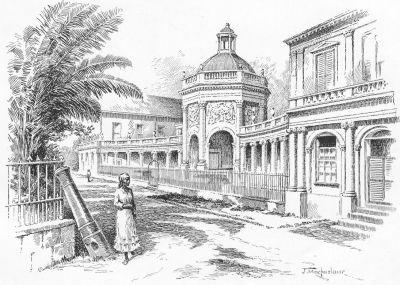
THE 'RODNEY TEMPLE,' SPANISH TOWN, JAMAICA [The two guns from the Ville de Paris are visible behind the railings.]
'All Jamaica,' wrote Rodney, 'went mad with joy.' So much so, indeed, that the Admiral did not set foot on shore for a week, 'to avoid being pestered with addresses, etc.' To this day Rodney is the genius loci in Jamaica. The statue to him, by Bacon, voted by the House of Assembly 'as a mark of gratitude and veneration,' is one of the sights of the island. It represents the Admiral in the dress of a Roman Imperator, and stands, flanked by two brass guns from the Ville de Paris presented by Rodney himself, under an imposing classic temple that takes up one side of 'the Square' in the centre of Spanish Town, the old capital of Jamaica; with the 'King's House,' the residence of the Governor, on one hand, and the House of Assembly on the other, and facing it, across the gardens of the square, the Court House.
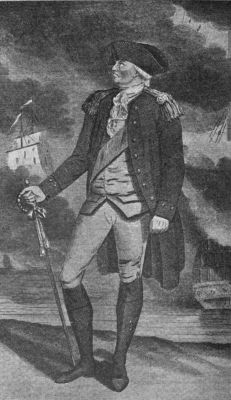
ADMIRAL DE GRASSE AS A PRISONER OF WAR
[Stated to have been 'drawn from the life by a celebrated artist,' while De Grasse was in London on parole as a prisoner of war. The background is, of course, artistic fancy work.]
The fleet remained refitting at Port Royal for upwards of nine weeks. Port Royal dockyard proved to be in an almost hopeless state of neglect and confusion, totally unfitted to supply the needs of a great fleet in the condition of Rodney's. De Grasse left for England in the interval, as a passenger in the first convoy sailing. We may take leave of him here. How the French admiral—the first commander-in-chief of an enemy brought to this country since Marshal Tallard came over after Blenheim—landed on Southsea beach in the presence of a cheering crowd; how King George received him in the most kindly and gracious manner, while English society showed him every mark of courteous sympathy, are matters beyond our present scope.[54] Nor can the unfortunate admiral's after fate be referred to at length. It will be enough to say that De Grasse later on published an open letter complaining that he had been betrayed by his captains. This caused an outburst of indignation in France which led to a Conseil de Guerre on every officer from De Vaudreuil downwards. The tribunal exonerated everybody,[55] laying all the blame on De Grasse himself, and the admiral was banished from Court in disgrace, which meant social ostracism and the cold shoulder for the rest of his days.[56]
The Ville de Paris followed her late admiral with the next convoy to England—never, however, to arrive there. She went to the bottom in a terrific storm which fell on the convoy in mid-Atlantic, but when, or exactly where, or how, is to this day unknown. Of all on board, upwards of five hundred officers and men, one seaman only was saved. He was picked up after the storm one morning, clinging to some floating wreckage—an imbecile. Mind and memory had gone. The only thing that the man could say was that a day or two before he had seen the Glorieux go down suddenly. All after that, all about his own ship, everything, except that he was 'Wilson of the Ville de Paris,'—was a blank.
Rodney was detained at Port Royal until the 10th of July. Then with all the fleet repaired and fit for service, just as he was on the point of sailing to blockade the enemy off Cape Haitien, a ship from England, the Jupiter, arrived bringing a curt order from the Admiralty to 'strike his flag and come home.' It was the first word of any kind he had had from England since the battle; indeed, since the beginning of April, when he was in Gros Islet Bay before the battle. To add to the sting of the blow Rodney's successor was on board the ship that brought the order:—Admiral Pigot, an absolute nonentity, a man who had never served at sea since he was a captain, and then without distinction. That was the sort of man sent out to supersede the first naval commander of the age on the morrow of his greatest triumph. It was all a matter of party politics, a shameless political job. Rodney was a Tory in politics and had been appointed by a Tory First Lord. The Whigs had come into power since he last heard from England, and the new Ministry on coming into office had promptly cancelled his appointment and sent out one of their own partisans, hitherto only known as a naval M.P., to replace, in the presence of the enemy, the ablest sea officer that Great Britain possessed.
The Ministry having discarded Rodney, what took place when the startling news of Rodney's victory, with the capture of De Grasse and the finest man-of-war in the world, reached England, was indeed the irony of fate. It made up a striking and intensely dramatic situation. When Rodney was ordered home the news of the battle had not arrived. It came on the 18th of May, when Captain Byron of the Andromache, and Lord Cranstoun, who had accompanied him, arrived with Rodney's despatches at the Admiralty at two in the morning. Admiral Pigot had only left London for Plymouth two or three days before. The Admiralty and the Ministry were aghast, amazed, absolutely nonplussed. They had recalled the victor in the hour of the greatest victory that the Royal Navy had ever won perhaps since the defeat of the Spanish Armada. It was an extremely awkward position. Admiral Pigot must be stopped at all cost, and Rodney's order of recall torn up. That was the only thing to be done. A King's messenger with relays of horses was sent galloping down to Plymouth as fast as man could ride. He carried with him a letter of compliment and congratulation to Rodney, written at seven on the morning of the 18th, which was to go instead of the other. The messenger got to Plymouth just too late. He arrived there at two in the afternoon of the 19th, to find that Pigot had sailed on the evening before. A swift cutter was sent after the Jupiter, but failed to catch her up. So the Whig Ministry were left face to face with the unenviable situation that their own narrow partisanship had created.
'A generation ago,' says a writer in one of the earlier numbers of the Quarterly Review, 'men were still living who could tell of the flame of indignation which ran through the country when it was known that the new Whig Government had recalled Admiral Rodney, because the expedition which he commanded had been planned by the Tories.' No doubt that was so. But the flame burned itself out quickly. The Whigs in Parliament and outside it were able to counter the Tory reproaches by retorting that whatever was the case then, when the recall of Rodney was first notified, three weeks before the despatches came, not a voice had been raised against it. All over the country at the same time, Whigs and Tories made common cause in heaping adulation on the victor, and expressing their general feelings in exuberant rejoicings. In London, after the Park and Tower guns and the pealing of the church bells had confirmed the breakfast-table rumour, 'the whole town was in an uproar,' we are told, everybody making the day a holiday and hanging out flags. All London was illuminated that night, the very poorest finding a candle to stick in every pane in their windows. Wraxall, writing in 1816 (the year after Waterloo) his recollections of how London received the news of Rodney's victory, says: 'When I reflect on the emotions to which it gave rise in London, I cannot compare them with any other occurrence of the same kind that we have since witnessed in this country.'[57] Dr. Blane writing some years afterwards from what he was told, says that even the cripples and invalids in hospital 'demonstrated their joy on hearing of this victory, by hoisting shreds of coloured cloth on their crutches.' Lady Rodney and her daughters went to the theatre that evening. 'When we went in,' wrote Miss Jane Rodney to her father, 'the whole house testified by their claps and huzzas, the joy they felt at the news, and their love for you, and their acclamations lasted for, I am sure, five minutes.'[58] The versifiers of course seized on the occasion, and they found editors ready to take their 'copy.'
The Grass in Paris streets so long had grown That farmer Rodney thought it should be mown, So up his Formidable scythe he took And cut the Grass of Paris at one stroke—
was one effusion that is among the best. Throughout the country, as the laurel-bedecked stage-coaches passed the news along, there was hardly a village that did not ring its bells and have its bonfire. Half the taverns, we are told, painted out their 'Markis o' Granby' signboards for 'The Admiral Rodney,' and Rodney's is to this day the most common of naval names on inn signboards. There are, as a fact, more 'Lord Rodneys' up and down the country than 'Lord Nelsons.'
Rodney, at Port Royal, accepted the situation with quiet dignity. He said nothing, handed over the command to Admiral Pigot, and shifted out of the Formidable forthwith into the smaller Montagu, then under orders to proceed to England. Twelve days after Pigot's arrival, Rodney sailed. There is no need to carry the story further. How Rodney was rewarded by the country, and how he passed his closing years, are matters of general history.
One of the Formidable's men on Rodney's day was a smart young seaman named Stephens. He lived to be 'Mr.' Stephens, the boatswain of the famous Shannon when she met the Chesapeake, on which occasion, too, he lost an arm. He found a place in Captain Broke's despatch, and had the further distinction of being asked by the officers to sit for a statuette of himself to be made, which became one of the special treasures of the last of the Shannon's officers, the late Admiral of the Fleet, Sir Provo Wallis. The last surviving officer of Rodney's flagship was Sir Charles Dashwood, who died in 1847, Vice-Admiral of the White, and K.C.B. The last survivor of all, both of the Formidable's company in 1782, and of all who fought in the battle itself, was a seaman of the Formidable, George Neale, who died at Coventry in 1849.
We will close the story with one final word about the Formidable's after career. She outlasted Rodney by nineteen years, and served in the interim throughout the war with the French Revolution and with Napoleon. Had it not been for an accidental delay she would have been Duncan's flagship at Camperdown. The Formidable had been fitted for Admiral Duncan's flag, and sailed from the Downs for the Texel on the very day that the battle was fought. Her end came in 1813, in which year the fine old veteran of the sea was struck off the Navy List as unfit for further service, and handed over to the shipbreaker.
To Dead Man's Bay when her day is past, To Dead Man's Bay comes the ship at last.
Thus for the present we close the record of this 'blustering adjective' from the point of view of naval history. Enough has been told. 'A nation,' says Guizot, 'is safe in the greatest crisis of its fate if it can remember its own history.' Those who on a future day may serve in our present Formidable before an enemy, will be none the worse for remembering the associations of old-time victory that form part and parcel of their ship's famous name, in virtue of which, that name finds its place to-day on the roll of the Royal Navy for 'one of the best' among the battle-ships of the British Fleet.[59] 'No man,' wrote a young officer of the famous Bellerophon, in his last letter home on the evening before Trafalgar, 'can be a coward on board the Billy Ruff'n.' No man on board the Formidable, who knows the story of his ship, should be found wanting on the day of battle. It will rest as a point of honour with those who then man the Formidable to remember Rodney and prove the Formidable 'worthy of her name.'
FOOTNOTES:
III
WON AT THE CANNON'S MOUTH
HIS MAJESTY'S SHIP UNDAUNTED
Sound, sound the clarion, fill the fife! To all the sensual world proclaim, One crowded hour of glorious life, Is worth an age without a name. Scott.
There is no incident quite like it in all the annals of the Royal Navy. There is hardly a finer tale, all said and done, hardly a more stirring story, than that which tells how we came by our first Undaunted—why there is an Undaunted to-day on the roll of the British fleet. Better name for British fighting ship there could be none; none, assuredly, of happier omen. In a sense, indeed, it is, so to speak, a self-made name. No Admiralty Lord of high degree in the comfortable surroundings of a sanctum at Whitehall first made choice of or appointed it. No lady fair with customary libation of foaming wine on dockyard gala day wished 'God speed' to our first Undaunted. In quite another way, indeed, was the name first given. Amid the clash and ring of hostile steel, in the heat of a hard-fought fight, with shells bursting round, and grape-shot hurtling through the powder smoke, with bullets flying thick, while men closed hand to hand with cutlass and bayonet and boarding pike, came the first idea of the name Undaunted, and the scene of its first appointment, of its first bestowal on a British man-of-war, was the quarter-deck of a British flagship, as the last echoes of battle were dying down.
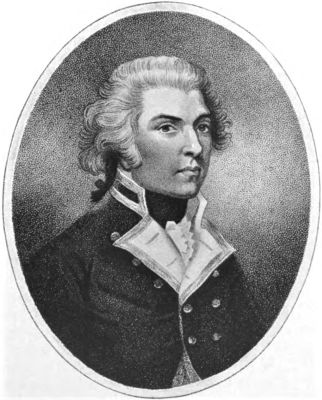
THE FIRST CAPTAIN OF THE FIRST UNDAUNTED—CAPTAIN ROBERT FAULKNOR
The West Indies, Nelson's 'station for honour,' was the scene of the event, off the island of Martinique, and Thursday the 20th of March 1794 was the day. There had been turbulent doings in Martinique for the past six weeks. Ever since the second week of February, day after day, almost incessantly, the quiet valleys and hillsides of the fair island had re-echoed with the crackle of musketry and the booming of cannon. It was the old story, of course, red-coats fighting blue; the old story—with the old result. We were in the second year of the war with the French Revolution, and a British army had been sent over to drive the French from their West Indian possessions. Martinique was the first to be attacked, and three columns of British troops had landed there at different points to fight their way inland until they met, driving the French field force and garrisons before them. Outmatched in the open, the French troops and local militiamen had in the end fallen back on Fort Royal, whither General Rochambeau, the French Commander-in-Chief in the West Indies, had called in all his forces and massed his battalions to make a final stand at bay. The fate of Martinique depended on their power of holding out until help from outside should reach them.
A large and powerful British fleet under Vice-Admiral Sir John Jervis, the future Earl St. Vincent, had escorted the troops across the Atlantic. After assisting the soldiers in the earlier stages of the campaign it had closed in and fastened its grip on the seaward approaches to Fort Royal.
Fort Royal was the headquarters station of the French in the West Indies. It was situated at the head of a deep bay, Cul de Sac Royal as it was called. The place was strongly fortified, and was the great arsenal and dockyard of France across the Atlantic. For a hundred years past and more French fleets and squadrons had fitted there for war, and had put in to repair after battle. Thence Du Casse had sailed to fight Benbow. From there, as we have seen, De Grasse put out to meet his fate off the 'Saints' at the hands of Rodney. Two fortified positions of considerable strength and with heavy cannon, besides outlying redoubts and batteries, defended the town of Fort Royal; one position fronting inland, the other facing towards the sea.
Against the former, Fort Bourbon, an entrenched work set on high ground at the back of the town of Fort Royal, the main force of our soldiers was to operate, attacking with a siege train of heavy guns and mortars and opening zigzags and parallels in the orthodox way. Fort Louis on the sea front, blocking the entrance to the carénage, or man-of-war harbour, and the dockyard, was to be attacked by the Naval Brigade, assisted by a number of grenadier and light infantry companies, with siege batteries made up of ships' 24-pounders. At the entrance to Fort Royal Bay, to 'keep the ring,' as it were, rode the big two-deckers and frigates of the fleet.
The bombardment began on the 7th of March and lasted ten days, during which time the enemy resisted stoutly. Their sorties were, however, beaten back, and by the 16th of the month the advanced batteries of the second parallel had been pushed forward to within 500 yards of Fort Bourbon. The sappers and miners had in the same time got nearer still to Fort Louis. As yet though no date had been fixed for the assault.
On the 17th of March an accidental circumstance suddenly brought on the crisis. Lieutenant Bowen of the flagship Boyne, who commanded the guard boats of the fleet, heard that there were some British seamen prisoners on board a French frigate that lay in the carénage moored close under the walls of Fort Louis. He was a young fellow of exceptional daring, and a fine piece of work suggested itself to his mind. It was to dash in on his own account and try and cut out the French ship and rescue the prisoners. Young Bowen said nothing about it to any one. He took his boats in and made the attempt. He boarded the frigate in the face of a sharp fire, only, however, to find that the prisoners had been removed. Then he tried to bring the prize off. It proved, however, impossible. The frigate had been moored with chains and had no sails bent to her yards. Lieutenant Bowen had to retire, but his daring attempt gave an idea to the British admiral. It took shape on paper, and the co-operation of the military on shore was arranged for. Sir John Jervis's plan was to send in all the boats of the fleet en masse, carrying landing parties of sailors and marines, and attempt Fort Louis itself by a coup de main. At the same time, it was arranged, a brigade of troops, detached from before Fort Bourbon, should move down and threaten the town of Fort Royal and the landward bastions of Fort Louis.
The plan was put in hand at once, and Thursday the 20th of March was fixed on for the attempt. It was to be made in broad daylight, going straight at the enemy. This, briefly, was to be the order of the attack. The Asia, a 64-gun ship, Captain John Brown, with the Zebra, a 16-gun sloop of war, Commander Robert Faulknor, were to push on ahead of the boats. Having got as close in to the ramparts as the tide would allow, the Asia was to batter away at the fort and breach the sea-wall. The Zebra at the same time was to sweep the ramparts with grape and canister and cover the approach of the boats with the storming parties, which were to come up a little astern of her. All the boats in the fleet—flat-bottomed boats, barges, and pinnaces, carrying 1200 seamen and marines—were to be employed, each provided with a number of bamboo scaling-ladders of from 20 to 36 feet long. Everything was ready by the appointed time, seven on Wednesday night, and at five o'clock on the morning of the 20th the signal was given to set off.
Promptly the Zebra led in. There was a brisk north-easterly breeze blowing, and standing right before it she headed directly for the French batteries. The enemy on their side opened fire on her at once, a long-range cannonade, but without effect. She was a small object to hit. Without checking her course the Zebra held on steadily. The Asia followed, and all went well until just as she was getting within grape-shot range. Then suddenly an amazing thing happened. To the blank astonishment of the whole squadron, the 64 suddenly wore round and stood out of the bay. She turned round deliberately and drew off from the enemy. What was the matter? Something very serious indeed must have happened on board. Sir John Jervis himself, the admiral, thought it could only be that Captain Brown had been killed, and sent off his flag-captain to take charge. It was not that, however. Not a man had been touched by a shot. Captain Grey[60] was only a few moments on board, and then went down the side into his boat to return to the flagship, after which the Asia stood in again. It was a great relief to all—when suddenly, just as she got to the same spot as before, within grape-shot range, round went the Asia's bows once more, and she for the second time put back. What on earth had happened now?
This is the story. It is not a very nice one.
A French naval officer who had deserted to the British was on board the Asia in charge of the pilotage arrangements for the day's attack. He was a M. de Tourelles, a Royalist, formerly harbour-master at Fort Royal. He had volunteered for the post and had been accepted for his pilot knowledge. The failure of the Asia was due to Lieutenant de Tourelles' nerves. All of a sudden, as the enemy's opening shots began to fly overhead through the Asia's rigging, M. de Tourelles got alarmed and lost his head. Whether it was sheer cowardice, or a qualm of conscience at the part he was taking against his own countrymen, or a fear for his own skin if anything went wrong and the French got hold of him—from one cause or another M. de Tourelles broke down abjectly. Before any one on board knew what was happening, he had put the Asia's helm hard over and rounded the ship out of action. That was the first failure, and the Frenchman's explanation was that he had somehow got out of his reckoning. After Captain Grey of the Boyne came on board M. de Tourelles said he would try again. He did so; and the same thing happened again. There was, though, another failure on board besides that of the pilot. Once more, to the surprise of all on deck in the Asia, Captain Brown did nothing. He was an officer who had seen service—of the same seniority as Nelson on the post list, and not far off flag rank in the ordinary course—yet he let the Frenchman for the second time carry the ship out of battle. Lookers-on expected him to pistol De Tourelles on the spot, or cut him down; at the least to send him below under arrest and take charge himself. The tide was flowing, it was nearly three-quarters high water, and he might well have risked touching on a shoal and borne up directly for the batteries. Captain Brown, however, did nothing of the kind. The Asia for the second time headed tamely out of action, this time to remain out.[61]
It was a disheartening spectacle and a bad start. The whole attack indeed was jeopardised. The Asia dropped back nearly outside the bay. The boats lay on their oars just within the bay. The Zebra, all by herself, entirely unsupported, was some distance ahead; all the time under fire from the enemy, stormed at by round-shot and shell and grape from every gun that the French could bring to bear on her.
Fortunately Commander Faulknor was not of the stamp of Captain Brown. He might well have anticipated a signal of recall and turned his little sloop away to retire out of range and wait for further orders. But he was not that sort of man. When he saw the Asia go about and retreat for the first time, although he had already got so far in as to be within musket-shot of the nearest French battery, he lay-to and waited. The French were already firing at him, but not the smallest notice would he allow to be taken of the enemy's shots. The Asia, as he saw, headed in and came on again; after which, for the second time she turned away and stood back. Commander Faulknor knew what that meant. He saw that he had been left in the lurch. He saw now that he must expect no assistance from the Asia, the big ship that was to have been the mainstay of the attack. The odds against him might well have daunted the bravest man. They did not, however, daunt Robert Faulknor. He then and there determined to undertake the whole duty of tackling the French batteries and covering the boat attack single-handed, with his own little ship and her crew of one hundred men all told.
It was a daring resolution, for Fort Louis was a very formidable work, mounting heavy guns and strongly held. It crowned a rocky eminence that jutted out menacingly into Fort Royal Bay. The sea face rose abruptly from the water's edge, with a wall and parapet, 15 feet high, scored with embrasures for big guns all along that side. In rear of the parapet three lofty tiers of platforms, rising one above another, with the muzzles of guns showing at all points, frowned fiercely down on all who should venture to approach in hostile guise. Fort Louis guarded the fairway into the carénage, or man-of-war harbour, round a bend immediately in rear of the fort, and it also covered the town and warehouses of Fort Royal proper, the civil settlement, which fringed the harbour on the farther side.
The perilous nature of the task he was taking in hand did not, however, count with the gallant officer who had charge of the Zebra. He was used to taking risks. Commander Faulknor had already in this campaign shown the stuff he was made of, and that not once nor twice. He was not the man to blench here.
The commander of the Zebra was indeed a man in a thousand. Hardly a finer fellow in every respect than Robert Faulknor ever trod the quarter-deck of a British man-of-war in any age. He could not, perhaps, well help being so. If ever a British naval officer had the sea 'in his blood,' as the old saying went, Faulknor had it. Not many families ever did more for the Sea Service than the Faulknors of Hampshire in the eighteenth century. A round dozen of its sons, as captains and admirals, walked the quarter-deck in the times between Queen Anne and William the Fourth. As a fact, he owed his very origin to a naval romance. His father was 'Bob Faulknor of the Bellona,' perhaps the most popular man in the service in his day, who in the first year of George the Third's reign took a big French 74, the Courageux, off the coast of Spain, in a ship-to-ship duel fought out to the bitter end, and won a fortune and a beautiful bride, our hero's mother, at one and the same time. The newspapers were full of the dashing fight, a story full of incidents of heroism on the part of the Bellona's captain, and the young lady reading the story there, gave her heart to the gallant captain she had never seen. Meeting 'Captain Bob' on his return to England at a ball, quite by chance, he for his part, in turn, fell violently in love with her, and they married and lived afterwards the happiest of wedded lives. Commander Faulknor's grandfather was old Admiral Balchen's flag-captain, who was lost with his veteran chief and upwards of a thousand officers and men, in the wreck of the Victory of George the Second's fleet, the predecessor of Nelson's Victory, off the Caskets near Alderney, one stormy October night of the year 1744. Commander Faulknor's great-grandfather got his lieutenant's commission three years after the battle of La Hogue, fought all through 'Queen Anne's War,' and died in George the First's reign, Lieutenant-Governor of Greenwich Hospital. Such was the stock that Commander Faulknor came of.
Faulknor gave orders to let fall the foresail and hoist every stitch of canvas that the ship's masts would stand. Then he again headed the Zebra up the bay, pointing in directly for the ramparts of Fort Louis. All round her, as the little sloop dashed forward, the water leaped and splashed, torn into spray under the tornado of grape and canister and round shot—any single one of which hitting the Zebra fairly must have torn the little vessel open and sent her to the bottom like a stone—with which the French batteries met her as she came on. But it made no difference. A special Providence—in the form of a drizzling squall that suddenly came on, blowing in from the sea right in the faces of the French gunners—seemed to be protecting the ship and her men, and she passed through practically unscathed. One shot cut the main-topmast away, but that was all. The balls whizzed through the rigging and within a few inches of the men's heads but not a single man was harmed.
At the instant that the Zebra was seen to make sail and move ahead, the boats of the squadron set off rowing after her at their best speed, while the Naval Brigade batteries on shore, facing the flanking bastions of Fort Louis on either side, redoubled their fire on the enemy's works to distract the attention of the French as far as possible. At the same time, to hold Fort Bourbon on the hill behind Fort Louis in check and prevent reinforcements being sent down to assist the lower fort, the British siege batteries up above burst out into a tremendous fire of round-shot and shell that swept the French ramparts in the upper fort from end to end.
On board the Zebra it was an anxious time for every one; and with it all, simultaneously, Commander Faulknor had yet another trial sprung upon him. The risk from the enemy's shot was not the severest ordeal that the captain of the Zebra had to go through. By an extraordinary coincidence, exactly the same thing happened on board the Zebra as had already happened with such unfortunate results on board the Asia.[62] The pilot's nerve failed. The pilot of the Zebra was an old man-of-war's man, who had been employed for many years in the West Indies on account of his pilot knowledge of the islands. He now broke down at the critical moment. But, as has been said, Commander Faulknor was not a Captain Brown.
As he gave the pilot the order 'to place the sloop close under the walls of Fort Royal,' he instinctively noticed that something was wrong. The man, he thought, seemed to hesitate. He turned aside to one of his officers.
'I think Mr. —— seems confused, as if he doesn't know what he is about. Has he been in action before?'
'Many times, Sir,' was the reply; 'he has been twenty-four years in the service.'
But Faulknor was not satisfied. He eyed the pilot closely and then stepped up to him and asked him a trifling question to test him. His suspicions were fully confirmed. The pilot's 'agitation was such as to render him incapable of giving any answer.' Recovering himself to some extent a moment later the wretched man, keeping his eyes on the deck, in a low voice addressed Faulknor, who was bending over him, with this startling admission:
'I see your Honour knows me. I am unfit to guide her. I don't know what is come over me. I dreamt last night I should be killed, and I am so afraid I don't know what I am about. I never in all my life felt afraid before.'
One cannot help feeling pity for the unhappy fellow; but it was no time for pity. Commander Faulknor could do only one thing, and he did it. Without for an instant losing his presence of mind, he replied to the man in a still lower tone:
'The fate of this expedition depends on the helm in your hand. Give it to me, and go and hide your head in whatever you fancy the safest part of the ship. But mind—fears are catching. If I hear you tell yours to one of your messmates, your life shall answer for it to-morrow!'
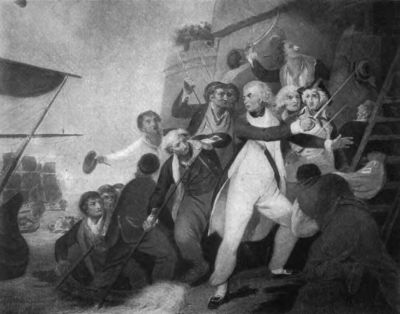
CAPTAIN FAULKNOR STORMING FORT LOUIS
'The poor fellow,' in the words of the Naval Chronicle, 'panic-struck, went away, and overcome with shame sat down upon the arm chest, whilst Captain Faulknor seized the helm and with his own hand laid the Zebra close to the walls of the Fort, but before he had got upon them at the head of his gallant followers, a cannon-ball struck the arm chest and blew the pilot to atoms.' He was the only man killed of all the Zebra's crew that day.
Would the pilot have escaped had he pulled himself together and stuck to the helm? This is what Commander Faulknor wrote home to his mother after the fight.[63] 'I had a ship's cartouch box, which is made of thick wood, buckled round my body with pistol cartridges in it, for the pistol I carried by my side. As the Zebra came close to the fort, a grape-shot struck, or rather grazed my right-hand knuckle, and shattered the cartouch in the centre of my body: had it not miraculously been there I must have been killed on the spot.'
Faulknor ran the Zebra in and laid her as close under the French guns as the depth of water at that state of the tide would allow, within fifteen feet of the walls of Fort Louis. The next instant 'the scaling-ladders flew from the rigging, the boats in tow astern became the bridge, and Captain Faulknor headed his boarders over the parapet into the fort.'
The boats of the squadron, led by Captains Nugent and Riou—'the gallant, good Riou,' killed before Copenhagen seven years later, as all the world knows—were coming up astern, flying through the water after the Zebra, as fast as the men, bending their hardest to their oars, could send them forward; but they were still some way off.
Faulknor and his men clambered up the parapet, through the embrasures, and sprang over into the fort. Right in front of them, drawn up in rear of the ramparts, stood with muskets at the present, a whole French regiment, the 33rd of the Line, a veteran battalion of the old Royal Army of France, and one not yet disorganised by Republican methods, the Régiment de Touraine. It met the first appearance of the sailors, as they set foot on the ramparts, with a crashing volley. Only three of the Zebra's men were hit, and they had only flesh wounds. With a cheer up went the cutlasses and the sailors made a rush in on the French bayonets, to settle the matter hand to hand. But no! A sudden panic seized the Frenchmen. Down, clattering to the ground, went their muskets all along the line, and up went their hands, as the Régiment de Touraine, panic-stricken, screamed and yelled for quarter. It was given. Faulknor turned round short, flung himself before his leading men, and by main force stopped them as they were in the act of closing. 'I take some credit to myself,' he related to his mother, 'that after the Zebra had stood a heavy fire, and when we had the power to retaliate, for we were mounted upon the walls, I would not allow a man to be hurt, on their being panic-struck and calling for mercy.'
The iron gates leading to the citadel of Fort Louis then barred the way, but these were burst in and the little band of sailors rushed through, the heroic Faulknor leading. They fought their way steadily and swiftly, until within seven minutes of forcing their entry they had got up to the very topmost platform of Fort Louis. That was instantly seized and the place was theirs. The commandant of the fort and his staff yielded themselves up as prisoners of war, and the French flag was hauled down, an English Jack going up in its place, 'amidst the shouts of triumph from the armed boats, from the squadron, and from the army, which thus announced its arrival outside.' Five stands of military colours were taken with the garrison. 'The sword and colours of Fort Royal,' wrote Faulknor home, 'were delivered to me by the Governor of the fort.'
This is the modest way in which Faulknor recorded the events of the day in the Zebra's log:—
March 20.—At 5 A.M. we weighed and came to sail. At 8 A.M. the enemy began to fire on us from Fort Royal, which they cond till noon, when we ran in under their fire to the fort. I, together with the officers and seamen, stormed the fort, with the loss of one man killed and five wounded. The rigging, masts, and sails much cut, and kedge anchor, which hung under the bowspritt, cut away the spritsail yard and carried away the jib-boom. A heavy and well-directed fire was kept up from our battery's and gun-boats whilst we were running in, and the flat boats under the command of Commodore Thompson followed us with 500 seamen.[64]
A touch that helps to show us something of the chivalrous character of Commander Faulknor must be noted in passing. 'The British ensign being displayed over the fort, Captain Faulknor sent his second lieutenant to the casements (sic), where the French officers' families, (and) the sick and wounded were, to assure them of protection.'
'After that,' we are told, 'Mr. Hill (the second lieutenant) had the proud duty of letting down the drawbridge to the Commander-in-Chief of the Army.'
The securing of the capture, the holding of the fort was, of course, for other people to do. The 100 officers and men of the Zebra were too few to do it. But the boats of the squadron were now alongside the walls and landing their men, and the soldiers were at the gates. There was no object in remaining ashore longer. Captain Faulknor handed over his capture to the senior officer present, and quietly drawing the Zebra's company off, marched them down and returned on board. Then he sent his boats and had the French frigate lying in the carénage taken possession of—the Bien Venu was her name—which was done without resistance, after which, in the most ordinary and matter-of-fact way, just as it were going out of a morning from Portsmouth Harbour to Spithead, he made sail and stood out to rejoin the squadron.
The unprecedented scene that followed, is indeed the climax of the whole story. 'Such compliments, that it is impossible for me to relate them—compliments ... without example in the navy,'—were Commander Faulknor's own comments on the extraordinary reception that was accorded him.
As the little Zebra was seen approaching, the Boyne, Sir John Jervis's flagship, manned yards and rigging. Then, a moment later, when the Zebra had neared the Boyne and was shaping her course to pass under the flagship's stern on her way to reach her station among the other ships, the 'flagship's band, drawn up on the poop, struck up "See the Conquering Hero comes!"' and a tremendous burst of enthusiastic cheering, repeated again and again, rang echoing out to welcome the daring little ship. It was a splendid scene, stirring and magnificent, and worthy of the occasion, but it was not all. There was more to come. The admiral had a part of his own to play.
'Old Jarvie' did it in a way peculiar to himself. The man of iron had his other side. They did not know the real Jervis who spoke of him as a tyrant, unsympathetic and saturnine, pitiless and a grim martinet, who hanged men on Sunday for the sake of discipline. This was an occasion after Jervis's own heart. None knew better than he how to reward merit: none ever did it better. A signal was made to the Zebra for Commander Faulknor to come on board the flagship. While the order was being obeyed, as the Zebra was lowering her boat Sir John had all hands on board the Boyne called aft and the guard of marines paraded under arms on the quarter-deck. All the officers were sent for to attend the admiral. The Zebra's boat sheered alongside, and Commander Faulknor came up the gangway. As he set foot on the flagship's quarter-deck the admiral, before the assembled officers, stepped forward to meet him. He greeted the young commander with unusual warmth and publicly embraced him. Then he ceremoniously handed Faulknor a commission promoting him post-captain on the spot.
'Captain Faulknor,' said Sir John Jervis, 'by your daring courage this day a French frigate has fallen into our hands. I have ordered her to be taken into our service, and here is your commission to command her, in which I have named her, Sir, after yourself,—the Undaunted.'
The ship in question was of course the frigate Bien Venu, which had been moored in the carénage under the walls of Fort Louis, and had been taken possession of by Faulknor's men after the fort had fallen.
In such exceptionally heroic circumstances was the name 'Undaunted' first introduced on the roll of the British fleet. It has remained there ever since to this day. A more happily chosen name in such a case there surely could be none—better name for British fighting ship there surely could be none.
'No language of mine,' wrote Sir John Jervis, in his despatch to the Admiralty that very afternoon, 'can express the merit of Captain Faulknor upon this occasion, but, as every officer and man in the army and squadron bears testimony, this incomparable action cannot fail of being recorded in the page of history.'
'The idol of the squadron,' 'the admiration of the whole army,' were other expressions that Jervis used in regard to Captain Faulknor.
Captain Faulknor, though, did more than storm and take Fort Louis. By the same act, with the same stroke, he brought about the fall of Fort Bourbon and the capture of the town of Fort Royal, 'rushed' by a column of the besieging troops simultaneously with the storming of Fort Louis. In addition, beyond that, it brought about the formal surrender to England of the entire island of Martinique. All collapsed like a house of cards. General Rochambeau, startled at seeing Fort Louis, his bulwark towards the sea, which covered the only way by which he might hope for relief, snatched abruptly from him, while his own garrison was thrown into a state of hopeless demoralisation by the rabble of fugitive soldiers, bolting before Faulknor's men, and flying in wild disorder for refuge to Fort Bourbon, despaired of making a further stand. He beat the chamade, and sent in a flag of truce. At half-past two that afternoon one of Rochambeau's aides-de-camp from Fort Bourbon appeared before the British outposts with a letter from the French Governor, offering to treat and asking for terms. Commissioners on each side were named, and two days were spent in discussing details, but the French position, with Fort Louis gone, was doomed. Within 48 hours of Captain Faulknor's hoisting the British flag on Fort Louis the terms of surrender were agreed on and ready for signature.
It was a great capture. Sixty-eight guns and 55 mortars and howitzers were taken in Fort Louis alone; and more than twice as many more came into our possession with the fall of Fort Bourbon, besides immense supplies of ammunition and stores, shot and shell, and a large number of prisoners. These last included four regiments of infantry, among them one of the most famous corps of the French army of the old régime, the 37th of the line, the Régiment de Maréchal Turenne. On their behalf, indeed, a special effort was made by the French commissioners in drawing up the terms of surrender, to save the credit of so famous a regiment. They demanded that it should keep its colours and arms on being shipped back to France with the rest of the army, on condition of taking no further part in the war, but the attempt failed, and the Régiment de Maréchal Turenne had to share the lot of the other regiments, except that its officers were allowed to keep their swords.[65] It went back to France to meet its end as a regiment under Napoleon in Russia, drowned almost to a man in the terrible catastrophe which sealed the doom of the Grande Armée at the passage of the Bridge of the Beresina.
On the afternoon of the 23rd the gates of the fort were delivered over to the charge of the British, the French being confined to quarters inside, and guards were mounted under the command of Prince Edward, afterwards the Duke of Kent, the father of Queen Victoria and grandfather of King Edward, who was in command of a brigade of the attacking troops, and had been present throughout the siege.
The colours taken at Martinique were sent home, and, by command of King George, were placed in St. Paul's Cathedral. They were carried through London in triumph, from St. James's Palace to St. Paul's, the Tower guns firing a salute, escorted by Life Guards, Grenadiers, and Foot Guards, with the band of the First Guards playing the procession along the streets, which were filled with cheering crowds. At St. Paul's they were received at the great west door of the cathedral by the Dean and Chapter, with a full choir. Where are those colours now? Not a rag, not a staff, remains. As was the fate of the captured flags won at Camperdown, at St. Vincent, and at Trafalgar, they were left to rot uncared for, and then at the time of the reaction in the years after Waterloo, the rags that were left were pulled down and bundled out of sight. What remained of the flags was thrown on a dust-heap and the poles were handed out among the vergers as broom and scrubbing-brush handles and for poking down rats' nests.
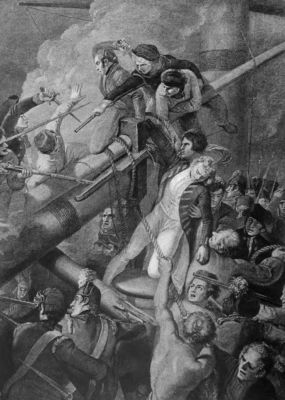
THE DEATH OF CAPTAIN FAULKNOR
On the morning of the 24th the French garrison marched out of Fort Bourbon. They were granted the honours of war, to make their exit with flags flying, bayonets fixed, drums beating, 30 rounds a man, and 2 field-pieces each with 12 rounds, and march down—between a double line of British seamen and soldiers—to the place of embarkation. They laid down their arms on the parade of Fort Royal, and filed on board the transports that had brought the British troops out, to set sail for France next day. The Island of Martinique was signed away from France with the capitulation of Fort Bourbon.
One last word must be said here of Captain Faulknor. He did not live to enjoy the benefits of his promotion long. Within ten months he was dead, killed in action, struck down in the performance of a deed of valour equal to anything that has in our own time won the Victoria Cross. In January 1795, when in command of the Blanche, a fine 32-gun frigate, to which he had been transferred, and while still in the West Indies, he fell in with a big French 36-gun frigate, the Pique, brought her to close action, and fought her for five hours, from midnight until five A.M., when the French ship surrendered. Captain Faulknor was shot dead, with a bullet through the heart, in the third hour of the fight, while in the act of lashing the Pique's bowsprit to the capstan of his own ship. He died, mourned by the whole country as a national loss, as the monument to him erected by order of Parliament in St. Paul's Cathedral testifies to this day.
Not once or twice in our rough island story The path of duty was the way to glory.
Since Faulknor's Undaunted, five British men-of-war have borne the name, and in every instance with distinction. Three of them may be referred to here. One Undaunted—the Undaunted of the Napoleonic war—crowned a career of exceptional brilliancy—a career that is one continuous record of daring exploits, which indeed won for her captain the sobriquet, taken from the name of his ship, of 'Undaunted Ussher'—by carrying Napoleon a prisoner of war to Elba. This same ship was later the last man-of-war to fly the flag of a Lord High Admiral of England at sea.[66] Another, in more recent times, as flagship on the East Indies station, had the honour of escorting his present Majesty King Edward, then Prince of Wales, through the Indian Ocean on his historic visit to India. Yet another Undaunted, our present cruiser of the name, was Lord Charles Beresford's first ship as a captain of the Royal Navy—with the Mediterranean fleet under Sir George Tryon,—and proved herself during a memorable commission nulli secundus for smartness and efficiency, in the spirit of her well-remembered duty call:—
'Undaunteds,' be ready! 'Undaunteds,' be steady! 'Undaunteds,' stand by for a job!
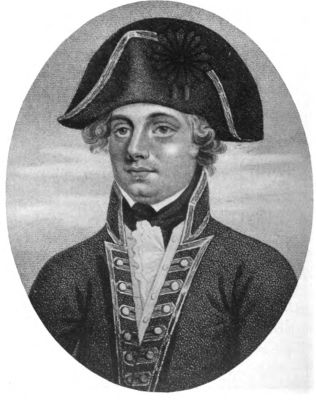
'BILLY BLUE'—ADMIRAL THE HON. SIR WILLIAM CORNWALLIS, G.C.B. [This portrait was drawn in 1775, and shows Cornwallis as a Captain at the age of 32. No later portrait of him is in existence apparently.]
FOOTNOTES:
IV
'BILLY BLUE': A BALLAD OF THE FLEET
ONE OF THE ROYAL SOVEREIGN'S DAYS
Slowly they mov'd, and wedged in firm array, The close compacted squadron won its way. Homer, Iliad (Pope's version).
Could common prudence have allowed me to let loose their valour on the enemy, I hardly know what might not have been accomplished by such men.—Admiral Cornwallis, June 17, 1795. (From the official despatch.)
Fighting days abound in the story of the Royal Sovereign. There is hardly a more famous name in the annals of the Royal Navy, and its record goes back to a hundred years before the Spanish Armada.
Our first Sovereign was one of the consorts of the Great Harry in Henry the Eighth's Navy, and fought the French in battle side by side with that 'greate shipp.'
The second was Charles the First's Sovereign of the Seas, built out of the ship-money tax which began the quarrel with Parliament that in the end brought the King's head to the block. 'Her building,' says Evelyn, 'cost his Ma'tie the affections of his subjects, who quarrell'd with him for a trifle, refusing to contribute either to their own safety or to his glory.'[67] The ship did brilliant service with Blake and Monk against Tromp and Ruyter, and won from the Dutch the sobriquet of the 'Golden Devil,' in allusion to her gorgeous ornamentation and the death-dealing broadsides from her heavy guns. As the Royal Sovereign, the name bestowed on her by Charles the Second at the Restoration, in place of the original form, the ship added laurels to her fame. She was in the thick of the fray in the 'Four Days' Fight' of 1666—the 'Four Days' Fight' was what the courtiers of Whitehall called the battle, the ruder 'tarpaulins' who fought the guns called it the 'Four Days' Bloody Blunder';—in the 'St. James's Day Fight' of the same year; at Solebay; and in all the other fleet battles of the Second and Third Dutch Wars. Among the men of note who flew their flags on board the Royal Sovereign in battle were James, Duke of York (afterwards King James the Second), and Prince Rupert. This same man-of-war, too, in William the Third's time, was one of the flagships at La Hogue, where she had 'a very hott dispute' with one of the French flagships. She was also flagship of the admiral in command at the burning of the famous Soleil Royal and two other French first-rates in Cherbourg Bay. A sleepy old bo'sun's mate, one January night, four years after La Hogue, left a lighted candle-end in his cabin in the Royal Sovereign, and then went on deck to keep his watch, forgetting all about it. So the quondam Sovereign of the Seas came to her end. In accordance with the sentence of the court-martial[68] on the wretched man, he was rowed up the Medway past the fleet lying there with a halter round his neck, and was then publicly flogged on his bare back, after which he was landed at Chatham dockyard with every mark of degradation, and taken off to be imprisoned in the Marshalsea for life.
The third Royal Sovereign, partly built, in accordance with an Admiralty order, out of as much of the timbers of the old ship as could be saved—'such part of the remains of the said ship as shall be serviceable'[69]—was launched in the presence of the great Duke of Marlborough, who presided on the occasion. It was in the cabin of this Royal Sovereign that Admiral Rooke planned his swoop on the Vigo galleons, and the ship also served as flagship to Sir Clowdisley Shovell.[70] She lasted long enough to be flagship at Portsmouth during the Seven Years' War, and it was on board her, one stormy March morning, that Admiral Boscawen signed the order for the firing party that shot Admiral Byng.
The fourth Royal Sovereign fought as a flagship with Lord Howe on the 'Glorious First of June,' and was Collingwood's ship at Trafalgar. 'See how that noble fellow Collingwood takes his ship into action!' exclaimed Nelson, as he saw the Royal Sovereign open fire and break the line. Nor did any other ship in all the British fleet make a more brilliant fight of it that day than the Royal Sovereign and her 'Tars of the Tyne,' as Collingwood himself called the sturdy Northumbrian lads who formed nine-tenths of his flagship's crew.
Our fifth Royal Sovereign was an ironclad of the 'sixties, and the sixth is the present battleship of the name, now in the Home Fleet, which was named and launched with much éclat by Queen Victoria at Portsmouth on the 26th of February 1891, and served for many years as flagship of the Channel Fleet.
Such in brief outline are some of the leading events in the story of the Royal Sovereign.
The historic event here related in ballad form belongs to the story of the Royal Sovereign of the great war with the French Revolution, the fourth ship of the name. 'Cornwallis's Retreat' was the name that our ancestors had for it. It took place on the 17th of June 1795, and the Royal Sovereign was the British flagship on the occasion. The event, no doubt, is unknown to most of us. Nine out of ten people probably never heard of it. It is one of the forgotten episodes of our annals. Nothing is said of it in our general histories. One finds it alluded to in naval books, but little mention is made of it outside that class of literature. Even that famous naval dining club, the 'Royal Naval Club of 1765 and 1785,' which meets regularly at intervals throughout the year to commemorate notable events in the annals of the Sea Service—La Hogue, Rodney's battle, the 'Glorious First of June,' the battle of Cape St. Vincent, Camperdown, and so on—does not celebrate the 17th of June, the anniversary day of 'Cornwallis's Retreat.' Yet, surely, it is deserving of the honour? As a display of cool valour in the face of tremendous odds, of down-right heroism and unflinching endurance, crowned in the end with complete success, this feat of Admiral the Honourable William Cornwallis's distinguished career deserves, there is no gainsaying, to be reckoned among the finest exploits in our history.[71]
It may partly be, of course, because of the term 'retreat' that the event of the 17th of June 1795 has nowadays been forgotten by the Navy and the nation. Englishmen do not like retreats. Everybody knows the story of how Napoleon once told a captured British drummer boy to prove his identity by beating the British Army 'retreat,' and how the little lad scornfully flung down his drum, and looking Bonaparte in the face replied, 'There is no such drum-beat in the British Army. We don't do it!'[72] To our forefathers of a hundred years ago, however, 'Cornwallis's Retreat,' as they themselves called it, was a source of infinite pride and gratification. They did not hesitate to compare it, and not unreasonably, with that famous tale of history, Xenophon's Retreat of the Ten Thousand.
Here is the story, told in plain unconventional ballad form, as it were by one present on the occasion. The details are historical, and the words attributed to the admiral are his own, as reported at the time. 'Billy Blue,' it should be added, was a favourite nickname for Cornwallis in the Navy, although whether it had come into vogue as early as the date of the incident is another thing.
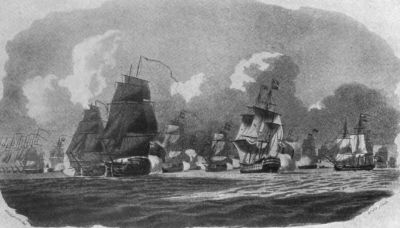
'CORNWALLIS'S RETREAT'
[On the left are the French frigates in a body to windward. The two leading British ships are the Bellerophon and the Brunswick, the slowest sailers of the squadron. To the right centre is the Royal Sovereign bearing down to help the Triumph and the Mars. On the right is the Pallas frigate (Captain the Hon. H. Curzon), Cornwallis's repeating frigate.]
BILLY BLUE
A BALLAD OF THE FLEET
It was just at break o' day, We were cruising in the Bay, With Blue Billy in the Sov'ren in the van, When the French fleet bound for Brest, From Belleisle came heading West— 'Twas so, my lads, the saucy game began. Billy Blue— Here's to you, Billy Blue, here's to you! Washing decks was hardly done, When we heard the warning gun, And we saw 'em, black and clear against the sky; Twelve big ships of the line,— And with frigates, twenty-nine, On the easterly horizon drawing nigh. Billy Blue, etc. We'd the Triumph and the Mars, And the Sov'ren—pride of tars, Billy Ruff'n, and the Brunswick, known to fame; With the Pallas, and the Phaeton, Frigates that the flag did wait on— Seven ships to uphold Old England's name. Billy Blue, etc. From the Phaeton frigate first, In a flash the numbers burst, As the signal bunting 'broke' and fluttered free; But we cheer'd from ship to ship, And we set the guns to strip, For to fight 'em we could trust old Blue Billee! Billy Blue, etc. He was shavin', so they say, When he heard the news that day, And his skipper came his wishes for to larn; But he only said, 'All right, Let 'em bark, for we can bite, For all they're like to try on us, I don't care a darn!' Billy Blue, etc. 'No, I don't care a rap For any Frenchy chap, When they come they'll get the dressing they deserve; I've the best four in the fleet, That the Frenchmen well could meet, With the "Fightin' Billy Ruff'n" in reserve.'[73] Billy Blue, etc. 'As she broke the line with Howe, So she's game to do it now, And repeat her "First o' June" here in these seas; With their name for dauntless pluck, And the Billy Ruff'n's luck, I will fight as many Frenchmen as you please!' Billy Blue, etc. But it wasn't merely bluff, For he saw the job was tough, And the signal promptly flew to 'Go about': With the slowest ship in front, And his own to bear the brunt,— So we headed back for England, guns run out. Billy Blue, etc. To the Sov'ren's lads he told Like some hero chief of old, As he bade 'em from the quarter-deck 'Good luck'; 'To no foe upon the sea. You may take it, men, from me, Is the ensign of the Sov'ren to be struck!' Billy Blue, etc. 'Let the odds be what they will, We must go on fighting still, For the honour of the Sov'ren's old renown; And when, men, all is done, As we fire our last gun, With our colours flying still, we'll go down!'[74] Billy Blue, etc. Soon we heard the Branle-bas What cheers up the Frenchy tar, And their 'Vives' for 'La Nation!' and 'La Patrie!' 'Tis the way, as you should know, With the maritime Crappo, When he's got to do his fightin' on the sea. Billy Blue, etc. Then they came on, looking slaughter, Like to blow us from the water, As they near'd to port and starboard and astarn; But we put in double shot, And we paid 'em back so hot, That they looked at one another with consarn. Billy Blue, etc. 'Just a broadside or two—Certainement, For the honour of their flag—cela s'entend, But it's more than very fine, seven ships to twenty-nine!— Most decidedly 'no go,' Not at all comme il faut, And a bit of British insolence for punishment condign!' Billy Blue, etc. 'Just a broadside, if they like, Then forthwith their colours strike Having rendered to their flag the homage due: It's sheer madness to pretend, They can fight us to the end— There's no other course the Rosbifs can pursue!' Billy Blue, etc. Next the Triumph they attacked, And the Mars got badly whacked, 'Twas the Sov'ren with her broadsides beat 'em back: Her three tiers all aflame, Sweeping round the flagship came, Leaving death and Frenchmen's wreckage in her track. Billy Blue, etc. And they didn't let us rest, For they did their level best, Fighting on and off from eight till after five; Till at length they seemed to see, That it wasn't going to be, That they shouldn't take us dead, nor yet alive. Billy Blue, etc. How it ended, is a story, Not at all to France's glory, Of a little game the Phaeton's men did play; Making Mossoo go in fear, That the Channel Fleet was near, And think perhaps he'd better run away. Billy Blue, etc. For Blue Billy sent the Phaeton, When the pass looked like a strait one, To cruise out in the offing,—just in sight: 'At a fitting time,' said he 'You will signal down to me, That Lord Bridport will be with us before night.' Billy Blue, etc. 'You will fire guns, you know, And to'gallant sheets let go, As the custom is, reporting fleets at sea; With a signal that they're 'friends'— Which I think will serve our ends, To humbug those chaps astarn with Monsieur V.'[75] Billy Blue, etc. The Frenchmen cried 'Morblo!' And they shuffled to and fro, Till they judg'd they'd haul their wind and go about; To Belleisle back all the way, At anchor there to stay, Till they learnt the coast was clear to venture out. Billy Blue, etc. Yet no Channel Fleet was near, To excuse the Frenchmen's fear, For Lord Bridport was still cruising leagues afar,[76] And a well-worn ruse de guerre Was a hardy game to dare, With French frigates—seventeen—the plot to mar. Billy Blue, etc. It so happened, for the rest, Just to point the Phaeton's jest, By the merest chance—it wasn't meant at all— Distant coasters passing by, Chanced to fleck the evening sky, And still faster to impel the flying Gaul. Billy Blue, etc. Here's to Stopford of the Phaeton, And Flag-Captain Whitby bold, To Fitzgerald of the Brunswick, tried and true, Gallant Gower of the Triumph, Gallant Cotton of the Mars, Lord Cranstoun—Billy Ruff'n—here's to you! Billy Blue, etc. Aye, Blue Billy:—here's to him, with three times three, To the honour of his name upon the sea! 'He upheld Old England's credit,' said the country in its pride: 'Cornwallis's Retreat,' Greek Xenophon's great feat, In its spirit we may claim to set beside. Billy Blue, etc. E'en our foes, the Parley Voos, At this feat of Billy Blue's Professed to be astounded—'Etonnés':— 'Hors de ligne' 'twas, so to speak, 'Une affaire trop héroïque,' 'Le Déterminé,' they call him to this day. Billy Blue— Here's to you, Billy Blue, here's to you!