III FRIENDS AND FOLLOWERS (continued 4)
Reading edition
P. S.—That was a very insufficient visit which you made here the last time. My mother is better, though far from well; and if you should chance along here any time after your journey, I trust that we shall all do better.
The mention by Thoreau of John Brown and my "case" recalls to me an incident of those excited days which followed the attack by Brown on slavery in Virginia. The day after Brown's death, but before the execution of his comrades, I received a message from the late Dr. David Thayer of Boston, implying, as I thought, that a son of Brown was at his house, whither I hurried to meet him. Instead, I found young F. J. Merriam of Boston, who had escaped with Owen Brown from Harper's Ferry, and was now in Boston to raise another party against the slaveholders. He was unfit to lead or even join in such a desperate undertaking, and we insisted he should return to safety in Canada,—a large reward being offered for his seizure. He agreed to go back to Canada that night by the Fitchburg Railroad; but in his hot-headed way he took the wrong train, which ran no farther than Concord,—and found himself in the early evening at my house, where my sister received him, but insisted that I should not see him, lest I might be questioned about my guest. While he had supper and went to bed, I posted down to Mr. Emerson's and engaged his horse and covered wagon, to be ready at sunrise,—he asking no questions. In the same way I engaged Mr. Thoreau to drive his friend's horse to South Acton the next morning, and there put on board the first Canadian train a Mr. Lockwood, whom he would find at my house. Thoreau readily consented, asked no questions, walked to the Emerson stable the next morning, found the horse ready, drove him to my door, and took up Merriam, under the name of Lockwood,—neither knowing who the other was. Merriam was so flighty that, though he had agreed to go to Montreal, and knew that his life might depend on getting there early, he declared he must see Mr. Emerson, to lay before him his plan for invading the South, and consult him about some moral questions that troubled his mind. His companion listened gravely,—and hurried the horse towards Acton. Merriam grew more positive and suspicious,—"Perhaps you are Mr. Emerson; you look somewhat like him."[96] "No, I am not," said Thoreau, and drove steadily away from Concord. "Well, then, I am going back," said the youth, and flung himself out of the wagon. How Thoreau got him in again, he never told me; but I suspected some judicious force, accompanying the grave persuasive speech natural to our friend. At any rate, he took his man to Acton, saw him safe on the train, and reported to me that "Mr. Lockwood had taken passage for Canada," where he arrived that night. Nothing more passed between us until, more than two years after, he inquired one day, in his last illness, who my fugitive was. Merriam was then out of danger in that way, and had been for months a soldier in the Union army, where he died. I therefore said that "Lockwood" was the grandson of his mother's old friend, Francis Jackson, and had escaped from Maryland. In return he gave me the odd incidents of their drive, and mentioned that he had spoken of the affair to his mother only since his illness. So reticent and practically useful could he be; as Channing says, "He made no useless professions, never asked one of those questions which destroy all relation; but he was on the spot at the time, he meant friendship, and meant nothing else, and stood by it without the slightest abatement."
TO HARRISON BLAKE (AT WORCESTER).
Concord, November 4, 1860.
Mr. Blake,—I am glad to hear any particulars of your excursion. As for myself, I looked out for you somewhat on that Monday, when, it appears, you passed Monadnock; turned my glass upon several parties that were ascending the mountain half a mile on one side of us. In short, I came as near to seeing you as you to seeing me. I have no doubt that we should have had a good time if you had come, for I had, all ready, two good spruce houses, in which you could stand up, complete in all respects, half a mile apart, and you and B. could have lodged by yourselves in one, if not with us.
We made an excellent beginning of our mountain life.[97] You may remember that the Saturday previous was a stormy day. Well, we went up in the rain,—wet through,—and found ourselves in a cloud there at mid-afternoon, in no situation to look about for the best place for a camp. So I proceeded at once, through the cloud, to that memorable stone, "chunk yard," in which we made our humble camp once, and there, after putting our packs under a rock, having a good hatchet, I proceeded to build a substantial house, which Channing declared the handsomest he ever saw. (He never camped out before, and was, no doubt, prejudiced in its favor.) This was done about dark, and by that time we were nearly as wet as if we had stood in a hogshead of water. We then built a fire before the door, directly on the site of our little camp of two years ago, and it took a long time to burn through its remains to the earth beneath. Standing before this, and turning round slowly, like meat that is roasting, we were as dry, if not drier, than ever, after a few hours, and so at last we "turned in."
This was a great deal better than going up there in fair weather, and having no adventure (not knowing how to appreciate either fair weather or foul) but dull, commonplace sleep in a useless house, and before a comparatively useless fire,—such as we get every night. Of course we thanked our stars, when we saw them, which was about midnight, that they had seemingly withdrawn for a season. We had the mountain all to ourselves that afternoon and night. There was nobody going up that day to engrave his name on the summit, nor to gather blueberries. The genius of the mountains saw us starting from Concord, and it said, There come two of our folks. Let us get ready for them. Get up a serious storm, that will send a-packing these holiday guests. (They may have their say another time.) Let us receive them with true mountain hospitality,—kill the fatted cloud. Let them know the value of a spruce roof, and of a fire of dead spruce stumps. Every bush dripped tears of joy at our advent. Fire did its best, and received our thanks. What could fire have done in fair weather? Spruce roof got its share of our blessings. And then, such a view of the wet rocks, with the wet lichens on them, as we had the next morning, but did not get again!
We and the mountain had a sound season, as the saying is. How glad we were to be wet, in order that we might be dried! How glad we were of the storm which made our house seem like a new home to us! This day's experience was indeed lucky, for we did not have a thunder-shower during all our stay. Perhaps our host reserved this attention in order to tempt us to come again.
Our next house was more substantial still. One side was rock, good for durability; the floor the same; and the roof which I made would have upheld a horse. I stood on it to do the shingling.
I noticed, when I was at the White Mountains last, several nuisances which render traveling thereabouts unpleasant. The chief of these was the mountain houses. I might have supposed that the main attraction of that region, even to citizens, lay in its wildness and unlikeness to the city, and yet they make it as much like the city as they can afford to. I heard that the Crawford House was lighted with gas, and had a large saloon, with its band of music, for dancing. But give me a spruce house made in the rain.
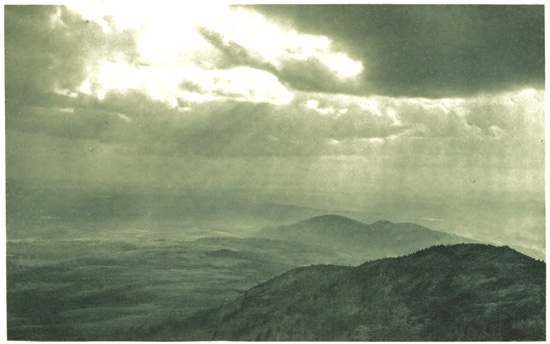
From the Summit of Monadnock
An old Concord farmer tells me that he ascended Monadnock once, and danced on the top. How did that happen? Why, he being up there, a party of young men and women came up, bringing boards and a fiddler; and, having laid down the boards, they made a level floor, on which they danced to the music of the fiddle. I suppose the tune was "Excelsior." This reminds me of the fellow who climbed to the top of a very high spire, stood upright on the ball, and hurrahed for—what? Why, for Harrison and Tyler. That's the kind of sound which most ambitious people emit when they culminate. They are wont to be singularly frivolous in the thin atmosphere; they can't contain themselves, though our comfort and their safety require it; it takes the pressure of many atmospheres to do this; and hence they helplessly evaporate there. It would seem that as they ascend, they breathe shorter and shorter, and, at each expiration, some of their wits leave them, till, when they reach the pinnacle, they are so light-headed as to be fit only to show how the wind sits. I suspect that Emerson's criticism called "Monadnoc" was inspired, not by remembering the inhabitants of New Hampshire as they are in the valleys, so much as by meeting some of them on the mountain-top.
After several nights' experience, Channing came to the conclusion that he was "lying outdoors," and inquired what was the largest beast that might nibble his legs there. I fear that he did not improve all the night, as he might have done, to sleep. I had asked him to go and spend a week there. We spent five nights, being gone six days, for C. suggested that six working days made a week, and I saw that he was ready to decamp. However, he found his account in it as well as I.
We were seen to go up in the rain, grim and silent, like two genii of the storm, by Fassett's men or boys; but we were never identified afterward, though we were the subject of some conversation which we overheard. Five hundred persons at least came on to the mountain while we were there, but not one found our camp. We saw one party of three ladies and two gentlemen spread their blankets and spend the night on the top, and heard them converse; but they did not know that they had neighbors who were comparatively old settlers. We spared them the chagrin which that knowledge would have caused them, and let them print their story in a newspaper accordingly.
Yes, to meet men on an honest and simple footing, meet with rebuffs, suffer from sore feet, as you did,—ay, and from a sore heart, as perhaps you also did,—all that is excellent. What a pity that that young prince[98] could not enjoy a little of the legitimate experience of traveling—be dealt with simply and truly, though rudely. He might have been invited to some hospitable house in the country, had his bowl of bread and milk set before him, with a clean pinafore; been told that there were the punt and the fishing-rod, and he could amuse himself as he chose; might have swung a few birches, dug out a woodchuck, and had a regular good time, and finally been sent to bed with the boys,—and so never have been introduced to Mr. Everett at all. I have no doubt that this would have been a far more memorable and valuable experience than he got.
The snow-clad summit of Mt. Washington must have been a very interesting sight from Wachusett. How wholesome winter is, seen far or near; how good, above all mere sentimental, warm-blooded, short-lived, soft-hearted, moral goodness, commonly so called. Give me the goodness which has forgotten its own deeds,—which God has seen to be good, and let be. None of your just made perfect,—pickled eels! All that will save them will be their picturesqueness, as with blasted trees. Whatever is, and is not ashamed to be, is good. I value no moral goodness or greatness unless it is good or great, even as that snowy peak is. Pray, how could thirty feet of bowels improve it? Nature is goodness crystallized. You looked into the land of promise. Whatever beauty we behold, the more it is distant, serene, and cold, the purer and more durable it is. It is better to warm ourselves with ice than with fire.
Tell Brown that he sent me more than the price of the book, viz., a word from himself, for which I am greatly his debtor.
Thoreau began to be more seriously ill than he had been for some years, early in December, 1860. He exposed himself unduly in one of his walks, while counting the rings on stumps of trees, amid snow. He ceased much of his small activity of letter-writing; but, in addressing Ricketson the next spring, he took the unusual pains of writing him a letter of some length which he never sent. It was found among his papers after death,—the first draft of it, which ran as follows, but was left a fragment:—
TO DANIEL RICKETSON (AT NEW BEDFORD).
Concord, March 19, 1861.
Friend R,—Your letter reached me in due time, but I had already heard the bluebirds. They were here on the 26th of February at least,—but not yet do the larks sing or the flickers call, with us. The bluebirds come again, as does the same spring, but it does not find the same mortals here to greet it. You remember Minott's cottage on the hillside,—well, it finds some change there, for instance. The little gray hip-roofed cottage was occupied at the beginning of February, this year, by George Minott and his sister Mary, respectively 78 and 80 years old, and Miss Potter, 74. These had been its permanent occupants for many years. Minott had been on his last legs for some time,—at last off his legs, expecting weekly to take his departure,—a burden to himself and friends,—yet dry and natural as ever. His sister took care of him, and supported herself and family with her needle, as usual. He lately willed his little property to her, as a slight compensation for her care. Feb. 13 their sister, 86 or 87, who lived across the way, died. Miss Minott had taken cold in visiting her, and was so sick that she could not go to her funeral. She herself died of lung fever[99] on the 18th (which was said to be the same disease that her sister had),—having just willed her property back to George, and added her own mite to it. Miss Potter, too, had now become ill,—too ill to attend the funeral,—and she died of the same disease on the 23d. All departed as gently as the sun goes down, leaving George alone.
I called to see him the other day,—the 27th of February, a remarkably pleasant spring day,—and as I was climbing the sunny slope to his strangely deserted house, I heard the first bluebirds upon the elm that hangs over it. They had come as usual, though some who used to hear them were gone. Even Minott had not heard them, though the door was open,—for he was thinking of other things. Perhaps there will be a time when the bluebirds themselves will not return any more.
I hear that George, a few days after this, called out to his niece, who had come to take care of him, and was in the next room, to know if she did not feel lonely? "Yes, I do," said she. "So do I," added he. He said he was like an old oak, all shattered and decaying. "I am sure, Uncle," said his niece, "you are not much like an oak!" "I mean," said he, "that I am like an oak or any other tree, inasmuch as I cannot stir from where I am."
Either this topic was too pathetic for Thoreau to finish the letter, or perchance he thought it not likely to interest his friend; for he threw aside this draft for three days, and then, with the same beginning, wrote a very different letter. The Minotts were old familiar acquaintance, and related to that Captain Minott whom Thoreau's grandmother married as a second husband. George was his "old man of Verona," who had not left Concord for more than forty years, except to stray over the town bounds in hunting or wood-ranging; and Mary was the "tailoress" who for years made Thoreau's garments.
TO DANIEL RICKETSON (AT NEW BEDFORD).
Concord, March 22, 1861.
Friend Ricketson,—The bluebird was here the 26th of February, at least, which is one day earlier than you date; but I have not heard of larks nor pigeon woodpeckers. To tell the truth, I am not on the alert for the signs of spring, not having had any winter yet. I took a severe cold about the 3d of December, which at length resulted in a kind of bronchitis, so that I have been confined to the house ever since, excepting a very few experimental trips as far as the post-office in some particularly fine noons. My health otherwise has not been affected in the least, nor my spirits. I have simply been imprisoned for so long, and it has not prevented my doing a good deal of reading and the like.
Channing has looked after me very faithfully; says he has made a study of my case, and knows me better than I know myself, etc., etc. Of course, if I knew how it began, I should know better how it would end. I trust that when warm weather comes I shall begin to pick up my crumbs. I thank you for your invitation to come to New Bedford, and will bear it in mind; but at present my health will not permit my leaving home.
The day I received your letter, Blake and Brown arrived here, having walked from Worcester in two days, though Alcott, who happened in soon after, could not understand what pleasure they found in walking across the country in this season, when the ways were so unsettled. I had a solid talk with them for a day and a half—though my pipes were not in good order—and they went their way again.
You may be interested to hear that Alcott is at present, perhaps, the most successful man in the town. He had his second annual exhibition of all the schools in the town, at the Town Hall last Saturday; at which all the masters and misses did themselves great credit, as I hear, and of course reflected some on their teachers and parents. They were making their little speeches from one till six o'clock P. M., to a large audience, which patiently listened to the end. In the meanwhile, the children made Mr. Alcott an unexpected present of a fine edition of "Pilgrim's Progress" and Herbert's Poems, which, of course, overcame all parties. I inclose an order of exercises.[100]
We had, last night, an old-fashioned northeast snow-storm, far worse than anything in the winter; and the drifts are now very high above the fences. The inhabitants are pretty much confined to their houses, as I was already. All houses are one color, white, with the snow plastered over them, and you cannot tell whether they have blinds or not. Our pump has another pump, its ghost, as thick as itself, sticking to one side of it. The town has sent out teams of eight oxen each, to break out the roads; and the train due from Boston at 8½ A. M. has not arrived yet (4 P. M.). All the passing has been a train from above at 12 M., which also was due at 8½ A. M. Where are the bluebirds now, think you? I suppose that you have not so much snow at New Bedford, if any.
TO PARKER PILLSBURY (AT CONCORD N. H.).
Concord, April 10, 1861.
Friend Pillsbury,—I am sorry to say that I have not a copy of "Walden" which I can spare; and know of none, unless possibly Ticknor & Fields may have one. I send, nevertheless, a copy of "The Week," the price of which is one dollar and twenty-five cents, which you can pay at your convenience.
As for your friend, my prospective reader, I hope he ignores Fort Sumter, and "Old Abe," and all that; for that is just the most fatal, and, indeed, the only fatal weapon you can direct against evil, ever; for, as long as you know of it, you are particeps criminis. What business have you, if you are an "angel of light," to be pondering over the deeds of darkness, reading the New York Herald, and the like?
I do not so much regret the present condition of things in this country (provided I regret it at all), as I do that I ever heard of it. I know one or two, who have this year, for the first time, read a President's Message; but they do not see that this implies a fall in themselves, rather than a rise in the President. Blessed were the days before you read a President's Message. Blessed are the young, for they do not read the President's Message. Blessed are they who never read a newspaper, for they shall see Nature, and, through her, God.
But, alas! I have heard of Sumter and Pickens, and even of Buchanan (though I did not read his Message). I also read the New York Tribune; but then, I am reading Herodotus and Strabo, and Blodget's "Climatology," and "Six Years in the Desert of North America," as hard as I can, to counterbalance it.
By the way, Alcott is at present our most popular and successful man, and has just published a volume in size, in the shape of the Annual School Report, which I presume he has sent to you.
Yours, for remembering all good things,
Henry D. Thoreau.
Parker Pillsbury, to whom this letter went, was an old friend of the Thoreau family, with whom he became intimate in the antislavery agitation, wherein they took part, while he was a famous orator, celebrated by Emerson in one of his essays. Mr. Pillsbury visited Thoreau in his last illness, when he could scarcely speak above a whisper, and, having made to him some remark concerning the future life, Thoreau replied, "My friend, one world at a time." His petulant words in this letter concerning national affairs would hardly have been said a few days later, when, at the call of Abraham Lincoln, the people rose to protect their government, and every President's Message became of thrilling interest, even to Thoreau.
Arrangements were now making for the invalid, about whose health his friends had been anxious for some years, to travel for a better climate than the New England spring affords, and early in May Thoreau set out for the upper Mississippi. He thus missed the last letter sent to him by his English friend Cholmondeley, which I answered, then forwarded to him at Redwing, in Minnesota. It is of interest enough to be given here.
T. CHOLMONDELEY TO THOREAU (IN MINNESOTA).
Shrewsbury [England], April 23, 1861.
My dear Thoreau,—It is now some time since I wrote to you or heard from you, but do not suppose that I have forgotten you, or shall ever cease to cherish in my mind those days at dear old Concord. The last I heard about you all was from Morton,[101] who was in England about a year ago; and I hope that he has got over his difficulties and is now in his own country again. I think he has seen rather more of English country life than most Yankee tourists; and appeared to find it curious, though I fear he was dulled by our ways; for he was too full of ceremony and compliments and bows, which is a mistake here; though very well in Spain. I am afraid he was rather on pins and needles; but he made a splendid speech at a volunteer supper, and indeed the very best, some said, ever heard in this part of the country.
We are here in a state of alarm and apprehension, the world being so troubled in East and West and everywhere. Last year the harvest was bad and scanty. This year our trade is beginning to feel the events in America. In reply to the northern tariff, of course we are going to smuggle as much as we can. The supply of cotton being such a necessity to us, we must work up India and South Africa a little better. There is war even in old New Zealand, but not in the same island where my people are! Besides, we are certainly on the eve of a continental blaze, so we are making merry and living while we can; not being sure where we shall be this time a year.
Give my affectionate regards to your father, mother, and sister, and to Mr. Emerson and his family, and to Channing, Sanborn, Ricketson, Blake, and Morton and Alcott and Parker. A thought arises in my mind whether I may not be enumerating some dead men! Perhaps Parker is!
These rumors of wars make me wish that we had got done with this brutal stupidity of war altogether; and I believe, Thoreau, that the human race will at last get rid of it, though perhaps not in a creditable way; but such powers will be brought to bear that it will become monstrous even to the French. Dundonald declared to the last that he possessed secrets which from their tremendous character would make war impossible. So peace may be begotten from the machinations of evil.
Have you heard of any good books lately? I think "Burnt Njal" good, and believe it to be genuine. "Hast thou not heard" (says Steinrora to Thangbrand) "how Thor challenged Christ to single combat, and how he did not dare to fight with Thor?" When Gunnar brandishes his sword, three swords are seen in air. The account of Ospah and Brodir and Brian's battle is the only historical account of that engagement, which the Irish talk so much of; for I place little trust in O'Halloran's authority, though the outline is the same in both.
Darwin's "Origin of Species" may be fanciful, but it is a move in the right direction. Emerson's "Conduct of Life" has done me good; but it will not go down in England for a generation or so. But these are some of them already a year or two old. The book of the season is Du Chaillu's "Central Africa," with accounts of the Gorilla, of which you are aware that you have had a skeleton at Boston for many years. There is also one in the British Museum; but they have now several stuffed specimens at the Geographical Society's rooms in Town. I suppose you will have seen Sir Emerson Tennent's "Ceylon," which is perhaps as complete a book as ever was published; and a better monument to a governor's residence in a great province was never made.
We have been lately astonished by a foreign Hamlet, a supposed impossibility; but Mr. Fechter does real wonders. No doubt he will visit America, and then you may see the best actor in the world. He has carried out Goethe's idea of Hamlet as given in the "Wilhelm Meister," showing him forth as a fair-haired and fat man. I suppose you are not got fat yet?
Yours ever truly, Thos. Cholmondeley.[102]
TO HARRISON BLAKE (AT WORCESTER).
Concord, May 3, 1861.
Mr. Blake,—I am still as much an invalid as when you and Brown were here, if not more of one, and at this rate there is danger that the cold weather may come again, before I get over my bronchitis. The doctor accordingly tells me that I must "clear out" to the West Indies, or elsewhere,—he does not seem to care much where. But I decide against the West Indies, on account of their muggy heat in the summer, and the South of Europe, on account of the expense of time and money, and have at last concluded that it will be most expedient for me to try the air of Minnesota, say somewhere about St. Paul's. I am only waiting to be well enough to start. Hope to get off within a week or ten days.
The inland air may help me at once, or it may not. At any rate, I am so much of an invalid that I shall have to study my comfort in traveling to a remarkable degree,—stopping to rest, etc., etc., if need be. I think to get a through ticket to Chicago, with liberty to stop frequently on the way, making my first stop of consequence at Niagara Falls, several days or a week, at a private boarding-house; then a night or day at Detroit; and as much at Chicago as my health may require. At Chicago I can decide at what point (Fulton, Dunleith, or another) to strike the Mississippi, and take a boat to St. Paul's.
I trust to find a private boarding-house in one or various agreeable places in that region, and spend my time there. I expect, and shall be prepared, to be gone three months; and I would like to return by a different route,—perhaps Mackinaw and Montreal.
I have thought of finding a companion, of course, yet not seriously, because I had no right to offer myself as a companion to anybody, having such a peculiarly private and all-absorbing but miserable business as my health, and not altogether his, to attend to, causing me to stop here and go there, etc., etc., unaccountably.
Nevertheless, I have just now decided to let you know of my intention, thinking it barely possible that you might like to make a part or the whole of this journey at the same time, and that perhaps your own health may be such as to be benefited by it.
Pray let me know if such a statement offers any temptations to you. I write in great haste for the mail, and must omit all the moral.
TO F. B. SANBORN (AT CONCORD).
Redwing, Minnesota, June 26, 1861.
Mr. Sanborn,—I was very glad to find awaiting me, on my arrival here on Sunday afternoon, a letter from you. I have performed this journey in a very dead and alive manner, but nothing has come so near waking me up as the receipt of letters from Concord. I read yours, and one from my sister (and Horace Mann, his four), near the top of a remarkable isolated bluff here, called Barn Bluff, or the Grange, or Redwing Bluff, some four hundred and fifty feet high, and half a mile long,—a bit of the main bluff or bank standing alone. The top, as you know, rises to the general level of the surrounding country, the river having eaten out so much. Yet the valley just above and below this (we are at the head of Lake Pepin) must be three or four miles wide.
I am not even so well informed as to the progress of the war as you suppose. I have seen but one Eastern paper (that, by the way, was the Tribune) for five weeks. I have not taken much pains to get them; but, necessarily, I have not seen any paper at all for more than a week at a time. The people of Minnesota have seemed to me more cold,—to feel less implicated in this war than the people of Massachusetts. It is apparent that Massachusetts, for one State at least, is doing much more than her share in carrying it on. However, I have dealt partly with those of Southern birth, and have seen but little way beneath the surface. I was glad to be told yesterday that there was a good deal of weeping here at Redwing the other day, when the volunteers stationed at Fort Snelling followed the regulars to the seat of the war. They do not weep when their children go up the river to occupy the deserted forts, though they may have to fight the Indians there.
I do not even know what the attitude of England is at present.
The grand feature hereabouts is, of course, the Mississippi River. Too much can hardly be said of its grandeur, and of the beauty of this portion of it (from Dunleith, and probably from Rock Island to this place). St. Paul is a dozen miles below the Falls of St. Anthony, or near the head of uninterrupted navigation on the main stream, about two thousand miles from its mouth. There is not a "rip" below that, and the river is almost as wide in the upper as the lower part of its course. Steamers go up the Sauk Rapids, above the Falls, near a hundred miles farther, and then you are fairly in the pine woods and lumbering country. Thus it flows from the pine to the palm.
The lumber, as you know, is sawed chiefly at the Falls of St. Anthony (what is not rafted in the log to ports far below), having given rise to the towns of St. Anthony, Minneapolis, etc., etc. In coming up the river from Dunleith, you meet with great rafts of sawed lumber and of logs, twenty rods or more in length, by five or six wide, floating down, all from the pine region above the Falls. An old Maine lumberer, who has followed the same business here, tells me that the sources of the Mississippi were comparatively free from rocks and rapids, making easy work for them; but he thought that the timber was more knotty here than in Maine.
It has chanced that about half the men whom I have spoken with in Minnesota, whether travelers or settlers, were from Massachusetts.
After spending some three weeks in and about St. Paul, St. Anthony, and Minneapolis, we made an excursion in a steamer, some three hundred or more miles up the Minnesota (St. Peter's) River, to Redwood, or the Lower Sioux Agency, in order to see the plains, and the Sioux, who were to receive their annual payment there. This is eminently the river of Minnesota (for she shares the Mississippi with Wisconsin), and it is of incalculable value to her. It flows through a very fertile country destined to be famous for its wheat; but it is a remarkably winding stream, so that Redwood is only half as far from its mouth by land as by water. There was not a straight reach a mile in length as far as we went,—generally you could not see a quarter of a mile of water, and the boat was steadily turning this way or that. At the greater bends, as the Traverse des Sioux, some of the passengers were landed, and walked across to be taken in on the other side. Two or three times you could have thrown a stone across the neck of the isthmus, while it was from one to three miles around it. It was a very novel kind of navigation to me. The boat was perhaps the largest that had been up so high, and the water was rather low (it had been about fifteen feet higher). In making a short turn, we repeatedly and designedly ran square into the steep and soft bank, taking in a cart-load of earth,—this being more effectual than the rudder to fetch us about again; or the deeper water was so narrow and close to the shore, that we were obliged to run into and break down at least fifty trees which overhung the water, when we did not cut them off, repeatedly losing a part of our outworks, though the most exposed had been taken in. I could pluck almost any plant on the bank from the boat. We very frequently got aground, and then drew ourselves along with a windlass and a cable fastened to a tree, or we swung round in the current, and completely blocked up and blockaded the river, one end of the boat resting on each shore. And yet we would haul ourselves round again with the windlass and cable in an hour or two, though the boat was about one hundred and sixty feet long, and drew some three feet of water, or, often, water and sand. It was one consolation to know that in such a case we were all the while damming the river, and so raising it. We once ran fairly on to a concealed rock, with a shock that aroused all the passengers, and rested there, and the mate went below with a lamp, expecting to find a hole, but he did not. Snags and sawyers were so common that I forgot to mention them. The sound of the boat rumbling over one was the ordinary music. However, as long as the boiler did not burst, we knew that no serious accident was likely to happen. Yet this was a singularly navigable river, more so than the Mississippi above the Falls, and it is owing to its very crookedness. Ditch it straight, and it would not only be very swift, but soon run out. It was from ten to fifteen rods wide near the mouth, and from eight to ten or twelve at Redwood. Though the current was swift, I did not see a "rip" on it, and only three or four rocks. For three months in the year I am told that it can be navigated by small steamers about twice as far as we went, or to its source in Big Stone Lake; and a former Indian agent told me that at high water it was thought that such a steamer might pass into the Red River.
In short, this river proved so very long and navigable, that I was reminded of the last letter or two in the voyage of the Baron la Hontan (written near the end of the seventeenth century, I think), in which he states, that, after reaching the Mississippi (by the Illinois or Wisconsin), the limit of previous exploration westward, he voyaged up it with his Indians, and at length turned up a great river coming in from the west, which he called "La Rivière Longue;" and he relates various improbable things about the country and its inhabitants, so that this letter has been regarded as pure fiction, or, more properly speaking, a lie. But I am somewhat inclined now to reconsider the matter.
The Governor of Minnesota (Ramsay), the superintendent of Indian affairs in this quarter, and the newly appointed Indian agent were on board; also a German band from St. Paul, a small cannon for salutes, and the money for the Indians (ay, and the gamblers, it was said, who were to bring it back in another boat). There were about one hundred passengers, chiefly from St. Paul, and more or less recently from the northeastern States; also half a dozen young educated Englishmen. Chancing to speak with one who sat next to me, when the voyage was nearly half over, I found that he was the son of the Rev. Samuel May,[103] and a classmate of yours, and had been looking for us at St. Anthony.
The last of the little settlements on the river was New Ulm, about one hundred miles this side of Redwood. It consists wholly of Germans. We left them one hundred barrels of salt, which will be worth something more when the water is lowest than at present.
Redwood is a mere locality,—scarcely an Indian village,—where there is a store, and some houses have been built for them. We were now fairly on the great plains, and looking south; and, after walking that way three miles, could see no tree in that horizon. The buffalo were said to be feeding within twenty-five or thirty miles.
A regular council was held with the Indians, who had come in on their ponies, and speeches were made on both sides through an interpreter, quite in the described mode,—the Indians, as usual, having the advantage in point of truth and earnestness, and therefore of eloquence. The most prominent chief was named Little Crow. They were quite dissatisfied with the white man's treatment of them, and probably have reason to be so. This council was to be continued for two or three days,—the payment to be made the second day; and another payment to other bands a little higher up, on the Yellow Medicine (a tributary of the Minnesota), a few days thereafter.
In the afternoon, the half-naked Indians performed a dance, at the request of the Governor, for our amusement and their own benefit; and then we took leave of them, and of the officials who had come to treat with them.
Excuse these pencil marks, but my inkstand is unscrewable, and I can only direct my letter at the bar. I could tell you more, and perhaps more interesting things, if I had time. I am considerably better than when I left home, but still far from well.
Our faces are already set toward home. Will you please let my sister know that we shall probably start for Milwaukee and Mackinaw in a day or two (or as soon as we hear from home) via Prairie du Chien, and not La Crosse.
I am glad to hear that you have written Cholmondeley,[104] as it relieves me of some responsibility.
The tour described in this long letter was the first and last that Thoreau ever made west of the Mohawk Valley, though his friend Channing had early visited the great prairies, and lived in log cabins of Illinois, or sailed on the chain of great lakes, by which Thoreau made a part of this journey. It was proposed that Channing should accompany him this time, as he had in the tour through Lower Canada, and along Cape Cod, as well as in the journeys through the Berkshire and Catskill mountains, and down the Hudson; but some misunderstanding or temporary inconvenience prevented. The actual comrade was young Horace Mann, eldest son of the school-reformer and statesman of that name,—a silent, earnest, devoted naturalist, who died early. The place where his party met the Indians—only a few months before the Minnesota massacre of 1862—was in the county of Redwood, in the southwest of the State, where now is a thriving village of 1500 people, and no buffaloes within five hundred miles. Red Wing, whence the letter was written, is below St. Paul, on the Mississippi, and was even then a considerable town,—now a city of 7000 people. The Civil War had lately begun, and the whole North was in the first flush of its uprising in defense of the Union,—for which Thoreau, in spite of his earlier defiance of government (for its alliance with slavery), was as zealous as any soldier. He returned in July, little benefited by the journey, of which he did not take his usual sufficiency of notes, and to which there is little allusion in his books. Nor does it seem that he visited on the way his correspondent since January, 1856,—C. H. Greene, of Rochester, Michigan, who had never seen him in Concord. The opinion of Thoreau himself concerning this journey will be found in his next letter to Daniel Ricketson.
TO DANIEL RICKETSON (AT NEW BEDFORD).
Concord, August 15, 1861.
Friend Ricketson,—When your last letter was written I was away in the far Northwest, in search of health. My cold turned to bronchitis, which made me a close prisoner almost up to the moment of my starting on that journey, early in May. As I had an incessant cough, my doctor told me that I must "clear out,"—to the West Indies, or elsewhere,—so I selected Minnesota. I returned a few weeks ago, after a good deal of steady traveling, considerably, yet not essentially, better; my cough still continuing. If I don't mend very quickly, I shall be obliged to go to another climate again very soon.
My ordinary pursuits, both indoors and out, have been for the most part omitted, or seriously interrupted,—walking, boating, scribbling, etc. Indeed, I have been sick so long that I have almost forgotten what it is to be well; and yet I feel that it is in all respects only my envelope. Channing and Emerson are as well as usual; but Alcott, I am sorry to say, has for some time been more or less confined by a lameness, perhaps of a neuralgic character, occasioned by carrying too great a weight on his back while gardening.
On returning home, I found various letters awaiting me; among others, one from Cholmondeley, and one from yourself.
Of course I am sufficiently surprised to hear of your conversion;[105] yet I scarcely know what to say about it, unless that, judging by your account, it appears to me a change which concerns yourself peculiarly, and will not make you more valuable to mankind. However, perhaps I must see you before I can judge.
Remembering your numerous invitations, I write this short note now, chiefly to say that, if you are to be at home, and it will be quite agreeable to you, I will pay you a visit next week, and take such rides or sauntering walks with you as an invalid may.
The visit was made, and we owe to it the preservation of the latest portraiture of Thoreau, who, at his friend's urgency, sat to a photographer in New Bedford; and thus we have the full-bearded likeness of August, 1861; from which, also, and from personal recollection, Mr. Walton Ricketson made the fine profile medallion reproduced in photogravure for this volume.
TO DANIEL RICKETSON (AT NEW BEDFORD).
Concord, October 14, 1861.
Friend Ricketson,—I think that, on the whole, my health is better than when you were here; but my faith in the doctors has not increased. I thank you all for your invitation to come to New Bedford, but I suspect that it must still be warmer here than there; that, indeed, New Bedford is warmer than Concord only in the winter, and so I abide by Concord.
September was pleasanter and much better for me than August, and October has thus far been quite tolerable. Instead of riding on horseback, I ride in a wagon about every other day. My neighbor, Mr. E. R. Hoar, has two horses, and he, being away for the most part this fall, has generously offered me the use of one of them; and, as I notice, the dog throws himself in, and does scouting duty.
I am glad to hear that you no longer chew, but eschew, sugar-plums. One of the worst effects of sickness is, that it may get one into the habit of taking a little something—his bitters, or sweets, as if for his bodily good—from time to time, when he does not need it. However, there is no danger of this if you do not dose even when you are sick.
I went with a Mr. Rodman, a young man of your town, here the other day, or week, looking at farms for sale, and rumor says that he is inclined to buy a particular one. Channing says that he received his book, but has not got any of yours.
It is easy to talk, but hard to write.
From the worst of all correspondents,
Henry D. Thoreau.
No later letter than this was written by Thoreau's own hand; for he was occupied all the winter of 1861-62, when he could write, in preparing his manuscripts for the press. Nothing appeared before his death, but in June, 1862, Mr. Fields, then editing the Atlantic, printed "Walking,"—the first of three essays which came out in that magazine the same year. Nothing of Thoreau's had been accepted for the Atlantic since 1858, when he withdrew the rest of "Chesuncook," then coming out in its pages, because the editor (Mr. Lowell) had made alterations in the manuscript. In April, just before his death, the Atlantic printed a short and characteristic sketch of Thoreau by Bronson Alcott, and in August, Emerson's funeral oration, given in the parish church of Concord. During the last six months of his illness, his sister and his friends wrote letters for him, as will be seen by the two that follow.
SOPHIA THOREAU TO DANIEL RICKETSON (AT NEW BEDFORD).
Concord, December 19, 1861.
Mr. Ricketson:
Dear Sir,—Thank you for your friendly interest in my dear brother. I wish that I could report more favorably in regard to his health. Soon after your visit to Concord, Henry commenced riding, and almost every day he introduced me to some of his familiar haunts, far away in the thick woods, or by the ponds; all very new and delightful to me. The air and exercise which he enjoyed during the fine autumn days were a benefit to him; he seemed stronger, had a good appetite, and was able to attend somewhat to his writing; but since the cold weather has come, his cough has increased, and he is able to go out but seldom. Just now he is suffering from an attack of pleurisy, which confines him wholly to the house. His spirits do not fail him; he continues in his usual serene mood, which is very pleasant for his friends as well as himself. I am hoping for a short winter and early spring, that the invalid may again be out of doors.
I am sorry to hear of your indisposition, and trust that you will be well again soon. It would give me pleasure to see some of your newspaper articles, since you possess a hopeful spirit. My patience is nearly exhausted. The times look very dark. I think the next soldier who is shot for sleeping on his post should be Gen. McClellan. Why does he not do something in the way of fighting? I despair of ever living under the reign of Sumner or Phillips.
BRONSON ALCOTT TO DANIEL RICKETSON (AT NEW BEDFORD).
Concord, January 10, 1862.
Dear Friend,—You have not been informed of Henry's condition this winter, and will be sorry to hear that he grows feebler day by day, and is evidently failing and fading from our sight. He gets some sleep, has a pretty good appetite, reads at intervals, takes notes of his readings, and likes to see his friends, conversing, however, with difficulty, as his voice partakes of his general debility. We had thought this oldest inhabitant of our Planet would have chosen to stay and see it fairly dismissed into the Chaos (out of which he has brought such precious jewels,—gifts to friends, to mankind generally, diadems for fame to coming followers, forgetful of his own claims to the honors) before he chose simply to withdraw from the spaces and times he has adorned with the truth of his genius. But the masterly work is nearly done for us here. And our woods and fields are sorrowing, though not in sombre, but in robes of white, so becoming to the piety and probity they have known so long, and soon are to miss. There has been none such since Pliny, and it will be long before there comes his like; the most sagacious and wonderful Worthy of his time, and a marvel to coming ones.
I write at the suggestion of his sister, who thought his friends would like to be informed of his condition to the latest date.
Ever yours and respectfully,
A. Bronson Alcott.
The last letter of Henry Thoreau, written by the hand of his sister, was sent to Myron Benton, a young literary man then living in Dutchess County, New York, who had written a grateful letter to the author of "Walden" (January 6, 1862), though quite unacquainted with him. Mr. Benton said that the news of Thoreau's illness had affected him as if it were that "of a personal friend whom I had known a long time," and added: "The secret of the influence by which your writings charm me is altogether as intangible, though real, as the attraction of Nature herself. I read and reread your books with ever fresh delight. Nor is it pleasure alone; there is a singular spiritual healthiness with which they seem imbued,—the expression of a soul essentially sound, so free from any morbid tendency." After mentioning that his own home was in a pleasant valley, once the hunting-ground of the Indians, Mr. Benton said:—
"I was in hope to read something more from your pen in Mr. Conway's Dial,[106] but only recognized that fine pair of Walden twinlets. Of your two books, I perhaps prefer the 'Week'—but after all, 'Walden' is but little less a favorite. In the former, I like especially those little snatches of poetry interspersed throughout. I would like to ask what progress you have made in a work some way connected with natural history,—I think it was on Botany,—which Mr. Emerson told me something about in a short interview I had with him two years ago at Poughkeepsie.... If you should feel perfectly able at any time to drop me a few lines, I would like much to know what your state of health is, and if there is, as I cannot but hope, a prospect of your speedy recovery."
Two months and more passed before Thoreau replied; but his habit of performing every duty, whether of business or courtesy, would not excuse him from an answer, which was this:—
TO MYRON B. BENTON (AT LEEDSVILLE, N. Y.).
Concord, March 21, 1862.
Dear Sir,—I thank you for your very kind letter, which, ever since I received it, I have intended to answer before I died, however briefly. I am encouraged to know, that, so far as you are concerned, I have not written my books in vain. I was particularly gratified, some years ago, when one of my friends and neighbors said, "I wish you would write another book,—write it for me." He is actually more familiar with what I have written than I am myself.
The verses you refer to in Conway's Dial were written by F. B. Sanborn of this town. I never wrote for that journal.
I am pleased when you say that in the "Week" you like especially "those little snatches of poetry interspersed through the book," for these, I suppose, are the least attractive to most readers. I have not been engaged in any particular work on Botany, or the like, though, if I were to live, I should have much to report on Natural History generally.
You ask particularly after my health. I suppose that I have not many months to live; but, of course, I know nothing about it. I may add that I am enjoying existence as much as ever, and regret nothing.
Yours truly, Henry D. Thoreau, bySophia E. Thoreau.
He died May 6, 1862; his mother died March 12, 1872, and his sister Sophia, October, 1876. With the death of his aunt, Maria Thoreau, nearly twenty years after her beloved nephew, the last person of the name in America (or perhaps in England) passed away.