I YEARS OF DISCIPLINE
Reading edition
It was a happy thought of Thoreau's friend Ellery Channing, himself a poet, to style our Concord hermit the "poet-naturalist;" for there seemed to be no year of his life and no hour of his day when Nature did not whisper some secret in his ear,—so intimate was he with her from childhood. In another connection, speaking of natural beauty, Channing said, "There is Thoreau,—he knows about it; give him sunshine and a handful of nuts, and he has enough." He was also a naturalist in the more customary sense,—one who studied and arranged methodically in his mind the facts of outward nature; a good botanist and ornithologist, a wise student of insects and fishes; an observer of the winds, the clouds, the seasons, and all that goes to make up what we call "weather" and "climate." Yet he was in heart a poet, and held all the accumulated knowledge of more than forty years not so much for use as for delight. As Gray's poor friend West said of himself, "like a clear-flowing stream, he reflected the beauteous prospect around;" and Mother Nature had given Thoreau for his prospect the meandering Indian river of Concord, the woodland pastures and fair lakes by which he dwelt or rambled most of his life. Born in the East Quarter of Concord, July 12, 1817, he died in the village, May 6, 1862; he was there fitted for Harvard College, which he entered in 1833, graduating in 1837; and for the rest of his life was hardly away from the town for more than a year in all. Consequently his letters to his family are few, for he was usually among them; but when separated from his elder brother John, or his sisters Helen and Sophia, he wrote to them, and these are the earliest of his letters which have been preserved. Always thoughtful for others, he has left a few facts to aid his biographer, respecting his birth and early years. In his Journal of December 27, 1855, he wrote:—
"Recalled this evening, with the aid of Mother, the various houses (and towns) in which I have lived, and some events of my life. Born ... in the Minott house on the Virginia Road, where Father occupied Grandmother's 'thirds,' carrying on the farm. The Catherines [had] the other half of the house,—Bob Catherine and [brother] John threw up the turkeys. Lived there about eight months; Si Merriam the next neighbor. Uncle David [Dunbar] died when I was six weeks old.[2] I was baptized in the old meeting-house, by Dr. Ripley, when I was three months, and did not cry. [In] the Red House, where Grandmother lived, we [had] the west side till October, 1818,—hiring of Josiah Davis, agent for the Woodwards; there were Cousin Charles and Uncle Charles [Dunbar], more or less. According to the day-book first used by Grandfather [Thoreau],[3] dated 1797 (his part cut out and [then] used by Father in Concord in 1808-9, and in Chelmsford in 1818-21), Father hired of Proctor [in Chelmsford], and shop of Spaulding. Chelmsford till March, 1821; last charge in Chelmsford about middle of March, 1821. Aunt Sarah taught me to walk there, when fourteen months old. Lived next the meeting-house, where they kept the powder in the garret. Father kept shop and painted signs, etc.
"Pope's house, at South End in Boston (a ten-footer) five or six months,—moved from Chelmsford through Concord, and may have tarried in Concord a little while.
"Day-book says, 'Moved to Pinkney Street [Boston], September 10, 1821, on Monday;' Whitwell's house, Pinckney Street, to March, 1823; brick house, Concord, to spring of 1826; Davis house (next to Samuel Hoar's) to May 7, 1827; Shattuck house (now Wm. Munroe's) to spring of 1835; Hollis Hall, Cambridge, 1833; Aunts' house to spring of 1837. [This was what is now the inn called 'Thoreau House.'] At Brownson's [Canton] while teaching in winter of 1835. Went to New York with Father peddling in 1836."
This brings the date down to the year in which Henry Thoreau left college, and when the family letters begin. The notes continue, and now begin to have a literary value.
"Parkman house to fall of 1844; was graduated in 1837; kept town school a fortnight in 1837; began the big Red Journal, October, 1837; found my first arrowheads, fall of 1837; wrote a lecture (my first) on Society, March 14, 1838, and read it before the Lyceum, in the Masons' Hall, April 11, 1838; went to Maine for a school in May, 1838; commenced school [in the Parkman house[4] ] in the summer of 1838; wrote an essay on 'Sound and Silence' December, 1838; fall of 1839 up the Merrimack to White Mountains; 'Aulus Persius Flaccus' (first printed paper of consequence), February 10, 1840; the Red Journal of 546 pages ended June, 1840; Journal of 396 pages ended January 31, 1841.
"Went to R. W. Emerson's in spring of 1841 [about April 25], and stayed there to summer of 1843; went to [William Emerson's], Staten Island, May, 1843, and returned in December, or to Thanksgiving, 1843; made pencils in 1844; Texas house to August 29, 1850; at Walden, July, 1845, to fall of 1847; then at R. W. Emerson's to fall of 1848, or while he was in Europe; Yellow House (reformed) till the present."
As may be inferred from this simple record of the many mansions, chiefly small ones, in which he had spent his first thirty-eight years, there was nothing distinguished in the fortunes of Thoreau's family, who were small merchants, artisans, or farmers mostly. On the father's side they were from the isle of Jersey, where a French strain mingled with his English or Scandinavian blood; on the other side he was of Scotch and English descent, counting Jones, Dunbar, and Burns among his feminine ancestors. Liveliness and humor came to him from his Scotch connection; from father and grandfather he inherited a grave steadiness of mind rather at variance with his mother's vivacity. Manual dexterity was also inherited; so that he practiced the simpler mechanic arts with ease and skill; his mathematical training and his outdoor habits fitted him for a land-surveyor; and by that art, as well as by pencil-making, lecturing, and writing, he paid his way in the world, and left a small income from his writings to those who survived him. He taught pupils also, as did his brother and sisters; but it was not an occupation that he long followed after John's death in 1842. With these introductory statements we may proceed to Thoreau's first correspondence with his brother and sisters.
As an introduction to the correspondence, and a key to the young man's view of life, a passage may be taken from Thoreau's "part" at his college commencement, August 16, 1837. He was one of two to hold what was called a "Conference" on "The Commercial Spirit,"—his alternative or opponent in the dispute being Henry Vose, also of Concord, who, in later years, was a Massachusetts judge. Henry Thoreau,[5] then just twenty, said:—
"The characteristic of our epoch is perfect freedom,—freedom of thought and action. The indignant Greek, the oppressed Pole, the jealous American assert it. The skeptic no less than the believer, the heretic no less than the faithful child of the church, have begun to enjoy it. It has generated an unusual degree of energy and activity; it has generated the commercial spirit. Man thinks faster and freer than ever before. He, moreover, moves faster and freer. He is more restless, because he is more independent than ever. The winds and the waves are not enough for him; he must needs ransack the bowels of the earth, that he may make for himself a highway of iron over its surface.
"Indeed, could one examine this beehive of ours from an observatory among the stars, he would perceive an unwonted degree of bustle in these later ages. There would be hammering and chipping in one quarter; baking and brewing, buying and selling, money-changing and speechmaking in another. What impression would he receive from so general and impartial a survey. Would it appear to him that mankind used this world as not abusing it? Doubtless he would first be struck with the profuse beauty of our orb; he would never tire of admiring its varied zones and seasons, with their changes of living. He could not but notice that restless animal for whose sake it was contrived; but where he found one man to admire with him his fair dwelling-place, the ninety and nine would be scraping together a little of the gilded dust upon its surface.... We are to look chiefly for the origin of the commercial spirit, and the power that still cherishes and sustains it, in a blind and unmanly love of wealth. Wherever this exists, it is too sure to become the ruling spirit; and, as a natural consequence, it infuses into all our thoughts and affections a degree of its own selfishness; we become selfish in our patriotism, selfish in our domestic relations, selfish in our religion.
"Let men, true to their natures, cultivate the moral affections, lead manly and independent lives; let them make riches the means and not the end of existence, and we shall hear no more of the commercial spirit. The sea will not stagnate, the earth will be as green as ever, and the air as pure. This curious world which we inhabit is more wonderful than it is convenient; more beautiful than it is useful; it is more to be admired and enjoyed than used. The order of things should be somewhat reversed; the seventh should be man's day of toil, wherein to earn his living by the sweat of his brow; and the other six his Sabbath of the affections and the soul,—in which to range this widespread garden, and drink in the soft influences and sublime revelations of Nature.... The spirit we are considering is not altogether and without exception bad. We rejoice in it as one more indication of the entire and universal freedom that characterizes the age in which we live,—as an indication that the human race is making one more advance in that infinite series of progressions which awaits it. We glory in those very excesses which are a source of anxiety to the wise and good; as an evidence that man will not always be the slave of matter,—but ere long, casting off those earth-born desires which identify him with the brute, shall pass the days of his sojourn in this his nether paradise, as becomes the Lord of Creation."[6]
This passage is noteworthy as showing how early the philosophic mind was developed in Thoreau, and how much his thought and expression were influenced by Emerson's first book,—"Nature." But the soil in which that germinating seed fell was naturally prepared to receive it; and the wide diversity between the master and the disciple soon began to appear. In 1863, reviewing Thoreau's work, Emerson said, "That oaken strength which I noted whenever he walked or worked, or surveyed wood-lots,—the same unhesitating hand with which a field-laborer accosts a piece of work which I should shun as a waste of strength, Henry shows in his literary task. He has muscle, and ventures on and performs feats which I am forced to decline. In reading him I find the same thoughts, the same spirit that is in me; but he takes a step beyond, and illustrates by excellent images that which I should have conveyed in a sleepy generalization." True as this is, it omits one point of difference only too well known to Emerson,—the controversial turn of Thoreau's mind, in which he was so unlike Emerson and Alcott, and which must have given to his youthful utterances in company the air of something requiring an apology.
This, at all events, seems to have been the feeling of Helen Thoreau,[7] whose pride in her brother was such that she did not wish to see him misunderstood. A pleasing indication of both these traits is seen in the first extant letter of Thoreau to this sister. I have this in an autograph copy made by Mr. Emerson, when he was preparing the letters for partial publication, soon after Henry's death. For some reason he did not insert it in his volume; but it quite deserves to be printed, as indicating the period when it was clear to Thoreau that he must think for himself, whatever those around him might think.
TO HELEN THOREAU (AT TAUNTON).
Concord, October 27, 1837.
Dear Helen,—Please you, let the defendant say a few words in defense of his long silence. You know we have hardly done our own deeds, thought our own thoughts, or lived our own lives hitherto. For a man to act himself, he must be perfectly free; otherwise he is in danger of losing all sense of responsibility or of self-respect. Now when such a state of things exists, that the sacred opinions one advances in argument are apologized for by his friends, before his face, lest his hearers receive a wrong impression of the man,—when such gross injustice is of frequent occurrence, where shall we look, and not look in vain, for men, deeds, thoughts? As well apologize for the grape that it is sour, or the thunder that it is noisy, or the lightning that it tarries not.
Further, letter-writing too often degenerates into a communicating of facts, and not of truths; of other men's deeds and not our thoughts. What are the convulsions of a planet, compared with the emotions of the soul? or the rising of a thousand suns, if that is not enlightened by a ray?
Your affectionate brother, Henry.
It is presumed the tender sister did not need a second lesson; and equally that Henry did not see fit always to write such letters as he praised above,—for he was quite ready to give his correspondents facts, no less than thoughts, especially in his family letters.
Next to this epistle, chronologically, comes one in the conventional dialect of the American Indian, as handed down by travelers and romancers, by Jefferson, Chateaubriand, Lewis, Clarke, and Fenimore Cooper. John Thoreau, Henry's brother, was born in 1815 and died January 11, 1842. He was teaching at Taunton in 1837.
TO JOHN THOREAU (AT TAUNTON).
(Written as from one Indian to another.)
Musketaquid, 202 Summers, two Moons, eleven Suns, since the coming of the Pale Faces. (November 11, 1837.)
Tahatawan, Sachimaussan, to his brother sachem, Hopeful of Hopewell,—hoping that he is well:—
Brother: It is many suns that I have not seen the print of thy moccasins by our council-fire; the Great Spirit has blown more leaves from the trees, and many clouds from the land of snows have visited our lodge; the earth has become hard, like a frozen buffalo-skin, so that the trampling of many herds is like the Great Spirit's thunder; the grass on the great fields is like the old man of many winters, and the small song sparrow prepares for his flight to the land whence the summer comes.
Brother: I write these things because I know that thou lovest the Great Spirit's creatures, and wast wont to sit at thy lodge-door, when the maize was green, to hear the bluebird's song. So shalt thou, in the land of spirits, not only find good hunting-grounds and sharp arrowheads, but much music of birds.
Brother: I have been thinking how the Pale-Faces have taken away our lands,—and was a woman. You are fortunate to have pitched your wigwam nearer to the great salt lake, where the Pale-Face can never plant corn.
Brother: I need not tell thee how we hunted on the lands of the Dundees,—a great war-chief never forgets the bitter taunts of his enemies. Our young men called for strong water; they painted their faces and dug up the hatchet. But their enemies, the Dundees, were women; they hastened to cover their hatchets with wampum. Our braves are not many; our enemies took a few strings from the heap their fathers left them, and our hatchets are buried. But not Tahatawan's; his heart is of rock when the Dundees sing,—his hatchet cuts deep into the Dundee braves.
Brother: There is dust on my moccasins; I have journeyed to the White Lake, in the country of the Ninares.[8] The Long-Knife has been there,—like a woman I paddled his war-canoe. But the spirits of my fathers were angered; the waters were ruffled, and the Bad Spirit troubled the air.
The hearts of the Lee-vites are gladdened; the young Peacock has returned to his lodge at Naushawtuck. He is the Medicine of his tribe, but his heart is like the dry leaves when the whirlwind breathes. He has come to help choose new chiefs for the tribe, in the great council-house, when two suns are past.—There is no seat for Tahatawan in the council-house. He lets the squaws talk,—his voice is heard above the war-whoop of his tribe, piercing the hearts of his foes; his legs are stiff, he cannot sit.
Brother: Art thou waiting for the spring, that the geese may fly low over thy wigwam? Thy arrows are sharp, thy bow is strong. Has Anawan killed all the eagles? The crows fear not the winter. Tahatawan's eyes are sharp,—he can track a snake in the grass, he knows a friend from a foe; he welcomes a friend to his lodge though the ravens croak.
Brother: Hast thou studied much in the medicine-books of the Pale-Faces? Dost thou understand the long talk of the Medicine whose words are like the music of the mockingbird? But our chiefs have not ears to hear him; they listen like squaws to the council of old men,—they understand not his words. But, Brother, he never danced the war-dance, nor heard the war-whoop of his enemies. He was a squaw; he stayed by the wigwam when the braves were out, and tended the tame buffaloes.
Fear not; the Dundees have faint hearts and much wampum. When the grass is green on the Great Fields, and the small titmouse returns again, we will hunt the buffalo together.
Our old men say they will send the young chief of the Karlisles, who lives in the green wigwam and is a great Medicine, that his word may be heard in the long talk which the wise men are going to hold at Shawmut, by the salt lake. He is a great talk, and will not forget the enemies of his tribe.
14th Sun. The fire has gone out in the council-house. The words of our old men have been like the vaunts of the Dundees. The Eagle-Beak was moved to talk like a silly Pale-Face, and not as becomes a great war-chief in a council of braves. The young Peacock is a woman among braves; he heard not the words of the old men,—like a squaw he looked at his medicine-paper.[9] The young chief of the green wigwam has hung up his moccasins; he will not leave his tribe till after the buffalo have come down on to the plains.
Brother: This is a long talk, but there is much meaning to my words; they are not like the thunder of canes when the lightning smites them. Brother, I have just heard thy talk and am well pleased; thou art getting to be a great Medicine. The Great Spirit confound the enemies of thy tribe.
Tahatawan. His mark [a bow and arrow].
This singular letter was addressed to John Thoreau at Taunton, and was so carefully preserved in the family that it must have had value in their eyes, as recalling traits of the two Thoreau brothers, and also events in the village life of Concord, more interesting to the young people of 1837 than to the present generation. Some of its parables are easy to read, others quite obscure. The annual State election was an important event to Henry Thoreau then,—more so than it afterwards appeared; and he was certainly on the Whig side in politics, like most of the educated youths of Concord. His "young chief of the Karlisles" was Albert Nelson, son of a Carlisle physician, who began to practice law in Concord in 1836, and was afterwards chief justice of the Superior Court of the County of Suffolk. He was defeated at the election of 1837, as a Whig candidate for the legislature, by a Democrat. Henry Vose, above named, writing from "Butternuts," in New York, three hundred miles west of Concord, October 22, 1837, said to Thoreau: "You envy my happy situation, and mourn over your fate, which condemns you to loiter about Concord and grub among clamshells [for Indian relics]. If this were your only source of enjoyment while in Concord,—but I know that it is not. I well remember that 'antique and fish-like' office of Major Nelson (to whom, and to Mr. Dennis, and Bemis, and John Thoreau, I wish to be remembered); and still more vividly do I remember the fairer portion of the community in C." This indicates a social habit in Henry and John Thoreau, which the Indian "talk" also implies. Tahatawan, whom Henry here impersonated, was the mythical Sachem of Musketaquid (the Algonquin name for Concord River and region), whose fishing and hunting lodge was on the hill Naushawtuck, between the two rivers so much navigated by the Thoreaus. In 1837 the two brothers were sportsmen, and went shooting over the Concord meadows and moors, but of course the "buffalo" was a figure of speech; they never shot anything larger than a raccoon. A few years later they gave up killing the game.
TO JOHN THOREAU (AT TAUNTON).
Concord, February 10, 1838.
Dear John,—Dost expect to elicit a spark from so dull a steel as myself, by that flinty subject of thine? Truly, one of your copper percussion caps would have fitted this nail-head better.
Unfortunately, the "Americana"[10] has hardly two words on the subject. The process is very simple. The stone is struck with a mallet so as to produce pieces sharp at one end, and blunt at the other. These are laid upon a steel line (probably a chisel's edge), and again struck with the mallet, and flints of the required size are broken off. A skillful workman may make a thousand in a day.
So much for the "Americana." Dr. Jacob Bigelow in his "Technology," says, "Gunflints are formed by a skillful workman, who breaks them out with a hammer, a roller, and steel chisel, with small, repeated strokes."
Your ornithological commission shall be executed. When are you coming home?
Your affectionate brother, Henry D. Thoreau.
TO JOHN THOREAU (AT TAUNTON).
Concord, March 17, 1838.
Dear John,—Your box of relics came safe to hand, but was speedily deposited on the carpet, I assure you. What could it be? Some declared it must be Taunton herrings: "Just nose it, sir!" So down we went on to our knees, and commenced smelling in good earnest,—now horizontally from this corner to that, now perpendicularly from the carpet up, now diagonally,—and finally with a sweeping movement describing the circumference. But it availed not. Taunton herring would not be smelled. So we e'en proceeded to open it vi et chisel. What an array of nails! Four nails make a quarter, four quarters a yard,—i' faith, this is n't cloth measure! Blaze away, old boy! Clap in another wedge, then! There, softly! she begins to gape. Just give that old stickler, with a black hat on, another hoist. Aye, we'll pare his nails for him! Well done, old fellow, there's a breathing-hole for you. "Drive it in!" cries one; "Nip it off!" cries another. Be easy, I say. What's done may be undone. Your richest veins don't lie nearest the surface. Suppose we sit down and enjoy the prospect, for who knows but we may be disappointed? When they opened Pandora's box, all the contents escaped except Hope, but in this case hope is uppermost, and will be the first to escape when the box is opened. However, the general voice was for kicking the coverlid off.
The relics have been arranged numerically on a table. When shall we set up housekeeping? Miss Ward thanks you for her share of the spoils; also accept many thanks from your humble servant "for yourself."
I have a proposal to make. Suppose by the time you are released we should start in company for the West, and there either establish a school jointly, or procure ourselves separate situations. Suppose, moreover, you should get ready to start previous to leaving Taunton, to save time. Go I must, at all events. Dr. Jarvis enumerates nearly a dozen schools which I could have,—all such as would suit you equally well.[11] I wish you would write soon about this. It is high season to start. The canals are now open, and traveling comparatively cheap. I think I can borrow the cash in this town. There's nothing like trying.
Brigham wrote you a few words on the 8th, which father took the liberty to read, with the advice and consent of the family. He wishes you to send him those [numbers] of the "Library of Health" received since 1838, if you are in Concord; otherwise, he says you need not trouble yourself about it at present. He is in C., and enjoying better health than usual. But one number, and that you have, has been received.
The bluebirds made their appearance the 14th day of March; robins and pigeons have also been seen. Mr. Emerson has put up the bluebird-box in due form. All send their love.
From your aff. br. H. D. Thoreau.
[Postscript by Helen Thoreau.]
Dear John,—Will you have the kindness to inquire at Mr. Marston's for an old singing-book I left there,—the "Handel and Haydn Collection," without a cover? Have you ever got those red handkerchiefs? Much love to the Marstons, Crockers, and Muenschers. Mr. Josiah Davis has failed. Mr. and Mrs. Howe have both written again, urging my going to Roxbury; which I suppose I shall do. What day of the month shall you return?
Helen.
One remark in this letter calls for attention,—that concerning the "bluebird-box" for Mr. Emerson. In 1853 Emerson wrote in his journal: "Long ago I wrote of Gifts, and neglected a capital example. John Thoreau, Jr., one day put a bluebird's box on my barn,—fifteen years ago it must be,—and there it still is, with every summer a melodious family in it, adorning the place and singing his praises. There's a gift for you,—which cost the giver no money, but nothing which he bought could have been so good. I think of another, quite inestimable. John Thoreau knew how much I should value a head of little Waldo, then five years old. He came to me and offered to take him to a daguerreotypist who was then in town, and he (Thoreau) would see it well done. He did it, and brought me the daguerre, which I thankfully paid for. A few months after, my boy died; and I have since to thank John Thoreau for that wise and gentle piece of friendship."
Little Waldo Emerson died January 27, 1842, and John Thoreau the same month; so that this taking of the portrait must have been but a few months before his own death, January 11. Henry Thoreau was then living in the Emerson family.
TO JOHN THOREAU (AT WEST ROXBURY).
Concord, July 8, 1838.
Dear John,—We heard from Helen to-day, and she informs us that you are coming home by the first of August. Now I wish you to write and let me know exactly when your vacation takes place, that I may take one at the same time. I am in school from 8 to 12 in the morning, and from 2 to 4 in the afternoon. After that I read a little Greek or English, or, for variety, take a stroll in the fields. We have not had such a year for berries this long time,—the earth is actually blue with them. High blueberries, three kinds of low, thimble- and raspberries constitute my diet at present. (Take notice,—I only diet between meals.) Among my deeds of charity, I may reckon the picking of a cherry tree for two helpless single ladies, who live under the hill; but i' faith, it was robbing Peter to pay Paul,—for while I was exalted in charity towards them, I had no mercy on my own stomach. Be advised, my love for currants continues.
The only addition that I have made to my stock of ornithological information is in the shape not of a Fring. melod.,—but surely a melodious Fringilla,—the F. juncorum, or rush-sparrow. I had long known him by note, but never by name.
Report says that Elijah Stearns is going to take the town school. I have four scholars, and one more engaged. Mr. Fenner left town yesterday. Among occurrences of ill omen may be mentioned the falling out and cracking of the inscription stone of Concord Monument.[12] Mrs. Lowell and children are at Aunts'. Peabody [a college classmate] walked up last Wednesday, spent the night, and took a stroll in the woods.
Sophia says I must leave off and pen a few lines for her to Helen: so good-by. Love from all, and among them your aff. brother,
H. D. T.
The school above mentioned as begun by Henry Thoreau in this summer of 1838 was joined in by John, after finishing his teaching at West Roxbury, and was continued for several years. It was in this school that Louisa Alcott and her sister received some instruction, after their father removed from Boston to Concord, in the spring of 1840. It was opened in the Parkman house, where the family then lived, and soon after was transferred to the building of the Concord Academy,[13] not far off. John Thoreau taught the English branches and mathematics; Henry taught Latin and Greek and the higher mathematics,—and it was the custom of both brothers to go walking with their pupils one afternoon each week. It is as a professional schoolmaster that Henry thus writes to his sister Helen, then teaching at Roxbury, after a like experience in Taunton.
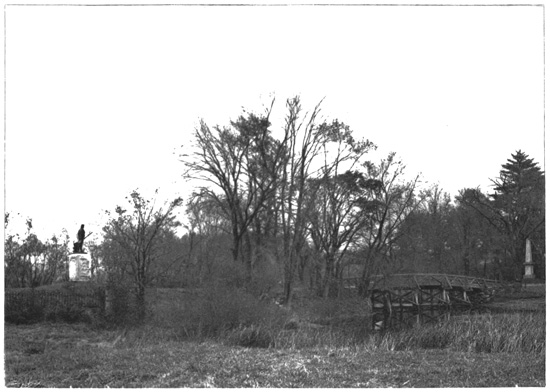
Concord Battle-Ground
TO HELEN THOREAU (AT ROXBURY).
Concord, October 6, 1838.
Dear Helen,—I dropped Sophia's letter into the box immediately on taking yours out, else the tone of the former had been changed.
I have no acquaintance with "Cleaveland's First Lessons," though I have peeped into his abridged grammar, which I should think very well calculated for beginners,—at least for such as would be likely to wear out one book before they would be prepared for the abstruser parts of grammar. Ahem!
As no one can tell what was the Roman pronunciation, each nation makes the Latin conform, for the most part, to the rules of its own language; so that with us of the vowels only A has a peculiar sound. In the end of a word of more than one syllable it is sounded like "ah," as pennah, Lydiah, Hannah, etc., without regard to case; but "da" is never sounded "dah," because it is a monosyllable. All terminations in es, and plural cases in os, as you know, are pronounced long,—as homines (hominese), dominos (dominose), or, in English, Johnny Vose. For information, see Adams' "Latin Grammar," before the Rudiments.
This is all law and gospel in the eyes of the world; but remember I am speaking, as it were, in the third person, and should sing quite a different tune if it were I that had made the quire. However, one must occasionally hang his harp on the willows, and play on the Jew's harp, in such a strange country as this.
One of your young ladies wishes to study mental philosophy, hey? Well, tell her that she has the very best text-book that I know of in her possession already. If she do not believe it, then she should have bespoken another better in another world, and not have expected to find one at "Little & Wilkins." But if she wishes to know how poor an apology for a mental philosophy men have tacked together, synthetically or analytically, in these latter days,—how they have squeezed the infinite mind into a compass that would not nonplus a surveyor of Eastern Lands—making Imagination and Memory to lie still in their respective apartments like ink-stand and wafers in a lady's escritoire,—why let her read Locke, or Stewart, or Brown. The fact is, mental philosophy is very like Poverty, which, you know, begins at home; and indeed, when it goes abroad, it is poverty itself.
Chorus. I should think an abridgment of one of the above authors, or of Ambercrombie, would answer her purpose. It may set her a-thinking. Probably there are many systems in the market of which I am ignorant.
As for themes, say first "Miscellaneous Thoughts." Set one up to a window, to note what passes in the street, and make her comments thereon; or let her gaze in the fire, or into a corner where there is a spider's web, and philosophize, moralize, theorize, or what not. What their hands find to putter about, or their minds to think about, that let them write about. To say nothing of advantage or disadvantage of this, that, or the other, let them set down their ideas at any given season, preserving the chain of thought as complete as may be.
This is the style pedagogical. I am much obliged to you for your piece of information. Knowing your dislike to a sentimental letter, I remain
Your affectionate brother, H. D. T.
The next letter to Helen carries this pedagogical style a little farther, for it is in Latin, addressed "Ad Helenam L. Thoreau, Roxbury, Mass.," and postmarked "Concord, Jan. 25" (1840).
TO HELEN THOREAU (AT ROXBURY).
Concordiae, Dec. Kal. Feb. A. D. MDCCCXL.
Cara Soror,—Est magnus acervus nivis ad limina, et frigus intolerabile intus. Coelum ipsum ruit, credo, et terram operit. Sero stratum linquo et mature repeto; in fenestris multa pruina prospectum absumit; et hic miser scribo, non currente calamo, nam digiti mentesque torpescunt. Canerem cum Horatio, si vox non faucibus haeserit,—
Vides ut alta stet nive candidum Nawshawtuct, nec jam sustineant onus Silvae laborantes, geluque Flumina constiterint acuto? Dissolve frigus, ligna super foco Large reponens, etc.
Sed olim, Musa mutata, et laetiore plectro,
Neque jam stabulis gaudet pecus, aut arator igne, Nec prata canis albicant pruinis; Jam Cytherea choros ducit Venus imminente luna.
Quam turdus ferrugineus ver reduxerit, tu, spero, linques curas scholasticas, et, negotio religato, desipere in loco audebis; aut mecum inter sylvas, aut super scopulos Pulchri-Portus, aut in cymba super lacum Waldensem, mulcens fluctus manu, aut speciem miratus sub undas.
Bulwerius est mihi nomen incognitum,—unus ex ignobile vulgo, nec refutandus nec laudandus. Certe alicui nonnullam honorem habeo qui insanabili cacoethe scribendi teneatur.
Specie flagrantis Lexingtonis non somnia deturbat? At non Vulcanum Neptunumque culpemus, cum superstitioso grege. Natura curat animalculis aeque ac hominibus; cum serena, tum procellosa, amica est.
Si amas historiam et fortia facta heroum, non depone Rollin, precor; ne Clio offendas nunc, nec illa det veniam olim. Quos libros Latinos legis? legis, inquam, non studes. Beatus qui potest suos libellos tractare, et saepe perlegere, sine metu domini urgentis! ab otio injurioso procul est: suos amicos et vocare et dimittere quandocunque velit, potest. Bonus liber opus nobilissimum hominis. Hinc ratio non modo cur legeres, sed cur tu quoque scriberes; nec lectores carent; ego sum. Si non librum meditaris, libellum certe. Nihil posteris proderit te spirasse, et vitam nunc leniter nunc aspere egisse; sed cogitasse praecipue et scripsisse. Vereor ne tibi pertaesum hujus epistolae sit; necnon alma lux caret,
Majoresque cadunt altis de montibus umbrae.
Quamobrem vale,—imo valete, et requiescatis placide, Sorores.
H. D. Thoreaus.
Memento scribere!
Cara Sophia,—Samuel Niger crebris aegrotationibus, quae agilitatem et aequum animum abstulere, obnoxius est; iis temporibus ad cellam descendit, et multas horas (ibi) manet.
Flores, ah crudelis pruina! parvo leti discrimine sunt. Cactus frigore ustus est, gerania vero adhuc vigent.
Conventus sociabiles hac hieme reinstituti fuere. Conveniunt (?) ad meum domum mense quarto vel quinto, ut tu hic esse possis. Matertera Sophia cum nobis remanet; quando urbem revertet non scio. Gravedine etiamnum, sed non tam aegre, laboramus.
Adolescentula E. White apud pagum paulisper moratur. Memento scribere intra duas hebdomedas.
Te valere desiderium est
Tui Matris, C. Thoreaus.
P. S. Epistolam die solis proxima expectamus. (Amanuense, H. D. T.)
Barring a few slips, this is a good and lively piece of Latin, and noticeable for its thought as well as its learning and humor. The poets were evidently his favorites among Latin authors. Shall we attempt a free translation, such as Thoreau would give?
VERNACULAR VERSION.
Concord, January 23, 1840.
Dear Sister,—There is a huge snow-drift at the door, and the cold inside is intolerable. The very sky is coming down, I guess, and covering up the ground. I turn out late in the morning, and go to bed early; there is thick frost on the windows, shutting out the view; and here I write in pain, for fingers and brains are numb. I would chant with Horace, if my voice did not stick in my throat,—
See how Naushawtuct, deep in snow, Stands glittering, while the bending woods Scarce bear their burden, and the floods Feel arctic winter stay their flow. Pile on the firewood, melt the cold, Spare nothing, etc.
But soon, changing my tune, and with a cheerfuller note, I'll say,—
No longer the flock huddles up in the stall, the plowman bends over the fire, No longer frost whitens the meadow; But the goddess of love, while the moon shines above, Sets us dancing in light and in shadow.
When Robin Redbreast brings back the springtime, I trust that you will lay your school duties aside, cast off care, and venture to be gay now and then; roaming with me in the woods, or climbing the Fair Haven cliffs,—or else, in my boat on Walden, let the water kiss your hand, or gaze at your image in the wave.
Bulwer is to me a name unknown,—one of the unnoticed crowd, attracting neither blame nor praise. To be sure, I hold any one in some esteem who is helpless in the grasp of the writing demon.
Does not the image of the Lexington afire trouble your dreams?[14] But we may not, like the superstitious mob, blame Vulcan or Neptune,—neither fire nor water was in fault. Nature takes as much care for midgets as for mankind; she is our friend in storm and in calm.
If you like history, and the exploits of the brave, don't give up Rollin, I beg; thus would you displease Clio, who might not forgive you hereafter. What Latin are you reading? I mean reading, not studying. Blessed is the man who can have his library at hand, and oft peruse the books, without the fear of a taskmaster! he is far enough from harmful idleness, who can call in and dismiss these friends when he pleases. An honest book's the noblest work of man. There's a reason, now, not only for your reading, but for writing something, too. You will not lack readers,—here am I, for one. If you cannot compose a volume, then try a tract. It will do the world no good, hereafter, if you merely exist, and pass life smoothly or roughly; but to have thoughts, and write them down, that helps greatly.
I fear you will tire of this epistle; the light of day is dwindling, too,—
And longer fall the shadows of the hills.
Therefore, good-by; fare ye well, and sleep in quiet, both my sisters! Don't forget to write.
H. D. Thoreau.
POSTSCRIPT. (BY MRS. THOREAU.)
Dear Sophia,—Sam Black [the cat] is liable to frequent attacks that impair his agility and good-nature; at such times he goes down cellar, and stays many hours. Your flowers—O, the cruel frost!—are all but dead; the cactus is withered by cold, but the geraniums yet flourish. The Sewing Circle has been revived this winter; they meet at our house in April or May, so that you may then be here. Your Aunt Sophia remains with us,—when she will return to the city I don't know. We still suffer from heavy colds, but not so much. Young Miss E. White is staying in the village a little while (is making a little visit in town). Don't forget to write within two weeks. We expect a letter next Sunday.
That you may enjoy good health is the prayer of
Your mother, C. Thoreau.
(H. D. T. was the scribe.)
Cats were always an important branch of the Thoreaus' domestic economy, and Henry was more tolerant of them than men are wont to be. Flowers were the specialty of Sophia, who, when I knew her, from 1855 to 1876, usually had a small conservatory in a recess of the dining-room. At this time (1840) she seems to have been aiding Helen in her school. The next letter, to Helen, is of a graver tone:—
TO HELEN THOREAU (AT ROXBURY).
Concord, June 13, 1840.
Dear Helen,—That letter to John, for which you had an opportunity doubtless to substitute a more perfect communication, fell, as was natural, into the hands of his "transcendental brother," who is his proxy in such cases, having been commissioned to acknowledge and receipt all bills that may be presented. But what's in a name? Perhaps it does not matter whether it be John or Henry. Nor will those same six months have to be altered, I fear, to suit his case as well. But methinks they have not passed entirely without intercourse, provided we have been sincere though humble worshipers of the same virtue in the mean time. Certainly it is better that we should make ourselves quite sure of such a communion as this by the only course which is completely free from suspicion,—the coincidence of two earnest and aspiring lives,—than run the risk of a disappointment by relying wholly or chiefly on so meagre and uncertain a means as speech, whether written or spoken, affords. How often, when we have been nearest each other bodily, have we really been farthest off! Our tongues were the witty foils with which we fenced each other off. Not that we have not met heartily and with profit as members of one family, but it was a small one surely, and not that other human family. We have met frankly and without concealment ever, as befits those who have an instinctive trust in one another, and the scenery of whose outward lives has been the same, but never as prompted by an earnest and affectionate desire to probe deeper our mutual natures. Such intercourse, at least, if it has ever been, has not condescended to the vulgarities of oral communication, for the ears are provided with no lid as the eye is, and would not have been deaf to it in sleep. And now glad am I, if I am not mistaken in imagining that some such transcendental inquisitiveness has traveled post thither,—for, as I observed before, where the bolt hits, thither was it aimed,—any arbitrary direction notwithstanding.
Thus much, at least, our kindred temperament of mind and body—and long family-arity—have done for us, that we already find ourselves standing on a solid and natural footing with respect to one another, and shall not have to waste time in the so often unavailing endeavor to arrive fairly at this simple ground.
Let us leave trifles, then, to accident; and politics, and finance, and such gossip, to the moments when diet and exercise are cared for, and speak to each other deliberately as out of one infinity into another,—you there in time and space, and I here. For beside this relation, all books and doctrines are no better than gossip or the turning of a spit.
Equally to you and Sophia, from
Your affectionate brother, H. D. Thoreau.
We come now to the period when Thoreau entered on more intimate relations with Emerson. There was a difference of fourteen years in their ages, which had hitherto separated them intellectually; but now the young scholar, thinker, and naturalist had so fast advanced that he could meet his senior on more equal terms, and each became essential to the other. With all his prudence and common sense, in which he surpassed most men, Emerson was yet lacking in some practical faculties; while Thoreau was the most practical and handy person in all matters of every-day life,—a good mechanic and gardener, methodical in his habits, observant and kindly in the domestic world, and attractive to children, who now were important members of the Emerson household. He was therefore invited by Emerson to make his house a home,—looking after the garden, the business affairs, and performing the office of a younger brother or a grown-up son. The invitation was accepted in April, 1841, and Thoreau remained in the family, with frequent absences, until he went in May, 1843, to reside with Mr. William Emerson, near New York, as the tutor of his sons. During these two years much occurred of deep moment to the two friends. Young Waldo Emerson, the beautiful boy, died, and just before, John Thoreau, the sunny and hopeful brother, whom Henry seems to have loved more than any human being. These tragedies brought the bereaved nearer together, and gave to Mrs. Emerson in particular an affection for Thoreau and a trust in him which made the intimate life of the household move harmoniously, notwithstanding the independent and eccentric genius of Thoreau.
TO MRS. LUCY BROWN[15] (AT PLYMOUTH).
Concord, July 21, 1841.
Dear Friend,—Don't think I need any prompting to write to you; but what tough earthenware shall I put into my packet to travel over so many hills, and thrid so many woods, as lie between Concord and Plymouth? Thank fortune it is all the way down hill, so they will get safely carried; and yet it seems as if it were writing against time and the sun to send a letter east, for no natural force forwards it. You should go dwell in the West, and then I would deluge you with letters, as boys throw feathers into the air to see the wind take them. I should rather fancy you at evening dwelling far away behind the serene curtain of the West,—the home of fair weather,—than over by the chilly sources of the east wind.
What quiet thoughts have you nowadays which will float on that east wind to west, for so we may make our worst servants our carriers,—what progress made from can't to can, in practice and theory? Under this category, you remember, we used to place all our philosophy. Do you have any still, startling, well moments, in which you think grandly, and speak with emphasis? Don't take this for sarcasm, for not in a year of the gods, I fear, will such a golden approach to plain speaking revolve again. But away with such fears; by a few miles of travel we have not distanced each other's sincerity.
I grow savager and savager every day, as if fed on raw meat, and my tameness is only the repose of untamableness. I dream of looking abroad summer and winter, with free gaze, from some mountain-side, while my eyes revolve in an Egyptian slime of health,—I to be nature looking into nature with such easy sympathy as the blue-eyed grass in the meadow looks in the face of the sky. From some such recess I would put forth sublime thoughts daily, as the plant puts forth leaves. Now-a-nights I go on to the hill to see the sun set, as one would go home at evening; the bustle of the village has run on all day, and left me quite in the rear; but I see the sunset, and find that it can wait for my slow virtue.
But I forget that you think more of this human nature than of this nature I praise. Why won't you believe that mine is more human than any single man or woman can be? that in it, in the sunset there, are all the qualities that can adorn a household, and that sometimes, in a fluttering leaf, one may hear all your Christianity preached.
You see how unskillful a letter-writer I am, thus to have come to the end of my sheet when hardly arrived at the beginning of my story. I was going to be soberer, I assure you, but now have only room to add, that if the fates allot you a serene hour, don't fail to communicate some of its serenity to your friend,
Henry D. Thoreau.
No, no. Improve so rare a gift for yourself, and send me of your leisure.
TO MRS. LUCY BROWN (AT PLYMOUTH).
Concord, Wednesday evening, September 8, [1841.]
Dear Friend,—Your note came wafted to my hand like the first leaf of the fall on the September wind, and I put only another interpretation upon its lines than upon the veins of those which are soon to be strewed around me. It is nothing but Indian summer here at present. I mean that any weather seems reserved expressly for our late purposes whenever we happen to be fulfilling them. I do not know what right I have to so much happiness, but rather hold it in reserve till the time of my desert.
What with the crickets and the crowing of cocks, and the lowing of kine, our Concord life is sonorous enough. Sometimes I hear the cock bestir himself on his perch under my feet, and crow shrilly before dawn; and I think I might have been born any year for all the phenomena I know. We count sixteen eggs daily now, when arithmetic will only fetch the hens up to thirteen; but the world is young, and we wait to see this eccentricity complete its period.
My verses on Friendship are already printed in the Dial; not expanded, but reduced to completeness by leaving out the long lines, which always have, or should have, a longer or at least another sense than short ones.
Just now I am in the mid-sea of verses, and they actually rustle around me as the leaves would round the head of Autumnus himself should he thrust it up through some vales which I know; but, alas! many of them are but crisped and yellow leaves like his, I fear, and will deserve no better fate than to make mould for new harvests. I see the stanzas rise around me, verse upon verse, far and near, like the mountains from Agiocochook, not all having a terrestrial existence as yet, even as some of them may be clouds; but I fancy I see the gleam of some Sebago Lake and Silver Cascade, at whose well I may drink one day. I am as unfit for any practical purpose—I mean for the furtherance of the world's ends—as gossamer for ship-timber; and I, who am going to be a pencil-maker to-morrow,[16] can sympathize with God Apollo, who served King Admetus for a while on earth. But I believe he found it for his advantage at last,—as I am sure I shall, though I shall hold the nobler part at least out of the service.
Don't attach any undue seriousness to this threnody, for I love my fate to the very core and rind, and could swallow it without paring it, I think. You ask if I have written any more poems? Excepting those which Vulcan is now forging, I have only discharged a few more bolts into the horizon,—in all, three hundred verses—and sent them, as I may say, over the mountains to Miss Fuller, who may have occasion to remember the old rhyme:—
"Three scipen gode Comen mid than flode Three hundred cnihten."
But these are far more Vandalic than they. In this narrow sheet there is not room even for one thought to root itself. But you must consider this an odd leaf of a volume, and that volume
Your friend, Henry D. Thoreau.
TO MRS. LUCY BROWN (AT PLYMOUTH).
Concord, October 5, 1841.
Dear Friend,—I send you Williams's[17] letter as the last remembrancer to one of those "whose acquaintance he had the pleasure to form while in Concord." It came quite unexpectedly to me, but I was very glad to receive it, though I hardly know whether my utmost sincerity and interest can inspire a sufficient answer to it. I should like to have you send it back by some convenient opportunity.
Pray let me know what you are thinking about any day,—what most nearly concerns you. Last winter, you know, you did more than your share of the talking, and I did not complain for want of an opportunity. Imagine your stove-door out of order, at least, and then while I am fixing it you will think of enough things to say.
What makes the value of your life at present? what dreams have you, and what realizations? You know there is a high table-land which not even the east wind reaches. Now can't we walk and chat upon its plane still, as if there were no lower latitudes? Surely our two destinies are topics interesting and grand enough for any occasion.
I hope you have many gleams of serenity and health, or, if your body will grant you no positive respite, that you may, at any rate, enjoy your sickness occasionally, as much as I used to tell of. But here is the bundle going to be done up, so accept a "good-night" from
Henry D. Thoreau.
TO MRS. LUCY BROWN (AT PLYMOUTH).
Concord, March 2, 1842.
Dear Friend,—I believe I have nothing new to tell you, for what was news you have learned from other sources. I am much the same person that I was, who should be so much better; yet when I realize what has transpired, and the greatness of the part I am unconsciously acting, I am thrilled, and it seems as if there were none in history to match it.
Soon after John's death I listened to a music-box, and if, at any time, that event had seemed inconsistent with the beauty and harmony of the universe, it was then gently constrained into the placid course of nature by those steady notes, in mild and unoffended tone echoing far and wide under the heavens. But I find these things more strange than sad to me. What right have I to grieve, who have not ceased to wonder? We feel at first as if some opportunities of kindness and sympathy were lost, but learn afterward that any pure grief is ample recompense for all. That is, if we are faithful; for a great grief is but sympathy with the soul that disposes events, and is as natural as the resin on Arabian trees. Only Nature has a right to grieve perpetually, for she only is innocent. Soon the ice will melt, and the blackbirds sing along the river which he frequented, as pleasantly as ever. The same everlasting serenity will appear in this face of God, and we will not be sorrowful if he is not.
We are made happy when reason can discover no occasion for it. The memory of some past moments is more persuasive than the experience of present ones. There have been visions of such breadth and brightness that these motes were invisible in their light.
I do not wish to see John ever again,—I mean him who is dead,—but that other, whom only he would have wished to see, or to be, of whom he was the imperfect representative. For we are not what we are, nor do we treat or esteem each other for such, but for what we are capable of being.
As for Waldo, he died as the mist rises from the brook, which the sun will soon dart his rays through. Do not the flowers die every autumn? He had not even taken root here. I was not startled to hear that he was dead; it seemed the most natural event that could happen. His fine organization demanded it, and nature gently yielded its request. It would have been strange if he had lived. Neither will nature manifest any sorrow at his death, but soon the note of the lark will be heard down in the meadow, and fresh dandelions will spring from the old stocks where he plucked them last summer.
I have been living ill of late, but am now doing better. How do you live in that Plymouth world, nowadays?[18] Please remember me to Mary Russell. You must not blame me if I do talk to the clouds, for I remain
Your friend, Henry D. Thoreau.
TO MRS. LUCY BROWN (AT PLYMOUTH).
Concord, January 24, 1843.
Dear Friend,—The other day I wrote you a letter to go in Mrs. Emerson's bundle, but, as it seemed unworthy, I did not send it, and now, to atone for that, I am going to send this, whether it be worthy or not. I will not venture upon news, for, as all the household are gone to bed, I cannot learn what has been told you. Do you read any noble verses nowadays? or do not verses still seem noble? For my own part, they have been the only things I remembered, or that which occasioned them, when all things else were blurred and defaced. All things have put on mourning but they; for the elegy itself is some victorious melody or joy escaping from the wreck.
It is a relief to read some true book, wherein all are equally dead,—equally alive. I think the best parts of Shakespeare would only be enchanced by the most thrilling and affecting events. I have found it so. And so much the more, as they are not intended for consolation.
Do you think of coming to Concord again? I shall be glad to see you. I should be glad to know that I could see you when I would.
We always seem to be living just on the brink of a pure and lofty intercourse, which would make the ills and trivialness of life ridiculous. After each little interval, though it be but for the night, we are prepared to meet each other as gods and goddesses.
I seem to have dodged all my days with one or two persons, and lived upon expectation,—as if the bud would surely blossom; and so I am content to live.
What means the fact—which is so common, so universal—that some soul that has lost all hope for itself can inspire in another listening soul an infinite confidence in it, even while it is expressing its despair?
I am very happy in my present environment, though actually mean enough myself, and so, of course, all around me; yet, I am sure, we for the most part are transfigured to one another, and are that to the other which we aspire to be ourselves. The longest course of mean and trivial intercourse may not prevent my practicing this divine courtesy to my companion. Notwithstanding all I hear about brooms, and scouring, and taxes, and housekeeping, I am constrained to live a strangely mixed life,—as if even Valhalla might have its kitchen. We are all of us Apollos serving some Admetus.
I think I must have some Muses in my pay that I know not of, for certain musical wishes of mine are answered as soon as entertained. Last summer I went to Hawthorne's suddenly for the express purpose of borrowing his music-box, and almost immediately Mrs. Hawthorne proposed to lend it to me. The other day I said I must go to Mrs. Barrett's to hear hers, and lo! straightway Richard Fuller sent me one for a present from Cambridge. It is a very good one. I should like to have you hear it. I shall not have to employ you to borrow for me now. Good-night.
From your affectionate friend, H. D. T.
TO RICHARD F. FULLER (AT CAMBRIDGE).
Concord, January 16, 1843.
Dear Richard,—I need not thank you for your present, for I hear its music, which seems to be playing just for us two pilgrims marching over hill and dale of a summer afternoon, up those long Bolton hills and by those bright Harvard lakes, such as I see in the placid Lucerne on the lid; and whenever I hear it, it will recall happy hours passed with its donor.
When did mankind make that foray into nature and bring off this booty? For certainly it is but history that some rare virtue in remote times plundered these strains from above and communicated them to men. Whatever we may think of it, it is a part of the harmony of the spheres you have sent me; which has condescended to serve us Admetuses, and I hope I may so behave that this may always be the tenor of your thought for me.
If you have any strains, the conquest of your own spear or quill, to accompany these, let the winds waft them also to me.
I write this with one of the "primaries" of my osprey's wings, which I have preserved over my glass for some state occasion, and now it offers.
Mrs. Emerson sends her love.
TO MRS. LUCY BROWN (AT PLYMOUTH).
Concord, Friday evening, January 25, 1843.
Dear Friend,—Mrs. Emerson asks me to write you a letter, which she will put into her bundle to-morrow along with the "Tribunes" and "Standards," and miscellanies, and what not, to make an assortment. But what shall I write? You live a good way off, and I don't know that I have anything which will bear sending so far. But I am mistaken, or rather impatient when I say this,—for we all have a gift to send, not only when the year begins, but as long as interest and memory last. I don't know whether you have got the many I have sent you, or rather whether you were quite sure where they came from. I mean the letters I have sometimes launched off eastward in my thought; but if you have been happier at one time than another, think that then you received them. But this that I now send you is of another sort. It will go slowly, drawn by horses over muddy roads, and lose much of its little value by the way. You may have to pay for it, and it may not make you happy after all. But what shall be my new-year's gift, then? Why, I will send you my still fresh remembrance of the hours I have passed with you here, for I find in the remembrance of them the best gift you have left to me. We are poor and sick creatures at best; but we can have well memories, and sound and healthy thoughts of one another still, and an intercourse may be remembered which was without blur, and above us both.
Perhaps you may like to know of my estate nowadays. As usual, I find it harder to account for the happiness I enjoy, than for the sadness which instructs me occasionally. If the little of this last which visits me would only be sadder, it would be happier. One while I am vexed by a sense of meanness; one while I simply wonder at the mystery of life; and at another, and at another, seem to rest on my oars, as if propelled by propitious breezes from I know not what quarter. But for the most part I am an idle, inefficient, lingering (one term will do as well as another, where all are true and none true enough) member of the great commonwealth, who have most need of my own charity,—if I could not be charitable and indulgent to myself, perhaps as good a subject for my own satire as any. You see how, when I come to talk of myself, I soon run dry, for I would fain make that a subject which can be no subject for me, at least not till I have the grace to rule myself.
I do not venture to say anything about your griefs, for it would be unnatural for me to speak as if I grieved with you, when I think I do not. If I were to see you, it might be otherwise. But I know you will pardon the trivialness of this letter; and I only hope—as I know that you have reason to be so—that you are still happier than you are sad, and that you remember that the smallest seed of faith is of more worth than the largest fruit of happiness. I have no doubt that out of S——'s death you sometimes draw sweet consolation, not only for that, but for long-standing griefs, and may find some things made smooth by it, which before were rough.
I wish you would communicate with me, and not think me unworthy to know any of your thoughts. Don't think me unkind because I have not written to you. I confess it was for so poor a reason as that you almost made a principle of not answering. I could not speak truly with this ugly fact in the way; and perhaps I wished to be assured, by such evidence as you could not voluntarily give, that it was a kindness. For every glance at the moon, does she not send me an answering ray? Noah would hardly have done himself the pleasure to release his dove, if she had not been about to come back to him with tidings of green islands amid the waste.
But these are far-fetched reasons. I am not speaking directly enough to yourself now; so let me say directly
From your friend, Henry D. Thoreau.
Exactly when correspondence began between Emerson and Thoreau is not now to be ascertained, since all the letters do not seem to have been preserved. Their acquaintance opened while Thoreau was in college, although Emerson may have seen the studious boy at the town school in Concord, or at the "Academy" there, while fitting for college. But they only came to know each other as sharers of the same thoughts and aspirations in the autumn of 1837, when, on hearing a new lecture of Emerson's, Helen Thoreau said to Mrs. Brown, then living or visiting in the Thoreau family, "Henry has a thought very like that in his journal" (which he had newly begun to keep). Mrs. Brown desired to see the passage, and soon bore it to her sister, Mrs. Emerson, whose husband saw it, and asked Mrs. Brown to bring her young friend to see him. By 1838 their new relation of respect was established, and Emerson wrote to a correspondent, "I delight much in my young friend, who seems to have as free and erect a mind as any I have ever met." A year later (Aug. 9, 1839), he wrote to Carlyle, "I have a young poet in this village, named Thoreau, who writes the truest verses." Indeed, it was in the years 1839-40 that he seems to have written the poems by which he is best remembered. Thoreau told me in his last illness that he had written many verses and destroyed many,—this fact he then regretted, although he had done it at the instance of Emerson, who did not praise them. "But," said he, "they may have been better than we thought them, twenty years ago."
The earliest note which I find from Emerson to Thoreau bears no date, but must have been written before 1842, for at no later time could the persons named in it have visited Concord together. Most likely it was in the summer of 1840, and to the same date do I assign a note asking Henry to join the Emersons in a party to the Cliffs (scopuli Pulchri-Portus), and to bring his flute,—for on that pastoral reed Thoreau played sweetly. The first series of letters from Thoreau to Emerson begins early in 1843, about the time the letters just given were written to Mrs. Brown. In the first he gives thanks to Emerson for the hospitality of his house in the two preceding years; a theme to which he returned a few months later,—for I doubt not the lovely sad poem called "The Departure" was written at Staten Island soon after his leaving the Emerson house in Concord for the more stately but less congenial residence of William Emerson at Staten Island, whither he betook himself in May, 1843. This first letter, however, was sent from the Concord home to Waldo Emerson at Staten Island, or perhaps in New York, where he was that winter giving a course of lectures.
In explanation of the passages concerning Bronson Alcott, in this letter, it should be said that he was then living at the Hosmer Cottage, in Concord, with his English friends, Charles Lane and Henry Wright, and that he had refused to pay a tax in support of what he considered an unjust government, and was arrested by the constable, Sam Staples, in consequence.
TO R. W. EMERSON (AT NEW YORK).
Concord, January 24, 1843.
Dear Friend,—The best way to correct a mistake is to make it right. I had not spoken of writing to you, but as you say you are about to write to me when you get my letter, I make haste on my part in order to get yours the sooner. I don't well know what to say to earn the forthcoming epistle, unless that Edith takes rapid strides in the arts and sciences—or music and natural history—as well as over the carpet; that she says "papa" less and less abstractedly every day, looking in my face,—which may sound like a Ranz des Vaches to yourself. And Ellen declares every morning that "papa may come home to-night;" and by and by it will have changed to such positive statement as that "papa came home larks night."
Elizabeth Hoar still flits about these clearings, and I meet her here and there, and in all houses but her own, but as if I were not the less of her family for all that. I have made slight acquaintance also with one Mrs. Lidian Emerson, who almost persuades me to be a Christian, but I fear I as often lapse into heathenism. Mr. O'Sullivan[19] was here three days. I met him at the Atheneum [Concord], and went to Hawthorne's [at the Old Manse] to tea with him. He expressed a great deal of interest in your poems, and wished me to give him a list of them, which I did; he saying he did not know but he should notice them. He is a rather puny-looking man, and did not strike me. We had nothing to say to one another, and therefore we said a great deal! He, however, made a point of asking me to write for his Review, which I shall be glad to do. He is, at any rate, one of the not-bad, but does not by any means take you by storm,—no, nor by calm, which is the best way. He expects to see you in New York. After tea I carried him and Hawthorne to the Lyceum.
Mr. Alcott has not altered much since you left. I think you will find him much the same sort of person. With Mr. Lane I have had one regular chat à la George Minott, which of course was greatly to our mutual grati- and edification; and, as two or three as regular conversations have taken place since, I fear there may have been a precession of the equinoxes. Mr. Wright, according to the last accounts, is in Lynn, with uncertain aims and prospects,—maturing slowly, perhaps, as indeed are all of us. I suppose they have told you how near Mr. Alcott went to the jail, but I can add a good anecdote to the rest. When Staples came to collect Mrs. Ward's taxes, my sister Helen asked him what he thought Mr. Alcott meant,—what his idea was,—and he answered, "I vum, I believe it was nothing but principle, for I never heerd a man talk honester."
There was a lecture on Peace by a Mr. Spear (ought he not to be beaten into a plowshare?), the same evening, and, as the gentlemen, Lane and Alcott, dined at our house while the matter was in suspense,—that is, while the constable was waiting for his receipt from the jailer,—we there settled it that we, that is, Lane and myself, perhaps, should agitate the State while Winkelried lay in durance. But when, over the audience, I saw our hero's head moving in the free air of the Universalist church, my fire all went out, and the State was safe as far as I was concerned. But Lane, it seems, had cogitated and even written on the matter, in the afternoon, and so, out of courtesy, taking his point of departure from the Spear-man's lecture, he drove gracefully in medias res, and gave the affair a very good setting out; but, to spoil all, our martyr very characteristically, but, as artists would say, in bad taste, brought up the rear with a "My Prisons," which made us forget Silvio Pellico himself.
Mr. Lane wishes me to ask you to see if there is anything for him in the New York office, and pay the charges. Will you tell me what to do with Mr. [Theodore] Parker, who was to lecture February 15th? Mrs. Emerson says my letter is written instead of one from her.
At the end of this strange letter I will not write—what alone I had to say—to thank you and Mrs. Emerson for your long kindness to me. It would be more ungrateful than my constant thought. I have been your pensioner for nearly two years, and still left free as under the sky. It has been as free a gift as the sun or the summer, though I have sometimes molested you with my mean acceptance of it,—I who have failed to render even those slight services of the hand which would have been for a sign at least; and, by the fault of my nature, have failed of many better and higher services. But I will not trouble you with this, but for once thank you as well as Heaven.
Your friend,H. D. T.
Mrs. Lidian Emerson, the wife of R. W. Emerson, and her two daughters, Ellen and Edith, are named in this first letter, and will be frequently mentioned in the correspondence. At this date, Edith, now Mrs. W. H. Forbes, was fourteen months old. Mr. Emerson's mother, Madam Ruth Emerson, was also one of the household, which had for a little more than seven years occupied the well-known house under the trees, east of the village.
TO R. W. EMERSON (AT NEW YORK).
Concord, February 10, 1843.
Dear Friend,—I have stolen one of your own sheets to write you a letter upon, and I hope, with two layers of ink, to turn it into a comforter. If you like to receive a letter from me, too, I am glad, for it gives me pleasure to write. But don't let it come amiss; it must fall as harmlessly as leaves settle on the landscape. I will tell you what we are doing this now. Supper is done, and Edith—the dessert, perhaps more than the dessert—is brought in, or even comes in per se; and round she goes, now to this altar, and then to that, with her monosyllabic invocation of "oc," "oc." It makes me think of "Langue d'oc." She must belong to that province. And like the gypsies she talks a language of her own while she understands ours. While she jabbers Sanskrit, Parsee, Pehlvi, say "Edith go bah!" and "bah" it is. No intelligence passes between us. She knows. It is a capital joke,—that is the reason she smiles so. How well the secret is kept! she never descends to explanation. It is not buried liked a common secret, bolstered up on two sides, but by an eternal silence on the one side, at least. It has been long kept, and comes in from the unexplored horizon, like a blue mountain range, to end abruptly at our door one day. (Don't stumble at this steep simile.) And now she studies the heights and depths of nature
On shoulders whirled in some eccentric orbit Just by old Pæstum's temples and the perch Where Time doth plume his wings.
And now she runs the race over the carpet, while all Olympia applauds,—mamma, grandma, and uncle, good Grecians all,—and that dark-hued barbarian, Partheanna Parker, whose shafts go through and through, not backward! Grandmamma smiles over all, and mamma is wondering what papa would say, should she descend on Carlton House some day. "Larks night" 's abed, dreaming of "pleased faces" far away. But now the trumpet sounds, the games are over; some Hebe comes, and Edith is translated. I don't know where; it must be to some cloud, for I never was there.
Query: what becomes of the answers Edith thinks, but cannot express? She really gives you glances which are before this world was. You can't feel any difference of age, except that you have longer legs and arms.
Mrs. Emerson said I must tell you about domestic affairs, when I mentioned that I was going to write. Perhaps it will inform you of the state of all if I only say that I am well and happy in your house here in Concord.
Your friend, Henry.
Don't forget to tell us what to do with Mr. Parker when you write next. I lectured this week. It was as bright a night as you could wish. I hope there were no stars thrown away on the occasion.
[A part of the same letter, though bearing a date two days later, and written in a wholly different style, as from one sage to another, is this postscript:]
February 12, 1843.
Dear Friend,—As the packet still tarries, I will send you some thoughts, which I have lately relearned, as the latest public and private news.
How mean are our relations to one another! Let us pause till they are nobler. A little silence, a little rest, is good. It would be sufficient employment only to cultivate true ones.
The richest gifts we can bestow are the least marketable. We hate the kindness which we understand. A noble person confers no such gift as his whole confidence: none so exalts the giver and the receiver; it produces the truest gratitude. Perhaps it is only essential to friendship that some vital trust should have been reposed by the one in the other. I feel addressed and probed even to the remote parts of my being when one nobly shows, even in trivial things, an implicit faith in me. When such divine commodities are so near and cheap, how strange that it should have to be each day's discovery! A threat or a curse may be forgotten, but this mild trust translates me. I am no more of this earth; it acts dynamically; it changes my very substance. I cannot do what before I did. I cannot be what before I was. Other chains may be broken, but in the darkest night, in the remotest place, I trail this thread. Then things cannot happen. What if God were to confide in us for a moment! Should we not then be gods?
How subtle a thing is this confidence! Nothing sensible passes between; never any consequences are to be apprehended should it be misplaced. Yet something has transpired. A new behavior springs; the ship carries new ballast in her hold. A sufficiently great and generous trust could never be abused. It should be cause to lay down one's life,—which would not be to lose it. Can there be any mistake up there? Don't the gods know where to invest their wealth? Such confidence, too, would be reciprocal. When one confides greatly in you, he will feel the roots of an equal trust fastening themselves in him. When such trust has been received or reposed, we dare not speak, hardly to see each other; our voices sound harsh and untrustworthy. We are as instruments which the Powers have dealt with. Through what straits would we not carry this little burden of a magnanimous trust! Yet no harm could possibly come, but simply faithlessness. Not a feather, not a straw, is intrusted; that packet is empty. It is only committed to us, and, as it were, all things are committed to us.
The kindness I have longest remembered has been of this sort,—the sort unsaid; so far behind the speaker's lips that almost it already lay in my heart. It did not have far to go to be communicated. The gods cannot misunderstand, man cannot explain. We communicate like the burrows of foxes, in silence and darkness, under ground. We are undermined by faith and love. How much more full is Nature where we think the empty space is than where we place the solids!—full of fluid influences. Should we ever communicate but by these? The spirit abhors a vacuum more than Nature. There is a tide which pierces the pores of the air. These aerial rivers, let us not pollute their currents. What meadows do they course through? How many fine mails there are which traverse their routes! He is privileged who gets his letter franked by them.
I believe these things.
Henry D. Thoreau.
Emerson replied to these letters in two epistles of dates from February 4 to 12, 1843,—in the latter asking Thoreau to aid him in editing the April number of the Dial of which he had taken charge. Among other things, Emerson desired a manuscript of Charles Lane, Alcott's English friend, to be sent to him in New York, where he was detained several weeks by his lectures. He added: "Have we no news from Wheeler? Has Bartlett none?" Of these persons, the first, Charles Stearns Wheeler, a college classmate of Thoreau, and later Greek tutor in the college, had gone to Germany,—where he died the next summer,—and was contributing to the quarterly Dial. Robert Bartlett, of Plymouth, a townsman of Mrs. Emerson, was Wheeler's intimate friend, with whom he corresponded.[20] To this editorial request Thoreau, who was punctuality itself, replied at once.
TO R. W. EMERSON (AT NEW YORK).
Concord, February 15, 1843.
My dear Friend,—I got your letters, one yesterday and the other to-day, and they have made me quite happy. As a packet is to go in the morning, I will give you a hasty account of the Dial. I called on Mr. Lane this afternoon, and brought away, together with an abundance of good-will, first, a bulky catalogue of books without commentary,—some eight hundred, I think he told me, with an introduction filling one sheet,—ten or a dozen pages, say, though I have only glanced at them; second, a review—twenty-five or thirty printed pages—of Conversations on the Gospels, Record of a School, and Spiritual Culture, with rather copious extracts. However, it is a good subject, and Lane says it gives him satisfaction. I will give it a faithful reading directly. [These were Alcott's publications, reviewed by Lane.] And now I come to the little end of the horn; for myself, I have brought along the Minor Greek Poets, and will mine there for a scrap or two, at least. As for Etzler, I don't remember any "rude and snappish speech" that you made, and if you did it must have been longer than anything I had written; however, here is the book still, and I will try. Perhaps I have some few scraps in my Journal which you may choose to print. The translation of the Æschylus I should like very well to continue anon, if it should be worth the while. As for poetry, I have not remembered to write any for some time; it has quite slipped my mind; but sometimes I think I hear the mutterings of the thunder. Don't you remember that last summer we heard a low, tremulous sound in the woods and over the hills, and thought it was partridges or rocks, and it proved to be thunder gone down the river? But sometimes it was over Wayland way, and at last burst over our heads. So we'll not despair by reason of the drought. You see it takes a good many words to supply the place of one deed; a hundred lines to a cobweb, and but one cable to a man-of-war. The Dial case needs to be reformed in many particulars. There is no news from Wheeler, none from Bartlett.
They all look well and happy in this house, where it gives me much pleasure to dwell.
Yours in haste, Henry.
P. S.
Wednesday evening, February 16.
Dear Friend,—I have time to write a few words about the Dial. I have just received the three first signatures, which do not yet complete Lane's piece. He will place five hundred copies for sale at Munroe's bookstore. Wheeler has sent you two full sheets—more about the German universities—and proper names, which will have to be printed in alphabetical order for convenience; what this one has done, that one is doing, and the other intends to do. Hammer-Purgstall (Von Hammer) may be one, for aught I know. However, there are two or three things in it, as well as names. One of the books of Herodotus is discovered to be out of place. He says something about having sent Lowell, by the last steamer, a budget of literary news, which he will have communicated to you ere this. Mr. Alcott has a letter from Heraud,[21] and a book written by him,—the Life of Savonarola,—which he wishes to have republished here. Mr. Lane will write a notice of it. (The latter says that what is in the New York post-office may be directed to Mr. Alcott.) Miss [Elizabeth] Peabody has sent a "Notice to the readers of the Dial" which is not good.
Mr. Chapin lectured this evening, and so rhetorically that I forgot my duty and heard very little. I find myself better than I have been, and am meditating some other method of paying debts than by lectures and writing,—which will only do to talk about. If anything of that "other" sort should come to your ears in New York, will you remember it for me?
Excuse this scrawl, which I have written over the embers in the dining-room. I hope that you live on good terms with yourself and the gods.
Yours in haste, Henry.
Mr. Lane and his lucubrations proved to be tough subjects, and the next letter has more to say about them and the Dial. Lane had undertaken to do justice to Mr. Alcott and his books, as may still be read in the pages of that April number of the Transcendentalist quarterly.
TO R. W. EMERSON (AT NEW YORK).
Concord, February 20, 1843.
My dear Friend,—I have read Mr. Lane's review, and can say, speaking for this world and for fallen man, that "it is good for us." As they say in geology, time never fails, there is always enough of it, so I may say, criticism never fails; but if I go and read elsewhere, I say it is good,—far better than any notice Mr. Alcott has received, or is likely to receive from another quarter. It is at any rate "the other side" which Boston needs to hear. I do not send it to you, because time is precious, and because I think you would accept it, after all. After speaking briefly of the fate of Goethe and Carlyle in their own countries, he says, "To Emerson in his own circle is but slowly accorded a worthy response; and Alcott, almost utterly neglected," etc. I will strike out what relates to yourself, and correcting some verbal faults, send the rest to the printer with Lane's initials.
The catalogue needs amendment, I think. It wants completeness now. It should consist of such books only as they would tell Mr. [F. H.] Hedge and [Theodore] Parker they had got; omitting the Bible, the classics, and much besides,—for there the incompleteness begins. But you will be here in season for this.
It is frequently easy to make Mr. Lane more universal and attractive; to write, for instance, "universal ends" instead of "the universal end," just as we pull open the petals of a flower with our fingers where they are confined by its own sweets. Also he had better not say "books designed for the nucleus of a Home University," until he makes that word "home" ring solid and universal too. This is that abominable dialect. He had just given me a notice of George Bradford's Fénelon for the Record of the Months, and speaks of extras of the Review and Catalogue, if they are printed,—even a hundred, or thereabouts. How shall this be arranged? Also he wishes to use some manuscripts of his which are in your possession, if you do not. Can I get them?
I think of no news to tell you. It is a serene summer day here, all above the snow. The hens steal their nests, and I steal their eggs still, as formerly. This is what I do with the hands. Ah, labor,—it is a divine institution, and conversation with many men and hens.
Do not think that my letters require as many special answers. I get one as often as you write to Concord. Concord inquires for you daily, as do all the members of this house. You must make haste home before we have settled all the great questions, for they are fast being disposed of. But I must leave room for Mrs. Emerson.
Mrs. Emerson's letter, after speaking of other matters, gave a lively sketch of Thoreau at one of Alcott's Conversations in her house, which may be quoted as illustrating the young Nature-worshiper's position at the time, and the more humane and socialistic spirit of Alcott and Lane, who were soon to leave Concord for their experiment of communistic life at "Fruitlands," in the rural town of Harvard.
"Last evening we had the 'Conversation,' though, owing to the bad weather, but few attended. The subjects were: What is Prophecy? Who is a Prophet? and The Love of Nature. Mr. Lane decided, as for all time and the race, that this same love of nature—of which Henry [Thoreau] was the champion, and Elizabeth Hoar and Lidian (though L. disclaimed possessing it herself) his faithful squiresses—that this love was the most subtle and dangerous of sins; a refined idolatry, much more to be dreaded than gross wickednesses, because the gross sinner would be alarmed by the depth of his degradation, and come up from it in terror, but the unhappy idolaters of Nature were deceived by the refined quality of their sin, and would be the last to enter the kingdom. Henry frankly affirmed to both the wise men that they were wholly deficient in the faculty in question, and therefore could not judge of it. And Mr. Alcott as frankly answered that it was because they went beyond the mere material objects, and were filled with spiritual love and perception (as Mr. T. was not), that they seemed to Mr. Thoreau not to appreciate outward nature. I am very heavy, and have spoiled a most excellent story. I have given you no idea of the scene, which was ineffably comic, though it made no laugh at the time; I scarcely laughed at it myself,—too deeply amused to give the usual sign. Henry was brave and noble; well as I have always liked him, he still grows upon me."
Before going to Staten Island in May, 1843, Thoreau answered a letter from the same Richard Fuller who had made him the musical gift in the previous winter. He was at Harvard College, and desired to know something of Thoreau's pursuits there,—concerning which Channing says in his Life,[22] "He was a respectable student, having done there a bold reading in English poetry,—even to some portions or the whole of Davenant's 'Gondibert.'" This, Thoreau does not mention in his letter, but it was one of the things that attracted Emerson's notice, since he also had the same taste for the Elizabethan and Jacobean English poets. An English youth, Henry Headley, pupil of Dr. Parr, and graduate of Oxford in 1786, had preceded Thoreau in this study of poets that had become obsolete; and it was perhaps Headley's volume, "Select Beauties of Ancient English Poetry, with Remarks by the late Henry Headley," published long after his death,[23] that served Thoreau as a guide to Quarles and the Fletchers, Daniel, Drummond, Drayton, Habington, and Raleigh,—poets that few Americans had heard of in 1833.
TO RICHARD F. FULLER (AT CAMBRIDGE).
Concord, April 2, 1843.
Dear Richard,—I was glad to receive a letter from you so bright and cheery. You speak of not having made any conquests with your own spear or quill as yet; but if you are tempering your spear-head during these days, and fitting a straight and tough shaft thereto, will not that suffice? We are more pleased to consider the hero in the forest cutting cornel or ash for his spear, than marching in triumph with his trophies. The present hour is always wealthiest when it is poorer than the future ones, as that is the pleasantest site which affords the pleasantest prospects.
What you say about your studies furnishing you with a "mimic idiom" only, reminds me that we shall all do well if we learn so much as to talk,—to speak truth. The only fruit which even much living yields seems to be often only some trivial success,—the ability to do some slight thing better. We make conquest only of husks and shells for the most part,—at least apparently,—but sometimes these are cinnamon and spices, you know. Even the grown hunter you speak of slays a thousand buffaloes, and brings off only their hides and tongues. What immense sacrifices, what hecatombs and holocausts, the gods exact for very slight favors! How much sincere life before we can even utter one sincere word.
What I was learning in college was chiefly, I think, to express myself, and I see now, that as the old orator prescribed, 1st, action; 2d, action; 3d, action; my teachers should have prescribed to me, 1st, sincerity; 2d, sincerity; 3d, sincerity. The old mythology is incomplete without a god or goddess of sincerity, on whose altars we might offer up all the products of our farms, our workshops, and our studies. It should be our Lar when we sit on the hearth, and our Tutelar Genius when we walk abroad. This is the only panacea. I mean sincerity in our dealings with ourselves mainly; any other is comparatively easy. But I must stop before I get to 17thly. I believe I have but one text and one sermon.
Your rural adventures beyond the West Cambridge hills have probably lost nothing by distance of time or space. I used to hear only the sough of the wind in the woods of Concord, when I was striving to give my attention to a page of calculus. But, depend upon it, you will love your native hills the better for being separated from them.
I expect to leave Concord, which is my Rome, and its people, who are my Romans, in May, and go to New York, to be a tutor in Mr. William Emerson's family. So I will bid you good-by till I see you or hear from you again.
Going to Staten Island, early in May, 1843, Thoreau's first care was to write to his "Romans, countrymen, and lovers by the banks of the Musketaquid,"—beginning with his mother, his sisters, and Mrs. Emerson. To Sophia and Mrs. E. he wrote May 22,—to Helen, with a few touching verses on his brother John, the next day; and then he resumed the correspondence with Emerson. It seems that one of his errands near New York was to make the acquaintance of literary men and journalists in the city, in order to find a vehicle for publication, such as his neighbor Hawthorne had finally found in the pages of the Democratic Review. For this purpose Thoreau made himself known to Henry James, and other friends of Emerson, and to Horace Greeley, then in the first freshness of his success with the Tribune,—a newspaper hardly more than two years old then, but destined to a great career, in which several of the early Transcendentalists took some part.