Front matter (continued 4)
Reading edition
"Then, by my troth, we will have them here, and see for ourselves what they can do, without the crowding we should suffer at the theatre. We will engage them for the first night they can come."
CHAPTER XIII.
THE HERO OF THE HOUR.
Grey's heart was beating to suffocation as he put the finishing touches to his toilet. The Old Lion sat beside the fire in his costume of Father Time, bending forward to the blaze, but giving vent from time to time to a hollow cough, which at a less all-engrossing moment might have caused Grey some uneasiness. But to-night his head was filled with other thoughts. He was about to start for Lord Romaine's house. The representation of "Time and the Youth" was to be given there before a large and fashionable assembly. She would be there! That was his first thought. She would watch the performance. He might even be able to pick her out from crowded audience, and feast his eyes upon her pure, pale beauty. At least for an hour he would be near her. That alone was enough to set his heart beating in tumultuous fashion. She would be there. At Lord Romaine's own house it was impossible it should be otherwise. Their eyes might meet; and though she would know him not—better that she should not, indeed—he would gaze upon those features which were dearest to him out of all the world. And whether for weal or woe, Grey knew by this time that the love of his whole being was centred in Lady Geraldine Adair, though he was schooling himself to the thought of seeing her and knowing her to be another man's wife. To him she could only be as a star in the firmament of heaven—as a benignant influence guiding him to higher and nobler paths. That was how he must ever learn to regard her, for her world and his were poles asunder. And what had he to offer to any woman—he whose future lay all uncertain before him, and whose fortunes were yet in the clouds?
A message from below warned them that the coach which was to convey them to Lord Romaine's house was now at the door.
"You are tired, sir," spoke Grey, suddenly waking from his reverie and turning to the old man, who rose with an air of lassitude which his strong will could not entirely conceal; "I fear me you are not quite yourself to-night. This constant acting is something too great a strain upon you."
"Ay, my boy, I am growing old," answered the other, with a note of pain in his voice; "I feel it as I never felt it before. My triumph has come just a little too late. I am too old to take up the threads of the past again. The Old Lion has risen once again to roar in the forest, but he must needs lay him down soon in his den—to die."
Over Grey's face there passed a quick spasm of anxiety and pain.
"Nay, nay; say not so. I have never heard you speak in such vein before. What ails you to-night, dear master?"
"No matter, boy, no matter; heed not my groanings," answered Wylde, assuming more of his usual manner, though he held tightly to Grey's arm as they descended the stairs. "I have been somewhat out of sorts these last few days, and you know how they did tell me at the theatre that my voice was not well heard the other night—"
"Ah, but you had that rheum upon you. It is better now. Yesterday your notes rang forth like those of a clarion."
"Ah yes, that may be; but what has happened once may chance again. Boy, did you observe a gray-headed man standing in the slips and watching my every action, his lips following mine as I spoke my part?"
"I did. I thought he seemed to know every word by heart himself. He had the face of an actor, methought."
"He is one, and a favourite with the people—Anthony Frewen is his name. He and I have held many an audience spellbound ere now. What think you he was there for?"
"Nay, I know not, save to watch and learn and admire."
"Ay, truly, to watch and learn, that he may step into Father Time's part, should the day come when I can hold my throne no longer."
A violent fit of coughing here interrupted the old man's words, seeming to give a point to his speech that otherwise it might have lacked.
Grey supported him tenderly whilst the paroxysm lasted; but he sat aghast, thinking what might be coming upon his master and friend. If, indeed, he were to be laid aside by illness, how could the successful dramatic interlude be carried on, save by another actor? And did it not look as though theatre managers were foreseeing this contingency, and preparing for it?
"Could they, indeed, supersede you, sir?" he asked at length. "Have they the right to do so, since the thing was written by you? Must they not rather wait for you to take up your part again, should the cold seize upon you, and for a time render you unfit for your part?"
"Nay, nay, they will not do that; and they have purchased the rights to produce the piece as long as they will. I could not complain. I could only submit." He stopped and drew his breath rather hard, and then broke out with something of his old fire: "But what matter? what matter? It is nature's law! The old must give way to the young. I have lived my life. I have shown men what I can do. I have aroused me from sleep, and shone like a meteor in the sky ere my long eclipse shall come. I am content. I ask no more. Let Elisha take up the mantle which falls from Elijah. My work will be remembered when the hand that penned it is dust."
Grey was almost horrified by these words. It seemed to him as though the Old Lion were almost making up his mind to some approaching calamity; and at the thought of losing his one friend, the young man's heart stood still. He had become greatly attached to Wylde; but he knew that amid those of his own profession he had many enemies. Nor had he been many weeks amongst actors before he had learned the jealousies and emulations that burned so fiercely amongst them, and how eagerly every vacant place was snapped up by one of a crowd of eager aspirants. Who knew but that somebody might even now be studying his part of the Youth, ready to step into his shoes should any untoward event occur to incapacitate him? He had constantly seen the handsome but unsteady Lionel Field hanging about the theatre, and once or twice he had come to see them in their lodgings, and had asked the Old Lion to speak a good word for him, declaring that he had resolved upon turning over a new leaf, and becoming steady and sober again. Grey remembered now how many questions he had put about the Duke of Marlborough, asking how Grey had become so well acquainted with his person and voice and gestures. These he himself had imitated, not without success, for the young man had considerable natural gifts, and far more training than Grey could boast, although he had won so great success through the close instructions of an able master.
The young man knew perfectly by this time that Wylde was somewhat feared in dramatic circles for his keen criticisms, his autocratic temper, and his scathing powers of retort. He knew, likewise, that he was regarded as something of an interloper—a man who had risen suddenly into notice by what might be called "back-stair" influence. Grey was fully aware himself that he had served no apprenticeship to his present calling, that he had stepped into success simply and solely through a series of happy accidents. He could not wonder that to others he should seem to be something of an impostor and a fraud. Whilst under the Old Lion's immediate patronage, nobody dared to flout or insult him; but he was sometimes conscious of an undercurrent of hostile jealousy directed against him, which increased with his increasing popularity with the public. He could not doubt that if some mischance were to befall him or his patron, his fall would be acclaimed in many circles with delight, as making room for another to fill his vacant place. And Grey, looking at the hollow cheeks and the gaunt frame of the Old Lion, hearing from time to time his painful coughing, began to fear that he, indeed, would not long be able to face the world or fight his own battle; and doubtful, indeed, did he feel of his own power and ability to fight that battle for himself single-handed.
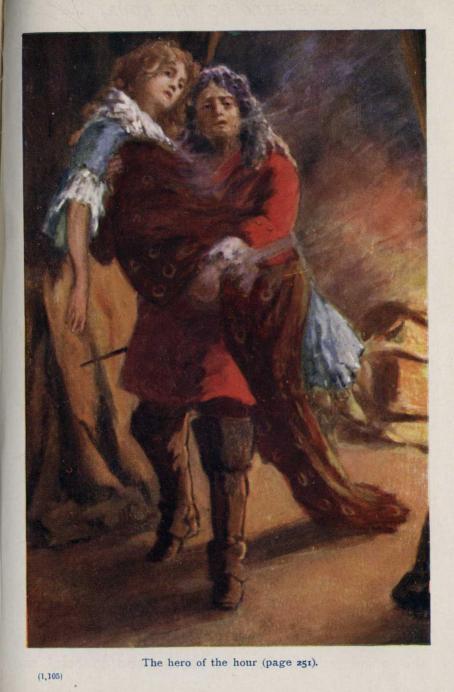
The hero of the hour (page 251).
These fears and misgivings, however, though somewhat dismal at the moment, were all driven away as the carriage rolled under the archway of Lord Romaine's house, and he found himself at his journey's end, and so close to the object of his heart's desire.
The actors were not, of course, taken into any of the thronged drawing-rooms; the day for the reception of dramatists as honoured guests at the houses of the nobility was not yet. They were, however, respectfully conducted to a small apartment and offered refreshments, which they partook of sparingly, and then conducted through the garden to a large temporary structure, which Lady Romaine had insisted on having run up, so that she might invite a very large audience to her house for the occasion.
There was a well-arranged stage for the actors, and the scenery, such as it was, had been well painted, in imitation of that at the theatres; Father Time's throne was a very fine erection, and all the arrangements were excellent. The old man seemed to throw off his lassitude as he made his observations, and the fire came back to his eyes and the power to his voice. Grey forgot his uneasiness in the excitement of the moment, and in the realization of where he was and who might at any moment appear before his eyes, and he was resolved that this representation should be the finest which had ever been seen heretofore.
In the grand reception-rooms of the Countess, Geraldine stood apart as one who dreams. She saw the throng of fashionable persons assembling; she heard delighted exclamations about the wonders of the little theatre which all had heard of. It had been brought from Spring Gardens, and the moving of it had been quite a small excitement for the fashionable world, who declared that Lady Romaine was the cleverest and most delightful of women, and that it was quite too charming to be able to witness this representation, of which all the town was talking, without the crush and fatigue of attending the theatres.
Geraldine heard as in a dream all this hubbub and clatter. She herself was as eager as any to witness the dramatic interlude, but from a motive different from that of the rest of the world. There was an unwonted flush upon her cheeks, a brilliance in her dreamy eyes. Many persons, who had scarcely noticed her before, or had passed her by with the epithet, "a maid of ice," "a snow-queen," now regarded her with greater attention, and said one to another that the Lady Geraldine was a more beautiful creature than they had fancied before.
Lord Sandford, pushing his way through the throng towards her, felt a peculiar thrill of triumph run through him as his eyes dwelt upon her face.
"She is a splendid woman—just fit to be the future Lady Sandford, the mother of those who shall come after me! My wooing shall not last much longer. I know the mind of her mother, and though her father promises nothing, he wishes me well. He will not have her coerced, nor would I. She must come to me willingly; but come she shall. She has no mind towards marriage, as other maids and damsels. Better so, better so. I would not have my mistress one of those whose ears are greedy for the flattery of all the world—one who looks upon each man as he appears in the light of a possible suitor. No, I would have my white lily just as she is—pure, spotless, calm, cold. It is for me to kindle the fire, for me to unlock the heart; and I will not grumble if the task be something hard, for better is the prize for which we have toiled and sweated, than the one which drops into our hands at the first touch."
So thinking, he pushed his way till he stood by Geraldine's side, and met the clear, steady glance of her eyes.
"Fair lady, I give you greeting. You are not going to absent yourself from the representation this night? We never know in our garish world where the Lady Geraldine will appear, or what places she will illumine with the light of her countenance. I rejoice to see you here to-night."
"I have a great desire to see this spectacle of which I have heard so much," answered Geraldine quietly; "I would fain have gone to the theatre, if so be that my mother had not arranged this representation here. I have heard of the Old Lion of the stage, though never have I seen him. There is something grand in the story I have heard of his talent, his early successes, and his bravely endured eclipse and poverty. I am right glad he has lived again to taste success and the plaudits of the people."
Lord Sandford laughed at her earnestness.
"You are a philanthropist in sooth, Lady Geraldine, to interest yourself in the affairs of such persons as these."
"Are they not of our own flesh and blood, my lord?" she asked.
"Faith, I know not, and I care not! At least, they are not of our world, which is more to the point in these days."
Geraldine turned away with a look upon her face which roused the hot blood of Lord Sandford; he was not used to scorn.
"Lady Geraldine," he began; but a sudden stir and as sudden a hush in the great rooms brought his words to an abrupt stop. The Duchess of Marlborough herself was making her formal entry, and there was almost the same respect paid to her as though royalty itself were appearing. They were only waiting for her to troop through the covered way into the theatre; and Geraldine, taking advantage of the movement and the confusion incident to this, escaped from Lord Sandford, who would have given her his arm, made her way rapidly downstairs by a private way, and took up a position in the theatre where he was quite unable to get near her.
She had decided beforehand where she would sit—near to a side-door into the garden, which, standing half-open, let in a current of cool air into the heated place. It had been warmed beforehand, and was dimly lighted by a number of small lanterns overhead, such as were used in the gardens of Vauxhall and Ranelagh.
Her heart was beating almost to suffocation as the curtain went up, and she saw the often-described figure of Time upon his throne. But it was not of his rounded periods nor his telling gestures that she had been dreaming; and though she listened and watched with a sense of fascination, she knew that she was waiting—waiting—waiting for the next actor, with a sense almost of suffocation in her throat.
Why had she thought this thing? Why had it seemed to her no impossibility that Sir Grey Dumaresq, vanished utterly from his old world, should be masquerading now in this part of the Youth? She could not have answered even to herself these questions, yet her heart was all in a tumult. Had he not once said to her, as he plucked a white rosebud and gave it her, "Why was my name not White instead of Grey? Then it would be like unto you"? Was that enough to build upon? Hardly, but yet she could not help it. Did not men speak of his grace, dignity, manly beauty? and did not many say of him that his face seemed familiar in some sort, yet none could say who he was? And now a thunder of new applause rent the air. For a moment her vision grew dim and she could not see. Then it cleared, and her heart gave a great bound. Clear silver tones fell upon her ear, and the ring of a voice that she knew. His face for the moment was turned away. He was addressing himself to Father Time; but as he turned towards the house and gazed full upon the audience sitting in spellbound silence, the foot-lights fell full upon his face, and she knew him!
She knew him—that was enough! What he said or did, she knew not—cared not. She sat with her gaze fastened full upon him. She recked not why that alone seemed enough. A strange trance that was half dream fell upon her. She gazed, and gazed, and gazed.
"Good lack, but the fellow is the very mirror of my husband! I had not believed it, had I not seen it with mine own eyes." The voice of the Duchess was clearly heard above the clarion notes of the actor. She was not one to hush her tones, and she was not a little astonished by the performance. Pleasure, gratification, and surprise were all written upon the hard but handsome features of the Queen's favourite; and every now and again she would tap her long ivory fan with some vehemence upon the back of the seat in front, and would exclaim aloud,—
"Vastly good! Vastly well done! Faith, but he is a pretty fellow, and knows what he is about. I must have speech with him. I would learn more of this. Beshrew me, but the Duke must see this when he returns!"
This loud-voiced praise could not but reach the ears of the actors, and they could not fail to know who it was that spoke. All knew that the Duchess was to be present, as a special mark of good will and condescension, and that she should speak such open praise seemed to set a seal upon the success of the entertainment. Lady Romaine could scarce contain herself for delight.
Geraldine still sat as in a maze of bewildered happiness. It was not till just as the performance was closing that she was awakened from her trance, and that somewhat rudely. The last words of the interlude were being spoken. Father Time and the Youth were standing together making their last speeches to the audience, and she was gazing with all her eyes into the face of one whom she alone out of all the company had recognized, when one of the lanterns overhead, insecurely fastened, burnt its way loose, and fell flaring and blazing upon the light train of her dress. Instantly she was in a blaze. The flames shooting up made a glare all over the house, and a hundred piercing shrieks attested the terror of the ladies at the sight.
But one had seen even before the flames shot up. Already the young actor had leaped like a deer to the floor of the house; in a moment he had reached the side of the lady. He had caught up in his hands a great rug which was picturesquely flung over the throne of Father Time, and before any other person in the room had recovered presence of mind sufficient to stir, he had the flaming figure wrapped round in this rug, and had borne it out through the half-open door into the safety of the grassy garden without, where, laying his burden down upon the ground tenderly, despite his haste, he was quickly able to stifle the flames and extinguish the last spark.
He bent over her, his face white and ghastly in the moonlight.
"You are not hurt—say you are not hurt!"
"I think not; you were so quick—so quick. How can I thank you?"
Her eyes looked into his; it was just one moment before the people came rushing out upon them in a frantic crowd. But that moment was their own. They looked into each other's eyes, and a thrill passed from heart to heart that never could be forgotten. Out rushed Lord Romaine, frantic with anxiety; out followed a motley crowd—some weeping, some gasping, some exclaiming, some even laughing in hysterical excitement. Grey stood up suddenly, and slipped away like a wraith in the moonlight.
Lord Romaine bent tenderly over his daughter, who was struggling to her feet, still encumbered by the folds of the great rug. She was dishevelled, her dress was torn and burnt, she held the folds of the covering wrap about her still; but her voice was only a little tremulous as she clung to her father's arm.
"I am not hurt; no, I am sure I am not. The hot breath of the fire just scorched for a moment; but then it was crushed out.. Please send the people away. I do not want to be stared at. I am not hurt. Please take me in, and let me go to my own room."
"Bless me, but what a pretty kettle of fish!" cried a loud and imperious voice. "Let me see the child and be sure she is all safe. Ha, there you are, my pretty white bird! A nice scare you gave us all wrapped about in a ring of fire like—who was the woman?—Brynhild, or some such outlandish name. But it was a fine ending to the drama. We have not quite lost our heroes yet. My faith, how he leaped down! He must have seen it before any of the rest of us. Well, well, well; it is a good thing that his fine show of bravery was not all in words. He is a mettlesome youth, and deserves the praise of the town. He will be more the hero of the hour than ever. Where is the boy? I would have speech of him myself."
The Duchess looked about her; but no one like the Youth was to be seen. He had vanished altogether; but, doubtless, he would be somewhere on the place, and could be fetched to receive the thanks of the parents and the compliments of the Duchess.
It was too cold to stand out in the moonlight, and there was a general move towards the house, Geraldine still clinging to her father's arm, avoiding the shrill questions, comments, and congratulations of the company, and shrinking back especially when Lord Sandford would have approached.
"The luck was not for me to-night," he said; "nevertheless, give me the chance, Lady Geraldine, and you shall see what I will do. But that actor chap shall not lose his reward for his promptitude. I will see to that."
She started as though she had been stung.
"My lord, do not insult him!"
He stared at her in amaze; but she slipped away and vanished like a wraith. He strode moodily about the rooms, joining in the general inquiry after the young actor whom the Duchess had sent for; but the servants came back after some time to say that the young man could not be found. He seemed to have disappeared into thin air.
CHAPTER XIV.
FICKLE FORTUNE.
Grey had a double reason for his rapid disappearance from the scene of his recent exploit. For one thing, he had recognized amid the audience assembled by Lady Romaine to witness the performance quite a number of men whom he had known with more or less intimacy in the former days, and whom he now desired to avoid. He knew that both his flowing wig and his fine clothes had received some injury from the fire, and moreover he quickly felt that his hands and one of his arms had suffered from the flames. If he were to be taken possession of by friendly or compassionate persons, to have these matters looked to, there was no end to the possible complications which might arise. The sensitive pride of the young man of gentle birth rose in arms against being unmasked in the midst of old associates. He pictured the laugh with which Lord Sandford would make the discovery that the youthful baronet, his whilom friend, was playing upon the boards of the theatre for a livelihood. That was a thing he could not and would not endure. And he had fled hastily from the coming crowd, so soon as he had been assured that Lord Romaine was on the spot to take care of his daughter.
Again, he was frightened by the intensity of his own feelings. When he held Geraldine in his arms, and when their eyes met, and he knew himself recognized, the flood of emotion which surged over him had well-nigh mastered him and led him into some wild act of folly. He had had much ado to stay the burning words which rushed like a torrent to his lips. He dared not trust himself to look again upon Geraldine's fair face. He was frightened at the immensity of the temptation which had assailed him to break into some wild declaration of love.
But when he had reached the waiting coach which was to convey him and his companion back to town, his thoughts were directed into quite another channel by the frightened faces of the servants who stood by.
"You had better get Master Wylde home without delay," spoke one, "and have a leech for him. He was taken with bleeding at the mouth almost as soon as he left the stage. He has only spoken once, and that was to ask for you. He should be got to bed as quick as may be, and kept there till he is better."
With a pale and anxious face Grey threw himself into the coach where the Old Lion was sitting, leaning back feebly against the cushions, his face ghastly, his hand holding to his mouth a kerchief stained and spotted with blood. In a great fright the young actor bade the man drive fast, and stop on his way at the residence of one of the many physicians, or quacks, who drove so brisk a trade in these times, each having some wonderful nostrum of his own for the cure of all ills under the sun, and some of them thriving so mightily that they drove four or six horses in their coaches, and had lackeys in scarlet and silver lace running beside them and distributing small leaflets, in which the wonders their master had performed were set forth.
Grey had heard of some of these men, and that they performed wonderful cures; and he cared not what he paid, at that moment, so that his master and friend might be relieved and healed.
With no small trouble he got him up the stairs to their attic, and put him to bed. But more than once the hacking cough brought back the dreaded bleeding; and by the time that the leech arrived, pompous and haughty, and none too well pleased at being summoned from the convivial gathering of friends whither he had betaken himself, he looked more like a corpse than a living man.
Grey was in a fever of anxiety, and listened with earnest heed to the words of the leech, and his instructions for the relief of the patient. He bought every suggested medicament, regardless of the cost, and made no hesitation in handing the exorbitant fee demanded by the great man for his valuable services. He cared for nothing, so that his master should recover; and the leech, finding that gold was plentiful in this humble abode, and rather interested in the discovery that he was attending the actor whose Father Time had made such talk in the town, really began to take some interest in the case, and to put forth his best skill; so that before very long the death-like hue of the patient's face changed to something more natural, and the hemorrhage was for the time being checked.
"He must be kept perfectly quiet. On no account must he exert his voice, or leave his bed, or take any liberties. Nature must be humoured, my dear sir; nature must be helped and aided. She is a kind mother to her obedient and reasonable children, but she has many a rod for the backs of those who despise her warnings. Our worthy friend has been tendering a deaf ear to her counsels; therefore has she chastened him somewhat severely. But let him show himself mild and docile under her rod, and it may be that she will restore him to favour again, and that the world will once more pay to him its tribute of admiration and praise."
So saying the leech took his departure, promising to come at any hour of the day or night that he might be sent for; and Grey was left alone with his patient, who had been soothed off to a quiet sleep by a draught administered. And it must be said in justice to these men—half physician, half quack—who flourished at this time, that some of their remedies were of no small value when properly applied. They used herbs and concoctions brewed from the leaves and roots of plants far more freely than has since become fashionable. Many purchased their nostrums from old women, who went forth into the fields and lanes, and distilled from their spoil mixtures which they regarded as remedies of infallible potency. Much ignorance prevailed as to the action of these simples upon the human body; but many of them were of no small value in sickness, and when used in cases where it chanced to be the thing required, worked wonders in rapid healing, and became at once the favourite elixir of the moment amongst those who had known of the cure.
So the Old Lion was at least soothed to quiet sleep, and in the warm atmosphere of the attic his breathing was sensibly relieved. Grey was able now to strip off his own finery, rather aghast at the sorry state of his coat, the total destruction of his costly ruffles, and the singed condition of his wig.
"These must be made good quickly, or I shall not be fit to appear on the boards on Monday night," he mused, as he looked at them. Luckily as this was Saturday night, he felt as though there were breathing time before him. "I must send word to Mr. Butler of what has befallen. Anthony Frewen, or some other, must needs play Father Time for a score of performances at least, I fear me. It will be a loss: I shall earn but the half of what was given us before. Still it will suffice to keep us, and I trust and hope that it will not be long ere he recover, to take his place once more."
A troubled look came over Grey's face as he looked towards the bed, and noted the patient's sunken cheek and cavernous eyes. He wondered that he had not before seen how thin and shrunken the old man was getting; but there was always so much fire about him that it deceived even those who saw him oftenest and loved him best.
"It has been too much for him," mused Grey, as he sat beside the fire, pain of body and anxiety of mind precluding all thought of sleep. His hands were becoming increasingly painful, and he had forgotten to ask the leech for any medicament for them. However, he applied linen rag steeped in oil; and the burning smart lessened somewhat, though he had no disposition to seek sleep.
"It hath been too much for him—the triumph, the adulation, the excitement of taking again his old place before the world. It meant so much to him, this play. It was like the child of his old age. It brought him his final triumph; but it took much out of him also. The fires of life blazed up too fiercely. Now they seem sinking down to ashes. Heaven grant that we may feed them yet, that he may recover him of this sickness. Yet will he ever be able to face the world again as heretofore? It is hard that his trumpet voice should be taken—the last of those attributes which made him the idol of the stage. Oh, it has been hard how one thing has followed another with him! Some men seem born to success and triumph, whilst others with equal gifts and powers are doomed to misfortune and sorrow."
Grey fell into a reverie of a sombre nature. "Was he fated to be one of those luckless mortals, ever falling lower and lower in fortune's favour, till perhaps a pauper's grave should at last close over him?
"What has life given me heretofore? A good old name, which I may not use for very pride; an estate so burdened and crippled that it is none of mine, save in name. I have had my days of glory and happiness; but what lies before me now? If my master dies, or lies sick and helpless, what will become of us in the future? I may play the part of the Youth with Anthony Frewen or some other till the world tires of it; but what then? Shall I join the crowd of cringing, hollow-eyed men, crowding the taverns and the stage doors of the theatres, and begging for some inferior part upon the boards? Shall I go vaunting my powers, or chaffering my wares in a market already overstocked, that wants none of me? No. Whatever happens, I will have none of that. I have tasted of the life, but it hath no charms for me. Rather would I gird my sword upon my thigh, and go forth as a soldier in foreign lands; and, indeed, were I alone in the world, methinks I would hesitate no longer, but offer myself for this."
As he spoke, his eyes turned to the bed where the old man lay, and a softer look came over his face.
"I cannot leave him. With him I must stay till he recover, or till he die. He took me in in my hour of need. To desert him in his would be base beyond all words. I will play the part of son to him so long as he needs me; and for his sake will I go through my part as before, though without him the joy will be gone. But it will bring us the needful gold; and we are not without our hoard, as it is. Truly my master was wise when he decided not to leave these rooms—not to live like rich men on the strength of our earnings. We have sufficient gold laid by against a rainy day. Ere that is spent, doubtless there will come some change to our fortunes."
But with the dawn of another day Grey found himself in very sorry plight. Great blisters had risen over his hand and arm, and the fingers were so swollen and painful that he could scarcely move them. He was forced to contrive a sling in which to carry his left hand and arm, and he could only just use his right sufficiently for the needful attendance upon the sick man, and that not without considerable pain. He began to feel feverish and weak himself from the effects of pain and shock.
It began to come over him with more and more conviction that he himself would be unfit to appear upon the stage on the morrow. And as soon as the morning light had fully come, he sent the servant of the house wherein they lodged to the rooms occupied by Mr. Butler of the Drury Lane theatre management, asking him to come at once to see him upon a matter of importance.
Mr. Butler was part proprietor of the theatre, and the practical stage manager, and he listened with great interest and concern to Grey's tale, looking earnestly at the sick man muttering to himself upon the bed, but taking no notice of what went on about him, and bending over him not untenderly, to see if could elicit some response. But the Old Lion unclosed his dim eyes for a few moments, looked into his face, and then turned restlessly and began the mutterings as before, interrupted sometimes by fits of coughing, which left him visibly exhausted, although there was no return of the hemorrhage.
"I have had my fears of this," spoke Mr. Butler, turning back to Grey. "He is scarce fit for the strain of the past weeks. He uses himself up too fast. The fires burn within too fiercely; and his long illness, though seeming only to cripple his limbs, has told upon him. I have feared it might be so, therefore we are not altogether unprovided."
"I know," answered Grey quietly. "I was going to say as much. Anthony Frewen has the part of Father Time at his fingers' ends. He can play it for Mr. Wylde till this illness be overpassed."
"That is true. I am glad you should know. He is ready at any time to take the part. It will be for him a great opportunity. But it would be well for you to rehearse with him ere appearing before the public. Shall we arrange for this to-morrow forenoon? As for this dress, it must be given at once into the hands of tailor and perruquier. But there should be no difficulty in having it repaired in time. A few guineas will set that matter to rights."
"At my cost," answered Grey promptly. "Let that be understood. It is in the bond; though I shall be grateful if you will see to the matter for me. As for the rehearsal, and even the performance to-morrow and the next few nights, I am not certain if I myself shall be able to go through my part. See here!" and Grey drew from the sling his maimed and stiffened hand, showing even a greater extent of injury in the daylight than he had observed before. His white face and drawn brows showed that he was suffering considerable pain; and Mr. Butler whistled in dismay.
"This is serious," he said, with a look of perplexity on his face.
"Yet methinks there is a way out of the difficulty," spoke Grey, with some eagerness. "Could you find and send to me the young actor Lionel Field, who has lodgings somewhere in these regions, for he comes and goes at the theatre, and has visited us often, albeit he has never told me where he dwells?"
"I could find the fellow, doubtless," was the answer; "but do you know your man? A fellow sober one day, drunk the next, upon whom no reliance can be placed, though his talent is considerable, and he has caught the public taste before now."
"Ay, and adversity has something sobered and tamed him," answered Grey eagerly. "I have a sort of liking for the fellow, though he has a jealous feeling towards me, in that I have stepped into a place without serving apprenticeship thereto. But believe me, he could act this part of mine. I am sure of it. He has studied it, I know. He has sat many a time in that chair whilst I have been going through my paces before my master. I have seen him watching and following all. Send him hither to me. I will undertake that he shall be ready to act for me till I am my own man again. Let him have the chance. I am sure he will remain sober. He has been steadier for long; and this, he knows, may give him just that lift for which he has been waiting and longing. It may be the beginning for him of better things; and since we are much of the same height, and he is only something broader and more stoutly built, there will be little trouble with the dress. Let him play the Youth for one week at least in my place, and I will give my time to my sick friend yonder, and let my injured hands recover their strength and suppleness."
The manager had been studying Grey's face with some attention. He saw that it would be impossible for the young man to act for some days to come. There was a look of fever about him, and the state of his hands was quite prohibitive. He spoke with a note as of warning in his voice.
"Do you know what it is that you would do?" he asked. "Have you heard the tale of the countryman who warmed a viper at his hearth, which afterwards did him to death?"
"The fable I know," answered Grey with a smile, "but I do not see the application in the present."
"Perchance you may have reason to understand it, if you do as you purpose towards Lionel Field. A man consumed by vanity and envy is not the safest wearer of one's discarded shoes."
"But is there any other?" asked Grey. "I know of none."
"No, nor I, i' faith. We have feared that the old man might break down—he has been growing so gaunt and hollow-eyed of late; but we had never thought of such a thing as the Youth failing us. We have no substitute for you, Mr. White. If you fall ill, the interlude must cease; and it were pity too, for it still draws us crowded houses."
"No, it need not cease," spoke Grey with energy. "Send me only Lionel Field this day, and I will undertake that by to-morrow forenoon he shall be fit for the rehearsal with Anthony Frewen in the theatre. Let him take my place till I am ready to fill it again. He will do it better than I, with these maimed hands, and with my heart so full of anxious fears for Mr. Wylde."
"Then so be it," answered the manager, with audible relief in his tones. He had no wish to withdraw the piece whilst it was still so high in favour. No one knew how soon the capricious public might tire of it; but for the moment, with the Duke of Marlborough the popular idol, and expected home week by week, nothing that gave him praise and honour could fail to catch the popular taste. The house filled double as full on those nights on which Time and the Youth were to appear as it did on the others. Grey knew this, and would not for the world have had the performances to cease on his account. He had no petty jealousy of an understudy. He simply desired that a man he had come to pity sincerely should have the chance he so coveted; and when Lionel Field stood before him, flushed, excited, filled with strenuous desire to succeed—to fill the part as ably as it had been filled before—Grey's only desire was to help him to this end.
It was a strange day that was passed in that upper chamber. On the bed lay the sick man, for the most part lying in the lethargy of weakness, but from time to time rousing up, watching with sudden feverish eagerness the actions of the young men, and occasionally in whispering tones giving some fragment of keen criticism or dramatic suggestion. At the other end of the room stood Lionel, going through his part again and yet again, with an unwearied energy and with increasing grip and power; whilst Grey, white-faced and exhausted, but still bent on the task before him, sat beside the fire watching, listening, instructing, rising every now and again to show how a certain trick of manner or of voice must be managed, to recall the great Duke to those who knew him. The master was in earnest; the pupil was eager and resolved to excel. Lionel had never lacked talent. What he had lacked was the power of self-restraint, whilst vanity had led him into the snare of thinking himself invaluable. A bitter lesson had followed, and he had learned wisdom by experience. His chance had now come to him most unexpectedly. He meant to use it well. He was grateful to Grey for selecting him at this juncture. He did not consciously meditate doing him an ill turn, but he resolved in his heart that this opportunity should be used to the uttermost. It would bring him once more before the public which once had favoured him. He would take care he did not sink into obscurity again.
It was dusk before he left with his part perfect, and everything learned that Grey could teach him. As his footsteps clattered down the wooden stairs, Grey sank back exhausted into his chair, closing his eyes in utter lassitude. It was more than an hour before he moved, and then nothing but the necessity for giving food to Wylde would have roused him.
The Old Lion was awake now, and his breathing, though very rapid, was somewhat easier. He was excessively weak; but the quiet day spent in the warm attic and without any exertion on his part had not been without effect, and there was more comprehension in the gaze now bent upon Grey's face than he had seen there since the previous night, when the old man had been taken suddenly ill.
"What is the matter, boy, and what have you been doing all day? Who was that went out at dusk? Methought it looked like young Lionel Field."
"It was he, sir. He came to learn—or rather to perfect—the part of the Youth. You and I are to take a week's holiday, and enjoy a rest together. Your cough is too bad for you to go abroad, and I have burnt my hands and must needs get them healed ere I step the boards again. Anthony Frewen and Lionel Field will take our places for the nonce; and after we are restored to our former health, and strength, the public will welcome us back the more gladly for our absence."
The Old Lion's eyes flashed suddenly from beneath their heavy lids. He half raised himself in his bed.
"I shall never tread the boards again. My acting days are done. I murmur not. I have had my heart's desire. I can now depart in peace. But you, boy—you! Why have you given up the place that was yours? I hear the knell tolling for you too. Not for your life—nay, you will live after these limbs are laid in the grave; but for your triumph—for your fame. You have given up your birthright to the supplanter. You will never take your rightful place again—never—never!"
Grey smiled at the sorrowful intensity with which these words were spoken. He laid the old man down, and spoke to him soothingly.
"Nay, do not fear; do not let such thoughts trouble you. I have seen Mr. Butler. All will be well. My place will be kept for me till my return. When I am able for it, I shall play the 'Youth' again; and we will live upon the proceeds till you are hale and strong; and then you shall write a great play which shall hold the whole world captive and enthralled. But now trouble not yourself of these matters. Only rest, and all will be well."
"Well, well; yes, for me all will soon be well," was the old man's dreamy answer. "But for you, my son—for you, what will befall? Fickle Fortune did smile at you; but her smile has changed to a frown. The open door is closing in your face, and where will you find another?"
Grey smiled and answered not. At the present moment he was too worn out in mind and body even to care what the future might hold.
CHAPTER XV.
DARK DAYS.
For above a fortnight things went very strangely for Grey in that upper room which had been for so long his home. The Old Lion was very ill—dangerously ill for many days; and though the leech was called in several times, and sometimes gave a medicine which brought relief, it was little his skill availed, and the tender nursing of the young man was undoubtedly the means under Providence whereby the sick man's life was saved.
But Grey himself was suffering from severe prostration, from an intermittent fever, and from much pain from his burns, which were slow to heal and made his task of nursing very difficult.
Nevertheless he would let no one else rob him of this labour of love; for none could soothe the sick man as he could, and if left to other care, he always became restless and feverish.
As for the world without, that was altogether blotted out from Grey's thoughts. He never even heard of the return of the Duke of Marlborough from his glorious campaign of victory; he never knew of the grand procession through the streets from Whitehall to Guildhall, and thence to the Vintners' Hall, where the victor of Ramillies was feasted by the civic authorities, after the standards taken at the great battle had been flaunted through the streets and acclaimed by a huge and enthusiastic crowd.
All this, if he heard rumour of it, passed through his brain unheeded. He did not even know that the Duke attended a performance at Drury Lane of "Time and the Youth," and laughed and applauded the representation, in which so much subtle flattery had been introduced. Always eager for popular applause, the Duke was not a little delighted by the ovation he received in his own person, and in the words of the interlude itself, which were cheered to the echo by a house crowded to suffocation. Afterwards the actors were summoned before him, and each received a purse of gold from the hands of the Duchess. And she told the Duke how that the young actor had been so brave and prompt in the saving of the life of her favourite, Lady Geraldine, at the private performance of the piece a short while back. So great a lady as the Duchess could not be expected to note any difference in the actors of the interlude, and none explained her error, for what did it matter? Anthony Frewen and Lionel Field were drawing just as well as the original pair had done, since the enthusiasm for the Duke was increasing with his presence in England. They asked lower terms for their services, and they gave none of the trouble that the Old Lion had done by his autocratic demands and his hasty temper. The managers of both theatres were well content with matters as they were, and congratulated themselves that nothing more had been heard of their former employés. Wylde's uncertain health would render his re-engagement a matter of some difficulty, if not of impossibility; and Anthony Frewen had openly declared that he would act only with Field. They had studied together. They understood each other, and they wanted no "interloper" coming between them.
This was in substance what Grey heard when, after three weeks of anxiety and watching, he found that their exchequer was almost empty, and realized that he must bestir himself again to earn the needful weekly sum to enable them to live comfortably, and provide the wherewithal for the sick man's needs. His hands were now almost well. He had discarded his sling and could use his arm freely. The fever had left him somewhat weak, but he believed he had power to take his part without any fear of failure, and he sought out the friendly stage-manager, Mr. Butler, to tell him as much. Little did he anticipate the answer he received.
The matter was fully and kindly explained; but there seemed no hesitation about the decision.
"I am sorry—very sorry—Mr. White. But what are we to do? Frewen and Field are both old stage favourites. Their return has been hailed with approval in many quarters. They have acted all this time together, and Frewen declines to act with any other. It is possible that he fears in you a rival; for there is a dash and a divine afflatus (if I may use the phrase) in your acting which is lacking in that of Field. Talent is always ready to be jealous of genius. It may be that the matter lies in that nutshell. However this may be, these are the facts. These two mean to do well; they refuse to be separated, and therefore—"
"I understand," answered Grey quietly. "It is quite right, I suppose. For myself I care little, but for Mr. Wylde I have my regrets. After all, it is his piece that is filling your pockets. Has he no claim upon you for that? I know not what the law may be; but can you suffer him to be in want whilst his genius is bringing you such success?"
"Well, well, well, we will see what we can do. I am sorry, very sorry, that you ever gave up your part. Oh, I know it was inevitable. You were not able for it; and you showed magnanimity in your instruction of another. But it was a mistake on your own part—the countryman and the viper—did I not warn you? A man of more worldly wisdom would have done differently."
"If you will only see that Mr. Wylde lacks not for the necessaries of life, I care nothing for my own loss," answered Grey with perfect truthfulness. "I am young and strong; I have the world before me. But whilst he is ill I cannot leave him; and if I lose my post here, how can I hope to support him through the bitter winter now upon us? I can face destitution for myself, but it were shame to let him suffer."
"Well, well, he shall not starve; we will do something for him. I promise you that. But it was a thousand pities that you did not receive the purse of gold from the hands of the Duchess last week. That would have set you on your feet for some time to come; and, after all, it was for you it was really meant. Field should be made to divide it."
"No, no," answered Grey, with sudden haste and imperiousness; "I touch no gold that I do not earn." And when he heard the story of the performance at which the Duke had been present, he rejoiced greatly that he had not played the "Youth" that night. He felt as though the eagle eyes of the Duke would have penetrated his disguise; and how could he have met the victor of Ramillies again in the garb of an actor, winning his bread on the London boards?
There was a curious strain of pride in the young man's nature. Although his short dramatic career had been so successful, he shrank with the deepest distaste from recognition by any of his former friends. He hated the very thought that the name of Grey Dumaresq should be linked with that of the actor of the "Youth."
In the same way he had always abstained from making any use of the token of favour bestowed upon him by the Duke of Marlborough as a pledge of friendship. He always carried the ring about his person, hung round his neck by a silken cord. But although he knew it would win for him the patronage of the great Duchess, whose influence with the Queen, if not the paramount power it once was, was still very great, he had never been able to make up his mind to use it. He had not learned how to present himself as a suppliant for favour. He felt that he had talent. He desired to see that talent recognized and rewarded. But to go about seeking for a patron to push him into notice was a thing he had never brought himself to do. Whilst living with the Old Lion he had rewritten his romance, and had made of it a very delicate piece of workmanship, which might well win him fame if he could but get it taken up. But hitherto he had been too busy to think much about the matter. The romance must wait his greater leisure. Now, however, turning away from the theatre feeling very certain that his dramatic career had closed as suddenly as it had opened, he began to realize that something must be done to keep the wolf from the door; and his thoughts instinctively turned to his pen with a certain joy and pride. For therein lay more real delight to him than in the plaudits of assembled crowds. If he could win fame in the realms of literature, he would with joy say farewell to his brief career as actor.
Walking thoughtfully along, he almost ran into two men who were strolling arm in arm along the pavement. Stopping short from the recoil, he looked at them, and saw that they were Anthony Frewen and Lionel Field—the very two whose amicable partnership had ousted him from his hoped-for employment. But there was no rancour in Grey's heart. Already his facile and eager mind had turned to other themes. He would have held out his hand in fellowship to his quondam pupil; but the young actor's face had suddenly flushed a deep crimson, and he pulled his companion down a side alley, laughing loudly, and affecting not to have seen the other. Plainly, he feared reproaches and recriminations, and was stung by the goad of an uneasy conscience.
Grey smiled a little as he pursued his way.
"It is something strange," he mused, "how that a man can never forgive one whom he has injured! Had I supplanted him, he might have swaggered up to demand explanation or redress, and we might even have made it up again; but since he has injured me, he will have none of it. I am henceforth to him an outcast."
Grey was not disposed at once to return home, to encounter the keen eyes and perhaps the burst of righteous indignation which no doubt his news would awaken within the breast of the Old Lion. That Wylde had had some fears of what the event had justified, Grey was aware. He knew the emulations, jealousies, and small cabals of the theatre, and how a young actor, raised by lucky chance to a post of eminence, is suspected and plotted against by others as an interloper. His own reputation and Grey's brilliant success had served them in good stead so long as he was able to retain his own place; but now that his influence was withdrawn, and Grey had shown himself not indispensable, the thing which he foresaw had come to pass; and the young man regretted it more for his master's sake than for his own, save for the immediate difficulty of seeing where the daily necessities of life were to come from.
But at least he had obtained a promise that something should be done for the old man, and he could surely fend for himself.
He was walking northward along the frost-bound road. A spell of bitter weather had succeeded the torrents of rain which had characterized the earlier part of the winter. Icicles hung from the eaves, and the water was frozen in the gutters and puddles. The sun hung like a red ball in the clear frosty sky, and there was a biting keenness in the air which made rapid motion a necessity.
Grey was not depressed, though he was grave and thoughtful. He walked on rapidly, one thought chasing another through his brain. Had it not been for the necessity of taking care of his old friend, he would have liked well enough to walk all the way to Hartsbourne, to see old Jock and faithful Dick, from whom the recent almost impassable state of the roads had sundered him. During the days of his extreme poverty Grey had hidden himself even from Dick. But with brighter times he had written to his faithful henchman; and once the latter had visited him at his new abode, and had accompanied him to the theatre to watch the performance there, which had filled him with pride and joy at his master's triumph, albeit he felt a pang of pain to see him reduced to such a method of earning his bread.
That was the last time they had met, for the constant rains had made the roads well-nigh impassable. But the frost had come as a friend to travellers, and Grey felt sure that Dick would not be long in availing himself of the changed conditions for a visit to town. It might be indeed that they would meet one another, if only he persevered in his walk. He wanted news of Don Carlos—now his one valuable asset. Much as it went against him to sell his beautiful horse, he brought himself to contemplate it as a possibility. As a poor man in London, the creature was of little use to him, and there were a score of wealthy young bloods who had offered again and again to purchase the horse at his own price. The strained shoulder had entirely recovered. The creature was as sound as ever. Perhaps—perhaps—Grey had got as far as that, when he suddenly heard himself hailed in rapturous tones as "Master! master!" and there was Dick racing to meet him at the top of his speed.
But the honest fellow's face was troubled; and scarce had Grey time to greet him ere the evil news was out.
"He is stolen, master—he is stolen! Don Carlos is gone! Oh, it has been foul play from first to last! We had kept him so safely, Jock and I. The old skinflint had no notion of his being there. He grazed out of sight of the house, and at night was never brought in till after dark. But that one-eyed Judas must have discovered the secret at last, and told his master. We never suspected it; but I will wager it was so. Then they played this scurvy trick on me. They said the old man was dying. The doctor must be fetched at all cost. I and my nag, who paid our board, were known to be living with old Jock. I galloped off to Edgeware for the leech, and Jock was kept within doors, making hot large quantities of water, never allowed for a moment outside the brew-house, where stood the great copper filled with water. I rode away gleefully enough, for I had no fears for the old man's life, though of course I would not have him die for lack of succour. I found the leech, and bade him ride back with me full speed; but we had both been long making the journey, for the roads were like troughs of mire, and the beasts flagged sorely when urged. We were forced to let them pick their way as they could, and so it was well-nigh dusk ere we arrived. He went up to the sick-room, and I to groom down my jaded horse and fetch in Don Carlos. When I went for him to the far paddock, he was gone! The rails were down. There was abundant trace of trampling hoofs and footprints of men. He had given them trouble; but they had him at last. The horse was stolen!"
Grey listened in silence. He felt somewhat as did the patriarch Job when one after another the messengers of evil tidings came with their words of woe. He scarce heard all that Dick was saying now—whom he suspected of being in complicity with his unscrupulous kinsman in this matter. But one name arrested his attention, and he stopped to ask a quick question.
"Lord Sandford! What said you of him?"
"Why, master, as I was telling you, when I began to make inquiry here, there, and everywhere, I heard that my Lord Sandford had been seen as near as Edgeware, and that he had been asking something about a horse. More I cannot find out; but it is enough for me. There is devilry in the matter, and Barty Dumaresq and Lord Sandford are both mixed up in it. I have come to town to see you first, and then to get some knowledge of his lordship's stables, and I'll wager I'll find out before very long where the Don is hidden away."
Grey's eyes flashed with anger. Was it possible that this man should sink to plotting a common theft? Or was it his kinsman who had stolen the horse, and sold him for a great sum to the young nobleman, who had always coveted the creature? This was most probably the truth, for the recluse of Hartsbourne had plainly feigned illness to get Dick and Jock out of the way. The whole thing was a dishonourable conspiracy, and he could only hope that Lord Sandford's part in it had been merely that of purchaser. If he had stooped to plot a theft with the old miser, he would be a worse and a meaner villain than Grey would willingly believe, since it was already the talk of the town that he would wed with the Lady Geraldine Adair so soon as the spring-tide should come.
Master and man discussed the matter for some time, and Grey agreed that Dick should carry out his plans, and report to him of the result at intervals. It was above a week since the horse had vanished; but the state of the roads had prevented the man from attempting the walk to London before, and he did not desire to be burdened with his own horse, as he knew not where he might have to lodge, or what was likely to turn up.
"Our fortunes are at a low ebb just now, good Dicon," said Grey as they parted. "You have but a few gold pieces left, and our exchequer is almost bare. But we must hope that Dame Fortune, who has shown a frowning face of late, will treat us to some of her smiles again. For the world is a harder place than once I thought it, and life a sorer struggle."
"But you have the Duke's token still, sir?" spoke Dick eagerly. "You need not despair whilst that remains. They say he is in London now. Why not take it boldly to him, and remind him of yourself and his promise? They say he has a kindly heart, as well as a gracious manner."
"I believe that is true," answered Grey with a smile. "Yes, why not go to him? Why not? Ah, Dicon, I would that life looked as simple to me as it does to you. But perhaps—perhaps— Who knows what may next betide? At least, so long as the token remains, I have still a card to play; and who can tell but that the last card shall take the trick and win the game?"
The sunlight had faded by the time Grey reached the attic, and the fire had burnt itself out to a handful of ashes. Wylde was turning restlessly upon his bed, coughing more than he had done of late; and Grey reproached himself with his long absence, though he quickly had things comfortable and bright again. But the old man must needs hear of his journey to the theatre; and though he professed himself in no wise astonished, it was plain that the blow struck home.
His protégé had been set aside for another. They ceased to regard him as a power. He was laid upon the shelf, and another had stepped into his place. His word carried no weight. No one cared whether he lived or died. He had brought success and prosperity by his talents to others, but he was to be left to die in obscurity and want. Ah well, better men than he had been treated just so. He desired of Grey to leave him to die alone, and to go forth and make his own way in the world that had no room for a feeble and broken man whose work was done.
Grey soothed him as well as he was able, but he could not find much to say that was hopeful or encouraging. He dared not speak of any promise of help from the theatres, lest the old man should wrathfully refuse to receive alms, where justice was denied. So he represented that there was still money left in their purse, which was in a measure true; but the funds were so excessively scanty that in a few days they would be quite exhausted. And when the old man at last passed into slumber, Grey went carefully over all his possessions, which had increased somewhat of late, and carefully detached from his clothing any ornaments which might be sold for small sums to eke out their subsistence till something should turn up. For it was evident that Wylde must not be left long by himself, as this day's experiment had proved. And how was Grey to obtain any sort of paid work, were he to be tied to this attic and to almost constant attendance upon his old friend and master?
How the next days passed by Grey scarcely knew, for the Old Lion had a relapse, medicines had to be obtained, together with food such as his condition required; and although a small sum of money had been sent by Mr. Butler, with an intimation that the same amount should be paid weekly for the present, it had soon melted away, and there came a night when Grey had not so much as a penny left in the purse, and he himself was almost faint for want of food.
But the old man lay sleeping peacefully; the fire burned clear and bright. The night was fine and cold, and Grey slipped forth into the streets, wrapping himself well up in a voluminous cloak belonging to his friend, which completely disguised him.
A strange desperation seized him, and he cared not what he did. He entered tavern after tavern, singing a roundelay in one, telling a story in another, reciting a speech or a part of a dramatic scene in another, and once going through the whole dialogue of "Time and the Youth," taking both parts himself, but so changing his aspect from moment to moment that his audience was electrified, and silver coins as well as coppers were his portion on this occasion.
He had now enough for two days' needs. He had supped well, and now must return home. He felt as though he had passed through a strange black dream; but he had learned how at a pinch the next day's wants might be supplied—at least until he had been the round of all the taverns and coffee-houses, and men were tired of him. But he would not think of that yet.
He, Sir Grey Dumaresq, had sunk to playing the buffoon in pot-houses, to earn coppers from the idle sots who frequented such places. He laughed aloud as the thought presented itself to him thus. Dame Fortune had proved a sorry shrew so far as he was concerned. Was there any lower turn in her wheel that he must presently experience?
He had wandered some distance from home, since after having supped he had been fired to try his luck at some of the more fashionable resorts of the day; and his last performance had been given at a coffee-house in one of the better localities, though for the life of him he could not exactly tell where he was.
It was long since he had walked in these wider streets, and the night, though starlight, was very dark. Suddenly a sound as of blows and cries wakened him from his reverie. Instinctively he started to run in the direction whence they came, and almost directly he met some fellows wearing livery fleeing helter-skelter, as for dear life, from a band of young Mohawks or Scourers, as they termed themselves, who made the terror of the town at night. In the distance there was still some tumult going on, and Grey, half guessing the cause, rushed onward, not heeding the pursuit he passed. A lamp dimly burning over a house showed him the outline of one of those chairs in which ladies of fashion were carried to and fro from house to house. Plainly the liveried servants in charge of the chair had been chased away, and its occupant was now at the mercy of the half-drunken young bloods against whom Father Time had inveighed so eloquently.
Grey understood in a moment, and with a cry of rage and scorn he flung himself into the heart of the fray, intent upon the rescue of the lady in the chair, whoever she might be.
CHAPTER XVI.
A NIGHT ADVENTURE.
The all-important Duchess of Marlborough had taken one of her sudden and somewhat vehement and exacting likings for the Lady Geraldine. This was a matter of no small gratification to Lord and Lady Romaine, notwithstanding the fact that the mother felt some jealousy and vexation that her daughter should have been singled out for this distinguished lady's favour, whilst she herself was entirely passed over. Still she was woman of the world enough to accept the situation with philosophy. She always declared freely that the Duchess bored her to death, and that she would never be able to put up with her temper and her autocratic ways. But she was glad enough to let Geraldine visit at Marlborough House whenever an invitation (or rather summons) came for her; and Geraldine herself was glad and thankful to go, for here at least she was safe from the unwelcome and ever more pressing attentions of Lord Sandford. And above and beyond this, her parents were disposed to treat her with more respect since she had been "taken up" by the Queen's favourite. When she begged of her father not to make any promise to Lord Sandford regarding the disposition of her hand, he laughingly consented to wait awhile; for in his heart he began to wonder whether his beautiful daughter might not do better for herself. Lord Sandford's reckless expenditure was becoming the talk of the town, and unless he had larger reserve funds to draw upon than were known, he might possibly find himself in awkward straits. In the house of the Duchess, Geraldine might possibly meet admirers with more to recommend them or at least with prospects more sound and secure. It is true that Lady Romaine still upheld her favourite Sandford's suit as warmly as ever; but Lord Romaine was quite willing to accede to his daughter's request, and to let things take their own course without bringing matters at once to a climax. Lord Sandford was not to be dismissed; but Geraldine was not to be coerced.
It was natural that the girl should welcome with pleasure and gratitude a friendship which brought her immunity from what promised to become something very like persecution. Her occasional visits to Marlborough House formed the brightest spots in her present life.
If the Duchess were proud, capricious, autocratic, and uncertain in temper, as her detractors declared, at least she possessed warm and deep feelings, and could be infinitely agreeable and kindly when she chose. To Geraldine she was uniformly gentle and sympathetic. Perhaps she already felt that she had passed the meridian of her days of power. The kinswoman, Abigail Hill (now Mrs. Masham), whom she had first introduced to the Queen, was rapidly rising in royal favour, and seemed likely to prove not only a rival, but a supplanter. It had not come to that yet; and the return of the Duke, covered with glory and honour, averted for a while the calamity already overshadowing her. But so clever and astute a woman could not be altogether blind to the Queen's waning affection; and perhaps the consciousness of her own faults and shortcomings, and her unguarded temper, helped at this juncture to soften the asperities of this rough but sterling nature, and disposed her to take pleasure in the sincere and undisguised affection and admiration of this beautiful girl.
Geraldine on her part took great pleasure in the society of one who held in a semi-masculine contempt the follies, frivolities, and buffooneries of the present day code of manners. Of men and women alike, the Duchess spoke with hearty scorn, her eyes flashing and her lips curling in a fine contempt. Her influence at Court had always been on the side of gravity, decorum, and what the fashionable dames and gallants called "dullness." She and the Queen were at one in all these matters, as they were at one in their ideas of conjugal fidelity and the sacredness of the marriage bond. The Queen was as devoted to her weak-minded husband as the Duchess to her victorious lord. Both held in detestation the laxity which prevailed in the world of fashion, and neither cared for the criticisms passed upon the dullness of the Court, so long as its virtue was preserved untainted.
Geraldine, sickened by what she saw and heard at the gay routs to which she had been taken in her mother's train, felt the solemn stately gravity of the Duchess's house as a haven of rest. She spent her time during her visits in the private apartment of the great lady, where the latter came and sat whenever she had leisure to do so, writing short notes to her husband, to be dispatched by special couriers, or talking of him and his triumphs, or the prospects of the war or of parties at home, to one who was eager to learn and ready to take a keen and intelligent interest in all, and whose sincere admiration and affection, expressed rather in looks and little unconscious actions than in words, seemed to soothe and refresh her not a little, accustomed as she was to full-mouthed flatteries to her face, and the scheming of jealousy behind her back.
With the return of the Duke came a break in these pleasant visits. But the break was not final in any sense of the word, and Geraldine received many little affectionate notes, expressing a hope of seeing more of her when they could escape from attendance at Court, and enjoy a season of privacy in their own house. At first it was necessary for the Duke to be constant in his attendance at Whitehall or Kensington Palace, and the Duchess went with him. But a day came at last when Geraldine was summoned to Marlborough House, to spend the afternoon with the Duke and Duchess, and to remain through the evening with the latter, as the Duke had to attend a meeting of friends at Lord Halifax's house, and the Duchess desired to keep the girl, asking that her chair might not be sent for her until eleven o'clock.
Geraldine was pleased and excited by this prospect; for as yet she had never seen the Duke at close quarters, though from all she had heard of him from his wife and others she felt as though he were familiar to her, and her admiration for him was very great. She had heard of his weakness where money was concerned, and she knew that he had more than once changed sides in his politics, and even in his loyalty. But those were days of change and confusion, when it was often difficult to see the way clear before one, and when the outlook varied so continually with changes of dynasty and of foreign and domestic policy that a perfectly consistent and straightforward walk in life was a thing almost impossible of achievement. The girl was not disposed to criticise him or suspect him of overmuch self-seeking. Still less so when the charm of his personality was brought to bear upon her. She well understood all she had heard respecting his powers of fascination, and felt that she could have listened for ever to the music of his voice, watching the changing expressions of his handsome, mobile features, and the graceful telling gestures of his beautiful white hands.
They enjoyed a little quiet dinner in their private apartments, almost unattended by servants. And it was as they sat with wine and dried fruits before them, awaiting the moment when the Duke must take his leave, that he suddenly addressed his wife,—
"Ha, Sarah! There is a question I have wanted to put a hundred times, but ever when it sprang to my lips the moment was not favourable. Tell me, has a young gentleman of prepossessing appearance ever presented himself to you with my amethyst ring as token of his good faith? I did surely tell you of the narrow escape I had at the battle of Ramillies, and how that I was saved and helped by the timely assistance of a gallant young English traveller."
"You did, my good lord; and I have greatly desired myself to see and to thank this young gentleman for the service rendered. You did warn me that you had bidden him come to me, if in need of any favour or influence. A warm welcome should have been his at any time, but he has never presented himself."
"Let us hope, then, that he has prospered without our aid," spoke the Duke. "He did tell me somewhat of himself, and I do remember how that I thought his future something uncertain. But the details of his story have escaped my memory, and I fear even his name is not clearly remembered. It was Grey—the Christian name—that do I recollect; for he said it was that of a kinsman of his whom I had overthrown at Sedgemoor in the days of the rebellion in the west. Grey, Grey—yes, that is clear; but for the rest—"
"Could it have been Sir Grey Dumaresq?"
Geraldine's was the voice which broke in here. They turned and looked at her. Her face was flushed: her eyes were bright. The Duke smiled as he made instant reply.
"Grey Dumaresq—that was the name. Say, fair lady, is this man known to you? I would fain renew my acquaintance with him, and show him some token of gratitude."
"I know not where he is now," answered Geraldine. "For a while he was dwelling with Lord Sandford, as his friend and comrade. But they say that they had some quarrel. Strange stories were told of them. And Sir Grey disappeared—no man knows whither. Many whispers and rumours have gone forth concerning him, even to the one which said that he had taken the part of the Youth in the representation you did witness, your Grace, at the theatre."
"It was not Grey Dumaresq whom I did see afterwards," spoke Marlborough quickly. "I do not forget faces. I should have known him instantly. That report could not be true."
Geraldine's face was changing colour every moment; her breath came thick and fast. Heretofore she had spoken no word of this matter, which had been on her mind night and day for long. Now an impulse of speech came over her.
"Ah, but the actors have changed," she said. "I did hear from our servants that the old man who played Father Time was taken ill the very night that they played at our house; and your Grace doth know," turning to the Duchess, "how that my dress caught fire, and how that the young actor did spring down and extinguish the flames, escaping away ere we could call him back to thank him. It was then that I made sure. I had suspected it before; but when I saw his face so near, I could not doubt. It was he."
"Extraordinary!" exclaimed the Duke. "How could things have come to such a pass with him? Why had he not sought you out, and told of his adversity? To be sure, many a gentleman born to fortune falls upon evil days, sometimes through no fault of his own. But with my token—well, there was no need for this. I must consider what should be done. Have you seen him since, Lady Geraldine?"
"Nay; and he has not been acting of late. Two strangers, or rather two other actors, have been playing the parts since that night. I did ask of my mother leave to send and seek him out, that we might at least give him thanks for the service rendered me; but she would not believe I had recognized him aright—she said it was but my fantasy; and for the rest, if the man wanted a guerdon, he had but to come and ask for it. Hence, nothing has been done."
"Well, 'tis a strange story; and yet, as I saw that representation at the theatre, I did say within myself that some eye-witness of the battle of Ramillies must have planned and written it. We will think and speak more of it anon. Stranger things have befallen ere this. It would please me well to befriend a gallant and chivalrous youth, too proud or too noble to ask favours for himself. I told him he had something of the poet in him. He may have a career before him yet. Well, sweetheart, I must needs be going now; but I will return ere midnight, and Lady Geraldine will beguile the hours of my absence."
He rose, and kissed his wife with a lover-like devotion which sat gracefully upon him, and which to Geraldine seemed in no wise ridiculous, notwithstanding the fact that this couple had grown-up children, married themselves. It was a beautiful thing, she thought, to see how their love survived, and grew in depth and intensity. She was able to speak of the Duke, when he had gone, in terms which brought smiles of pleasure to the wife's face.
It was a happy evening for Geraldine; for the flame of hope leaped up in her heart, and she felt as though something bright and beautiful had come into her life. The Duke had shown interest in the subject of the young actor, who had saved her from injury on the night of the performance at their house. He did not gibe at her half-formed fancy. On the contrary, he seemed disposed to examine for himself the possible truth of the tale. He would seek out Grey—for Grey, she knew, it was. He would raise him out of obscurity and poverty into the position to which he was born. There seemed no end to the possibilities of good fortune which might come to him with the favour and gratitude of the Duke. The girl passed a happy, dreamy evening, these fancies weaving themselves into a background for her thoughts, whilst she talked with the Duchess of the Duke's magnificent reception, of the palace of Blenheim being erected at the cost of the nation for a residence for him, and of the honours to which he was likely to attain through his genius and the favour of her Majesty.
She was in the same happy frame of mind when she got into her chair shortly before midnight; for the Duchess kept her talking till past the time arranged, and it never occurred to her to be afraid of the darkness of the ill-lighted streets. She had her bearers—her father's liveried servants. And, after all, the distance to traverse was not so very great.
She had not proceeded far, however, before she was aroused from her pleasant reverie by the sounds of shouts, yells, and hurrying steps. She felt her own bearers break into a run, and the chair swayed from side to side in a fashion that was alarming. Something struck sharply against the panels, then a shower of missiles seemed to rattle against its side. Her own men yelled aloud in fear or pain, and next moment the chair seemed to be heavily dropped, and the air was rent with sounds of strife, the fall of weapons, and cries of pain and terror. There was no mistaking what had happened. She was the object of some attack from the street bullies; but whether by a luckless chance or by premeditation and design, the frightened girl could not guess. The thought of Lord Sandford and his unscrupulous ways flashed into her mind, and a shudder ran through her frame. She could see little or nothing of what was going on without. Her breath had dimmed the window-panes; there was scarcely any light in the streets. Never was any creature more helpless than a lady shut into one of the cumbersome chairs of the period. She could by no means get out, or even let down a window from within; and before many minutes had elapsed, the girl was perfectly certain that her bearers had run wildly away to save their own skins, and that she was left to the mercy of one of the lawless bands of street marauders, the terror of the helpless old watchmen, powerless to cope with them, the scandal of the whole town.
For a moment it seemed as though pursuers and pursued had alike left her alone, and she made at that juncture a frantic but useless effort to escape from her prison. Then roars of laughter and the trampling of feet assured her that her foes were coming back, and she closed her eyes and set her teeth, and, clasping her hands, tried to frame a few words of prayer, for she knew not what next would betide her. A hand seemed fumbling with the chair. In another moment it would be thrown open. But ere that moment had arrived a new sound arose. More footsteps came tearing along—a fierce voice—shouts of derision—more blows—more oaths—cries of pain and anger—fierce threats—savage recriminations. What was going on? Had some one flown to the rescue? Oh, when would the horrid scene end? These men were capable of doing to death any single or unarmed man who tried to stand between them and their brutal pastimes.
But what was this? Another sound! The roll of wheels—a commanding voice that she knew ringing through the darkness of the night, dominating all other sounds.
"It is the Duke—the Duke himself!" cried Geraldine, falling back almost fainting on the cushions; but the next minute lights were flashing round her, then the head of the chair was lifted off, and she saw the Duke himself bending towards her, his face full of concern and anxiety.
"What! The Lady Geraldine! Then, indeed, I come in good time. Are you hurt, sweet lady? Answer quick! For these villains shall not escape so easily, if you are."
"No, no, I am not hurt; but I fear me some one is who came to my rescue. I heard him shout to them to stop their coward play. They were about to look inside the chair, but they all turned upon him with shouts of derision and fury. I trow he gave them blow for blow, for I heard them yell and swear the fiend was in him. Oh, I fear me they must have been too many for him, and that he has been injured in my defence. Pray, your Grace, let your people see to it. I might have been grossly ill-treated but for his opportune arrival."
"There is a young man lying in the roadway here, your Grace," spoke one of the servants, "his clothes half torn from his back, his head bleeding, and his arm broken. I think he is not of that band we dispersed, for I saw one of them deal him a kick and swear a lusty oath at him as they ran off."
"Oh, it is my preserver—I know it is!" cried Geraldine, with tears in her eyes. "Ah, your Grace will know what to do."
"Why, put him into the coach, and take him home," spoke Marlborough at once, his well-known humanity towards his wounded soldiers extending instantly to this injured citizen, who had risked perhaps life itself on behalf of law and order, and in defence of some unknown victim. "And as for you, Lady Geraldine, you must likewise return with me. I cannot suffer you to be abroad with these bands of ruffians prowling the streets. I will send a message to your father's house, and your dispersed servants will doubtless find their way home in time. Lord Romaine shall know you safe; but you must return with me to-night."
Geraldine was only too thankful to do so. The very presence of the great Duke, calm and fearless, dissipated her fears and gave her confidence. She saw him superintend the lifting of the injured and unconscious man into the coach, heard him give directions to the servants to drive direct to Marlborough House, and then he himself took up his position beside her chair, and walked with it till they entered the hall of his great house, where she was suffered to alight, to be met by the Duchess (to whom a messenger had been hastily dispatched), and embraced by her with a motherly solicitude of which Lady Romaine would have been quite incapable.
"My dearest girl, what a terrible fright has been yours! Oh, how I rejoice that no hurt has come to you! I should never have forgiven myself for detaining you so long. Ah! and what have we here? Poor creature! he surely is not dead! What a ghastly object! Come away, dearest; it is no sight for you. What? He came to your rescue? One against a band? No wonder he has been roughly handled. Oh, he shall be well tended; I warrant you that. Yes, let him be carried into yonder ante-room. He shall have his wounds washed and dressed, and we will hear his story later. Geraldine, my love, what ails you? What do you see that you should look like that?"
For Geraldine's eyes, fixed upon the face of the wounded man being carried into the hall under the personal direction of the humane Duke, had grown fixed and glassy, and every drop of blood had ebbed from her face, leaving it of a marble hue.
As the sense of the Duchess's questions penetrated to her senses, the girl grasped her by the hand and whispered in tones of unrestrainable emotion,—
"It is he! it is he! And he has laid down his life for me!"
"It is who? What mean you, child? Do you know the—the gentleman?" asked the Duchess, perplexed and bewildered in her turn.
Geraldine's grip on her hands was firmer and faster.
"It is he of whom we were speaking but this evening. It is Sir Grey Dumaresq himself."
With an exclamation of amaze, the Duchess stepped forward to get a better view of the white and blood-stained face. She saw now that, despite his torn and muddy garments, his lack of all the fine adjuncts of the man of fashion, even to the falling wig, so essential to the equipment of the "gentleman" of the day, it was no low-born personage who had been carried into their stately house. Something of the refinement of the young man's face and features could be distinguished even in the midst of the disfiguring wounds and bruises and mire stains. She grasped her husband by the arm, and whispered in his ear,—