Front matter (continued 2)
Reading edition
"Zounds, man, don't look like that! Better men than you or I have not been shamed to thank their wives for their promotion. But there are more ways of killing a cat than hanging. We'll look about and see. You put yourself in my hands, and I'll show you the ropes. No, no; no thanks. I want some diversion myself. Poor Tom Gregory, my boon companion, made a fool of himself over the wine the other night, and got spitted like a cockchafer by Captain Dashwood. I've felt bad ever since. I tried what a trip into the country would do for me. But dash it all, I can't stand the dreariness of it. I am on my way back to town as fast as may be. And you shall come with me. Nay, I'll take no denial. A man must have something to do with his time, or he'll get into a pretty peck of mischief. I've taken a liking to you; and I always get my own way, because I won't listen to objections."
So an hour later, when the coach rumbled out from under the archway of the old inn, Grey Dumaresq sat within by Lord Sandford's side, and Dick, with a puzzled but satisfied face, led his master's horse behind.
CHAPTER V.
A HIGH-BORN DAME.
Westward from Whitehall, just after one had left behind the streets and lanes of the fashionable westerly portion of London town, and emerged into a fair region of smiling meadows, blossoming fruit-trees, orchards, and woodlands, were in those days to be found many pleasant and stately houses, varying in size and splendour according to the condition of the owner, but fair mansions for the most part, and inhabited by persons of quality, many of whom held posts at Court, and found this proximity to Whitehall a matter of no small convenience.
Some of the fairest and seemliest of these mansions were those which lay along the river banks, with gardens terraced to the water's edge, where light wherries could deposit gay gallants at the foot of the steps leading to the wide gravelled walks, and where a gay panorama of shipping could be seen by those who paced the shady walks, or sat in the little temples and bowers which made a feature of so many of these gardens.
There was one house in particular that in these days had a notoriety of its own. It had been an old manor house in the time when London had not extended so far to the west, and it lay embosomed in a quaint old garden, where fair and tall trees made a pleasant shade through the hot summer days, where the turf was emerald green and soft to the foot, and roses flourished in wild abundance. Now there was a formal Dutch garden set in the midst of the old-time wilderness, where clipped box edges divided the parterres of brilliant-hued blossoms sent from Holland, and where nymphs disported themselves around marble fountains, and heathen divinities on pedestals kept watch and ward over the long terraces which lined the margin of the river. But in spite of these innovations of modern taste, the silvan charm of the old garden had by no means been destroyed, and there were many who declared that not even Hampton Court itself could hold a candle to Lord Romaine's riverside garden for beauty and brightness and the nameless fascination which defies analysis. Lord Romaine was accounted a rising man. The friend of Marlborough and Godolphin, a moderate Whig in politics, a courtier above all else, and loyal to the backbone, he had been regarded with favour by the late King, who had given him some appointment about the Court, which had been confirmed by the Queen on her accession. And although Queen Anne was herself of such strong Tory leanings, she was beginning to find that the moderate Whigs were the men most useful and most to be depended upon; and the shrewd Duchess Sarah—her dear "Mrs. Freeman"—herself a convert from high Tory principles to those of their moderate opponents, was using her influence steadily and strongly to bring the Queen round to the same state of mind.
So Lord Romaine's star was likely to rise with the rising tide of Whig supremacy; and as he was a man of very large private means, and kept open house in a lavish fashion, it was likely enough that he would make his mark in the world. It would be certainly no fault of his wife if he did not.
Truth to tell, Lady Romaine's head had been somewhat turned when, three years before, her husband succeeded to his father's title and estates, and from being Viscount Latimer, with moderate means and only a measure of Court favour to depend upon, became an earl with a very large rent-roll, and a great fortune in ready money, which his father, who lived a secluded existence in the country, had amassed during the later years of his life. As Lord and Lady Latimer this couple had lived at the riverside house they still occupied when in town; but it had not then worn the aspect that it did to-day, albeit the garden had been something of a hobby to its owner for many years.
The lady cared little for the garden, save for the admiration it aroused in others; but she longed with a mighty longing to furbish up the old house after her own design, and as soon as the funds for this were in their hands, not a moment was lost in the carrying out of her cherished plans and projects. With a rapidity that astonished the town, a great new front was added to the old building, converting it into a quadrangle, in the centre of which a great fountain threw its waters high into the air. All the new rooms were large, stately, and imposing, and furnished according to the latest mode. Inlaid cabinets from the far East, crammed with curios of which my lady knew not even the names; crooked-legged chairs and sofas of French make; furniture in the new mahogany wood, just beginning to attract attention and admiration; rich carpets and hangings from India, Persia, or China; embroideries from all quarters of the globe; Italian pottery, Spanish inlaid armour, silver trinkets from Mexico, feather work from the isles of the west—all these things, jostled and jumbled together in rich confusion, made Lady Romaine's new house the talk of the town; and her tall powdered lackeys and turbaned negro pages were more numerous and more sumptuously attired than those of any other fashionable dame of her acquaintance.
My lady was at her toilet upon this brilliant June morning; and as custom permitted the attendance of gentlemen at this function, in the case of married ladies, the hall and staircase leading up to her suite of private apartments were already thronged by a motley crew.
There were dandies, fresh from their own elaborate toilets, reeking of the perfume in which they had bathed themselves, displaying in their own persons all the hues of the rainbow, and all the extravagant fripperies of the day, laughing and jesting together as they mounted the softly-carpeted stairs, their cocked hats under their arms, or descended again after having paid their devoirs to my lady, often cackling with mirth over some bon mot they had heard or uttered. There were chattering French milliners or French hair-dressers, with boxes or bundles of laces, silks, perfumes, or trinkets, wherewith to tempt the fancy of their patroness. There were gaily-dressed pages running to and fro with scented notes; turbaned negro boys carrying a lap-dog or monkey or parrot to the doting mistress, who had suddenly sent for one of her pets. Tire-women pushed themselves through the throng, intent on the business of the toilet, which was such an all-absorbing matter; and the whole house seemed to ring with the loud or shrill laughter and the ceaseless chatter of this motley throng, bent on killing time in the most approved fashion.
Some of the dandies about to depart, who were sipping chocolate from cups of priceless Sèvres china, and talking in their free, loose fashion with each other, kept looking about them as though in hope or expectation, and more than once the name of "Lady Geraldine" was bandied about between them. One young blood asked point blank why she was never to be seen at her mother's toilet. A laugh broke from his companions.
"If it's Lady Geraldine you come to see, you can save yourself the trouble of the visit. They say she was brought up by a Puritan grandmother, who died last year, and left her all her fortune. However that may be, the Lady Geraldine never appears when she can escape doing so. My lady gives way to her. They say she does not care to have a grown-up daughter at her heels, she who might pass for four-and-twenty herself any day, but for that damning evidence. But they say the father is beginning to declare that his daughter is no longer to be kept in the background. I suppose the next thing will be that they will marry her to some young nobleman. Gadzooks! with that face and that fortune—if the fortune be not a clever myth—they ought not to find it a difficult task!"
"I heard it said at the club that Sandford was the favoured suitor for the hand of Lady Geraldine," said one young exquisite, speaking with a lisp and taking snuff.
There was a laugh from the group of men standing by.
"Oh, Sandford is my lady's favourite! They say he is a kinsman; and he amuses her vastly, and gives her all the homage her heart desires. But Lord Romaine may have something to say to that. Sandford is going the pace that kills, and is playing old Harry with his fortune and estate. And as for my Lady Geraldine—well, 'tis said the pretty little Puritan will look at none of us. Split me! but it will be a pretty comedy to watch! The awakening of Aphrodite; isn't that the thing to call it? But Aphrodite is not generally credited with much coyness—ha, ha, ha! Perhaps it is but a pose on the part of the pretty maid. The sweet creatures are so artful in these days, one can never be too cautious." And a roar of laughter answered this sally, caution being about the last quality ever cultivated by the speaker.
Whilst all this was going on within doors, the object of these latter remarks was enjoying a silvan solitude in the most secluded portion of the beautiful old garden.
Far away from the house, far out of earshot of all the fashionable clamour resounding there, set in the midst of a dense shrubbery of ilex and yew, was an arbour—itself cut out of a giant yew-tree—commanding a view of a portion of the river, slipping by its alder-crowned banks, and overlooking a small, square lawn, sunk between high turf walls, in the centre of which stood an ancient moss-grown sundial, whose quaintly-lettered face was a source of unending interest to the fair girl, who had made of this remote and sheltered place a harbour of refuge for herself.
She was seated now just within the arbour, an open book of poetry upon her knee; but she was not reading, for her chin rested in the palm of her hand, as she leaned forward in an unstudied attitude of grace, her elbow on her knee, her wonderful dark eyes fixed full upon the shining river, a dreamy smile of haunting sweetness playing round her lips. At her feet a great hound lay extended, his nose upon his paws, his eyes often lifted to the face of his mistress, his ears pricked at the smallest sound, even at the snapping of a twig. Nobody could surprise the Lady Geraldine when she had this faithful henchman at her side.
The girl was dressed with extreme simplicity for the times she lived in, when hoops were coming in, stiff brocades, laces and lappets, high-heeled coloured shoes, and every extravagance in finery all the rage. True, the texture of her white silk gown was of the richest, and it was laced with silver, and fastened with pearl clasps that must have cost a great sum; but it was fashioned with a simplicity that suggested the rustic maiden rather than the high-born dame. Yet the simple elegance of the graceful, girlish figure was displayed to such advantage that even the modish mother had been able to find no fault with the fashion in which her daughter instructed that her gowns should be cut; and surmises and bets were freely exchanged by the gallants crowding Lord Romaine's house as to whether it were a deep form of coquetry or real simplicity of taste which made the Lady Geraldine differ so much from the matrons and maids about her.
She wore no patches upon her face, though the dazzling purity of her complexion would thereby have been enhanced. And in days when the hair was dressed into tower-like erections, and adorned with powder, laces, ribbons, and all manner of strange fripperies, this girl wore her beautiful waving golden tresses floating round her face in the fashion of the ladies of Charles the Second's reign, or coiled them with careless grace about her head in a natural coronet. With powder or pomatum, wires or artificial additions, she would have nothing to do. She had been brought up in the country by her grandmother, a lady of very simple tastes, who would in no wise conform to the extravagant fashions which had crept in, and were corrupting all the old-time grace and simplicity of female attire.
"Leave those fripperies to the gallants," had been the old lady's pungent remark; "what do we want with powder and periwigs, patches and pomatum?"
She remembered the simple elegance of the court-dresses of the ladies in the Stuart times, and had no patience with the artificial trappings that followed. Moreover, albeit not a Puritan in any strict sense of the word—being a loyal advocate of the Stuart cause—she was a woman of great piety and devotion, and studied her Bible diligently; so that she took small pleasure in the adornment of the person in gaudy clothing, and the broidering of the hair, and in fine array. She taught her granddaughter to think more of the virtue of the meek and quiet spirit, and to seek rather to cultivate her mind, and store it with information and with lofty aspirations, than to give her time and thoughts to the round of folly and dissipation which made up the life of the lady of fashion.
Geraldine was so happy in the care of her grandmother, and felt so little at home with her fashionable mother, that her visits had been few and far between hitherto, until the sudden death of Mrs. Adair six months previously had obliged her to return permanently to her father's roof.
Here she found a state of things which amazed and troubled her not a little, and greatly did she marvel how her mother could be the daughter of the guardian of her childhood. True, Lady Romaine had married very young, and early escaped from the watchful care of her judicious mother; but it seemed marvellous that so close a tie could have existed between them, and the girl would look on with amaze and pain at her mother's freaks and follies, wondering how any woman could find entertainment in the idle, foolish, and often profane vapourings of the beaux who fluttered about her, and how any sane persons could endure such a life of trivial amusement and ceaseless meaningless dissipation.
Pleading with her father her grief at her grandmother's death, she had obtained a six months' respite from attendance at the gay functions which made up life to Lady Romaine. Those six months had been spent, for the most part, in the privacy of her own apartments, which she had furnished with the dim and time-honoured treasures of her grandmother's house, all of which were now her own, and which made her quarters in the old part of the house like an oasis of taste, and harmony, and true beauty in an ocean of confused and almost tawdry profusion. The old garden was another favourite haunt of hers, for there were portions of it which were seldom invaded by the gay butterflies who often hovered about the newer terraces and the formal Dutch garden, and the hound always gave her ample warning of any approaching footstep, so that she could fly and hide herself before any one could molest her.
So here she prosecuted her studies, read her favourite authors, and when the house was quiet—her mother having flown off to some gay rout or card-party or ball—she would practise her skill on the lute, virginal, spinet, or harp, and her fresh young voice would resound through the house, drawing the servants to the open windows to hear the sweet strains.
Lady Romaine would have humoured the girl's fancy for seclusion indefinitely. She felt almost humiliated by the presence of a daughter so stately and so mature. Geraldine was nineteen, but might have passed for more, with her grave, refined beauty, and her lack of all the kittenish freakishness which made many matrons seem almost like girls, even when their charms began to fade, and nature had to be replaced by art. Lady Romaine fondly believed that her admirers took her for four-and-twenty; and now to have to pose as the mother of a grown-up daughter was a bitter mortification, and one which disposed her to make as speedy a marriage for Geraldine as could well be achieved. Lord Romaine had at last insisted that his daughter should appear in the world of fashion, and she had been once or twice to Court in her parents' train, where her striking beauty and unwonted appearance had made some sensation. Geraldine had little fault to find with what she saw and heard there. Good Queen Anne permitted nothing reprehensible in her neighbourhood, and her Court was grave to the verge of dullness. She was a loving and a model wife; and the Duchess was devoted to her husband, though often making his life a burden by her imperious temper. Anything like conjugal infidelity was not tolerated therefore by either of these ladies, and decorum ruled wherever the Queen was to be found.
But at other places and in other company matters were far different, and already Geraldine began to shrink with a great disgust and distaste from the compliments she received, from the coarse, foolish, affected talk she heard, and from the knowledge of the senseless dissipation which flowed like a stream at her feet, and which seemed to encircle the span of her life in a way that made escape impossible.
But she had been taught obedience as one of the cardinal virtues, and the days of emancipated daughters were not yet. When her father bade her lay aside her mourning and join in the life of the house, she knew she must obey. But she had asked from him the favour of being permitted to design her own dresses, and to follow her own tastes in matters pertaining to her own toilet, and also that she might be excused attendance at her mother's morning levee; for the spectacle of crowds of men flocking in and out of her mother's apartments, and witnessing the triumphs of the coiffeurs and tire-women, was to her degrading and disgusting; and though Lord Romaine laughed—being himself so inured to the custom—and told her she was a little fool, and must get the better of her prudery, he gave way to her in this, and the more readily because she represented to him how that these morning hours were now the only ones she could command for study; and he was proud to find in his daughter an erudition and talent very rare amongst women in those days.
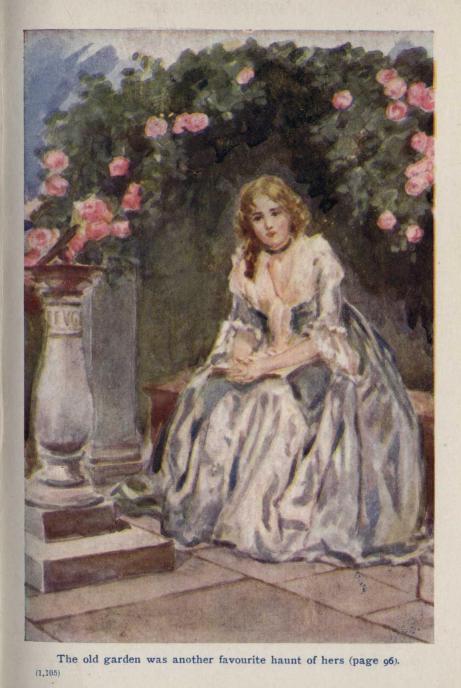
The old garden was another favourite haunt of hers (page 96).
But now an approaching footstep warned the girl that her pleasant morning was over. The dog sprang up, but did not growl. It was Geraldine's own serving-woman approaching with the girl's white-plumed hat and long silver-laced gloves.
"My lady's coach waits, and she desires your presence," was the message that reached her. Geraldine sat down to let the woman fasten the hat upon her head, and with a sigh she put away her books in their basket, and gave it to the charge of the faithful hound. She had found that her treasures were far more carefully safeguarded by him than when left in the care of a giddy maid, who was more bent on having the same kind of amusement with the men-servants that her mistress had with the gallants than of seeking to discharge her duties faithfully and well.
"Hasten, child, hasten!" cried Lady Romaine's shrill voice from the entrance-hall, as Geraldine approached. She was a wonderful object as she stood there in the full light of the June sunshine, her stiff amber brocade sweeping round her in great billows, her waist laced in like that of a wasp, and accentuated by the style of the long-pointed bodice; her high-heeled shoes, ornamented to extravagance, the heels being bright red and the uppers sewed with precious stones; gems glittering in the mass of laces at her throat, and in a number of clasps fastened to the bodice; her hair towering upwards to such a height that she could scarce sit comfortably in her lofty coach, and could wear nothing in the way of head-gear save the laces and ribbons which were worked in with much skill by the French hair-dresser. She was redolent of perfume; gloves, lace handkerchief, dainty muff, every little knickknack, of which she possessed so many, all emitted the same cloying sweetness. Geraldine felt herself heave a sigh of oppression as she followed this grotesque object into the coach. She was growing used to the aspect presented by the dames of fashion, but there were moments when her first disgust came over her in great waves.
"I marvel that you like to make yourself such a figure of fun, child," remarked the mother, as she settled herself in her coach, smirked towards the piece of looking-glass let in opposite, and turned a sidelong glance upon her daughter; "'tis enough to set the gallants laughing to see how you habit yourself. Well, well; you are a lucky girl to have found a suitor so soon. Now take good heed to show him no saucy airs, should he present himself at our box at the play to-day. He has been away these last days, but he can never long absent himself from town. Mind you have a smile for him when he appears, or I shall have somewhat to say to you later, Miss Impertinence." And the lady's ivory fan came down somewhat smartly upon Geraldine's arm.
"Of whom are you speaking, ma'am?" she asked, whilst the colour mounted suddenly in her fair face.
"Oh, come now; so we are already posing as a belle of many beaux! Pray who has ever cast a glance upon you save my good kinsman Sandford? And, mind you, he is a man of taste and fashion, and it is a great compliment that he has singled you out for notice. There be girls would give their ears for a kind glance from his eyes, and there are as good fish in the sea as ever came out of it; so mind your manners, miss, and treat him to no tricks. It is high time you were wed, and had a husband to look after you, and that is why I take you about. For, as for pleasure in such company, one might as well play bear-leader to a snow queen!"
"I did not know that Lord Sandford had done me any favour," spoke Geraldine quietly. "I have seen him but seldom, and he has spoke not over much to me. But I will bear your wishes in mind, madam, should he appear to-day."
"Ha! there he is!" suddenly cried my lady, becoming excited, and rapping smartly with her fan on the glass of the window. The next minute the coach had pulled up, and Lord Sandford, attired in the very height of the fashion, was bowing over her hand with his courtliest air.
CHAPTER VI.
THE PASTIMES OF THE TOWN.
"The sun shines once again," quoth Lord Sandford, as he raised the extended hand of Lady Romaine to his lips, and dropped a light kiss upon her scented glove. "The sun shines in the sky; but let him beware and look to his laurels, for there are stars abroad of such dazzling lustre that Phoebus must have a care lest the brightness of his shafts be quenched in a more refulgent glow." And the young man gazed into the lady's eyes with a bold laughing stare that pointed the meaning of the compliment.
"La! but you talk the greatest nonsense!" cried Lady Romaine, highly delighted, as she tapped him smartly with her fan. "Come, tell me where you have been these many days. Some said you had been a-wooing in the country, and others that your dolts of tradesmen were dunning you to distraction, and others that you had fought a duel and had need to fly; but, pardieu! if one believed all the gossip of the town, one would have enough to do. I know there has been a duel, and I am aching to hear all about it. I'll warrant you know all the story, since he was your friend. Come, get into the coach, and tell me all about it. Were you there? What was it all about? And what sort of an end did he make?"
Lady Romaine's face expressed the eager pleasure and curiosity of a child talking over some trivial pleasure; she flirted her fan, cast languishing glances, and played off upon the young Earl all those countless little airs and graces which characterized the fine lady of the period.
But Geraldine drew back in her corner, her face growing cold and pale. She had scarcely acknowledged Lord Sandford's presence, only just bending her head in response to his bow. He had not addressed her as yet, and he appeared engrossed by the mother; but he flashed one quick glance upon her now, and possibly read something of the pain and disgust which possessed her, for he answered,—
"Nay, madam, let us not talk of what is past and done. How can thought of gloom and death dwell in so radiant a presence? In sooth, all dark thoughts take to themselves wings in this company, and will not be caught or caged. I forget that we are not in the bowers of Arcadia; for, in sooth, I am transported thither so soon as these poor eyes be dazzled by the light of those twin stars of love and beauty!"
Again Lady Romaine tapped him with her fan. She loved a compliment, however fulsome; but she wanted at this moment to be entertained by the account of the duel, which had made a little stir in the town, from the fact of one of the combatants having been the boon companion and friend of Lord Sandford.
"You dear, tormenting devil! But I will have the story yet! And we are all dying to know how you will get on without your Fidus Achates. By my troth, you do not look as though you had wasted away in fruitless longing. Perchance you have found already another to fill his place?"
"Perhaps I have, madam," was the negligent reply. "I had not known the town had so much thought to spare for worthless me. I' faith, I am a bigger man than I thought for. But I must not keep your coach standing in this blaze of sunshine. Whither are you bound, fair ladies? To some Arcadian bowers of Paphos, I doubt not, where Orpheus will charm you with his lyre, and nymphs will cluster round in envy, marvelling at those charms which not even Aphrodite herself can rival."
"Oh fie! you are a sad flatterer!" cried Lady Romaine, sinking back upon her cushions and waving her hand. "We are bound to Lady Saltire's hazard table for an hour's play. Shall we meet you there, my lord? Afterwards, we take supper at our favourite India house, and then to the play—Wynstanly's water theatre. He has a new piece—monstrous fine, those who have seen it vow. They have nymphs, and mermaids, and tritons, and I know not what beside; and they ask a pretty price for the boxes, I can tell you. But la! one must go and see what all the world is talking of. Mind you come to our box if you be there. We shall expect you, and shall welcome you and any friend you like to bring."
"Even the new Fidus Achates, of whom you spoke just now?" asked Lord Sandford, with a slightly ironical bow.
"Oh gracious, yes!" cried Lady Romaine, excited by the very idea; "bring him at once and present him to us. I hope he is a pretty fellow, and can turn a merry quip and tell a story. You should have heard Beau Sidney last night! Sakes! I thought I should have split my sides!"
At this juncture the horses became so fidgety with standing in the glare of the sun that Lord Sandford stepped back, and the coach rolled upon its way. Lady Romaine waved her scented kerchief, and then routed her scent-bottle out of her reticule, and turning sharply upon her daughter, said,—
"Why sit you ever like a stuffed owl, without so much as a word or a smile? I die for shame every time I take you out. What have I done to be punished with such a daughter? One would think you to be a changeling child, if you did not so favour the Adairs. How think you you will ever get wed, sitting gaping there like a farm-house wench, who is afraid to open her lips lest she should betray herself by her speech. You put me to shame, child; I could cry with mortification. What will the world say, save that I have an idiot for a daughter?"
Geraldine knew not what to answer. As she listened to the fatuous and stilted talk which was fashionable in her mother's world, with its senseless mythological allusions and high-flown extravagances, it often seemed to her that these gay dandies and dames were all playing at madmen together. Her tongue had never learned the trick of such talk. It perplexed and disgusted her, seeming trivial and childish when it was not improper or profane. She saw other young girls who listened eagerly, and as eagerly reproduced the flowery nonsense amongst themselves and their admirers; but it seemed impossible to her to do the like, and she listened in humble silence to her mother's tirades, wondering whether there were something radically wrong about herself, or whether the absurdity and folly were in others.
"But, madam," she said gently at the last, "why should I get me a husband so soon? My grandmother was against very early marriages, and as she lay dying she often warned me to make very careful choice ere I gave my hand in troth-plight. She said I must needs be certain of mine own heart, for that no more wretched life could exist for woman than when she was tied to a man she could not love or respect."
"Tush, child! Your grandmother was a good woman. I speak no hurt of her. But she knew less of life than many a girl of eighteen does nowadays, and her ideas were all topsy-turvy. A woman wants a fine establishment, her powdered footmen, her negro boys, her dresses, her jewels, and all the world doing her homage. That is what makes the pleasure of life. A good husband who can give you all that is what you want; and what can you ask better than the addresses of Lord Sandford? I tell you there are half the girls in town would give their ears for his smiles. He has been extravagant, 'tis true; but the estate can stand a heavy drain, and he is lucky at cards. He soon finds himself on his legs again. When he marries he will open his great house in the Strand, of which he uses but one wing now. With your fortune and his estates and his luck in gaming, you might be the gayest couple in town. Look to it, girl, that you show him no airs. I am ashamed to have such a mannerless wench for a daughter. If you are not more careful, you will drive all the beaux away; and then, when it is too late, you will be sorry."
Geraldine had her own ideas on that point. It was her one desire just now to keep at arm's length all those gay popinjays that fluttered about her mother. Lord Sandford, it is true, was somewhat removed from the crowd by a handsomer person, a more distinguished air, and by a greater force of character. On more than one occasion, when he had put himself about to gain her ear, she had found that he could drop his mask of gay affectations, and be both shrewd and entertaining. Some of his criticisms had even interested and aroused her; but she was very far from being captivated. She did not know whether it would be possible to give to such a man either love or reverence, and without either one or other Geraldine had resolved not to marry, though she knew that it was a hard task for a daughter to set at naught the wishes of her parents in these matters. She saw that both father and mother, though for different reasons, desired her to make a speedy choice, and take up her position in the fashionable world as a lady of title and importance.
However, she was spared further strictures by the arrival of the carriage at Lady Saltire's fine house: and shortly she found herself standing behind her mother's chair at the hazard table, half stunned by the clatter and clamour of voices, watching with grave, pained eyes the eager faces of the players, their excited gestures as they reached for their winnings, their rage and disappointment when the luck went against them, the greed she saw in all faces—that lust after gold which is of all vices one of the most hateful and degrading.
Old men and young girls, matrons and aged dames, all crowded round the tables, their hoops crushing together, their tall powdered heads sometimes meeting in sharp collision. There were scented dandies, who regarded this "ladies' play" as the merest bagatelle, and lost or won their gold pieces with careless grace, thinking of the more serious play which awaited them later at the club, or at the lodgings of some member of their own set.
Amongst this motley crowd, gaily apparelled servants moved to and fro, handing coffee, chocolate, and delicate confectionery, or offering scented waters for the refreshment of the ladies. The gentlemen preferred stronger potations, and congregated together, laughing and jesting. But not infrequently they would be joined by some giddy young matron, who called them all by their Christian names, passed jests with them that would not bear repetition in these days, and even toasted some "pretty fellow," laughing gaily and giddily the while.
There were a few graver spirits congregated together in one small room, and Geraldine could catch fleeting glimpses of them through an open door. She knew some of the faces, and that they were politicians and men of letters; and she thought they were discussing some literary point, for one held a paper in his hand, and he seemed to be reading from it to the others.
"I'll warrant they have got a new ode to my Lord of Marlborough yonder," spoke a voice at Geraldine's elbow; and turning she saw an elderly man whose face was known to her from his having been a guest at her father's house. "They had a great trouble after the victory of Blenheim to find a poet able to hymn the triumph in periods sufficiently fine; but I think it was Lord Halifax who discovered Mr. Addison, whose noble lines set the city wondering. Belike he has broken forth into lyric or epic praise over the battle of Ramillies, and the marvellous effects it has had abroad. Shall we go and listen to his periods?"
Geraldine was thankful to get away from the heated atmosphere of the card-room, and to find herself amongst men and women who had other fashions of thought and speech. But she was not allowed much peace in these different surroundings; for she was quickly summoned to her mother's side, taken from house to house, ever seeing and hearing the like vapourings, the like fripperies and follies. It was the same thing at the dinner or supper, where her mother had a whole train of young bloods in her wake. She gave them the best the house afforded, and spent her time quizzing the dresses of the other ladies at the surrounding tables, learning all the gossip about any person whose face or costume struck her, and drinking in flattery and adulation as a bee sips honey from the flowers.
In spite of her efforts to please her mother, Geraldine found it impossible to take any share in this strange sort of gaiety. Her answers were little more than monosyllables. Often she did not even understand the allusions or the far-fetched metaphors of those who addressed her. More often she shrank from their glances and their open compliments, feeling degraded by both, but powerless to repel them. She was thankful when at last she found herself by her mother's side in the box at Wynstanly's; for here she hoped she might find some measure of peace, since the box would not hold any great number of persons, and her mother was never satisfied without the attention of four or five gentlemen at once.
If the play in itself were not very entertaining, the effects of fire and water were rather magnificent, and something new, so that more attention was given to the stage than was usual at such entertainments in those days. The fashionable listeners did not turn their backs upon the players and talk at the top of their voices all the while the play was in progress, as in some houses, and Geraldine was quite wrapped in contemplation of the monsters and mermaids and denizens of the deep, with Father Neptune and his trident at their head, so that she knew nothing of what went on in the box where she sat, till a voice at her elbow spoke insistently.
"They lack but one thing more—snow-white Aphrodite rising in peerless beauty from the foam of the sea; and yet the audience has but to turn its eyes hither, and behold they will see that crowning marvel for themselves!"
The girl started, and looked full into the eyes of Lord Sandford, bent upon her with a significance there was no misunderstanding. He was dressed in a daring costume of scarlet and gold, with quantities of lace and sparkling jewels. Even his well-turned legs were encased in scarlet stockings, and his shoes were of the same flaming hue. His height and breadth of shoulder always made him a notable figure; and the immense wig he wore, which to-night was cunningly powdered so as to look almost like frosted silver, added to the distinction of his appearance. Gilded popinjay Lord Sandford with all his extravagances could never be called. There was something too virile and strong about his whole personality for that.
"I do not like compliments, my lord," she answered, the words escaping her lips almost before she was aware; "I have heard something too much of Venus and Cupid, Pallas and Hymen, since I made my appearance in London routs. I am but a simple country maid, and desire no high-flown compliments. I am foolish enough to regard them rather as honeyed insults. I pray you pardon my freedom of speech."
"I pray you pardon mine," spoke Lord Sandford quickly. "You have spoken, Lady Geraldine, a deeper truth than perchance you know. I, for one, will not offend again. I would that all our sisters, wives, and daughters would look as you and speak as you."
The frank sincerity in face and voice pleased her, and a smile dawned in her eyes. It was the first he had ever seen bent on him, and he was struck afresh with the pure unsullied beauty of this girl's face. Truth to tell, his first attraction towards her had been the rumour of her fortune, for he was more deeply in debt than he wished the world to know; but something in the remoteness and isolation in which she seemed to wrap herself piqued and interested him; for his jaded palate required fresh food when it was to be had, and the vein of manliness and strength which his life had never altogether warped or destroyed responded to the sincerity he read in Lady Geraldine's fair face.
The curtain was down now. For a few minutes he spoke of the play and the water apparatus, worked by a windmill on the roof, which was exciting so much interest in London. Geraldine's eyes meantime travelled round the box. She saw her mother engrossed in gay talk with a small circle of admirers; but one of these edged himself somewhat away from the rest, and finally stood apart, leaning against the wall of the box and surveying the house from that vantage point.
Geraldine's eyes were riveted with some interest upon this newcomer, whom she was certain she had never seen before. In some indefinable way he was different from the men she had been used to meet at such places. For one thing, he wore his own hair; and the floating brown curls, like Cavalier love-locks, seemed to her infinitely more becoming than the mass of false hair which was so much in vogue in all ranks save the lowest. His dress, too, though far more simple than that of the beaux fluttering round her mother, seemed to her far more graceful and distinguished. His stockings, breeches, and vest were all of white, with a little silver frosting. His coat was of pale blue, with silver buttons; and his lace cravat, though small and unostentatious, was rich in quality, and fastened by a beautiful pearl. He carried neither muff nor snuff-box, cane nor toothpick. He did not simper nor ogle, nor look as though he desired to attract the eyes of the house upon himself. But he was, notwithstanding, a rather notable figure as he stood looking gravely and thoughtfully downwards; there was something very graceful in his attitude, and in the carriage of his head, and his features were so remarkably handsome that Lady Romaine turned her eyes upon him many times, and exerted all her artifices to draw him back to her immediate neighbourhood. But he was perfectly unconscious of this, not hearing the chatter which went on about him, lost in some reverie of his own, which brought a peculiar dreamy softness into his eyes.
Lord Sandford, following the direction of Geraldine's glance, looked at this motionless figure, then back at the girl, and laughed.
"Lady Geraldine, pray permit me to present to you my newly-made friend and comrade, Sir Grey Dumaresq, who, I doubt not, is dying to make his bow to so fair a lady."
She flashed him a glance half merry, half reproachful, and he suddenly laid his hand upon his lips, a laugh rolling from them hearty and full.
"I' faith I had forgot! How shall I teach my rebel tongue a new language? But Sir Grey will atone for all my defects.—Here is a lady, if you will believe it, O friend, who loves not the sugared and honeyed phrase of adulation, but seeks in all things truth, virtue, and I know not what else beside. It is whispered to me that she is a mistress of all the belles lettres, and perchance a poetess herself."
"Nay, my lord," answered Geraldine, with a blush and a smile—"only one who loves the poesy of those who have lived before, and left their treasures for us who come after, and would fain drink in all the beauty of their thoughts and of their lives."
Lord Sandford good-naturedly yielded his seat to Grey, whose sensitive face had lighted at the girl's words.
"Methought I had come to a world where naught was dreamed of save fashion and frippery, false adulation and falser scorn. I am well-nigh stunned by the clamour of tongues, the strife of parties, the bustle of this gay life of fashion."
"Oh, and I too—I too!" breathed the girl softly: and he flashed at her a quick, keen glance of sympathy and interest.
"I was bred in the country; my grandam brought me up. I lived with my books, amid silvan solitudes, the songs of birds, the scent of flowers. This great glittering world of folly and fashion is like a fiery wheel going round in my head. Ofttimes I could cry aloud for mercy, the pain and bewilderment are so great. I know there must be noble men and good in this strange Pandemonium; but I know not where to find them, and my heart grows sick. Would that I could go back to my books and my dreams! But alas! a maiden may not choose for herself."
"Still there is life here," spoke Grey quickly, "and it behoves us to know men as well as books. I have studied both. I will study them again. I would fain learn all that life has to teach, whether for weal or woe. No hermit-monk was ever truly a man. Yet there be times when one shrinks in amaze from all one sees and hears."
The chord of sympathy was struck. They passed from one thing to another. She found one at last who knew and loved the poets of her childhood's dreams—who could talk of Spenser and Sidney, of Watson, Greville, and Drayton, quoting their verses, and often lighting upon her favourite passages. Here was a man who knew Milton and Clarendon, Hobbes, Herbert, Lovelace and Suckling, Lord Herbert of Cherbury and Izaak Walton. He had read eagerly, like herself, poetry and prose, drama and epic, lyric and sonnet. He could speak of Poetry as one who had loved and courted her as a mistress. The girl longed to ask him if he had written himself, but maiden shyness withheld her. Yet her eyes brightened as she talked, and the peach-like colour rose and deepened in her cheeks; and Lord Sandford, turning back once again from the mother to look at the daughter, was struck dumb with admiration and delight.
"There is a rose worth winning and wearing, though the stem may not be free from a sharp thorn," he said to himself; and Lady Romaine, who chanced to catch sight of Geraldine during a shifting of the admirers who surrounded her, gave something very like a start, and felt a curious thrill run through her in which pride and envy were blended.
"Gracious! I did not know I had so handsome a daughter! I must wed her as fast as may be, else shall I find my beaux going from me to her," was her unspoken thought; and aloud she said, tapping Lord Sandford with her fan, "Pray tell my daughter that I am about to depart. We have had enough of the naiads and dryads, and I am tired and hungry. Who will come home with me to supper—to take pot-luck with us?"
There was an eager clamour in response; but when the supper-party assembled round Lady Romaine's chocolate tables in her favourite private parlour, she noted that Geraldine had disappeared to bed, and that Sir Grey Dumaresq had not availed himself of her open invitation.
CHAPTER VII.
A FAIR FACE.
If Grey Dumaresq was a man who craved a variety of experiences, and wished to see life under different aspects, he was getting his wish now; for the gay world of fashion, into which he suddenly found himself plunged, differed in toto from any of his former experiences; and so swift was the pace, and so shifting the throng amid which he moved, that he often felt as though his breath were fairly taken away, and as though he had suddenly stepped into a new existence.
Lord Sandford had chanced upon the young baronet at a moment when a blank had been made in his own life by the sudden and violent death of one who had been his boon companion and friend. The gay young man, who had fallen in a foolish duel a few weeks before, had been the inmate of his house and the companion in all his freaks and follies; so much so, that without him the young nobleman felt for the moment bewildered and lost, and had absented himself from town with a view to "getting over it," as he hoped: for he despised himself for any sign of weakness, and would not for worlds have had his comrades and boon companions know how the loss had affected him.
Then, as it seemed just by a lucky chance, this young and attractive man had fallen as from the very skies at his feet. Grey Dumaresq, new to the world of London, curious and speculative, willing to see all, learn all, participate in all, seemed exactly the person to fill the gap in his life. Grey had no place of abode; why, then, should he not occupy the vacant chambers in the wing of the great mansion in the Strand which Lord Sandford used as his customary lodging, when he was not spending his time with friends, or making one of a gay party elsewhere? Grey had no valid reason for declining the invitation pressed upon him. Lord Sandford was a masterful man, and his strong personality impressed itself upon Grey with something between attraction and repulsion. But, on the whole, attraction seemed the stronger power, and curiosity to know more of this man and his life held Grey's soul in thrall. He had always experienced a vivid curiosity to taste life in its various forms, to know and understand the thoughts, the feelings, the aspirations, the ambitions of other men. His travels had given him insight into many matters; but he felt that these new experiences were likely to be more searching, more exciting, more full of keen personal interest. He had been, as it were, a spectator heretofore; now he was to be a participator.
He had not meant to be any man's guest; he had meant to take a modest lodging of his own, and look about him for something in the way of employment, but Lord Sandford had roared with laughter over such a notion.
"What! Sir Grey Dumaresq going cap in hand to some proud place-giver to ask for patronage, or I know not what! Gadzooks, man, with that face, that figure, that horse, and a purse full of guineas, you can do better than that! Trust yourself to me. I'll show you where fame and fortune lie. You shall redeem your rat-infested old house in a very brief while, if you will but trust yourself to my guidance. You be Damon to my Pythias—or is it t'other way round, eh?—and I'll show you the royal road to the goal you want."
For lack of any definite plans, Grey had consented for the nonce to accept Lord Sandford's advice, and had quickly found himself installed in some gloomy and stately yet luxurious chambers in a vast house, of which only a portion was open for use, and the rest given over to a neglect and decay that Hartsbourne itself could scarcely rival.
"But we shall change all that some day," spoke Lord Sandford, with a careless laugh, as Grey expressed his surprise at the vast rooms and long galleries shut up and infested by rats and spiders. "Oh yes, we shall change all that some day; but what does a bachelor want with such a house as this? What should I be the better for a crowd of liveried servants, eating off their heads, idling away their time dicing and drinking? What have I to give an army of scullions and cooks to do—I who seldom take a meal at home after my morning chocolate? No, no; I know a trick worth two of that. I don't ruin myself to keep a crew of fat, lazy rogues about me, cheating me at every turn. Half a dozen fellows and a few kitchen wenches do well enow for me; but when Lady Sandford comes to her husband's home—ah well! then we shall see the difference."
But though he talked jestingly from time to time of the Lady Sandford that was to be, he gave Grey no hint as to whether his fancy inclined more to one or another of the many gay maidens with whom he chatted and flirted, danced and romped, in the fashion of the day; and so bewildering and dazzling were these young madams and their surroundings that the newcomer was lost in a maze of wonder and bewilderment, and found it hard to distinguish one face from another, until he met one, different from all the rest.
But Grey was not left idle; he had small time for musing. The very first day of his sojourn in London he was surrounded by a fluttering crowd of tailors, glove-sellers, barbers, fencers, sellers and purveyors of every imaginable ware, who all professed their eagerness to serve him, and quoted Lord Sandford as a patron who could swear to their honesty and the excellence of their goods.
Into the midst of this motley throng Lord Sandford thrust himself, laughing his great hearty laugh, and quickly sent to the right-about two-thirds of the importunate crowd—a jest here, a keen thrust there, a slap on back or shoulder in another quarter, emphasizing his forcible hints. And when the room was cleared of all but the lucky few, he flung himself into an armchair with another laugh, telling Grey he was sorry his knaves of servants, who looked for perquisites everywhere, had let in this flood of rogues upon him, but added that he must needs have the wherewithal to cut a proper figure in London town, and forthwith set about the business of ordering an outfit for the young man which almost took his guest's breath away.
"Poof!" he cried, when the latter strove to remonstrate, "you have plenty of money; and these rascals can wait if it suits your pleasure. Father's memory! Oh, be hanged to all such mawkish sentiment! You need not think less of your father because you wear a blue coat in lieu of a black! Rabbit me! but you are of a different world from this if you keep alive your father's memory for six months after his decease! No, no; you must cut a figure. Sir Hugh's name is clean forgot by now. I'll eat my boots if 'tis not so. I'll have you as gay as my fancy paints you. No black—no sables for the gentleman, I tell you. Let us see those other patterns. Ah! here is something more like."
Grey submitted. In sooth, he cared but little for the colour of his clothes, or the set of his hat, or the cut of his coat. He let Lord Sandford have his way for the most part, only insisting here and there upon soft and tender tints, and showing a predilection for white, which his friend quite approved.
"You shall be a foil to me, not a rival. I have learned that art from the ladies. I like to blaze like old Sol in his strength; you shall rather recall gentle Luna amid her galaxy of stars. Faugh! One's tongue gets into this silly trick of speech, so that one cannot drop it even betwixt man and man! But you are right to think that white becomes you well. You will look a pretty fellow, in all conscience, when you have added a peruke to your other adornments."
But here Grey stood firm. Nothing would induce him to cumber his head with one of those mountains of hair. In vain the perruquiers displayed their wares; in vain Lord Sandford bantered and laughed, and made out that he would be reckoned as a mad fellow by the young bloods of the city. Grey would not yield an inch. He had always found his own hair sufficient and comfortable, and he would wear it to the end. And as the discomfited perruquier at last departed, Lord Sandford broke into another of his great laughs.
"I' faith you are right, man. I like you the better that you have the courage of your opinions, and care no whit for fashion. You'll be a match for more than the perruquiers yet. There's a fighting strain in your blood. I can see it in the glint of your eye. Well, you shall not lack opportunity to fight as well as to laugh here in London town; but we'll not have cold steel or hot lead again. I've seen enough of that cursed duelling to last me for a lifetime."
Grey was quickly to discover the nature of the battles in which he was to take a part, and at the first he shrank from them with an instinctive aversion he could not well have defined, being no grave moralist or philosopher. Contests of skill or of luck at the gaming tables were all the rage of the day with the young dandies of the town, and the man who could keep a steady head, and in some cases a steady hand, was certain in the long run to obtain advantage over his fellows. At one club a game something like our modern billiards was all the rage; and, of course, a man who was moderate in his cups could score heavily over the reckless, dissipated bloods, who were seldom sober after sundown. Dice and cards had their vogue at other places; and though some of the games played were those purely of chance, others required no small skill and a clear head to ensure success, and it was here that Lord Sandford's strong head and Grey's cool blood and temperate habits gave them the advantage.
The young man had not been a fortnight in town before finding his capital doubled, as well as all bills paid to the astonished tradesmen, who seldom looked to receive their money within a twelvemonth. He was disposed to be troubled at this easy fashion of making money; but Lord Sandford laughed him to scorn.
"Zounds, man, what does it matter? Those young popinjays are bound to lose their money to some one. Why not then to honest fellows like you and me, who pay our bills and do good to the community with the money? Scruples! Faugh! you must rid yourself of them! Sir Hugh Dumaresq's son need not trouble himself thus. Let us eat and drink, for to-morrow we die. Isn't that good Scripture?" But the reckless young lord paled a little at the sound of his own words. He had seen sudden death once too often for his peace of mind of late.
In sooth, Grey felt but little scruple in taking his winnings. The young man was not greatly in advance of his age, although he was indued with a nature more finely strung and aspirations more lofty than belonged to most. Gambling was so much a matter of course both in this and in other lands, and the devotees of the amusement so numerous and so bent upon their sport, that it would have needed stronger convictions than Grey as yet possessed to make any stand on such a point. He took the same risks as the others, and if his coolness of head, steadiness of hand, and quick observation and memory served to make for success in his case, he rather regarded this as a witness to his superiority, and felt only a small sense of reluctance in pocketing his gains; which reluctance he could only attribute to a lingering memory of words spoken by his mother when he was a growing boy, and news came to them from time to time of Sir Hugh's losses over cards, and the necessity for further retrenchments upon the already impoverished estate.
But the cases being so dissimilar, Grey did not see that he need debar himself from this easy highroad to fortunes, as it then seemed. Nobody was dependent upon him. Nobody was there to grieve over his troubles or to rejoice over his success. His honest serving-man was in sooth the only being in any way deeply attached to him; and Dick was as delighted at his master's brave appearance, and at the golden stream running into his pocket, as though he had achieved some great success or triumph.
There was one way by which Grey had pocketed considerable sums of money that was very congenial to him, and had given him some very happy hours. This was the speed and strength of his horse, which Lord Sandford had made boast of, vowing in the hearing of some of the smartest dandies of the town that Don Carlos would beat any steed against whom he was pitted—a challenge eagerly taken up by the young bloods, proud of their own horses and horsemanship, to whom trials of skill and strength, and contests over which wagers might freely be exchanged, were as the very salt of life.
So either out at Hampstead, or at Richmond or Hampton Court, Don Carlos had been set to show the metal of which he was made, and had come off easy victor in every race and every match, whether flat running, or leaping, or a course of the nature of a steeplechase had been elected. His strength and speed, sagacity and endurance, had never once failed him, and already he was the talk of the town, and Grey could have sold him for a great price had he been willing to part with his favourite.
Many bright eyes had smiled upon the young centaur, many languishing glances had been cast at him. He had been called up again and again to be presented to some high-born dame, or some bevy of laughing maidens, and he had bowed with courtly grace, and received their sugared compliments with suitable acknowledgments. But no face had attracted him as that face he had seen once at the water theatre, almost upon his first appearance in the gay world. He knew that it belonged to Lady Geraldine Romaine; and often his eyes roved round some gay assemblage, searching half unconsciously for a sight of her tall and graceful figure, and the sweet, earnest face, so different from the laughing and grimacing crowd in which he now moved. Grey had not known much of women, so far. His college life first, and then his roving career of adventure, had hindered him from making friendships save with those of his own sex; and his deep love for his mother had preserved as a living power his chivalrous belief in women, and a resolute determination to disbelieve the idle, malicious, and vicious tales he heard of them on all sides. Womanhood was sacred to him, and should be sacred to the world. That was his inalienable conviction; and he had striven to be blind and deaf to much of what had often been passing around him, that he might not sink to the level of the men he met, who would tear to tatters a woman's reputation for an evening's pastime, or revel in every ugly bit of scandal or tittle-tattle that the young beaux' valets learned from the lackeys of other fine folk, and retailed with additions at the door of the theatre, the gates of the Park, or on the staircases of the fashionable houses whither their masters and mistresses flocked for amusement, unconscious or heedless of the gossip spread abroad about them by their servants at the doors.
Grey took no pleasure in the society of these fashionable dames. His tongue had not learned the trick of the artificial language then in vogue. He was disgusted by the gross flattery every lady looked to receive, and the lisping platitudes of the attendant beaux filled him with scorn. It was small wonder that he chose rather the society of men of more virility and stronger fibre, such as Lord Sandford and his chosen friends; for though many of them were wild young rakes, and not a few had a very doubtful record, yet Grey knew little enough about that, and found them not without attraction, although the higher part of his nature revolted from much that he saw and heard. Nevertheless, he regarded it all as a part of the experience in life which he craved, and he might have become in a short while just such another as these, had it not been for an incident which suddenly arrested him in his career of dissipation, and turned his thoughts into different channels.
It had been early June when he came to town, and now July had come, with its sultry suns and breathless nights, when Grey ofttimes felt after an evening over cards that it was mockery to go to bed, and lounged away the residue of the night at his open window, enjoying the only coolness and freshness that was to be had, as the wind came whispering from the river charged with refreshing moisture.
Sometimes the river seemed to call him; and at such times he would lay aside his finery, clothe himself in some plainer habit, and betake himself through the silent house, where the night watchman was always found slumbering at his post, out through the big courts and down to the river steps, where a few light wherries were always kept moored, one of which he would select, and shoot out upon the glimmering river to meet the new day there.
Some of his happiest hours were spent thus; and at such times as these he felt rising within him a vague sense of unrest and of disgust. He had come to the world of London to conquer fate, to make for himself a name and a career; and here he was wasting day after day in coffee-houses or clubs, with a crowd of idlers whose thoughts never rose above the fancy of the hour, whose only ambition was to kill time as easily and pleasantly as possible, and to line their pockets with gold, that they might have more to throw away on the morrow.
Was this what he would come to? Was this what he was made for? Would he become like unto them, a mere roisterer and boon companion, a man without aspirations and without ambition? His cheeks burned at the thought; and he sent his light craft spinning rapidly up the stream as the questions formed themselves.
It was an exquisite summer morning. The bells in the many towers and steeples of the city had chimed the hour of five. The sun had long been up, yet the glamour and glory of the new-born day still lay upon the sleeping city and the dewy meadows of the opposite shore. Grey rowed on rapidly, yet drinking in the beauty of all he saw. He knew not how far he had rowed; he had lost count of his surroundings; he was absorbed in a deep reverie, when he was suddenly brought up breathless and wondering by the sound of a voice singing—a voice so clear and sweet and true that he asked himself whether it could be any creature of earth that sang, or whether it might be some nymph or mermaid such as sailors spoke of in their wondrous tales.
He gazed about him. He saw that he was passing a garden, and that a group of weeping willows overhung the water at this spot. The singing seemed to come from thence. Burning curiosity possessed him, and he very slowly and softly rowed himself onwards, till the prow of his boat met the drooping boughs with a soft rustle. The song ceased suddenly. Grey turned in his seat, and drew himself within the sheltering shade; as he did so, a quick exclamation broke from him. He dropped his oars as he exclaimed,—
"The Lady Geraldine!"
* * * * *
How had it come about? Grey never could have said. But now it was all told—the story of his chequered life. She had been silent at the first—not exactly resentful of his intrusion, not unwilling to let him have speech of her again, but quiet, with a maidenly reserve and dignity which had acted upon him like a charm. It brought back to him the memory of his mother, and her noble dignity. The look in her eyes recalled those things that he had learned at her knee, and those aspirations after true greatness of life which she had cherished and fostered. Suddenly his present life looked to him utterly sordid, mean, and unworthy; and in a burst of confidence, for which he could have given no reason, he told her all his tale, encouraged by the soft and earnest glances of her beautiful eyes, although she scarcely spoke a word from beginning to end.
And now she looked at him with a great compassion in her face.
"Oh, it is sad, it is sad!" she said in her earnest musical tones. "I know a little how sad it is. I see it too. But you are a man. You are strong, you are your own master. Why do you let yourself be made the sport and plaything of fate? Oh, do not do it! Rise to your calling as a man, as a gentleman, as a Christian! You can—I know you can! I read it in your face! What is Lord Sandford to you? The acquaintance of a few weeks. What are his comrades to you? You know that in your heart you despise them. Then will you make yourself as one of them? Will you sink to their level? Oh no, no, no! Break the fetters; they cannot be fast riveted yet. Break them, and stand a free man, and then see what the world has to offer you."
She was gazing at him now, not shyly, not as a maiden archly coquetting with a handsome young swain, but as a woman yearning to reclaim one whose footsteps had well-nigh slipped in the mire, and whose whole soul was stirred by the effort.
Grey listened like a man who dreams; and yet his eyes were on fire, and his heart was kindled to a great flame—shame at his own weakness, yearnings after vanished memories and half-forgotten aspirations struggling together with some new and utterly unknown emotion which seemed to come surging over him like a flood, leaving him speechless, motionless.
She had risen, and now held out her hand.
"You will triumph yet. I am assured of it. And I shall pray God to give you His strength and grace. Farewell, sir; we may meet again sometimes. I shall hear of you. I shall listen to hear naught but good. Your mother's voice shall plead through mine. Give up evil companions; give up idle dissipation, and all that it brings in its train. Lead the higher life of the Courteous Knight, the Spotless Knight, the Knight of the Holy Grail. Did we not speak of them all when first we met, and methought you looked such a one yourself? Be true to that better self; and so I say farewell again. May God be with you!"
She was gone, and Grey stood looking after her as a man who sees a vision.
CHAPTER VIII.
A STARTLING DISCOVERY.
As Grey Dumaresq drifted downstream with the tide that sunny July morning, he felt as though something new and wonderful had come into his life, as though some great and marvellous change had fallen upon him, which, for good or ill, must leave its mark upon his life.
He did not try to analyze the strange feelings which possessed him. For a time he did not even consciously think. He seemed to be drifting along a shining pathway—drifting, he scarce knew whither, and did not care to ask. His heart was strangely heavy, and yet strangely light. A curious loathing and shame at himself was blended with a sense of exultant triumph, which held him in a mood of ecstasy. For a long while he drifted onwards, scarce thinking or knowing whither he went, till a sudden consciousness that he was passing Lord Sandford's house brought him to himself with a sense of shock. He had left that house only two hours before; yet it might have been as many years that had rolled over his head, so different were his feelings, so changed was his outlook upon life.
He moored his boat, and went up to his room. Before long he would be expected to drink coffee or chocolate at his friend's levee, meet all those of his comrades who had energy to pay their customary devoirs to their patron, and discuss the plans for the ensuing day and night. Grey dashed some cold water over his hot head, and sat down to think.
What would Lord Sandford say if he suddenly expressed his intention of giving up gambling in all its many insidious forms, in order to enter upon a life totally different from that of the past weeks? It was not as though he had any alternative plan to unfold to him. He was as ignorant how his fortune was to be made now, after several weeks in gay London town, as he had been on his first approach to that city. He could almost hear the great guffaw of laughter with which Lord Sandford would greet his confession. He half feared the powerful personality and the imperious temper of the man who had been a good friend to him, and who had the reputation of being a dangerous enemy when his will was crossed. Grey knew that this man liked him—went near to loving him—would not easily let him go. He knew that he would appear both ungrateful and capricious; and the young man writhed at the thought of seeming either the one or the other. But yet he must break away. Pacing up and down the room, he seemed to see the soft earnest eyes of the Lady Geraldine bent upon him. He had pledged his word to her, and in spirit to his dead mother. From that pledge there was no drawing back. Yet how could the break best be made?
He thought over the engagements already entered into. Was it needful that these should be kept? He thought not—at least not those which were but promises to meet at such and such clubs or coffee-houses for the purposes of card-playing and similar recreations. But there was one engagement that Grey did not see his way honourably to break. He had promised to ride Don Carlos the following Saturday in a course against three other picked horses, and heavy wagers, he knew, had been laid upon or against his steed. This engagement he felt he could not break; but the rest he would. He might even make the excuse that Don Carlos wanted attention, and that he was going to take him into the country for purposes of training; and, once away from Sandford House, he ought to be able to pen a letter to the master which might excuse his return, and explain the nature of the change which had come over him.
Yes, that would be the way. He would not go open-mouthed to him this morning, to be perhaps scoffed or cajoled into some rash compromise. Grey knew that his ability to see both sides of a question often led him into difficulties and the appearance of vacillation. Surely he could keep his pledge if he made the break with a certain diplomatic skill. Not only would it be easier to himself, but it might prove the safer method also.
When he saw Lord Sandford in the midst of his friends, laughing at the last bit of scandal, passing jokes over the latest repartee of the redoubtable Duchess of Marlborough to the meek Queen, discussing the rivalries of the ministers, and the other rivalries (to them more important) of the reigning beauties of the gay world, Grey felt that it would indeed be impossible to speak in this company of any of those things which were in his mind. He contented himself by standing aloof, looking out of the window and sipping his chocolate, whilst the gay flood of talk surged around him, and he caught a word here and a phrase there, but always heard when Lord Sandford's resonant tones dominated those of all others.
"Talk of rival beauties; we shall see sport to-night. Lady Romaine and Lady Saltire—dearest friends and dearest foes—are to go to Vauxhall Gardens to-night, each in a new toilet specially designed and ordered for the occasion. It will be a ladies' battle, in very truth; and public opinion must needs decide which of the rival queens is fairest to look upon. I have promised both the dear creatures to be there, to give my admiration to both alike. Shall I risk the undying enmity of either by giving the palm to one? No such fool, gentlemen—no such fool is Sandford. I vow I will have ready such a pretty speech or couplet for each that she shall go away with a better opinion of me than ever! Ha, ha, ha! I love to see the pretty dears, tricked out in their finery, and ready to tear each other's eyes out! So, gentlemen, I cancel all previous engagements for to-night. I am for Vauxhall, and Heaven only knows how late we shall be detained there by the battle of beauty."
"We will all be there!" cried the young bloods, who were at all times ready to follow Lord Sandford to whatever place of entertainment he elected to go; and one voice followed with a laughing question,—
"Will the snow maiden be there in the train of her mother?"
Grey felt himself start, and was glad his face was turned away. He would not for worlds that the sharp mocking eyes of Lord Sandford should see him at this moment, albeit he had no notion of any sort that he had special interest in his spotless Lady Geraldine.
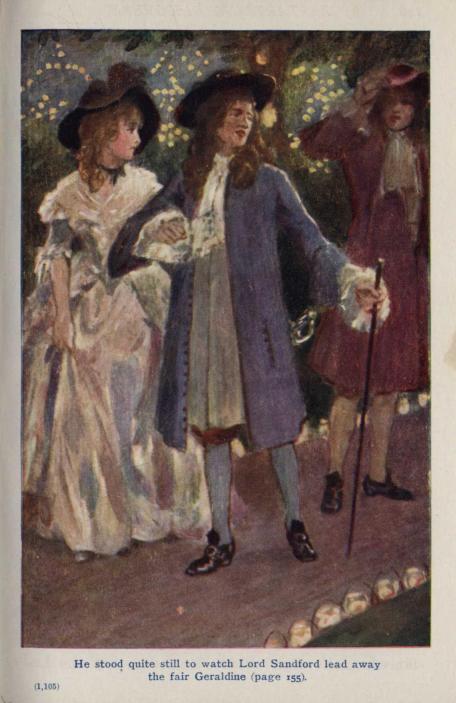
He stood quite still to watch Lord Sandford lead away the fair Geraldine (page 155).
"I trow so," was the carelessly-spoken reply of Lord Sandford, as he adjusted his wig and suffered his valet to spray some delicate perfume over his person, as a finishing touch to his toilet. "The Lady Geraldine is no longer to lead the life of a nun. It has been decreed that she is to show her lovely face abroad, and add thereby a lustre to her mother's charms."
"A lustre her ladyship would well dispense with," laughed another. "She would sooner pose as the stepmother than the mother of a grown-up daughter—ha, ha! How comes it that this young beauty hath never been shown before to the world? Other damsels make their début at sixteen; but the Lady Geraldine can scarce be less than twenty, and has the dignity of matronhood."
"A vast deal more dignity than the most part of our matrons do show forth," spoke Lord Sandford incisively. "Doubtless she learned it from her grandam, her mother's mother and her father's aunt; for my Lord and my Lady Romaine are cousins, and Mrs. Adair was trusted and revered by both. Young children are in the way of such gay ladies of fashion, wherefore the babe was sent to its grandam, and remained with her till the virtuous and discreet old lady died, having bequeathed her store of wisdom and discretion to the beautiful maid she had reared."
"And her fortune too," sniggered one gay dandy. "Do not forget that item, my lord. It is whispered that it will make the biggest of her charms. What is the figure? Doth anybody know?"
All disclaimed any precise information, and Lord Sandford spoke no word; his brow was slightly furrowed, and there was a subdued gleam in his eye which warned those who saw it that something in the conversation was not to his mind. They therefore hastened to change it, and many of them said adieu and sauntered away. Only a small knot remained with their patron, discussing the plans for the day; and Grey stood still in the embrasure of the window, his heart still beating with curious violence and rapidity. When those men were speaking of Geraldine, he had scarce been able to keep his fingers from their throats. What business had they taking her pure name upon their lips? And why had they spoken of her fortune? Could it be true that she was so great an heiress? He hated to believe it; yet what was it to him? He was wakened from his reverie by a quick question from Lord Sandford, which he heard as through the mists of a dream, and answered,—
"'Tis true I am not quite myself. I slept not at all last night, and have been on the river well-nigh since sunrise to rid me of the vapours. Methinks I will seek some sleep in mine own rooms ere night. Reckon not on me for to-day's pastime."
"Ay, you have the air of a man squeamish and in need of rest. Go get thee a good sleep, friend Grey, for we must keep you in fettle for the match on Saturday. Man and beast must come to the field strong and robust, with nerve and wind and muscle true and taut. But you must make one of our party to Vauxhall to-night. There will be many bright eyes on the lookout for the gay cavalier, as the ladies call you for your love-locks. You must not fail us there."
For a moment Grey hesitated, prudence and passion fighting together for mastery. But the overwhelming desire to see Geraldine again—perhaps to speak a word of farewell—overcame him, and he answered briefly as he strolled through the room on his way out,—
"I shall be ready enough for that; you can reckon on me."
How the day passed Grey never knew, and it was still broad daylight when he and his comrades started for the gardens of Vauxhall, where it was the fashion to spend the evening hours when nothing more attractive offered, and where such music and such illuminations as the times had to offer were to be enjoyed, and where ladies and their attendant beaux fluttered about like so many gay butterflies, and found opportunity as the dusk fell for walks and talks of a more private nature in the bosky alleys and shady paths than they could hope to gain in crowded routs and card-parties. Supper could be obtained too, and pleasant little parties made up; and the fashionable world found it agreeable on these hot summer nights to take their pleasure out in the open air.
Grey detached himself from his friends upon the first opportunity, and wandered alone through the gardens, avoiding encounters with persons he knew, though often accosted with laugh and jest and challenge by masked ladies, or young bloods eager to make friends with one whose face and figure began to be known, owing to his successes in horsemanship with Don Carlos, and his friendship with Lord Sandford. But Grey made small response to overtures, quickly shook himself free, and pursued his solitary ramble, till at length a sound of gay voices, laughter, and almost uproarious mirth, in which the tones of Lord Sandford could plainly be heard, drew him to a wide open space where an illuminated fountain seemed to have drawn a great concourse of people; and there, amid a tossing crowd of gaudy gallants, and ladies with towering heads, mincing, giggling, uttering little shrieks, little jests, or playing off an infinitude of coquetries and artifices to attract admiration, he beheld the stately white-robed figure around which his thoughts and fancies had been playing all through the long hours of the day.
He saw not the rival queens of beauty in their gorgeous apparel. He saw not the surging crowd that eddied around them, appraising, flattering, admiring, laughing. He only saw one white figure, standing aloof and for the moment alone, the moonbeams glimmering upon the shining whiteness of her dress, the fair face bent, as though in some sort of sorrow or shame. He saw it, and he was instantly at her side.
Whether or not he spoke, he knew not. He offered his arm, and the next moment he was leading her away from that giddy, mocking crowd; and he felt the clinging clasp of her fingers thrilling him to his heart's core. He heard the breath of relief as the chorus of flippant merriment died away in the distance. He paused, and a quick exclamation escaped his lips.
"This is no place for you, Lady Geraldine. Why do they bring you hither?"
She answered not, but turned her gaze for a moment towards him, and then dropped her eyes. With an impulse for which he could not account, he covered the fingers which lay upon his arm with his own disengaged hand, and passionate words sprang to his lips.
"Give me only the right, fair lady, and I will save you from them all. I ask only to live and die as your knight—your champion—without wages—without reward!"
Then he was silent. His breath came thick and fast. He felt the quiver of the hand he held. He knew not how long the silence lasted, it was so strangely sweet, so full of mysterious meaning.
"I thank you, sir. I trow that you speak truth, and that your words are not idle froth—gone in a moment—as the words of so many of yonder gallants. But it may not be. I may not give you such a right. A maiden is not free to choose her friends; and the knights of chivalry are long since vanished from the earth. I would that I might call you friend, that sometimes we might meet and hold converse together. I trust that I may learn a good report of you, that one day I may speak with pride of having known you in your youth. But that must suffice us. Let it be enough for both. I may not—"
She hesitated, and her voice died into silence. She spoke with a repressed emotion which he scarcely understood. The tumult of his own heart was such that he could not seek to gauge the depths of her feelings.
"If I may not be your knight, let me at least be your friend—your servant!" he pleaded. "And if there is anything wherein I can serve you—"
She seemed struck by the phrase. She lifted her bent head and gazed earnestly at him; but the words she spoke seemed strange.
"You are the friend of Lord Sandford; is it not so?"
"I have been his comrade these many weeks. He has shown me much kindness and good-fellowship. I owe him gratitude."
"And you must know him well, I doubt not. Tell me, Sir Grey—and I pray you deceive me not—what kind of a man is this same Lord Sandford? Is he leal and true, faithful, loving, and loyal? Is he better than the crowd who follow at his heels and ape his manners, use his name as a watchword, and fawn upon his favour? Tell me, what think you of him? A friend must needs speak sooth."
"Lady, you have asked a hard question, inasmuch as I know but little of the man, albeit I have lived with him above a month. He attracts me, and yet there be moments when he repels me too. He is a good friend—I would not speak a word against him; yet it is said that he can be a bitter and an unscrupulous enemy; and those who have lost his favour withdraw themselves as speedily as possible from his notice, fearful lest some evil may befall them."
"Is he then cruel and rancorous?"
"I can believe that he might be, were his passions roused. He has that forceful nature which tends to vehement liking and bitter hatred. I have experienced the one; I have not tasted of the other. For the rest, he is a man of parts, and can do all well to which he puts his hand. Methinks he would be strong enough to break off his reckless and vicious habits, had he but motive sufficient to make him! desire to do so. But for the nonce he floats with the current, and lives as the world lives. More I cannot say."
At that moment a swift, firm tread was heard approaching along the dim alley; and Geraldine looked hastily round, her hand dropping from Grey's arm.
"It is he!" she whispered, and there was a catch in her voice which the young man heard without understanding. He faced round, and beheld the towering figure of Lord Sandford beside them.
"Well chanced upon!" quoth he in his resonant tones. "I was sent by your mother in search of you, Lady Geraldine. The court of beauty has sat. To her has been adjudged the prize. She now desires the presence of her daughter, to share her triumph. We shall sup anon, and the table will not be complete without one gracious and lovely presence. Lady Geraldine, honour me by accepting my escort.—Grey, will you join us?"
He spoke the last words over his shoulder, and there was a note in his voice which the young man had never heard before, and which he did not fully understand. It seemed to sting him, but he knew not why.
"I thank you—no," he answered. "I am going home."
And then he stood quite still to watch Lord Sandford lead away the fair Geraldine, who threw him one strange, half-appealing glance over her shoulder, but spoke no word of farewell.
Grey had meant to go home, but somehow he could not bring himself to do so. His brain seemed on fire, and his heart with it. He knew not what ailed him, but a fever was consuming him. He left the gardens, but walked on and on, not knowing or caring whither he went. The night was far spent, and the dawn was beginning to blush in the eastern sky, before he found himself in the region of Sandford House again.
The place was still and deserted. The revellers and roisterers seemed all at home. A watchman dozed at his post, thankful for the peace of the streets, and Grey met no interruption, till suddenly, round a corner, he came face to face with his host, who gave him a look, uttered a short laugh, and linked his arm within his.
"Well met, friend Grey! You too have had no desire to woo the somnolent god? We find metal more attractive elsewhere. Say now, what think you of the future Lady Sandford? Methought you had eyes but for her to-night. Will she not queen it right royally here—the beautiful stately creature? You have taste, Grey, and I am well pleased that you have. Those painted, patched, and powdered Jezebels, smirking and ogling and running all over the town for the adulation of the crowd, are as little to your mind as to mine. We can flatter and fool and make mock with the best; but when it comes to marriage! Faugh! one's soul sickens at the thought. What man in his senses would trust his happiness or his honour in the hands of that tawdry crew? Gilt and tinsel do very well to play with; but when one desires to purchase, one asks for gold."
Grey's heart seemed to stand still within him. He felt growing numb and cold. As they passed beneath the gateway, and the lamp shone upon his face, Lord Sandford saw that it was white as death, and a strange gleam came into his own eyes.
"Come, my friend, you do not answer. What think you of the wife that I have chosen? What think you of the Lady Geraldine Adair? Is she not a matchless creature? Who would have believed such a sport could come from such a tree?"
Grey commanded himself by a great effort.
"Is the Lady Geraldine Adair, then, your affianced wife?"
"That, or next door to it. My suit is approved of her parents. We shall be betrothed ere long. I thought you might be learning as much from her own lips to-night. Did I not hear my name pass between you twain?"
"She did ask some question anent you," answered Grey, who had no desire to fence or parry—he felt too stunned and bewildered; "but she spoke not of any troth-plight. Why should she?"
"True, why should she? She is not one of your empty-headed chatterers. She wears not her heart upon her sleeve. And your acquaintance is of the slightest; is it not so? Have you met before, since that evening in the water theatre when I did first present you to each other?"
"I have seen her but once between," answered Grey, still in the same quiet, stunned fashion; and when they had entered the house, he made excuse to go at once to his room, declining all proffer of refreshment or further converse.
Lord Sandford looked after him with an intent look upon his face, which slowly clouded over, till there was something almost malignant and ferocious in his aspect.
"So it is as I thought. He has been hit, and hard hit. Where can he have seen her in the interim? They would not have been standing thus, talking thus, if some bond had not been established between them. Yet I thought I had kept an eye upon him. I knew there might be danger. I saw it the first moment that they met. There is something akin in their natures. They feel it themselves. Hr-r-r-rr! that must be put a stop to. I will have no rival in Geraldine's heart. She does not love me yet; but she fears me a little, and she thinks of me. That is no bad basis to build upon. I shall win her yet, if I have a fair field. But a rival—no, that must not be! And yet I read somewhat in her eyes to-night which had not been there before. The fiend take all false friends! I must rid myself of this one, and that speedily. I have liked him; but he shall not stand in my way. Well, 'tis I have made him: I can quickly unmake him. Let me but think of the way and the means. Grey Dumaresq, you are a pretty fellow and a pleasant comrade; but you shall never be suffered to stand in the light of Sandford's hopes and plans and desires. Look to yourself, my friend; for evil is abroad for you!"