HOP O' MY THUMB
Reading edition
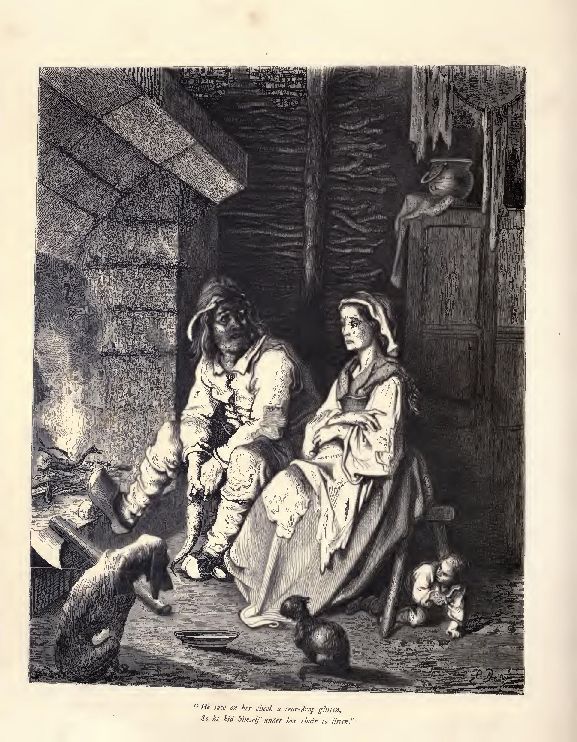
UPON a forest thick and gloomy A cottage, the reverse of roomy- To put it plainly, just a hut And nothing better—did abut. 'T was built of clay and roofed with straw; The walls had many a gap and flaw; The chimney wouldn't always draw; The floor was damp, the ceiling leaky; With stains of rains the walls were streaky. Around the hearth, where seldom smiled A blazing fire, were faggots piled As if for fuel- Oh, mockery cruel! For they were heaped from floor to raft- -Ers as a check upon the draught. The fires that used that draught to flicker to Consisted only of a stick or two, Enough to warm a mess of pottage. Pshaw! why waste time In spinning rhyme, When one can easily contrive To picture it with words just five?- The usual "English labourer's cottage." There dwelt a goodwife, and her goodman, Who by profession was a woodman, But was so poor and so prolific (A family of seven's terrific To one whose trade is not first chop), That oft when trees he'd limb and lop He wished—his lot did him appal so- That he could cut his own stick also. But while he in the woods was hewing, What, think you, the poor wife was doing, Who had to sit at home, and see Her children gather round her knee With looks that, plain as words could utter, Said, "Please, we want some bread and butter" r What could she do but sit and sigh,. While bitter tears bedewed her eye?- His was the "hew," but hers the "cry." Her household duties were but few: When she had clothed the infant crew, The toils that as a rule belong To cooking, did not take her long; They never tasted meat, to vary an Eternal diet vegetarian. And well we know, to rear a troop On turnip broth and carrot soup, And ne'er taste "pieces of resistance," Is vegetation, not existence! Said the husband one night As they sat by the light Of a fire that for them was uncommonly bright, * "My dear, we have got One carrot—and not A single scrap more to put into the pot. * How it flickered and flared has been drawn con amore By that notable artist of artists, G. Dore. We 're as poor as church mice, and there's nothing much surer Than that we every day shall grow poorer and poorer. And what for our brats Can we do, my love? That's The question that gnaws at my heart 'like green rats!' It's long since we had any victuals to carve, But now we 've no soup To spoon out for the group- What is to be done? for we can't see them starve." The wife shook her head, And mournfully said, "If we have not the food, why, they cannot be fed; Unless we find heart to entrust them all seven. To the Power that feeds And attends to the needs Of the wild things of earth and the winged things of heaven." Said the father, "That's true! It's what we must do- We 'll take to the forest the poor little crew By roundabout ways, all the more to confuse them; And then, when we find they 're not looking, we 'll lose them." Here the reader polite 'll Allow the recital To pause while they 're settling a question so vital; And I, in requital, To make it all right, 'll Explain how my story has come by its title. The last child that was born To this couple forlorn Was tiny in figure; Not very much bigger Than the wee dancing dolls that one sees in an organ; Or rather, so small That no figure at all He'd, I think, have been called by Professor de Morgan, But—devoted to fractions most infinitesimal- That diminutive point which is known as a decimal. So, though he was a boy, And we do not employ- Says the grammar that Eton lads always enjoy- For the masculine omne quod exit in um, They christened the little one Hop o' my Thumb. The father regarded the child with surprise; And his mother, poor woman, shed tears for his size, For she felt as she looked at her babe the misgiving That so little a boy could but make a small living. And as he grew older Still every beholder That he didn't grow bigger at all always told her; But then as some comfort they all of them found him Possessed of great nous, Though the size of a mouse- For though he was little, they couldn't get round him. Now it chanced on the night that begins my narration, When his parents were holding this grave consultation, Sleep would not come To Hop o' my Thumb- He was on the alert "a remarkable some;" So he sat up in bed, And there by the red And flickering light that around it was shed, By the glare of the log Saw the cat and the dog- She was poor as a rat;—he'd a waist like a frog, Or a greyhound—but due to the absence of prog, Not the presence of breed,- He resembled, indeed, He saw on her cheek a tear-drop glisten, So he hid himself under her chair to listen The nags that you see in a cab-driver's stud, Whose "points" are all owing to bone, not to blood. There his father and mother Too sat by each other, Conversing in tones they seemed anxious to smother, And he saw on her cheek a tear-drop glisten, So he hid himself under her chair to listen.
Original Size -- Medium-Size
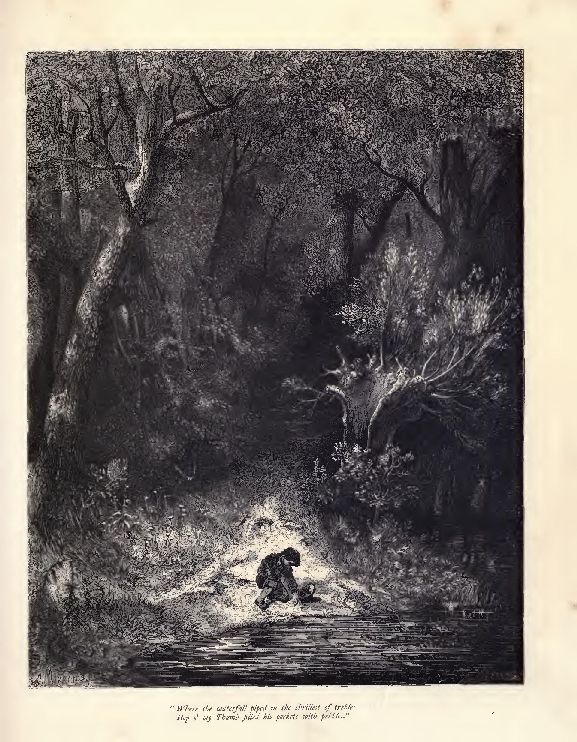
What did he hear?- He regarded with fear Being left in the forest so dismal and drear! And all for no good, For 'twas likely he should Get wholly mislaid, like the Babes in the Wood, Whom (see story) with leaves the kind robin, alack! buries, When they eat, by mistake, deadly nightshade for blackberries! In a state of despair, Hidden under the chair, Poor Hop o' my Thumb heard his parents declare That the first thing next day they would make the excursion Which, so they determined, should end in desertion. "What's to be done? This is really no fun: I 'm the wretchedest mortal that's under the sun. To bed I must creep— But awake I will keep, For what I've to do is to think, not to-sleep," Said Hop o' my Thumb, When his father said, "Mum!"- To his mother, intending that she should be dumb On the subject that late Had formed their debate- "I think you had better get breakfast at eight." The boy stole to bed, To turn o'er in his head The things which his father and mother had said, And discover, if possible, 'cute little chap! As well as he can, Some snug little plan To guard him and brothers against a mishap. One thing was clear: When they started from here He some landmarks must leave by which homeward to steer; For if he'd the means to discover the track again, Go where they would, he could find his way back again! But in vain to devise Some guide-post he tries, Till he's quite wearied out, and sleep closes his eyes. But while he still sleeps, On a moonbeam down sweeps A fairy: beneath his closed eyelids she peeps, And finding him busy on all sorts of schemes, To aid his escape From the morrow's sad scrape, She a cunning suggestion slips into his dreams. Where lofty oaks deep shadows make, And ceaselessly the aspens quake, Where ancient elms their branches spread, And ashes whisper overhead; Within the forest's darkest glades There flows a stream among the shades, Above its wave a hoary group Of melancholy willows droop. The kingfisher its waters loves; 'T is haunted by the startled doves; And, free of fear, beside its brink The dappled fawn oft stops to drink. 'T is fed by twenty tinkling rills, And here and there—where sunlight spills Through openings in the boughs o'erhead A halo, yellow, azure, red- A tiny rainbow bright and small Hangs o'er the mimic waterfall; Where through the overarching green Bright glimpses of the sky are seen, The dancing waters as they go Mirror the snatch of blue below. Long mosses wave within its stream, And silvery fishes glance and gleam, And water-lilies float and sail. But these do not concern my tale. My point, the mystery to unravel, Is, that the bed of it is gravel, And that its bays and banks abound In pebbles small, and smooth, and round. By the side of this stream, As he walked in his dream, It appeared that the pebbles all set up a scream, "Hop o' my Thumb! Come hither, boy, come; If we cannot show you the way it is rum!" * At the first streak of day He is up and away! He creeps out of the house through a crack in the * At the slang the stones speak don't, I pray, be offended: How their schooling's neglected Must be recollected— Just remember how often roads have to be mended! Off like a rocket To fill every pocket With stones—precious stones, though not fit for a locket Brooch, bracelet, or ring, Or any such thing- But precious to him for the help they will bring. Away must he go Like arrow from bow, Yet all in a quiver, And reaches the river. The scene is a taking one, though this is a giver Of peaceful delight, Full of charm for the sight That reads all the beauty of Nature aright. On the bank of the stream Rests one fleeting gleam, Where the bluebells and dainty anemones teem, And there rises o'er them The grey hollow stem Of an old pollard willow; while many a gem From the waters is hung Leaf and blossom among, For 't is here that the stream's sweetest madrigal's sung. But what does he care for song, bluebell, or pollard?— There are the jockeys that have to be collared.
Original Size -- Medium-Size
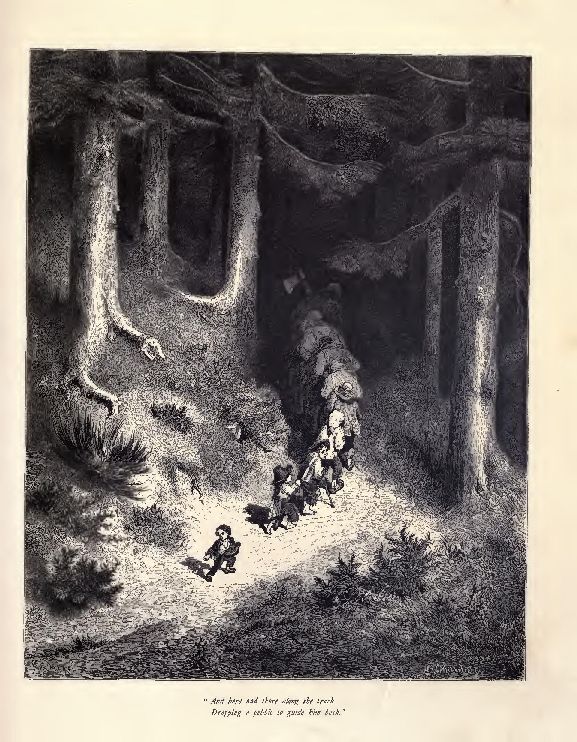
Down on his knees he. went, if you please, And oblivious of sunshine, and blossoms, and trees, Where the waterfall piped in the shrillest of trebles Hop o' my Thumb filled his pocket with pebbles. Then homeward he stole, Returned through the hole, And crept into bed, not disturbing a soul; But feeling the danger completely forestalled. Curled up, and slept soundly until he was called! At eight o' clock the mother rose, And donning mournfully her clothes, Lit up some sticks and put the kettle on, As she and he did last night settle on:— The water boiling, in goes, souse! The one last carrot in the house. The hapless mother can't but feel In any case it's their last meal; For even if they now gave up The plan on which they had agreed, There's nothing left,—nor bite nor sup,— Her hungry, starving babes to feed. Less pain 't will be, she feels, poor mother, To lose them one way than another. And so this poor Hagar Prepared her soupe maigre, While grief and perplexity harass and plague her. And soon as their eyes Are open, with cries Of "Oh, we 're so hungry!" the little ones rise. While the father, who's not Very great at a plot, Conceives that his plan some more treachery lacks; So in order to hatch it, goes out with his axe, And makes an attempt at restoring his mind's tone By setting the edge of the blade to the grindstone. The poor little souls Sit down to their bowls, And eat up their pottage without any rolls. It's not a remarkably nourishing diet, But it eases the pangs Of hunger's sharp fangs, And the wolf in the stomach keeps partially quiet. But the mother's afraid It's far from well made, For the carrot's fine flavour and strength haven't stopt in it, And it's rather too salt—from the tears that have dropt in it. However, no matter! They clear out each platter: In expecting a share of the soup, dog and cat err; If they want a first course they must e'en lick the dish for it, And as for the second, they 'll have to go fish for it- A third they 'll not meet with, however they wish for it. So the table was cleared; The cloth disappeared: And then came what Hop o' my Thumb had so feared. Said the father, "Come, children, I'm off to the wood, And I 'll take you all with me providing you 're good. There are lots of wild fruits, Not to mention the roots, And the hawthorns are putting forth midsummer shoots. You 'll have plenty to eat- 'T will be really a treat;- So run to your mother, and all be made neat!" Off they ran in great glee To their mother, and she Did the best that she could for the boys; but, you see, A respectable look's not the easiest of matters To give to clothes made of shreds, patches, and tatters. However, at last, inspected and passed, They set out for the forest so gloomy and vast. The father goes first with his axe on his shoulder, The next place was the mother's, And then all the others; First he of the brothers Who is than the rest of the family older, And so from the tallest Right down to the smallest, On a scale that would greatly amuse a beholder. And, pray, who last of all should come But the mite of the family, Hop o' my Thumb r Trudging along, Humming a song, As if he were quite unsuspecting of wrong, But keeping an eye Very much on the sly On the various objects the road took them by, And here and there along the track Dropping a pebble to guide him back.
Original Size -- Medium-Size
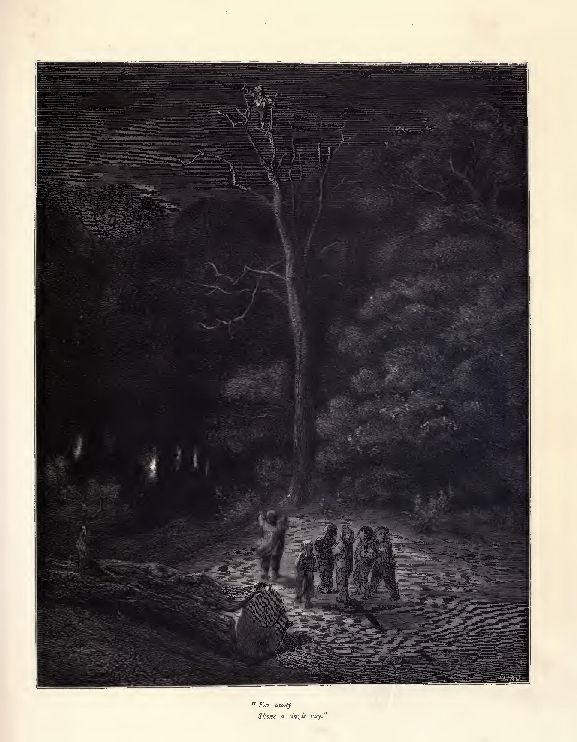
On they went still, mounting a hill In the sort of locality papers call "ill"- That retired kind of spot You would look on as not An unsuitable place for the scene of a murther- Up the steep gloomy slope They stumble and grope; They'd come to a fir wood, but still they went further. At last the old woodcutter cried out a halt, Set the children to play, And then stole away With his wife when he fancied they'd all be at fault. And so they were rather When, weary of playing And running and straying, They hunted in vain for their mother and father. Oh, where could they be? In bush, thicket, and tree They searched, but their parents they nowhere could see. And some of them cried, "Oh, where do you hide?" As young Lovell remarked to his beautiful bride, Who got in "the wrong box," while the key was outside, And suffered such pains in the chest that she died. They ran to and fro, And searched high and low, And exerted themselves till near ready to drop, Whereupon little Hop my Thumb, who till then held his tongue, called out "Stop This was done to deceive us: They meant thus leave us; But I, if you 'll just let me manage the job, 'll Soon help you all out of this queer-looking hobble." That night the sad sire Sat down by the fire, And the mother sat near him in agony dire, And, though they'd not dined, Felt far from inclined To eat of the loaf they'd the good luck to find Where some gay picnic party had left it behind, Just as they- Well-a-day! (As the madrigals say)- Had left their poor children behind in dismay. "Rat-tat-tat!" "What is that?" Said the sire as he sat On the desolate hearth 'twixt the dog and the cat. "A knock at the door." And without any more Ado, it was opened—and, lo! on the floor Stood those desolate ones, His seven little sons, With Hop o' my Thumb walking coolly before! There was nought to be said: They put them to bed;- You can't solve a riddle by scratching your head, Or that father distrest Would have certainly guessed All the "Family Herald's" most puzzling and best. But he said to his wife, "Though it's much to our sorrow, We 'll lose the young rascals once more, dear, to-morrow. But for fear that again of our scheme nought should come, Just keep a sharp eye on that Hop o' my Thumb." The very next day He led them away, In a different part of the forest to stray- Where the foliage was thicker, and darker, and denser, And—if I'm permitted the term—much immenser! Any chance, to provide From the rivulet's side Any pebbles, to Hop o' my Thumb was denied; But the youngster was one Not easily done- Said he, "I 'll contrive it, as sure as a gun!" So into his pocket, unnoticed, the crust He had given him for breakfast he quietly thrust, And when onward they strode By this different road, He dropt crumbs all along, that had certainly showed Very well the way back, as had been his intention, But for one little fact I am going to mention:- That the thrush and the blackbird, the woodlark and linnet Discovered this strewing of bread in a minute, And alighting at once, ate up all of the crumbs, And ruined this plan of poor Hop o' my Thumb's! Now the boys didn't mind If they were left behind, Thinking Hop o' my Thumb would the road for them find. But, alas! when they thought It was late, and they ought To get home, and he failed to find out what he sought, A pretty to-do And a frightened "bohoo!" Was set up all at once by the terrified crew. T was useless to search; They were left in the lurch, They were lost in the forest as safe as the church. What a terrible plight! It was getting t'wards night, And although there might not be (so whispered their fright) Wild beasts in the forest about,—yet there might! The sun adown the western sky in dying glory rolled, And turned the forest's topmost leaves to fluttering flecks of gold; The twilight shadows deepened round And filled the violet sky, Till, springing out of depths profound, The stars were in the sky. A purple pall Fell over all; The last ray faded soon. And, like a galley far and small Appeared the thread of moon. All noises died Save winds that sighed Among the sombre trees. And nightingale's sad song, allied In melody to these! Huddling shoulder to shoulder, And not growing bolder. As the breezes moaned louder, the moon shone out colder, Those poor little brothers in terrors the sorest, Went wandering on through the gloom of the forest. Free from dismay, Gallant and gay, Hop o' my Thumb, marching first, led the way; But they hadn't got the same spirit—not they! At last he espies A trunk of huge size; Said he, "In the world this will give me a rise- I can see by ascending it how the land lies." So without wasting time He hastes to the climb. ' His own elbows and knees, With some limbs of the trees, Assisting him up to the top by degrees, He contrives on a bough very lofty to sit him, And views all the darkness of night will permit him, While his brothers conjure him to tell what he sees.
Original Size -- Medium-Size
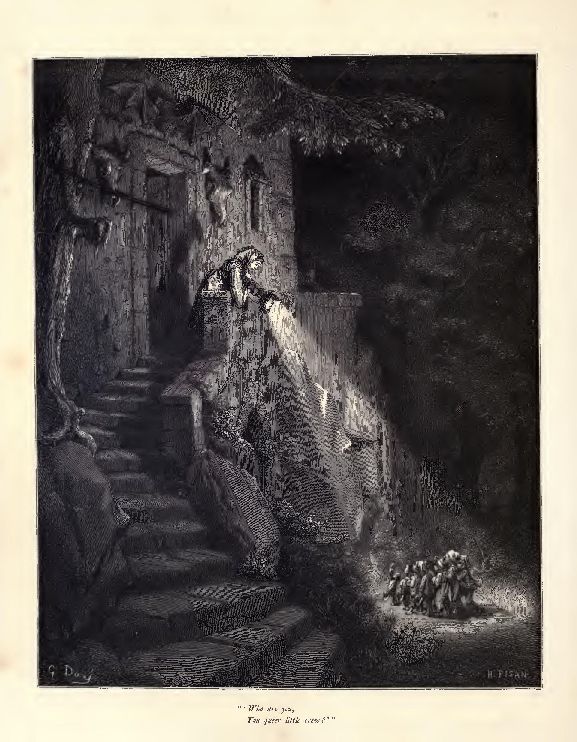
"Far away Shines a single ray, But what it may be I can't venture to say; It looks rather far, But since here we are Without any voice In the matter or choice, Whatever the distance we ought to rejoice- For whether the night be a melter Or pelter- If it's muggy as beer or it rains helter-skelter- We mustn't make light of a light that means shelter!" On went the children, still shoulder to shoulder, As frightened as bricks, and-than stones vastly colder, And much more alarmed, for a stone is oft bowlder! Arm-in-arm, In alarm, Expecting some harm, In a terror no words of their brother's could charm, They walked t'wards the light Gleaming out through the night, And as fearful to turn as if playing at Fright. Through brake and through mire, Beginning to tire, Trudged the sorrowful sons of a sorrowful sire. On wandered they In pursuit of a ray (Though girls more than boys think of dress, so they say); Till at length at the great Front-door, postern-gate (Or whatever 't was called at that very vague date), Of a castle, or mansion, a building gigantic, Designed on the model of dwellings romantic- You queer little crew Gothic, solid, and strong, That lasts ever so long- Not sham Gothic run up on that very bad plan, tick! 'T was terribly high; It wearied the eye To follow its turrets up into the sky, How many feet. I don't care to repeat,- I 'm a bad hand at figures, of which to be sparing, T was as high as the Grosvenor, or Langham, or Charing. * They none of them knew what course to pursue, Till Hop o' my Thumb found a horn—which he blew; Whereon some one the bolts, bars, and fastenings withdrew, And came out with a light Very vivid and bright, On the top of the steps at the head of the flight, And they saw, to their joy, Not a man—nor a boy- But one of a sex for which terms we employ Of a tenderer sort; In short, one to court- "In short"? Not at all—but a tall one, in short! For she was a giantess, being in figure Than Chang the tremendous, An-actually bigger.
Original Size -- Medium-Size
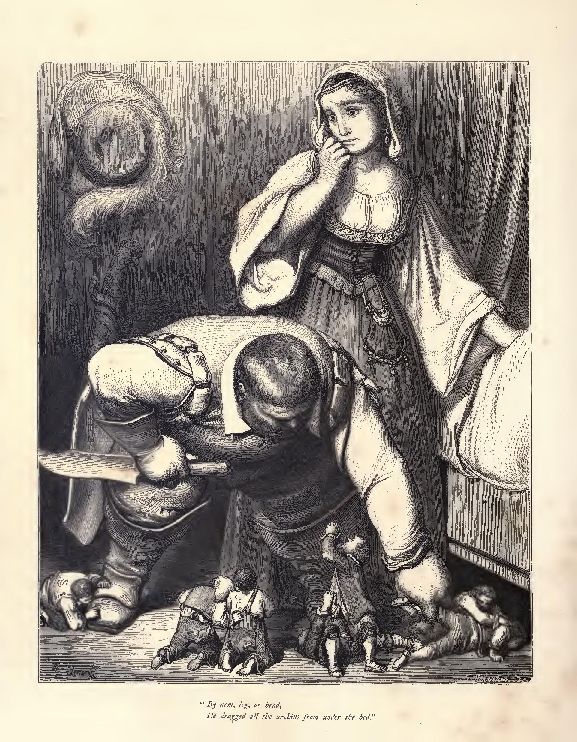
"Who are you, you queer little crew?" Said Hop o' my Thumb, "Madam, pray how d' ye do? * The poet who sighed (he's depicted as thin) The warmest of welcomes to find at an inn Might equal in panting The sighs of a Banting To learn that these inns are prepared, in kind thrift, To give to those guests who are poorest—a lift! We people so small Have come for a call: We want a night's lodging and supper, that's all!" "Alas!" said the dame, "I can't promise that same, Though your lonely condition to pity lays claim. But to grant your entreaty were really a sin- In receiving you here, I should take you all in!" "Please, madam, do!" Said the terrified crew, Who fancied each moment much darker it grew, And gazing with awe, Believed that they saw Wild beasts coming after with ravenous maw (Not to mention such trifles as jaw, paw, or claw), And spectres enough all their marrow to thaw; So closer and closer together they drew, Repeating the chorus of "Please, madam, do!" "My poor children!" said she, "I've a husband, and he Is an Ogre as savage as savage can be; His appetite's great, and when hungry he's sweet on boys; So board, lodging, and clothing He 'll give you for no-thing, * Besides education—because you 'll be Eton, boys!" These words they don't like, But the terror they strike Not being so near As the darkness they fear, They beg her once more to their prayer to give ear. * Pray pardon the rhyme, which, it's terribly clear, Is a rhyme to the eye, not a rhyme to the ear. If in thus fitting clothing you fancy I fail, or Am making a botch—say 't was done by a tailor. "By arm, leg, or head, He dragged all the urchins from under the bed" "Please, madam, do!" Said the terrified crew; "We're prepared to be eaten, we're in such a stew! Besides, ma'am, you might Put us out of his sight; We only want shelter and food for the night. Let our prayers, and our tears, and our woes your heart soften; Some supper provide us, And hide us—please hide us,- We 're quite used to it, father has done it so often.'' Moved by their tears, she flung open the door, And gave them some food; but in five minutes more, Ere they'd finished their bread And Gloster, she said, "Here's the Ogre approaching—get under the bed! Unless you feel gridiron-like or stewpan-ish, Or would like to be fried with the onions called Spanish! They were off in a jiffy, As promptly as if he Were Colonel Stodare and had said to them, "Vanish!" But scarce were they hidden away, I declare, Than the giant came in with a curious air. All his wife's kind precautions were very well meant, But he, like a Jew Who is going to do A bill, was not easily sent off the scent. "Fee, faw, fum!" Said he, "there are some Little children about—yes, I nose there are, mum!" No sooner said, Than by arm, leg, or head, He dragged all the urchins from under the bed.
Original Size -- Medium-Size
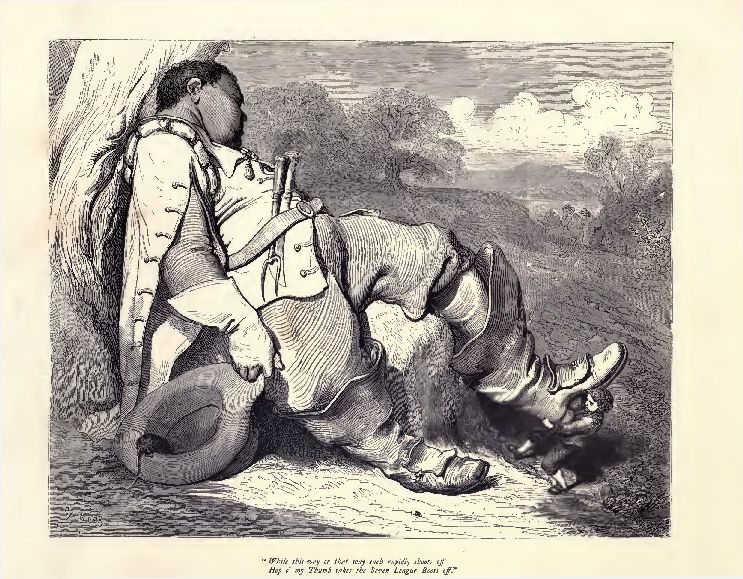
Each began to entreat him To please not to eat him, But the Ogre replied he'd be happy to meat him; So he sharpened his knife To take every life- As he would have done had it not been for his wife, Who showed him the supper she'd got—"Wasn't that enough If so, she was willing To feed up for killing The children, who now he could see were not fat enough. Said the Ogre, "That's true- The supper will do. We 'll fatten the brats for a week—or p'rhaps two. Meanwhile, since late hours make them tasteless and flabby, Let them all go to bed—without waking the babby! ' Away they all sped And hurried to bed, For fear his opinion should change on that head. But Hop o' my Thumb, while his brothers were weeping, Everywhere peeping, Stealthily creeping, Found seven young Ogrelings cozily sleeping In the very next bed on a pillow of down, And each of them wearing a little gold crown. Cried Hop o' my Thumb, on perceiving those bright caps, "We've not been accustomed to sleep without nightcaps!" So he took the gold circlets away from the others, And put them instead on himself and his brothers. By and bye The Ogre so sly (Who had made up his mind to a little boy-pie For his breakfast) comes up in the dead of the night With his very sharp knife, but without any light, And so in the dark (as pitched as the ark) Begins fumbling and feeling about for his mark,- Comes to the bed, But feels on Hop's head A crown, so goes off to his children instead, And at once—for at slaughter you see he a dab is- He cuts all the throats of his slumbering babbies. (For which, since here, Reader, you coroner are, dict- -Ate, "Sarve him right"—it's the usual verdict.) Hop o' my Thumb Heard all, but kept mum; And as soon as the first streak of daylight was come, And the dawn "breaking fast" in the heavens he saw (The night was quite done, if the morning was raw), Woke his brothers at once; and they all crept downstairs, Climbed up to a window by aid of some chairs, Got easily out through a large broken pane, Jumped down on the grass, and were free once again! Off went each urchin, And left quite the lurch in The Ogre, who still his bed slept like a church in. And well may they run, For as sure as a gun The Ogre will wake and find out what he's done, And at once setting forth from his castle to catch 'em, In spite of their start will be sure to outmatch' 'em. They may run like the wind—but the horrible brute s Possessed of a pair of charmed Seven League Boots! Yes! dread and fear! Already they hear The giant pursuing them—coming more near:- They must try to conceal themselves closely, that's clear. They endeavour to save Themselves in a cave: The Ogre approaches, and even the brave Little Hop o' my Thumb feels a tremor of dread When the giant, who suffers most frightful fatigues From striding across at each step seven leagues, Sits down on the rock that is over their head; But it's not long before He's beginning to snore, And Hop o' my Thumb plucks up courage once more. "Now while he's asleep We must quietly creep From our hiding, and bolt like a parcel of sheep! '' Out scramble the boys Without making a noise, And while this way or that way each rapidly shoots off, Hop o' my Thumb takes the Seven League Boots off.
Original Size -- Medium-Size
With the boots was our hero at once in his glory. He returned at full speed to the house of the giant, And finding the wife to his orders compliant, Made her hand him more treasure at once from the coffer Than the whole Bank of England is able to offer, And took it straightway to his parents, by which He made, like a 'tickler good joke, the poor rich. So his and his brothers' And father's and mother's Good fortune he made—not to name any others.. And as for the Ogre, what chanced to become of him I know not—I never asked Hop o' my Thumb of him; But one can't but suppose That such giants as those Which in nursery legends and stories one knows, By defaming the race must inflict quite a pang On the large hearts of giants like Anak and Chang, "While this way or that way each rapidly shoots off Hop o' my Thumb takes the Seven League Boots off (Though, their size for their suffering some remedy gives, Since one learns the more patience the longer one lives). So we 'll trust that this giant, So fierce and defiant, Got punished. Indeed, on one fact I'm reliant- His gold was all taken by Hop o' my Thumb! And so being left with a very small sum, Namely, nothing, 't is likely ere long he began To fall in arrear—and so sank to a van,- A poor sort of coop In which he'd to stoop (E'en the greatest must bow if their fortunes will droop). Then at revels and fairs he'd be shown as a sight- As "A Giant"—see handbills—"unrivalled in height, Allowed on all sides to be taller than any That ever existed. Admission, one penny. N.B. Babies in arms free of charge are admitted." In which case e'en a monster like that's to be pitied. l'envoi. Five Favourite Fairy Fables old,- The efforts of a muse, which eke Are efforts to amuse,—are told, And my farewell 't is time to speak, Since ended now this book of mine is, With one more "f" for't—adding FINIS.