CINDERELLA
Reading edition
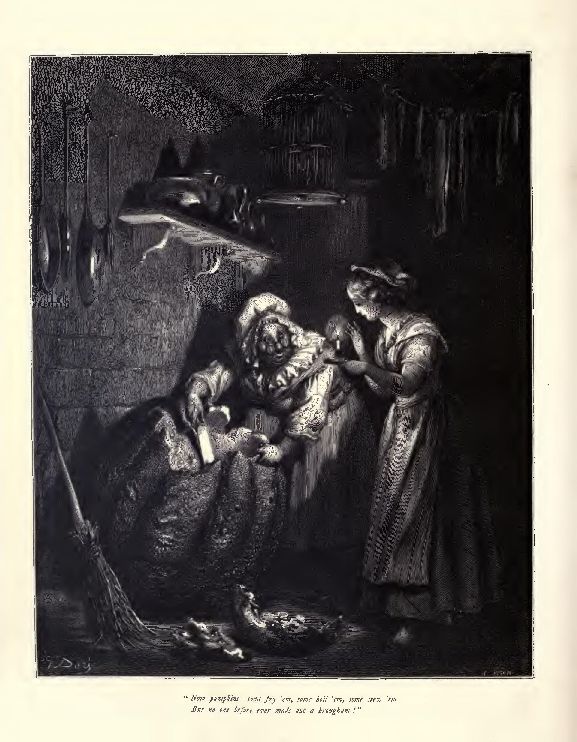
THERE once was a Baron who dwelt at the top Of a rock by the Rhine, Whence, whene'er he'd incline, Upon travellers that way he was ready to drop, And lighten their purses— Which brought many curses On the head of the Baron of Snitherumpopp For a practice, which now We shouldn't allow, And, in fact, the police would immediately stop. Hard by where the Bar(i)on * These strange tricks did carry on There lived a young Prince, who by flourish of clarion Proclaimed unto all, both great folks and small, He intended to give a great banquet and ball— Or, to use modern language, a spread and a hop:— 'T was good news for the daughters of Snitherumpopp. For the Baron, you see, had daughters three, The two eldest as ugly as ugly can be, And prouder than Lucifer—(no! I must scratch That through. For they'd waited so long for a catch, It's not true that their pride was above any match)— But the youngest was fair, with beautiful hair; Her sisters looked on her with rage and despair; And that they'd have no chance they declared past a doubt, If that "forward young minx" was allowed to "come out." * At this new mode of spelling the word don't feel shy— I have seen a Baron with more than one eye! So for fear of her beauty their lovers bewitching, They compelled her to stop In that wretched cook's-shop Which is—by its own denizens—christened the "kitching." In clothes very mean they compelled her to clean Pots, kettles, and pans—implements de cuisine. In her pa's worn-out gloves She polished the stoves, Poker, shovel, and tongs, and whatever belongs To the role of what Stubbs * calls "say po-vers onfongs," The General Servants—or Maids-of-All-Work, Though this last is a name they seem anxious to shirk, Or at least as a rule in advertisements burke. Though far from robust, she'd to sweep and to dust, And to see dinner cooked, when skewered rightly or trussed, (Though dining herself off a scrap and a crust, While if aught turned out wrong by her pa she was cussed) Not to mention, en passant, the fact that she must Chairs and tables adjust; and, from last unto fust, See that all things were clean from dirt, mildew, or rust. (For this last she used paper, which is, unless memory Deserts this poor brain altogether, called Emery.) [N.B. Any doubt on the point to enlighten, I don't mean the actor, although he's a bright 'un.] When the ball was announced, off the two sisters bounced To send their best dresses to have them re-flounced, And soon became clawers from various drawers Of fans, flowers, gloves (by the shopman styled "strawers"), Trimmings, ribbons, and laces, to add to the graces Of their very poor forms and their very poor faces. * Of scenes continental Poor Stubbs has been viewer But once, though he speaks of his trip as "mong two-er." I must own that they were (since plain speaking de rigueur 's) What tradesmen denominate "marked in plain figures!" One routs out a scarf, one contrives to unearth a Compound of tulle And ribbons which you 'll Hear described by your sister or wife as a Bertha. The eldest's inclined to declare for a tarlatane, Either an emerald green or a scarlet 'un, With a silk under-petticoat known as a slip; While the second decides double skirts are "the tip." (What "the tip" means you know, though one can't see the point of it. I'd not use the slang, save that rhyme makes a joint of it.) At last draws near the festal day! The ball's to last three nights, they say. What a hustle and bustle—oh, dear! what a fuss 'll Be made when the ball-dresses whisper and rustle, I 'll warrant that scuffle And noise quite enough 'll Be made when along the oak floors their feet shuffle, While the band are all playing as hard as they 're able The popular waltz of the season—the "Mabel." While her unprepossessing Two sisters are dressing, Cinderella to do all the work, I'm afraid, is made, Not only of general servant, but lady's maid. She lays out the robes by which each so much store sets, Takes things down to air, Cleans their shoes, curls their hair, Pins their sleeves, hooks their dresses, and laces their corsets. And now they're both drest,—each, looking her best, Is prepared to become at the Prince's a guest. They 're gone! And yet neither her thanks has conveyed To poor Cinderella for lending her aid; They 've not wished her good-night—they have not even kist her, Though for once they 've allowed her to act as assister. She could not but feel it, her heart being tender, So she sat down and had a good cry on the fender; When—as good Mrs. Brown, Of world-wide renown, Whose figures of speech may, without any bosh, Be described as "the things that come home from the wash," Says—"All of a suddin" The room was a flood in Of light! Cinderella, surprised, said, "Oh, Jim'ni! The soot must have caught and set fire to the chimney! But no! t' was not so! The beautiful glow Was not due to an accident—quite the contrairy— Altogether another affair,—and a fairy! Cinderella had got what now-a-day not Very often has fallen to any one's lot, As I fancy you can't but instantly grant When you learn it's a fairy by way of an aunt. This benevolent fay has called in, in this way To hear what her favourite niece has to say, And to send her, if any desire she evinces To share in the fun, to the ball at the Prince's. When she said, "Will you go?" she didn't say, "No!" But answered, "Just shouldn't I, aunt!" adding, "Oh! How I wish I'd a ball-dress—one fit for a belle—a White muslin with tucks!" "So you shall, Cinderella. But first we must get you an equipage proper. You'll find some black-beetles down there by the copper; There's a rat in the trap, and some mice, too, mayhap, And there's also a lizard, a little green chap, On the grass-plot before the scullery door. Bring them here, there's a dear. Stay, I want one thing more— A pumpkin! And yonder I see, if my eyes Don't deceive me, a pumpkin exactly the size!" Cinderella soon sought the things out, and brought To her aunt, who, by magic as rapid as thought, Turned the beetles to pages, and made of the rat A coachman, all powder, bouquet, and laced hat. As for the mice, they became in a trice Eight cream-coloured galloways, worth any price; And the lizard—she made that most active of friskers A footman!—with livery, calves, and big whiskers. "And now, dear," said she, "For a coach we must see! Now pumpkins—some fry 'em, some boil 'em, some stew 'em, But no one before ever made one a brougham." *
Original Size -- Medium-Size
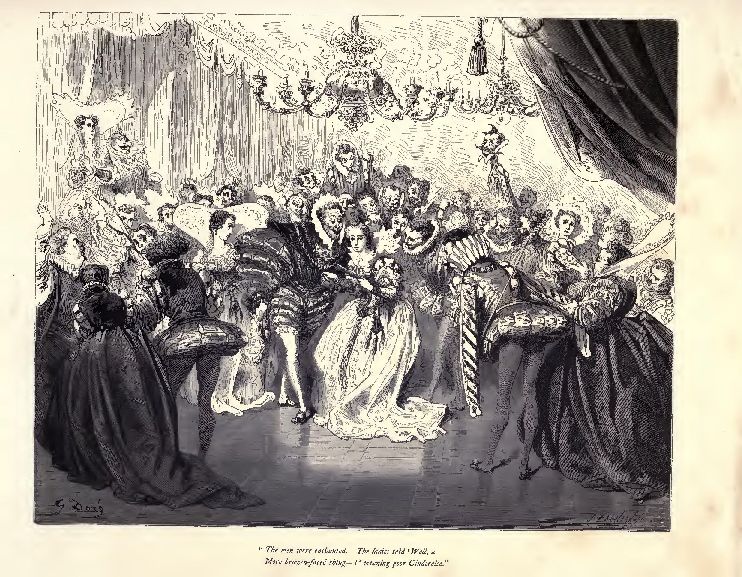
At once—although strange you may fancy the change, And think I am drawing a bow at long range- The pumpkin (of that as cock-sure as a bantam I'm) Turned to a coach like a trick in a pantomime. Then the worthy old fay touched her niece's array— Rags and tatters all vanished at once quite away, And, lo! in their lieu, she appeared to the view In a ball-dress of fashion the newest of new! She'd such lovely jewels- The thought of them cruel's!- Not at Hancock's, or Ryder's, or H. Emmanuel's, Or the shops of some forty more- (Say Storr and Mortimore, Hunt and Roskell, or any besides of the many Where on things of the sort you may spend a nice penny)- * No! But at the Adelphi some folks "I 've heard tell on" Are often quite carried away by a Mellon. Could you ever procure such pearls, diamonds, and top az: I very much doubt if their equal the Pope has; Though there are (so I've read in a newspaper par.) a Good many gems in the papal tiara! But what sort of shoes had the sweet Cinderella- Polished leather, white satin, French kid, or prunella? No! not one of those hid her dear little toes. She wore—can't you guess?—now what do you suppose?— She wore—come, you know what she had pour ses souliers?— She wore—as A. Ward would remark, 't was "pekoolier"— She wore, to be brief, then, a pair of glass slippers, And what vulgar rapture calls "regular clippers!" "And now," said her aunt, "your sisters may flaunt, And fancy they 'll catch the young Prince—but they shan't! There's one thing, however, I'm anxious to mention- And I beg you will give to my words your attention: If you stop at the ball till the hours that are small, Your jewels and finery'll vanish—that's all! So when twelve's drawing near be careful, my dear, And to get away safely take five minutes clear. Yes; at five minutes to, pray take your adieu, Or something may happen you 'll long have to rue!" Cinderella, quite charmed with her gorgeous array, Scarce had patience to hear what her aunt had to say, But the moment she seemed to be making an end to it, Kissed her, and promised she'd strictly attend to it! Cinderella steps into her carriage and eight, Tantara-tantara-ta! With coachman, and footmen, and pages of state, She is driven away to the Prince's grand gate. Tantara-tantara-ta! Oh, didn't they think she was somebody great! Tantara-tantara-ta! The Prince's Lord Chamberlain rushed to the door, Tantara-tantara-ta! And bowed very low that fair lady before, While retainers and guards crowded round by the score, Tantara-tantara-ta! And even the solemn old porter said, "Lor!" Tantara-tantara-ta! The Prince, when he heard all the hubbub and din, Tantara-tantara-ta! Came down the grand staircase, and held out his fin To the fair Cinderella, and welcomed her in, Tantara-tantara-ta! And a very sweet smile was so blest as to win. Tantara-tantara-ta! He leads her to the ball-room. As they enter, At once all eyes on Cinderella centre. Each noble of the land, well-born or grand, Desires the honour of her tiny hand. The women all are on the hooks styled tenter To learn who she can be, Though "really they can't see"- Like female jealousy there's no fermenter For turning tempers naturally placid Into a bitterly corrosive acid- "What all the men could find in her to praise- They'd ne'er met one more plain in all their days. Her clothes were fine, And did with jewels shine, But then, you know, they'd probably been lent her." What need to enlarge?—It appears woman's duty To differ from us upon questions of beauty.
Original Size -- Medium-Size
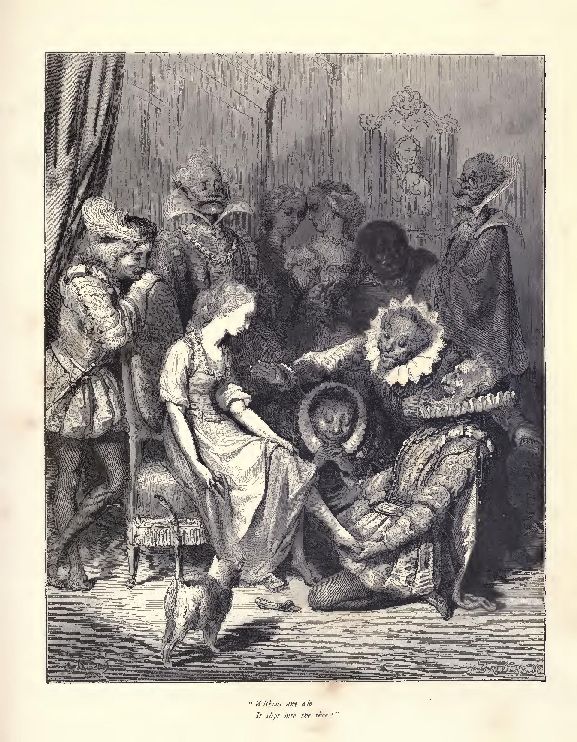
The men were enchanted. The ladies said, "Well, a More brazen-faced thing—!" meaning poor Cinderella. (The dissension of belles, As experience tells, Is one of the oldest of horrida bella.) The Prince claimed her hand for the very next dance; Cinderella consented, but gave him a glance That set his heart dancing with passion and pleasure Much faster by far than his feet danced the measure. "Now 's your chance, Miss, to dance. Hark! they play the 'Mabel.' Who'd be false To such a waltz, If to spin he's able? "Faster they Ought to play- Can't they do it quicker? No, that ass The double-bass, He's far gone in liquor. "O'er the floor One round more Will not tire, I trust, you." "Only one— And now it's done I'll sit down." "Oh, must you:" For dance after dance his delight to enhance The Prince asks her hand; no one else has a chance! While young ladies and old, "left out in the cold," Shake their heads at such doings, and say that it's "bold! But the Prince doesn't care for any one there But his own darling partner, so gentle and fair (Which is more than his conduct is—so they declare). At last Cinderella looked up at the clock, One minute to twelve! What a terrible shock! In two seconds more she is out at the door,- She has no time to wait, but runs to the gate- It's well no one sees her, because she's too late: The clock has struck twelve. The enchantment is o'er The guards who were stationed each side of the portal, When questioned, said they Had seen none pass that way Except—yes! one scullery-maid, a poor mortal, All rag, patch, and tatter, but didn't look at her. The porter declared he knew nought of the matter; At the door as he sat he'd seen nothing thereat But a pumpkin, a lizard, some mice, and a rat. The Prince, who'd rushed out to look after his partner And hand her downstairs To her carriage, declares He can't make it out—"It is quite a disheart'ner!" However, next night he feels it's all right When he sees her again at his palace alight. Once more by his side through the hall she will glide— And if he's a chance, In the midst of the dance He '11 ask her permission to make her his bride. Cinderella, taught wisdom by yesterday's scrape, Though enjoying the ball, Watched the clock on the wall, And in plenty of time from the room made escape. But the Prince, looking out very sharply, no doubt, Saw what his mysterious guest was about- So sent for a follower trusty and tried, And said he was yearning the name to be learning Of the lady just gone to her carriage outside; And so he must ride A little way on—say just down the next turning- And follow the coach, let whatever betide! The Prince then conducted the fair to her coach- But in vain did his vassal await its approach To ride in its track, so at last he came back. At the news of his failure his master looked black, And instead of a money-bag gave him the sack. The next night came round—once more the Prince found His love at the ball—and his heart gave a bound! In the midst of the hop the question to pop He determined—and nought his intention should stop. How sweet are first love's tender words As on the ear they fall! More musical than song of birds- More sweet than whey, more soft than curds, So welcome to us all. And, ah! to Cinderella's ear, Who'd heard so little love, How were the Prince's accents dear, Which her fond heart could plainly hear All other sounds above! Her aunt's directions to her niece Young Cupid makes her shelve; When suddenly her joy must cease- The clock upon the mantelpiece Is on the stroke of twelve. One! run- Two! through- Three! the- Four! door. Five! look alive!—If you do not contrive To be out of the place ere the clock strikes twice six, I guess, Miss, you 'll be in a tall sort of a fix. She is off and away without any delay, Ere the Prince can get rid of his fear and. dismay: Off down the stairs Like a mad thing she tears- When one of her slippers, small blame for that same, Slipt off altogether, quite true to its name; So the Prince when he came To the top of the staircase his love to pursue, Found that she was a slipper—but left him a shoe. What was he to do? He put two and two Together at once, "calculating" like Babbage; And as Taylor would say In adapting a play, Remarked, "If that's choux, I will make it my cabbage; The guards were all questioned, but nought could he glean; They had carefully watched, but had nobody seen Except one poor beggar girl, ragged and mean. £; Who," so one observed, "from her beautiful colour, he Thought had been scrubbing the pans in the scullery." The very next day, in the usual way, His nobles he sent, with a herald, to say, That the fortunate fair Who could easily wear The slipper which they on a cushion then carried Would be by the Prince instantaneously married. "Pooh!" say the ladies, as each trial made is, "Only fit for Chang's lady, that shoe, we 're afraid, is. You'd better convince that foolish young Prince, If he waits till it's fitted—the fact not to mince- He 'll finish at last by not marrying at all; The slipper is really too foolishly small!" But in spite of their sneers, they were all half in tears, And to get on the slipper bad given their ears; Indeed, there were those who cut off their toes To try and contrive it—or so the tale goes. Cinderella's two sisters were fiery as blisters, And abused the young Prince and his learned ministers, Altogether, as Toole would observe, "just a-goin' it!" Because, if you please, When each tried to squeeze The shoe on, she scarcely could get her big toe in it. When they 'd done, Cinderella sat down in the chair: Oh, didn't they stare with contemptuous air! While each to the other said, "Well, I declare!" But when the lords put The shoe on her foot, Without any ado it slipt into the shoe—
Original Size -- Medium-Size
Said the Prince in a trice, "I 'll wed none, love, but you!" What more? The good fairy returned on the scene, And, instead of the garb which was really not clean, At a touch of her wand, in a dress of rare sheen Presented her niece to the Prince who had been So faithful and fond, and who made her his Queen. [From the "Post" you will all the particulars glean Of the marriage performed the two parties between By a Bishop, assisted by Canon and Dean.] Her sisters were very near dying of spleen, And thought their aunt's conduct remarkably mean, But lived as neglected old maids, spare and lean (Though they'd never acknowledge to more than nineteen). So there's no more to tell a- -Bout sweet Cinderella, Whose life was quite happy—in fact, "all serene!"