Chapter IV · OF THE DIFFERENT KINDS OF CARDS AND THE MARKS OF THE SUITS. (continued 2)
Reading edition
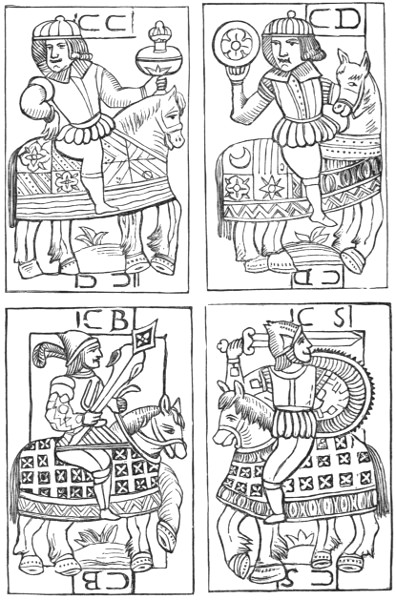
Some of the specimens of Portuguese cards given in the 'Jeux de Cartes Tarots et de Cartes Numérales' have very much the appearance of having been originally suggested by, if not copied from, an Oriental type; more especially in the suits of Danari and Bastoni,—Money and Clubs. In those cards the circular figure, generally understood as representing Danari, or Money, is certainly much more like the Chakra, or quoit of Vichnou, as seen in Hindostanee drawings, than a piece of coin; while on the top of the Club there is a diamond proper, which is another of the attributes of the same deity. The dragon seen on each of the Aces is perfectly Oriental in character; and the shields which appear on the Kings and Queens are very much like those which are to be seen in Hindostanee drawings. The coat cards in this pack are King, Queen, and Horseman; and the suits are Coppe, Danari, Bastoni, and Spade—Cups, Money, Clubs proper, and Swords. The Queen, which here appears as the second coat card, is of unusual occurrence in cards of this kind, and more especially in such as are of Spanish or Portuguese manufacture. [299] In two of the suits,—Clubs and Swords,—the Queen appears in the act of encountering a dragon. The coat cards and aces have letters both at top and bottom, indicating the suit, and the rank or name of the card. Specimens of those cards, which appear to have been executed in 1693, are preserved in the Bibliothèque du Roi. The four annexed cuts show the outlines of the four Valets. The letters CC, CD, CB, CS, signify respectively the Caballo, or Chevalier of Coppe, Danari, Bastoni, and Spade.
The most remarkable changes that cards have undergone, with respect to the characters displayed on them, are to be found in certain packs manufactured at Paris in the time of the Revolution. Specimens of the coat cards of two of those packs engraved by Chossonnerie and Gayant, in 1793-4, are given in the 'Jeux de Cartes Tarots et de Cartes Numérales.' In one of them the places of the Kings are occupied by four Philosophers, namely, Molière, La Fontaine, Voltaire, and J. J. Rousseau; the Queens are substituted by the four Virtues, Prudence, Justice, Temperance, and Fortitude; while the Valets are superseded by four Republicans, one of whom is a grim-looking ruffian, with a red cap on, and his shirt-sleeves turned up, brandishing a pike; the second is a soldier armed with a musket; the third an artilleryman; and the fourth a young man, in fancy costume, armed with a musket. In the other pack, four Sages, Solon, M. P. Cato, J. J. Rousseau, and J. J. Brutus, serve instead of Kings; four Virtues, as in the other pack, represent the Queens; though with this difference, that Temperance is displaced by Union; while four "Braves,"—Annibal, Horatius, P. Decius Mus, and M. Scævola, supply the place of Valets.
Another pack of Republican cards of the same period is thus described by Peignot, in his 'Analyse de Recherches sur les Cartes à jouer.'
"For Kings we have Genii; for Queens, Liberties; and for Valets, Equalities. In place of the King of Hearts there is the Genius of War,—'Génie de la Guerre.' This Genius, which is winged, is seated on the breech of a cannon; he holds in the right hand a sword and a wreath of laurel, and in the left, a shield, round which is the inscription, 'Pour la République Française.' On the right, read vertically from the top, is the word 'Force.' At the feet of the Genius are a bomb, a lighted match, and a heap of bullets. At the bottom of the card is the inscription, 'Par brevet d'invention. Naume et Dugouec, au Génie de la Rép. franç.'
"For the Queen of Hearts: 'Liberté des Cultes,'—Religious Liberty. This is a female seated, very badly draped, and with her legs bare. She holds a pike surmounted with a red cap; and on a bannerol attached to the pike are the words 'Dieu seul.' Towards her feet are seen three volumes, inscribed 'Thalmud,' 'Coran,' and 'Evangile.' The vertical inscription is, 'Fraternité.'
"Knave of Hearts: 'Égalité des Devoirs,'—Equality of Duties. This is a soldier seated on a drum, with his musket between his knees. In his left hand he holds a paper containing the words, 'Pour la patrie.' The vertical inscription is 'Sécurité.'
"King of Spades: 'Génie des Arts,'—the Genius of Arts. The figure of Apollo with a red cap on his head; in one hand he holds the Belvedere statue of himself, and in the other a lyre. The vertical inscription: 'Goût.' At the bottom, emblems of painting, sculpture, and such like.
"Queen of Spades: 'Liberté de la Presse,'—Liberty of the Press. A female figure with a pen in one hand, and with the other sustaining a desk, on which lies a roll of paper partly unfolded, and displaying the words 'Morale, Religion, Philosophie, Physique, Politique, Histoire.' At the bottom, masks, rolls of manuscript, and such like.
"Knave of Spades: 'Egalité de Rangs,'—Equality of Ranks. The figure of a man whose costume accords rather with that of a 'Septembriseur' than with that of a mere 'Sans-culotte' of the period. He wears sabots, and has a red cap on his head. He has no coat on, and his shirt-sleeves are tucked up to the elbows. His small-clothes are loose at the knees, and his legs are bare. He is seated on a large stone, on which is inscribed: 'Démolition de la Bastille. 10 Août, 1792.' Under his feet is a scroll inscribed 'Noblesse,' and displaying shields of arms. The vertical inscription is 'Puissance.'
"King of Clubs: 'Génie de la Paix,'—Genius of Peace. In his right hand he holds the 'Fasces' and an olive branch, and in the left a scroll containing the word 'Lois.' The vertical inscription is 'Prospérité.'
"Queen of Clubs: 'Liberté du Mariage,'—Liberty of Marriage. The figure of a female holding a pike surmounted with the red cap; and on a scroll attached to the pike is the word 'Divorce.' The vertical inscription is 'Pudeur.' On a pedestal is a statue of the crouching Venus entirely naked,—without doubt intended for the emblem of Modesty.
"Knave of Clubs: 'Egalité de Droits,'—Equality of Rights. A judge in tricolor costume, holding in one hand a pair of scales, and in the other a scroll containing the inscription 'La loi pour tous.' He is trampling on a serpent or dragon, the tortuous folds of which represent legal chicanery. The vertical inscription is 'Justice.'
"King of Diamonds: 'Génie du Commerce,'—the Genius of Commerce. He is seated on a large bale, which contains the inscription 'P. B. d'inv. J. D. à Paris.' In one hand he holds a purse, and in the other a caduceus and an olive-branch. The vertical inscription is 'Richesse.' At the bottom are an anchor, the prow of a ship, a portfolio, and such like.
"Queen of Diamonds: 'Liberté des Professions,'—Liberty of Professions and Trades. A female figure who, in the same manner as the other three Liberties, holds a pike surmounted with the red cap. With the other hand she holds a cornucopiæ and a scroll containing the word 'Patentes.' The vertical inscription is 'Industrie.'
"Knave of Diamonds: 'Egalité de Couleurs,'—Equality of Colours. The figure of a Negro, seated, and leaning upon a musket. Below is the word 'Café.' Near to him are a sugar-loaf, a broken yoke, fetters, iron collars for the neck, and such like. The vertical inscription is 'Courage.'
"Such are the coat cards of this Republican pack. The numeral cards are the same as the old ones, with the exception of the Aces, which are surrounded by four fasces placed lozenge-wise, with these words: 'La Loi. Rép. Franç.;' the whole coloured blue. It is scarcely necessary to say that those ridiculous cards had not even a momentary vogue." [300]
The coat cards of a Republican pack, of recent American manufacture, have been forwarded to me by a friend, resident at New York. From the name of the maker,—R. Sauzade,—which occurs on the Ace of Spades, I am inclined to think that their invention is to be ascribed rather to a Frenchman than to an American. For the Kings we have: Hearts, Washington; Diamonds, John Adams, the second President of the United States; Clubs, Franklin; Spades, La Fayette. For the Queens: Hearts, Venus,—modestly concealing her charms with a mantle, in accordance with American notions of delicacy. Diamonds, Fortune; Clubs, Ceres; Spades, Minerva. The Knaves are represented by Four Indian chiefs. The figures appear to be engraved on copper, and are coloured. The marks of the suits are the same as those on the cards in common use in England. Those cards, I am informed, are held in no estimation by the card-players of America, who continue to prefer those of the old pattern.—The chief town in America for the manufacture of cards is Boston; whose discreet, meeting-going people seem to have no objection to make a profit by supplying the profane with the instruments of perdition.
No cards of an "instructive" character have ever obtained popularity amongst regular card-players; for when people sit down to play at cards they do not like to have their attention withdrawn from the game by the historical or biographical reminiscences suggested by Coat cards, either containing portraits of distinguished characters, or commemorating remarkable events; and least of all can they bear that the heads of a sermon or moral lecture should be presented to them in the shape of the four cardinal virtues; which are just as appropriate in a pack of cards as they would be on the proscenium of her Majesty's Theatre.
The best of the costume cards that I have seen are those designed by Armand Houbigant, a French artist, who named them "Cartes Royales," and obtained from Louis XVIII, a license to manufacture them for general use, in 1818. They did not, however, acquire any vogue, and are now seldom to be met with, except in the collections of amateurs of prints. The coat cards, which are etched, and delicately coloured by hand, display the costume of the French Court at four different periods. The characters represented are as follows.
Spades. King, Charlemagne, "Carolus Magnus;" crowned, and seated on a throne, with a globe in the right hand, and a long sceptre in the left.—Queen, Hildegarde, second wife of Charlemagne; erect, crowned, and holding a book in her hands.—Knave, Roland, described in romances as the nephew of Charlemagne; and said to have been killed at the battle of Roncevalles in 778; holding a spear and shield, and clothed in armour, which appears rather to belong to the sixteenth century than to the time of Charlemagne.
Diamonds. King, Louis IX, "Sainct Loys;" crowned, seated on a throne, wearing a blue robe powdered with fleurs-de-lis, and having a sceptre in his left hand.—Queen, Blanche de Castille, wife of Louis VIII, and mother of St. Louis; erect, crowned, and holding a rosary in her right hand.—Knave, Sire de Joinville, the biographer of Louis IX, and one of the nobles of his court; clothed in chain-mail, over which is a surcoat of arms.
Clubs. King, Francis I; seated, wearing the broad bonnet in which he is usually represented, and holding a sceptre.—Queen, Marguerite de Valois, Queen of Navarre, sister of Francis I; erect, holding a rose in her right hand.—Knave, Bayard; in plate-armour, leaning on a kind of pedestal on which is inscribed "Sans peur, sans reproche."
Hearts. King, Henry IV; seated, holding a sceptre, and wearing the characteristic hat and feather which, in modern times, are designated by his name.—Queen, Jeanne d'Albret, mother of Henry IV; erect, holding a fan in her right hand.—Knave, Sully; bald and bearded, as he is usually represented in engravings, holding in his right hand a paper inscribed "Economie Roy. [301] ..."
A set of Picture Cards, published by Cotta, the bookseller of Tubingen, in one of his Card Almanacs—'Karten Almanach'—is noticed by Mons. Peignot. The designer has chosen for the coat cards the principal characters in Schiller's Joan of Arc, and has clothed them, as well as he could, in the costume of the period. The King of Hearts is Charles VII; the Queen, Isabella of Bavaria; the Knave, La Hire.—The King of Clubs is the English commander, Talbot, dying; the Queen, Joan of Arc; the Knave, Lionel, taking away the sword of Joan of Arc.—The King of Diamonds is Philip, Duke of Burgundy; the Queen, Agnes Sorel; the Knave, Raimond, a villager.—The King of Clubs is Réné of Anjou, with the crown of Sicily at his feet; the Queen, Louise, sister of Joan of Arc; and the Knave, Montgomery, on his knees, and weeping. The low cards from 1 to 10 also contain fanciful designs; but with the subjects so arranged that the numbers and marks of the suits can be readily distinguished. The subject of the Four of Clubs is an illustration of Burger's ballad of Leonore—Death armed, and mounted on horseback, appears to be threatening with his dart a young woman who rides behind him; the scene is laid in a churchyard, and a skeleton appears crawling towards an open grave. The mark of the suit is seen on four crosses in the churchyard. Cotta's Card Almanack first appeared in 1806, and was continued for several years. It was published as a small pocket volume of a square form; and the illustrations consisted entirely of fanciful cards,—the mark of the suit being always introduced into each subject, either by hook or by crook. The designs for the cards in the first four volumes, from 1806 to 1809 inclusive, are said to have been made by a lady.—Numerous packs of fancy cards have appeared in Germany since the commencement of the present century; some displaying costume, ancient and modern; some representing eminent characters, and others devoted to the illustration of trades and professions. In one of them, published at Frankfort-on-the-Maine, in 1815, in memory of the principal military events of 1813-14, the Duke of Wellington figures as the Knave of Diamonds, and Marshal Blucher as the Knave of Clubs.
In 1811 two different packs of caricature cards, imitated, or rather adapted, from the picture-cards in Cotta's Almanack, appeared in England. The one was published by S. and J. Fuller, Rathbone place, London; and the other, by Jones, at the Repository of Arts, Market hill, Cambridge. Neither of those packs was intended for the purposes of play. They have very much the appearance of having been designed by the same artist. On the wrapper of both packs the inscription is the same: "Metastasis. Transformation of Playing-cards."—A set of costume cards was published by Ackermann, in the 'Repository of Arts,' in 1806: a particular description of them would be just as interesting as a description of the plates in 'La Belle Assemblée' of the same period.
A pack of cards published by Baker and Co., in 1813, requires more particular notice. On the wrapper they are entitled "Eclectic Cards;" and in a pamphlet giving an account of them, they are announced as "Complete, Grand, Historical, Eclectic Cards, for England, Ireland, Scotland, and Wales; being a Selection or an Eclectic Company of Twelve of the most eminent Personages, that ever distinguished themselves in those respective Countries, for Heroic deeds, Wisdom, &c. And the other Forty Cards descriptive of the Local and National Emblems of the Four Nations.
"Historian, Poet, Painter, all combine, To charm the eye, the taste and mind refine; Fancy and sentiment their aid impart, To raise the genius, and to mend the heart."
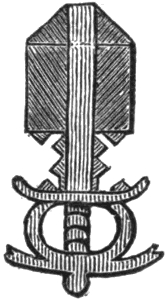
These cards, which are considerably larger than those in common use, display considerable skill and fancy in the designs, and are beautifully coloured. Hearts and Diamonds are retained as marks of two of the suits; but Acorns are substituted for Clubs; and instead of Spades there is a "true representation of the real Spata, which is not a coal-heaver's spade, but a two-edged heavy sword, without a point, as used by the ancient Britons to fight with; cut, hew, and slash down, either enemy or tree. So says our ancient history." A fac-simile of this formidable weapon is here subjoined, in order that the reader may judge for himself of its peculiar fitness for cutting, hewing, or slashing down. It has very much the appearance of a heavy cast-metal article, new from the Carron foundry, and of modern Gothic design. In the descriptive pamphlet, the coat cards are thus explained:
"FOR ENGLAND.
King of Clubs.—Arthur, the Great and Victorious Hero, King of Britain.
Queen of Clubs.—Elizabeth, the Wise and Virtuous Queen of England.
Knight of Clubs.—Sir John Falstaff, the Facetious Knight, and companion of Henry V, Knight of England.
FOR IRELAND.
King of Hearts.—Gathelus, the Grecian Prince, King of Ireland.
Queen of Hearts.—Scotia, his Wife, the Egyptian Princess, Queen of Ireland.
Knight of Hearts.—Ossian, the Warrior and Poet, Son of Fingal, Knight of Ireland.
FOR SCOTLAND.
King of Diamonds.—Achaius, the fortunate Contemporary, and in alliance with Charlemagne, King of Scots.
Queen of Diamonds.—Mary Stuart, the unfortunate Dowager Queen of France, and Queen of Scots.
Knight of Diamonds.—Merlin, the Magic Prophet, Cabinet Counsellor to Vortigern, Aurelius Ambrosius, Uter Pendragon, the Father of King Arthur, and to King Arthur, who was his Pupil, Knight of Scotland.
FOR WALES.
King of Spata.—Camber, the third Son of Brute, King of Cambria.
Queen of Spata.—Elfrida, the beautiful Queen of Mona, and of the Mountains.
Knight of Spata.—Thaliessin, the Welch Bard and Poet, dressed like a Herald or King at Arms of the Divine and Ancient Druids, as he sang to King Henry II of the great deeds of Arthur, the justly termed hero of the British Isle, Knight of Cambria."
"In the selection which we have made," say the proprietors, "to form our set of court cards, we have chosen them from among those characters who have rendered themselves most conspicuous in the history of the United Kingdom. In this particular, we have had recourse not only to historical truth, which we have rigidly observed, but we have taken care to fix upon personages, who lived at different periods, and which are calculated in colour, variety of dress, and characteristic features, to form an agreeable and elegant contrast, and to avoid that unpleasant monotony which must have taken place if they had all been selected from the same period of time; and it will be a peculiar gratification to us, in our attempts to form a set of cards, should we contribute in the smallest degree, to augment the elegant and rational amusements of taste and fashion.
"Nor have we been inattentive to minor objects in our anxiety to complete the plan. We believe it has never been attempted to be explained why the coarse and vulgar appellation of knave, was originally given to the card next in degree to the queen. Perhaps the following demonstration is the most plausible way in which it can be accounted for. It was usual with kings in ancient times to choose some ludicrous person, with whose ridiculous and comical tricks they might be diverted in their hours of relaxation, from the cares and formalities of royalty. This person was generally chosen from among men of low condition, but not wholly destitute of talent, particularly in that species of low cunning and humour calculated to excite mirth and laughter, and the tricks of knavery (in which he was allowed free indulgence in the presence of the king), gave him the appellation of the king's fool, or knave.
"Whether this explanation be really the origin from whence the knave in the old cards is derived, may still remain undetermined, but it appears to us the most rational way of accounting for it. Nor is it indeed essential to our present purpose; the name of knave in our opinion is vulgar, unmeaning, and inconsistent, and being moreover absolutely incompatible with the dignity of our characters, and the uniformity of our plan, we have entirely rejected it, and substituted a knight in its stead. This being a title of honour, not only in immediate succession to that of king and queen, but is ever considered as an honorable appendage to royalty itself."
About 1819, a set of cleverly drawn satirical cards, with the marks of the suits introduced in the same manner as in Cotta's cards, appeared at Paris. Their satire is directed against the political party then in the ascendant; and in the Nine of Hearts, portraits of Chateaubriand and other persons, both lay and clerical, are introduced as advocates of the old order of things; in the background are the ruins of the Bastille, and at the foot is the inscription, "Les Immobiles." The coat cards of the suit of Hearts consist of figures representing three popular journals: King, "Constitutionnel,"—a figure in Roman costume, with sword and shield, defending a column inscribed: "Charte constitutionnel. Liberté de la Presse. Liberté Individuelle. Loi des Elections. Tolérance." Queen, "Minerve,"—Minerva putting to flight certain evil spirits of the "Partie Prêtre."—Knave, "Figaro,"—the character in proper costume. The coat cards of Spades are: King, "Conservateur,"—a Jesuit with a sword in one hand, and a torch in the other. Queen, "Quotidienne,"—an old woman holding in her left hand a book inscribed, "Pensée Chrétienne quotidienne;" and in her right an extinguisher, which she is about to clap upon a figure of Truth seen emerging from a well. Knave, "Bazile,"—figure of Chateaubriand, in clerical costume, but concealing a Jesuit's cap under his robe; beside him is a braying ass, on its knees. Clubs: King, "Débats,"—the Editor endeavouring to carry two large bags, the one inscribed, "Débats" and the other "Empire:" in the distance, two asses mutually caressing each other. Queen, "Gazette,"—a hard-featured old lady, with a pen in her hand, at a writing table: near to her a magpie in a cage. Knave, "Clopineau,"—the figure of Talleyrand; towards the top are the signs of the political zodiac which he had already passed through. In the only pack which I have had an opportunity of examining, the Queen of Diamonds is wanting. The representative of the King is the "Moniteur,"—a brazen head on a kind of pedestal, round which are stuck flags of various colours, indicative of the different parties whose cause the paper had advocated. Knave, "Don Quichotte,"—the Don, with shield and lance, attacking a windmill: the person intended by this figure I have not been able to discover. [302]
With respect to the common names of the first three numeral cards,—Ace, Deuce, and Tray,—it may be observed that the term Ace or As is common in almost every country in Europe as the designation of the One at cards; [303] and that the terms Deuce and Tray, signifying Two and Three, may have been derived either from the Spanish Dos and Tres, or from the French Deux and Trois. The Deuce of cards, it may be observed, has no connexion with the term Deuce as used in the familiar expression "to play the Deuce;" in which it is synonymous with the Devil, or an evil spirit, and is of Northern origin. In some parts of the country, the Deuce, though lower in value, is considered to be a more fortunate card than the Tray; and "There's luck in the Deuce, but none in the Tray," is a frequent expression amongst old card-players, who like to enliven the game with an occasional remark as they lay down a card. In Northumberland, the Four of Hearts at Whist is sometimes called "Hob Collingwood," [304] and is considered by old ladies an unlucky card. As far as memory can trace, according to Captain Chamier, in his novel entitled the 'Arethusa,' the Four of Clubs has been called by sailors the "devil's bedpost." In Northamptonshire, according to a writer in the 'Gentleman's Magazine,' 1791 (p. 141), the Queen of Clubs is called "Queen Bess," and the Four of Spades, "Ned Stokes." [305]
In various parts of Ireland, but more particularly in the county of Kilkenny, the Six of Hearts is known by the name of "Grace's card;" and it is said to have acquired that name from the following circumstance. A gentleman of the name of Grace, being solicited, with promises of royal favour, to espouse the cause of William III, gave the following answer, written on the back of the Six of Hearts, to an emissary of Marshal Schomberg's, who had been commissioned to make the proposal to him:—"Tell your master I despise his offer; and that honour and conscience are dearer to a gentleman than all the wealth and titles a prince can bestow."
The Nine of Diamonds is frequently called the "Curse of Scotland;" and the common tradition is that it obtained this name in consequence of the Duke of Cumberland having written his sanguinary orders for military execution, after the battle of Culloden, on the back of a Nine of Diamonds. This card, however, appears to have been known in the North as the "Curse of Scotland" many years before the battle of Culloden; for Dr. Houstoun, speaking of the state of parties in Scotland shortly after the rebellion of 1715, says that the Lord Justice-Clerk Ormistone, who had been very zealous in suppressing the rebellion, and oppressing the rebels, "became universally hated in Scotland, where they called him the Curse of Scotland; and when the ladies were at cards playing the Nine of Diamonds, (commonly called the Curse of Scotland) they called it the Justice Clerk." [306]
In the 'Gentleman's Magazine' for 1786, a correspondent offers the following heraldic conjecture on the subject. "There is a common expression made use of at cards, which I have never heard any explanation of. I mean the Nine of Diamonds being called the Curse of Scotland. Looking lately over a book of heraldry, I found nine diamonds, or lozenges, conjoined,—or, in the heraldic language, Gules, a cross of lozenges,—to be the arms of Packer. Colonel Packer appears to have been one of the persons who was on the scaffold when Charles the First was beheaded, and afterwards commanded in Scotland, and is recorded to have acted in his command with considerable severity. It is possible that his arms might, by a very easy metonymy, be called the Curse of Scotland; and the Nine of Diamonds, at cards, being very similar, in figure, to them, might have ever since retained the appellation." Another correspondent says that he has always understood that the application of the expression, "the Curse of Scotland," to the nine of diamonds was not earlier than the year 1707; and that he thinks it more probable that the nine lozenges in the arms of the Earl of Stair, who made the Union, should have given rise to the phrase, than the arms of Packer. In the same Magazine, for 1788, we have "One more conjecture concerning the Nine of Diamonds." It is syllogistic in form, and appears to have been intended as a clinch to the controversy. [307] "The Curse of Scotland must be something which that nation hate and detest; but the Scots hold in the utmost detestation the Pope; at the game of Pope Joan, the Nine of Diamonds is Pope; therefore the Nine of Diamonds is the Curse of Scotland. Q. E. D."
In the 'Oracle, or Resolver of Questions,' a duodecimo volume, printed about 1770, the following solution is given, which is perhaps as near the truth as any of the preceding conjectures. "Q. Pray why is the Nine of Diamonds called the Curse of Scotland? A. Because the crown of Scotland had but nine diamonds in it, and they were never able to get a tenth."
The word Trump, signifying a card of the suit which has the superiority at certain games, such superiority being determined by hazard, is derived either from the French Triomphe, or the Spanish Triunfo: at cards, these words have precisely the same meaning as the English Trump. [308] With the French, Triomphe is also the name of a game at cards; and in England the old game of Ruff seems also to have been called Trump or Triumph. [309] At Gleek, the Ace was called Tib; the Knave, Tom; and the Four, Tiddy. The Five and Six appear to have been respectively called Towser and Tumbler, and to have counted double when turned up. At All-Fours, the Knave appears in his proper character of Jack,—a serving-man, not a cheat, or rogue.
At certain games the Knave of Clubs is called Pam. A few years ago the name was applied to the celebrated public character whom Byron is supposed to have designated as "a moral chimney-sweep," in one of the cantos of Don Juan. [310] Most of the terms in the game of Ombre are Spanish.
Formerly a pack of cards was usually called a "Pair of cards;" and it appears deserving of remark, that the Italians use the word Pajo, which properly signifies a pair, in precisely the same sense when applied to a pack of cards,—Pajo di carte. In the time of Queen Elizabeth a pack of cards appears to have been sometimes called a bunch. In the time of Charles II the term "Pair of Cards" fell into disuse; and perhaps one of the latest instances of its employment, is to be found in Poor Robin's Almanac for 1684, under the month December, where the writer, in his introductory verses, laments the decline of good housekeeping in the houses of the rich:
"The kitchen that a-cold may be, For little fire you in it may see. Perhaps a pair of cards is going, And that's the chiefest matter doing."
The French call a pack of cards "Un Jeu de cartes,"—a game, or play of cards; and the German name, "Ein Spiel Karten" has the same literal meaning as the French.
As the object of this work is not to teach people how to play at cards, those who wish for information, with respect to the different games, are referred to Cotton's 'Complete Gamester,' Seymour, Hoyle, and the Académie des Jeux,—taking with them this piece of advice:
"He who hopes at Cards to win, Must never think that cheating's sin; To make a trick whene'er he can, No matter how, should be his plan. No case of conscience must he make, Except how he may save his stake; The only object of his prayers,— Not to be caught, and kicked down stairs."[311]
With respect to the manufacture of cards, it would appear to have been a regular business, both in Germany and Italy, about 1420; but, though it has generally been asserted that the earliest cards for common use were engraved on wood, there is yet reason to believe that they were at first executed by means of a stencil; and that the method of engraving the outlines on wood was of subsequent introduction. However this may be, it is certain that the art of wood-engraving was at an early period applied to the manufacture of cards, and that in Germany, in the latter quarter of the fifteenth century, the term Briefdrucker, or Briefmaler,—card-printer, or card-painter—was commonly used to signify a wood-engraver. From the importation of playing cards into England being prohibited by an act of parliament in 1463, as injurious to the interests of native tradesmen and manufacturers, it might be concluded that at that time the manufacture of cards was established in this country. No cards, however, of undoubted English manufacture of so early a date have yet been discovered. In the sixteenth century, there is reason to believe that most of the cards used in England were imported either from France, or the Netherlands. In the reign of Elizabeth the importation of cards was a monopoly; [312] but from the time of her successor James I, it would appear that most of the cards used in this country were of home manufacture. From the reign of Charles II to the present time, cards have, either directly or indirectly, been subject to a duty.
In France, by an ordonnance dated 21st February, 1581, a tax of "un ecu sou" was ordered to be paid upon each bale of cards of two hundred pounds weight intended for exportation; and, by an ordonnance of the 22d May, 1583, a tax of "un sou parisis" was laid upon each pack of cards intended for home use. By an ordonnance of the 14th January, 1605, the exportation of cards was prohibited; but, as a compensation to the manufacturers, the duty on cards for home consumption was reduced. As the collection of the duties was rendered difficult in consequence of the manufacturers residing in so many different places, it was, at the same time, determined that the only places where the manufacture of cards might be carried on, should be Paris, Rouen, Lyons, Toulouse, Troyes, Limoges, and Thiers in Auvergne. Shortly afterwards, the same privilege was accorded to Orleans, Angers, Romans, and Marseilles; and, by way of recompense to other places, it was determined that the tax should be expended in the encouragement of manufactures. Louis XV, having established the Ecole Militaire, in 1751, ordered that the money raised by the tax on cards, should be applied to its support. The company, or guild, of card-makers of Paris was suppressed in 1776, but re-established a few months afterwards. The period of their first establishment appears to be unknown. In their statutes of the year 1594, they call themselves Tarotiers. [313] In Russia, at the present day, the manufacture of cards is a royal monopoly. A few months ago a paragraph appeared in the Literary Gazette, stating that though 14,400 packs were manufactured daily, yet the supply was unequal to the demand, and that a petition had been presented to the emperor praying for a more liberal issue. In Mexico a considerable revenue was derived from a tax on cards; and it would appear to be still productive, notwithstanding the unsettled state of the country, as it is one of those which have been appropriated, ad interim, by the American commander-in-chief.
Most of the cards engraved on copper are merely "cartes de fantaisie," designed rather for the entertainment of the more wealthy classes, than for the ordinary purposes of play. Until a comparatively recent period the coat cards, after having been printed in outline from wood blocks, were coloured by means of stencils; but at present, in this country, the colours are all applied by means of the press. The following account of the manner of making cards at the manufactory of Messrs. De La Rue and Company, of London, is extracted from Bradshaw's Journal, No. 24, 16th April, 1842.
"The first object that engages our attention, is the preparation of the paper intended to be formed into cards. It is found that ordinary paper, when submitted to pressure, acquires a certain degree of polish, but not sufficient for playing-cards of the finest quality. In order therefore that it may admit of the high finish which is afterwards imparted, the paper is prepared by a white enamel colour, consisting of animal size and other compounds. This substance, which renders the paper impermeable to the atmosphere, is laid on by a large brush, and left to dry by exposure to the atmosphere.
"The paper being ready for use, we proceed to explain the printing of the fronts of the cards, which are technically distinguished as pips and têtes.
"To commence with the simpler, the pips (i.e. the hearts, diamonds, spades, and clubs:)—sets of blocks are produced, each containing forty engravings of one card; and as the ordinary method of letterpress printing is employed, forty impressions of one card are obtained at the same moment. As the pips bear but one colour, black or red, they are worked together at the hand-press, or at one of Cowper's steam printing machines.
"For the têtes, however (i.e. the court cards), which, with the outline, contain five colours—dark blue, light blue, black, red, and yellow,—a somewhat different contrivance is employed. The colours are printed separately, and are made to fit into each other with great nicety, in the same manner as in printing silks or paper-hangings. For this purpose a series of blocks are provided, which, if united, would form the figure intended to be produced. By printing successively from these blocks, the different colours fall into their proper places, until the whole process is completed. Great care is of course necessary in causing each coloured impression to fit in its proper place, so that it may neither overlap another, nor leave any part imprinted upon; but as the hand-press is employed, the workman is enabled to keep each colour in register by means of points in the tympan of the press or on the engraving.
"The whole operation of printing at the press being completed, the sheets are next carried to drying-rooms, heated to about 80° Fahrenheit, and are allowed to remain there three or four days, in order to fix the colours.
"The successful printing of playing-cards greatly depends upon the quality of the inks which are employed. The common printing ink, even after the lapse of years, is liable to slur or smutch. In the manufacture of playing-cards, such inks only must be used as will bear the friction to which the cards are subjected in the process of polishing, as well as in passing between the fingers of the players. The colours employed by the Messrs. De La Rue are prepared from the best French lamp-black, or Chinese vermilion, ground in oil;—this is effected by a machine, consisting of cylinders revolving at regulated speeds, by which any defects from the inattention of the workman, in grinding by hand, are avoided. These colours are now brought to such perfection, that the card itself is not more durable than the impression on its surface.
"The paper intended for the backs, being previously prepared with the colour desired, in the same manner as the fronts, is printed in various devices at the hand-press or steam-machine. The plaid or tartan backs are produced from a block engraved with straight lines, and printed in one colour, which is afterwards crossed with the same or any other colour, by again laying the sheet on the block, so that the first lines cross the second printing at any required angle. A variety of other devices are obtained from appropriate blocks; and some, like the court cards, and by the same process, are printed in a number of colours.
"In printing gold backs, size is substituted for ink; the face of the card is then powdered over with bronze dust, and rubbed over with a soft cotton or woollen dabber, by which the bronze is made to adhere to those parts only which have received the size. The printing of gold backs is usually executed after the card is pasted, but we have described the process here for the sake of convenience.
"As connected with the printing of backs, we may mention that the Messrs. De La Rue have lately taken out a patent for printing from woven wire, from which some highly beautiful patterns are obtained, bearing, of course, a perfect resemblance to the woven fabric. The wire when prepared for printing, is merely fastened at the ends by two pieces of wood, and stretched over a cast-iron block, on which it is fixed by means of screws passing through the wood into the iron. The variety of these patterns is very great; the printing is effected in the ordinary manner.
"Hitherto we have been referring to printed sheets of paper, which are either the size of double or single foolscap; the next object, therefore, is the conversion of these sheets into card-boards of the usual thickness. In France the card generally consists of two sheets of paper; but in England a more substantial article is demanded; it is generally four sheets thick, that is, the foreside and the back, and two inside leaves of an inferior description.
"In order to make a firm and smooth card, it is first necessary to obtain a paste of an equable well-mixed substance. A paste of this quality is produced from flour and water, mixed together, and heated to the boiling point, in a forty-gallon copper, by steam; which is made to pass into the interstices between the copper and an external casing of cast-iron, of the same shape as the boiler. By employing steam, instead of fire, the paste is not liable to burn, or adhere to the sides of the copper, and thus become deteriorated in its colour and quality.
"Previous to the commencement of pasting, it is necessary that the sheets be arranged in the order in which they are to be pasted. This operation is termed mingling. The insides, which are merely two sheets of paper pasted together, are placed between the foresides and backs, so that the paste may take them up without the possibility of error. A heap of paper so pasted will therefore uniformly consist of the foreside and back, between which, the inside, pasted on each side, is placed.
"The paste is laid on by means of a large brush, resembling the head of a hair-broom, with which the workman, by a series of systematic circular movements, distributes a thin coat. And by way of illustration of the long practice and manual dexterity which are necessary for perfection in even the simplest departments of art or labour, it may be worthy of notice that card-pasting is in itself a branch of labour, and that three or four years' practice is necessary to render the operator complete master of his business.
"These newly-pasted cards are then, in quantities of four or five reams at a time, subjected to the gradual but powerful pressure of a hydraulic press of one hundred tons, worked by a steam-engine. By this means the water in the paste exudes, and the air between the leaves is expelled, which would otherwise remain, and give the card a blistered appearance.
"After remaining a short time in the press, they are hung up on lines to dry; and to prevent, as much as possible, their warping while in this limpid state, small pins or wires are passed through the corners, and are then dexterously bent over the lines in the drying-room.
"The card-boards, after thus drying, are subjected to the pressure and friction of a brush-cylinder,—the face of which is covered with short thickset bristles, which not merely polish the surface, but even penetrate into the interstices. At this stage of the manufacture, cards of a superior description are waterproofed on the back with a varnish prepared for the purpose, so that they may not be marked by the fingers in dealing. When so prepared, they will keep perfectly clean, and may even be washed, without injuring the impression or softening the card.
"In continuation of the process of polishing, the card-boards are passed between revolving rollers of moderate warmth, one being of iron, the other of paper cut edge-ways; they are next subjected to two bright iron-faced rollers; and finally, to the number of ten or fifteen at a time, they are interleaved with thin sheets of copper, and effectually milled by being passed about a dozen times between two large and powerful cylinders. After being thus thoroughly polished, for the purpose of being flattened they are subjected to the pressure of a hydrostatic press of eight hundred tons, worked by steam.
"It may appear surprising that so much labour and machinery, and such circuitous means—requiring the operation of four distinct cylindrical machines, as well as a hydraulic press, all worked by steam,—should be required for effecting an object apparently so simple as that of polishing and flattening a card-board. It is, however, found that this end cannot be attained in a more expeditious manner, but that the means adopted must be gradual, though increasingly powerful in their different stages.
"The boards being printed and pasted, polished and flattened, are next cut up into single cards. The apparatus by which this is effected, and by which perfect exactness in the size of the cards is preserved, may be briefly described as a pair of scissors from two to three feet long, one blade of which is permanently fixed on the table. The card-board, being placed upon the bench, is slipped between the blades of the scissors, and pushed up to a screw-gauge adjusted to the requisite width; the moveable blade, by being then closed, cuts the card-board into eight narrow slips, called traverses, each containing five cards. These traverses then undergo a similar operation at a smaller pair of gauge-scissors, where they are cut up into single cards, to the amount of thirty thousand daily.
"All that now remains is the making-up into packs. After assorting the cards, the workman begins by laying out on a long table a given number (say two hundred) at one time; he then covers these with another suit, and so on consecutively until he has laid out all the cards that constitute a pack; so that by this operation two hundred packs are completed almost simultaneously. The best cards are called Moguls, the others Harrys, and Highlanders,—the inferior cards consist of those which have any imperfection in the impression, or any marks or specks on the surface.
"It may be necessary to remark that the Aces of Spades are printed at the Stamp Office, whether the cards be for exportation or for the home market,—the paper for printing being sent to the Stamp Office by the maker; and an account of the number of aces furnished by the Stamp Office is kept by the authorities. Before cards are delivered by the manufacturer an officer is sent to seal them, and a duty of a shilling per pack is paid monthly for those that are sold for home consumption. But as they are not liable to duty when intended for exportation, the card-maker enters into a bond that they shall be duly shipped, and an officer is sent to see them put into the case, and to seal it up."
FOOTNOTES:
"Discincta tunica fugiendum est; Ne nummi pereant. Deprendi miserum est."—Horat.