Chapter III · THE PROGRESS OF CARD-PLAYING. (continued 2)
Reading edition
"It would be difficult," says Mons. Leber, "to name an elementary book of science or art, which had not a pack of cards as an auxiliary. Grammar, Rhetoric, Fable, Geography, History, Heraldry, the principles of Morals and Politics,—all these things, and many others besides, were to be learnt through the medium of play. The game of cards had served for the amusement of a royal lunatic; and similar games were comprehended in the plan for the education of one of our greatest kings. [185] —Though France had a large share in the dissemination of such treasures of knowledge, England showed herself not less diligent in working the same mine; if to us she owes the game of Piquet, it is from her own proper resources that she has endowed the culinary art with a game of a different kind, yet highly interesting considered in its relation to the play of the jaws, the most ancient and highly esteemed of all play. It was in December, 1692, that the London papers first announced to the world the invention of the game of Carving at Table. This precious announcement is conceived in the following terms: 'The Genteel Housekeeper's Pastime; or the mode of Carving at the table, represented in a pack of Playing Cards, with a book by which any ordinary capacity may learn how to cut up, or carve in mode, all the most usual dishes of flesh, fish, fowl, and baked meats, with the several sawces and garnishes proper to each dish of meat. Price 1s. 6d. Sold by J. Moxon, Warwick Lane.'" [186] In those cards the suit of Hearts is occupied by flesh; Diamonds by fowl; Clubs by fish; and Spades by baked meats. The King of Hearts presides over a sirloin of beef; of Diamonds over a turkey; of Clubs over a pickled herring; and of Spades over a venison pasty. A red stamp on the Ace of Spades belonging to a pack which I have had an opportunity of examining, contains the words "Six pence." If this was the duty on each pack, it was certainly great for the period.
In the reign of Queen Anne and that of George I, several packs of satirical and fanciful cards were published. A pack of the latter description, now in the possession of Thomas Heywood, Esq., of Pendleton, near Manchester, relates entirely to the subject of love. Each card is neatly engraved on copper; and, from the stamp on the Ace of Spades, it appears evident that they were manufactured and sold for the purposes of play. The subject of this card is a Cupid plucking a rose, with the inscription "In love no pleasure without pain," and the following verses at the foot:
"As when we reach to crop ye blooming rose From off its by'r, ye thorns will interpose; So when we strive the beauteous nymph to gain, Ye pleasures we pursue are mixed with pain."
All the other cards have, in the same manner, explanatory verses at the foot. The mark of the suit is placed at the top, to the left, and above it is engraved the value of the card, in Roman numerals. In the coat cards, the name of each,—King, Queen, or Knave—is engraved above the mark of the suit. This pack has been in the possession of Mr. Heywood's family for upwards of a century.
A pack of satirical cards, belonging to W. H. Diamond, Esq., Frith street, Soho square, appear to have been executed about the same time. Each subject has an explanatory couplet at the bottom, and the value of each in the game is indicated by a small card engraved at the top, to the left. As in the other pack, there is a red stamp on the Ace of Spades. All the subjects are coarsely engraved, though some of them display points of character very much in the style of Hogarth. In the Three of Spades there is a billiard-table, at which a gentleman is playing with a curved cue. The inscription is:
"Think not a losing gamester will be fair,
In the Ten of Spades, a Moorfields quack is seen pointing to his sign, with the inscription:
"To famed Moorfields I dayly do repair; Kill worms, cure itch, and make ye ladies fair."
In the Ace of Diamonds, a lady is seen showing her palm to a fortune-teller, with the inscription:
"How can you hope this Gipsey drabb should know The Fates decrees, and who was made for you."
In the Four of Diamonds, a lady is seen exchanging some of her clothes for china ware, with an itinerant dealer. The inscription is:
"Your pockets, madam, surely are wondrous bare, To sell your very clothes for china ware."
In the Ten of Diamonds, the interior of a shop is shown, with articles of plate on the shelves. A woman is standing behind the counter, on which are a box and dice, and in front are a lady and gentleman who seem to have just thrown. The inscription is:
"At Epsom oft these rafflings I have seen, But assignation's what they chiefly mean."
In England, books containing instructions for playing at cards appear to have been first published in the reign of Charles II, to the great benefit, most assuredly, of all adepts who had acquired their knowledge by practice; for in card-playing, as well as in chemistry, the experienced manipulators have a great advantage over the merely book-learned when matters are brought to the test. The real science of play is not to be acquired by the study of books, but by frequent encounters across the table, with men, whose keenness ensures attention to the rules of the game. But, even with the knowledge thus acquired, the proficient will gain but little, unless he also be skilled in the discrimination of flats and sharps.
In 1670, an edition of a book entitled 'Wits Interpreter,' was enlarged with directions for playing the "Courtly Games of L'Hombre, Piquit, Gleek, and Cribbage;" and in 1674 appeared Cotton's "Compleat Gamester; or, Instructions how to play at all manner of usual and most Gentile games, either on Cards, Dice, Billiards, Trucks, Bowls, or Chess." This book was several times reprinted; and in an edition published in 1709, the following are enumerated as the principal games at cards: Piquet; Gleek; l'Ombre, a Spanish game; Cribbage; All-Fours; English Ruff and Honours, alias Slam; Whist; French Ruff; Five Cards; a game called Costly Colours; Bone-Ace; Put, and the High Game; Wit and Reason, a game so called; a Pastime called the Art of Memory; a game called Plain-Dealing; a game called Queen Nazareen; Lanterloo; a game called Penneech; Bankafalet; Beast; [187] and Basset. [188]
The game of Whist, or Whisk, as it seems to have been usually called, is unquestionably of English origin, and appears to have been popular long before it became fashionable.
"Let India vaunt her children's vast address, Who first contriv'd the warlike sport of Chess; Let nice Piquette the boast of France remain, And studious Ombre be the pride of Spain; Invention's praise shall England yield to none, While she can call delightful Whist her own. But to what name we this distinction owe, Is not so easy for us now to know: The British annals all are silent here, Nor deign one friendly hint our doubts to clear: Ev'n Hume himself, whose philosophic mind Could not but love a pastime so refin'd: Ungrateful Hume, who, till his dying day, Continued still his fav'rite game to play; [189] Tho' many a curious fact his page supplies, To this important point a place denies." [190]
Barrington's observations on the introduction of the game into respectable company, are as follows: "Quadrille (a species of Ombre) obtained a vogue upon the disuse of the latter, which it maintained till Whisk was introduced, which now [1787] prevails not only in England, but in most of the civilized parts of Europe. [191] If it may not possibly be supposed that the game of Trumps (which I have before taken notice of, as alluded to in one of the old plays contained in Dodsley's Collection) is Whisk, I rather conceive that the first mention of that game is to be found in Farquhar's 'Beaux Stratagem,' which was written in the very beginning of the present century. [192] It was then played with what were called Swabbers, [193] which were possibly so termed, because they who had certain cards in their hand were entitled to take up a share of the stake, independent of the general event of the game. The fortunate, therefore, clearing the board of this extraordinary stake, might be compared by seamen to the Swabbers (or cleaners of the deck), in which sense the term is still used. Be this as it may, Whisk seems never to have been played on principles till about fifty years ago, when it was much studied by a set of gentlemen who frequented the Crown coffee-house in Bedford row: before that time it was confined chiefly to the servants' hall with All-Fours and Put."
From Mr. Barrington's own references it would appear to have been a favorite game with country squires about 1707, the date of the Beaux Stratagem; and occasionally indulged in by clergymen about 1728, the date of Swift's Essay on the Fates of Clergymen. Their example, however, seems to have been unable to retrieve it from the character of vulgarity, until it was seriously taken up by "a set of gentlemen," who appear to have commenced their studies at the Crown coffee-house, in Bedford row, just about the time that the Treatise on Whist, by "Edmond Hoyle, Gent.," was first published by Thomas Osborne, at Gray's Inn. The studies of such gentlemen, and the celebrity of their scientific instructor, are thus commemorated in the prologue to the 'Humours of Whist,' a dramatic satire quoted in the preceding page.
"Who will believe that man could e'er exist Who spent near half an age in studying Whist; Grew grey with Calculation,—Labour hard!— As if Life's business centred in a card? That such there is, let me to those appeal, Who with such liberal hands reward his zeal. Lo! Whist he makes a science; and our Peers Deign to turn school-boys in their riper years; Kings too, and Viceroys, proud to play the game, Devour his learned page in quest of Fame: While lordly sharpers dupe away at White's, And scarce leave one poor cull for common bites."
Though Mr. Barrington has not assigned any grounds for supposing that Whist was the same game as that which was formerly called Trumps, or Trump, it is not unlikely that he was induced to suggest the possibility of their being the same from his having read, in 'The Compleat Gamester,' that Whist differed but little from the game called English Ruff and Honours, and in consequence of his having learnt, from Cotgrave's Dictionary, that Ruff and Trump were the same. [194] He says, in a note, that "In 1664, a book was published, entitled 'The Compleat Gamester,' which takes no notice of Whisk." Though it be true that "Whisk" is not named in the first edition of the book—printed in 1674, not 1664—yet the following passage, distinctly asserting that Whist was then a common game in all parts of England, appears in the second edition published in 1680.
"Ruff and Honours (by some called Slam), and Whist, are games so common in England, in all parts thereof, that every child almost, of eight years, hath a competent knowledge in that recreation; and therefore I am more unwilling to speak anything more of them than this, that there may be a great deal of art used in dealing and playing at these games, which differ very little one from the other." In the 'Memoirs of the most Famous Gamesters, from the reign of Charles II, to that of Queen Anne,' 1714, a sharper named Johnson, who was hanged in 1690, is mentioned as having excelled in the art of securing honours for himself and partner when dealing at Whist; and in the works of Taylor the Water-poet, printed in 1630, Whisk is mentioned among the games at which the prodigal squanders his money:
"The prodigalls estate like to a flux, The Mercer, Draper, and the Silkman sucks: The Taylor, Millainer, Dogs, Drabs, and Dice, Trey-trip, or Passage, or the Most-at-thrice. At Irish, Tick-tacke, Doublets, Draughts, or Chesse, He flings his money free with carelessnesse: At Novum, Mumchance, Mischance (chuse ye which), At One-and-thirty, or at Poor-and-rich, Ruffe, Slam, Trump, Noddy, Whisk, Hole, Sant, New-cut. Unto the keeping of four Knaves he'll put His whole estate; at Loadum or at Gleeke, At Tickle-me quickly, he's a merry Greek; At Primifisto, Post-and payre, Primero, Maw, Whip-her-ginny, he's a lib'ral hero; At My-sow pigg'd: but (reader, never doubt ye) He's skill'd in all games, except Looke about ye. Bowles, Shove-groat, Tennis, no game comes amiss, His purse a nurse for anybody is; Caroches, Coaches, and Tobacconists, All sorts of people freely from his fists His vaine expenses daily sucke and soake, And he himself suckes only drinke and smoake. And thus the Prodigall, himselfe alone, Gives sucke to thousands, and himself sucks none." [195]
In an edition of 'The Compleat Gamester' of 1709, it is said that the game of Whist is so called from the silence that is to be observed in the play; and Dr. Johnson, from the manner in which he explains the term, seems to have favoured this opinion: "Whist, a game at cards, requiring close attention and silence." [196] The name, however, appears more likely to have been a corruption of the older one of Whisk. As the game of Whisk and Swabbers was nearly the same as that of the still older one of Ruff and Honours, it would seem that the two former terms were merely the ludicrous synonyms of the latter,—introduced perhaps about the time that Ruffs were going out of fashion, and when the Honours represented by the coat cards were at a discount. The fact that a game, so interesting in itself, should be so slighted, as it was, by the higher orders, from the reign of Charles II to that of George II, would seem to intimate that they were well aware of the ridicule intended to be conveyed by its popular name of Whisk and Swabbers. Looking at the conjunction of these terms, and considering their primary meaning, [197] there can scarcely be a doubt that the former was the original of Whist, the name under which the game subsequently obtained an introduction to fashionable society, the Swabbers having been deposed and the Honours restored.
In playing the game, Swabbers seem to have signified either the Honours, or the points gained through holding them. At the older game of Ruff and Honours, Ruff signified the Trump. It would appear that when the Ruff was called a Whisk, in ridicule of the Ruff proper, the Honours, or points gained through them were, "in concatenation accordingly, designated Swabbers." In the present day, a Parisian tailor calls, facetiously, the shirt-ruffle of a shopmate a damping clout; and Philip Stubbes, in his 'Anatomie of Abuses,' 1583, thus speaks of the ruffs of the gallants of his time: "Thei have great and monsterous ruffes, made either of cambricke, holland, lawne, or els of some other the finest cloth that can be got for money, whereof some be a quarter of a yarde deepe, yea some more, very few lesse: so that thei stande a full quarter of a yarde (and more) from their necks, hanging over their shoulder points instead of a vaile. But if Æolus with his blasts, or Neptune with his stormes, chaunce to hit upon the crasie barke of their bruised ruffes, then they goeth flip-flap in the winde, like ragges that flew abroode, lying upon their shoulders like the dishcloute of a slut."
In the reign of Queen Anne, card-playing seems to have attained its full tide in every part of civilized Europe. In England, in particular, it was at once fashionable and popular; Ombre was the favorite game of the ladies; and Piquet of the gentlemen, par excellence; clergymen and country squires rubbed on at Whist; and the lower orders shuffled away at All-Fours, Put, Cribbage, and Lanterloo. Subsequently some of the games may have been more diligently studied, and the chances more nicely calculated "on principles," but at no other time, either before or since, was card-playing more prevalent amongst people of all classes. The more pious indeed did their best to discourage the general passion for play; but their dissuasions appear to have produced but little effect; as indeed might be expected at a period when one of the first statesmen of the time piqued himself rather on his skill in gaming than on his political reputation, and when kind landlords, of the Sir Roger de Coverley school, used to send a string of hog's puddings and a pack of cards as a Christmas gift to every poor family in the parish. [198] The character of the statesman alluded to—Lord Godolphin, who died 1712, [199]—is thus sketched by Pope in his first Moral Epistle:
"Who would not praise Patricio's high desert, His hand unstained, his uncorrupted heart, His comprehensive head! all interests weighed, All Europe saved, yet Britain not betrayed? He thanks you not; his pride is in piquette, Newmarket fame, and judgement in a bet."
The following particulars relating to the manufacture of cards in the reign of Queen Anne, are derived from a broadside entitled "Considerations in relation to the Imposition on Cards, humbly submitted to the Hon. House of Commons." It is without date, but was certainly printed in the reign of Queen Anne, for the purpose of being circulated among the members of the House of Commons on the occasion of a proposal to lay a tax of sixpence per pack on cards. "Nine parts in ten of the cards now made," it is stated, "are sold from 6s. to 24s. per gross; and even these at 6s. will by this duty be subjected to £3 12s. tax. This, with submission, will destroy nine parts in ten of the manufacture; for those cards which are now bought for 3d. [per pack] can't then be afforded under 10d. or 1s. If any of your honours hope by this tax to suppress expensive card-playing, it is answered that the common sort who play for innocent diversion will only be hindered; the sharp gamesters who play for money will not be discouraged; for those who play for many pounds a game will not be hindered by 12d. a pack." There were then 40,000 reams of Genoa white paper annually imported, chiefly for the purpose of making cards. The business was in the hands of small masters, mostly poor, of whom there were no less than a hundred, in and about London. Their price to retailers, one sort of cards with another, was three halfpence a pack, and their profit not above a halfpenny. Though cards were at that period much smaller than they are at present, it is difficult to conceive how they could be manufactured at so low a price.
As Pope's description of the game of Ombre in the Rape of the Lock has been so frequently referred to by writers of all kinds,—whether treating, like Richard Seymour, Esq., on Court Games, or, like Miss Mitford, on Country Contentments, [200]—the omission of a reference to it here might be considered a gross oversight; but as it is impossible to go a pitch beyond the encomiums which have been bestowed on it, the following remarks by an old author may be introduced as a variation: "Mr. Pope, too, most certainly has his merit; yet the generality of polite men heed him little more than a pack-horse upon the road; they hear the jingle of his bells and pass on, without thinking of the treasure he carries. I have frequently thought it odd, that in all the good company I have kept, I never heard a line quoted from any part of him, unless, now and then, an accidental one, from his beautiful and accurate description of the game of Ombre." [201]
During the greater portion of the "Georgian Era" it would seem that cards were as much played at by all classes as in the reign of Queen Anne. In the early part of George I, Seymour published his 'Court Gamester,' written, as the title-page states, for the use of the young Princesses. [202] The only games of which Mr. Seymour treats are Ombre, Piquet, and the Royal Game of Chess. His instructions for playing at Ombre and Piquet are minute and precise, and have all the appearance of having been adapted for royal capacities. At cards with princesses, he may have been a master, in both senses of the word, and have played, in any company, a "decent hand;" but at Chess, it is evident, he was a mere novice,—"aut caprimulgus, aut fossor." Though, in the title-page, the work is said to have been written for the use of the young princesses, yet, in the preface, the author candidly acknowledges that he had been induced to compile it for the fashionable world at large, seeing that "gaming had become so much the fashion among the beau-monde, that he who in company should appear ignorant of the games in vogue would be reckoned low-bred and hardly fit for conversation." In his explanation of the Spanish terms employed in the game of Ombre, he is laudably precise; though when he renders the words, "No se deve, por Dios," by "It is not lost, by G—d," he seems wishful rather to give the spirit of the exclamation than the simple meaning of the phrase, and to be emphatic even at the risk of appearing profane. It is to be hoped that the princesses confined themselves to the original Spanish, and that they were ignorant that it contained an oath, supposing the objectionable English words to be merely added, elegantiæ causa, by their polite teacher.
About the time that Seymour's 'Court Gamester' was first published, a spirit of gambling seems to have pervaded all classes. Skill in the games at cards most in vogue was a test of gentility; stock-jobbing, or speculating for a rise or a fall in the public funds, had become a regular trade; and even pious ministers, of high dissenting principles, who looked on card-playing as sinful, scrambled as eagerly as the most profane for shares of South Sea stock, and were blinded to the sense of Christian duty by the dazzling hope of becoming suddenly rich. The South Sea bubble, however, at length burst, and its promoters and their dupes were appropriately caricatured in a pack of cards. [203] The South Sea directors, instead of having thousands of pounds presented to them by the shareholders, as a tribute to their speculative genius, were summoned before a parliamentary committee to give an account of their estates. Parliamentary committees have of late been employed for a purpose widely different:
" • • • • • multi Committunt eadem diverso crimina fato: Ille crucem pretium sceleris tulit, hic diadema."
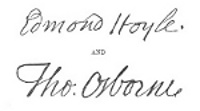
About 1737, Hoyle's 'Treatise on Whist' was first published. The work, which seems to have been admirably adapted to the wants of society at the time, was most favorably received; and in the course of the succeeding ten or twelve years it ran through as many editions as Lindley Murray's Grammar, in the same period, in modern times. It proved a "lucky hit," both for the author and the publisher, who took every precaution to secure their copyright: injunctions were held up in terrorem against pirates; and purchasers were informed that no copies of the work were genuine unless they bore the signatures of
The race of "Wits," who had previously exercised no small influence on the world of fashion, was then on the decline; the beau-monde had acquired the ascendency over Grub street; and gentlemen of rank and fashion formed themselves into clubs, for the purposes of gaming and social intercourse, from which thread-bare poets and hack pamphleteers were excluded by the very terms of subscription, to say nothing of the preliminary ordeal of the ballot. Those were the golden days of Beau Nash; when George the Second was king; and his son, the Duke of Cumberland, the patron of Broughton and Figg; when Cibber was Poet-Laureate, and when Quin's brutality passed for wit; when the Guards, the pride of the army, were such heroes as we see them in Hogarth's March to Finchley; and when such statesmen as Bubb Doddington had the entrée, by the back stairs, both at Leicester House and St. James's. Even those who professed to correct the vices of the age seem in some degree to have been infected with its spirit; Richardson, the novelist, writing with the ostensible design of reforming "Rakes" and retaining innocent young women in the paths of virtue, seems often to indulge, more especially in Pamela and Clarissa Harlowe, in describing scenes and suggesting circumstances which only could have been conceived by a prurient imagination; and even John Wesley appears to have encouraged his poor converted sinners to exaggerate their petty vices, when speaking their experience at a love-feast, and to dwell, with a peculiar kind of complacency, on their former state of carnal wickedness as compared with their present state of spiritual grace,—just as William Huntington, S.S., when in the fulness of sanctity, dwelt on the memory of his former backslidings, and told all the world, with ill-dissembled pride, that his first-born love-begotten son was an exact copy of his father, both in humour and in person.
The reign of Beau Nash at Bath forms a "brilliant" era in the annals of ostentatious frivolity. Under his auspices the City of the Sick [204] became the favorite place of resort for the fashionable and the gay; and in the pools where formerly lepers alone washed to cleanse them of their sores, smooth-skinned ladies dabbled for pleasure, to the sound of soft music, while gentlemen, enraptured, looked on. [205] The Beau was admirably fitted, from his mercurial talents, to discharge the peculiar duties of purveyor of pleasure to the fashionable society of his age: he could administer flattery to a duchess while he pretended to reprove her; and could persuade the little madams, of the Would-be family, that they were honoured by his patronising condescension, at the very time that he was endeavouring to make them appear ridiculous, for the amusement of real ladies. He displayed great tact in bringing parties together who wished to be better acquainted, and denounced scandal as the bane of fashionable society. He promoted play as a recreation for the polite of both sexes; and encouraged dancing, not only as a healthy exercise per se, but for the benefit of the rooms, and for the sake of aiding the salutary operation of the waters. In his dress he was "conspicuously queer," as was requisite in a Master of the Ceremonies: he wore a large white hat,—cocked, be it observed,—the buckle of his stock before instead of behind, and, even in the coldest weather, his waistcoat unbuttoned, displaying the bosom of his shirt. He drove six greys in his carriage, and when he went in state to the rooms he was always attended by a numerous escort and a band of music, the principal instruments of which were French horns,—"Sonorous metal, blowing martial sounds." On his decease, which took place in 1761, the corporation of Bath, grateful for the benefits conferred on their city through his means, erected a marble statue of the Grand Master of the Ceremonies in the Pump-room, between the busts of Newton and Pope; and his good-natured friend, the Earl of Chesterfield, in an epigram, thus did justice to his memory and the taste of the corporation:
"The Statue, placed these busts between, Gives Satire all its strength; Wisdom and Wit are little seen, But Folly at full length."
The Earl of Chesterfield was a frequent visitor at Bath, where he found many admirers of his wit, and many opportunities of exercising it. Bath, indeed, was the very place for such a genius to shine in, for in no other city in the kingdom were manners and morals, such as his lordship's, more highly appreciated. His lordship was fond of play too; and was partial to the company of Mr. Lookup, one of the most noted professional gamesters of the day. Lookup, as well as Colonel Charteris,—of notorious memory in the annals of gaming and debauchery,—was from the north of the Tweed. He was born in the neighbourhood of Jedburgh, and was bred an apothecary. On the expiration of his apprenticeship, he proceeded southward, and obtained a situation in the shop of an apothecary at Bath. On the death of his master, he wooed and won the widow; and having thus obtained possession of about five hundred pounds in ready money, he gave up the shop, and devoted himself entirely to play, an itch for which he is said to have brought with him from his native country. In Lookup's youth, and, indeed, for many years afterwards, a fondness for card-playing was more prevalent in Jedburgh than in any other town on the Scottish border.
Lookup, having determined to make gaming his business, devoted, like a sensible man, his whole attention to it: he calculated the odds coolly, played steadily, and, consequently, won considerably from those fashionable amateurs whose confidence was not according to knowledge. He was not only a proficient in all the usual games at cards, but also played well at billiards. Lord Chesterfield used sometimes to amuse himself at billiards with Lookup; and on one occasion had the laugh turned against him by a ruse of his antagonist, who, after winning a game or two, asked his lordship how many he would give if he were to put a patch over one eye. His lordship agreed to give him five; [206] and Lookup having won several games in succession, his lordship threw down his mace, declaring that he thought Lookup played as well with one eye as with two. "I don't wonder at it, my lord," replied Lookup, "for I have only seen out of one these ten years." The eye of which Lookup had lost the use appeared as perfect as the other, even to a near observer. With the money which he had at various times won of Lord Chesterfield, chiefly at Piquet, he built some houses at Bath, which he jocularly called "Chesterfield Row."
Lookup's gambling career, though successful, was not uniformly smooth; and on one occasion he got himself very awkwardly entangled in the meshes of the law. A gentleman, who had lost between three and four hundred pounds to Lookup at Cribbage, being persuaded that there had been "a pull" upon him, brought an action against Lookup for double damages, according to the statute made and provided for the special protection of the Tom-Noddy class of gamesters,—pitiful, whimpering, greedy fools, who call upon the world to commiserate their losses, though occasioned solely by their attempts on the purses of people more knowing, though not a whit more knavish, than themselves. In the course of some proceedings arising out of this action, Lookup, through the blunder of his attorney, it is said, swore to the truth of a circumstance which was subsequently proved to be false. Lookup was hereupon prosecuted for perjury, and imprisoned; and only escaped the pillory in consequence of a flaw in the indictment: the blunder of his own attorney brings him into peril, and the blunder of his opponent's sets him free; John a-Nokes's broken arm is a set-off against Tom a-Styles's broken leg; each party is left to pay his own costs, and thus the Law at least is satisfied. The oyster is swallowed, and the scales of justice are evenly balanced with a shell in each.
Lookup, like his contemporary, Elwes the miser, who was also a great card-player, frequently lost large sums by projects which he was allured to engage in by the tempting bait of a large return for his capital; a corrective occasionally administered by fortune to her spoiled children when they leave their old successful course of retail trickery, to embark as merchant adventurers on the sea of speculation. But though fortune frowned on him when he gave up gaming as a regular profession, to become the principal partner in a saltpetre manufactory at Chelsea, she yet looked favorably on some of his other speculations which were more in accordance with his old vocation: the shares which he held in several privateers, in the French war from 1758 to 1763, paid well; and he was highly successful as an adventurer in the slave trade. He is said to have died "in harness, "—that is, with cards in his hand,—when engaged in playing at his favorite game of Humbug, or two-handed Whist. Foote—who is supposed to have represented him in the character of Loader, in the farce of the Minor—is said to have observed, on learning the circumstances of his death, that "Lookup was humbugged out of the world at last." He died in November, 1770, aged about seventy. His biographer thus sums up his character: "Upon the whole, Mr. Lookup was as extraordinary a person as we have met with for several years in the metropolis. He possessed a great share of good sense, cultivated by a long acquaintance with the world; had a smattering of learning, and a pretty retentive memory; was fluent in words, and of a ready imagination. We cannot add, he was either generous, grateful, or courageous. In his sentiments, his cunning, and his fate, he nearly resembles the famous Colonel Charteris; a Scotchman by birth, and a gamester by profession, he narrowly escaped condign punishment for a crime that was not amongst the foremost of those of which he probably might be accused." [207] Had he lived in the railway era, he would, most assuredly, have been either a king or a stag royal:
"The craven rook and pert jackdaw, Although no birds of moral kind, Yet serve, when dead, and stuffed with straw, To show us which way points the wind."
The reign of George II is a historical picture of "great breadth," abounding in strongly marked characters, strikingly contrasted; but chiefly undignified, and generally low. The Carnal man is a ruffian rioting in Gin Lane; whilst the Spiritual is typified by a sinister-looking personage, with lank hair, cadaverous visage, and a cock-eye, preaching Free Grace from a tub to a miscellaneous company at Mile-end Green,—the indifference of the unregenerate being indicated by a prize fight in the background. Here a poor rogue is going, drunk, to Tyburn, for having robbed a thief-taker's journeyman of a silver watch, a steel chain, and a tobacco-stopper,—worth altogether forty shillings and threepence, the value required by law to entitle the thief-taker to his price of blood; and there a wealthy soap-boiler, who has made a fortune by cheating the excise, is going in state to Guildhall as Lord Mayor of London. Here a young rake is making violent love to his mother's maid, who has been induced to encourage his attentions from her reading Pamela; and there his aunt, a maiden lady of fifty-two, but having in her own right three thousand a year, is complacently listening to the matrimonial proposals of a young New-light preacher. Here is Colley Cibber sipping his wine at the table of "my lord;" and there sits Samuel Johnson, behind the screen in Cave's back shop, eagerly devouring the plate of meat which the considerate bookseller has sent him from his own table. Here are Johnny Cope and the dragoons riding a race from Preston Pans; and there sits the young Chevalier, unkempt and bare-legged, smoking a short pipe in a Highland hut. Here hangs the sign of the Duke of Cumberland's head; and there, grinning down on it from the elevation of Temple Bar, are the heads of the decapitated rebels. Here Ranelagh is seen shut up on account of the earthquake at Lisbon; [208] and there a batch of gambling senators are hurrying down to the House from the club at White's, to give their votes in favour of a bill to repress gaming.
The several acts passed against gaming, in the reign of George II, appear to have had but little effect in restraining the practice, either at the time, or in any subsequent reign; for though occasionally a solitary loose fish might become entangled in their meshes, they never interrupted the onward course of the great shoal.
The shameless inconsistency of many of the noble lords and honorable gentlemen who were parties to the enactment of those laws, is cleverly shown up in an ironical pamphlet entitled, "A Letter to the Club at White's. In which are set forth the great Expediency of repealing the Laws now in force against Excessive Gaming, and the many Advantages that would arise to this Nation from it. By Erasmus Mumford, Esq.," 1750. The following passages appear most worthy of transcription, both as showing the composition of a celebrated club about a hundred years ago, and as containing the pith of the writer's argument.
"The pertinency of my address to you, my Lords and Gentlemen, on this occasion, must be evident to every one that knows anything of your history; as that you are a Club of about Five Hundred, much the greatest part of you Peers and Members of Parliament, who meet every day at a celebrated Chocolate House, near St. James's, with much greater assiduity than you meet in the Court of Requests; and there, all party quarrels being laid aside, all State questions dropped, Whigs and Tories, Placemen and Patriots, Courtiers and Country Gentlemen, you all agree for the good of the Public, in the salutary measures of excessive gaming. But then as this is against laws of your own making, though now become old-fashioned, musty things, it would save appearances a little to the world methinks, that they should be repealed in the same solemn form in which they were enacted. And as you are, by yourselves and your relations, a great majority of the Legislature, and have no party bias whatsoever on this article, so it would certainly be as easy for you, as it is, in my opinion, incumbent on you, to accomplish such a repeal.... For, whatever we mean in our hearts, the forms of government should be carefully preserved; and though gaming is of the highest advantage to this nation, as I shall presently make appear, yet to practise it in defiance of all order, in the very sight, as it were, of the Government, and against the spirit and letter of the laws which you made yourselves, is entirely inconsistent with the character of Patriots, Nobles, Senators, Great Men, or whatever name of public honour you would chuse to call yourselves by.
"Besides, we have some odd queer maxims in our heads, that the Law is the same for the King and the Cobler, &c., nor is there in any Act of Parliament that has come to my knowledge, any exception of this same house called White's and the good company who frequent it. If you have any act against Gaming with any such exception in it, be so good as to produce it; for I believe verily that, besides yourselves, there is not a man in the kingdom who knows any thing of it. I have read the last Act over and over, and I protest that I can't see any such thing; and yet I don't know how to persuade myself that so many noble Lords and so many of the House of Commons, of all parties and denominations, should every day meet together in open contradiction to such an Act, without a saving clause to shelter themselves under.—
"But though it does no other harm at present, yet still it continues to be an act of the Lords and Commons of the kingdom, (of which you, to your eternal praise, are a great part,) and which has had the Royal assent. And whilst it does so continue, it not only hinders the rest of the kingdom, who are so silly as to mind Acts of Parliament, from Gaming, but it prevents a scheme, which I have had in my head for some time, from taking place; which is, that you should use your utmost endeavours with his Majesty, that he would be pleased, in consideration of the great good of his people, to give neither place nor pension to any Peer, howsoever deserving in all other respects, who is not of your body; and that a Bill should be brought in to render every one incapable of sitting as a member in either House of Parliament, how sound soever his political principles may be, who is not likewise a member of the Gaming Club at White's. This, I apprehend, would be an effectual way of introducing this wholesome innocent diversion into every house of Fashion and Politeness in the kingdom, and make your illustrious body more in vogue, if that can be, than it is at present.—
"But this scheme, which I apprehend to be of such great utility, can never be executed whilst these Acts of Parliament remain unrepealed.... There is one difficulty indeed which I am aware of, which, as I don't know how to get over very well myself, I must submit to your greater wisdom; and that is, getting the king and his chief ministers to consent. For as to the former, though he allows of the practice in his palace once a year, from mere antient custom, [209] yet it is well known that he discourages it very much; and the moment he heard of a table at his house at Kensington, sent immediate orders to forbid it. And as to the Secretaries of State, though they have this diversion once a year or so at their houses, for the entertainment of the Foreign Ministers, yet they never play themselves, nor show any other countenance to it, directly nor indirectly." [210]
In the political pamphlets which appeared in opposition to the ministry in the latter part of the reign of George II, the club at White's is frequently alluded to; and in 'A Political and Satirical History of the years 1756, 1757, 1758, 1759, and 1760, in a series of one hundred and four Humourous and Entertaining Prints,' [211] the gaming propensities of Lord Anson, the circumnavigator, who was at the same time a member of the club and of the government, are keenly satirised. In Plate 7 he is represented as a Sea Lion, with the body of a man and the tail of a fish; in one hand he holds a dice-box, and in the other a card; and on the wall are two pictures, the one showing an E.O. table, and the other a table covered with money, with the inscription "Blacks and Whites." In another print he figures as the Knave of Diamonds, with the inscription at the top, "Hic niger est;" and at the bottom, "Acapulca." In the Key prefixed to the work the person represented is thus denounced: "This caricatura's propensity to gaming tells us at once how valuable he must be to a shipwrecked state, and that he deserves (like a drunken pilot in a storm) to be thrown overboard, to make room for one of clearer brains and more integrity." The three other Knaves are: Spades, inscribed "Monsr. Dupe;" and in the Key it is said that, by the flower-de-luces, seen on the ground, is expressed, "how much this caricatura was connected with our enemies, and was even a Dupe to them against the interests of his country." Hearts, with a fox's head, and inscribed "Monsr. Surecard:" in the Key it is said that this character "infers, by the sharpness of the nose, that craft and subtilty which is natural to creatures of a similar kind, known by the name of Foxes, and is here pointed out as a Knave." Clubs, with a broken yoke in his hand, and inscribed "Null Marriage:" the Key says, "this caricatura was esteemed the most atrocious Knave in the pack, and the worst of the black sort."
Another plate in the same series of caricatures displays the gamester's coat of arms. The shield is charged with cards, dice, and dice-boxes, and is surrounded by a chain, from which hangs a label inscribed "Claret." Supporters, two Knaves. Crest, a hand holding a dice-box. Motto, "Cog it Amor nummi." In Plate 90, of which a copy is here given, the principal performers figuring on the political stage in 1759 are represented as coat cards. [212] In the suit of Hearts, the King, Optimus, is George II; Queen, Britannia; Knave, Pitt. Diamonds, King, the King of Prussia; Queen, the City of London; Knave, Prince Ferdinand. Spades, King, the King of Poland; Queen, the Queen of Hungary; Knave, Holland. Clubs, King, the King of France; Queen, Gallia; Knave, Marshal Broglie. In the Key it is said that "the labels and characters here represented are sufficient to explain the meaning of the print, with the least application."
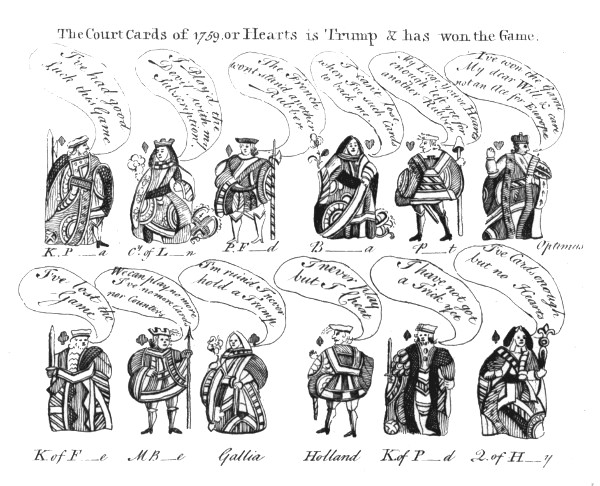
The Court Cards of 1759 or Hearts is Trump & has won the Game.
In a work relating to the authorship of Junius's Letters, [213] the following account is given of the volume of caricatures in question. It is not, however, correct in every point; for though it may be true that the earlier plates were at first privately distributed, it is certain that subsequently they were publicly sold. The first collection of them, published in a volume, consisted only of the caricatures for 1756-7; and appears to have been enlarged from time to time, by the addition of such plates as had been published separately in the preceding year. The edition of the first volume which I have consulted, containing the plates from 1756 to 1760, is the fifth,—a proof that latterly those caricatures were not privately distributed, whatever they might have been at the commencement. Though Lord George Townshend might have supplied the publisher with sketches or hints, [214] for some of the subjects, and even have suggested the publication of the series, it would be absurd to conclude that he was the designer of the whole. There are only four subjects in the volume relating to Lord George Sackville; and they are among the most worthless of the series, both with respect to conception and design.
"Soon after the unfortunate misunderstanding at Minden, Lord George Townshend (who had formerly been on friendly terms with Lord George Sackville, particularly at the battle of Dettingen) joined with the court party in publicly censuring his conduct. He had an ingenious turn for drawing, and he even went so far as to caricature Lord George flying from Minden, which, with many others, he privately circulated among his friends. This book of caricatures, bearing date from 1756 to 1762, is extremely curious. As they were privately distributed, they are, of course, seldom to be met with. I never saw but one complete set, now in the possession of W. Little, Esq., of Richmond, who has obligingly allowed me to copy the one in question, which is submitted to the reader's inspection. We have Lord Orford's testimony to prove that this book was the production of Lord George Townshend. Lord Orford has described the first of the series, vol. ii, p. 68, 'A new species of this manufacture now first appeared, invented by Lord George Townshend; they were caricatures on cards. The original one, which had amazing vent, was of Newcastle and Fox, looking at each other, and crying with Peachum, in the Beggar's Opera, 'Brother, brother, we are both in the wrong.' On the Royal Exchange a paper was affixed, advertising 'Three kingdoms to be let: inquire of Andrew Stone, broker, in Lincoln's Inn Fields.'—The whole series forms a curious collection. Those on Lord George Sackville were very severe."
The example set by the club at White's appears to have been much more influential in promoting gaming than the denunciation of an Act of Parliament to have been effective in repressing it: the letter of the act was, indeed, killing, but the spirit of the legislators, as displayed at White's, kept the game alive. New clubs of the same kind,—on the principle of mutual insurance against informers,—were established in the metropolis; and even in the provinces, country gentlemen and tradesmen, becoming aware of the advantages of the social compact, formed themselves into little clubs for the purpose of indulging in a quiet game at cards or dice. Card-playing about the same time, or a little later, was greatly promoted by the establishment of assembly-rooms in country towns, where cock-fighting squires, after attending the pit in the morning, might enjoy in the evening the more refined amusements of dancing and cards. [215] The example set by the higher classes was followed by the lower; and at a "merry night" in a Cumberland village, some fifty years since, cards were as indispensable as at an assize ball in the county town: with the exception of the dress of the company and the arrangement of the rooms, the one assembly, at the commencement at least, seems to have displayed all the essentials of the other.
"Ay, lad, see a murry-neet we've had at Bleckell! The sound o' the fiddle yet rings i' my ear; Aw reet clipt and heeled were the lads and the lasses, And monnie a clever lish hussey was there: The bettermer sort sat snug i' the parlour; I' th' pantry the sweethearters cuttered sae soft; The dancers they kicked up a stour i' the kitchen; At lanter the caird-lakers sat i' the loft. " [216]
The passion for card-playing appears to have been extremely prevalent in the earlier part of the reign of George III. [217] In almost every town where there is an assembly-room, traditional anecdotes are handed down of certain keen players keeping up the game for twenty-four successive hours, till they were up to their knees in cards; and there is scarcely a county in England that has not a story to tell of two or three of its old landed gentry being ruined at cards by the Prince of Wales. Even villages have their annals of gaming; of once substantial farmers turning horse-coursers and riding headlong to ruin on a leather plater; of others going more quietly off at cards, staking their corn before it was housed; and of certain desperate cock-fighters losing their whole substance at a single match, and then straightway hanging themselves in their own barn. The love of card-playing, to the great horror of the inordinately pious, seems even to have infected ladies who were, in other respects, irreproachable:—good wives, affectionate mothers, teaching their children the Catechism, going regularly to church on Sundays, and taking the sacrament every month; yet, alas! dearly loving a snug private party of four or five tables, and immensely fond of Quadrille; and making but a poor atonement for their transgression by never touching a card in Passion week, nor the night before the Communion, nor even on the Wednesdays and Fridays in Lent,—whenever they could avoid playing, "consistently with good manners." [218]
A discourse against gaming, preached in 1793, by Dr. Thomas Rennell, Master of the Temple, seems to have made much noise about the time, but no converts. The most original passage in the work is the following, wherein he asserts that the habit of card-playing renders the mind insensible of Gospel evidence: in the present day, it may be observed in passing, that a similar effect has been ascribed to the study of Oriel-college logic. "The mind of one immersed in cards soon becomes vacant, frivolous, and captious. The habits form a strange mixture of mock gravity and pert flippancy. The understanding, by a perpetual attention to a variety of unmeaning combinations, acquires a kind of pride in this bastard employment of the faculty of thought, which is so far from having any analogy to the real exercise of reason, that we generally find a miserable eminence in it attainable by the dullest, the most ignorant, and most contemptible of mankind. The gamester, however, frequently mistakes this skill for general acuteness, and from that conceit either totally rejects the Gospel evidence, or if political or professional considerations render this indecent or inexpedient, he harbours all that contemptible chicane, all that petty sophistry, all that creeping evasion, with which a selfish heart, and a contracted understanding, meets and embraces the prevailing heresy of the times in which we live." [219]
The following appears to be levelled at an individual of no small reputation in his day, and whose memory is likely to outlast Dr. Rennell's. "What is it that converts those designed by Providence to be the GUARDIANS and PROTECTORS into the BANE and CURSE of their country? I will answer, the GAMING TABLE. The reverses here every moment occurring unite beggared fortunes, mortified pride, callous baseness, and inflamed appetites, directing their joint operations to the destruction of that common mother which gave them birth. And here I wish to be rightly understood—that with a frugal, active, dignified poverty, the discharge of public duty is perfectly compatible. Such a poverty was highly reverenced in the best ages of Pagan antiquity, as the nurse of every great and useful exertion; but as distant as light from darkness is such a poverty from that degraded, malevolent, abject MENDICITY, the offspring of vice, the organ of faction, and the parent of universal prostitution and venality."
Dr. Parr, in his copy of this discourse, wrote the following note, which may serve as a tail-piece to the present chapter: "Dr. Rennell is said, with his own hand, to have put a copy of this animated sermon under the knocker of Mr. Fox's door in South street. I could wish the story to be untrue. But the eloquent preacher did not employ his great talents in a sermon against Sabbath-breaking, though his illustrious patron, Mr. Pitt, had lately fought a duel with Mr. Tierney on Wimbledon Common."