WILLIAM LLEWELLYN ADAMS
Reading edition

PRESS OF J. B. LIPPINCOTT COMPANY PHILADELPHIA 1911
Copyright, 1911 By William L. Adams
All Rights Reserved
This Book is Respectfully
Inscribed to my
“BUNKIES AND SHIPMATES”
OF THE
ARMY AND NAVY
Preface
In introducing the following narratives, the contents of which have been gleaned through my voyage around the earth in quest of excitement and natural oddities, for which since childhood I have possessed an insatiable desire, I wish to acquaint the reader, in a brief prefatory discourse, with the nature of the work that is to follow, and thereby gratify the curiosity, so natural at the beginning, in a reader of reminiscences.
Through the prevailing influence of some loyal friends, whom it has been my good fortune to have had as correspondents during my military career, I herein attempt to depict events as they actually happened, without recourse to imagination.
Having served under the dominion of “Old Glory” in the Occident and Orient, on land and on sea, in war and peace, for the period of ten years, I naturally fell heir to novel and interesting occurrences, so numerous
As an author I do not wish to be misunderstood. I merely desire to portray what has come under my observation, rather than make a Marathon with the laurels of so dignified a profession, and in so doing communicate to those whose arduous duties at home have deprived them of the romance of globetrotting, and thereby distribute the knowledge that some more silent person might never unfetter.
In conclusion to this preface, I desire to say, that I have refrained from the manufacture of episodes or any tendency toward fiction, which I trust the following pages will confirm, and that, as from the description of a spectator, these narratives will meet with the approval of those into whose hands they might chance to fall.
The Author.
Contents
Chapter Page
I Campaign of the “Governor’s Troop,” Penna. Vol. Cavalry 15
II On board a “Man-of-war” from New York to Morocco 45
III Thrilling Adventure with Moors in the “Kasbah” of Algiers 63
IV From the Pyramids of Egypt to Singapore 71
V Hong Kong, China, and the Denizens of the Underworld 90
VI A Trip to Japan 103
VII War Orders in the “Land of the Rising Sun” 118
VIII The Cowboy Soldier, a Coincidence 145
IX Life Among Hostile Moros in the Jungles of Mindanao 169
X A Midnight Phantasy in California 197
XI “Semper Fidelis,” the Marine “Guard of Honor,” World’s Fair, St. Louis. 1904 208
XII Topographical Survey in the Jungles of Luzon 242
XIII “Cock-fighting,” the National Sport of the Philippines 271
XIV Departure of the 29th Infantry for the Home-land; Reception in Honolulu 279
Illustrations
Page
William Llewellyn Adams Frontispiece
Detachment of “Governor’s Troop,” Mt. Gretna, 1898 20
A Trooper 42
Tent No. 2, Fynmore and Adams, “World’s Fair,” St. Louis, 1904 214
Coleman and Adams, Gun-mule “Dewey,” Machine-gun Battery 258
Machine Gun Platoon of the 29th Infantry in the Snow Capped Wasatch Range, Utah 260
Where spades grow bright and idle swords grow dull, Where jails are empty and where barns are full, Where church paths are with frequent feet outworn, Law court-yards empty, silent, and forlorn; Where lawyers foot it and the farmers ride, Where age abounds and youth is multiplied: Where these signs are, they clearly indicate A happy people and well-governed state. Anonymous.
I.
Campaign of the “Governor’s Troop,” Penna. Volunteer Cavalry
The “Pandora Box”—Call for Volunteers—Mustered In—Breaking of Horses at Mt. Gretna—Liberality of the Ladies of Harrisburg and Hazleton—Departure of the Tenth Pennsylvania for the Philippines—My First Rebuff, by Major-General Graham—Thirty Thousand Soldiers Celebrate the Victory of Santiago—Troopers Decorated with Flowers by the Maidens of Richmond—The Concert Halls of Newport News—The Ghost Walks—Off for the Front—Convoyed by Battleships—Porto Rico—Spanish Hospitality—Wounded by a Shell—Jack the “Mascot” Passes the Deal—Reception in New York, Harrisburg, and Hazleton.
The destruction of the United States battleship Maine in Havana harbor, on the night of February 15, 1898, was the key to the mysterious “Pandora Box,” containing maps of new United States possessions, the
The uncivilized, brutal, and oppressive methods resorted to by the Spaniards in conducting military operations on the Island of Cuba and other territory adjacent to the United States had long been a theme of discussion by patriotic and sympathizing Americans. When the news flashed over the wires that the big man-of-war, the Maine, had been blown up and two hundred and sixty-six members of her gallant crew had been sent to a watery grave, the hearts of American youths burned with indignation and every mother’s son yearned to avenge what was considered Spanish treachery. What followed is entered in the archives of American history and is familiar to all. The call for volunteers was responded to universally, there being so many applicants to fill the ranks that only the flower of the American youth was accepted.
When the news was wired broadcast that A.M. on the second of May, 1898, this news was received in Hazleton, Pennsylvania. It was followed by a telegram from the Captain of the “Governor’s Troop,” Pennsylvania Volunteer Cavalry, of Harrisburg, which stated that twelve vacancies existed in that troop and that in accordance with the request of Governor Hastings these vacancies should be filled with the first volunteers from the city of Hazleton. In two hours’ time the recipient of the telegram, Mr. Willard Young, had notified and enlisted twelve of Hazleton’s stalwart sons, and at 7.40 A.M. the next morning, amidst the waving of the national colors and cheers from the populace the boys were escorted by the famous old Liberty Band to the Lehigh Valley Station where, after bidding adieu to relatives, sweethearts, and friends, they boarded a train for Mt. Gretna, the military rendezvous.
The men who comprised this Hazleton assemblage were—
Ario P. Platte, Jr. Schuyler Ridgeway John J. Turnbach William K. Byrnes Willard Young Charles H. Rohland Edward R. Turnbach Stephen A. Barber Edwin W. Barton Herbert S. Houck Clarence H. Hertz William L. Adams
En route to Pottsville the train was boarded by my life-long friend, David L. Thomas, who was on his way to his law office. On learning the destination of the patriots he laid down his “Blackstone” and wired his parents in Mahanoy City that he had cast his fortunes with the avengers of Spanish tyranny. Of this group of volunteers, two loyal soldiers have answered the last roll call, namely: Ario P. Platte, Jr., and David L. Thomas.
Arriving at Mt. Gretna we beheld, under miles of canvas, Pennsylvania’s gallant National Guard. Upon inquiry we found the cavalry headquarters, consisting of the “City Troop” of Philadelphia, the “Sheridan Troop” of Tyrone, and the “Governor’s Troop” of Harrisburg, stationed in a clump of forest near the lake.
Immediately reporting to Captain Ott, commanding the “Governor’s Troop,” we were assigned to quarters in large Sibly tents and met the old members of the troop, among whom I was delighted to find Feight and Barker, two classmates of mine at “Dickinson Seminary.” We were at once issued mess kits, the most necessary equipment required by a soldier when not in the face of the enemy, and, roaming hither and thither, awaited the usual medical examination preparatory to being mustered into the service of the United States, which, after several dreary and monotonous days, occurred on the 13th of May. After being fitted in natty cavalry uniforms we were drilled twice daily on foot by an ex-sergeant of the regular army, whose service in the
Before bringing the troop to attention, the sergeant would usually say: “Now boys, I want you to pay attention to my orders, and if you make mistakes I am apt to say some things I do not really mean.” So we would take his word for this, but ofttimes thought things we did mean. This was his song: “Fall in,” “Troop attention,” “Right dress,” “Front,” “Count off,” “Backward guide right,” “March,” “As skirmishers,” “March,” “Get some speed on you,” “Wake up,” “Wake up,” “Assemble double time,” “March,” “Look to the front, and get in step, you walk like farmers hoeing corn,” “Close in,” “Close in,” “Take up that interval.” These were the daily commands, until the troop was able to execute close and extended order to perfection. Then came the horses, and the monkey drill, and some pitiful sights of
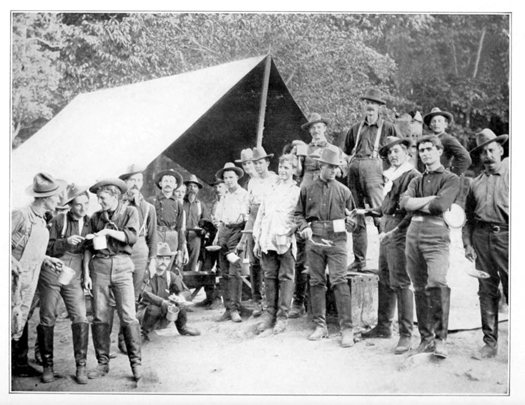
DETACHMENT OF GOVERNOR’S TROOP, MT. GRETNA PA., 1898.
At first we were equipped with the old Springfield rifle, but this was soon replaced by the Krag-Jorgensen carbine. Each trooper was soon fully equipped as follows: horse, McClellen saddle, saddle bags, bridle, halter, and horse blanket, carbine, saber, Colt revolver, belts, and ammunition, canteen, mess kits, sleeping blanket, shelter half, and uniforms.
The ladies of Harrisburg and Hazleton were extremely generous to the troop. From Harrisburg each soldier received a large and beautiful yellow silk neckerchief, a Bible, and a large quantity of pipes and tobacco. From Hazleton came literature and boxes after boxes of edibles, which were greatly relished by the troopers.
Some time was consumed in the breaking of horses, getting them bridle wise, and training them to the saddle, and this afforded great amusement to the thousands of spectators who visited the reservation daily. The troop, which consisted of one
“Broncho buster,” George S. Reed, an ex-Texas ranger, Nome gold miner, and survivor of several duels, the most noted man of the “Governor’s Troop,” had cast his fortunes with the soldier “lay out,” and had boasted that there never was a broncho foaled that he could not cling to. “Broncho’s” debut as an equestrian was to ride a horse we called the “rat,” a bad one. Reed had great difficulty in getting his foot in the
Each day brought forth news of the mobilization of troops and the progress of the war. Mt. Gretna, an ideal place for a military rendezvous, presented a grand spectacle. Regiments were rigidly disciplined and drilled to the requirements of war, sham battles were fought, galloping horsemen
Days rolled by and the troops yearned for active service. The Tenth Pennsylvania Infantry, having received orders to proceed to the Philippine Islands, was the first regiment to break the monotony. There was great activity in breaking camp, and a speedy departure amidst a wild demonstration enthused the boys whose fate lay with the fortunes of war, and whose valiant bravery along the south line, from Bacoor to Manila, will ever remain vivid in the annals of the insurrection.
The news of the departure of the “Rough Riders” for Cuba was heralded with much joy as a forerunner of our getting to the front, also the distribution of regiments to southern camps, where the sons of the “Blue and the Gray” commingled and fraternized as comrades fighting for the same cause, and spun yarns of the bloody strife of the rebellion
The promulgation of the general order directing our departure for the South was received with cheers. Breaking camp was immediately begun, the loading of horses and equipment on the train being accomplished with the dexterity of a troop of regulars. All along the route the train met with an ovation. There was waving of flags and handkerchiefs, bells were tolled, and the shrill whistles of factories welcomed the boys on to the front. Arriving at Falls Church, Virginia, we at once set to work unloading our horses and accoutrements of war, which was accomplished with almost insuperable difficulty, due to our having reached our destination at night and in a blinding rain-storm.
Among the members of our troop was a Swedish Count, and at this point I recall a little incident which it will not be amiss to relate. We had unloaded our horses and were awaiting orders, when the Count approached me and said:
““Bill, ven do ve eat?”
““I guess we don’t eat, Count,” I replied; “these are the horrors of war.”
“Vell, py tam,” said the Count, “dis vore vas all horrores. I vanted to blay benuckle on der train und der corporal say: ‘You go mit der baggage car, unt cook some beans,’ unt by tam, I couldn’t cook vater yet.”
We remained at Falls Church over night, and in the morning marched to Camp Alger through blinding torrents of rain and fetlock-deep in mud. This camp, like most Southern camps, was very unhealthy, the heat was stifling, and many soldiers succumbed to fever. Here the troops of cavalry were consolidated into a squadron, consisting of Troop “A” of New York, Troop “C” of Brooklyn, “City Troop” of Philadelphia, “Sheridan Troop” of Tyrone, and “The Governor’s Troop” of Harrisburg, under the command of Major Jones, formerly captain of the “Sheridan Troop,” who relieved Captain Groome, of the “City Troop” of Philadelphia, who had been temporarily in command.
Camp Alger was a city of tents, as far as the eye could discern in every direction, there
“Sir, Trooper Adams, of the ‘Governor’s Troop,’ reports as orderly to the Commanding General.”
“Very well,” replied the General; “give the Colonel of the Second Tennessee my compliments and tell him I will review his regiment at 4.30 P.M.”
“Yes, sir, but, by the way, General,” said I, “where is the Second Tennessee located?”
“Make an about face and follow your nose,” the old man replied, and I did; but if the old General could have heard the mute invectives aimed at him I probably never would have told this yarn. I do not blame him now, as I realize how unmilitary I was. I had no difficulty in finding the Colonel of the Second Tennessee, as I kept my nose right in front of me.
The news of the victory of Santiago was
The cavalry was ordered to Newport News to await the arrival of the transports; but, unlike the Sixth Massachusetts, that was stoned in Baltimore at the outbreak of the rebellion, our greetings in the South were exceptionally friendly. At Richmond bouquets of flowers were scattered in profusion among the soldiers, and many a fair maiden left the station with a pair of cross sabers pinned to her shirtwaist.
Our camp at Newport News was on sandy soil on the banks of the James River, which afforded excellent bathing and fishing. Here the cavalry received their khaki uniforms, which were the first issued to United States troops and had the appearance of an officer’s regimentals. As a consequence it was a common sight to see a “doughboy” saluting a trooper as he
A few days after pitching camp, something happened; it is an occasion when a soldier possesses that air of complacency which invariably pervades the atmosphere. It is when the “ghost walks” (pay day) that the soldier is not only happy, but has a keen desire for making every one with whom he comes in contact happy. As a dispenser of pleasure, when he has “the necessary,” his speed brooks no competition, and all others look like “pikers” compared with “the man behind the gun.”
In 1898 Barton’s Theatre and Concert Hall was a nightly scene of revelry, by cavalry, artillery, and infantry, and from a spectator’s point of view it was hard to decide which was of more interest, the scenes in front or in rear of the footlights. Songs that reached a soldier’s heart were sung by dashing “prima donnas from the cottonfields of Dixie,” the soldiers joining in the chorus. After the “ghost had walked” this particular concert hall fell into the hands of
As the orchestra struck up the music to “For he is only a Soldier Boy,” a dashing southern beauty, in military costume, would saunter to the footlights, accompanied by a chorus of lesser lights, whose evolutions, combined with their singing, were extremely pretty and inspiring to the soldiers. This sketch brought forth deafening applause, dying out only as a trooper announced that he would endeavor to recite “The Midnight Ride of Paul Revere,” or perhaps “Tam O’Shanter,” while another would volunteer to inflict us with “Casey at the Bat” or “The Face upon the Bar-room Floor,” to the mournful strains from the dirge of Imogen, a sure harbinger for the dispensers of “sangaree” to get busy and take orders. Another song, and the dance was on once more and continued until the “dog watch”
This was the bright side of war, and, as each soldier was intent on getting to the front, it was the exception rather than the rule to hear of a misdemeanor being committed, or even to hear of a man being confined to the “guard house.”
Newport News was a gay place in ’98. Its people were very hospitable and friendly with the troops. Old Point Comfort and the Forts of Hampton Roads were but a short run by rail from the camp, and these were favorite resorts of the soldiers. Great excitement prevailed when the order for the Porto Rican expedition—“Pennsylvania Cavalry to the front”—was received.
The transport Manitoba had been fitted from an old cattle scow to a serviceable troop-ship, and had just returned from conveying a detachment of “Rough Riders” to Cuba. This vessel was spacious but lacking in the accommodations of our present-day transports that ply the Pacific. Considerable
Our time on board was occupied in preparing for a harder campaign than materialized. Carbines and six-shooters were oiled, and sabers burnished (the scabbards of these, being nickel-plated, required merely a coating of oil to keep them from rust). Our boots were greased, and the front and rear sights of our carbines were blackened. The boys scalloped the rims of their campaign hats, and some were tattooed by adepts in the art. Cards and reading were other pastimes of the voyage.
The fifth day out the United States cruiser Columbia and battleship Indiana were sighted; they had come to convoy the ship into the harbor of Playa Del Ponce.
Having finally reached the ground of the enemy, great precaution was taken to avoid a surprise; the water was inspected to make sure that it contained no poisonous substance and the orders in posting sentinels were rigidly enforced—each sentry before being posted had to be thoroughly familiar with his orders, being required to repeat them verbatim, and was also admonished as to the importance of keeping constantly on the alert. He was forewarned that to be found asleep on post in the enemy’s country meant to be tried by court-martial and if convicted to suffer the penalty of death.
Our first rendezvous was alongside of an old Spanish cathedral, surrounded by plantations of sugarcane, coffee, hemp, and tobacco; here we pitched a camp of shelter or “dog-tents” as they were generally called. As we were getting our accoutrements of war in shape the rapid fire of the Sixteenth Pennsylvania engaging the enemy could be distinctly heard, this engagement, however, being of short duration, like all other Spanish-American encounters in the West Indies.
Playa Del Ponce is the port of the city of Ponce, and is the shipping point for that section of the Island of Porto Rico. The town is surrounded by rich plantations of tobacco, coffee, sugarcane, and rice, also trees teeming with oranges, cocoanuts, guavas, lemons, grape-fruit, and groves of bananas and plantains. The staple production of the island is tobacco, from which is manufactured a very choice brand of cigars. The city of Ponce lies inland a distance of about three miles, and is typically Spanish in its architecture.
Shortly after our arrival at Playa Del
I was given a room overlooking the bay on one side, with the town bounding the other; a crutch and an oil-cloth shoe were provided for me, with which I was able to hobble around with the two beautiful daughters of the old gentleman, namely, Anita and Consuelo Del Valyo. They spoke the
I spent nine days in this hospitable domicile and was sorry when my wound had healed, but alas! I had to join my troop, which had departed for the interior. Before leaving Playa Del Ponce, I was presented with a small gold case containing the miniatures of these charming ladies. During the campaign on the island, I made several trips in to see them, accompanied by members of
On my way to join the troop, I met the Sixteenth Pennsylvania Infantry, escorting about eight hundred prisoners of war into the city, where they were to remain in incarceration until the arrival of the transports which were to convey the Spanish soldiers to Spain. When they halted near the old stockade in the city of Ponce I secured some unique curios including a Spanish coronet of solid gold (a watch charm), rings, knives, Spanish coins, and ornaments of various kinds.
Having finally reached my troop and reported for duty, I joined my old “bunkies,” Young and Turnbach, and learned from
Camp life in the tropics in active service was not without its pleasures, however, and, as fruit grew in abundance, sustenance was maintained even if it was of the Indian variety. Details of mounted scouting parties galloped through the mountains daily, taking observations and frequently exchanging shots with guerrillas, who in riding and marksmanship were no match for the American troopers. The cavalry squadron figured in several skirmishes, but the retreat of the Spanish from the carbine volleys and glittering sabers of their foe put them to rout, so that I doubt if the same troops ever reassembled.
At last the news of the armistice was received, hostilities had ceased, and preparations for the trip to the home land were begun. Hither and thither we had marched for months, in cold and hot climates, slept in Mississippi, a miserable specimen of “troop-ship,” had been put at our disposal, and was to convey the greater part of General Miles’ expedition to New York City.
After striking camp and loading all the equipage of war accessories onto army schooners, a march of a few hours brought the cavalry to the point of embarkation. Playa Del Ponce presented a spectacle of grand military activity. Soldiers representing the army in all its branches were busily engaged in storing aboard ship the munitions of war and necessary rations for the homeward bound voyage. The artillery and cavalry were spared the irksome duty of loading their horses, these animals being left behind for the relief of the “regulars.” When all was in readiness and the signal given, the “homeward bound pennant” was flown to the breeze, as the ship’s bell tolled seven. Steaming northwest over a sea of calm saline
Our return was uneventful until we reached Sandy Hook, where the transport was met and convoyed through New York Harbor by myriads of yachts, launches, and tugs loaded with relatives and friends of the boys who had offered their lives for their country and many of whom the grim reaper had grasped from loving ties and the comradeship of their compatriots.
The reception in New York City was one grand elaboration of hospitality, evidenced by the demonstration of the thousands of people who thronged the landing place. Numerous bands of music played inspiring airs, as the city’s fair ladies dispensed chicken sandwiches and demijohns of wine to the soldiers, while others fairly covered the squadron with garlands of beautiful flowers.
On the arrival at Harrisburg, the home of the “Governor’s Troop,” an immense demonstration awaited the boys. Leaving the train in their worn habiliments of the jungle, the troopers were soon dressed in ranks, answered roll call, had counted off, and were marching behind a band of music, under a bower of pyrotechnics that resembled a mythological scene in “Hades.” After parading through the principal streets of the city, the troop was marched to the armory, which was beautifully decorated for the occasion; here the battle-scarred heroes of a successful campaign sat down to a banquet, over which an host of Harrisburg’s fair maidens presided. Oh for a moving picture of that scene! Each soldier wore a vestige of the pretty silk neckerchief the Harrisburg ladies had presented him with. Speeches were made by prominent citizens, songs were sung and toasts responded to, and it was with a feeling of deep appreciation that the troop left the banquet hall to seek a much-needed rest. The following day was spent in meeting friends and relating episodes of the campaign.
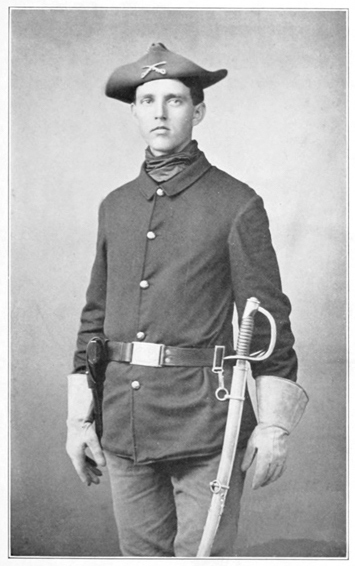
A TROOPER
The Hazletonian complement of the “Governor’s Troop” had been apprised of a demonstration awaiting them at their home city, and upon the reception of the prescribed two months’ furlough, departed for the scene of the climax to the campaign. This Hazleton greeting was the most enthusiastic reception of all, perhaps because this was home. Alighting from the cars amidst thousands of people who thronged the platform and streets, the soldiers were met by a committee, relatives, and friends, and it was with great difficulty that the horses provided for the troopers were reached. As each man swung into the saddle, the famous old Liberty Band struck up a march, and as the procession, consisting of the Band, Reception Committee, Clergy, Grand Army,
II.
On Board a Man-of-war from New York to Morocco
Admiral’s Orderly on the U. S. Cruiser New York—A Storm on the Atlantic—Duties of a Marine—The Author Reads his own Obituary—Under the Guns of Gibraltar—A Bull-fight in Spain—Pressing an Indemnity Against the Sultan of Morocco—An American Subject Burned at the Stake by Moors—Burial in Morocco of a Shipmate.
The Boxer outbreak in China in 1900 attracted the attention of the entire civilized world, and was the incitement that inspired many of an adventurous turn of mind to cast their fortunes with the allied forces in suppressing the depredations of the Tartar tribes in the land of the Heathen Chinee. In August, 1900, while a spectator at the Corbett-McCoy bout, in “Madison Square Garden,” New York, I learned, from a chief petty officer of the battleship Massachusetts, that the United States cruiser New , lying in dry dock at the Brooklyn Navy Yard, was being rapidly prepared to be put in commission, and was to be the “flag-ship” of Rear Admiral Rodgers, who was destined for a cruise to the Chinese coast. Upon further inquiries at the Navy Yard, I heard this news authentically corroborated, and at once determined to see the Orient.
A battalion of marines under the command of Major Waller had won laurels in Tien Tsin and Pekin, being among the first to enter the Forbidden City. Keeping tabs on the daily progress of the war, I became more and more interested, and, having learned that marines were the first landing force during hostilities, I enlisted in this branch of the service, and ere long was installed in the “Lyceum” of the Brooklyn Navy Yard operating telephone switches. From my window in the “Lyceum” I could gaze on the sailors who were rapidly putting the big cruiser in readiness for her cruise around the world; for, contrary to expectations, the order to proceed direct to China was abrogated in lieu of an indemnity which required pressure in Morocco.
Having made application for the “marine guard” of the New York, which consisted of seventy-two men, one captain, and one lieutenant, I was very much pleased when informed that my application had been approved of, and that I was to prepare to board the vessel in the capacity of “orderly” to the admiral. I was relieved from duty in the “Lyceum” and ordered to join the “guard,” which had been undergoing a process of special drill.
On being ordered aboard the ship, we were assigned to quarters, instructed as to our stations for boat drill, fire drill, large gun drill, abandon ship, arm and away, strip ship for action, collision drill, and the positions of alignment on the quarter-deck, where the “present arms,” the courtesy extended to military and civil dignitaries at home and abroad, had to be daily executed.
The New York, which had been the “flag-ship” of Rear Admiral Bunce, who commanded the “North Atlantic Squadron,” and later the “flag-ship” of Rear Admiral Sampson at the battle of Santiago, was in 1900 the show ship of the navy, making a
A feature of the New York was her enormous engine strength compared with her weight, the battleship Indiana developing nine thousand horse-power on a ten thousand two hundred ton displacement, while that of the cruiser New York was seventeen thousand horse-power on a displacement of eight thousand two hundred tons.
The day having arrived for placing the vessel in commission, a galaxy of army and navy officers, civilians, and beautiful women assembled on the quarter-deck, which was inclosed and draped with flags of all nations. Orderlies were kept busy announcing the arrival of the guests to the admiral and captain, many of whose names included exclusive members of New York’s “Four Hundred,” whose ancestral genealogies, emblazoned with ensigns of heraldry, adorn their multitudinous—what not?—though ofttimes, let it be known, the power and
Wafting adieu to old New York town, our sea-going home steamed out of New York harbor and down along the Atlantic coast to Hampton Roads, our first stop, anchoring midway between Fortress Monroe and the “Rip Raps,” where tons of coal were placed in the bunkers.
Coaling ship is the most disagreeable work
Immediately after coaling, the ship is thoroughly cleansed from truck to kelson; the decks are holy-stoned and the berth deck is shackled, after which the men take a thorough shower-bath, don immaculate uniforms, and all has the refreshing appearance of a swan on a lake.
The essential duty of a “marine” on board a ship is to preserve order; he fulfils the position of both sailor and soldier, and, while he is sometimes dubbed a leather-neck, on account of his tight-fitting uniform, by his more aquatically uniformed shipmate, it is nevertheless noticeable that he is the first to cross the gang-plank when there is trouble in the wind; and the number of “medals of honor” and “certificates of merit” that have been awarded to marines since 1898 is the mute indubitable evidence of his fidelity and bravery; however, this is not to be construed in any way to detract from the loyalty of our brave “Jack tars.”
Our ocean voyage from the Atlantic coast to the Fortress of Gibraltar was beset with difficulties, due to a severe storm we encountered the second day out, in which one of our cutters or life-boats was washed away. This it seems was picked up by a “liner” en route to Havre, France, and, as we were four days overdue at Gibraltar, it was believed that the cruiser had gone down with all on board. Some time later along the African coast, it was amusing to read, in the Paris edition of the New York Herald, our own obituary, and to see the picture of the “flag-ship” and her crew going down to “Davy Jones’s locker.”
The storm abated as we came in sight of the Madeira Islands, but, owing to our being overdue at the “Rock,” we were compelled to pass this beautiful place without stopping. The voyage from the Madeiras to the straits was quite calm, and we were again able to eat soup without the aid of a dipper.
When off duty I spent a great deal of time playing chess and reading. We had an excellent library stocked with the best editions from the pens of the most famous
As outlines of the “Pillars of Hercules” appeared on the horizon, it was evident that in a very few hours we would be plowing the waters of the great Mediterranean Sea. The quartermaster and signal-men were busy getting their signal-flags in shape, ammunition was hoisted for the salute, and the marine guard and band were busy policing themselves for the part they had to play in entering a foreign port.
Passing through the Straits of Gibraltar, which separate the mainland of Europe and Africa, we beheld, looming into the clouds, the most magnificent and impregnable fortress of the world, Gibraltar.
As we entered the bay of Algesiras, the huge guns of the fortress and battleships of various nations belched forth an admiral’s salute of thirteen guns; these were responded to by the American “flag-ship.”
Gibraltar is an impregnable promontory fortress, seven miles around at the base, and
The population of Gibraltar is composed of English, Spaniards, Jews, and Moors. A causey separates the town from the mainland of Spain. The British side is patrolled by British soldiers, who are so close to the Spanish sentries that the challenge can be heard at night by either side.
We remained in Gibraltar ten days, and had the pleasure of meeting a large number of English soldiers and sailors at the “Royal Naval Canteen,” where we swapped stories over a can of “shandy gaff,” which is a mixture of stout and ginger ale.
At the solicitation of some of the soldiers of the Royal Artillery, we Americans accompanied them to the town of Algesiras, in Spain, to witness a bull-fight. Engaging passage to a point of landing about five miles across the bay, we embarked with a pent-up feeling of excitement, overly eager to see en masse for their national sport.
On our arrival in town, we found business practically suspended, and all making their way to the arena, which was enclosed by a high board fence. On being admitted, we at once became objects of considerable scrutiny, as the war fever had scarcely died out.
Venders were busy disposing of their wares; senoritas, gayly bedecked in flowers and loud colors, seemed to bubble over with enthusiasm; horsemen galloped through the enclosure, and bands of music thrilled this novel audience with inspiration. As we took our seats and patiently awaited the onslaught, a sickening silence cast its pall over this picturesque assemblage. This was momentary, however, as a blast from a bugle was followed by the entrance of the alguazil and mounted toreadors in costumes of velvet; the arrival of these gladiators of the arena was heralded with a tumult of cheers, which became deafening as the gate was thrown open and the bull rushed in.
Mounted picadors were stationed in
The last charge is made with defiance, but alas! is met with the undaunted courage of the matadore, whose fatal blade reaches a vital spot, adding another victory to his list of successful combats. “Bravo! Bravo!” yell the maddened crowd, as the victor is showered with compliments and carried from the arena. Preparations immediately follow for a continuance of this semi-barbaric sport, and in like manner each encounter was attended with the same skill of the matadore and enthusiasm of the spectators.
On leaving the arena, it was with little wonder at the Spanish for their marked devotion to this their national sport, as it proved to be exceedingly fascinating and fraught with great excitement.
On our return to Gibraltar we journeyed to the naval canteen, where sailors and marines of the British battleships Endymion and Ben-bow were laying the foundation for a session of joy, the Boer war being the chief topic of discussion.
During the day the Governor-General of Gibraltar, Sir George White, whose appointment had recently followed his winning the “Victoria Cross” while in command of troops in South Africa, had been entertained on board the American ship, in company with other notables of the army and navy.
After the ship had been coaled and various stores taken aboard, anchors were weighed and the vessel steamed for Morocco, a sultanate on the northwest coast of Africa. On reaching the straits the signal was given to strip ship for action, all unnecessary impediment was removed from the gun-decks and superstructure, awnings were furled and secured by gasket, spars and davits lowered and all secured in places of safety, while the big eight-inch turret guns free from tompions were trained abeam or at right angles to the ship’s keel.
On entering the harbor of Tangier, the customary salute was fired; this was answered by the crumbling old forts of the Moors, relics of the Dark Ages and monuments of antiquity.
As the cruiser anchored with her starboard battery trained on the city, it was evident that the visit was of far greater import than that of a mere social call.
The pressure of an indemnity is a matter of deep concern, the wilful disregard of which is usually followed by hostilities. When one sovereign nation calls on another sovereign nation to apologize, the first nation is expected to resort to arms if the apology is not forthcoming. Though not representing a sovereign nation, the mission of the New York in the harbor of Tangier was clearly perceptible as an expounder of a precedent.
The grand vizier of the Sultan of Morocco had made himself obnoxious to America by refusing an interview with Mr. Gummere, United States consul at the port of Tangier. For this discourtesy and other claims of the United States long pending against the government
The history of the conflicts between the Moors and the United States had covered a period of more than one hundred years, dating back to the naval wars of the infant nation with the Mediterranean pirates. Discriminations against Americans and interference by officials of the Sultan with Americans doing business in Morocco were largely due to the ignorance of the Moors as to the power of the United States.
Claim after claim was ignored by the Sultan. In 1897, in order to bring this sublime potentate to a realizing sense of the importance of recognizing the demands of the United States, the United States cruisers Raleigh and San Francisco, in command of Rear Admiral Selfridge, were ordered from Smyrna to Tangier for the purpose of lending support to Consul-General Burke. This act had its effect, as promises were given that in the future discriminations would be eradicated.
In June, 1900, however, the strife was
For this atrocious crime the United States asked an indemnity of $5000 and the punishment of the offenders; the request received little adherence by the Moorish government; then the State Department demanded $5000 for the failure of Morocco to punish the offenders.
After much diplomatic correspondence between Washington and Fez, the Moroccan capital, the United States battleship Kentucky was ordered across the Atlantic to procure the necessary demands. In this she was partially successful, though failing to New York to consummate a successful issue, in the undertaking of which she was ably commanded by Rear Admiral Frederick Rodgers, whose iron-willed ancestors had bequeathed him a priceless heritage,—the courage of his convictions combined with executive diplomacy.
On the reception of Consul-General Gummere by the admiral, it became known adventitiously that the grand vizier of his Sultanic Majesty, in company with the Sultan, had departed for the city of Fez. This they called moving the capital. With the afore, aft, and waist eight-inch “long toms” trained idly on the city and forts, Admiral Rodgers, with flag-officers and escort and accompanied by Consul Gummere, departed on a small British yacht for the city of Fez, with the determination to promulgate his mission to his excellency’s government,—namely,
A member of the ship’s crew having crossed the “great divide,” permission for the obsequies and burial in Tangier was granted. In a casket draped with the American colors, the body was conveyed by launch to the beach, where pall-bearers, members of the departed sailor’s division, took charge of the conveyance to the cemetery. With muffled drums the band led off, playing a solemn funeral dirge, followed by the procession, which included an escort of honor and firing squad of marines.
A circuitous route of three miles through narrow streets, with buildings crumbling to decay and indicative of architecture of an early period, led us to the cemetery on a shady plateau near the outskirts of the city. Here the cortege halted, and the last rites were solemnized by Chaplain Chidwick of the New York, well known as the late chaplain Maine. Three volleys were fired over the sailor’s grave, and the services closed impressively with the sound of “taps,” “lights out.”
As the band struck up “In the good old summer-time,” ranks were broken, and the men roamed at will through the narrow, spicy-scented streets, thronged with semi-barbarians, rough-riding vassals of the Sultan costumed in turbans, sandals, and flowing robes, whose contempt for all foreigners cannot brook restraint. It was a pleasant relief to escape the fumes of this incensed city, to inhale the fresh ozone aboard the man-of-war.
On departing from Morocco, our cruise led to ports along the coast of the great Mediterranean Sea.
III.
Thrilling Adventure with Moors in the “Kasbah” of Algiers
Moonlight on the Mediterranean—Meeting with O’Mally, a Pedestrian of the Globe—“Birds of a Feather” in the Moulin Rouge—A Midnight Hold-up by Moors; O’Mally with Gendarmes and French Soldiers to the Rescue—A Pitched Battle in which Blood Flows Freely—French Soldiers Drink the Health of the United States—Malta and Singers of the “Yama Yama.”
A calm moonlight night on the waters of the Mediterranean Sea is the most awe-inspiring feeling that can be manifested in the heart of a man-of-war’s-man. The dark blue billows, resembling a carpet of velvet, surging in mountainous swells, seem to reflect the glitter of every star in the celestial firmament, while moonbeams dance in shadowy vistas o’er the surface of the deep. It was on such a night that our cruiser plowed her course from Palermo, Sicily, and
I can vividly remember the embodiment of contentment with which I was possessed as I leaned on the taffrail of the ship and beheld the illuminated city of Algiers, rising from the water’s edge diagonally to an immense altitude.
Life-buoys dotted the harbor, and a small light-house played a search-light to our anchorage. After the anchors had been cast, booms spread, the gig, barge, and steam-launches lowered, the deep stentorian voice of the boatswain’s mate could be heard through the ship, piping silence about the deck; taps had been sounded, and all except those on duty were supposed to be swinging in their hammocks.
With the loud report of the morning gun could be heard “Jimmy-legs,” the master at arms, as he made his way through the berth-decks, singing his daily ditty, “Rise, shine, and lash up.” This, repeated rapidly for a period of five minutes, was likened unto a band of colored brethren at a Georgia camp-meeting hilariously singing, “Rise,
After breakfast in port, every man must appear military. Uniforms must be pressed, buttons and shoes polished, and accoutrements ready for inspection, for at eight bells the colors are hoisted, the National air is played by the band, and visits of courtesy commence between the various fleets and shore officers.
The ship’s band renders music three times daily in port, and visiting parties are conducted through the ship. A large number of bum-boats, with their venders of fruit and curios, always surround the ship; these people are an interesting class and present a picturesque scene, with their quaint costumes, noisy chatter, and cargo of varieties.
As in all other ports, the men entitled to “liberty” (a word used to designate shore leave) make their preparation early, then await the noon hour, when the boatswain’s mate pipes his whistle, and cries out: “Lay
On our first day in the harbor of Algiers I was on duty, and among other announcements I had to make to the admiral was the announcement of one Mr. O’Mally, a pedestrian from San Francisco, California, who desired an interview with the admiral of the flag-ship New York.
Mr. O’Mally was walking around the world for a wager; he had covered the distance from San Francisco to New York, had walked through Europe, and was at this time making his way through Africa. He had come on board the American ship to have Admiral Rodgers sign his credentials showing he had been at this point in Africa on this particular date. At the close of the interview the admiral ordered me to show our distinguished perambulator through the ship. I found him to be a very congenial
Accompanied by his French interpreter, we started through the vessel, I explaining everything of interest to their apparent satisfaction, after which we returned to the quarter-deck, and, after exchanging cards, Mr. O’Mally and his guide departed for the city, stating that he would probably meet me in Algiers the following day, where I would be on shore leave.
The next day, accompanied by five other marines, with that almost uncontrollable desire for pleasure and excitement known only by the men who undergo the rigid discipline of the navy, I boarded a sampan and was sculled ashore, where numerous guides, always in evidence in foreign ports, offered to conduct us through the labyrinths of gayety. Waving aside these pests, we ascended the stone steps leading to the plaza overlooking the bay and a grand boulevard. This plaza was thronged with pedestrians and equipages of the civic and military, French and Moorish officers, gendarmes, tourists, fakirs, fortune-tellers, Bedouins,
Arabs, Moors, Spaniards, Jews, French, Germans, Maltese, and Italians—in fact, every nationality extant—seem to be represented here.
The City of Algiers was built about 935 A.D., was poorly governed by a long succession of Turkish deys, and fell under the yoke of French rule in 1830, obliterating the despotism which had long existed.
The Boulevards, beautifully adorned with arcades and lined on either side with orange and lime trees, are the scenes of magnificent equipages drawn by blooded Arabian horses.
The heat, though at times intense, is mitigated by a delightful cool sea-breeze.
The principal places of interest are the French bazaars, the Catholic cathedral, the hot baths of Hammam Phira, the marketplace, casino, public bath, coffee-houses, L’amour et la fumee ne peuvent se cacher.
Discharging our landaus, we journeyed through the Rue Bab Azoun, passing here and there groups of French and Moorish soldiers, and occasionally brushing against women of the true faith, whose veils hide many a beautiful face.
In the cabarets or cafés which line the plazas, French soldiers can frequently be heard singing the national air of France, the “Marseillaise.” The cosmopolites who comprise the foreign legion are an interesting body of soldiers, representing all nations, but serving under the dominion of the French government. Entering a cabaret where a game of roulette was in progress, we marines took a chance on the roll of the ivory ball, in which some of the party increased their wealth considerably. About every fourth turn of the ball, wine was dispensed. I had been very lucky in my play,
As conversation had become boisterous and my luck had taken a sudden turn, I cashed in, and, after thanking the croupier for his kind donations, whose smile portrayed a feeling of derision, I made my exit.
After depositing for safe keeping, in one of the leading hotels, numerous curios and several hundred dollars in French currency, I roved at random through the city without any special point of direction.
Having heard a great deal about the interesting sights to be seen in the “Kasbah,” the Moorish quarter, which is the ancient fortress of the deys and commands a view of the city from a height of five hundred feet above sea level, I ventured to this weird section of the city. Climbing the long winding stairway, or steps of stone, I soon found myself encompassed by a collection of wild-looking Moors in flowing robes, turbans, and sandals, the women similarly dressed, whose veiled faces showed only their eyes,
Being unable to hold conversation with these barbarians, I contented myself with being a silent spectator of their grotesque actions.
After making the rounds of various places of interest, where it was distinctly obvious that I was an unwelcome visitor, I decided to return to the better-lighted and more civilized plazas of the city. As I tried to figure out my bearings on an imaginary compass, I became bewildered, and in consequence followed any street which had an incline.
From the main street of the “Kasbah” are numerous short streets or lanes, which seem to have no connection with other streets, terminating at the entrance to a building. I had tried various ways to reach the steps I had climbed, without success, and here realized the importance of having a guide or an interpreter. Finally I sighted the rays of a search-light, and later a light
It was absolutely futile for me to think of an attempt at anything except that of securing myself and reaching the heart of the city. At this juncture, and to my great surprise, I was delighted to see, coming out
These soldiers, unlike the American soldier, carry their side arms when off duty, and it was with great difficulty that the gendarmes prevented some of the Moors from being killed. At one stage of the game we had a battle royal, and there are a number of Moors in the “Kasbah” who carry scars as evidence of this night’s fracas.
On our return to the plaza, I discovered that besides leaving the buttons on my blouse the robbers had overlooked two gold napoleons which I carried in the watch-pocket of
Mr. O’Mally and his guide left the party in the “wee sma” hours of the morning, and, as three years intervened before my return to America, I lost all trace of this interesting gentleman.
Next day while returning to my ship, I received the intelligence that the other marines who had accompanied me ashore had fallen into the hands of the gendarmes for destroying the roulette-wheel and creating a general “rough house,” due, they claimed, to crooked work on the part of the croupier. Later in the day on paying a small fine they were released.
Our stay in Algiers covered a period of ten days, which included Easter Sunday. This was a gala day on the plazas and along the Boulevard; the services in the French cathedral were performed with great pomp and ceremony; flowers were banked in profusion, while the singing of the choir was decidedly of a rare quality.
Before leaving this memorable city I had the pleasure of attending a French masquerade ball in the Rue de Rome, where Parisian dancing novelties were introduced and where fantastic costumes had no limit.
The last day in Algiers was given to a reception, aboard the ship, to the foreign legations. As usual on these occasions, the ship was gayly decorated with flags of all nations. Easter lilies, which had been presented to the admiral by Algerians, fairly covered the quarter-deck. Dancing continued throughout the evening, the guests departing at midnight to the strains of the “Marseillaise.” A few hours later anchors were weighed, and, under a beautiful pale moonlight, our cruiser steamed out of the harbor, carrying with it everlasting memories of the picturesque City of Algiers.
After a cruise of four days the Island of Gozo was sighted, and ere long we had entered and anchored in Valetta, the capital of Malta. A large British fleet lay anchored here, also a yacht having on board his royal personage “The King of Siam,” who was making a cruise of the Mediterranean Sea. Ophir bound for Australia, for the opening of Parliament, was also sighted in the Mediterranean Sea.
The Island of Malta is of Arabic origin, but at present an English possession. It is frequently mentioned in Biblical history, having been conquered by the Romans two hundred and fifty years before the birth of Christ.
Near the City of Valetta a spot is pointed out as having been the place where Paul the Apostle’s ship was wrecked.
I heard Captain McKenzie of the New York remark to the admiral that Malta is the only place where a Jew cannot prosper, as a Maltese will beat a Jew.
The principal sights of Malta are the Strada san Giovanni in Valetta, a wide stone stairway lined on either side with buildings of ancient architecture, the ruins of a Roman villa and the Beggar’s Stairs. The Maltese are a musically inclined people, and at night it was very inspiring to hear the young people, as they coursed around the ship in “gondolas,” singing selections from the
It was with regret that Alexandria, our next port, was to end our cruise on this magnificent body of water.
IV.
From the Pyramids of Egypt to Singapore
The Pyramids of Gizeh—The Sphinx—A Famous Relic of the Honeymoon of Cleopatra and Mark Antony—Cairo—Camel Caravansary en route from Syria to Cairo—Suez Canal—Red Sea—Mt. Sinai—Aden—A Monsoon in the Indian Ocean—Singalese of Ceylon—Singapore.
On the arrival of our ship at Port Said, Egypt, the haven of beach-combers and the most immoral city on the face of the earth, preparations were at once made for coaling ship. Lighters loaded with coal were towed alongside, and natives of the Nubian Desert relieved the crew of this detestable task. Men were granted liberty with the privilege of visiting Jerusalem or Cairo. It being necessary to travel by boat a long distance to Jaffa in order to get a train for the Holy Land, I decided to spend the time in seeing the sights of Cairo, the Pyramids, Sphinx, and the Nile.
Securing transportation, I boarded a train for the Egyptian capital; not a very pleasant trip, however, as the heat was intense, and thick gusts of dust were continually blown from the Sahara and Nubian Deserts.
The first novel sight that met my gaze was a camel caravansary with a band of Arabs on their way from Cairo to Syria. Upon entering the city, the Arabic architecture was the first to attract my attention, the mosques and minarets particularly appearing prominent. The streets were thronged with tourists of all nations; camels wending their way and donkeys for hire or sale at every corner gave the city the aspect of the “Far East.”
I visited the Sacred Gardens of the “Howling Dervishes,” the tombs of the Caliphs, an ostrich-breeding house, “Wells of Moses,” the mosque of the Sultan Hassan, and several museums containing relics of priceless value dating back to dynasties before the birth of Christ.
In Shephard’s Hotel, Napoleon’s headquarters during his campaign in Egypt, I saw, guarded with jealous care, the magnificent catamaran or gondola in which the
After visiting the citadel and places of less interest, I journeyed to the streets where the music of the tomtoms was attracting attention. The shades of night having fallen and my appetite being keen, I sauntered into an Arabian café for dinner, where a string of Egyptian dancers amused the guests with the muscle-dance, far surpassing “Little Egypt” or “The Girl in Blue.” These dancers are serious in their art, and to snicker at them is to manifest ridicule and is considered an unpardonable breach of manners.
After my “Seely dinner,” every course of which was served quite warm, I repaired to my hotel and retired for the night.
The following day I engaged a hack and journeyed across the grand bridge of the Nile to the Pyramids and Sphinx. These landmarks of prehistoric ages, seventy in number and considered one of the seven wonders of the world, can be seen from a great distance looming up in the desert.
The Pyramids of Gizeh, on the west bank of the Nile, are the largest of the group. The first or Great Pyramid covers thirteen acres at the base, and is nearly five hundred feet high; it is honeycombed, and contains the remains of the ancient rulers of Egypt. One hundred thousand men were employed thirty years in its construction.
Following our guide through the cavernous catacombs, we finally reached the sarcophagus of Cheops, who ruled Egypt twenty-five dynasties before the Christian era. After a random tramp of more than an hour through this dreary dark abode, we returned to the light of day, and, climbing the Pyramid, reached a point from where Napoleon reviewed his troops after his campaign against the Mamelukes.
Lying three hundred feet east of the second Pyramid is the colossal form of the Sphinx, hewn out of solid natural rock, having the body of a lion with a human head. It is one hundred and seventy-two feet long and fifty-six feet high. The Sphinx was symbolic of strength, intellect, and force, and thousands of Egyptians were employed twenty years in its construction.
Having spent two days of most interesting sight-seeing in this old historical city, I returned to the cruiser, and after remaining a few days in the harbor of Port Said, commenced our journey through the Suez Canal.
This canal, which connects the Mediterranean and Red Seas, was built by Ferdinand De Lessepps, a Frenchman. France built the canal, but England owns it, although she permits Frenchmen to run it. The idea originally was not De Lessepps’, as there had been a canal connecting the Mediterranean and Red Seas thirteen centuries before Christ. When Napoleon was in Egypt, he also entertained the project, in order that France might supplant England in the eastern trade; but it required the indomitable courage and wonderful genius of De Lessepps to carry the herculean task to triumph.
The work was begun in 1860 and finished in 1869. One hundred million dollars were spent, and thirty thousand men were employed in its construction. The canal is eighty-eight miles long, twenty-six feet deep,
A novel sight midway in the canal was a French transport loaded with French soldiers returning from the Boxer campaign in China. Vociferous cheering from the Americans was responded to by the Frenchmen.
After ploughing the waters of the Suez Canal, our ship entered Bitter Lake, where we anchored for the night, departing on our voyage at the break of dawn. Entering “The Gate of Tears,” a strait between Arabia and the continent of Africa, and so called from the danger arising to navigation caused by strong currents, we beheld the
Steaming by Mocha, celebrated for its production of the finest coffee in the world, we entered the harbor of Aden, our first port in Arabia. Aden is a city typical of the “Far East”; spices of a rich odor permeate the atmosphere for miles from the coast. The city is built in the crater of an extinct
The heat in this section of the world is intense, and, as we steamed out of the harbor of Aden, it seemed we were ploughing through molten copper; however, the nights were cool. After passing through the Straits of Bab el Mandeb and the Gulf of Aden, we entered the Indian Ocean, enjoying a delightful cool breeze; but soon encountered an interval of calm, which was followed by an East Indian “monsoon,” a veritable hurricane at sea. Engines were shut down, guns were lashed, hatches battened, and lookouts were strapped to the crow’s nest. Mountainous swells of water washed aboard the ship, and for nine hours the vessel was at the mercy of the waves.
Ceylon, a British possession, is an island in the Indian Ocean, lying southeast of the peninsula of Hindustan, and is covered with a rich luxuriance of tropical vegetation. The Singhalese are the most numerous of its inhabitants; they are devoted to Buddhism, the prevailing religion of the island. In Kandy, an inland town near the capital, the sacred tooth of Buddha is guarded with jealous care.
Ceylon is rich in metals, minerals, and precious stones; its gems, such as sapphires, rubies, topaz, garnets, amethysts, and cats-eye, have been celebrated from time immemorial. The interior of the island abounds with birds of paradise and immense bats resembling the vampire. Animals, such as the elephant, bear, leopard, wild boar, deer, and monkeys, roam at will, while the crocodile,
Colombo, the capital, a fortified city on the western side of the island, shaded by the trees of the cocoanut palm, is progressive as a maritime port and particularly as the entrepôt for the East India trade. The hotels are furnished with “punkahs,” while hammocks of rattan are stretched on every veranda.
In addition to the native Singhalese, Hindus, Tamils, Moors, Malays, and Portuguese engage in various occupations, a large number of these being employed on the coffee and tea plantations.
In the Prince of Wales Hotel I met some soldiers of the famous “Black Watch” who had participated in the Boer War and who had been sent to Colombo to recuperate; I accompanied them to their barracks, where we exchanged various curios.
A large revenue is derived by the government from the pearl-fishery in the Gulf of
Seven days were spent in the harbor of Colombo, after which our ship steamed across the Indian Ocean, and through the Straits of Malacca to Singapore, an island in the Straits Settlements, south of the Malay Peninsula, and eighty miles from the equator. It commands the highway leading from British India to China, and became a British possession by a treaty with the Sultan of Johore in the year 1824.
Singapore is the entrepôt for the trade of the Malayan archipelago and China; its chief exports are tapioca, tin, tortoise-shell, camphor, coffee, nutmegs, gutta percha, and rattan. Situated on the south side of the island, the town has a very oriental appearance, and its inhabitants represent sixteen nationalities speaking different tongues, the most enterprising of these being the Chinese. Though very warm, the climate is healthy and it is seldom subjected to quarantine.
For ages past the tiger has been a menace to Singapore, and the government’s archives
While lying in the harbor of Singapore, the crew of the New York had the opportunity of witnessing a total eclipse of the sun. Astronomers from various nations had come to take observations and data for the official chronological records of their respective governments. It was an amusing sight to watch the natives as the eclipse passed over the sun; their superstition led them to believe that the end of the world had come, and their utterance and performance were ridiculous.
From Singapore our ship steamed into the China Sea for ports in the Philippine Islands.
V.
Hong Kong, China, and the Denizens of the Underworld
A Trip to Canton—“Happy Valley” the “Epsom Downs” of the Far East—Discovery of an American Actress in an Opium Joint—A “Rough House” in which Guns are Drawn—Moonlight Meditations on the Quarter-deck of the Rainbow—Encounter with a Victim of Brain Storm.
I had made numerous trips across the China Sea, and had been up and down the Chinese coast from Taku to Saigon several times, on board the United States Cruiser New York, during the Boxer campaign. On this particular trip, however, I was serving on board the United States Flagship Rainbow, in the capacity of orderly to the junior commander of the Asiatic fleet, the late Rear Admiral Wilde.
This trip had been looked forward to with great pleasure as our ship was scheduled for dry dock and this meant lots of shore leave for the crew.
Leaving Manila we steamed across the China Sea, which required about three days. After the usual quarantine inspections we entered the land-locked harbor and cast anchor near Kowloon, a town on the mainland of China.
Hong Kong is situated on Victoria Island and is a British possession; the island rises to an immense altitude on the slope of which, facing Kowloon, spreads the City of Hong Kong. The entrance to the harbor is well fortified and from a light-house on a cliff a powerful light is cast at night for miles over the China Sea.
Having visited Hong Kong several times, it was my desire this time to pay a visit to the more typical Chinese City of Canton. So, accompanied by the Japanese steward of the Rainbow, I secured passage on the British side-wheeler Moonlight.
The passengers seemed to represent every nation on earth. There were Bombay and Chinese merchants, American and European tourists, East Indian Sikhs, Japanese waiters, and Chinese sailors.
After an all night run on the Pearl River,
Entering through a gate of the old stone wall, we found the only European hotel in the city, the “Victoria,” where, after having had breakfast, we engaged two sedan chairs carried by coolies, and sought the places of interest. The streets are so narrow that two chairs can just barely pass each other. We visited the ancient pagodas, the execution ground and block where highbinders are beheaded, the markets, bazaars, and opium dens, and finally witnessed a Chinese wedding.
One of the interesting sights of the Pearl River is its floating population. It is estimated that three million Chinese live in junks on this river.
I was not at all reluctant to leave this relic of the dark ages for the more up-to-date city of Hong Kong. We know the nations of the earth are represented in our New York, but for real cosmopolitanism the “Queen’s Road” in Hong Kong makes old
The principal enterprises of Hong Kong are shipping, the manufacture of chinaware, silk goods, sedan wood-work, and pyrotechnics. Labor is very cheap, and, as British imports are entered free of duty, the living in this city of the far East is very cheap.
Many Hong Kong Chinamen are educated in the English language, have adopted the customs and manners of the English people, and for cleverness in business and practical affairs are unexcelled.
A tram-way leads up the mountain-side to the Peak Hotel, from which you can be conveyed in sedan chairs to the zenith of Victoria Peak. At the Peak Hotel I met two American prospectors, with whom I played several games of billiards; these men had spent three years in Sumatra and were awaiting a liner for “Frisco.” With them I visited Happy Valley, the Chinese Court, the Dairy Farm, Douglass Castle, Kennedy Road, the Chinese market, the Royal Naval Canteen, the barracks of the Welsh Fusileers, the Highlanders, the Scots Guards,
Horse-racing is the favorite sport in Hong Kong, and the track at Happy Valley is the Epsom Downs of the Far East. A Derby is a signal for the suspension of business, and the excitement in the paddock, grand stand, and along the rail is akin to that at Sheepshead Bay on the day of the Brooklyn handicap.
The Chinese are born gamblers, whether playing at “fan tan” or picking the winners on the track. They will carry complete data of a horse: the distance he can go at his best; the weight he can best carry; whether fast or slow in starting; and whether a good or bad animal in mud; all this a Chinaman will study over before placing his money, and it is usually safe to follow his system.
Hong Kong, like all other cities of the earth, has its underworld. These labyrinthal subways, where flourish the opium dens, are as thickly infested with thugs as are the darkest recesses of Mulberry Bend.
There were some ugly-looking heathens in this underground bee-hive, and, before leaving, we played at “fan tan,” having considerable luck, which seemed to irritate an almond-eyed highbinder to such an extent that he broke up the game. This caused a Highlander to hand him a jolt on the eye, and this started a “rough house,” in which I was compelled to declare peace along the barrel of my Colt automatic; it looked like work for a coroner, but Chinese are afraid of a gun, and the resumption of order was momentary.
Having visited every nook and cranny of this quaint city during my ten days’ shore leave, I returned to the arduous duties about the deck of a “man-of-war.”
The Rainbow had changed her position from the anchorage ground in the bay to a
On board a “man-of-war” the hours for performing duty are divided into three watches, each watch commencing at eight bells. At eight o’clock commences what is known as the first watch, this watch is relieved at twelve o’clock by the mid watch, and this is relieved at four o’clock by the dog watch, the night watches being regulated the same as the day.
In the navy the non-commissioned officers of the guard exercise no authority over the orderlies of the admiral and “skipper,” and there is no posting an orderly, as in the case of a sentry, there being a mutual compact that each relief report promptly on the hour.
At night it is customary for each orderly to waken his own relief. As eight bells struck for the dog watch, I was in the bulkhead leading to the admiral’s cabin, testing my annunciator and receiving any verbal orders which might have been left by the flag-officer or officer of the deck. On this particular night Admiral Wilde, who “by Boston of Dewey’s fleet at the battle of Manila Bay, accompanied by Commander Staunton of the Rainbow, had left the ship to attend a dinner party on board the British commerce destroyer Terrible.
The old man being away, I spent my watch in leisure, as an admiral’s orderly takes orders from no one but the admiral. After sampling a few of his mild Manila cigars and running off a few letters on the typewriter, I climbed aloft to the quarter-deck, where the capstan and brass tompions of the big aft eight-inch guns shone bright in the moonlight.
What a night this was! Never on such a night could Dewey’s fleet have passed unseen the forts of Corregidor. There, stretching over the mountain-side of Victoria, lay the illuminated City of Hong Kong; the wavelets of the Pearl River, with its myriads of junks and sampans, seemed to dance in the moonlight; off at the entrance, from the tower of a light-house, a powerful revolving search-light cast its rays beyond the horizon of the China Sea. Here
All was silent about the deck. The tramp, tramp, tramp of the big East Indian Sikh who patrolled the water front was the only sound to disturb the tranquillity of this dream-like night. As I leaned on the taffrail of the quarter-deck, in deep meditation, I thought of what a prodigious subject this scene would make for the pen of a Byron or a Browning, and that it was on such a night in Venice that Desdemona eloped with her tawny Moorish warrior.
As my eyes feasted on the grandeur of these moonlight scenes, the tongue of the bell tolled seven; it was half past eleven and time to call my relief. With a dark lantern I started for the berth-deck; near the entrance to the conning tower I was approached by an excited sailor, who asked my opinion of the terrible massacre in Hong
Having aroused my curiosity, I further inquired as to the circumstances leading to the massacre. For several minutes the fellow was non-committal, acting surprised at my ignorance in not even having heard the report of the guns. Impulsively he shouted, “Look there! see that cloud of smoke? The Inniskilling Dragoons have fired on the Royal Artillery, and, as the result of the conflict, ten thousand natives lie strewed in death.” This unusual surprise did not exactly paralyze me, but it was the cue for me to make my exit, which I did with symptoms of the ague, having made an excuse to go below for a pair of binoculars that we might gaze on the scene more clearly.
This was my first experience with a victim
On the main deck I met some coal-passers who had been gambling in the engine-room; apprising these fellows of there being a crazy man on deck, we concurred in the advisability of notifying the master at arms and having him put away for safe keeping. In a short time the fellow was manacled and led to the brig, protesting his innocence of having been a party to the massacre.
Upon examination by the surgeon, the man was removed to the “sick bay,” where it developed that the unfortunate fellow was suffering from acute melancholia. During the investigation to consider the advisability of sending him to a sanitarium in Yokohama, he tried to cough up a ten-inch shell which he claimed to have accidentally swallowed. Having undergone a course of treatment on the Island of Hondo, Japan, the fellow fully recovered, and I have since learned that he regained his normal health and is prospering in the middle West.
Upon completion of our ship in dry dock, we bade adieu to the land of the heathen Chinee and steamed into the China Sea en route to the Sula Archipelago, spending Thanksgiving in the harbor of Puerto Princessa on the Island of Palawan.
VI.
A Trip to Japan
Departure of the “Flag-Ship” from Manila—A Typhoon in the China Sea—The Inland Sea of the “Rising Sun”—Baseball with the Kobe Country Club—Fujiyama—Yokohama—Tokio, and the Imperial Palace of the Mikado—A French Fleet Celebrates the Taking of the Bastille—Unveiling of Perry’s Monument—A Reception on Board the New York to the Nobility of the “Flowery Kingdom.”
The United States Cruiser New York,—flying the ensign of Rear Admiral Rodgers, commander-in-chief of the Asiatic station, who had received orders to proceed to Yokohama, Japan, to participate in the unveiling of a monument erected by the Japanese government in commemoration of the achievement of Commodore Perry, his grandfather, who anchored there with his fleet in 1854, and, as ambassador sent by President Filmore, succeeded in opening the ports of Japan to foreign commerce,—drew anchor June 25, 1901, and steamed Yorktown following in her wake.
The cruise was uneventful for the first few days, when, about 11 A.M. of the third day, the barometer suddenly dropped several degrees and dark, heavy clouds gave evidence that a typhoon was approaching. All sails on board were secured, guns were lashed, hatches battened down, and sou’westers donned by the lookouts. A few minutes later we were being rocked in a heavy sea; a terrible gale of wind, whistling through the ventilators, brought relief to the coal-passers below. Our deep fog-whistle was blown every minute, and the boatswain and his mates were active and constantly on the alert. Our engines were kept going as usual, and by evening the typhoon had broken and we were sailing on a fair sea off the coast of Formosa.
After two days’ more sail, occasionally passing a man-of-war or mail-steamer, we sighted the beautiful islands of the Inland Sea, the land of the Rising Sun, which we entered at sunrise. This land-locked Japanese body of water is a broad lake over two
Dotted throughout this fairy-like lake are stone torrils, miniature light-houses, which guide the ships at night. Junks and sampans lie anchored in fleets or creep idly across the water, and small coasting steamers thread their way in and out among the islands. For miles we steamed by what is supposed to be the most picturesque scenery in the world. It was yet twilight when Kobe was seen in the distance at the head of the Inland Sea, sheltered from the land by the range of mountains back of it. We entered the harbor after having been inspected by Aurora. Before the last notes of tattoo were sounded our booms were spread and launches lowered, and the beautifully illuminated city of Kobe lay before us. Kobe means “Gate of God” and is the model foreign settlement of the eastern part of Japan, with a population of 215,000.
A pretty park in the heart of the concession, shaded by camphor trees and ornamented by groups of palms, thatched summer houses, and a bell-tower, was once the execution ground of Hiogo. A line of tea-houses cover the brow of the hill, which is also dotted here and there with orange groves. The streets are lined with curio shops and jinrikshaws drawn by coolies. Here we spent the Fourth of July; the men-of-war lying here all dressed in holiday attire, our flag-ship fired a salute of twenty-one guns. In the afternoon our base-ball team, accompanied by the band and all those eligible for liberty, went ashore, where we crossed bats with the Kobe country club, our band rendering inspiring music during
After spending two weeks in this city we set out for Yokohama, making the voyage in thirty hours. After passing the famous light-ship at the entrance to Yokohama harbor, we were met by the quarantine officials. Their usual routine of work completed, we steamed into the harbor, firing a national salute of twenty-one guns, which was returned by the forts and by the British, French, Italian, and Japanese men-of-war, our band playing the national airs of the various countries here represented, the marines presenting arms. Casting anchor near the French cruiser Friant, the usual visits of courtesy were exchanged.
Numerous vessels of the merchant marine of all nations, besides men-of-war, brigs, yachts, barks, sampans, and junks, were scattered profusely over the harbor, coming and going, bells rang in chorus around the anchorage ground, saluting and signal-flags slipped up and down the masts, while the bang and low-rolling echo of the ship’s
Yokohama lies between immense bluffs, on one of which the stars and stripes are seen flying over an American hospital. Beyond the bluff proper stretches the race-course, from which can be seen Fujiyama, or sacred mountain, which is invested with legends; it is said to have risen up in a single night, two thousand years ago, and for centuries pilgrims have toiled up the weary path to pray at the highest shrine and to supplicate the sun at dawn.
Fujiyama, with the circling storks and ascending dragons, symbolizes success in life and triumph over obstacles. Until the year 1500 it was a living volcano. A road leads from “Fuji” to Mississippi Bay, where Commodore Perry’s ships anchored in 1854.
To the port side lies Kanagawa, well fortified; just beyond is the grave of Richardson, the Briton who was killed, by the retainers of the prince of Satsuma in 1862, for
Near this spot is situated black-eyed Susan’s tea-house, a favorite resort for tourists. According to one version, “Susan’s strand” is where the Rip Van Winkle of Japan (Urashima) sailed on an immense tortoise for the home of the sea king. Yokohama is surrounded by rich silk districts, orchards, and the most beautiful flowers I have ever seen. The villages in the suburbs are very picturesque, with narrow roads and shady paths leading through perpetual scenes of sylvan beauty: bamboo trees, thatched roofs, and gnarled camphor trees everywhere charm the eye.
Tokio, the capital, is but eighteen miles from Yokohama. The city is intensely interesting; Japanese ladies in silk kimonos and straw sandals, fluttering along the streets like butterflies, invariably wearing a red carnation in their neatly dressed coal-black
The coolies of Japan are superior to those of Ceylon and Singapore in the power of endurance and intelligence, the former being full of spirit and animation, while the latter possess that languorous indifference characteristic of the Straits Settlements native.
The Imperial Palace, the abode of the Mikado, is a magnificent edifice surrounded by the Imperial Gardens, which cover a vast area of ground; a short distance beyond, with no less ostentation, stands the palatial residence of the Empress Dowager. My “rickshaw coolie” having taken me into this Imperial Park, I was admiring the beauty thereof, when we were approached by a sentry who admonished the coolie to proceed no farther; when I urged him to continue, he
The police register the arrival of all strangers, keeping a record of their movements and admonishing them as to their behavior. The temples are of great interest; in one I was shown the tomb of Buddha, whose final interment, like the disposition of the bones of Columbus and John Paul Jones, has been based on presumptive evidence.
Besides the diplomatic corps, there are a great many missionaries in Tokio, while the army is everywhere in evidence.
July the 14th, the day set for the unveiling of Commodore Perry’s monument at Uraga, dawned with a heavy fog hanging over the harbor. Coincident with this event was the anniversary of the destruction of the “Bastille,” which the flag-ship of the French fleet, the cruiser Friant, had prepared to celebrate.
About 7.45 A.M. quarters sounded: the marines formed an alignment on the starboard
The Japanese fleet represented ancient, medieval, and modern warfare, and included two of the most modern battleships afloat at Shikishima and Hatsuse, both of which figured prominently in the bombardment of the Liaotung Peninsula and the terrible slaughter of the Russians in the Straits of Korea.
The Yokohama Yacht Club was well represented in the harbor, and every craft and packet, down to the odd-looking sampan, endeavored to appear festive and holiday like.
The terrible weather prevented what was to have been a very imposing ceremony. Thousands of Japanese from Tokio, Yokohama, Hakodate, Kioto, Kobe, Osaka, Nagasaki, and the interior villages, had congregated to witness the unveiling. A guard of five hundred marines from the fleet, with the naval band of the Hatsuse, landed and were stationed in front of the monument. The officers of the ships and government officials were stationed on stands erected.
About twelve o’clock the ceremonies commenced with the band rendering the Japanese national air, Admiral Rodgers broke the cords that held the veil, and the monument
This was followed by a speech in Japanese by Premier Viscount Kasura, after which Admiral Rodgers addressed the assemblage. Governor Sufu also spoke in Japanese, and this was followed by the last address, made by Rear Admiral Beardsley (retired), who was a midshipman on Commodore Perry’s flag-ship over half a century ago.
After several appropriate selections by the band, during which courtesies and greetings were exchanged, this military and civic pageant, drenched by the rain that continually fell, dispersed to their respective vessels and returned to Yokohama.
The monument consists of an immense slab of granite, resting on a large granite foundation, on which the inscription, in
It was about five o’clock when the anchors of the New York were again hauled, and before supper was over we had again entered Yokohama Bay, where the Friant lay beautifully dressed in various-colored flags, and literally covered with incandescent lights, the name Friant shining over the mizzen-top.
As the guns of the American war-ship belched forth a national salute, in honor of the day that changed the current of events in France, the American band struck up the “Marseillaise” (Chant de Guerre de l’Armee du Rhin), and as the ship cast her anchors off the port bow of the British commerce-destroyer Terrible, rapturous enthusiasm was exhibited by the sailors. The festivities on board the French flag-ship were joined in the evening by the officers of
The following day a reception was tendered by the Americans, on board the New York, to representatives of the nobility, officers of the army and navy of Japan, members of the legation, civilian representatives, and officers of the various fleets. The ship was dressed in her best holiday attire for this occasion, and it was a gala day for all on board. Ladies of various nations vied with one another for beauty and effect. Japanese attired in European dress, many of whom had been educated in the United States and Europe and spoke Anglo-Saxon fluently, were there with sparkling vivacity. Lunch was served on board by Japanese waiters, who could carry eighteen goblets of champagne on one tray without spilling a drop. Music and dancing were the chief features of the day.
The ship remained in Yokohama two weeks on this trip, steaming from here to the famous dry-dock at Kure on the Island of Hondo. Here the cruise was curtailed, owing to American interests requiring pressure New York steamed off in the darkness for the Malay Peninsula.
VII.
War Orders in the “Land of the Rising Sun”
Sacred Ports of the “Mikado”—The “Kobe Country Club”—A Baseball Game—War Orders—Under Forced Draft to Manila—A Company of the Ninth Infantry Annihilated by “Bolomen”—A Midnight Bombardment along the Coast of Samar—Death and Solemn Burial of a Midshipman—Blowing up a “Banco”—A Fight in the Gandarra Straits—Midnight Fusillade—Terrible Deprivations—War is Hell—Return to the Land of the “Rising Sun.”
Through the courtesy of the Mikado of Japan, Admiral Rodgers, commanding the American Asiatic squadron, had been granted the unusual privilege of visiting, with his flag-ship the New York, ports in the land of the “Rising Sun” whose harbors, surrounded by a succession of mountain scenery and terraced hills of fantastic formation, had never been graced by the flag of a foreign nation. It was therefore hailed with delight by all on board when the
From the Malay Peninsula, and ports along the Celebes Sea, our ship ploughed her way to the smaller islands of the Philippine archipelago, where the crew had been occupied for several months placing beacons and bell-buoys along the rocks and shoals.
Some time had been spent in target practice in the China Sea, both shell and torpedo, and, with the exception of an occasional run to Zamboango or Cebu, isolated ports, the monotony was intensified by the lack of news from the outside world.
“Heaving the hook” (as the sailors say) one cloudy morning, as the mist hung o’er the rice fields, the cruiser steamed for an anchorage of a few days in the waters of Manila Bay. Lord, what a relief! We had
Arriving in Manila Bay the ship cast anchor off Cavite, innumerable sacks of mail were soon brought aboard, and as the master-at-arms yelled out, “Mail O, mail O, on the starboard side of the gun-deck!” a scrimmage ensued, such as would make the army and navy foot-ball contest look like a game of quoits at a country fair. This day it required two assistants to the master-at-arms in handling the bulk of letters, papers, and periodicals that had accumulated during our absence from civilization, the distribution of which reminded me of the post-office scene from an old sketch at Carncross and Dixey’s Philadelphia “play-house.”
Such queries as the following could be heard on the deck: “How many letters did you get, Jack?” “Oh, I haven’t counted them, but here’s a good one: ‘Dear Jack, how is it you never speak of your roommate? Is he tall or short? Where does he come from and what is his name?’ Now, wouldn’t that shatter your shingles?” “Say, fellows, did you hear what ‘Jack o’ the Dust’s’ sweetheart wrote? She wants to know if the Philippines are anywhere near Germany. He is going to write and tell her they are a little south of Germany and China.” “Hello, ‘Sinbad,’ I don’t see you reading any mail,” is jokingly aimed at a husky “tar,” whose derisive reply is, “No, nor you don’t see me answering advertisements either.” For genuine humor, the arrival of mail aboard a “man-of-war” in a foreign port is one droll dramatic comedy.
Three weeks later found the flag-ship gracing the bay of Nagasaki, where Baron Kaneko and party of envoys boarded the cruiser, as guests of Admiral Rodgers, for a trip through the Inland Sea.
The first port the vessel steamed for was
The people of this island, in their more than semi-nudeness, courtesied to the ground on meeting the Americans, offering their broad sun-shades during the day, and providing sandals for the visitor who on entering their pretty bamboo homes is required to remove his shoes.
Morality in Japan has been decried as being lax; the assertion in my estimation is a libel, when attended with more weight than should be given other countries. From my personal observation of countries, the customs and manners of their people, the records of divorce courts, mutual separations, desertions, and the “red-light” signals
In the villages of Mitsugahamo cleanliness was the dominating virtue; carefully swept streets were offset by bamboo fences enclosing productive gardens and rockeries with plants of flaunting blossoms. Hardwood carving and lacquer work employed a large number of the men, while the women, with their little tycoons strapped like a papoose, were engaged in weaving silk on a loom or in fancy painting and embroidering.
The people of this island seemed to be the typical Japanese aborigines, there being no indication of a mixture of blood, such as is seen in such seaport cities as Nagasaki and Yokohama.
Our next visit of importance was to the sacred island of Miyajima, where legend tells us a sacred fire has been burning for three thousand years. For ages past there has been neither a birth nor a death chronicled on this strange island of the “Rising Sun.” Indisposition of health is immediately Endymion, two Italian cruisers, a German battleship, two Russian monitors, and the Japanese battleship Hatsuse. The following day the baseball team of the cruiser New York, having accepted a challenge, went ashore to cross bats with the “Kobe Country Club,” the members of which were more than eager to blot out the stigma of their previous defeat. The day was an ideal baseball day in every respect; a cool breeze blew through the park in the west end of the city, while thick gray clouds shut off the burning rays of the sun.
On reaching the “diamond,” the American contingent, consisting of the baseball
With the rendition of popular selections by the band, the game opened with clever playing on both sides, the New York’s battery and in-field having a shade the better of the game, though the out-field of the “Country Club” did excellent service in stopping the sphere, which was pounded hard by the Americans. The game was very pretty in all its details, resulting in a victory for the “blue jackets”; score, 5 to 3.
After the game had closed, it was amusing to hear the admirers of our opponents expressing their opinions as to what might have been the result if the short-stop had only swung to “first” instead of “home,” how a double play could have been made, putting the side out and preventing a score, et cetera.
In the evening, with some friends whom I had met on a previous visit, I journeyed to the “club,” where the conversation was all baseball; after the fine points of the game had been discussed, it was unanimously decided that, it being too late to perform a diagnosis, an autopsy should be held, somebody even suggested an inquest; however, let it suffice, that the obsequies terminated ceremoniously, with the pathetic recital of “Casey at the bat” by W. P. Bradley, an American. In the British army during its hard-fighting days, when the loss of so many soldiers had a depressing effect on those who attended their departed heroes to the grave, it was deemed expedient to have the band play inspiring airs, immediately following the last notes of “taps,” which invariably
The sad loss the “Kobe Country Club” had suffered on the “diamond” this day had enjoined the members to seek recourse to the above custom, and verily I disclose unto those in attendance that night in Japan, if, with the awakening of the dawn, your feverish brows throbbed for cracked ice as mine did, my sympathy for you is unbounded.
During the celebration this night at the club, each guest performed some little sketch of his own; an officer of the British battleship Endymion, being pressed “real hard” for a song, was finally prevailed upon for a selection. Taking a position at the piano, he skilfully ran over the keys, then, turning, addressed the club as follows: “Gentlemen, am noute at ’ome in the voucal loine, but, if you must ’ave a song, a’l endeavor to sing a selection sent to me by an aeold friend in the United States, entitled, ‘I’d
“I’d leave my ’appy ’ome for you, double o, double o; For you’re the sweetest girl I ever knew, double o, double o,”
et cetera. Well, the chuckling expressions of mirth that this ridiculous song brought forth created a laughable scene. Once begun, the fellow was unwilling to stop; he evidently had hysteria, and thought the laughing applause, for he pounded away on the keys, and rang in double o, whether it fitted or not, until, finally, a brother officer went to him and whispered something in his ear, whereupon he ceased, and joined in the laugh with all the attributes of a good sport.
Many of the crew had planned a visit to the quaint inland city Osaka; but the destiny of the soldier and sailor is one of absolute uncertainty. This time the unexpected Nashville; this, however, seemed absurd, though not improbable. It was evident, at any rate, that something of a serious nature needed repairing, as consultations in the admiral’s cabin by the flag-officers and captain were at fever heat. The following day at dawn, coaling ship was commenced by a motley throng of natives, who kept a continuous stream of coal pouring into the bunkers, which by night-fall contained two hundred and fifty tons. At two bells (9 o’clock) the ship had been thoroughly cleansed, and at four bells (10 o’clock) anchors were weighed, and the “bull-dog of war” ploughed madly through the waters of the phosphorous deep. Fair weather prevailed throughout the voyage, alleviating to some extent the labor of the coal-passers below, who by their strenuous efforts kept the cruiser under forced draft,
Most every person is familiar with the horror of this massacre on the Island of Samar in October, 1901; of how the savages stealthily crept upon the sentries, dispatching them with a thrust of the bolo, as one might blow out a flame, so adroit and silent was the operation; how, at a signal given, one detachment secured the arms in the barracks, as another made the fatal charge at the mess-hall, where one of the bloodiest struggles ensued that has been recorded since the battle of the “Alamo,” one or two soldiers of a whole company miraculously escaping to tell the tale.
Great activity was at once begun on board the vessel, when it was learned that the army
What a scene this was on board a man-of-war!—seven hundred sailors in the fashion of the sea, and three hundred marines in the garb of the field, all ready, as mad Anthony Wayne said, to storm hell if necessary.
One of the most magnificent military
“Damn, damn, damn the Filipinos, Pock-marked, almond-eyed ladrones, And beneath the starry flag We’ll civilize them with the ‘Krag,’ Then we’ll journey to our old beloved homes.”
This was a gala day for all on board; burnished bayonets glittered in the noonday’s sun, while the khaki uniforms of the soldiers of the sea contrasted with the immaculate white of the sailors.
The officers of the battalion to a man were soldiers, like those of the St. Louis battalion, thorough in the art of war; men who had proved themselves in active service; unlike a few under whom I served, who broke into the army in ’98 and earlier, whose non-commissioned officers were required to draw their topographical outlines, and who, were
The voyage down the coast was one grand round of pleasure; apparently it was “an excursion” for the men who had fought their way through Tien Tsin on to Pekin, and with Riley’s battery, the Ninth and the Fourteenth Infantry, had battered, rammed, fired, and scaled the walls of the Forbidden City. On the gun-deck of the man-of-war talented musicians of the battalion kept an incessant flow of music in action, a piano accompanying the popular songs of the sea and field, as rendered in their true originality by some whose bones were doomed to bleach on the gruesome battle-fields of Samar.
Lieutenant “Jack” Gridley, ever popular with the officers and men, in whose company the writer had served, cheerfully announced the proceedings of the programme. It was far from our thoughts that night that this brave son of the captain of the historic Olympia, after braving the dangers of war, must suffer the wiles of the grim reaper in peace, in the terrible explosion aboard the battleship Missouri.
About midnight of the second day, while cruising along the coast of Samar, under the cover of darkness, signal-lights could be seen dimly burning at points of vantage. With the aid of night binoculars a camp of insurgents was discovered bivouacked along the side of the mountains, several miles up the coast from Catabalogan. A powerful search-light thrown on this scene made the enemy clearly visible, and great activity could be seen among the insurgents, as if startled by impending danger. With great accuracy of aim an eight-inch shell was dropped in the camp; this was followed by a bombardment of the coast, in which the broadside batteries flashed their deadly munitions of war, creating terrible havoc and demoralizing the enemy. Dropping anchor in the harbor of Catabalogan, the cruiser was met by the Zafiro, which conveyed the battalion to Balangiga, the scene of the slaughter of the Ninth.