WILLIAM LLEWELLYN ADAMS (continued 2)
Reading edition
The following day the sad news of the death of Midshipman Noya reached the New York, being the first naval officer killed in the Samar campaign. Cadet Noya was
Some time was spent in making primary arrangements for the final resting-place, which consisted, in that hostile country at that time, of turning over the sod and organizing a firing squad. A heavy rain fell as the procession was formed at the dock in the following order: Military band, detachment of soldiers, naval band, detachment of sailors, body, pall-bearers, and mourners, consisting of members of the army and navy. To the slow music of a dirge, the procession moved out of town to the little National cemetery on the hill-side. Here the mourners drew up about the grave while the solemn burial service was read by Chaplain Chidwick, who took this occasion to make a few remarks on the character of the deceased. As the chaplain concluded his remarks, the firing squad of soldiers drew up, and three sharp clear volleys rang out over the open grave, followed by the ever-beautiful sound of “taps,” concluding the service. As the first clods fell in the grave, the military band struck up a lively two-step and led the procession
Samar is one of the large islands of the Philippines group, lying west of the archipelago between Mindanao and Luzon. Catabalogan, on the western slope, is the chief town and capital. Along the coast there is considerable cultivation, but the balance of the island is mountainous, rugged, and sharp, with high precipitous declivities, rocky defiles, and deep gullies, surrounding and entangling which are dense jungles almost impenetrable; such were the haunts of the savage bolo-men, who, like the “Fuzzy Wuzzy” of Kipling, were sociable but full of fight.
An order issued by General Smith read as follows: “All soldiers on the islands of Samar and Leyte must be armed at all times, arise an hour before daybreak and stand under arms till breakfast; any officer whose men shall be surprised through disobedience of these orders will be punished as a court-martial may direct. Scouting parties
A paragraph from the general’s congratulations on the success of the expedition read: “Success by barefooted Americans began at Valley Forge, and I am proud to know that the same indomitable spirit which won in spite of obstacles, over one hundred years ago, has shown itself in Samar.”
A fleet of small gun-boats captured from the Spanish had been doing yeoman service around Samar, in cutting off supplies to Lukban’s forces from the other islands. They had destroyed hundreds of barotes and burned numerous villages. In fact the Island of Samar was completely blockaded, with the exception of the narrow strip of the Gandarra Straits separating the island from Leyte. A spy in the habit of a friar arrived on the vessel in the darkness of the night, with the information that banco after banco loaded with rice was being smuggled across the straits. Volunteers were called for, to ascend this small channel in a steam-launch.
About midnight, with fires secured, we shoved off under cover of darkness for the entrance to the channel. On reaching it we could see, in the distance along its shores, a fire dimly burning; steaming quietly through the stream, closely hugging the shore, about two miles had been covered from the ship, when a cumbersome object was seen drifting across the straits. “Ah! a banco,” was whispered, as if uttered by the voice of a buccaneer. The midshipman in command immediately trained the forward one-pounder as near the water line of the “smuggler” as could be discerned through the gloom. As the coxswain swung
Each man crouched close to the gunwale as the order to halt was given by the “middy” at the forward gun. This command was replied to by a shot, momentarily followed by a whizzing fusillade of steel-jackets in dangerous proximity, several penetrating the smoke-funnel. As the low bang of the one-pounders rang through the midnight, the sweeping rattle of the Colt automatic played its deadly missiles like rain-drops on a tin roof. Unearthly yells arose from the surface of the straits, as the banco was seen to sink. At this juncture a volley rang out from the opposite shore; turning the Colt in the direction where the flash of the guns could be seen, the beach was swept and jungle riddled, silencing the guns of the enemy. While rescuing a native who in the agony of fear and bewilderment was drowning near the launch, several shots were fired from the jungle on our side of the stream. It being impossible to train the Colt from the position we held, we waded Garduqui, of the “mosquito fleet,” was ordered into the channel, sounding her way clear through the straits. The natives were hemmed in on all sides and reports of smuggling ceased.
Near Balayán, as a member of a landing party that stormed and burned a number of villages, I secured a unique relic, in the
Every day brought news to the cruiser of the excellent work of the soldiers and marines. In carrying out the orders of Generals Smith and Hughes, the boys were sweeping everything before them, driving the murderous natives to either death or surrender. Victor, who had led the assault in the slaughter of the Ninth Infantry, had fallen victims to the marines, and the splendid culmination to a successful campaign was the surrender of twelve hundred bolo-men with their various implements of warfare.
After swearing allegiance to the United States, these savage jungle warriors were allowed their freedom.
The island having been pacified, a number of the troops were recalled, though the blockade was continued by the Vicksburg, Nashville, and the small gun-boats of the mosquito fleet.
The flag-ship New York, having completed her mission in the Samar campaign, steamed back to Luzon, where a fortnight
Back to the land of the “Rising Sun” Where the blood-red poppies grow, To the minarets of the Inland Sea And the “geishas” of Tokio.
NOTE.
This being merely a narrative of that part of the Samar campaign that fell under my personal observation, without any pretence to an elaboration or an historical account, I desire to say that it would be doing a great injustice to the gallant battalion of marines, conveyed by the flag-ship New York to the scenes of the depredations of the treacherous natives, were I not to inform the reader that, in order to portray in detail the hardships endured by the men of Major Waller’s command, it would be necessary to have a more comprehensive knowledge of the data, and a very keen ability, in order to expedite the union of the composite stages of this diversified expedition: of the harassing and almost incredible obstacles countered; the personal courage, determination, and zeal, each step treading its own dangers; the attack upon the overwhelming force of insurgents in the cliffs along the Sojoton River, where it was necessary to elevate the three-inch field-pieces till they were almost vertical, the cliffs being nearly two hundred en route to Liruan, where death lurked in concealed spear-pits; the terrible execution of the Colt automatics; the revolt of the native help, their execution, and the sensational court-martial that followed, attended by the honorable exoneration of the defendants, et cetera; of the admirable work of the army, and fourth company of Macabebe scouts, and numerous side-lights on this novel campaign of warfare, that would tax the fertile brain of the experienced author in their portrayal.
VIII.
The Cowboy Soldier, a Coincidence
Departure for New Orleans—Arrival at the Capital—The Soldiers—Peach Tree Street, Atlanta—Christening of the “Peace-togs”—New Orleans—The Levee—Creoles—The Race-track—A Quadroon-ball—The Farandole and La Bourree—Madame La Bouchere, Goddess of Sorcery—The Mardi Gras—The Plaza de Goiti, Manila—The Coincidence.
One crisp wintry afternoon late in the month of January, 1899, having bade adieu to a party of boon companions at a little railway station in the Blue Ridge mountains of Pennsylvania, I ensconced myself on the cushions of the smoking-compartment of the Black Diamond Express, lit a cigar, and ran through the pages of a popular magazine, possessed with a feeling of satisfaction that my destination, New Orleans, lay under the warmth of Southern skies, free from the bleak winds of the North, and with that suavity manifest in a person whose most
Though having touched both Florida and Texas, I had never been as far south as the crescent city at the mouth of the Mississippi, so that on this trip it was my object to appease an insatiable desire by thoroughly acquainting myself with the natural and historical charms of this quaint old Southern city, and particularly witness the festivities of the Mardi Gras.
In picturing New Orleans in phantasm, I had always had a conception of a beautiful city of Spanish architecture, dotted with churches and cathedrals whose chimes pealed sweetly overhead, and along whose flagstone streets the beautiful Creole belles vied in angelic accord with their more dusky sisters, the quadroons; darkies rolling cotton bales on the levee, their negro melodies interspersed with the deep sonorous steam-boat whistles on the wide-spreading river; haunts of the vendetta and the mafia; southern homes shaded by palmetto, whose confines exhaled in fragrant quintessence the aroma of magnolia; dusky “Dinahs” in red bandannas
On my arrival at Washington, D. C., the sun shone bright in southern warmth, in combative contrast to the bleak sweeping winds of the north, and, having ample time in which to reach New Orleans before the beginning of the Mardi Gras season (St. Valentine’s Day), I decided to see some of the points of interest overlooked on previous visits to the capital. One in particular was the trip to the tomb of General Washington, at Mount Vernon, a short but very beautiful ride by steam-boat on the Potomac River.
During this period two weighty questions were being handled by the silver-tongued orators of the Senate,—namely, the ratification of the peace treaty and the retention of
After spending several pleasant days in Washington, I journeyed to the Pennsylvania Railroad station to catch my train on the “Sea-board Air Line” for the city of Atlanta. While having my ticket validated for berth reservation, a very military-looking soldier appeared at the window of the ticket-office and made inquiries regarding a train for Atlanta, Georgia. Having been recently mustered out of the service, I sought to learn the fellow’s regiment; addressing him interrogatively, I was informed that he had enlisted in Philadelphia, and was en route to Fort McPherson, Georgia, to join
At Columbia, South Carolina, the train was boarded by a large number of soldiers of the Second Tennessee Volunteer Infantry, who had recently been mustered out with their regiment, and were en route to their respective destinations. Two sergeants—namely, Clark and Gautrell, two very agreeable fellows—joined us in a sociable game of cards. Although they had served in a Tennessee regiment, their homes were in Georgia. The conversation from this point on was all war talk and “broncho-busting.” The cavalryman’s interesting anecdotes of branding and roping cattle, the tedium of the “round-up,” the vigilance necessary in protecting calves from the howling
Before we had alighted from the train, Gautrell and Clark had decided to see the Mardi Gras at New Orleans, and it pleased me greatly to have the company of two such jolly chaps, whose liberation from the arduous duties of a soldier animated them with a spirit that brooked no restraint.
On our arrival in the city, we journeyed to a hotel, where, after washing the cinders from our eyelashes and submitting to a tonsorial operation, we sat down to a good substantial Southern breakfast. Following this
The soldiers had some shopping in the line of purchasing an outfit of “peace-togs,” as the war was over and they desired to get on a footing with the common herd, as they termed the civil throng; so, promising to meet the boys that afternoon, I hopped on a Peach Tree street-car and rode out to the old ground of the “Cotton Exposition,” where I spent a few hours, including my return, which was footed most of the way for the purpose of gazing on those beautiful old Southern homes, with their unfenced lawns extending to the sidewalks, likened unto the suburban route leading to Willow Grove, Philadelphia, though far in advance in nature’s loveliness. Old colonial mansions of stained wood and light-gray stucco—sacred to the tread of the marshals of a lost cause and the chivalrous knights of antebellum
It is not at all difficult to reconstruct in one’s memory the past joyful scenes of these quaint and lovely homes, under whose eaves avowals bound by the ties of love have been softly whispered; refusals sometimes spoken, fidelity having previously been pledged; where no heed was paid to false news clandestinely carried from schools for scandal; where coquetry was at a minimum; where lies no doubt were sometimes nourished by the organs of deceit, and where passion yielded to the tempter only in platonic affection
If the reader who has never journeyed along the quaint old Peach Tree street of Atlanta, Georgia, can imaginatively depict the moonlight scene of Julia Marlowe in “Barbara Frietchie,” he will have a monomial fac-simile of these old-time Southern homes.
Returning to the bright stimulating thoroughfare fronting the Poindexter Hotel, I alighted from my car and entered the café, where I learned that the soldiers had not yet returned. After visiting various places of interest, including the Confederate museum, I returned to the hotel and wrote letters until about 4 o’clock, when the boys launched on the scene in brand-new spick and span attire, everything completely modern. They had made inquiries about the train for New Orleans, which was scheduled to leave Atlanta at 12.02 midnight, over the “Sunset” route, giving us ample time to attend the theatre. Clark proposed a christening of the “togs”; this suggestion was emphasized
After a few rounds of this delicious Southern beverage, we repaired to the Poindexter, checked our baggage through to New Orleans, and dined sumptuously on teal and water-cress. As the coffee and cigarettes were being served, a trombone “rag” burst forth from the minstrel band near the entrance to the theatre; as the last notes of this died away, we hastened to the parquet, arriving in time for the grand opening scene. Having enjoyed the show, our grips were collected at the hotel, and a short walk to the station found us in ample time for the train. As the Pullman vestibule sleepers rolled in, we were not long in getting aboard and having the porter arrange the berths for a night of restful sleep.
The trip by rail through the Gulf States was enlivened on either side by scenery of commanding excellence. Cards were played, and the dusky porter was playfully bullied to the delight of the news-butcher who seemed to dote on the porter’s repartee. The most important cities our trip included were Birmingham, Montgomery, and Mobile. After crossing Lake Pontchartrain, I observed, from the dining-car window, the crescent-shaped site of our destination. On the arrival at the station near the levee, my eyes immediately feasted on what had previously been a dream: Negroes humming a medley as they rolled the huge cotton bales along the levee and aboard the Mississippi steam-boats; a happy-go-lucky bunch of darkies whose hard work commands a compensation of two bits per hour. Gautrell and Clark, being from Georgia, smiled at the interest I took in this scene. Strolling along Canal Street, we switched to the left at the Clay monument and entered St. Charles Street, where after a walk of two blocks we entered the magnificent St. Charles Hotel. “Everything taken, gentlemen,” Nawrleans is one lawg week fo’ the hotels, and without makine reservations in advance, the chances fo’ accommodations is a foa cod draw.” He, however, directed us to a splendid place, in fact preferable to the hotel, a small row of flats on Carondelet Street, with modern conveniences and near the heart of the city. Here we engaged rooms, free from the busy whirl and the bang, jam, smash, of the trunk-line populace.
The city was being profusely arrayed in its holiday attire for the famous Creole fiesta, the Mardi Gras, which was but three days off. Large arches were nearing completion, windows were being decorated with the prettiest designs, while every building, from its gable to the wainscoting or foundation, presented a striking spectacle with its flabelliform folds of orange and black drapery.
A splendid trolley system affords an elegant view of the entire city, every car leaves and returns to the Clay monument on Canal
Riding out Ursuline Avenue you see, flying over the paddock and immense grandstand of the world-renowned race-track, the colors of the Crescent City Jockey Club gently floating in the breeze; the grassy carpet of the inclosure, encircled by the red-shale turf, around which the lithe-limbed thoroughbreds dash for the wire in incommunicable antagony, exerting every fibre as if conscious of the triumph of a victory. Here may be seen during the winter meet the most noted race-horses, trainers, jockeys,
It had occurred to Gautrell, himself of French extraction, that he had often heard of New Orleans “gumbo” as being a dish par excellence; having sauntered into this famous hostelry, “okra gumbo” for three was ordered. Unlike “chilli-concarni,” the staff of life of the Mexicans, “okra gumbo,” though prepared from okra, meats, and vegetables, is devoid of cayenne pepper flavor. Clark, who had evidently never sampled “tobasco sauce,” remarked that catsup came in very small bottles in New Orleans, at the same time drawing the stopper and pouring the fiery liquid over his “gumbo” like so much “Worcestershire.” As the tears filled Clark’s eyes, he said, “Fellows, par excellence, go to it, but none of it for mine,” then, with a mouthful of ice, signalled the waiter. “Waiter,” he said, “kindly remove this bonfire and bring me a pineapple-frappée quick.” “Gumbo” was relished by the balance of the party, but Clark could never be induced to give it another trial.
The pool-rooms of the races along Royal Street are attractive halls of amusement; bookmakers screened from the patrons as the clerks of a bank; blackboards, on which appear the names of the horses, jockeys, weight carried, odds, and pedigrees, decorate the walls, everything being conducted with the same business decorum and excitement attending the stock operations of the New York “curb.” The telegraph ticks off the condition of the weather, the arrival of the horses at the post, the start, their position at the quarter, the half, the three-quarters, in the stretch, and under the wire, as a well-trained voice in the language of the turf calls off the results. Here one may play the races of any “meet” in the United States, lacking only in the excitement of seeing the horses dashing for the winning wire.
In the old “French quarter” a few blocks from Royal Street, along whose time-worn thoroughfare the past generations of “Nawrleans’” most exclusive Creole society basked in the sunshine of their graceful gentility, we saw some quaint sights amidst the chattering jargon of its people, principally among these being a quadroon ball, at which Creoles predominated, though almost indistinguishable from their quadroon sisters, whose beauty is their stock in trade, and whose mellow-toned voices drop the “r” in that quaint characteristic style of the Southern people. The luxuriousness of their costumes, pomp of procession, harmony of music, and grace of attitudes, all united in furnishing a scene of festive splendor.
In close proximity to Jackson Square, near the haunts of the “Vendetta” beautifully illustrated in the play of “Romeo and Juliet,” we visited a Creole resort, the interior of which resembled somewhat the subterrane of “Little Hungary,” the famous Bohemian hostelry of Houston Street, on New York’s east side. Here,
Voudooism, which included all the intricacies of the black-art in prognosticating future events, flourished uninterrupted for years in New Orleans, until finally eradicated by the hands of authority. This superstitious form of worship was practised principally by the negroes, who carried its inheritance with the first trading vessel from the shores of Africa to the United States. We were told that the negroes would indulge
Stories are told of the handsome fortune-telling quadroon Madame La Bouchere, who held her court near the Bayou Saint John, and in whose sumptuous boudoir the patrons of her art, consisting not only of the bourgeoisie, but the Creole aristocracy, paid visits incognito to suffer the enchantments of the “goddess” of this shrine of sorcery. A landau driven to the door of this cypress-sheltered dwelling, there hastily alighted therefrom a veiled lady, who, carelessly brushing by the magnolias, vanished from view. In this green-curtained domicile the intrigues of forbidden love, deceptions, betrayals, and future certainties, would all be revealed to the satisfaction of the votary of this dark-eyed enchantress, without the evil eyes of the gossip-mongers to feast upon and scatter broadcast. Madame La Bouchere’s soft voice and alluring smiles have vanished with the strokes of time; in the slumberous shade of the willow she rests in a tomb of the old Metaire cemetery, her soul
The cemeteries of New Orleans have a particular charm, the bodies being buried above-ground. In handsome memorial to the Confederate soldiers, there have been erected gigantic mausoleums, shafts, and columns, monumentally inscribed to the memory of Louisiana’s departed heroes.
Mardi Gras week was ideal in every respect, all the personages of the characters of comedy blended in their primitive originality; “Columbine” flirted with “Harlequin,” while “Ajax” defied the lightning; “Vulcan” shaped harpoons for “Neptune,” and “Falstaff” drank to the health of “Bacchus.” Mountebanks, clowns, and buffoons all joined in the revelry of mirth. The street pageant was a magnificent spectacle; floats garlanded with flowers representing every State in the Union, trades and professions, were led by Rex, the king of the carnival, surmounting the “globe,” and the Queen, the most beautiful Creole lady in New Orleans, riding in a chariot drawn by sixteen cream-colored horses. The array of the Crescent City Jockey Club evoked tremendous New Orleans, and bands of music from all over the State, joined in completing this gigantic saturnalia, which had, for its gorgeous setting, the Creole “bal-masque,” where New Orleans’ most exclusive society, costumed in Parisian elegance, was seen at its best.
The entire week was one round of jollification, at the close of which my friends Gautrell and Clark left for their homes in Georgia. I remained in New Orleans for four months, when, cases of “yellow-fever” having been reported, I concluded to seek a more congenial clime. Boarding the Knickerbocker, of the Cromwell Line, I made a most delightful cruise through the gulf and along the coast to the city of New York.
* * * * *
Three years having elapsed since my departure from the little railway station in the Blue Ridge Mountains of Pennsylvania, New York, had recently slipped into the harbor of Manila, and lay anchored off the break-water. Having gone ashore this particular afternoon for the purpose of attending the races at Pasay, I had engaged a “victoria” and with some friends attended the scenes at the track, called at the “Hefting House” overlooking Manila Bay, had dined in the old walled city, and driven to the “Lopez” road-house at Caloocan. The sun had set back of the hills of Olongapo, ere I discharged the cochero on the Plaza de Goiti and entered the Hotel Metropole. “Hello, boys,” said old Maulini, the proprietor; “I am glad to see you, you’re just in time to sample some fresh ice-cold hoff-brau; it just arrived to-day on the Kronprince from Germany.” Drawing the rustic hardwood chairs around the square tables, we sat in the delightful breeze of the electric fans as large fantastic steins of cool hoff-brau were served.
Through the short swinging screen doors of the café could be seen the cosmopolitan procession wending its way on business and pleasure; army and naval officers in “victorias,” Red-Cross nurses natilly attired in pure white lawn, friars in black habit and broad-brimmed hats, mestizos of Chinese, Spanish, and French extraction, East Indian, Malay, and Japanese merchants, and American soldiers, all stalking along the plaza.
“Tell us a good Dutch story, Maulini,” asked one of the boys, as another put in, “Ah, Maulini ain’t Dutch; he’s a French carpet-bagger.” As Maulini was about to take up cudgels in his own defence, there entered the café a bunch of cavalrymen, among whom I instantly recognized my old friend Loomis the cowboy. “Great heavens!” I said, “is this Loomis?” “Well, for the love of the powers that be, Adams, is it possible this is you?” “Yep,” I replied, “this is the fellow you taught how to throw a lariat.” “Where have you been the last three years?” he asked; “the last I heard of you was through Clark and Gautrell; they
“Army of the United States.
“To All Whom It May Concern:
“Know ye that Harry K. Loomis, First Sergeant of Troop ‘M,’ Third United States Cavalry, who was enlisted at Philadelphia, Pennsylvania, on the 1st day of February, 1899, to serve three years, is hereby honorably discharged from the Army of the United States by reason of expiration of enlistment. Said Harry K. Loomis was born in the city of St. Louis,
“Given under my hand at Division Headquarters, Army of the Philippines, Manila, P. I., this 31st day of January, 1902.
“Colonel Dodd, “Commanding Third Cavalry.
“Character EXCELLENT.
“No objection to his re-enlistment known to exist.”
On the back of this discharge, in red ink, several lines told of the meritorious conduct of this soldier, his unflinching bravery in the face of the enemy in action, his promotion for bravery during the Chinese campaign, and a recommendation for a “certificate of merit.” Some time was spent in the exchange of experiences, and it goes without saying that this event was appropriately celebrated, ending a very unique coincidence.
Loomis, on the arrival of his transport, returned to the United States, and at present, besides being a successful ranchman in Oklahoma, is an intrepid and fearless deputy United States marshal.
IX.
Life Among Hostile Moros in the Jungle of Mindanao
A Trip to the Sulu Archipelago—New Year’s Eve on Board the Zafiro—A Royal Bit of a Time in the Cabin of McDonald—Blowing the Siren—New Year’s Dinner at 1.00 A.M.—Isabella de Basilan—Prang Prang—Dancing Girls of the Nippa Villages—Roasted Grasshoppers—Outpost Duty—Nearly Converted to the Darwinian Theory—Experience with a Boa Constrictor while Hunting Wild-Boar—Rescued from Hostile Moros—Relief of the Outpost.
Two men were caught in a Moro trap, and the Datto’s guns sang near, And one wore an officer’s shoulder-strap, the other a private’s gear; One was a black of the Twenty-fourth, and one was a Southern man, And both were caught in a dark defile by the line of the Moro clan. Oh, wonder it is, and pity it is, that they send the scouts alone To die in the silent jungle paths with never a word or groan; Wonder it is, and pity it is, but the two stood back to back, And never a word between them passed as they waited the first attack. What prayers they said they said them low, and to their beating hearts That thumped so loud and out of tune; and now the battle starts. A ring of flame about them ran; a tongue of fire shot through; Then as machines their muscles moved and aimed their rifles true. The bullets whined, the wounded shrieked, the rifle bores grew hot; But still the two stood back to back, and answered shot for shot. And now the Moro fire dies down, and now there comes a hush; And white and black, with bayonets fixed, await the bolo rush. They heard the Moro chief call out, “Oh, black man, hark to me! You give to us the Christian dog and you shall go out free. Heed you the call of color and blood—what need we longer fight? In color and blood you’re brother to me. Oh, black man, give the white.” Now, one was a white of the Southern breed, and cheap he held the black, And little he’d thought, as the two had fought, of the man behind his back; He loved to live as the white man lives, but the Datto’s words rang true; And he had no doubt, as the chief called out, what the black behind would do. Two men they stood them back to back, and never a word they said; But, face to face with an easy death, what thoughts were in each head! “You go,” the white man spoke at last; “for you owe naught to me; You go; for I can die alone, that you may go out free; “You go; it seems your time has come to draw the color line; You and your breed owe naught to me, nor certainly to mine. I’ll go to death as my fathers went”—between his cold set lips— “My fathers who used to use your kind for trade—and poker-chips.” One was a black of the Twenty-fourth, and his face was washed with fear, And his breath came quick, and his bowels were sick, as he thought of the knife-blades near. Then steady his hand swung to his belt, and back to the bolt again, And he loaded and fired, as a well-drilled man, and counted his dead to ten. And, “Man,” he said, “in ole Kaintuck a mammy she prays foh me; An’ Ah laks to lib lak yo’ laks to lib, but ouah end it am plain to see. Ouah colah an’ blood it ain’t de same, but we sets to de same old boahd, An’ if we diffah in skin an’ blood, w’y, we pass dat up to de Lawd. “Ouah colah an’ blood it ain’t de same, but de flag dat covahs us bofe— It nevah has changed on de colah line, an’ dey didn’t colah ouah oafe; Yo’ go yo’ route to de gates o’ Gawd an’ I shell trabel mine— An’ we shell see, when we reach His knee, how He’s drawin’ de colah line. “Doan’ fink Ah’m fightin’ foh de lub o’ yo’ or de breed that yo’ laks to brag— Ah’m fightin’ foh mammy in ole Kaintuck, an’ lub o’ mah kentry’s flag; Yo’ watch dem niggahs along yo’ front, an’ Ah’ll attend to mine, An’ we’ll go up to de Gates o’ Gawd to settle de colah line.” Two men they stood them back to back, and the white man called to the chief: “He’s answered the call of the color line, and his answer will bring you grief. We don’t declare as brothers-in-blood, or the burden of friendship drag, But we do unite on a color line, and our color’s our country’s flag.” Two men lay dead in the jungle path, and their faces stared at the sky; And out in the bush on each man’s front the Moros were piled waist high. And when the warriors they went in to mutilate the dead. They found them lying back to back, but white and black were red! “How strange it is,” the chief he cried, “these men should together go; They did not love each other’s kind—in blood they differed so. For one was black and one was white, and yet they chose to die Because they served a single flag; in honor they shall lie. “What gods they worshipped I know not—what gods I do not care— They fought me well, and for their flag, and they shall have a prayer. For be he white, or be he black, his flag be what it may— All honor to him who dies for that—my men, kneel down and pray.” Two mounds they stand in a jungle path; they buried them back to back; And the wondering Moros tell the tale of the white man and the black. Oh, the warlike Moros pass that way to kneel in silent prayer, And ask their gods for the spirit of the men they buried there!
The Island of Mindanao, which lies about six hundred miles south of Manila, bordering on the Sulu Archipelago, was highly esteemed by marines in 1903 as an ideal place to soldier, notwithstanding the fact that the natives were extremely hostile, and it was of common occurrence to hear of a sentry being treacherously boloed or speared while walking his post in the jungle.
Having yearned for active service for several weeks while stationed at Fort San Philippi, Cavite, the spell of anxiety was broken one day when orders were received detailing three marines to proceed by the Zafiro, one of Admiral Dewey’s old colliers at the battle of Manila Bay.
On reporting to the executive officer of the vessel, I was assigned to quarters, and, after unbuckling my accoutrements and placing them safely away, I met Corporal Bates and Drummer Vogt, from another company, who were also detailed on a southern trip,—Bates to Isabella de Basilan, a post on the Island of Basilan, and Vogt to the post where I was bound for.
It was New Year’s eve, December 31, 1902, and, as the ship was under orders to sail at 9 P.M., we decided to hurry ashore, purchase a basket of edibles, drinkables, cigars, and playing cards, that we might see the old year out and the new year in, in true military fashion. Jumping into a launch we were taken ashore, and, after laying in a supply, hastened back to the ship.
Having returned on board this historic old collier, which had been converted into a supply-ship manned by a Chinese crew, we reported to the “skipper” who was responsible for our safe delivery at the destinations designated in our orders.
The chief engineer, McDonald, a typical Scotch-Highlander, whose birthplace was in Ayr, Scotland, but who had lived most of his life in Australia, was glad to have company this New Year’s eve and greeted us with that fervor so characteristic of his race. We were introduced to First Mate Meigs and Quartermaster Nolan. Meigs had held a lieutenant’s commission in the Brazilian navy during the revolution, while Nolan had served under General Kitchener in the Soudan.
The Chinese crew of the Zafiro were thorough sailors to a man, from the “chink” who handled the wheel down to the fellows who passed the coal.
At two bells (9 o’clock) anchors were weighed, and the splash of the propellers made it evident that we were under way. Chinese could be seen at their various posts
As the ship passed through the Mona Chica, the gateway between the China Sea and Manila Bay, we could see, off to starboard, the lights on Corregidor Island, which faded from view as our vessel steamed into the darkness of the China Sea.
As the ship cruised along the coast of Luzon, Chinese off duty could be seen engaged in playing Fan Tan, some pleating their cues, while others stored away potions of chop-suey.
In the cabin of McDonald, Vogt picked a banjo, while Bates and myself sang songs such as, “There’s a red light on the track for boozer Brown” and “Oh, Mona, you shall be free.” Stories of adventure were told by Meigs and Nolan, and Chief McDonald recited poem after poem of the great poet Burns.
On the dawn of the new year 1903, the siren was blown, and the bell struck 19 and 3, after which the entire contingent surrounded Lusitania than we were this night in the cabin of McDonald on the Zafiro.
After cruising for two days along the verdant shore of Luzon, we entered the picturesque harbor of Isabella de Basilan, a Filipino village situated along the water’s edge surrounded by banana and cocoanut groves. Quaint-looking fishermen, adepts at throwing the seine, were scattered over the bay, while a motley crowd of native women were engaged in pounding calico with smooth stones, their mode of cleansing.
Barracks on the edge of the town contained a company of marines; among these I found a number of whom I knew. After
Although isolated, Polloc was an ideal post, a health-giving resort with excellent water and trees teeming with tropical fruit. Game, such as wild boar, deer, and wild cattle, roamed at will throughout the island. The Moros of this island kept “Uncle Sam’s” soldiers guessing for several years, until finally subdued through the efforts of General Wood. Unlike the Filipino, the Moro is a brave warrior, preferring the open to jungle fighting. The Moros handle the
The nights in this island of the Celebes Sea commence immediately at sundown, there being no twilight; a calm serenity pervades the barrios after the shades of night have fallen, when natives gather under the drooping palms surrounding the nippa-shacks, around which the graceful coils of smoke ascend from a smudge kept burning to check the advance of the ever-annoying mosquito. Here, to the accompaniment of harp and guitar, the Filipino inhabitants (for there are many of these in Mindanao) sing quaint songs in the Tagalog or Visayan tongue. Dancing girls, bearing such names as Oleano, Agripina, Donaziti, and Juana, perform the “Fandango” with bewitching contortions, gracefully tapping a tambourine and snapping the castanets to the music of the “La Paloma.” The village is dimly lighted by cocoanut oil, kerosene being a rarity in this section of the world. At such places we marines off duty gathered nightly,
The Moros had become quite hostile in the Lake region, and a battle had been fought near what is now Camp Vicars on Lake Lanao, with dire results to the enemy; this had exercised every native warrior on the island to such an extent that it became necessary for the marines to re-establish an outpost overlooking the bay and the Amadao Valley. Having volunteered for this particular duty, we were ordered (one sergeant, two corporals, and ten privates) to pack everything of necessity pertaining to field-service on ponies and proceed to our destination.
With a string of pack ponies, two Colt automatic and one machine gun, we set out for the site of the outpost amid deafening cheers from the garrison. We reached the knoll of a hill, a splendid point of vantage, seven miles distant from the town, from which we could view the entire surrounding
The only break in the monotony of several months of this life would occur when a detail, sent into the garrison for rations, would return, bringing us mail from the outside world and news from the company in quarters.
Game abounded plentifully in this section of the island, and at night the weird grunt of a wild boar and the bark of a deer could be heard in the near-by jungle. Large vampires, darting overhead like phantom aeroplanes, were numerous here as in other islands of the Philippines.
Moros approaching the outpost were compelled to leave their side-arms in the jungle. Quite a number desired to be friendly with the Americans; these were
Thousands of monkeys infested the jungle surrounding the camp. On one occasion while returning from a boar hunt, something happened which nearly converted me to the Darwinian theory. Near the edge of a coffee plantation I spied a number of monkeys in a mango tree; raising my rifle I fired, dropping a monkey. The animal, merely wounded, came running toward me, bleeding from the chest and uttering a pitiful cry, then, leaning against a tree, placed its hands over the wound and, with a most pitiful and appealing expression, gazed up at me in tearful agony, as much as to say, “What the devil did I do to you?” I ended its suffering, and resolved never to shoot another monkey.
While hunting wild-boar in company with Weismantle, a member of the detachment, we had come across a “wallow” in a ravine near the Rio Grande River. Weismantle, being an experienced huntsman, could tell that the “wallow” had recently been frequented by hogs; he said, “You take a position about forty feet on one side of the ravine, and I’ll be on the opposite side; sit perfectly quiet, don’t even smoke, as the boar is sure to return.” Following his directions to the letter, I sought the shade of a large grape-fruit tree, where, seated on a log with a bramble-bush blind, I awaited the arrival of the game.
In deep meditation I had sat with my rifle cocked for perhaps forty minutes, eagerly awaiting the shadow of a pig, and was beginning to get restless, when hark! a dull thud on the ground attracted my attention to a guava tree near by, where I saw, hanging from and partly wrapped around a low limb, an immense boa constrictor. For a moment I was hypnotized; the snake’s head was hidden by the underbrush, and in fact it was impossible to see
Chess, pinocle, whist, and poker were popular games in the camp, as they are in all quarters of the army and navy, and in this way many pleasant hours were spent when off duty.
The migration of locusts on the Island of Mindanao is a novel sight; approaching in the distance, they appear like a large black cloud, the forerunner of a tornado; millions upon millions of these jumping insects, totally eclipsing the sun, continue on their flight for hours, leaving leafless trees and devastated fields in the train of their route.
A great character at the outpost was Corporal Jim Iddles, a Scotchman, and a great friend of mine. Jim had a keen appetite for tuber, and, growing weary of the simple life, approached me one morning with the suggestion that we take a hike to a near-by “barrio” in quest of some native sangaree. The nearest barrio was Mongahon, seven miles distant, so, slipping on our belts, with
On our arrival at Mongahon, we found the village deserted, with no natives to climb the cocoanut trees, and, as tuber is tapped at the top of the tree, we were out of luck, as an American cannot climb these trees owing to the millions of red ants that infest them. The nearest village from this point was Amadao, in the Amadao Valley, on the Rio Grande River eight miles distant. At this juncture it was decided to toss a coin, head for Amadao, tail for the outpost. As the coin was tossed on the “heads I win, tails you lose” system, it was not long before we were beating the trail, with the valley of the Rio Grande for our destination. The tribes in this section of the island had been very hostile, and a battle had been waged near Amadao some months previous; but, as we had been dealing with traders from this valley, we decided to keep on the alert until we found these, whom we knew would represent us as being amigo Americanos.
As we drew near the “barrio,” we noticed Moros here and there withdrawing from the fields toward their casas or shacks, evidently apprehensive of impending danger, as a Moro, on seeing two or three soldiers within their territory, infers at once that they are an advance guard of a larger body. Many Moros, in addition to their own lingo, speak a mixture of Spanish and Visayan, so that with this help we were able to trace our traders. Resting at a shack in a large cocoanut grove while an apparently friendly native went in search for a trader, we were soon greeted by old “Montone,” a native warrior, but friendly to the Americans. Montone had a complexion as black as the ace of spades, and was reputed to have been a formidable pirate in his palmy days, operating along the coast of the Celebes Sea. He bore evidence of this reputation by the valuable ornaments he possessed; on his wrist he wore a jade bracelet, above each elbow a bracelet of solid gold, while two massive rings hung from his ears; his kreese was priceless, containing pearls and other precious gems, the blade being inlaid with
Montone at once sent a native for a stick of tuber (a bamboo cylinder holding three quarts). Tuber is a cool tropical beverage, the sap of the cocoanut tree, which can only be drawn by tapping the top of the tree. It has a sharp sweet taste and, like champagne, its effects are lasting. After finishing the first order we sent for more. I believe we were on the fourth order when the Scotchman endeavored to entertain an imaginary audience, and the last I remember of him before a profound slumber claimed me, he was standing on a stone pile singing, “Green grow the rushes O, Green grow the rushes O,” et cetera, to an imaginary audience of about twenty thousand, it seemed to me.
Dawn was breaking when I awoke, I knew not where; my first thought was of my six-shooter; it was gone; my rifle, belt, and
He informed me that he was en route
On making inquiries about my rifle, the native went to the adjoining room, returning with my six-shooter, rifle, and belt. Both weapons I had made useless by taking the drum and pin from the revolver and the bolt from the rifle, a custom a soldier is taught early in his military career, for cases of emergency.
When I inquired about my partner Jim, the Filipino said that I was the only white man he had seen in the valley, but that, at about midnight, he had heard rifle volleys in various directions. Here I concluded that the garrison had been turned out in quest of the two missing marines, and the shots had been fired with the hope of getting an answer.
By this time the other members of the household had awakened, and, after being served with hot black coffee, I was directed to follow the trail along the Rio Grande River, which led through tall grass and bramble.
As I hiked along the lonely trail, my thoughts were centred on my friend Jim Iddles. I could imagine his lifeless form lying cold in abhorrent demise, and conjectured how if alive we were to escape the punishment of a general court-martial. After many miles of tiresome travel, I was hailed from a branch trail by a friendly Moro, a dwarf of the mountains, whose abode was in the village of Panay and who frequently visited the outpost, selling produce and game. This diminutive spirit of the forest, who reminded me of the elves in Irving’s Rip Van Winkle, aimed straight for me, cutting his way through the jungle with his kreese. He greeted me with the customary “Amigo Americano,” and informed me that he had been sent out in search of me by the commanding officer of marines at Polloc. Leading the way, I followed
Iddles was found asleep in a Moro shack, in front of which patrolled a Moro sentry carrying Jim’s rifle, belt, and six-shooter.
After relating part of my adventure to the boys, the garrison was informed of my safety, and in a few hours the commandant and captain of marines were on the scene to ascertain the facts connected with our absence. Meanwhile both Jim and myself, looking the worse for wear, policed ourselves to a high degree of soldierly immaculateness, and after a confab it was decided that I
The story we framed was this: that, having followed the bark of a deer for a considerable distance in the jungle, we lost our bearings (“lost our bearings” was good!), and, differing in opinion as to the direction of the camp, we were each directed by the influence of our respective opinions, resulting in both getting lost. The circumstances in connection with the finding of James had been withheld from the officers; while my experience had been only partly related to the men, they having heard that I departed from the valley mounted on a caribou driven by a Filipino.
When confronted by the officers, I told the tale of our adventure: of our having followed the bark of a deer leading us into a labyrinth of perplexity (as dears sometimes do!), of our difference in opinion, the friendly attitude of the Moros, and the kindness of a Filipino in conducting me to his casa, where I was provided with quarters for the night. Iddles corroborated my story as far as it related to himself, and dwelt particularly
There was no court-martial, scarcely a reprimand, and the soldiers of the outpost tendered Jim and me a vote of thanks for the hand we played in getting them back to the comforts of the barracks.
It is a singular fact that a few months later, on the renewal of hostilities in the Lake region, a band of Moros of the Amadao Valley, under the leadership of a noted “Datto,” offered their services to the commanding officer at Polloc. Like the American Indians, the Moros are divided into tribes, among whom for ages past there has been strife or contention for superiority.
Our two years having expired in foreign service, the detachment was ordered to Olongapo to join the homeward-bound battalion. Shortly after this we bade adieu to Moroland and swung out of the bay of Prang Prang en route to the Island of Luzon.
X.
A Midnight Phantasy in California
The Vision—The Capture—“Frisco” and Its Favorite Haunts.
Having had considerable experience with copper thieves in the navy yards of Washington, D. C., New York, and Cavite, Philippine Islands, I was not overly surprised when, about midnight late in the autumn of 1903, while serving in the capacity of patrol at the Mare Island Navy Yard, California, as I chanced along the waterfront, to see the shadow of an apparent river pirate, presumably collecting copper bars from a large pile of this valuable metal. The man evidently, it appeared to me, had a boat in which he was storing the bars to be rowed across the channel to Valejo, the old Spanish gambling town and gold-miners’ retreat of the old days.
Without the least exaggeration, I must acknowledge to having been during my
As I quietly knelt in seclusion surrounded by the densest gloom, meditating as to how I might take the object alive, positively realizing that he was well armed, from my previous experience with river thieves, I saw the shadow portray a man drawing a gun and examining it closely, the shadow indicating that he was either trying the trigger or testing the T block of an automatic pistol.
It dawned on me that my duty bade me to halt this man, and, if in any way he attempted to evade me, to kill him.
I had the narrow neck of the channel covered, and it was my intention, if he attempted to shove off in a boat with any copper, to halt him, and, if he ignored my command, to fire. However, not seeing the shadow disappear for even an instant aroused my suspicion, as to load the copper in the boat in any shape or manner it would have been necessary to pass on the opposite side of an old obsolete sentry-box, thereby obliterating even the semblance of a shadow.
I was cognizant of the fact that had I aroused the guard they would send out the steam-launch to cover the exit, and, if the man attempted to escape, fire on him, which I wished to prevent.
What in the devil can that fellow be doing? I conjectured in silence, as the mystical representation of his every move, like a phantom depicting anything and everything, was cast along the ground and pier as if superinduced by some supernatural agency. Merely prowling for the choicest
The shadow had taken another position and seemed to be in kneeling posture at the rifle-range, setting the wind-gauge of his rifle for the prone figure in the skirmish run.
The corporal was marching the old relief back to the guard-house, as sentry number one called out, “Number one, half past one and all is well!” followed in succession by each sentry calling off the hour. Each man of the relief, on falling out, kicked like a mule for being detained overtime on post.
It was half past one and surely time for me to make the rounds through my various posts of duty.
At this instant the shadow disappeared, followed by the dull sound of dislodged copper. The moon had taken a position
As the lunar glow beamed through the clouds, the outlines of a soldier appeared to my view, merely the profile, with his face resting in the palms of his hands. I momentarily seized this opportunity and pounced upon my prey, and, for the “love of Mike,” who was it but “Stormy Bill,” a “character” at the post. “Ha! ha! What in hell are you doing here? robbing the copper pile, hey?” I exclaimed, knowing in my heart Bill was as honest as the night was long. Like the raven, Bill quoth, “Never more.” “What brought you here at this hour of the night?” I asked. “Bad whiskey,” sighed Bill, his light of enthusiasm burning dimly. “I hid a flask here yesterday and came here to-night to look for it.” “Yes, and keep me prowling around all night expecting
I felt like kicking him a few times, then rubbing him with liniment and kicking him again, merely using the liniment to keep him from becoming callous lest he should fail to feel the kicks.
He became garrulous, and, in order to get him to the barracks without falling into the hands of the guard, it was necessary for me to walk him about two miles to reach one-fourth the distance. Having piloted him over lawns and through the shade of the leafy trees, we finally reached his quarters,
En route from the Philippines with the Twenty-ninth Infantry in 1909, as the transport pulled up to the pier at Honolulu a voice from the dock called out my name. Leaning over the taffrail, whom should I see but “Stormy Bill!” He had been made a non-commissioned officer in a battery of artillery and was stationed on the Island of Oahu.
Mare Island covers considerable space in the Bay of San Francisco, lying about sixteen miles northwest of the “Golden Gate” overlooking the bay and Pacific Ocean. It is the naval base of California.
While stationed at this post I frequently ran over to “Frisco,” either by steam-boat or rail, where with a good convivival bunch I joined in the festivities at such temples of
Occasionally we tripped to “Mechanic’s Pavilion,” to witness the knights of the fistic art battle for supremacy, and note the radiant smiles of the shining lights of the arena as a “knockout” was perfected. But alas! the old haunts of Market and Ellis Streets and the beautiful edifices of the old-time “Frisco”—where are they? The echo answers, “Where?” Vanished with the stroke of nature’s wand, that calamitous earthquake and subsequent fire of 1906, in whose train the mournful ravages of devastation grinned in fiendish glee.
Though similar to the overwhelming destruction of the ancient city of Campania, San Francisco’s ruin was not irremediable,
My tour of duty at Mare Island was brought to a close on being ordered to New York to join the mobilization of the St. Louis battalion.
XI.
Semper Fidelis—the Guard of Honor
U.S. Marines at the St. Louis Exposition—Veterans of Various Expeditions—Mobilization at Washington, D. C.—Arrival in St. Louis—An Ideal Military Camp—Exhibition Drills, Marines in Bohemia—The Spanish Señoritas of Old Madrid—Coleens and Harpists of the Emerald Isle—Cheyenne Joe’s Rocky Mt. Inn—Palm Garden Dances in the “Wee Sma” Hours—Chaperoning a Theatrical Party—A Dinner at the Tyrolean Alps—A Famous “Broadway” Actress Meets Geronimo the Apache Chief—Marines Battle with Filipino Scouts—Arrival of Mounted Police, Farewell to the “Fair”—Oh, Maryland, My Maryland.
The battalion of marines that composed the Guard of Honor at the Louisiana Purchase Exposition in St. Louis in 1904 was the finest representation of Uncle Sam’s sea soldiers that has ever been mobilized. In order to meet the requirements in organizing this battalion, it was necessary to select
Washington, D. C., was the site of our mobilization. Every member of the battalion was exempt from duty, save that which tended to the arduous exhibit of military evolutions, calisthenics, and bayonet exercise. The drill in these was strenuous; five hours each day under the tutorage of a skilful drill-master soon brought the battalion to a state of perfection. The famous United States Marine Band furnished the music during these drills, and the pleasure
Each man was perfectly fitted by a tailor for the eight uniforms which he was required to have; these were of blue, khaki, and white duck. Every article of his wearing apparel had to be an exact fit, from shoes to cap. Every article of equipment and all accoutrements were issued brand new. Flags, tents, ditty-boxes, cots, blankets, mosquito-bars, rifles, six-shooters, bayonets, belts, canteens, haversacks, toilet-sets were all fresh and new.
The Louisiana Purchase Exposition, which commemorated the centennial of the purchase of the Louisiana Territory in 1803, opened April 30, 1904, and closed December 1, of the same year.
The site of the Marine Camp was near and on the west side of the Palace of Liberal Arts, lying between the Liberal Arts building and the Intramural Railway, near the Government building, and north of the Tyrolean Alps, lagoons, and cascades.
May 20, 1904, the day set for our departure from Washington to St. Louis, was an ideal day in every respect. The Marine
The men who comprised this “Guard of Honor” were tried and seasoned veterans: some had been with Dewey at the battle of Manila Bay, some with the American squadron at Santiago, while others had taken part in the Philippines insurrection, the “Boxer” campaign in China, the campaign against hostile Moros, and the Samar expedition. Several had been awarded certificates of merit for valor by Congress, while at least one man—namely, Sergeant John Quick, “the hero of Guantanamo”—was distinguished as possessing that most coveted emblem of heroism, “the Medal of Honor,” which can be gained only by exceptional gallantry in action in the presence of the enemy.
To these soldiers of the sea this trip was of considerable moment as regards the novelty thereof. Thousands of miles had been covered by land and sea by the majority, who had touched at the ports of every country on the face of the globe, many of whom having served in the City of Pekin, China, as members of the Legation Guard; so that this variation from the irksome duties aboard
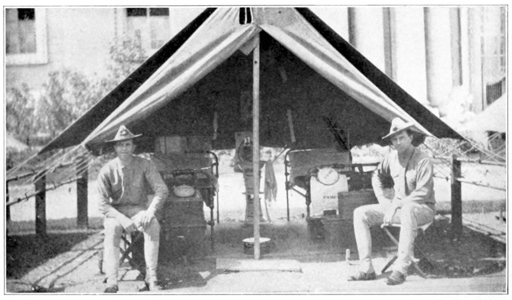
Arriving in St. Louis Sunday morning, May 22, we immediately alighted from the train, the battalion was formed, and marched to the “Fair” grounds, through the Olive Street entrance, to the site of our rendezvous; the colors were hoisted to the flagpole, and by 12 o’clock noon our camp had been pitched, each A wall tent towering uniformly over the chalk-marked square on the red shale, and with the precision of the Barnum and Bailey shows. Each tent had a well-fitting floor, and between each row of tents stretched a beautiful lawn of grass, on either side of which was a board-walk. The battalion commander’s headquarters,
The camp was typically a model military village, with all modern conveniences, even to an up-to-date restaurant which had been erected purposely for the accommodation of the battalion. This building was beautifully situated in a shady grove opposite the Kentucky building. In India the British are noted for their model camps and bungalow quarters; but an English officer, after seeing the marines in St. Louis, was heard to remark, that this American camp beggared description.
U.S. MARINES, WORLD’S FAIR, ST. LOUIS, 1904
The Plaza Orleans was the scene of daily exhibitions given by the West Point cadets, Philippine scouts, and United States marines. Thousands of spectators thronged the roped enclosure daily, and the applause from these was deafening. Strains of music from a dozen different bands filled the air, the most famous of these being the United States Marine Band, Sousa’s, Gilmore’s, Hawaiian, Mexican, Royal Grenadier of London, Philippines Constabulary, La Republic of France, Band De Espanol, Neapolitan of Italy, and the army bands,—the Second and Twenty-fourth Infantry, the latter colored. Besides these there were scores of others, including bagpipers and the insular band of the Tagalogs with bamboo instruments.
In addition to the exhibition drills and camp exhibit of the marines, they also had charge of the naval exhibits in the government building. Each man had to be thoroughly familiar with the mechanism or history, as the case might be, of the integral point of each exhibit, in order to explain and answer questions intelligently. The camp was garrisoned by a detail of marines, who patrolled on each side of the square, from the day of our arrival until the close of the “Fair.”
This style of soldiering was a rare treat to the boys; they were given free admittance
Stretching over a vast area of Forest Park, enclosed by a high board fence, stood the magnificent Palaces of Varied Industries, Liberal Art, Agriculture, Mines and Metallurgy, Manufacture and Transportation, Palaces of Machinery and Electricity, Festival Hall, and the Cascades, the Government Building, Tyrolean Alps, the Stadium, Ferris Wheel, and the sunken garden; the camps of the West Point cadets, Artillery and Infantry; Hospital, Signal, and Life-saving Corps. Museums containing relics of anthropology, zoölogy, geology, anthology, and numerous other scientific researches were everywhere in evidence. In one British concession, soldiers of the “Household” cavalry of London stood watch over the magnificent “Queen’s Jubilee presents” which had been presented to Queen Victoria by the nations of the earth. Five hundred Indians, representing various
To enumerate even the most important exhibits of this prodigious exposition would require volumes, and, for the benefit of those whose duties prevented them from seeing the “Fair,” I wish to say that it is impossible to form a conception of the progress this world attained during the century since the purchase of the Louisiana Territory.
At night the electrical display was a dazzling glitter of phosphorescence; myriads of incandescent lights of variegated colors were strung along the lagoons, cascades, and Pike, these combined with large arc lights
A group of marines could be found nightly in social session on Napoleon bridge, a span of the lagoons, meditatively absorbing the sweet strains of the ever-entrancing Italian Yama Yama, sung by Venetian “gondoliers,” as they gracefully plied parties in gondolas through thread-like canals fed by the waters of the cascades. The inspiration animated by the grandeur of the surroundings on these occasions, the thrilling sweetness of the singing, to the mellow-toned accompaniment of mandolins and guitars, had a most electrifying effect. Music, music, music, music, everywhere; sweethearts, music, and mirth, that was the slogan. “Love me and the world is mine” is hummed in chorus by this happy-go-lucky bunch of jolly tars, whose only responsibilities are confined to the hours of love and duty, and whose motto is, “Be a good fellow here, and you’ll be a good fellow there.”
“The Pike, the Pike! let’s shove off for the Pike.” They stop a few moments to hear the soft tones of Il Trovatore by the Merrimac, also the battle of Santiago. There is a rush, and we find ourselves in Turkey, watching the slim princess trying to beat it with an American kodak fiend. After “shooting the chutes” a few times, in order to be sure of not missing anything, you stroll to a palmy dance-hall and join in a “Frisco dip” or perhaps a “St. Louis rag,” with liquid refreshments during the intervals.
From this point you take a boat for the “Garden of Eden” and the scenes of creation; the dark recesses of this cavernous route were the cause of many leap-year proposals in 1904. Leaving Paradise you stop to watch a fellow picking confetti out of his sweetheart’s eyes; he is laughing, and some one throws a handful of confetti into his mouth; he swears at this, but he is only joking. A barker on the opposite side is holding a crowd with his spiel on “Hereafter.” You enter a dark subterranean passage likened unto the intricate caves in the “Chamber of Horrors” depicted in Dante’s Inferno, a journey along the river Styx on the outskirts of hades, and you are transported
All aboard for St. Petersburg shouts the conductor of the Great Siberian Express, from Vladivostok to St. Petersburg and return. “Under and over the sea” pipes a sailor; “take a ride in a submarine, ten thousand leagues under the sea.” From a balcony over the entrance to the Old St. Louis arena, “The Cowboy’s Farewell” is being played by a genuine cowboy band. This arena is the Indian’s favorite place of amusement, as the scenes are typical of frontier life. Wading ankle deep in confetti, you enter into the enchantments and desolations of Paris, with its relics of the
Arabs with tomtoms are attracting a stream of people to mysterious Asia. Here you find Hindu jugglers, magicians, and snake-charmers, Oriental dancers of the hootche kootche, and venders of wares of the “Far East,” camels and donkeys for hire, elephants with gorgeous canopies in which the children love to ride. This concession has the spicy odor and Oriental aspect of the Far East.
Blarney Castle and the Irish village are next. “Ho for the Irish jaunting car!” All pile in, and we’re off for the Lakes of Killarney, climb to the Castle and kiss the blarney stone. A Dublin colleen who is vending shillalahs, canes, and other ornaments of Irish bog-oak, sweetly sings, “Where the River Shannon flows,” as she
The Pike was the favorite promenade of the “Fair,” something doing every minute. Here millionaires nudged elbows with paupers; celebrities of distinguished vocations with the butcher, the baker, and the candlestick-maker. The various nations of the earth here commingled in harmony, all possessed with the same feeling of curiosity and intent on having pleasure.
After doing the Pike, the Tyrolean Alps was a favorite resort for midnight diners whose mirth and good fellowship were in keeping with their surroundings. Delicious terrapin, lobster, and rare-bits were specialties in this extraordinary café. From a pass in the mountain chain of the Alps came the clear yodel of a quartette of Tyrolean singers,
Swiss maidens from Geneva presided over stalls of quaint curios from Switzerland, beer-steins and long tobacco-pipes being the most favored articles. These Swiss girls were great favorites of the marines; they were constant visitors at the camp during the entire exposition, scarcely a tent was lacking in some ornamentation or other from the booths of this Alpine exhibit, while each girl wore pinned to her shirt-waist an ornament emblematic of the marines, consisting of the semisphere, the eagle, and the anchor.
Though not on the grounds, one of the most interesting places of amusement, and one which without seeing the visitor’s trip to the “Fair” was incomplete, was “Cheyenne Joe’s Rocky Mountain Inn.” This famous or infamous resort, as you will have it, had a seating capacity of more than one thousand people. Tables arranged in squares over a saw-dust floor were attended by waiters in cowboy costume; in the centre of this large pavilion a vaudeville performance entertained its racy patronage; music
During the wee sma’ hours of the morning the Palm Garden, a rustic summer dancing
Surrounding the Fair-grounds and in close proximity were shows of every description. Conspicuous among these were Forest Park Highlands, a veritable Coney Island; Luna Park; Delmar Garden, the scene of the celebrated extravaganza “Louisiana,” the old mill-wheel and “the girl in blue,” “the cave of the wind,” and “the Queen of the Gypsy fortune-tellers,” the Delmar Race-track, where gathered together could be found the most famous thoroughbred racers of the world, with their coterie of noted jockeys and attendants.
“Old Heidelberg,” in the German village, was the bohemia of the outskirts of the
Sundays, when the Fair was closed, the permanent summer resorts of St. Louis were flooded with people. Montesano, an island in the Mississippi River connected by a fleet of steamboats, was the most favored Sunday resort; the trip down the river alone broke the monotonoy of the quietude of a hot summer day. The island, with its groves of shady maple trees and inviting dells, extending from the smooth sandy beach and through the interior, was an ideal spot to while away the midday hours in lingering lassitude. There were dancing, boating, fishing, roller-coasting, flirtations, and all that goes to make up an ideal pleasure resort. Along the beach, children with diminutive spades dug holes in the sand in search for shells. Games of all descriptions were conducted quietly, and with far less compunction than under the restraint and restrictive laws elsewhere enforced.
Merrimac Highlands and Creve Cœur
The daily average attendance at the exposition was sixty thousand, and those represented nations of all countries and zones.
It was very amusing to hear some of the nonsensical questions that were asked by our rural friends from the land of the sage-brush and cactus. On one occasion I was approached by an elderly lady with the following query, “Soldier, would you kindly tell me what time they feed the lagoons?” I was nonplussed at the question, but ventured to ask, “Is it a bird or an animal?” She wasn’t sure which, she said, but a friend of hers had told her that it was a mighty interesting sight. I had heard of raccoons, loons, and baboons with Mr. Hagenbach’s wild animal show, and, knowing these had to be fed, I directed the misinformed old lady to this site on the Pike, where I trust her misconstruction of the word or misinformation was amended.
Having some business in St. Louis in connection with our canteen or camp exchange which necessitated the carrying of my haversack,
Not far from our camp was a high spiral tower, on the top of which was the wireless telegraph exhibit connected by a lift or elevator. “Is this the scenic railway?” a young lady inquired. “Not yet,” I replied; “that is the elevated railroad.” She smiled and thanked me very much. Why, they even went to the Kentucky building to invite Daniel Boone out for dinner!
Every day the marine camp was the scene of a constant stream of visitors, many of whom were in search of friends and relatives.
The cool days of early autumn seemed to be the most popular season for the Eastern and Western visitors; each day groups of friends, ensconced under the khaki canvas of an A wall tent or seated on steamer-chairs along the smooth level lawn, joined in social intercourse with these jolly rovers of land and sea. Tent number 2 was daily the scene of some festive occasion, the erstwhile pranks of which were likened unto a scene from the “Rodgers Brothers in Paris.” On these occasions the author was assisted by his dear friends and compatriots Boland and Fynmore.
Before going to St. Louis as pay-clerk of the battalion, I had spent three years afloat and in the tropics, and during that time had met but one man from my native town, with
The circumstances attending the meeting of the other man in question were exceptionally singular. It was late in the autumn of 1902, and I was stationed in the old “Quartel de Espanol” at Fort San Philippi, Cavite, P. I. Every evening about sundown, when not on duty, it was my custom to stroll with a friend or two to a hacienda in the adjacent “barrio” of San Ruki, where the soft-toned music from a harp and guitar was artistically rendered by two charming mestizos. At this native bungalow, shaded by large palms and drooping banana stalks, gathered nightly the elite of the village, and occasionally señoritas from the city of Manila, whose predominant beauty, in fluffy kimonos woven from the fibre of the pineapple with a texture as fine as silk, was augmented by that indisputable
It was while wending my way home in the moonlight from such an allurement of beauty and music, that I chanced along the Calle Real and into the Café Del Monte, when I was agreeably surprised to see, seated at a game of cards, my old shipmate “Jack” Lavery of the cruiser New York. Being clothed in a suit of civic white duck, I was unrecognized for a moment. “Hello, Jack!” I exclaimed. “Well, Bill! for God’s sake, where did you come from? I thought you were in China on board the monitor Monadnock?” “No, the application was disapproved of, so I fired in another for shore duty.” “Well, but you left us in Shanghai.” “Yes, my application was approved there, I crossed the sea on the gun-boat Manila.” “Well, where are you now?” “Fort San Philippi.” “Good! Shake hands with some friends of mine.—Fellows,
The fourth game was in progress, and, as the cards were being dealt, I remarked to my partner, whose cuffs had been rolled back, “Corporal, that dragon represents artistic work; where did you have that done?” “The dragon was tattooed by an expert on the Queen’s Road in Hong Kong; these storks I had put on in Kobe, Japan; and the spider’s webb was worked in at Cairo, by a professional who had the honor of tattooing his excellency the Khedive of Egypt.” “That is pretty work, and I see it harmonizes with the blue scar on your wrist; where did you dig coal?” “Oh, years ago, away back in Pennsylvania, all the way from slate-picking to working a gangway.” “What part of Pennsylvania, may I ask?” “Hazleton, Luzerne County.” “Hazleton? Are you from Hazleton?” “Pretty close to it; my home is in Beaver Brook, a
For several days my home city, Hazleton, Pennsylvania, was well represented at the “Fair,”—a special containing a large concourse of Sir Knights of the Masonic Fraternity who, accompanied by their wives and daughters, were homeward bound from San Francisco, where they had been attending a
Each day was given to some especial event. Every State in the Union celebrated on one particular day, the buildings representing the State being more elaborately decorated for this occasion. This function was attended by their respective governors and staff, occasionally accompanied by a troop of horse or infantry. Various branches of business had their day; there was also theatrical day, automobilist day, Elk day, and in fact every day during the continuance of the “Fair” was taken up by some particular branch of business or profession, the turnstile recording the largest attendance on Chicago and St. Louis day.
Theatrical day I had the pleasure of escorting a party of the profession, whose names in glittering light frequently adorned the theatres along Forty-second Street and
Strong resentment against the conduct of Filipino scouts had been expressed in different quarters of the “Fair,” and trouble between these and the white soldiers had been narrowly averted a number of times. The flirtations between white women of apparent respectability and the islanders had created adverse criticism. The marines, goaded by these flirtations and seeing fashionably gowned women on the arms of Filipinos promenading the Pike, felt that it was more than they could stand. In consequence a plan of campaign was outlined. One of the officers said, “I foresaw this situation and gave warning that it would come about. It is amazing the way white women shower attentions on the scouts, parading them to their homes and all that sort of thing.”
On several occasions marines had interfered when white girls were seen with the scouts; this usually precipitated a fight, causing bitter feelings in both camps. The resentment against the brown men, which continued growing stronger daily, took form when, at about ten o’clock at night, sixty
This scene was laughable in the extreme, and reminded me of a chapter from “Gulliver’s Travels”; those who had escaped a knockout were glad to end the struggle. Having retreated toward their camp, they had arrived in the vicinity of the Agricultural Building, when some of them drew arms and commenced firing. This enraged the marines to such an extent that they decided to charge their camp, which precipitated a clash with the Jeffersonian Guards in which two of the guards were seriously injured. At this juncture an alarm brought the mounted police galloping to the scene, who finally restored order, both sides withdrawing to the peaceful habitations of their camp.
Washington was apprised of the affair, and the troops were severely reprimanded; but the lesson taught the scouts had great
No military organization could have been treated with more courtesy than the marine battalion at the St. Louis Exposition, and, when the day arrived for its departure, it was with reluctance rather than pleasure that the comfortable tents, the scenes of so much merriment, had to be vacated for the less desirable quarters in barracks.
After breaking camp and securing our equipment, we bade the big show a fond farewell. A long line of street cars conveyed the battalion to the Union Station, where Pullman sleepers of the “Big Four” draped with streamers awaited it. The Sixth Infantry band discoursed music as the soldiers of the sea bade their friends good-by, and, as they boarded the two sections of the train, the reverberating strains of “Maryland, my Maryland” were received with vociferous applause by the multitude that crowded the station platform.
The marine barrack at Annapolis is the finest military post in the United States. On our arrival in the city, the battalion was met by the marine band, and escorted to the quarters, where an especially arranged dinner lay in waiting.
The following day, orders were received for the battalion to proceed to Washington, D. C., to participate in the unveiling of a monument to “Frederick the Great,” presented to the United States by Germany. This was the last procession in which the St. Louis battalion was seen intact.
Shortly after our return to Annapolis, an order was received from marine headquarters, detailing all men having two years or more to serve, on the Panama expedition. Having less than one year to serve to complete my enlistment, I was ordered to duty at the United States Naval Academy, until the expiration of my enlistment.
XII.
Topographical Survey in Northern Luzon
The Friars’ Monastery—Headquarters of the Insurgent Aguinaldo—In Charge of the Cargadores—Meeting with Albinos—Among the Igorrote Head-hunters—Enamored with a Beautiful Señorita—Planting Rice to Music—A Midnight Ride Through the Jungle—A Moonlight Fiesta—Quartered in a Cholera Infected Hacienda—The Jungle—The Rainy Season—Return to Civilization.
In the summer of 1908 while stationed at Ft. William McKinley, a military post in the Philippines, I was detailed from brigade headquarters for topographical survey on the Island of Luzon. This assignment was more than welcomed as a departure from the monotonous routine of guard duty, wearisome marches, and military manœuvres. I was instructed to report to First Lieutenant Kenyon A. Joyce of the Thirteenth Cavalry, whose headquarters were in an old Spanish
Hastily gathering together my necessary field equipment with transportation and orders, I departed for my destination with a feeling akin to that of the small boy on his first excursion from home. Alighting from the street car on the escolta near the old bridge of Spain, I purchased some periodicals and a large sombrero, then, engaging a caramato, was driven to the Tondo station, where I boarded a first-class coach for Bocaue.
After a wearisome ride through stifling humidity, over rice-dikes and through jungle, I arrived at my post of duty and immediately reported to the commanding officer of the detachment, after which I divested myself of my accoutrements and met the members of the survey party, consisting of about twenty-four soldiers, representing every branch of the United States army.
This aged edifice, with its mysterious subterranean vaults, its columns of Tuscan and Doric origin, and surrounded by balconies encompassed with ornamental balustrades, was occupied by the soldiers and used as headquarters by the topographical ensemble.
Prior to the Spanish-American war, this building had been a sanctuary of worship, the abode of mendicant friars. At the time of the insurrection, the old monastery was occupied as headquarters by General Aguinaldo, until compelled to relinquish his stronghold by the American troops.
Expert Filipino draughtsmen were employed in the plottings of the survey, their work in delineating offsets being admirably executed.
The circuitous route our journey necessitated through mountains, jungle, and across innumerable streams and ravines made it impossible to use ponies or caribou in the conveyance of our provisions, so that a contingent of native cargadores were employed in drawing a native cartello, which carried not only the provisions, but also the camp equipage, including our cooking utensils.
The entire party was divided into three sections, each section comprising one commissioned officer, eight enlisted men, and four brawny cargadores who handled the native cart or cartello. Each section had a separate circuit on which to work, these circuits penetrating jungle and mountainous country hitherto unexplored by the military. Provisions for two weeks were usually carried, the length of time it required in covering our territory.
My first duty in connection with this survey was recording the readings of the transit, operated by the officer in charge. Our route led through the “barrios” of Marilao, Santa Maria, Tomano, Buena Vista, San Jose, Bagbaguen, Prensa, and Santa Cruz, in the province of Bulacan. The heat endured on these expeditions was intense, especially along the rice-dikes, which were barren of foliage. Occasionally, when in the vicinity of a barrio where we had but one night to remain, instead of spreading canvas we bivouacked under the roof of some convenient casa. On one occasion, having worked until sundown, our cartello
In the interior of this sanctuary, the flickering lights in a large candelabrum, at the base of the crucifix, shone dimly through the gloom. With a feeling of absolute safety, the soldiers spread their ponchos over the bamboo matting and, wrapped in blankets, reposed in peaceful slumber. There was nothing to disturb the tranquillity of this night until, shortly before the break of dawn, we were aroused by the tolling of the bells, and the chanting of the Ave Maria, uttered in solemn devotion by a long procession of natives garbed in ceremonious black, preceded by a señorita bearing a cross, flanked on either side by torch-bearers. As the procession moved slowly down the aisle, the soldiers arose from their unusual berth and, occupying seats, observed the ceremonies with respectful silence. These natives were the thoroughbred Tagalogs, the
Leaving Buena Vista, our route led through the beautiful Marquina Valley, with its immense forests of bamboo, ebony, sapan-wood, and gum-trees entwined by the bush-rope of palasan, trees teeming with the luscious mango and guava, bordering on plantations and groves of the vegetable kingdom, including the banana, plantain, sugarcane, pineapple, coffee, cinnamon, and tobacco.
From Marquina our course led into the dense forest of the San Madre Mountains. Before leaving the valley, I was detailed to handle the cargadores. This party in itself was a comedy; the only things they thought seriously of were cigarettes, salmon, and rice. I gave each of them a sobriquet,—namely, “Blinky,” Pedro, Carlo, and Pablo de Gusman. Blinky, a one-eyed dusky savage, was the hero of the drama; when he wanted anything, he would pat me
Having been detained rather late one evening in a barrio where I had been exchanging rice, bacon, and salmon, for chickens, eggs, and vegetables, I could have made my objective point before sundown had not something unforeseen occurred; we had reached an unexpected ravine or gorge through which a torrent of water gushed; here we found it necessary to cut two bamboo trees on which to slide the cartello across on its hubs. We were having excellent success when the hubs slipped off, dumping our cargo into the stream and Pablo de Gusman with it. Luckily the native grabbed the
The country through which we passed was one of tropical grandeur; monkeys, wild-boar, and parrots were frequently seen along the mountain ranges. At night it was interesting to watch the vampires darting hither and thither over mango-trees, nipping the delicious mangos, sometimes carrying them to their roosts for their young. These vampires resemble a bat, though much larger; the body is about the size of a kitten,
Albinos are frequently met with in northern Luzon; on one occasion, strange to relate, we came in contact with a small colony of this type of people, unrelated, however, as the albino is a freak of nature possessing no inherency. They were reluctant to converse, contenting themselves with looking on, as they shielded their pink eyes from the rays of the sun with a fan of the palm-leaf. The interest we Americans manifested in these people seemed greatly to amuse the Filipinos.
The Igorrote head-hunters are a wild tribe inhabiting the northern provinces. Their features are large, with kinky hair, large teeth, and black complexions. They are far below the other tribes in intellect and intelligence. The appellation “head-hunter” has its significance in the fact that the head of the enemy is taken as a relic, similar to the custom of the American Indian in scalping his victim. We watched these barbarians killing dogs for market, saw them making grasshopper pies, and, to our disgust, they
It was a great pleasure to return to our headquarters in the old monastery, where wholesome food and cool shower-baths could be had. The evenings at this domicile were always enjoyably spent, either at cards, reading, or music. Occasionally, Sebastian Gomez, an old Filipino, would bring his two granddaughters to the quarters; these were fairly good-looking señoritas and excellent musicians, the one playing the harp while the other played the accordion, accompanied by the old man with a guitar. Very often a deputy revenue collector, who spent considerable time with us, would join this trio with a violin, and these instruments combined rendered excellent music.
Occasionally my work consisted in planting signal-flags on points of vantage, where they could be seen through the telescope of a transit. It was incidental to one of these trips that Kane, of the Engineer Corps, and myself, while driving through a remote barrio, came in contact with the beautiful
We had left headquarters at Lolomboy in the early morning, with a pony hitched to a cartello containing the signal-flags, tent equipage, and rations for three days. Crossing the ferry at Bocaue, we struck a northerly route running west of Malolos, the old Filipino capital. We had covered a number of miles over a dusty road and through sweltering heat, when a quaint little barrio shaded by cocoa and palm trees on the banks of the Cianti River was reached. As the pony jogged along through the heart of the village, turning out occasionally for the little pickaninnies who played in the street, my eyes fell on something unusual for this section of the world,—an exceptionally
“Kane, did you see that?” I asked. “Yes, some class; I wonder where that complexion came from,” he replied. “Let’s try and find out,” I said.
It was about the hour for the Filipino siesta and time for “tiffin”; so, drawing under the shade of a large mango tree, we tied and fed the pony, and I informed the engineer that I was going to buy some eggs. “Let me buy them,” said Kane, smilingly.
Approaching the hacienda, I saw standing under the eaves, with the grace of a Wanamaker cloak-model and the beauty of the allegorical Psyche, a Filipino señorita still in her ’teens, whose raven tresses would have been the envy of the “Sutherland sisters.” “Buenos dios, señorita,” I ventured. “Buenos dios,” she replied. “Tiene weibus?” (Tagalog for “Have you eggs?”). “Si, señor,” she replied. Kane, whose
“Are you soldiers the advance-guard of a regiment, or merely out for a joy ride?” she inquired, showing two rows of pearly teeth through an inquisitive smile. “Joy ride is right, with room for six,” replied Kane. Here my curiosity led me to inquire as to how this illustrious personage had acquired such fluency in the English language. Whereupon she informed me that she had been educated at the University of Manila and was a school-teacher home on vacation.
Having purchased some eggs, she further attracted our attention by volunteering to fry them, and asking if we desired the albumen
Before our departure we exchanged addresses; I found her name to be Carmen Lemaire, which further increased my curiosity. Having asked permission to pay her a visit some evening in the future she informed me that it would afford her much pleasure to have me call, but that several natives were very jealous of her, including a cousin whose ire, if aroused by my calling after sundown, might jeopardize my life; therefore any other than an impromptu daylight visit would be imprudent for her to approve. Assuring the señorita a little boastfully of my utter disregard for the marksmanship of her suitors, of my utmost
Bidding adieu, we left this hacienda with its fair inhabitant, and journeyed on our route. The following day the pony had to go some to make up for lost time, and it required the best part of three days to complete the work. Our return trip was the longest way round, but not the sweetest way home.
On our return to Lolomboy we told the story of having met the beautiful señorita. The old Filipino Sebastian knew of her, and told us she had been selected to act as queen of the “Grande Fiesta” at the Manila Carnival.
The following Thursday evening before sundown, “knighthood was in flower.” Having selected and placed some choice literature in my saddle-bags, I mounted a pony and galloped off for the scene of my triumph with the visage of the charming Carmen before me.
The iridescent hues of the vanishing sun tinted the western horizon, as I reined my
On entering the large bamboo casa, with its nippa eaves extending beyond the walls, I was met by the affable Carmen, and conducted to a cosey retreat, in the manner and customs of the Philippines, After meeting her mother, a very retiring Filipino lady. I presented the señorita with the periodicals, which included the San Francisco Sunset Magazine, containing my picture taken at Salt Lake City when a soldier in a machine-gun battery. Her beauty on this occasion was augmented by a pretty silken kimono and straw sandals, characteristically simple. In her hair she wore a pink carnation, which vied in beautiful contrast with her complexion.
Side by side on the wall hung two large pictures,—one the martyred patriot Jose Rizal, the other the ex-Governor-General of the Philippines, now our President, William H. Taft. On the opposite wall hung the señorita’s much-cherished diploma from the University of Manila and a certificate of belles-lettres. Books were shelved in galore. An East Indian matting covered the bamboo floors, while the sleeping compartments were hidden from view by large portières. Various articles of interest were shown to me, including photographs, a prayer-book printed in Spain in the sixteenth century, and the bridal-veil worn by her mother on her wedding morn.
During the evening the son of the presidente of the village, accompanied by his sweetheart, a pleasing young couple, called at the hacienda. Being unable to hold an intelligent conversation with these guests, our conversazione was one of ignorance crasse. The elder Señora Lemaire, Carmen’s mother, served the guests with limeade and charlotte-russe, which were delectable and refreshing.
CHIEF ADAMS GUN MULE DEWEY AID COLEMAN
After the couple had departed, I related several stories of the United States to this amiable señorita. I told of my home away off in Pennsylvania, my school days, friends, escapades, the war, my travels, and incidentally mentioned the resemblance she bore the Creoles of New Orleans, among whom I had spent a winter; being careful to impress on her mind, that the Creole is of Spanish and French descent, not negro, as some educated people suppose. She listened very attentively to my stories, occasionally asking questions, particularly regarding the Creoles.
The anecdotes of her college days were more than interesting, as were the stories she told about the insurrection. She was very familiar with the history of the war, from the blowing up of the Maine to the battle of the “crater” in the Sulu.
“Lemaire is a very uncommon name in the Philippines, is it not?” I remarked. “Yes,” she sighed, “very uncommon.” Realizing the interest I took in her, and the
“About twenty years ago a party of European surveyors employed by the Manila and Dagupán Railroad, in surveying this section of my country, were stationed at Malolos, my former home. In the course of human events, one of the party—namely, Armand Lemaire—became enamoured with and courted my mother, with whom he was eventually joined in holy wedlock. Of this union I am the fruition. At the expiration of my father’s duties in the Philippines, he was ordered to India, where, falling a victim, he succumbed to the plague.” Reaching into the drawer of an escritoire, she drew forth the picture of a man, whose intelligent features clearly indicated the ancestry of this charming young woman.
Continuing, she said: “My mother, on receiving notice of my father’s death, took up her residence on this plantation, provided before his departure for India, and here she has lived ever since in pensive quietude, never fully recovering from the effects of her dire misfortune.”
MACHINE GUN PLATOON OF THE 29TH INFANTRY IN THE SNOW CAPPED WASATCH RANGE, UTAH.
There was something unusually pathetic in this sincere girl’s story, and my conjecture, as I gazed on her mother’s bridal-veil, had found a sequel. With the assurance of my utmost sympathy, the conversation switched on to other topics. Glancing at my watch the hands indicated midnight, and I had told the patrol to be on hand with my pony at eleven o’clock.
Glancing over the balustrade, Carmen inquired, “Donde cabalyo?” The patrol had arrived with the pony as if by magic.
As I bade Carmen Lemaire a fond adieu, she again admonished me as to the possible violence of her jealous suitors. “Keep on the alert and take no chances,” she said.
After tipping the patrol a two-peso note, I mounted my pony, and wafting a “buenos-notches” galloped off in the pale moonlight, sincerely wishing some dusky rival would take a shot at me, that I might demonstrate “the survival of the fittest.”
My ride through the jungle in lonely contemplation was uneventful until the barrio of Bocaue was reached. Here I found a barrier in the shape of a river. I
In imitation of the semaphore system, I wig-wagged the Filipino, and with a hoarse voice in bad Spanish impressed on his mind the necessity of my getting across. Having a passing acquaintance with the municipal officer, he recognized me, and propelled the boat across himself by means of a cable, the river being about one hundred yards wide at this point. On reaching the other side, the patrol was as much pleased in making a little side money as I was delighted in getting across. It was not long before I had stabled my pony and sought peaceful repose
A few days later I set out with the cargadores on a new circuit. A very odd scene we encountered on this trip in the province of Pangasinán was a skirmish line of Filipinos transplanting rice to music. The rice paddies, or dikes, resembled level meadow-land and stretched out as far as the eye could discern in every direction. About one thousand Filipinos, men and women dressed in loud colors, were engaged in this work. Their formation was in the shape of a skirmish line, with a deploy of about two feet; each planter was covered in rear by another who passed the rice plants as the supply became exhausted; a short distance in rear of all were bands of music with intervals of one hundred yards. Large sun-shades, with long spike handles stuck in the soil, afforded considerable shade for the musicians. As the music from these bamboo instruments resounded o’er the meadows, each planter moved forward one step, at the same time placing a rice shoot in the soil, with the utmost uniformity and in absolute harmony with the band.