Front matter (continued 3)
Reading edition
Based upon the foregoing evidence, it would seem likely that the Geomyini evolved from an early Pliocene (perhaps late Miocene) Dikkomyini ancestor that had evolved the specializations of M1 and M2 that characterize its relative, Pliosaccomys, but had not also evolved the specializations of m1 and m2 that distinguish Pliosaccomys. Therefore, the ancestor of the Geomyini differed from the Pliosaccomys-Thomomyini lineage in its retention, unmodified, of the primitive patterns in m1 and m2 that characterized the earliest known Geomyines (Dikkomys). The same patterns are preserved in m1 and m2 of its modern descendents, the living Geomyini. In the Pliosaccomys-Thomomyini lineage the pattern of m1 and m2 are entirely different, as described above.
The earliest record of the Geomyini is the extinct genus Pliogeomys (see Fig. 6) in the latest Hemphillian (middle Pliocene) and earliest Blancan (late Pliocene). Pliogeomys is more primitive than any modern genus of the Geomyini, seems to have been a late survivor of the primitive stock, but was itself probably a collateral lineage and not on the direct line of descent. The cheek teeth in Pliogeomys are rooted and less hypsodont than in the late Pliocene examples of the modern genera, and the anterior enamel plate of the lower molars shows no indication of reduction, as would be expected if Pliogeomys were in the direct line of evolution. Separation of Pliogeomys from the main stem of the Geomyini probably occurred after several specializations had already been achieved by the Geomyini. Two inheritances might have been grooving on the upper incisors and some reduction in amount of enamel on the sides of the cheek teeth. The dentine tracts on the sides of the cheek teeth of Pliogeomys are narrow (see Fig. 7A) and barely separate the enamel blades and there is no discernible reduction in the anterior enamel blades on its lower molars. Those blades evidently were lost in the main lineage before the Pleistocene radiation of the living genera took place. Pliogeomys is in an intermediate stage in evolution, and was not so advanced as was the main lineage at the time Pliogeomys died out. Its structure does provide clues as to phyletic development that took place in the main lineage.
Specialized trends in the early phylogeny of the Geomyini included: development of rootless, ever-growing cheek teeth and an increase in hypsodonty; loss of the bicolumnar structure of the first and second molars, and, consequently, the formation of a single elliptical column in the final stage of wear; interruption of the enamel investment of the molariform teeth and formation of anterior and posterior enamel plates; and enlargement of the masseteric ridge and fossa. Each of these trends occurred independently in the Thomomyini, and each is an example of parallelism in the phyletic evolution of the two lineages. Three additional specializations lacking in the Thomomyini are the grooving on upper incisors, loss of anterior enamel plate in lower molars, and development of a basitemporal fossa on the mandible. Evidently, two grooves evolved in the ancestral incisors in the same bisculcate pattern preserved in Pliogeomys, Zygogeomys and Geomys. The innermost groove is weakly developed in Pliogeomys, suggesting that this character was in an intermediate stage of evolution in the ancestral lineage at the time that Pliogeomys split off. Numerous other specializations in the Geomyini appeared later, but evolved in the different genera that diverged from the ancestral lineage and are discussed separately in the next account. Only two of the major features characterizing the Dikkomyini are retained in the Geomyini: the H-pattern on the occlusal surface of the m1 and m2 developed during the initial stages of wear, and the bicolumnar pattern of M3. Adaptive radiation produced the living genera of the Geomyini in the late Pliocene and early Pleistocene (see Fig. 6) and subsequent specialization of the ancestral morphology followed.
Parallelism in the molars of later geomyines and the Entoptychinae is illustrated by the lateral interruption of the enamel investment and loss of enamel plates and by the omission of the H-pattern stage in the first and second molars (in Pliosaccomys). Resemblance of dentitions in certain stages of wear in Pliosaccomys and in entoptychines led some investigators, for instance, Hibbard (1953:357), to suggest that Pliosaccomys descended from one of the less specialized entoptychines, possibly Grangerimus but probably Gregorymys. Actually, the highly specialized upper and lower premolars and third molars of the entoptychines rule them out as ancestors of the later geomyines. The evolution of entoptychine-like features in Pliosaccomys is regarded as an example of iteration, a pattern of parallelism (see Simpson, 1953:248-253) where an allochronic and independent lineage undergoes the same evolutionary trend that phyletically characterized an earlier lineage, usually after the latter has become extinct. In this case, the lineage giving rise to Pliosaccomys passed through the same phyletic stages in its evolution in the early Pliocene (and possibly the late Miocene) as did the entoptychines in the late Oligocene and early Miocene.
Another parallelism by iteration, occurring in the middle and late Pliocene in both the Thomomyini and Geomyini, is the loss of enamel from the lateral surfaces of the cheek teeth, and, in the Geomyini only, the eventual loss of the anterior plate in the lower teeth and the posterior plate in the upper teeth. Both features were evolved more than an epoch earlier in the specialized entoptychid genus Entoptychus of the lower Miocene. In Entoptychus, only the posterior plate of the lower molars and the anterior plate of the upper molars remained in the final stages of attrition, although a central enamel fossette, a remnant of the re-entrant fold, remained throughout life. Iteration is also expressed in the subfamily Geomyinae by the development of grooving on the upper incisor and the formation of the basitemporal fossa. A shallow but distinct basitemporal fossa occurs between the coronoid process and the third lower molar in the genus Entoptychus and a sulcated upper incisor, a single shallow groove usually near the median border of the tooth, is found in the genus Gregorymys of the subfamily Entoptychinae. Both features are regarded as advanced specializations in the tribe Geomyini, even though each was evolved in the entoptychines of the Lower Miocene.
The postcranial skeleton of living genera of pocket gophers, as befits animals that spend most of their life within underground burrows, are highly specialized for a fossorial life. Elements of the postcranial skeleton recovered from Lower Miocene deposits indicate that the entoptychines were only semi-fossorial (see Cope, 1884:857; Wood, 1936:4-5; Wilson, 1949:117-118). One of the basic trends of the entoptychines was towards greater fossorial adaptation; the skeleton of Entoptychus shows a greater degree of fossorial adaptation than earlier genera of the subfamily. There is no reason to suppose that the geomyine genus Dikkomys, which lived at the same times as the entoptychines, had acquired any more advanced fossorial adaptations than had the entoptychines.
The most pronounced fossorial adaptations seem to have evolved only in the ancestral lineage of the modern geomyines, probably in the latter part of the Miocene and in the early Pliocene, before the modern Thomomyini and Geomyini diverged. Extreme fossorial adaptations in herbivorous rodents, such as those characteristic of the modern pocket gophers and their immediate ancestors, are thought to have evolved only in response to pronounced arid conditions. The Entoptychinae and evidently the early geomyines lived in environments that were either tropical or temperate, and under conditions more mesic than I would consider necessary to bring about selection pressure resulting in fossorial specializations. In late Oligocene and early Miocene, according to Axelroad (1958:433-509), arid conditions did not exist in the United States, and the only xerophytic environments in North America occurred on the Central Plateau of México. Moreover (Axelroad, loc. cit.), arid conditions did not develop in the western United States until the early Pliocene. Geomyids evidently became extinct in this region at the close of the Middle Miocene, and none appear in fossil deposits in the western United States until the latest Lower Pliocene (Clarendonian). The reappearance of geomyids, Pliosaccomys, in the western United States coincides with a trend toward aridity and the northward movement of the Madro-tertiary geoflora into the Great Basin and Great Plains from its place of origin on the Central Plateau of México (Axelroad, loc. cit.). Later, in the middle and later Pliocene, the Madro-tertiary geoflora gave rise to the modern xerophytic plants that now characterize the desert vegetation of North America.
The Madro-tertiary climax does not appear as a major flora until the Miocene, but probably originated earlier. According to Axelroad (loc. cit.), this xerophytic flora evolved from elements of the Neotropical-tertiary geoflora that became adapted to arid conditions that developed in the rain shadow of the high mountains flanking the Central Plateau of México. Originally, the Madro-tertiary flora consisted of small trees, shrubs, and grasses. Although some elements of this flora moved northward in the late Miocene, the major part of it remained in México until the early Pliocene. In the western United States, mountain formation increased in intensity in the Pliocene and continued on into the early Pleistocene. As the mountains became more elevated, especially the Sierra Nevada and Cascade ranges, they blocked the prevailing winds from the Pacific Ocean and extensive aridity developed on their leeward side. As xeric conditions became widespread, the Madro-tertiary flora successfully occupied the drier regions of southern California, the Great Basin, and the western parts of the Great Plains.
While the Entoptychinae probably evolved in response to the Arcto-tertiary flora, the late Tertiary geomyines probably evolved in response to the Madro-tertiary geoflora on the Central Plateau of México. Some of these early geomyines, especially ancestors of the modern lineages, probably were pushed southward by competition with the more specialized entoptychines. Most geomyines were pushed out of the northern area of distribution, except for Dikkomys that survived in association with the entoptychids throughout the early and middle Miocene. During this time, and probably continuing on into the late Miocene, the geomyines occurring to the south in México became adapted to the arid environments of the Madro-tertiary geoflora.
Of course, information is lacking about climates in several parts of the late Miocene and early Pliocene. When such information becomes available it conceivably could modify the hypothesis outlined immediately above.
The principal trend of evolution in these semi-fossorial rodents was toward more complete fossorial adaptation, and the pronounced fossorial features characteristic of the modern pocket gophers were perfected. This trend continued in response to the intense selection pressures in this arid environment. The principal structural characters effected were in the postcranial anatomy, especially in the skeletal and muscular systems. Consequently, it is not surprising that in skull and dentition, Pliosaccomys differs but little from Dikkomys. Therefore, most of the basic structural specializations so far developed for subterranean existence probably had evolved by the time geomyines moved back north in the early Pliocene. Both modern lineages, the tribes Thomomyini and Geomyini, have essentially the same fossorial features, and it seems unlikely that these features were acquired independently in the relatively short period of time available to them after their divergence; probably they were inherited from a common ancestor. These probabilities indicate that the evolution of the fossorial specialization was in the later phyletic development of the tribe Dikkomyini.
Plio-Pleistocene radiation of Geomyini
Unlike the lineage of the Thomomyini that remained essentially rectilinear through out its history, the Geomyini in the late Pliocene and the early Pleistocene underwent adaptive radiation in a degree comparable to the earlier radiation of the Entoptychinae, and all of the later history of the tribe is dominated by the radiation—the resulting structural diversity. At least four lineages were produced by the Plio-Pleistocene radiation (see Fig. 6); each originated at essentially the same time (late Pliocene) presumably from the same ancestral stock. Each of these lineages within the Geomyini has given rise to one of the four modern genera: Zygogeomys, Geomys, Orthogeomys, and Pappogeomys.
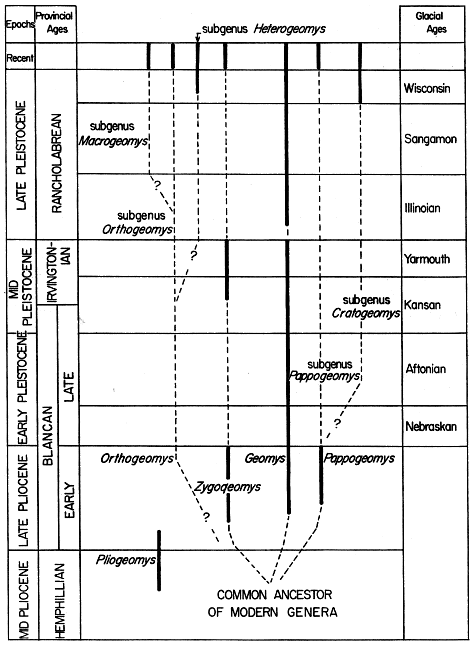
Fig. 6. Plio-Pleistocene radiation of the Tribe Geomyini.
Morphotype
The immediate, unknown, ancestor probably lived on the Central Plateau of México. After the radiation began the ancestors of Geomys and Zygogeomys extended their ranges northward.
Features of the hypothetical morphotype, that would permit derivation of the modern genera would include the following: (1) Skull generalized, neither excessively long and narrow or short and broad; (2) skull smoothly rounded, without pronounced angularity, rugosity or cresting (sagittal crest probably lacking, even in old individuals); (3) zygomata slender, without lateral platelike expansions; (4) rostrum moderately broad; (5) upper incisors bisulcate, two grooves in pattern found in Pliogeomys, Zygogeomys and Geomys; (6) lateral re-entrant angles of premolars obtuse; (7) p4 having four enamel plates (one on anterior wall, one on posterior wall, and two lateral plates) and lower molars having one enamel plate on the posterior wall of tooth (anterior plate is lacking); (8) P4 having four enamel plates, in same pattern as described for p4, M1 having two enamel plates (one anterior and one posterior), M2 same as M1, M3 having three plates (one anterior, two lateral on sides of posterior loph, none posterior); (9) M3 subtriangular in cross-section, distinctly bicolumnar, two columns marked by shallow re-entrant folds and connected by broad isthmus; (10) masseteric ridge large, forming high crest bordering masseteric fossa; (11) basitemporal fossa shallow; (12) angular process of mandible short, its lateral projection barely exceeding that of zygomatic arch.
Specializations in Genera
In relation to the primitive morphotype, increase in size, simplification of dentition, and changes in shape of skull are regarded as specializations. Considerable parallelism between the four lineages is seen. But each lineage is distinguished by a combination of specialized features, and three by a few unique specializations.
Among trends resulting in simplification of the dentition, reduction of enamel on the posterior wall of the upper cheek teeth has occurred in various degrees in all lineages of the Geomyini even to loss of all enamel on the posterior wall of the premolars and molars in two genera. Loss of some enamel is more common on P4 than on M1-2, and has occurred in all genera (see Figs. 7 and 9.)
In evolutionary sequence loss of enamel from M1 and M2 usually occurs after, but never preceding, the reduction of enamel on P4. Loss of enamel plates from the posterior face of M1 and M2 is associated with the evolution of an efficient anterotransverse shearing action of the teeth.
On the anterior wall of those teeth no reduction of the cutting blade has been observed; a complete anterior plate is retained in all living Geomyini.
Presence of both the posterior and anterior plates decreases the efficiency of transverse shearing, by providing two upper plates (anterior plate of one tooth and posterior plate of the preceding tooth) over which the lower cutting blade simultaneously must pass with each movement. The advantages of shearing over the more common mechanics of planing are largely lost unless the posterior plates are eliminated. Also, none of the living Geomyini have retained a definitive posterior enamel plate on M3, the last upper molar; but two well-developed lateral plates, that extend almost all of the way back to the posterior apex of M3, have been retained, and, together function as a posterior plate. Loss of either or both of the lateral plates of M3 is rare, and occurs only in old individuals. Their loss in the final stages of wear may represent the beginning of a new trend in those species where it occurs (the castanops-group of the subgenus Cratogeomys). In any case, reduction of enamel takes place by transverse shortening of the plate through the complete loss of enamel on one end, the diminution beginning first on the labial end and proceeding by progressive atrophy to the lingual end of the plate. Evidently, when enamel has been eliminated from the labial end of a plate, the rate of loss decreases markedly, and the last stages of evolution, terminating in complete loss of an enamel plate, occurs more slowly. Evolution may be arrested before complete loss has occurred, and that part of the enamel that remains forms a short, vestigial plate restricted to the lingual one-fourth or one-third of the wall. The enamel pattern of the lower dentition is the same in all of the diverging lineages, with no evidence of additional loss of enamel from that which had already occurred in their common ancestor (see Figs. 7 and 9). Reduction and loss of enamel plates began and was terminated in the lower dentition before reduction began in the upper dentition.
Other dental specializations have occurred in the shape of the third upper molar and in the pattern of grooving in the upper incisor. Unlike M3 of the Thomomyini, that of the Geomyini differs in shape from M2, and its enamel investment differs from that of M2. Primitively, M3 was probably subtriangular in cross-section, and the posterior loph evidently projected posteriorly as a short, rudimentary heel that formed the apex of the triangle. Other shapes of M3 are considered to be specializations that have been derived from the primitive form. In addition to the primitive subtriangular pattern, the M3 of living Geomyini may be suborbicular, quadriform, elongate, or obcordate in shape. Usually each lineage is characterized by only one pattern, but in one genus (Pappogeomys) all patterns occur. Of the different forms, the elongate and obcordate seem to be the most highly specialized deviations from the triangular-shaped tooth. The bicolumnar pattern is accentuated in the elongate type (Fig. 7D, F, H) by deep lateral re-entrant folds, on both the lingual and labial sides, and by the elongation of the posterior loph into a pronounced heel. Teeth having this pattern have been illustrated by Merriam (1895:76-82) in Figures 27 (6 and 7), 28 (c and d), 34 (7 through 15), and 35 (8).
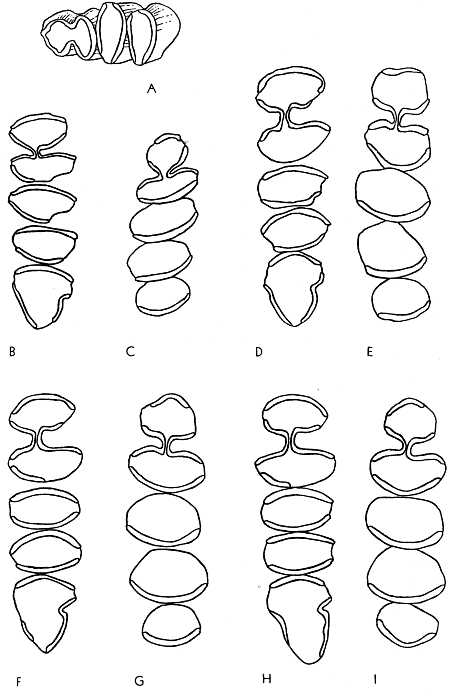
Fig. 7. Molariform dentitions of the Tribe Geomyini. Drawings illustrating enamel patterns characteristic of Pliogeomys, Zygogeomys, and the subgenera of Orthogeomys (Orthogeomys, Heterogeomys and Macrogeomys). × 5.
A. Pliogeomys buisi, No. 29157 (UMMP), holotype, Buis Ranch (Upper Middle Pliocene), Beaver Co., Oklahoma. Right lower, p4-m2 (m3 unknown).
B and C. Zygogeomys trichopus trichopus, adult female, No. 51971 (FMNH), Mt. Tancítaro, 10,500 ft., Michoacán. Left upper (B), P4-M3; right lower (C), p4-m3.
D and E. Subgenus Orthogeomys. Orthogeomys grandis guerrerensis, adult female, No. 39807 (KU), 1/2 mi. E La Mira, 300 ft., Michoacán. Left upper (D), P4-M3; right lower (E), p4-m3.
F and G. Subgenus Heterogeomys. Orthogeomys hispidus hispidus, adult female, No. 23975 (KU), 4 km. W Tlapacoyan, 700 ft., Veracruz. Left upper (F), P4-M3; right lower (G), p4-m3.
H and I. Subgenus Macrogeomys. Orthogeomys heterodus cartagoensis, adult female, No. 60664 (KU), Rancho Redando, Volcán Lrozá, Prov. San José, Costa Rica. Left upper (H), P4-M3; right lower (I), p4-m3.
The subcordate form is characterized by pronounced anteroposterior compression, and retention of a distinct labial re-entrant fold. The posterior loph apparently has been rotated in such a way that what was previously its posterior border now lies on the outer margin of the tooth; therefore, the axis of the posterior loph is strongly oblique in relation to the anteroposterior bearing of the maxillary tooth-row, and the median enamel plate also has been rotated and so lies transversely across the posterior wall of the tooth. Owing to the rotation of the posterior loph, the apex of the obcordate tooth is at its lingual side. The subcordate type is illustrated by Merriam (loc. cit.) in Figures 27 (3 and 4), 28 (a and b), 34 (3 and 4), and 35 (5, 6, and 7). The suborbicular and quadriform types are less specialized than the two described above. Both are characterized by reduction, often obliteration, of the bicolumnar pattern of the subtriangular ancestral form, especially marked by the decrease in depth of the lateral re-entrant folds and the decrease in length of the posterior projection of the posterior loph. With these changes, the tooth becomes essentially monocolumnar, its occlusal surface oval in outline in one and squarish in shape in the other. Occlusal views of the suborbicular form are presented by Merriam (loc. cit.) in Figure 33 (1, 5, 6, 7, 11, and 12) and the quadriform tooth is depicted in Figure 29. Grooved upper incisors are characteristic of the living Geomyini, but variation occurs in the number of grooves, and, if only one groove is present, its position on the anterior face of the tooth varies. Except for the previously mentioned (p. 480) abnormal tooth having three grooves, incisors with no more than two grooves are found in these pocket gophers, and this number of grooves is taken to be primitive. Loss of one or the other of the two grooves of the bisulcate pattern, therefore, is regarded as specialization. However, complete loss of both grooves never occurs in the Geomyini. Each of the four major lineages is characterized by one of the three patterns of grooving, and the particular groove-pattern is remarkably stable in each group.
Shape of skull varies from dolichocephalic to platycephalic. The morphology of each has been described in foregoing accounts. The dolichocephalic skull is highly specialized for planing, a grinding action of the teeth; whereas, the platycephalic skull is highly specialized for shearing, a slicing action of the teeth. Of course, concomitant specializations of the dentition, as described above, are closely associated with both specialized trends in the skull. Most kinds of living Geomyini have generalized skulls that show no tendency toward either of the specialized conditions.
Increase in size of body and skull is seen in most Pleistocene lineages of the Geomyini. Judging from the smallness of the skull in late Pliocene species, representing the base of three of these lineages, the ancestral species of the living assemblage were no larger than the living species of the subgenus Pappogeomys or the smaller subspecies of Geomys bursarius. The recorded range of variation in condylobasal length is 36.1 to 45.5 in Pappogeomys bulleri, including both adult males and females. Probably the skulls of the ancestral species were not significantly larger. Maximum dimensions of males in living species are 74.5 (subgenus Cratogeomys) and 75.0 (subgenus Orthogeomys). These are more than twice the minima observed in Pappogeomys bulleri.
Zygogeomys
This is the least specialized and most primitive of the four lineages, has a generalized type of skull, two grooves on the anterior face of each upper incisor, an enamel plate on the posterior wall of P4, open or divergent lateral re-entrant angles on the premolars, and a bicolumnar and elongated M3. All of these features are primitive and essentially as in the ancestral morphotype. No other modern genus retains so much of the primitive structure. Phyletic trends in Zygogeomys are not well documented in the fossil record; and only a few fossils are known and they are fragmentary as discussed before. The genus is represented in the late Pliocene (Z. minor), middle Pleistocene (Z. persimilis), and Recent (Z. trichopus). The living species is a relict population in the mountains of Central México. Judging from the known material, the phyletic trends in the genus have been increase in size, reduction of enamel on the posterior face of P4 (occurring only in the living species) where a short enamel plate is retained on the lingual side of the tooth (see Fig. 7B), loss of the outer fourth of the enamel blade on the posterior wall of M1 and M2 (also occurring only in the living species), development of a more pronounced heel on the M3 by progressive elongation of the posterior loph, reduction in size of the jugal and its displacement ventrally, which allows the maxillary and squamosal bones to meet along the dorsal border of the zygomatic arch. The last specialization is seen in at least one taxon of Orthogeomys (Orthogeomys cherriei costaricensis). In my opinion, too much weight has been given to this feature in past classifications. Reduction of enamel in the upper dentition evidently occurred in the late Pleistocene, since the posterior plates on the upper cheek teeth were complete in specimens from the middle Pleistocene (Z. persimilis).
Geomys
Geomys, slightly more specialized than Zygogeomys, must also be regarded as one of the most primitive of the living genera. Primitive features that have been retained are the generalized type of skull, the bisulcate pattern of grooves on the upper incisor, and the retention of enamel plates on both the anterior and posterior walls of M1 and M2 (see Fig. 9A). All of these primitive features are shared with Zygogeomys. In addition, three other trends, or specializations, in evolution characterize the phyletic development of Geomys. One major trend is toward loss of the enamel plate from the posterior wall of P4. No trace of enamel remains on the posterior wall of this tooth in late Pleistocene or Recent species of Geomys, and at least one of the earlier species (quinni) was also characterized by loss of this enamel plate. Secondly, M3 retains only a vestige of the primitive bicolumnar pattern after the initial stages of wear. In most Recent specimens, especially of the species G. bursarius, the lateral re-entrant fold and the heel of M3 are small, and the re-entrant inflection is hardly evident. The lateral fold is more frequently well-developed in Irvingtonian species than in living species (White and Downs, 1961:13), illustrating progressive loss of the bicolumnar pattern in Pleistocene evolution. A third trend involves the modification of the lateral folds of the premolars. Primitively the angles of these folds are broadly open or divergently V-shaped, and some of the earliest species of Geomys, for example G. quinni, have retained this feature throughout life. Nevertheless, the main trend is toward progressive compression of the folds resulting in their walls being more nearly perpendicular, and parallel, to the long axis of the tooth. Obtuse re-entrant angles persist in premolars of young individuals of Irvingtonian species, but the adults are characterized by well-compressed folds, as in Recent species.
Remains of Geomys are abundant, especially from Pleistocene deposits of the Great Plains, but in most instances specific assignment is difficult or impossible since only isolated teeth or fragments of skulls have been preserved. Estimates of phyletic relationships of the known species of Geomys are depicted in Figure 8; those estimates are useful in discussing the phyletic development of the genus. One of the earliest known species, Geomys quinni, ranges from Upper Pliocene to the later stages of the Lower Pleistocene (Aftonian interglacial deposits). The dentition of G. quinni is essentially the same as in the living species except that open lateral re-entrant angles are retained in the premolars. Geomys paenebursarius, also of the early Pleistocene, is a smaller species and seems to be more directly in the line of evolution of the modern species. As yet unnamed smaller species of Geomys from the Rexroad fauna (late Pliocene) and Saunders fauna (latest Aftonian) may also be on the main line of evolution. Surprisingly, Geomys tobinensis and Geomys garbanii of later Irvingtonian provincial age are less specialized than either Geomys quinni or Geomys paenebursarius. It is likely that G. tobinensis and the unnamed species from the Dixon are closer to the main line of descent than G. paenebursarius suggesting that the direct ancestral lineage of the living species of Geomys was more conservative and less specialized than Geomys paenebursarius of the Lower Pleistocene. Geomys quinni and G. paenebursarius seem to have acquired specialized dental features in the early Pleistocene. Geomys quinni was successful on the Great Plains, and persisted into the late Blancan. The main line may be represented in the early Pleistocene by Geomys paenebursarius from the Hancock formation of the Texas Trans-Pecos. The structure of G. paenebursarius indicates that it is in or close to the main line of descent, and probably evolved from one of the more primitive late Pliocene species of Geomys from the Rexroad fauna.
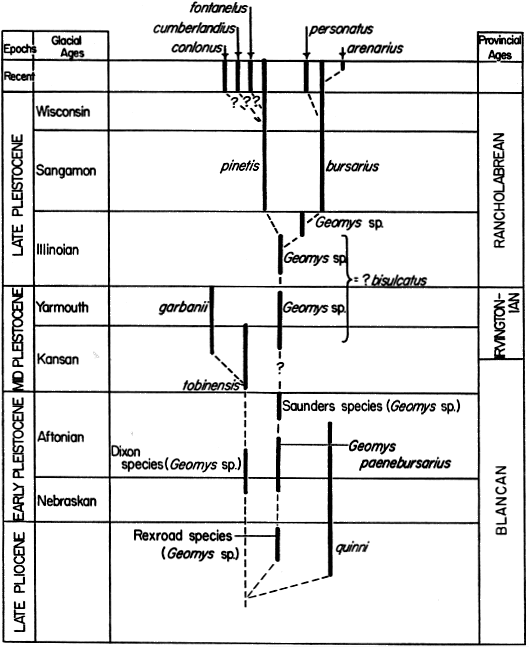
Fig. 8. Tentative arrangement of species of the genus Geomys, depicting phylogenetic trends and probable relationships within the genus.
Isolated teeth, to which the name Geomys bisulcatus probably applies, from Illinoian deposits on the Great Plains, show that the dentition characteristic of the living Geomys had been developed by that time. Actually, the Illinoian material is too fragmentary to show clearly its taxonomic or phyletic affinities with the species of the later Pleistocene. Even so, the two main stocks of living Geomys, G. bursarius and G. pinetis, had certainly been differentiated by Sangamon time. The other living species evidently evolved from one or the other of these two stocks in a period of isolation from the main population, probably in either the Wisconsin or post-Wisconsin. For example, Geomys arenarius clearly differentiated from populations of Geomys bursarius that were isolated by the eastward retreat of the main population from the southwestern United States as that region became more arid in the post-Wisconsin.
In review, it seems that the Recent species, represented basically by bursarius and pinetis, evolved from Illinoian species (Geomys bisulcatus?), which descended in turn from the more primitive species of the early Pleistocene, possibly Geomys paenebursarius or possibly from descendants of the Saunders species. Actually the Saunders species may prove to be Geomys paenebursarius. At any rate, three trends that took place during the Pleistocene stage of evolution, in the direction of the modern species, were an increase in size, progressive loss of the posterior enamel plate on P4, and a decrease in the vertical depth of the enamel cap as a result of which the dentine is reached in the initial phases of attrition on the tooth of a juvenile. Geomys garbanii, occurring at the periphery of the range of the genus, is regarded as a sterile offshoot of the primitive tobinensis-line of evolution.
Orthogeomys
This is one of the more specialized genera of the Geomyini. Save for one record in the late Pleistocene (Orthogeomys onerosus), there is no fossil history of the genus upon which to reconstruct its phylogeny; therefore, its phyletic development must be estimated by comparing it and the primitive morphotype of the tribe. Results of that comparison suggest that Orthogeomys has closer affinities with Zygogeomys than with any of the other genera, and that Orthogeomys may have originated in an early dichotomy of primitive Zygogeomys stock instead of descending from the ancestral stock of the tribe. Except for the unisulcate incisors and the longer posterior loph on the third upper molars, the teeth of the two genera do not differ significantly. As in Zygogeomys, the enamel blade on the posterior wall of P4 has been reduced to a short plate restricted to the lingual third of the tooth (see Fig. 7F and H). In Orthogeomys, the trend in reduction of enamel is carried to its extreme only in the subgenus Orthogeomys, where this plate has been completely lost in most taxa (see Fig. 7D). The most significant trends in Orthogeomys, and the principal basis for recognizing the genus, are the dolichocephalic specializations of the skull, as described elsewhere, and the adaptive traits that have equipped the genus for living in tropical environments. The dolichocephalic features are more sharply defined in the subgenera Orthogeomys and Macrogeomys, and are less developed in the subgenus Heterogeomys. Aside from the general dolichocephalic specializations, trends in Orthogeomys include: Increase in size; loss of the median one of the two grooves on the anterior face of the upper incisor in the ancestral stock; increase in the anteroposterior length of each of the cheek teeth, as well as the aforementioned elongation of the posterior loph of M3; compression of the lateral angles of the premolars; and the remarkable increase in the size of the rostrum.
Pappogeomys
The genus Pappogeomys, as it is conceived of in this study, is comprised of two subgenera; one, Pappogeomys, is generalized and primitive, and the other, Cratogeomys, is specialized, and includes the most highly specialized of the modern pocket gophers. The subgenus Pappogeomys is regarded as the ancestral lineage, and the subgenus Cratogeomys is regarded as an early offshoot, probably in the early Pleistocene, that became progressively more specialized in the course of its subsequent evolution. In the same period of time, the subgenus Pappogeomys changed little. It is known only from late Pliocene fragments and from the living species. The ancestral morphotype is preserved in Pappogeomys. Primitive characters are: (1) Small size; (2) skull generalized and smoothly rounded; (3) temporal ridges separate (not uniting into a sagittal crest); (4) enamel plates retained on both anterior and posterior walls of M1 and M2; (5) M3 bilophate, its posterior loph short. Basic specializations are few and include loss of the inner groove from the anterior face of the upper incisor; anteroposterior compression of the lateral re-entrant folds of the premolars; and loss of enamel from the posterior wall of P4. All three features have been perpetuated in the advanced subgenus Cratogeomys, suggesting that they were already developed in the early evolution of the subgenus Pappogeomys before Cratogeomys diverged. Agreement with Geomys is demonstrated by the lack of enamel on the posterior wall of P4 (see Fig. 9) and by retention of the posterior enamel plate on M1 and M2. In Pappogeomys (Pappogeomys) alcorni the enamel from the posterior face of M1 has been lost from all but the lingual fourth or so of the posterior wall (Fig. 9E). Reduction of enamel in M1 provides an example of parallelism with the more advanced subgenus Cratogeomys, discussed below.
There is no record as yet of the early evolution of the subgenus Cratogeomys. The features that characterize the subgenus were already well developed in the first known fossils which are from Wisconsin deposits of the late Pleistocene. Cratogeomys is not a homogenous assemblage; instead it is composed of two groups of living species, the generalized castanops group and the specialized gymnurus group. The castanops group may be survivors of the ancestral lineage that diverged in two different stages in the phyletic development of the main line. Even so, the castanops group has acquired its peculiar specializations. Indeed, P. merriami of the castanops group differs from the hypothetical stem more than does P. castanops. Judging from the structure of the living species of the subgenus Cratogeomys and from the primitive subgenus Pappogeomys, the subgenus Cratogeomys featured five major trends: (1) Increase in size; (2) formation of sagittal crest by union of the temporal impressions; (3) increase in rugosity and angularity of the skull; (4) progressive development of platycephalic specializations, including the elongation of the angular process of the mandible; (5) complete loss of enamel plates from the posterior wall of M1 and M2. Each trend is thought to be adaptive.
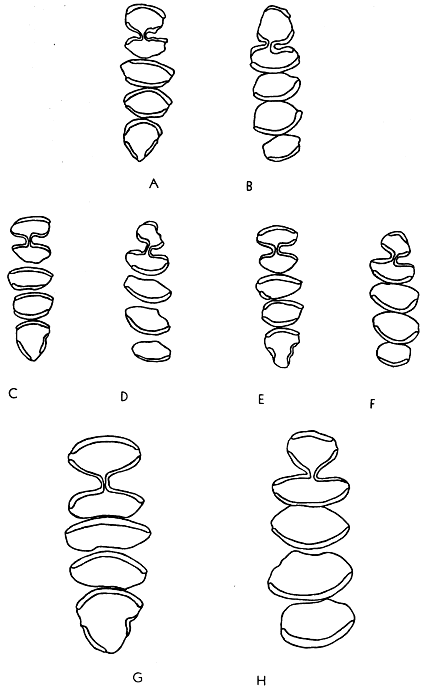
Fig. 9. Molariform dentitions of the Tribe Geomyini. Drawings illustrating enamel patterns characteristic of Geomys and Pappogeomys (including the subgenera Pappogeomys and Cratogeomys). × 5.
A and B. Geomys bursarius bursarius, adult female, No. 46275 (KU), Elk River, Sherborne Co., Minnesota. Left upper (A), P4-M3; right lower (B), p4-m3.
C and D. Subgenus Pappogeomys. Pappogeomys bulleri albinasus, adult female, No. 31002 (KU), W side La Venta, 13 mi. W and 4 mi. N Guadalajara, Jalisco. Left upper (C), P4-M3; right lower (D), p4-m3.
E and F. Subgenus Pappogeomys. Pappogeomys alcorni, adult female, No. 31051 (KU), holotype, 4 mi. W Mazamitla, 6600 ft., Jalisco. Left upper (E), P4-M3; right lower (F), p4-m3.
G and H. Subgenus Cratogeomys. Pappogeomys gymnurus tellus, adult female, No. 31051 (KU), 1 mi. NE Tala, 4400 ft., Jalisco. Left upper (G), P4-M3; right lower (H), p4-m3.
Loss of enamel is a trend common to all living genera of the tribe Geomyini, but the greatest loss has occurred in Cratogeomys. It has lost the plates on the posterior walls of M1 and M2 (Fig. 9G). If the lateral plates of M3 are considered as one functional plate and the lateral plates on either side of P4 together as two transverse plates, then, the transverse cutting blades in Cratogeomys number seven in the upper and seven in the lower cheek teeth compared with 10 in the upper and seven in the lower in the primitive morphotype. Indeed, in some species of the subgenus, one or both of the lateral plates on M3 is also lost, usually in old age, resulting in even greater reduction of enamel. Loss of enamel from the posterior walls of the upper molars may be associated with changes in the mechanics of mastication from anteroposterior planing to anterotransverse shearing, as discussed elsewhere. Merriam (1895:95-96) argues convincingly that the posterior cutting blades of the upper molars would hinder efficient shearing action of the teeth; hence, selection would favor their reduction and eventual loss. Changes in the shape of the skull also seem to be correlated with the shift from a planing to a shearing type of mastication. More efficient shearing action, which depends upon lateral movement of the jaw, can be developed if the functional muscles insert farther laterally than is possible in the generalized type of skull. Therefore, platycephalic specializations involved lateral expansion of the braincase and mandible. Pronounced lateral expansion has been developed only in the gymnurus group of species, suggesting that the dental specializations evolved earlier in the evolution of the subgenus than did the platycephalic specializations of the skull, and that the castanops group separated from the gymnurus group before the common ancestor had developed the more extreme trends in platycephaly. It is interesting to note that the subtriangular M3 (Fig. 9G) postulated for the ancestral morphotype and that characterizes the subgenus Pappogeomys is retained also in the gymnurus group.
LITERATURE CITED
Alston, E. R.
1876. On the classification of the order Glires. Proc. Zool. Soc. London, 1876:61-98, 1 pl., June.
Alvarez, T.
1964. Nota sobre restos oseos de mamiferos del Reciente, encontrados cerca de Tepeapulco, Hidalgo, Mexico. Publ. Inst. Nac. Antro, e Hist., 15:1-15.
1965. Catálago Paleomastozoológico Mexicano. Publ. Inst. Nac. Antro, e Hist., 17:1-70.
Axlerod, D. I.
1950. Studies in late Tertiary paleobotany. Carnegie Inst. Washington Publ., 590:1-322.
1958. Evolution of the Madro-tertiary geoflora. Bot. Rev., 24:433-509.
Bader, R. S., and Techter, D.
1959. A list and bibliography of the fossil mammals of Illinois. Nat. Hist. Misc., Chicago Acad. Sci., 172:1-8, October 30.
Baird, S. F.
1858. Mammals. Part I. General report upon the zoology of the several Pacific railroad routes. Repts., explorations and surveys for a railroad route from the Mississippi River to the Pacific Ocean. Washington, D. C., vol. 8, pp. xlviii + 757, 35 figs., 43 pls., July 14.
Barbour, H., and Schultz, C. B.
1937. An early Pleistocene fauna from Nebraska. Amer. Mus. Nat. Hist. Novit., 942:1-10, September 10.
Berry, E. W.
1937. Tertiary floras of North America. Bot. Rev., 3:31-46.
Black, C. C.
1961. Rodents and lagomorphs from the Miocene Fort Logan and Deep River Formations of Montana. Postilla, Yale Peabody Museum, 48:1-20, 6 figs., January 16.
Brandt, J. F.
1855. Beiträge zur mähern Kenntiss der Säugethiere Russlands. Acad. Imp. des Sciences St. Petersburg, 7:79-336, 11 pls.
Brown, B.
1908. The Conard fissure, a Pleistocene bone deposit in northern Arkansas with description of two genera & 20 new species of mammals. Mem. Amer. Mus. Nat. Hist., 9:157-208, 2 pls., 3 figs.
1912. Brachyostracon, a new genus of glyptodont from Mexico. Bull. Amer. Mus. Nat. Hist., 31:167-177, August 2.
Chaney, R. W.
1947. Tertiary centers and migration routes. Ecol. Monog., 17:139-148.
Cook, H. J., and Cook, M. C.
1933. Faunal lists of the Tertiary Vertebrata of Nebraska and adjacent areas. Nebraska Geol. Surv., Paper No. 5:49.
Cope, E. D.
1878. Description of new extinct Vertebrata from the upper Tertiary and Dakota formations. Bull. U. S. Geol. and Geog. Surv., 4:379-396.
1884. The White River and John Day faunae, pp. 759-1002, pl. 64, figs. 1-9. In The Vertebrata of the Tertiary formations of the west. Book I. Part second. Rept. U. S. Geol. Surv. Terr. (F. V. Hayden), vol. 3.
1889. The vertebrate fauna of the Equus beds. Amer. Nat., 23:160-165.
Coues, E.
1877. Monographs of North American Rodentia. No. 8, Saccomyinae, pp. 483-542, and No. 10, Geomyinae, pp. 601-629, pl. 7, August.
Dalquest, W. W.
1962a. A record of the giant bison (Bison latifrons) from Cooke County, Texas. Texas Jour. Sci., 13:41-44, March.
1962b. The Good Creek Formation of Texas, and its fauna. Jour. Paleont., 36:568-582.
1964. A new Pleistocene local fauna from Motley County, Texas. Trans. Kansas Acad. Sci., 67:499-505, 4 figs., December 11.
1965. New Pleistocene Formation and local fauna from Hardeman County, Texas. Jour. Paleont., 39:63-72, 2 figs., January.
Dice, L. R.
1925. Rodents and lagomorphs of the Rancho La Brea Deposits. Carnegie Inst. Washington Publ., 349:119-130.
Davis, W. B.
1937. Variations in Townsend pocket gophers. Jour. Mamm., 18:145-158, May 12.
Ellerman, J. R.
1940. The families and genera of living rodents. Vol. I. Rodents other than Muridae. British Museum (Nat. Hist.), London, pp. xxvi + 689, 189 figs., June 8.
Elliott, D. G.
1903. A list of mammals obtained by Edmund Heller from the coast region of northern California and Oregon. Field Columb. Mus. Publ., 76, zool. ser. vol. 3(11):175-197, July 25.
Elftman, H. O.
1931. Pleistocene mammals of Fossil Lake, Oregon, Amer. Mus. Novit., 481:1-21, 10 figs., July 14.
Franzen, D. S.
1947. The pocket gopher, Geomys quinni McGrew, in the Rexroad fauna, Blancan age, of southwestern Kansas. Trans. Kansas Acad. Sci., 50:55-59.
Freudenberg, W.
1921. Geologie von Mexiko. Berlin, pp. viii + 232.
Galbreath, E. C.
1848. An additional specimen of the rodent Dikkomys from the Miocene of Nebraska. Trans. Kansas Acad. Sci., 51:316-317.
Gazin, C. L.
1935. Annotated list of Pleistocene Mammalia from American Falls, Idaho, Jour. Washington Acad. Sci., 25:297-302.
1942. The late Cenozoic vertebrate fauna from the San Pedro Valley, Arizona. Proc. U. S. Nat. Mus., 92(3155):475:518, 2 pls., 9 figs.
Gervais, P.
1849. Rongeurs. In Dictionnaire universel d'historie naturelle, Dirigé par M Ch. d'Orbigny, Paris, M. M. Renard, Martinet et Cie, vol. 11:198-204.
Gidley, J. W.
1922. Preliminary report on fossil vertebrates of the San Pedro Valley, Arizona, with descriptions of new species of Rodentia and Lagomorpha. U. S. Geol. Surv. Prof. Papers, 131:119-130, pls. 34 and 35.
Gidley, J. W., and Gazin, C. L.
1933. New Mammalia in the Pleistocene fauna from Cumberland Cave. Jour. Mamm., 14:343-357, 9 figs.
Gill, T. H.
1872. Arrangement of the families of mammals with analytical tables. Smithsonian Misc. Coll., 11, art. 1, pp. vi + 98.
Gilmore, R. M.
1947. Report on a collection of mammal bones from archeologic cave-sites in Coahuila, Mexico. Jour. Mamm., 38:147-165, June 1.
Gray, J. E.
1868. Synopsis of the species Saccomyinae or pouched mice in the collection of the British Museum. Proc. Zool. Soc. London, 1868:199-206, May.
Green, M.
1956. The lower Pliocene Ogallala-Wolf Creek vertebrate fauna, South Dakota. Jour. Paleo., 30(1):146-169, 12 figs., January.
Gut, H. J., and Ray, C. E.
1963. The Pleistocene vertebrate fauna of Reddick, Florida. Quart. Jour. Florida Acad. Sci., 26:315-328.
Hall, E. R., and Kelson, K. R.
1959. The mammals of North America. 2 vols., xxx + 1083 pp., 553 figs., 500 maps, March 31.
Harris, A. H., and Findley, J. S.
1964. Pleistocene—Recent fauna of the Isleta Caves, Bernalillo County, New Mexico. Amer. Jour. Sci., 262:114-120, January.
Hay, O. P.
1920. Description of some Pleistocene vertebrates found in the United States. Proc. U. S. Nat. Mus., 57:83-146, 8 pls., 4 figs.
1921. Description of species of Pleistocene vertebrate types of specimens of most of which are preserved in the U. S. National Museum. Proc. U. S. Nat. Mus., 59:599-642.
1923. The Pleistocene of North America and its vertebrated animals from the states east of the Mississippi River and from the Canadian provinces east of longitude 95°. Carnegie Inst. Washington, Publ. 322: 1-499, February 24.
1924. The Pleistocene of the middle region of North America and its vertebrated animals. Carnegie Inst. Washington, Publ. 322A:1-346.
1927. The Pleistocene of the western region of North America and its vertebrate animals. Carnegie Inst. Wash., Publ. 322B, pp. v + 346, 12 pls., 21 maps, 10 text figs.
Hibbard, C. W.
1938. An Upper Pliocene fauna from Meade County, Kansas. Trans. Kansas Acad. Sci., 40:239-265, 5 pls., 2 figs.
1941a. The Borchers fauna, a new Pleistocene interglacial fauna from Meade County, Kansas. Bull. State Geol. Surv. Kansas, 38:197-220, 2 pls., July 14.
1941b. Mammals of the Rexroad Fauna from the Upper Pliocene of southwestern Kansas. Trans. Kansas Acad. Sci., 44:265-313, 4 pls.
1943. The Rezabek fauna, a new Pleistocene fauna from Lincoln County, Kansas. Univ. Kansas Sci. Bull., 29:235-247, October 15.
1944. Stratigraphy and vertebrate paleontology of Pleistocene deposits of southwestern Kansas. Geol. Soc. Amer. Bull., 55:707-754, 3 pls., 20 figs.
1950. Mammals of the Rexroad Formation from Fox Canyon, Meade County, Kansas. Univ. Michigan Paleo. Contrib., 8(6):113-192, 5 pls., 23 figs.
1951. Thomomys talpoides (Richardson) from a late Pleistocene deposit in Kansas. Jour. Mamm., 32:229-230.
1952. Vertebrate fossils from late Cenozoic deposits of central Kansas. Univ. Kans. Paleont. Contrib., Vertebrata, 2:1-14, March 20.
1953. The Saw Rock Canyon fauna and its stratigraphic significance. Papers Michigan Acad. Sci., Arts, and Letters, 38:387-411.
1954. A new Pliocene vertebrate fauna from Oklahoma. Papers Michigan Acad. Sci., Arts, Letters, 39:339-359.
1955a. Pleistocene vertebrates from the upper Bercerra (Bercerra Superior) Formation, valley of Tecquixquiac, Mexico, with notes on other Pleistocene forms. Contribution from Mus. Paleo., Univ. Michigan, 12:47-96, 9 pls., 5 figs., February 18.
1955b. The Jinglebob interglacial (Sangamon?) fauna from Kansas and its climatic significance. Contrib. Mus. Paleo., Univ. Michigan, 12: 179-228, 2 pls., 8 figs., September 1.
1956. Vertebrate fossils from the Meade Formation of southwestern Kansas. Papers Michigan Acad. Sci., Arts, and Letters, 41:145-200.
1958. Summary of North American Pliestocene mammalian local faunas. Papers of Michigan Acad. Sci., Arts, and Letters, 43:1-32.
1963. A late Illinoian fauna from southwestern Kansas and its climatic significance. Papers Michigan Acad. Sci., Arts and Letters, 48:187-221, 8 figs.
Hibbard, C. W., and Keenmon, K. A.
1950. New evidence of the Lower Miocene age of the Blacktail Deer Creek Formation in Montana. Contrib. Univ. Michigan Mus. Paleo., 8:193-204, 3 figs., 1 map, July 28.
Hibbard, C. W., and Mooser, O.
1963. A porcupine from the Pleistocene of Aguascalientes, Mexico. Contrib. Mus. Paleo. Univ. Michigan, 18:245-250, November 22.
Hibbard, C. W., Ray, D. E., Savage, D. E., Taylor, D. W., Guilday, G. E.
1965. Quaternary mammals of North America. In Quaternary of the United States. Eds. H. E. Wright, Jr., and D. G. Frey. Princeton Univ. Press, Princeton, pp. x + 922.
Hibbard, C. W., and Riggs, E.
1949. Upper Pliocene vertebrates from Keef Canyon, Meade County, Kansas. Geol. Soc. Amer. Bull., 60(5):829-860, 11 figs., 5 pls.
Hibbard, C. W., and Taylor, D. W.
1960. Two late Pleistocene faunas from southwestern Kansas. Contrib. Univ. Michigan Mus. Paleo., 16(1):1-223, 16 pls., 18 figs.
Hibbard, C. W., and Wilson, J. A.
1950. A new rodent from subsurface stratum in Bee County, Texas. Jour. Paleo., 24:621-623, September.
Hooper, E. T.
1946. Two genera of pocket gophers should be congeneric. Jour. Mamm., 27:397-399, November, 1965.
James, G. T.
1963. Paleontology and nonmarine stratigraphy of the Cuyama Valley Badlands, California. Part I. Geology, faunal interpretations, and systematic descriptions of Chiroptera, Insectivora, and Rodentia. Univ. California Publ. Geol. Sci., 45:iv + 170, 8 pls., 53 figs., June 26.
Johnson, C. S., and Savage, D. E.
1955. A survey of various Late Cenozoic vertebrate faunas of the Panhandle of Texas, Part I. Univ. California Publ. Geol. Sci., 31:27-50.
Kendeigh, C. S.
1961. Animal Ecology. Prentice Hall, Inc., Englewood Clifts, New Jersey, pp. x + 468.
Kurten, B.
1965. The Pleistocene Felidae of Florida. Bull. Florida State Mus., 9(6):215-273, June 8.
Leidy, J.
1869. The extinct mammalian fauna of Dakota and Nebraska—together with a synopsis of the mammalian remains of North America. Philadelphia, 472 pp., 30 pls.
MacDonald, J. R.
1963. The Miocene faunas from the Wounded Knee area of western North Dakota. Bull. Amer. Mus. Nat. Hist., 125:141-328, 30 figs., August 26.
Maldonado-Koerdell, M.
1948. Los vertebrados fosiles del Cuaternario en Mexico. Rev. Soc. Mex. Hist. Nat., 9:1-35, June.
Marsh, O. C.
1871. Notice of some new fossil mammals and birds from the Tertiary formations of the west. Amer. Jour. Sci. and Art, 3:120-127.
Matthew, W. D.
1899. A provisional classification of the fresh-water Tertiary of the West. Bull. Amer. Mus. Nat. Hist., 12:19-75, March 31.
1902. List of the Pleistocene fauna from Hay Springs, Nebraska. Bull. Amer. Mus. Nat. Hist., 16:317-322, September 25.
1909. Faunal lists of the Tertiary mammalia of the west. Bull. U. S. Geol. Surv., 361:91-138.
1910. Notes on the osteology and relationships of Paramys, and the affinities of the Ischyromyidae. Bull. Amer. Mus. Nat. Hist., 28: 43-72, 19 figs., March 22.
1923a. Fossil bones in the rock. The fossil quarry near Agate, Sioux County, Nebraska. Nat. Hist., 23:358-369.
1923b. The occurrence of the Hesperopithecus tooth. Amer. Mus. Novit., 53:11-13, January 6.
1924. Third Contribution to the Snake Creek Fauna. Bull. Amer. Mus. Nat. Hist., 50:59-210, July 3.
Matthew, W. D., and Cook, H. J.
1909. A Pliocene fauna from western Nebraska. Bull. Amer. Mus. Nat. Hist., 26:361-414.
Mayer-Oakes, W. J.
1959. A stratigraphic excavation at El Risco, Mexico. Proc. Amer. Phil. Soc., 103:332-373, June 15, 1959.
McGrew, P. O.
1944. An early Pleistocene (Blancan) fauna from Nebraska. Field Mus. Nat. Hist., Geol. Ser., 9(2):33-66, January 20.
Merriam, C. H.
1895. Monographic revision of the pocket gophers, family Geomyidae (exclusive of the species of Thomomys). N. Amer. Fauna, 8:1-258, 19 pls., 4 maps, 81 figs., January 31.
Miller, G. S., Jr., and Gidley, J. W.
1918. Synopsis of the supergeneric groups of rodents. Jour. Washington Acad. Sci., 8:431-448, July 19.
Miller, G. S., Jr., and Kellogg, R.
1955. List of North American Recent mammals. Bull. U. S. Nat. Mus., 205:xii + 954, March 3.
Mooser, O.
1959. La fauna "Cedazo" del Pleistoceno en Aguascalientes. An. Inst. Biol. Mex., 29(1 and 2):409-452, 29 figs.
Paulson, G. R.
1961. The mammals of the Cudahy fauna. Papers Michigan Acad. Sci., Arts, and Letters, 46:127-153.
Peters, W.
1874. Uber die Taschenmause und eine neue Art derselben, Heteromys adspersus, aus Panama. Monatsber. K. Acad. Wissensch. Berlin, pp. 354-359, 1 pl.
Ray, C. E.
1958. Additions to the Pleistocene mammalian fauna from Melbourne, Florida. Bull. Mus. Comp. Zool., 119:421-449, 5 figs., November.
Russell, R. J.
1960. Pleistocene pocket gophers from San Josecito Cave, Nuevo León, México. Univ. Kansas Publ., Mus. Nat. Hist., 9:539-548, January 14.
Savage, D. E.
1951. Late Cenozoic vertebrates of the San Francisco Bay Region. Univ. California Publ. Geol. Sci., 28:215-314, March 23.
Schultz, C. B., and Howard, E. B.
1935. The fauna of Burnet Cave, Guadalupe Mountains, New Mexico. Proc. Acad. Nat. Sci. Philadelphia, 87:273-298, 37 figs., 6 pls.
Schultz, C. B., Lueninghoener, G. C., and Frankforter, W. D.
1951. A graphic résumé of the Pleistocene of Nebraska. Bull. Univ. Nebraska State Mus., 3(6):1-41, July.
Schultz, C. B., and Stout, T. M.
1948. Pleistocene mammals and terraces in the Great Plains. Bull. Geol. Soc. Amer., 59:553-589, June.
Schultz, C. B., and Tanner, L. G.
1957. Medial Pleistocene fossil vertebrate localities in Nebraska. Univ. Nebraska State Mus., 4(4):59-81, September.
Schultz, G. E.
1965. Pleistocene vertebrates from the Butler Springs local fauna, Meade County, Kansas. Papers Michigan Acad. Sci., Arts, and Letters, 50:235-265.
Schultz, J. R.
1938. A late Quaternary mammal fauna from the tar seeps of McKittrick, California. Carnegie Inst. Washington Publ., 487:111-215, July 6.
Shotwell, J. A.
1956. Hemphillian mammalian assemblage from northeastern Oregon. Bull. Geol. Soc. Amer., 67:717-738, 7 figs., June.
1963. The Juntura Basin: studies in earth history and paleoecology. Mammalian fauna of the Drewsey Formation, Bartlett Mountains, Drinkwater and Otis Basin local faunas. Trans. Amer. Phil. Soc., n.s., 53(1):1-77, April.
Simpson, G. G.
1928. Pleistocene mammals from a cave in Citrus County, Florida. Amer. Mus. Novit., 328:1-4, October 26.
1929. Pleistocene Mammalian fauna of the Seminole Field, Pinellas County, Florida. Bull. Amer. Mus. Nat. Hist., 56:561-599.
1945. The principles of classification and a classification of mammals. Bull. Amer. Mus. Nat. Hist., 85: pp. xvi + 350, October 5.
1953. The major features of evolution. Columbia Univ. Press, New York, pp. xx + 434, 52 figs.
Sinclair, W. J.
1905. New Mammalia from the Quaternary caves of California. Bull. Dept Geol. Univ. California, 4:145-161, pls. 19 and 23.
Skinner, M. F.
1942. The fauna of Papago Springs Cave, Arizona. Bull. Amer. Mus. Nat. Hist., 80:143-220, November 6.
Slaughter, B. H., and Hoover, B. R.
1963. Sulphur River Formation and the Pleistocene mammals of the Ben Franklin local fauna. Jour. Grad. Resc. Center, 31(3):132-148, June.
Slaughter, B. H., and Ritchie, F.
1963. Pleistocene mammals of the Clear Creek local fauna, Denton County, Texas. Jour. Grad. Resc. Center, 31(3):117-131, June.
Starrett, A.
1956. Pleistocene mammals of the Berends fauna of Oklahoma. Jour. Paleo., 30:1187-1192.
Stephens, J. J.
1960. Stratigraphy and paleontology of a late Pleistocene Basin, Harper Co., Oklahoma. Bull. Geol. Soc. Amer., 71:1675-1702, November.
Strain, W. S.
1966. Blancan mammalian fauna and Pleistocene formations, Hudspeth County, Texas. Bull Texas Memorial Mus., 10:1-55, 8 figs., 13 pls., February.
Tamsitt, J. R.
1957. Peromyscus from the Late Pleistocene of Texas. The Texas Jour. Sci., 9(3):355-363, September.
Waterhouse, G. R.
1839. Observations on the Rodentia, with a view to point out the groups, as indicated by the structure of the crania, in this order of mammals. Mag. Nat. Hist., new series, 3:90-96, 184-188, 274-279, 593-600, 1 pl.
1841. Observations on the Rodentia. Ann. Mag. Nat. Hist., 8:81-84, pl. 2.
1848. A natural history of the mammalia. Vol. 2, containing the order Rodentia, or gnawing mammalia. Hippolyte Bailliere, London, 500 pp., 21 pls.
Waters, J. H.
1957. Second find of Thomomys talpoides from late Pleistocene in Kansas. Jour. Mamm., 37:540-542.
White, J. A., and Downs, T.
1961. A new Geomys from the Vallecito Creek Pleistocene of California, with notes on variation in Recent and fossil species. Contr. in Science, Los Angeles Co. Mus., 42:1-34, June 30.
Wilson, R. W.
1933a. Pleistocene mammalian fauna from the Carpinteria asphalt. Carnegie Inst. Washington Publ., 440:59-76, November.
1933b. A rodent fauna from the later Cenozoic beds of southwestern Idaho. Carnegie Inst. Washington Publ. 440:117-135, 8 figs., 2 pls., December.
1936. A Pliocene rodent fauna from Smith's Valley, Nevada. Carnegie Inst. Washington Publ., 473:15-34.
1937. Pliocene rodents of western North America. Carnegie Inst. Washington Publ. 487:21-73, July 23.
1940. Two new Eocene rodents from California. Carnegie Inst. Washington Publ., 514:85-95, June 27.
1949. Early Tertiary rodents of North America. Carnegie Inst. Washington Publ., 584:67-164, June 22.
Winge, H.
1924. Pattedyr-Slaegter. Vol. 2, Rodentia, Carnivora, Primates. H. Hagerups Forlag, Copenhagen, 321 pp.
Wood, A. E.
1935. Evolution and relationship of the heteromyid rodents. Ann. Carnegie Mus., 24:73-262, May 13.
1936. Geomyid rodents from the Middle Tertiary. Amer. Mus. Novit., 866:1-31, July 2.
1950. A new geomyid rodent from the Miocene of Montana. Ann. Carnegie Mus., 31:335-338, 1 fig.
1955. A Revised classification of rodents. Jour. Mamm., 36:165-187, May 26.
Wood, A. E., and Wilson, R. W.
1936. A suggested nomenclature for the cusps of the cheek teeth of rodents. Jour. Paleo., 10:388-391, 2 figs., July.
Transmitted May 29, 1967.

Transcriber's Notes
All obvious typographical errors were corrected. Minor changes were made to standardize the text to match the most prevalent form used.
Typographical Corrections
Page Correction
477 cumberlandicus => cumberlandius
535 breath => breadth