Front matter (continued 2)
Reading edition
Description.—Size small (alveolar length of mandibular tooth-row measuring 6.0 in holotype), about as in Thomomys monticola; upper incisor relatively broad and flat, having anterior face smooth, without trace of grooving; crowns of cheek teeth of medium height and rooted; enamel investment continuous and uninterrupted in all stages of wear; premolars permanently, biprismatic; P4 having anterior prism subtriangular and decidedly smaller that sub-crescentic posterior prism, and joined near centers by narrow, obliquely oriented isthmus; p4 having anterior prism subovate, posterior prism strongly compressed anteroposteriorly, and joined at mid-points by relatively broad and straight isthmus; first and second molars, both above and below, monoprismatic in final (?adult) stage of wear, derived ontogenetically from primitive bilophate pattern by coalescence of two columns into one; M1 and M2 mirror images of m1 and m2 in pre-final stages of wear, two columns first uniting at edge of protomeres forming U-pattern, and primitive H-pattern never developing in either series (for detailed description of stages of wear, see account of phylogeny, p. 546); m3 (M3 unknown, but probably with same form as in Geomyini, see p. 552) persistently biprismatic, two columns joined by relatively broad isthmus at centers, consequently, forming H-pattern of primitive ancestors; rostrum heavy and broad as in modern geomyids; palate narrow and strongly ribbed; mandible stout; masseteric ridge and fossa well developed; basitemporal fossa absent.
Specimens examined.—Six, nos. 1796 (holotype)—1799, 1804 and 1806 (CIT) now in the Los Angeles County Museum, all from Smiths Valley local fauna, Middle Pliocene, Nevada.
Referred species.—two:
*Pliosaccomys dubius Wilson, 1936. Carnegie Inst. Washington Publ., 743:20, May 21. Known from early and middle Pliocene faunas including Wolf Creek local fauna (late Clarendonian), Shannon County, South Dakota; McKay Reservoir local fauna and Otis Basin local fauna (Hemphillian), Oregon; type from Smiths Valley local fauna (probably middle Hemphillian), Lyon County, Nevada.
*Pliosaccomys wilsoni James, 1963. Univ. California Publ. Geol. Sci., 45:101, June 26. Type from Nettle Springs local fauna of late Clarendonian (early Pliocene), Ventura County, California.
Tribe Thomomyini, new tribe
Type.—Thomomys Wied-Neuwied, 1839.
Chronologic and geographic range.—Known from late Pliocene (early Blancan) to Recent. Known primarily from western North America from southern Canada south to Central México in Pliocene, Pleistocene and Recent and in middle and late Pleistocene of Maryland and Florida.
Diagnosis.—Size small to medium (basilar length exclusive of T. bulbivorus, measuring from approximately 24 to 45, including both males and females); upper incisors without grooving, excepting fine, indistinct sulcus rarely near inner margin (grooving more common in T. monticola than in other Recent species); crowns of cheek teeth high, rooted and ever-growing; all molars, including M3, monoprismatic and anteroposteriorly compressed, sometimes (especially in subadults) having slight inflection on labial side in upper teeth and lingual side in lower teeth; molars bicolumnar in pre-final stages of wear (seen in juvenal teeth only), patterns of wear in both upper and lower molars resembling those of Pliosaccomys, except that crowns of m3 and M3 unite into single column in final stages of wear; enamel pattern interrupted in all cheek teeth, loss occurring only at sides of each column; transverse enamel blade completely covering posterior face of both P4 and p4; all upper and lower molars with two transverse enamel blades, one on anterior surface and one on posterior surface, of each tooth, including M3; small third plate sometimes persistent on broad side of tooth, labial side in upper molars and lingual side in lower molars (T. bulbivorus); skull generalized, neither unusually narrow and deep or broad and flat; usually without marked cresting or rugosity; masseteric ridge well developed and massive; basitemporal fossa absent, sometimes shallow depression forming in T. townsendii; pelage soft, never harsh or hispid, covering body with thick coat of hair; forefoot exceptionally small for fossorial mammal, claws not especially long; body form remarkably fossorial.
The tribe Thomomyini is monotypic, including only the genus Thomomys.
Genus Thomomys Wied-Neuwied
1839. Thomomys Wied-Neuwied, Nova Acta Phys. Med. Acad. Caesar. Leop.-Carol., 19(1):377.
1836. Oryctomys Eydoux and Gervais (in part), Mag. de Zool., 6:20, pl. 21. Type: Oryctomys (Saccophorus) bottae, from coast of California, probably near Monterey.
1903. Megascapheus Elliot, Field Columb. Mus., Publ. 76, Zool. Ser., 3(11):190, July 25. Type: Diplostoma bulbivorum Richardson, from Columbia River, probably near Portland, Ore.
1933. Pleisothomomys Gidley and Gazin, Jour. Mamm. 14:354. Type: Pleisothomomys potomacensis Gidley and Gazin, from Pleistocene, Cumberland Cave local fauna, Allegany County, Maryland.
Chronologic range.—Known from late Pliocene to Recent.
Description.—Same as that given for the tribe Thomomyini above.
Discussion.—Features characterizing Thomomys and the tribe Thomomyini are more advanced than those characterizing the tribe Dikkomyini. Also, the Thomomyini retain more of the primitive features of the Geomyinae than do the more specialized tribe Geomyini.
Specializations are few, but include the third molar being a single column both above and below, enamel plates, and a masseteric ridge.
Key to the Subgenera of Thomomys
A Molars sub-crescent or ovate in cross-section, not becoming abruptly narrower at one end of tooth. Subgenus Pleisothomomys
p. 519
A´ Molars pear-shaped, not sub-crescent or ovate, in cross-section, crown becoming abruptly narrow at one end of tooth. Subgenus Thomomys
p. 520
Subgenus Pleisothomomys Gidley and Gazin
1933. Pleisothomomys Gidley and Gazin, Jour. Mamm., 14:354, November 13.
Type.—Pleisothomomys potomacensis Gidley and Gazin, 1933.
Chronologic range.—Late Pliocene (Hagerman local fauna, Idaho) to late Pleistocene. The latest records are from the fauna of Saber-tooth Cave, Florida, a late Pleistocene assemblage that probably was deposited in the Sangamon. The middle and late Pleistocene records are from the eastern United States, suggesting that the subgenus Pleisothomomys was restricted to that region while the subgenus Thomomys occupied the western United States and parts of Canada and México as it does today.
Description and Comparison.—Separated from subgenus Thomomys only on basis of sub-crescentic shaped molars (only jaw fragments and isolated teeth known), seemingly a primitive feature of the genus. This dental structure continued into the late Pleistocene; none of the Recent species expresses this feature of the molars, although the molars of Thomomys vetus of the late Pleistocene (Wisconsin deposits), referred to the subgenus Thomomys on the basis of its alleged relationship to Thomomys townsendii (see Davis, 1937:156-158), are less distinctly pear-shaped, and are more sub-crescentic, than in any other known species of the subgenus Thomomys. Pleisothomomys Gidley and Gazin (loc. cit.) was proposed as a genus but is here considered as of no more than subgeneric worth, and is recognized because of the apparent constancy of the sub-crescentic molars in the earlier members of the genus and in those populations of Thomomys occurring in Pleistocene times in the eastern United States.
Referred species.—Three (all extinct):
*Thomomys gidleyi Wilson, 1933. Carnegie Inst. Washington Publ. 440:122, December. Type from Hagerman beds, late Pliocene, Idaho.
*Thomomys potomacensis Gidley and Gazin, 1933. Jour. Mamm., 14:354, November 13. Type from Cumberland Cave, middle and late Pleistocene, Maryland.
*Thomomys orientalis Simpson, 1928. Amer. Mus. Novit., 328:6, October 26. Type from Saber-tooth Cave, late Pleistocene, Florida.
Subgenus Thomomys Wied-Neuwied
1839. Thomomys Wied-Neuwied, Nova Acta Phys.-Med. Acad. Caesar. Leop. Carol., 19(1):377.
1903. Megascapheus Elliot, Field Columb. Mus., Publ. 76, Zool. Ser., 3 (11):190, July 25. Type: Diplostoma bulbivorum Richardson, from Columbia River, probably near Portland, Oregon.
Type.—Thomomys rufescens Wied-Neuwied, 1839.
Chronologic range.—Early Pleistocene (Broadwater-Lisco local fauna, Nebraska) to Recent. Numerous records, mostly isolated teeth, from nearly all stratigraphic levels of the Pleistocene (for details, see account of fossil record).
Description.—Molars pear-shaped in cross-section, becoming abruptly narrow at one end of the tooth. The teeth of the late Pleistocene species Thomomys vetus are less distinctly pear-shaped than other referred species (see remarks in the description of the subgenus Pleisothomomys).
Essentially on the basis of its significantly larger size and details of the skull, Elliott (1903:190) proposed subgeneric recognition of Thomomys bulbivorus and described the subgenus Megascapheus to include it. Also the molars of Thomomys bulbivorus usually have a small enamel plate, both above and below, bordering the persistent inflection on the protomere end of the tooth; each lateral plate is isolated from the transverse plates on the anterior and posterior walls of the tooth. In my opinion these features do not warrant subgeneric recognition; however, these characters do distinctly separate Thomomys bulbivorus from other groups of species, and the character of the molars suggests retention of a primitive trait. Therefore, I propose that the unique structure of this species be recognized by setting it apart in the bulbivorus species-group.
Referred species.—Ten species, three extinct, placed in three species-groups (the numerous subspecies of this genus are listed in Miller and Kellogg, 1955:276-332, and Hall and Kelson, 1959:412-447).
bulbivorus species-group
Thomomys bulbivorus (Richardson, 1829). Fauna Boreali-Americana, 1:206. Type from Columbia River, probably near Portland, Oregon.
umbrinus species-group
*Thomomys scudderi Hay, 1921. Proc. U. S. Nat. Mus., 49:614. Type from Fossil Lake beds, late Pleistocene, Oregon.
Thomomys umbrinus (Richardson, 1829). Fauna Boreali-Americana, 1:202. Type from southern México, probably near Boca de Monte, Veracruz.
Thomomys bottae (Eydoux and Gervais, 1836). Mag. de Zool., Paris, 6:23. Type from coast of California, probably near Monterey.
*Thomomys vetus Davis, 1937. Jour. Mamm., 18:156, May 12. Type from Fossil Lake beds, late Pleistocene, Oregon.
Thomomys townsendii (Bachman, 1839). Jour. Acad. Nat. Sci. Philadelphia, 8:105. Type probably from near Nampa, Canyon Co., Idaho (erroneously given as "Columbia River").
talpoides species-group
*Thomomys microdon Sinclair, 1905. Bull. Dept. Geol. Univ. California, 4:145-161. Type from Potter Creek Cave, late Pleistocene, California.
Thomomys monticola J. A. Allen, 1893. Bull. Amer. Mus. Nat. Hist., 5:48, April 28. Type from Mt. Tallac, 7500 ft., El Dorado Co., California.
Thomomys talpoides (Richardson, 1828). Zool. Jour., 3:518. Type locality fixed at near Fort Carlton (Carlton House), Saskatchewan River, Saskatchewan, Canada.
Thomomys mazama Merriam, 1897. Proc. Biol. Soc. Washington, 11:214, July 15. Type from Anna Creek, 6000 ft., near Crater Lake, Mt. Mazama, Klamath Co., Washington.
Tribe Geomyini, new tribe
Genotype.—Geomys Rafinesque, 1817.
Chronologic and geographic range.—Known from late middle Pliocene deposits to Recent. The range of living members extends from extreme southern Manitoba and the southeastern United States south to southern Panamá, and probably northern Colombia, South America.
Diagnosis.—Size small to large (condylobasal length of skull 33.0 to 73.0 in adults, including both sexes); sexual dimorphism marked, sometimes strongly, females being smaller than males, especially in cranial dimensions; upper incisors invariably grooved, number and position of grooves varying according to genus; cheek teeth high-crowned and ever-growing, except in one primitive genus (Pliogeomys); all three lower molars and M1 and M2 monoprismatic, and elliptical in cross-section in final stages of wear (teeth of young, subadult, and adult animals); primitive biprismatic patterns (as known from Recent specimens) occurring only in pre-final stages of wear (teeth of juveniles only); biprismatic patterns of lower molars as in Dikkomys, and upper molars as in Pliosaccomys (for detailed description of these patterns, see account beyond of the phylogeny of the Geomyinae); m3 becoming monoprismatic, anteroposteriorly compressed and elliptical in cross-section like m1 and m2, but M3 remaining, with rare exceptions (see accounts of Geomys and Pappogeomys beyond), at least partially biprismatic throughout life, having one or both lateral inflections usually persisting (with exceptions) and developing various occlusal shapes (subtriangular, elongate, obcordate, suborbiculate, or quadriform) but never elliptical.
Enamel of cheek teeth reduced to interrupted plates, with exception of p4 in Pliogeomys; plate on posterior wall of P4 variable, occurring completely across posterior surface in primitive members, but progressively reduced to lingual side only or completely lost in modern genera (see generic accounts beyond for detailed description); both anterior and posterior plates usually retained in M1 and M2, posterior plate sometimes reduced to lingual side or completely lost (as in Pappogeomys) but anterior plate always completely retained; M3 usually having three plates, one anterior and two lateral; posterior plate wanting (sometimes lingual plate moved to posterior position); plates retained completely across posterior walls of all lower cheek teeth with no reduction, but anterior plates of m1-3 always lacking, except in primitive genus Pliogeomys (only Geomyini having both anterior and posterior enamel plates on lower molars).
Skull primitively generalized, but becoming specialized towards either dolichocephaly (Orthogeomys) or platycephaly (Pappogeomys) in two modern genera; skull highly specialized for fossorial life; mandible stout and deep, angular process being high and diverging laterally at right angles to ramus; masseteric ridge and fossa weakly developed in primitive members, becoming well developed and massive in modern genera; basitemporal fossa absent in primitive forms (Pliogeomys and early members of Zygogeomys); pelage usually soft, but harsh and hispid in some genera; forefeet broad and massive, claws long and stout for digging; body form remarkably fossorial.
The tribe Geomyini includes the most highly specialized members of the subfamily Geomyinae.
Key to the Genera of the Tribe Geomyini
A Cheek teeth rooted; p4 with uninterrupted enamel loop; enamel plates on both anterior and posterior walls of m1 and m2; masseteric ridge weakly developed, low, not massive. Genus Pliogeomys
p. 522
A´ Cheek teeth rootless, ever-growing; p4 with enamel investment interrupted at ends of columns, consequently, forming four isloted plates; enamel plate retained only on posterior wall of m1 and m2, anterior wall without trace of enamel (except rarely in pre-final stage of wear in Geomys tobinensis of middle Pleistocene); masseteric crest strongly developed and massive.
B Enamel plate on posterior wall of P4, but usually restricted to lingual end of tooth (usually absent in subgenus Orthogeomys of genus Orthogeomys); M3 conspicuously bicolumnar, longer than wide owing to elongation of posterior loph.
C Upper incisor bisulcate; skull generalized; rostrum relatively narrow; length of labial enamel plate of M3 decidedly less than length of lingual plate; pelage soft and thick. Genus Zygogeomys
p. 523
C´ Upper incisor unisulcate; skull strongly dolichocephalic; rostrum remarkably broad and massive; length of lingual plate of M3 approximately equal to, or greater than, length of labial plate; pelage harsh, often hispid and scant. Genus Orthogeomys
p. 528
B´ Posterior wall of P4 without trace of enamel; M3 not strongly bicolumnar, having shallow re-entrant fold on labial side, and crown no longer than wide owing to shortness of posterior loph.
D Upper incisor bisulcate; skull generalized; both anterior and posterior walls of M1 and M2 having complete enamel plates. Genus Geomys
p. 525
D´ Upper incisor unisulcate; skull generalized or tending towards platycephaly; enamel plate on posterior wall of M1 usually reduced to lingual side or absent (complete only in one species, Pappogeomys bulleri); enamel plate on posterior wall of M2 also absent in advanced species (subgenus Cratogeomys). Genus Pappogeomys
p. 532
Genus Pliogeomys Hibbard
1954. Pliogeomys Hibbard, Michigan Acad. Sci., Arts and Letters, 39:353.
Genotype.—Pliogeomys buisi Hibbard, 1954, from Buis Ranch local fauna (middle Pliocene), Beaver County, Oklahoma.
Chronologic range.—Latest Middle Pliocene, known only from the highest part of the Hemphillian mammalian fauna (Buis Ranch local fauna, Oklahoma). Professor Hibbard informs me (personal communication) that he found the type, a right ramus, lying on the surface near the base of the fossil beds. The isolated teeth of small geomyids from the Saw Rock Canyon local fauna (see Hibbard, 1953:392) may also be referable to this genus. The Saw Rock Canyon local fauna may also be middle Pliocene in age but is considered to be from the later part of the late Pliocene, and, therefore, somewhat younger than the Buis Ranch local fauna (Hibbard, op. cit.:342).
Description and discussion.—The size of members of this small genus of the Geomyinae is about the same as in smaller adults of Geomys bursarius. According to Hibbard (op. cit.:353), the holotype is smaller than specimens from the Rexroad local fauna referred to Geomys quinni and larger than specimens referred to Zygogeomys cf. minor. The cheek teeth are rooted, and the crowns are as high as those of living geomyids. The upper incisor is bisulcate, and the inner groove is fine and indistinct in places.
Of the molariform dentition only the lower premolar and first two lower molars are known. The enamel investment of p4 is complete, and would not be subject to interruption at any stage of wear; the two prisms are joined at their mid-points, and the isthmus of dentine is relatively broad (as in Pliosaccomys) when compared with modern pocket gophers of this tribe. Also, the re-entrant folds, rather than having parallel sides, diverge broadly to the sides. The divergence is especially noticeable in the labial fold. The lower deciduous premolar would have formed essentially the same enamel pattern with wear as observed in Nerterogeomys [= Zygogeomys] cf. minor (see Hibbard, 1954:fig. 5, A and B) and Pliosaccomys dubius (see Wilson, 1936; pl. 1, fig. 1). Each molar is a single column in the final stages of wear; pre-final stages are unknown. Anterior and posterior enamel plates are present on m1 and m2 (m3 has not been recovered). The dentine tracts of m1 are exposed over a relatively wide surface; therefore, the enamel plates are distinctly separated. The tracts of dentine of m2 are much narrower than in m1 and the enamel plates are barely separated at the anterolateral margin of the tooth. Possibly the enamel band of m2 was continuous in an earlier stage of wear.
The mandible is stout and its general construction not unlike that in modern geomyines. The capsule at the base of the angular process that receives the terminal end of the lower incisor is well developed. The base of the angular processes is preserved, and suggests that the process was short and decidedly smaller than in living examples of the tribe. The masseteric ridge is distinct but weakly developed, and not at all massive as in living pocket gophers. The mental foramen is immediately anterior, and slightly ventral, to the anterior extension of the crest. The basitemporal fossa is absent as such, but its position is marked by a slight depression.
Specimens examined.—Two rami; nos. 29147 (holotype) and 33446; several isolated teeth 30194 and 30195, including an upper incisor and a dp4 (deciduous lower premolar), all from Univ. Michigan Mus. Paleo.
Referred species.—One.
*Pliogeomys buisi Hibbard, 1954. Papers Michigan Acad. Sci., Arts, and Letters, 39:353. Type from Buis local fauna, latest middle Pliocene, Beaver County, Oklahoma.
Genus Zygogeomys Merriam
1895. Zygogeomys Merriam, N. Amer. Fauna, 8:195, January 31.
1942. Nerterogeomys Gazin, Proc. U. S. Nat. Mus., 92:507 (type, Geomys persimilis Hay, 1927).
Type.—Zygogeomys trichopus Merriam, 1895, from Nahuatzen, Michoacán.
Chronologic range.—Late Pliocene (Benson and Curtis Ranch local faunas, Arizona, and ?Rexroad Formation, Kansas) to Recent.
Description and discussion.—The size is small to medium for the subfamily Geomyinae. This genus is distinguished principally by the retention of primitive features. In the living species, the skull is generalized, rather than specialized toward either extreme dolichocephaly or platycephaly. The angular process is short, barely exceeding the lateral extensions of the mastoid process of the squamosal. The rostrum is remarkably narrow in relation to its length. The jugal is reduced and displaced ventrally, causing the maxillary arm of the zygomata to articulate with the squamosal arm of the zygomata along the dorsal border of the zygomatic arch (a feature observed also in Orthogeomys cherriei costaricensis).
The upper incisor, recovered in material from the late Pliocene and middle Pleistocene, is bisulcate as in the genus Geomys and the primitive genus Pliogeomys. The enamel plate across the posterior wall of P4 is either complete (late Pliocene to late Pleistocene) or restricted to the lingual half of the tooth (always restricted in living species). The Pliocene specimens of the Rexroad local fauna referred to Nerterogeomys cf. minor by Hibbard (1950:138-139) are exceptional. In these specimens the length and position of the posterior enamel plate is variable; however, all but one specimen had persistant enamel. Evidently, in approximately 43 per cent of the specimens, a complete enamel blade was present (see Paulson, 1961:139), and in the others (except the one without any enamel) the plate was restricted to a small area of the ventral surface, usually on the lingual side of the loph. Hibbard suggested that the decrease in size of the plate, and its restriction to the lingual side, may be a function of age. Hence, most adults would be characterized by the reduced posterior plate on the upper premolar. Although age may be the important factor, intragroup variation cannot be ruled out. It is of interest to note that in all specimens from the Benson (type series of P. minor) and Curtis Ranch local faunas, the former of late Pliocene age and the latter of middle Pleistocene age, the enamel plates are complete on the posterior face of the upper premolar. As mentioned before, the specimens from Kansas may actually represent the transitional stages of the early evolution of Geomys in which the posterior plate of P4 is entirely lost. The enamel pattern of p4 is like that in other members of the tribe (excepting the genus Pliogeomys). The re-entrant angles of P4 and p4 are widely open (obtuse) in the examples recovered from late Pliocene and middle Pleistocene deposits, representing retention of a trait that is primitive in the Geomyini (see account of phylogeny).
M1 and M2 are elliptical in cross-section and each has an enamel plate on both the anterior and posterior surface. In the living species (Z. trichopus), the posterior enamel plate fails to reach the labial margin of the tooth and is restricted to the lingual two-thirds of the posterior surface; however, the enamel plates are complete in the late Pliocene species (Z. minor) and the middle Pleistocene species (Z. persimilis), being only slightly separated from the anterior plate by narrow tracts of dentine on the ends of the tooth. M3 is partly biprismatic in the living species, the two incompletely divided lophs being separated by a distinct outer sulcus. The posterior loph is elongated and forms a conspicuous heel paralleling the evolution of this trait in the genus Orthogeomys; therefore, the crown is longer than wide. The posterior part of the tooth is protected by two lateral enamel plates; of the two, the lingual plate is especially long and extends to the end of the heel. M3 has not been recovered in the Pliocene species, but in the middle Pleistocene species (Z. persimilis) M3 is subtriangular, no longer than wide, and the lateral inflections are weakly developed. The trend towards elongation of M3 evidently occurred in late Pleistocene evolution of the genus. All three of the inferior molars are elliptical, and only the posterior enamel plate is present (as in all other genera of the tribe except Pliogeomys).
The masseteric ridge of the mandible is well developed. In the late Pliocene species Z. persimilis and Z. minor the mental foramen is directly beneath the anterior extension of the masseteric ridge, but in the living species, Z. trichopus, the foramen lies well anterior to the ridge. The basitemporal fossa in the living species is well developed and deep; in the Pliocene species it is usually distinct but shallow (late Pliocene specimens of Z. minor).
Referred species.—Three (two extinct and one living; the last has two subspecies):
*Zygogeomys minor (Gidley), 1922. U. S. Geol. Surv. Prof. Paper, 131:123, December 26. Type from Benson local fauna (late Pliocene), Cochise County, Arizona; also known from the Rexroad local fauna, Meade County, Kansas.
*Zygogeomys persimilis Hay, 1927. Carnegie Inst. Washington Publ., 136. Originally described by Gidley, 1922 (U. S. Geol. Surv. Prof. Papers, 131:123, December 26) as Geomys parvidens which was preoccupied by G. parvidens Brown, 1908. Type from Curtis Ranch local fauna (middle Pleistocene), Cochise County, Arizona.
Zygogeomys trichopus trichopus Merriam, 1895. N. Amer. Fauna, 8:196, January 31. Type from Nahuatzen, Michoacán.
Zygogeomys trichopus tarascensis Goldman, 1938. Proc. Biol. Soc. Washington, 51:211, December 23. Type from 6 mi. SE Pátzcuaro, 8,000 ft., Michoacán.
Genus Geomys Rafinesque
1817. Geomys Rafinesque, Amer. Monthly Mag., 2(1):45, November.
1817. Diplostoma Rafinesque, Amer. Monthly Mag., 2(1):44-45, November. Included species: Diplostoma fusca Rafinesque [= Mus bursarius Shaw] and Diplostoma alba Rafinesque [= Mus bursarius Shaw] from the Missouri River region.
1820. Saccophorus Kuhl, Beitr. Zool. und Vergl. Anat., pp. 65, 66. Type: Mus bursarius Shaw, from upper Mississippi Valley.
1823. Pseudostoma Say, Long's Expd. Rocky Mts., I, pp. 406. Type: Pseudostoma bursaria [= Mus bursarius Shaw], from upper Mississippi Valley.
1825. Ascomys Lichtenstein, Abh. K. Akad. Wiss. Berlin (1822), p. 20., fig. 2. Type: Ascomys canadensis Lichtenstein [= Mus bursarius Say], probably from upper Mississippi Valley.
1944. Parageomys Hibbard, Bull. Geol. Soc. Amer., 55:735, June. Type: Parageomys tobinensis Hibbard, from Pleistocene, Cudahy (Tobin) local fauna, Russell Co., Kansas.
Type.—Geomys pinetis Rafinesque, 1817, restricted to Screven County, Georgia, in region of the pines.
Chronologic range.—Late Pliocene faunas of Blancan age (Rexroad, Kansas, and Sand Draw, Nebraska, local faunas) to Recent. Reported from numerous Pleistocene deposits of all stratigraphic levels, especially from the Great Plains, where common today.
Description and discussion.—Pocket gophers of this genus are medium-sized geomyids; none is so small as the average-sized Thomomys. The skull is generalized and lacks the dolichocephalic and platycephalic specializations seen in the genera Orthogeomys and Pappogeomys, respectively. Geomys closely resembles Zygogeomys, but retains fewer of the primitive characters of the ancestral stock. At the same time, Geomys has several specializations. Even so, a considerable amount of parallelism is evident in the phyletic trends of the two genera.
The upper incisor of Geomys is bisulcate as in Pliogeomys and Zygogeomys; the deeper grove is medial and the shallower grove lies near the inner border of the tooth. The premolar, above and below, is bicolumnar; and two columns are joined at their mid-points (deep re-entrant angles separate the columns at the sides). A permanent enamel plate protects the anterior face of the anterior loph, and enamel bands outline each of the re-entrant folds. In p4 a complete enamel plate covers the posterior surface of the posterior loph. All of the enamel bands are interrupted by tracts of dentine, except in the initial stages of wear of the occlusal surface of the newly erupted tooth. For a short time in living Geomys, the enamel bands are continuous as observed in juveniles of Geomys bursarius major (KU 5628, 8531, and 41540). But, the enamel cap is thin and the dentine tracts, which are high on the sides of the tooth, are soon revealed by a minimum of wear on the crown. Therefore, the adult, or final, pattern characterized by interrupted enamel plates emerges early in life and remains throughout the life of the individual. Evidence from fossil Geomys, especially from specimens from early and late Pleistocene deposits, suggests that the final adult pattern appears later, ontogenetically, than in Recent specimens. Some of the fossil premolars in initial stages of wear have continuous and uninterrupted bands of enamel. Geomys quinni of the late Pliocene and early Pleistocene has the interrupted pattern seen in late Pleistocene and Recent Geomys. Also, in late Pliocene and early Pleistocene species, the re-entrant folds diverge laterally and form "open" angles. In later taxa (middle Pleistocene to Recent) the folds are compressed and parallel-sided, and the "open" folds are found only in the early stages of wear.
The posterior enamel plate of P4 disappears in the final stages of wear as the interrupted enamel pattern is formed. In the late Pleistocene and Recent Geomys, the loss of the posterior plate occurs early in life, usually in the first phases of wear on the occlusal surface of the newly erupted tooth, but in fossils of Geomys of corresponding ontogenetic age from the early and middle Pleistocene, the posterior plate is retained in some individuals until a later phase of wear, thereby delaying the appearance of the final pattern. Indeed, in five or fewer per cent of the individuals (see Paulson, 1961:138-139; and White and Downs, 1961:18) a vestige of enamel is retained throughout life or at least until late in adulthood. In Geomys tobinensis, for example, a thin, but transversely complete, plate of enamel occurs all the way down to the base of the loph (Paulson, loc. cit.) and would persist throughout life. In Geomys garbanii, a vestige on the lingual side of the posterior surface of a fully adult specimen was noted by White and Downs (loc. cit.). Vestiges of the posterior plate occur less frequently in living geomyids. Paulson (loc. cit.) found a posterior plate in one of 75 specimens of Geomys bursarius dutcheri. A young (suture present between exoccipitals and supraoccipital) female of Geomys pinetis austrinus (KU 23358) has a vestige of the posterior plate on the lingual side of the tooth as White and Downs (loc. cit.) observed in a specimen of Geomys garbanii. The enamel, I suspect, tends to be thicker on the lingual than on the labial side of the loph and extends farther down the lingual surface in some individuals; therefore, wear on the occlusal surface erodes it down to the dentine more rapidly on the labial than on the lingual side. The tendency of enamel to be retained is a primitive feature.
A lower molar of Geomys is a single elliptical column, and enamel is restricted to the posterior surface as in Zygogeomys, Orthogeomys, and Pappogeomys. Paulson (loc. cit.) found a thin enamel plate on the anterior surfaces of the lower molars in about five per cent of the individuals of Geomys tobinensis from the Cudahy local fauna (middle Pleistocene, deposits of the late Kansan glaciation). An anterior plate is unknown in other members of the tribe Geomyini, except in the primitive genus Pliogeomys of the middle Pliocene. Occurrence of the plate in Geomys tobinensis is an atavistic trait. Primitive dental patterns occur occasionally in geomyids, as pointed out above, but the frequency of occurrence in G. tobinensis is higher than would be expected.
M1 and M2, like the lower molars, are elliptical in cross-section. Complete enamel plates on the anterior and posterior surfaces are separated by tracts of dentine on the sides of each tooth. M3 is usually suborbicular (sometimes subtriangular) in cross-section. The tooth is not especially elongated posteriorly and usually has no definite heel; therefore, it is not significantly longer than wide. Living species of Geomys rarely have a well defined outer re-entrant fold on M3; less than 10 per cent of the individuals (and usually only one side in each individual in which it occurs) have it, although a shallow inconspicuous groove occurs more frequently. The biprismatic molar characteristic of the ancestral morphotype is less often found in Geomys than in any other living member of the tribe Geomyini. The outer re-entrant fold and biprismatic pattern are more often present in the extinct species Geomys garbanii of the Middle Pleistocene than in other species. Less than 24 per cent of the third upper molars in Geomys garbanii lack a tract of the re-entrant fold and more than 38 per cent have a well developed outer fold (see White and Downs, 1961:13, 18). The bicolumnar pattern, although incomplete, would be clearly evident in those teeth having a well marked re-entrant fold; the pattern occurs less frequently in those teeth with no fold or only a slight one. M3 of geomyids is not usually recovered and, therefore, the occlusal pattern of M3 is unknown in most extinct kinds of Geomys. In Recent Geomys the fold is more common in the eastern pinetis species-group than in the western bursarius species-group.
The masseteric ridge on the outer side of the mandible is well developed in all species of the genus. The position of the mental foramen relative to the anterior part of the ridge varies with individuals and according to species. The basitemporal fossa is always present, but is shallower in the late Pliocene and Pleistocene species than in Recent species. The angular process is short.
Referred species.—The twelve species, five of which are extinct, are as follows:
quinni species-group
*Geomys quinni McGrew, 1944. Geol. Ser., Field Mus. Nat. Hist., 9 (546):49, January 20. Type from Sand Draw local fauna (late Pliocene), Brown County, Nebraska; also known from Broadwater-Lisco local faunas (early Pleistocene), Morrill and Garden counties, Nebraska, Deer Park local fauna (early Pleistocene), Meade County, Kansas.
*Geomys paenebursarius Strain, 1966. Bull. Texas Memorial Mus., 10:36. Type from Hudspeth local fauna (early Pleistocene), Hudspeth County, Texas.
*Geomys tobinensis Hibbard, 1944. Bull. Geol. Soc. Amer., 55:736. Type from Tobin local fauna (middle Pleistocene), Russell County, Kansas; also known from Cudahy local fauna (middle Pleistocene), Meade County, Kansas.
*Geomys garbanii White and Downs, 1961. Contrib. Sci., Los Angeles Co. Mus., 42:1-34, June 30. Type from Vallecito Creek local fauna (middle Pleistocene), San Diego County, California.
*Geomys bisulcatus Marsh, 1871. Amer. Jour. Sci., 3:121. Type from Loup River fossil beds, near Camp Thomas, Nebraska (probably late Pleistocene).
bursarius species-group
*Geomys parvidens Brown, 1908. Mem. Amer. Mus. Nat. Hist., 9:194. (An extinct subspecies of Geomys bursarius according to White and Downs, 1961:6). Type from Conard Fissure local fauna (late Pleistocene), northern Arkansas.
Geomys bursarius (Shaw, 1800). Trans. Linn. Soc. London, 5:227. Type from somewhere in Upper Mississippi Valley, North America.
Geomys arenarius Merriam, 1895. N. Amer. Fauna, 8:139, January 31. Type from El Paso, El Paso County, Texas.
Geomys personatus True, 1889. Proc. U. S. Nat. Mus., 11:159, January 5. Type from Padre Island, Cameron County, Texas.
pinetis species-group
Geomys pinetis Rafinesque, 1806. Amer. Monthly Mag., 2 (1):45, November. Type locality restricted to Screven County, Georgia.
Geomys colonus Bangs, 1898. Proc. Boston Soc. Nat. Hist., 28:178, March. Type from Arnot Plantation, about 4 mi. W St. Marys, Camden County, Georgia.
Geomys cumberlandius Bangs, 1898. Proc. Boston Soc. Nat. Hist., 28:180, March. Type from Stafford Place, Cumberland Island, Camden County, Georgia.
Geomys fontanelus Sherman, 1940. Jour. Mamm., 21:341, August 13. Type from 7 mi. NW Savannah, Chatham County, Georgia.
Genus Orthogeomys Merriam
1895. Orthogeomys Merriam, N. Amer. Fauna 8:172, January 31.
1895. Heterogeomys Merriam, N. Amer. Fauna 8:179, January 31 (type, Geomys hispidus Le Conte, 1862).
1895. Macrogeomys Merriam, N. Amer. Fauna 8:185, January 31 (type, Geomys heterodus Peters, 1865).
Type.—Geomys scalops Thomas, 1894, from Tehuantepec, Oaxaca, México.
Chronologic range.—Late Pleistocene Wisconsin deposits (San Josecito Cave local fauna, Nuevo León, México) to Recent.
Description and discussion.—Species of this genus are of medium to large size. The skull is strongly dolichocephalic in most species; the posterior part of the skull is especially narrow. The angular processes are remarkably short, especially in relation to the length of the mandible. The nasals and rostrum are relatively broad and heavy. The pelage is coarse, and often hispid. In some species the hairs are so sparsely distributed that the body appears almost naked, and none has so dense a covering of hair as do other genera. The genus occurs entirely within the tropical life-zones, and most of the external features seem to be associated with adaptation to tropical conditions.
The upper incisor is unisulcate; the sulcus is usually near the inner border of the tooth, but in some species (subgenus Orthogeomys) it is more medial, and in a few individuals with an extremely wide groove the outer lip of the sulcus may actually reach the middle of the tooth. The groove is compressed or open. The premolar is a double column united at the mid-point. The two prisms are of approximately equal size, and the lateral re-entrant folds are so compressed that their sides are parallel. Enamel plates cover the anterior surface and border the re-entrant angles in both upper and lower premolars. As in other members of the tribe, the lower premolar has a fourth enamel plate on the posterior surface of the posterior lophid. In the upper premolar, the enamel plate is reduced to a narrow blade on the lingual side of the loph as in the living species of the genus Zygogeomys. In the subgenus Orthogeomys the posterior plate is usually absent, and otherwise is narrow and near the lingual border of the tooth.
Each lower molar, in the final stage of wear, consists of a single elliptical column having an enamel plate only on the posterior surface. The first and second upper molars are single elliptical columns having one enamel plate on the anterior surface and another on the posterior surface. The plates are separated by a tract of dentine on each side of the tooth. The third upper molar is partly bilophodont, and the two lophs are separated by a deep outer re-entrant fold. In many of the species an inner re-entrant fold also is retained, but in the adult tooth it is less distinct than the outer. In all of the species the posterior loph is long and forms a conspicuous heel; consequently the crown is significantly longer then wide. Moreover, the posterior loph has an enamel plate on each side. The labial plate always borders the outer re-entrant fold, and in the subgenus Orthogeomys is infrequently separated into two small plates.
The mandible is relatively long. Its masseteric ridge is well developed and massive. The basitemporal fossa is usually deep and well defined; it tends to be shallow in the subgenus Orthogeomys, and in young individuals is hardly more than a slight depression.
Key to the Subgenera of Orthogeomys
A Frontal wide and greatly inflated; no interorbital constriction; enamel plate on posterior wall of P4 usually absent, although sometimes having small plate, restricted to lingual end of wall. Subgenus Orthogeomys
p. 529
A´ Frontal narrow and not greatly inflated; interorbital region decidedly constricted; enamel plate on posterior wall of P4 always present but short and restricted to lingual end of wall.
B Anterior margin of mesopterygoid fossa even with plane of posterior wall of M3; postorbital bar weakly developed; anteroposterior occlusal length of M3 equal to, or less than, combined length of M1 and M2. Subgenus Heterogeomys
p. 530
B´ Anterior margin of mesopterygoid fossa decidedly behind plane of posterior wall of M3; postorbital bar strongly developed; anteroposterior occlusal length of M3 more than combined length of M1 and M2. Subgenus Macrogeomys
p. 531
Subgenus Orthogeomys Merriam
1895. Orthogeomys Merriam, N. Amer. Fauna, 8:172, January 31.
Type.—Geomys scalops Thomas, 1894, from Tehuantepec, Oaxaca, México.
Chronologic range.—Known only from the Recent.
Description.—Skull elongated and narrow (many skulls of nearly uniform breadth throughout), being extreme in dolichocephalic specializations; mandibles long and narrow, rami not spreading laterally, being more nearly parallel-sided than in other subgenera; angular processes short; breadth across zygomata not significantly exceeding breadth across mastoid processes (in many skulls considerably less); interorbital area remarkably broad, lacking deep constriction; frontals between orbits greatly inflated laterally, postorbital prominence inconspicuous; mesopterygoid fossa extending to level of posterior margin of M3; I having sulcus broader than in other subgenera, mostly on inner half of anterior surface but sometimes overlapping mid-line; enamel plate lacking from posterior wall of P4, rarely retaining narrow vestige near lingual border of posterior loph; M3 having distinct heel, bicolumnar pattern with inner re-entrant fold usually minute, occlusal length less than in other subgenera, length less than combined lengths of M1-2; hair generally coarse, sometimes hispid, sparse, in lowland forms, so sparse as to impart appearance of nakedness.
Referred species and subspecies.—Fourteen taxa:
Orthogeomys grandis alleni Nelson and Goldman, 1930. Jour. Mamm., 11:156, May 9. Type from near Acapulco, 2000 ft., Guerrero.
Orthogeomys grandis annexus Nelson and Goldman, 1933. Proc. Biol. Soc. Washington, 46:195, October 26. Type from Tuxtla Gutierrez, 2600 ft., Chiapas.
Orthogeomys grandis carbo Goodwin, 1956. Amer. Mus. Novit., 1757:5, March 8. Type from Excurano, 2500 ft., Cerro de San Pedro, 20 km. W Mixtequilla, Oaxaca.
Orthogeomys grandis felipensis Nelson and Goldman, 1930. Jour. Mamm., 11:157, May 9. Type from Cerro San Felipe, 10 mi. N Oaxaca, Oaxaca.
Orthogeomys grandis huixtlae Villa, 1944. Anal. Inst. Biol. Univ. Nac. México, 15:319. Type from Finca Lubeca, 12 km. NE Huixtla, 850 m., Chiapas.
Orthogeomys grandis grandis (Thomas, 1893). Ann. Mag. Nat. Hist., ser. 6, 12:270, October. Type from Dueñas, Guatemala.
Orthogeomys grandis latifrons Merriam, 1895. N. Amer. Fauna, 8:178, January 31. Type from Guatemala, exact locality unknown.
Orthogeomys grandis nelsoni Merriam, 1895. N. Amer. Fauna, 8:176, January 31. Type from Mt. Zempoaltepec, 8000 ft., Oaxaca.
Orthogeomys grandis pluto Lawrence, 1933. Proc. New England Zool. Club, 13:66, May 8. Type from Cerro Cantoral, north of Tegucigalpa, Honduras.
Orthogeomys grandis scalops (Thomas, 1894). Ann. Mag. Nat. Hist., ser. 6, 13:437, May. Type from Tehuantepec, Oaxaca.
Orthogeomys grandis soconuscensis Villa, 1949. Anal. Inst. Biol. Univ. Nac. México, 19:267, April 8. Type from Finca Experanza, 710 m., 45 km. (by road) NW Huixtla, Chiapas.
Orthogeomys grandis guerrerensis Nelson and Goldman, 1930. Jour. Mamm., 11:158, May 9. Type from El Limón, in valley of Río de las Balsas approximately 20 mi. NW La Unión, Guerrero.
Orthogeomys cuniculus Elliot, 1905. Proc. Biol. Soc. Washington, 18:234, December 9. Type from Zanatepec, Oaxaca.
Orthogeomys pygacanthus Dickey, 1928. Proc. Biol. Soc. Washington, 41:9, February 1. Type from Cacaguatique, 3500 ft., Dept. San Miguel, El Salvador.
Subgenus Heterogeomys Merriam
1895. Heterogeomys Merriam, N. Amer. Fauna, 8:179, January 21.
Type.—Geomys hispidus Le Conte, 1852, from near Jalapa, Veracruz.
Chronologic range.—Late Pleistocene, Wisconsin deposits (San Josecito Cave local fauna, Nuevo León) to the Recent.
Description.—Skull dolichocephalic (less so than in the other subgenera); zygomata more widely spreading than in Orthogeomys; ramus and angular process short; interorbital area noticeably constricted; frontals between orbits neither exceptionally broad or inflated; mesopterygoid fossa extending to level of posterior margin of M3; I having sulcus on inner third of anterior surface usually narrower than in subgenus Orthogeomys; enamel plate on posterior wall of P4 restricted to lingual half of loph; M3 distinctly biprismatic, posterior loph usually circumscribed by shallow inner re-entrant fold and outer deep fold well developed in all members of genus; posterior loph forming conspicuous heel longer than in subgenus Orthogeomys; occlusal length equal to or slightly less than combined lengths of M1-2; hair coarse and hispid but never so sparse as to impart appearance of nakedness.
Referred species and subspecies.—Eleven taxa:
*Orthogeomys onerosus (Russell, 1960). Univ. Kansas Publ., Mus. Nat. Hist., 9 (21):544, January 14. Type from San Josecito Cave local fauna, Upper Pleistocene, Nuevo León.
Orthogeomys hispidus cayoensis (Burt, 1937). Occ. Papers Mus. Zool., Univ. Michigan, 365:1, December 16. Type from Mountain Pine Ridge, 12 mi. S El Cayo, British Honduras.
Orthogeomys hispidus chiapensis (Nelson and Goldman, 1929). Proc. Bio. Soc. Washington, 42:151, March 30. Type from Tenejapa, 16 mi. NE San Cristobal, Chiapas.
Orthogeomys hispidus concavas (Nelson and Goldman, 1929). Proc. Biol. Soc. Washington, 42:148, March 30. Type from Pinal de Amoles, Querétaro.
Orthogeomys hispidus hispidus (Le Conte, 1852). Proc. Acad. Nat. Sci. Philadelphia, 6:158. Type from near Jalapa, Veracruz.
Orthogeomys hispidus latirostris (Hall and Alvarez, 1961). Anal. Escuela Nac. Ciencias Biol., 10:121, December 20. Type from Hacienda Tamiahua, Cabo Rojo, Veracruz.
Orthogeomys hispidus negatus (Goodwin, 1953). Amer. Mus. Novit., 1620:1, May 4. Type from Gomez Ferias, 1300 ft., about 45 mi. S Ciudad Victoria, 10 km. W Pan American Highway, Tamaulipas.
Orthogeomys hispidus tehuantepecus (Goldman, 1939). Jour. Washington Acad. Sci., 29:174, April 15. Type from mountains 12 mi. NW Santo Domingo and about 60 mi. N Tehuantepec, 1600 ft., Oaxaca.
Orthogeomys hispidus torridas (Merriam, 1895). N. Amer. Fauna, 8:183, January 31. Type from Chichicaxtle, Veracruz.
Orthogeomys hispidus yucatanensis (Nelson and Goldman, 1929). Proc. Biol. Soc. Washington, 42:150, March 30. Type from Campeche, Campeche.
Orthogeomys lanius (Elliot, 1905). Proc. Biol. Soc. Washington, 18:235, December 9. Type from Xuchil, Veracruz.
Subgenus Macrogeomys Merriam
1895. Macrogeomys Merriam, N. Amer. Fauna, 8:185, January 31.
Type.—Geomys heterodus Peters, 1865, from Costa Rica, exact locality unknown.
Chronologic range.—Known only from the Recent.
Description.—Skull dolichocephalic in varying degree (overlapping subgenera Orthogeomys and Heterogeomys in this respect); mandibles elongated, not spreading far laterally; angular processes decidedly short; breadth across zygomata in no instance significantly exceeding mastoid breadth; interorbital area strongly constricted; frontals between orbits slightly inflated laterally (especially in forms having more strongly dolichocephalic skulls); postorbital prominence conspicuous; anterior margin of mesopterygoid fossa terminating well behind M3; I having narrow and deep sulcus entirely on inner third of anterior surface; enamel plate on posterior wall of P4 restricted to inner half of loph; M3 bilophodont (outer and inner re-entrant folds each circumscribing a loph), posterior loph remarkably elongated and forming pronounced heel, length of crown more than combined lengths of M1-2; hair wooly in some individuals, harsh in others but seldom hispid, never so sparse as in subgenus Orthogeomys; some species having white markings, especially on lumbar region and head.
Referred species and subspecies.—Eleven taxa:
Orthogeomys heterodus cartagoensis (Goodwin, 1943). Amer. Mus. Novit., 1227:2, April 22. Type from Paso Ancho, Province Cartago, Costa Rica.
Orthogeomys heterodus dolichocephalus (Merriam, 1895). N. Amer. Fauna, 8:189, January 31. Type from San José, Costa Rica.
Orthogeomys heterodus heterodus (Peters, 1865). Monatsb. preuss. Acad. Wiss., Berlin, 1865:177. Type from Costa Rica, exact locality unknown.
Orthogeomys cavator nigrescens (Goodwin, 1943). Amer. Mus. Novit., 1227:3, April 22. Type from El Muneco (Río Navarro), 10 mi. S Cartago, 4000 ft., Province Cartago, Costa Rica.
Orthogeomys cavator pansa (Bangs, 1902). Bull. Mus. Comp. Zool., 39:44, April. Type from Bogava (= Bugaba), 600 ft., Chiriquí, Panamá.
Orthogeomys dariensis (Goldman, 1912). Smithsonian Misc. Coll., 60(2):8, September 20. Type from Cana, 2000 ft., mountains of eastern Panamá.
Orthogeomys underwoodi (Osgood, 1931). Field Mus. Nat. Hist., Publ. 295, Zool. Ser., 185:143, Aug. 3. Type from Alto de Jabillo Pirris, between San Geronimo and Pozo Azul, western Costa Rica.
Orthogeomys cherriei carlosensis (Goodwin, 1943). Amer. Mus. Novit., 1227:3, April 22. Type from Cataratos, San Carlos, Alajuela, Costa Rica.
Orthogeomys cherriei cherriei (J. A. Allen, 1893). Bull. Amer. Mus. Nat. Hist., 5:337, December 16. Type from Santa Clara, Costa Rica.
Orthogeomys cherriei costaricensis (Merriam, 1895). N. Amer. Fauna, 8:192, January 31. Type from Pacuare, Costa Rica.
Orthogeomys matagalpae (J. A. Allen, 1910). Bull. Amer. Mus. Nat. Hist., 28:97, April 30. Type from Peña Blanca, Matagalpa, Nicaragua.
Genus Pappogeomys Merriam
1895. Pappogeomys Merriam, N. Amer. Fauna, 8:145, January 31.
1895. Cratogeomys Merriam, N. Amer. Fauna, 8:150, January 31. Type: Geomys merriami Thomas.
1895. Platygeomys Merriam, N. Amer. Fauna, 8:162, January 31. Type: Geomys gymnurus Merriam; Hooper, Jour. Mamm., 27:397, November 25, 1946.
Type.—Geomys bulleri Thomas, 1892, from near Talpa, west slope Sierra de Mascota, 8500 ft. (actually about 5000 ft.), Jalisco.
Chronologic range.—Late Pliocene, from deposits of early Blancan age (Benson local fauna, Arizona) to the Recent. However in the Pleistocene, only late Pleistocene records are known, and Pappogeomys has not been found in early (late Blancan) or middle (Irvingtonian) Pleistocene local faunas. Presumably the genus was restricted to México during the Pleistocene until post-Wisconsin time.
Description and discussion.—The size ranges from as little as in the smaller kinds of Thomomys to the maximum attained in the subfamily and matched elsewhere perhaps in only a few of the larger subspecies of Orthogeomys grandis. Depending on the species and subgenus, the form of the skull varies from generalized to specialized. The generalized skulls are short and not especially narrow; the zygomatic arches are spread laterally so far that the breadth across them exceeds the breadth across the mastoid processes. The most specialized skulls are platycephalic and the breadth across the mastoid processes equals or exceeds the breadth across the zygomatic arches (even so, the zygomatic arches are still relatively widespread). In correlation with the great breadth of the posterior part of the cranium, the rami of the mandibles diverge widely posteriolaterally and the angular processes are remarkably elongated. The rostrum is moderately broad in most species, but not nearly so broad and heavy as in Orthogeomys.
The single deep, median sulcus on the outer surface of the upper incisor is slightly displaced to the inner side of the tooth. The posterior surface of P4 lacks enamel (small vestige found on lingual end of posterior wall in only two adult individuals—UA 3260 and KU 100442, of the subgenus Pappogeomys); the other three plates are fully developed as usual. The p4 is provided with four fully developed enamel plates, in the pattern characteristic of the tribe Geomyini. In the p4 of the late Pliocene species (P. bensoni) the re-entrant angles are open (obtuse), a trait that is evidently primitive in the Geomyini.
All three lower molars are single, compressed, elliptical columns with enamel on only the posterior surfaces. M1 and M2 are also elliptical in cross-section and decidedly anteroposteriorly compressed, like the lower molars. Nevertheless, the enamel pattern is variable; enamel plates may be retained completely across both the anterior and posterior walls of M1 and M2 or only the anterior plate may be retained without reduction and the posterior plate may be reduced so that only a vestige is retained on the lingual fourth of the tooth or the posterior plate may be completely lost.
M3 tends to remain at least incompletely bilophodont by reason of retaining a permanent labial re-entrant fold in most species (with exceptions in Pappogeomys bulleri and some old adults of P. castanops). Primitively the occlusal surface of M3 is subtriangular (subgenus Pappogeomys), but in the castanops species-group of the advanced subgenus Cratogeomys, the posterior loph usually is reduced and the occlusal surface is quadriform or obcordate. Curiously, the trend towards reduction of the posterior loph is reversed in one subspecies (P. merriami fulvescens) and, the loph has elongated into a pronounced heel in some specimens, resembling the condition in Orthogeomys. The entire range of variation occurs in P. m. fulvescens. The subtriangular pattern is retained in the most specialized species of Cratogeomys where that pattern is associated with extreme platycephaly in the gymnurus species-group. In most species the posterior loph supports two lateral plates, the outer one always bordering the labial re-entrant fold. In Pappogeomys bulleri and in the castanops species-group, the outer re-entrant fold of M3 tends to be obsolete, and the tooth becomes quadriform or suborbiculate in some individuals and loses the bilophodont pattern that characterizes other species. The lingual enamel plate is displaced to the posterior surface of the tooth, and one or both plates may disappear with advancing age. Consequently, only the anterior enamel plate remains in some adults, and constitutes the maximum degree of reduction of enamel on M3 in the Geomyinae. In many adults of Pappogeomys bulleri, the enamel investment of the posterior loph is complete and the two lateral plates are connected, without interruption around the posterior apex of the tooth, evidently representing the retention of a primitive character of the ancestral lineage.
The m3 of P. bensoni from the late Pliocene is distinguished by minute lateral inflections suggesting the primitive biprismatic pattern. Also the posterior enamel plates of m1 and m2 are remarkably long, extending around the ends of the tooth. The associated upper incisor was unisulcate as in the modern species, and the basitemporal fossa of the mandible is well developed and deep.
The lower jaw is stout and relatively short. The masseteric ridge is well developed and has an especially thick crest. The basitemporal fossa is deep. In most living species, the pelage is soft and dense, but in one species, Pappogeomys fumosus, the hairs are coarse and hispid somewhat as in Orthogeomys.
Key to the Subgenera of Pappogeomys
A Enamel plates completely developed across posterior walls of M1 and M2, except in one species (P. alcorni) having enamel restricted to lingual fourth in M1; sagittal crest lacking owing to impressions of temporal muscles remaining separated (even in old adults); zygomata slender, and without platelike expansion at lateral angle. Subgenus Pappogeomys
p. 534
A´ Enamel lacking on posterior walls of M1 and M2; pronounced sagittal crest developed in adults of both sexes by union of temporal impressions at middorsal line; zygomata stout and wide, with lateral angle expanded into broad plate. Subgenus Cratogeomys
p. 535
Subgenus Pappogeomys Merriam
1895. Pappogeomys Merriam, N. Amer. Fauna, 8:145, January 31.
Type.—Geomys bulleri Thomas, 1892, from near Talpa, west slope Sierra de Mascota, 8500 ft. (actually about 5000 ft.), Jalisco.
Chronologic range.—Late Pliocene (Benson local fauna, Arizona) to Recent, but no specimens known from Pleistocene.
Description.—Small, approximately same size as small subspecies of Thomomys umbrinus but forefeet larger and claws longer; skull of generalized shape, broad, relatively short, smoothly rounded, not especially compressed dorso-ventrally; zygomatic breadth great but not exceeding mastoid breadth; zygomata relatively slender for geomyid and lacking platelike expansions at lateral angles; rostrum relatively narrow; sagittal crest lacking, owing to impressions of temporal muscles remaining separated; angular process of mandible not especially elongated; enamel plates extending completely across posterior wall of M1 and M2, except in one species, P. alcorni, where posterior plate of M1 remains only on lingual fourth of posterior wall (remainder of plate lacking); with wear, plates sometimes exceptionally thin completely across posterior face of M2 and especially M1 in a few individuals of P. bulleri much as Paulson (1961:138-139) describes in extinct Geomys tobinensis; one or both plates rarely disappear in final stages of attrition in old individuals resulting in same dental pattern found in Cratogeomys; M1 and M2 retaining enamel plate on anterior wall throughout life; M3 usually subtriangular in cross-section but sometimes suborbiculate or ovoid, crown slightly bilophodont owing to shallowness of labial re-entrant angle in modern species; posterior loph of M3 not especially elongated and crown not significantly longer than wide; both lateral enamel plates of M3 usually well developed and approximately equal in length, occasionally plates reduced in length and rarely one or both plates are lost with wear in old individuals; patch of whitish or buffy hairs surrounding nose of most individuals.
The primitive character of the lower dentition, as described in the species account above, suggest that Cratogeomys [= Pappogeomys] bensoni Gidley should be referred to the subgenus Pappogeomys rather than Cratogeomys. Only the upper dentition would make positive identification possible; however, reference to the subgenus Pappogeomys seems to be the best arrangement at this time.
Referred species.—Three (one extinct):
*Pappogeomys bensoni (Gidley), 1922. U. S. Geol. Surv. Prof. Papers, 131:123. Type from Benson local fauna (late Pliocene), Cochise County, Arizona.
Pappogeomys alcorni Russell, 1957. Univ. Kansas Publ. Mus. Nat. Hist., 9(11):359. Type from 4 mi. W Mazamitla, Jalisco.
Pappogeomys bulleri Thomas, 1892. Ann. Mag. Nat. Hist., Ser. 6, vol. 10:196, August. Type from "near Talpa," west slope of Sierra Madre de Mascota, Jalisco.
Subgenus Cratogeomys Merriam
1895. Cratogeomys Merriam, N. Amer. Fauna, 8:150, January 31.
1895. Platygeomys Merriam, N. Amer. Fauna, 8:162, January 31. Type: Geomys gymnurus Merriam, 1892.
Type.—Geomys merriami Thomas, 1893, from "Southern México," probably in Valley of México.
Chronologic range.—Late Pleistocene, from Wisconsin deposits (San Josecito Cave, Nuevo León, Upper Bercerra, México, and Burnet Cave, New Mexico, local faunas) to the Recent.
Description.—Size medium to large; skull becoming angular and rugose with age, and tending towards platycephaly and dorso-ventral compression; zygomata stout, each bearing platelike expansion at anterolateral angle into which anterior end of jugal becomes morticed; breadth across zygomata great relative to length of skull; rostrum relatively broad; squamosals expanding medially with age eventually growing over lateral parts of parietals, and sometimes also expanding laterally displacing postglenoid notch; sagittal crest well developed in adults of both sexes, but especially high and bladelike in males; lambdoidal crest prominent in all but young animals, having dorsal outline broadly convex posteriorly in most species but strongly sinuous in gymnurus-group; enamel plate on posterior wall of P4 absent; enamel plates present only on anterior walls of M1 and M2; M3 variform in occlusal shape (as described in species account), either subtriangular (gymnurus-group), quadriform or obcordate (castanops-group, with exceptions as noted before); lateral plates of M3 usually present in all species, labial plate approximately as long as lingual plate in gymnurus-group (like that in subgenus Pappogeomys) or distinctly shorter in castanops-group (labial plate scarcely extending beyond border of labial re-entrant fold); one or both lateral plates tending to disappear with wear in castanops-group, with lingual plate usually disappearing first; breadth across angular processes clearly more than breadth across zygomatic processes, especially in gymnurus-group.
Remarks.—In the species of the castanops-group the skulls can be spoken of as generalized and the least platycephalic of the subgenus. Indeed, the species of the castanops-group are hardly more specialized in this respect than is the subgenus Pappogeomys. In these skulls the breadth across the squamosal processes is less than that across the zygomatic arches, although the two dimensions are almost equal in some examples of P. merriami of the castanops-group (where squamosal breadth varies from 85 to 98% of zygomatic breadth). In the species having marked platycephalic skulls (gymnurus species-group) the breadth across the squamosal processes equals or exceeds the breadth across the zygomatic arches (squamosal breadth rarely 97 to 99% of zygomatic breadth), except in P. zinseri and P. tylorhinus zodius.
The variable character of the third upper molar as between species suggests that this tooth is presently undergoing active evolution. The structure of this tooth, although differing between taxa, is remarkably stable in other kinds of Geomyini. The most remarkable modification of M3 in Cratogeomys is the obcordate pattern developed in P. merriami of the castanops-group. The posterior loph and entire tooth is shortened somewhat resembling in shape that of Thomomys. Moreover, the posterior loph is twisted labially; consequently, its posterior surface now forms the labial border of the weakly defined posterior loph. Owing to the torsion, the lingual enamel plate has been rotated to the posterior surface of the tooth. Therefore, the tooth is provided with two transverse enamel plates, including the plate on the anterior wall of the tooth. The labial plate is greatly reduced, its total surface being restricted to the small labial inflection. The highly specialized obcordate M3 is not found in the most specialized platycephalic skulls characteristic of the gymnurus species-group. Instead the gymnurus-group retains the primitive subtriangular pattern without significant modification.
Referred species.—Seven:
castanops species-group
Pappogeomys castanops (Baird, 1852). Report Stanbury's Exp'd. to Great Salt Lake, p. 313, June. Type from "Prairie road to Bent's Fort," near present town of Las Animas, Colorado.
Pappogeomys merriami (Thomas, 1893). Ann. Mag. Nat. Hist., ser. 6, 12:271, October. Type from "southern Mexico," probably Valley of México (see Merriam, 1895:152).
gymnurus species-group
Pappogeomys fumosus (Merriam, 1892). Proc. Biol. Soc. Washington, 7:165, September 29. Type from 3 mi. W Colima, Colima.
Pappogeomys gymnurus (Merriam, 1892). Proc. Biol. Soc. Washington, 7:166, September 29. Type from Zapotlan (Ciudad Guzman), Jalisco.
Pappogeomys neglectus (Merriam, 1902). Proc. Biol. Soc. Washington, 15:68, March 22. Type from Cerro de la Calentura, about 8 mi. NW Pinal de Amoles, Querétaro.
Pappogeomys tylorhinus (Merriam, 1895). N. Amer. Fauna, 8:167, January 31. Type from Tula, Hidalgo.
Pappogeomys zinseri (Goldman, 1939). Jour. Mamm., 20:91, February 15. Type from Lagos, Jalisco.
PHYLOGENY OF THE GEOMYIDAE
The fossil record of the Geomyidae provides a sequence of morphotypes, each representing a stage in the phyletic development of the family. Most of the preserved specimens probably represent the stufenreihe rather than the ahnenreihe, as Simpson (1953:219-220) points out. Even so, the stufenreihe closely approximates the general trend of evolution, and the level of structural organization in the different stages of phyletic development may be ascertained. The actual ancestral series of most lineages probably will remain unknown, but hopefully some of the existing gaps will be filled by future discoveries. From the established record, several clearly defined lineages can be distinguished; in fact the sequence of origin, pattern of evolution, and specializations, of the principal lineages are reasonably well expressed.
Primitive Morphotype
In the earliest known geomyids from the Upper Oligocene and Lower Miocene, the premolars and molars are biprismatic and bilophodont. In rodents, this is itself a specialized pattern, and is thought to have evolved from a more primitive sextituberculate prototype by the union of individual cusps, and probably also cuspules, forming the two transverse enamel lophs. The primitive, common ancestor of the Geomyidae and Heteromyidae with sextituberculate teeth in the early Tertiary is unknown.
As soon as geomyids attained the early bilophodont stage of evolution, the basic morphological structure of the family was established. The family probably first became clearly distinguished from other Geomyoidea at this stage. In the early bilophodont stages of evolution, owing to the relatively deep valley between them, the two columns probably failed to unite in the normal cycle of wear, as they do in all later geomyids. Griphomys described by Wilson (1940:93) from the late Eocene of California, has a bilophate pattern in which the anterior and posterior lophs are separated by a persistent transverse valley. The occlusal pattern of Griphomys closely resembles a stage through which the ancestors of the early Miocene geomyids must have passed in their pre-Miocene evolution, as Wilson suggests (1949:115-116). Although he (1940:95; 1949:110-118) tentatively referred Griphomys to the superfamily Geomyoidea and Simpson (1945:80) went so far as to refer it to the family Geomyidae, with a notation of incertae sedis, its exact relationship to the pocket gophers is uncertain. However, the structure of the molariform dentition of Griphomys does not exclude it from the phyletic ancestry of the Geomyidae. In subsequent stages of evolution the anterior and posterior columns become united. Thereby part of the valley floor between the transverse prisms was progressively elevated, to the stage where attrition on the occlusal surface would unite the two columns. On the unworn enamel cap of living geomyids the two transverse enamel folds are separated by a shallow but well defined valley, briefly reflecting the ancient ancestral pattern.
Union of the lophs may have been either at the mid-points of the two columns or at the edge of their protomeres. [A protomere is the half of a tooth containing the protocone or protoconid—lingual side of upper tooth and labial side of lower tooth. The paramere is the opposite half of a given tooth—labial side of upper tooth and lingual side in lower tooth. See Miller and Gidley, 1918:434.] Union of the columns at the mid-points would have produced the figure-8 occlusal pattern (or H-pattern), which is characteristic of the early Miocene Geomyinae (Dikkomys). Union of the two columns at the protomeres would have produced the U-shaped pattern of the Entoptychinae, which also occurred in the early Miocene and were contemporary with the earliest Geomyinae. Since pre-Miocene geomyids are unknown, the actual phyletic development of the dentition is a matter of speculation. Probably the development of the two divergent lineages, one leading to the Entoptychinae and the other to the subfamily Geomyinae, occurred in the Oligocene (as depicted in Fig. 3). Of the two lineages, the subfamily Geomyinae, in my view, is the more primitive and less specialized. Support for this view is furnished by a reconstruction of the pattern of occlusal wear in Dikkomys and Pliosaccomys, especially on the first and second molars.
In Dikkomys, the anterior and posterior column first unite near their mid-points in the first stages of wear thus producing a figure-8 shaped (H-shaped) occlusal pattern in the premolar and all three molars. Evidently in the first two upper molars, the columns unite closer to their lingual margins than their mid-points, but at any rate both outer and inner re-entrant folds are evident at this stage of wear. With continued attrition on m1 and m2 of Dikkomys, the anterior and posterior columns secondarily unite at the edge of their labial margins thus enclosing a fossette of enamel in the labial half of the tooth. The lateral coalescence at the ends of the protomeres occurs because of the shallow vertical depth of the labial re-entrant fold, and the fossette itself does not reach the base of the crown and with continued wear it too would disappear, but not until the last stages of wear, at least in Dikkomys matthewi. The lingual re-entrant fold is deep, and therefore, persistent through all stages of wear. Although the amount of wear required for its effacement would be great, the occlusal configuration of the first and second lower molars in Dikkomys could be eventually ground down to a U-pattern as in the entoptychids. Only one upper molar of Dikkomys, the first, has been recovered (see Wood, 1936:23, fig. 32B). Although the tooth is in an early stage of wear, the lingual valley is minute. Less attrition than required in m1 and m2 would progressively reduce the lingual fold until it too would essentially form a U-pattern, perhaps retaining a slight lingual inflection. Hence, the first upper molar becomes a mirror image of the first lower molar, and the second upper molar probably had the same pattern as the first (at least it does so in Pliosaccomys). Both of the lateral re-entrant folds of the premolar are deep vertically, and consequently would not disappear with occlusal wear. Therefore, the H-pattern of the premolars is retained throughout life.
The m3 (M3 unknown for Dikkomys or Pliosaccomys) also has deep lateral folds; hence, it too retains the H-pattern in all stages of attrition, although the isthmus between the two prisms may become wider in the final phases of wear (as it does in Pliosaccomys).
In Pliosaccomys, the stages of wear are essentially the same as those described for Dikkomys, except that the anterior and posterior loph of the first and second molars tend to unite closer to one side of the tooth, lingual side in upper molars and labial in lower. Only a slight inflection of the re-entrant fold is evident on the side of union, and the inflection disappears in the first phases of wear as the columns unite. Concomitant with the lateral shift in the initial point of coalescence of the transverse lophs, the occlusal penetration of the re-entrant fold from the opposite side increases in horizontal depth, and the fold extends medially more than half way across the occlusal surface, thus forming a pattern essentially like that of the entoptychids. The U-pattern in Pliosaccomys appears in the initial stages of wear without going through an earlier H-pattern as is the case in its Miocene ancestors of the genus Dikkomys, unless the minute inflection is considered as indicative of that stage. The two columns of the premolar and m3 are joined near their mid-points as in Dikkomys; therefore, they retain their primitive H-pattern, a feature unique to the Geomyinae.
The evolutionary trend toward an ontogenetically earlier U-pattern in the first two molars in the primitive lineage of the Geomyinae suggests that the U-pattern characteristic of the Entoptychinae was simply an earlier tendency toward the same specialization that occurred later in the subfamily Geomyinae. If so, early entoptychines would have been characterized by an H-pattern in the first stages of attrition, like Dikkomys, and later developed union at the edge of the protomeres. However, in the entoptychines, all the molariform dentition, and not merely the first and second molar, became specialized; consequently the U-pattern was produced on the occlusal surfaces of each of the cheek teeth. As in Pliosaccomys, the transitional phase, in which the two columns were united at their mid-points, was eventually eliminated from the pattern of wear and only the U-pattern, that now appeared in the initial stages of wear, was retained. In the entoptychines of the early Miocene there is no suggestion of the H-pattern that characterizes the Geomyinae, except in the position of the cusps before wear in the lower molars of Pleurolicus sulcifrons, which, according to Wood (1936:6), suggests the H-pattern. In earlier unknown Oligocene stages of evolution, the prisms possibly united first at their mid-points, and the columns may have joined at the side of the tooth only in the terminal stages of wear. The U-pattern of pre-Miocene entoptychines, therefore, may have become the dominant occlusal pattern only in the later stages of phyletic development.
According to the recently expressed views of several paleontologists, the Entoptychinae constitute the primitive lineage of the family and the early Geomyinae constitute a specialized offshoot of the entoptychine ancestral assemblage. The structure of the Entoptychinae, especially of the less advanced genera, closely approximates that of the hypothetical primitive morphotype. But, according to my view, the subfamily Geomyinae constitutes the ancestral assemblage and its structure is essentially that of the primitive morphotype of the family. At any rate the structure of the early geomyines more closely approximates the structure of the ancestral stock than the more divergent entoptychines. Therefore, the genus Dikkomys of the early Miocene, the first known geomyine, is considered to be a generalized geomyid, and, although it is a contemporary of the more specialized entoptychid assemblage, is considered to be more closely allied to the ancestral stock.
The entoptychines were the dominant and most highly differentiated geomyids of the early and middle Miocene. Nevertheless, they became extinct in the middle Miocene, and the geomyines of that time survived and later gave rise to the modern pocket gophers. Therefore, the early history of the family Geomyidae is characterized by an early radiation and trend toward specialization, followed by survival of the less specialized Geomyinae and extinction of the more specialized Entoptychinae.
Entoptychid Radiation
The most abundant geomyids of the early and middle Miocene, the Entoptychinae, consisted of at least 24 species (see Wood, 1936:4-25) classified in four genera: Pleurolicus, Gregorymys, Grangerimus, and Entoptychus. The genera were essentially contemporaneous (see Figure 3). Even so, the subfamily was morphologically varied, pointing to an earlier origin in the Oligocene (actually a part of the John Day Fauna, including Pleurolicus may be correlated with late Oligocene Whitneyian age) followed by a relatively rapid radiation including all four genera in the early Miocene. Two genera, Pleurolicus and Gregorymys, continued into the Middle Miocene (Hemingfordian). This divergence, specialization, and subsequent radiation suggest that the entoptychines evolved into a new major adaptive zone, in the sense described by Simpson (1945:199-206).
The radiation is correlated geographically and temporally with the southward retreat of the Neotropical flora of the Tertiary from the western United States and southward movement of the Arctic flora of the Tertiary (see Axlerod, 1950; Berry, 1937:31-46; Chaney, 1947:139-148; and Kendeigh, 1961:280-283). In the early Tertiary the Neotropical-tertiary geoflora occurred northward to at least 49° latitude in western North America, and the boreal Arctic-tertiary flora was restricted to a circumpolar zone. The southward and eastward shift of the Neotropical-tertiary flora, associated with the drying and chilling of the continent, began in the middle or late Oligocene and was concurrent with the divergence and radiation of the Entoptychinae. Beginning in late Oligocene and continuing at least into middle Miocene, most of the region in which the entoptychines occurred was occupied by the Arcto-tertiary geoflora of which the temperate forest division contributed the dominate plant associations. The maples, chestnuts, dogwoods, beeches, walnuts, oaks, elms, birches, and sycamores of that flora were the forerunners of today's eastern deciduous forest. It is my view that the entoptychines became adapted to the conditions of this paleoecological environment and radiated rapidly in the Arikareean when the major change occurred in climax vegetation. The ancestral stock of the Geomyinae was not so successful in the Arcto-tertiary climax, and most of it probably was displaced southward along with the tropical flora.
The skeleton in the entoptychines is not so strongly fossorial as in the modern geomyids (Wilson, 1949:117), and these early geomyids probably were semi-fossorial with somewhat the same burrowing habits as those of the living mountain beaver (Aplodontia). Inasmuch as the morphology and taxonomy of the entoptychines were discussed in detail by Cope (1884) and reviewed later by Wood (loc. cit.), there is no need to recount the details here. According to Wood (op. cit., 27-28), Pleurolicus occupied a central position in the entoptychid radiation and perhaps appeared slightly earlier than the other genera. Wilson (1949) suggested that the lower part of the John Day may actually be Upper Oligocene rather than Lower Miocene, and this arrangement is followed here. Also, Pleurolicus is less specialized than the other genera and occurs in deposits of both the Great Plains and the Pacific Coast. Gregorymys, also little specialized, occurred only on the Great Plains. The more specialized genera, Grangerimus and Entoptycus, evidently appeared somewhat later than Pleurolicus and evolved from it. Except for a record from southern Texas reported recently by Hibbard and Wilson (1950:621-623) and the new species described by MacDonald (1963:182) from the Sharps Formation of South Dakota (early Arikareean), Grangerimus is known only from the Pacific coast. Entoptycus was restricted to the Pacific Coast (John Day fauna).
Entoptycus is the most specialized of the known genera; it has pronounced fossorial adaptations, especially in the skull. Its molariform teeth are rootless and ever-growing as in the modern geomyines. Moreover, the continuous enamel bands on only moderately worn teeth become separated in the final stages of wear into anterior and posterior enamel plates by tracts of dentine that extend toward the crown on the sides of each tooth. This extension was made possible by the union of the two columns at both the lingual and labial margins of the tooth forming an O-pattern, and the crown is essentially monoprismatic save for the isolated enamel fossette in the center of the tooth. The fossette is all that remains of the lateral re-entrant fold that characterized the preceding U-pattern of the earlier stages of wear. Late in the sequence of wear, the anterior enamel plate is lost in the lower molars and the posterior plate in the upper molars. The U-pattern characterizes the final stages of attrition in the other genera of the Entoptychinae; none developed the dental specializations seen in Entoptycus. Rootless, ever-growing cheek teeth, discontinuous enamel patterns, and monoprismatic molars were not evolved in the subfamily Geomyinae until the late Pliocene.
Phyletic Trends in Subfamily Geomyinae
The subfamily Geomyinae is made up of three groups, recognized taxonomically for the first time in this account as tribes—Dikkomyini, Thomomyini, and Geomyini (for full discussion of classification, see previous account). The phylogeny proposed by me is illustrated in Figure 3. The tribe Dikkomyini is characterized by generalized and primitive features that together form the basic structural foundation of the subfamily. Evolution within the Dikkomyini resulted in the acquisition and perfection of fossorial adaptations. The Thomomyini and Geomyini are considerably more specialized than the ancestral Dikkomyini from which they evolved. The Geomyini are clearly more specialized than the Thomomyini, suggesting closer affinity between the Thomomyini and the Dikkomyini than between the Geomyini and the Dikkomyini. The specializations in the dentition and the associated changes in the skull of the Thomomyini and Geomyini permit more efficient mastication of fibrous vegetation. Along with these specializations, fossorial adaptations inherited from the Dikkomyini are retained without noteworthy modification.
Dikkomys, the earliest known genus of the tribe Dikkomyini, can be taken as a starting point of evolution for the subfamily Geomyinae. The Pliocene genus Pliosaccomys is the only other known geomyine having primitive features closely resembling those of Dikkomys. The relatively close but previously unrecognized relationship between Dikkomys and Pliosaccomys can be understood when patterns of wear on the occlusal surfaces of the cheek teeth are taken into account. It appears that Pliosaccomys descended from Dikkomys-like stock, if not Dikkomys itself. Although Dikkomys is towards the beginning of this phyletic sequence and Pliosaccomys towards the end of the sequence, the primitive features shared by the two provide a generalized morphotype for the subfamily Geomyinae.
In the molariform dentition, an almost complete series of stages of wear in Pliosaccomys has been preserved, and those of Dikkomys can be reconstructed with reasonable accuracy from those that are known (see Fig. 4):
(1) In the initial stage of wear in Dikkomys the anterior and posterior columns are separated by an intervening valley (Fig. 4A), and the occlusal surface of each column bears a loph of dentine surrounded by a ring of enamel: protoloph on the anterior column and metaloph on the posterior column of the upper teeth (protolophid and hypolophid in corresponding positions in the lower teeth). Actually this stage is not preserved in the known material of Dikkomys, but does occur in both geomyines and entoptychines in all stages of evolution, and it must have also occurred in Dikkomys in order for the next two stages, which are preserved, to have developed.
(2) The occlusal surfaces are ground down to a level where the enamel loops of the two columns join at their mid-points, thus forming an H-shaped pattern (Fig. 4B), or more exactly a pattern resembling a figure 8. Probably this was the primitive pattern in the final stage of wear in the geomyid ancestor of the Oligocene.
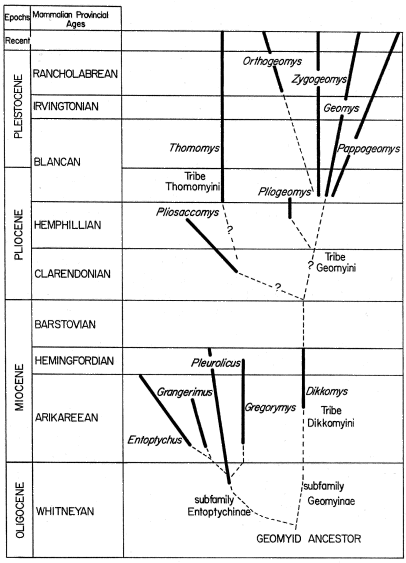
Fig. 3. Diagram depicting geologic range and probable phyletic relationships of the family Geomyidae. Dashed lines represent parts of lineages that are not represented by fossil records, and solid lines represent parts of lineages verified by actual specimens. Question marks indicate uncertainty of suggested ancestry of known taxa. The relationships within the subfamily Entoptychinae are modified after Wood (1936), and the temporal range of the Miocene geomyids have been adjusted to agree with current stratigraphic correlations. Hence, Pleurolicus, Gregorymys and Dikkomys are illustrated as ranging into the Hemingfordian, rather than being confined to the Arikareean (see MacDonald, 1963, and Black, 1961).
(3) In the pre-final stage of wear, the anterior and posterior lophs of the first and second molars unite secondarily at the edge of their protomeres (labial side in the lower and lingual in the upper), thus enclosing an isolated enamel fossette (Fig. 4C). Lateral union occurs in the lower teeth because the vertical depth of the labial re-entrant angle is less than the depth of the lingual re-entrant fold. In the upper teeth the reverse is true. The re-entrant angle on one side of the premolar is as deep vertically as the angle on the other side of that tooth, and both reach the base of the crown; therefore, they do not disappear at any stage of attrition. The same pertains in the third lower molar.
(4) In the final stage of wear (Fig. 4D), the enamel fossette disappears as a result of continued attrition on the occlusal surface in the upper series. The fossette may vary somewhat in vertical depth in m1 and m2, but the amount of wear required for its effacement would be greater than in the upper teeth. Therefore, upon wear, the U-pattern would become characteristic of the final stage in M1 (and probably also M2), but the modified H-pattern described in Fig. 4C would prevail in m1 and m2. Perhaps, in extremely worn teeth, the labial fossette of m1 and m2 would disappear. If this advanced stage of effacement is obtained, then the two columns would be united across the entire surface of their protomeres from the center of the crown to its labial edge, and the occlusal pattern would be in the shape of a U.
The occlusal pattern, at least in M1 and M2, in the final stages of wear in Dikkomys resembles that in the subfamily Entoptychinae, but the U-pattern develops on only the first and probably the second molar in Dikkomys and not on all of the cheek teeth as it does in the entoptychines. Judging from the material that has been described, the U-pattern did not develop in the lower teeth of Dikkomys until the Hemingfordian (D. woodi), upper Rosebud, and specimens of D. matthewi from the earlier Arikareean, lower Harrison, suggest that the modified H-pattern, with secondary coalescence at the edge of the protomeres, persisted throughout life, without developing the U-pattern in the final stages of wear.
Essentially the same patterns of wear characterize the genus Pliosaccomys, except that the earlier stages were telescoped and the second stage was omitted while another (final) stage was added. The stages are reconstructed in sequence in figure 4, and all are based on preserved dentitions, as follows:
(1) The first phases of wear produced the pattern (p. 4E and I) described for Dikkomys in the previous account (Fig 4A).
(2) A small additional amount of wear produced the 2nd stage (Fig. 4F and J) characterized by a U-pattern, formed by union of the anterior and posterior columns at the edge of the protomeres of the first and second molars, both above and below, without first forming an H-shaped pattern. Union at the mid-points thus was omitted from the sequence of wear in these two teeth. In the premolars and third molars the primitive H-pattern did form, as in Dikkomys. The pattern of wear in the first two molars is the same as in the entoptychines of the early Miocene. The trend of evolution through which the Pliosaccomys lineage passed must have featured a progressively earlier union at the edge of the tooth until the lateral coalescence occurred simultaneously with the median union. At that stage, emphasis was shifted to the union at the edge of the tooth, and eventually the teeth failed to unite at their mid-points and the U-pattern developed directly. Therefore, the horizontally deep re-entrant fold that separates the two lophs of the U-pattern is equivalent to one fold plus the apex of the opposite fold.
(3) The horizontal re-entrant fold of the U-pattern was remarkably shallow vertically and disappeared with little additional wear. Thus the two parts of M1, and also of M2, are united into a single column except for a slight inflection on the labial side and this is true also of m1 and m2 except for a slight inflection on the lingual side (Fig. 4G and K). The inflection appears to have persisted in the upper teeth (Fig. 4H), but evidently with slight wear, disappeared in the lower teeth (Fig. 4L). The final monocolumnar pattern was attained early ontogenetically, evidently before the permanent premolar had fully erupted; hence, the earlier stages occurred only in transition, persisted for only a brief interval in the teeth of juveniles, and the final stage developed in the young animal and lasted throughout the rest of its life in Pliosaccomys. In Dikkomys the two columns never united into a single column, and a bilophodont occlusal pattern persisted throughout life.
The early phyletic development of the subfamily Geomyinae took place in the tribe Dikkomyini from the early Miocene into the early Pliocene. Compared with the rapid evolution of the specializations that distinguish the Entoptychinae, the structural changes in the early Geomyinae occurred at a remarkably slow rate. In fact the lineage changed but little from Dikkomys to Pliosaccomys, in parts of the animal that can be compared, as illustrated by the low-crowned and rooted cheek teeth, the continuous enamel bands, the lack of grooving of the upper incisor, the retention of the primitive H-pattern, both above and below, in the premolar and third lower molar, and the ridges and fossae of the mandible to which the muscles of mastication attach. The only major changes detected in the known fragments are in the pattern of wear and the final configuration of the first and second molars, as described above. The unification of the two lophs in each of these two teeth into a single column was a significant step in the evolution of the Geomyinae, and is a stage between the primitive bilophodont pattern of the early and middle Miocene geomyines having continuously bicolumnar teeth and the monolophodont pattern in the modern pocket gophers of both lineages in which these teeth consist of a single column in all but the initial stages of wear. The monocolumnar structure of the first and second molars in the final stages of wear, therefore, is closer to that in the lineage of Thomomys than it is to that of Dikkomys. Other specializations in the dentition of Pliosaccomys, especially in m1 and m2 where the H-pattern has been completely eliminated from the sequence of wear, are too far advanced for Pliosaccomys to have given rise to the tribe Geomyini. The teeth in the immediate ancestor of the Geomyini must have been less specialized in m1 and m2, perhaps about as in Dikkomys. In the m1 and m2 of the tribe Geomyini, the H-pattern is formed in the initial stages of wear; therefore, in the early Pliocene ancestor, presently unknown in the fossil record, the H-pattern probably was present. Even so, the ancestor of the Geomyini and that of Pliosaccomys probably were closely allied otherwise, and both probably had attained the highly specialized fossorial adaptations characterizing all modern pocket gophers, before the divergence of Pliosaccomys and the Geomyini took place.
The evidence points to a major divergence of the geomyines that lived in the latest Miocene or the early Pliocene (probably the latter) and that gave rise to the two modern lineages, Thomomyini and Geomyini (see Fig. 3). One, the most primitive of the two, gave rise to the Thomomyini lineage that eventually evolved into Thomomys. Pliosaccomys is closely allied to the ancestry of this lineage, although it is probably not the actual ancestor, as mentioned previously. Aside from the aforementioned specializations of the first and second molars, the features of the Thomomyini are less advanced than in the other specialized lineage (tribe Geomyini). Primitive traits retained in the tribe Thomomyini (and also characteristic of the ancestral tribe Dikkomyini) are: (1) Small size, in general no larger than the ancestral morphotype; (2) lack of grooving on the upper incisor (although a slight rudimentary groove is developed rarely in some living species); (3) retention of anterior and posterior enamel plates in lower and upper cheek teeth; (4) premolars having widely open re-entrant folds; (5) smooth and generalized skull lacking marked angularity, regosity or cresting (neither the sagittal nor the lambdoidal crest are ordinarily well developed except in Thomomys bulbivorus); (6) forefoot small, less modified for digging than in the Geomyini.
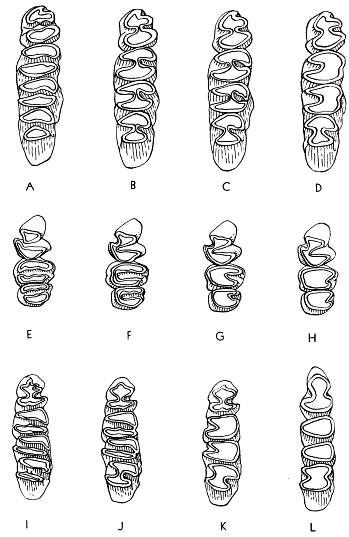
Fig. 4. Drawings of the molariform dentitions of Dikkomys and Pliosaccomys (Tribe Dikkomyini) depicting the patterns of wear on the occlusal surfaces. Ontogenetically, the stages of wear are arranged from left to right in each row. Stages not represented by actual specimens have been carefully reconstructed from information provided by known stages in the sequence of wear and the dentitions of other geomyines. × 5.
A-D. Dikkomys woodi, right lower tooth-row, including p4-m3. Patterns based on No. P26284 (FMNH) from Upper Rosebud (Middle Miocene), Shannon Co., South Dakota (B above).
E-H. Pliosaccomys dubius, left upper tooth-row, including P4-M2 (M3 unknown). Patterns based on Nos. 1798 and 1799 (LAM) from Smiths Valley (Middle Pliocene), Lyon Co., Nevada.
I-L. Pliosaccomys dubius, right lower tooth-row, including p4-m3. Patterns based on Nos. 1796 (holotype), 1804, and 1806 (LAM) from Smiths Valley (Middle Pliocene), Lyon Co., Nevada.
The lineage of the Thomomyini is essentially rectilinear and without the major branching seen in the tribe Geomyini. The one genus, Thomomys, appears first in the Upper Pliocene (early Blancan time), and the specializations characterizing the lineage had already developed by that time. Evidently, the early stages of divergence from the ancestral stock resulted in the development of rootless, ever-growing, more hypsodont cheek teeth, simplification of M3, and enlargement of the masseteric ridge on the mandible. The enamel investment on the sides of the molariform teeth is interrupted owing to intrusion of tracts of dentine on the sides of each column. Even so, complete anterior and posterior plates are retained on all of the cheek teeth (Fig. 5, K and L) and there is no trend toward additional loss of enamel as in the Geomyini. The enamel on the sides of the column has little functional value, and its elimination probably reduces friction during the anteroposterior movements of the lower jaw, thereby increasing the efficiency of the cutting blades on the anterior and posterior wall of the tooth. The simplification of M3 was achieved by union of the two columns of the primitive pattern into a single column and obliteration of both the labial and lingual re-entrant folds in the first stages of wear. The adult tooth (see Fig. 5L) is without trace of the bilophate pattern and is not elongated; therefore, its structure is essentially the same as that of the first and second upper molars.
In the Thomomyini, the two lophs of the unworn molars unite entirely across the width of their surfaces with the first traces of wear (see Fig. 5, I and J), owing to the shallow and uniform depth of the transverse valley. In the molars, the final pattern is acquired, therefore, before the deciduous premolar has been replaced by the permanent tooth. A relatively shallow re-entrant inflection between the ends of the parameres sometimes is retained, although it also will disappear with slight additional wear. Therefore, both lophs tend to unite completely with the first stages of wear in the Thomomyini, thus omitting both U and H patterns from the sequence of wear. This is the highest degree of specialization attained in the Geomyidae in regard to the patterns of wear, since a sequence of bilophodont patterns appear in both the Dikkomyini and Geomyini before the monoprismatic pattern is developed.
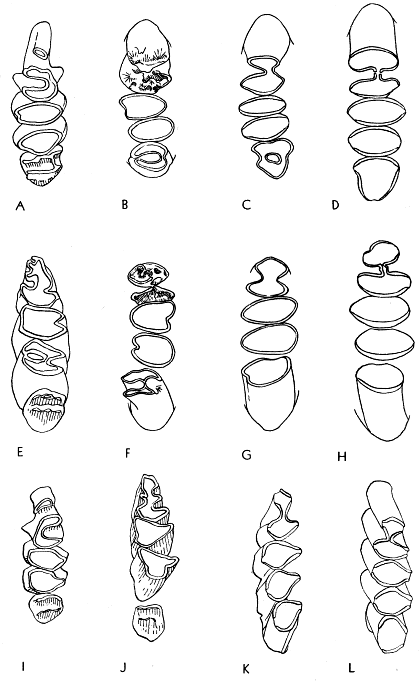
Fig. 5. Drawings of molariform dentitions representative of the tribes Geomyini and Thomomyini depicting patterns of wear on the occlusal surface. A-D represent, in ontogenetic sequence from left to right, upper tooth-rows of the tribe Geomyini. E-H represent, in the same sequence of stages, lower tooth-rows of the tribe Geomyini. I-L represents both upper and lower tooth-rows of both pre-final and final stages of wear in the tribe Thomomyini. All × 5.
A and E. Geomys bursarius majusculus, No. 2948 (KU), Douglas Co., Kansas. Right upper (A) including DP4-M3; lower left (E) including dp4-m3.
B and F. Pappogeomys bulleri burti, No. 100444 (KU), 10 mi. NNW Barra de Navidad, Jalisco. Right upper (B) including P4-M3; right lower (F) including p4-m3 (both P4 and p4 with unworn enamel caps).
C and G. Pappogeomys bulleri albinasus, No. 31044 (KU), 10 mi. S and 8 mi. W Guadalajara, Jalisco. Right upper (C) including P4-M3; right lower (G) including p4-m3.
D and H. Pappogeomys bulleri albinasus, No. 31002 (KU), W side La Venta, 13 mi. W and 4 mi. N Guadalajara, Jalisco. Right upper (D) including P4-M3; right lower (H) including p4-m3.
I and J. Thomomys talpoides bridgeri, No. 6865 (KU), 2 mi. up Mink Creek, Pocatella, Bannock Co., Idaho. Left upper (I), DP4-M3; left lower (J), dp4-m3.
K and L. Thomomys talpoides fossor, No. 13205 (KU), Wasson Ranch, 3 mi. E Creede, Mineral Co., Colorado. Right lower (K), p4-m3; left upper (L), P4-M3.
Relationship of the Geomyini with the ancestral Dikkomyini is most clearly demonstrated in the sequence of wear on the occlusal surfaces of the molars. As in all geomyids, the upper part of the crown is biprismatic in the newly erupted tooth, and the two columns are separated by an intervening valley. With slight attrition on the unworn enamel cap, the weakly developed cusps merge and form a transverse enamel loop on each of the two columns (see third molar in Fig. 5, A and E), each loop enclosing a core of dentine that had become exposed. The valley between the two columns is shallow, and upon further wear of the tooth, the two loops unite. The two columns become joined at different points in the upper and lower molars depending on the varying depth of the valley in different teeth. Therefore, upper and lower molars develop distinctly different occlusal configurations.
In the lower molars, the pattern characteristic of Dikkomys (Fig. 4C) is preserved without significant modification, as illustrated in an immature specimen of Geomys (see Fig. 5E). The H-pattern and modified H-pattern are developed in the same sequence of wear in the Geomyini. A juvenal female (not illustrated), KU 2931, provides an example of the intermediate H-pattern. In this specimen, the protolophid and hypolophid of the left m2 are united only at their mid-points, indicating that the pattern of wear occurs in the same sequence in the Geomyini as it did in the Miocene genus Dikkomys. After the two columns have become united at their mid-points, a secondary union is formed at the edge of their protomeres, thus enclosing the enamel fossette as illustrated in Figure 5E (this is the modified H-pattern mentioned above). However, the fossette itself is shallow and soon disappears with slight wear. At this stage, the occlusal configuration would be in a U-pattern (m1 in Fig. 5E). The lingual re-entrant fold is also shallow in vertical depth; therefore, it is obliterated by wear following the eradication of the labial fossette. Consequently, the two columns are united into one. In m3 (see Figs. 5E, F, and G), the two columns merge by progressive lateral expansion of the medial isthmus.
In the first and second upper molars, the two columns unite across the entire surface of their protomeres from near the lingual edge of the crown to near its center. A minute inner inflection may be temporarily retained in some teeth. At this stage (see Fig. 5B), the parameres are still separated by the labial fissure, and the occlusal pattern is in the shape of a U, resembling, but not exactly duplicating, the pre-final pattern of Ml and M2 in the genus Pliosaccomys (see Fig. 4H). The labial fissure is shallow, and, with further wear, the inflection is worn away and the parameres also unite, thereby forming a monoprimatic crown in the final stage. In M3, the two lophs first become united near the edge of their protomeres (see Fig. 5B), therefore forming a U-pattern similar to that developed in Ml and M2 of Pliosaccomys. The connection of the two lophs is not directly at the end of the protomere; consequently a shallow lingual inflection remains. The lingual edge of the valley is also shallow, and, with continued wear a second union of the two lophs takes place near the ends of their parameres, and the deeper, interior part of the valley remains as an isolated enamel fossette (see Fig. 5C). The two primary lophs of the tooth are now joined near both sides, having shallow lingual and labial re-entrant angles on the sides and the enamel island in the center. With continued effacement of the occlusal surface, the fossette will be eradicated, and the pattern of the occlusal surface will become the partially biprismatic pattern of the final stages (adult) of wear (see Fig. 5D). M3's of Dikkomys and Pliosaccomys are not known; however, it seems reasonable to assume that the pattern of wear in the M3 of Dikkomyini was not essentially different from that of the Geomyini, except that it is likely that the U-pattern of the second stage of wear in the Geomyini was probably the final stage in the genus Dikkomys.
Judging from the pre-final stages of wear, the dentition of the Geomyini provides a curious combination of patterns that resemble in part the Miocene genus Dikkomys and in part the early and middle Pliocene genus Pliosaccomys. There is no significant variation in the premolars or third molars (at least in the lower teeth) of the Geomyinae from the early Miocene to late Pliocene; therefore, deviations of major significance are in the character of the first and second molars. In the Geomyini, the patterns of wear of m1 and m2 are the same as those of Dikkomys, and are distinctly different from those of Pliosaccomys where the two columns first unite at the edge of their protomeres to form a U-pattern, rather than at their mid-points to form an H-pattern. Even though the intermediate stages of ontogeny in m1 and m2 of Pliosaccomys and the Geomyini are entirely different, the bicolumnar crowns of both eventually unite, upon wear, into a single column. On the other hand, the patterns of M1 and M2 in the Geomyini most closely resemble those of Pliosaccomys, rather than Dikkomys. In this regard it should be pointed out that the upper molars of Dikkomys are presently represented by only one tooth, an M1 in an early stage of wear. As described already, the patterns of M1-2 evidently would be mirror images of m1-2 in corresponding stages of wear. However, the initial union of the two columns, in the M1 that is known, is somewhat to the lingual side of center and the relatively small lingual valley does not reach the base of the crown, indicating, that eventually with wear, the two columns of Dikkomys might have become united across the entire surface of their protomeres as in Pliosaccomys. Even so, the two columns of M1 do initially join closer to their mid-points than they do in Pliosaccomys, and, if they did actually unite across their protomeres, the union would have occurred with subsequent wear. That is, the first occlusal pattern would be H-shaped (but with the connection closer to the lingual than the labial side), as in m1 and m2, and it would become U-shaped only after additional wear. This sequence of patterns of M1 and M2, as already pointed out, does not pertain in Pliosaccomys or the Geomyini, since the U-pattern is formed with the first union of the two columns at the edge of their protomeres, and the primitive H-pattern is never developed, unless one counts the slight lingual inflection, that occasionally is formed just after the two columns unite, as being indicative of the primitive pattern. As in the lower teeth, the bicolumnar crowns of early ontogeny in both Pliosaccomys and the Geomyini become eventually united, with wear, into a single column.