Margaret Murray Robertson (continued 4)
Reading edition
But she came to surer and happier knowledge as the months went on. In her troubled moments, before she came home, she had said to herself that she needed Eunice, and she was right. And now she had Eunice, and her sweet words, dropped only now and then, did her good, and her beautiful life day by day did more. Her full content in that which God’s will had assigned to her, though it had brought loss and pain in the past, and involved now a daily expectation of death, wrought, with higher teaching still, to bring Fidelia to clearer light and stronger faith than she had ever yet enjoyed. And with these came first submission, and then joy in God’s will, for them both. But this came later, when her school-keeping days were over; and to the end, so greatly to be desired, Jabez helped a little, as well as Eunice.
For three whole months school life had gone on “without a hitch,” as Jabez said triumphantly, and the pupils and teacher together were beginning to discuss the propriety of giving a little time to special preparation for the closing examination, when something happened. A thaw came—a sudden fall of warm rain, which lasted a day and a night, and covered the ice on the mill-pond with water, and the neighbouring meadows as well. And then the frost came again strong and sharp, making mill-pond and meadows sheets of shining silver; and for once everything happened just right, for it was full moon, with clear skies—the brightest of moonlight.
Of course every scholar in the school was bound to be on the ice, and a great many besides; and Jabez and a few others voted themselves into the office of a safety committee to see to the rest, to keep the naughty ones out of mischief and the heedless ones out of danger. There were not skates enough in the town of Halsey for half who were there, but there were a good many pairs, and there were sleds, and those who had neither skates nor sleds could slide on their own feet; and all expected a good time, and most of them had it.
Fidelia was not there the first night, but, yielding to entreaty, she came the second night, and enjoyed it as well as any of them all. But she was not there on the third night, when something happened. No one else ought to have been there, for the frost had gone, and there was water over the ice on some parts of the pond. The meadow ice was safe enough, but on the pond, where the water was not, the ice was like glass, and thinner than they knew.
Especially was this the case where the weir brook fell into the pond, a little below the bridge, at the place where the boys had taken their sleds to “coast” down the hill and over the sloping bank with an impetus which sent them flying over to the other side of the pond. Young Van, preferring to-night his sled to his skates, was there with the rest, and either through bravado or want of skill, steered, or let his sled take its own way, to the open water where the brook came in. A cry from his companions came too late to warn him, but it warned the others at a distance that some one was in danger; and several were on the spot in a minute or two, and among the rest Jabez.
“Who is it? Young Van? Yes, he is just the fellow for such a job,” said he, taking off his skates and plunging into the water where the boy’s sled was floating, the ice cracking and crumbling beneath his feet as he ran. The water was not very deep, and young Van, gasping and shivering with terror and cold, was passed over to the hands waiting for him.
“And I say, you boys, keep back. The ice at the edge is none too strong to bear the half of you. Be off home, or your mothers will be here before you know it. I mean to go the other way, if I can, and save a journey.”
All this time Jabez was struggling, and always into deeper water, with the ice that would not bear his weight when he let himself rest upon it. He could land easily on the other side, he knew, but then he must go home by the bridge, a good half-mile and more, which he did not care to do. He struggled awhile, cheered by the voices of his companions; but he had to give it up at last, as he owned afterwards he should have done at first; and he was chilled to the bone before he reached home.
The next day young Van was at school—“as smart as ever,” the boys declared—and so was Jabez, but Jabez was not as smart as ever. He shivered and burned alternately till noon, and then he went home; and that was the last that was seen of Jabez in the school that winter.
Chapter Thirteen.
Good Seed and Good Fruit.
There was a hard time before Jabez. Rheumatic fever was among the least of the troubles suggested as possible in his case by his grandfather, when he came shivering home from the mill-pond that night. But that was happily averted by the prompt and skilful treatment of Dr Everett, after just enough of suffering to make Jabez ever for the future rather more sympathetic with the aches and pains of his grandfather.
Jabez, however, was not to escape his share of discipline; and his trouble came, as most people’s troubles seem to come, in the way which is hardest to bear. He did not have “the long spell of rheumatism” which his grandfather had predicted, but he had what was worse. Inflammation settled in the lad’s eyes, and for a time he suffered great pain. He could have borne the pain patiently, even cheerfully. That which tried his courage and brought him low was the darkness—the darkness and the horrible doubt whether he was ever to see the light again.
He need not have suffered from this fear. Dr Everett never really feared blindness for him, and always spoke cheerfully to him about soon being well again.
“But that is the way the doctors have of letting a fellow down easy,” thought Jabez, taking less comfort than he might have done from the doctor’s words.
No visitors were admitted except those whom the doctor allowed to come, and every day seemed like a week to Jabez, and the nights were longer still. In the daytime he could hear his grandmother moving about the rooms, and the voices of chance comers and goers to the house. At night there was no sound but the rush of the wind, or the barking of his dog Buff outside; and within the ceaseless tick-tack of the tall clock in the corner, which said to him all manner of solemn things which he could not forget.
His grandmother made him nice things to eat, and his grandfather sat beside him a little while many times a day, and both were as good to him as good could be. His grandfather was faithful as well as kind, and reminded him of past misdeeds—the sins of his youth, he called them—and warned him of worse things that were in store for him unless he turned from his evil ways. It was “hitting a fellow when he was down,” Jabez thought, but he listened in silence to all he had to say. Indeed, through all these dark days he lay without a word, fighting his battle with his fears and his rebellious murmurs alone, asking help from no one.
Fidelia came in to see him for a minute or two every night on her way home from school, and gave him a summary of school work and school events generally, and enlarged more than would have been wise at another time on the amusing incidents of the day, for the sake of bringing a smile to his sober face. But even Fidelia got few words from him, and it was a good while before she came to see how miserable the poor fellow was in his solitude; and even when she saw it she did not know how to help him.
“What are you thinking about, Jabez?” said she one night, when she had scarcely got from him even the usual response. Seeing the look on his face, she did not wait for an answer. “To-morrow is Saturday. I shall bring down the books and have school here, if doctor will let me. Or shall I bring Eunice? Yes, if it is a fine day I will bring Eunice. She has wanted to come for ever so long, but she has waited till she should be able to have a good long visit with you. If any one can do you good, Eunice can,” added Fidelia, laughing, though, seeing Jabez’s sober face, she did not feel much like it.
“I shall be glad to have Miss Eunice come and see me,” said Jabez gravely.
A good while after that, Jabez told Fidelia what he had been thinking about that afternoon, and indeed what he had been thinking about most of the time during these sorrowful nights and days.
“The ‘blackness of darkness for ever.’ Yes, I did feel hard. I thought I was going to be blind; and I would a great deal rather have died, only I was afraid.”
Eunice came to see him, but even Eunice did not seem to help him much on her first visit. Before her second visit, something had happened. Mr Swift had paid Dr Everett a visit, and they had had a little talk together.
The doctor owned that he was anxious about Jabez. No, he was not afraid he was going to die. It was his eyes he was in doubt about.
“Blind?” said Mr Swift. “He’d better die.”
“Only one can’t die till his time comes. Blind? No, I am not afraid of utter blindness. But I almost think it would be easier for Jabez to find himself blind than with just sight enough to potter about and do a little. He is a bright boy, Jabez, and ambitious.”
“Dr Everett, do you suppose you know all that is to be known about the eye and its diseases? Hadn’t you better have help?”
“I’d be glad to have help. No; I don’t know about the eye, as one who has made it the study of his life must know it. If Jabez could only pick up a little strength I would take him to Boston, and hear what Dr Blake would have to say about him. It would be too great a risk just now.”
“Send for Dr Blake—why can’t you?” said Mr Swift.
Dr Everett shook his head.
“I should like to. But it would cost a good deal; and Deacon Ainsworth is not a rich man.”
“Send for him. I’ll stand the fee.”
“It may be a big one.”
“It won’t cost more than my boy’s funeral would have done,” said Mr Swift huskily. “Jabez saved me that, they say.”
It was a queer way to put it, Dr Everett thought. Mr Swift went on—
“I’ll go on to Boston and fetch him straight on here. Days are precious when a man’s eyesight is to be considered.”
And he was as good as his word. Dr Everett saw him in a little while driving his sleigh at a great pace, over half-bare roads, in order to catch the afternoon train.
“He is something more than just a rich man,” said he to himself, “though I never thought it before.”
The next day Dr Blake came. He was an old man to look at, but he spoke like a young man, and had the quick, cheerful ways of youth; and he had wonderful bright eyes of his own. He saw a good deal more in Deacon Ainsworth’s house than the eyes of Jabez, which he had come to see, and his prescription went beyond them. He spoke encouragingly of the eyes, and gave a word of advice about other matters.
Jabez was to do his best to get strong and well, and he must be cheerful and hopeful. Nothing was so bad for a fellow as letting himself be downhearted. His eyesight was safe, as the doctor believed, but it would depend on the state of the patient’s general health as to how soon and how rapid the change for the better in the eyes would be—and so on. To Dr Everett he said—
“A solemn sort of place, Deacon Ainsworth’s house, isn’t it? The lad ought to get a change. Is there nowhere you could send him after a little while?”
He said this at Dr Everett’s tea-table, where on that occasion Fidelia was seated with the rest.
“Let Eunice have him for a little while,” said she to Dr Everett.
“All right,” said he, and explained the situation to Dr Blake.
“I have no doubt such a change will do all that can be wished, if Miss Eunice is at all like her sister,” said he politely.
So to Eunice Jabez came after awhile; and doubtless Eunice felt it to be her duty to improve the occasion also. But her way was not quite the deacon’s way. It went farther, and circumstances gave it a better chance. For Jabez had got a glimpse of daylight by this time, and the change was wonderfully pleasant to him. His heart was tender too, and the good seed of the Word which Miss Eunice let fall now and then, fell into ground prepared for it, and in course of time it took root there and sprang up, and, though Eunice did not live to see it, bore fruit a hundred-fold. Through the ministry of pain and a terrible dread, the Lord Himself had dealt with him, and a great light had begun to shine through the darkness, even before he knew that that which he feared was not to come upon him.
It was a good while before he told this to any one but Miss Eunice. It was years before he put into words, for other men to hear, the vow which he uttered to the Lord on the very first day when, standing by the fence in Miss Eunice’s garden, he could look over the field and the river to the hills beyond—the vow to be His servant for ever.
In the meantime the winter school, in which Fidelia had won golden opinions, came to an end; and the leisure which this brought to her was as good for her as the constant occupation of teaching had been when the winter school began. She hardly knew what to do with her new liberty at first. She made plans for the wise disposal of her time, but these were for the future. For the present time she was content to go out and in, to read or work, to visit or receive visitors with a free mind; and her chief work which was also her chief pleasure, was taking care of Eunice.
Not that Eunice was supposed to need especial care just then. She was not strong, but her strength was not tried. Household matters were altogether in the hands of Mrs Stone, and in better hands they could not have been. Eunice was quite content that it should be so—a sign, if Fidelia had considered it, that she was no longer able for the lightest of her household work, which she had made her pleasure during all the years which they had been alone together. But Fidelia, at this time, had no thought of fear. It seemed to her almost as if the old happy days, when she, at least, had no dread of coming sorrow, had come again, with only the comfortable difference which the presence of Mrs Stone made in the house; and she saw no reason why this quiet happy life might not continue for years.
Jabez came often up the hill, after his return home, as soon as he had strength to do so—a little too often, his grandfather was afraid.
“Don’t you wear your welcome out up there,” said he. “Why don’t you go—” here or there, or to the other place which the deacon named.
Jabez troubled no one by his frequent comings and goings, for which his studies, to which he had returned with quiet determination, made reason sufficient. He had had a talk with his grandfather about this in the beginning of the winter. He was going to college—that was certain. No, he did not quite know what was to come after. He “was going to be President of the United States maybe,” he said gravely; and at any rate he was going to make himself fit for it.
His grandfather was by no means convinced of the wisdom of the boy’s resolution—indeed, he “worried about it considerable,” as Mrs Ainsworth had occasion to know. He could not refuse to let him attend the winter school, though he had told him it would pay him better to be splitting reeds in Weir’s swamp than in going to a woman’s school—and “only a girl at that,” said the deacon, with good-humoured contempt.
Since his illness Jabez had been allowed to do as he pleased, but his grandfather worried about him still. Few boys had a better chance than Jabez had. There was the farm—not a large one, but as good land as any in Halsey—which might be his as soon as ever the old folks were gone. It might be his now as far as management and profits were concerned. All the old folks would want was a home there while they lived. Jabez did not know his privileges—and so on.
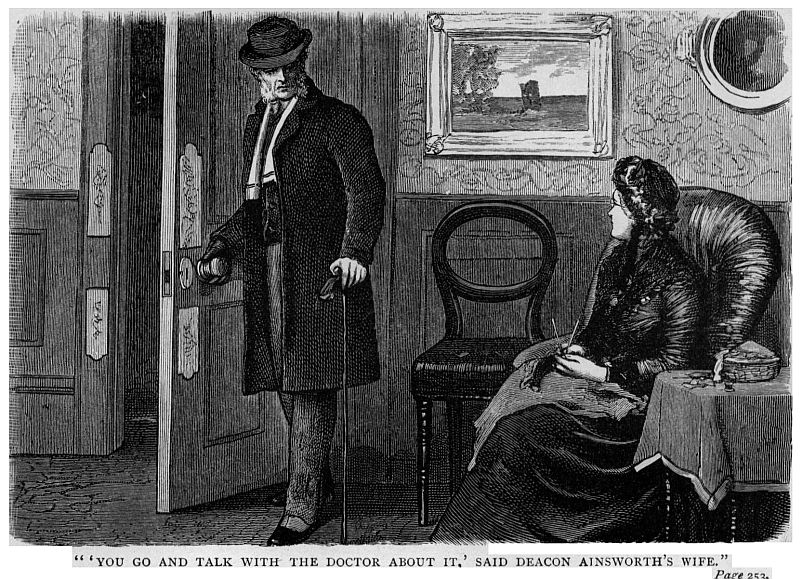
“You go and talk with the doctor about it, and with Miss Eunice,” said his wife, a little weary of the constant theme. So the deacon “freed his mind” to Miss Eunice, making a grievance of his idea that she and Fidelia encouraged Jabez in his determination to turn his back on the old place.
“Not directly, may be,” said he, qualifying his words after a glance at Fidelia’s face. “But you set so much by books, and a chance of getting an education, and all that—nothing else seems to count, and Jabez has always thought so much of you both. Well, I am not blaming you. But when a boy like Jabez begins to talk of going to college and being President of the United States, there does not seem to be much hope of him.”
“Why not?” said Fidelia, throwing down the gauntlet, or, rather taking it up. “All the Presidents of the United States were boys once, and a good many of them were just such boys as Jabez—farmers’ boys or poor men’s sons who had to push their own way.”
“But that is just what Jabez needn’t do. I am not rich, but neither am I so poor that there need be any hardship in getting along right here in Halsey. The fact is, he is a sight too ambitious. He thinks all he’s got to do is to go to college and come out again, and things will fix themselves to suit him. But he’ll fail as like as not; and then where will he be?”
“He can come home then to the farm,” said Fidelia, laughing. “But he is not going to fail.”
“Deacon Ainsworth,” said Miss Eunice gently, “I am sorry you feel so about Jabez. I know it will be a trouble to you if he should go.”
“Oh, well, as to that, I have other grandsons!”
“Yes, and I am glad for your sake it is so. Jabez, is not going to be President. But if you think of it, almost all the men of mark in our country that you or I know much about have begun by being just such boys as Jabez.”
“Yes, indeed!” said Fidelia; and she went over the names of half a dozen who were prominent men in the State, and in other States.
“Yes, and even better men and greater men, in your opinion and in mine, than some of these,” said Miss Eunice gently; and in her turn she gave the names of a good many distinguished ministers who had begun life as farmers’ boys, and the names of missionaries in whom they took interest for their work’s sake, as well.
Deacon Ainsworth did not get much help from Miss Eunice, nor from Dr Everett either.
“Whether Jabez is fit to make a scholar remains to be seen,” said the doctor. “But he has the fever on him, and he is bound to try.”
“I know he is a smart boy,” said the deacon dolefully.
“He isn’t a boy any longer. And I think he sees his way clear before him. You can’t keep him at home on the farm, deacon, and you may as well let him go, and help him along all you can.”
All this had been at the beginning of the winter. Jabez had gone to school, and in the spring the deacon saw that he must let him go his own way. As to helping him along—that had to be considered. But in the meantime, till he should get strong again, Jabez was permitted to do as he liked. He had changed very much since the beginning of the winter, especially since his illness. He looked less like an overgrown boy, and more like a lank and loose-jointed young man, who did not know quite what to do with his hands or feet in certain circumstances, and who was in danger of slouching somewhat, and of getting a stoop in his shoulders, unless some one took him in hand. Mrs Stone did him this kindness, and to good purpose.
He changed in other ways. He talked less, and it is to be supposed, thought more. But, though he was rather silent than otherwise, he was as cheerful as ever, and more gentle and considerate at home. His grandfather could see the difference, and acknowledged a hope that with his help the boy might come out right at last. His help at this time was given in a way that Jabez could appreciate.
It was the grandfather this time who proposed to Miss Eunice that she should let Jabez have her garden again. He was afraid of the mischief found for idle hands, and he could not be satisfied that in his books Jabez might find enough work to keep him out of any temptation to idleness. So the proposal about the garden was made by him.
Jabez had no objection. The garden had paid well last year, and would do better this year, he thought; and he knew that as much as he ought to do with his eyes, in the way of study, would not be hindered by the work of the garden. So he sat and listened while his grandfather set the matter in all lights, and assented quietly to all arrangements made. Fidelia was listening also, and watching Jabez. His silent and smiling assent to all that was agreed on,—so different from the boyish self-assertion which had amused them last year,—made her wonder. His manner to his grandfather also was very different.
“Yes,” said Eunice, when Fidelia spoke of this to her, “Jabez is changed. His sickness has been blessed to him.”
“His sickness, or something else, is making a man of him,” said Mrs Stone. “The world will hear of Jabez before he dies.”
“He is going to be President,” said Fidelia laughing. “One thing is sure. He is getting beyond my teaching. I shall have to look out, or I shall be left behind.”
There was more truth in Fidelia’s admission than she knew. Jabez had indeed “taken a new departure.” He had a new motive for work, and he worked better. He had no troubled thoughts as to what he was to do, or as to how he was to do it. He knew all would go well with him, because his life’s work, and his life itself, belonged to Him who had all things at His disposal, and Whose promise was sure that “all things shall work together for good” to His children.
He could speak to Miss Eunice about these things when she encouraged him to do so; he could not so easily speak to Fidelia. It was about their reading, as it had always been, and about the garden, that he had much to say to her for a time, and there was enough to say about both.
Gardening was pleasant enough work as they did it. They did not make hard work of it. Jabez sowed and planted; and, when the time came for the disposal of the products of the garden, he was as pleased with the results as he had been last year, though he did not show his pleasure quite in the same way. His success meant even more to him than it had done the last year, for he saw more clearly the way before him, and the end of the way.
And, after all, the real work of the summer was not done in the garden. A good deal of it was done in his grandfather’s old buggy, which carried here and there the garden products for the benefit of the summer visitors, who were this year more numerous than ever. One book, and sometimes more than one, in covers of thick brown paper, found a place beneath the cushion; and the deacon’s trustworthy old horse was allowed to take his own way, and to choose his own pace along the hilly road between Halsey Centre and Halsey Corners, while Jabez read or pondered the wise words which they contained.
And more was done in the back porch when the time came for a pause in the work of the garden. There on fine mornings Miss Eunice sat with her needlework, and Fidelia with her books; and it was her part usually to read for the benefit of the three. In this way were gone through a good many books, and, among the rest, Fidelia’s text-book on “The Evidences,” which she acknowledged had been gone over rather hurriedly; and Butler’s “Analogy,” which was one of the studies of the last year in the seminary, to which she was beginning to think she might possibly go again. Neither of these would help Jabez in the preliminary examinations to which he looked forward. They might come in afterwards; and he took part in the reading, and in the talk which grew out of it, with an eagerness and a just appreciation which astonished the sisters. All enjoyed these mornings. Even Mrs Stone brought sometimes her peas to shell, or her beans to pick over, so that she might share the pleasure and the profit of the reading with the rest.
Chapter Fourteen.
“So He Giveth His Beloved Sleep.”
And so the spring days passed, and the summer days shone over a happy homestead. Many a time Fidelia said to herself that she desired no other work and no other pleasure than just to live as they were living now. And it did seem as though God was going to permit it for a time. Her “bad dream” had vanished; if the thought of it came back now and then, the sharpness had gone out of the pain which still touched her a little. She had not forgotten altogether. Dr Justin had not allowed her to forget.
He had written frequently—not to her, but to her sister—kind, pleasant letters; the excuse for the first being to send her tidings of the friend whose address had been asked and given on that last day, and whom he had visited at her request.
He had found her a cripple and nearly helpless, but striving to do her part still in the great educational institution to which her health and strength had been given in her youth. Then he added a few good and true words about the hope and the help which had sustained this friend amid all her labours and suffering—“as they are doubtless sustaining you, dear Eunice, in the quiet of your favoured home.”
Then he sent his respects to Mrs Stone, and added—“I was not surprised to hear that Miss Faithful had chosen to remain at home with you; and may the comfort and joy which her presence must give you be given to her by the best Comforter when her day of trial shall come!” In a little while he wrote again, sending also a book which he was sure Eunice would like; and after that he wrote with no excuse at all.
He told them about his new work in the college to which he had been appointed professor, and about his friends, and his pleasant social relations, and his outside work. Eunice did not answer all his letters, but she took pleasure in receiving them. Kind brotherly letters they were, which Fidelia read, and which they discussed a little, as they might have discussed the letters of Dr Everett himself, if he had been away from and had written, to them.
So the spring passed, and the summer wore on, till August came with burning days and sultry nights, which told on the strength of Eunice, already failing, so slowly that the eyes that watched her so lovingly did not see it for a time. Even Dr Everett saw no cause for alarm, nor Mrs Stone, who watched her more closely than he did.
But Eunice knew that the end was drawing near. Afterwards they all wondered that they had not seen more clearly, remembering looks and words which they might have taken for a sign that the joy of heaven was not far away. But so quietly passed the days, with so little to disturb or tire her, that she herself did not know how rapidly her strength was passing from her.
The close days of early August oppressed her, and made the change for the worse suddenly visible to them all. The end did not come without a warning, as Dr Everett had thought it might come. There were days and nights of waiting before her still, when even Fidelia saw the tokens of the last change. There was no great suffering, only weariness and exhaustion, borne sweetly and patiently, and a joyful waiting for “the rest which remains.”
There was a word spoken now and then to console or to encourage her sister, who waited quietly beside her.
“You know all I wish for you, dear; I am not afraid for you. You are in a Father’s loving hand, and by-and-by, when your work is done, you will come to me there,” she said to her, murmuring the sentences at intervals, as she had the strength to speak; and Fidelia could answer firmly and smile brightly. For so deep was the peace and so sure the trust of the dying, and so near the glory awaiting her, that no thought of herself or her loss, or the lonely days that were before her, could move her from the calm which had fallen upon her. All was peace with her also.
Once, at the beginning of these last days, a word was spoken by Mrs Stone.
“About Fidelia, Eunice? The time may come when she will long to know what your wish would have been—have you ever said a word to her about—Justin Everett?”
“No; I think there is nothing to be said. Yes, I know—afterwards she would give heed to any word of mine. But it might not be the right word. No; I can leave this, with all else that concerns her, in the hands of a loving Father. He will guide her in this as in all things.”
And so no care nor shadow of care came to darken these last days. Truly her eyes said to them, when her lips could not utter the words: “I will fear no evil, for Thou art with me.” And, waiting and watching beside her, Fidelia was for the time lifted above all fear or care or sorrow for herself, and rejoiced in her sister’s joy.
Thus quietly one summer morning she passed away. So quietly, they—
“Thought her dying when she slept, And sleeping when she died.”
They buried her beside her kinsfolk in the little graveyard of Halsey; and her memory still lives in the hearts of her friends and neighbours who knew and loved her so well.
Then, for a time, life and all its interests seemed to stand still for Fidelia. She was weary and spent, and they left her alone to rest and grow strong again. By-and-by, with no word of appeal or entreaty from any one, she came back to her old ways, and tried to take up her work again. It was not easy for her to do this, but it was easier than it would have been had her loss come a year sooner.
“It is God’s will that I should go first; and, dear, though you cannot see it now, God’s will in this, as in all things, is best,” Eunice had said to her many times; and she knew in her heart that it was true.
“And, oh, how much the best for my Eunice!” she said with many tears, yet with submission also.
But her occupation was gone; and, though friends and neighbours did what kind friends and neighbours may do at such a time, to cheer her, the days passed slowly and heavily, till one night Jabez came up “to have a little talk” with her. She had not seen much of him since her sister’s death. He had kept away, he told her, “because it hurt him dreadfully to see her in trouble that he could not help.” It cannot be said that she had missed him much, but she was glad to see him when he came.
Jabez’s “little talk” was about himself, and nothing could have been farther from his thoughts than a desire to give a lesson to his teacher. But she got her lesson all the same. They sat for awhile in the front porch, which was bright with the glory of the sunset. Mrs Stone was there as well as Fidelia, and they spoke about various matters at first; and a few words were said about Eunice. When Mrs Stone rose to go about some household duty, the others rose also, and went through the house into the garden, and down the walk between the tall hollyhocks, to the fence, where there was an opening between the apple-trees—a spot where Fidelia always stood a minute or two whenever she came there. They lingered for awhile in silence, looking down over the river flowing softly between wide irregular meadows, and over to the broken hill country beyond, beautiful now in the glow that fell on it from the west.
Something—perhaps it was the familiar voice of White Star coming suddenly to her ear—brought back to Fidelia the remembrance of the time when she stood there petting the pretty creature, the day after her first return from the seminary—the day when Jabez came up to speak about the garden. It came back so vividly that when Jabez began to speak his first words were lost in the surprise which seized her when she turned towards him.
What had happened to the lad since then? He was a boy no longer, for one thing. As he stood there regarding her with grave eyes, speaking quietly and earnestly, he was very different from the lad who had come whistling up the field, with his hoe over his shoulder, to greet her that day. A man? Well, hardly that yet; but with the promise of manhood on his good and pleasant face, to which, though she was tall herself, she had to look up now! A shadow passed over his face, and he ceased speaking and looked away, as a smile, of which she was quite unconscious, parted Fidelia’s lips.
“I thought maybe you would like to hear about it,” said he in a little, without turning round.
“Of course I shall like to hear about it. Excuse me; I was thinking about something else. You must begin again. Do you know, Jabez, that you are changed lately. You are not a boy any longer; you are a man, and I have only just found it out.”
“A man! No, not quite; but I mean to be a man one of these days,” said Jabez gravely. “And I think now I can see my way.”
“Well! Tell me all about it.”
There was not much to tell, but it took some time to tell it. A letter had come from an uncle of Jabez—his mother’s only brother—written in answer to one sent to him by Deacon Ainsworth, asking advice about the future career of his grandson. The uncle was a minister, living in the far West. He could do nothing for Jabez as to money, for he was a poor man, but he believed that he could better help the lad to help himself, in the part of the country where his home was, than could be done for him in New England. His own son, he said, with but little help from any one, had paid his way through college; and he did not doubt that Jabez, if he were the bright boy his grandfather described him to be, could do the same.
“And so,” said he, “you had better send him on. This is a good country for head-work and for handwork too—whichever he may prove himself best fitted for—and we shall all be glad to see him when he comes.”
“And,” said Jabez gravely, “I think I’ll go and have a try at it.”
“But surely your grandfather might help you a little? And Amhurst or Harvard is the right place for you, Jabez. Why do you wish to go so far away?”
“About grandfather’s help—no. If I go I suppose Cousin Calvin will come and take my place, and have the farm by-and-by, which is all right. And grandfather will pay my way out there, he says. And, as I expect my life’s work will be done out West, the preparation for it may as well be done there too. There is a good chance out there, uncle says.”
“Why should your life’s work be done in the West? And what is it to be?”
Jabez answered the last question first.
“Maybe you will think it presumptuous in me to talk of going in for the highest work of all. But I talked with Miss Eunice about it, and she said she was glad. If it hadn’t been for Miss Eunice I shouldn’t have thought of it. ‘Entire consecration to the highest work of all.’ That was her idea, and it is mine.”
There were tears in Fidelia’s eyes, but there were smiles on her face as well. She did not speak, however, and Jabez went on.
“I don’t just know what I’m fit for yet, but I do know that I don’t feel like holding back; and the Master will see about the rest. He has all kinds of work to be done in His world, and I will find something to do.”
“Yes; and He has work to be done here in New England. Why are you so glad to go away?”
“Oh, I am not glad to go away! But I am glad that I see my way to make a beginning; and I mean to do my best. It may not be a great deal that I can ever do, but the Lord will accept the best I have to give.”
“Yes; I am not afraid for you.”
“And about going West. A great country is being opened up there, and it is being filled with all sorts of people in a wonderful way. New towns, and even cities, are springing up everywhere; and my uncle says that what this wide land needs for true greatness is that the light of the glorious Gospel of the blessed God should shine through every corner of it. I shall like uncle, I am sure,” said Jabez.
“And you want to have a share in making the country great?”
“I want to do my part for my country and the world. It is God’s work, and there doesn’t seem to be anything else worth doing in comparison with this ‘holding forth the Word of Life,’ as uncle calls it, does there?”
Jabez spoke with eager voice and shining eyes, and Fidelia listened amazed. And then she asked herself: “Why should she be amazed?”
It was true. Jabez was right and wise in his choice. What else was there worth doing in comparison with the honour and blessedness of having a part in this work?
“And so far,” she said to herself, “I have neither part nor lot in the matter.” Her face grew grave as she stood looking away to the darkening hills. Hitherto she had lived for herself and for Eunice. Now Eunice was gone, what was she going to do with her life? What would Eunice have liked her to do?
“Miss Fidelia,” said Jabez in a little, “you’ll be going back to the seminary this fall, I suppose. It is a good place to go to, I guess. And it would be lonesome here now.”
“Yes, it would be lonesome here. Yes, I think I may go back again. There seems to be nothing better to do than to go there. Eunice always wished me to go.”
But she spoke sadly, and evidently without much interest.
“You will like it when you are fairly there, and have begun at your books again,” said Jabez.
“Yes, I suppose so. It is best to go any way. Eunice wished it.”
“I am glad of one thing—I shall be gone first,” said Jabez.
“Shall you? When do you go?”
“Next week, if grandma can get my things ready. Time is precious.”
“She must let us help her,” said Fidelia; and then there was silence between them. Fidelia was thinking of a letter which she had received a day or two since, which must be answered soon. Miss Kent had written to her, inviting her to visit her in Boston for as long a time as she could stay. It was such a letter as it is good to write and to receive. There were a few words of sympathy in her sorrow for her sister’s loss, and a few more as to the pleasant things to be done and seen and enjoyed during the visit; but the best of it was the evident kindness and sincerity of the writer in all she said.
Fidelia’s desire to accept the invitation had been growing since the day it came. She longed for a change of some sort, and she needed it. The thought of the seminary and her books gave her very little pleasure.
“It is because you are tired,” said Mrs Stone; but she did not, as it was her first impulse to do, remind her that it had been her sister’s wish that the next year should be passed at the seminary. “She will think of it herself by-and-by.”
Fidelia thought of it now. “Time is precious,” Jabez had said. Surely time ought to be precious to her as well! She ought to go to the seminary this year, if ever she meant to go; and, if so, there was no time to lose.
And, besides, she knew on which side temptation lay for her. An easy, pleasant life among people who knew no other kind of existence; a chance to see and hear and enjoy the beautiful and wonderful things of which she knew little, except from books, would be delightful; but would it be good for her? Would it be a preparation for the work of which she and Eunice used to talk and plan?—“the highest of all work,” as Jabez had called it, and “entire consecration to God’s service.”
“I must be a poor creature to have any other desire,” she told herself.
In a little Jabez said—
“Miss Eunice said something to me once. She said it made her glad to think that I might be permitted to do some of the work for the Lord which she would have been so glad to do. Does it seem presumptuous in me to say it, Fidelia? I would not say it to any one but you,” said Jabez humbly; “and I owe everything to Miss Eunice.”
“And what do I not owe to my Eunice?” said Fidelia to herself. To Jabez she said—“Yes, I know it made her last days happy to feel that perhaps she had helped you a little. And we must both honour her memory by trying to do in the world what she would have loved to do. I only wish—”
Fidelia did not put her wish into words for Jabez’s hearing. It was growing dark, and Mrs Stone’s white cap at the porch door had been more than once visible as a reminder that the dew was beginning to fall; and they knew it was time to go into the house.
But Jabez had one thing more to say, over which he hesitated a moment.
“Fidelia, I want to say one thing more, if I may. It was Miss Eunice that made me think more about it, so I hope you won’t be vexed. You haven’t any brother, and I haven’t any sister. Suppose we—adopt one another,” said Jabez, with a laugh which had the sound of a sob in it. “Miss Eunice told me more than once, that if ever the time came when I saw you in trouble I must help you, if I had a chance, for her sake.”
“Oh, my Eunice!” cried Fidelia; and she held out her hand to the lad. And then, to her amazement, he stooped and touched it with his lips before he took it in his own.
There were not many words spoken after that. This was their real parting. They met several times before Jabez went away; but it was this half-hour under the apple-trees that Fidelia always remembered, when the thought of Jabez came back to her, with all the other memories of these last days at home. For these were “last days.”
Fidelia came back again when her year at the seminary was ended. Mrs Stone was still in the old brown house, which in most respects looked just as it had looked when she came home the first time, to find Eunice waiting for her. It was good to see her old friend standing to welcome her at the gate, but her old friend was not Eunice. And, though she wondered that it should be so, and grieved over it, the house in which the greater part of her life had been passed never seemed quite like home again.
Chapter Fifteen.
Fidelia’s Perplexity.
This year in the seminary was far more profitable to Fidelia than the former year had been. The work which she had done so faithfully at home told now. She was not pressed or hurried by overwork in preparing for her classes, and had time to take the good of other things besides study.
Under the Christian influence lovingly and judiciously exercised over them, not even the careless or unimpressionable among the pupils could remain altogether untouched by some sense of their responsibility to the Lord Jesus, or to the claims which He had on them to be workers together with Him in the world which He came to save. Fidelia, with softened heart and awakened conscience, was now open to that influence, and yielded to it as she had not done before. There was no neglect or misappropriation of the “quiet half-hour” morning and evening now, nor of any other of the many means of grace provided for the benefit of all.
The scope and sense of all the teaching, as to duty, of the noble woman through whose labours and self-denials the seminary was founded had been—“Ye are not your own: ye are bought with a price; therefore glorify God in your body and in your spirit, which are God’s.”
“No man liveth to himself.” One of her last utterances to the pupils whom she loved and for whom she laboured was this: “There is nothing in the universe that I fear, but that I shall not know all my duty, or shall fail to do it.” She was dead, but her works and words still lived and spoke through those who had come after her, and through them there came richly to Fidelia the blessing which above all other blessings she desired for herself—the wish and the power to consecrate her life to the work which is the highest of all. So she came back to her home in a different state of heart and mind this time—she herself did not know how different till she was among old familiar friends and circumstances again, looking over the past and on to the future with other hopes and aspirations than those which had made her discontented about the time of her last coming home.
It did not seem quite like home to her in Halsey any more. But she told herself she would wait patiently and do faithfully the work which came to her hand, till some opening should come to her of higher work in a larger field as a teacher, and then she would strive to be such a teacher as Eunice might have been in her youth, had not other work fallen to her hand.
By-and-by something happened. A letter came to her from Dr Justin Everett which surprised her. It was not the first time that he had written to her. After the death of her sister he had written a letter of sympathy which she had answered briefly. She had not answered other letters which had followed, but this one must be answered. It was a long letter, telling her something of his youth and of his engagement to her sister, and of the disappointment and pain which their necessary separation had caused to them both.
He said he had returned to Halsey two years ago, hoping to carry Eunice back with him as his wife; but in her state of health they had both seen this to be impossible. Then he went on to say how unconsciously at first his heart had turned to the sister of the woman he had loved so dearly in his youth, and how Eunice had not refused to sanction his love, though she had utterly forbidden him to speak then or for some time to come. “Has the time come now when I may speak? And will you not listen to me?” That was the sum of what followed, though many words were used in saying it; and it must be owned that Fidelia was moved by them—for a time. If he had come himself it would have been a much more troublesome matter. But her dream had passed, and so had the pain it had caused her, though it took a little time to make her sure that it was so. After reading her letter over again, she wrapped a shawl about her, and went up the hill till she came to the turn of the road where she had seen Dr Justin standing soothing his startled mare. She could think of it all quietly enough now, and her calmness might have helped her to the knowledge of what her answer ought to be. But she allowed herself to ponder over it. It was a pleasant life that was set before her. She might have a charming home, intellectual society, a chance to improve herself, a chance also to do good to others. There would be the happy mean—neither poverty nor riches, and a home of her own; and for a time she was not aware how the possibility of taking all this into consideration, and of weighing it all quietly, proved that she did not care for Justin Everett as she ought to do before she answered him, “Yes.” There was the further question, though she scarcely dared to pursue it. Was the man who could thus transfer his affections really worthy of her trust? She shrank back when she thought of the past, as if she were wronging her sister’s memory.
“You are not worrying about anything, are you, Fidelia?” said Mrs Stone at last.
“Worrying? No; I hope not. I don’t think so. Why do you ask?”
“Was the big letter that Calvin brought you the other day from Dr Justin Everett?”
“Yes, it was,” answered Fidelia, with a touch of vexation in her voice.
“I wouldn’t have asked only—”
“Oh, there is no harm done!” said Fidelia, laughing. “I hope not,” said Mrs Stone gravely. “I have been expecting it ever since you came here. You mustn’t think I want to meddle, dear. I want just to tell you something that Eunice said to me. Oh, yes! She knew it might come some time. But she would not say a word about it. She said that the Lord would guide you right in this and in all other things. And so He will, if you ask Him.”
Mrs Stone gathered up her work, and rose to leave the room.
“Tell me about it, Aunt Ruby,” said Fidelia gently.
There was not much to tell. For herself, Mrs Stone had not a word to say. Even when Fidelia asked her advice, she replied quietly—
“It seems to me you ought to have known what answer to send to that letter as soon as ever you read it.” And then she went away, leaving Fidelia to ponder her words. She came back to add another word, however.
“Let your answer, whether it be Yes or No, be final. Don’t let there be any half-and-half doings—any waiting to find out what your real feelings are. You ought to know this minute all you need to know. Say it once for all.”
That very day another letter came, not so long as the other, but it brought help to Fidelia, in a way unexpected. This letter was from “Ella Wainright.” Fidelia knew that Miss Kent had married; but she did not know that she had married a widower with children. The letter told her this, and it told her also that the two little girls who had fallen into her hands more than filled them. They had been spoiled all their lives by two loving grandmothers and several aunts, all of whom had the best intentions with regard to the motherless children.
“As for me,” wrote Mrs Wainright, “I am to them the cruel or indifferent stepmother of the story-books, and I should not have a chance with them, even if I had any faculty with children, which I have not. They are bright girls of nine and twelve. I might leave them in school while I go to Europe with my husband, but that would not be good for them nor right for me, and it would only be postponing, perhaps increasing, the trouble. I know you mean to teach, and I have heard from your friend Nelly Austin that you covet hard work; and here it is, ready to your hand. You may name your salary. You will earn it, whatever it is. We shall be in Europe two years at least, perhaps longer. You will have a chance to see much that every one wishes to see, and you can improve yourself in your music, and learn a language or two; and you can help me to do the same. Do not decide against me till you come over to Eastwood to see me.” And so on.
Fidelia came into the room where Mrs Stone was sitting with her letter in her hand.
“Aunt Ruby, listen, and tell me what I had better do.” Then she read the letter.
Mrs Stone listened, but she did not need to advise. She saw that, though she was not aware of it herself, Fidelia had almost made up her mind to go.
“I think I would go over to Eastwood and see Mrs Wainright, and talk it over with her.” And she would have liked to add—“You may as well write your letter to Dr Justin before you go,” but she did not. “It is all right, I guess; and I, for one, am glad of it.”
Fidelia went to Eastwood. If she had been inclined to hesitate over her decision, she could hardly have done so. Mrs Wainright took possession of her at once.
“If it is a chance to do good that you desire, it is the very place for you, for the children need you sorely.” And Miss Abby Chase, who had seen the children, said the same. Mrs Austin wished her to go because of Mrs Wainright, who was not strong, and who did not seem to have a chance with the children; and Nellie enlarged upon the delights of travel, and the opportunities for self-improvement which she would enjoy. There was, besides, little time for hesitation. Within ten days they were to sail. So Fidelia went home and wrote her letter to Dr Justin, and set her house in order, and was ready to depart.
“Halsey will always be your home while you own this place, and so you must keep it,” said Mrs Stone. “I don’t know a more forlorn feeling than for such a home-bird as you have always been than to find herself without a nest. We talked it all over, Eunice and I. I’d as lief live in your house as in my own, and I will pay you rent. It’s paid already in a way. Eunice had a little change of investment to make, under Dr Everett’s advice, about the time I came here, and I put something with what she had in your name—just about enough to make the interest pay rent for your house and land. I’ll keep up the place as well as I know how; the rent may be put with the rest while you don’t want, and it will be handy when you do. I thought it would be better to fix it so than to put you in my will, because of Ezra’s folks. No; there is nothing to be said. Eunice knew all about it; and you can just think of me as keeping house for you till you come home.”
Fidelia did not say much, but she said just the right thing in the right way when the time came. It was the night before she left.
“Aunt Ruby, let us go down to the graveyard now. We can go by the old road, where we shall not likely to meet any one, and come home by moonlight.”
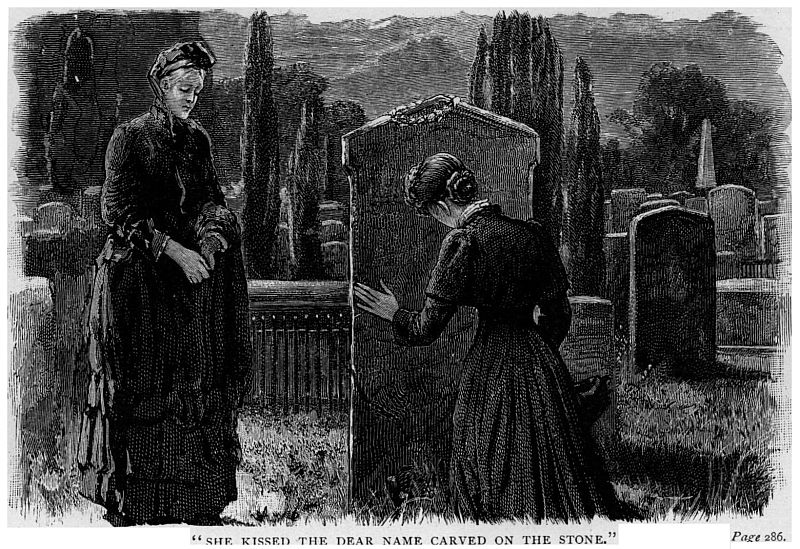
So together they stood beside the grave of Eunice, and spoke lovingly and thankfully of her, and prayed in silence for each other. And there was no bitterness in Fidelia’s tears, though they came in a flood as she turned away. For it was well with Eunice, and she knew they would meet again. She turned back when she had gone a little way toward the gate, and, kneeling once more, kissed the dear name carved on the stone, and prayed with all her heart that by God’s grace she might be kept unspotted from the world, till the time came when she should meet her sister again.
And so Fidelia left her home—sad, but hopeful.
One untoward event happened before she set sail. She had to meet Dr Justin face-to-face, and give him his answer. She was not many minutes in his company, but they were full of pain to her.
Strangely enough, she caught her first glimpse of him from a window, as she had done that day in Eastwood from Miss Abby’s room; and, more strangely still, he was walking as he had been walking that day, by Miss Avery’s side, looking down upon her, while she, with smiles and pretty eager gestures, looked up at him. For a minute Fidelia was not sure of the nature of the feelings which the sight awoke within her; but she was quite sure of one thing—she did not intend to break her engagement to go with her friend and schoolmate, Mary Holbrook, to Cambridge, to see at least the outside of the poet’s house before she went away. She listened till she heard them enter the house; and, when she knew them to be safe in the parlour, she went softly downstairs and out into the street; and, though she felt a little ashamed of herself for running away, she laughed heartily as she hastened on. She enjoyed every minute of the day, she told Mrs Wainright when—rather late in the evening—she came home. She had seen, not only the outside of the poet’s house, but also, through the kindness of a friend of Miss Holbrook, the inside of it, and Mr Longfellow himself as well; and the day was a day to be remembered for many reasons.
She saw Dr Justin in the morning, however, though she hoped she need not. There was not time for many words between them; but Fidelia’s words were spoken with sufficient decision. Dr Justin had not received her letter. He had heard from his niece Susie that her friend was going away, and he hastened to see her before her departure. He asked for nothing that would make it necessary for her to break her engagement with Mrs Wainright. He only asked her promise to return at the end of the year, and give him her answer then. But she refused to make the promise, or even to correspond with him while she was away.
“I have spoken too soon; I will wait and come again,” said he.
“You will not be wise to wait or to come again,” said Fidelia gravely.
He came to the steamer with other friends of the Wainrights to see the last of them. Miss Avery was there among the rest; and, as Fidelia watched them moving away together, she said to herself, that the chances were few that Dr Justin would either wait or return to her again.
And so it proved. Before the first year of her absence was quite over there came to Mrs Wainright a letter from her cousin, telling her of her engagement to Dr Justin Everett, and trusting that they might meet them in Europe before many months.
“And so that is well over,” said Fidelia.
Fidelia’s desire for real work by which she might do some good in the world was granted during the next three years, and besides her work she had both pleasure and profit; and little more than this can be told of the time she spent away from her home, on the other side of the sea. Her pupils respected her always, and by-and-by they loved her dearly; and her influence over them was altogether good and happy to body, mind, and spirit. And as much as that can be said as regarded her influence over their mother also. During a long and tedious illness, which came upon Mrs Wainright in Switzerland, Fidelia nursed and comforted her as she could not have done had there not been mutual respect as well as love between them; and to both mother and daughters her influence and example was a source of blessing which did not cease when the time came that they were called to separate.
This time came when they returned to America, for on going home to Halsey Fidelia found Mrs Stone—not ill, but ailing; and she made up her mind that it was her duty to remain with her old friend during the winter. Her pupils were to be sent to school, and needed her no longer. Their mother needed her very much, or she thought she did, and entreated her to return. But, even if Fidelia had not thought it her duty to remain with Mrs Stone, she would have hesitated about returning, for she had not been long in Halsey before she made a discovery which surprised her, and which made her ashamed.
After the first joy of welcome from old friends, and the first glad renewal of old associations well over, she could not but own to herself that she did not find life in Halsey altogether to her mind. This was not her discovery. She had hardly expected to find it so. She had had some such thought before she left it. Her surprise was, to find that she missed—even greatly missed—the pleasant things which she had become accustomed to during the last three years—the new books, the music, the sight and touch of rare and beautiful things; all the luxuries and the ease-giving which wealth dispensed judiciously, sometimes lavishly, had secured to her friend’s household, and to her with the rest. She missed the movement and the change made by the coming and going of the many friends of the household—not merely the ordinary friends and neighbours, but people of whom the world had heard—men and women whom it was good to see and know.
The life had suited her. It was not surprising that she should regret many things which she had enjoyed while with the Wainrights. Was it wrong to regret them? She might enjoy them all again in somewhat different circumstances. Would it be right and wise for her to return at the entreaty of her friend?
“I must settle the question once for all,” she said to herself. And she did settle it; and with it she settled another question which went farther and deeper. “Ye are not your own; ye are bought with a price: therefore glorify God in your body, and in your spirit, which are God’s.” Would a chance to lead an easy, pleasant, even useful life in the house of her friend cover for her all the ground which this command covered? She did not need a long time to consider the answer. The past she did not regret. It was well that she had gone with Mrs Wainright. She knew that she had helped the mother and the children to a better knowledge of each other, and she trusted also that she had done something towards encouraging in them a desire for a higher knowledge—the knowledge which God alone can give. She was glad in looking back; but could she look forward and see that she had any special work for these young people which their mother might not do better than she did? And might she not be taking out of the mother’s hands work the doing of which would be for her good as well as for theirs?
And then as to herself. Was “an easy time,” with only light duties—which could hardly be called work in any right sense, amid the luxury which she had learned to like so well that now she missed it—was this what she ought to accept for herself as the best and highest? Did she owe no more than this to Him Who had bought her with a price? She was, in a sense, quite alone, and at her own disposal, free from all ties of relationship or friendship, such as might interfere with any work to which she gave herself. She could teach. That had been her plan always, and her sister’s plan for her, because teaching undertaken and pursued in a right spirit might be made a part of the highest work of all. This Eunice had coveted for her; she had coveted it for herself.
Yes; the faithful doing of such work might be made work for the Master. Had she lost her desire to have a part in this work? she asked herself. Had her easy life among the pleasant things of the last few years done her this evil? She had many thoughts about it, and, after a time, she had some talk with Mrs Stone about it also.
“No; I don’t think you are spoiled. Your life could not have been a very easy one. Anyway, it hasn’t spoiled you. You had good work to do over there and you did it pretty well, I expect, or they wouldn’t want you back again. In one way it has helped you. Yes, I think you could now do good work in a better way for the advantages you have had, and you are bound to do it. If you don’t, your privileges may become a snare to you, and you may get to be satisfied with a kind of work lower than the highest you are capable of. ‘No man liveth to himself,’ you must remember.”
“And the highest work I seem to be capable of, is to teach.”
“There is no higher work, if it is done in the right spirit. And it is the work you have prepared yourself for. If you are better fitted for other work, you’ll have a chance to try it. It seems to be your work in the meantime. You may marry.”
Fidelia shook her head.
“I am not sure about other work. I know I can teach.”
And so for the next few years she did teach. In one of those large seminaries which the Christian beneficence of many wise men of moderate means, with the help of a few rich men, has established for the higher education of the young women of the country, Fidelia found her work. She was one of many who there worked willingly and well, in a field where good and willing work rarely fails to give a full return.
It would take a long chapter to give even a glimpse of her experiences during those years. She was not without her troubles and anxieties, but on the whole they were happy years. For to be successful in good work which one loves, and which one can do well, comes as near to true happiness as most people ever come in this world. Day by day, as time went on, she was permitted to see the springing up of some “plant of grace” from the seed which she had sown; and she had good cause to hope that there were more to follow, for such plants do not die out, but increase, and bear fruit abundantly as the years go by. Once in a while, but not often, she paused amid her work, to ask herself whether she would be quite content in it all her life long. It was a question which did not need an answer, as she was quite satisfied with the present; and the future, she believed, would be guided and guarded by the Hand of love which had led her during the past.
Chapter Sixteen.
Thanksgiving.
Fidelia had not lost sight of her friends during these years in the seminary. A few weeks of every summer were given to Mrs Stone and her Halsey friends, and as many to Mrs Wainright and her daughters, either in their own home, or at the seaside, or among the mountains, wherever they chanced to be passing the summer. The change and the happy renewal of old associations did her good, and kept her interested in other matters than those which concerned her daily life and duties. Her friends did not allow her to forget them. Even Mrs Stone wrote frequently to her, though the writing of a letter cost her more labour than a day’s housework did. One or other of Dr Everett’s family wrote now and then, and so did the Austins. With Mrs Wainright the correspondence was constant.
“Come home to Thanksgiving,” wrote that lady soon after the work of Fidelia’s fourth year in the seminary had commenced. She had written the same thing every year, but Fidelia had never been able to accept the invitation. This year she had a great desire to accept it, for various reasons; so, though the journey was long, and the time she could give for the visit was short, she found herself in her friend’s house on the eve of Thanksgiving Day; and among the many thousands who, throughout the land, had that day turned their faces homeward, few could have been welcomed more kindly than she.
Thanksgiving Day was kept in the town of C— much as it is kept everywhere throughout the country, in which there is so much over which a thankful people may rejoice. Everybody, except the anxious housekeepers who had dinner on their minds, was expected to go to church in the early part of the day, and join in thanksgiving with their neighbours. The Wainrights all went, and so did Fidelia. There were many people present. The service was simple and devout; the sermon was appropriate; and all things went as usual till it came to the singing of the thanksgiving anthem, and that went better than usual, because Fidelia joined in it, and put all her glad and thankful heart into her wonderful voice as she sang.
She even sang the “solo” which Mrs Wainright was expected to sing. But a whispered entreaty from her friend, which there was time neither to answer nor to refuse, gave the honour to Fidelia. Clear and full and sweet rose her voice, and filled the house, thrilling and satisfying all the listening hearts and ears with the melody, till the saintly old souls among them asked themselves whether even the heavenly music could be sweeter.
Some one sitting near the door rose when the other voices came in again, and walked up the aisle till he came to a point where, looking up, the choir in the gallery could be seen. There he stood till the anthem was ended, and then moved quietly away. He was a stranger, and no one took much notice of him at the moment, though some among them remembered him afterwards. Lucy Wainright noticed him, and spoke of it when she came home.
“It must have been some stranger. No one of our people would have done such a thing,” said she.
“It must have been that he wanted to see where the voice came from,” said her sister.
“I do not wonder,” said their father. “Miss Marsh, how came you to take the place of honour to-day?”
“I don’t know,” said Fidelia.
Mrs Wainright laughed.
“I don’t know either. I did not think of it a second before I spoke. It was a risk, I acknowledge—or it would have been with any one but Fidelia.”
“A risk! It might have caused a breakdown. She might have refused.”
“No; I was sure of Fidelia!”
And while they went on talking the door-bell rang, and the maid brought in a card and gave it to Mrs Wainright.
“A stranger? Did he ask for me? I do not know the name. Jabez Ainsworth!”
Fidelia uttered an exclamation, holding out her hand for the card.
“I know him well. He is one of my oldest friends, though I have not seen him for years. Shall I go and see him?”
“Do go,” said Mr Wainright; “and, if he is a friend of yours, ask him to stay to eat his Thanksgiving dinner with us. He will have something to be thankful for when he sees you, I should say.”
“Of course—ask him to stay. And don’t be long about it, for dinner is ready.”
So Fidelia went in quickly, with both hands stretched out in eager welcome to the friend whom she had not seen for so many years.
“Can it be Jabez?” she said softly, pausing before she came near.
“I need not ask if it can be Fidelia. You haven’t changed, except to grow a little like your sister.”
“Ah, my Eunice!”
Was it the dear name that brought the tears to Fidelia’s eyes, and the memory of so many sad and happy days? She could not hide them except by turning her face away, for Jabez held her hands firmly in his, and her smiles came quickly as she looked up at him.
“You are a happy woman, Fidelia. Your face tells me that before a word is spoken.”
“Happy! Yes; and so glad to see you. How can it have happened that we have never met all these long years—never once since you left Halsey?”
“I have only been once in Halsey since I left it, and then you were on the other side of the sea, where I have been since.”
They ought to have had much to say to each other after so long a time, but there was not much said for awhile. Fidelia looked on the face and listened to the voice at once so strange and so familiar, saying to herself how changed he was—and yet he seemed the same. He was a large man now, dark and strong, not at all in these respects like the slender sallow boy who had loitered about the garden in Halsey. But it was Jabez all the same. He was very grave and silent for a time, and walked up and down the room once or twice, pausing at the window which looked out upon the street, as though he had something to consider or to conquer before he could either listen or speak. After a little he came and sat down beside her.
“Well, Fidelia, you are a happy woman. You have lived through your troubles, and have come safely to the other side, thank God!”
“But, Jabez, it does not seem like trouble to look back upon it now. Only think of my Eunice safe and blessed all these years. Why, I have not shed a tear for a long time—in sorrow!”
She might well add the word, for there were tears in her eyes and on her cheeks while she spoke; but there were smiles on her face as well, which made Jabez say—
“I thank God that you are happy now.”
There was no time for more. The door opened and Mrs Wainright entered, followed by her husband. She did not need an introduction.
“I am glad to see you, Mr Ainsworth, and sorry to interrupt you so soon, but dinner is ready, and there will be time to visit afterwards.”
Then she introduced her husband, whose welcome, though quiet, was sufficiently cordial. Then he said:
“I hope you have no other Thanksgiving dinner in view, for I think ours is to be a good one; and we are very happy to see you.”
“I supposed that I was to spend Thanksgiving in Halsey, but a mistake as to connection, and then a breakdown on the road, left me here for the day. I shall be glad to give thanks with you, and with—Fidelia.”
“I am sorry for your grandmother,” said Fidelia.
“You need not be sorry. My visit was to be a surprise to them. It must wait till next summer now. I am going West again.”
“Well, we will go to dinner now,” said Mr Wainright, offering his arm to his wife. “Miss Marsh, you must show Mr Ainsworth the way.”
“Miss Marsh?” said Jabez, turning astonished eyes upon her, as the others passed out at the door.
“Why, who did you suppose me to be?” said Fidelia, laughing.
“I—I don’t know. I asked the door-keeper at the church who was the singer to-day, and he said it was Mrs Wainright. But I am very glad he was mistaken.”
“I sang to-day—”
“You cannot imagine how strange it was—how wonderful. I had been thinking about you all the morning—never supposing that you were within hundreds of miles of me—and I heard your voice, Fidelia,” he added, taking both her hands in his. “It is Thanksgiving Day indeed with me to-day.”
“And with me too,” it was on Fidelia’s lips to say, but she only said it in her heart. The joy that shone in her friend’s eyes kept her silent, though why it should do so she could hardly have told.
They went very soberly into the dining-room, where a few friends besides the family were assembled. Fidelia sat between the two girls as usual, and Lucy whispered that her friend was the stranger who walked up the aisle, and that it must have been to to see where the voice came from, as Lena had said.
And Lena said: “How tall he is, and how strong! He is not the least like the lanky boy about whom you used to tell us funny stories.”
Fidelia laughed and said softly, “Yes, he has changed—almost as much as the little girls to whom the stories were told. It is a long time ago, you must remember.”
Mr Wainright was not mistaken. The dinner was a very good one, and passed off, as all Mrs Wainright’s dinners did, quite successfully. So did the evening with music and pleasant talk, and all else that was required for success. But it is not to be supposed that all this was quite satisfactory to Fidelia and her friend.
“There were so many things I wanted to hear about,” said Mr Ainsworth.
“And I too,” said Fidelia.
“I shall see you in the morning before I leave, if possible,” said he.
He came in the morning, and he stayed all day.
He could, by travelling all night, get to M— in time to meet an engagement on Monday. He should have had to do so if he had gone to Halsey.
He had something to tell and much to hear. He had, he thought, a right to say that he had been fairly successful as a student. He had had to help himself, and had done so in various ways, but not more than was right, or than had been good for him. His last two years had been spent in Germany. He had gone there in charge of two lads, sons of a German merchant in the West. Of course he had availed himself of the opportunity to go on with his own studies at the university, and now he was going West to find his work.
It was a very poor sort of work in the opinion of Mr Wainright, who, coming in at the moment, heard him say that the next few months were to be spent in travelling through some of the newer states in the service of one of the great missionary societies, with a view to the encouragement and aid of weak Churches, and the establishment of new ones, in the small settlements springing up everywhere.
“It will be hard work,” said Mrs Wainright. “And do you really suppose it will pay? Don’t you think that all that sort of thing might be safely left to the people themselves?”
“It seems to be the work laid out for me just now,” said Jabez, not caring to get into any discussion of the question.
“You might do far better work in an older community. It is the majority of the dwellers in our great cities which need most the civilising—or, if you like it better, the Christianising—influence which strong and good men can exercise in a community. It is from our great cities that power for good or for evil is sent out over all the land, in ways of which I need not tell you. If you have the will and the power to work for your fellow-men, it is not to these remote and sparsely-settled parts of the country that you should go. You are needed more where crowds would gather to hear you.”
But Mr Ainsworth shook his head.
“I have the will to work, and I trust, by God’s grace, to have also the power. But I think I am best fitted for such work as is needed out in our newer settlements. It will be hard work, perhaps, but it will be work, direct and simple, for the good of men and the glory of God. I don’t think I am so made and fashioned as to be likely to be very useful among such men as fill our great cities.”
“There are all sorts of men in our great cities; and you can hardly tell what sort of work you are good for yet, till you try.”
“And as to the importance of my work out there—it would be a good work, wouldn’t it, to help to educate and influence some of the boys who come from country places to make the business men and the professional men of the great cities? Yes, and our senators and the governors of our states. You must know several country boys who have come to that.”
“I know several certainly; and you may be right. We have a great country out there, which is getting filled up in a wonderful way with all sorts of people. God knows, some strong influence for good is needed among them.”
“Yes, that is our hope—God knows,” said Mr Ainsworth gravely.
This was the beginning of a long conversation, during which each man surprised the other, and each learned something from the other which bore fruit in the life of both in after years.
East and West, North and South, the past, the present, and the future of all sections of the country—all “the burning questions” of the day were discussed. Fidelia listened with shining eyes and changing colour, and dropped a strong word in now and then; and all the time she was saying to herself—
“To think that Jabez should have grown to be just the best sort of man! And what a life lies before him! I wonder if my Eunice knows?”
And Jabez, seeing her softened glance, knew as well as if she had spoken her name that it was of her sister that she thought.
It rained all the morning, so that there was nothing said about showing the town and the surrounding country to the visitor; and there was all the more time for the talk which seemed to interest them all. The rain ceased, and the sky cleared a little in the afternoon, and a walk was proposed. Mr Ainsworth rose at once and looked at Miss Marsh.
“I shall be glad to take a walk,” said she. “I have heard so much talk to-day that I need to rest my mind by tiring my body. Come, Lucy and Lena, get your wrappers and let us go. Will you come with us, Mrs Wainright?”
“No, I think not; and I am not sure about its being best for the girls to go. Had they better, Fidelia?”
“Because of the dampness? It will do Lucy no harm. Lena, perhaps, had better not go.”
“Oh, if one goes, they may both go! I guess the damp won’t hurt them,” said Mrs Wainright. And to her husband she said—“And if he has anything to say to her, I guess he’ll find a chance to say it.”
Apparently Mr Ainsworth had nothing particular to say—at least nothing which Lucy and Lena might not hear, for they all walked on together till they came to the church. It was a new and fine church, and visitors in C— were often taken to see and to admire it; so when Mr Ainsworth proposed that they should go into it, the girls at once set off to get the keys. They returned almost immediately, and with them came a gentleman who told Mr Ainsworth, after he had been introduced, that he knew more about the church than any one in C—, and could give them the history of every nail and stone, window and door. He did not quite do that, but he gave them many interesting particulars as to construction and cost, and the special advantages of the building generally over all the other churches in the town, or, in fact, any other town. Mr Ainsworth listened and kept silence in a way which won the respect of the pleased narrator, who probably was not always so fortunate in his listeners. He got through at last, or had another engagement and went away; and then Jabez said softly—
“Miss Fidelia, do you know why I wanted to come in here? I want to hear you sing again, ‘For His merciful kindness is great toward us, and the truth of the Lord endureth for ever.’”
“Of course I will sing it. But I might have done that at home, and saved you the deacon’s lecture on architecture. Oh, I must go up into the gallery, must I?”
“Yes; and I will stand here, where I first caught sight of your face.”
So Fidelia went up and sang with a glad heart, not the solo only, but the whole Thanksgiving anthem, the two girls doing their best to help. They did not linger long after that; and when they had left the church, and the girls had gone to carry back the key, Jabez said gravely—
“I shall have that always to think about, till I see you again.”
“And I hope that will not be so very long this time,” said Fidelia.
It was not very long. They met the next summer in Halsey. There he found her one summer morning standing in the garden, at the opening under the apple-trees, looking down on the river and the meadows and the hills beyond, thinking of many things. There he found courage to say to her all that was in his heart.
Not at that first meeting, however; though even then it would not have surprised her or found her unready with her answer. For they had written to one another constantly since their first meeting at that glad Thanksgiving time; and Fidelia knew all that letters frequent and long could tell her about the work which he had found ready for hand, head, and heart in the far West. Now he had more to tell her. He had been called by the Church in M—, in the state of W—, to be their pastor, and he had accepted the call.
There were just fifteen members in the Church, but they were all New England men and women, of the right sort. M— was only a small place as yet, but the prospects were fair that it would be a city within twenty years. It would one day be a great commercial centre for a grand stretch of country; and the faithful fifteen who had made their home there meant that, in so far as it should be in their power to make it so, it should be a centre of influence for good in the state, and in the whole great country; and their pastor elect meant no less than that also. And when he had got thus far, he said gravely—
“Fidelia, will you come with me, and help in this great work?”
And Fidelia put her hand in his and said quietly—“Jabez, I shall be glad to go.” And let the wise men of this world, and the rich men and the mighty, say what they will, there is no greater or grander work to be done under the sun than the work which these two, standing under the apple-trees, agreed to help one another to do. There is no work whose success can avail so much for the happiness of the individual soul, for the household, or for the community, and there is none whose success can bring such wealth and honour and stability to the nation, as that through which the hearts of men are taught to believe and know, and the eyes of men are enlightened to see, that it is “righteousness which exalteth a nation,” and that “sin is a reproach to any people.”
“Fidelia,” said Jabez in a little, “do you suppose that Eunice knows?”
And Fidelia answered softly,—“If she knows, I am pure she is glad.” Before the summer was quite over these two happy people went West to begin their work together. A good many years have passed since then. The place in which “the faithful fifteen” set up the standard is a great city now. They, and those who have joined themselves to them since then, have kept the promise made in these early days to their Lord and to each other. And He who said, “Them that honour Me I will honour,” has kept His promise to them.
|
Chapter 1
| |
Chapter 2
| |
Chapter 3
| |
Chapter 4
| |
Chapter 5
| |
Chapter 6
| |
Chapter 7
| |
Chapter 8
| |
Chapter 9
| |
Chapter 10
| |
Chapter 11
| |
Chapter 12
| |
Chapter 13
| |
Chapter 14
| |
Chapter 15
| |
Chapter 16
|