Margaret Murray Robertson (continued 2)
Reading edition
“He won’t sleep long. And, see, I have a book.”
So the boys set off, and Fidelia had a quiet two hours with her book,—which ought to have been Butler’s “Analogy,” considering her next year’s work at the seminary, but which was “Astoria”—much more appropriate for the time and place. Franky woke rested and much the better for his nap, but indignant at being allowed to lose so much time. But he forgot his vexation in the pleasure of listening to a story Fidelia told, and which lasted till they came in sight of Amos, happy and successful as ever, but a little tired also. So they sat down to rest and enjoy another lunch, and to talk about things in general.
Fidelia knew how to talk to boys. She knew every tree in the woods, and the note of every bird which chirped among the branches. She knew something about most plants that grew in field or wood, so there was no danger of falling out of talk. The boys were interested in what they heard, and each had something to tell. By-and-by Franky said—
“How many brothers have you, Miss Faithful?”
“Not one! I never had a brother.”
“Well, they would have had good times, if you had.”
Fidelia laughed—“I am not so sure. I have one sister.”
“Yes, I know—Miss Eunice,” said Amos.
“Yes, my Eunice. She is all I have got, and she is better to me than two or three brothers.”
“Yes, I know,” said Amos, nodding his head; “I heard Dr Everett talking about her with father. Oh, no, it wasn’t doctor’s talk; only how good she is, and how much she thinks of you!”
“Why do they call you Faithful?” asked Ned.
“No one calls me that but Nellie, and you must ask her why.”
“I suppose it is because you never shirk,” said Amos.
Fidelia looked grave.
“I don’t deserve it for that reason,” said she.
“You know Jabez Ainsworth, don’t you?” said Amos.
“Oh, yes; I have always known him! We are good friends.”
“He is a smart boy, isn’t he?”
“Yes, he is smart, and good, though he gets into trouble now and then. He is seventeen.”
She told them an amusing story or two about Jabez—about adventures which he had had and trouble into which he had fallen when he was a little fellow, because of a determination to get his own way. She ended with an account of his last venture in taking Eunice’s garden for the summer, so as to make some money, because he “was bound to put himself through college, and be somebody.”
Amos listened in silence.
“Do you suppose he’ll do it?” said Ned.
“I think so. Oh, yes, he is sure to succeed! His grandfather will help him, perhaps, when he sees that he is determined to be educated. But, whether he helps him or not, Jabez is bound to succeed.”
“I wonder if the hardest things aren’t the easiest after all!” said Amos. “I mean, that we don’t always care much about what we can get without much trouble.”
“He means, he don’t care about going to college,” said Ned; “but father means he shall.”
“Oh, yes, I suppose I shall go! But I’d a good deal rather go West to Uncle John’s great farm.”
“You can do both,” said Fidelia.
“It takes five years to get through Amherst College.”
“Well, you can spare them. You are young. How old are you?”
“I was fifteen in May.”
“Only fifteen! I thought you were older than that.”
Amos looked pleased.
“How nearly are you ready for college?”
“I might go this fall; but father thinks I had better wait a year. I don’t care.”
“I think so too—if you don’t care. Next year Jabez may go too. I only wish he had your chance—and yet I am not sure. He may do all the better for having to work his way through. But for one to have your chance, and not to care for it, that I cannot understand!” added Fidelia gravely.
“My father is not a rich man,” said Amos.
“No—not as Mr Kent is rich. But an education such as he is able and willing to give his boys will be worth more—if they take the good of it—than all Mr Kent’s money would be. You don’t realise, your privileges, young man.”
She said a good deal more than that. Amos had heard much of it before, but somehow it sounded differently repeated by this girl with laughing lips and shining eyes, and with now and then a touch of only half-conscious scorn for the eyes that would not see and the hands that did not care to seize the chances for which others were eager to strive. Amos had not much to say as they rose and turned homewards.
By-and-by they stopped to rest, leaning for a little on the crooked fence on the brow of the hill, from which more than one tree-shaded town could be seen, and many cultivated fields and rough pastures, and broken stretches of woodland, with the light of a wonderful sunset lying on them all. It was a fair scene, suggestive of peace and plenty and contentment; and, looking on it, Fidelia lifted up her voice and sang—
“My country, ’tis of thee, Sweet land of liberty—Of thee I sing!” and so on to the end. Amos looked up amazed, and at the second verse struck in a true boy’s second. So did Ned; and even Franky, climbing up to the top rail of the fence, tuned his shrill pipe with the rest.
Of course they sang “My Country” to the tune which belongs to it—a tune which with these words, and with other words, has stirred and thrilled patriotic breasts on both sides of the sea for many a year and day. Fidelia and the Austin boys called it “America,” but on the other side of the sea it is called “God save the Queen.” They sang it there on the hill-top, with all their hearts. Then they sang “The Star-spangled Banner” and “Hail! Columbia!” as they took their way through field and wood; and more besides, till tired old ladies, rocking themselves in their chairs and taking their rest at open doors caught the sound and smiled; and boys and girls, milking their cows in pasture corners, paused in their work to listen.
Tired? That was the very last thing they were thinking of as they passed the south porch, on their way to the kitchen with their fish. Fidelia nodded and smiled to the party sitting there, waiting to be called to tea, but passed on to the kitchen with the boys, where the fish was displayed to the admiring eyes of cousin Abby and the doctor.
“And so Miss Fidelia did not scare away the fishes, as girls generally do?” said cousin Abby.
“I guess she didn’t. I tell you, she knows how!” said Ned.
“She’s first-rate,” said Frank.
Fidelia laughed—“I have had a good time. I should like to go again some day.”
“And why should you not? And Nellie shall go next time. I don’t believe she has had so good a time at home,” said the doctor, as his daughter came in.
“Oh, yes, I have had a pretty good time! But I should like to go fishing with the boys and Fidelia next time. You feel better, don’t you, Fie?” said Nellie, as they went upstairs together; and her friend assured her that the day’s tramp with the boys had done her good.
On the bed, as smooth as cousin Abby’s skill in ironing could make it, and adorned with here and there a knot of ribbon which Fidelia had not put on, lay the white dress which was “to be kept for Sunday.”
“I thought I had better have it all ready,” said Nellie hurriedly, “as I thought you might be late. We are going to have company this evening—just the Newtons, and Conways, and a few others. Mother thought she would like Mrs Kent and the girls to see some of our friends, and this was the best night for them to come. I am sorry it happened so, for you must be tired—though you don’t look tired.”
“I am not a bit tired. And don’t look so troubled, child. Oh, yes, I’ll wear the white gown—red ribbons and all! I’ll do my best to do you credit.”
“How you talk, Fidelia! But I do want you to look nice. Father says—”
But what her father said Fidelia was not to hear. A knock came to the door, and cousin Abby entered with a tray.
“Doctor said Miss Fidelia had better have her tea up here, and rest a spell till the company come. She mustn’t get too tired, you know,” said the old lady, smiling.
“Well, there! I might have had the sense to think of that myself, and saved you the trouble,” said the delighted Nellie.
Fidelia said nothing, but she cleared a place on the table for the tray, and thanked the old lady with a kiss.
“If you should drop asleep for half an hour it wouldn’t hurt you any,” said Cousin Abby as she closed the door.
And, in the midst of her questioning as to why these people should be so kind to her, Fidelia did fall asleep, and woke only when, an hour later, Nellie returned ready dressed and eager to help her—
“You look quite nice!” was all Nellie allowed herself to say to her friend as they went downstairs together. “Now they’ll see for themselves whether she is beautiful or not,” she was saying to herself; but she knew it would not be wise to say it to Fidelia.
Of course Miss Austin had to be ready to receive their friends; and Fidelia fortunately found Amos entertaining the minister with an account of the day’s sport and the pleasures of a day among the hills.
“Here is Miss Fidelia. She knows all about it,” said the boy; and they had a pleasant half-hour together.
Nellie’s triumph began when Judge Newton asked her whether the tall girl standing talking to the minister was the beautiful Miss Avery they had heard so much about. More than one asked the same question.
“Oh, no,” said Nellie demurely, “that is only my room-mate, Fidelia Marsh! Wait till you see Miss Avery.”
And she had another little triumph when, drawn towards the piano by the exquisite touch of Miss Kent, Fidelia almost unconsciously put out her hand to turn the page of the difficult music she was playing, and kept on turning it to the end. It was the look of surprise which passed between Miss Kent and her cousin that delighted Fidelia’s friend.
“You play, do you not?” said Miss Kent, rising.
“Not as you play. Oh, please don’t go yet!” said Fidelia earnestly.
“Sing something, Ella,” said her cousin. “Sing this”—laying a song open before her. “No, Miss Marsh. I will turn the music. You must only enjoy it.”
And Fidelia did enjoy it, as she had seldom enjoyed music before; growing pale and red by turns, as the thrilling voice rose and fell. For the moment the enjoyment was perfect. When it ceased, Fidelia would have slipped quietly out of the room. Miss Kent rose.
“You sing, I am sure, Miss Marsh?”
“No,” said Fidelia gravely; “I do not sing.”
“Fidelia!” exclaimed Nellie.
“No,” repeated Fidelia; “I don’t sing. I have only just found it out.”
“And what is this Amos has been telling us about your starting the echoes among the hills on your way home to-night?” said Dr Everett, who had drawn near.
“I think you can sing,” said Amos. “Oh, yes, I can sing to please Amos!” said Fidelia, trying to speak lightly, but troubled under the eyes of those who had gathered round the piano, and more troubled still by the rush of her own vexed thoughts.
“Is it envy?” she was saying to herself. “Is it pride and jealousy and discontent? Am I going to disappoint Eunice, after all? Oh, I am not good!”
She did not know who proposed it, or how it happened, but in a little Miss Kent seated herself at the piano again, and the young people gathered round her, “to sing something they all could sing,”—a much more enjoyable affair to most uneducated singers than just to sit and listen to fine music. Of course they began with “The Star-spangled Banner;” and if Fidelia’s voice did not ring out quite as it had rung out to please the boys among the hills, it still caused the Boston cousins to exchange surprised glances, thus giving the watchful Nellie another moment of delight. They did not sing long, however; and when Miss Kent rose again, Fidelia moved away to the other end of the room, believing that the pleasure of the evening was over for her.
But it was not. She found herself in a little listening with much interest to the minister and the judge as they discussed a question which had come up before the last ministerial association of the county, and thinking it would be something to tell Eunice about when she went home. In the midst of it a voice said,—
“Miss Fidelia, I have a message for you from your sister.”
“From Eunice?”—and she turned to see Dr Justin Everett standing beside her.
“Yes. I went to Halsey with my brother this morning, and have only just returned. We called to see your sister on our way.”
“She is well?”
“That is part of the message she sent to you. She says you are not to hurry home, as my brother seemed to think you meant to do. You are to stay and have a good time. She does not need you in the least. No; that is not part of her message. But she is going with Mrs Stone to pay a visit of a week over in Northwood, and you are to stay here till that is over. She will write fully to-morrow.”
“I am glad she is strong enough even to think of a visit to Northwood.”
“Yes; and Mrs Stone will take excellent care of her. The change will do her good. And your change will do you good also.”
“It has done me good already.”
Then he gave her another message from his niece, Susie Everett, and told her several items of Halsey news; and then some one came to interrupt their talk; and then the evening went on as all such evenings do, until the guests rose to go away. And Fidelia was saying to herself, while she listened to Nellie’s remarks on things in general, that Eunice and Dr Justin were good friends again, and she was not sure whether she was glad or sorry that it should be so.
Chapter Six.
Discontent.
In looking back on it afterwards, and in talking it all over with her sister, Fidelia could hardly decide whether she had had more pain or pleasure in the week which followed. It was a time she did not like to think about. There had been no real cause for pain, she acknowledged. She had acknowledged as much as that at the time, and she had known that she ought to be ashamed of herself.
That she—Fidelia Marsh—should have a single uncomfortable moment over a faded dress, or the appearance of a last summer’s bonnet, was humiliating—she who had never cared about her clothes! She had never thought much about her clothes in any way. Eunice had always done that for her, as she had done other things. At home she had thought herself as well dressed as her neighbours. At the seminary there had been no time to think about dress; and there had been other faded alpacas there as well as hers. Why should she think about her clothes now? She was ashamed of herself. But it was not clothes altogether. She did not “fit in” among these people. They were different from her—or, rather, she was different from them.
Everybody was pleasant and kind. Miss Avery even, whom she liked least, was especially friendly—she seemed to seek her out always. She sat with her on the lawn in the morning, and in the evenings brought a stool and sat at her feet, while they listened to Miss Kent’s music. They walked and talked together; and why should she not like Miss Avery, who seemed to like her and to wish to be with her? Why should she shrink from her questions about Eunice and their home life, and their friendship with the Everetts, and answer them briefly, and go over all that had been spoken between them in her own thoughts afterwards, in fear of having said something that she ought not to have said?
She liked Miss Kent, though she was a grave and silent person who did not seem to have much to say to any one. They had their love of music in common, and Fidelia was grateful for Miss Kent’s quietly given hints on that subject, and profited by them. She was at her ease with her, but she was not at ease with Miss Avery.
“And why not?” asked Nellie Austin, to whom she one day made the admission. “I’m sure she seems to think everything that is good about you. To-night, when you were sitting together, before the lamps were brought in, Mrs Kent said what friends you seemed to be; and Dr Justin said what a picture you made, sitting there in the fire-light.”
“Yes, I guess so! The picture of a hen and a humming-bird!” said Fidelia, laughing. “If he saw anything but Miss Avery and a feather duster it is a wonder. I have no doubt Miss Avery realised how pretty the picture was, as well as he. No, I am not cross nor sarcastic either, and I am willing to act as a set-off to her now and then, if it is to do her any good. But I can’t just say I like quite so much of that kind of thing.”
“Fidelia,” said Nellie gravely, “we shall have to let you go fishing again with the boys.”
“Yes, let us go. Is it too late to make a plan for to-morrow? We should have to make an early start.”
“It is too late to plan for to-morrow. Amos has gone to bed. And, besides, we couldn’t go to-morrow; we are going to Colonel Green’s. And the day after to-morrow we are all going to the Summit; and those who like can go by the way of Smellie’s Brook, and go to the Summit by the other path.”
“Well, I will go with the boys, and you had better come with us. That was the most delightful day I have had in Eastwood—the day I had with Amos and his brothers at the brook.”
“Thank you, for myself and all the rest. Faithful, what is the matter with you these days?” said Nellie, laying her hand gently on her friend’s hair, “There is something the matter, is there not, dear?”
“There must be, if you say so; but I can’t tell you what it is. I must be ‘gettin’ kind o’ nervous,’ as Deacon Ainsworth says of his wife. It’s queer, isn’t it? I, who never knew there were nerves, until I learned it out of a school-book! I guess I want Eunice. She’ll set me all right. I never had any bad feelings yet that she couldn’t deliver me from, in one way or another. Oh, yes; I shall be all right as soon as I see my Eunice!”
But she was not quite sure of it, even when she said it.
The next day, instead of going with the rest to pay a visit to friends in a neighbouring town, Fidelia chose to stay at home and help cousin Abby with her preparations for the expedition to the Summit, as the highest hill in the neighbourhood was called, and had a better time than if she had gone with the rest. She enjoyed helping Miss Abby, and she enjoyed her talk while the work went on. For Miss Abby Chase saw clearly—had all her life seen clearly—many things which eyes intent only on personal interests might easily have overlooked. Her talk did not flow on in “a straight stream,” so as to become wearisome; but now and then a remark was made, or a word of advice given, or a bit of personal experience told, of which Fidelia made a note, saying to herself: “I must remember to tell Eunice that. How Eunice would like to hear cousin Abby talk!”
They had not, for various reasons, been ready to begin “in the cool of the morning,” as was Miss Abby’s custom when there was anything special to do. The day was warm, and, though the work was pleasant work, it was hard work too in a way. But no feeling of weariness could interfere with the satisfaction with which they viewed results. The success was complete.
“They will spoil a good housekeeper if they make a schoolmistress of you!”—as Fidelia stood folding her apron, and regarding with admiring eyes a big chicken-pie which Mattie had just brought in from the oven. “But I don’t suppose you’d care about spending your life as a housekeeper, when you might have higher work to do.”
“Higher work? Yes, I suppose so. Teaching is either the highest work, or it is drudgery. I suppose it depends upon the teacher,” said Fidelia gravely. “But any sort of work is good if it is needed, and if it is well done—as we have done our work to-day,” added she, smiling.
“Yes; and it is something to do well the humblest work, when others are helped by it to do the highest. And then the Lord doesn’t always see ‘high’ and ‘low’ just as we do. And those who just help other folks’ works, and come into other folks’ lives, without having much of a life of their very own, may have a good time too—yes, and a good reward.”
“Yes,” said Fidelia, thinking of her sister. “Miss Abby, don’t you go visiting sometimes? Won’t you come to our house and see my sister? She would like to have you, and I am sure you would like each other.”
“I should be pleased to visit you and your sister. Yes, I should like her. I like what I have heard about her. I saw her once—she visited here a long time ago.”
“Did she? I don’t think I ever knew it. Was she a little girl? Was it with our father that she came?”
“No; she was a grown woman—a sweet and beautiful young woman. She stayed two or three days. There was company in the house, and I remember they all went one day to the Summit. It was with Dr Justin Everett that she came.”
“Ah!” said Fidelia, sitting suddenly down on the window-seat.
They had come into Miss Abby’s room by this time, and the old lady was resting in the rocking-chair while Fidelia lingered, going on with their talk.
“It was just about the time when her grandmother grew worse. No, I didn’t see much of her; I had more to do in those days. I saw her, but we did not speak together, and I have nothing special to tell you about her, dear, only that I saw her when she came. I have often thought of her since.”
Fidelia sat still, with her chin on her hand and her eyes fixed on the far-away hills; and Miss Abby could not but see the change that had passed over her face. But she did not speak.
The old trouble about Eunice was stirring at her heart. Eunice had always helped others; she had only come in for “a part in other folks’ lives,” as Miss Abby had said. Had Eunice “had a good time and a good reward?” She had been at least content during the last few years. Was she content still? Was she grieving over the past, or was she wishing for that which could never be hers?—“for that which is really not worth having or grieving for, if she only knew it!” thought Fidelia, with an angry flush rising to her cheeks, as the thought of Miss Avery, and the interest which Dr Justin seemed to take in her, came to her mind.
“She doesn’t care. I don’t think she would care; but, oh, I wish I were quite sure! Surely the Lord would never let that trouble come into her life again, after all she has done and suffered.”
She sat long with her eyes fixed on the hills beyond the river, on which the glory of the sunset lay; and when at last she turned to meet the grave looks of Miss Abby, she started and grew red, with a feeling that the old lady must know her thoughts. But Miss Abby only said,—
“Think of it! I had forgotten all about the eggs. I must go down again.” And when she had gone out and shut the door, she opened it again to say,—“You had better stay right here in my room, hadn’t you, and rest? There will be some noise in the other part of the house when they all get home. I may go over to see Sally Hanson a minute; I have something to take to her. But I guess you had better stay here.”
Whether she went to see Sally Hanson or not, she stayed away a good while, and it was growing dark when she returned. Fidelia still sat with her cheek on her hand, and her eyes on the hills, hardly seen now in the gathering gloom.
“Well, dear, are you rested? You have been having a quiet time, haven’t you?”
“Oh, yes! I was not tired—only lazy. I suppose I ought to go and brush my hair and change my dress before they all come home. I wonder if I need go down at all? They will be tired enough not to wish to see any one.”
“Well, yes, I’d go down a spell, if I were you, for the sake of being friendly.”
“Do you suppose I should be missed?” said Fidelia, with a laugh which did not sound so pleasantly to the old lady as Fidelia’s laugh usually did.
“You don’t feel very well to-night, do you, dear? I guess you are over-tired, though you don’t know it. Or is there anything else the matter with you, Miss Fidelia?”
“If there is I don’t know, or at least I can’t talk about it.”
She rose and approached Miss Abby as she spoke, conscious that her words might sound strange; but turned to the window again, and stood looking out into the gloom, and there was silence for a time. Then Miss Abby said gently,—
“But you know just where to carry your trouble, dear. Whatever it may be, it isn’t beyond help, is it? How can it be to a Christian?”
Fidelia made no answer to this.
“Have you been living up to your privileges over there in the seminary, dear? I have always heard that it was a good place in which to grow in knowledge and in grace. You haven’t been so much taken up with your books as to neglect better things, have you? Fidelia, are you a Christian?”
There was a moment’s silence before Fidelia answered.
“I once thought I was a Christian. Now I do not know—I am not sure.”
“And so you got kind of down and discouraged, and no wonder, dear.”
Fidelia had to resist a strong impulse to rush away, when Miss Abby rose and came to the window.
“But you needn’t be discouraged. If you are not sure of your hope, you must just let it go, and come again to Him who is our only hope, and it will be all right with you. If you have fallen back, it must be because you have failed to ask His help, or your heart has been after other things. But you haven’t done anything, or neglected anything that He will not be glad to forgive if you’ll tell Him of it, dear. You needn’t be a mite discouraged. I’d be glad to help you if I could,” said Miss Abby, laying her hand gently on that of the girl. “I’m an old woman now, and I’ve seen a good many things in my time, and I have suffered some, too, but not any more than I’m glad to look back upon now. Anyhow, it never pays to get discouraged.”
“Discouraged!” thought Fidelia. “Why, I think I am wrong all through. I am not sure that even Eunice can set me right now.” Aloud she said—“No; it does no good to be discouraged.”
Then they heard the south gate open, and knew that the young people had returned; and, before Fidelia had time to escape, Nellie was calling her name on the stairs, and there was no time for more.
Of course they went downstairs together, and heard all about the visit, and whom they had seen, and what they had said and heard and done, and how sorry every one was that Miss Marsh had not gone with them. And no one would have suspected that Miss Marsh was “discouraged,” or even tired, so interested was she in it all. Indeed, she seemed to have more to say than usual, and even became boastful, as Nellie declared, when allusion was made to the preparations for next day’s expedition to the Summit.
Miss Avery was even more demonstrative in her friendliness than usual that night; and as she was so much fatigued that she found it necessary to recline on the sofa, she would have Fidelia bring a low seat and sit beside her, saying she had seen enough of all the rest for one day. Fidelia sat down willingly enough, but she would not give up her hand to be caressed, as Miss Avery desired; she was busy covering a ball for Franky; and in a little she found it necessary to go nearer the light, but not before Miss Avery had whispered a few words in her ear.
“What a good woman your sister must be! How lovely she must have been when she was young! Dr Justin Everett thinks her nearly perfect.”
She had no time to say more. Fidelia rose suddenly, and, without a glance toward her, walked across the room; and Dr Justin, coming in with letters in his hand, alone saw the paleness of her face and the anger in her eyes. Miss Avery rose from the sofa, and in her pretty eager way came forward to claim her letters.
“Now, Dr Justin, there must be one at least for me! Do say you have got one for me this time,” said she, clasping her hands imploringly.
The doctor laid the letters on the table without a word. It was Nellie who distributed them, and the last one was for Fidelia.
“Now you will be happy! It is from your sister,” said she.
There were letters for several of the others; and in the interest of receiving and opening them, Fidelia was allowed to slip out of the room unnoticed, and only returned in time to say good-night.
“And it must be ‘good-bye’ too, I am afraid, as I must go home to-morrow morning. Eunice wants me. No; she is not sick, but she wants me. I have told Mrs Austin all about it, and she says I ought to go. Amos has promised to take me to the depôt in the morning.”
“But our trip to the Summit?”
“You must stay for that!”
“One day can make no difference!”
Fidelia was sorry to miss the day’s pleasure, but a day would make much difference. The letter had been delayed one day already, and her sister had several reasons for wishing her to come home at once.
“But your packing! You will have to be up all night. You must let me help you, Miss Marsh! Now say you will,” pleaded Miss Avery with pretty beseeching gestures.
Fidelia laughed.
“My packing! It is all done already, thank you. You will see the last of me to-night.”
It was not quite the last to several of the party. The departure was not so early but that all the family were down, and even Miss Avery had a chance to say good-bye again from the window, as Fidelia and Amos drove off. She proposed that they should wait a little, that she might drive with them, but this was not to be thought of.
“Dr Justin wanted to drive you down, but I said I had promised,” said Amos gravely; “you don’t care, do you?”
“I should have been very sorry if you had forgotten your promise or broken your word. I would not have cared to trouble Dr Justin Everett.”
“Oh, it wouldn’t have troubled him any! He’d as lief come with you as not, I guess. If any one had come, it ought to have been Nellie; but I told her I had something to tell you, and she was very good about it. As for Miss Avery, I guess she didn’t care much about going. You like Miss Avery pretty well, don’t you?”
“Oh, yes! Not as I like Nellie, you know. But Miss Avery has been—very—”
“Kind and condescending!” said Amos, as Fidelia paused for a word.
They both laughed a little, but nothing more was said about Miss Avery. A good deal was said about things in general, but not a word which Nellie and all the rest of them might not have heard; and Fidelia began to think she had misunderstood the boy as to his having something to say to her. But when the horse had been securely fastened at a safe distance from the track, they turned to walk up and down the platform. During the few minutes that remained, Amos said,—
“I am going to tell father that I am going to college this fall or next, just as he thinks best.”
“Yes, of course,” said Fidelia. “Well?”
“That is all; and it isn’t ‘of course’ by a good deal. I had about made up my mind for something else. I was going West, to see how it looked out there, any way.”
“Not without your father’s knowledge?”
“No—I don’t know as I should have gone with his knowledge and consent. But he’d have let me go, I guess, if I had kept at him, even if he had hated to.”
Fidelia shook her head.
“That is not the kind of talk I should expect to hear from you, Amos, with such a father as you have.” Amos hung his head, but said,—“Well, I’ve changed my mind. I am going to college, and I am going to do my best. Yes; it is partly to please father, and partly because I see things a little differently. Do you remember what you said to me that day on the hill?”
“I am afraid I talked a good deal that day. I don’t think I remember anything particular.”
“It was about the honour of having a part in the highest work of all, and about the duty of preparing one’s self to do it in the best way. I am going to have a try for it, any way,” said Amos, with a break in his voice.
Fidelia put out her hand and touched his, but she did not speak for a full minute. She was thinking,—“A word of mine! That can’t be—discontented, worldly-minded girl that I have proved myself to be! I am not worthy.” Aloud she said,—“I am glad, Amos. Tell me more.”
“It was only a word you said, but it set me thinking; though I don’t see why it should, for mother, and cousin Abby, and even Nellie, have said about the same to me often. I suppose it was because it seemed new as you said it; and I had got kind of used to cousin Abby’s good advice, and even to mother’s. But I made up my mind that I would see the thing through this time, and decide one way or another. What Dr Justin said helped me some. I mean to try and be a good man—a servant of God,” added the boy, speaking with difficulty.
“Amos,” said Fidelia, “do you mean that you have become a Christian?”
“I mean that I wish to be a Christian, and to have a part in the very highest work, if the Lord will have me for His servant.”
“If, Amos? There is no ‘if’ on the Lord’s side.”
Then she paused, telling herself that she too had desired to have a share in the highest work, and asking herself whether she had not drawn back. She did not know. She only knew that she was all wrong, and that she too must begin again.
“I, too, shall have to decide once for all. Oh, I must!”
There was no time for more, for the shriek of the engine was heard in the distance.
“Amos, I am so glad! And I am glad you have told me. I wish I knew just the right thing to say to you. I can only say I am glad. I wish you could come and talk with my Eunice. Oh, dear—just as if you hadn’t your father and mother, and cousin Abby! But my first thought is always of my Eunice,” added Fidelia, with an uncertain smile. “Good-bye, dear Amos. Everybody in your home has been so good to me; and I am glad for them all. They will be very happy.”
There was not time for another word. As Amos turned from the window as the train moved on, he stumbled on some one—or, rather, some one stumbled on him—and he had no idea who it was till a voice called out,—
“Just in time, Amos! A miss is as good as a mile;” and he ran forward in time to catch a glimpse of Dr Justin Everett on the platform of the cars as the train moved on.
Fidelia had not seen the approach of Dr Justin; and it was a surprise, to say the least, when he entered the car, and, bidding her “Good morning,” took his seat beside her, as if that had been the most natural thing in the world to do.
“I did not know you thought of going to Halsey this morning. What about the Summit?” said Fidelia.
“It looks ungrateful to leave them, does it not? But it could not be helped; I did not know till late last night that I was expected elsewhere this morning. And I am at least no more to blame than you are.”
Fidelia made no answer to that. They could see the Summit as they turned a curve among the hills.
“It looks pleasant up there!” said she.
“Yes, with the morning sunshine on it.”
“I am sorry it happened that I could not go up with Nellie and the rest. I should have enjoyed it, and it would have been something always to remember.”
“Yes, it would have been something to remember,” said Dr Justin.
The sound of his voice had quite changed, and the look on his face also, Fidelia thought, as she glanced up at him.
“Have you ever been at the Summit?” said she; and then she remembered.
“Yes. Once I was on the Summit,” he answered gravely; and he did not remove his eyes from the mountain while it was in sight, nor did a word pass between them for some time after that. It was Dr Justin who spoke first, and his first words were about her friend Amos.
“I should like to take him West with me; and your friend Jabez Ainsworth as well. They are bound to go there first or last.”
“Oh, but you must not think of such a thing! His father would not like it. Amos is going to please his father now, he says, and go to college. Don’t speak of his going West, please.”
“Well, no; not just at present; but when these boys are ‘thoroughly furnished,’ as there is good hope they may be in time, the great West is the place for them, and for many more of their sort. They are needed there now, and will be needed still more in the future.”
“I like Amos. He will do his part well wherever he is,” said Fidelia.
“Yes, I am sure he will.”
“And Jabez, too, in a different way. Jabez and I have always been good friends.”
“Yes, I know. You have helped them both.”
“I have helped Jabez with his arithmetic and grammar, and with good advice, too, sometimes,” added she, laughing; “but as for Amos, if I have ever helped him, it has been without knowing it.”
“That is the best kind of help to give, I think,” said Dr Justin, smiling.
The Austin family was a safe subject to discuss, and they held to it for awhile. Fidelia told about her good fortune in having Nellie for her room-mate at the seminary, and of the many pleasant things they had enjoyed together during the year. When she thought about it afterwards, she wondered at the ease with which she had talked with him, and hoped she had not talked too much.
As they drew near to the last stopping-place before reaching Halsey, Dr Justin stooped to lift his handbag, saying,—
“My brother is waiting for me here, I think. We are going to M— to see a patient of his, about whom he is anxious. Have you a message to send to any one in Eastwood: I go back there to-night.”
“I shall send a message to-morrow by mail, I thank you,” said Fidelia a little stiffly. She was indignant with herself in feeling a little disappointed that he was not going on to Halsey.
“Well, good-bye. We ought to be friends, you and I, and we shall be friends in time.” And then he was gone.
Chapter Seven.
Home Again.
Fidelia did not have to take her homeward way through fields and woods this time. Jabez was waiting with his grandfather’s “team,” which was more than capable of taking her and all her belongings.
“All well, Jabez?” said Fidelia, as she caught sight of his smiling sunburnt face.
“Oh, yes, pretty much as usual! Miss Eunice is first-rate;” and with this satisfactory though rather indefinite assurance Fidelia had to content herself till all things were safely bestowed in the wagon, and they were on their way home. Then she did not need to ask questions. Jabez had the faculty of putting a good deal of information into a few words; and as she listened, Fidelia got a summary of all that had been said and done—or at least attempted—in town-meeting, church-meeting, and even in school meeting, with personal and domestic items of the neighbours thrown in here and there as he went on. He had an interested and appreciative listener, and he knew it and did his best to be at the same time comprehensive and brief.
“And the garden, Jabez? I hope that has been a success,” said Fidelia at last.
“Well, yes—pretty middling;” and then a brief but clear and satisfactory statement of the sowing and planting, the transplanting, watering, and hoeing which had followed; of what the bugs and worms had taken, and what had come to maturity; of how all had in general been disposed of, and the net results in dollars and cents.
It was not a large sum, but it was the first money that Jabez had ever earned—that is, it was the first he had earned for himself, though he had done a good many fair days’ work for his grandfather. He had all he needed as to food, clothes, and schooling. He had been as well off as most boys in the state; and the boys in the state where Jabez lived were bound to believe that nowhere in the world were the boys better off than they were. But Jabez had never before owned a tenth of the money which by cents and dimes he had been accumulating through the summer; and his dollars meant more to him by a great deal than his first ten thousand—should he ever possess such a sum—could possibly do.
“It isn’t so much, but it is a beginning. I tell you, Fidelia, it feels good to be earning money for yourself—to be independent and to kind o’ see your way clear. If I were to set out for it, I could be a rich man before I died.”
“Would it pay, do you suppose?” said Fidelia gravely.
“Well, judging by the pains folks take to get rich, it ought to pay. There would have to be a good many other things along with it to make it amount to—well, to satisfaction.”
Fidelia laughed, partly at his way of expressing himself, and partly at the extreme gravity of his countenance.
“I expect more from you, Jabez, than just to die a rich man. Many can do as much as that.”
“Oh, well, I say before I die; but I mean a good while before, so that I should have the benefit a spell! I say I could do it.”
“I hope you haven’t let your lettuce and cucumbers put your Nepos and Euclid out of your head. If I were you, I would make up my mind to be a learned man rather than a rich man, though, as you remarked, there would have to be something else along, to make even that amount to satisfaction.”
“And better be a wise man than either one or the other. That would be about the right thing to end off with, wouldn’t it?” said Jabez, looking up with a smile. “But about Nepos—I’ve tackled him; and I find him pretty tough. As for Euclid—I’ve walked through the first four books without a hitch. I’ve had considerable satisfaction out of him. Give me any proposition you like—well, some time, as we’ve got almost home. And I’ve never asked you a word about what you have been doing. I have thought about you often enough.”
“That may wait too; I haven’t done very much.”
“But if Miss Eunice keep so pretty well, you’re going back again, aren’t you?”
Fidelia turned on him a startled look. She had been at ease of late with regard to her sister, partly because she had been much occupied, and partly because of the cheerful tone of her sister’s letters. Jabez’s words were spoken just as they had reached the top of the hill, where, on her last return home, she had caught sight of Dr Everett; and a sudden pang of the fear that had seized her then came back upon her now. She forgot to answer the lad’s question, and took little heed of all that he was saying as they went down the hill.
But when they turned the little curve which the road made round a projecting rock, and came in sight of the house, her heart leaped up with a sense of relief, and a rush of happy tears came to her eyes. For at the gate, serene and smiling, stood Eunice, waiting. The light which fell on the expressive face came trembling through the boughs of the elm which waved and murmured above. But Fidelia only saw the face. Afterwards it all came back to her—the vine and the pale blossoms that lingered, and the flickering shadows never to be forgotten; but it was her sister’s face that she saw first.
She might have been more beautiful in her youth which was past, but now she was more than beautiful. The “afterwards” had come—of the chastening, “not joyous, but grievous,” which she had endured in her youth; and the “peaceable fruits” of the promise were appearing. Very fragile she looked, but cheerful and bright.
“To think that I ever should have been afraid for my Eunice!” said Fidelia with a sob, before her foot touched the ground.
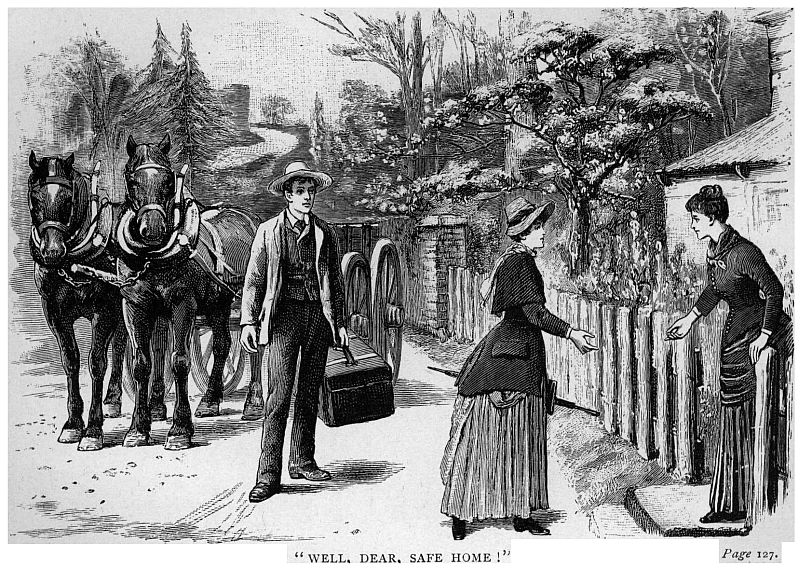
“Well, dear, safe home!” was her sister’s gentle greeting.
“Home at last!” Fidelia answered.
Few words were spoken, either of welcome or rejoicing. Few were needed. It was not the way of either of them to say out easily all that was in her heart; and in a little they were sitting as quietly as they sat that last day, when Dr Everett brought Fidelia home. It was spring-time then; and now the summer was nearly over—the summer which had done something for Eunice, as her sister clearly saw, but which, even to herself, she could not name.
She was not so much stronger as Fidelia had hoped to find her. There was the same paleness, with the same quick flush coming and going on her cheek when anything moved her, beautiful but sad to see. She had been peaceful then, even cheerful, but there had been some tokens that the peace had been striven for, and had come slowly, perhaps to go away again. Now it was assured. And Fidelia said again to herself, “How could I have been afraid?”
As Eunice went on to tell how, after all, Mrs Stone had decided not to delay her departure after the day appointed, Fidelia was recalling with sorrowful amazement her troubled thoughts about Dr Justin and Miss Avery, and her doubts as to how Eunice might feel when she came to know. Neither the one nor the other, nor both together, could harm her, nor even trouble her peace. “Nor any one or anything else in the world,” she added in her heart.
“I think I am a little glad that Mrs Stone went, after all,” Eunice was saying, when Fidelia came back to the present again. “I am glad to have you to myself a little while: you must have a great deal to tell me after so long a time, and we won’t hurry over it. It is good to have you at home again.”
“It is good to be at home, though they were all very good to me in Eastwood.”
“You are not looking very rosy even yet,” said Eunice gravely.
“Oh, I am perfectly well; and so I was when I went there, only I was tired. Yes, I liked every one of them. They were all very good to me.”
“And the visitors?”
“I liked them pretty well. I envied them a little, I am afraid. It was silly of me, wasn’t it, and wicked? But I have got over it, and I don’t suppose I shall ever be exposed to the same temptation again—I mean, I have seen the last, of them, I guess—of Miss Avery at any rate. I am glad too that Mrs Stone went away for awhile, though I would like to see her. What is she like?”
“She is good, and sensible, and strong. Some people might think her hard at first not knowing her well—but she is not hard. She has been in some hard spots since she used to take care of me as a baby, and she might have grown hard and sour also, if it had not been, as she says, ‘for the grace of God.’ But, hard or not, I love her dearly. She suits me.”
“You must have been glad to see her again.”
“Yes; when she came I was glad. I was not altogether glad at the thought of her coming. I suppose I was afraid a little of the old times coming back too clearly, and that I might be troubled and unsettled by the sight of her. But it has not been so—far otherwise,” added Eunice with a smile.
A momentary shadow had passed over her face, but Fidelia forgot it in seeing the brightness that followed it; and she sat thinking about it in silence, till the gate opened, and Susie Everett came in. But as they sat the next morning in the back porch, looking out on the large garden, the subject of Mrs Stone’s relations to them was renewed.
“I don’t suppose that Ruby will be away long, and before she comes I want you to understand how it is with her, and just what she would like to do. Of course you are going back to the seminary next year?”
“Of course I would like to go, if ways and means will permit I would like to graduate with my class.”
“I am afraid you have worked too hard, dear.”
“No, not too hard; but I don’t think I worked in the best way. I should do differently next year. At least I should try.”
“Tell me about it, dear.”
Fidelia sat silent a minute or two, then she said:—
“Some time I will tell you about it—not to-day. But about ‘ways and means.’ Perhaps I had better teach this year, as I meant to do at first.”
But Eunice had a plan to unfold, by which, should Fidelia approve, all would be made easy for them both. Mrs Stone wished to stay in Halsey for a time. The place was more like home than any other place could ever be to her, and she would like to share the home of the sisters for a time.
“Would you like it, Eunice?” asked Fidelia a little anxiously.
“Yes; for some reasons I would like it. Mrs Stone is kind and good, and she does not seem like a stranger to me, though she has been away so many years. She is capable too, and I am not so strong as I used to be.”
“But you are well, Eunice? You are not afraid any more—of—”
Fidelia could not utter the word which rose to her lips—a word which, indeed, had never been uttered between them.
“Yes, I am well—for me. No, I am not afraid any more. But, dear, I own to have been lonesome last winter, and a little downhearted sometimes.”
“I ought to have been at home.”
“No, dear. It was all right; and it is best that you should go again next year for various reasons, rather than to wait. And, besides—”
Then Eunice went on to explain that, though not a rich woman, Mrs Stone had enough for her own wants, and more. She had no near ties of kindred, and no special work in the world to look forward to, and work she could find in Halsey more easily than anywhere else.
“And, dear, if I had been asked to plan for my own comfort, and for a chance to make going away again easy for you at the same time, I could not have asked for anything more suitable than this. The obligation and the comfort will be mutual. Yes, I like the plan.”
“Would it be for always, Eunice?”
Eunice smiled and shook her head.
“Dear, I don’t much believe in making plans for always. ‘Short views’ are best, you know. We might try it for a year, and then decide.”
“Eunice, if I liked to take it, I might have the school at the Corners this winter; and I could be at home.”
“Yes; and that would be pleasant all round, if it were necessary. But I think it would be wiser for you to go back to the seminary this winter.”
Fidelia did not answer immediately. Indeed, she rose and went the length of the garden, and stood looking over the fields to the river and the hills, and she was saying some hard things to herself as she stood there. In a little she turned and came slowly back again.
“Well, dear, what do you say?” said Eunice gently.
“I say that the plan is good, if you like it. It is I who am all wrong. It is hateful in me, I know, but, Eunice, I could not have any one come between you and me. Not any one, Eunice.”
“But, my darling,” cried Eunice, laughing a little, and stretching out her hands, “that could never be! Why, you are all I have got!”
Fidelia sat down on the step, and laid her face for a minute on her sister’s lap.
“I never knew till lately that I had an envious and jealous disposition,” said she in a little.
“But you need not be jealous of Ruby Stone, or of any one else, as far as I am concerned, dear. I am almost sorry now, that she did not stay another day, so that you might have seen her. Oh, you will like her, I am sure!—she is so sincere and simple, and so much in earnest.”
A great deal more was said about their plans, and about Mrs Stone, but not a word about Dr Justin Everett.
It was good to be at home again. A great many people, young and old, came to see Fidelia within the next three days. In the meantime Mrs Stone returned, and all necessary arrangements for the year were made between her and the sisters. Mrs Stone would have liked to rent the place or to buy it; but it was not to be thought of that the sisters should give up their home altogether, and so their plans were made for the year only.
Mrs Stone was a small dark-eyed woman, thin and brown, with deeper wrinkles between her eyes than her forty years should have shown. When she sat with her eyes cast down on her work, and her lips firmly shut, one who did not know her well might be excused for saying that she looked “hard.” But when she looked up, and spoke, or smiled, her face changed. She had a good and pleasant face, with some signs of trouble upon it.
Her married life had been a time of discipline to her, she owned to Eunice, when they first met, and to her she spoke of the troubles of the time; but she spoke to no one else of it. She was capable and active, and did what was to be done in the house with such evident pleasure and success that the housekeeping gradually fell into her hands, and Fidelia had more liberty than ever she had at home before. And she made a good use of her liberty. She had preparations for next year to make, and friends to visit, and began to feel more light-hearted—more like herself—than she had done for a good while.
There was much going on to make the time pass pleasantly. Nellie Austin and her brother Amos were visiting the Everetts; and in whatever was planned for their pleasure and the pleasure of the household Fidelia had a share. There were fishing parties and berrying expeditions; and they went sometimes to the woods, or to visit some mountain or waterfall, or chasm among the hills.
Dr Everett himself, when one of his rare days of leisure came, liked nothing better than to go with the young folks; and it was a day to be marked with a white stone when he could make one of the party. Dr Justin had more leisure, and could go oftener. Dr Everett was as merry and as eager for adventures as any of them. Dr Justin was quiet, and took the place of a looker-on rather than a sharer in the amusements of the young people. Privately some of them were inclined to think him something of a tyrant, for he kept them in order, and did not hesitate to assume and exercise authority when occasion called for it, nor to reprove—and that with sufficient emphasis—any of them who through thoughtlessness or selfishness interfered with the pleasure of the rest. But this did not often happen, and he was a favourite among them all.
Fidelia came to like Dr Justin better than at Eastwood she would have supposed possible. She went very often with the rest of the young people, and no one of them all enjoyed the delights of woods and fields and mountains more than she. Nellie Austin declared that she hardly recognised in her the dull, determined student of the first part of the year. She was light-hearted and happy; and she told Nellie, and herself as well, that she had good cause.
Eunice was well, and every day made it more clear to them that they had made no mistake in deciding to share their home with Mrs Stone. And then she was going back to the seminary and her beloved studies again.
Yes, Eunice was very well—“for her,” Fidelia sometimes added with a sigh, which meant that Eunice might never be altogether well and strong again. But she was happy—there could be no doubt about that. Dr Justin came sometimes as a visitor to the house, quiet and grave there as elsewhere; and his quietness and gravity was the reason that Fidelia liked him better than she had liked him at Eastwood, she told herself. Nothing could be more evident than that he exerted no disturbing influence on Eunice. They were friendly—they were even confidential, Fidelia sometimes thought. But she never spoke of Dr Justin to her sister, except as his name came in the account which Eunice always liked to hear of the expeditions in which she could take no part; and she day by day grew less afraid lest her sister might have something to tell her of him that she would not like to hear.
But she liked Mr Justin, she owned to herself; and after awhile she began to see that, though he had less to say to her than to Nellie and the rest, he was not less mindful of her than of them—that though he amused himself with them, and submitted to be teased by them, and even condescended to tease them in return, he had only grave respectful words for her, and indeed carried himself towards her as though he thought she might not care for friendly advances on his part; but he was always careful for her safety and comfort, and one day he told her why.
“I promised your sister that I would take care of you,” said he one day, when he found it necessary to insist on helping her, as well as the others, over some difficulty in the way.
“Eunice?” said Fidelia, startled. “Eunice knows that I am quite able to take care of myself.”
“But I thought you had been taken care of all your life?” said Dr Justin as she slowly followed the others up the steep ascent.
“By my Eunice! Yes.”
It would not have been easy for either of them to say much of Eunice, so they were silent as they went slowly on.
This was one of the marked days of that happy time to them all. The young people had made their arrangements for a blackberrying excursion; but when it proved that Dr Everett had a day of leisure, and could go with them, it was proposed that the blackberries should be left for another day, and that they should all go to the Peak to see the view. The young Austins were still there, and all the Everetts were to go except the mother. Jabez and young Mr Fuller, who had been teacher of last winter’s school, and a few others, made up the party. To climb “the Peak” was a thing to be done at least once or twice in the lifetime of every dweller in Halsey, and it was worth the trouble it cost.
At the last moment Mrs Stone declared her intention of joining the party—“just to see how it would seem to be there again;” and Deacon Ainsworth for a minute or two entertained the idea of going also, but thought better of it. He had serious doubts as to the moral effect of so much tramping up hill and down again, just to look at things, in a world where there is so much work that needed to be done. Blackberrying parties and fishing expeditions he could understand; but to give so much time to pleasure which generally turned out to be hard work that did not pay, was a doubtful matter to him.
All this was said to Jabez, who would have done better, he declared, to stick to the work he had undertaken. It would pay better.
“Well, but I don’t seem to have anything that needs to be done just to-day, grandpa. And it will pay to go there. Oh, yes, it will pay to go up there with the two doctors! They’ll have something to say about a good many things we’ll see up there—botany, geology, mineralogy, and all the rest of it. Why, you would enjoy it, grandpa! If it wasn’t for your rheumatism, I’d say, ‘Go.’ I expect to have a real good time.”
So did they all. They made an early start, driving as far as horses could be taken; then, taking an irregular course northwards along the western side of the mountain, they gradually reached a point from which could be seen the commencement of the two mountain ranges which extend through two neighbouring states. It was early still, and here they were to rest for awhile. The real climbing of the day was still before them. The view which they had come to see, was the view eastward from the Peak—the view of a long reach of the river, and the valley and the cultivated hill country beyond. Here they sat in the shadow of a great rock, looking northwards to the mountains.
There was little variety in the view—only a wide stretch of broken hill country, with the grey rock showing through in wide irregular patches, and along the dry water-courses—all changing into a haze of smoky blue in the distance, where the mountains seemed to touch the sky. Dr Justin and a friend, who in their boyish days had been often at the Peak, and through all the hills within sight of it, pointed out to each other, the position of their old familiar haunts—the best trout stream, Silver Lake, the Glen and the Gorge, and by the help of a field-glass tried to point them out to the others. They could see gleams of blue water here and there between the nearer hills; and higher up, a tinge of bright colour where the early frost had already been, but almost everywhere the summer green prevailed. It was a scene strange and beautiful; and to those who looked upon it for the first time, the charm and interest lay in its wide extent and in the utter silence and solitude resting upon it. There were farms and cottage homes, and even towns and mills and churches, scattered out of sight among the hills; workers and pleasure-seekers—the busy and idle—were going to and fro among them; but the only signs of human life or labour which came up to those who were gazing down on the wide expanse were the shriek of the locomotive and the wisp of vaunting vapour which for a moment lingered on its track.
Mrs Stone sat a little withdrawn from the rest, looking northward also, with a strange fixed look on her face—the look which made people who did not know her very well say she was hard. She shook her head, smiling a little, when Fidelia asked her if she would not like to look at the mountains through the glass.
“Well, no, I don’t seem to care much about it. I didn’t come to see anything in particular. I wanted to see how it would seem to be up here again—that is all.”
“And how does it seem?” asked Dr Justin, who had drawn near with his glass in his hand.
“Well, I don’t know as I could tell you. I am not sorry I came. I guess I have thought about this place as often as about any other place in the state in the last ten years. No; I am not sorry I came. I don’t know as I’m sorry I came last time. It is all right, I expect.”
“Tell us about last time,” said Fidelia softly.
“Some time I’ll tell you, maybe. I guess I shall need all my breath before I get up the Peak. I am not so spry as I was last time I came.”
“I’ll help you up,” said Fidelia.
“Oh, I guess I shan’t need any help! I’ll start now, and take it slowly. I don’t suppose I shall miss the way.”
“I will go with you,” said Fidelia.
Dr Justin looked as if he would like to go too, but he did not. He shut the glass with a snap, and turned to the group still standing on the edge of the rock looking northwards; and the two set off together.
They went on slowly and silently till they came to a point where the path they had followed became two paths, the one going up the steep side of the mountain, the other holding northward along the ledge.
“Now I ought to know which path to take, but I don’t feel sure about this,” said Mrs Stone meditatively. “They say the longest way round is the nearest way home; and according to that we should hold on round the ledge. The path will take us somewhere.”
But it did not seem to do so, for in a little they came up against a steep rock, and Mrs Stone owned herself at a loss and out of breath. Fidelia proposed that she should sit down and rest, while she went alone in search of the path.
“No; we’ll keep together. I don’t suppose we can be lost; at any rate two people are not so lost as one alone would be. We’ll keep together.”
They must have turned themselves round in some way, for they could not find the point where they had left the ascending path. By-and-by they came to a shelving rock where the bushes had been recently pressed down; some broken branches, still unwithered, lay near.
“This must be the near way that Jabez and the boys took,” said Fidelia, “We ought to be able to find our way now.”
But they did not find it after several attempts. Mrs Stone was firm in refusing to let Fidelia separate from her.
“Two are better than one,” said she.
At last they came to a point where they got a glimpse of the valley lying west of the mountain. The land-marks were familiar, only it seemed as though north and south had changed places, Mrs Stone said. Another attempt brought them back to the place where they had found the broken branches, and they had fancied themselves going in the other direction.
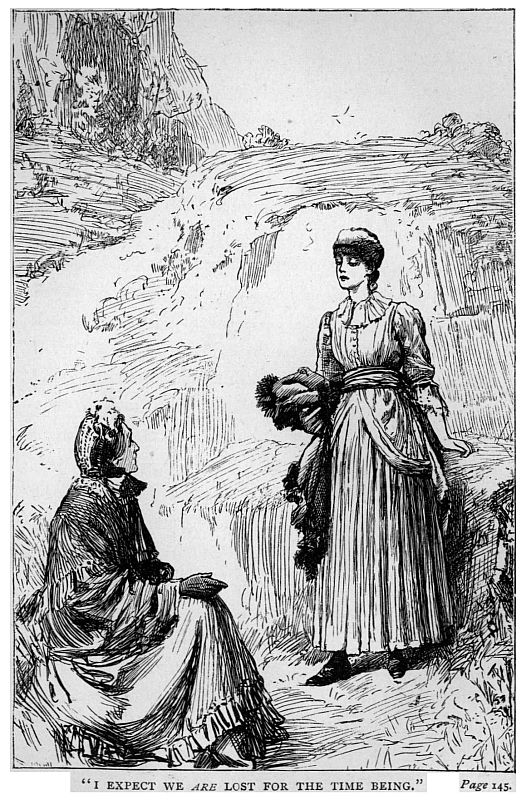
“Well, there! I guess we’d better sit down till some one comes to find us. Not that we are lost. I never heard yet of any one being lost on Shattuck Peak for more than an hour or two. Why didn’t I think of it before, dear? Are you too hungry and tired to sing, Fidelia? I shouldn’t wonder if they were beginning to worry about us up there. They’ll be listening.”
Fidelia clambered a little higher, and sang “The Star-spangled Banner,” smiling a little at the thought of the time when she sang it with the boys on Eastwood Hill. She wondered that she had not thought of lifting up her voice sooner.
But nothing came of it. Fidelia amused herself gathering some late flowers, and in searching about for other wild wood treasures, and then she sang again, and listened for an answering voice; but she listened in vain.
“I expect we are lost for the time being,” said Mrs Stone composedly. “We’d as well make the best of it, and see what we can do to pass the time. I wish I had brought my knitting. They’ll miss us pretty soon, and come to find us.”
“Tell me about the last time you were on the mountain,” said Fidelia.
“To pass the time? Well, that may do as well as anything. But it isn’t much of a story, and what is of it is not very pleasant to tell or to hear.”
The telling of that story involved the telling of much more; but there was time enough, before an answer came to Fidelia’s next song, for all Mrs Stone had to tell.
Chapter Eight.
Mrs Stone.
Mrs Stone did not tell her story straight on as she sat waiting there on the mountain side, but with many a break and pause, and with now and then an exclamation of wonder or indignation at her own foolishness, or the foolishness of some one else. But she told it quietly—making no moan for herself, though the troubles of her life had been neither light nor few.
“Yes, I have had a share of trouble, but no more than my share; and, take it altogether, I have had considerable enjoyment, too. There was Eunice—I could never tell the comfort I took with her when she was a little child. I was only a child myself—little more than twelve or thirteen years old—when my sister Myra let me go to take care of Eunice for a spell, when she came home, a motherless baby, to live with her grandmother Peabody on the hill. Her grandmother was a busy woman in those days, with many duties at home and elsewhere; and Eunice was a healthy, happy little creature; and after awhile she was mostly left to me night and day for years; and I did my very best for her, and we were very happy together till your father married again and took her home.
“I ought by rights to have gone with her, as they all wanted to have me; but sister Myra was married by this time, and lived on father’s old place, and she wanted me to come and make my home with her, as I had a good right to do, seeing the farm was as much mine as hers, by our father’s will. So I tried it a spell. She had two babies by this time, and I was good with babies, and could have helped her, and been contented after awhile.
“But Ezra Stone, Myra’s husband, wasn’t—well, he was peculiar. He was close—he came from a stingy family, and I don’t suppose he was more to blame for his stinginess than other folks are for being extravagant—he inherited it. Well, he thought I wasn’t needed there: he thought his wife hadn’t any too much to do with her babies, and her cows, and her housework—no more than other folks had, he said; and he said I might do better for myself some where else. And he kept at it in his worrying way, till he rather wore us out at last. And so, when Squire Peabody came over one day to say that his wife was sick and much in need of help, Myra said I had better go. I’d have a better time than I’d ever be likely to have in her house; and maybe after awhile I might be able to help her and the children more than I could now. So I went, and I stayed there till—well, till I was married.”
There was a long pause here, and Mrs Stone spoke very softly when she went on again.
“I didn’t see so much of Myra after that, as I ought to have done. I used to see her Sundays at meetings, and we met at some of the neighbours’ houses sometimes; but I did not go often to her house. I knew she wasn’t very happy. She was different from her husband. She had a big heart and a free hand, and hated his small ways. She was nervous too, and high strung; and when she had anything on her mind, it had to come out when occasion called for it. Yes, she could say hard things!
“But what she said touched her husband just as the water in the brook touches the stones in its bed. It never moved him; and she wore herself out at last. She had held out through a good deal for the sake of her boys; and when she gave up at last, the end was pretty near. I was with her the last few weeks. She hadn’t strength to say much, but it was—‘My boys, Ruby! Keep them in mind and help them all you can,’ whenever we were alone together.
“I think if she had asked me to come and take care of them, and make my home with them, I must have done it. But she didn’t. Ezra’s mother was living there then, and his sister Susan, and I wasn’t needed. But I did pity those pretty slender boys, and the baby between them all. But I couldn’t do anything about it, and I didn’t see much of them for a good while.
“Well, next June I got a letter, which I knew was from Ezra before I opened it; and I said to myself, ‘He wants me to sell out my share of the farm, or maybe sign off altogether for the benefit of Myra’s boys. I have been expecting it all along, and I shan’t do it.’
“But I was mistaken. That hadn’t come yet. It was a queer composition, that letter. It was to tell me that there was going to be a picnic at the Peak for two or three of the Sunday schools in the neighbourhood; and two of his boys were to be there, and wouldn’t I go and see them? There might be a good many easier ways to see them, I thought, than to go up the mountain to do it. However, some of the neighbours were going, so I said I would go.”
There was another pause here.
“I was in some trouble about that time myself. I never said anything to anybody, and I don’t suppose anybody suspected it. I had lost my sister lately, and that might well account for having less to say than usual. But I had lost another friend—one that would have been more than a friend if he had lived. We were not to say engaged. We hadn’t even kept company much; but when Jim Sedley died down there at Lowell it went hard with me, and for awhile the world seemed to have come to an end for me.
“But I went to the picnic with the rest, and I saw the boys and had a little talk with them, just long enough to find out that they missed their mother dreadfully, and that they were much in need of a mother’s care; and my heart ached for the little fellows; and, when they were called away to join in some play with the rest, I slipped off into the woods, so as to get away from the talk, and to think it all over by myself. But thinking didn’t help me much. There was one thing I could do. I could marry Ezra Stone, and so try to be a mother to them; and as the thought was in my mind I heard Ezra’s voice close to me. I would have hid myself or run away if I could have done it, for I was afraid that I would do or say something that I would be sorry for all my life. But I couldn’t get away; and there was Ezra saying how glad he was to see me, and that he had come to the Peak on purpose, and a lot more of the same kind.
“I was thinking about it all as I sat down there this morning,” said Mrs Stone after a little pause. “A hundred times in the days that followed I asked myself whether I could believe that the Lord was taking care of me that day, according to His promise. It was a great while before I could see it so. But I expect He was, though I never should have married Ezra Stone if I hadn’t gone up the Peak that day. At least I don’t believe I should.
“He didn’t begin about that, but about business. His sister Susan was going to be married to Nathan Pease, whose farm joined father’s old place; and he wanted to buy it, and would I be willing to sell my half of it? I never had calculated much on anything which was likely to come to me from the place; but Myra had always advised me to hold on to my share, and so I said I should have to think about it before I could say whether I would sell or not.
“There is no call to tell you all his talk. He didn’t seem to care about the place since Myra had gone, he said; and there did not seem to be much chance for him and his boys at the East. What he wanted to do was to take what he had and go West with them. There was the best of land to be had there cheap, and no such hard work needed, and a better climate. He knew just the place he could have out there in Wisconsin, and with a little money he could do well for his boys and himself; and he ended by asking if I would go West with him and help him do for Myra’s boys?
“He knew pretty well what my opinion of him was. I didn’t need to say anything about that. My sister hadn’t been much more than six months in her grave, and I didn’t waste words upon him. But all the time it was borne in upon me that it had got to be, and that it would come to that at last.
“‘It isn’t so much a wife that I want as a mother for Myra’s children,’ he said; ‘and I hope, when you come to think of it, you’ll see it your duty to come West with them. If you change your mind, you can let me know.’
“‘It isn’t very likely,’ said I; but all the time I felt that I would be as likely to go as not. I told him I would talk over business matters with Squire Peabody, and that I would sign any papers the squire told me to sign, when the right time came; but I let him understand that I meant to have the full value of my share. It would, I thought, be as safe for Myra’s boys in my hands as in his, though I didn’t just say that to him.
“Well, he went away, and I sat there thinking it all over, just on the spot where I sat to-day when you and the other girls were looking through Dr Justin’s spy-glass; and I told myself that I hadn’t much of anything to look forward to, and that, after all, I might as well do one thing as another. Life didn’t seem worth much to me, but I might make my life worth something to Myra’s boys. There is always duty left when hope is gone, and if I owed duty to any one, surely it was to my sister’s children—so I reasoned. I would wait and see.
“Well, the children came back, and had something more to eat, and sang some hymns, and then it was time to go. The boys kept close to me as we all went down to the place where the trains were waiting; and the poor little fellows cried, and did seem so forlorn when they went away, that I just couldn’t get them out of my thoughts for a long time.
“I didn’t think the sale of the farm would come off for awhile, but I was mistaken. Ezra came over to see the squire one day in October, and they talked it over, and matters were settled, and papers signed, and my share of the price of the land made over to me; and Ezra was to go away at the end of the month. The boys were to be left till spring, till he could make some kind of a home for them, and he said he depended more on me than on any one else to see that they were well done by till then: ‘For they are more and nearer to you than to any one else except myself,’ he said.
“‘It is not likely that I can do much for them while they are in your mother’s keeping,’ I said.
“‘Oh, mother thinks everything of you!’ he said, with a foolish laugh; ‘and you’ve got your share all right. Squire Peabody has seen to that.’
“That was the first winter that Mrs Peabody’s health began to fail. It wasn’t long before your father died, and the squire took her South for the winter, and the house was left to my care; and they said, if I liked, I might have one or two of Myra’s children to keep me company. So I went over and got Jim, the eldest, so as to give him a chance at our winter school, and the baby, as everybody called him, though he was nearly four years old.
“You’ve heard me tell about my Davie before. I needn’t say much about him. The very first feeling of rest and comfort that had come to me, after months of lonesome pain, came the first time he fell asleep in my arms, with his little chapped hand upon my cheek: it was like the coming back of the time when I had baby Eunice to care for; but it was different; too, in some ways. Jim was as good and as bright a boy as need be, and we had a happy winter together.
“Well, in the spring the squire and his wife came home, and she seemed better. They hadn’t been home long when a letter came from Ezra, saying he wanted the boys to be sent out to him. He couldn’t, without considerable loss of time, go for them, but there were chances every day of people coming West, who would look after them all they needed. A chance of any one willing to trouble himself with the care of four boys, one of them little more than a baby, wasn’t likely to come very soon, and the summer was over before we heard again; and all that time Jim and Davie had stayed on with me. Then there came another letter, saying that the boys were to be sent on alone. Nothing would be likely to happen to them, as they needn’t change cars more than once before they reached Chicago, and he would meet them there.
“Then I wrote, saying the rest of them might go so, and I would keep Davie for some better chance; or, if his father said so, I would keep him altogether, and do for him till he was old enough to do for himself. Well, quicker than ever an answer came before, a letter came, saying ‘No!’—Davie must come with the rest. He saw his way clear to do well by all his boys. Farming was a better thing out West than in New England. He wanted all his boys.
“Afterwards I thought of two or three ways I might have taken to keep the child with me, but nobody encouraged me much to undertake it; and I saw no better way at the time than just to go with them myself a part of the way, especially as a gentleman, who had to do with western railroads, offered me a free ticket to Chicago and back. The squire and Mrs Peabody said all they could to put me off the notion.
“‘Ruby,’ said she, ‘if you go, you’ll marry Ezra Stone.’
“‘That’s his idea, anyway,’ said the squire; ‘and Ruby, don’t you do it.’
“‘I know Ezra Stone,’ said I, thinking all the time that what they said might be true. And so it was.
“Ezra met us at Chicago; and as soon as I saw his face I felt sick at the thought of letting Myra’s children go off with him alone. ‘What kind of a woman will he put over them?’ said I to myself.
“Well, you know all about it. I did marry him, right there in Chicago. He didn’t say much. Nothing he could have said would have had much influence with me one way or another. But I saw Myra’s eyes looking at me every time that Jim or the baby smiled at me, and I couldn’t let them all go away alone to I didn’t know who or what. No, he didn’t say much; and afterwards he rather twitted me with being ready the minute I was asked. I don’t suppose I should have done any different if I had known just all that was before me. I wasn’t a free agent in the matter.
“Yes—oh, yes!—I laid the matter before the Lord, or I thought I did. I knew that I wasn’t going to have any easy time, and that it wasn’t my own pleasure I was seeking; and that made me feel as though I was just trying to do my duty, and that the Lord would see me through. Yes, I was self-willed about it. I was faithless, I suppose, and afraid just to leave the boys in God’s hands. Oh, yes, He did see me through; and more than made up for the trouble I had to endure, and I wouldn’t have anything different from all that He sent me! But I am making a long story, and there isn’t really much to tell.
“The next three years was just a dead level. Nothing happened but just summer and winter, and seed-time and harvest. But such harvests! Full and rich beyond any experience we had ever had of harvests. High prices were given too, and much money must have come in. But with that part of it the boys and I had nothing to do. There was nothing but hard work, early and late, to show as far as we were concerned.
“I did my best for them. I kept them at their books, Sundays and rainy days, and winter evenings; and they were smart boys and learnt well. They were good boys and pleasant-natured, taking after their mother, and I took comfort with them in many ways. They were good boys to work too. There wasn’t a lazy bone in one of them; and, while they did the work that was expected of them, everything went well between them and their father. He let them pretty much alone at other times. His heart was set on just one thing, and that was making money, and the more he got the more he wanted. He didn’t spare himself, and he didn’t spare any one else, if the chance to make a dollar came along.
“Jim was doing the work of a man before he was fifteen; and every year brought more to be done, for more land was taken up as fast as it could be paid for. Ezra did have wonderful success. After the narrow stony fields of the old place, it was a sight to see the scores of acres of wheat growing so full and strong. It was threshed right there on the ground, and sometimes it was sold there; and if he had only been content with moderate success, he might have been living now, and well-to-do.
“I blame myself when I think of those times—the times that came after the first three years. I think maybe, if I had done differently, things might have turned out differently for us all. In this third spring my Eunice was born—my only baby, and while she stayed with us she made the world a better place for us all. The boys did think everything of her, and her father too. But she died of croup. If we had had a doctor near us, or if I had known better how to deal with it, she might have lived, I thought, and that made it very hard to bear. Ezra felt so about it too, and we had a dark winter.
“But spring came, and the work had to be done. We couldn’t get all the help we wanted; and from daylight till dark Jim and his brothers had to be in the fields. Even little Davie had his share to do; and, though they were not inclined to shirk their work, it was hard for them, and they did sometimes complain. I complained for them, but I might just as well have held my tongue, and I did after awhile. They grew fast. Jim was as tall as his father when he was sixteen, and if he had had any chance he would have been a strong man in a few years. But he was slim and stooping, and had little flesh on his bones, and I worried about him a good deal; and one day I asked his father how many acres of wheat he supposed it would take to pay for the life and health of a boy like Jim.
“‘He’s my boy,’ said he, ‘and not yours, and it ain’t worth while for you to make the calculation. I know all about it.’
“‘He is my boy more than yours,’ said I, ‘if love means anything. I can’t make you answer me, but some time pretty soon you’ll have to answer his Maker and yours, and you’d best reckon up in time, for as sure as you go on as you are going now, you’ll have to bury him; and that’s my last word.’
“He gave an angry laugh at that, and said my last words came pretty often; but I saw him looking curiously at Jim that night, and I guess he’d have let him take it easier for a spell if Jim had known how to take it easy. But there was just so much to do, and he kept on along with the rest. It was Asher, the second one, who gave out first.
“Once or twice he had complained to me that he had dizzy turns, when he kind of lost himself, and I had doctored him a little, not thinking him very sick, till one day they brought him home from the field insensible; and, if he ever knew any of us again, he could never tell us so, and he died in just a week after he was brought home. Yes, we had a doctor. Jim went twenty miles for one without asking any one’s leave. He came twice, but he couldn’t help him. All the time he was sick I never spoke a word to his father about him unless he first spoke to me, till one day, when he came in from his work, he found his boy lying still and white, with his hands clasped on his breast, dressed ready for the grave.
“‘He’ll never be tired any more,’ I said.
“He turned and went out without a word; and Asher’s name was never spoken between us for years after that.
“It was different with Jim. He kept on till the winter he was eighteen; and I shall always be glad to remember how easy and pleasant his last days were made to him. It was a mild winter, and he kept about doing something or other most of the time. His father, let him do pretty much as he liked, and went on hoping that the spring would make him all right again. He even talked of sending him back to the old place for a change when the summer came; and Jim used to listen, and sometimes said what he would do when he got there. But he knew better. He knew he was dying, and he was not afraid. But he had something he wanted to do before he could be quite willing to go.