OF WIT
Reading edition
WIT in K. Charles IId's Reign, seem'd to be the Fashion of the Times; in the next Reign it gave way to Politicks and Religion; while K. William was on the Throne, it reviv'd under the Protection of Lord Somers and some other Nobleman, and then those Geniuses received that Tincture of Elegance and Politeness which afterwards made such a Figure in the Tatlers, Spectators, &c. thro' the greatest Part of the Reign of Q. Anne: But since it has broke out only by Fits and Starts. Few People of Distinction trouble themselves about the Name of Wit, fewer understand it, and hardly any have honoured it with their Example. In the next Class of People it seems best known, most admired, and most frequently practiced; but their Stations in Life are not eminent enough to dazzle us into Imitation. Wit is a Start of Imagination in the Speaker, that strikes the Imagination of the Hearer with an Idea of Beauty, common to both; and the immediate Result of the Comparison is the Flash of Joy that attends it; it stands in the same Regard to Sense, or Wisdom, as Lightning to the Sun, suddenly kindled and as suddenly gone; it as often arises from the Defect of the Mind, as from its Strength and Capacity. This is evident in those who are Wits only, without being grave or wise, Just, solid, and lasting Wit is the Result of fine Imagination, finished Study, and a happy Temper of Body. As no one pleases more than the Man of Wit, none is more liable to offend; therefore he shou'd have a Fancy quick to conceive, Knowledge, good Humour, and Discretion to direct the whole. Wit often leads a Man into Misfortunes, that his Prudence wou'd have avoided; as it is the Means of raising a Reputation, so it sometimes destroys it. He who affects to be always witty, renders himself cheap, and, perhaps, ridiculous. The great Use and Advantage of Wit is to render the Owner agreeable, by making him instrumental to the Happiness of others. When such a Person appears among his Friends, an Air of Pleasure and Satisfaction diffuses itself over every Face. Wit, so used, is an Instrument of the sweetest Musick in the Hands of an Artist, commanding, soothing, and modulating the Passions into Harmony and Peace. Neither is this the only Use of it; 'tis a sharp Sword, as well as a musical Instrument, and ought to be drawn against Folly and Affectation. There is at the same time an humble Ignorance, a modest Weakness, that ought to be spar'd; they are unhappy already in the Consciousness of their own Defects, and 'tis fighting with the Lame and Sick to be severe upon them. The Wit that genteely glances at a Foible, is smartly retorted, or generously forgiven; because the Merit of the Reprover is as well known as the Merit of the Reproved. In such delicate Conversations, Mirth, temper'd with good Manners, is the only Point in View, and we grow gay and polite together; perhaps there's no Moment of our Lives so sincerely happy, certainly none so innocent. Wit is a Quality which some possess, and all covet; Youth affects it, Folly dreads it, Age despises it, and Dulness abhors it. Some Authors wou'd persuade us, that Wit is owing to a double Cause; one, the Desire of pleasing others, and one of recommending ourselves: The first is made a Merit in the Owners, and is therefore rang'd among the Virtues; the last is stiled Vanity, and therefore a Vice; tho' this is an erroneous Distinction, as Wit was never possess'd by any without both; for no Man endeavours to excell without being conscious of it, and that Consciousness will produce Vanity, let us disguise it how we please. Upon the whole, Vanity is inseparable from the; Heart of Man; where there is Excellency, it may be endur'd; where there is none, it may be censur'd, but never remov'd.
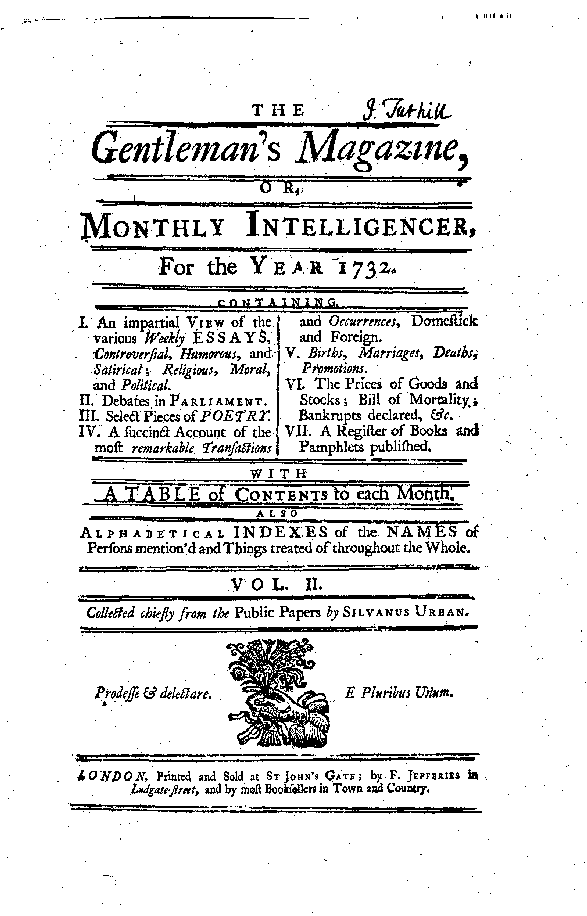
(From The Weekly Register, July 22, 1732, No. 119, as reprinted in The Gentleman's 'Magazine, II, July, 1732, pp. 861-2.)