AN ESSAY ON WIT.
Reading edition
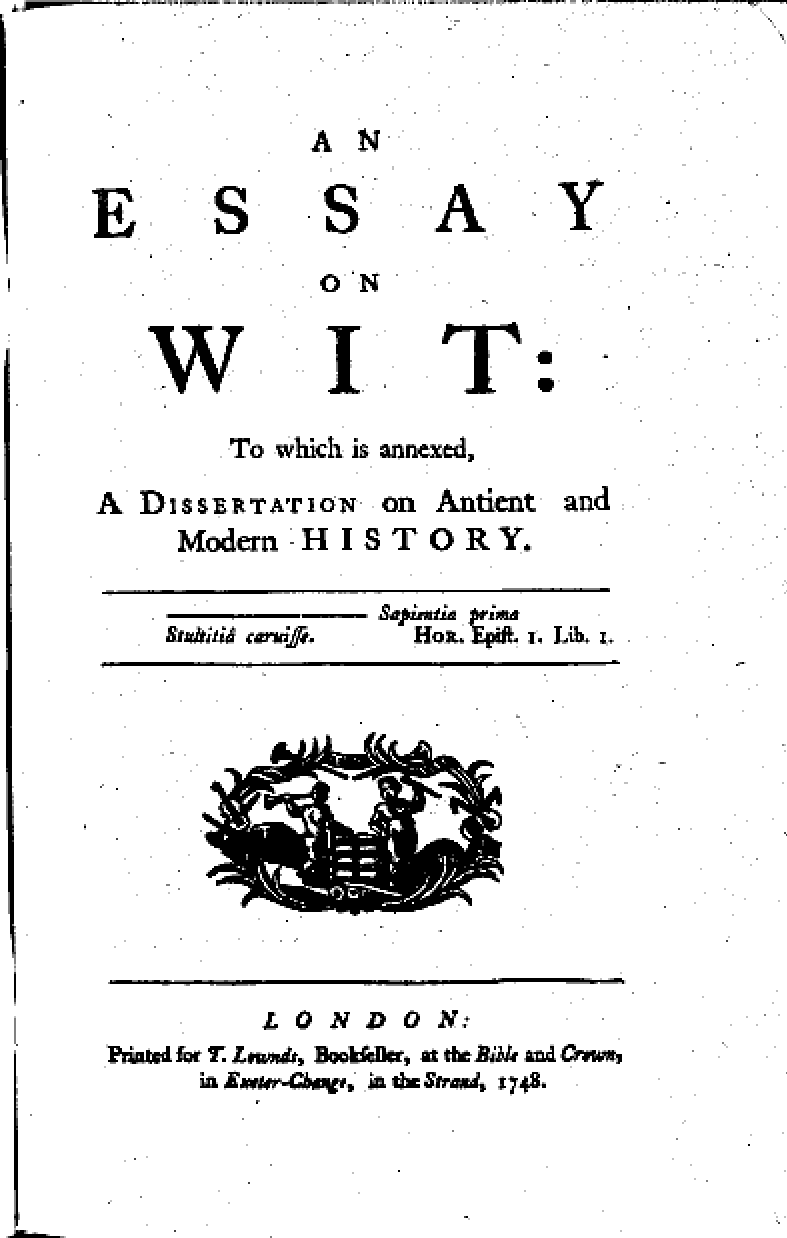
AN ESSAY ON WIT.
A Gentleman who had some Knowledge in the human Heart, was consulted about a Tragedy which was going to be acted: He answer'd that there was so much Wit in the Piece that he doubted of its Success.—At hearing such a Judgment, a Man will immediately cry out, What! is Wit then a Fault, at a Time when every Body aims at having it, when nobody writes but to shew he has it; when the Publick applauds even false Thoughts, provided they are shining! Yes, 'twill doubtless be applauded the first Day, and grow truthtiresome the next.
That which they call Wit, is sometimes a new Simile, sometimes a fine Allusion: Here 'tis the Abuse of a Word which presents itself in one Sense, and is understood in another; there a delicate Relation between two uncommon Ideas: 'Tis an extraordinary Metaphor; 'tis something which in an Object does not at first present itself, but nevertheless is in it; 'tis the Art, to unite two Things which were far from one another; to separate two which seem to be joined, or to set them in Opposition; 'tis the Art, of expressing but half the Thought and leaving the other to be found out. In short, I'd tell all the different Ways of shewing Wit, if I knew of any more.
But all these Brightnesses (and I speak not of the false ones) agree not, or very seldom agree with a serious Work, which ought to be interesting. The Reason of it is, that 'tis then the Author that appears, and the Publick will see no body but the Hero. Moreover the Hero is always either in a Passion, or in Danger. Danger, and the Passions seek not Expressions of Wit. Priam and Hecuba don't make Epigrams, when their Children's Throats are cut and Troy in Flames:—Dido does not sigh in Madrigals, when she flies to the Pile upon which she's going to sacrifice herself:—Demosthenes has no Prettinesses, when he animates the Athenians to War; if he had, he'd be a Rhetorician indeed, instead of which he's a Statesman.
If Pyrrhus was always to express himself in this Stile:
'Tis true, My Sword has often reek'd in Phrygian Blood, And carried Havock through your Royal Kindred: But you, fair Princess, amply have aveng'd Old Priam's vanquish'd House: And all the Woes, I brought on them, fall short of what I suffer.
This Character wou'd not touch at all: 'Twou'd soon be perceiv'd, that true Passion seldom makes Use of such Comparisons, and that there is very little Proportion between the real Fires which consumed Troy, and the amorous Fires of Pyrrhus; between the Havock he made amongst Andromache's Kindred and the Cruelty she shews him.
Chamont says, in speaking of Monimia:
You took her up a little tender Flower, Just sprouted on a Bank, which the next Frost Had nipt; and, with a careful loving Hand, Transplanted her into your own fair Garden, Where the Sun always shines: There long she flourish'd, Grew sweet to Sense, and lovely to the Eye; Till at the last, a cruel Spoiler came, Cropt this fair Rose, and rifled all its Sweetness, Then cast it, like a loathsome Weed, away.
This Thought has a prodigious Eclat: There's a great deal of Wit in it, and even an Air of Simplicity that imposes upon one. We all see, that these Verses, pronounced with the Art and Enthusiasm of a good Actor never fail of Applause; but I think we may also see, that the Tragedy of the Orphan wrote entirely in this Taste would never have lived long.
In effect, why should Chamont make such a long-winded Simile almost in the Height of Rage for the Ruin of his Sister? Is that natural? Does not the Poet here quite hide his Hero to shew himself?
This brings into my Mind the absurd Custom of finishing the Acts of almost all our modern Tragedies with a Simile; surely in a great Crisis of Affairs, in a Council, in a violent Passion of Love or Wrath, in a pressing Danger, Princes, Ministers, Heroes or Lovers, should not make Poetical Comparisons.—Even Marcia's (or rather Mr. Addison's) beautiful Simile at the End of the first Act of Cato, is scarcely to be forgiven.
What then would a Work be, that was filled with far-fetched and Problematick Thoughts? How infinitely superior to all such dazling Ideas, are these simple and natural Words of Monimia to her angry Brother?
Look kindly on me then. I cannot bear Severity; it daunts, and does amaze me: My Heart's so tender, should you charge me rough, I should but weep, and answer you with sobbing. But use me gently, like a loving Brother, And search through all the Secrets of my Soul.
Or these of Brutus, when he receives the News of his Wife's Death:
Brutus. Now, as you are a Roman, tell me true. Messala. Then like a Roman bear the Truth I tell; For certain she is dead, and by strange manner. Brutus. Why farewel Portia.—We must die, Messala. With meditating that she must die once, I have the Patience to endure it now.
Or these noble ones of Titinius, when he stabs himself:
By your leave Gods—this is a Roman's Part.
It is not that which is called Wit, but what is sublime and noble that makes true Beauty.
I have purposely chose these Examples from good Authors, that they may be the more striking; and I speak not of those Points and Quibbles, whose Impropriety is easily perceiv'd. There is no one but laughs when Hotspur says,
Why, what a deal of candied Courtesie This fawning Greyhound then did proffer me! Look, when his infant Fortune came to Age, And gentle Harry Percy—and kind Cousin—The Devil take such Cozeners.—
Shakespear found the Stage, and all the People of his Days, infected with these Puerillities, and he very well knew how (though perhaps he never read it in Epictetus)

to attune, or harmonize his Mind to the Things which happen.
I now remember one of these shining Strokes, which I have seen quoted in several Works of Taste, and even in the Treatise of Studies by the late Mr. Rollin. This Morceau is taken from the beautiful Funeral Oration of the great Turenne: The whole Piece is very fine, but it seems to me that the Stroke I am speaking of should not have been made Use of by a Bishop.—This is it:
"O Sovereigns! Enemies of France, ye live, and the Spirit of Christian Charity forbids me to wish your Deaths, &c.—But ye live, and I mourn in this Pulpit the Death of a virtuous Captain, whose Intentions were pure, &c.—
An Apostrophe in this Taste would have been very proper at Rome in the Civil Wars, after the Assassination of Pompey; or at London after the Death of Charles the First. But is it decent, in a Pulpit, to wish for the Death of the Emperor, the King of Spain, and the Electors; to put them in Balance with the General of a King's Army, who is their Enemy? Or ought the Intentions of a Captain, which can be no other than to serve his Prince, to be compared with the Politick Interests of the crown'd Heads against which he serves? What would be said of a Frenchman, who had wished for the Death of the King of England, because of the Loss of the Chevalier Belleisle, whose Intentions were pure?
For what Reason has this Passage been always praised by the Criticks? 'Tis because the Figure is in itself beautiful and pathetick, but they did not examine into the Congruity and Bottom of the Thought.
I return to my Paradox—That all these shining Strokes, to which they give the Name of Wit, never ought to be introduced into great Works made to instruct or to move; I'll even say they ought not to be found in Odes for Musick. Musick expresses Passions, Sentiments and Images: but what are the Concords that can be giv'n an Epigram? Dryden was sometimes negligent, but he was always natural.
In a Sermon of Doctor South, where he speaks of Man's Rectitude and Freedom from Sin before the Fall, are seen these Words:
"We were not born crooked, we learnt these Windings and Turnings of the Serpent."
I remember to have heard this Passage admired by several People: but who does not see that the Motions, viz. the Windings and Turnings of the Serpent's Body are here confounded with those of its Heart: and that at best, 'tis but a mere Point and Pleasantry.
Certainly there's a great Impropriety in putting any kind of Smartness into Pieces of such a Nature as Dr. South's; but what is still worse, we generally find these Smartnesses to be quite vague and superficial; they don't enter, but only play upon the Surface of the Soul.
Had a certain polite Author been a Cotemporary of the Doctor's, he'd have told him that

Humour is the only Test of Gravity; and Gravity of Humour. For a Subject which will not bear Raillery, is suspicious; and a Jest which will not bear a serious Examination, is certainly false Wit.
These Sports of the Imagination, these Finesses, these Conceits, these glittering Strokes, these Gaieties, these little cut Sentences, these ingenious Prodigalities, which are lavished away in our Times, agree with none but little Works. The Front of St Paul's Church is simple and majestick. A Cabinet may with Propriety enough contain little Ornaments. Have as much Wit as you will, or you can, in a Madrigal, in little light Verses, in the Scene of a Comedy, which is neither passionate or simple, in a Compliment, in a little Story, in a Letter where you would be merry yourself to make your Friends so.
Spencer was very well acquainted with this Art. In his Fairy Queen, you find hardly any thing but what is sublime and full of Imagery: but in his detached Pieces, such as the Hymn in Honour of Beauty, The Fate of the Butterfly, Britain's Ida, &c. he gave a Loose to his Wit and Delicacy. The following Verses are Part of the Description of Venus asleep, in the last mention'd Poem:
Her full large Eyes, in jetty-black array'd, Proud Beauty not confin'd to red and white, But oft herself in black more rich display'd; Both Contraries did yet themselves unite, To make one Beauty in different Delight: A thousand Loves, sate playing in each Eye, And smiling Mirth kissing fair Courtesy, By sweet Persuasion won a bloodless Victory. Her Lips most happy each in other's Kisses, From their so wish'd Imbracements seldom parted, Yet seem'd to blush at such their wanton Blisses; But when sweet Words their joining Sweets disparted, To the Ear a dainty Musick they imparted; Upon them fitly sate delightful Smiling, A thousand Souls with pleasing Stealth beguiling: Ah that such shews of Joys shou'd be all Joys exiling! Lower two Breasts stand all their Beauties bearing, Two Breasts as smooth and soft;—but oh alas! Their smoothest Softness far exceeds comparing: More smooth and soft—but naught that ever was, Where they are first, deserves the second Place: Yet each as soft, and each as smooth as other; But when thou first try'st one, and then the other, Each softer seems than each, and each than each seems smoother.
These Lines (pretty as they are) would be unsufferable in a large and serious Work, nay, there are some People who tax them with being too extravagant even for the Poem where they stand; and in truth, their warmest Admirer can say no more than this:
Nequeo Monstrare, & Sentio tantum.
So far am I from reproaching Waller with putting too much Wit in his Poems; that on the contrary, I have found too little, though he continually aims at it. They say that Dancing Masters never make a handsome Bow, because they take too much Pains. I think Waller is often in this Case; his best Verses are studied; one finds he quite tires himself to find that which presents itself so naturally to Rochester, Congreve, and to so many more, who with all the Ease in the World, write these Bagatelles better than Waller did with Labour.
I know it signifies very little to the Affairs of the World, whether Waller was or was not a great Genius; whether he only made a few pretty Things, or that all his Verses may stand for Models. But we who love the Arts, carry an attentive Eye on that which to the rest of the World is a Matter of mere Indifference. Good Taste is for us in Literature, what it is for Women in Dress; and provided we don't make our Opinions an Affair of Party, I think we may boldly say, that there are few excellent Things in Waller, and that Cowley might be easily reduced to a few Pages.
It is not that we would deprive them of their Reputation; 'tis only to inquire strictly what brought them that Reputation which is so much respected; and what are the true Beauties which made their Faults be overlooked. It must be known what ought to be followed in their Works, and what avoided; this is the true Fruit of a deep Study in the Belles Lettres; it is this that Horace did, when he examined Lucilius critically. Horace got Enemies by it, but he enlightened his Enemies themselves.
This Desire of shining, and to say in a new Manner what others have said before, is the Foundation of new Expressions, as well as of far-fetched Thoughts.
He that cannot shine by a Thought will distinguish himself by a Word. This is their Reason for substituting Placid for Peaceful, Joyous for Joyful, Meandring for Winding; and a hundred more Affectations of the same kind. If they were to go on at this Rate, the Language of Shakespear, Milton, Dryden, Addison and Pope, would soon become quite superannuated. And why avoid an Expression in use, to introduce one which says precisely the same Thing? A new Word is never pardonable, but when it is absolutely necessary, intelligible and sonorous; they are forc'd to make them in Physics: A new Discovery, or a new Machine demands a new Word. But do they make new Discoveries in the human Heart? Is there any other Greatness than that of Shakespear and Milton? Are there any other Passions than those that have been handled by Otway and Dryden? Is there any other Evangelic Moral than that of Dr. Tillotson?
Those who accuse the English Language of not being copious enough, do, in Truth, find a Sterility, but 'tis in themselves.
Rem Verba Sequuntur.
When one is thoroughly struck with an Idea, when a Man of Sense, fill'd with Warmth, is in full Possession of his Thought, it comes from him all ornamented with suitable Expressions, as Minerva sprang out, compleatly arm'd, from the Head of Jupiter.
In short, the Conclusion of all this is, that you must never seek for far-fetch'd Thoughts, Conceits or Expressions; and that the Art of all great Works, is to reason well, without making many Arguments; to paint accurately, without Painting all; to move, without always exciting the Passions.