Part 3 — CAROLINGIAN LEGENDS.
M. W. Macdowall translation
I The CHILDREN of HAYMON.
Haymon.
Safe and victorious, Karl the Great (Charlemagne), king of the Franks, had returned from Hungary. He had conquered the wild Avars, destroyed their strongholds, and come back to Paris with much booty.
High festival was being held in the royal palace, for the king was busied dividing the newly conquered country into counties and baronies amongst those of his warriors whom he thought best fitted for such responsible charge. While thus employed, Lord Hug of Dordone came forward, and asked the king if he had forgotten the faithful services rendered him by Count Haymon of Dordone, that he had not mentioned his appointment to any of the new fiefs. Karl at once replied, that he had not forgotten Haymon, but he considered that bold warrior had already fiefs enough and to spare. Indeed, if he gave him more, it would only make him think himself as powerful as his master, and might even tempt him to throw off his allegiance to the Frankish crown.
“He is a faithful vassal, sire,” answered Hug, “as true as a sword to its sheath; but if he is given a lower position than meaner men, he may in good truth forget his oath of allegiance, and fight for his rights. Did he do so, he would not lack aid from many a trusty comrade.”
As he spoke, the hero touched his sword significantly. The king’s wrath was so roused by the boldness of this speech, that he drew his sword, and, next moment, the good lord’s head was severed from his body at one blow.
The courtiers drew back in speechless horror, and Haymon, who came in at that instant, asked one of the bystanders what had happened. When he heard the reason of the king’s murderous deed, he turned sharp round upon his heel, and went out without further word or greeting.
As soon as he reached his own castle, he gathered his friends about him, and declared war against his liege lord. No great battle was fought; but continual conflict raged between the contending parties, the country was laid waste, and the peasantry suffered terribly. Haymon was able to move about from place to place with such incredible swiftness that people began to say he rode a magic horse, gifted with the speed of lightning, and the wit of man. The war lasted for years, till at last King Karl came with a large army, and besieged the castle of the rebel count.
One morning, when matters were in this position, Haymon went to the stables as usual with a feed of oats for his favourite horse; but the stall was empty, the good steed Bayard was gone. Haymon was in despair. He was just considering whether it was worth while carrying on such a hopeless war, when his cousin Malagis, a small, insignificant-looking man with a long beard, came to him, and told him that he knew for certain that the devil had carried off the horse, and had hidden it in Mount Vulcanus, which is near the mouth of hell. He further promised to go and fetch it, in spite of all difficulties. Then, without waiting for a word of thanks or warning, the little man turned, and left the count.
When he got outside the castle gate, Malagis pulled a small bag of powdered hellebore from his pocket. He sprinkled a good deal of it in the air, and the wind carried it over the besieger’s camp. A general fit of sneezing suddenly infected the whole army. While the men-at-arms were thus sneezing, and calling out, “God bless you!” to each other, Malagis quietly walked through their lines, and pursued his journey to Mount Vulcanus.
He reached the foot of the great mountain in safety, and saw smoke and flames issuing from its top. He at once went in search of the ruler of the world of fire, greeted him courteously, and introduced himself as a great necromancer, who had come to offer his valuable services to his Satanic majesty. The devil answered sarcastically, that he was accustomed to hear the followers of the black art vaunt their powers and wisdom, but as he was curious to see what the stranger could really do, he would give him a chance of showing off.
“You must know, fellow,” he continued, “that I have always hitherto ridden on the storm-wind, but I find that too great an exertion now. I am grown too old for that sort of thing, so I looked out for a good horse, and managed to find one fleet enough to satisfy me. I therefore took possession of it, and brought it here. I thought that I should now be able to ride through the world of men more at my ease than before; but,” and here he sighed deeply, and blue flames issued from his mouth as he did so, “if I were not the devil myself, I should say that that horse was an incarnation of Satan, he will not even let me mount him. I have therefore put him into the volcano, hoping to tame him in that manner. I have kept awake for months to look after this work myself, but hitherto without effect. Will you take my place while I enjoy a little nap?”
“Well spoken, great king,” said Malagis, “but should I not be able to watch the effect on the horse better if I were close to it? Let me therefore beg you to withdraw the fire and smoke for a few minutes, that I may go down into the heart of the mountain, and enter upon my duty. Perhaps, also, the horse may be more easily induced to obey, if he gets a breath of fresh air.”
Satan consented to do as he was asked. He climbed to the top of the mountain, accompanied by Malagis, and ordered the spirits of the nether-world to hold back the flames. As soon as the intense heat had cooled down, the necromancer descended into the abyss, and took up his position near the horse. Then, as if by accident, he threw what looked like a handful of ashes up in the air. But it was really a sleeping-powder. In another moment the prince of hell was sound asleep, and snoring so loud that the mountain trembled at the sound, and ignorant men thought there was an earthquake. Malagis now approached the horse, which snapped and kicked at him viciously. But no sooner had he whispered the word, “Bayard,” than the creature pricked up its ears, and when he added, “your master, Haymon, has need of you,” it became gentle as a lamb, and allowed him to lead it to the upper-world.
“To Haymon!” cried Malagis, springing on its back; and the horse, neighing for joy, set off with the speed of the wind over hill and dale, heath and morass.
At the sound of the whinny, the prince of darkness awoke out of his sleep, and at once understood what had happened. Without loss of time, he flung himself astride of a storm-cloud, and hurled a thunderbolt after the fugitives. But Malagis quietly said, “Abracadabra,” at the same time holding up his crucifix. The thunderbolt fell harmless to the ground; but Lucifer was so much startled by the sight of the cross that he tumbled off his cloud, and, falling to the earth, broke his leg; and from that day forward he has had a limp in his gait.
Meanwhile Count Haymon was in sore distress. He was hunted like a wild beast from place to place. His men were all dead, or else had deserted him. He was alone and desolate. One day, as he rode through a wood on a wretched broken-down hack, listening bitterly to the bay of the blood-hounds, and the hollo of the hunters who pursued him, he saw a rider gallop into the clearing in front, and exclaimed in joy:
“Malagis, cousin Malagis, and Bayard, faithful Bayard! My misery is at an end now.”
Scarcely had he uttered these words when his pursuers were upon him. He sprang on Bayard’s back, swung his sword, and faced his foes. He and his horse fought together, and but few of his antagonists lived to tell the tale of that day’s work.
Haymon’s evil fortune now changed to good. Friends came to his aid, and many castles and strongholds fell into his hands. The paladins of the great king avoided giving him battle, and the war seemed as if it might go on for ever. The proud king longed for peace, and at last sent ambassadors to his disobedient vassal, offering to restore all his fiefs, and to pay him four times the weight in gold of the murdered Hug of Dordone. Count Roland was sent at the head of the embassy. Haymon received the messengers with all honour, especially his old friend Roland; but when he heard the terms offered by Karl, he said that the king’s expiation for the murder must be six times the weight of his victim, and that he must further give his sister Aya to Haymon in marriage. These terms were at first rejected by the king, but afterwards he consented, partly because the country needed peace, and partly, it was said, because the fair princess Aya used her influence with her brother to that end.
So peace was at length concluded. Count Haymon was restored to his former rank and dignity, and was married to the princess. After the wedding, the newly married couple retired to their castle of Pierlepont, where they lived for some time in love and unity. But Haymon’s was too active a disposition to be content with an idle life for long. He thirsted for glory, and to do great deeds. So he crossed over the Pyrenees into Spain, a country where the Christians and heathen Moors kept up a constant internecine war. For the first few years Count Haymon used to return home from time to time to see his wife and children, but when the fortune of war led him further south, he stayed away altogether, and seemed to have forgotten his beautiful home, and all that it contained.
Reinold and his Brothers.
Countess Aya mourned him as dead, and expended all her love on her four sons, whom she educated with the greatest care, and who rewarded her for her pains by growing up into wise and stately men. Reinold, the youngest, and his father’s image, was taller and stronger than his brothers, and a better swordsman than any one about Pierlepont. He had inherited much of his father’s quick temper; but to his mother he was always gentle and bidable.
The four lads, Richard, Adelhart, Wichart, and Reinold had already shown their prowess in the field, when a messenger came to Pierlepont to say that Count Haymon was lying sick at an inn at the foot of the Pyrenean hills, and near a place where hot mineral springs were to be found. He wanted his wife to come and nurse him. Aya prepared to obey her husband without a moment’s delay, and set out accompanied by her sons.
On her arrival at the inn, she hastened to embrace her husband, and present her sons to him. The three elder lads embraced their sick father tenderly, but Reinold hung back.
“Who is this broken-down old man?” he cried. “It cannot be my father, for he is a great hero, and that man does not look much of a warrior. I wonder if he will try a bout with me.”
“Boy,” said Haymon, standing up straight, “do you not know me for your father? Look at this ring which your mother gave me years ago, and at these scars which I gained in battle.”
“And,” continued the countess, “does not my love for him bear witness that he is your father?”
“Yes, mother,” cried Reinold, “I recognise him now;” and, so saying, he clasped his father in his arms, and squeezed nearly all the breath out of his body.
“Ah, this one is my son, and no mistake,” said Haymon. “He was cut out of the same quarry.”
Aya and her sons were anxious to hear all that the count had done and seen since they had met last, so Haymon told them all that had befallen him, and ended by saying that he had brought home great wealth. This wealth he intended his three elder sons to divide equally amongst them, whilst his youngest son was to have his good sword Flammberg and the horse Bayard, if he could manage to ride it.
Reinold did not in the least doubt his powers of riding anything, and begged his father, mother, and brothers to come and see him mount his new steed. They followed the lad into the stable. Reinold went straight up to Bayard, and seizing the halter in one hand, was about to mount, when the horse caught his coat between its teeth, and threw him on the ground. The bold warrior, ashamed of his fall, sprang to his feet, and next moment was seated in the saddle. There was a fierce struggle for mastery, which ended in the victory of Reinold. After a wild and dangerous ride, when Bayard once more stood in its stall, Haymon went up to the noble animal, and said:
“Bayard, this is my son, your future master.”
The horse seemed to understand, for it laid its head gently against Reinold’s breast, as though to acknowledge his mastery.
Count Haymon was soon strong enough to return to Pierlepont with his family. Shortly after his arrival there, he heard that the king, who had lately been crowned emperor at Rome, intended to confer the honour of knighthood on his son and heir, Prince Ludwig, and on several squires of noble birth. Haymon and his sons at once determined to go to court on this occasion.
A great tournament was held before the emperor knighted the young men, and each and all of the candidates showed himself worthy of the honour about to be bestowed on him; more especially Reinold, whose prowess brought down endless acclamations. After the ceremony of knighting the young nobles was over, Ludwig was crowned king, and named his father’s successor in the empire. The young king’s first act was to distribute fiefs to the new-made knights, save and except to the brothers alone; these he passed over entirely. He did not even invite them to the feast, and to all appearance the day of general rejoicing was to be a fast day for them. Reinold thought it too bad, so he walked into the royal kitchen and helped himself to all he needed for himself and his brothers.
The reason of this extraordinary conduct on Ludwig’s part was easy to guess. He was jealous of the superior strength and prowess Reinold had displayed in the lists; above all, he could not forget the fall he had met with at his hands. He confided his dislike of Reinold to his favourite, Ganelon, a fawning sycophant, and told him that he wanted to rid himself and the country of him whom he chose to regard as his enemy. Ganelon at once had a plan to propose. He said that Ludwig, who was famous for his skill in playing chess, should challenge Adelhart, one of the brothers, to play a game with him, each player to stake his head to the other. Reinold would be sufficiently punished, in Ganelon’s eyes, by the pain his brother’s death would cause him. Ludwig agreed to the plan with alacrity. Adelhart, on receiving the challenge, declined to play on such terms, saying that if he won, he could not raise his hand against the life of his future liege lord; but Ludwig would not listen to any excuse, saying he would have him proclaimed a coward if he did not consent. So the young hero gave way, much against his will.
A few minutes later the two men were seated opposite each other before a chess-board, while three of the courtiers, who had been chosen umpires, stood beside the table and watched the players. Five games were to be played. The chess-men on the one side were made of gold, those on the other of silver. Ludwig, who played with the golden chess-men, had the first move. The five stipulated games were played one after the other, and in each of the five, Ludwig was check-mated. The umpires were silent. The king swept the pieces together impatiently, and when Adelhart said he had only played for the sake of his life and honour, that the head of his king was sacred in his eyes, Ludwig caught up the chess-board and flung it in his face with such force that the blood flowed from his mouth and nose, and stained his garments.
The hero instantly rose and withdrew. As he crossed the courtyard, his brother Reinold hastened to meet him, and asked what was the matter. On learning what had taken place, the younger brother was very angry. He gave orders that all should be got ready for their departure, and sent a servant to tell his father and brothers to come down to their horses. Then, turning to Adelhart, he said he would fetch him the prize he had won. Signing to his brother to follow him, he at once directed his steps to the throne-room, where the emperor was seated with his knights and nobles about him. Ludwig and the umpires were there also. Reinold advanced to the throne, and told Karl the whole story, asking the umpires if it were not so. Two of them were afraid, and held their peace; but the third boldly avowed the truth. Reinold, upon this, drew his sword Flammberg, and with one stroke severed Ludwig’s head from his body. Almost before the spectators could draw breath, the brothers had left the room. On reaching the courtyard, they at once mounted their horses and rode away, accompanied by Haymon and the rest of their party.
They were pursued on the instant. The men-at-arms came up with them outside the town gates, and a battle ensued. From the first there seemed to be very little chance for Count Haymon and his sons. They had but a few men-at-arms to support them, and the enemy’s numbers increased every minute. Their men were at last all slain, and so were all their horses, except Bayard, which bore bold Reinold here, there, and everywhere with equal speed and safety. At length, seeing that further contest was useless, Reinold called to his father and brothers to mount behind him on Bayard. The three brothers lost no time in obeying him but Haymon was so hemmed in by the press of people that he could not move. Although bearing a fourfold burden, Bayard galloped away as lightly and easily as if he had had nothing on his back.
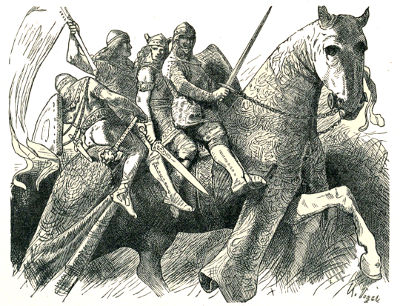
THE CHILDREN OF HAYMON.
Haymon meantime yielded himself prisoner to Bishop Turpin, the bishop promising that his life should be spared. But the emperor refused to be bound by Turpin’s promise, and ordered that Haymon should be publicly hung for the offence his son had committed. The bishop’s entreaties were vain. It was not until Roland and the other paladins threatened to leave his service if he persisted in ordering Haymon’s death, that the emperor gave way, and set his prisoner free, after making him swear to deliver his sons into his hands on the first opportunity. With the prospect of the gallows before his eyes, Haymon took the oath demanded of him.
Meanwhile the brothers journeyed rapidly through the broad lands of France. Nowhere could they find an abiding-place, for they were outlaws, whose life was forfeited if they fell into the emperor’s hands. At length they came to Saforet, a Moorish chieftain, with whom they made friends, and to whom they swore fealty. They remained with him three years, serving him well; but when, at the expiration of that time, they asked for the pay he had promised but never given, the Moor, who thought them unable to defend their rights, refused to listen to the request. So Reinold, growing impatient, cut off his head. It was certainly an effectual way of ending the argument, but it necessitated immediate flight on the part of the brothers. This time they turned for protection to Iwo, prince of Tarasconia, the mightiest opponent of Saforet. The prince received them with every mark of honour, and with their help gained many victories over his enemies. But when he heard of the imperial ban under which they lived, Iwo called his council together, and asked what was to be done. Some of his advisers wanted him to get rid of the brothers as quickly as possible; while others said that it would be well to court the emperor’s favour by delivering the outlaws into his hand; but the greater number were of opinion that the best thing to do would be to bind the heroes by some strong tie to the princely house. This last piece of advice was the one followed by Iwo, who gave Reinold his only daughter Clarissa to wife, and appointed him and his brothers a residence by the sea. There a strong fortress called Montalban was built, which became the chief stronghold of the principality. On one occasion the emperor’s forces besieged it for a whole year, and then had to withdraw, baffled.
“Look,” cried Richard, looking down from the battlements, “the imperial eagle flutters away into the forest with a broken wing. Up, Reinold, and after it, that we may send it home like a plucked goose.”
“I have something else to do,” answered his brother thoughtfully. “Seven years have passed over our heads since we saw our good mother. The longing to see her again gnaws at my heart; I must go and visit her, were it to cost me my life.”
His brothers agreed to go with him; so they armed themselves cap-a-pie, drew long grey pilgrims’ dresses over their armour, and set out for Castle Pierlepont. They got there safely, and were received with the greatest joy by their mother, who could not do enough to show them how happy their coming had made her.
The chamberlain who had taken them into the presence of the Countess Aya, soon discovered who they were, and determined to betray them. He went at once to his lord, Count Haymon, told him who the supposed pilgrims were, and reminded him of his oath to the emperor. Haymon was very angry, and felt inclined to slay the chamberlain there and then, but refrained. After taking counsel with himself, he made up his mind that the best thing he could do would be to take his sons prisoner, and march them off to the emperor; giving them, however, an opportunity of slipping away before they reached Paris. So he called his men-at-arms to follow him, and went to his wife’s apartments. Aya, seeing them crossing the court, would have hidden her sons, but they refused to hide, and, throwing off their pilgrims’ robes, prepared to defend their lives to the last. Reinold’s great strength served him in good stead. He fought so furiously that the men-at-arms fell back. Haymon alone stood firm. Reinold swung his sword, but his mother clung to him, entreating him to remember that it was his father who stood before him. Reinold at once put up his sword, but disarmed his father, and took him prisoner.
“The man that would have delivered his own children up to the executioner’s axe shall go to his friend the emperor in a guise that befits his knightly character,” said Reinold.
The men-at-arms stood so much in awe of the young man’s prowess and strong arm, that they promised implicit obedience. Reinold, therefore, sent one of them to fetch an ass. When it was brought he placed the count upon it, and bound him to the saddle. Then calling a boy, he placed the reins in his hands, and bade him lead the prisoner to Paris. The count, however, had not so far to go, after all; for, meeting some of the imperial troops on the way, he was set at liberty, mounted on a horse, and taken back to Pierlepont.
The brothers were enjoying themselves in their old home, when the emperor’s troops arrived before the gates of the castle. Reinold was alone with his mother when the order to surrender was given by the invaders. The young man snatched up his sword, but his mother silently pointed to the gates, which were already thrown open. She then dressed him hastily in his pilgrim’s robes, and led him out of the castle by a secret door. Having done this, Aya returned to seek, and, if it might be, save her other sons; but she found them prisoners and bound, and in the hands of their enemies. She wept and wrung her hands, for she knew that she was powerless to help them.
Meantime Reinold was hastening back to Montalban as quickly as he could. He was determined to save his brothers, and knew that delay would be fatal. Arrived at home, he went straight to the stables, where Bayard whinnied with joy to see him. After eating a few mouthfuls of food hastily, he mounted his gallant steed and started for Paris, as swiftly as if his horse had had wings.
He halted in a thick wood near the town, dismounted, and while his horse grazed beside him, threw himself down at the foot of a great tree, and began to consider what would be his best plan of operation. Overmastered by fatigue, he presently fell asleep, and dreamt that a necromancer was stealing his horse. When he awoke he looked about him anxiously, and called “Bayard,” but in vain. He called louder and louder. No answer was returned. He looked carefully for marks of his horse’s feet, but found none.
At the edge of the wood, he met a pilgrim, who spoke to him humbly. After some conversation, the pilgrim pushed back his hood, and looked at Reinold with a smile, and the young man recognised his cousin Malagis. The necromancer then promised to restore the brothers and Bayard safe and sound. He took some yellow powder out of a box, and sprinkled it over himself and Reinold, at the same time muttering his Abracadabra, and in a moment they were changed into the likeness of crippled beggars. Together they limped into Paris.
A crowd of richly-dressed lords and ladies were crossing the bridge over the Seine, which at that time connected the island-city with the mainland. The emperor was there also, and beside him was the famous hero Roland, to whom he had promised the horse Bayard, if he would fight and conquer the sons of Haymon. The horse was led by several grooms. All at once it stopped short, whinnied, jerked the reins out of the grooms’ hands, and trotted up to the two beggars, who were watching the procession.
“Bayard is strangely constituted,” cried Count Roland; “the beast seems actually to like poor folk better than noble knights.”
“Bayard! Is this Bayard?” asked one of the beggars. “Oh, noble gentleman, if this be Bayard, pray permit my poor comrade to mount him. A holy man told us that if he did so, he would at once be cured, and, as you see, he is a lamester.”
“Well, Cousin Roland,” said the emperor, “help the poor fellow up, that we may see a miracle for once in our lives. I only hope it will be a miracle, and that the miserable wretch’s arms and legs may not be broken.”
Roland signed to his servants, who with much difficulty hoisted the ragged lamester into the saddle. They had to do it three times before he was safely settled. No sooner was he firmly seated than he drew himself up proudly, touched Bayard with the heel of one of his wooden shoes, and galloped away so fast that no one could overtake him. Malagis pretended to be much frightened lest his comrade should meet with some injury from the runaway horse.
At midnight, a little man might have been seen creeping along the streets of Paris, dressed in a grey coat. He kept continually murmuring, “Ista, sista, pista, abracadabra!” And dark clouds rose and covered the sky, making the moon and stars grow dim. He at last reached a tall, gloomy-looking house, before which a guard was set; but the watchmen had bent their heads and fallen asleep at his approach. The strong oak doors opened when he touched them with the point of his staff. He entered, and went straight to an underground dungeon, where three men were chained to the wall. He muttered some mysterious words, and the chains fell from off them.
“Rise, brothers,” he said; “your cousin Malagis is here. He has come to save you.”
So they rose and followed him.
Before leaving Paris, the necromancer went to the sleeping emperor, and asked him for the loan of his crown and sword. Karl immediately gave them to him.
The emperor’s feelings next morning may be more readily imagined than described, when he heard of the events that had taken place during the night. He longed more than ever to have his revenge on the sons of Haymon; but could not see how to accomplish his desire.
Cunning Ganelon then said that he was sure that Iwo had his price, and might be induced to sell the brothers to the emperor. Karl tried the plan, and won Iwo to his side, on paying him a ton’s weight of gold.
This done, the faithless traitor went to Montalban, and said that he brought good news from Paris; he had persuaded the emperor to let bygones be bygones, and all would now be well if the four brothers would only go to Falkalone unarmed, and in the garb of penitents, and there beg forgiveness. The emperor had promised, Iwo said, to grant them a full pardon, and to restore them to their ancient dignities.
When the brothers were about to start for Falkalone, Clarissa entreated them to beware lest the message were a treacherous one, adding that she knew her father would sell his own child for gold. Reinold sternly told her she was an unnatural daughter, and bade her hold her peace. He then rode on; but Adelhart remained behind for a moment, and hid four swords, which his sister-in-law handed him, under the skirts of his penitent’s robe.
As the brothers were riding on their asses up the steep and narrow path that led to Falkalone, they were set upon by an armed band of warriors. Adelhart divided the swords with which Clarissa had provided him, and they defended themselves so well, that the count of Châlons, fearful of losing more men, determined to draw a cordon round the place where the brothers had taken their stand, and starve them out.
The four weary men sat down to rest. They looked anxiously all round to see whether help would not come. The hot day was over, and evening coming on apace, when all at once they saw a well-known banner on the opposite hill. It was waved by a horseman who was galloping towards them, accompanied by a small band of armed men. Reinold immediately recognised his Bayard, and his cousin the necromancer.
The battle at once began in the plain below. Before it had lasted long, Bayard had caught sight of its master; with a loud neigh of pleasure the noble horse broke through the enemy’s ranks and galloped up to Reinold. Malagis dismounted, threw his cousin the reins, and at the same time handed him his sword Flammberg, which Clarissa had sent. Reinold flung himself into the saddle, and rode down to the place of combat, followed by his brothers, who had in the meantime caught some of the riderless chargers that were flying from the field. The brothers gained a glorious victory, and the count of Châlons only succeeded in saving the remnant of his forces by retreating under cover of the darkness.
“Who told the magician? Who is the traitor?” cried the emperor, when he heard what had happened.
After many conjectures had been hazarded, every one came to the conclusion that none other than Iwo had betrayed the true state of matters to Malagis, and one of the courtiers added that the prince of Tarasconia had taken refuge in the monastery of Beaurepart. Upon which the emperor said grimly, that even the walls of the sanctuary should not protect him from his vengeance, and immediately despatched Roland to capture Iwo, and see him hanged.
When Reinold first returned to Montalban, it was his firm intention to punish his father-in-law’s treachery with death; but Clarissa’s entreaties prevailed, and he promised to spare him. It was for fear of his vengeance that Iwo had taken refuge in the monastery. He never thought of the emperor turning against him. Reinold did not hide his satisfaction when he learnt that Karl had sent to take Iwo out of the monastery, that he might hang him at Monfaucon. But Clarissa was much troubled in spirit when her husband told her the news.
“Ah, my baby,” she said, bending over her child, “perhaps you will grow up to be a hero like your father, and then people will point at you and say, ‘Yes, he is very brave, and a true hero; but still, he is the grandson of a man who died on the gallows,’ and then you will creep away from the assembly of noble men, and try to hide your shame in the wilderness.”
Reinold sat for some minutes in thoughtful silence; then springing to his feet, he kissed his wife, and said:
“You are as wise and good as one of God’s angels. The traitor shall be saved.”
He hastened to the stable, mounted his horse, and galloped away to the forest of Monfaucon. There he found Iwo standing at the gallows with the cord round his neck. Reinold knocked down one of the executioners, cut the cord round Iwo’s neck, exclaiming, “Be off, you rascal, lest you be hanged after all,” and then beat back the other executioner, who would have recaptured the prince of Tarasconia. Count Roland now came to the rescue, but was soon forced to measure his length upon the ground, and Reinold rode away, saying, “It was your horse’s fault, good cousin, not yours.”
Several of the paladins, who had witnessed the short combat between the heroes, began to make jesting remarks about what had occurred. Roland had never been unhorsed before, except once or twice by Oliver, and he took the matter grievously to heart. He rode away in silence; not to Paris, but in the direction of Montalban, that he might seek vengeance for his overthrow.
As he was riding through a wood, he met a man with a crossbow, who was shooting a deer, and at once recognised him to be Richard, Reinold’s brother. He took him prisoner, and in spite of Richard’s remonstrances, and his reminders of their relationship, took him to Paris, and delivered him to the emperor. Karl was delighted at the lucky chance, at once condemned Richard to be hung at Monfaucon, and asked which of his paladins would undertake the task of seeing the sentence carried out. They all refused, saying that hanging was not a seemly death for a knight to die. At length Rype, a new-made knight, offered his services to the emperor. A pious pilgrim who was present at the discussion, begged that execution might be delayed until he had had time to pray for the weal of the poor sinner at St. Denys.
But instead of going to St. Denys, the holy man went to Montalban, and told Reinold all that had happened, bidding him make haste if he would arrive at Monfaucon in time to save Richards life. Having said this, Malagis—for the pilgrim was none other than he—went to the kitchen to ask for some food, for he was tired and hungry after his long and arduous journey on foot.
Reinold, Adelhart, Wichart, and their men soon reached the gallows at Monfaucon. There was no one there, so they stretched themselves out on the grass and fell asleep. When Rype came with his prisoner, they were still asleep; but Bayard, hearing them, awoke his master with a kick. In another moment the brothers had fallen upon the imperial troops, whom they soon put to flight. They then set Richard free, and hung Rype with the same rope he had brought for his prisoner.
The emperor, finding that all his former attempts to avenge his son’s death had been in vain, determined on a new plan of action. He called out a large army, and marched to lay siege to Montalban.
The fortress was strictly invested. The besieged ventured on making an occasional sally on the enemy without the walls, for the purpose of getting provisions, etc. Much blood was shed on either side, but nothing decisive took place. The siege went on for years, and neither party gave way. At length the garrison of Montalban began to feel the want of provisions, and Reinold made up his mind to a desperate step. He broke through the besiegers’ camp and carried off a number of provision wagons. Malagis had rendered such action possible by slipping out of the fortress unnoticed and sprinkling some of his sleeping powder over part of the camp. As he was about to scatter another pinch, he was seized by the collar, and, looking round, saw that it was strong Olivier, one of the twelve paladins, who was dragging him away. The rough attack had knocked the powder out of the necromancer’s hand, and it had fallen on the ground. Instead of laying his hand on his sword, the little man caught hold of the bag of hellebore snuff he had hidden within his garment, and threw a pinch into Olivier’s face. The hero sneezed and sneezed, and still he sneezed; but the more convulsively he sneezed, the tighter he clutched his prisoner, whom he at length dragged into the emperor’s presence.
“A-chew! your Highness!” he said and sneezed; “I bring you—a-chew!—the wicked-a-chew!—necromancer—a-chew!—do with him—a-chew!—as you will.” Here such an agony of sneezing came upon poor Olivier that he could say no more.
The emperor thanked and pitied the worthy paladin, and ordered that the magician should be bound, and guarded to Monfaucon, where he was to be hanged.
“Sire,” whimpered Malagis, “pray let me live this one more night, and let me have a good supper, for I have not tasted food for the last four and twenty hours.”
Meanwhile the paladins and many other knights had entered the royal tent. They one and all joined their entreaties to those of the poor little man. Seeing that the emperor seemed inclined to yield, Malagis said in a grave and solemn tone,—
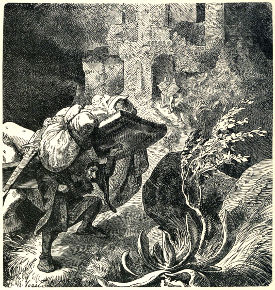
MALAGIS CARRIES THE SLEEPING EMPEROR TO MONTALBAN.
“Your Majesty, I swear on my honour that I will not go away from here without your own consent, nor will I go unless you bear me company.”
Karl then promised to let him have the twenty-four hours’ grace, and several of the knights offered their services as guards.
The lords sat down to supper, and devoted their whole attention to the good food and wine that were set before them, while Malagis, curled up in a corner close at hand, appeared to do the same. When supper was over, the necromancer was taken to the place that was to serve him as prison, and the noble knights, who had undertaken to keep watch and ward, took up their places for the night.
At midnight Malagis had recourse to his knowledge of the black art. He made a deep magic sleep fall upon the camp, and all within its bounds, save and except himself. Then, stepping softly, he made his way to the emperor’s bedside, and dropped a few drops of some medicament into Karl’s mouth, which insured his sleep lasting for twelve good hours. After which he lifted him up, and carried him pickaback to the castle. The great gate was flung open at the sound of his well-known voice, and great was the astonishment of Reinold when he saw what burden he carried on his shoulders.
“Here is the pledge of peace,” said Malagis. “It has cost me much hard work to bring it here. See that my labour bears fruit.”
The emperor was carried to the best guest-room the castle contained, and the Lady Clarissa did all that lay in her power for the comfort of the great man.
Karl did not awake till noon. At first he thought he must be dreaming when he saw Reinold, Malagis, and strange servants about him. The truth dawned upon him gradually, and a bitter truth it was. Hunger forced him to accept the food Clarissa brought, though he would much rather not have eaten it. Reinold tried by every means in his power to induce the emperor to give up his plans of vengeance, and make peace with him. But his efforts were vain. Then it occurred to him that a proud, haughty nature, that could not be bent by harshness, was often softened by kindness. He set Kaiser Karl at liberty, and the emperor went away from Montalban without a word or sign that betokened reconciliation.
When Reinold re-entered the castle, he found his cousin Malagis burning boxes, bags, and all kinds of written papers. Much surprised, he asked what he was doing, and Malagis replied:
“I am burning all that the noble art of necromancy has taught me. I shall need these things no more, for my services are useless to such a madman as you. I am now going away into the wilderness to join the holy penitents, there I shall repent with them in sackcloth and ashes.”
He was as good as his word, for he took his departure soon afterwards, never to return.
When the emperor went back to his camp, he related all his adventures. The paladins one and all entreated him to make peace with the heroic brothers, but he refused, saying that his murdered son’s blood still cried aloud for vengeance. So the castle still remained beleaguered, and fortune seemed to have deserted the garrison with the departure of the little necromancer. The store of provisions grew less every day. Hunger stared the brave men in the face. Reinold, after much consideration, thought of a way of escape, and made all needful preparations. One evening, when darkness had begun to set in, he took leave of his weeping wife, and, accompanied by his brothers and a small band of determined men, made his way cautiously and silently through the enemy’s lines, and set out for a strong castle in the forest of Ardennes.
Next morning the emperor was told what had happened, and he did what Reinold had expected. He at once ordered the siege of Montalban to be raised, and started in pursuit of the fugitives. He soon came up with them, but they defended themselves so well, and took such wise measures to ensure their safety, that they succeeded in reaching the stronghold for which they were bound.
Death of Bayard and Reinold.
The heroes fought as bravely as ever in defence of their new place of refuge, emboldened by the knowledge that their dear ones at Montalban were now free; but however courageous a man may be, hunger and disease are foes under whose attacks it is impossible to hold out for ever.
In the time of their sorest distress, Aya went to the imperial camp, and entreated her brother to have mercy on her children. The emperor refused to listen to her, and harshly bade her go out of his presence. But she returned again and again to the charge, and at last Karl said:
“Very well, listen to my offer, and let Reinold accept it if he will. The horse Bayard, that Malagis brought up out of hell, has done me more harm than any other creature, excepting Reinold himself. Now I will pardon your four sons, and restore their fiefs, if Reinold will give the brute to me, to be killed as I think best. I give you my word as an emperor that I will accept Bayard’s life in expiation of my son’s death.”
When Aya returned to the castle, and showed the parchment on which she had had the terms of the proposed treaty written out in full, Reinold refused to give up his dearest and most faithful friend.
“Think of your wife, your children, and your brothers—the gallows at Monfaucon are prepared—an inscription will be placed there that will be read by future generations: ‘He gave them all up to die a shameful death for the sake of a dumb animal.’”
“Mother,” cried the hero, and rushing up to Bayard, he fed his faithful friend with a last piece of bread, and, bursting into tears, threw his arms round its slender neck. The horse whinnied softly, and laid its head trustingly on his shoulder.
“I cannot do it, mother, I cannot do it,” cried Reinold. “Bayard and I must live and die together.”
“Very well, my son,” she said; “but remember that when all my children and grandchildren are hanging on the gallows, your mothers heart will break.”
“Mother,” he answered, in a strange, hollow voice, “have your will. You have conquered, but I shall not survive it.”
He then signed the treaty, and Aya returned with it to the imperial camp.
A crowd was assembled on the bridge in Paris, for the news had gone abroad that the famous Bayard was to be drowned. Kaiser Karl was there also with his paladins.
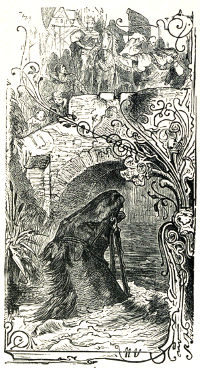
BAYARD’S DEATH
The noble horse was led to the middle of the bridge, with iron weights fastened to its feet, and at a signal was suddenly pushed over the edge, and fell with a splash into the Seine. In spite of the weights upon its legs, it rose to the surface, once, twice, thrice.
“That horse is the devil incarnate,” cried the emperor furiously. “Ha, Count Reinold, beware, its eyes are fixed on you; if you are keeping it alive by any enchantment, it will be the worse for you. I will tear up the treaty.”
With a low cry of terror Aya flung her arms round her son, drawing down his head, so that he did not see how Bayard rose a fourth time, and then, not seeing its master’s face, sank, to rise no more.
The hero felt that all his happiness was gone with Bayard. He thrust his mother aside, flung at the emperor’s feet the letters patent entitling him to his fiefs, and breaking his sword Flammberg, threw it into the Seine, muttering,—
“Lie there with my Bayard, and may God forget to be gracious to me, if I ever mount a horse or draw a sword again.”
Then he turned, and fled into the depths of the wild forest, until at last he sank exhausted on the ground. There he remained for two days and a night, overwhelmed and mad with misery.
After that he went home to Montalban. Meeting a pilgrim on the way, he gave him his golden spurs and all his ready money for his grey robes and felt hat.
Lady Clarissa wept when she heard the end of the noble horse, for she had loved Bayard; but she wept still more bitterly, when Reinold took leave of her for ever.
“Who will teach our sons,” she cried, “to be true knights and noble men, if you go and leave them thus?”
“Our cousin Count Roland will do so,” he answered, “and you will do your part, dear wife.” He kissed the tears from her eyes, and continued: “Accept no fief from Kaiser Karl. Go with our children to our own lands on the other side of the mountains. The tyrant has no power there, for the lands are your own. As for me, I am about to start on a pilgrimage to the grave of our Lord, to see whether I may find forgiveness. You will never see me again.”
Saying this, he tore himself away, and set out at once upon his long and toilsome journey.
Reinold went to the Holy Land, where he found a fierce war raging between the Christians and Infidels. He was true to his vow. He neither mounted a horse, nor wielded a sword; but still he fought like a hero with an enormous club, and helped in the taking of Jerusalem. After he had prayed at the Holy Sepulchre, he returned to his native land; but not to his wife and children, nor yet to his brothers, for he had died to all earthly ties and joys. He went to Cologne, where the cathedral was being built. There he lived a hard, ascetic life, and worked as a labourer at the building. He did not even stop working during the hour of rest in the middle of the day, although his wages were only a penny a day. This conduct aroused the anger of the stone-masons, so they rose in a body, killed him, and threw his body into the Rhine. But the river would not keep it, the corpse floated on the surface of the water, and was drawn to land by some pious souls. And now several miracles were wrought upon those who touched his body, which showed that he had been a holy man. The emperor, hearing of the wonders that had taken place, had the murderers tried and executed, and sent orders that the body of the saint should be brought to Aix-la-Chapelle (Aachen), or to Paris. No sooner was the body laid upon the cart which was to convey it, than the vehicle moved of its own accord, and rolled on and on, no matter how bad the roads, till it arrived at Dortmund in Westphalia, where it stopped, that being the spot the saint had evidently chosen as his last resting-place. The Reinaldi-Church at Dortmund was built in his honour.
The Legend gives the exact date of the miracle, 7th of January, 811.
II. ROLAND.
Siege of Viane (Vienne).
Kaiser Karl had not been married very long. He held a great assembly of the notables. Count Gerhart appeared amongst the rest, for he expected that this would be the time chosen by the emperor to invest him with the promised fief of Viane (Vienne in France), and perhaps also with that of Burgundy. When he received the letters patent relating to the first of these, he stooped, and, in fulfilment of ancient custom, would have kissed the emperor’s foot; but he staggered, for the empress had stuck out her foot, which he involuntarily touched with his lips in falling.
“He must have drunk too much Burgundy before he would have kissed the foot of the Lady, whose rosy mouth he formerly disdained. Wine teaches humility,” murmured the courtiers.
Gerhart sprang to his feet, his cheeks flushing with anger. He waited in expectation of the second letter; but the emperor told him that he could not have the fief of Burgundy, for the empress, who was also the widow of the last duke, was strongly against it. The count took his leave with a low bow, and set out for Vienne, his heart boiling with rage. Arrived there, he called out his troops, and sent to ask his brother, the mighty lord of Apulia, for help against his sovereign. He knew that the emperor’s heart would henceforth be turned against him, for was not the empress that same widowed duchess of Burgundy whose proffered love he had rejected?
The brothers took the field at the head of a great army. With them came their younger brother Rainier, his son Olivier, a bold warrior, and his daughter Auda, who was marvellously beautiful, and brave as one of the Northern valkyrs.
Karl besieged the stronghold on the river Rhone where they had taken up their abode. The place seemed impregnable, for it was defended by brave men, rocks, and river. Sometimes the besiegers tried to take the citadel by storm, and sometimes part of the garrison would make an attack on the enemy beneath the walls. On such occasions, Auda would now and then accompany her friends dressed in full armour, and would fight with the best. Once when she had done so, she found that her opponent was none other than strong Roland. He disarmed her without even drawing his sword, and took her prisoner. Her brother Olivier, seeing what had happened, at once came to the rescue. While the heroes were engaged in single combat, Auda made good her escape, and took refuge in the castle, where she was soon afterwards joined by the rest of the party. The siege continued. The Lady Auda often stood on the battlements, and helped to fling stones on the heads of those warriors who came within reach of their missiles. One day Roland came with the rest, and, seeing the maiden, asked her name and parentage. When she had told him, and he had answered by informing her that he was Count Roland, a nephew of the emperor, he went on to say that he loved her, and would never cease to woo her, even though it were at the cost of his life. At this moment Olivier appeared, and flung a spear at him, upon which Roland challenged him to single combat on an island in the Rhone.
The heroes and their horses were ferried over the river to the island, and there they fought. Each of the combatants displayed the most heroic valour. At length, when evening was drawing on, a fleecy cloud hovered over them, and, coming between them, forced them apart. An angel wrapped in rosy light came out of the cloud, and said:
“Wherefore do you fight, Christian against Christian? Why would you shed a brother’s blood? I call upon you to be reconciled in the name of the Saviour who died upon the cross. Be of one heart and of one mind, and turn your arms against the adversaries of the true faith.”
The angel then waved a palm branch as a sign of farewell, and vanished.
The two men exchanged a hearty shake of the hand, and sat down to talk over matters of much moment to both of them. Before they separated, Olivier had promised to use his influence with his sister in Roland’s favour, and the latter had given his word to fight no more against Vienne, and its defenders.
Now the emperor was very fond of hunting, and used to go on many an expedition into the neighbouring country in search of game. On one such occasion he and his companions were attacked and hard pressed by a party of Viennese under the leadership of Olivier. At one moment it seemed as if Karl must lose his life in the struggle. Olivier, seeing this, protected him with his shield. When the combat was over, the emperor and Olivier had some talk together, and the former was so touched and pleased with the noble and generous disposition of the young man, that he not only promised to make peace, but to appoint Olivier one of his paladins, to forgive Gerhart, and to restore the fiefs he held under him.
There was great joy in Vienne and all the neighbouring country when the news of the peace was spread abroad. Smiling faces were everywhere to be seen, and happiest of all was perhaps Kaiser Karl himself. A few days later a time was fixed for the public betrothal of Roland and Auda. Great preparations were made, and all was done to make the day a joyful one.
While the heroes were sitting at the feast in the royal tent, messengers appeared from the banks of the Garonne, who brought the sad news that the Moorish king Eigoland had come from Africa with a large army of blacks, had fallen upon Gascony, and laid waste the country with fire and sword.
“That is good news,” said brave Roland, “for an angel appeared to my comrade Olivier and me, and told us to fight against the infidel.”
“It is bad news,” answered the emperor, “for the Moor is a great warrior, and has an immense number of black devils at his back. Listen, noble knights, and I will tell you what happened years ago. After the death of my father Pipin, my step-brothers, the sons of cunning Bertha, drove me out of my inheritance. I found refuge with the heathen king Marsilio at Saragossa. With the help of brave Diebolt, I regained my rights, was crowned king of the Franks at Aix (Aachen), and emperor in Rome. One night St. James, the apostle, appeared to me, and commanded me to free his grave, to which there was a yearly pilgrimage, from the yoke of the infidel. I obeyed him, and reduced the whole country as far as Galicia, where the apostle lies buried. There I learnt that Eigoland had come over from Africa, and had already reached Pampeluna. I marched back at once, and met the Moorish forces near the river Ceres. There was a terrible battle. The Africans fought like very devils. They broke through our ranks, and defeat seemed certain. Then the brave Milo, my brother-in-law, and your father, nephew Roland, threw himself upon the demons at the head of his men. They fought like heroes, and defeated the enemy. But before the victory was quite decided, the noble Milo fell, wounded to death. The loss on both sides was so great that either party retreated on the morrow. Eigoland returned to his African deserts; but he seems to have come back at the head of a larger army than before, and to have invaded our own land. We must now fight for home and faith, for on this crisis will depend whether Christ or Machmet shall rule the Franks.”
“I think this much is certain,” said Roland: “we shall conquer, whether we live or die. Was not my father victorious, though he fell at Pampeluna? The Lord would not deny him the martyr’s crown, when he passed away on that field of blood. Here, or there, ye Frankish men, what does it matter which? The crown is ours.”
As he spoke, his eyes shone with enthusiasm.
“And what is to become of me,” whispered Auda, “if you do not return?”
“You are the angel that shall give me the palm, either here or there,” he answered; and before the assembled knights and ladies he gave her the kiss of affiance.
Ganelon.
Next day they marched to meet the enemy, whom they saw when they had at length reached the beautiful land that is watered by the Dordone (Dordogne). The morning after their arrival, a terrible battle took place between them and the Moors. Roland, Olivier, Ogier, Archbishop Turpin, and the other paladins fought like heroes, and led their men again and again against the foe. At night-fall, and not till then, did the Moors acknowledge themselves beaten. They fled to Pampeluna, where they found more troops that had just arrived from Africa. Eigoland and his men were impatient to avenge the defeat they had sustained, and they were sure that they could do so, for they trusted in their numbers, their skill, and their prophet.
Karl did not at once follow the fugitives. He waited for reinforcements from France, and from Marsilio, who, although a heathen, had formerly aided him. He sent messengers to him; but soon afterwards learnt that the faithless king had murdered them, and had joined the Moors. Then the emperor called his heroes around him, and, telling them of the evil tidings he had had, asked them whether they advised him to risk a battle, when the enemy’s numbers were so overwhelming.
“Let us go forward,” cried brave Roland; “before us lie two objects, victory or paradise; who is it that will draw back?”
The rest agreed with him, and the horns sounded to battle; and a great battle took place, in which many men were slain on either side, and each party fought with a desperate valour. At last Eigoland fell under the sword of Roland, and then the Moors took flight.
The emperor reduced the country to obedience to his rule. Saragossa alone held out, for there Marsilio had taken up his station and determined to defend the town alone until the arrival of the troops his liege lord Baligant, caliph of Babylon, had promised to send to his aid. Karl, remembering his former kindness, had determined to treat Marsilio with the greatest forbearance. He therefore sent Ganelon, one of his paladins, to offer the king terms, and they were these: Marsilio’s life should be spared if he would be baptized, and become a vassal of the empire. Ganelon would have liked to decline the honour of carrying this message; but he knew the emperor too well to dare remonstrance.
The king received the ambassador with all kindness, listened to his message quietly, and begged for a short time to think the matter over, and consult his friends. Meanwhile he led Ganelon over the palace, and showed him all his treasures. When he saw that the sight of these things had had the desired effect on the ambassador, he offered him three baggage-horse loads of gold, three of silver, and three of costly stuffs, if he would turn the emperor’s vengeance away from him, and save him from becoming a Frankish vassal. Ganelon promised to do all that the heathen wished; nay, for double the reward, he even promised to detain a division of the Frankish army when the rest had gone away, on the pretext of guarding the country, and then to deliver them into Marsilio’s hands. The compact was soon concluded, and each of the contracting parties swore to keep his share of the bargain.
Marsilio, who thought little of bloodshed, did not hesitate to hand over some of the nobles of his host as hostages for his good faith, which therefore was not doubted. Ganelon spoke strongly of Marsilio’s repentance for the past, and promises for the future; and then, when he had succeeded in turning matters as he wished, and the emperor was about to return to France with his whole army in the belief that he now possessed a faithful vassal in Marsilio, went on to persuade him to leave Roland and the other paladins behind at the head of a small force to watch the borders. His eloquence carried all before it, and what he advised was done. He alone of all the paladins returned to France with the emperor, while Roland and the other ten remained with six thousand chosen warriors to guard the land from foreign invasion.
At Ronceval (Vale of Thorns).
The heroes spent one quiet day after the army had gone. On the second morning, their outposts came in to announce the approach of a large army, so they got ready for the fight. Roland led his forces to Ronceval, a narrow pass between two high mountains, which he determined to defend. The Moors, more than twenty thousand strong, came up with the Franks before they had reached the end of the pass.
“Blow your horn,” said Olivier, “the emperor will hear you and return, he cannot have got very far yet.”
Roland gazed at his great horn, Olifant, which was hanging at his side. It was made of ivory with gold inlaid, and, when blown by one who understood how to sound it, would send its voice for miles around.
“Look, faithful friend,” said the hero, “I was given this horn, and my good sword Durindart, by an angel from heaven. I then swore only to blow the horn in case of utmost need. We are not now in such a case; I think we are strong enough to make these heathen bite the dust. Ha! what do I see? Look, there is the traitor Marsilio! No doubt the faithless Ganelon has betrayed us for much red gold, but we will fight for the good cause. Monjoie, Saint Denys! Up, soldiers of Christ, let us do battle for our holy Faith!”
The heroes and their men rushed on to meet the Moorish hosts, who withstood their furious onslaught with the greatest courage; but after a while fell back, and fled, pursued by the Christians, who slew all they came up with.
When the heroes had recalled their little army from the pursuit, they made their men sit down and rest. Before they had sat very long, they were startled by a shout behind them of “Machmet! Machmet!” and a great blowing of trumpets and beating of drums. A larger army than that which they had already put to flight was approaching in their rear. Marsilio was at its head.
Roland prepared for battle. He sent Count Walter to guard a wooded height, and then, accompanied by his brother Balduin, brave Olivier, the bold Archbishop Turpin, and the other paladins, advanced with his men against the foe.
The battle raged with intensest fury round the leaders. Wild cries and the clash of arms filled the air. At last Roland flew at Marsilio, but next moment his horse was killed beneath him. He sprang to his feet, and fought so desperately that the Moors turned and fled. He looked round, and could see none but the dead or dying. He raised his horn to his lips, and blew a mighty blast. About a hundred men-at-arms appeared in answer to his call, then came a few more, and lastly Olivier, Balduin, Archbishop Turpin, and others of the heroes.
“Your horn has a goodly sound, and carries far, friend Roland,” said Olivier; “the emperor must have heard it, and will return and help us. It will be high time, in sooth; for see how the wild Moors assemble in close order, and prepare to renew the attack.”
“Up, ye faithful of the Lord,” cried Roland; “close your ranks. May Christ preserve us!”
The hero mounted an Arab horse he had caught a moment before, and took his place at the head of his men. Soon spears were hurtling through the air, and swords were clashing. Many a doughty deed was done by small and great in the Christian force; but fight as they might, the Franks were so few in number, that it seemed as if the Moors must finally prevail. Olivier fell defending his friend and brother-in-arms. Roland’s sword did such terrible execution that the Moors once more retreated in fear, and the hero was too weary to pursue them. His wounded horse fell dead beneath him, and he, bleeding from many wounds, and feeling that his end was near, staggered into a neighbouring gorge, and sank upon the ground at the foot of a rock. Then, raising his eyes to heaven, he whispered,—
“Lord, give me grace in Thy sight. Receive, if so be that Thou hearest me, this pledge of my submission to Thy will.”
So saying, he held up his gauntlet; a soft breeze passed over his face, and an invisible hand took the gauntlet, and bore it away. The hero then lifted his sword Durindart, and tried to break it against the rock, that it might not fall into the hands of the Moors. But the marble rock was split by the blow, while the sword remained unharmed. He now blew his horn for the third time. The worthy Archbishop Turpin limped up to him, then came Balduin, Roland’s half-brother, his faithful squire Thiedrich, and bold Walter, who had defended the height committed to his charge until all his men were slain.
Time passed slowly with the wounded men. At last they heard the glad sound of horns blowing, and the clanking of armour. Kaiser Karl had come back to their assistance. But before he arrived, Roland had gone to the realms of eternal peace. His faithful squire told the emperor, with tears in his eyes, that he had seen one of God’s angels come to receive his master’s soul. Then he went on to tell of Marsilio’s faithlessness, of the battles which had that day been fought, and of the suspicion they all felt that Ganelon had betrayed them into the hands of the Moor.
“You were right there,” said the emperor; “the traitor deceived me also. I wanted to return the moment I heard Count Roland’s horn, but Ganelon dissuaded me, saying that my nephew must only be hunting.”
The bodies of the Frankish soldiers were buried, while those of the paladins who had lost their lives at Ronceval, amongst whom were Turpin, Roland, Olivier, and Walter, were to be taken away and embalmed for burial in France. Ganelon was at the same time arrested and bound.
These things done, the emperor marched against the Moors, who meanwhile had been reinforced by the arrival of Caliph Baligant of Babylon with hosts of followers. The battle between the Christian and Moorish forces lasted two days, and was then decided in favour of the Franks. Baligant died on the field, and Marsilio at Saragossa. This victory gave Spain to the conqueror.
The emperor returned to France. Halt was made by the vine-clad banks of the Dordone, and the bodies of the fallen heroes were interred at Blaive, after which the march to Paris was resumed. There the feast of victory was held, and when it was over, Kaiser Karl set out for Aix, where Ganelon was tried before a jury of twelve of his peers. He was sentenced to prove his innocence by single combat against Thiedrich, Roland’s faithful squire. As Ganelon was much weakened by his imprisonment, he was allowed to choose any one he liked to act as proxy for him. He chose Pinabel, one of the most famous swordsmen of his day; but that availed him nothing; God fought for Thiedrich, and Pinabel was overthrown. Ganelon was then sentenced to be torn in pieces by wild horses.
Soon after this, fair Auda came to Aix in search of her betrothed. None of the warriors had courage to tell her the truth, so they referred her to the emperor, and he told her with tears in his eyes.
“Dead,” she said; “Roland dead!”
With these words she sank lifeless to the ground, so they took her away, and buried her beside her hero in the vault at Blaive.


III. WILLIAM OF ORANGE.
The Inheritance.
Count Henry of Narbonne, who was both a good man and a hero, lived at the time when Kaiser Karl ruled over the Franks. He was held in much esteem by the emperor, because of his valorous deeds, and had received many fiefs in addition to his paternal estates. After a time he withdrew to his own castle, and, together with his wife, occupied himself with the education of his seven sons, and several daughters. Years passed on, and the sons all grew up to man’s estate. One day their father called them to him, and said that he had a story to tell them, to which they must listen attentively.
“You must know,” he said, “that once, long ago, I sank exhausted on the field of battle, worn with fighting, and covered with wounds. The enemy rushed up to slay me, but a faithful squire defended me at the risk of his own life. Just as further help arrived, he sank severely wounded on the blooming heather beside me. We were removed from the field, and every care and attention was lavished on us. I got better, but he grew weaker every day. He was not afraid to die, but he was troubled about the fate of his little son, whom he would leave an orphan, for his wife had died some time before. I comforted the man who had given his life for me, by telling him that I would be a father to the boy, and that if he grew up fit for the trust, he should be my heir, whether I had children of my own or not. He is now a gallant knight and brave warrior, and I am proud to call him my pupil. Now, my sons, tell me, do you wish me to keep my word to my dying preserver, or do you desire to share my estate amongst you?”
Then one of the sons, named William, answered for the rest, and said that they would all rather be beggars than that their father should break his word to his faithful squire.
“Not beggars,” cried the Countess Irmschart. “All that I brought my husband belongs to you, and your father has already endowed you with a priceless inheritance; namely, his piety, his good faith both to God and man, his courage, and all the lessons in knightliness he has given you. This is an inheritance that cannot be taken from you.”
“Well, my sons,” continued the count, “you may go to the emperor’s court in the full certainty that you will get on there, if you are true to the lessons you have learnt in your youth.”
The young warriors followed their father’s advice. They were well received by the emperor, at first for Count Henry’s sake, and then for their own. They fought against the Moors when Eigoland invaded Gascony, and helped to avenge the death of the heroes at Ronceval. After their return from Spain, the emperor knighted the brothers, and gave them considerable fiefs. William, who enjoyed the special favour of his liege lord, was made governor of the whole southern coast of France. He showed himself a vigilant warden of the coast. Wherever any Saracens ventured to land, there he was with his troopers to beat them back, and sometimes even seized their ships.
After the death of Kaiser Karl, surnamed the Great, his son Ludwig succeeded him on the throne. The first action of the new ruler was to go about the country, and see in what condition it was. Amongst other places, he visited the castle where Count William lived with his youngest sister. Ludwig was so taken with the maiden’s beauty and sweetness, that he fell in love with her, and soon afterwards married her. This circumstance increased Count William’s influence at court, and enabled him to keep up a larger army, and do what he otherwise considered necessary for the proper defence of the coast.
Captivity and Deliverance.
Peace lasted for a long time under the wise rule of Count William, but, suddenly and unexpectedly, the Moors invaded the land, under the lead of the powerful Emirs Terreman and Balikan. King Ludwig and Count William attacked the children of the desert, and strove to chase them from the country. After performing many feats of valour, William was at last surrounded by the Moors, and carried off a prisoner to Valencia by the Emir Tibalt, whose captive he was by the fortune of war.
Arrived at Valencia, the count was chained up in a dark and dismal dungeon, and placed under the charge of the emir’s wife, Arabella, during her husband’s absence on a plundering expedition. Before going away, Tibalt told his wife to feed the prisoner on bread and water, and forbade her on any account to take off his chains. He added that he hoped on his return to find him willing to embrace the Mahommedan religion.
For some time Arabella did as her husband had desired with the strictest punctuality, but after a time she became curious to see what the Frankish prisoner was like. So she made her servants accompany her with torches to the cell. She saw that William was a goodly man, and felt sorry for him. As for him, he never could have imagined that an infidel could look so gentle and like an angel.
The weeks passed quickly. Arabella tried to teach the count her religion, by repeating passages of the Koran, and by entreating him to remember that he had only to become a Mahommedan, and he would at once be free. And he, on his side, told her about God and Christ, and explained to her the religion of mercy and love. What he said came home to her heart. She visited him again and again, thought over his teachings when she sat quietly in her own room, and at last confessed that she wished to become a Christian. She and William had by this time learnt to love each other, so they determined to fly to King Ludwig.
By the help of an old and faithful servant, Arabella hired a vessel, set the count free, and went on board with him. The captain, on learning that he was to steer for the coast of France, refused point-blank to do so; and William, without an instant’s hesitation, flung him overboard. He then threatened to slay the mate if he did not obey him in all things, and he looked so terrible with his drawn sword and stern face, that the crew durst not disobey him.
Meanwhile Tibalt returned from his raid, and learnt all that had occurred from the captain, who had swum ashore. He embarked without loss of time, and set sail in pursuit of the runaways, but only came within bow-shot just as William and Arabella landed and took refuge in the citadel.
Tibalt vainly tried to take the place by storm, and had at last to return to Valencia without accomplishing the object of his voyage.
Ludwig invited Count William and Arabella to his court, where they were received with the utmost kindness by both him and his queen. Every one admired the Moorish lady’s beauty, and thought her lovelier than any one about the court, even than the queen herself. This roused the queen’s jealousy, and she began to treat both her brother and Arabella with marked coldness.
Count William and his bride went on to Avignon, where they were married by Pope Leo, after Arabella had been received into the Christian Church. She was given the name of Gyburg at her baptism, as that was an old family name in the house of Narbonne. Ludwig was present at the marriage, but the queen said she was too busy to go.
A few days after this, William sent his wife home to Orange, while he accompanied King Ludwig to Italy, with the object of recovering Rome and the States of the Church for the banished Pope. This they succeeded in doing after much fighting; and when Leo was once more master of the imperial city, he showed his gratitude to the Frankish king by crowning him emperor in the room of his great father.
When the coronation feast was over, the warriors all returned home, and William with the rest. He and his wife lived happily at Orange, and, as they had no children, William adopted the son of one of his sisters who had died early, and brought him up as his heir. The boy Vivian (or Vivianz) grew up to be a bold youth, and showed promise of future excellence.
More Fighting.
As it happened, Vivian was to have a chance of winning glory at an early age. The Moors invaded France in hordes. They swept over Aquitaine in no time, and seemed as though they would soon have the rule in France. Count William took leave of his wife, and, accompanied by young Vivian and his men-at-arms, set out to meet, and, if it might be, drive back the bold invaders.
The armies met on the plain of Alischanz (Alicon). “Machmet! Machmet!” was the cry on one side, and “Monjoie, St. Denys!” on the other.
The battle began, and raged for hours; young Vivian fought like a hero, and then fell, mortally wounded. His men avenged his fall. He was insensible for some time, and when he came to himself again, he found that he was lying on the battle-field surrounded by the bodies of the slain. He was very thirsty, and prayed for a drink of water. His prayer was heard. A shining angel came down from heaven, and supported his tottering steps to the side of a little rushing brook, where he quenched his raging thirst. Before finally disappearing from sight, the angel said,—
“The good town of Orange and kind Gyburg are in danger.”
The young man fainted again when he heard these words. On recovering his senses, he saw his uncle bending over him, and had just strength enough to repeat the warning given him by the angel, before he fell back dead.
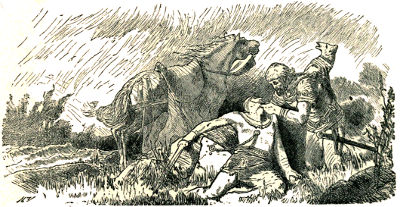
WILLIAM OF ORANGE AND HIS DYING NEPHEW.
The count considered what was to be done. He had lost sight of his men in the wild hand-to-hand conflict in which he had cut his way through the enemy’s ranks; and then, coming upon his nephew’s broken shield, he had followed his bloody track until he found him. The battle was now at an end; but without men how could he save Gyburg and Orange? His horse was so severely wounded that he had to lead it by the rein. Without further loss of time, he set out on his long and toilsome walk. At daybreak he met a Moorish commander with several followers. He was at once attacked by them, but with the first blow he clove the emir to the saddle, and put his men to flight. Finding himself alone and unobserved, he slipped the emir’s dress over his armour, and, mounting the emir’s horse, pursued his journey to Orange. He made his way in safety to the castle gate, which opened in time to receive him just as the enemy had recognised the Frankish accoutrements of his wounded war-horse, for the faithful beast had followed him all the way.
The besiegers tried again and again to storm the castle, but in vain. At last they determined to starve the garrison out. After a time, the inmates of the castle suffered so much from want of food that the count made up his mind to slip through the Moorish hosts to bring back reinforcements and provisions. He made his wife and captains swear to hold the fortress at all hazards, and then, donning the garments he had taken from the emir, set out on his perilous undertaking.
He made his way through the enemy’s lines, and reached Orleans in safety. There he was taken prisoner by the captain of the guard, and ordered to instant death as a Moorish infidel. In vain he assured the man that he was a Christian and a Frank; in vain he told him his name and rank; neither the captain nor any one else would believe him, and he was in great danger of being torn in pieces by the excited populace. Fortunately, at that moment the governor of the town appeared at the head of an armed force, and, on seeing William, at once recognised him as his brother, and took him away to his house. The count would have nothing to eat but bread and water; he could not feast while his wife and his men were fasting. Having rested for an hour or two, he set out again on his way to court.
Ludwig received him coldly, and his sister was still more unkind. Indeed, the empress went so far as to say, that for aught any one knew, the Moorish woman might have sent for those Saracens; she might be tired of France and Christianity, and want to return to her own people. Ludwig showed himself unwilling to call out his troops, saying that William was strong enough to help himself.
Day after day passed, and nothing was done. Meanwhile the rumour spread that the count of Orange had come to court to ask for help against the Moors; and the aged count of Narbonne, his six sons, and many noble knights came to offer their help in the good work. When they heard how ill William had fared at court, the lord of Narbonne went to the emperor, and warned him that if he did not support his vassals in their need, he must not be surprised if they threw off his suzerainty. Then, turning to his daughter, he told her plainly what he thought of her conduct, and threatened her with his curse if she did not forget her foolish rancour and do her duty. This bold speaking had such good effect, that orders were at once given to call out a great army, which assembled in an incredibly short time.
On hearing of the approach of a Frankish host, the Moors hastened to their ships, leaving their tents and provisions behind. These William gladly seized for the use of the imperial troops. Life and bustle now reigned in the castle from garret to cellar, and the cooks had hard work to provide food for so many men. Among the scullions was a tall strong young fellow, a Moor by birth, who had been stolen from his home, and presented by his captors to Kaiser Ludwig. William thought from his appearance that he must be of noble birth, but every one else regarded him as half-witted, and called him nothing but Jack Dunderhead. While he was at the palace, he had once had the good fortune to save the Princess Alice from a wolf. The only reward he asked of her was that she would keep the adventure a secret. This she did. But when he was going to the wars with the other officers of the royal kitchen, she sought him out and gave him a ring as a farewell gift. After his arrival at Orange, William’s attention was drawn to him; and seeing the heroic qualities of the youth, and the masterly fashion in which he handled his quarter-staff, the only weapon he possessed, he redeemed him from servitude, took him to the Lady Gyburg, and desired her to provide him with coat of mail and all the requisites of a warrior. Rennewart, for that was his real name, was so grateful for this kindness that he swore to be faithful to William to the death. And, as he turned to leave the room, the countess heard him say, in a low voice:
“Now, at length, I can show that I am of royal lineage, and may strive to win my pearl. Ah, father Terramer, while you have forgotten your long-lost son, he has become a Frank, and is both able and willing to fight for his new and better country.”
These words revealed to Gyburg that Rennewart was her own brother, so she called him back hastily and told him all. After this joyful recognition, he went out in full armour, but still bearing the long staff he had always carried for his defence. He joined the rest of the forces and marched with them to fight the Moors, who were awaiting them on the shore.
The battle began, and Rennewart showed himself so good a warrior as to justify Count William’s trust to the full. He even attacked and boarded some of the Moorish ships, freed the Christian slaves who were attached to the oars, and, getting them to join him, drove the Moors overboard, and, taking several of high degree prisoners, returned to the castle.
Among the prisoners taken was the Moorish commander Terramer. Badly wounded, and broken-hearted at his utter defeat, he was astonished at the kindness with which he was tended by William and Gyburg, to whom he had tried to do so much harm. But he soon made friends with them, and was then rejoiced to see the son he had long mourned as dead.
A few days later William and Gyburg went with the victorious army to where Ludwig was staying with the court. They met with a hearty reception, and the count of Orange was created duke of Aquitaine, while Rennewart was given the town and district of Nismes. The emperor then rewarded all the other leaders for their services, and gave a great feast to the men-at-arms, and a banquet to the nobles.
While the heroes were enjoying the good things provided for their entertainment, the empress noticed that the young hero Rennewart sat silent and absorbed, till her daughter Alise approached to fill his glass; then his eyes rested joyfully on her countenance, the royal maiden blushed, and her hand trembled so, that the wine ran over. She wondered where they could have met before, and took the first opportunity of questioning her sister-in-law. The Countess Gyburg told her brother’s story, and informed the empress that Rennewart and Alise had loved each other ever since the day when the prince, in the guise of a scullion, saved the princess’s life. A few days afterwards the young people were betrothed, and on the very day of their betrothal messengers arrived bringing rich presents from the Emir Terramer to his son.
William, who was now duke of Aquitaine and count of Orange, governed his people wisely and justly. He preserved them from dangers without and within, and listened to all petitioners of whatever rank with equal kindness. The Lady Gyburg helped him in all ways that a woman might. Together they founded churches and alms-houses, and the blessing of God was with them. When they were both stricken in years, an angel one night appeared to the count in a dream, and, showing him a desert place high up in the mountains, desired him to build there a religious house, where pious monks might live, and give shelter to any travellers who had lost their way, and might even seek out belated wanderers lost in the snow, and save them from a dreadful death. Next day the pious hero set out in search of the place the angel had pointed out, and, having found it, built the monastery. He and his wife lived on together for several years after this, doing good to all; then they withdrew into solitary cells to prepare for eternity. After their death so many signs and wonders were wrought at their graves, that the people believed they must have died saints.

TITUREL SEES THE HOLY GRAIL.