VOLUME XVI SLICE I L to Lamellibranchia (continued 6)
Reading edition
See Rationes Collectorum Pontif. in Hungaria, 1281-1375 (Budapest, 1887); Dano Gruber, The Struggle of Louis I. with the Venetians for Dalmatia (Croat.) (Agram, 1903); Antal Pór, Life of Louis the Great (Hung.) (Budapest, 1892); and History of the Hungarian Nation (Hung.) (vol. 3, Budapest, 1895).
(R. N. B.)

LOUIS II. (1506-1526), king of Hungary and Bohemia, was the only son of Wladislaus II., king of Hungary and Bohemia, and the French princess Anne of Candale. Prematurely born at Buda on the 1st of July 1506, it required all the resources of medical science to keep the sickly child alive, yet he developed so precociously that at the age of thirteen he was well bearded and moustached, while at eighteen his hair was silvery white. His parts were good and he could speak and write six languages at a very early age, but the zeal of his guardians and tutors to make a man of him betimes nearly ruined his feeble constitution, while the riotous life led by him and his young consort, Maria of Austria, whom he wedded on the 13th of January 1522, speedily disqualified him for affairs, so that at last he became an object of ridicule at his own court. He was crowned king of Hungary on the 4th of June 1508, and king of Bohemia on the 11th of May 1509, and was declared of age when he succeeded his father on the 11th of December 1521. But during the greater part of his reign he was the puppet of the magnates and kept in such penury that he was often obliged to pawn his jewels to get proper food and clothing. His guardians, Cardinal Bakócz and Count George of Brandenburg-Anspach, shamefully neglected him, squandered the royal revenues and distracted the whole kingdom with their endless dissensions. Matters grew even worse on the death of Bakócz, when the magnates István Báthory, János Zapolya and István Verböczy fought each other furiously, and used the diets as their tools. Added to these troubles was the ever-present Turkish peril, which became acute after the king, with insensate levity, arrested the Ottoman envoy Berham in 1521 and refused to unite with Suleiman in a league against the Habsburgs. Nevertheless in the last extremity Louis showed more of manhood than any of his counsellors. It was he who restored something like order by intervening between the magnates and the gentry at the diet of 1525. It was he who collected in his camp at Tolna the army of 25,000 men which perished utterly on the fatal field of Mohács on the 29th of August 1526. He was drowned in the swollen stream of Csele on his flight from the field, being the second prince of the house of Jagiello who laid down his life for Hungary.
See Rerum Hungaricarum libri (vol. 2, ed. Ferencz Toldy, Budapest, 1867); and József Podhradczky, King Louis (Hung.) (Budapest, 1860).
(R. N. B.)
LOUIS, the name of three kings of Naples, members of the house of Anjou.
Louis I., duke of Anjou and count of Maine (1339-1384), was the second son of John II., king of France, and was born at Vincennes on the 23rd of July 1339. Having been given the duchy of Anjou in 1356 he led a wing of the French army at the battle of Poitiers and was sent to England as a hostage after the conclusion of the treaty of Brétigny in 1360, but he broke his parole in 1363 and so brought about King John’s return into captivity. He took part in the war against England which was renewed in 1369, uniting the rival houses of Foix and Armagnac in the common cause, and in other ways rendering good service to his brother, King Charles V. Anjou’s entrance into the troubled politics of Italy was one result of the papal schism which opened in 1378. Anxious to secure the support of France, the antipope Clement VII. persuaded the queen of Naples, Joanna I., to name Louis as her heir, and about the same time the death of Charles V. (September 1380) placed the duke in the position of regent of France. Neglecting France to prosecute his ambitions in Italy, he collected money and marched on Naples; but although helped by Amadeus VI., count of Savoy, he was unable to drive his rival, Charles, duke of Durazzo, from Naples. His army was destroyed by disease and Louis himself died at Biseglia, near Bari, on the 20th of September 1384, leaving two sons, his successor, Louis II., and Charles, duke of Calabria.
Louis II., duke of Anjou (1377-1417), born at Toulon on the 7th of October 1377, took up the struggle for Naples after his father’s death and was crowned king by Clement VII. in 1389. After carrying on the contest for some years his enemies prevailed and he was compelled to take refuge in France, where he took part in the intestine strife which was desolating that kingdom. A few years later he made other attempts to secure the kingdom of Naples, which was now in the possession of Ladislas, a son of his father’s foeman, Charles of Durazzo, and he gained a victory at Roccoserra in May 1411. Soon, however, he was again driven back to France, and after sharing anew in the civil wars of his country he died at Angers on the 29th of April 1417. His wife was Yolande, a daughter of John I., king of Aragon, and his son was his successor, Louis III.
Louis III., duke of Anjou (1403-1434), born on the 25th of September 1403, made in his turn an attempt to conquer Naples. This was in 1420, and he had met with considerable success in his task when he died at Cosenza on the 15th of November 1434. In 1424 Louis received from King Charles VII. the duchy of Touraine.
Another titular king of Naples of this name was Louis, a son of Philip, prince of Taranto. In 1346 he became the husband of Joanna I., queen of Naples, and in 1352 he was crowned king. After making an attempt to conquer Sicily he died on the 26th of May 1362.
LOUIS (893-911), surnamed the “Child,” king of the Franks, son of the emperor Arnulf, was born at Ottingen, designated by Arnulf as his successor in Germany in 897, and crowned on the 4th of February 900. Although he never received the imperial crown, he is sometimes referred to as the emperor Louis IV. His chief adviser was Hatto I., archbishop of Mainz; and during his reign the kingdom was ravaged by Hungarians and torn with internal strife. He appears to have passed his time in journeys from place to place, and in 910 was the nominal leader of an expedition against the Hungarians which was defeated near Augsburg. Louis, who was the last of the German Carolingians, died in August or September 911 and was buried at Regensburg.
See Regino von Prüm, “Chronicon,” in the Monumenta Germaniae historica. Scriptores, Band i. (Hanover and Berlin, 1826); E. Dümmler, Geschichte des ostfränkischen Reichs (Leipzig, 1887-1888); O. Dietrich, Beiträge zur Geschichte Arnolfs von Kärnthen und Ludwigs des Kindes (Berlin, 1890); and E. Mühlbacher, Die Regesten des Kaiserreichs unter den Karolingern (Innsbruck, 1881).
(A. W. H.*)
LOUIS OF NASSAU (1538-1574), son of William, count of Nassau, and Juliana von Stolberg, and younger brother of William the Silent, took an active part in the revolt of the Netherlands against Spanish domination. He was one of the leaders of the league of nobles who signed the document known as “the Compromise” in 1566, and a little later was a member of the deputation who presented the petition of grievances called “the Request” to the regent, Margaret of Parma. It was on this occasion that the appellation of “the Beggars” (les Gueux) was first given to the opponents of King Philip’s policy. On the arrival of Alva at Brussels, Count Louis, with his brother William, withdrew from the Netherlands and raised a body of troops in defence of the patriot cause. In the spring of 1568 Louis invaded Friesland, and at Heiligerlee, on the 23rd of May, completely defeated a Spanish force under Count Aremberg, who was killed. Alva then advanced to meet the invaders with a large army, and at Jemmingen (July 21), with very slight loss, annihilated the levies of Louis, who himself escaped by swimming from the field across an estuary of the Ems. He now joined the army of his brother William, which had in October to beat a hasty retreat before Alva’s superior skill. Then Louis, in company with his brothers William and Henry, made his way across the French frontier to the camp of the Huguenot leader, Admiral Coligny. Louis took an active part in the campaign and fought heroically at Jarnac and Moncontour. In 1572 Louis, not deterred by previous disaster, raised a small force in France, and, suddenly entering Hainaut, captured Mons (May 23). Here he was besieged by Don Frederick of Toledo, Alva’s natural son, who blockaded all approach to the town. William made an attempt to relieve his brother, but failed, and Mons had to surrender (September 17). Louis, who was sick with fever, withdrew to his ancestral home, Dillenburg, to recruit his health, and then once more to devote his energies to the raising of money and troops for another invasion of the Netherlands. In the hope of drawing away the Spaniards from the siege of Leiden by a diversion in the south, Louis, with his brothers John and Henry, at the head of a force of mixed nationalities and little discipline, crossed the frontier near Maastricht, and advanced as far as the Mookerheide near Nijmwegen. Here he was attacked by a body of Spanish veterans under an experienced leader, Sancho d’Avila, and speedily routed. In the disorderly flight both Louis and his younger brother Henry, refusing to abandon the field, lost their lives. Their bodies were never recovered. Thus perished at the age of thirty-six one of the most chivalrous and gifted of a gallant band of brothers, four of whom laid down their lives in their country’s cause.
See P. J. Blok, Lodewijk von Nassau, 1538-1574 (The Hague, 1689), and the Cambridge Modern History, vol. iii. chs. vi. and vii., and bibliography (1904); also A. J. Van der Aa, Biographisch woordenboek der Nederlanden (22 vols., Haarlem, 1852-1878).
LOUIS, JOSEPH DOMINIQUE, Baron (1755-1837), French statesman and financier, was born at Toul (Meurthe) on the 13th of November 1755. At the outbreak of the Revolution the abbé Louis (he had early taken orders) had already some reputation as a financial expert. He was in favour of the constitutional movement, and on the great festival of federation (July 14, 1790) he assisted Talleyrand, then bishop of Autun, to celebrate mass at the altar erected in the Champ de Mars. In 1792, however, he emigrated to England, where he spent his time studying English institutions and especially the financial system of Pitt. Returning to France on the establishment of the Consulate he served successively in the ministry of war, the council of state, and in the finance department in Holland and in Paris. Made a baron of the empire in 1809 he nevertheless supported the Bourbon restoration and was minister of finance in 1814-1815. Baron Louis was deputy from 1815 to 1824 and from 1827 to 1832. He resumed the portfolio of finance in 1815, which he held also in the Decazes ministry of 1818; he was the first minister of finance under the government of Louis Philippe, and held the same portfolio in 1831-1832. In 1832 he was made a peer of France and he died on the 26th of August 1837.
LOUIS PHILIPPE I., king of the French (1773-1850), was the eldest son of Louis Philip Joseph, duke of Orleans (known during the Revolution as Philippe Egalité) and of Louise Marie Adelaide de Bourbon, daughter of the duc de Penthièvre, and was born at the Palais Royal in Paris on the 6th of October 1773. On his father’s side he was descended from the brother of Louis XIV., on his mother’s from the count of Toulouse, “legitimated” son of Louis XIV. and Madame de Montespan. The legend that he was a supposititious child, really the son of an Italian police constable named Chiapponi, is dealt with elsewhere (see Maria Stella, countess of Newborough). The god-parents of the duke of Valois, as he was entitled till 1785, were Louis XVI. and Queen Marie Antoinette; his governess was the famous Madame de Genlis, to whose influence he doubtless owed many of the qualities which later distinguished him: his wide, if superficial knowledge, his orderliness, and perhaps his parsimony. Known since 1785 as the duc de Chartres, he was sixteen at the outbreak of the Revolution, into which—like his father—he threw himself with ardour. In 1790 he joined the Jacobin Club, in which the moderate elements still predominated, and was assiduous in attendance at the debates of the National Assembly. He thus became a persona grata with the party in power; he was already a colonel of dragoons, and in 1792 he was given a command in the army of the North. As a lieutenant-general, at the age of eighteen, he was present at the cannonade of Valmy (Sept. 20) and played a conspicuous part in the victory of Jemappes (Nov. 6).
The republic had meanwhile been proclaimed, and the duc de Chartres, who like his father had taken the name of Egalité, posed as its zealous adherent. Fortunately for him, he was too young to be elected deputy to the Convention, and while his father was voting for the death of Louis XVI. he was serving under Dumouriez in Holland. He shared in the disastrous day of Neerwinden (March 18, 1793); was an accomplice of Dumouriez in the plot to march on Paris and overthrow the republic, and on the 5th of April escaped with him from the enraged soldiers into the Austrian lines. He was destined not to return to France for twenty years. He went first, with his sister Madame Adelaide, to Switzerland where he obtained a situation for a few months as professor in the college of Reichenau under an assumed name,1 mainly in order to escape from the fury of the émigrés. The execution of his father in November 1793 had made him duke of Orleans, and he now became the centre of the intrigues of the Orleanist party. In 1795 he was at Hamburg with Dumouriez, who still hoped to make him king. With characteristic caution Louis Philippe refused to commit himself by any overt pretensions, and announced his intention of going to America; but in the hope that something might happen in France to his advantage, he postponed his departure, travelling instead through the Scandinavian countries as far north as Lapland. But in 1796, the Directory having offered to release his mother and his two brothers, who had been kept in prison since the Terror, on condition that he went to America, he set sail for the United States, and in October settled in Philadelphia, where in February 1797 he was joined by his brothers the duc de Montpensier and the comte de Beaujolais. Two years were spent by them in travels in New England, the region of the Great Lakes, and of the Mississippi; then the news of the coup d’état of 18 Brumaire decided them to return to Europe. They returned in 1800, only to find Napoleon Bonaparte’s power firmly established. Immediately on his arrival, in February 1800, the duke of Orleans, at the suggestion of Dumouriez, sought an interview with the comte d’Artois, through whose instrumentality he was reconciled with the exiled king Louis XVIII., who bestowed upon his brothers the order of the Saint Esprit. The duke, however, refused to join the army of Condé and to fight against France, an attitude in which he persisted throughout, while maintaining his loyalty to the king.2 He settled with his brothers at Twickenham, near London, where he lived till 1807—for the most part in studious retirement.
On the 18th of May 1807 the duc de Montpensier died at Christchurch in Hampshire, where he had been taken for change of air, of consumption. The comte de Beaujolais was ill of the same disease and in 1808 the duke took him to Malta, where he died on the 29th of May. The duke now, in response to an invitation from King Ferdinand IV., visited Palermo where, on the 25th of November 1809 he married Princess Maria Amelia, the king’s daughter. He remained in Sicily until the news of Napoleon’s abdication recalled him to France. He was cordially received by Louis XVIII.; his military rank was confirmed, he was named colonel-general of hussars, and such of the vast Orleans estates as had not been sold were restored to him by royal ordinance. The object may have been, as M. Debidour suggests, to compromise him with the revolutionary parties and to bind him to the throne; but it is more probable that it was no more than an expression of the good will which the king had shown him ever since 1800. The immediate effect was to make him enormously rich, his wealth being increased by his natural aptitude for business until, after the death of his mother in 1821, his fortune was reckoned at some £8,000,000.
Meanwhile, in the heated atmosphere of the reaction, his sympathy with the Liberal opposition brought him again under suspicion. His attitude in the House of Peers in the autumn of 1815 cost him a two years’ exile to Twickenham; he courted popularity by having his children educated en bourgeois at the public schools; and the Palais Royal became the rendezvous of all the leaders of that middle-class opinion by which he was ultimately to be raised to the throne.
His opportunity came with the revolution of 1830. During the three “July days” the duke kept himself discreetly in the background, retiring first to Neuilly, then to Raincy. Meanwhile, Thiers issued a proclamation pointing out that a Republic would embroil France with all Europe, while the duke of Orleans, who was “a prince devoted to the principles of the Revolution” and had “carried the tricolour under fire” would be a “citizen king” such as the country desired. This view was that of the rump of the chamber still sitting at the Palais Bourbon, and a deputation headed by Thiers and Laffitte waited upon the duke to invite him to place himself at the head of affairs. He returned with them to Paris on the 30th, and was elected by the deputies lieutenant-general of the realm. The next day, wrapped in a tricolour scarf and preceded by a drummer, he went on foot to the Hôtel de Ville—the headquarters of the republican party—where he was publicly embraced by Lafayette as a symbol that the republicans acknowledged the impossibility of realizing their own ideals and were prepared to accept a monarchy based on the popular will. Hitherto, in letters to Charles X., he had protested the loyalty of his intentions,3 and the king now nominated him lieutenant-general and then, abdicating in favour of his grandson the comte de Chambord appointed him regent. On the 7th of August, however, the Chamber by a large majority declared Charles X. deposed, and proclaimed Louis Philippe “King of the French, by the grace of God and the will of the people.”
The career of Louis Philippe as King of the French is dealt with elsewhere (see France: History). Here it must suffice to note something of his personal attitude towards affairs and the general effects which this produced. For the trappings of authority he cared little. To conciliate the revolutionary passion for equality he was content to veil his kingship for a while under a middle-class disguise. He erased the royal lilies from the panels of his carriages; and the Palais Royal, like the White House at Washington, stood open to all and sundry who cared to come and shake hands with the head of the state. This pose served to keep the democrats of the capital in a good temper, and so leave him free to consolidate the somewhat unstable foundation of his throne and to persuade his European fellow-sovereigns to acknowledge in him not a revolutionary but a conservative force. But when once his position at home and abroad had been established, it became increasingly clear that he possessed all the Bourbon tenaciousness of personal power. When a “party of Resistance” came into office with Casimir-Périer in March 1831, the speech from the throne proclaimed that “France has desired that the monarchy should become national, it does not desire that it should be powerless”; and the migration of the royal family to the Tuileries symbolized the right of the king not only to reign but to rule. Republican and Socialist agitation, culminating in a series of dangerous risings, strengthened the position of the king as defender of middle-class interest; and since the middle classes constituted the pays légal which alone was represented in Parliament, he came to regard his position as unassailable, especially after the suppression of the risings under Blanqui and Barbès in 1839. Little by little his policy, always supported by a majority in a house of representatives elected by a corrupt and narrow franchise, became more reactionary and purely dynastic. His position in France seeming to be unassailable, he sought to strengthen it in Europe by family alliances. The fact that his daughter Louise was the consort of Leopold I., king of the Belgians, had brought him into intimate and cordial relations with the English court, which did much to cement the entente cordiale with Great Britain. Broken in 1840 during the affair of Mehemet Ali (q.v.) the entente was patched up in 1841 by the Straits Convention and re-cemented by visits paid by Queen Victoria and Prince Albert to the Château d’Eu in 1843 and 1845 and of Louis Philippe to Windsor in 1844, only to be irretrievably wrecked by the affair of the “Spanish marriages,” a deliberate attempt to revive the traditional Bourbon policy of French predominance in Spain. If in this matter Louis Philippe had seemed to sacrifice the international position of France to dynastic interests, his attempt to re-establish it by allying himself with the reactionary monarchies against the Liberals of Switzerland finally alienated from him the French Liberal opinion on which his authority was based. When, in February 1848, Paris rose against him, he found that he was practically isolated in France.
Charles X., after abdicating, had made a dignified exit from France, marching to the coast surrounded by the cavalry, infantry and artillery of his Guard. Louis Philippe was less happily situated. Escaping with the queen from the Tuileries by a back entrance, he made his way with her in disguise to Honfleur, where the royal couple found refuge in a gardener’s cottage. They were ultimately smuggled out of the country by the British consul at Havre as Mr and Mrs Smith,4 arriving at Newhaven “unprovided with anything but the clothes they wore.” They settled at Claremont, placed at their disposal by Queen Victoria, under the incognito of count and countess of Neuilly. Here on the 26th of August 1850, Louis Philippe died.
The character of Louis Philippe is admirably traced by Queen Victoria in a memorandum of May 2, 1855, in which she compares him with Napoleon III. She speaks of his “vast knowledge upon all and every subject,” and “his great activity of mind.” He was, unlike Napoleon, “thoroughly French in character, possessing all the liveliness and talkativeness of that people.” But she also speaks of the “tricks and over-reachings” practised by him, “who in great as well as in small things took a pleasure in being cleverer and more cunning than others, often when there was no advantage to be gained by it, and which was, unfortunately, strikingly displayed in the transactions connected with the Spanish marriages, which led to the king’s downfall, and ruined him in the eyes of all Europe” (Letters, pop. ed., iii. 122).
Louis Philippe had eight children. His eldest son, the popular Ferdinand Philippe, duke of Orleans (b. 1810), who had married Princess Helena of Mecklenburg, was killed in a carriage accident on the 13th of July 1842, leaving two sons, the comte de Paris and the duc de Chartres. The other children were Louise, consort of Leopold I., king of the Belgians; Marie, who married Prince Alexander of Württemberg and died in 1839; Louis Charles, duc de Nemours; Clementine, married to the duke of Coburg-Kohary; François Ferdinand, prince de Joinville; Henri Eugène, duc d’Aumale (q.v.); Antoine Philippe, duc de Montpensier, who married the Infanta, younger sister of Queen Isabella of Spain.
Authorities.—F. A. Gruyer, La Jeunesse du roi Louis-Philippe, d’après les pourtraits et des tableaux (Paris, 1909), édition de luxe, with beautiful reproductions of portraits, miniatures, &c.; Marquis de Flers, Louis-Philippe, vie anecdotique, 1773-1850 (Paris, 1891); E. Daudet, Hist. de l’émigration (3 vols., Paris, 1886-1890). Of general works on Louis Philippe’s reign may be mentioned Louis Blanc, Hist. de Dix Ans, 1830-1840 (5 vols., Paris, 1841-1844), from the republican point of view; J. O. d’Haussonville, Hist. de la politique extérieure de la monarchie de juillet, 1830-1848 (2 vols., Paris, 1850); V. de Nouvion, Hist. de Louis-Philippe (4 vols., Paris, 1857-1861); F. Guizot, France under Louis Philippe, 1841-1847 (Eng. trans., 1865); Karl Hillebrand, Geschichte Frankreichs von der Thronbesteigung Louis Philippes, 1830-1841 (2 vols., Gotha, 1877-1879); V. du Bled, Hist. de la monarchie de juillet (2 vols., Paris, 1887); P. Thureau-Dangin, Hist. de la monarchie de juillet (Paris, 1887, &c.); A. Malet, “La France sous la monarchie de juillet,” in Lavisse and Rambaud’s Hist. Générale, vol. x. ch. x. (Paris, 1898); G. Weill, La France sous la monarchie de juillet (Paris, 1902); Émile Bourgeois, “The Orleans Monarchy,” ch. xv. of vol. x., and “The Fall of Constitutionalism in France,” ch. ii. of vol. xi. of the Cambridge Modern History (Cambridge, 1907 and 1909). Further works will be found in the bibliographies attached by M. Bourgeois to his chapters (vol. x. p. 844, vol. xi. p. 874; the latter including works on the revolution of 1848 and the Second Republic). To the list of published correspondence and memoirs there mentioned may be added the Chronique of the duchesse de Dino (Paris, 1909).
Louis Philippe himself published the Journal du duc de Chartres, 1790-1791; Mon Journal, événements de 1815 (2 vols., 1849); Discours, allocutions et réponses de S. M. Louis-Philippe, 1830-1846; and after his death was issued his Correspondance, mémoire et discours inédits (Paris, 1863).
(W. A. P.)
1 As M. Chabaud de la Tour. He was examined as to his fitness before being appointed. Gruyer, p. 165.
2 This at least was his own claim and the Orleanist view. The matter became a question of partisan controversy, the legitimists asserting that he frequently offered to serve against France, but that his offers were contemptuously refused. A. Debidour in the article “Louis-Philippe” in La Grande Encyclopédie supports the latter view; but see Gruyer, La Jeunesse, and E. Daudet, “Une réconciliation de famille en 1800,” in the Revue des Deux Mondes, Sept. 15, 1905, p. 301. M. Daudet gives the account of the interview left by the comte d’Artois, and he also makes it clear that Louis Philippe, while protesting his loyalty to the head of his house, did not disguise his opinion that a Restoration would only be possible if the king accepted the essential changes made by the Revolution.
3 To say that these protestations were hypocritical is to assume too much. Personal ambition doubtless played a part; but he must have soon realized that the French people had wearied of “legitimism” and that a regency in the circumstances was impossible.
4 There is a vivid account in Mr Featherstonhaugh to Lord Palmerston, Havre, March 3, 1848, in The Letters of Queen Victoria (pop. ed., ii. 156).
LOUISBURG, a town and port of entry of Cape Breton county, Nova Scotia, Canada, on the Sydney & Louisburg railway, 39 m. from Sydney. Pop. (1901) 1588. Under the French régime, Louisburg was second only to Quebec. A fortress was erected at enormous expense, and the city was the centre of the cod-fisheries. The fortress was, however, captured in 1745 by the American colonists, under Sir William Pepperrell (1696-1759), assisted by the British fleet, and again in 1758 by a British land and sea force under General Jeffrey Amherst (1717-1797) and Admiral Boscawen. The jealousy of the British settlement of Halifax led to its almost utter destruction, and only a few case-mates now remain. Under English rule a fishing village grew up on the other side of the harbour, and has now become the winter shipping port of the Dominion Coal Company. The harbour is deep, spacious and open all the year round, though occasionally blocked by drift ice in the spring.
LOUISE [Auguste Wilhelmine Amalie Luise] (1776-1810), queen of Prussia, was born on the 10th of March 1776 in Hanover, where her father, Prince Charles of Mecklenburg-Strelitz, was field-marshal of the household brigade. Her mother was a princess of Hesse-Darmstadt. In 1793 Louise met at Frankfort the crown prince of Prussia, afterwards King Frederick William III., who was so fascinated by her beauty, and by the nobleness of her character, that he asked her to become his wife. They were married on the 24th of December of the same year. As queen of Prussia she commanded universal respect and affection, and nothing in Prussian history is more pathetic than the dignity and unflinching courage with which she bore the sufferings inflicted on her and her family during the war between Prussia and France. After the battle of Jena she went with her husband to Königsberg, and when the battles of Eylau and Friedland had placed Prussia absolutely at the mercy of France, she made a personal appeal to Napoleon at his headquarters in Tilsit, but without success. Early in 1808 she accompanied the king from Memel to Königsberg, whence, towards the end of the year, she visited St Petersburg, returning to Berlin on the 23rd of December 1809. During the war Napoleon attempted to destroy the queen’s reputation, but the only effect of his charges in Prussia was to make her more deeply beloved. On the 19th of July 1810 she died in her husband’s arms, while visiting her father in Strelitz. She was buried in the garden of the palace at Charlottenburg, where a mausoleum, containing a fine recumbent statue by Rauch, was built over her grave. In 1840 her husband was buried by her side. The Louise Foundation (Luisenstift) for the education of girls was established in her honour, and in 1814 Frederick William III. instituted the Order of Louise (Luisenorden). In 1880 a statue of Queen Louise was erected in the Thiergarten at Berlin.
See F. Adami, Luise, Königin von Preussen (7th ed., 1875); E. Engel, Königin Luise (1876); A. Kluckhohn, Luise, Königin von Preussen (1876); Mommsen and Treitschke, Königin Luise (1876); in English, Hudson, Life and Times of Louisa, Queen of Prussia (1874); G. Horn, Das Buch von der Königin Luise (Berlin, 1883); A. Lonke, Königin Luise von Preussen (Leipzig, 1903); H. von Petersdorff, “Königin Luise,” Frauenleben, Bd. i. (Bielefeld, 1903, 2nd ed., 1904).
LOUISE OF SAVOY (1476-1531), duchess of Angoulême, mother of Francis I. of France, was daughter of a cadet of the house of Savoy, Philip, count of Bresse, afterwards duke of Savoy. Through her mother, Marguerite de Bourbon, she was niece of Pierre de Bourbon, sire de Beaujeu, afterwards duke of Bourbon. At the age of twelve she was married to Charles of Valois, count of Angoulême, great-grandson of King Charles V. The count died in 1496, leaving her the mother of two children, Marguerite (b. 1492) and Francis (b. 1494). The accession of Louis XII., who was childless, made Francis of Angoulême the heir-presumptive to the throne of France. Louise brought her children to the court, and received Amboise as her residence. She lived henceforth in fear lest Louis should have a son; and in consequence there was a secret rivalry between her and the queen, Anne of Brittany. Finally, her son became king on the 1st of January 1515 by the death of Louis XII. From him Louise received the county of Angoulême, which was erected into a duchy, the duchy of Anjou, and the counties of Maine and Beaufort. She was then given the title of “Madame.” From 1515 to her death, she took the chief share in the government. The part she played has been variously judged, and is not yet completely elucidated. It is certain that Louise had a clear head, practical good sense and tenacity. In the critical situation after the battle of Pavia (1525) she proved herself equal to the emergency, maintained order in the kingdom, and manœuvred very skilfully to detach Henry VIII. of England from the imperial alliance. But she appears to have been passionate, exceedingly rapacious and ever careful of her own interest. In her malignant disputes with the constable de Bourbon on the question of his wife’s succession, she goaded him to extreme measures, and her rapacity showed itself also in her dealings with the surintendant des finances, J. de Beaune, baron de Samblançay (d. 1527), who diverted the money intended for the French soldiers in Italy into the coffers of the queen, and suffered death in consequence. She died in 1531, and Francis reunited to the crown her domains, which comprised the Bourbonnais, Beaujolais, Auvergne, la Marche, Angoumois, Maine and Anjou.
There is extant a Journal of Louise of Savoy, the authenticity of which seems certain. It consists of brief notes—generally very exact and sometimes ironical—which go as far as the year 1522. The only trustworthy text is that published by Guichenon in his Histoire généalogique de la maison de Savoie (ed. of 1778-1780, vol. iv.).
See Poésies de François Ier et de Louise de Savoie ..., ed. by Champollion-Figeac (1847); De Maulde, Louise de Savoie et François Ier (1895); G. Jacqueton, La Politique extérieure de Louise de Savoie ... (1892); H. Hauser, “Étude critique sur le Journal de Louise de Savoie,” in the Revue historique, vol. 86 (1904).
LOUISIADE ARCHIPELAGO, a chain of islands in the Pacific Ocean, extending south-eastward from the easternmost promontory of New Guinea, and included in the Australian territory of Papua (British New Guinea). The islands number over eighty, and are interspersed with reefs. They are rich in tropical forest products, and gold has been discovered on the chief island, Tagula or South-east (area 380 sq. m.) and on Misima or St Aignan. The natives are of Papuan type, and practise cannibalism. The islands were probably observed by Torres in 1606, but were named by L. A. de Bougainville in 1768 after Louis XV.
LOUISIANA, one of the Southern States of the United States of America, lying on the N. coast of the Gulf of Mexico. Beginning on the N., its boundary follows eastward the parallel of 33° N., separating Louisiana from Arkansas; then descends the Mississippi river, separating it from the state of Mississippi, southward to 31°; passes eastward on this parallel to the Pearl river, still with the state of Mississippi on the E.; and descends this river to the Gulf. On the W. the Sabine river, from the Gulf to 32° N., and, thence to the parallel of 33°, a line a little W. of (and parallel to) the meridian of 94° W., separate Louisiana from Texas. Including islands in the Gulf, the stretch of latitude is approximately 4° and of longitude 5°. The total area is 48,506 sq. m., of which 3097 sq. m. are water surface (including 1060 sq. m. of landlocked coastal bays called “lakes”). The coast line is about 1500 m.
Physical Features.—Geologically Louisiana is a very recent creation, and belongs to the “Coastal Plain Province.” Most of the rocks or soils composing its surface were formed as submarine deposits; the easternmost and southernmost parts are true river deposits. These facts are the key to the state’s chorography. The average elevation of the state above the sea is only about 75 ft., and practically the only parts more than 400 ft. high are hills in Sabine, Claiborne and Vernon parishes. The physiographic features are few and very simple. The essential elements are five1: diluvial plains, coast marshes, prairies, “bluffs” and “pine-hills” (to use the local nomenclature). These were successive stages in the geologic process which has created, and is still actively modifying, the state. They are all seen, spread from N. to S., west of the Mississippi, and also, save only the prairies, in the so-called “Florida parishes” E. of the Mississippi.
These different elements in the region W. of the Mississippi are arranged from N. to S. in the order of decreasing geologic age and maturity. Beginning with elevations of about 400 ft. near the Arkansas line, there is a gentle slope toward the S.E. The northern part can best be regarded as a low plateau (once marine sediments) sloping southward, traversed by the large diluvial valleys of the Mississippi, Red and Ouachita rivers, and recut by smaller tributaries into smaller plateaus and rather uniform flat-topped hills. The “bluffs” (remnants of an eroded plain formed of alluvion deposits over an old, mature and drowned topography) run through the second tier of parishes W. of the Mississippi above the Red river. Below this river prairie areas become increasingly common, constituting the entire S.W. corner of the state. They are usually only 20 to 30 ft. above the sea in this district, never above 70, and are generally treeless except for marginal timber along the sluggish, meandering streams. One of their peculiar features—the sandy circular “mounds,” 2 to 10 ft. high and 20 to 30 or even 50 ft. in diameter, sometimes surmounted by trees in the midst of a treeless plain and sometimes arranged in circles and on radii, and decreasing in size with distance from the centre of the field—has been variously explained. The mounds were probably formed by some gentle eruptive action like that exhibited in the “mud hills” along the Mississippi below New Orleans; but no explanation is generally accepted. The prairies shade off into the coast marshes. This fringe of wooded swamp and sea marsh is generally 20 to 30, but in places even 50 and 60 m. in width. Where the marsh is open and grassy, flooded only at high tides or in rainy seasons, and the ground firm enough to bear cattle, it is used as range. Considerable tracts have also been diked and reclaimed for cotton, sugar and especially for rice culture. The tidal action of the gulf is so slight and the marshes are so low that perfect drainage cannot be obtained through tide gates, which must therefore be supplemented by pumping machinery when rains are heavy or landward winds long prevail. Slight ridges along the streams and bayous which traverse it, and occasional patches of slightly elevated prairie, relieve in a measure the monotonous expanse. It is in and along the borders of this coast swamp region that most of the rice and much of the sugar cane of the state are grown. Long bar-like “islands” (conspicuous high land rising above the marsh and prairie)—Orange, Petite Anse, Grand Cote, Cote Blanche and Belle Isle—offer very interesting topographical and geological problems. “Trembling prairies”—land that trembles under the tread of men or cattle—are common near the coast. Most of the swamp fringe is reclaimable. The marshes encroach most upon the parishes of St Charles, Orleans and Plaquemines. In St Charles the cultivable strip of land along the river is only about 3 m. wide. In Orleans the city of New Orleans occupies nearly all the high ground and encroaches on the swamps. In Plaquemines there is practically no cultivable land below Forts Jackson and St Philip, and above there is only a narrow strip.
The alluvial lands include the river flood plains. The principal rivers are the Mississippi, which flows nearly 600 m. through and along the border of the state, the Red river, the Ouachita (or Washita), Sabine and Pearl; all except the last are navigable at all stages of the water. There are many “bayous,” several of which are of great importance, both for navigation and for drainage. They may be characterized as secondary outlets of the rivers or flood distributaries. Among them are Bayou Teche, Bayou Plaquemine, Atchafalaya Bayou,2 Bayou Lafourche and Bayou Bœuf. Almost all secondary water-courses, particularly if they have sluggish currents, are known as bayous. Some might well be called lakes, and others rivers. The alluvial portion of the state, especially below the mouth of the Red river, is an intricate network of these bayous, which, before their closure by a levee system, served partially, in time of flood, to carry off the escaping surplus of river waters. They are comparatively inactive at all seasons; indeed, the action of the tides and back-waters and the tangle of vegetation in the sombre swamps and forests through which they run, often render their currents almost imperceptible at ordinary water. Navigable waters are said to penetrate all but four of the parishes of the state, their total length approximating 3800 m.
Each of the larger streams, as well as a large proportion of the smaller ones, is accompanied by a belt of bottom land, of greater or less width, lying low as regards the stream, and liable to overflow at times of high water. These flood plains form collectively what is known as the alluvial region, which extends in a broad belt down the Mississippi, from the mouth of the Ohio to the Gulf of Mexico, and up the Ouachita and its branches and the Red river to and beyond the limits of the state. Its breadth along the Mississippi within Louisiana ranges from 10 to 50 or 60 m., and that along the Red river and the Ouachita has an average breadth of 10 m. Through its great flood-plain the Mississippi river winds upon the summit of a ridge formed by its own deposits. In each direction the country falls away in a succession of minor undulations, the summits of the ridges being occupied by the streams and bayous. Nearly all of this vast flood-plain lies below the level of high water in the Mississippi, and, but for the protection afforded by the levees, every considerable rise of its waters would inundate vast areas of fertile and cultivated land. The low regions of Louisiana, including the alluvial lands and the coast swamps, comprise about 20,000 sq. m., or nearly one-half the area of the state. The remainder consists of the uplands of prairie and forest.
The alluvial region of the state in 1909 was mainly protected against overflow from the Mississippi river by 754 m. of levee on the Mississippi river within the state, and 84 m. on the Mississippi river, Cypress and Amos Bayou in Arkansas, forming part of the general system which extends through other states, 1000 m. up to the highlands about the junction of the Ohio river. The state and the national government co-operate in the construction and maintenance of this system, but the Federal government did not give material aid (the only exception being the grant of swamp lands in 1850) until the exceptionally disastrous flood in 1882. For about a century and a half before that time, levee building had been undertaken in a more or less spasmodic and tentative way, first by riparian proprietors, then by local combinations of public and private interests, and finally by the state, acting through levee districts, advised by a Board of Engineers. The Federal government, after its participation in the work, acted through a Board of Engineers, known as the “Mississippi River Commission.” The system of 754 m. of Mississippi river levees, within the state, was built almost entirely after 1866, and represents an expenditure of about $43,000,000 for primary construction alone; of this sum, the national government contributed probably a third (the state expended about $24,000,000 on levees before the Civil War). Some of the levees, especially those in swampy regions where outlet bayous are closed, are of extraordinary solidity and dimensions, being 20 to 40 ft. high, or even more, across streams or bayous—formerly outlets—with bases of 8 or 10 ft. to one of height. The task of maintenance consists almost entirely in closing the gaps which occur when the banks on which the levees are built cave into the river. Levee systems on some of the interior or tributary rivers, aggregating some 602 m., are exclusively built and maintained by the state. Louisiana also contributes largely to the 84 m. of levee in Arkansas, necessary to its security from overflow. The improvement of bayous, channels, the construction of canals and the drainage of swamp lands also contribute to the protection of the state.
The lakes are mainly in three classes. First come the coast lagoons, many of which are merely landlocked salt-water bays, the waters of which rise and fall with the tides. Of this class are Pontchartrain, Borgne, Maurepas and Sabine. These are simply parts of the sea which have escaped the filling-in process carried on by the great river and the lesser streams. A second class, called “ox-bow” lakes, large in numbers but small in area, includes ordinary cut-off meanders along the Mississippi and Red rivers. A third class, those upon the Red river and its branches, are caused mainly by the partial stoppage of the water above Shreveport by the “raft,” a mass of drift such as frequently gathers in western rivers, which for a distance of 45 m. almost completely closed the channel until it was broken up by government engineers. These lakes are much larger at flood season than at other times, and have been much reduced in size by the cutting of a channel through the raft. Lakes of this class are sometimes formed by the choking of the mouth of feeble tributaries by silt deposited by the Red river where the currents meet.
Mineral Resources.—Mineral resources are few, but important. In the Tertiary region are found small quantities of iron ore and an indifferent brown coal. The important mineral products are salt, sulphur, petroleum and natural gas. The deposit of rock salt on Petite Anse Island, in the coast swamp region, has been extensively worked since its discovery during the Civil War. The deposit is in places 1000 ft. thick, and yields salt of extraordinary purity (sometimes 99% pure). There are large deposits also on Orange Island (in places at least 1800 ft. thick), on Week’s Island, on Belle Isle and probably beneath the intervening marshes. In 1907 Louisiana ranked sixth among the salt-producing states of the country (after New York, Michigan, Ohio, Kansas and California), its output being valued at $226,892, only a few hundred dollars more than that of Texas. Near Lake Charles, at Sulphur, are very extraordinary sulphur deposits. The beds lie several (for the most part four to six) hundred feet underground and are of disputed origin. Many regard them as products of an extinct volcano; according to others they are of vegetable origin (they are found in conjunction with gypsum). They were discovered before 1870 by searchers after petroleum, but their exploitation remained in the experimental stage until about 1900. The sulphur is dissolved by superheated water forced down pipes, and the water with sulphur in solution is forced upward by hot air pressure through other pipes; the sulphur comes, 99% pure, to the surface of the ground, where it is cooled in immense bins, and then broken up and loaded directly upon cars for shipment. These mines divide with the Sicilian mines the control of the sulphur market of the world. The value of the sulphur taken from the mines of Louisiana in 1907 was a little more than $5,000,000. Evidences of petroleum were discovered long ago, in the very field where in recent years the Beaumont and Vinton wells were bored. In 1909 Jennings was the chief field in Louisiana, lesser fields being at Welsh, Anse la Butte, Caddo and Vinton. The Jennings field, one of the greatest in the United States, produced up to and including 1907 more than 26,000,000 barrels of high-grade oil, twelve-thirteenths of which came from an area of only 50 acres, one well producing a tenth of the entire output. In 1907 the state produced 5,000,221 barrels of petroleum, valued at $4,063,033. Natural gas is found in Caddo parish, about 20 m. N. of Shreveport. The depth of the wells is from 840 to 2150 ft.; two wells completed in 1907 had a daily capacity estimated at 35,000,000 to 50,000,000 ft. Shreveport, Oil City, Blanchard, Mooringsport, Bossier City and Texarkana are supplied with natural gas by pipe lines from this field. Kaolin is found in the state; in 1907 the total value of all clay products was $928,579.
Climate.—The climate is semi-tropical and exceptionally equable over large areas. In the S. and S.E. the equable temperature is largely the effect of the network of bays, bayous and lakes, and throughout the state the climate is materially influenced by the prevailing southerly winds from the Gulf of Mexico. Some daily variation in the temperature of adjoining localities is caused by a dark soil in the one and a light soil in the other, but the differences of mean annual temperature are almost wholly due to differences of latitude and elevation. The mean annual temperature for a period of nineteen years (Jan. 1888 to Dec. 1906) ranged from 70° F. at Port Eads, in the extreme S.E., to 65° F. at Lake Providence, in the N.E. The mean temperature of July, the hottest month, is comparatively uniform over the state, varying only from 81° to 83°; the mean for January, the coldest month, varies from 46° in the extreme north to 56° in the extreme south. Even in the coldest localities eight or nine months are wholly free from frost, and in the coast parishes frost occurs only a few days in each year. Rainfall is usually heavy in the S.E., but it decreases toward the N.W. As much as 85.6 in. have fallen within a year at New Orleans, but in this locality the average for a year is about 57.6 in.; at Shreveport the average is 46 in., and for the entire state it is 55 in. Much more rain falls in summer than in any other season, but in some parts the heaviest rainfall is in the spring and in others in the winter. A light fall of snow is not uncommon in the northern parishes, but in the southern part of the state snow falls not oftener than once in three to five years. Hailstorms are infrequent everywhere, but especially so in the south. Only a fourth to a half of the days of the different months are wholly or partly clear even in the north, and in the same district the monthly means of relative humidity vary from 65 to 70.
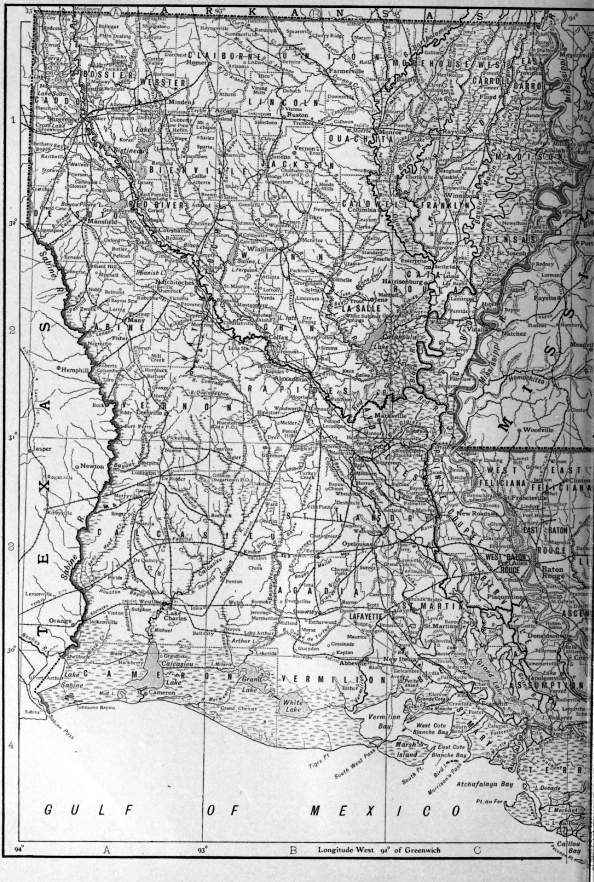
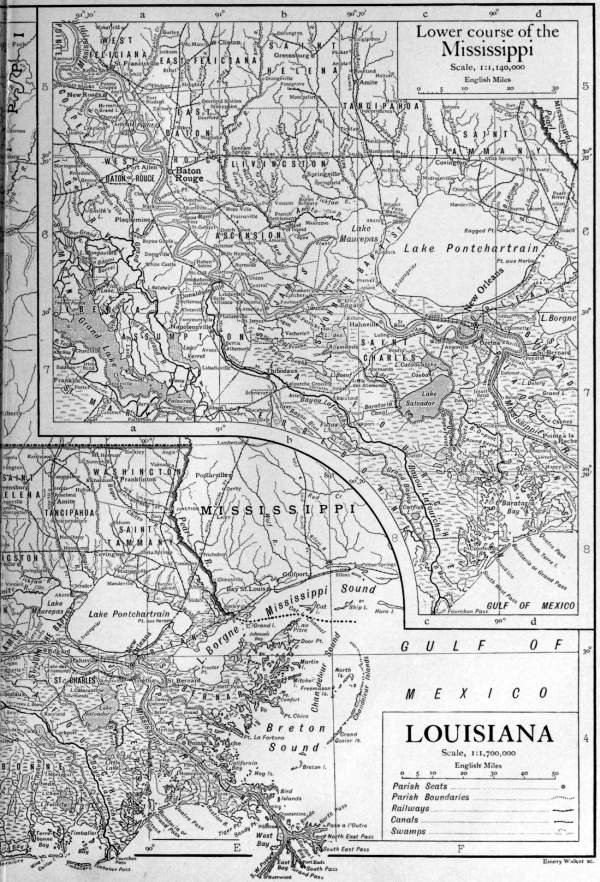
(Click to enlarge left section.)
(Click to enlarge right section.)
Fauna.—The entire state is included within the Austro-riparian life zone; the higher portions fall within the Carolinian area and the lower portions, including the Gulf and the Mississippi embayment almost to the N.E. corner of the state, constitute a special semi-tropical region. The native fauna of the state resembles in its general features that of the other Gulf states. The feral fauna was once rather varied. Black bears, wolves and deer are not yet extinct, and more rarely a “wild cat” (lynx) or “panther” (puma) is seen in the swamps. Of smaller mammals, raccoons, squirrels and opossums are very common. Every bayou contains alligators; and reptiles of various species, such as turtles, lizards, horned toads, rattlesnakes and moccasins are abundant. Shrimps, frogs (of great commercial importance), terrapin, clams and oysters are common. Only in very recent years have oysters, though plentiful, become of competitive importance in the national market; they are greatly favoured by state protective legislation. In 1904 a state oyster commission was created to supplant the independent control by the parishes. An important boundary dispute with Mississippi arose over beds lying near the state line. The state leases the beds at a low annual rental in tracts (limited for each person, firm or corporation to 1000 acres), and draws from them a considerable revenue. The avifauna is varied and abundant, comprising eagles, vultures (protected by law), hawks, owls, pelicans, cranes, turkeys, geese, “partridges” (called quail or “Bob White” elsewhere), ducks, &c., besides numerous smaller species, many of which are brilliant of plumage but harsh of voice.
Flora.—Heavy rainfall, high temperature and fertile soil combine to cover the greater part of the state, and particularly the alluvial regions and the coast swamps, with a most luxuriant subtropical vegetation, both arborescent and herbaceous. Louisiana is justly celebrated for the beauty and fragrance of its flowers. The range of temperature is not sufficient to give the variety of annual wild flowers of more northern climates; nevertheless flowers cover the bottom lands and uplands in great profusion. The upland flora is the more diversified. Flowering annuals are mainly aquatic. Water lilies, water hyacinths, which are an obstruction in many streams, and irises in rich variety give colour to the coast wastes and sombre bayous. Notable among the flora are roses, japonicas, hibiscus shrubs of various species, poinsettias, tea olives, crepe myrtle, jasmines, magnolias, camellias, oleanders, chrysanthemums, geraniums and plumbagos. The value and variety of the timber are very great. Much of the river swamp region is covered with cypress trees festooned with Spanish moss. The most common species in the alluvial regions and, to a less degree, in the drier portions of the swamps and in the stream bottoms of the prairies are various oaks, black, sweet and tupelo gum, holly, cotton-wood, poplar, magnolia sweet bay, the tulip tree, catalpa, black walnut, pecans, hickories, ash, beech and short-leaf pine. On drier and higher soils are the persimmon, sassafras, red maple, elm, black haw, hawthorn, various oaks (in all 10 species occur), hickories and splendid forests of long-leaf and loblolly yellow pine.
Forestry.—These forests are the greatest and finest of their kind remaining in the United States. In 1898 it was estimated by Henry Gannett (followed by the Federal census of 1900) that the timbered area covered 28,300 sq. m. Professor C. S. Sargent estimated in 1884 that the stand of short-leaf and long-leaf pines aggregated respectively 21,625 and 26,558 million feet. The timber product of 1900 ($17,294,444) was almost ten times that of 1880 ($1,764,640); and in 1905 the product value ($35,192,374) was more than twice that of 1900. Nevertheless, in 1900 the cypress forests remained practically untouched, only slight impression had been made upon the pine areas, and the hard-wood forests, except that they had been culled of their choicest oak, remained in their primal state (U.S. census). Between 1900 and 1905 furniture factories and planing mills became somewhat important. Pond pine occurs only near the Pearl river. Curly pine is fairly abundant. The eastern pine belt is composed of the long-leaf pine, interspersed with some loblolly. It covers an area of about 3900 sq. m. The south-western pine belt contains the heaviest growth of long-leaf pine timber in the world, covering an area of about 4200 sq. m., and occasionally interspersed with short-leaf pine. The short-leaf growth is especially heavy in the north-western portion of the state, while the long-leaf is found mainly in large masses N. and S. of the Red river around Alexandria as a centre. The cypress forests of the alluvial and overflowed lands in the S. of the state are among the largest and the most heavily timbered known. The hard-woods are found in the river bottoms throughout the state.
Agriculture and Soils.—Agriculture is the chief industry of the State. In 1900 26.2% of the land was in farms, and of this area about two-fifths was improved. The size of the average farm decreased in the two preceding decades from 171.3 to 95.4 acres. The percentage of farms operated by owners (i.e. owners, part owners, owners and tenants, and managers) fell from 64.8 to 42.1% from 1880 to 1900, and the percentage operated by cash tenants increased from 13.8 in 1880 to 24.9 in 1900, and by share tenants from 21.5 in 1880 to 33.0 in 1900; the percentage of farms operated by white farmers was 49.8 in 1900. The value of farm property, $198,536,906 in 1900, increased 79.8% in the preceding decade. The value of live stock in the latter year was $28,869,506. The total value of all farm products in 1899 was $72,667,302, of which $59,276,092 was the value of the distinctive crops—cotton, sugar and rice. The state bureau of agriculture in 1903 estimated that of the total area 14.9 millions of acres were timber land, 5.7 millions pasture and marsh, and 5.0 millions cultivated farm land.
In the N. there are many sandy districts in the uplands, also sandy clays; in the “second bottoms” of the streams fertile sandy loams; abundant tertiary marls in the north-central region; some gypsum in the cretaceous “islands”; and some fossiliferous marls with decomposed limestones. The prairies of south-western Louisiana have much yellow marl underlying them. Alluvial soil and bluff, the location of which has been indicated, are of primary agricultural importance. Reclaimed marsh-land and fresh alluvium (the so-called “front-lands” on rivers and bayous) are choice soil for Indian corn, sugar-cane, perique tobacco, semi-tropical fruits and cotton. The bluff lands are simply old alluvium now well drained and above all floods. The prairies of the S.W. are devoted almost exclusively to rice. On the hills yellow-leaf tobacco can be grown. Cereals and forage plants can be successfully grown everywhere, and varied and profitable agriculture is possible even on the “pine-barrens” or uplands of the N.; but more intelligent and more intensive farming is necessary than that practised by the average “piney-woods” farmer. The alluvial section of lower Louisiana is mostly devoted to sugar, and farther northward to Indian corn and cotton.
Cotton is the principal crop. In 1907 Louisiana ranked eighth in acreage of cotton (1,622,000 acres) among the states of the United States, and in 1907-1908 the cotton crop (675,428 bales) was eighth among the crops of the states. The average yield per acre varies from about .45 to .75 bale according to the season. In good seasons and exceptional localities the yield may approach a bale per acre, as in Assumption parish, and in the Mississippi valley at the junction of Louisiana, Mississippi and Arkansas. For many years there has been a reaction against the all-cotton farming system. In general, the small cotton farmer was at the mercy of the commission merchant, to whom he mortgaged his crops in advance; but this evil has lessened, and in some districts the system of advancing is either non-existent or very slightly developed.
In 1907-1908 all the sugar produced from cane grown in the United States came from Louisiana (335,000 long tons) and Texas (12,000 tons); in the same year cane sugar from Hawaii amounted to 420,000 tons, from Porto Rico to 217,000 tons and from the Philippines to 135,000 tons; and the total yield of beet sugar from the United States was 413,954 tons. Of all the cane grown, an amount between one-sixth and one-quarter—and that the best—must be reserved for seed every other year, and this is a great handicap to the state in competing with other cane regions and with the sugar beet. Of the total sugar consumption of the country in 1899-1904 Louisiana produced somewhat more than a fifteenth. Since about 1880 there have been central factories, and their increase has been a very prominent factor in the development of the industry, as it has been in Cuba. Though very much of the region S. of the Red river is fairly well suited to sugar-growing, it is still true that sugar cannot, over much of this area, be grown to so great advantage as other crops. Its hold upon the delta region is, however, almost unchallenged, especially since the rice farmers have found in the prairie lands that excel the delta for their purposes. Sugar is grown also in St Landry and the eastern part of Attakapas—a name formerly loosely applied to what are now St Mary, Iberia, Vermilion, St Martin and Lafayette parishes. Though introduced with success from Santo Domingo about the middle of the 18th century, the sugar industry practically dates from 1796, when Étienne Boré first succeeded in crystallizing and clarifying the syrup. Steam motive power was first introduced on the plantations in 1822. The average product of the ten seasons 1894-1904 was 299,745 tons. A state sugar experiment station is maintained at Audubon Park in New Orleans, its work embracing the development of seedlings, the improvement of cane varieties, the study of fungus diseases of the cane, the improvement of mill methods and the reconciliation of such methods (for example, the use of sulphur as a bleaching and clarifying agent) with the requirements of “pure food” laws. Good work has also been done by the Audubon sugar school of the state university, founded “for the highest scientific training in the growing of sugar cane and in the technology of sugar manufacture.”
Tobacco might be grown profitably over a large part of the state, but in reality very little is grown. The strong, black perique of the delta—cultivated very generally in the lower alluvial region before the Civil War, but now almost exclusively in St James parish—is a famous leaf, grown since early colonial times. Bright or yellow plug and smoking leaf are grown on the pine uplands and pine “flats,” and a small amount of cigar tobacco on the flats, prairies and “bluffs.” The total value of the tobacco crop of 35,000 ℔ in 1907 was only $10,000, an amount exceeded by each of the other 24 tobacco-growing states, and the crop was about one-twentieth of 1% of the product of the whole United States.
Rice farming, which had its beginning immediately after the Civil War and first became prominent in the ’seventies, has developed enormously since 1880. From 1879 to 1899 the product increased twenty-five fold. Formerly the grain was raised by preference in the river bottoms, which still yield, almost invariably, the earliest rice of the season and perhaps the finest. The “buckshot clays” of the backlands, which are so stiff that they can scarcely be ploughed until flooded and softened, and are remarkably retentive of moisture, are ideal rice soil; but none of the alluvial lands has an underlying hardpan, and they cannot as a rule be drained sufficiently to make the use of heavy harvesting machinery possible. In 1880 the prairies of the S.W. were opened to settlement by the railway. These prairies are traversed by ridges, which facilitate irrigation, and are underlaid by an impervious subsoil, which facilitates both effective storage and drainage. Thus the use of machinery became possible, and this revolutionized the entire industry. The year 1884 may be taken as the initial date of the new period, and the grain is now harvested exactly as is wheat in the west-central states. Previously the grain had ordinarily been cut with sickles and harvested by hand. The farms were also small, usually from 5 to 10 acres. They are now very much larger. All the prairies district—the centre of which is Crowley—is becoming one great rice field. Some rice also is grown on the lowlands of the Mississippi valley, notably in Plaquemines, Jefferson and Lafourche parishes. In the decade 1881-1890 Louisiana produced about half of the total yield of the country, and from 1891 to 1900 about five-sevenths. In 1904 and 1906 the Louisiana crop, about one-half of the total yield of the country, was larger than that of any other state; but in 1905 and in 1907 (6,192,955 ℔ and 7,378,000 ℔ respectively) the Louisiana crop was second in size to that of Texas. Carolina and Honduras rices were practically the only varieties until after 1896. Since that time select Japanese species, chosen for superior milling qualities, have been widely introduced, as the market prejudice in favour of head rice made the large percentage of broken rice a heavy handicap to the farmers. Hundreds of varieties have been tested by the state and federal agricultural experiment stations. A strong tendency to run to red rice (hardier, but not so marketable) has been a second great difficulty to overcome.
Irrigation is almost entirely confined to rice farms. In the prairie region there is abundant water at depths of 100 to 400 ft. beneath the surface, but this was little used for irrigation for the first few years of the development of this field, when water was pumped from the streams and canals. In 1902 nearly one-eighth of the acreage irrigated was by systems supplied from wells. The irrigated rice area increased 92.9% from 1899 to 1902, and the construction cost of irrigation works ($4,747,359 in 1902; $12.25 per irrigated acre) 87.7% in the same years. This increase was almost wholly in the prairie parishes. Of the total irrigated area for rice of 387,580 acres in 1902, 310,670 acres were in the parishes of Calcasieu, Acadia and Vermilion. In the Mississippi valley water is taken from the river by flumes in the levees or by siphons. The danger of floods and the difficulty of drainage make the extension of the practice unprofitable, and the opening of the prairies has made it unnecessary.
Many of the fruits of warm-temperate and semi-tropical lands, whether native or exotic, including oranges, olives, figs, grape-fruit, kumquats and pomegranates are cultivated. Oranges are grown especially on the coast. There are many fine groves on the Mississippi below New Orleans. The fig is a common door-yard tree as in other Gulf and South Atlantic states, and is never killed down by frost. Louisiana produced in 1899 only a fifth as great a value in sub-tropic fruits as Arizona and Texas combined. Orchard fruits are fairly varied, but, compared with other states, unimportant; and the production of small fruits is comparatively small, the largest crop being strawberries. Oranges and pears are seriously damaged by insect and fungus pests. The total value of fruit products in 1899 was $412,933. Among nuts the native pecan is exceptionally abundant, the product (637,470 ℔ in 1899) being much greater than that of any other state save Texas.
The total value of cereal products in 1899 was $14,491,796, including Indian corn valued at $10,327,723 and rice valued at $4,044,489; in 1907 it was more than $27,300,000, including Indian corn valued at $19,600,000, rice valued at $7,378,000 and oats valued at $223,000. Indian corn is grown only for home use. Dairying interests are not largely developed, and in Texas and the adjoining states the “Texas fever” and “charbon” have done great damage to cattle. Forage crops are little grown, though soil conditions are favourable. Cowpeas are a common fertilizer. Garden trucking is very slightly developed, but has been successful where it has been tried. The state maintains a crop pest commission, the duties of which include the inspection of all nursery stock sold in the state.
Manufactures.—The state’s manufacturing interests have during the last few decades grown greatly in importance. From 1890 to 1900 the capital invested, the cost of materials used and the value of output (in 1900, $121,181,683) increased respectively 225.4, 147.3 and 109.6%. The value of the factory products in 1900 was $111,397,919; in 1905 it was $186,379,592. Slightly above one-half of the product of 1900 was from New Orleans, and in 1905 about 45.4%. A constitutional amendment of 1902 exempted from parochial and municipal taxes between 1900 and 1910 practically all factories and mines in the state, employing at least five hands. Manufacturing industries are for the most part closely related to the products of the soil, about two-thirds of the value of all manufactures in 1900 and in 1905 being represented by sugar and molasses refining, lumber and timber products, cotton-seed oil and cake, and rice cleaned and polished.
Rice is milled at New Orleans, Crowley, Abbeville, Gayden, Jennings and Lake Charles. Ramie fibre and jute are available for coarse cloth; cotton weaving is almost non-existent. The lumber industry is centred chiefly in Calcasieu parish. Lake Charles, Westlake, Bogalusa, Bon Ami, Carson, Fisher, Fullerton, Leesville, Oakdale and Pickering were the leading sawmill towns of the state in 1908. Of the rarer woods particular mention may be made of curly pine, yielding a wood of beautiful figure and polish; magnolia, hard, close-grained, of fine polish and of great lasting qualities; and cypress, light, strong, easily worked and never-rotting. The timber cut of 1900 was officially stated as 1,214,387 M. ft. B.M., of which two-thirds were of yellow pine and most of the remainder of cypress. In some localities, especially in the “Florida parishes,” small quantities of rosin and turpentine are taken from the long-leaf pine, but this industry was unimportant in Louisiana before 1908. Sawdust, slabs, stumps and large quantities of logs are wasted. Other manufactures with a product value in 1905 of between $4,000,000 and $1,000,000 were: bags (not paper); foundry and machine-shop products; planing-mill products; railway cars, construction and repairs; malt liquors; men’s clothing; cooperage; food preparations; roasted and ground coffee and spice; fertilizers; cigars and cigarettes; cotton goods; and manufactured ice.
Communications.—The length of railway in the state was 1740 m. in 1890 and 4943.55 m. at the end of 1908. By the state constitution of 1898 and by amendments of 1902 and 1904 tax exemptions for ten years were granted to newly-built railroads completed before 1909. The principal roads are the Missouri Pacific (St Louis, Iron Mountain & Southern, New Orleans & North-western and St Louis, Watkins & Gulf), the Southern Pacific (Morgan’s Louisiana & Texas Railroad & Steamship Co. and the Louisiana Western), the Texas & Pacific, the Kansas City Southern, the Vicksburg, Shreveport & Pacific, the Louisiana Railway & Navigation Co., the Yazoo & Mississippi Valley, the Illinois Central, and the Louisiana & Arkansas. The Illinois Central, the first railway giving Louisiana connexion with the north, and of immense importance in the trade of New Orleans, has only about 100 m. of double track in the state. The problem of inland waterways has always been a most important one in northern, eastern and southern Louisiana, where there are systems of improved bayous, lakes and canals which, with the levees, make this region something like Holland, on a greater scale. Many bayous are convertible by improvement into excellent drainage and irrigation canals. The canal system is especially well developed in the parishes of the Mississippi delta, where, at the close of 1907, there were about 50 m. of these waterways of decided commercial importance. They serve the trade of Lake Pontchartrain and the Florida parishes, the lumber, coal, fish, oyster and truck trade of New Orleans, and to some extent are the highway of a miscellaneous coasting trade. The most important canal is probably the new Atchafalaya Bay canal (14 ft. deep), opened in 1907, connecting the Atchafalaya river and Morgan City with the Gulf of Mexico. In 1907 active preliminary work was begun on the Louisiana section of a great interstate inland waterway projected by the national government between the Mississippi and Rio Grande rivers, almost parallel to the Gulf Coast and running through the rice and truck-farm districts from the Teche to the Mermenton river (92 m.). The competition of the water lines is felt by all the railways, and the importance of water transportation is rapidly increasing. A state railroad commission, organized in 1899, has power to regulate railway, steamer, sleeping-car, express, telephone and telegraph rates within the state. Foreign commerce is almost wholly centred at New Orleans.
Population.—The population of the state increased in the ten decades from 1810 to 1910 successively by 100.4, 40.6, 63.4, 46.9, 36.7, 2.7, 29.3, 19.0, 23.5 and 19.9%. In 1910 it was 1,656,388 (36.5 per sq. m.).3 In 1900 47.1% was of negro blood, as compared with 51.5 in 1890. In 1910 there were nine cities with more than 5000 inhabitants each: New Orleans (339, 075); Shreveport (28,015); Baton Rouge (14,897), the capital; Lake Charles (11,449); Alexandria (11,213); Monroe (10,209); New Iberia (7449); Morgan (5477); Crowley (5099). The urban element is larger than in any other southern state, owing to the large population of New Orleans. The Acadians (see § History below) to-day are settled mainly in St Mary, Acadia and Vermilion parishes; lesser numbers are in Avoyelles and St Landry; and some are scattered in various other parishes. The parishes of St Mary, Iberia, Vermilion, St Martin and Lafayette are known as the Attakapas country from an Indian name. A colony of Germans sent over by John Law to the Arkansas removed to the Mississippi above New Orleans, and gave to its bank the name of the “German Coast,” by which it is still known. In recent years there has been an immigration of Italians into Louisiana, which seems likely to prove of great social and economic importance. The industrial activity of the state has required more labour than has been available. The negroes have moved more and more from the country to the towns, where they easily secure work at good wages. Owing to the inadequate supply of labour two important immigration leagues of business men were formed in 1904 and 1905, and in 1907 the state government began officially to attempt to secure desirable foreign immigration, sending agents abroad to foster it. Roman Catholics greatly predominate among religious denominations, having in 1906 477,774 members out of a total of 778,901 for all denominations; in the same year there were 185,554 Baptists, 79,464 Methodists, 9070 Protestant Episcopalians and 8350 Presbyterians.
Administration.—Since the admission of the state to the Union in 1812 there have been eight state constitutions (not counting that of 1861) admirably illustrating—and not less the Territorial government preceding them—the development of American democracy and the problems connected with the negroes. Under the Territorial government the legislative officers were not at first elective. The “parishes” date from 1807; they were based on an earlier Spanish division for religious purposes—whence the names of saints in parish nomenclature. The constitution of 1812 allowed the General Assembly to name the governor from the two candidates receiving the highest number of votes; gave the governor large powers of appointment, even of local functionaries; and required a property qualification for various offices, and even for voters. The constitution of 1845 made the popular suffrage final in the choice of the governor, abolished property qualifications, and began to pare executive powers for the benefit of the General Assembly or the people. From it dates also the constitutional recognition of the public schools. In 1852 even the judges of the supreme court were placed among the officers chosen by popular vote. The constitutions of 1864 and 1868 were of importance primarily as bearing on negro status and national politics. That of 1879 showed a profound distrust of legislative action, bred of reconstruction experiences. Nearly all special legislation was forbidden. The last constitution (1898, with 26 amendments 1898-1906), unlike all others after that of 1812, was not submitted to the people for ratification.
Under this constitution sessions of the General Assembly are biennial (meeting the second Monday in May in even-numbered years) and are limited to sixty days. The number of senators is fixed by the constitution at 39; the number of representatives is to be not more than 116 or less than 98. Any elector is eligible for election as a representative if he has been a citizen of the state for five years and a resident of the district or parish from which he is elected for two years immediately preceding the election; a change of residence from the district or parish from which he was elected vacates the seat of a representative or senator. A senator must be at least 25 years of age. Members of the legislature are elected for four years. Revenue or appropriation bills originate in the House of Representatives, but may be amended by the Senate. Contingent appropriations are forbidden, and the constitution contains a long list of subjects on which special laws may not be passed. The chief executive officers have four-year terms, neither the governor nor the treasurer being eligible for immediate re-election. The governor must be at least 30 years old and must have been a citizen of the United States and a resident of the state for 10 years next preceding his election. Within five days after the passage of any bill by the General Assembly he may veto this measure, which then becomes a law only if passed by a two-thirds vote of all members elected to each house of the General Assembly. The lieutenant governor (and then the secretary of state) succeeds to the office of governor if the governor is removed, dies or leaves the state. The five judges of the supreme court of the state are elected by the people for a term of twelve years. The supreme court is almost without exception a court of appeal with jurisdiction in cases involving at least $2000, in cases of divorce, in suits regarding adoption, legitimacy and custody of children and as regards the legality and constitutionality of taxes, fines, &c. The supreme court appoints courts of appeal to judge cases involving less than $2000. The constitution prohibits lotteries and the sale of lottery tickets.
The suffrage clauses are of particular interest, as they accomplish the practical disfranchisement of the negroes. The constitution requires that a voter must (in addition to other qualifications) either be able to show conclusively ability to read and write, or be the owner of property within the state assessed at not less than $300, on which, if personalty, all taxes are paid. But it excepts from these requirements—thus letting down the bars for illiterate whites excluded with negroes by the foregoing clauses—persons who were entitled to vote in some state on or before the 1st of January 1867 (i.e. before the adoption of the Fourteenth and Fifteenth Amendments of the United States Constitution); also the sons or grandsons of such voters, not under 21 years of age, on the 12th of May 1898; and males of foreign birth who have resided in the state for five years next preceding the date of application for registration and who were naturalized prior to 1898. The constitution provides that no person less than 60 years of age shall be permitted to vote unless he has paid an annual poll-tax of one dollar for the two years next preceding the year in which he offers to vote. Convicts not pardoned with an explicit restoration of suffrage privileges are disfranchised—a rare clause in the United States. Suffrage was by this constitution first extended to women tax-payers in questions “submitted to the tax-payers, as such.” The creation of a railroad commission was ordered and the preparation of a code of criminal law.
The Louisiana Board of Levee Commissioners was organized in 1865. The state board of health was the first one effectively organized (1855) in the United States. It encountered many difficulties, and until the definite proof of the stegomyia hypothesis of yellow-fever inoculation made by the United States army surgeons in Cuba in 1900, the greatest problem seemed insoluble. Since that time conditions of health in New Orleans have been revolutionized (in 1907 state control of maritime quarantine on the Mississippi was supplanted by that of the national government), and smaller cities and towns have been stimulated to take action by her example. Sanitary institutes are held by the state board at various towns each year for the instruction of the public. Boards of appraisers and equalization oversee the administration of the tax system; the cost of collection, owing to the fee system for payment of collectors, was higher than in any other state of the Union until 1907, when the fees were greatly reduced. The state assessment in 1901 totalled $301,215,222 and in 1907 was $508,000,000. Schools and levees absorb about half of all revenues, leaving half for the payment of interest on the state debt (bonded debt on 1st of April 1908, $11,108,300) and for expenses of government. A general primary election law for the selection, by the voters, of candidates for state office came into effect in 1906.
Law.—Louisiana has been peculiar among the states of the Union in the history of the development of its legal system. In Louisiana alone (as the state is known to-day), out of all the territory acquired from France as the Louisiana Purchase in 1803, was the civil law so established under French and Spanish rule that it persisted under American dominion. In all the other states formed from the Purchase, the civil law, never existent practically, was early expressly abrogated, and the common law of England established in its place. After O’Reilly established his power in 1769 (see History, below), the Spanish law was supreme. All the old codes of the Peninsula, as well as the laws of the Indies and special royal decrees and schedules, were in force in the colony. The United States left the task of altering the laws to the people, as far as there was no conflict between them and the Constitution of the United States and fundamental American legal customs. Copies of the Spanish codes were very rare, and some of them could not be had in the colonies. Discussions of the Roman Institute and Pandects were common in the deliberations of the courts. Great confusion prevailed in the first years of American dominion owing to the diversities of languages and the grafting of such Anglo-Saxon institutions as the jury upon the older system. A provisional code of judicial procedure, prepared by Edward Livingston, was in effect in 1805 to 1825. The earliest digest, completed in 1808, was mainly a compilation of Spanish laws. The project of the Code Napoléon, however—the code itself not being available in Louisiana, though promulgated in France in 1804—was used by the compilers in the arrangement and substance of their work; and the French traditions of the colony, thus illustrated, were naturally introduced more and more into the organic commentaries and developments that grew up around the Code Napoléon. This evolution was little marked, so similar in large parts were the systems of France and Spain (although in other parts, due to the Gothic element in the Spanish, they were very different)—a similarity which explains the facility with which O’Reilly and his successors introduced the Spanish laws after 1769. The Louisiana code of 1808 was not, however, exhaustive; and the courts continued to go back to the old Spanish sources whenever the digest was inconclusive. Thus so late as 1819, when the legislature ordered the compilation of such parts of King Alfonso’s Siete Partidas (the most common authority in the colony) as were considered in force, this compilation filled a considerable volume. In 1821 the legislature authorized Livingston to prepare the “Livingston Code” of criminal law and procedure, completed in 1824 (in French and English) and published in 1833, but never adopted by the state. In 1825 legislative sanction was given to the greater part of a civil code prepared by a commission (including Livingston) appointed in 1821, and the French element became steadily more important. In its present form the law shows plainly the Latin and English elements. English law has largely moulded, for example, criminal and commercial law and the law of evidence; the development of the law of corporations, damages, prohibitions and such extraordinary remedies as the mandamus has been very similar to that in other states; while in the fusion of law and equity, and the law of successions, family relations, &c., the civil law of Spain and France has been unaffected.
Education.—Schooling was very scant before the creation of the public schools in 1854. Very little was done for education in the French and Spanish period, although the Spanish governors made commendable efforts in this regard; the first American Territorial legislature began the incorporation of feeble “colleges” and “academies.” To some of these the state gave financial aid ($1,613,898) before 1845. The public schools were flourishing at the outbreak of the Civil War. War and reconstruction threw upon them the new burden of the black children. The constitution of 1879 was illiberal in this respect, but a healthier public opinion soon prevailed. The money given by the state to the public schools is distributed among the parishes according to their school population, and the constitution of 1898 set a generous minimum to such aid. An annual poll-tax is also collected for the schools from every adult male. Local taxes, besides, are imposed, and these are becoming heavier. The parishes retain primary control of the schools. Institutes, summer schools and rural libraries have been introduced. The salaries of white teachers advanced from a monthly average of $38.87 in 1903 to $61.84 in 1906. The average attendance of enrolled black and white pupils is practically identical, but the enrolment of whites (about 52% in 1902) is somewhat higher and that of the blacks about a third lower than their ratio in the population. The school term for white children is much longer than for negroes, and white teachers are paid much better salaries—in 1906 the average monthly salary of a negro teacher was $29.15. The total enrolment is very low. But progress is now being made very rapidly in the improvement of the educational system. Higher schools include: the State University and Agricultural and Mechanical College (1860) at Baton Rouge (q.v.); Tulane University of Louisiana (1864) in New Orleans; Jefferson College (1864; Roman Catholic) at Convent; the College of the Immaculate Conception (1847; Roman Catholic) in New Orleans; St Charles College (1835; Roman Catholic) at Grand Couteau; St Joseph’s College (1849; Roman Catholic) at Baton Rouge; the following colleges for women—Silliman Collegiate Institute (1852; Presbyterian) at Clinton, Mansfield Female College (1854; Methodist Episcopal, South) at Mansfield, the H. Sophie Newcomb Memorial College for women (a part of Tulane University) in New Orleans and the Louisiana Female College (1856; Baptist) at Keatchie; the State Normal School of Louisiana (1884) at Natchitoches and the New Orleans Normal and Training School; the South-western Louisiana Industrial Institute at Lafayette; the Louisiana Industrial Institute at Ruston; and, among schools for negroes, the Peabody State Normal and Industrial School at Alexandria and New Orleans University (1873; Methodist Episcopal), Luther College (Evangelical Lutheran), Leland University (1870; Baptist), Straight University (Congregational) and Southern University (1883; aided by the state), all in New Orleans.
Charitable and Penal Institutions.—The State Board of Charities and Correction, for which the constitution of 1898 first made provision, and which was organized under an act of 1904, is composed of six members, appointed by the governor for six years, with the governor as ex-officio chairman. The members of the board serve gratuitously, but elect a salaried secretary. The board has no administrative or executive power, but makes annual inspections of all public charitable, correctional or reformatory institutions, all private institutions which receive aid from, or are used by municipal or parochial authorities, and all private asylums for the insane; and reports annually to the governor on the actual condition of the institutions. Any suggestions as to improvements in institutions must be approved by the majority of the governing body of that institution before they may be put into effect. The charitable institutions include two charity hospitals—at New Orleans (1832) and Shreveport; an Eye, Ear, Nose and Throat Hospital, a Hôtel Dieu, the Touro Infirmary and a Home for Incurables, all at New Orleans; an Institute for the Deaf and Dumb (for whites—there is no state provision for negro deaf and dumb) and an Institute for the Blind, both at Baton Rouge; an Insane Hospital at Jackson and another at Pineville; and the Louisiana Retreat for the Insane at New Orleans. At Monroe there is a State Reform School, and at New Orleans a Coloured Industrial Home and School. There is also a state home for disabled Confederate soldiers at New Orleans on Bayou St John. The State Penitentiary is at Baton Rouge, and a House of Detention at New Orleans; and there are parish prisons. State convicts, and all places in which they are confined or employed, are under the supervision of a Board of Control appointed by the governor. This board may allow commutation or diminution of sentence for good behaviour, meritorious services or exemplary conduct. The leasing or hiring of state convicts is prohibited by the constitution, but parish convicts may be hired or leased for farm and factory work, work on roads and levees, and other public undertakings. Such convicts are classified according to physical ability and a minimum rate is fixed for their hire, for not more than ten hours a day. Many state convicts are employed in levee construction, and there are convict farms at Angola, Hope, Oakley and Monticello.
History.—The early history of Louisiana belongs to the romance of American history. It is possible that the mouth of the Mississippi was discovered in 1519 by Alonso Alvarez de Piñeda, but this interpretation of his vague manuscript remains conjectural; and that it was discovered by the expedition of Panfilo de Narvaez cannot be established. That Hernando de Soto entered the borders of the present state of Louisiana, and that his burial place in the Mississippi was where that river takes the waters of the Red, are probable enough, but incapable of conclusive proof. Survivors of de Soto’s expedition, however, descended the Mississippi to its mouth in 1542. Spain set up no claim to the region, and when Robert Cavalier, Sieur de la Salle, came down the river in 1682 from the French possessions to the north, he took possession in the name of France, which hereby gained her first title to the vast drainage basin of the Mississippi. In honour of Louis XIV. the new possession was named “Louisiana”—a name then and until 1812 applied to a much larger area than that of the present state. La Salle attempted to settle a colony in 1684, but missed the Mississippi’s mouth and landed in Texas, where he was murdered in 1687 by some of his followers. In 1697, after Ryswick, Pierre le Moyne d’Iberville (1662-1706) was chosen to lead another colony, which reached the Gulf coast early in 1699. Soon after Iberville had built Fort Maurepas (near the present city of Biloxi, Mississippi) in 1699, a fort was erected on the Mississippi river about 40 m. above the mouth.
This was the earliest settlement in what is now the state of Louisiana. It was unhealthy and unprosperous. From 1712 to 1717 “Louisiana,” or the French possessions of the Mississippi valley, was held by Antoine Crozat (1655-1738) as a private grant from the king. It proved as great a drain upon his purse as it had proved to the crown, and he willingly parted with it to the so-called “Western Company,” afterwards incorporated with the great Company of the Indies. The head of this company was John Law, who, after spreading glowing accounts of the new land, launched his famous “Mississippi scheme” (see Law, John). The company accomplished much for the colony of Louisiana. Jean Baptiste le Moyne, Sieur de Bienville (1680-1768), a brother of Iberville, was sent out as governor. For forty years he was the life of the colony. One of his first acts was to found the city of New Orleans on its present site in 1718. In this same year seven vessels were sent from France with stores and immigrants; eleven followed during the next year. Five hundred negroes from the Guinea coast were imported in 1719, and many hundreds more soon followed. The Law company eventually came to an end fatal to its creditors in France, but its misfortunes did not check the prosperity of “Louisiana.” The company retained its grant of the colony until 1731, when it reverted to the crown. Meantime New Orleans had become the seat of government in 1722. In 1766 an official census showed a total population of 5552. The years of royal rule were uneventful. Cotton culture began in 1740, and sugar-cane was successfully introduced from Santo Domingo by the Jesuits in 1751. Tafia rum and a waxy, sticky sugar syrup subsequently became important products; but not until the end of the century were the means found to crystallize sugar and so give real prosperity to the industry.
By a secret treaty of the 3rd of November 1762, “Louisiana” was transferred from France to Spain. This treaty was not made public for a year and a half, and Spain did not take full possession of the colony until 1769. By a treaty between Spain and France on the one hand and Great Britain and Portugal on the other, signed at Paris in February 1763, all that portion lying E. of the Mississippi river, the Iberville river, and Lakes Maurepas and Pontchartrain was ceded to Great Britain. The international interests thus created, and others that sprang from them, heavily burdened the diplomacy, and even threatened the safety of the United States after they were placed in possession of the eastern bank of the Mississippi down to 31° in 1783.
The news of the cession of the colony to Spain roused strong discontent among the colonists. Antonio de Ulloa (1716-1795), a distinguished Spanish naval officer and scholar, came to New Orleans in 1766 to take possession for his king. Merchants, people, and many civil officers held toward him from the beginning a hostile attitude; the military, especially, refused to pass into the Spanish service as stipulated in the treaty; and Ulloa was compelled to continue in an ambiguous and anomalous position—which his lack of military force probably first compelled him to assume—ruling the colony through the French governor, Philippe Aubry (who loyally supported him throughout), without publicly exhibiting his powers. The fear of Spanish commercial laws powerfully stimulated resistance to the transfer, and though Ulloa made commercial and monetary concessions, they were not sufficient. When the colonists found protests at Paris unavailing, they turned to the idea of independence, but sought in vain the armed support of the British at Pensacola. Nevertheless they compelled Ulloa to leave the colony or exhibit his credentials. He took his leave in November 1768. The open resistance by the colonists (October 1768) was a carefully planned revolt. There is no doubt that the men who led the Creole opposition contemplated independence, and this gives the incident peculiar interest. In the summer of 1769 Alejandro O’Reilly came to New Orleans with a strong military force (3600 troops). Beginning his rule with an affability that allayed suspicions and securing from Aubry proofs against the popular leaders, he invited them to a reception and arrested them while they were his guests. Five were put to death and others were imprisoned at Havana. O’Reilly put down the rebellion with determination and in accord with the instructions of his king. Regarded without republican sympathies, and in the light of 18th-century doctrines of allegiance, his acts, however severe, in no way deserve the stigma of cruelty ordinarily put upon them. He was liberal and enlightened in his general rule.
Among the incidents of these troubled years was the arrival in Louisiana (after 1765) of some hundreds of French exiles from Acadia, who made their homes in the Attakapas country. There their descendants live to-day, still somewhat primitively, and still in somewhat of the glamour thrown over land and people by the Evangeline of Longfellow.
On the 18th of August 1769 Louisiana was formally transferred to Spain. Spanish law and Spanish tongue replaced the French officially, but the colony remained essentially French. The Spanish rulers made efforts to govern wisely and liberally, showing great complaisance, particularly in heeding the profit of the colony, even at the expense of Spanish colonial commercial regulations. The judicial system was much improved, a better grade of officials became the rule, many French Creoles were appointed to office, intermarriages of French and Spanish and even English were encouraged by the highest officials, and in general a liberal and conciliatory policy was followed, which made Louisiana under Spanish rule quiet and prosperous. Bernardo de Galvez (1756-1794), a brilliant young officer of twenty-one, when he became the governor of the colony, was one of the most liberal of the Spanish rulers and of all the most popular. During the American War of Independence he gave valuable aid to the United States; and when Spain finally joined in the war against Great Britain, Galvez, in a series of energetic and brilliant campaigns (1779-1781), captured all the important posts in the British colony of West Florida. The chief interest of the Spanish period lies in the advance of settlement in the western territories of the United States, the international intrigues—British, French and Spanish—involving the future of the valley, the demand of the United States for free navigation on the Mississippi, and the growing consciousness of the supreme importance of the river and New Orleans to the Union. With the Spanish governor Estevan Miro, who succeeded Galvez in 1785, James Wilkinson of Kentucky, arrested at New Orleans with a flat-boat of supplies in 1787, intrigued, promising him that Kentucky would secede from the United States and would join the Spanish; but Wilkinson was unsuccessful in his efforts to carry out this plan. In 1794 Spain, hard pressed by Great Britain and France, turned to the United States, and by the treaty of 1794 the Mississippi river was recognized by Spain as the western boundary of the United States, separating it from Louisiana, and free navigation of the Mississippi was granted to citizens of the United States, to whom was granted for three years the right “to deposit their merchandise and effects in the port of New Orleans, and to export them from thence without paying any other duty than a fair price for the hire of the stores.” At the expiration of the three years the Spanish governor refused the use of New Orleans as a place of deposit, and contrary to the treaty named no other port in its place. Spanish rule, however, came unexpectedly to an end by the retrocession of Louisiana to France in 1800; and French dominion gave way in turn in 1803—as the result of a chain of events even more unexpected, startling, and for the United States fortunate—to the rule of the last-named country. On the 30th of November 1803 the representatives of the French republic received formal possession from the Spanish governor, and on the 20th of December lower Louisiana was transferred to the United States. (See Louisiana Purchase.)