VOLUME XVI SLICE VIII Logarithm to Lord Advocate (continued 5)
Reading edition
Kant’s theory of knowledge, then, needed to be pressed to other consequences for logic which were more consonant with the spirit of the Critique. The forms of thought and what gives thought its particular content in concrete acts of thinking could not be regarded as subsisting in a purely external and indifferent relation one to the other. “Laws according to which the subject thinks” and “laws according to which the object is known” cannot be the concern of separate departments of inquiry. As soon divorce the investigation of the shape and material of a mirror from the laws of the incidence of the rays that form images in it, and call it a science of reflection! An important group of writers developed the conception of an adaptation between the two sides of Kant’s antithesis, and made the endeavour to establish some kind of correlation between logical forms and the process of “the given.” There was a tendency to fall back upon the conception of some kind of parallelism, whether it was taken to be interpretative or rather corrective of Kant’s meaning. This device was never remote from the constructions of writers for whom the teaching of Spinoza and Leibnitz was an integral part of their intellectual equipment. Other modes of correlation, however, find favour also, and in some variety. Kant is seldom the sole source of inspiration. His unresolved antithesis131 is interpreted either diversely or with a difference of emphasis. And the light that later writers bring to bear on Kant’s logic and epistemology from other sides of his speculation varies in kind and in degree.
Another logical movement springs from those whom a correlation of fact within the unity of a system altogether failed to satisfy. There must also be development of the correlated terms from a single principle. Form and content must not only correspond one to the other. They must be exhibited as distinguishable moments within a unity which can at one and the same time be seen to be the ground from which the distinction springs and the ground in virtue of which it is over-ruled. Along this line of speculation we have a logic which claims that whatsoever is in one plane or at one stage in the development of thought a residuum that apparently defies analysis must at another stage and on a higher plane be shown so to be absorbed as to fall altogether within thought. This is the view of Hegel upon which logic comes to coincide with the progressive self-unfolding of thought in that type of metaphysic which is known as absolute, i.e. all-inclusive idealism. The exponent of logic as metaphysic, for whom the rational is the real is necessarily in revolt against all that is characteristically Kantian in the theory of knowledge, against the transcendental method itself and against the doctrine of limits which constitutes the nerve of “criticism.” Stress was to be laid upon the constructive character of the act of thought which Kant had recognized, and without Kant’s qualifications of it. In all else the claim is made to have left the Kantian teaching behind as a cancelled level of speculation.
Transcendental method is indeed not invulnerable. A principle is transcendentally “deduced” when it and only it can explain the validity of some phase of experience, some order of truths. The order of truths, the phase of experience Limitation of Transcendental Method. and its certainty had to be taken for granted. The sense, for example, in which the irreversibility of sequence which is the more known in ordine ad hominem in the case of the causal principle differs from merely psychological conviction is not made fully clear. Even so the inference to the a priori ground of its necessity is, it has been often pointed out, subject to the limitation inherent in any process of reduction, in any regress, that is, from conditionate to condition, viz. that in theory an alternative is still possible. The inferred principle may hold the field as explanation without obvious competitor potential or actual. Nevertheless its claim to be the sole possible explanation can in nowise be validated. It has been established after all by dialectic in the Aristotelian sense of the word. But if transcendental method has no special pride of place, Kant’s conclusion as to the limits of the competence of intellectual faculty falls with it. Cognition manifestly needs the help of Reason even in its theoretical use. Its speculation can no longer be stigmatized as vaticination in vacuo, nor its results as illusory.
Finally, to logic as metaphysic the polar antithesis is psychology as logic. The turn of this also was to come again. If logic were treated as merely formal, the stress of the problem of knowledge fell upon the determination of the Logic and Psychology. processes of the psychological mechanism. If alleged a priori constituents of knowledge—such rubrics as substance, property, relation—come to be explained psychologically, the formal logic that has perforce to ignore all that belongs to psychology is confined within too narrow a range to be able to maintain its place as an independent discipline, and tends to be merged in psychology. This tendency is to be seen in the activity of Fries and Herbart and Beneke, and was actualized as the aftermath of their speculation. It is no accident that it was the psychology of apperception and the voluntaryist theory or practice of Herbart, whose logical theory was so closely allied to that of the formal logicians proper, that contributed most to the development of the post-Kantian psychological logic. Another movement helped also; the exponents of naturalistic evolution were prepared with Spencer to explain the so-called a priori in knowledge as in truth a posteriori, if not to the individual at any rate to the race. It is of course a newer type of psychological logic that is in question, one that is aware of Kant’s “answer to Hume.” Stuart Mill, despite of his relation of antagonism to Hamilton and Mansel, who held themselves to be Kantian in spirit, is still wholly pre-Kantian in his outlook.
Kant’s influence, then, upon subsequent logic is least of all to be measured by his achievement in his professed contribution to technical logic. It may be attributed in some slight degree, perhaps, to incidental flashes of logical Summary. insight where his thought is least of what he himself calls logic, e.g. his exposition of the significance of synthetic judgments a priori, or his explanation of the function of imagery in relation to thought, whereby he offers a solution of the problem of the conditions under which one member of a group unified through a concept can be taken to stand for the rest, or again the way in which he puts his finger on the vital issue in regard to the alleged proof from essence to existence, and illustrations could be multiplied. But much more it belongs to his transformation of the epistemological problem, and to the suggestiveness of his philosophy as a whole for an advance in the direction of a speculative construction which should be able to cancel all Kant’s surds, and in particular vindicate a “ground of the unity of the supersensible which lies back of nature with that which the concept of freedom implies in the sphere of practice,”132 which is what Kant finally asserts.
iv. After Kant.
Starting from the obvious antithesis of thought and that of which it is the thought, it is possible to view the ultimate relation of its term as that of mutual indifference or, secondly, as that of a correspondence such that while they retain their distinct character modification of the one implies modification of the other, or thirdly and lastly, as that of a mergence of one in the other of such a nature that the merged term, whichever it be, is fully accounted for in a complete theory of that in which it is merged.
The first way is that of the purely formal logicians, of whom Twesten133 and in England H. L. Mansel may be regarded as typical. They take thought and “the given” as self-contained units which, if not in fact separable, are The Formal Logicians. at any rate susceptible of an abstraction the one from the other so decisive as to constitute an ideal separation. The laws of the pure activity of thought must be independently determined, and since the contribution of thought to knowledge is form they must be formal only. They cannot go beyond the limits of formal consistency or analytic correctness. They are confined to the determination of what the truth of any matter of thought, taken for granted upon grounds psychological or other, which are extraneous to logic, includes or excludes. The unit for logic is the concept taken for granted. The function of logic is to exhibit its formal implications and repulsions. It is questionable whether even this modest task could be really achieved without other reference to the content abstracted from than Mansel, for example, allows. The analogy of the resolution of a chemical compound with its elements which is often on the lips of those who would justify the independence of thought and the real world, with an agnostic conclusion as to non-phenomenal or trans-subjective reality, is not really applicable. The oxygen and hydrogen, for example, into which water may be resolved are not in strictness indifferent one to the other, since both are members of an order regulated according to laws of combination in definite ratios. Or, if applicable, it is double-edged. Suppose oxygen to be found only in water. Were it to become conscious, would it therefore follow that it could infer the laws of a separate or independent activity of its own? Similarly forms of thinking, the law of contradiction not excepted, have their meaning only in reference to determinate content, even though distributively all determinate contents are dispensable. The extreme formalist is guilty of a fallacy of composition in regard to abstraction.
It does not follow, however, that the laws asserted by the formal logicians are invalid or unimportant. There is a permissible abstraction, and in general they practise this, and although they narrow its range unduly, it is legitimately to be applied to certain characters of thinking. As the living organism includes something of mechanism—the skeleton, for example—so an organic logic doubtless includes determinations of formal consistency. The skeleton is meaningless apart from reference to its function in the life of an organism, yet there are laws of skeleton structure which can be studied with most advantage if other characters of the organism are relegated to the background. To allow, however, that abstraction admits of degrees, and that it never obliterates all reference to that from which it is abstracted, is to take a step forward in the direction of the correlation of logical forms with the concrete processes of actual thinking. What was true in formal logic tended to be absorbed in the correlationist theories.
Those formal logicians of the Kantian school, then, may be summarily dismissed, though their undertaking was a necessary one, who failed to raise the epistemological issue at all, or who, raising it, acquiesced in a naïve dualism agnostic of the real world as Kant’s essential lesson. They failed to develop any view which could serve either in fact or in theory as a corrective to the effect of their formalism. What they said with justice was said as well or better elsewhere.
Among them it is on the whole impossible not to include the names of Hamilton and Mansel. The former, while his erudition in respect to the history of philosophical opinion has rarely been equalled, was not a clear thinker. His general theory of knowledge deriving from Kant and Reid, and including among other things a contaminatio of their theories of perception,134 in no way sustains or mitigates his narrow view of logic. He makes no effective use of his general formula that to think is to condition. He appeals to the direct testimony of consciousness in the sense in which the appeal involves a fallacy. He accepts an ultimate antinomy as to the finiteness or infinity of “the unconditioned,” yet applies the law of the excluded middle to insist that one of the two alternatives must be true, wherefore we must make the choice. And what is to be said of the judgment of a writer who considers the relativity of thought demonstrated by the fact that every judgment unites two members? Hamilton’s significance for the history of logic lies in the stimulus that he gave to the development of symbolic logic in England by his new analytic based upon his discovery or adoption of the principle of the quantification of the predicate. Mansel, too, was learned, specially in matters of Aristotelian exegesis, and much that is of value lies buried in his commentation of the dry bones of the Artis Logicae Rudimenta of Locke’s contemporary Aldrich. And he was a clearer thinker than Hamilton. Formal logic of the extremest rigour is nowhere to be found more adequately expressed in all its strength, and it must be added in all its weakness, than in the writings of Mansel. But if the view maintained above that formal logic must compromise or mitigate its rigour and so fail to maintain its independence, be correct, the logical consistency of Mansel’s logic of consistency does but emphasize its barrenness. It contains no germ for further development. It is the end of a movement.
The brief logic of Herbart135 is altogether formal too. Logical forms have for him neither psychological nor metaphysical reference, we are concerned in logic solely with the systematic clarification of concepts which are wholly abstract, so that Herbart. they are not merely not ultimate realities, but also in no sense actual moments of our concrete thinking. The first task of logic is to distinguish and group such concepts according to their marks, and from their classification there naturally follows their connexion in judgment. It is in the logic of judgment that Herbart inaugurates a new era. He is not, of course, the first to note that even categorical judgments do not assert the realization of their subject. That is a thought which lies very near the surface for formal logic. He had been preceded too by Maimon in the attempt at a reduction of the traditional types of judgment. He was, however, the first whose analysis was sufficiently convincing to exorcise the tyranny of grammatical forms. The categorical and disjunctive judgment reduce to the hypothetical. By means of the doctrine of the quantification of the predicate, in which with his Leibnitzian conception of identity he anticipated Beneke and Hamilton alike, universal and particular judgments are made to pull together. Modal, impersonal, existential judgments are all accounted for. Only the distinction of affirmative and negative judgments remains unresolved, and the exception is a natural one from the point of view of a philosophy of pluralism. There was little left to be done here save in the way of an inevitable mutatis mutandis, even by Lotze and F. H. Bradley. From the judgment viewed as hypothetical we pass by affirmation of the antecedent or denial of the consequent to inference. This point of departure is noteworthy, as also is the treatment of the inductive syllogism as one in which the middle term is resoluble into a group or series (Reihe). In indicating specifically, too, the case of conclusion from a copulative major premise with a disjunctive minor, Herbart seems to have suggested the cue for Sigwart’s exposition of Bacon’s method of exclusions.
That it was the formal character of Herbart’s logic which was ultimately fatal to its acceptance outside the school as an independent discipline is not to be doubted. It stands, however, on a different footing from that of the formal logic hitherto discussed, and is not to be condemned upon quite the same grounds. In the first place, Herbart is quite aware of the nature of abstraction. In the second, there is no claim that thought at one and the same time imposes form on “the given” and is susceptible of treatment in isolation by logic. With Herbart the forms of common experience, and indeed all that we can regard as his categories, are products of the psychological mechanism and destitute of logical import. And lastly, Herbart’s logic conforms to the exigencies of his system as a whole and the principle of the bare or absolute self-identity of the ultimate “reals” in particular. It is for this reason that it finally lacks real affinity to the “pure logic” of Fries. For at the basis of Herbart’s speculation there lies a conception of identity foreign to the thought of Kant with his stress on synthesis, in his thoroughgoing metaphysical use of which Herbart goes back not merely to Wolff but to Leibnitz. It is no mere coincidence that his treatment of all forms of continuance and even his positive metaphysic of “reals” show affinity to Leibnitz. It was in the pressing to its extreme consequences of the conception of uncompromising identity which is to be found in Leibnitz, that the contradictions took their rise which Herbart aimed at solving, by the method of relations and his doctrine of the ultimate plurality of “reals.” The logic of relations between conceptual units, themselves unaltered by the relation, seems a kind of reflection of his metaphysical method. To those, of course, for whom the only real identity is identity in difference, while identity without difference, like difference without identity, is simply a limit or a vanishing point, Herbart’s logic and metaphysic will alike lack plausibility.
The setting of Herbart’s logic in his thought as a whole might of itself perhaps justify separate treatment. His far-reaching influence in the development of later logic must certainly do so. Directly he affected a school of thought which contained one logician of first-rate importance in Moritz Wilhelm Drobisch (1802-1896), professor at Leipzig. In less direct relation stands Lotze, who, although under other influences he developed a different view even in logic, certainly let no point in the doctrine of his great predecessor at Göttingen escape him. A Herbartian strain is to be met with also in the thought of writers much further afield, for example F. H. Bradley, far though his metaphysic is removed from Herbart’s. Herbart’s influence is surely to be found too in the evolution of what is called Gegenstandstheorie. Nor did he affect the logic of his successors through his logic alone. Reference has been made above to the effect upon the rise of the later psychological logic produced by Herbart’s psychology of apperception, when disengaged from the background of his metaphysic taken in conjunction with his treatment in his practical philosophy of the judgment of value or what he calls the aesthetic judgment. Emerson’s verdict upon a greater thinker—that his was “not a mind to nestle in”—may be true of Herbart, but there can be no doubt as to the stimulating force of this master.
The second way of interpreting the antithesis of thought to what is thought of, was taken by a group of thinkers among whom a central and inspiring figure was Schleiermacher. They in no sense constitute a school and manifest Logic as the rationale of knowledge. radical differences among themselves. They are agreed, however, in the rejection, on the one hand, of the subjectivist logic with its intrinsic implication that knowledge veils rather than reveals the real world, and, on the other hand, of the logic of the speculative construction with its pretension to “deduce,” to determine, and finally at once to cancel and conserve any antithesis in its all-embracing dialectic. They agree, then, in a maintenance of the critical point of view, while all alike recognize the necessity of bringing the thought-function in knowledge into more intimate relation with its “other” than Kant had done, by means of some formula of correlation or parallelism. Such an advance might have taken its cue directly from Kant himself. As an historical fact it tended rather to formulate itself as a reaction towards Kant in view of the course taken by the speculative movement. Thus Schleiermacher’s posthumously published Dialektik (1839) may be characterized as an appeal from the absolutist element in Schelling’s philosophy to the conception of that correlation or parallelism which Schelling had exhibited as flowing from and subsisting within his absolute, and therein as a return upon Schleiermacher. Kant’s doctrine of limits. Schleiermacher’s conception of dialectic is to the effect that it is concerned with the principles of the art of philosophizing, as these are susceptible of a relatively independent treatment by a permissible abstraction. Pure thinking or philosophizing is with a view to philosophy or knowledge as an interconnected system of all sciences or departmental forms of knowledge, the mark of knowledge being its identity for all thinking minds. Dialectic then investigates the nexus which must be held to obtain between all thoughts, but also that agreement with the nexus in being which is the condition of the validity of the thought-nexus. In knowing there are two functions involved, the “organic” or animal function of sensuous experience in virtue of which we are in touch with being, directly in inner perception, mediately in outer experience, and the “intellectual” function of construction. Either is indispensable, though in different departments of knowledge the predominant rôle falls to one or other, e.g. we are more dependent in physics, less so in ethics. The idea of a perfect harmony of thinking and being is a presupposition that underlies all knowing but cannot itself be realized in knowledge. In terms of the agreement of thought and being, the logical forms of the part of dialectic correspondent to knowledge statically considered have parallels and analogies in being, the concept being correlated to substance, the judgment to causal nexus. Inference, curiously enough, falls under the technical side of dialectic concerned with knowledge in process or becoming, a line of cleavage which Ueberweg has rightly characterized as constituting a rift within Schleiermacher’s parallelism.
Schleiermacher’s formula obviously ascribes a function in knowledge to thought as such, and describes in a suggestive manner a duality of the intellectual and organic functions, resting on a parallelism of thought and being whose collapse into identity it is beyond human capacity to grasp. It is rather, however, a statement of a way in which the relations of the terms of the problem may be conceived than a system of necessity. It may indeed be permitted to doubt whether its influence upon subsequent theory would have been a great one apart from the spiritual force of Schleiermacher’s personality. Some sort of correlationist conception, however, was an inevitable development, and the list136 of those who accepted it in something of the spirit of Schleiermacher is a long one and contains many distinguished names, notably those of Trendelenburg and Ueberweg. The group is loosely constituted however. There was scope for diversity of view and there was diversity of view, according as the vital issue of the formula was held to lie in the relation of intellectual function to organic function or in the not quite equivalent relation of thinking to being. Moreover, few of the writers who, whatsoever it was that they baptized with the name of logic, were at least earnestly engaged in an endeavour to solve the problem of knowledge within a circle of ideas which was on the whole Kantian, were under the dominance of a single inspiration. Beneke’s philosophy is a striking instance of this, with application to Fries and affinity to Herbart conjoined with obligations to Schelling both directly and through Schleiermacher. Lotze again wove together many threads of earlier thought, though the web was assuredly his own. Finally it must not be forgotten that the host of writers who were in reaction against Hegelianism tended to take refuge in some formula of correlation, as a half-way house between that and formalism or psychologism or both, without reference to, and often perhaps without consciousness of, the way in which historically it had taken shape to meet the problem held to have been left unresolved by Kant.
Lotze on the one hand held the Hegelian “deduction” to be untenable, and classed himself with those who in his own phrase “passed to the order of the day,” while on the other hand he definitely raised the question, how an “object” Lotze. could be brought into forms to which it was not in some sense adapted. Accordingly, though he regards logic as formal, its forms come into relation to objectivity in some sort even within the logical field itself, while when taken in the setting of his system as a whole, its formal character is not of a kind that ultimately excludes psychological and metaphysical reference, at least speculatively. As a logician Lotze stands among the masters. His flair for the essentials in his problem, his subtlety of analysis, his patient willingness to return upon a difficulty from a fresh and still a fresh point of view, and finally his fineness of judgment, make his logic137 so essentially logic of the present, and of its kind not soon to be superseded, that nothing more than an indication of the historical significance of some of its characteristic features need be attempted here.
In Lotze’s pure logic it is the Herbartian element that tends to be disconcerting. Logic is formal. Its unit, the logical concept, is a manipulated product and the process of manipulation may be called abstraction. Processes of the psychological mechanism lie below it. The paradox of the theory of judgment is due to the ideal of identity, and the way in which this is evaded by supplementation to produce a non-judgmental identity, followed by translation of the introduced accessories with conditions in the hypothetical judgment, is thoroughly in Herbart’s manner. The reduction of judgments is on lines already familiar. Syllogism is no instrumental method by which we compose our knowledge, but an ideal to the form of which it should be brought. It is, as it were, a schedule to be filled in, and is connected with the disjunctive judgment as a schematic setting forth of alternatives, not with the hypothetical, and ultimately the apodictic judgment with their suggestion that it is the real movement of thought that is subjected to analysis. Yet the resultant impression left by the whole treatment is not Herbartian. The concept is accounted for in Kantian terms. There is no discontinuity between the pre-logical or sub-logical conversion of impressions into “first universals” and the formation of the logical concept. Abstraction proves to be synthesis with compensatory universal marks in the place of the particular marks abstracted from. Synthesis as the work of thought always supplies, beside the mere conjunction or disjunction of ideas, a ground of their coherence or non-coherence. It is evident that thought, even as dealt with in pure logic, has an objectifying function. Its universals have objective validity, though this does not involve direct real reference. The formal conception of pure logic, then, is modified by Lotze in such a way as not only to be compatible with a view of the structural and functional adequacy of thought to that which at every point at which we take thinking is still distinguishable from thought, but even inevitably to suggest it. That the unit for logic is the concept and not the judgment has proved a stumbling-block to those of Lotze’s critics who are accustomed to think in terms of the act of thought as unit. Lotze’s procedure is, indeed, analogous to the way in which, in his philosophy of nature, he starts from a plurality of real beings, but by means of a reductive movement, an application of Kant’s transcendental method, arrives at the postulate or fact of a law of their reciprocal action which calls for a monistic and idealist interpretation. He starts, that is in logic, with conceptual units apparently self-contained and admitting of nothing but external relation, but proceeds to justify the intrinsic relation between the matter of his units by an appeal to the fact of the coherence of all contents of thought. Indeed, if thought admits irreducible units, what can unite? Yet he is left committed to his puzzle as to a reduction of judgment to identity, which partially vitiates his treatment of the theory of judgment. The outstanding feature of this is, nevertheless, not affected, viz. the attempt that he makes, inspired clearly by Hegel, “to develop the various forms of judgment systematically as members of a series of operations, each of which leaves a part of its problem unmastered and thereby gives rise to the next.”138 As to inference, finally, the ideal of the articulation of the universe of discourse, as it is for complete knowledge, when its disjunctions have been thoroughly followed out and it is exhaustively determined, carried the day with him against the view that the organon for gaining knowledge is syllogism. The Aristotelian formula is “merely the expression, formally expanded and complete, of the truth already embodied in disjunctive judgment, namely, that every S which is a specific form of M possesses as its predicate a particular modification of each of the universal predicates of M to the exclusion of the rest.” Schleiermacher’s separation of inference from judgment and his attribution of the power to knowledge in process cannot find acceptance with Lotze. The psychologist and the formal logician do indeed join hands in the denial of a real movement of thought in syllogism. Lotze’s logic then, is formal in a sense in which a logic which does not find the conception of synthetic truth embarrassing is not so. It is canon and not organon. In the one case, however, where it recognizes what is truly synthesis, i.e. in its account of the concept, it brings the statics of knowledge, so to speak, into integral relation with the dynamics. And throughout, wherever the survival from 1843, the identity bug-bear, is for the moment got rid of in what is really a more liberal conception, the statical doctrine is developed in a brilliant and informing manner. Yet it is in the detail of his logical investigations, something too volatile to fix in summary, that Lotze’s greatness as a logician more especially lies.
With Lotze the ideal that at last the forms of thought shall be realized to be adequate to that which at any stage of actual knowledge always proves relatively intractable is an illuminating projection of faith. He takes courage from the reflection that to accept scepticism is to presume the competence of the thought that accepts. He will, however, take no easy way of parallelism. Our human thought pursues devious and circuitous methods. Its forms are not unseldom scaffolding for the house of knowledge rather than the framework of the house itself. Our task is not to realise correspondence with something other than thought, but to make explicit those justificatory notions which condition the form of our apprehension. “However much we may presuppose an original reference of the forms of thought to that nature of things which is the goal of knowledge, we must be prepared to find in them many elements which do not directly reproduce the actual reality to the knowledge of which they are to lead us.”139 The impulse of thought to reduce coincidence to coherence reaches immediately only to objectivity or validity. The sense in which the presupposition of a further reference is to be interpreted and in which justificatory notions for it can be adduced is only determinable in a philosophic system as a whole, where feeling has a place as well as thought, value equally with validity.
Lotze’s logic then represents the statical aspect of the function of thought in knowledge, while, so far as we go in knowledge thought is always engaged in the unification of a manifold, which remains contradistinguished from it, though not, of course, completely alien to and unadapted to it. The further step to the determination of the ground of harmony is not to be taken in logic, where limits are present and untranscended.
The position of the search for truth, for which knowledge is a growing organism in which thought needs, so to speak, to feed on something other than itself, is conditioned in the post-Kantian period by antagonism to the speculative Logic as Metaphysic. movement which culminated in the dialectic of Hegel. The radical thought of this movement was voiced in the demand of Reinhold140 that philosophy should “deduce” it all from a single principle and by a single method. Kant’s limits that must needs be thought and yet cannot be thought must be thought away. An earnest attempt to satisfy this demand was made by Fichte whose single principle was the activity of the pure Ego, while his single method was the assertion of a truth revealed by reflection on the content of conscious experience, the characterization of this as a half truth and the supplementation of it by its other, and finally the harmonization of both. The pure ego is inferred from the fact that the non-ego is realized only in the act of the ego in positing it. The ego posits itself, but reflection on the given shows that we must add that it posits also the non-ego. The two positions are to be conciliated in the thought of reciprocal limitation of the posited ego and non-ego. And so forth. Fichte cannot be said to have developed a logic, but this rhythm of thesis, antithesis and synthesis, foreshadowed in part for Fichte in Spinoza’s formula, “omnis determinatio est negatio” and significantly in Kant’s triadic grouping of his categories, gave a cue to the thought of Hegel. Schelling, too, called for a single principle and claimed to have found it in his Absolute, “the night” said Hegel, “in which all cows are black,” but his historical influence lay, as we have seen, in the direction of a parallelism within the unity, and he also developed no logic. It is altogether otherwise with Hegel.
Hegel’s logic,141 though it involves inquiries which custom regards as metaphysical, is not to be characterized as a metaphysic with a method. It is logic or a rationale of thought by thought, with a full development among Hegel. other matters of all that the most separatist of logicians regards as thought forms. It offers a solution of what has throughout appeared as the logical problem. That solution lies doubtless in the evolution of the Idea, i.e. an all-inclusive in which mere or pure thought is cancelled in its separateness by a transfiguration, while logic is nothing but the science of the Idea viewed in the medium of pure thought. But, whatever else it be, this Panlogismus, to use the word of J. E. Erdmann, is at least a logic. Thought in its progressive unfolding, of which the history of philosophy taken in its broad outline offers a pageant, necessarily cannot find anything external to or alien from itself, though that there is something external for it is another matter. As Fichte’s Ego finds that its non-ego springs from and has its home within its very self, so with Hegel thought finds itself in its “other,” both subsisting in the Idea which is both and neither. Either of the two is the all, as, for example, the law of the convexity of the curve is the law of the curve and the law of its concavity. The process of the development of the Idea or Absolute is in one regard the immanent process of the all. Logically regarded, i.e. “in the medium of mere thought,” it is dialectical method. Any abstract and limited point of view carries necessarily to its contradictory. This can only be atoned with the original determination by fresh negation in which a new thought-determination is born, which is yet in a sense the old, though enriched, and valid on a higher plane. The limitations of this in turn cause a contradiction to emerge, and the process needs repetition. At last, however, no swing into the opposite, with its primarily conflicting, if ultimately complementary function, is any longer possible. That in which no further contradiction is possible is the absolute Idea. Bare or indeterminate being, for instance, the first of the determinations of Hegel’s logic, as the being of that which is not anything determinate, of Kant’s thing-in-itself, for example, positively understood, implicated at once the notion of not-being, which negates it, and is one with it, yet with a difference, so that we have the transition to determinate being, the transition being baptized as becoming. And so forth. It is easy to raise difficulties not only in regard to the detail in Hegel’s development of his categories, especially the higher ones, but also in regard to the essential rhythm of his method. The consideration that mere double negation leaves us precisely where we were and not upon a higher plane where the dominant concept is richer, is, of course, fatal only to certain verbal expressions of Hegel’s intent. There is a differentiation in type between the two negations. But if we grant this it is no longer obviously the simple logical operation indicated. It is inferred then that Hegel complements from the stuff of experience, and fails to make good the pretension of his method to be by itself and of itself the means of advance to higher and still higher concepts till it can rest in the Absolute. He discards, as it were, and takes in from the stock while professing to play from what he has originally in his hand. He postulates his unity in senses and at stages in which it is inadmissible, and so supplies only a schema of relations otherwise won, a view supported by the way in which he injects certain determinations in the process, e.g. the category of chemism. Has he not cooked the process in the light of the result? In truth the Hegelian logic suffers from the fact that the good to be reached is presupposed in the beginning. Nature, e.g., is not deduced as real because rational, but being real its rationality is presumed and, very imperfectly, exhibited in a way to make it possible to conceive it as in its essence the reflex of Reason. It is a vision rather than a construction. It is a “theosophical logic.” Consider the rational-real in the unity that must be, and this is the way of it, or an approximation to the way of it! It was inevitable that the epistemologists of the search for truth would have none of it. The ideal in whatsoever sense real still needs to be realized. It is from the human standpoint regulative and only hypothetically or formally constitutive. We must not confuse οὐσία with εἶναι, nor εἶναι with γίγνεσθαι.
Yet in a less ambitious form the fundamental contentions of Hegel’s method tend to find a qualified acceptance. In any piece of presumed knowledge its partial or abstract character involves the presence of loose edges which force the conviction of inadequacy and the development of contradictions. Contradictions must be annulled by complementation, with resultant increasing coherence in ascending stages. At each successive stage in our progress fresh contradictions break out, but the ideal of a station at which the thought-process and its other, if not one, are at one, is permissible as a limiting conception. Yet if Hegel meant only this he has indeed succeeded in concealing his meaning.
Hegel’s treatment of the categories or thought determinations which arise in the development of the immanent dialectic is rich in flashes of insight, but most of them are in the ordinary view of logic wholly metaphysical. In the stage, however, of his process in which he is concerned with the notion are to be found concept, judgment, syllogism. Of the last he declares that it “is the reasonable and everything reasonable” (Encyk. § 181), and has the phantasy to speak of the definition of the Absolute as being “at this stage” simply the syllogism. It is, of course, the rhythm of the syllogism that attracts him. The concept goes out from or utters itself in judgment to return to an enhanced unity in syllogism. Ueberweg (System § 101) is, on the whole, justified in exclaiming that Hegel’s rehabilitation of syllogism “did but slight service to the Aristotelian theory of syllogism,” yet his treatment of syllogism must be regarded as an acute contribution to logical criticism in the technical sense. He insists on its objectivity. The transition from judgment is not brought about by our subjective action. The syllogism of “all-ness” is convicted of a petitio principii (Encyk. § 190), with consequent lapse into the inductive syllogism, and, finally, since inductive syllogism is involved in the infinite process, into analogy. “The syllogism of necessity,” on the contrary, does not presuppose its conclusion in its premises. The detail, too, of the whole discussion is rich in suggestion, and subsequent logicians—Ueberweg himself perhaps, Lotze certainly in his genetic scale of types of judgment and inference, Professor Bosanquet notably in his systematic development of “the morphology of knowledge,” and others—have with reason exploited it.
Hegel’s logic as a whole, however, stands and falls not with his thoughts on syllogism, but with the claim made for the dialectical method that it exhibits logic in its integral unity with metaphysic, the thought-process as the self-revelation of the Idea. The claim was disallowed. To the formalist proper it was self-condemned in its pretension to develop the content of thought and its rejection of the formula of bare-identity. To the epistemologist it seemed to confuse foundation and keystone, and to suppose itself to build upon the latter in a construction illegitimately appropriative of materials otherwise accumulated. At most it was thought to establish a schema of formal unity which might serve as a regulative ideal. To the methodologist of science in genesis it appeared altogether to fail to satisfy any practical interest. Finally, to the psychologist it spelt the failure of intellectualism, and encouraged, therefore, some form of rehabilitated experientialism.
In the Hegelian school in the narrower sense the logic of the master receives some exegesis and defence upon single points of doctrine rather than as a whole. Its effect upon logic is rather to be seen in the rethinking of the traditional body of logical doctrine in the light of an absolute presupposed as ideal, with the postulate that a regulative ideal must ultimately exhibit itself as constitutive, the justification of the postulate being held to lie in the coherence and all-inclusiveness of the result. In such a logic, if and so far as coherence should be attained, would be found something akin to the spirit of what Hegel achieves, though doubtless alien to the letter of what it is his pretension to have achieved. There is perhaps no serious misrepresentation involved in regarding a key-thought of this type, though not necessarily expressed in those verbal forms, as pervading such logic of the present as coheres with a philosophy of the absolute conceived from a point of view that is intellectualist throughout. All other contemporary movements may be said to be in revolt from Hegel.
v. Logic from 1880-1910
Logic in the present exhibits, though in characteristically modified shapes, all the main types that have been found in its past history. There is an intellectualist logic coalescent with an absolutist metaphysic as aforesaid. There is an epistemological logic with sometimes formalist, sometimes methodological leanings. There is a formal-symbolic logic engaged with the elaboration of a relational calculus. Finally, there is what may be termed psychological-voluntaryist logic. It is in the rapidity of development of logical investigations of the third and fourth types and the growing number of their exponents that the present shows most clearly the history of logic in the making. All these movements are logic of the present, and a very brief indication may be added of points of historical significance.
Of intellectualist logic Francis Herbert Bradley142 (b. 1846) and Bernard Bosanquet143 (1848) may be taken as typical exponents. The philosophy of the former concludes to an Absolute by the annulment of contradictions, though the ladder of Hegel is conspicuous by its absence. His metaphysical method, however, is like Herbart’s, not identifiable with his logic, and the latter has for its central characteristic its thorough restatement of the logical forms traditional in language and the text-books, in such a way as to harmonize with the doctrine of a reality whose organic unity is all-inclusive. The thorough recasting that this involves, even of the thought of the masters when it occasionally echoes them, has resulted in a phrasing uncouth to the ear of the plain man with his world of persons and things in which the former simply think about the latter, but it is fundamentally necessary for Bradley’s purpose. The negative judgment, for example, cannot be held in one and the same undivided act to presuppose the unity of the real, project an adjective as conceivably applicable to it and assert its rejection. We need, therefore, a restatement of it. With Bradley reality is the one subject of all judgment immediate or mediate. The act of judgment “which refers an ideal content (recognized as such) to a reality beyond the act” is the unit for logic. Grammatical subject and predicate necessarily both fall under the rubric of the adjectival, that is, within the logical idea or ideal content asserted. This is a meaning or universal, which can have no detached or abstract self-subsistence. As found in judgment it may exhibit differences within itself, but it is not two, but one, an articulation of unity, not a fusion, which could only be a confusion, of differences. With a brilliant subtlety Bradley analyses the various types of judgment in his own way, with results that must be taken into account by all subsequent logicians of this type. The view of inference with which he complements it is only less satisfactory because of a failure to distinguish the principle of nexus in syllogism from its traditional formulation and rules, and because he is hampered by the intractability which he finds in certain forms of relational construction.
Bosanquet had the advantage that his logic was a work of a slightly later date. He is, perhaps, more able than Bradley has shown himself, to use material from alien sources and to penetrate to what is of value in the thought of writers from whom, whether on the whole or on particular issues, he disagrees. He treats the book-tradition, however, a debt to which, nowadays inevitable, he is generous in acknowledging,144 with a judicious exercise of freedom in adaptation, i.e. constructively as datum, never eclectically. In his fundamental theory of judgment his obligation is to Bradley. It is to Lotze, however, that he owes most in the characteristic feature of his logic, viz., the systematic development of the types of judgment, and inference from less adequate to more adequate forms. His fundamental continuity with Bradley may be illustrated by his definition of inference. “Inference is the indirect reference to reality of differences within a universal, by means of the exhibition of this universal in differences directly referred to reality.”145 Bosanquet’s Logic will long retain its place as an authoritative exposition of logic of this type.
Of epistemological logic in one sense of the phrase Lotze is still to be regarded as a typical exponent. Of another type Chr. Sigwart (q.v.) may be named as representative. Sigwart’s aim was “to reconstruct logic from the point of view of methodology.” His problem was the claim to arrive at propositions universally valid, and so true of the object, whosoever the individual thinker. His solution, within the Kantian circle of ideas, was that such principles as the Kantian principle of causality were justified as “postulates of the endeavour after complete knowledge.” “What Kant has shown is not that irregular fleeting changes can never be the object of consciousness, but only that the ideal consciousness of complete science would be impossible without the knowledge of the necessity of all events.”146 “The universal presuppositions which form the outline of our ideal of knowledge are not so much laws which the understanding prescribes to nature ... as laws which the understanding lays down for its own regulation in its investigation and consideration of nature. They are a priori because no experience is sufficient to reveal or confirm them in unconditional universality; but they are a priori ... only in the sense of presuppositions without which we should work with no hope of success and merely at random and which therefore we must believe.” Finally they are akin to our ethical principles. With this coheres his dictum, with its far-reaching consequences for the philosophy of induction, that “the logical justification of the inductive process rests upon the fact that it is an inevitable postulate of our effort after knowledge, that the given is necessary, and can be known as proceeding from its grounds according to universal laws.”147 It is characteristic of Sigwart’s point of view that he acknowledges obligation to Mill as well as to Ueberweg. The transmutation of Mill’s induction of inductions into a postulate is an advance of which the psychological school of logicians have not been slow to make use. The comparison of Sigwart with Lotze is instructive, in regard both to their agreement and their divergence as showing the range of the epistemological formula.
Of the formal-symbolic logic all that falls to be said here is, that from the point of view of logic as a whole, it is to be regarded as a legitimate praxis as long as it shows itself aware of the sense in which alone form is susceptible of abstraction, and is aware that in itself it offers no solution of the logical problem. “It is not an algebra,” said Kant148 of his technical logic, and the kind of support lent recently to symbolic logic by the Gegenstandstheorie identified with the name of Alexius Meinong (b. 1853)149 is qualified by the warning that the real activity of thought tends to fall outside the calculus of relations and to attach rather to the subsidiary function of denoting. The future of symbolic logic as coherent with the rest of logic, in the sense which the word has borne throughout its history seems to be bound up with the question of the nature of the analysis that lies behind the symbolism, and of the way in which this is justified in the setting of a doctrine of validity. The “theory of the object,” itself, while affecting logic alike in the formal and in the psychological conception of it very deeply, does not claim to be regarded as logic or a logic, apart from a setting supplied from elsewhere.
Finally we have a logic of a type fundamentally psychological, if it be not more properly characterized as a psychology which claims to cover the whole field of philosophy, including the logical field. The central and organizing principle of this is that knowledge is in genesis, that the genesis takes place in the medium of individual minds, and that this fact implies that there is a necessary reference throughout to interests or purposes of the subject which thinks because it wills and acts. Historically this doctrine was formulated as the declaration of independence of the insurgents in revolt against the pretensions of absolutist logic. It drew for support upon the psychological movement that begins with Fries and Herbart. It has been chiefly indebted to writers, who were not, or were not primarily, logicians, to Avenarius, for example, for the law of the economy of thought, to Wundt, whose system, and therewith his logic,150 is a pendant to his psychology, for the volitional character of judgment, to Herbert Spencer and others. A judgment is practical, and not to be divorced without improper abstraction from the purpose and will that informs it. A concept is instrumental to an end beyond itself, without any validity other than its value for action. A situation involving a need of adaptation to environment arises and the problem it sets must be solved that the will may control environment and be justified by success. Truth is the improvised machinery that is interjected, so far as this works. It is clear that we are in the presence of what is at least an important half-truth, which intellectuallism with its statics of the rational order viewed as a completely articulate system has tended to ignore. It throws light on many phases of the search for truth, upon the plain man’s claim to start with a subject which he knows whose predicate which he does not know is still to be developed, or again upon his use of the negative form of judgment, when the further determination of his purposive system is served by a positive judgment from without, the positive content of which is yet to be dropped as irrelevant to the matter in hand. The movement has, however, scarcely developed its logic151 except as polemic. What seems clear is that it cannot be the whole solution. While man must confront nature from the human and largely the practical standpoint, yet his control is achieved only by the increasing recognition of objective controls. He conquers by obedience. So truth works and is economical because it is truth. Working is proportioned to inner coherence. It is well that the view should be developed into all its consequences. The result will be to limit it, though perhaps also to justify it, save in its claim to reign alone.
There is, perhaps, an increasing tendency to recognize that the organism of knowledge is a thing which from any single viewpoint must be seen in perspective. It is of course a postulate that all truths harmonize, but to give the harmonious whole in a projection in one plane is an undertaking whose adequacy in one sense involves an inadequacy in another. No human architect can hope to take up in succession all essential points of view in regard to the form of knowledge or to logic. “The great campanile is still to finish.”
Bibliography.—Historical: No complete history of logic in the sense in which it is to be distinguished from theoretical philosophy in general has as yet been written. The history of logic is indeed so little intelligible apart from constant reference to tendencies in philosophical development as a whole, that the historian, when he has made the requisite preparatory studies, inclines to essay the more ambitious task. Yet there are, of course, works devoted to the history of logic proper.
Of these Prantl’s Geschichte der Logik im Abendlande (4 vols., 1855-1870), which traces the rise, development and fortunes of the Aristotelian logic to the close of the middle ages, is monumental. Next in importance are the works of L. Rabus, Logik und Metaphysik, i. (1868) (pp. 123-242 historical, pp. 453-518 bibliographical, pp. 514 sqq. a section on apparatus for the study of the history of logic), Die neuesten Bestrebungen auf dem Gebiete der Logik bei den Deutschen (1880), Logik (1895), especially for later writers § 17. Ueberweg’s System der Logik und Geschichte der logischen Lehren (4th ed. and last revised by the author, 1874, though it has been reissued later, Eng. trans., 1871) is alone to be named with these. Harms’ posthumously published Geschichte der Logik (1881) (Die Philosophie in ihrer Geschichte, ii.) was completed by the author only so far as Leibnitz. Blakey’s Historical Sketch of Logic (1851), though, like all this writer’s works, closing with a bibliography of some pretensions, is now negligible. Franck, Esquisse d’une histoire de la logique (1838) is the chief French contribution to the subject as a whole.
Of contributions towards the history of special periods or schools of logical thought the list, from the opening chapters of Ramus’s Scholae Dialecticae (1569) downwards (v. Rabus loc. cit.) would be endless. What is of value in the earlier works has now been absorbed. The System der Logik (1828) of Bachmann (a Kantian logician of distinction) contains a historical survey (pp. 569-644), as does the Denklehre (1822) of van Calker (allied in thought to Fries) pp. 12 sqq.; Eberstein’s Geschichte der Logik und Metaphysik bei den Deutschen von Leibniz bis auf gegenwärtige Zeit (latest edition, 1799) is still of importance in regard to logicians of the school of Wolff and the origines of Kant’s logical thought. Hoffmann, the editor and disciple of von Baader, published Grundzüge einer Geschichte der Begriffe der Logik in Deutschland von Kant bis Baader (1851). Wallace’s prolegomena and notes to his Logic of Hegel (1874, revised and augmented 1892-1894) are of use for the history and terminology, as well as the theory. Riehl’s article entitled Logik in Die Kultur der Gegenwart, vi. 1. Systematische Philosophie (1907), is excellent, and touches on quite modern developments. Liard, Les Logiciens Anglais Contemporains (5th ed., 1907), deals only with the 19th-century inductive and formal-symbolic logicians down to Jevons, to whom the book was originally dedicated. Venn’s Symbolic Logic (1881) gave a careful history and bibliography of that development. The history of the more recent changes is as yet to be found only in the form of unshaped material in the pages of review and Jahresbericht.
(H. W. B.*)
1 Cf. Heidel, “The Logic of the Pre-Socratic Philosophy,” in Dewey’s Studies in Logical Theory (Chicago, 1903).
2 Heraclitus, Fragmm. 107 (Diels, Fragmente der Vorsokratiker) and 2, on which see Burnet, Early Greek Philosophy, p. 153 note (ed. 2).
3 e.g. Diog. Laërt. ix. 25, from the lost Sophistes of Aristotle.
4 Plato and Platonism, p. 24.
5 Nothing is. If anything is, it cannot be known. If anything is known it cannot be communicated.
6 Metaphys. μ. 1078b 28 sqq.
7 Cf. Arist. Top. θ. i. 1 ad fin.
8 For whom see Dümmler, Antisthenica (1882, reprinted in his Kleine Schriften, 1901).
9 Aristotle, Metaphys. 1024b 32 sqq.
10 Plato, Theaetetus, 201 E. sqq., where, however, Antisthenes is not named, and the reference to him is sometimes doubted. But cf. Aristotle, Met. H 3. 1043b 24-28.
11 Diog. Laërt. ii. 107.
12 Aristotle, An. Pr. i. 31, 46a 32 sqq.; cf. 91b 12 sqq.
13 Athenaeus ii. 59c. See Usener, Organisation der wissenschaftl. Arbeit (1884; reprinted in his Vorträge und Aufsätze, 1907).
14 Socrates’ reference of a discussion to its presuppositions (Xenophon, Mem. iv. 6, 13) is not relevant for the history of the terminology of induction.
15 Theaetetus, 186c.
16 Timaeus, 37a, b (quoted in H. F. Carlill’s translation of the Theaetetus, p. 60).
17 Theaetetus, 186d.
18 Sophistes, 253d.
19 Ib. id.; cf. Theaetetus, 197d.
20 Aristotle, de An. 430b 5, and generally iii. 2, iii. 5.
21 For Plato’s Logic, the controversies as to the genuineness of the dialogues may be treated summarily. The Theaetetus labours under no suspicion. The Sophistes is apparently matter for animadversion by Aristotle in the Metaphysics and elsewhere, but derives stronger support from the testimonies to the Politicus which presumes it. The Politicus and Philebus are guaranteed by the use made of them in Aristotle’s Ethics. The rejection of the Parmenides would involve the paradox of a nameless contemporary of Plato and Aristotle who was inferior as a metaphysician to neither. No other dialogue adds anything to the logical content of these.
Granted their genuineness, the relative dating of three of them is given, viz. Theaetetus, Sophistes and Politicus in the order named. The Philebus seems to presuppose Politicus, 283-284, but if this be an error, it will affect the logical theory not at all. There remains the Parmenides. It can scarcely be later than the Sophistes. The antinomies with which it concludes are more naturally taken as a prelude to the discussion of the Sophistes than as an unnecessary retreatment of the doctrine of the one and the many in a more negative form. It may well be earlier than the Theaetetus in its present form. The stylistic argument shows the Theaetetus relatively early. The maturity of its philosophic outlook tends to give it a place relatively advanced in the Platonic canon. To meet the problem here raised, the theory has been devised of an earlier and a later version. The first may have linked on to the series of Plato’s dialogues of search, and to put the Parmenides before it is impossible. The second, though it might still have preceded the Parmenides might equally well have followed the negative criticism of that dialogue, as the beginning of reconstruction. For Plato’s logic this question only has interest on account of the introduction of an Ἀριστοτέλης in a non-speaking part in the Parmenides. If this be pressed as suggesting that the philosopher Aristotle was already in full activity at the date of writing, it is of importance to know what Platonic dialogues were later than the début of his critical pupil.
On the stylistic argument as applied to Platonic controversies Janell’s Quaestiones Platonicae (1901) is important. On the whole question of genuineness and dates of the dialogues, H. Raeder, Platons philosophische Entwickelung (1905), gives an excellent conspectus of the views held and the grounds alleged. See also Plato.
22 E.g. that of essence and accident. Republic, 454.
23 E.g. the discussion of correlation, ib. 437 sqq.
24 Politicus, 285d.
25 Sophistes, 261c sqq.
26 E.g. in Nic. Eth. i. 6.
27 Philebus, 16d.
28 Principal edition still that of Waitz, with Latin commentary, (2 vols., 1844-1846). Among the innumerable writers who have thrown light upon Aristotle’s logical doctrine, St Hilaire, Trendelenburg, Ueberweg, Hamilton, Mansel, G. Grote may be named. There are, however, others of equal distinction. Reference to Prantl, op. cit., is indispensable. Zeller, Die philosophie der Griechen, ii. 2, “Aristoteles” (3rd ed., 1879), pp. 185-257 (there is an Eng. trans.), and Maier, Die Syllogistik des Aristoteles (2 vols., 1896, 1900) (some 900 pp.), are also of first-rate importance.
29 Sophist. Elench. 184, espec. b 1-3, but see Maier, loc. cit. i. 1.
30 References such as 18b 12 are the result of subsequent editing and prove nothing. See, however, Aristotle.
31 Adrastus is said to have called them πρὸ τῶν τοπικῶν.
32 Metaphys. E. 1.
33 De Part. Animal. A. 1, 639a 1 sqq.; cf. Metaphys. 1005b 2 sqq.
34 De Interpretatione 16a sqq.
35 De Interpretatione 16a 24-25.
36 Ib. 18a 28 sqq.
37 Ib. 19a 28-29.
38 As shown e.g. by the way in which the relativity of sense and the object of sense is conceived, 7b 35-37.
39 Topics 101a 27 and 36-b 4.
40 Topics 100.
41 Politics 1282a 1 sqq.
42 103b 21.
43 Topics 160a 37-b 5.
44 This is the explanation of the formal definition of induction, Prior Analytics, ii. 23, 68b 15 sqq.
45 25b 36.
46 Prior Analytics, i. 1. 24a 18-20, Συλλογισμὸς δὲ ἑστὶ λόγος ἐν ᾦ τεθέντων τινῶν ἕτερόν τι τῶν κειμένων ἐξ ἀνάγκης σνμβαίνει τῷ ταῦτα εἶναι. The equivalent previously in Topics 100a 25 sqq.
47 Prior Analytics, ii. 21; Posterior Analytics, i. 1.
48 67a 33-37, μὴ συνθεωρῶν τὸ καθ᾽ ἑκάτερον.
49 67a 39-63.
50 79a 4-5.
51 24b 10-11.
52 Posterior Analytics, i. 4 καθ᾽ αὐτὸ means (1) contained in the definition of the subject; (2) having the subject contained in its definition, as being an alternative determination of the subject, crooked, e.g. is per se of line; (3) self-subsistent; (4) connected with the subject as consequent to ground. Its needs stricter determination therefore.
53 73b 26 sqq., 74a 37 sqq.
54 90b 16.
55 Metaphys. Z. 12, H. 6 ground this formula metaphysically.
56 94a 12, 75b 32.
57 90a 6. Cf. Ueberweg, System der Logik, § 101.
58 78a 30 sqq.
59 Topics, 101b 18, 19.
60 Posterior Analytics, ii. 13.
61 Posterior Analytics, ii. 16.
62 Posterior Analytics, i. 13 ad. fin., and i. 27. The form which a mathematical science treats as relatively self-subsistent is certainly not the constitutive idea.
63 Posterior Analytics, i. 3.
64 Posterior Analytics, ii. 19.
65 De Anima, 428b 18, 19.
66 Prior Analytics, i. 30, 46a 18.
67 Topics, 100b 20, 21.
68 Topics, 101a 25, 36-37, b1-4, &c.
69 Zeller (loc. cit. p. 194), who puts this formula in order to reject it.
70 Metaphys. Δ 1, 1013a 14.
71 Posterior Analytics, 72a 16 seq.
72 Posterior Analytics, 77a 26, 76a 37 sqq.
73 Metaphys. Γ.
74 Posterior Analytics, ii. 19.
75 de Anima, iii. 4-6.
76 Metaphys. M. 1087a 10-12; Zeller loc. cit. 304 sqq.; McLeod Innes, The Universal and Particular in Aristotle’s Theory of Knowledge (1886).
77 Topics, 105a 13.
78 Metaphys. 995a 8.
79 E.g., Topics, 108b 10, “to induce” the universal.
80 Posterior Analytics, ii. 19, 100b 3, 4.
81 Topics, i. 18, 108b 10.
82 Prior Analytics, ii. 23.
83 Παράδειγμα, Prior Analytics, ii. 24.
84 Sigwart, Logik, Eng. trans. vol. ii. p. 292 and elsewhere.
85 Ueberweg, System, § 127, with a ref. to de Partibus Animalium, 667a.
86 See 67a 17 ἐξ ἁπάντων τῶν ἀτόμων.
87 Ἐπιφορά. Ἐπι = “in” as in ἐπαγωγὴ, inductio, and -φορὰ = -ferentia, as in διαφορὰ, differentia.
88 Diog. Laërt. x. 33 seq.; Sext. Emp. Adv. Math. vii. 211.
89 Diog. Laërt. x. 87; cf. Lucretius, vi. 703 sq., v. 526 sqq. (ed. Munro).
90 Sextus Empiricus, Pyrrhon. Hypotyp. ii. 195, 196.
91 Sextus, op. cit. ii. 204.
92 Op. cit. iii. 17 sqq., and especially 28.
93 The point is raised by Aristotle, 95A.
94 See Jourdain, Recherches critiques sur l’âge et l’origine des traductions latines d’Aristote (1843).
95 See E. Cassirer, Das Erkenntnisproblem, i. 134 seq., and the justificatory excerpts, pp. 539 sqq.
96 See Riehl in Vierteljahrschr. f. wiss. Philos. (1893).
97 Bacon, Novum Organum, ii. 22, 23; cf. also Aristotle, Topics i. 12. 13, ii. 10. 11 (Stewart, ad Nic. Eth. 1139b 27) and Sextus Empiricus, Pyrr. Hypot. iii. 15.
98 Bacon’s Works, ed. Ellis and Spedding, iii. 164-165.
99 A notable formula of Bacon’s Novum Organum ii. 4 § 3 turns out, Valerius Terminus, cap. 11, to come from Aristotle, Post. An. i. 4 via Ramus. See Ellis in Bacon’s Works, iii. 203 sqq.
100 De Civitate Dei, xi. 26. “Certum est me esse, si fallor.”
101 Cf. Plato, Republic, 381E seq.
102 Elementa Philosophiæ, i. 3. 20, i. 6. 17 seq.
103 Hobbes, Elementa Philosophiæ, i. 1. 5.
104 Id. ib. i. 6. 16.
105 Id. ib. i. 4. 8; cf. Locke’s Essay of Human Understanding, iv. 17.
106 Id. Leviathan, i. 3.
107 Id. Elem. Philos. i. 6. 10.
108 Condillac, Langue des Calculs, p. 7.
109 Locke, Essay, iii. 3.
110 Id. ib. iv. 17.
111 Loc. cit. § 8.
112 Id. ib. iv. 4, §§ 6 sqq.
113 Berkeley, Of the Principles of Human Knowledge, § 142.
114 Hume, Treatise of Human Nature, i. 1. 7 (from Berkeley, op. cit., introd., §§ 15-16).
115 Essay, iv. 17, § 3.
116 Hume, Treatise of Human Nature, i. 3. 15.
117 Mill, Examination of Sir William Hamilton’s Philosophy, cap. 17.
118 Cf. Mill, Autobiography, p. 159. “I grappled at once with the problem of Induction, postponing that of Reasoning.” Ib. p. 182 (when he is preoccupied with syllogism), “I could make nothing satisfactory of Induction at this time.”
119 Autobiography, p. 181.
120 The insight, for instance, of F. H. Bradley’s criticism, Principles of Logic, II. ii. 3, is somewhat dimmed by a lack of sympathy due to extreme difference in the point of view adopted.
121 Bacon, Novum organum, i. 100.
122 Russell’s Philosophy of Leibnitz, capp. 1-5.
123 See especially remarks on the letter of M. Arnauld (Gerhardt’s edition of the philosophical works, ii. 37 sqq.).
124 Gerhardt, vi. 612, quoted by Russell, loc. cit., p. 19.
125 Ibid., ii. 62, Russell, p. 33.
126 Spinoza, ed. van Vloten and Land, i. 46 (Ethica, i. 11).
127 Nouveaux essais, iv. 2 § 9, 17 § 4 (Gerhardt v. 351, 460).
128 Critique of Judgment, Introd. § 2, ad. fin. (Werke, Berlin Academy edition, vol. v. p. 176, l. 10).
129 Kant’s Introduction to Logic and his Essay on the Mistaken Subtlety of the Four Figures, trans. T. K. Abbott (1885).
130 Loc. cit., p. 11.
131 Or antitheses. Kant follows, for example, a different line of cleavage between form and content from that developed between thought and the “given.” And these are not his only unresolved dualities, even in the Critique of Pure Reason. For the logical inquiry, however, it is permissible to ignore or reduce these differences.
The determination too of the sense in which Kant’s theory of knowledge involves an unresolved antithesis is for the logical purpose necessary so far only as it throws light upon his logic and his influence upon logical developments. Historically the question of the extent to which writers adopted the dualistic interpretation or one that had the like consequences is of greater importance.
It may be said summarily that Kant holds the antithesis between thought and “the given” to be unresolved and within the limits of theory of knowledge irreducible. The dove of thought falls lifeless if the resistant atmosphere of “the given” be withdrawn (Critique of Pure Reason, ed. 2 Introd. Kant’s Werke, ed. of the Prussian Academy, vol. iii. p. 32, ll. 10 sqq.). Nevertheless the thing-in-itself is a problematic conception and of a limiting or negative use merely. He “had woven,” according to an often quoted phrase of Goethe, “a certain sly element of irony into his method; ... he pointed as it were with a side gesture beyond the limits which he himself had drawn.” Thus (loc. cit. p. 46, ll. 8, 9) he declares that “there are two lineages united in human knowledge, which perhaps spring from a common stock, though to us unknown—namely sense and understanding.” Some indication of the way in which he would hypothetically and speculatively mitigate the antithesis is perhaps afforded by the reflection that the distinction of the mental and what appears as material is an external distinction in which the one appears outside to the other. “Yet what as thing-in-itself lies back of the phenomenon may perhaps not be so wholly disparate after all” (ib. p. 278, ll. 26 sqq.).
132 Critique of Judgment, Introd. § 2 (Werke, v., 276 ll. 9 sqq.); cf. Bernard’s “Prolegomena” to his translation of this, (pp. xxxviii. sqq.).
133 Die Logik, insbesondere die Analytik (Schleswig, 1825). August Detlev Christian Twesten (1789-1876), a Protestant theologian, succeeded Schleiermacher as professor in Berlin in 1835.
134 See Sir William Hamilton: The Philosophy of Perception, by J. Hutchison Stirling.
135 Hauptpunkte der Logik, 1808 (Werke, ed. Hartenstein, i. 465 sqq.), and specially Lehrbuch der Einleitung in die Philosophie (1813), and subsequently §§ 34 sqq. (Werke, i. 77 sqq.).
136 See Ueberweg, System of Logic and History of Logical Doctrines, § 34.
137 Drei Bücher der Logik, 1874 (E.T., 1884). The Book on Pure Logic follows in essentials the line of thought of an earlier work (1843).
138 Logic, Eng. trans. 35 ad. fin.
139 Logic, Introd. § ix.
140 For whom see Höffding, History of Modern Philosophy, Eng. trans., vol. ii. pp. 122 sqq.; invaluable for the logical methods of modern philosophers.
141 Wissenschaft der Logik (1812-1816), in course of revision at Hegel’s death in 1831 (Werke, vols. iii.-v.), and Encyklopädie der philosophischen Wissenschaften, i.; Die Logik (1817; 3rd ed., 1830); Werke, vol. vi., Eng. trans., Wallace (2nd ed., 1892).
142 The Principles of Logic (1883).
143 Logic, or The Morphology of Thought (2 vols., 1888).
144 Logic, Pref. pp. 6 seq.
145 Id. vol. ii. p. 4.
146 Logik (1873, 1889), Eng. trans. ii. 17.
147 Op. cit. ii. 289.
148 Introd. to Logic., trans. Abbott, p. 10.
149 Ueber Annahmen (1902, &c.).
150 Logik (1880, and in later editions).
151 Yet see Studies in Logic, by John Dewey and others (1903).

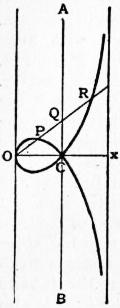
LOGOCYCLIC CURVE, STROPHOID or FOLIATE, a cubic curve generated by increasing or diminishing the radius vector of a variable point Q on a straight line AB by the distance QC of the point from the foot of the perpendicular drawn from the origin to the fixed line. The polar equation is r cos θ = a(1 ± sinθ), the upper sign referring to the case when the vector is increased, the lower when it is diminished. Both branches are included in the Cartesian equation (x2 + y2)(2a − x) = a2x, where a is the distance of the line from the origin. If we take for axes the fixed line and the perpendicular through the initial point, the equation takes the form y √(a − x) = x √(a + x). The curve resembles the folium of Descartes, and has a node between x = 0, x = a, and two branches asymptotic to the line x = 2a.
LOGOGRAPHI (λόγος, γράφω, writers of prose histories or tales), the name given by modern scholars to the Greek historiographers before Herodotus.1 Thucydides, however, applies the term to all his own predecessors, and it is therefore usual to make a distinction between the older and the younger logographers. Their representatives, with one exception, came from Ionia and its islands, which from their position were most favourably situated for the acquisition of knowledge concerning the distant countries of East and West. They wrote in the Ionic dialect, in what was called the unperiodic style, and preserved the poetic character of their epic model. Their criticism amounts to nothing more than a crude attempt to rationalize the current legends and traditions connected with the founding of cities, the genealogies of ruling families, and the manners and customs of individual peoples. Of scientific criticism there is no trace whatever. The first of these historians was probably Cadmus of Miletus (who lived, if at all, in the early part of the 6th century), the earliest writer of prose, author of a work on the founding of his native city and the colonization of Ionia (so Suïdas); Pherecydes of Leros, who died about 400, is generally considered the last. Mention may also be made of the following: Hecataeus of Miletus (550-476); Acusilaus of Argos,2 who paraphrased in prose (correcting the tradition where it seemed necessary) the genealogical works of Hesiod in the Ionic dialect; he confined his attention to the prehistoric period, and made no attempt at a real history; Charon of Lampsacus (c. 450), author of histories of Persia, Libya, and Ethiopia, of annals (ὦροι) of his native town with lists of the prytaneis and archons, and of the chronicles of Lacedaemonian kings; Xanthus of Sardis in Lydia (c. 450), author of a history of Lydia, one of the chief authorities used by Nicolaus of Damascus (fl. during the time of Augustus); Hellanicus of Mytilene; Stesimbrotus of Thasos, opponent of Pericles and reputed author of a political pamphlet on Themistocles, Thucydides and Pericles; Hippys and Glaucus, both of Rhegium, the first the author of histories of Italy and Sicily, the second of a treatise on ancient poets and musicians, used by Harpocration and Plutarch; Damastes of Sigeum, pupil of Hellanicus, author of genealogies of the combatants before Troy (an ethnographic and statistical list), of short treatises on poets, sophists, and geographical subjects.
On the early Greek historians, see G. Busolt, Griechische Geschichte (1893), i. 147-153; C. Wachsmuth, Einleitung in das Studium der alten Geschichte (1895); A. Schäfer, Abriss der Quellenkunde der griechischen und römischen Geschichte (ed. H. Nissen, 1889); J. B. Bury, Ancient Greek Historians (1909), lecture i.; histories of Greek literature by Müller-Donaldson (ch. 18) and W. Mure (bk. iv. ch. 3), where the little that is known concerning the life and writings of the logographers is exhaustively discussed. The fragments will be found, with Latin notes, translation, prolegomena, and copious indexes, in C. W. Müller’s Fragmenta historicorum Graecorum (1841-1870).
See also Greece: History, Ancient (section, “Authorities”).
1 The word is also used of the writers of speeches for the use of the contending parties in the law courts, who were forbidden to employ advocates.
2 There is some doubt as to whether this Acusilaus was of Peloponnesian or Boeotian Argos. Possibly there were two of the name. For an example of the method of Acusilaus see Bury, op. cit. p. 19.
LOGOS λόγος, a common term in ancient philosophy and theology. It expresses the idea of an immanent reason in the world, and, under various modifications, is met with in Indian, Egyptian and Persian systems of thought. But the idea was developed mainly in Hellenic and Hebrew philosophy, and we may distinguish the following stages:
1. The Hellenic Logos.—To the Greek mind, which saw in the world a κόσμος (ordered whole), it was natural to regard the world as the product of reason, and reason as the ruling principle in the world. So we find a Logos doctrine more or less prominent from the dawn of Hellenic thought to its eclipse. It rises in the realm of physical speculation, passes over into the territory of ethics and theology, and makes its way through at least three well-defined stages. These are marked off by the names of Heraclitus of Ephesus, the Stoics and Philo.
It acquires its first importance in the theories of Heraclitus (6th century B.C.), who, trying to account for the aesthetic order of the visible universe, broke away to some extent from the purely physical conceptions of his predecessors and discerned at work in the cosmic process a λόγος analogous to the reasoning power in man. On the one hand the Logos is identified with γνώμη and connected with δίκη, which latter seems to have the function of correcting deviations from the eternal law that rules in things. On the other hand it is not positively distinguished either from the ethereal fire, or from the εἱμαρμένη and the ἀνάγκη according to which all things occur. Heraclitus holds that nothing material can be thought of without this Logos, but he does not conceive the Logos itself to be immaterial. Whether it is regarded as in any sense possessed of intelligence and consciousness is a question variously answered. But there is most to say for the negative. This Logos is not one above the world or prior to it, but in the world and inseparable from it. Man’s soul is a part of it. It is relation, therefore, as Schleiermacher expresses it, or reason, not speech or word. And it is objective, not subjective, reason. Like a law of nature, objective in the world, it gives order and regularity to the movement of things, and makes the system rational.1
The failure of Heraclitus to free himself entirely from the physical hypotheses of earlier times prevented his speculation from influencing his successors. With Anaxagoras a conception entered which gradually triumphed over that of Heraclitus, namely, the conception of a supreme, intellectual principle, not identified with the world but independent of it. This, however, was νοῦς, not Logos. In the Platonic and Aristotelian systems, too, the theory of ideas involved an absolute separation between the material world and the world of higher reality, and though the term Logos is found the conception is vague and undeveloped. With Plato the term selected for the expression of the principle to which the order visible in the universe is due is νοῦς or σοφία, not λόγος. It is in the pseudo-Platonic Epinomis that λόγος appears as a synonym for νοῦς. In Aristotle, again, the principle which sets all nature under the rule of thought, and directs it towards a rational end, is νοῦς, or the divine spirit itself; while λόγος is a term with many senses, used as more or less identical with a number of phrases, οὖ ἕνεκα, ἐνέργια, ἐντελέχεια, οὐσία, εἶδος, μορφή, &c.
In the reaction from Platonic dualism, however, the Logos doctrine reappears in great breadth. It is a capital element in the system of the Stoics. With their teleological views of the world they naturally predicated an active principle pervading it and determining it. This operative principle is called both Logos and God. It is conceived of as material, and is described in terms used equally of nature and of God. There is at the same time the special doctrine of the λόγος σπερματικός, the seminal Logos, or the law of generation in the world, the principle of the active reason working in dead matter. This parts into λόγοι σπερματικοί, which are akin, not to the Platonic ideas, but rather to the λόγοι ἔνυλοι of Aristotle. In man, too, there is a Logos which is his characteristic possession, and which is ἐνδιάθετος, as long as it is a thought resident within his breast, but προφορικός when it is expressed as a word. This distinction between Logos as ratio and Logos as oratio, so much used subsequently by Philo and the Christian fathers, had been so far anticipated by Aristotle’s distinction between the ἔξω λόγος and the λόγος ἐν τῇ ψυχῇ. It forms the point of attachment by which the Logos doctrine connected itself with Christianity. The Logos of the Stoics (q.v.) is a reason in the world gifted with intelligence, and analogous to the reason in man.
2. The Hebrew Logos.—In the later Judaism the earlier anthropomorphic conception of God and with it the sense of the divine nearness had been succeeded by a belief which placed God at a remote distance, severed from man and the world by a deep chasm. The old familiar name Yahweh became a secret; its place was taken by such general expressions as the Holy, the Almighty, the Majesty on High, the King of Kings, and also by the simple word “Heaven.” Instead of the once powerful confidence in the immediate presence of God there grew up a mass of speculation regarding on the one hand the distant future, on the other the distant past. Various attempts were made to bridge the gulf between God and man, including the angels, and a number of other hybrid forms of which it is hard to say whether they are personal beings or abstractions. The wisdom, the Shekinah or Glory, and the Spirit of God are intermediate beings of this kind, and even the Law came to be regarded as an independent spiritual entity. Among these conceptions that of the word of God had an important place, especially the creative word of Genesis i. Here as in the other cases we cannot always say whether the Word is regarded as a mere attribute or activity of God, or an independent being, though there is a clear tendency towards the latter. The ambiguity lies in the twofold purpose of these activities: (1) to establish communication with God; (2) to prevent direct connexion between God and the world. The word of the God of revelation is represented as the creative principle (e.g. Gen. i. 3; Psalm xxxiii. 6), as the executor of the divine judgments (Hosea vi. 5), as healing (Psalm cvii. 20), as possessed of almost personal qualities (Isaiah lv. 11; Psalm cxlvii. 15). Along with this comes the doctrine of the angel of Yahweh, the angel of the covenant, the angel of the presence, in whom God manifests Himself, and who is sometimes identified with Yahweh or Elohim (Gen. xvi. 11, 13; xxxii. 29-31; Exod. iii. 2; xiii. 21), sometimes distinguished from Him (Gen. xxii. 15, &c.; xxiv. 7; xxviii. 12, &c.), and sometimes presented in both aspects (Judges ii., vi.; Zech. i.). To this must be added the doctrine of Wisdom, given in the books of Job and Proverbs. At one time it is exhibited as an attribute of God (Prov. iii. 19). At another it is strongly personified, so as to become rather the creative thought of God than a quality (Prov. viii. 22). Again it is described as proceeding from God as the principle of creation and objective to Him. In these and kindred passages (Job xv. 7, &c.) it is on the way to become hypostatized.
The Hebrew conception is partially associated with the Greek in the case of Aristobulus, the predecessor of Philo, and, according to the fathers, the founder of the Alexandrian school. He speaks of Wisdom in a way reminding us of the book of Proverbs. The pseudo-Solomonic Book of Wisdom (generally supposed to be the work of an Alexandrian flourishing somewhere between Aristobulus and Philo) deals both with the Wisdom and with the Logos. It fails to hypostatize either. But it represents the former as the framer of the world, as the power or spirit of God, active alike in the physical, the intellectual, and the ethical domain, and apparently objective to God. In the Targums, on the other hand, the three doctrines of the word, the angel, and the wisdom of God converge in a very definite conception. In the Jewish theology God is represented as purely transcendent, having no likeness of nature with man, and making no personal entrance into history. Instead of the immediate relation of God to the world the Targums introduce the ideas of the Mēmrā (word) and the Shechīnā (real presence). This Memra (= Ma’amar) or, as it is also designated, Dibbūrā, is a hypostasis that takes the place of God when direct intercourse with man is in view. In all those passages of the Old Testament where anthropomorphic terms are used of God, the Memra is substituted for God. The Memra proceeds from God, and retains the creaturely relation to God. It does not seem to have been identified with the Messiah.2
3. Philo.—In the Alexandrian philosophy, as represented by the Hellenized Jew Philo, the Logos doctrine assumes a leading place and shapes a new career for itself. Philo’s doctrine is moulded by three forces—Platonism, Stoicism and Hebraism. He detaches the Logos idea from its connexion with Stoic materialism and attaches it to a thoroughgoing Platonism. It is Plato’s idea of the Good regarded as creatively active. Hence, instead of being merely immanent in the Cosmos, it has an independent existence. Platonic too is the doctrine of the divine architect who seeks to realize in the visible universe the archetypes already formed in his mind. Philo was thus able to make the Logos theory a bridge between Judaism and Greek philosophy. It preserved the monotheistic idea yet afforded a description of the Divine activity in terms of Hellenic thought; the word of the Old Testament is one with the λόγος of the Stoics. And thus in Philo’s conception the Logos is much more than “the principle of reason, informing the infinite variety of things, and so creating the World-Order”; it is also the divine dynamic, the energy and self-revelation of God. The Stoics indeed sought, more or less consciously, by their doctrine of the Logos as the Infinite Reason to escape from the belief in a divine Creator, but Philo, Jew to the core, starts from the Jewish belief in a supreme, self-existing God, to whom the reason of the world must be subordinated though related. The conflict of the two conceptions (the Greek and the Hebrew) led him into some difficulty; sometimes he represents the Logos as an independent and even personal being, a “second God,” sometimes as merely an aspect of the divine activity. And though passages of the first class must no doubt be explained figuratively—for Philo would not assert the existence of two Divine agents—it remains true that the two conceptions cannot be fused. The Alexandrian philosopher wavers between the two theories and has to accord to the Logos of Hellas a semi-independent position beside the supreme God of Judaea. He speaks of the Logos (1) as the agency by which God reveals Himself, in some measure to all men, in greater degree to chosen souls. The appearances recorded in the Old Testament are manifestations of the Logos, and the knowledge of God possessed by the great leaders and teachers of Israel is due to the same source; (2) as the agency whereby man, enmeshed by illusion, lays hold of the higher spiritual life and rising above his partial point of view participates in the universal reason. The Logos is thus the means of redemption; those who realize its activity being emancipated from the tyranny of circumstance into the freedom of the eternal.
4. The Fourth Gospel.—Among the influences that shaped the Fourth Gospel that of the Alexandrian philosophy must be assigned a distinct, though not an exaggerated importance. There are other books in the New Testament that bear the same impress, the epistles to the Ephesians and the Colossians, and to a much greater degree the epistle to the Hebrews. The development that had thus begun in the time of Paul reaches maturity in the Fourth Gospel, whose dependence on Philo appears (1) in the use of the allegorical method, (2) in many coincident passages, (3) in the dominant conception of the Logos. The writer narrates the life of Christ from the point of view furnished him by Philo’s theory. True, the Logos doctrine is only mentioned in the prologue to the Gospel, but it is presupposed throughout the whole book. The author’s task indeed was somewhat akin to that of Philo, “to transplant into the world of Hellenic culture a revelation originally given through Judaism.” This is not to say that he holds the Logos doctrine in exactly the same form as Philo. On the contrary, the fact that he starts from an actual knowledge of the earthly life of Jesus, while Philo, even when ascribing a real personality to the Logos, keeps within the bounds of abstract speculation, leads him seriously to modify the Philonic doctrine. Though the Alexandrian idea largely determines the evangelist’s treatment of the history, the history similarly reacts on the idea. The prologue is an organic portion of the Gospel and not a preface written to conciliate a philosophic public. It assumes that the Logos idea is familiar in Christian theology, and vividly summarizes the main features of the Philonic conception—the eternal existence of the Logos, its relation to God (πρὸς τὸν θεόν, yet distinct), its creative, illuminative and redemptive activity. But the adaptation of the idea to John’s account of a historical person involved at least three profound modifications:—(1) the Logos, instead of the abstraction or semi-personification of Philo, becomes fully personified. The word that became flesh subsisted from all eternity as a distinct personality within the divine nature. (2) Much greater stress is laid upon the redemptive than upon the creative function. The latter indeed is glanced at (“All things were made by him”), merely to provide a link with earlier speculation, but what the writer is concerned about is not the mode in which the world came into being but the spiritual life which resides in the Logos and is communicated by him to men. (3) The idea of λόγος as Reason becomes subordinated to the idea of λόγος as Word, the expression of God’s will and power, the outgoing of the divine energy, life, love and light. Thus in its fundamental thought the prologue of the Fourth Gospel comes nearer to the Old Testament (and especially to Gen. i.) than to Philo. As speech goes out from a man and reveals his character and thought, so Christ is “sent out from the Father,” and as the divine word is also, in accordance with the Hebrew idea, the medium of God’s quickening power.
What John thus does is to take the Logos idea of Philo and use it for a practical purpose—to make more intelligible to himself and his readers the divine nature of Jesus Christ. That this endeavour to work into the historical tradition of the life and teaching of Jesus—a hypothesis which had a distinctly foreign origin—led him into serious difficulties is a consideration that must be discussed elsewhere.
5. The Early Church.—In many of the early Christian writers, as well as in the heterodox schools, the Logos doctrine is influenced by the Greek idea. The Syrian Gnostic Basilides held (according to Irenaeus i. 24) that the Logos or Word emanated from the νοῦς, or personified reason, as this latter emanated from the unbegotten Father. The completest type of Gnosticism, the Valentinian, regarded Wisdom as the last of the series of aeons that emanated from the original Being or Father, and the Logos as an emanation from the first two principles that issued from God, Reason (νοῦς) and Truth. Justin Martyr, the first of the sub-apostolic fathers, taught that God produced of His own nature a rational power(δύναμίν τινα λογικήν), His agent in creation, who now became man in Jesus (Dial. c. Tryph. chap. 48, 60). He affirmed also the action of the λόγος σπερματικός, (Apol. i. 46; ii. 13, &c.). With Tatian (Cohort. ad. Gr. chap. 5, &c.) the Logos is the beginning of the world, the reason that comes into being as the sharer of God’s rational power. With Athenagoras (Suppl. chap. 9, 10) He is the prototype of the world and the energizing principle (ἰδέα καὶ ἐνέργεια) of things. Theophilus (Ad Autolyc. ii. 10, 24) taught that the Logos was in eternity with God as the λόγος ἐνδιάθετος, the counsellor of God, and that when the world was to be created God sent forth this counsellor (σύμβουλος) from Himself as the λόγος προφορικός, yet so that the begotten Logos did not cease to be a part of Himself. With Hippolytus (Refut. x. 32, &c.) the Logos, produced of God’s own substance, is both the divine intelligence that appears in the world as the Son of God, and the idea of the universe immanent in God. The early Sabellians (comp. Eusebius, Hist. Eccl. vi. 33; Athanasius, Contra Arian. iv.) held that the Logos was a faculty of God, the divine reason, immanent in God eternally, but not in distinct personality prior to the historical manifestation in Christ. Origen, referring the act of creation to eternity instead of to time, affirmed the eternal personal existence of the Logos. In relation to God this Logos or Son was a copy of the original, and as such inferior to that. In relation to the world he was its prototype, the ἰδέα ἰδεῶν and its redeeming power (Contra Cels. v. 608; Frag. de princip. i. 4; De princip. i. 109, 324).
In the later developments of Hellenic speculation nothing essential was added to the doctrine of the Logos. Philo’s distinction between God and His rational power or Logos in contact with the world was generally maintained by the eclectic Platonists and Neo-Platonists. By some of these this distinction was carried out to the extent of predicating (as was done by Numenius of Apamea) three Gods:—the supreme God; the second God, or Demiurge or Logos; and the third God, or the world. Plotinus explained the logoi as constructive forces, proceeding from the ideas and giving form to the dead matter of sensible things (Enneads, v. 1. 8 and Richter’s Neu-Plat. Studien).
See the histories of philosophy and theology, and works quoted under Heraclitus, Stoics, Philo, John, The Gospel of, &c., and for a general summary of the growth of the Logos doctrine, E. Caird, Evolution of Theology in the Greek Philosophers (1904), vol. ii.; A. Harnack, History of Dogma; E. F. Scott, The Fourth Gospel, ch. v. (1906); J. M. Heinze, Die Lehre vom Logos in der griech. Philosophie (1872); J. Réville, La Doctrine du Logos (1881); Aal, Gesch. d. Logos-Idee (1899); and the Histories of Dogma, by A. Harnack, F. Loofs, R. Seeberg.
(S. D. F. S.; A. J. G.)
1 Cf. Schleiermacher’s Herakleitos der Dunkle; art. Heraclitus and authorities there quoted.
2 Cf. the Targum of Onkelos on the Pentateuch under Gen. vii. 16, xvii. 2, xxi. 20; Exod. xix. 16, etc.; the Jerusalem Targum on Numb. vii. 89, &c. For further information regarding the Hebrew Logos see, beside Dr Kaufmann Kohler, s.v. “Memra,” Jewish Encyc. viii. 464-465, Bousset, Die Religion des Judenthums (1903), p. 341, and Weber, Jüdische Theologie (1897), pp. 180-184. The hypostatizing of the Divine word in the doctrine of the Memra was probably later than the time of Philo, but it was the outcome of a mode of thinking already common in Jewish theology. The same tendency is of course expressed in the “Logos” of the Fourth Gospel.