VOLUME XII SLICE III Helmont, Jean to Hernösand (continued 6)
Reading edition
The divine smith naturally became a “culture-god”; in Crete the invention of forging in iron was attributed to him, and he was honoured by all metal-workers. But we have little record of his cult in this aspect, except at Athens, where his worship was of real importance, belonging to the oldest stratum of Attic religion. A tribe was called after his name, and Erichthonius, the mythical father of the Attic people, was the son of Hephaestus. Terra-cotta statuettes of the god seem to have been placed before the hearths of Athenian houses. This temple has been identified, not improbably, with the so-called “Theseum”; it contained a statue of Athena, and the two deities are often associated, in literature and cult, as the joint givers of civilization to the Athenians. The class of artisans was under their special protection; and the joint festival of the two divinities—the Chalceia—commemorated the invention of bronze-working by Hephaestus. In the Hephaesteia (the particular festival of the god) there was a torch race, a ceremonial not indeed confined to fire-gods like Hephaestus and Prometheus, but probably in its origin connected with them, whether its object was to purify and quicken the land, or (according to another theory) to transmit a new fire with all possible speed to places where the fire was polluted. If the latter view is correct, the torch race would be closely akin to the Lemnian fire-ritual which has been mentioned. The relation between Hephaestus and Prometheus is in some respects close, though the distinction between these gods is clearly marked. The fire, as an element, belongs to the Olympian Hephaestus; the Titan Prometheus, a more human character, steals it for the use of man. Prometheus resembles the Polynesian Maui, who went down to fetch fire from the volcano of Mahuika, the fire-god. Hephaestus is a culture-god mainly in his secondary aspect as the craftsman, whereas Prometheus originates all civilization with the gift of fire. But the importance of Prometheus is mainly mythological; the Titan belonged to a fallen dynasty, and in actual cult was largely superseded by Hephaestus.
In archaic art Hephaestus is generally represented as bearded, though occasionally a younger beardless type is found, as on a vase (in the British Museum), on which he appears as a young man assisting Athena in the creation of Pandora. At a later time the bearded type prevails. The god is usually clothed in a short sleeveless tunic, and wears a round close-fitting cap. His face is that of a middle-aged man, with unkempt hair. He is in fact represented as an idealized Greek craftsman, with the hammer, and sometimes the pincers. Some mythologists have compared the hammer of Hephaestus with that of Thor, and have explained it as the emblem of a thunder-god; but it is Zeus, not Hephaestus, who causes the thunder, and the emblems of the latter god are merely the signs of his occupation as a smith. In art no attempt was made, as a rule, to indicate the lameness of Hephaestus; but one sculptor (Alcamenes) is said to have suggested the deformity without spoiling the statue.
Authorities.—L. Preller (ed. C. Robert), Griech. Mythologie, i. 174 f. (Berlin, 1894); W. H. Roscher, Lex. der griech. u. röm. Mythologie, s.v. “Hephaistos” (Leipzig, 1884-1886); Harrison, Myth. and Mon. of Ancient Athens, p. 119 f. (London, 1890); O. Gruppe, Griech. Mythologie u. Religionsgesch. p. 1304 f. (Munich, 1906); O. Schrader and F. B. Jevons, Prehistoric Antiquities of the Aryan People, p. 161, &c. (London, 1890); L. R. Farnell, Cults of the Greek States, v. (1909).
(E. E. S.)
HEPPENHEIM, a town of Germany, in the grand-duchy of Hesse-Darmstadt, on the Bergstrasse, between Darmstadt and Heidelberg, 21 m. N. of the latter by rail. Pop. (1905), 6364. It possesses a parish church, occupying the site of one reputed to have been built by Charlemagne about 805, an interesting town hall and several schools. On an isolated hill close by stand the extensive ruins of the castle of Starkenburg, built by the abbot, Ulrich von Lorsch, about 1064 and destroyed during the Seven Years’ War, and another hill, the Landberg, was a place of assembly in the middle ages. Heppenheim, at first the property of the abbey of Lorsch, became a town in 1318. After belonging to the Rhenish Palatinate, it came into the possession of Hesse-Darmstadt in 1803. Hops, wine and tobacco are grown, and there are large stone quarries, and several small industries in the town.
HEPPLEWHITE, GEORGE (d. 1786), one of the most famous English cabinet-makers of the 18th century. There is practically no biographical material relating to Hepplewhite. The only facts that are known with certainty are that he was apprenticed to Gillow at Lancaster, that he carried on business in the parish of Saint Giles, Cripplegate, and that administration of his estate was granted to his widow Alice on the 27th of June 1786. The administrator’s accounts, which were filed in the Prerogative Court of Canterbury a year later, indicate that his property was of considerable value. After his death the business was continued by his widow under the style of A. Hepplewhite & Co. Our only approximate means of identifying his work are The Cabinet-Maker and Upholsterer’s Guide, which was first published in 1788, two years after his death, and ten designs in The Cabinet-maker’s London Book of Prices (1788), issued by the London Society of Cabinet-Makers. It is, however, exceedingly difficult to earmark any given piece of furniture as being the actual work or design of Hepplewhite, since it is generally recognized that to a very large extent the name represents rather a fashion than a man. Lightness, delicacy and grace are the distinguishing characteristics of Hepplewhite work. The massiveness of Chippendale had given place to conceptions that, especially in regard to chairs—which had become smaller as hoops went out of fashion—depended for their effect more upon inlay than upon carving. In one respect at least the Hepplewhite style was akin to that of Chippendale—in both cases the utmost ingenuity was lavished upon the chair, and if Hepplewhite was not the originator he appears to have been the most constant and successful user of the shield back. This elegant form was employed by the school in a great variety of designs, and nearly always in a way artistically satisfying. Where Chippendale, his contemporaries and his immediate successors had used the cabriole and the square leg with a good deal of carving, the Hepplewhite manner preferred a slighter leg, plain, fluted or reeded, tapering to a spade foot which often became the “spider leg” that characterized much of the late 18th-century furniture; this form of leg was indeed not confined to chairs but was used also for tables and sideboards. Of the dainty drawing-room grace of the style there can be no question. The great majority of modern chairs are of Hepplewhite inspiration, while he, or those who worked with him, appears to have a clear claim to have originated, or at all events popularized, the winged easy-chair, in which the sides are continued to the same height as the back. This is probably the most comfortable type of chair that has ever been made. The backs of Hepplewhite chairs were often adorned with galleries and festoons of wheat-ears or pointed fern leaves, and not infrequently with the prince of Wales’s feathers in some more or less decorative form. The frequency with which this badge was used has led to the suggestion either that A. Hepplewhite & Co. were employed by George IV. when prince of Wales, or that the feathers were used as a political emblem. The former suggestion is obviously the more feasible, but there is little doubt that the feathers were used by other makers working in the same style. It has been objected as an artistic flaw in Hepplewhite’s chairs that they have the appearance of fragility. They are, however, constructionally sound as a rule. The painted and japanned work has been criticized on safer grounds. This delicate type of furniture, often made of satinwood, and painted with wreaths and festoons, with amorini and musical instruments or floral motives, is the most elegant and pleasing that can be imagined. It has, however, no elements of decorative permanence. With comparatively little use the paintings wear off and have to be renewed. A piece of untouched painted satinwood is almost unknown, and one of the essential charms of old furniture as of all other antiques is that it should retain the patina of time. A large proportion of Hepplewhite furniture is inlaid with the exotic woods which had come into high favour by the third quarter of the 18th century. While the decorative use upon furniture of so evanescent a medium as paint is always open to criticism, any form of marquetry is obviously legitimate, and, if inlaid furniture be less ravishing to the eye, its beauty is but enhanced by time. It was not in chairs alone that the Hepplewhite manner excelled. It acquired, for instance, a speciality of seats for the tall, narrow Georgian sash windows, which in the Hepplewhite period had almost entirely superseded the more picturesque forms of an earlier time. These window-seats had ends rolling over outwards, and no backs, and despite their skimpiness their elegant simplicity is decidedly pleasing. Elegance, in fact, was the note of a style which on the whole was more distinctly English than that which preceded or immediately followed it. The smaller Hepplewhite pieces are much prized by collectors. Among these may be included urn-shaped knife-boxes in mahogany and satinwood, charming in form and decorative in the extreme; inlaid tea-caddies, varying greatly in shape and material, but always appropriate and coquet; delicate little fire-screens with shaped poles; painted work-tables, and inlaid stands. Hepplewhite’s bedsteads with carved and fluted pillars were very handsome and attractive. The evolution of the dining-room sideboard made rapid progress towards the end of the 18th century, but neither Hepplewhite nor those who worked in his style did much to advance it. Indeed they somewhat retarded its development by causing it to revert to little more than that side-table which had been its original form. It was, however, a very delightful table with its undulating front, its many elegant spade-footed legs and its delicate carving. If we were dealing with a less elusive personality it would be just to say that Hepplewhite’s work varies from the extreme of elegance and the most delicious simplicity to an unimaginative commonplace, and sometimes to actual ugliness. As it is, this summary may well be applied to the style as a whole—a style which was assuredly not the creation of any one man, but owed much alike of excellence and of defect to a school of cabinet-makers who were under the influence of conflicting tastes and changing ideals. At its best the taste was so fine and so full of distinction, so simple, modest and sufficient, that it amounted to genius. On its lower planes it was clearly influenced by commercialism and the desire to make what tasteless people preferred. Yet this is no more than to say that the Hepplewhite style succumbed sometimes, perhaps very often, to the eternal enemy of all art—the uninspired banality of the average man.
(J. P.-B.)
HEPTARCHY (Gr. ἑπτά, seven, and ἀρχή, rule), a word which is frequently used to designate the period of English history between the coming of the Anglo-Saxons in 449 and the union of the kingdoms under Ecgbert in 828. It was first used during the 16th century because of the belief held by Camden and other older historians, that during this period there were exactly seven kingdoms in England, these being Northumbria, Mercia, East Anglia, Essex, Kent, Sussex and Wessex. This belief is erroneous, as the number of kingdoms varied considerably from time to time; nevertheless the word still serves a useful purpose to denote the period.
HERA, in Greek mythology, the sister and wife of Zeus and queen of the Olympian gods; she was identified by the Romans with Juno. The derivation of the name is obscure, but there is no reason to doubt that she was a genuine Greek deity. There are no signs of Oriental influence in her cults, except at Corinth, where she seems to have been identified with Astarte. It is probable that she was originally a personification of some department of nature; but the traces of her primitive significance are vague, and have been interpreted to suit various theories. Some of the ancients connected her with the earth; Plato, followed by the Stoics, derived her name from ἀήρ, the air. Both theories have been revived in modern times, the former notably by F. G. Welcker, the latter by L. Preller. A third view, that Hera is the moon, is held by W. H. Roscher and others. Of these explanations, that advanced by Preller has little to commend it, even if, with O. Gruppe, we understand the air-goddess as a storm deity; some of the arguments in support of the two other theories will be examined in this article.
Whatever may have been the origin of Hera, to the historic Greeks (except a few poets or philosophers) she was a purely anthropomorphic goddess, and had no close relation to any province of nature. In literature, from the times of Homer and Hesiod, she played an important part, appearing most frequently as the jealous and resentful wife of Zeus. In this character she pursues with vindictive hatred the heroines, such as Alcmene, Leto and Semele, who were beloved by Zeus. She visits his sins upon the children born of his intrigues, and is thus the constant enemy of Heracles and Dionysus. This character of the offended wife was borrowed by later poets from the Greek epic; but it belongs to literature rather than to cult, in which the dignity and power of the goddess is naturally more emphasized.
The worship of Hera is found, in different degrees of prominence, throughout the Greek world. It was especially important in the ancient Achaean centres, Argos, Mycenae and Sparta, which she claims in the Iliad (iv. 51) as her three dearest cities. Whether Hera was also worshipped by the early Dorians is uncertain; after the Dorian invasion she remained the chief deity of Argos, but her cult at Sparta was not so conspicuous. She received honour, however, in other parts of the Peloponnese, particularly in Olympia, where her temple was the oldest, and in Arcadia. In several Boeotian cities she seems to have been one of the principal objects of worship, while the neighbouring island of Euboea probably derived its name from a title of Hera, who was “rich in cows” (Εὔβοια). Among the islands of the Aegean, Samos was celebrated for the cult of Hera; according to the local tradition, she was born in the island. As Hera Lacinia (from her Lacinian temple near Croton) she was extensively worshipped in Magna Graecia.
The connexion of Zeus and Hera was probably not primitive, since Dione seems to have preceded Hera as the wife of Zeus at Dodona. The origin of the connexion may possibly be due to the fusion of two “Pelasgic” tribes, worshipping Zeus and Hera respectively; but speculation on the earliest cult of the goddess, before she became the wife of Zeus, must be largely conjectural. The close relation of the two deities appears in a frequent community of altars and sacrifices, and also in the ἱερὸς γάμος, a dramatic representation of their sacred marriage. The festival, which was certainly ancient, was held not only in Argos, Samos, Euboea and other centres of Hera-worship, but also in Athens, where the goddess was obscured by the predominance of Athena. The details of the ἱερὸς γάμος may have varied locally, but the main idea of the ritual was the same. In the Daedala, as the festival was called at Plataea, an effigy was made from an oak-tree, dressed in bridal attire, and carried in a cart with a woman who acted as bridesmaid. The image was called Daedale, and the ritual was explained by a myth: Hera had left Zeus in her anger; in order to win her back, Zeus announced that he was about to marry, and dressed up a puppet to imitate a bride; Hera met the procession, tore the veil from the false bride, and, on discovering the ruse, became reconciled to her husband. The image was put away after each occasion; every sixty years a large number of such images, which had served in previous celebrations, were carried in procession to the top of Mount Cithaeron, and were burned on an altar together with animals and the altar itself. As Frazer notes (Golden Bough,² i. 227), this festival appears to belong to the large class of mimetic charms designed to quicken the growth of vegetation; the marriage of Zeus and Hera would in this case represent the union of the king and queen of May. But it by no means follows that Hera was therefore originally a goddess of the earth or of vegetation. When the real nature of the ritual had become lost or obscured, it was natural to explain it by the help of an aetiological myth; in European folklore, images, corresponding to those burnt at the Daedala, were sometimes called Judas Iscariot or Luther (Golden Bough,² iii. 315). At Samos the ἱερὸς γάμος was celebrated annually; the image of Hera was concealed on the sea-shore and solemnly discovered. This rite seems to reflect an actual custom of abduction; or it may rather refer to the practice of intercourse between the betrothed before marriage. Such intercourse was sanctioned by the Samians, who excused it by the example of Zeus and Hera (schol. on Il. xiv. 296). There is nothing in the Samian ἱερὸς γάμος to suggest a marriage of heaven and earth, or of two vegetation-spirits; as Dr Farnell points out, the ritual appears to explain the custom of human nuptials. The sacred marriage, therefore, though connected with vegetation at the Daedala, was not necessarily a vegetation-charm in its origin; consequently, it does not prove that Hera was an earth-goddess or tree-spirit. It is at least remarkable that, except at Argos, Hera had little to do with agriculture, and was not closely associated with such deities as Cybele, Demeter, Persephone and Dionysus, whose connexion with the earth, or with its fruits, is beyond doubt.
In her general cult Hera was worshipped in two main capacities: (1) as the consort of Zeus and queen of heaven; (2) as the goddess who presided over marriage, and, in a wider sense, over the various phases of a woman’s life. Dionysius of Halicarnassus (Ars rhet. ii. 2) calls Zeus and Hera the first wedded pair, and a sacrifice to Zeus τέλειος and Hera τελεία was a regular feature of the Greek wedding. Girls offered their hair or veils to Hera before marriage. In Aristophanes (Thesm. 973) she “keeps the keys of wedlock.” The marriage-goddess naturally became the protector of women in childbed, and bore the title of the birth-goddess (Eileithyia), at Argos and Athens. In Homer (Il. xi. 270) and Hesiod (Theog. 922) she is the mother of the Eileithyiae, or the single Eileithyia. Her cult-titles παρθένος (or παῖς), τελεία and χήρα the “maiden,” “wife,” and “widow” (or “divorced”) have been interpreted as symbolical of the earth in spring, summer, and winter; but they may well express the different conditions in the lives of her human worshippers. The Argives believed that Hera recovered her virginity every year by bathing in a certain spring (Paus. viii. 22, 2), a belief which probably reflects the custom of ceremonial purification after marriage (see Frazer, Adonis, p. 176). Although Hera was not the bestower of feminine charm to the same extent as Aphrodite, she was the patron of a contest for beauty in a Lesbian festival (καλλιστεῖα). This intimate relation with women has been held a proof that Hera was originally a moon-goddess, as the moon is often thought to influence childbirth and other aspects of feminine life. But Hera’s patronage of women, though undoubtedly ancient, is not necessarily primitive. Further, the Greeks themselves, who were always ready to identify Artemis with the moon, do not seem to have recognized any lunar connexion in Hera.
Among her particular worshippers, at Argos and Samos, Hera was much more than the queen of heaven and the marriage-goddess. As the patron of these cities (πολιοῦχος) she held a place corresponding to that of Athena in Athens. The Argives are called “the people of Hera” by Pindar; the Heraeum, situated under a mountain significantly called Mt. Euboea, was the most important temple in Argolis. Here the agricultural character of her ritual is well marked; the first oxen used in ploughing were, according to an Argive myth, dedicated to her as ζευξιδία; and the sprouting ears of corn were called “the flowers of Hera.” She was worshipped as the goddess of flowers (ἀνθεία); girls served in her temple under the name of “flower-bearers,” and a flower festival (Ἠροσανθεία, Ἠροάνθια) was celebrated by Peloponnesian women in spring. These rites recall our May day observance, and give colour to the earth-goddess theory. On the other hand it must be remembered that the patron deity of a Greek state had very wide functions; and it is not surprising to find that Hera (whatever her origin may have been) assumed an agricultural character among her own people whose occupations were largely agricultural. So, although the warlike character of Hera was not elsewhere prominent, she assumed a militant aspect in her two chief cities; a festival called the Shield (ἀσπίς, in Pindar ἀγὼν χάλκεος) was part of the Argive cult, and there was an armed procession in her honour at Samos. The city-goddess, whether Hera or Athena, must be chief alike in peace and war.
The cow was the animal specially sacred to Hera both in ritual and in mythology. The story of Io, metamorphosed into a cow, is familiar; she was priestess of Hera, and was originally, no doubt, a form of the goddess herself. The Homeric epithet βοῶπις may have meant “cow-faced” to the earliest worshippers of Hera, though by Homer and the later Greeks it was understood as “large-eyed,” like the cow. A car drawn by oxen seems to have been widely used in the processions of Hera, and the cow was her most frequent sacrifice. The origin of Hera’s association with the cow is uncertain, but there is no need to see in it, with Roscher, a symbol of the moon. The cuckoo was also sacred to Hera, who, according to the Argive legend, was wooed by Zeus in the form of the bird. In later times the peacock, which was still unfamiliar to the Greeks in the 5th century, was her favourite, especially at Samos.
The earliest recorded images of Hera preceded the rise of Greek sculpture; a log at Thespiae, a plank at Samos, a pillar at Argos served to represent the goddess. In the archaic period of sculpture the ξόανον or wooden statue of the Samian Hera by Smilis was famous. In the first half of the 5th century the sacred marriage was represented on an extant metope from a temple at Selinus. The most celebrated statue of Hera was the chryselephantine work of Polyclitus, made for the Heraeum at Argos soon after 423 B.C. It is fully described by Pausanias, who says that Hera was seated on a throne, wearing a crown (στέφανος), and carrying a sceptre in one hand and a pomegranate in the other. Various ancient writers testify to the beauty and dignity of the statue, which was considered equal to the Zeus of Pheidias. Polyclitus seems to have fixed the type of Hera as a youthful matron, but unfortunately the exact character of her head cannot be determined. A majestic and rather severe beauty marks the conception of Hera in later art, of which the Farnese bust at Naples and the Ludovisi Hera are the most conspicuous examples.
Authorities.—F. G. Welcker, Griech. Götterl. i. 362 f. (Göttingen, 1857-1863); L. Preller (ed. C. Robert), Griech. Mythologie, i. 160 f. (Berlin, 1894); W. H. Roscher, Lex. der griech. u. röm. Mythologie, s.v. (Leipzig, 1884); C. Daremberg and E. Saglio, Dict. des ant. grecques et rom. s.v. “Juno” (Paris, 1877); L. R. Farnell, Cults of the Greek States, i. 179 f. (Oxford, 1896); A. B. Cook in Class. Rev. xx. 365 f. 416 f.; O. Gruppe, Griech. Mythologie u. Religionsgesch. p. 1121 f. (Munich, 1903). In the article Greek Art, fig. 24, will be found a roughly executed head of Hera, from the pediment of the treasury of the Megarians.
(E. E. S.)
HERACLEA, the name of a large number of ancient cities founded by the Greeks.
1. Heraclea (Gr. Ἡράκλεια), an ancient city of Lucania, situated near the modern Policoro, 3 m. from the coast of the gulf of Tarentum, between the rivers Aciris (Agri) and Siris (Sinni) about 13 m. S.S.W. of Metapontum. It was a Greek colony founded by the Tarentines and Thurians in 432 B.C., the former being predominant. It was chosen as the meeting-place of the general assembly of the Italiot Greeks, which Alexander of Epirus, after his alienation from Tarentum, tried to transfer to Thurii. Here Pyrrhus, king of Epirus, defeated the consul Laevinus in 280 B.C., after he had crossed the river Siris. In 278 B.C., or possibly in 282 B.C., probably in order to detach it from Tarentum, the Romans made a special treaty with Heraclea, on such favourable terms that in 89 B.C. the Roman citizenship given to the inhabitants by the Lex Plautia Papiria was only accepted after considerable hesitation. We hear that Heraclea surrendered under compulsion to Hannibal in 212 B.C. and that in the Social war the public records were destroyed by fire. Cicero in his defence of the poet Archias, an adopted citizen of Heraclea, speaks of it as a flourishing town. As a consequence of its having accepted Roman citizenship, it became a municipium; part of a copy of the Lex Iulia Municipalis of 46 B.C. (engraved on the back of two bronze tablets, on the front of which is a Greek inscription of the 3rd century B.C. defining the boundaries of lands belonging to various temples), which was found between Heraclea and Metapontum, is of the highest importance for our knowledge of that law. It was still a place of some importance under the empire; a branch road from Venusia joined the coast road here. The circumstances of its destruction and abandonment was unknown; the site is now marked by a few heaps of ruins. Its medieval representative was Anglona, once a bishopric, but now itself a heap of ruins, among which are those of an 11th-century church.
2. Heraclea Minoa, an ancient town on the south coast of Sicily, at the mouth of the river Halycus, near the modern Montallegro, some 20 m. N.W. of Girgenti. It was at first an outpost of Selinus (Herod. v. 46), then overthrown by Carthage, later a border town of Agrigentum. It passed into Carthaginian hands by the treaty of 405 B.C., was won back by Dionysius in his first Punic war, but recovered by Carthage in 383. From this date onwards coins bearing its Semitic name, Ras Melkart, become common, and it was obviously an important border fortress. It was here that Dion landed in 357 B.C., when he attacked Syracuse. The Agrigentines won it back in 309, but it soon fell under the power of Agathocles. It was temporarily recovered for Greece by Pyrrhus.
(T. As.)
3. Heraclea Pontica (mod. Bender Eregli), an ancient city on the coast of Bithynia in Asia Minor, at the mouth of the Kilijsu. It was founded by a Megarian colony, which soon subjugated the native Mariandynians and extended its power over a considerable territory. The prosperity of the city, rudely shaken by the Galatians and the Bithynians, was utterly destroyed in the Mithradatic war. It was the birthplace of Heraclides Ponticus. The modern town is best known for its lignite coal-mines, from which Constantinople receives a good part of its supply.
4. Heraclea Sintica, a town in Thracian Macedonia, to the south of the Strymon, the site of which is marked by the village of Zervokhori, and identified by the discovery of local coins.
5. Heraclea, a town on the borders of Caria and Ionia, near the foot of Mount Latmus. In its neighbourhood was the burial cave of Endymion.
6. Heraclea-Cybistra (mod. Eregli in the vilayet of Konia), under the name Cybistra, had some importance in Hellenistic times owing to its position near the point where the road to the Cilician Gates enters the hills. It lay in the way of armies and was more than once sacked by the Arab invaders of Asia Minor (A.D. 805 and 832). It became Turkish (Seljuk) in the 11th century. Modern Eregli had grown from a large village to a town since the railway reached it from Konia and Karaman in 1904; and it has now an hotel and good shops. Three hours’ ride S. is the famous “Hittite” rock-relief of Ivriz, representing a king (probably of neighbouring Tyana) adoring a god (see Hittites). This was the first “Hittite” monument discovered in modern times (early 18th century, by the Swede Otter, an emissary of Louis XIV.).
For Heraclea Trachinia see Trachis, and for Heraclea Perinthus see Perinthus.
Heraclea was also the name of one of the Sporades, between Naxos and Ios, which is still called Raklia, and bears traces of a Greek township with temples to Tyche and Zeus Lophites.
(D. G. H.)
HERACLEON, a Gnostic who flourished about A.D. 125, probably in the south of Italy or in Sicily, and is generally classed by the early heresiologists with the Valentinian school of heresy. In his system he appears to have regarded the divine nature as a vast abyss in whose pleroma were aeons of different orders and degrees,—emanations from the source of being. Midway between the supreme God and the material world was the Demiurgus, who created the latter, and under whose jurisdiction the lower, animal soul of man proceeded after death, while his higher, celestial soul returned to the pleroma whence at first it issued. Though conspicuously uniting faith in Christ with spiritual maturity, there are evidences that, like other Valentinians, Heracleon did not sufficiently emphasize abstinence from the moral laxity and worldliness into which his followers fell. He seems to have received the ordinary Christian scriptures; and Origen, who treats him as a notable exegete, has preserved fragments of a commentary by him on the fourth gospel (brought together by Grabe in the second volume of his Spicilegium), while Clement of Alexandria quotes from him what appears to be a passage from a commentary on Luke. These writings are remarkable for their intensely mystical and allegorical interpretations of the text.
HERACLEONAS, east-Roman emperor (Feb.-Sept. 641), was the son of Heraclius (q.v.) and Martina. At the end of Heraclius’ reign he obtained through his mother’s influence the title of Augustus (638), and after his father’s death was proclaimed joint emperor with his half-brother Constantine III. The premature death of Constantine, in May 641, left Heracleonas sole ruler. But a suspicion that he and Martina had murdered Constantine led soon after to a revolt, and to the mutilation and banishment of the supposed offenders. Nothing further is known about Heracleonas subsequent to 641.
HERACLIDAE, the general name for the numerous descendants of Heracles (Hercules), and specially applied in a narrower sense to the descendants of Hyllus, the eldest of his four sons by Deïaneirathe, conquerors of Peloponnesus. Heracles, whom Zeus had originally intended to be ruler of Argos, Lacedaemon and Messenian Pylos, had been supplanted by the cunning of Hera, and his intended possessions had fallen into the hands of Eurystheus, king of Mycenae. After the death of Heracles, his children, after many wanderings, found refuge from Eurystheus at Athens. Eurystheus, on his demand for their surrender being refused, attacked Athens, but was defeated and slain. Hyllus and his brothers then invaded Peloponnesus, but after a year’s stay were forced by a pestilence to quit. They withdrew to Thessaly, where Aegimius, the mythical ancestor of the Dorians, whom Heracles had assisted in war against the Lapithae, adopted Hyllus and made over to him a third part of his territory. After the death of Aegimius, his two sons, Pamphilus and Dymas, voluntarily submitted to Hyllus (who was, according to the Dorian tradition in Herodotus v. 72, really an Achaean), who thus became ruler of the Dorians, the three branches of that race being named after these three heroes. Being desirous of reconquering his paternal inheritance, Hyllus consulted the Delphic oracle, which told him to wait for “the third fruit,” and then enter Peloponnesus by “a narrow passage by sea.” Accordingly, after three years, Hyllus marched across the isthmus of Corinth to attack Atreus, the successor of Eurystheus, but was slain in single combat by Echemus, king of Tegea. This second attempt was followed by a third under Cleodaeus and a fourth under Aristomachus, both of which were equally unsuccessful. At last, Temenus, Cresphontes and Aristodemus, the sons of Aristomachus, complained to the oracle that its instructions had proved fatal to those who had followed them. They received the answer that by the “third fruit” the “third generation” was meant, and that the “narrow passage” was not the isthmus of Corinth, but the straits of Rhium. They accordingly built a fleet at Naupactus, but before they set sail, Aristodemus was struck by lightning (or shot by Apollo) and the fleet destroyed, because one of the Heraclidae had slain an Acarnanian soothsayer. The oracle, being again consulted by Temenus, bade him offer an expiatory sacrifice and banish the murderer for ten years, and look out for a man with three eyes to act as guide. On his way back to Naupactus, Temenus fell in with Oxylus, an Aetolian, who had lost one eye, riding on a horse (thus making up the three eyes) and immediately pressed him into his service. According to another account, a mule on which Oxylus rode had lost an eye. The Heraclidae repaired their ships, sailed from Naupactus to Antirrhium, and thence to Rhium in Peloponnesus. A decisive battle was fought with Tisamenus, son of Orestes, the chief ruler in the peninsula, who was defeated and slain. The Heraclidae, who thus became practically masters of Peloponnesus, proceeded to distribute its territory among themselves by lot. Argos fell to Temenus, Lacedaemon to Procles and Eurysthenes, the twin sons of Aristodemus; and Messene to Cresphontes. The fertile district of Elis had been reserved by agreement for Oxylus. The Heraclidae ruled in Lacedaemon till 221 B.C., but disappeared much earlier in the other countries. This conquest of Peloponnesus by the Dorians, commonly called the “Return of the Heraclidae,” is represented as the recovery by the descendants of Heracles of the rightful inheritance of their hero ancestor and his sons. The Dorians followed the custom of other Greek tribes in claiming as ancestor for their ruling families one of the legendary heroes, but the traditions must not on that account be regarded as entirely mythical. They represent a joint invasion of Peloponnesus by Aetolians and Dorians, the latter having been driven southward from their original northern home under pressure from the Thessalians. It is noticeable that there is no mention of these Heraclidae or their invasion in Homer or Hesiod. Herodotus (vi. 52) speaks of poets who had celebrated their deeds, but these were limited to events immediately succeeding the death of Heracles. The story was first amplified by the Greek tragedians, who probably drew their inspiration from local legends, which glorified the services rendered by Athens to the rulers of Peloponnesus.
Apollodorus ii. 8; Diod. Sic. iv. 57, 58; Pausanias i. 32, 41, ii. 13, 18, iii. 1, iv. 3, v. 3; Euripides, Heraclidae; Pindar, Pythia, ix. 137; Herodotus ix. 27. See Müller’s Dorians, i. ch. 3; Thirlwall, History of Greece, ch. vii.; Grote, Hist. of Greece, pt. i. ch. xviii.; Busolt, Griechische Geschichte, i. ch. ii. sec. 7, where a list of modern authorities is given.
HERACLIDES PONTICUS, Greek philosopher and miscellaneous writer, born at Heraclea in Pontus, flourished in the 4th century B.C. He studied philosophy at Athens under Speusippus, Plato and Aristotle. According to Suidas, Plato, on his departure for Sicily, left his pupils in charge of Heraclides. The latter part of his life was spent at Heraclea. He is said to have been vain and fat, and to have been so fond of display that he was nicknamed Pompicus, or the Showy (unless the epithet refers to his literary style). Various idle stories are related about him. On one occasion, for instance, Heraclea was afflicted with famine, and the Pythian priestess at Delphi, bribed by Heraclides, assured his inquiring townsmen that the dearth would be stayed if they granted a golden crown to that philosopher. This was done; but just as Heraclides was receiving his honour in a crowded assembly, he was seized with apoplexy, while the dishonest priestess perished at the same moment from the bite of a serpent. On his death-bed he is said to have requested a friend to hide his body as soon as life was extinct, and, by putting a serpent in its place, induce his townsmen to suppose that he had been carried up to heaven. The trick was discovered, and Heraclides received only ridicule instead of divine honours (Diogenes Laërtius v. 6). Whatever may be the truth about these stories, Heraclides seems to have been a versatile and prolific writer on philosophy, mathematics, music, grammar, physics, history and rhetoric. Many of the works attributed to him, however, are probably by one or more persons of the same name.
The extant fragment of a treatise On Constitutions (C. W. Müller, F.H.G. ii. 197-207) is probably a compilation from the Politics of Aristotle by Heraclides Lembos, who lived in the time of Ptolemy VI. Philometor (181-146). See Otto Voss, De Heraclidis Pontici vita et scriptis (1896).
HERACLITUS (Ἡράκλειτος; c. 540-475 B.C.), Greek philosopher, was born at Ephesus of distinguished parentage. Of his early life and education we know nothing; from the contempt with which he spoke of all his fellow-philosophers and of his fellow-citizens as a whole we may gather that he regarded himself as self-taught and a pioneer of wisdom. So intensely aristocratic (hence his nickname ὀχλολοίδορος, “he who rails at the people”) was his temperament that he declined to exercise the regal-hieratic office of βασιλεύς which was hereditary in his family, and presented it to his brother. It is probable, however, that he did occasionally intervene in the affairs of the city at the period when the rule of Persia had given place to autonomy; it is said that he compelled the usurper Melancomas to abdicate. From the lonely life he led, and still more from the extreme profundity of his philosophy and his contempt for mankind in general, he was called the “Dark Philosopher” (ὁ σκοτεινός), or the “Weeping Philosopher,” in contrast to Democritus, the “Laughing Philosopher.”
Heraclitus is in a real sense the founder of metaphysics. Starting from the physical standpoint of the Ionian physicists, he accepted their general idea of the unity of nature, but entirely denied their theory of being. The fundamental uniform fact in nature is constant change (πάντα χωρεῖ καὶ οὐδὲν μένει); everything both is and is not at the same time. He thus arrives at the principle of Relativity; harmony and unity consist in diversity and multiplicity. The senses are “bad witnesses” (κακοὶ μάρτυρες); only the wise man can obtain knowledge.
To appreciate the significance of the doctrines of Heraclitus, it must be borne in mind that to Greek philosophy the sharp distinction between subject and object which pervades modern thought was foreign, a consideration which suggests the conclusion that, while it is a great mistake to reckon Heraclitus with the materialistic cosmologists of the Ionic schools, it is, on the other hand, going too far to treat his theory, with Hegel and Lassalle, as one of pure Panlogism. Accordingly, when he denies the reality of Being, and declares Becoming, or eternal flux and change, to be the sole actuality, Heraclitus must be understood to enunciate not only the unreality of the abstract notion of being, except as the correlative of that of not-being, but also the physical doctrine that all phenomena are in a state of continuous transition from non-existence to existence, and vice versa, without either distinguishing these propositions or qualifying them by any reference to the relation of thought to experience. “Every thing is and is not”; all things are, and nothing remains. So far he is in general agreement with Anaximander (q.v.), but he differs from him in the solution of the problem, disliking, as a poet and a mystic, the primary matter which satisfied the patient researcher, and demanding a more vivid and picturesque element. Naturally he selects fire, according to him the most complete embodiment of the process of Becoming, as the principle of empirical existence, out of which all things, including even the soul, grow by way of a quasi condensation, and into which all things must in course of time be again resolved. But this primordial fire is in itself that divine rational process, the harmony of which constitutes the law of the universe (see Logos). Real knowledge consists in comprehending this all-pervading harmony as embodied in the manifold of perception, and the senses are “bad-witnesses,” because they apprehend phenomena, not as its manifestation, but as “stiff and dead.” In like manner real virtue consists in the subordination of the individual to the laws of this harmony as the universal reason wherein alone true freedom is to be found. “The law of things is a law of Reason Universal (λόγος), but most men live as though they had a wisdom of their own.” Ethics here stands to sociology in a close relation, similar, in many respects, to that which we find in Hegel and in Comte. For Heraclitus the soul approaches most nearly to perfection when it is most akin to the fiery vapour out of which it was originally created, and as this is most so in death, “while we live our souls are dead in us, but when we die our souls are restored to life.” The doctrine of immortality comes prominently forward in his ethics, but whether this must not be reckoned with the figurative accommodation to the popular theology of Greece which pervades his ethical teaching, is very doubtful.
The school of disciples founded by Heraclitus flourished for long after his death, the chief exponent of his teaching being Cratylus. A good deal of the information in regard to his doctrines has been gathered from the later Greek philosophy, which was deeply influenced by it.
Bibliography.—The only authentic extant work of Heraclitus is the περὶ φύσεως. The best edition (containing also the probably spurious Ἐπιστολαί) is that of I. Bywater, Heracliti Ephesii reliquiae (Oxford, 1877); of the epistles alone by A. Westermann (Leipzig, 1857). See also in A. H. Ritter and L. Preller’s Historia philosophiae Graecae (8th ed. by E. Wellmann, 1898); F. W. A. Mullach, Fragm. philos. Graec. (Paris, 1860); A. Fairbanks, The First Philosophers of Greece (1898); H. Diels, Heraklit von Ephesus (2nd ed., 1909), Greek and German. English translation of Bywater’s edition with introduction by G. T. W. Patrick (Baltimore, 1889). For criticism see, in addition to the histories of philosophy, F. Lassalle, Die Philosophie Herakleitos’ des Dunklen (Berlin, 1858; 2nd ed., 1892), which, however, is too strongly dominated by modern Hegelianism; Paul Schuster, Heraklit von Ephesus (Leipzig, 1873); J. Bernays, Die heraklitischen Briefe (Berlin, 1869); T. Gomperz, Zu Heraclits Lehre und den Überresten seines Werkes (Vienna, 1887), and in his Greek Thinkers (English translation, L. Magnus, vol. i. 1901); J. Burnet, Early Greek Philosophy (1892); A. Patin, Heraklits Einheitslehre (Leipzig, 1886); E. Pfleiderer, Die Philosophie des Heraklitus von Ephesus im Lichte der Mysterienidee (Berlin, 1886); G. T. Schäfer, Die Philosophie des Heraklit von Ephesus und die moderne Heraklitforschung (Leipzig, 1902); Wolfgang Schultz, Studien zur antiken Kultur, i.; Pythagoras und Heraklit (Leipzig, 1905); O. Spengler, Heraklit. Eine Studie über den energetischen Grundgedanken seiner Philosophie (Halle, 1904); A. Brieger, “Die Grundzüge der heraklitischen Physik” in Hermes, xxxix. (1904), 182-223, and “Heraklit der Dunkle” in Neue Jahrb. f. das klass. Altertum (1904), p. 687. For his place in the development of early philosophy see also articles Ionian School of Philosophy and Logos. Ancient authorities: Diog. Laërt. ix.; Sext. Empiric., Adv. mathem. vii. 126, 127, 133; Plato, Cratylus, 402 A and Theaetetus, 152 E; Plutarch, Isis and Osiris, 45, 48; Arist. Nic. Eth. vii. 3, 4; Clement of Alexandria, Stromata, v. 599, 603 (ed. Paris).
(J. M. M.)
HERACLIUS (Ἡρακλεῖος) (c. 575-642), East Roman emperor, was born in Cappadocia. His father held high military command under the emperor Maurice, and as governor of Africa maintained his independence against the usurper Phocas (q.v.). When invited to head a rebellion against the latter, he sent his son with a fleet which reached Constantinople unopposed, and precipitated the dethronement of Phocas. Proclaimed emperor, Heraclius set himself to reorganize the utterly disordered administration. At first he found himself helpless before the Persian armies (see Persia: Ancient History; and Chosroës II.) of Chosroës II., which conquered Syria and Egypt and since 616 had encamped opposite Constantinople; in 618 he even proposed in despair to abandon his capital and seek a refuge in Carthage, but at the entreaty of the patriarch he took courage. By securing a loan from the Church and suspending the corn-distribution at Constantinople, he raised sufficient funds for war, and after making a treaty with the Avars, who had nearly surprised the capital during an incursion in 619, he was at last able to take the field against Persia. During his first expedition (622) he failed to secure a footing in Armenia, whence he had hoped to take the Persians in flank, but by his unwearied energy he restored the discipline and efficiency of the army. In his second campaign (624-26) he penetrated into Armenia and Albania, and beat the enemy in the open field. After a short stay at Constantinople, which his son Constantine had successfully defended against renewed incursions by the Avars, Heraclius resumed his attacks upon the Persians (627). Though deserted by the Khazars, with whom he had made an alliance upon entering into Pontus, he gained a decisive advantage by a brilliant march across the Armenian highlands into the Tigris plain, and a hard-fought victory over Chosroës’ general, Shahrbaraz, in which Heraclius distinguished himself by his personal bravery. A subsequent revolution at the Persian court led to the dethronement of Chosroës in favour of his son Kavadh II. (q.v.); the new king promptly made peace with the emperor, whose troops were already advancing upon the Persian capital Ctesiphon (628). Having thus secured his eastern frontier, Heraclius returned to Constantinople with ample spoils, including the true cross, which in 629 he brought back in person to Jerusalem. On the northern frontier of the empire he kept the Avars in check by inducing the Serbs to migrate from the Carpathians to the Balkan lands so as to divert the attention of the Avars.
The triumphs which Heraclius had won through his own energy and skill did not bring him lasting popularity. In his civil administration he followed out his own ideas without deferring to the nobles or the Church, and the opposition which he encountered from these quarters went far to paralyse his attempts at reform. Worn out by continuous fighting and weakened by dropsy, Heraclius failed to show sufficient energy against the new peril that menaced his eastern provinces towards the end of his reign. In 629 the Saracens made their first incursion into Syria (see Caliphate, section A, § 1); in 636 they won a notable victory on the Yermuk (Hieromax), and in the following years conquered all Syria, Palestine and Egypt. Heraclius made no attempt to retrieve the misfortunes of his generals, but evacuated his possessions in sullen despair. The remaining years of his life he devoted to theological speculation and ecclesiastical reforms. His religious enthusiasm led him to oppress his Jewish subjects; on the other hand he sought to reconcile the Christian sects, and to this effect propounded in his Ecthesis a conciliatory doctrine of monothelism. Heraclius died of his disease in 642. He had been twice married; his second union, with his niece Martina, was frequently made a matter of reproach to him. In spite of his partial failures, Heraclius must be regarded as one of the greatest of Byzantine emperors, and his early campaigns were the means of saving the realm from almost certain destruction.
Authorities.—G. Finlay, History of Greece (Oxford, 1877) i. 311-358; J. B. Bury, The Later Roman Empire (London, 1889), ii. 207-273; T. E. Evangelides, Ἡρακλεῖος ὁ αὐτοκράτωρ τοῦ Βυζαντίου (Odessa, 1903); A. Pernice, L’Imperatore Eraclio (Florence, 1905). On the Persian campaigns: the epic of George Pisides (ed. 1836, Bonn); F. Macler, Histoire d’Héraclius par l’évêque Sebèos (Paris, 1904); E. Gerland in Byzantinische Zeitschrift, iii. (1894) 330-337; N. H. Baynes in the English Historical Review (1904), pp. 694-702.
(M. O. B. C.)
HERALD (O. Fr. heraut, herault; the origin is uncertain, but O.H.G. heren, to call, or hariwald, leader of an army, have been proposed; the Gr. equivalent is κῆρυξ: Lat. praeco, caduceator, fetialis), in Greek and Roman antiquities, the term for the officials described below; in modern usage, while the word “herald” is often used generally in a sense analogous to that of the ancients, it is more specially restricted to that dealt with in the article Heraldry.
The Greek heralds, who claimed descent from Hermes, the messenger of the gods, through his son Keryx, were public functionaries of high importance in early times. Like Hermes, they carried a staff of olive or laurel wood surrounded by two snakes (or with wool as messengers of peace); their persons were inviolable; and they formed a kind of priesthood or corporation. In the Homeric age, they summoned the assemblies of the people, at which they preserved order and silence; proclaimed war; arranged the cessation of hostilities and the conclusion of peace; and assisted at public sacrifices and banquets. They also performed certain menial offices for the kings (mixing and pouring out the wine for the guests), by whom they were treated as confidential servants. In later times, their position was a less honourable one; they were recruited from the poorer classes, and were mostly paid servants of the various officials. Pollux in his Onomasticon distinguishes four classes of heralds: (1) the sacred heralds at the Eleusinian mysteries;1 (2) the heralds at the public games, who announced the names of the competitors and victors; (3) those who superintended the arrangements of festal processions; (4) those who proclaimed goods for sale in the market (for which purpose they mounted a stone), and gave notice of lost children and runaway slaves. To these should be added (5) the heralds of the boulē and demos, who summoned the members of the council and ecclesia, recited the solemn formula of prayer before the opening of the meeting, called upon the orators to speak, counted the votes and announced the results; (6) the heralds of the law courts, who gave notice of the time of trials and summoned the parties. The heralds received payment from the state and free meals together with the officials to whom they were attached. Their appointment was subject to some kind of examination, probably of the quality of their voice. Like the earlier heralds, they were also employed in negotiations connected with war and peace.
Among the Romans the praecones or “criers” exercised their profession both in private and official business. As private criers they were especially concerned with auctions; they advertized the time, place and conditions of sale, called out the various bids, and like the modern auctioneer varied the proceedings with jokes. They gave notice in the streets of things that had been lost, and took over various commissions, such as funeral arrangements. Although the calling was held in little estimation, some of these criers amassed great wealth. The state criers, who were mostly freedmen and well paid, formed the lowest class of apparitores (attendants on various magistrates). On the whole, their functions resembled those of the Greek heralds. They called the popular assemblies together, proclaimed silence and made known the result of the voting; in judicial cases, they summoned the plaintiff, defendant, advocates and witnesses; in criminal executions they gave out the reasons for the punishment and called on the executioner to perform his duty; they invited the people to the games and announced the names of the victors. Public criers were also employed at state auctions in the municipia and colonies, but, according to the lex Julia municipalis of Caesar, they were prohibited from holding office.
Amongst the Romans the settlement of matters relating to war and peace was entrusted to a special class of heralds called Fetiales (not Feciales), a word of uncertain etymology, possibly connected with fateor, fari, and meaning “the speakers.” They formed a priestly college of 20 (or 15) members, the institution of which was ascribed to one of the kings. They were chosen from the most distinguished families, held office for life, and filled up vacancies in their number by co-optation. Their duties were to demand redress for insult or injury to the state, to declare war unless satisfaction was obtained within a certain number of days and to conclude treaties of peace. A deputation of four (or two), one of whom was called pater patratus, wearing priestly garments, with sacred herbs plucked from the Capitoline hill borne in front, proceeded to the frontier of the enemy’s territory and demanded the surrender of the guilty party. This demand was called clarigatio (perhaps from its being made in a loud, clear voice). If no satisfactory answer was given within 30 days, the deputation returned to Rome and made a report. If war was decided upon, the deputation again repaired to the frontier, pronounced a solemn formula, and hurled a charred and blood-stained javelin across the frontier, in the presence of three witnesses, which was tantamount to a declaration of war (Livy i. 24, 32). With the extension of the Roman empire, it became impossible to carry out this ceremonial, for which was substituted the hurling of a javelin over a column near the temple of Bellona in the direction of the enemy’s territory. When the termination of a war was decided upon, the fetiales either made an arrangement for the suspension of hostilities for a definite term of years, after which the war recommenced automatically or they concluded a solemn treaty with the enemy. Conditions of peace or alliance proposed by the general on his own responsibility (sponsio) were not binding upon the people, and in case of rejection the general, with hands bound, was delivered by the fetiales to the enemy (Livy ix. 10). But if the terms were agreed to, a deputation carrying the sacred herbs and the flint stones, kept in the temple of Jupiter Feretrius for sacrificial purposes, met a deputation of fetiales from the other side. After the conditions of the treaty had been read, the sacrificial formula was pronounced and the victims slain by a blow from a stone (hence the expression foedus ferire). The treaty was then signed and handed over to the keeping of the fetial college. These ceremonies usually took place in Rome, but in 201 a deputation of fetiales went to Africa to ratify the conclusion of peace with Carthage. From that time little is heard of the fetiales, although they appear to have existed till the end of the 4th century A.D. The caduceator (from caduceus, the latinized form of κηρυκεῖον) was the name of a person who was sent to treat for peace. His person was considered sacred; and like the fetiales he carried the sacred herbs, instead of the caduceus, which was not in use amongst the Romans.
For the Greek heralds, see Ch. Ostermann, De praeconibus Graecorum (1845); for the Roman Praecones, Mommsen, Römisches Staatsrecht, i. 363 (3rd ed., 1887); also article Praecones in Pauly’s Realencyclopädie (1852 edition); for the Fetiales, monographs by F. C. Conradi (1734, containing all the necessary material), and G. Fusinato (1884, from Atti della R. Accad. dei Lincei, series iii. vol. 13); also Marquardt, Römische Staatsverwaltung, iii. 415 (3rd ed., 1885), and A. Weiss in Daremberg and Saglio’s Dictionnaire des antiquités.
(J. H. F.)
1 These heralds are regarded by some as a branch of the Eumolpidae, by others as of Athenian origin. They enjoyed great prestige and formed a hieratic caste like the Eumolpidae, with whom they shared the most important liturgical functions. From them were selected the δαδοῦχος or torch-bearer, the ἱεροκῆρυξ, whose chief duty was to proclaim silence, and ὁ ἐπὶ βωμῷ, an official connected with the service at the altar (see L. R. Farnell, Cults of the Greek States, iii. 161; J. Töpffer, Attische Genealogie (1889); Dittenberger in Hermes, xx.; P. Foucart, “Les Grands Mystères d’Eleusis” in Mém. de l’Institut National de France, xxxvii. (1904).
HERALDRY. Although the word Heraldry properly belongs to all the business of the herald (q.v.), it has long attached itself to that which in earlier times was known as armory, the science of armorial bearings.
History of Armorial Bearings.—In all ages and in all quarters of the world distinguishing symbols have been adopted by tribes or nations, by families or by chieftains. Greek and Roman poets describe the devices borne on the shields of heroes, and many such painted shields are pictured on antique vases. Rabbinical writers have supported the fancy that the standards of the tribes set up in their camps bore figures devised from the prophecy of Jacob, the ravening wolf for Benjamin, the lion’s whelp for Judah and the ship of Zebulon. In the East we have such ancient symbols as the five-clawed dragon of the Chinese empire and the chrysanthemum of the emperor of Japan. In Japan, indeed, the systematized badges borne by the noble clans may be regarded as akin to the heraldry of the West, and the circle with the three asarum leaves of the Tokugawa shoguns has been made as familiar to us by Japanese lacquer and porcelain as the red pellets of the Medici by old Italian fabrics. Before the landing of the Spaniards in Mexico the Aztec chiefs carried shields and banners, some of whose devices showed after the fashion of a phonetic writing the names of their bearers; and the eagle on the new banner of Mexico may be traced to the eagle that was once carved over the palace of Montezuma. That mysterious business of totemism, which students of folk-lore have discovered among most primitive peoples, must be regarded as another of the forerunners of true heraldry, the totem of a tribe supplying a badge which was sometimes displayed on the body of the tribesman in paint, scars or tattooing. Totemism so far touches our heraldry that some would trace to its symbols the white horse of Westphalia, the bull’s head of the Mecklenburgers and many other ancient armories.
When true heraldry begins in Western Europe nothing is more remarkable than the suddenness of its development, once the idea of hereditary armorial symbols was taken by the nobles and knights. Its earliest examples are probably still to be discovered by research, but certain notes may be made which narrow the dates between which we must seek its origin. The older writers on heraldry, lacking exact archaeology, were wont to carry back the beginnings to the dark ages, even if they lacked the assurance of those who distributed blazons among the angelic host before the Creation. Even in our own times old misconceptions give ground slowly. Georg Ruexner’s Thurnier Buch of 1522 is still cited for its evidence of the tournament laws of Henry the Fowler, by which those who would contend in tournaments were forced to show four generations of arms-bearing ancestors. Yet modern criticism has shattered the elaborated fiction of Ruexner. In England many legends survive of arms borne by the Conqueror and his companions. But nothing is more certain than that neither armorial banners nor shields of arms were borne on either side at Hastings. The famous record of the Bayeux tapestry shows shields which in some cases suggest rudely devised armorial bearings, but in no case can a shield be identified as one which is recognized in the generations after the Conquest. So far is the idea of personal arms from the artist, that the same warrior, seen in different parts of the tapestry’s history, has his shield with differing devices. A generation later, Anna Comnena, the daughter of the Byzantine emperor, describing the shields of the French knights who came to Constantinople, tells us that their polished faces were plain.
Of all men, kings and princes might be the first to be found bearing arms. Yet the first English sovereign who appears on his great seal with arms on his shield is Richard I. His seal of 1189 shows his shield charged with a lion ramping towards the sinister side. Since one half only is seen of the rounded face of the shield, English antiquaries have perhaps too hastily suggested that the whole bearing was two lions face to face. But the mounted figure of Philip of Alsace, count of Flanders, on his seal of 1164 bears a like shield charged with a like lion, and in this case another shield on the counterseal makes it clear that this is the single lion of Flanders. Therefore we may take it that, in 1189, King Richard bore arms of a lion rampant, while, nine years later, another seal shows him with a shield of the familiar bearings which have been borne as the arms of England by each one of his successors.
That seal of Philip of Alsace is the earliest known example of the arms of the great counts of Flanders. The ancient arms of the kings of France, the blue shield powdered with golden fleurs-de-lys, appear even later. Louis le Jeune, on the crowning of his son Philip Augustus, ordered that the young prince should be clad in a blue dalmatic and blue shoes, sewn with golden fleurs-de-lys, a flower whose name, as “Fleur de Loys,” played upon that of his own, and possibly upon his epithet name of Florus. A seal of the same king has the device of a single lily. But the first French royal seal with the shield of the lilies is that of Louis VIII. (1223-1226). The eagle of the emperors may well be as ancient a bearing as any in Europe, seeing that Charlemagne is said, as the successor of the Caesars, to have used the eagle as his badge. The emperor Henry III. (1039-1056) has the sceptre on his seal surmounted by an eagle; in the 12th century the eagle was embroidered upon the imperial gloves. At Mölsen in 1080 the emperor’s banner is said by William of Tyre to have borne the eagle, and with the beginning of regular heraldry this imperial badge would soon be displayed on a shield. The double-headed eagle is not seen on an imperial seal until after 1414, when the bird with one neck becomes the recognized arms of the king of the Romans.
There are, however, earlier examples of shields of arms than any of these. A document of the first importance is the description by John of Marmoustier of the marriage of Geoffrey of Anjou with Maude the empress, daughter of Henry I., when the king is said to have hung round the neck of his son-in-law a shield with golden “lioncels.” Afterwards the monk speaks of Geoffrey in fight, “pictos leones preferens in clypeo.” Two notes may be added to this account. The first is that the enamelled plate now in the museum at Le Mans, which is said to have been placed over the tomb of Geoffrey after his death in 1151, shows him bearing a long shield of azure with six golden lioncels, thus confirming the monk’s story. The second is the well-known fact that Geoffrey’s bastard grandson, William with the Long Sword, undoubtedly bore these same arms of the six lions of gold in a blue field, even as they are still to be seen upon his tomb at Salisbury. Some ten years before Richard I. seals with the three leopards, his brother John, count of Mortain, is found using a seal upon which he bears two leopards, arms which later tradition assigns to the ancient dukes of Normandy and to their descendants the kings of England before Henry II., who is said to have added the third leopard in right of his wife, a legend of no value. Mr Round has pointed out that Gilbert of Clare, earl of Hertford, who died in 1152, bears on his seal to a document sealed after 1138 and not later than 1146, the three cheverons afterwards so well known in England as the bearings of his successors. An old drawing of the seal of his uncle Gilbert, earl of Pembroke (Lansdowne MS. 203), shows a cheveronny shield used between 1138 and 1148. At some date between 1144 and 1150, Waleran, count of Meulan, shows on his seal a pennon and saddle-cloth with a checkered pattern: the house of Warenne, sprung from his mother’s son, bore shields checky of gold and azure. If we may trust the inventory of Norman seals made by M. Demay, a careful antiquary, there is among the archives of the Manche a grant by Eudes, seigneur du Pont, sealed with a seal and counterseal of arms, to which M. Demay gives a date as early as 1128. The writer has not examined this seal, the earliest armorial evidence of which he has any knowledge, but it may be remarked that the arms are described as varying on the seal and counterseal, a significant touch of primitive armory. Another type of seal common in this 12th century shows the personal device which had not yet developed into an armorial charge. A good example is that of Enguerrand de Candavène, count of St Pol, where, although the shield of the horseman is uncharged, sheaves of oats, playing on his name, are strewn at the foot of the seal. Five of these sheaves were the arms of Candavène when the house came to display arms. In the same fashion three different members of the family of Armenteres in England show one, two or three swords upon their seals, but here the writer has no evidence of a coat of arms derived from these devices.
From the beginning of the 13th century arms upon shields increase in number. Soon the most of the great houses of the west display them with pride. Leaders in the field, whether of a royal army or of a dozen spears, saw the military advantage of a custom which made shield and banner things that might be recognized in the press. Although it is probable that armorial bearings have their first place upon the shield, the charges of the shield are found displayed on the knight’s long surcoat, his “coat of arms,” on his banner or pennon, on the trappers of his horse and even upon the peaks of his saddle. An attempt has been made to connect the rise of armory with the adoption of the barrel-shaped close helm; but even when wearing the earlier Norman helmet with its long nasal the knight’s face was not to be recognized. The Conqueror, as we know, had to bare his head before he could persuade his men at Hastings that he still lived. Armory satisfied a need which had long been felt. When fully armed, one galloping knight was like another; but friend and foe soon learned that the gold and blue checkers meant that Warenne was in the field and that the gold and red vair was for Ferrers. Earl Simon at Evesham sent up his barber to a spying place and, as the barber named in turn the banners which had come up against him, he knew that his last fight was at hand. In spite of these things the growth of the custom of sealing deeds and charters had at least as much influence in the development of armory as any military need. By this way, women and clerks, citizens and men of peace, corporations and colleges, came to share with the fighting man in the use of armorial bearings. Arms in stone, wood and brass decorated the tombs of the dead and the houses of the living; they were broidered in bed-curtains, coverlets and copes, painted on the sails of ships and enamelled upon all manner of goldsmiths’ and silversmiths’ work. And, even by warriors, the full splendour of armory was at all times displayed more fully in the fantastic magnificence of the tournament than in the rougher business of war.
Plate I.
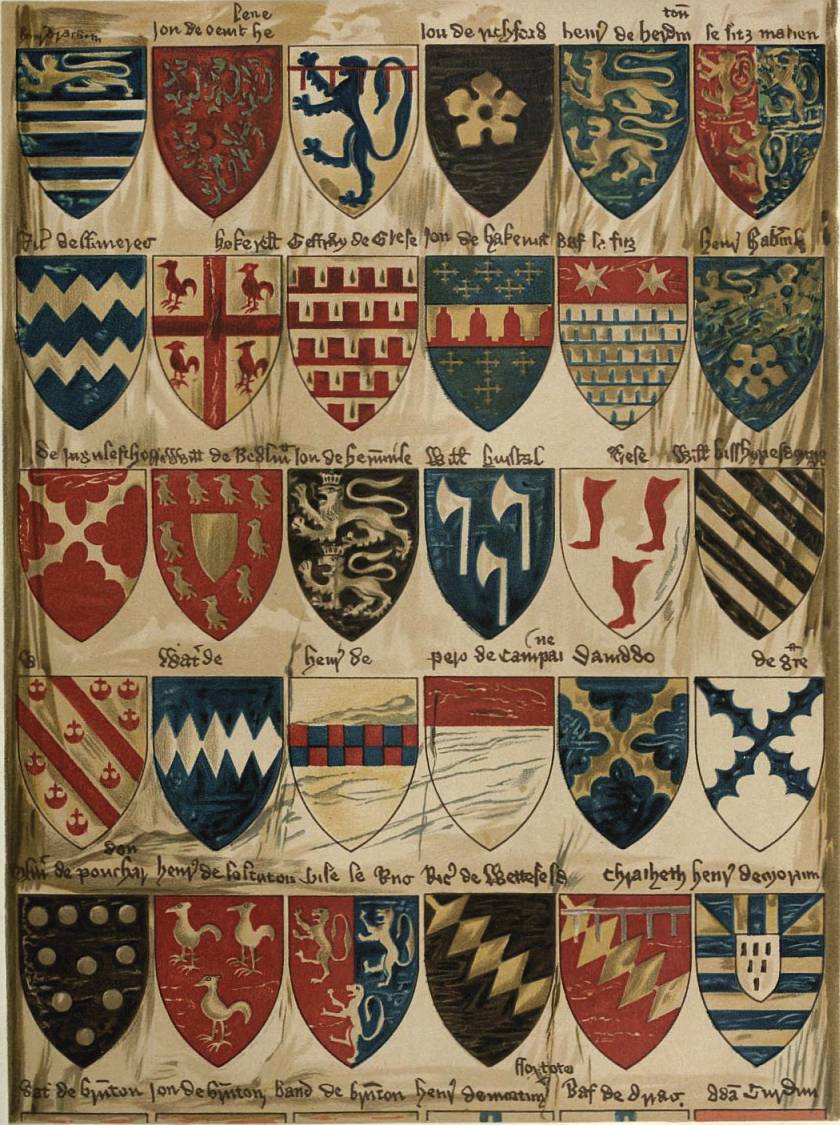
PART OF A ROLL OF ARMS PAINTED IN ENGLAND AT THE BEGINNING OF THE 14TH CENTURY. THE NAMES HAVE BEEN ADDED BY A SOMEWHAT LATER HAND, AND ARE IN MANY CASES MISTAKEN AND MIS-SPELLED.
Drawn by William Gibb for the ENCYCLOPAEDIA BRITANNICA.
There can be little doubt that ancient armorial bearings were chosen at will by the man who bore them, many reasons guiding his choice. Crosses in plenty were taken. Old writers have asserted that these crosses commemorate the badge of the crusaders, yet the fact that the cross was the symbol of the faith was reason enough. No symbolism can be found in such charges as bends and fesses; they are on the shield because a broad band, aslant or athwart, is a charge easily recognized. Medieval wisdom gave every noble and magnanimous quality to the lion, and therefore this beast is chosen by hundreds of knights as their bearing. We have already seen how the arms of a Candavène play upon his name. Such an example was imitated on all sides. Salle of Bedfordshire has two salamanders saltirewise; Belet has his namesake the weasel. In ancient shields almost all beasts and birds other than the lion and the eagle play upon the bearer’s name. No object is so humble that it is unwelcome to the knight seeking a pun for his shield. Trivet has a three-legged trivet; Trumpington two trumps; and Montbocher three pots. The legends which assert that certain arms were “won in the Holy Land” or granted by ancient kings for heroic deeds in the field are for the most part worthless fancies.
Tenants or neighbours of the great feudal lords were wont to make their arms by differencing the lord’s shield or by bringing some charge of it into their own bearings. Thus a group of Kentish shields borrow lions from that of Leyborne, which is azure with six lions of silver. Shirland of Minster bore the same arms differenced with an ermine quarter. Detling had the silver lions in a sable field. Rokesle’s lions are azure in a golden field with a fesse of gules between them; while Wateringbury has six sable lions in a field of silver, and Tilmanstone six ermine lions in a field of azure. The Vipont ring or annelet is in several shields of Westmorland knights, and the cheverons of Clare, the cinquefoil badge of Beaumont and the sheaves of Chester can be traced in the coats of many of the followers of those houses. Sometimes the lord himself set forth such arms in a formal grant, as when the baron of Greystock grants to Adam of Blencowe a shield in which his own three chaplets are charges. The Whitgreave family of Staffordshire still show a shield granted to their ancestor in 1442 by the earl of Stafford, in which the Stafford red cheveron on a golden field is four times repeated.
Differences.—By the custom of the middle ages the “whole coat,” which is the undifferenced arms, belonged to one man only and was inherited whole only by his heirs. Younger branches differenced in many ways, following no rule. In modern armory the label is reckoned a difference proper only to an eldest son. But in older times, although the label was very commonly used by the son and heir apparent, he often chose another distinction during his father’s lifetime, while the label is sometimes found upon the shields of younger sons. Changing the colours or varying the number of charges, drawing a bend or baston over the shield or adding a border are common differences of cadet lines. Beauchamp, earl of Warwick, bore “Gules with a fesse and six crosslets gold.” His cousins are seen changing the crosslets for martlets or for billets. Bastards difference their father’s arms, as a rule, in no more striking manner than the legitimate cadets. Towards the end of the 14th century we have the beginning of the custom whereby certain bastards of princely houses differenced the paternal arms by charging them upon a bend, a fesse or a chief, a cheveron or a quarter. Before his legitimation the eldest son of John of Gaunt by Katharine Swinford is said to have borne a shield party silver and azure with the arms of Lancaster on a bend. After his legitimation in 1397 he changed his bearings to the royal arms of France and England within a border gobony of silver and azure. Warren of Poynton, descended from the last earl Warenne and his concubine, Maude of Neirford, bore the checkered shield of Warenne with a quarter charged with the ermine lion of Neirford. By the end of the middle ages the baston under continental influence tended to become a bastard’s difference in England and the jingle of the two words may have helped to support the custom. About the same time the border gobony began to acquire a like character. The “bar sinister” of the novelists is probably the baston sinister, with the ends couped, which has since the time of Charles II. been familiar on the arms of certain descendants of the royal house. But it has rarely been seen in England over other shields; and, although the border gobony surrounds the arms granted to a peer of Victorian creation, the modern heralds have fallen into the habit of assigning, in nineteen cases out of twenty, a wavy border as the standard difference for illegitimacy.
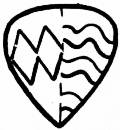
Shield from seal of Robert de Pinkeny, an early example of parted arms.
Although no general register of arms was maintained it is remarkable that there was little conflict between persons who had chanced to assume the same arms. The famous suit in which Scrope, Grosvenor and Carminow all claimed the blue shield with the golden bend is well known, and there are a few cases in the 14th century of like disputes which were never carried to the courts. But the men of the middle ages would seem to have had marvellous memories for blazonry; and we know that rolls of arms for reference, some of them the records of tournaments, existed in great numbers. A few examples of these remain to us, with painted shields or descriptions in French blazon, some of them containing many hundreds of names and arms.
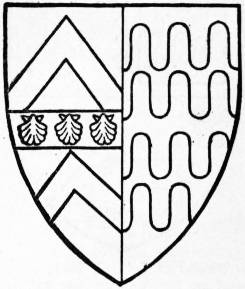
Shield of Joan atte Pole, widow of Robert of Hemenhale, from her seal (1403), showing parted arms.
To women were assigned, as a rule, the undifferenced arms of their fathers. In the early days of armory married women—well-born spinsters of full age were all but unknown outside the walls of religious houses—have seals on which appear the shield of the husband or the father or both shields side by side. But we have some instances of the shield in which two coats of arms are parted or, to use the modern phrase, “impaled.” Early in the reign of King John, Robert de Pinkeny seals with a parted shield. On the right or dexter side—the right hand of a shield is at the right hand of the person covered by it—are two fusils of an indented fesse: on the left or sinister side are three waves. The arms of Pinkeny being an indented fesse, we may see in this shield the parted arms of husband and wife—the latter being probably a Basset. In many of the earliest examples, as in this, the dexter half of the husband’s shield was united with the sinister half of that of the wife, both coats being, as modern antiquaries have it, dimidiated. This “dimidiation,” however, had its inconvenience. With some coats it was impossible. If the wife bore arms with a quarter for the only charge, her half of the shield would be blank. Therefore the practice was early abandoned by the majority of bearers of parted shields although there is a survival of it in the fact that borders and tressures continue to be “dimidiated” in order that the charges within them shall not be cramped. Parted shields came into common use from the reign of Edward II., and the rule is established that the husband’s arms should take the dexter side. There are, however, several instances of the contrary practice. On the seal (1310) of Maude, wife of John Boutetort of Halstead, the engrailed saltire of the Boutetorts takes the sinister place. A twice-married woman would sometimes show a shield charged with her paternal arms between those of both of her husbands, as did Beatrice Stafford in 1404, while in 1412 Elizabeth, Lady of Clinton, seals with a shield paled with five coats—her arms of la Plaunche between those of four husbands. In most cases the parted shield is found on the wife’s seal alone. Even in our own time it is recognized that the wife’s arms should not appear upon the husband’s official seal, upon his banner or surcoat or upon his shield when it is surrounded by the collar of an order. Parted arms, it may be noted, do not always represent a husband and wife. Richard II. parted with his quartered arms of France and England those ascribed to Edward the Confessor, and parting is often used on the continent where quartering would serve in England. In 1497 the seal of Giles Daubeney and Reynold Bray, fellow justices in eyre, shows their arms parted in one shield. English bishops, by a custom begun late in the 14th century, part the see’s arms with their own. By modern English custom a husband and wife, where the wife is not an heir, use the parted coat on a shield, a widow bearing the same upon the lozenge on which, when a spinster, she displayed her father’s coat alone. When the wife is an heir, her arms are now borne in a little scocheon above those of her husband. If the husband’s arms be in an unquartered shield the central charge is often hidden away by this scocheon.
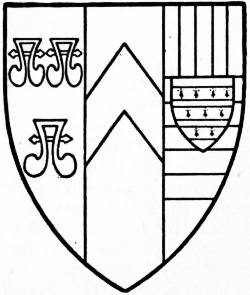
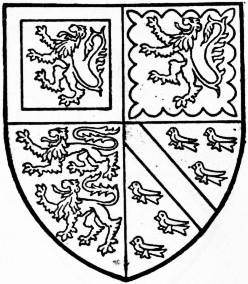
Shield of Beatrice Stafford from her seal (1404), showing her arms of Stafford between those of her husbands—Thomas, Lord Roos, and Sir Richard Burley. Shield of John Talbot, first earl of Shrewsbury (d. 1453), showing four coats quartered.
The practice of marshalling arms by quartering spread in England by reason of the example given by Eleanor, wife of Edward I., who displayed the castle of Castile quartered with the lion of Leon. Isabel of France, wife of Edward II., seals with a shield in whose four quarters are the arms of England, France, Navarre and Champagne. Early In the 14th century Simon de Montagu, an ancestor of the earls of Salisbury, quartered with his own arms a coat of azure with a golden griffon. In 1340 we have Laurence Hastings, earl of Pembroke, quartering with the Hastings arms the arms of Valence, as heir of his great-uncle Aymer, earl of Pembroke. In the preceding year the king had already asserted his claim to another kingdom by quartering France with England, and after this quartered shields became common in the great houses whose sons were carefully matched with heirs female. When the wife was an heir the husband would quarter her arms with his own, displaying, as a rule, the more important coat in the first quarter. Marshalling becomes more elaborate with shields showing both quarterings and partings, as in the seal (1368) of Sibil Arundel, where Arundel (Fitzalan) is quartered with Warenne and parted with the arms of Montagu. In all, save one, of these examples the quartering is in its simplest form, with one coat repeated in the first and fourth quarters of the shield and another in the second and third. But to a charter of 1434 Sir Henry Bromflete sets a seal upon which Bromflete quarters Vesci in the second quarter, Aton in the third and St John in the fourth, after the fashion of the much earlier seal of Edward II.’s queen. Another development is that of what armorists style the “grand quarter,” a quarter which is itself quartered, as in the shield of Reynold Grey of Ruthyn, which bears Grey in the first and fourth quarters and Hastings quartered with Valence in the third and fourth. Humphrey Bourchier, Lord Cromwell, in 1469, bears one grand quarter quartered with another, the first having Bourchier and Lovaine, the second Tatershall and Cromwell.
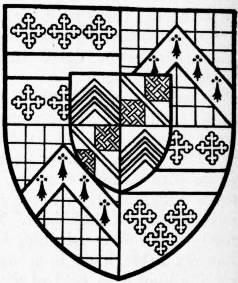
Shield of Richard Beauchamp, earl of Warwick, from his garter stall-plate (after 1423). The arms are Beauchamp quartering Newburgh, with a scocheon of Clare quartering Despenser.
The last detail to be noted in medieval marshalling is the introduction into the shield of another surmounting shield called by old armorists the “innerscocheon” and by modern blazoners the “inescutcheon.” John the Fearless, count of Flanders, marshalled his arms in 1409 as a quartered shield of the new and old coats of Burgundy. Above these coats a little scocheon, borne over the crossing of the quartering lines, had the black lion of Flanders, the arms of his mother. Richard Beauchamp, the adventurous earl of Warwick, who had seen most European courts during his wanderings, may have had this shield in mind when, over his arms of Beauchamp quartering Newburgh, he set a scocheon of Clare quartering Despenser, the arms of his wife Isabel Despenser, co-heir of the earls of Gloucester. The seal of his son-in-law, the King-Maker, shows four quarters—Beauchamp quartering Clare, Montagu quartering Monthermer, Nevill alone, and Newburgh quartering Despenser. An interesting use of the scocheon en surtout is that made by Richard Wydvile, Lord Rivers, whose garter stall-plate has a grand quarter of Wydvile and Prouz quartering Beauchamp of Hache, the whole surmounted by a scocheon with the arms of Reviers or Rivers, the house from which he took the title of his barony. On the continent the common use of the scocheon is to bear the paternal arms of a sovereign or noble, surmounting the quarterings of his kingdoms, principalities, fiefs or seigniories. Our own prince of Wales bears the arms of Saxony above those of the United Kingdom differenced with his silver label. Marshalling takes its most elaborate form, the most removed from the graceful simplicity of the middle ages, in such shields as the “Great Arms” of the Austrian empire, wherein are nine grand quarters each marshalling in various fashions from three to eleven coats, six of the grand-quarters bearing scocheons en surtout, each scocheon ensigned with a different crown.
Crests.—The most important accessory of the arms is the crested helm. Like the arms it has its pre-heraldic history in the crests of the Greek helmets, the wings, the wild boar’s and bull’s heads of Viking headpieces. A little roundel of the arms of a Japanese house was often borne as a crest in the Japanese helmet, stepped in a socket above the middle of the brim. The 12th-century seal of Philip of Alsace, count of Flanders, shows a demi-lion painted or beaten on the side of the upper part of his helm, and on his seal of 1198 our own Richard Cœur de Lion’s barrel-helm has a leopard upon the semicircular comb-ridge, the edge of which is set off with feathers arranged as two wings. Crests, however, came slowly into use in England, although before 1250 Roger de Quincy, earl of Winchester, is seen on his seal with a wyver upon his helm. Of the long roll of earls and barons sealing the famous letter to the pope in 1301 only five show true crests on their seals. Two of them are the earl of Lancaster and his brother, each with a wyver crest like that of Quincy. One, and the most remarkable, is John St John of Halnaker, whose crest is a leopard standing between two upright palm branches. Ralph de Monthermer has an eagle crest, while Walter de Moncy’s helm is surmounted by a fox-like beast. In three of these instances the crest is borne, as was often the case, by the horse as well as the rider. Others of these seals to the barons’ letter have the fan-shaped crest without any decoration upon it. But as the furniture of tournaments grew more magnificent the crest gave a new field for display, and many strange shapes appear in painted and gilded wood, metal, leather or parchment above the helms of the jousters. The Berkeleys, great patrons of abbeys, bore a mitre as their crest painted with their arms, like crests being sometimes seen on the continent where the wearer was advocatus of a bishopric or abbey. The whole or half figures or the heads and necks of beasts and birds were employed by other families. Saracens’ heads topped many helms, that of the great Chandos among them. Astley bore for his crest a silver harpy standing in marsh-sedge, a golden chain fastened to a crown about her neck. Dymoke played pleasantly on his name with a long-eared moke’s scalp. Stanley took the eagle’s nest in which the eagle is lighting down with a swaddled babe in his claws. Burnell had a burdock bush, la Vache a cow’s leg, and Lisle’s strange fancy was to perch a huge millstone on edge above his head. Many early helms, as that of Sir John Loterel, painted in the Loterel psalter, repeat the arms on the sides of a fan-crest. Howard bore for a crest his arms painted on a pair of wings, while simple “bushes” or feathers are seen in great plenty. The crest of a cadet is often differenced like the arms, and thus a wyver or a leopard will have a label about its neck. The Montagu griffon on the helm of John, marquess of Montagu, holds in its beak the gimel ring with which he differenced his father’s shield. His brother, the King-Maker, following a custom commoner abroad than at home, shows two crested helms on his seal, one for Montagu and one for Beauchamp—none for his father’s house of Nevill. It is often stated that a man, unless by some special grace or allowance, can have but one crest. This, however, is contrary to the spirit of medieval armory in which a man, inheriting the coat of arms of another house than his own, took with it all its belongings, crest, badge and the like. The heraldry books, with more reason, deny crests to women and to the clergy, but examples are not wanting of medieval seals in which even this rule is broken. It is perhaps unfair to cite the case of the bishops of Durham who ride in full harness on their palatinate seals; but Henry Despenser, bishop of Norwich, has a helm on which the winged griffon’s head of his house springs from a mitre, while Alexander Nevill, archbishop of York, seals with shield, supporters and crowned and crested helm like those of any lay magnate. Richard Holt, a Northamptonshire clerk in holy orders, bears on his seal in the reign of Henry V. a shield of arms and a mantled helm with the crest of a collared greyhound’s head. About the middle of the same century a seal cut for the wife of Thomas Chetwode, a Cheshire squire, has a shield of her husband’s arms parted with her own and surmounted by a crowned helm with the crest of a demi-lion; and this is not the only example of such bearings by a woman.
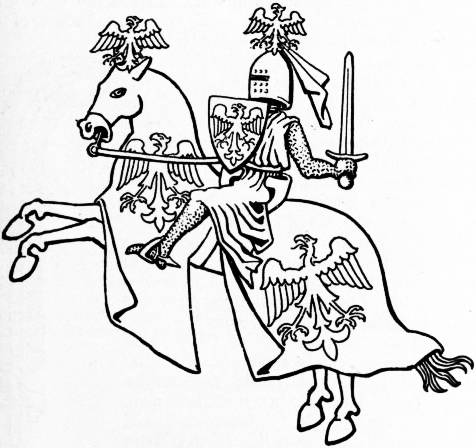
Ralph de Monthermer (1301), showing shield of arms, helm with crest and mantle, horse-crest and armorial trappers.
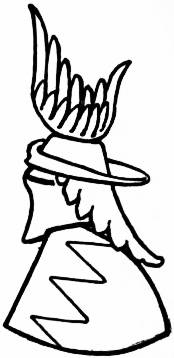
Shield and crested helm with hat and mantle of Thomas of Hengrave (1401).
Before passing from the crest let us note that in England the juncture of crest and helm was commonly covered, especially after the beginning of the 15th century, by a torse or “wreath” of silk, twisted with one, two or three colours. Coronets or crowns and “hats of estate” often take the place of the wreath as a base for the crest, and there are other curious variants. With the wreath may be considered the mantle, a hanging cloth which, in its earliest form, is seen as two strips of silk or sendal attached to the top of the helm below the crest and streaming like pennants as the rider bent his head and charged. Such strips are often displayed from the conical top of an uncrested helm, and some ancient examples have the air of the two ends of a stole or of the infulae of a bishop’s mitre. The general opinion of antiquaries has been that the mantle originated among the crusaders as a protection for the steel helm from the rays of an Eastern sun; but the fact that mantles take in England their fuller form after our crusading days were over seems against this theory. When the fashion for slittering the edges of clothing came in, the edges of the mantle were slittered like the edge of the sleeve or skirt, and, flourished out on either side of the helm, it became the delight of the painter of armories and the seal engraver. A worthless tale, repeated by popular manuals, makes the slittered edge represent the shearing work of the enemy’s sword, a fancy which takes no account of the like developments in civil dress. Modern heraldry in England paints the mantle with the principal colour of the shield, lining it with the principal metal. This in cases where no old grant of arms is cited as evidence of another usage. The mantles of the king and of the prince of Wales are, however, of gold lined with ermine and those of other members of the royal house of gold lined with silver. In ancient examples there is great variety and freedom. Where the crest is the head of a griffon or bird the feathering of the neck will be carried on to cover the mantle. Other mantles will be powdered with badges or with charges from the shield, others checkered, barred or paled. More than thirty of the mantles enamelled on the stall-plates of the medieval Garter-knights are of red with an ermine lining, tinctures which in most cases have no reference to the shields below them.
Supporters.—Shields of arms, especially upon seals, are sometimes figured as hung round the necks of eagles, lions, swans and griffons, as strapped between the horns of a hart or to the boughs of a tree. Badges may fill in the blank spaces at the sides between the shield and the inscription on the rim, but in the later 13th and early 14th centuries the commonest objects so serving are sprigs of plants, lions, leopards, or, still more frequently, lithe-necked wyvers. John of Segrave in 1301 flanks his shields with two of the sheaves of the older coat of Segrave: William Marshal of Hingham does the like with his two marshal’s staves. Henry of Lancaster at the same time shows on his seal a shield and a helm crested with a wyver, with two like wyvers ranged on either side of the shield as “supporters.” It is uncertain at what time in the 14th century these various fashions crystallize into the recognized use of beasts, birds, reptiles, men or inanimate objects, definitely chosen as “supporters” of the shield, and not to be taken as the ornaments suggested by the fancy of the seal engraver. That supporters originate in the decoration of the seal there can be little doubt. Some writers, the learned Menêtrier among them, will have it that they were first the fantastically clad fellows who supported and displayed the knight’s shield at the opening of the tournament. If the earliest supporters were wild men, angels or Saracens, this theory might be defended; but lions, boars and talbots, dogs and trees are guises into which a man would put himself with difficulty. By the middle of the 14th century we find what are clearly recognizable as supporters. These, as in a lesser degree the crest, are often personal rather than hereditary, being changed generation by generation. The same person is found using more than one pair of them. The kings of France have had angels as supporters of the shield of the fleurs de lys since the 15th century, but the angels have only taken their place as the sole royal supporters since the time of Louis XIV. Sovereigns of England from Henry IV. to Elizabeth changed about between supporters of harts, leopards, antelopes, bulls, greyhounds, boars and dragons. James I. at his accession to the English throne brought the Scottish unicorn to face the English leopard rampant across his shield, and, ever since, the “lion and unicorn” have been the royal supporters.
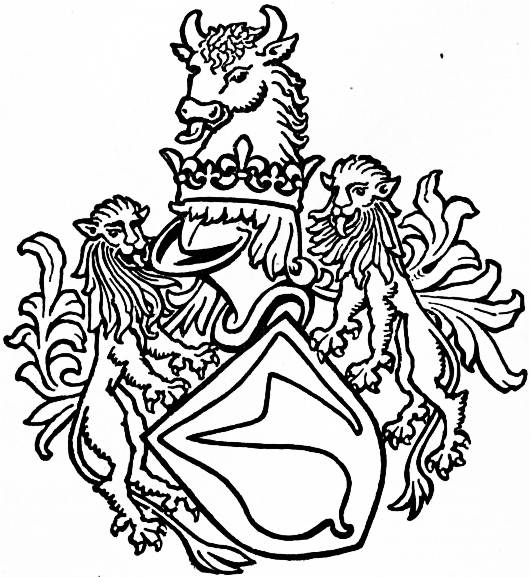
Arms of William, Lord Hastings, from his seal (1477), showing shield, crowned and crested helm with mantle and supporters.
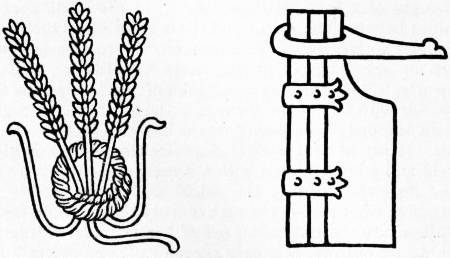
Badge of John of Whethamstede, abbot of St Albans (d. 1465), from his tomb in the abbey church. Rudder badge of Willoughby.
An old herald wrote as his opinion that “there is little or nothing in precedent to direct the use of supporters.” Modern custom gives them, as a rule, only to peers, to knights of the Garter, the Thistle and St Patrick, and to knights who are “Grand Crosses” or Grand Commanders of other orders. Royal warrants are sometimes issued for the granting of supporters to baronets, and, in rare cases, they have been assigned to untitled persons. But in spite of the jealousy with which official heraldry hedges about the display of these supporters once assumed so freely, a few old English families still assert their right by hereditary prescription to use these ornaments as their forefathers were wont to use them.
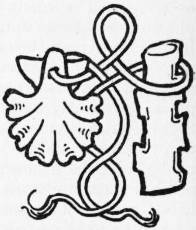
Badge of Dacre of Gilsland and Dacre of the North.
Badges.—The badge may claim a greater antiquity and a wider use than armorial bearings. The “Plantagenet” broom is an early example in England, sprigs of it being figured on the seal of Richard I. In the 14th and 15th centuries every magnate had his badge, which he displayed on his horse-furniture, on the hangings of his bed, his wall and his chair of state, besides giving it as a “livery” to his servants and followers. Such were the knots of Stafford, Bourchier and Wake, the scabbard-crampet of La Warr, the sickle of Hungerford, the swan of Toesni, Bohun and Lancaster, the dun-bull of Nevill, the blue boar of Vere and the bear and ragged staff of Beauchamp, Nevill of Warwick and Dudley of Northumberland. So well known of all were these symbols that a political ballad of 1449 sings of the misfortunes of the great lords without naming one of them, all men understanding what signified the Falcon, the Water Bowge and the Cresset and the other badges of the doggerel. More famous still were the White Hart, the Red Rose, the White Rose, the Sun, the Falcon and Fetterlock, the Portcullis and the many other badges of the royal house. We still call those wars that blotted out the old baronage the Wars of the Roses, and the Prince of Wales’s feathers are as well known to-day as the royal arms. The Flint and Steel of Burgundy make a collar for the order of the Golden Fleece.