VOLUME XII SLICE III Helmont, Jean to Hernösand (continued 2)
Reading edition
Homoptera
This sub-order includes the cicads, lantern-flies, frog-hoppers, aphids and scale-insects. The face has such a marked backward slope (see fig. 1) as to bring the beak into close contact with the haunches of the fore-legs. The feelers have one or more thickened basal segments, while the remaining segments are slender and thread-like. The fore-wings are sometimes membranous like the hind-wings, usually they are firmer in texture, but they never show the distinct areas that characterize the wings of Heteroptera. When at rest the wings of Homoptera slope roofwise across the back of the insect. In their life-history the Homoptera are more specialized than the Heteroptera; the young insect often differs markedly from its parent and does not live in the same situations; while in some families there is a passive stage before the last moult.
After Weed, Riley and Howard, Insect Life, vol iii.
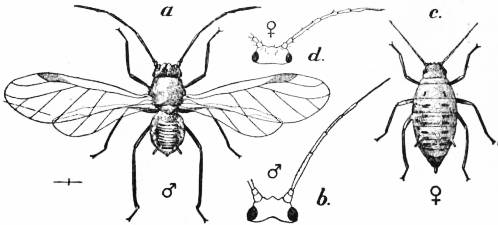
Fig. 11.—Cabbage Aphid (Aphisbrassicae). a, Male; c, female (wingless). Magnified. b and d, Head and feelers of male and female, more highly magnified.
After Howard, Year Book U.S. Dept. Agr., 1894.
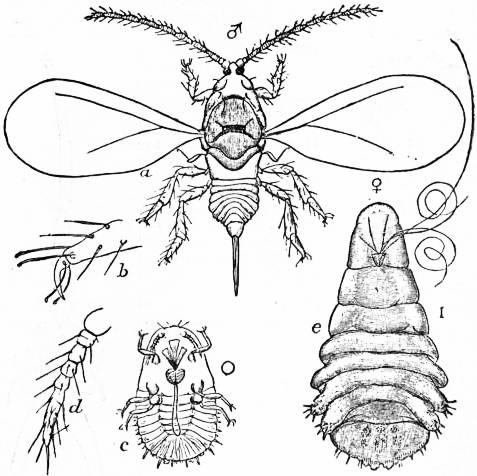
Fig. 12.—Apple Scale Insect (Mytilaspis pomorum). a, Male; e, female; c, larva magnified—; b, foot of male; d, feeler of larva, more highly magnified.
The Cicadidae are for the most part large insects with ample wings; they are distinguished from other Homoptera by the front thighs being thickened and toothed beneath. The broad head carries, in addition to the prominent compound eyes, three simple eyes (ocelli) on the crown, while the feeler consists of a stout basal segment, followed by five slender segments. The female, by means of her serrated ovipositor, lays her eggs in slits cut in the twigs of plants. The young have simple feelers and stout fore-legs (fig. 10) adapted for digging; they live underground and feed on the roots of plants. In the case of a North American species it is known that this larval life lasts for seventeen years. The “song” of the male cicads is notorious and the structures by which it is produced have already been described (see also Cicada). There are about 900 known species, but the family is mostly confined to warm countries; only a single cicad is found in England, and that is restricted to the south.
After Howard, Year Book U.S. Dept. Agr., 1894.
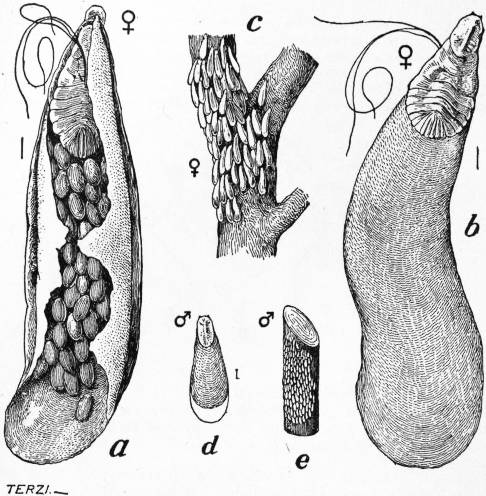
Fig. 13.—Apple Scale Insect (Mytilaspis pomorum). a, Scale from beneath showing female and eggs; b, from above, magnified—; c and e, female and male scales on twigs, natural size; d, male scale magnified.
From Osborn (after Denny), Bull. 5 (N.S.), Div. Ent. U.S. Dept. Agr.
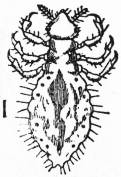
Fig. 14.—Louse (Pediculus vestimenti). Magnified.
The Fulgoridae and Membracidae are two allied families most of whose members are also natives of hot regions. The Fulgoridae have the head with two ocelli and three-segmented feelers; frequently as in the tropical “lantern-flies” (q.v.) the head is prolonged into a conspicuous bladder, or trunk-like process. The Membracidae are remarkable on account of the backward prolongation of the pronotum into a process or hood-like structure which may extend far behind the tail-end of the abdomen. Two other allied families, the Cercopidae and Jassidae, are more numerously represented in our islands. The young of many of these insects are green and soft-skinned, protecting themselves by the well-known frothy secretion that is called “cuckoo-spit.”
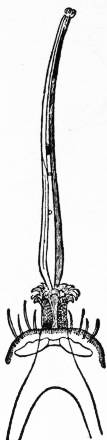
From Osborn (after Schiödte), Bull. 5; (N.S.), Div. Ent. U.S. Dept. Agr.
Fig. 15.—Proboscis of Pediculus. Highly magnified.
In all the above-mentioned families of Homoptera there are three segments in each foot. The remaining four families have feet with only two segments. They are of very great zoological interest on account of the peculiarities of their life-history—parthenogenesis being of normal occurrence among most of them. The families Psyllidae (or “jumpers”) with eight or ten segments in the feeler and the Aleyrodidae (or “snowy-flies”) distinguished by their white mealy wings, are of comparatively slight importance. The two families to which special attention has been paid are the Aphidae or plant-lice (“green fly”) and the Coccidae or scale-insects. The aphids (fig. 11) have feelers with seven or fewer distinct segments, and the fifth abdominal segment usually carries a pair of tubular processes through which a waxy secretion is discharged. The sweet “honey-dew,” often sought as a food by ants, is secreted from the intestines of aphids. The peculiar life-cycle in which successive generations are produced through the summer months by virgin females—the egg developing within the body of the mother—is described at length in the articles Aphides and Phylloxera. The Coccidae have only a single claw to the foot; the males (fig. 12 a) have the fore-wings developed and the hind-wings greatly reduced, while in the female wings are totally absent and the body undergoes marked degradation (figs. 12, e, 13, a, b). In the Coccids the formation of a protective waxy secretion—present in many genera of Homoptera—reaches its most extreme development. In some coccids—the “mealy-bugs” (Dactylopius, &c.) for example—the secretion forms a white thread-like or plate-like covering which the insect carries about. But in most members of the family, the secretion, united with cast cuticles and excrement, forms a firm “scale,” closely attached by its edges to the surface of the plant on which the insect lives, and serving as a shield beneath which the female coccid, with her eggs (fig. 13 a) and brood, finds shelter. The male coccid passes through a passive stage (fig. 4) before attaining the perfect condition. Many scale-insects are among the most serious of pests, but various species have been utilized by man for the production of wax (lac) and red dye (cochineal). See Economic Entomology, Scale-Insect.
Anoplura
The Anoplura or lice (see Louse) are wingless parasitic insects (fig. 14) forming an order distinct from the Hemiptera, their sucking and piercing mouth-organs being apparently formed on quite a different plan from those of the Heteroptera and Homoptera. In front of the head is a short tube armed with strong recurved hooks which can be fixed into the skin of the host, and from the tube an elongate more slender sucking-trunk can be protruded (fig. 15). Each foot is provided with a single strong claw which, opposed to a process on the shin, serves to grasp a hair of the host, all the lice being parasites on different mammals. Although G. Enderlein has recently shown that the jaws of the Hemiptera can be recognized in a reduced condition in connexion with the louse’s proboscis, the modification is so excessive that the group certainly deserves ordinal separation.
Bibliography.—A recent standard work on the morphology of the Hemiptera by R. Heymons (Nova Acta Acad. Leop. Carol. lxxiv. 3, 1899) contains numerous references to older literature. An excellent survey of the order is given by D. Sharp (Cambridge Nat. Hist. vol. vi., 1898). For internal structure of Heteroptera see R. Dufour, Mem. savans étrangers (Paris, iv., 1833); of Homoptera, E. Witlaczil (Arb. Zool. Inst. Wien, iv., 1882, Zeits. f. wiss. Zool. xliii., 1885). The development of Aphids has been dealt with by T. H. Huxley (Trans. Linn. Soc. xxii., 1858) and E. Witlaczil (Zeits. f. wiss. Zool. xl., 1884). Fossil Hemiptera are described by S. H. Scudder in K. Zittel’s Paléontologie (French translation, vol. ii. Paris, 1887, and English edition, vol. i., London, 1900), and by A. Handlirsch (Verh. zool. bot. Gesell. Wien, lii., 1902). Among general systematic works on Heteroptera may be mentioned J. C. Schiödte (Ann. Mag. Nat. Hist. (4) vi., 1870); C. Stal’s Enumeratio Hemipterorum (K. Svensk. Vet. Akad. Handl. ix.-xiv., 1870-1876); L. Lethierry and G. Severin’s Catalogue générale des hémiptères (Brussels 1893, &c.); G. C. Champion’s volumes in the Biologia Centrali-Americana; W. L. Distant’s Oriental Cicadidae (London, 1889-1892), and many other papers; M. E. Fernald’s Catalogue of the Coccidae (Amherst, U.S.A., 1903). European Hemiptera have been dealt with in numerous papers by A. Puton. For British species we have E. Saunders’s Hemiptera-Heteroptera of the British Isles (London, 1892); J. Edwards’s Hemiptera-Homoptera of the British Isles (London, 1896); J. B. Buckton’s British Aphidae (London, Ray Society, 1875-1882); and R. Newstead’s British Coccidae (London, Ray Society, 1901-1903). Aquatic Hemiptera are described by L. C. Miall (Nat. History Aquatic Insects; London, 1895), and by G. W. Kirkaldy in numerous recent papers (Entomologist, &c.). For marine Hemiptera (Halobates) see F. B. White (Challenger Reports, vii., 1883); J. J. Walker (Ent. Mo. Mag., 1893); N. Nassonov (Warsaw, 1893), and G. H. Carpenter (Knowledge, 1901, and Report, Pearl Oyster Fisheries, Royal Society, 1906). Sound-producing organs of Heteroptera are described by A. Handlirsch (Ann. Hofmus. Wien, xv. 1900), and G. W. Kirkaldy (Journ. Quekett Club (2) viii. 1901); of Cicads by G. Carlet (Ann. Sci. Nat. Zool. (6) v. 1877). For the Anoplura see E. Piaget’s Pediculines (Leiden, 1880-1905), and G. Enderlein (Zool. Anz. xxviii., 1904).
(G. H. C.)
HEMLOCK (in O. Eng. hemlic or hymlice; no cognate is found in any other language, and the origin is unknown), the Conium maculatum of botanists, a biennial umbelliferous plant, found wild in many parts of Great Britain and Ireland, where it occurs in waste places on hedge-banks, and by the borders of fields, and also widely spread over Europe and temperate Asia, and naturalized in the cultivated districts of North and South America. It is an erect branching plant, growing from 3 to 6 ft. high, and emitting a disagreeable smell, like that of mice. The stems are hollow, smooth, somewhat glaucous green, spotted with dull dark purple, as alluded to in the specific name, maculatum. The root-leaves have long furrowed footstalks, sheathing the stem at the base, and are large, triangular in outline, and repeatedly divided or compound, the ultimate and very numerous segments being small, ovate, and deeply incised at the edge. These leaves generally perish after the growth of the flowering stem, which takes place in the second year, while the leaves produced on the stem became gradually smaller upwards. The branches are all terminated by compound many-rayed umbels of small white flowers, the general involucres consisting of several, the partial ones of about three short lanceolate bracts, the latter being usually turned towards the outside of the umbel. The flowers are succeeded by broadly ovate fruits, the mericarps (half-fruits) having five ribs which, when mature, are waved or crenated; and when cut across the albumen is seen to be deeply furrowed on the inner face, so as to exhibit in section a reniform outline. The fruits when triturated with a solution of caustic potash evolve a most unpleasant odour.
Hemlock is a virulent poison, but it varies much in potency according to the conditions under which it has grown, and the season or stage of growth at which it is gathered. In the first year the leaves have little power, nor in the second are their properties developed until the flowering period, at which time, or later on when the fruits are fully grown, the plant should be gathered. The wild plant growing in exposed situations is to be preferred to garden-grown samples, and is more potent in dry warm summers than in those which are dull and moist.
The poisonous property of hemlock resides chiefly in the alkaloid conine or conia which is found in both the fruits and the leaves, though in exceedingly small proportions in the latter. Conine resembles nicotine in its deleterious action, but is much less powerful. No chemical antidote for it is known. The plant also yields a second less poisonous crystallizable base called conhydrine, which may be converted into conine by the abstraction of the elements of water. When collected for medicinal purposes, for which both leaves and fruits are used, the former should be gathered at the time the plant is in full blossom, while the latter are said to possess the greatest degree of energy just before they ripen. The fruits are the chief source whence conine is prepared. The principal forms in which hemlock is employed are the extract and juice of hemlock, hemlock poultice, and the tincture of hemlock fruits. Large doses produce vertigo, nausea and paralysis; but in smaller quantities, administered by skilful hands, it has a sedative action on the nerves. It has also some reputation as an alterative and resolvent, and as an anodyne.
The acrid narcotic properties of the plant render it of some importance that one should be able to identify it, the more so as some of the compound-leaved umbellifers, which have a general similarity of appearance to it, form wholesome food for man and animals. Not only is this knowledge desirable to prevent the poisonous plant being detrimentally used in place of the wholesome one; it is equally important in the opposite case, namely, to prevent the inert being substituted for the remedial agent. The plant with which hemlock is most likely to be confounded is Anthriscus sylvestris, or cow-parsley, the leaves of which are freely eaten by cattle and rabbits; this plant, like the hemlock, has spotted stems but they are hairy, not hairless; it has much-divided leaves of the same general form, but they are downy and aromatic, not smooth and nauseous when bruised; and the fruit of Anthriscus is linear-oblong and not ovate.
HEMP (in O. Eng. henep, cf. Dutch hennep, Ger. Hanf, cognate with Gr. κάνναβις, Lat. cannabis), an annual herb (Cannabis sativa) having angular rough stems and alternate deeply lobed leaves. The bast fibres of Cannabis are the hemp of commerce, but, unfortunately, the products from many totally different plants are often included under the general name of hemp. In some cases the fibre is obtained from the stem, while in others it comes from the leaf. Sunn hemp, Manila hemp, Sisal hemp, and Phormium (New Zealand flax, which is neither flax nor hemp) are treated separately. All these, however, are often classed under the above general name, and so are the following:—Deccan or Ambari hemp, Hibiscus cannabinus, an Indian and East Indian malvaceous plant, the fibre from which is often known as brown hemp or Bombay hemp; Pité hemp, which is obtained from the American aloe, Agave americana; and Moorva or bowstring-hemp, Sansevieria zeylanica, which is obtained from an aloe-like plant, and is a native of India and Ceylon. Then there are Canada hemp, Apocynum cannabinum, Kentucky hemp, Urtica cannabina, and others.
The hemp plant, like the hop, which is of the same natural order, Cannabinaceae, is dioecious, i.e. the male and female flowers are borne on separate plants. The female plant grows to a greater height than the male, and its foliage is darker and more luxuriant, but the plant takes from five to six weeks longer to ripen. When the male plants are ripe they are pulled, put up into bundles, and steeped in a similar manner to flax, but the female plants are allowed to remain until the seed is perfectly ripe. They are then pulled, and after the seed has been removed are retted in the ordinary way. The seed is also a valuable product; the finest is kept for sowing, a large quantity is sold for the food of cage birds, while the remainder is sent to the oil mills to be crushed. The extracted oil is used in the manufacture of soap, while the solid remains, known as oil-cake, are valuable as a food for cattle. The leaves of hemp have five to seven leaflets, the form of which is lanceolate-acuminate, with a serrate margin. The loose panicles of male flowers, and the short spikes of female flowers, arise from the axils of the upper leaves. The height of the plant varies greatly with season, soil and manuring; in some districts it varies from 3 to 8 ft., but in the Piedmont province it is not unusual to see them from 8 to 16 ft. in height, whilst a variety (Cannabis sativa, variety gigantea) has produced specimens over 17 ft. in height.
All cultivated hemp belongs to the same species, Cannabis sativa; the special varieties such as Cannabis indica, Cannabis chinensis, &c., owe their differences to climate and soil, and they lose many of their peculiarities when cultivated in temperate regions. Rumphius (in the 17th century) had noticed these differences between Indian and European hemp.
Wild hemp still grows on the banks of the lower Ural, and the Volga, near the Caspian Sea. It extends to Persia, the Altai range and northern and western China. The authors of the Pharmacographia say:—“It is found in Kashmir and in the Himalaya, growing 10 to 12 ft. high, and thriving vigorously at an elevation of 6000 to 10,000 ft.” Wild hemp is, however, of very little use as a fibre producer, although a drug is obtained from it.
It would appear that the native country of the hemp plant is in some part of temperate Asia, probably near the Caspian Sea. It spread westward throughout Europe, and southward through the Indian peninsula.
The names given to the plant and to its products in different countries are of interest in connexion with the utilization of the fibre and resin. In Sans. it is called goni, sana, shanapu, banga and ganjika; in Bengali, ganga; Pers. bang and canna; Arab. kinnub or cannub; Gr. kannabis; Lat. cannabis; Ital. canappa; Fr. chanvre; Span. cáñamo; Portuguese, cánamo; Russ. konópel; Lettish and Lithuanian, kannapes; Slav. konopi; Erse, canaib and canab; A. Sax. hoenep; Dutch, hennep; Ger. Hanf; Eng. hemp; Danish and Norwegian, hamp; Icelandic, hampr; and in Swed. hampa. The English word canvas sufficiently reveals its derivation from cannabis.
Very little hemp is now grown in the British Isles, although this variety was considered to be of very good quality, and to possess great strength. The chief continental hemp-producing countries are Italy, Russia and France; it is also grown in several parts of Canada and the United States and India. The Central Provinces, Bengal and Bombay are the chief centres of hemp cultivation in India, where the plant is of most use for narcotics. The satisfactory growth of hemp demands a light, rich and fertile soil, but, unlike most substances, it may be reared for a few years in succession. The time of sowing, the quantity of seed per acre (about three bushels) and the method of gathering and retting are very similar to those of flax; but, as a rule, it is a hardier plant than flax, does not possess the same pliability, is much coarser and more brittle, and does not require the same amount of attention during the first few weeks of its growth.
The very finest hemp, that grown in the province of Piedmont, Italy, is, however, very similar to flax, and in many cases the two fibres are mixed in the same material. The hemp fibre has always been valuable for the rope industry, and it was at one time very extensively used in the production of yarns for the manufacture of sail cloth, sheeting, covers, bagging, sacking, &c. Much of the finer quality is still made into cloth, but almost all the coarser quality finds its way into ropes and similar material.
A large quantity of hemp cloth is still made for the British navy. The cloth, when finished, is cut up into lengths, made into bags and tarred. They are then used as coal sacks. There is also a quantity made into sacks which are intended to hold very heavy material. Hemp yarns are also used in certain classes of carpets, for special bags for use in cop dyeing and for similar special purposes, but for the ordinary bagging and sacking the employment of hemp yarns has been almost entirely supplanted by yarns made from the jute fibre.
Hemp is grown for three products—(1) the fibre of its stem; (2) the resinous secretion which is developed in hot countries upon its leaves and flowering heads; (3) its oily seeds.
Hemp has been employed for its fibre from ancient times. Herodotus (iv. 74) mentions the wild and cultivated hemp of Scythia, and describes the hempen garments made by the Thracians as equal to linen in fineness. Hesychius says the Thracian women made sheets of hemp. Moschion (about 200 B.C.) records the use of hempen ropes for rigging the ship “Syracusia” built for Hiero II. The hemp plant has been cultivated in northern India from a considerable antiquity, not only as a drug but for its fibre. The Anglo-Saxons were well acquainted with the mode of preparing hemp. Hempen cloth became common in central and southern Europe in the 13th century.
Hemp-resin.—Hemp as a drug or intoxicant for smoking and chewing occurs in the three forms of bhang, ganja and charas.
1. Bhang, the Hindustani siddhi or sabzi, consists of the dried leaves and small stalks of the hemp; a few fruits occur in it. It is of a dark brownish-green colour, and has a faint peculiar odour and but a slight taste. It is smoked with or without tobacco; or it is made into a sweetmeat with honey, sugar and aromatic spices; or it is powdered and infused in cold water, yielding a turbid drink, subdschi. Hashish is one of the Arabic names given to the Syrian and Turkish preparations of the resinous hemp leaves. One of the commonest of these preparations is made by heating the bhang with water and butter, the butter becoming thus charged with the resinous and active substances of the plant.
2. Ganja, the guaza of the London brokers, consists of the flowering and fruiting heads of the female plant. It is brownish-green, and otherwise resembles bhang, as in odour and taste. Some of the more esteemed kinds of hashish are prepared from this ganja. Ganja is met with in the Indian bazaars in dense bundles of 24 plants or heads apiece. The hashish in such extensive use in Central Asia is often seen in the bazaars of large cities in the form of cakes, 1 to 3 in. thick, 5 to 10 in. broad and 10 to 15 in. long.
3. Charas, or churrus, is the resin itself collected, as it exudes naturally from the plant, in different ways. The best sort is gathered by the hand like opium; sometimes the resinous exudation of the plant is made to stick first of all to cloths, or to the leather garments of men, or even to their skin, and is then removed by scraping, and afterwards consolidated by kneading, pressing and rolling. It contains about one-third or one-fourth its weight of the resin. But the churrus prepared by different methods and in different countries differs greatly in appearance and purity. Sometimes it takes the form of egg-like masses of greyish-brown colour, having when of high quality a shining resinous fracture. Often it occurs in the form of irregular friable lumps, like pieces of impure linseed oil-cake.
The medicinal and intoxicating properties of hemp have probably been known in Oriental countries from a very early period. An ancient Chinese herbal, part of which was written about the 5th century B.C., while the remainder is of still earlier date, notices the seed and flower-bearing kinds of hemp. Other early writers refer to hemp as a remedy. The medicinal and dietetic use of hemp spread through India, Persia and Arabia in the early middle ages. The use of hemp (bhang) in India was noticed by Garcia d’Orta in 1563. Berlu in his Treasury of Drugs (1690) describes it as of “an infatuating quality and pernicious use.” Attention was recalled to this drug, in consequence of Napoleon’s Egyptian expedition, by de Sacy (1809) and Rouger (1810). Its modern medicinal use is chiefly due to trials by Dr O’Shaughnessy in Calcutta (1838-1842). The plant is grown partly and often mainly for the sake of its resin in Persia, northern India and Arabia, in many parts of Africa and in Brazil.
Pharmacology and Therapeutics.—The composition of this drug is still extremely obscure; partly, perhaps, because it varies so much in individual specimens. It appears to contain at least two alkaloids—cannabinine and tetano-cannabine—of which the former is volatile. The chief active principle may possibly be neither of these, but the substance cannabinon. There are also resins, a volatile oil and several other constituents. Cannabis indica—as the drug is termed in the pharmacopoeias—may be given as an extract (dose ¼-1 gr.) or tincture (dose 5-15 minims).
The drug has no external action. The effects of its absorption, whether it be swallowed or smoked, vary within wide limits in different individuals and races. So great is this variation as to be inexplicable except on the view that the nature and proportions of the active principles vary greatly in different specimens. But typically the drug is an intoxicant, resembling alcohol in many features of its action, but differing in others. The early symptoms are highly pleasurable, and it is for these, as in the case of other stimulants, that the drug is so largely consumed in the East. There is a subjective sensation of mental brilliance, but, as in other cases, this is not borne out by the objective results. It has been suggested that the incoordination of nervous action under the influence of Indian hemp may be due to independent and non-concerted action on the part of the two halves of the cerebrum. Following on a decided lowering of the pain and touch senses, which may even lead to complete loss of cutaneous sensation, there comes a sleep which is often accompanied by pleasant dreams. There appears to be no evidence in the case of either the lower animals or the human subject that the drug is an aphrodisiac. Excessive indulgence in cannabis indica is very rare, but may lead to general ill-health and occasionally to insanity. The apparent impossibility of obtaining pure and trustworthy samples of the drug has led to its entire abandonment in therapeutics. When a good sample is obtained it is a safe and efficient hypnotic, at any rate in the case of a European. The tincture should not be prescribed unless precautions are taken to avoid the precipitation of the resin which follows its dilution with water.
See Watt, Dictionary of the Economic Products of India.
HEMSTERHUIS, FRANÇOIS (1721-1790), Dutch writer on aesthetics and moral philosophy, son of Tiberius Hemsterhuis, was born at Franeker in Holland, on the 27th of December 1721. He was educated at the university of Leiden, where he studied Plato. Failing to obtain a professorship, he entered the service of the state, and for many years acted as secretary to the state council of the United Provinces. He died at the Hague on the 7th of July 1790. Through his philosophical writings he became acquainted with many distinguished persons—Goethe, Herder, Princess Amalia of Gallitzin, and especially Jacobi, with whom he had much in common. Both were idealists, and their works suffer from a similar lack of arrangement, although distinguished by elegance of form and refined sentiment. His most valuable contributions are in the department of aesthetics or the general analysis of feeling. His philosophy has been characterized as Socratic in content and Platonic in form. Its foundation was the desire for self-knowledge and truth, untrammelled by the rigid bonds of any particular system.
His most important works, all of which were written in French, are: Lettre sur la sculpture (1769), in which occurs the well-known definition of the Beautiful as “that which gives us the greatest number of ideas in the shortest space of time”; its continuation, Lettre sur les désirs (1770); Lettre sur l’homme et ses rapports (1772), in which the “moral organ” and the theory of knowledge are discussed; Sopyle (1778), a dialogue on the relation between the soul and the body, and also an attack on materialism; Aristée (1779), the “theodicy” of Hemsterhuis, discussing the existence of God and his relation to man; Simon (1787), on the four faculties of the soul, which are the will, the imagination, the moral principle (which is both passive and active); Alexis (1787), an attempt to prove that there are three golden ages, the last being the life beyond the grave; Lettre sur l’athéisme (1787).
The best collected edition of his works is by P. S. Meijboom (1846-1850); see also S. A. Gronemann, F. Hemsterhuis, de Nederlandische Wijsgeer (Utrecht, 1867); E. Grucker, François Hemsterhuis, sa vie et ses œuvres (Paris, 1866); E. Meyer, Der Philosoph Franz Hemsterhuis (Breslau, 1893), with bibliographical notice.
HEMSTERHUIS, TIBERIUS (1685-1766), Dutch philologist and critic, was born on the 9th of January 1685 at Groningen in Holland. His father, a learned physician, gave him so good an early education that, when he entered the university of his native town in his fifteenth year, he speedily proved himself to be the best student of mathematics. After a year or two at Groningen, he was attracted to the university of Leiden by the fame of Perizonius; and while there he was entrusted with the duty of arranging the manuscripts in the library. Though he accepted an appointment as professor of mathematics and philosophy at Amsterdam in his twentieth year, he had already directed his attention to the study of the ancient languages. In 1706 he completed the edition of Pollux’s Onomasticon begun by Lederlin; but the praise he received from his countrymen was more than counterbalanced by two letters of criticism from Bentley, which mortified him so keenly that for two months he refused to open a Greek book. In 1717 Hemsterhuis was appointed professor of Greek at Franeker, but he did not enter on his duties there till 1720. In 1738 he became professor of national history also. Two years afterwards he was called to teach the same subjects at Leiden, where he died on the 7th of April 1766. Hemsterhuis was the founder of a laborious and useful Dutch school of criticism, which had famous disciples in Valckenaer, Lennep and Ruhnken.
His chief writings are the following: Luciani colloquia et Timon (1708); Aristophanis Plutus (1744); Notae, &c., ad Xenophontem Ephesium in the Miscellanea critica of Amsterdam, vols. iii. and iv.; Observationes ad Chrysostomi homilias; Orationes (1784); a Latin translation of the Birds of Aristophanes, in Küster’s edition; notes to Bernard’s Thomas Magister, to Alberti’s Hesychius, to Ernesti’s Callimachus and to Burmann’s Propertius. See Elogium T. Hemsterhusii (with Bentley’s letters) by Ruhnken (1789), and Supplementa annotationis ad elogium T. Hemsterhusii, &c. (Leiden, 1874); also J. E. Sandys’ Hist. Class. Scholarship, ii. (1908).
HEMY, CHARLES NAPIER (1841- ), British painter, born at Newcastle-on-Tyne, was trained in the Newcastle school of art, in the Antwerp academy and in the studio of Baron Leys. He has produced some figure subjects and landscapes, but is best known by his admirable marine paintings. He was elected an associate of the Royal Academy in 1898, associate of the Royal Society of Painters in Water Colours in 1890 and member in 1897. Two of his paintings, “Pilchards” (1897) and “London River” (1904), are in the National Gallery of British Art.
HEN, a female bird, especially the female of the common fowl (q.v.). The O. Eng. hæn is the feminine form of hana, the male bird, a correlation of words which is represented in other Teutonic languages, cf. Ger. Hahn, Henne, Dutch haan, hen, Swed. hane, hönne, &c. The O. Eng. name for the male bird has disappeared, its place being taken by “cock,” a word probably of onomatopoeic origin, being from a base kuk- or kik-, seen also in “chicken.” This word also appears in Fr. coq, and medieval Lat. coccus.
HÉNAULT, CHARLES JEAN FRANÇOIS (1685-1770), French historian, was born in Paris on the 8th of February 1685. His father, a farmer-general of taxes, was a man of literary tastes, and young Hénault obtained a good education at the Jesuit college. Captivated by the eloquence of Massillon, in his fifteenth year he entered the Oratory with the view of becoming a preacher, but after two years’ residence he changed his intention, and, inheriting a position which secured him access to the most select society of Paris, he achieved distinction at an early period by his gay, witty and graceful manners. His literary talent, manifested in the composition of various light poetical pieces, an opera, a tragedy (Cornélie vestale, 1710), &c., obtained his entrance to the Academy (1723). Petit-maître as he was, he had also serious capacity, for he became councillor of the parlement of Paris (1705), and in 1710 he was chosen president of the court of enquêtes. After the death of the count de Rieux (son of the famous financier, Samuel Bernard) he became (1753) superintendent of the household of Queen Marie Leszczynska, whose intimate friendship he had previously enjoyed. On his recovery in his eightieth year from a dangerous malady (1765) he professed to have undergone religious conversion and retired into private life, devoting the remainder of his days to study and devotion. His religion was, however, according to the marquis d’Argenson, “exempt from fanaticism, persecution, bitterness and intrigue”; and it did not prevent him from continuing his friendship with Voltaire, to whom it is said he had formerly rendered the service of saving the manuscript of La Henriade, when its author was about to commit it to the flames. The literary work on which Hénault bestowed his chief attention was the Abrégé chronologique de l’histoire de France, first published in 1744 without the author’s name. In the compass of two volumes he comprised the whole history of France from the earliest times to the death of Louis XIV. The work has no originality. Hénault had kept his note-books of the history lectures at the Jesuit college, of which the substance was taken from Mézeray and P. Daniel. He revised them first in 1723, and later put them in the form of question and answer on the model of P. le Ragois, and by following Dubos and Boulainvilliers and with the aid of the abbé Boudot he compiled his Abrégé. The research is all on the surface and is only borrowed. But the work had a prodigious success, and was translated into several languages, even into Chinese. This was due partly to Hénault’s popularity and position, partly to the agreeable style which made the history readable. He inserted, according to the fashion of the period, moral and political reflections, which are always brief and generally as fresh and pleasing as they are just. A few masterly strokes reproduced the leading features of each age and the characters of its illustrious men; accurate chronological tables set forth the most interesting events in the history of each sovereign and the names of the great men who flourished during his reign; and interspersed throughout the work are occasional chapters on the social and civil state of the country at the close of each era in its history. Continuations of the work have been made at separate periods by Fantin des Odoards, by Anguis with notes by Walckenaer, and by Michaud. He died at Paris on the 24th of November 1770.
Bibliography.—Hénault’s Mémoires have come down to us in two different versions, both claiming to be authentic. One was published in 1855 by M. du Vigan; the other was owned by the Comte de Coutades, who permitted Lucien Perey to give long extracts in his work on President Hénault (Paris, 1893). The memoirs are fragmentary and disconnected, but contain interesting anecdotes and details concerning persons of note. See the Correspondance of Grimm, of Madame du Deffand and of Voltaire; the notice by Walckenaer in the edition of the Abrégé; Sainte-Beuve, Causeries du lundi, vol. xi.; and the Origines de l’abrégé (Ann. Bulletin de la Société de l’histoire de France, 1901). Also H. Lion, Le Président Hénault (Paris, 1903).
HENBANE (Fr. jusquiaume, from the Gr. ὑοσκύαμος, or hog’s-bean; Ital. giusquiamo; Ger. Schwarzes Bilsenkraut, Hühnertod, Saubohne and Zigeuner-Korn or “gipsies’ corn”), the common name of the plant Hyoscyamus niger, a member of the natural order Solanaceae, indigenous to Britain, found wild in waste places, on rubbish about villages and old castles, and cultivated for medicinal use in various counties in the south and east of England. It occurs also in central and southern Europe and in western Asia extending to India and Siberia, and has long been naturalized in the United States. There are two forms of the plant, an annual and a biennial, which spring indifferently from the same crop of seed—the one growing on during summer to a height of from 1 to 2 ft., and flowering and perfecting seed; the other producing the first season only a tuft of radical leaves, which disappear in winter, leaving underground a thick fleshy root, from the crown of which arises in spring a branched flowering stem, usually much taller and more vigorous than the flowering stems of the annual plants. The biennial form is that which is considered officinal. The radical leaves of this biennial plant spread out flat on all sides from the crown of the root; they are ovate-oblong, acute, stalked, and more or less incisely-toothed, of a greyish-green colour, and covered with viscid hairs; these leaves perish at the approach of winter. The flowering stem pushes up from the root-crown in spring, ultimately reaching from 3 to 4 ft. in height, and as it grows becoming branched, and furnished with alternate sessile leaves, which are stem-clasping, oblong, unequally-lobed, clothed with glandular clammy hairs, and of a dull grey-green, the whole plant having a powerful nauseous odour. The flowers are shortly-stalked, the lower ones growing in the fork of the branches, the upper ones sessile in one-sided leafy spikes which are rolled back at the top before flowering, the leaves becoming smaller upwards and taking the place of bracts. The flowers have an urn-shaped calyx which persists around the fruit and is strongly veined, with five stiff, broad, almost prickly lobes; these, when the soft matter is removed by maceration, form very elegant specimens when associated with leaves prepared in a similar way. The corollas are obliquely funnel-shaped, of a dirty yellow or buff, marked with a close reticulation of purple veins. The capsule opens transversely by a convex lid and contains numerous seeds. Both the leaves and the seeds are employed in pharmacy. The Mahommedan doctors of India are accustomed to prescribe the seeds. Henbane yields a poisonous alkaloid, hyoscyamine, which is stated to have properties almost identical with those of atropine, from which it differs in being more soluble in water. It is usually obtained in an amorphous, scarcely ever in a crystalline state. Its properties have been investigated in Germany by T. Husemann, Schroff, Höhn, &c. Höhn finds its chemical composition expressed by C18H28N2O3. (Compare Hellmann, Beiträge zur Kenntnis der physiolog. Wirkung des Hyoscyamins, &c., Jena, 1874.) In small and repeated doses henbane has been found to have a tranquillizing effect upon persons affected by severe nervous irritability. In poisonous doses it causes loss of speech, distortion and paralysis. In the form of extract or tincture it is a valuable remedy in the hands of a medical man, either as an anodyne, a hypnotic or a sedative. The extract of henbane is rich in nitrate of potassium and other inorganic salts. The smoking of the seeds and capsules of henbane is noted in books as a somewhat dangerous remedy adopted by country people for toothache. Accidental poisoning from henbane occasionally occurs, owing sometimes to the apparent edibility and wholesomeness of the root.
See Bentley and Trumen, Medicinal Plants, 194 (1880).
HENCHMAN, originally, probably, one who attended on a horse, a groom, and hence, like groom (q.v.), a title of a subordinate official in royal or noble households. The first part of the word is the O. Eng. hengest, a horse, a word which occurs in many Teutonic languages, cf. Ger. and Dutch hengst. The word appears in the name, Hengest, of the Saxon chieftain (see Hengest and Horsa) and still survives in English in place and other names beginning with Hingst- or Hinx-. Henchmen, pages of honour or squires, rode or walked at the side of their master in processions and the like, and appear in the English royal household from the 14th century till Elizabeth abolished the royal henchmen, known also as the “children of honour.” The word was obsolete in English from the middle of the 17th century, and seems to have been revived through Sir Walter Scott, who took the word and its derivation, according to the New English Dictionary, from Edward Burt’s Letters from a Gentleman in the North of Scotland, together with its erroneous derivation from “haunch.” The word is, in this sense, used as synonymous with “gillie,” the faithful personal follower of a Highland chieftain, the man who stands at his master’s “haunch,” ready for any emergency. It is this sense that usually survives in modern usage of the word, where it is often used of an out-and-out adherent or partisan, ready to do anything.
HENDERSON, ALEXANDER (1583-1646), Scottish ecclesiastic, was born in 1583 at Criech, Fifeshire. He graduated at the university of St Andrews in 1603, and in 1610 was appointed professor of rhetoric and philosophy and questor of the faculty of arts. Shortly after this he was presented to the living of Leuchars. As Henderson was forced upon his parish by Archbishop George Gladstanes, and was known to sympathize with episcopacy, his settlement was at first extremely unpopular; but he subsequently changed his views and became a Presbyterian in doctrine and church government, and one of the most esteemed ministers in Scotland. He early made his mark as a church leader, and took an active part in petitioning against the “five acts” and later against the introduction of a service-book and canons drawn up on the model of the English prayer-book. On the 1st of March 1638 the public signing of the “National Covenant” began in Greyfriars Church, Edinburgh. Henderson was mainly responsible for the final form of this document, which consisted of (1) the “king’s confession” drawn up in 1581 by John Craig, (2) a recital of the acts of parliament against “superstitious and papistical rites,” and (3) an elaborate oath to maintain the true reformed religion. Owing to the skill shown on this occasion he seems to have been applied to when any manifesto of unusual ability was required. In July of the same year he proceeded to the north to debate on the “Covenant” with the famous Aberdeen doctors; but he was not well received by them. “The voyd church was made fast, and the keys keeped by the magistrate,” says Baillie. Henderson’s next public opportunity was in the famous Assembly which met in Glasgow on the 21st of November 1638. He was chosen moderator by acclamation, being, as Baillie says, “incomparablie the ablest man of us all for all things.” James Hamilton, 3rd marquess of Hamilton, was the king’s commissioner; and when the Assembly insisted on proceeding with the trial of the bishops, he formally dissolved the meeting under pain of treason. Acting on the constitutional principle that the king’s right to convene did not interfere with the church’s independent right to hold assemblies, they sat till the 20th of December, deposed all the Scottish bishops, excommunicated a number of them, repealed all acts favouring episcopacy, and reconstituted the Scottish Kirk on thorough Presbyterian principles. During the sitting of this Assembly it was carried by a majority of seventy-five votes that Henderson should be transferred to Edinburgh. He had been at Leuchars for about twenty-three years, and was extremely reluctant to leave it.
While Scotland and England were preparing for the “First Bishops’ War,” Henderson drew up two papers, entitled respectively The Remonstrance of the Nobility and Instructions for Defensive Arms. The first of these documents he published himself; the second was published against his wish by John Corbet (1603-1641), a deposed minister. The “First Bishops’ War” did not last long. At the Pacification of Birks the king virtually granted all the demands of the Scots. In the negotiations for peace Henderson was one of the Scottish commissioners, and made a very favourable impression on the king. In 1640 Henderson was elected by the town council rector of Edinburgh University—an office to which he was annually re-elected till his death. The Pacification of Birks had been wrung from the king; and the Scots, seeing that he was preparing for the “Second Bishops’ War,” took the initiative, and pressed into England so vigorously that Charles had again to yield everything. The maturing of the treaty of peace took a considerable time, and Henderson was again active in the negotiations, first at Ripon (October 1st) and afterwards in London. While he was in London he had a personal interview with the king, with the view of obtaining assistance for the Scottish universities from the money formerly applied to the support of the bishops. On Henderson’s return to Edinburgh in July 1641 the Assembly was sitting at St Andrews. To suit the convenience of the parliament, however, it removed to Edinburgh; Henderson was elected moderator of the Edinburgh meeting. In this Assembly he proposed that “a confession of faith, a catechism, a directory for all the parts of the public worship, and a platform of government, wherein possibly England and we might agree,” should be drawn up. This was unanimously approved of, and the laborious undertaking was left in Henderson’s hands; but the “notable motion” did not lead to any immediate results. During Charles’s second state-visit to Scotland, in the autumn of 1641, Henderson acted as his chaplain, and managed to get the funds, formerly belonging to the bishopric of Edinburgh, applied to the metropolitan university. In 1642 Henderson, whose policy was to keep Scotland neutral in the war which had now broken out between the king and the parliament, was engaged in corresponding with England on ecclesiastical topics; and, shortly afterwards, he was sent to Oxford to mediate between the king and his parliament; but his mission proved a failure.
A memorable meeting of the General Assembly was held in August 1643. Henderson was elected moderator for the third time. He presented a draft of the famous “Solemn League and Covenant,” which was received with great enthusiasm. Unlike the “National Covenant” of 1638, which applied to Scotland only, this document was common to the two kingdoms. Henderson, Baillie, Rutherford and others were sent up to London to represent Scotland in the Assembly at Westminster. The “Solemn League and Covenant,” which pledged both countries to the extirpation of prelacy, leaving further decision as to church government to be decided by the “example of the best reformed churches,” after undergoing some slight alterations, passed the two Houses of Parliament and the Westminster Assembly, and thus became law for the two kingdoms. By means of it Henderson has had considerable influence on the history of Great Britain. As Scottish commissioner to the Westminster Assembly, he was in England from August 1643 till August 1646; his principal work was the drafting of the directory for public worship. Early in 1645 Henderson was sent to Uxbridge to aid the commissioners of the two parliaments in negotiating with the king; but nothing came of the conference. In 1646 the king joined the Scottish army; and, after retiring with them to Newcastle, he sent for Henderson, and discussed with him the two systems of church government in a number of papers. Meanwhile Henderson was failing in health. He sailed to Scotland, and eight days after his arrival died, on the 19th of August 1646. He was buried in Greyfriars churchyard, Edinburgh; and his death was the occasion of national mourning in Scotland. On the 7th of August Baillie had written that he had heard that Henderson was dying “most of heartbreak.” A document was published in London purporting to be a “Declaration of Mr Alexander Henderson made upon his Death-bed”; and, although this paper was disowned, denounced and shown to be false in the General Assembly of August 1648, the document was used by Clarendon as giving the impression that Henderson had recanted. Its foundation was probably certain expressions lamenting Scottish interference in English affairs.
Henderson is one of the greatest men in the history of Scotland and, next to Knox, is certainly the most famous of Scottish ecclesiastics. He had great political genius; and his statesmanship was so influential that “he was,” as Masson well observes, “a cabinet minister without office.” He has made a deep mark on the history, not only of Scotland, but of England; and the existing Presbyterian churches in Scotland are largely indebted to him for the forms of their dogmas and their ecclesiastical organization. He is thus justly considered the second founder of the Reformed Church in Scotland.
See M‘Crie’s Life of Alexander Henderson (1846); Aiton’s Life and Times of Alexander Henderson (1836); The Letters and Journals of Robert Baillie (1841-1842) (an exceedingly valuable work, from an historical point of view); J. H. Burton’s History of Scotland; D. Masson’s Life of Drummond of Hawthornden; and, above all, Masson’s Life of Milton; Andrew Lang, Hist. of Scotland (1907), vol. iii. Henderson’s own works are chiefly contributions to current controversies, speeches and sermons.
(T. Gi.; D. Mn.)
HENDERSON, EBENEZER (1784-1858), a Scottish divine, was born at the Linn near Dunfermline on the 17th of November 1784, and died at Mortlake on the 17th of May 1858. He was the youngest son of an agricultural labourer, and after three years’ schooling spent some time at watchmaking and as a shoemaker’s apprentice. In 1803 he joined Robert Haldane’s theological seminary, and in 1805 was selected to accompany the Rev. John Paterson to India; but as the East India Company would not allow British vessels to convey missionaries to India, Henderson and his colleague went to Denmark to await the chance of a passage to Serampur, then a Danish port. Being unexpectedly delayed, and having begun to preach in Copenhagen, they ultimately decided to settle in Denmark, and in 1806 Henderson became pastor at Elsinore. From this time till about 1817 he was engaged in encouraging the distribution of Bibles in the Scandinavian countries, and in the course of his labours he visited Sweden and Lapland (1807-1808), Iceland (1814-1815) and the mainland of Denmark and part of Germany (1816). During most of this time he was an agent of the British and Foreign Bible Society. On the 6th of October 1811 he formed the first Congregational church in Sweden. In 1818, after a visit to England, he travelled in company with Paterson through Russia as far south as Tiflis, but, instead of settling as was proposed at Astrakhan, he retraced his steps, having resigned his connexion with the Bible Society owing to his disapproval of a translation of the Scriptures which had been made in Turkish. In 1822 he was invited by Prince Alexander (Galitzin) to assist the Russian Bible Society in translating the Scriptures into various languages spoken in the Russian empire. After twenty years of foreign labour Henderson returned to England, and in 1825 was appointed tutor of the Mission College, Gosport. In 1830 he succeeded Dr William Harrison as theological lecturer and professor of Oriental languages in Highbury Congregational College. In 1850, on the amalgamation of the colleges of Homerton, Coward and Highbury, he retired on a pension. In 1852-1853 he was pastor of Sheen Vale chapel at Mortlake. His last work was a translation of the book of Ezekiel. Henderson was a man of great linguistic attainment. He made himself more or less acquainted, not only with the ordinary languages of scholarly accomplishment and the various members of the Scandinavian group, but also with Hebrew, Syriac, Ethiopic, Russian, Arabic, Tatar, Persian, Turkish, Armenian, Manchu, Mongolian and Coptic. He organized the first Bible Society in Denmark (1814), and paved the way for several others. In 1817 he was nominated by the Scandinavian Literary Society a corresponding member; and in 1840 he was made D.D. by the university of Copenhagen. He was honorary secretary for life of the Religious Tract Society, and one of the first promoters of the British Society for the Propagation of the Gospel among the Jews. The records of his travels in Iceland (1818) were valuable contributions to our knowledge of that island. His other principal works are: Iceland, or the Journal of a Residence in that Island (2 vols., 1818); Biblical Researches and Travels in Russia (1826); Elements of Biblical Criticism and Interpretation (1830); The Vaudois, a Tour of the Valleys of Piedmont (1845).
See Memoirs of Ebenezer Henderson, by Thulia S. Henderson (his daughter) (London, 1859); Congregational Year Book (1859).
HENDERSON, GEORGE FRANCIS ROBERT (1854-1903), British soldier and military writer, was born in Jersey in 1854. Educated at Leeds Grammar School, of which his father, afterwards Dean of Carlisle, was headmaster, he was early attracted to the study of history, and obtained a scholarship at St John’s College, Oxford. But he soon left the University for Sandhurst, whence he obtained his first commission in 1878. One year later, after a few months’ service in India, he was promoted lieutenant and returned to England, and in 1882 he went on active service with his regiment, the York and Lancaster (65th/84th) to Egypt. He was present at Tell-el-Mahuta and Kassassin, and at Tell-el-Kebir was the first man of his regiment to enter the enemy’s works. His conduct attracted the notice of Sir Garnet (afterwards Lord) Wolseley, and he received the 5th class of the Medjidieh order. His name was, further, noted for a brevet-majority, which he did not receive till he became captain in 1886. During these years he had been quietly studying military art and history at Gibraltar, in Bermuda and in Nova Scotia, in spite of the difficulties of research, and in 1889 appeared (anonymously) his first work, The Campaign of Fredericksburg. In the same year he became Instructor in Tactics, Military Law and Administration at Sandhurst. From this post he proceeded as Professor of Military Art and History to the Staff College (1892-1899), and there exercised a profound influence on the younger generation of officers. His study on Spicheren had been begun some years before, and in 1898 appeared, as the result of eight years’ work, his masterpiece, Stonewall Jackson and the American Civil War. In the South African War Lieutenant-Colonel Henderson served with distinction on the staff of Lord Roberts as Director of Intelligence. But overwork and malaria broke his health, and he had to return home, being eventually selected to write the official history of the war. But failing health obliged him to go to Egypt, where he died at Assuan on the 5th of March 1903. He had completed the portion of the history of the South African War dealing with the events up to the commencement of hostilities, amounting to about a volume, but the War Office decided to suppress this, and the work was begun de novo and carried out by Sir F. Maurice.
Various lectures and papers by Henderson were collected and published in 1905 by Captain Malcolm, D.S.O., under the title The Science of War; to this collection a memoir was contributed by Lord Roberts. See also Journal of the Royal United Service Institution, vol. xlvii. No. 302.
HENDERSON, JOHN (1747-1785), English actor, of Scottish descent, was born in London. He made his first appearance on the stage at Bath on the 6th of October 1772 as Hamlet. His success in this and other Shakespearian parts led to his being called the “Bath Roscius.” He had great difficulty in getting a London engagement, but finally appeared at the Haymarket in 1777 as Shylock, and his success was a source of considerable profit to Colman, the manager. Sheridan then engaged him to play at Drury Lane, where he remained for two years. When the companies joined forces he went to Covent Garden, appearing as Richard III. in 1778, and creating original parts in many of the plays of Cumberland, Shirley, Jephson and others. His last appearance was in 1785 as Horatius in The Roman Father, and he died on the 25th of November of that year and was buried in Westminster Abbey. Garrick was very jealous of Henderson, and the latter’s power of mimicry separated him also from Colman, but he was always gratefully remembered by Mrs. Siddons and others of his profession whom he had encouraged. He was a close friend of Gainsborough, who painted his portrait, as did also Stewart and Romney. He was co-author of Sheridan and Henderson’s Practical Method of Reading and Writing English Poetry.
HENDERSON, a city and the county-seat of Henderson county, Kentucky, U.S.A., on the S. bank of the Ohio river, about 142 m. W.S.W. of Louisville. Pop. (1890), 8835; (1900), 10,272, of whom 4029 were negroes; (1910 census) 11,452. It is served by the Illinois Central, the Louisville & Nashville, and the Louisville, Henderson & St. Louis railways, and has direct communication by steamboat with Louisville, Evansville, Cairo, Memphis and New Orleans. Henderson is built on the high bank of the river, above the flood level; the river is spanned here by a fine steel bridge, designed by George W. G. Ferris (1859-1896), the designer of the Ferris Wheel. The city has a public park of 80 acres and a Carnegie library. It is situated in the midst of a region whose soil is said to be the best in the world for the raising of dark, heavy-fibred tobacco, and is well adapted also for the growing of fruit, wheat and Indian corn. Bituminous coal is obtained from the surrounding country. Immense quantities of stemmed tobacco are shipped from here, and the city is an important market for Indian corn. The manufactures of the city include cotton and woollen goods, hominy, meal, flour, tobacco and cigars, carriages, baskets, chairs and other furniture, bricks, ice, whisky and beer; the value of the city’s factory products in 1905 was $1,365,120. The municipality owns and operates its water works, gas plant and electric-lighting plant. Henderson, named in honour of Richard Henderson (1734-1785), was settled as early as 1784, was first known as Red Banks, was laid out as a town by Henderson’s company in 1797, was incorporated as a town in 1810, and was first chartered as a city in 1854. The city boundary lines were extended in 1905 by the annexation of Audubon and Edgewood. Henderson was for some time the home of John James Audubon, the ornithologist.
HENDIADYS, the name adopted from the Gr. ἓν διὰ δυοῖν (“one by means of two”) for a rhetorical figure, in which two words connected by a copulative conjunction are used of a single idea; usually the figure takes the form of two substantives instead of a substantive and adjective, as in the classical example pateris libamus et auro (Virgil, Georgics, ii. 192), “we pour libations in cups and gold” for “cups of gold.”
HENDON, an urban district in the Harrow parliamentary division of Middlesex, England, on the river Brent, 8 m. N.W. of St Paul’s Cathedral, London, served by the Midland railway. Pop. (1891), 15,843; (1901), 22,450. The nucleus of the township lies on high ground to the east of the Edgware road, which crosses the Welsh Harp reservoir of Regent’s Canal, a favourite fishing and skating resort. The church of St Mary is mainly Perpendicular, and contains a Norman font and monuments of the 18th century. To the north of the village, which has extended greatly as a residential suburb of the metropolis, is Mill Hill, with a Roman Catholic Missionary College, opened in 1871, with branches at Rosendaal, Holland and Brixen, Austria, and a preparatory school at Freshfield near Liverpool; and a large grammar school founded by Nonconformists in 1807. The manor belonged at an early date to the abbot of Westminster.
HENDRICKS, THOMAS ANDREWS (1819-1885), American political leader, vice-president of the United States in 1885, was born near Zanesville, Ohio, on the 7th of September 1819. He graduated at Hanover College, Hanover, Indiana, in 1841, and began in 1843 a successful career at the bar. Identifying himself with the Democratic party, he served in the state House of Representatives in 1848, and was a prominent member of the convention for the revision of the state constitution in 1850-1851, a representative in Congress (1851-1855), commissioner of the United States General Land Office (1855-1859), a United States senator (1863-1869), and governor of Indiana (1873-1877). From 1868 until his death he was put forward for nomination for the presidency at every national Democratic Convention save in 1872. Both in 1876 and 1884, after his failure to receive the nomination for the presidency, he was nominated by the Democratic National Convention for vice-president, his nomination in each of these conventions being made partly, it seems, with the hope of gaining “greenback” votes—Hendricks had opposed the immediate resumption of specie payments. In 1876, with S. J. Tilden, he lost the disputed election by the decision of the electoral commission, but he was elected with Grover Cleveland in 1884. He died at Indianapolis on the 25th of November 1885.
HENGELO, or Hengeloo, a town in the province of Overyssel, Holland, and a junction station 5 m. by rail N.W. of Enschede. Pop. (1900), 14,968. The castle belonging to the ancient territorial lords of Hengelo has long since disappeared, and the only interest the town now possesses is as the centre of the flourishing industries of the Twente district. The manufacture of cotton in all its branches is very actively carried on, and there are dye-works and breweries, besides the engineering works of the state railway company.
HENGEST and HORSA, the brother chieftains who led the first Saxon bands which settled in England. They were apparently called in by the British king Vortigern (q.v.) to defend him against the Picts. The place of their landing is said to have been Ebbsfleet in Kent. Its date is not certainly known, 450-455 being given by the English authorities, 428 by the Welsh (see Kent). The settlers of Kent are described by Bede as Jutes (q.v.), and there are traces in Kentish custom of differences from the other Anglo-Saxon kingdoms. Hengest and Horsa were at first given the island of Thanet as a home, but soon quarrelled with their British allies, and gradually possessed themselves of what became the kingdom of Kent. In 455 the Saxon Chronicle records a battle between Hengest and Horsa and Vortigern at a place called Aegaels threp, in which Horsa was slain. Thenceforward Hengest reigned in Kent, together with his son Aesc (Oisc). Both the Saxon Chronicle and the Historia Brittonum record three subsequent battles, though the two authorities disagree as to their issue. There is no doubt, however, that the net result was the expulsion of the Britons from Kent. According to the Chronicle, which probably derived its information from a lost list of Kentish kings, Hengest died in 488, while his son Aesc continued to reign until 512.
Bede, Hist. Eccl. (Plummer, 1896), i. 15, ii. 5; Saxon Chronicle (Earle and Plummer, 1899), s.a. 449, 455, 457, 465, 473; Nennius, Historia Brittonum (San Marte, 1844), §§ 31, 37, 38, 43-46, 58.
HENGSTENBERG, ERNST WILHELM (1802-1869), German Lutheran divine and theologian, was born at Fröndenberg, a Westphalian village, on the 20th of October 1802. He was educated by his father, who was a minister of the Reformed Church, and head of the Fröndenberg convent of canonesses (Fräuleinstift). Entering the university of Bonn in 1819, he attended the lectures of G. G. Freytag for Oriental languages and of F. K. L. Gieseler for church history, but his energies were principally devoted to philosophy and philology, and his earliest publication was an edition of the Arabic Moallakat of Amru’l-Qais, which gained for him the prize at his graduation in the philosophical faculty. This was followed in 1824 by a German translation of Aristotle’s Metaphysics. Finding himself without the means to complete his theological studies under Neander and Tholuck in Berlin, he accepted a post at Basel as tutor in Oriental languages to J. J. Stähelin, who afterwards became professor at the university. Then it was that he began to direct his attention to a study of the Bible, which led him to a conviction, never afterwards shaken, not only of the divine character of evangelical religion, but also of the unapproachable adequacy of its expression in the Augsburg Confession. In 1824 he joined the philosophical faculty of Berlin as a Privatdozent, and in 1825 he became a licentiate in theology, his theses being remarkable for their evangelical fervour and for their emphatic protest against every form of “rationalism,” especially in questions of Old Testament criticism. In 1826 he became professor extraordinarius in theology; and in July 1827 appeared, under his editorship, the Evangelische Kirchenzeitung, a strictly orthodox journal, which in his hands acquired an almost unique reputation as a controversial organ. It did not, however, attain to great notoriety until in 1830 an anonymous article (by E. L. von Gerlach) appeared, which openly charged Wilhelm Gesenius and J. A. L. Wegscheider with infidelity and profanity, and on the ground of these accusations advocated the interposition of the civil power, thus giving rise to the prolonged Hallische Streit. In 1828 the first volume of Hengstenberg’s Christologie des Alten Testaments passed through the press; in the autumn of that year he became professor ordinarius in theology, and in 1829 doctor of theology. He died on the 28th of May 1869.
The following is a list of his principal works: Christologie des Alten Testaments (1829-1835; 2nd ed., 1854-1857; Eng. trans. by R. Keith, 1835-1839, also in Clark’s “Foreign Theological Library,” by T. Meyer and J. Martin, 1854-1858), a work of much learning, the estimate of which varies according to the hermeneutical principles of the individual critic; Beiträge zur Einleitung in das Alte Testament (1831-1839); Eng. trans., Dissertations on the Genuineness of Daniel and the Integrity of Zechariah (Edin., 1848), and Dissertations on the Genuineness of the Pentateuch (Edin., 1847), in which the traditional view on each question is strongly upheld, and much capital is made of the absence of harmony among the negative critics; Die Bücher Moses und Ägypten (1841); Die Geschichte Bileams u. seiner Weissagungen (1842; translated along with the Dissertations on Daniel and Zechariah); Commentar über die Psalmen (1842-1847; 2nd ed., 1849-1852; Eng. trans. by P. Fairbairn and J. Thomson, Edin., 1844-1848), which shares the merits and defects of the Christologie; Die Offenbarung Johannis erläutert (1849-1851; 2nd ed., 1861-1862; Eng. trans. by P. Fairbairn, also in Clark’s “Foreign Theological Library,” 1851-1852); Das Hohe Lied ausgelegt (1853); Der Prediger Salomo ausgelegt (1859); Das Evangelium Johannis erläutert (1861-1863; 2nd ed., 1867-1871; Eng. trans., 1865) and Die Weissagungen des Propheten Ezechiel erläutert (1867-1868). Of minor importance are De rebus Tyriorum commentatio academica (1832); Über den Tag des Herrn (1852); Das Passa, ein Vortrag (1853); and Die Opfer der heiligen Schrift (1859). Several series of papers also, as, for example, on “The Retention of the Apocrypha,” “Freemasonry” (1854), “Duelling” (1856) and “The Relation between the Jews and the Christian Church” (1857; 2nd ed., 1859), which originally appeared in the Kirchenzeitung, were afterwards printed in a separate form. Geschichte des Reiches Gottes unter dem Alten Bunde (1869-1871), Das Buch Hiob erläutert (1870-1875) and Vorlesungen über die Leidensgeschichte (1875) were published posthumously.
See J. Bachmann’s Ernst Wilhelm Hengstenberg (1876-1879); also his article in Herzog-Hauck, Realencyklopädie (1899), and the article in the Allgemeine deutsche Biographie. Also F. Lichtenberger, History of German Theology in the Nineteenth Century (1889), pp. 212-217; Philip Schaff, Germany; its Universities, Theology and Religion (1857), pp. 300-319.
HENKE, HEINRICH PHILIPP KONRAD (1752-1809), German theologian, best known as a writer on church history, was born at Hehlen, Brunswick, on the 3rd of July 1752. He was educated at the gymnasium of Brunswick and the university of Helmstädt, and from 1778 to 1809 he was professor, first of philosophy, then of theology, in that university. In 1803 he was appointed principal of the Carolinum in Brunswick as well. He died on the 2nd of May 1809. Henke belonged to the rationalistic school. His principal work (Allgemeine Geschichte der christl. Kirche, 6 vols., 1788-1804; 2nd ed., 1795-1806) is commended by F. C. Baur for fullness, accuracy and artistic composition. His other works are Lineamenta institutionum fidei Christianae historico-criticarum (1783), Opuscula academica (1802) and two volumes of Predigten. He was also editor of the Magazin für die Religionsphilosophie, Exegese und Kirchengeschichte (1793-1802) and the Archiv für die neueste Kirchengeschichte (1794-1799).
His son, Ernst Ludwig Theodor Henke (1804-1872), after studying at the university of Jena, became professor extraordinarius there in 1833, and professor ordinarius of Marburg in 1839. He is known as the author of monographs upon Georg Calixt u. seine Zeit (1853-1860), Papst Pius VII. (1860), Konrad von Marburg (1861), Kaspar Peucer u. Nik. Krell (1865), Jak. Friedr. Fries (1867), Zur neuern Kirchengeschichte (1867).
HENLE, FRIEDRICH GUSTAV JAKOB (1809-1885), German pathologist and anatomist, was born on the 9th of July 1809 at Fürth, in Franconia. After studying medicine at Heidelberg and at Bonn, where he took his doctor’s degree in 1832, he became prosector in anatomy to Johannes Müller at Berlin. During the six years he spent in that position he published a large amount of work, including three anatomical monographs on new species of animals, and papers on the structure of the lacteal system, the distribution of epithelium in the human body, the structure and development of the hair, the formation of mucus and pus, &c. In 1840 he accepted the chair of anatomy at Zürich, and in 1844 he was called to Heidelberg, where he taught not only anatomy, but physiology and pathology. About this period he was engaged on his complete system of general anatomy, which formed the sixth volume of the new edition of S. T. von Sömmerring’s treatise, published at Leipzig between 1841 and 1844. While at Heidelberg he published a zoological monograph on the sharks and rays, in conjunction with his master Müller, and in 1846 his famous Manual of Rational Pathology began to appear; this marked the beginning of a new era in pathological study, since in it physiology and pathology were treated, in Henle’s own words, as “branches of one science,” and the facts of disease were systematically considered with reference to their physiological relations. In 1852 he moved to Göttingen, whence he issued three years later the first instalment of his great Handbook of Systematic Human Anatomy, the last volume of which was not published till 1873. This work was perhaps the most complete and comprehensive of its kind that had so far appeared, and it was remarkable not only for the fullness and minuteness of the anatomical descriptions, but also for the number and excellence of the illustrations with which they were elucidated. During the latter half of his life Henle’s researches were mainly histological in character, his investigations embracing the minute anatomy of the blood vessels, serous membranes, kidney, eye, nails, central nervous system, &c. He died at Göttingen on the 13th of May 1885.
HENLEY, JOHN (1692-1759), English clergyman, commonly known as “Orator Henley,” was born on the 3rd of August 1692 at Melton-Mowbray, where his father was vicar. After attending the grammar schools of Melton and Oakham, he entered St John’s College, Cambridge, and while still an undergraduate he addressed in February 1712, under the pseudonym of Peter de Quir, a letter to the Spectator displaying no small wit and humour. After graduating B.A., he became assistant and then headmaster of the grammar school of his native town, uniting to these duties those of assistant curate. His abundant energy found still further expression in a poem entitled Esther, Queen of Persia (1714), and in the compilation of a grammar of ten languages entitled The Complete Linguist (2 vols., London, 1719-1721). He then decided to go to London, where he obtained the appointment of assistant preacher in the chapels of Ormond Street and Bloomsbury. In 1723 he was presented to the rectory of Chelmondiston in Suffolk; but residence being insisted on, he resigned both his appointments, and on the 3rd of July 1726 opened what he called an “oratory” in Newport Market, which he licensed under the Toleration Act. In 1729 he transferred the scene of his operations to Lincoln’s Inn Fields. Into his services he introduced many peculiar alterations: he drew up a “Primitive Liturgy,” in which he substituted for the Nicene and Athanasian creeds two creeds taken from the Apostolical Constitutions; for his “Primitive Eucharist” he made use of unleavened bread and mixed wine; he distributed at the price of one shilling medals of admission to his oratory, with the device of a sun rising to the meridian, with the motto Ad summa, and the words Inveniam viam aut faciam below. But the most original element in the services was Henley himself, who is described by Pope in the Dunciad as
“Preacher at once and zany of his age.”
He possessed some oratorical ability and adopted a very theatrical style of elocution, “tuning his voice and balancing his hands”; and his addresses were a strange medley of solemnity and buffoonery, of clever wit and the wildest absurdity, of able and original disquisition and the worst artifices of the oratorical charlatan. His services were much frequented by the “free-thinkers,” and he himself expressed his determination “to die a rational.” Besides his Sunday sermons, he delivered Wednesday lectures on social and political subjects; and he also projected a scheme for connecting with the “oratory” a university on quite a utopian plan. For some time he edited the Hyp Doctor, a weekly paper established in opposition to the Craftsman, and for this service he enjoyed a pension of £100 a year from Sir Robert Walpole. At first the orations of Henley drew great crowds, but, although he never discontinued his services, his audience latterly dwindled almost entirely away. He died on the 13th of October 1759.
Henley is the subject of several of Hogarth’s prints. His life, professedly written by A. Welstede, but in all probability by himself, was inserted by him in his Oratory Transactions. See J. B. Nichols, History of Leicestershire; I. Disraeli, Calamities of Authors.
HENLEY, WILLIAM ERNEST (1849-1903), British poet, critic and editor, was born on the 23rd of August 1849 at Gloucester, and was educated at the Crypt Grammar School in that city. The school was a sort of Cinderella sister to the Cathedral School, and Henley indicated its shortcomings in his article (Pall Mall Magazine, Nov. 1900) on T. E. Brown the poet, who was headmaster there for a brief period. Brown’s appointment, uncongenial to himself, was a stroke of luck for Henley, for whom, as he said, it represented a first acquaintance with a man of genius. “He was singularly kind to me at a moment when I needed kindness even more than I needed encouragement.” Among other kindnesses Brown did him the essential service of lending him books. To the end Henley was no classical scholar, but his knowledge and love of literature were vital. Afflicted with a physical infirmity, he found himself in 1874, at the age of twenty-five, an inmate of the hospital at Edinburgh. From there he sent to the Cornhill Magazine poems in irregular rhythms, describing with poignant force his experiences in hospital. Leslie Stephen, then editor, being in Edinburgh, visited his contributor in hospital and took Robert Louis Stevenson, another recruit of the Cornhill, with him. The meeting between Stevenson and Henley, and the friendship of which it was the beginning, form one of the best-known episodes in recent literature (see especially Stevenson’s letter to Mrs Sitwell, Jan. 1875, and Henley’s poems “An Apparition” and “Envoy to Charles Baxter”). In 1877 Henley went to London and began his editorial career by editing London, a journal of a type more usual in Paris than London, written for the sake of its contributors rather than of the public. Among other distinctions it first gave to the world The New Arabian Nights of Stevenson. Henley himself contributed to his journal a series of verses chiefly in old French forms. He had been writing poetry since 1872, but (so he told the world in his “advertisement” to his collected Poems, 1898) he “found himself about 1877 so utterly unmarketable that he had to own himself beaten in art and to addict himself to journalism for the next ten years.” After the decease of London, he edited the Magazine of Art from 1882 to 1886. At the end of that period he came before the public as a poet. In 1887 Mr Gleeson White made for the popular series of Canterbury Poets (edited by Mr William Sharp) a selection of poems in old French forms. In his selection Mr Gleeson White included a considerable number of pieces from London, and only after he had completed the selection did he discover that the verses were all by one hand, that of Henley. In the following year, Mr H. B. Donkin in his volume Voluntaries, done for an East End hospital, included Henley’s unrhymed rhythms quintessentializing the poet’s memories of the old Edinburgh Infirmary. Mr Alfred Nutt read these, and asked for more; and in 1888 his firm published A Book of Verse. Henley was by this time well known in a restricted literary circle, and the publication of this volume determined for them his fame as a poet, which rapidly outgrew these limits, two new editions of this volume being called for within three years. In this same year (1888) Mr Fitzroy Bell started the Scots Observer in Edinburgh, with Henley as literary editor, and early in 1889 Mr Bell left the conduct of the paper to him. It was a weekly review somewhat on the lines of the old Saturday Review, but inspired in every paragraph by the vigorous and combative personality of the editor. It was transferred soon after to London as the National Observer, and remained under Henley’s editorship until 1893. Though, as Henley confessed, the paper had almost as many writers as readers, and its fame was mainly confined to the literary class, it was a lively and not uninfluential feature of the literary life of its time. Henley had the editor’s great gift of discerning promise, and the “Men of the Scots Observer,” as Henley affectionately and characteristically called his band of contributors, in most instances justified his insight. The paper found utterance for the growing imperialism of its day, and among other services to literature gave to the world Mr Kipling’s Barrack-Room Ballads. In 1890 Henley published Views and Reviews, a volume of notable criticisms, described by himself as “less a book than a mosaic of scraps and shreds recovered from the shot rubbish of some fourteen years of journalism.” The criticisms, covering a wide range of authors (except Heine and Tolstoy, all English and French), though wilful and often one-sided were terse, trenchant and picturesque, and remarkable for insight and gusto. In 1892 he published a second volume of poetry, named after the first poem, The Song of the Sword, but on the issue of the second edition (1893) re-christened London Voluntaries after another section. Stevenson wrote that he had not received the same thrill of poetry since Mr Meredith’s “Joy of Earth” and “Love in the Valley,” and he did not know that that was so intimate and so deep. “I did not guess you were so great a magician. These are new tunes; this is an undertone of the true Apollo. These are not verse; they are poetry.” In 1892 Henley published also three plays written with Stevenson—Beau Austin, Deacon Brodie and Admiral Guinea. In 1895 followed Macaire, afterwards published in a volume with the other plays. Deacon Brodie was produced in Edinburgh in 1884 and later in London. Beerbohm Tree produced Beau Austin at the Haymarket on the 3rd of November 1890 and Macaire at His Majesty’s on the 2nd of May 1901. Admiral Guinea also achieved stage performance. In the meantime Henley was active in the magazines and did notable editorial work for the publishers: the Lyra Heroica, 1891; A Book of English Prose (with Mr Charles Whibley), 1894; the centenary Burns (with Mr T. F. Henderson) in 1896-1897, in which Henley’s Essay (published separately 1898) roused considerable controversy. In 1892 he undertook for Mr Nutt the general editorship of the Tudor Translations; and in 1897 began for Mr Heinemann an edition of Byron, which did not proceed beyond one volume of letters. In 1898 he published a collection of his Poems in one volume, with the autobiographical “advertisement” above quoted; in 1899 London Types, Quatorzains to accompany Mr William Nicolson’s designs; and in 1900 during the Boer War, a patriotic poetical brochure, For England’s Sake. In 1901 he published a second volume of collected poetry with the title Hawthorn and Lavender, uniform with the volume of 1898. In 1902 he collected his various articles on painters and artists and published them as a companion volume of Views and Reviews: Art. These with “A Song of Speed” printed in May 1903 within two months of his death make up his tale of work. At the close of his life he was engaged upon his edition of the Authorized Version of the Bible for his series of Tudor Translations. There remained uncollected some of his scattered articles in periodicals and reviews, especially the series of literary articles contributed to the Pall Mall Magazine from 1899 until his death. These contain the most outspoken utterances of a critic never mealy-mouthed, and include the splenetic attack on the memory of his dead friend R. L. Stevenson, which aroused deep regret and resentment. In 1894 Henley lost his little six-year-old daughter Margaret; he had borne the “bludgeonings of chance” with “the unconquerable soul” of which he boasted, not unjustifiably, in a well-known poem; but this blow broke his heart. With the knowledge of this fact, some of these outbursts may be better understood; yet we have the evidence of a clear-eyed critic who knew Henley well, that he found him more generous, more sympathetic at the close of his life than he had been before. He died on the 11th of July 1903. In spite of his too boisterous mannerism and prejudices, he exercised by his originality, independence and fearlessness an inspiring and inspiriting influence on the higher class of journalism. This influence he exercised by word of mouth as well as by his pen, for he was a famous talker, and figures as “Burly” in Stevenson’s essay on Talk and Talkers. As critic he was a good hater and a good fighter. His virtue lay in his vital and vitalizing love of good literature, and the vivid and pictorial phrases he found to give it expression. But his fame must rest on his poetry. He excelled alike in his delicate experiments in complicated metres, and the strong impressionism of Hospital Sketches and London Voluntaries. The influence of Heine may be discerned in these “unrhymed rhythms”; but he was perhaps a truer and more successful disciple of Heine in his snatches of passionate song, the best of which should retain their place in English literature.
See also references in Stevenson’s Letters; Cornhill Magazine (1903) (Sidney Low); Fortnightly Review (August 1892) (Arthur Symons); and for bibliography, English Illustrated Magazine, vol. xxix. p. 548.
(W. P. J.)
HENLEY-ON-THAMES, a market town and municipal borough in the Henley parliamentary division of Oxfordshire, England, on the left bank of the Thames, the terminus of a branch of the Great Western railway, by which it is 35¾ m. W. of London, while it is 57½ m. by river. Pop. (1901) 5984. It occupies one of the most beautiful situations on the Thames, at the foot of the finely wooded Chiltern Hills. The river is crossed by an elegant stone bridge of five arches, constructed in 1786. The parish church (Decorated and Perpendicular) possesses a lofty tower of intermingled flint and stone, attributed to Cardinal Wolsey, but more probably erected by Bishop Longland. The grammar school, founded in 1605, is incorporated with a Blue Coat school. Henley is a favourite summer resort, and is celebrated for the annual Henley Royal Regatta, the principal gathering of amateur oarsmen in England, first held in 1839 and usually taking place in July. Henley is governed by a mayor, 4 aldermen and 12 councillors. Area, 549 acres.
Henley-on-Thames (Hanlegang, Henle, Handley), not mentioned in Domesday, was a manor or ancient demesne of the crown and was granted (1337) to John de Molyns, whose family held it for about 250 years. It is said that members for Henley sat in parliaments of Edward I. and Edward III., but no writs have been found. Henry VIII. having granted the use of the titles “mayor” and “burgess,” the town was incorporated in 1570-1571 by the name of the warden, portreeves, burgesses and commonalty. Henley suffered from both parties in the Civil War. William III. on his march to London (1688) rested here and received a deputation from the Lords. The period of prosperity in the 17th and 18th centuries was due to manufactures of glass and malt, and to trade in corn and wool. The existing Thursday market was granted by a charter of John and the existing Corpus Christi fair by a charter of Henry VI.
See J. S. Burn, History of Henley-on-Thames (London, 1861).
HENNA, the Persian name for a small shrub found in India, Persia, the Levant and along the African coasts of the Mediterranean, where it is frequently cultivated. It is the Lawsonia alba of botanists, and from the fact that young trees are spineless, while older ones have the branchlets hardened into spines, it has also received the names of Lawsonia inermis and L. spinosa. It forms a slender shrubby plant of from 8 to 10 ft. high, with opposite lance-shaped smooth leaves, which are entire at the margins, and bears small white four-petalled sweet-scented flowers disposed in panicles. Its Egyptian name is Khenna, its Arabic name Al Khanna, its Indian name Mendee, while in England it is called Egyptian privet, and in the West Indies, where it is naturalized, Jamaica mignonette.
Henna or Henné is of ancient repute as a cosmetic. This consists of the leaves of the Lawsonia powdered and made up into a paste; this is employed by the Egyptian women, and also by the Mahommedan women in India, to dye their fingernails and other parts of their hands and feet of an orange-red colour, which is considered to add to their beauty. The colour lasts for three or four weeks, when it requires to be renewed. It is moreover used for dyeing the hair and beard, and even the manes of horses; and the same material is employed for dyeing skins and morocco-leather a reddish-yellow, but it contains no tannin. The practice of dyeing the nails was common amongst the Egyptians, and not to conform to it would have been considered indecent. It has descended from very remote ages, as is proved by the evidence afforded by Egyptian mummies, the nails of which are most commonly stained of a reddish hue. Henna is also said to have been held in repute amongst the Hebrews, being considered to be the plant referred to as camphire in the Bible (Song of Solomon i. 14, iv. 13). “The custom of dyeing the nails and palms of the hands and soles of the feet of an iron-rust colour with henna,” observes Dr J. Forbes Royle, “exists throughout the East from the Mediterranean to the Ganges, as well as in northern Africa. In some parts the practice is not confined to women and children, but is also followed by men, especially in Persia. In dyeing the beard the hair is turned to red by this application, which is then changed to black by a preparation of indigo. In dyeing the hair of children, and the tails and manes of horses and asses, the process is allowed to stop at the red colour which the henna produces.” Mahomet, it is said, used henna as a dye for his beard, and the fashion was adopted by the caliphs. “The use of henna,” remarks Lady Callcott in her Scripture Herbal, “is scarcely to be called a caprice in the East. There is a quality in the drug which gently restrains perspiration in the hands and feet, and produces an agreeable coolness equally conducive to health and comfort.” She further suggests that if the Jewish women were not in the habit of using this dye before the time of Solomon, it might probably have been introduced amongst them by his wife, the daughter of Pharaoh, and traces to this probability the allusion to “camphire” in the passages in Canticles above referred to.
The preparation of henna consists in reducing the leaves and young twigs to a fine powder, catechu or lucerne leaves in a pulverized state being sometimes mixed with them. When required for use, the powder is made into a pasty mass with hot water, and is then spread upon the part to be dyed, where it is generally allowed to remain for one night. According to Lady Callcott, the flowers are often used by the Eastern women to adorn their hair. The distilled water from the flowers is used as a perfume.
HENNEBONT, a town of western France, in the department of Morbihan, 6 m. N.E. of Lorient by road. Pop. (1906) 7250. It is situated about 10 m. from the mouth of the Blavet, which divides it into two parts—the Ville Close, the medieval military town, and the Ville Neuve on the left bank and the Vieille Ville on the right bank. The Ville Close, surrounded by ramparts and entered by a massive gateway flanked by machicolated towers, consists of narrow quiet streets bordered by houses of the 16th and 17th centuries. The Ville Neuve, which lies nearer the river, developed during the 17th century and later than the Ville Close, while the Vieille Ville is older than either. The only building of architectural importance is the church of Notre-Dame de Paradis (16th century) preceded by a tower with an ornamented stone spire. There are scanty remains of the old fortress. Hennebont has a small but busy river-port accessible to vessels of 200 to 300 tons. An important foundry in the environs of the town employs 1400 work-people in the manufacture of tin-plate for sardine boxes and other purposes. Boat-building, tanning, distilling and the manufacture of earthenware, white lead and chemical manures are also carried on. Granite is worked in the neighbourhood. Hennebont is famed for the resistance which it made, under the widow of Jean de Montfort, when besieged in 1342 by the armies of Philip of Valois and Charles of Blois during the War of the Succession in Brittany (see Brittany).
HENNEQUIN, PHILIPPE AUGUSTE (1763-1833), French painter, was a pupil of David. He was born at Lyons in 1763, distinguished himself early by winning the “Grand Prix,” and left France for Italy. The disturbances at Rome, during the course of the Revolution, obliged him to return to Paris, where he executed the Federation of the 14th of July, and he was at work on a large design commissioned for the town-hall of Lyons, when in July 1794 he was accused before the revolutionary tribunal and thrown into prison. Hennequin escaped, only to be anew accused and imprisoned in Paris, and after running great danger of death, seems to have devoted himself thenceforth wholly to his profession. At Paris he finished the picture ordered for the municipality of Lyons, and in 1801 produced his chief work, “Orestes pursued by the Furies” (Louvre, engraved by Landon, Annales du Musée, vol. i. p. 105). He was one of the four painters who competed when in 1802 Gros carried off the official prize for a picture of the Battle of Nazareth, and in 1808 Napoleon himself ordered Hennequin to illustrate a series of scenes from his German campaigns, and commanded that his picture of the “Death of General Salomon” should be engraved. After 1815 Hennequin retired to Liége, and there, aided by subventions from the Government, carried out a large historical picture of the “Death of the Three Hundred in defence of Liége”—a sketch of which he himself engraved. In 1824 Hennequin settled at Tournay, and became director of the academy; he exhibited various works at Lille in the following year, and continued to produce actively up to the day of his death in May 1833.
HENNER, JEAN JACQUES (1829-1905), French painter, was born on the 5th of March 1829 at Dornach (Alsace). At first a pupil of Drolling and of Picot, he entered the École des Beaux-Arts in 1848, and took the Prix de Rome with a painting of “Adam and Eve finding the Body of Abel” (1858). At Rome he was guided by Flandrin, and, among other works, painted four pictures for the gallery at Colmar. He first exhibited at the Salon in 1863 a “Bather Asleep,” and subsequently contributed “Chaste Susanna” (1865); “Byblis turned into a Spring” (1867); “The Magdalene” (1878); “Portrait of M. Hayem” (1878); “Christ Entombed” (1879); “Saint Jerome” (1881); “Herodias” (1887); “A Study” (1891); “Christ in His Shroud,” and a “Portrait of Carolus-Duran” (1896); a “Portrait of Mlle Fouquier” (1897); “The Levite of the Tribe of Ephraim” (1898), for which a first-class medal was awarded to him; and “The Dream” (1900). Among other professional distinctions Henner also took a Grand Prix for painting at the Paris International Exhibition of 1900. He was made Knight of the Legion of Honour in 1873, Officer in 1878 and Commander in 1889. In 1889 he succeeded Cabanel in the Institut de France.
See E. Bricon, Psychologie d’art (Paris, 1900); C. Phillips, Art Journal (1888); F. Wedmore, Magazine of Art (1888).
HENRIETTA MARIA (1609-1666), queen of Charles I. of England, born on the 25th of November 1609, was the daughter of Henry IV. of France. When the first serious overtures for her hand were made on behalf of Charles, prince of Wales, in the spring of 1624, she was little more than fourteen years of age. Her brother, Louis XIII., only consented to the marriage on the condition that the English Roman Catholics were relieved from the operation of the penal laws. When therefore she set out for her new home in June 1625, she had already pledged the husband to whom she had been married by proxy on the 1st of May to a course of action which was certain to bring unpopularity on him as well as upon herself.
That husband was now king of England. The early years of the married life of Charles I. were most unhappy. He soon found an excuse for breaking his promise to relieve the English Catholics. His young wife was deeply offended by treatment which she naturally regarded as unhandsome. The favourite Buckingham stirred the flames of his master’s discontent. Charles in vain strove to reduce her to tame submission. After the assassination of Buckingham in 1628 the barrier between the married pair was broken down, and the bond of affection which from that moment united them was never loosened. The children of the marriage were Charles II. (b. 1630), Mary, princess of Orange (b. 1631), James II (b. 1633), Elizabeth (b. 1636) Henry, duke of Gloucester (b. 1640), and Henrietta, duchess at Orleans (b. 1644).
For some years Henrietta Maria’s chief interests lay in her young family, and in the amusements of a gay and brilliant court. She loved to be present at dramatic entertainments, and her participation in the private rehearsals of the Shepherd’s Pastoral, written by her favourite Walter Montague, probably drew down upon her the savage attack of Prynne. With political matters she hardly meddled as yet. Even her co-religionists found little aid from her till the summer of 1637. She had then recently opened a diplomatic communication with the see of Rome. She appointed an agent to reside at Rome, and a papal agent, a Scotsman named George Conn, accredited to her, was soon engaged in effecting conversions amongst the English gentry and nobility. Henrietta Maria was well pleased to become a patroness of so holy a work, especially as she was not asked to take any personal trouble in the matter. Protestant England took alarm at the proceedings of a queen who associated herself so closely with the doings of “the grim wolf with privy paw.”